The Etymology of the Placename Clouncagh in County Limerick

1-dsc03379 (1)
The entrance to the Old Graveyard in Clouncagh as it is today. http://www.HistoricGraves.ie

The half-parish of Clouncagh/Cloncagh nestles in the heartland of rural West Limerick.  It was formerly part of the Barony of Upper Connello and is bounded on the north by Rathkeale; on the east by Ballingarry; on the south by Kilmeedy and the west by its other half-parish, Knockaderry and Newcastle West.  The townland and former civil parish extended over 4,540 acres of level pastoral land in the heart of West Limerick. 

Clouncagh, in the recent past, was probably best known for its famous Creamery.  The Co-Operative Movement had been founded by Sir Horace Plunkett in 1889 and had very strong roots in West Limerick.  It was not surprising then that farmers in the Clouncagh area came together and formed the Clouncagh Co-operative Dairy Society in 1890. Gradually Clouncagh began to develop its butter-making skills and in 1939 they won the Read Cup, the most prestigious prize available to the butter-making industry in all of Ireland. 

The first manager of the creamery was David O’Brien from Clonakilty.  His son, Donnchadh O’Briain later served as Fianna Fail TD for West Limerick for 36 years – having the honour to serve as Parliamentary Secretary to Taoiseach Eamon De Valera for a number of years and also to Taoiseach Sean Lemass.  He was one of the founding members of Fianna Fail and served as its General Secretary for many years and was first nominated to stand for Fianna Fail in the ground breaking General Election of 1933.  He also served as Chief Whip for many years. He retired from politics in 1969.

The Creamery and Donnchadh O’Briain helped put Clouncagh on the map but, if the truth were told, there has always been a certain amount of confusion as to whether the place should be known as Clouncagh or Cloncagh.  The placename has taken on several variations down through the years: Clouncagh, Cloncagh, Clooncagh, Cloencagh and Clonki.  There are even greater variations in the Irish version with Cluain Catha, Cluain Cath, Cluain Coimdhe, Cluain-Claidheach and also Cluain Claidheach-Maodog, Cluainchladh-bhaith, Cluain-claidhblaim being some of these.

According to Donal Begley, another native of Clouncagh and former Chief Herald of Ireland until his retirement in 1995,

‘the oldest of those forms is Clonki which is formed from the root elements ‘cluain’ (a bounded area), and possibly ‘Coimdhe’, meaning the Lord, God.  On that basis Clonki would signify ‘God’s enclosure’ – surely an appropriate name to describe the location of a monastery, abbey or church, such as we have in Clouncagh.

The Black Book of Limerick, a 13th– Century topographical survey of the Diocese of Limerick has a reference to a church in Cluonkai, and this is surely a reference to present day Clouncagh.

3-dsc03375

The more generally accepted, though not necessarily correct, form of the placename in Irish is Cluain Catha which would translate into English as ‘The Meadow or Enclosure of the Battle’.  Meanwhile, for some time now, the anglicised versions ‘Clouncagh’ and ‘Cloncagh’ vie with one another for preference locally and the reality is that Clouncagh and Cloncagh seem to be interchangeable to this day on official documents, local signposts and in local usage.

Donal Begley, a firm believer that the correct version is Clouncagh, tells us that, traditionally,

The civil parish or state parish is written as ‘Cloncagh’, and under this form are classified such records as census and valuation returns.  In short ‘Clouncagh’ designated the Catholic parish and ‘Cloncagh’ the civil or state or Protestant parish.

Rather mischievously the Wikipedia entry for Knockaderry claims that  ‘during the ministry of Canon Timothy J. Lyons as parish priest, (1964 – 1994) the “u” in Clouncagh was dropped, although it can still be seen on some of the signs entering the parish’.  As Donal Begley points out the ‘u’ in Clouncagh was dropped long before Canon Lyons came to the parish. 

The monastic church in Clouncagh, nestling as it did within the graveyard and centrally located within the larger fort enclosure, was a centre of worship for the local Christian community until around 1700 when public Catholic worship in Ireland was proscribed by the Penal Laws. The present parish of Knockaderry – Clouncagh (bringing together the previous parishes of Cloncagh, Clonelty and Grange) seems to have come into being around 1700 when Knockaderry began to be used as a Mass venue.  The village was also granted a patent for a fair in 1711 and so it became the new centre of economic activity in the area and the old monastic sites in Cloncagh and Clonelty and Grange, which had been the focus of activity for the previous one thousand years began to fade in importance. In the 17th and 18th Century the church in Cloncagh continued in use as a Church of Ireland church.  By the early 19th century the church lay abandoned and in ruins. 

Diocesan and Parish’ boundaries were established at the Synod of Ráth Breasail (also known as Rathbreasail) in 1111. This Synod marked the transition of the Irish church from a monastic to a diocesan and parish-based church and many present-day dioceses trace their boundaries to decisions made at the synod. Our earliest records show that Fr Hugh Conway, who resided in Gortnacrehy, was registered and appointed Parish Priest of the former medieval parishes of Clouncagh, Clonelty and Grange, the rough equivalent of the present-day parish, in 1704.   However, it wasn’t until 1853 on the death of Fr James Quillinan that Fr Denis O’Brien, who was Parish Priest in Knockaderry at the time, became the Parish Priest of the united parishes of Knockadery and Clouncagh.

In the 19th Century the Catholic Mass House in Clouncagh was situated just off the byroad, behind the present day church in land owned by the Begley family.  This Mass House was severely damaged on the night of January 6th, 1839, ‘The Night of the Big Wind’.  The roof was blown off and the wooden structure suffered other damage and yet amazingly within a year this Mass House had been replaced with a new church, St. Mary’s, which was officially opened in Clouncagh in1840.  This is the church which still stands today having undergone numerous renovations down the years. 

Over the gothic entrance to the church carved in limestone is the original inscription: Clouncagh RC Church Erected 1840.  Inside the church there are also inscriptions to past parish priests who were revered by the local parishioners for their pastoral work in very difficult times. In the early nineteenth century the supply of priests improved and two priests were appointed to the parish, Fr James Quillinan for Clouncagh and Fr Denis O’Brien for Knockaderry. When Fr James Quillinan died in 1853 he was buried before the altar in Clouncagh as he had been the main driving force in the construction of the new church in 1840. Fr Denis O’Brien, who had built St Munchin’s Church in Knockaderry also in 1840, then took over as the parish priest for the united parishes of Knockaderry and Clouncagh.  Both priests are buried in Clouncagh where there is also a separate memorial to Fr. O’Brien to the left of the nave near the altar.  This reads:

A.M.D.G.

This monument has been erected

By his devoted sister to the memory of

Rev. Denis O’Brien P.P.

Whose long and zealous pastoral charge

For 36 years has endeared his name

To his numerous and admiring friends.

He died 19th March 1868

Year of his age 60

Requiescat in Pace. Amen.

The Rev. Cornelius McCarthy is also buried within the church.  He was ordained in 1848 and served in the united parishes of Knockaderry and Clouncagh and died on Christmas Day 1885.  A commemorative plaque on the wall to the right of the nave reads:

In memory

Of the priestly virtues

And sterling patriotism

Of the Rev Cornelius McCarthy

Who ruled for eighteen years

As the much beloved pastor of these parishes.

It became accepted practice within the parish that the Parish Priest resided in Clouncagh and the curate, if there was one, resided in Knockaderry.

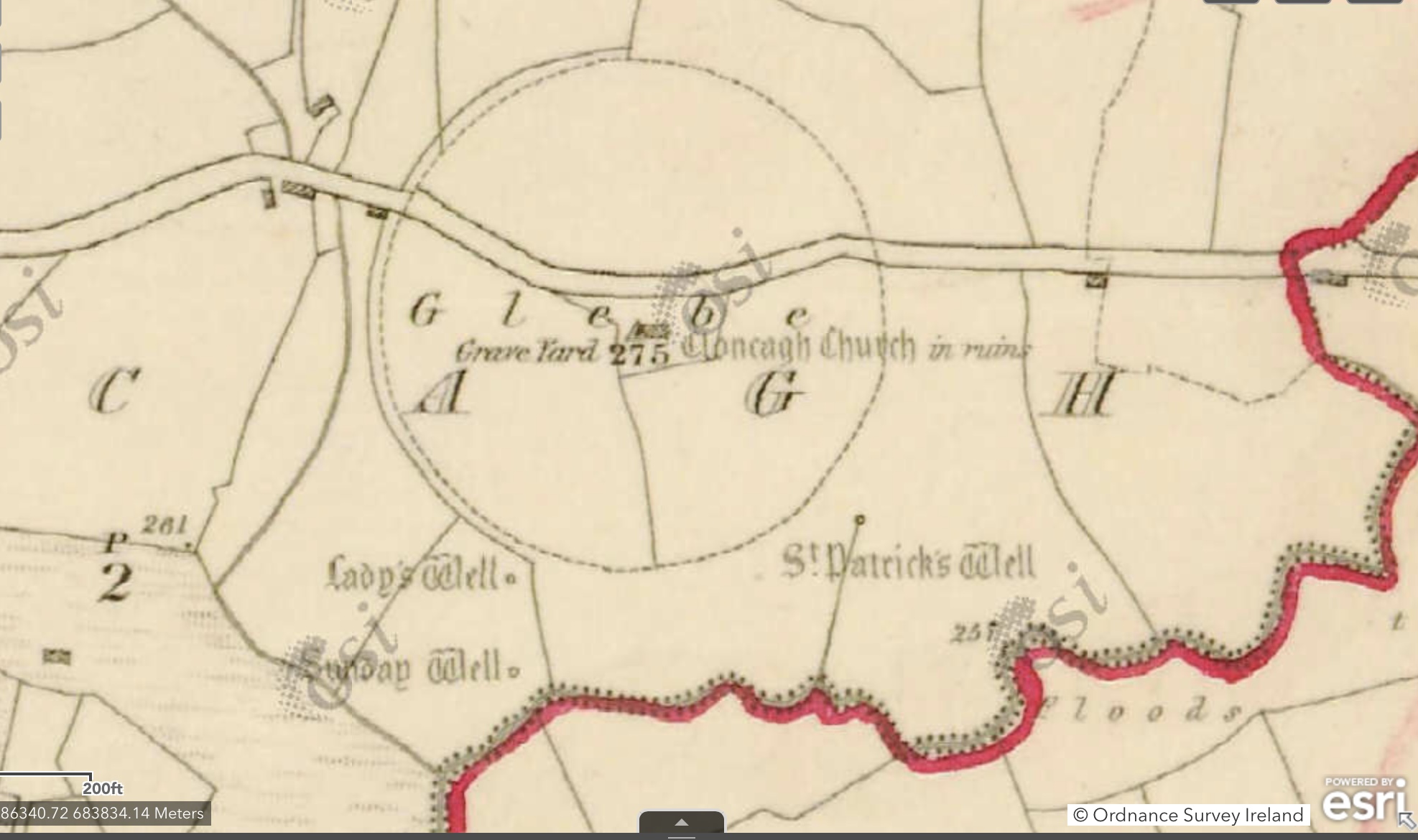
The site of the Old Graveyard and ruined church at Cloncagh, from which the area gets its name, was the site of an early monastic establishment possibly dating from the 7th – Century.  Some have credited its foundation to St. Maedoc of Ferns, who died in 624AD, while others say that he may just have been its patron.  The graveyard and ruined church is contained within a large circular enclosure, formed by an earthen bank and an exterior ditch (some of which has now been dismantled but visible in earlier OS maps).  The diameter of the enclosure is 220 metres and it encloses an area of 9.38 acres.  The church and graveyard are located centrally within the enclosure and the present day local roadway bisects it east to west. 
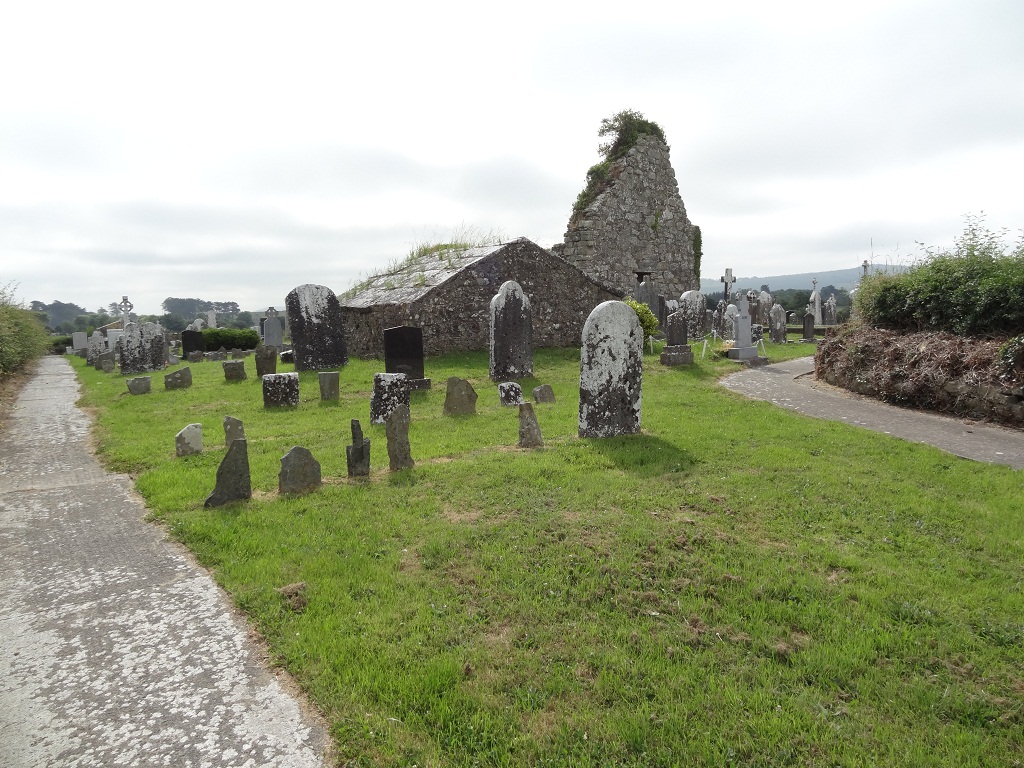
2-dsc03377
The gable of the ruined church and in the middle foreground the impressive tomb of the D’Arcy family, local landlords.

Further evidence that the site is an early monastery is provided by three holy wells recorded in the vicinity, Lady’s Well (Tubbermurry or Tobar Muire), Sundays Well (Tobar Rí an Domhnaigh), and St. Patrick’s Well.  Only St. Patrick’s Well survives.  Caoimhín Ó Danachair, the prominent Irish folklorist wrote about St. Patrick’s Well in 1955 in Holy Wells of County Limerick:

St Patrick’s Well was celebrated for curing blindness. Visited especially on 17th March. The Legend goes that while praying at Leacht Phádraig (a rock about 1000 yards from the well, associated in tradition with the saint) St Patrick saw a serpent approaching the church, and banished it by throwing his prayer-book at it. The well sprang up where the book fell. A fish is seen in the well by those whose requests are to be granted. (p. 204).

There is a record of the burning of Clouncagh church in 1326 by the Irish in their war with the Normans. There are at least two burial chambers still visible today in the graveyard – one belonging to the D’Arcy family, local landlords and the others for members of the Tierney family.
IMG_4294
The circular fort in Clouncagh showing the ruins of Cloncagh church, the graveyard and the three wells associated with St. Patrick: Lady’s Well, Sunday’s Well and St. Patrick’s Well. Detail taken from Historical Ordnance Survey Map 1840.

Usually a fort, especially one as big and imposing as the one in Clouncagh would be referred to as a ráth or a lios or a dún in Irish.  We have to wonder why this is not the case with the great fort in Clouncagh.  Indeed, within the parish there are examples of townlands with names such as Lisanisky (Lios an Uisce) or Rathfredagh, while the neighbouring parish to the north is Rathkeale (Ráth Caola).  However, Clouncagh seems to be an exception to the rule, probably because of its vast size.  In his extensive writings on the ancient churches and ring forts in County Limerick, noted Irish antiquarian, folklorist and archaeologist, T.J. Westropp M.A. M.R.I.A., mentions ‘the great fort of Dromin at Clouncagh’.  He classes it as the largest ring fort in County Limerick. This fact is interesting in itself because Limerick has 2,147 ring forts taking up approximately 317 acres. P. J. Lynch who surveyed the parish of Knockaderry – Cloncagh in 1944 as part of the Irish Tourist Association Topographical and General Survey tells us that ‘locally it is considered to have been a seat of Government in ancient times’.

The Irish version of the name Cluain Catha, seems to imply that it is named after a battle but as Donal Begley has already pointed out this is but one possible translation of the placename.   There is very little reference to be found in official sites of any significant battle and very little in local folklore although we do have the reference to the fact that the then wooden church was ‘destroyed by war’ in 1326 and was rebuilt.

The following account is found in the Schools Folklore Collection (1937 – 1939) from the Convent National School in Ballingarry. The teacher’s name is Sister Mary Treasa. In my opinion, it is a perfect example of local folklore stepping in with its own narrative in the absence of any concrete historical evidence to the contrary and there may also be some evidence of nationalism insinuating itself into the mix!

One young contributor to the Collection wrote:

Clouncagh means Cluain – Cath. The Meadow of the Battle. It derived its name from a great battle fought there in the 17th century between the Irish and the English. The Irish were successful in that Battle. The victors followed the retreating army from Clouncagh across the country to Ballinarouga. Ballinarouga means the town of the rout. It got its name from the fact that the English troops were put to flight there.

However, while this claim is at best very fanciful it is true that the townland of Ballinarouga (‘The Townland of the Rout’) lies directly to the east of the ring fort enclosure in Clouncagh, and it is also interesting to note that the townland of Gortnacrehy (‘The Field of the Plunder’) also lies directly to the south.  So even though there is no historical evidence of major battles being fought there it does seem that, going on the evidence of the local placenames alone, there were a fair few skirmishes in the area surrounding the monastic settlement in Clouncagh.  The very fact that the battle, and not the fort itself is remembered in the placename leads us to believe that like many other important monastic sites in Ireland the fort at Clouncagh may have been a great source of dispute and contention in the dim and distant past.  Is not the fact that the site was surrounded by impressive defensive ramparts but further evidence of its historic importance in the local area?

IMG_4306

As I have already discussed here the renowned scholar and antiquarian, John O’Donovan visited and surveyed the parishes of Clonelty and Cloncagh in the summer of 1840 as part of preparatory work for the 6” Ordnance Survey Map being developed at the time.  Dr O’Donovan was a noted historian and the translator of The Annals of the Four Masters, an Irish-speaking scholar and scribe, and he was the Ordnance Survey’s overall Names Expert during their survey conducted between 1824 and 1846.  It was O’Donovan’s responsibility to enter all the Irish versions of names into the Names Books, in addition to the English spelling recommended for the published maps.  In effect, his role was to standardize the translations of the Irish placenames into English and as far as the Ordnance Survey were concerned his word was law.

The vast majority of placenames in Ireland are anglicized versions of Irish language names.  In many cases this entailed adapting the original Irish names to a standardized English phonology and spelling.   Gerard Curtin in his fabulous book, Every Field Had a Name, tells us that all of the townland placenames in the parish of Knockaderry and Clouncagh were recorded between 1200 and 1655.  Curtin tells us that this is the only instance of this occurring in West Limerick and is evidence of a land well-endowed and densely populated.  So when O’Donovan surveyed the parish of Knockaderry in 1840 he found a rich vein of placenames containing often mysterious and sometimes unexplained echoes of the past.

His work on this survey was rigorous and meticulous, so much so that the Ordnance Survey of Ireland Names Books are sometimes referred to as ‘O’Donovan’s Name Books’.  O’Donovan spent July and August 1840 in West Limerick and he signed off on his work on the parish of Cloncagh and Clonelty on 25 July 1840.  He was assisted in his work in Limerick by Padraig Ó Caoimh and Antaine Ó Comhraí (Ó Maolfabhail, xvii).   Ó Maolfabhail recognises the validity and status of O’Donovan’s work when he tells us that by 1840 there were only four other counties to be completed as part of this nationwide survey and so, therefore, O’Donovan had huge experience gained already as part of his work on the survey.  This experience stood him in good stead in his attempts to standardize the translations of placenames from the Irish to the English and in trying to make sense of the etymology of the various placenames he came across (Ó Maolfabhail, xvii).

Cloncagh Ringfort
The view of the remnants of the great fort at Clouncagh as it is seen today on Google Maps

The Orthography Section of the Names Books provides the various spellings for each townland or place and the Authority Section gives the source from which these variations were derived.  This was a controversial part of the Survey, especially in the Irish-speaking areas of Ireland. Thomas Larcom, the head of the Ordnance Survey, and, John O’Donovan, had a clear policy when it came to the variant spellings and meanings of Irish place-names, which was to adopt ‘the version which came closest to the original Irish form of the name’.  O’Donovan is following on from long accepted practice the advice and ground rules laid down by such experts as his friend and fellow academic Patrick Weston Joyce who wrote the book Irish Local Names Explained which dealt with the process of anglicizing Irish placenames.  Joyce, a Limerick man from Ballyorgan, near Kilfinnane, tells us that the governing principle in anglicizing placenames from the Irish is that ‘the present forms are derived from the ancient Irish, as they were spoken, not as they were written’.   He goes on to say that there had been a long standing procedure whereby ‘those who first committed them to writing, aimed at preserving the original pronunciation, by representing it as nearly as they were able in English letters’.  In my view, the over-rigorous application of standardization by O’Donovan fails to take account of local variations of pronunciation and so, to this day, we are left with a dissonance between the spelling and the local pronunciation of Clouncagh.

O’Donovan, in his extensive travels throughout Ireland as part of this nationwide survey, would have come across many placenames with the popular prefix ‘Cluain’ and he seems to have decided that this should be universally rendered as ‘Clon’ in the accepted Anglicised translation.  We are very familiar with many of these placenames today throughout the length and breadth of Ireland: Clonmel, Clontarf, Clonlara, Clontibret, Clonmacnoise, Cloncagh, etc.  Even though his Name Books refer to ‘Clooncagh’ and ‘Cloonelty’ they would later appear as Cloncagh and Clonelty in the 6” map which was produced by the Ordnance Survey in 1843.  So, dare I say it, we have none other than the eminent John O’Donovan to blame for giving us ‘Cloncagh’ despite the mild-mannered objections of many locals to this day; especially those who continue to pronounce the placename with a ‘u’.

Referring to the origins of the placename in his Name Books, he is at pains to balance the two vying possibilities: on the one hand, he acknowledges the monastic site and the possible connection to St Maedoc, while on the other hand, he states that, ‘The name, however, is now pronounced by the natives as if written Cluain Cath, which if correct would signify Battle-Field.’ 

In his Name Books he also references numerous historical documents which mention Clouncagh and references one story which may be relevant to the origins of the placename.  He quotes from, the noted priest and academic,  Dr John Lanigan’s,  The Ecclesiastical History of Ireland, V.II, p 338:

Maidoc was remarkable for his hospitality and benevolence.  On being informed that some relatives of his were prisoners in Hy-Conall Gabhra (141) he went to that Country, although far distant from Ferns, for the purpose of delivering them and did not desist until he induced the Chieftain, otherwise very harsh on this point, to give them up.  It is added that this Chieftain was so affected by the Saint’s (p.339) conduct that he granted him a place called Cluain-Claidheach, in which he erected a Monastery (142).

In my opinion, this may go some way to explaining why Clouncagh (Clauin Catha) is an exception to the rule mentioned earlier: the fort was gifted to St. Maedoc and changed from being a fortified place to a place of worship and monastic activity as far back as the 7th century.  In a way, the fort was, in effect, a trophy of war and so retained its original name to remind people of its history. Donal Begley seems to agree with this view and he asks the question:

Could it be that Cluain Catha means a ‘trophy’ townland to remind us of a notable victory won by the fort men   against an enemy on the ‘battlefield’?

Cloncagh Ringfort (2)
A close-up view of the Old Graveyard in Clouncagh showing the semi-circular rampart to the north largely still intact. The original outline of the great fort can still be made out despite changes made by the local landowner. The old church ruin and adjoining graveyard were at the centre of the original fort.

In his beautiful book, Thirty-Two Words for Field, Manchán Magan illustrates the richness and variety which the Irish language bestows on those seemingly anonymous expanses of indistinguishable fields which surround us in our beautiful countryside.  He tells us that Cluain is ‘a meadow field between two woods’.    This suggests a fenced off or bounded meadow, and would aptly describe the fort enclosure at Clouncagh.  Today, we can but surmise as to what took place on this holy site and the significance of the placename associated with it.   It may be that it was the focus of local rivalry between warring chieftains in pre-Christian times, or indeed, as was very common in early Irish society, it may have been the location of numerous old fashioned cattle raids like the famous Cattle Raid at Cooley.  Or, as John O’Donovan suggests in another one of his references to olden manuscripts it may indeed have been gifted to St Maedoc by the local chieftain as a reward for restoring his daughter to life.  He references a story from The Life of St Maedoc:

Before the entrance of that fort the Man of God fasted for three days.  The fast being ended, the daughter of the Chief … died suddenly.  The wife of the Chief, knowing that this fact was the cause of a miracle, brought the lifeless body to St Maedoc.  And the servant of God being requested by her mother and by her attendants, resuscitated her from death.  ……. The Chief seeing this now, did penance and left his relatives liberated to St Maedoc, and offered him the place which is called Cluainchladh-bhaith (Cluain-claidhblaim) and the Holy Man erected a Monastery there, and blessing the place itself and the Chief who gave it, retired from thence.

Today as one stands at the gateway to the old cemetery in Clouncagh the semi-circular rampart to the north of the roadway is still clearly visible while the ramparts to the south have been eroded over time and removed by local farmers trying to improve their farmsteads.  Today also there is only one well in the fields to the south – St. Patrick’s Well still stands forlornly as a reminder of former glory. 

So, we can see that the confusion as to whether   Clouncagh or Cloncagh is the correct modern version of the placename is still contentious.  Our Ordnance Survey maps, our County Council, other government agencies, indeed the Diocese, all still rely on long-outdated information found in the old civil parishes documentation and so they still refer to the place as Cloncagh while the locals with their generations of lore and accepted pronunciation seem to prefer Clouncagh.  As with the etymology and orthography of other placenames in our community, such as Aughalin/Ahalin for example, local lore is often ignored and disregarded as not having sufficient authority.

In reality, I suppose, the more we delve into the blurry past the more we realise that placenames don’t correspond to a single event and are more often the accretion over time of mundane common speech which is finally calcified by someone of the calibre of John O’Donovan who stops the spinning wheel of discursive meaning and sets it in amber for future generations as he did in July 1840.  Mixed metaphors aside, I suppose, we must seek forgiveness for our desire to ascribe heroic meaning to a placename if at all possible and human nature being what it is if we can entwine some simplistic nationalism in the knot then more’s the better!

Meanwhile, the locals, including such esteemed scholars as Donal Begley continue to plough their lonely furrow and seek to have restored the only version of the placename acceptable to them: Clouncagh (Cluain Catha).  However, whatever our preferences the reality is that it is impossible to know with absolute certainty what the correct version is and that ensures that the original etymology of many of our placenames will always be up for discussion and debate.

Sources:

Bailiúchán na Scol, Imleabhar 0500, page 171

Begley, Donal. A Wayside Farm by the River: Clouncagh Remembered, Privately Published by the author.  Printed by Reads Design, Print and Display Dublin. 2015.

Begley, Donal. John O’Byrne Croke: Life and Times of a Clouncagh Scholar. Print and Design: Modern Printers, Kilkenny. 2018.

Curtin, Gerard. Every Field Had a Name – The Place-Names of West Limerick. Sliabh Luachra Historical Society, 2012.

Joyce, P. W., Irish Local Names Explained (1923).  Scholar’s Choice Edition, Creative Media Partnership, LLC, 2015.

Knockaderry Clouncagh Parish Annuals

Lanigan’s, Dr John (1758 – 1825), The Ecclesiastical History of Ireland.

Manchán Magan, Thirty-Two Words for Field: Lost Words of the Irish Landscape, Gill Books, Dublin, 2020.

Ó Danachair, Caoimhín, Holy Wells of County Limerick, in The Journal of the Royal Society of Antiquaries of Ireland, Vol. LXXXV, 1955.

Art Ó Maolfabhail, Logainmneacha na hÉireann Imleabhair: 1 Contae Luimnigh, (Baile Átha Cliath, 1990).

O’Donavan, John. Ordnance Survey Name Books

Quilty, Pat. Knockaderry Clouncagh Graveyards, a West Limerick Resources grant aided project, 2014.

Westropp, T.J., “A Survey of the Ancient Churches of the County of Limerick”, Proceedings of the Royal Irish Academy, XXV, 327 – 480.

IMG_4295
Wider view of the townland of Clouncagh taken from same 1840 map.

Study Guide to Dancing at Lughnasa by Brian Friel

brian-friel-a-tribute
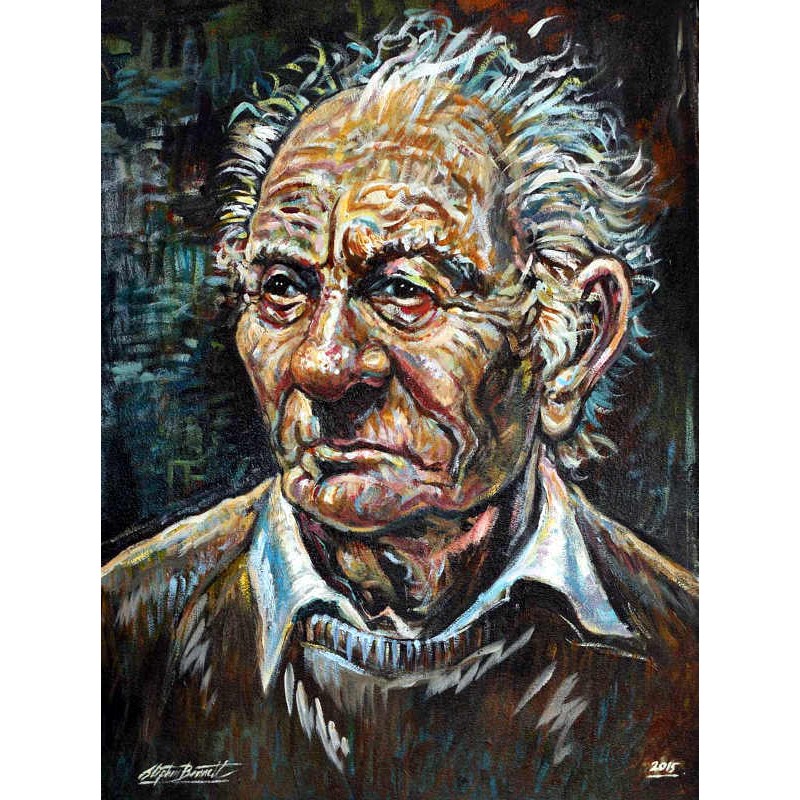
Original portrait of playwright Brian Friel by Donegal artist Stephen Bennett

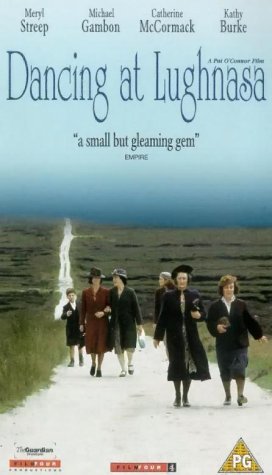
This semi-autobiographical play by Brian Friel was first performed in the Abbey Theatre in 1990.  In 1998 the play was adapted and turned into a very successful, award-winning film,  directed by Pat O’Connor.  The film competed in the Venice Film Festival of 1998. It won an Irish Film and Television Award for Best Actor in a Female Role for Brid Brennan. It was also nominated for 6 other awards, including the Irish Film and Television Award for Best Feature Film and the Best Actress Award for the American actress, Meryl Streep, who played the part of Kate.

 Like many other of Friel’s works it is set in the fictional town of Ballybeg and tells the story of a family unit being torn apart by the many strong forces in society.  It is a memory play told from the point of view of the adult Michael Evans, the narrator. He recounts the summer in his aunts’ cottage when he was seven years old. 

This play is loosely based on the lives of Friel’s mother and aunts who lived in Ardara, a small town in the Glenties area of County Donegal. Set in the summer of 1936, the play depicts the late summer days when love briefly seems possible for five of the Mundy sisters (Maggie, Chris, Agnes, Rose, and Kate) and the family welcomes home the frail elder brother, Jack, who has returned from a life as a missionary in Africa. However, as the summer ends, the family foresees the sadness and economic privations under which they will suffer and all hope seems to fade.

The play takes place in early August, around the Festival of Lughnasa, the pagan Celtic harvest festival. The play describes a bitter harvest for the Mundy sisters, a time of reaping what has been sown.

MV5BMTA3MTM0MjcwOTVeQTJeQWpwZ15BbWU3MDA0NjU3MTE@._V1_

PLOT SUMMARY

In the play, the adult narrator, Michael Evans, recalls the summer of 1936 when as a small boy of seven, he lived with his mother Chris, and his four aunts – Kate, Maggie, Agnes and Rose – in the fictional village of Ballybeg, the setting for many of Friel’s finest plays.  His uncle Jack, a missionary priest, had recently returned from Africa to live with them.  He is suffering from the after effects of malaria and some other more mysterious mental ailment that has made him forgetful and frail.

The Mundy family are not well off.  Kate, a teacher, is the only wage-earner.  Agnes and Rose make a little money knitting gloves at home, a cottage industry at the time.  Maggie and Rose look after the hens and household duties, as does Christina, Michael’s mother.

Michael’s abiding memories of that summer are of his Uncle Jack’s return to the family home, linked forever in his mind with hearing dance music on their first ever radio, and the two visits of his father, Gerry Evans.  The play depicts the complexity of the relationships of the adults around him and the changes that came over their lives in that crucial summer, against a deeply traditional and rural backdrop.

The action of the play takes place in August, (the Irish word for August is Lughnasa – the ‘Lughnasa’ of the title), traditionally a time when the pagan Celtic god of the harvest, Lugh, was commemorated and celebrated.  The play is divided into two acts, reflecting the two particular days that stand out in Michael’s memory.  He narrates the action from an adult vantage point, and is, therefore, both part of and distanced from it.  As the illegitimate son of Christina (Chris) Mundy and Gerry Evans he is both a source of joy and shame – all of the sisters have a great affection for him, but in the Ireland of the 1930s a child born to a couple who were not married was seen as a source of shame in the community.

Summary of Act 1

Act 1 depicts four of the sisters as they wait for their sister Kate to return home.  They carry out their everyday tasks – knitting, ironing, making mash for the hens – and they talk in a light-hearted way about ordinary things, a broken mirror, lipstick, the erratic behaviour of the radio that they have nicknamed Marconi, after the famous inventor.  Their relationships are affectionate, occasionally exasperated as in any family.

When Kate returns she brings news of the forthcoming Harvest Festival of Lughnasa that everyone in the town is preparing for.  The excitement of that seems to unsettle the women.  Against Kate’s better judgement they even consider going to the harvest dance, like most of their neighbours.  Another unsettling moment is when they discuss Father Jack’s strange behaviour since he came home from Uganda.  He has returned home to Ballybeg as he is suffering the after effects of malaria, but he also appears confused as to his own whereabouts.  He cannot remember ordinary English words and makes constant references to pagan rituals he seems to have practiced while in Uganda.

Michael’s father, Gerry Evans makes one of his infrequent visits to see him and his mother Christina.  Chris is still in love with him but it is clear that he, an irresponsible charmer, full of empty promises, has no intention of staying in Ballybeg with her and her son.  By the end of Act 1 we learn that Gerry intends to go to Spain to fight with the International Brigade in the Spanish Civil War.  By the end of the Act we have also learned a great deal about the lives and personalities of the five sisters and also about their brother, Father Jack.

Summary of Act 2

Act 2 takes place in early September, three weeks later.  Michael still waits for the bike his father, Gerry, has promised to buy him.  Jack continues to speak of strange pagan rites.  He seems to have no interest in Catholic rituals such as the Mass.  This is now becoming a problem for the sisters in the village, especially for Kate as the schoolteacher.

Slowly but surely events begin to unfold and we hear that she will lose her job.  Agnes and rose will also lose their jobs as home knitters, due to the opening of a knitting factory in the area.  Gerry abandons Chris again, this time forever.  Money is scarce in the household.

Michael then narrates what transpired in the following weeks.  Rose and Agnes have to leave Ballybeg and go to London to find work.  He tells us that they lose contact with the family and it is twenty-five years later when he tracks them down – Agnes is dead by then and Rose is dying in a hospital.  Father Jack, who doesn’t resume his ministry as a Catholic priest as was expected, dies of a heart attack a year after the action of the play.  Gerry Evans is wounded in Spain, but survives to form a new family in Wales.  Chris spends the rest of her life working in the knitting factory, and hates it.  Kate finally gets a job as a private tutor.

The play ends as it began, with Michael remembering what happened that summer, particularly the sights and sounds of his mother and his aunts dancing in the kitchen.

unnamed (3)
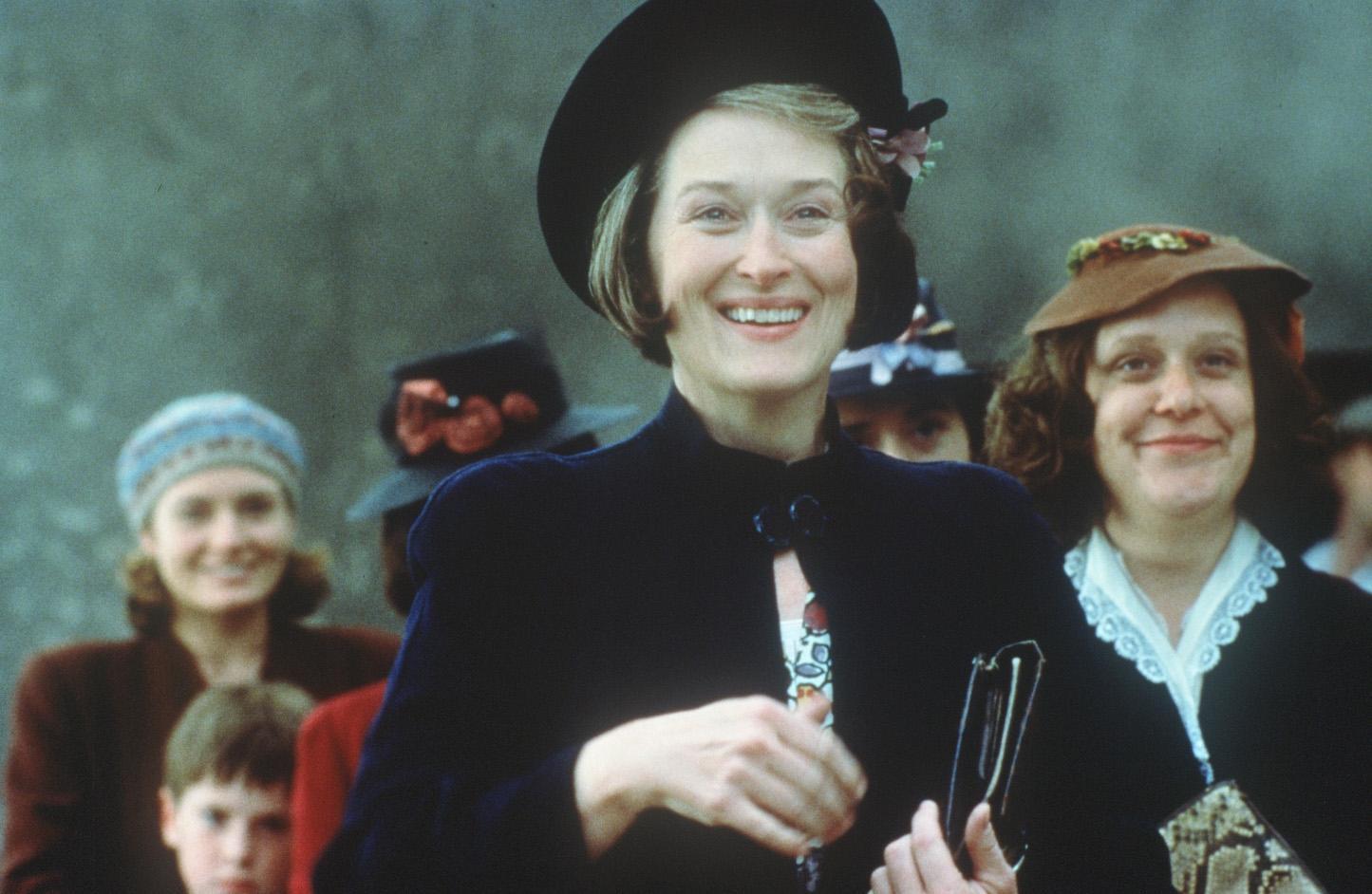
The famous ‘Gander Scene’ with Meryl Streep and young Michael

THE HISTORICAL AND POLITICAL SETTING OF THE PLAY

Dancing at Lughnasa captures a time and place where great changes are about to take place – both in the Mundy household and in the wider world where all is about to change forever with the ominous rumblings of war to be heard in many parts of Europe.  The unspoken backdrop is Ireland and its emerging Republic which at the time was dominated by very strict social morality and the repressive influence of the Catholic Church.  The play seems to suggest that this traditional rural society, dominated for so long by communal values, will be changed forever by the power of the radio. 

From a twenty-first century vantage point giving the radio a name – Marconi – seems absurd, but it highlights the point that the radio will be like another presence in the play, giving people a window to what is going on in the outside world probably for the first time.  It is interesting that the predominant political movement in Ireland in the previous quarter of a century before 1936 was that of Sinn Féin which translates as Ourselves Alone – Ireland could survive on its own, isolationism was a good thing.  Ironically, a century later and our near neighbours have stolen our ideas with their obsession with Brexit.

It is significant that the tune to which the sisters dance so wildly to at the beginning of the play is the old Irish reel, The Mason’s Apron.  Towards the end of the play, however, the tune that plays when Gerry dances with Chris and her sisters is Anything Goes, with its faintly shocking lyrics:

In olden times a glimpse of stocking

Was looked on as something shocking

Now heaven knows

Anything goes.

This may indicate that the old traditional moralities are also changing fast.

Michael, the narrator, tells us at the beginning of the play that he is remembering ‘that summer of 1936’ and the events that took place in Ballybeg.  As a boy of seven at that time, he clearly had very little understanding of the historical and political context in which he lived.  Throughout the play, however, Friel alludes to several specific events that took place in 1936 in both Ireland and Europe.

In Act 1, rose, one of the five Mundy sisters, sings,

‘Will you come to Abyssinia will you come?

Bring your own cup and saucer and a bun.

Mussolini will be there with his aeroplanes in the air

Will you come to Abyssinia will you come?

Shortly afterwards Maggie joins in with, ‘Will you vote for De Valera will you vote?’, to the same tune.  They are both referring to highly topical issues at the time: the invasion of Abyssinia by the Italian Fascist dictator, Benito Mussolini, and the success of Eamon de Valera, leader of the Fianna Fáil Party in the Irish General Election of 1933.  There was another General Election in the offing and this took place on 1 July 1937. A plebiscite on whether to approve the new Constitution of Ireland was held on the same day. This was a very significant event and it is interesting that here in Dancing at Lughnasa as in  Philadelphia Here I Come the important date to remember is 1/1/1937.  This was the day the new Irish Constitution came into effect and some critics suggest that Friel is here passing a harsh judgement on the Ireland that had emerged under that Constitution. 

Many critics and scholars also suggest that Friel is here giving a barbed rebuff to De Valera’s notorious St. Patrick’s Day radio broadcast of 1943 in which he fantasised about a rural Ireland ‘joyous with sounds of industry, the romping of sturdy children, the contests of athletic youths, the laughter of comely maidens; whose firesides would be the forums of the wisdom of serene old age’. 

Later in the play, Gerry Evans, Michael’s father, decides to join the International Brigade, a group of socialists who opposed Franco in the Spanish Civil War in 1936.  All these events point to the fact that in the world outside Ballybeg great change and upheaval is happening – the Mundy family can’t but be caught up in and affected by these great changes also.

However, the most important change, according to Friel, is the rise to power in Ireland of Eamon de Valera.  De Valera’s celebrated view of Ireland as a predominantly rural society, peopled by frugal, contented people, clearly applies to the lifestyle of the five Mundy sisters – in fact, they are the very epitome of de Valera’s vision for the new Republic: comely maidens dancing at the crossroads or in their frugal kitchens.

Limited Opportunities

The limited opportunities available to the five Mundy sisters was typical of Irish society in the 1930s.  Conversation revolves around local gossip – who’s marrying who, the forthcoming harvest festival for the Festival of Lughnasa – and family issues; Father Jack’s strange behaviour since his return from Africa; the visit of Chris’s ex-lover Gerry Evans, the father of her child.  Their activities are equally confined to looking after the hens, baking, knitting and ironing.  They are barely making ends meet.  Crucially, it is Kate who does the shopping.  Their only source of entertainment is the radio, which fails to work more often than not.

From their conversations it is clear that the society of Ballybeg is small, not only literally but also metaphorically.  Michael tells us that Ballybeg was proud of his uncle and his work in the Ugandan leprosy hospital.  The local newspaper called him ‘our own leper priest’.  As he says:

‘it gave us that little bit of status in the eyes of the parish.  And it must have helped my aunts to bear the shame my mother brought on the household by having me – as it was called then – out of wedlock.’

The Influence of the Catholic Church

Religion had an enormous influence in 1930s Ireland.  In 1932 the great Eucharistic Congress took place in Dublin and it is obvious that religion directly affects the lives of the characters in the play.  To have a priest in the family, especially a missionary priest, was considered a great honour.  It is Kate who expresses the most orthodox religious views for most of the play.  Indeed, Friel deliberately juxtaposes those views with the paganism associated with the Lughnasa festival bubbling away beneath the surface.  Early on Kate thinks it would be ‘sinful’ to give the name of the old pagan god, Lugh, to the new radio.  Any talk of the ‘pagan practices’ that take place back in the hills during the Festival of Lughnasa are not to be heard in ‘a Christian home, a Catholic home’, which for her is the ultimate ideal.  She reminds the others that ‘this is Father Jack’s home – we must never forget that – ever’.

Going to the harvest dance, as her sisters suggest, is for young people with ‘nothing in their heads but pleasure’.  In Catholic morality of the day, the idea of ‘pleasure’ was associated in a negative way with sex.  In the 1930s, attempts were made to prevent people going to what were called ‘pagan dances’.  These rigid attitudes extended to anything that might encourage personal vanity or loose behaviour and we can see from the play that the Mundy sisters have only an ‘oul cracked thing’ of a mirror to see themselves in.

Although he does not appear directly in the play (and only fleetingly in the film version), the power of the parish priest to fire Kate from her job in the village school because her priest brother does not conform to religious expectations, is another measure of the desire of the Catholic Church authorities to exert control in society. 

Friel returns to this theme many times in his plays.  In Philadelphia Here I Come! for example, religion is represented through the figure of the Canon. It is clear that he is an inept and ineffective one-dimensional character. Gar satirises his ineptitude when he comes in one evening to play his usual game of cards with S. B.,

“Sure Canon what interest have you in money? Sure as long as you get to Tenerife for five weeks every winter, what interest have you in money?”. 

In Philadelphia Here I Come!,  the Canon is seen as a very shallow man who is constantly being ridiculed by Gar Private.  He is not a pastor, he waits until, ‘the rosary’s over and the kettle’s on.’ And, in the end,  he proves to be as predictable and one-dimensional as S.B.  Indeed, both men are cruelly caricatured by Friel and the priest, in particular, is seen as a sad figure without influence or a constructive role to play in modern society.

We can also sense what a blow it must have been to the Mundy household when Chris became an unmarried mother.  De Valera and the Catholic Church at the time emphasised the role of marriage and the nuclear family – mother, father and ‘sturdy’ children – as a force for moral and political stability.  This ideal was best expressed in De Valera’s radio broadcast to the nation on St. Patrick’s Day 1943 when he said:

The ideal Ireland that we would have, the Ireland that we dreamed of, would be the home of a people who valued material wealth only as a basis for right living, of a people who, satisfied with frugal comfort, devoted their leisure to the things of the spirit – a land whose countryside would be bright with cosy homesteads, whose fields and villages would be joyous with the sounds of industry, with the romping of sturdy children, the contest of athletic youths and the laughter of happy maidens, whose firesides would be forums for the wisdom of serene old age. The home, in short, of a people living the life that God desires that men should live. With the tidings that make such an Ireland possible, St. Patrick came to our ancestors fifteen hundred years ago promising happiness here no less than happiness hereafter. It was the pursuit of such an Ireland that later made our country worthy to be called the island of saints and scholars.

It is clear from the concern of the five Mundy sisters that they too value marriage and family.  Circumstances have caused them all to be single.  Only Chris has had sexual experience.  Given their ages – from twenty-six to forty – it appears that they have lost their chances of finding suitable men to marry.  But that does not mean that all desire for romance or sexual relationships has been crushed.  In different ways, each of the women in the play reveals a longing for love that goes beyond their actual circumstances.  Chris is still very much in love with Gerry Evans, the father of her child.  His visits cause emotional havoc to all in the household but especially to Chris and her young son.  He represents for all of them a different sort of life – there are hints that Agnes too is in love with him – even if Kate sees him as a sort of threat.  In her jokes and songs such as ‘The Isle of Capri’, Maggie reveals a sentimental side to her tough exterior.  Even Rose, described as ‘simple’, has a romantic interest in Danny Bradley, a married man.  Later in the play she joins him in ‘the back hills’, although we do not find out what, if anything, happens between them.  Even Kate, who is described as ‘a very proper woman’ and more negatively as a ‘self-righteous old bitch’, has had some hopes of attracting the attentions of Austin Morgan.  However, we later learn that he goes and marries a ‘wee young thing from Carrickfad’.

Dolores Keane sings ‘Down by the Sally Gardens’ backed by the Irish Film Orchestra … and then the climactic dance of wild and free women.

The Dancing Metaphor

Throughout the play the metaphor of dancing is used to suggest romance, escape and sexual freedom.  For a short while the sisters entertain ideas of going to the harvest dance as they used to in their youth.  Kate, the authority figure in the family, makes it clear that this is out of the question, ‘do you want the whole countryside to be laughing at us? – women of our age? – mature women, dancing?’

Maggie has fond memories of going to dances with her friend Bernie O’Donnell, when she was sixteen and in love with Brian McGuinness, who later went to Australia.  The relationship between Gerry Evans and Chris is also depicted very much in terms of dancing.  And of course, the wild dance that the sisters engage in in their kitchen is a crucial moment in the play.  It allows them to get in touch with their inner selves, the sensuous side of their nature that is held in check by the dominant social attitudes of the Ireland in which they live.

Conflict in the Play

As already mentioned Friel juxtaposes in Dancing at Lughnasa the conflict between the repressive social and religious attitudes of Ireland in the 30s with an older, freer pre-Christian way of life.  This pagan way of life was one of celebration, wild dances and rituals held in the ‘back hills’ far away from the influence of the Catholic Church.  The Festival of Lughnasa traditions that Rose describes take place ‘up there in the back hills’, among people that Kate refers to as ‘savages’.  There are numerous references to Lugh, the pagan god, to voodoo, to omens of good and bad luck, to the devilish faces that Michael has painted on his kites.  Sweeney (the boy who was burnt in the festival bonfire) bears the same name as the legendary Sweeney who defied Christian authorities and was punished by being condemned to fly around like a bird for the rest of his life.

Father Jack embodies this conflict too.  His experience as a missionary in Africa has caused him to lose his sense of what is appropriate in the context of Ballybeg.  From an Irish cultural point of view, sending priests as missionaries to Africa was seen as benefitting the native Africans by teaching them and enabling them to participate in the rituals of the Catholic Church.  But Father Jack no longer appears to believe that Christian ritual is superior to the rituals he observed in ‘pagan’ Africa.  In fact, after his time spent as a missionary, he now sees Catholic rituals such as the Mass as synonymous with the sacrifice offered to ‘Obi, our Great Goddess of the Earth’.   Rather amusingly, he fails to live up to his expected role as moral judge of Gerry Evans (‘Father Jack may have something to say to Mr. Evans’ says Kate at one point).  Instead, he sees Michael as Chris’s ‘love-child’ and he asks her if she has any more ‘love-children’, and he pronounces that in Uganda ‘women are eager to have love-children’.  He even suggests that if they were in Uganda he would be able to provide at least one husband for all of his sisters, ‘That’s our system and it works very well’.

Father Jack’s view of religion now corresponds more to the goings-on at the pagan festival of Lughnasa than it does to the norms of the Catholic Ireland, ‘the island of saints and scholars’.  There is one telling statement he makes about the African people that seems to recognise the underlying truth of this.  He declares, ‘In some respects they’re not unlike us’.  It is clear, however, that his views would not be acceptable in the Ireland of the 30s to which he has returned.  This is sadly borne out by his own forced return to Ireland and the treatment meted out to his sister Kate by the local parish priest.

Change in Society

The over-riding impression we get from the play, however, is that changes are taking place, the world is sliding towards war and the old certainties are losing ground.  This is made even more evident with the return of Father Jack from Africa.  This event suggests that the domestic world of the Mundy’s faces disruption from the outside.  Father Jack brings with him from Uganda hints that Catholic ritual may not have universal appeal.  His obvious respect for native Ugandan rituals gives us a reverse view of the traditional role of the missionary priest!

Gerry Evans also brings a sense of the changing world of Ireland when he talks of giving ballroom dancing lessons, or of gramophone sales in Dublin.  When he decides to join the International Brigade in Spain, it is seen as part of a desire to experience the big bad world outside of Ireland.  There is a suggestion that Ireland’s cultural landscape is beginning to change ever so slowly.

One of the clearest indications of change takes place when Agnes and Rose can no longer make their living from home knitting, due to the opening of the new knitting factory in Donegal Town.  As the narrator says: ‘The Industrial Revolution had finally caught up with Ballybeg’.  Their subsequent emigration was typical of the large-scale emigration from Ireland that took place in the first half of the twentieth century.  As in Philadelphia Here I Come!, Ballybeg is depicted here as a backwater, a stagnant place of despair and routine.  Escape through emigration is the only safety valve.   Like many an Irish town in the late thirties, forties and fifties Ballybeg has maintained its economic stability at a terrible price, the constant exportation of human beings!  It is an example of a town that is alive because the young leave, a town that would most certainly be ruined if those same young people stayed at home en masse

Faraway hills are said to be greener but when Agnes and Rose leave they possessed little education, few skills, and in reality their opportunities in London were limited to menial cleaning jobs.  Sad though this is, the narrator nevertheless suggests that they wanted ‘to get away’, to experience change and novelty, with all their challenges and disadvantages.  Someone said once that the only people who welcome change are babies with wet nappies but there may be a positive side to change as countless numbers of Irish emigrants discovered as they made new prosperous lives for themselves in foreign lands.

nintchdbpict000001487915

Family Relationships

Family is important to the Mundy sisters.   Within the family there may be disappointment, resentment or anger, but they will always present a united and brave face to the outside world.  Kate, in particular, insists that problems with Father Jack must be kept within the family, ‘not a word of this must go outside these walls’.

It is this family solidarity that causes them to unite in the face of the shame that Chris must have brought on them as an unmarried mother in a small town, baile beag, in 1930s Ireland.  Throughout the play we see the genuine affection each of the aunts feels for Michael: Kate brings him presents, Maggie jokes with him, Rose even says, ‘I wish he was mine’.  Clearly, he has never been made to feel unloved or unwanted.  It almost seems as if any or all of them could have been his mother. 

Similarly, their love and care for Father Jack outweighs any disappointment they may have felt at his ‘disgrace’.  Kate’s surprising acceptance of his religious beliefs and her grief when he dies reveal that family feeling overcomes conventional morality.  Each of the family members watches out for ‘simple’ and vulnerable Rose, as we see when she goes missing for an afternoon with Danny Bradley.  When Kate is sacked from her teaching job, it is ‘Rosie’ she worries about most.

However, despite the obvious closeness and the obvious loneliness and lack of fulfilment that they all feel, they rarely speak about their intimate feelings.  When Kate confides to Maggie that she feels ‘it’s all going to collapse’, for instance, Maggie declines to engage with her fears and simply says, ‘Nothing is about to collapse, Kate’.

Despite this, however, the family is capable of expressing negative feelings.  Hurtful things can be said.  Kate points out rather meanly to Agnes that neither she nor Rose made much money to contribute to the upkeep of the household.  Agnes retorts that she and rose are like ‘two unpaid servants’ in the house.  At another stage Agnes calls Kate ‘a damned self-righteous bitch’.

Ironically, the Mundy family of five sisters, one brother and their young nephew would not have corresponded to De Valera’s ideal nuclear family unit consisting of father, mother and their children of the time.  Tragically, too, the family grouping will disintegrate, as Michael the narrator tells us:

  • Poverty and economic change force Agnes and Rose to emigrate to London to find work;
  • Father Jack will die within a year;
  • Chris settles for a job she hated, working in the knitting factory;
  • Gerry Evans will visit less and less, until his visits stop altogether;
  • Michael himself will leave.  As he says, ‘In the selfish way of young men I was happy to escape’.

In many ways, then, it can be said that circumstances in the end have conspired to defeat the Mundy family.

images (6)

CHARACTER ANALYSIS IN DANCING AT LUGHNASA

Kate

Kate is the mother-figure and matriarch in the Mundy household.   She is the main bread-winner, respected in the community and the leader of the Mundy sisters.  She is a very religious and puritanical woman.  She has no time for ‘pagan’ ideas and is very prim and proper.  She doesn’t agree that the radio should be given a name, and definitely not the name Lugh because of its pagan origins.  She teaches in the local Primary School and would have been seen as a pillar of the community – especially in 1930s Ireland.  She had been involved in the War of Independence and she is very firm in her Christian attitudes.

She is very concerned with the way the people in the community view her and her family.  She would prefer the Mundys to be viewed as a decent family with a strong sense of dignity and strong religious faith.  She is, therefore, embarrassed by Father Jack’s return from Africa and feels that he has brought some shame on the family following his exploits in Uganda.  She has also been disappointed and hurt when Chris became pregnant outside of marriage and she does not want people to look down on the family.  When it is suggested that the sisters go to the harvest dance she is horrified at first.  She is very concerned about keeping up appearances and showing restraint both emotionally and socially.

Despite being part of a large family, Kate feels isolated and lonely in some way.  Perhaps she feels that she has to shoulder the burden of looking after the family on her own.  When the sisters dance together she dances alone.  This highlights her loneliness and isolation as she deals with her feelings by herself.

Maggie

At first Maggie seems to be the joker of the family.  She is always ready with a song, dance or joke.  However, on closer inspection we discover why she seems to be so bubbly.  Whenever there are moments of tension, or the possibility of any conflict, Maggie intercedes with some humour to help diffuse the situation.  In this way she keeps the peace and helps keep the family together because the family bond is very important to her.  She is a very likeable character and of all the sisters she is least prone to sarcasm and attempts to hurt others.  She is also generous spirited and kind and she adores young Michael.

Behind this apparent happy façade, however, Maggie is hiding deep unhappiness.  At one point Kate describes her meeting in Ballybeg with an old friend of Maggie’s by the name of Bernie O’Donnell.  It was Bernie O’Donnell who could attract the men that Maggie couldn’t when they were young.  Bernie later left Ballybeg and made a new life for herself somewhere else.  When Maggie hears this story from Kate she is quiet for once, which is very unlike her.

It is Maggie who is the first to start dancing in the climactic scene in Act 1.  She initiates the dance because she feels angry and frustrated with her small, lonely life in Ballybeg.  As described in the text her dance is ‘defiant’ as if she is trying to show life that it can throw anything at her and she will bounce back.

She is also a tower of strength for others when they need help.  She is there for Kate when she breaks down over her fears of not being able to keep the family together.  Maggie is possibly the most emotionally strong of the Mundy sisters, and she hides her secret pain much more effectively than the others.

images (5)
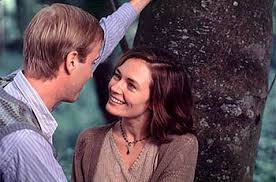
Catherine McCormack as Chris and Rhys Ifans as Gerry Evans in Dancing at Lughnasa.

Chris

Chris is a strong-willed character whose one great weakness is Gerry Evans.  She cannot help but love him despite all his false and empty promises.  Like all the Mundy sisters she fights off despair with humour and a defiant attitude.  She tries very hard not to let anything get to her.

When Gerry arrived back for the first time in over a year she tries to resist his advances by refusing to engage him in conversation.  He responds by dancing with her and she cannot resist the romance of this.  She returns to the house a changed woman, full of life and happiness, having conveniently forgotten what an unreliable rogue Gerry is.  She obviously craves romance in her life, otherwise she would not give in to Gerry in this way.  There are moments when she thinks back silently on her dance with Gerry, and it is obvious from her happy reaction that it has had a profound effect on her.

Throughout the play, however, she seems to be very jealous and suspicious of Agnes.  It becomes obvious to her that Gerry is also attracted to Agnes and visa versa, particularly after they both dance together.  This enrages Chris who probably feels deep down that Gerry loves Agnes more than he loves her.

However, her main claim to fame – or infamy – in the play is the fact that she is Michael’s mother.  He is obviously the apple of her eye and she is fiercely protective and proud of her son.  We have to remember also of course that this story is being narrated to us by her son Michael as he remembers with nostalgia the events of that momentous summer of 1936.

Agnes

Agnes is the most reserved and quiet of the five sisters, but she is also perhaps the strongest willed and the one with the greatest hidden reserves of strength.  She tends to listen when the others banter and poke fun at each other.  She is not the kind of person to start a conversation, yet despite her quiet and shy nature she is never afraid to stand up for herself or others.  She becomes quite angry when Kate refuses to use Gerry Evans’s name when referring to him.

She is the first to suggest that they could all go to the harvest dance and she is the one who makes the most emotional plea when she says she wants to dance and feel alive while dancing.  Despite being very quiet Agnes is not afraid at certain points in the play of revealing what her true emotions are.  However, normally she tends to bottle up her emotions and say very little, but when she does let go what she says is usually of great importance.  When she dances with her sisters in the famous kitchen scene she is very graceful and proud but also defiant at the same time.

Agnes is obviously very taken by Gerry Evans.  When she dances with him she is as graceful as ever and she dances like a woman who has been dancing with this man all her life.

Ultimately, Agnes is fearless despite her quiet nature.  She knows that when a crisis hits that hard decisions have to be made.  This is most obviously shown in her decision to go to London with Rose.  Of all the sisters, Agnes is the closest to Rose and she sees it as her life-long job to look after her sister.

Rose

Rose is very childish and innocent.  At that time, she would have been referred to as being ‘a bit simple’.  She is full of fun and life, but she is by no means a weak character who can be walked all over.   She has intelligence when required and like a child who wants something she knows cunning ways and means of getting it!

The other sisters are very protective of her, especially her sister Agnes.  They see her as the child of the family and it is their task to make sure she comes to no harm.  She takes a fancy to Danny Bradley, a local rascal with a bad reputation.    Despite her sisters’ insistence that she shouldn’t meet with him, rose concocts a plan to spend a day with him.  The fact that she does this shows her cunning and determination and also shows how underestimated she is, even by her own sisters.  Rose’s key character moment arrives when she defiantly stands up to Kate and is honest about her meeting with Danny Bradley.  In this moment she appears most adult-like and willing to be independent.

She has no shame, unlike Kate who is obsessed with the family’s good name and status in the community.  She is honest and pure and sees no harm in enjoying life.  She is a warm and endearing character with many childlike traits, but ultimately she is depicted as a strong, independent woman.

Brian Friel uses both Rose and Agnes to represent a generation of young Irish women (and men) who were forced by limited opportunities, poverty and economic depression top leave their small towns and villages in rural Ireland to seek work in London and elsewhere during the 1930s.

Gerry Evans

Gerry Evans is feckless, weak and irresponsible.  He is a scoundrel and a liar, but he manages to get away with it and gets by on his easy charm and a way with words.  This allows him to worm his way back into Chris’s life.  Gerry seems to be a drifter: unwilling or incapable of settling down, but later in the play we learn that he has been living a lie, and that he has another family in Wales.

Despite his flaws there is something likeable at times about Gerry.  He can get away with almost anything.  He is a child unwilling to take on real responsibility and merely puts on a show of enquiring about his son Michael’s well-being.

We also get the sense that Gerry is searching for something.  He goes off to fight in the Spanish Civil War but is not sure why he made that decision.  Gerry is also quite possibly in love with Agnes and he seems to have a problem asking after her when he is speaking to Chris.

He is a rogue who cannot be depended upon for anything.  He is a restless character with a great ability to charm all those around him with his easy words and his dancing skills.

Father Jack

Father Jack has obviously suffered deeply, both physically and mentally, as a result of his time spent as a Catholic missionary priest among the leper colonies in Uganda.  Despite his evident weaknesses and illnesses, we get a sense that he was once a great and determined man who deserved his reputation as a great missionary priest.

Father Jack is also quite unconventional.  This part of his nature is slowly revealed in the play until we get the ultimate revelation that he almost discarded his own Catholic beliefs to become one with the natives at his mission.  Unlike Kate he is tolerant of others beliefs, so much so that he took part in many tribal celebrations and rituals when he was in Uganda.  He is a very non-judgemental man who accepts everyone for what they are.

He is a good man with everyone’s best interests at heart.  He is a man of great humanity and strength and he quickly regains his physical strength after returning to his home in Ballybeg.  He is not a man who feels shame and is quite happy about how his African experiences have changed him.