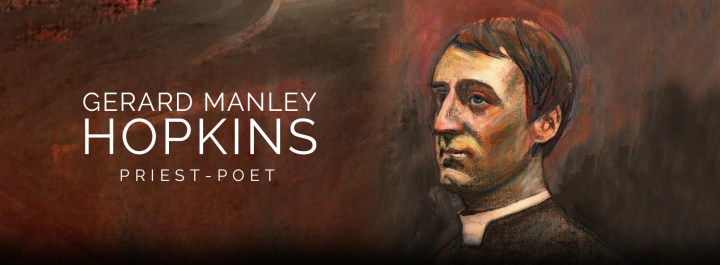
Humour me as I indulge in a little bit of poetic nostalgia! I love the poetry of Fr. Gerard Manley! As a teacher of English literature, you are always conscious of introducing poets and novelists to a younger cohort who come from many and varied backgrounds. Like Roddy Doyle in his Barrytown trilogy, you have to cut your cloth according to its measure! Father Gerrah speaks to all ages and backgrounds – but he is an acquired taste. In these horrible Trumpian days, his poetry, even his Terrible Sonnets, has given me great hope. For me, his poetry is timeless; he is a poet for all ages. The world surrounded Hopkins with visions of God’s glory, and the poet responded by capturing those moments in imagery that is both original and quite remarkable in its range. In his early poetry, Hopkins employs imagery to expose God’s glory in nature’s elements, while the later poetry gives us dramatic images of near desolation and despair.
As well as his poetry, his life story has long fascinated me. He was born in Essex in 1844, the eldest son of a prosperous middle-class family. He was educated at Highgate School and Balliol College, Oxford, where he studied Classics and began his lifelong friendship with Robert Bridges. In 1866, he converted to the Catholic Church, and two years later, he joined the Jesuit Order, having come to admire the work of the recently canonised Saint, Cardinal John Henry Newman. He was ordained a Jesuit in 1877 and served as a priest in several parishes, including slum districts in Liverpool and Glasgow. From 1882 to 1884, he taught at Stonyhurst College and in 1884, he became Classics Professor at the fledgling University College, Dublin. What fascinates me about the man and the poet is that he was hardly known as a poet, except for one or two friends, during his lifetime. He lived and died in the nineteenth century, yet his poems were not published until 1918, nearly thirty years after his death. They were published in a volume edited by his great friend, Robert Bridges.
In Roddy Doyle’s novel The Van, Darren is making valiant efforts to study Hopkins’s poetry for his Leaving Cert. He is introduced as ‘the clever one’ in the family, a teenage son who is trying to find a place to study in the kitchen, highlighting the domestic chaos of the Rabbitte household. He reads ‘Inversnaid’ and wonders when Tippex had been invented and concludes, ‘Gerrah Manley Hopkins had definitely been sniffing something.’ Unfortunately, he was also struggling to make sense of a wide range of other Gerard Manley Hopkins poems on the course, such as ‘God’s Grandeur,’ ‘Spring,’ ‘The Windhover,’ ‘Felix Randal,’ ‘I wake and feel the fell of dark,’ and Inversnaid .
In The Windhover, Hopkins uses recurring images of royalty. The high-flying solitary falcon is a monarch of the sky, surging with the poet’s spirit through the steady air. The poet uses chivalric terms such as ‘dauphin’ and ‘minion’ to capture the elegant and dignified ‘striding’ falcon, the prince of the daylight. God, too, is seen as a ‘chevalier’. These images carry connotations of medieval romance and chivalry, and perhaps the virtuous struggle of the falcon in the air is symbolic of the Christian knight, Christ the chevalier, overcoming the pervasive threat of evil. This conflict in the poem is dramatised through imagery that suggests the supremacy of the falcon in flight, and its control and mastery that ‘rebuffed the big wind’.
Another feature of Hopkins’s images here is the way in which they are loaded with possibilities. It is as if Hopkins intended to create multiple ideas in some of his images, each interesting and valid in its own way. For example, the image of the falcon on a ‘rein’ may represent the motion of a horse at the end of a trainer’s long rein. However, the term, being ambiguous, could also suggest the spiral climb of the bird. Perhaps Hopkins is encouraging us to ‘Buckle’ several ideas in our engagement with the poem. What is not in doubt, at any rate, is the powerful and original representation, through the falcon, of Christ’s beauty and nobility.
Hopkins uses a very different image in describing the precision of the falcon’s flight, where he says, ‘As a skate’s heel sweeps smooth on a bow-bend’. This image also conveys the speed of the bird’s flight. Other original images include that of ‘blue-bleak embers’ representing self-sacrifice and the ‘plough down sillion’ that evokes the hardship and perhaps tedium of daily labour.
In ‘The Windhover’, therefore, Hopkins employs images of flight, of majesty, of sacrifice and of glory ranging from a ‘dauphin’ to a ‘skate’s heel’, from a ‘fire’ to ‘blue-bleak embers’. Such remarkable and wide-ranging imagery reflects the vivid and precise response of the poet’s imagination to the sight of the falcon at dawn. More importantly, perhaps, the imagery reveals that the moment created a response of deep spiritual insight. There is nothing particularly novel in taking a falcon as subject matter. The good news for us is that this sight of a hovering falcon has, thankfully, become a common sight once again. However, what is original here is the way Hopkins engages with the falcon, observes it and concentrates on it in a deeper way and articulates what it revealed to him through an interesting range of original imagery. Let it be your own mindfulness exercise today as you ramble the rural highways and byways.
However, particularly in his The Terrible Sonnets, there is another, more disturbing effect created by Hopkins’s wide-ranging use of imagery. We know that he wrestled with doubt, particularly during his final years, which he spent teaching in Dublin and, in my opinion, these poems could have been written this January, or as we were told, schools were closing because of this bloody pandemic in March 2020! In ‘I Wake and Feel the Fell of Dark’, he states that God exists; he is always certain of that, but why does he appear to be so far away, apparently unresponsive and uncaring to a man whose letters are ‘dead’? Hopkins’s increasingly sinister images explore the bounds of human suffering and despair.
In this sonnet, the conspicuous absence of daylight reminds us how far the poet has come from the glorious sunshine and colour in Spring or ‘The Windhover’. There is little evidence of ‘couple-colour’ in ‘the black hours’ Hopkins has spent with his torment, suffering ‘yet longer light’s delay’. The delay of light represents, of course, the delay of hope – all is now ‘gall’ and ‘heartburn’. Quite remarkably, taste is evoked as a description of the poet’s state – he didn’t have Covid, so! He becomes bitterness itself, born out of his near despair. Yet perhaps this is God’s will that he suffer the ‘curse’ with which his ‘bones’ and ‘flesh’ must contend. He compares his tormented spirit to sour dough, which needs to be transformed.
In his sonnet, “No worst, there is none’, Hopkins outlines the intensity of his pain in the opening quatrain and then proceeds to seek significant comfort, but in vain. This sonnet is particularly interesting in that many of its images echo through earlier poems where the mood was less despondent. The poet’s sense of despair is emphasised in quatrain two in an unusual but particularly poignant image of his cries heaving ‘herds-long’, gathering at the gate of heaven, perhaps, but not being admitted or even acknowledged. Where is the comfort that Hopkins himself had administered to Felix Randal? The poet then refers to an ‘age-old anvil’, a sounding board which winces and rings out his pain. This very original image of the anvil reminds us again of Felix and his work in the forge, except on this occasion, the poet is the raw material that Christ is beating into shape.
In the sestet, the poet refers to a natural landscape, the mountains. In earlier poems, ‘wilderness’ filled him with joy. Here, however, the steep cliffs, a nightmarish metaphor, represent the spiritual torment and physical suffering that the poet has had to endure, day in, day out. The only comfort is the relief of sleep. But in ‘I wake and feel the fell of dark’, the poet awakens to the oppressive darkness of night and yearns for the respite of daylight. The dark night is itself symbolic of dark periods in the poet’s life when hope of spiritual ecstasy may have seemed very distant.
In Hopkins’s poetry, therefore, the range of imagery is certainly quite extensive, his originality unquestioned. Imagery ignites the poet’s celebration, and it ignites his desolation. In his own unique Trumpian-like darkness, there is no flash of colour, of light, no ’dapple-dawn-drawn’ inspiration to lift his thoughts, no sparks, no flashes, no gold in his oval office. In 1889, only weeks before his death, Hopkins wrote ‘Thou art indeed just, Lord’. In the poem, images of fertility in nature abound: building, breeding, waking, growing. Yet, the concluding appeal, expressed again through a vivid and most appropriate image, is that as Spring renews nature, so God may send his ‘roots rain’. And as my mother always said, where there’s life, there’s hope! Hopkins himself would probably have said, where there’s prayer, there’s hope. So, as I’ve said somewhere else, even the so-called Terrible Sonnets are that terrible after all!
At the end of The Van, Darren is doing well in school and is a success, in contrast to his father, Jimmy Sr., who has been laid off again and is struggling financially. Darren, who is still ‘doing very well in school’, expresses regret for his remark that ‘the State’ and not his father has put the dinner on the table, suggesting a deeper understanding of his father’s situation and a desire for reconciliation.
For that flash of empathy and compassion alone, we surely have to thank ‘Gerrah Manley Hopkins’!
English must be a nearly impossible language to learn – but then again, maybe this applies to all languages. We’ve all heard of the phrases, “It was all Greek to me” or even, “It was all double Dutch”. However, in my opinion, nowhere is this more apparent than in Ireland, where, as Bing Crosby used to croon, “They speak a language the strangers do not know”. I suppose there is a good reason we call language our “mother tongue”. My mother-in-law, Lord rest her, had hundreds of phrases and words I hear very rarely nowadays. I find myself explaining some of them with the words, “as my mother-in-law always used to say”.
These phrases were used over and over; so, I suppose I shouldn’t be surprised that many of my wife’s sayings also defy explanation. For example, if I were getting notions above my station, she would tell me that I was “like the gander that got up on the ditch to die”! If you argued with this unfair assessment of your character, she’d say that I was ‘sailing very close to the wind’ and if it was Winter, she’d tell me that ‘I was skating on very thin ice’!
According to her mother, a harsh wind would “skin you,” while a critical person had “a tongue like a lash”. Someone inclined to give out was likely, “to ate you without salt’. If she said someone had “a lack in him”, in her lexicon it meant that he had no common sense or empathy – maybe he was, “a bit simple”. If there was a big crowd at the card game in the local hall she’d tell us “They were there from the lighthouse”.
Of someone who had changed beyond recognition, she would say she “wouldn’t know him, or the sky over him” because she hadn’t seen him in “donkey’s years”. If someone was cunning, he probably “knew more than his prayers”. She rarely, if ever, swore, but invoked “Jesus, Mary, and Joseph” regularly, on the grounds that it was a prayer. I believed that one for years! Reference to prayer also occurred when someone was annoying, “I said prayers for that fella, I can tell you.” It meant the opposite, naturally!
Someone who was mean, was “tight”, he would “mind mice at crossroads”. A mean person “wouldn’t give you the steam off his piss”. A disputatious person would be capable of “making trouble in heaven”, or if cranky of, “fighting with his fingernails” or being “as cross as a bag of cats” – in truth, “he’d bate the Maker” and anyway he was “a horrible disciple” and “he’d break your melt”. Skinny people were as “thin as a rake”, whereas a heavy person was “gone out of the way altogether”, sure he was “a big falbo” or a “big, awkward fostook of a fellow”.
When she made too much food, she would muse that she had made enough “to feed a thrashing”. I think that phrase came from the custom of neighbours getting together to help one another, to ‘comhar’ (from the Irish word cabhair, meaning to help) to save oats or barley, with the original expression being “threshing”. This gathering of close neighbours was also referred to by her as “a meitheal”. Indeed, many of her finest gems were left-overs from a bygone age where Gaelic was the spoken language – until that was beaten out of us and made to seem very vulgar and unfashionable in the nineteenth century. Sure, maybe that was all “pure baloney”!
Breda O’Brien, writing in The Irish Times some time ago, said her mother couldn’t put a sentence together in Irish, but something that was a mess was “trína chéile”, and a stupid man was “an amadán” or a “right bacach”, and a silly woman was still “an óinseach”, and of course, just as she always pointed out, delph invariably smashed into “smidiríní”. Ah, but she was in the ha’penny place compared to my mother-in-law, Breda from Monegea, who told me one Christmas that she was, “as full as a tick” – an old word for a mattress filled with duck feathers! No one could ever accuse her of being shy or introverted; she had a huge heart and fierce, unflinching loyalty to her family and friends. It is not just their wonderfully expressive words that I miss, and not just long-gone Christmas memories that make me want to shed a tear.
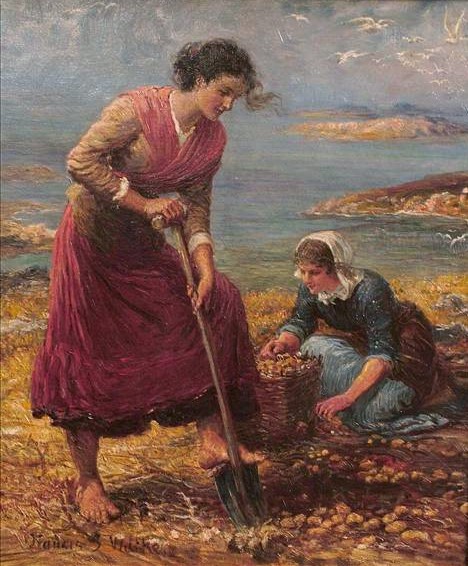
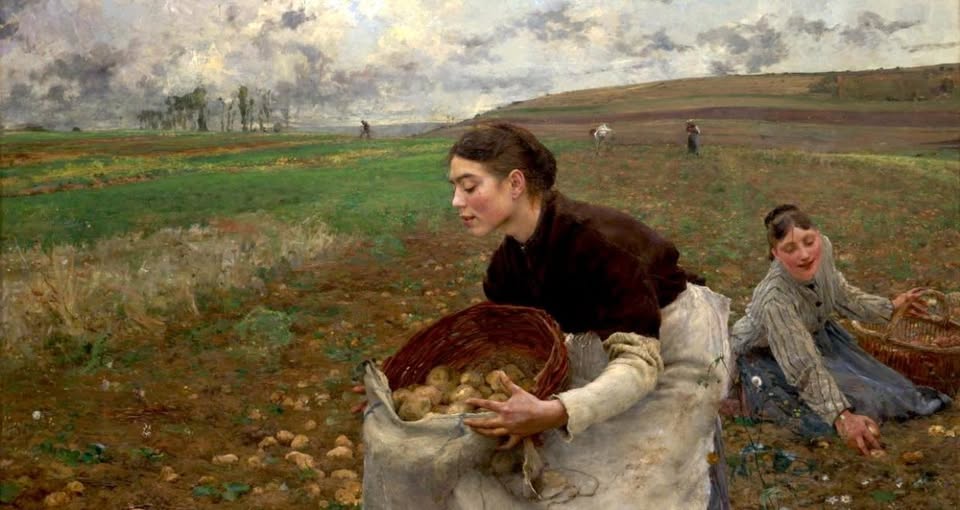
So, if by chance, in the near future, you visit Ireland, you can be assured that there are still strong women, “in the uplands digging praties, speaking a language the strangers do not know”!
October (also known as Saison d’Octobre or Potato Gatherers) by French naturalist artist Jules Bastien-Lepage.
The huge differences between Democrats and Republicans!
I was never that good at Maths, and I’m so old that my Maths education consisted mainly of Geometry, Algebra and Trigonometry! Some of my teachers may even have been Greek; at least it was all Greek to me! However, if I were to represent where I stand politically, I’d probably use the more modern Venn Diagram. One bubble would represent the constituency covered by Christian Democrats, while the other bubble would represent the area covered by Social Democratic thought and policy. The oval intersection in the centre of this diagram is where I have stood politically since the ‘70s.
Firstly, two stories from the past. The first one I heard from my mother and her sister, my Aunty Meg. One evening in the Spring of 1932, shortly after Fianna Fáil had come to power, and a mere nine years since the end of the bitter Civil War, they were both on their way home from their National School in Glenroe. As they were passing a local farmer on the road, they shouted out, ‘Up Dev!’ which was the great political slogan of the day, following Eamonn De Valera’s victory in the General Election which had just taken place on March 9th that year. However, the following morning, both were brought before the class, and Aunty Meg was beaten about the head by her teacher, so that she was rendered profoundly deaf for the rest of her life. When their father, my Grandad, found this out, he went immediately to the school, withdrew his two youngest daughters and transferred them both to the convent school in Kilfinnane, five miles away, where they completed their education.
I also have a clear memory of the General Election in 1957. I remember my Grandad waiting patiently outside our home in Rapala, in the March sunshine, to be collected by local members of the Fianna Fáil political party who would take him to the Polling Booth in nearby Glenroe so that he could cast his vote in the General Election. I, even as a five-year-old, could sense how important this was to him. He was dressed in his best Sunday outfit, his flat cap, waistcoat and jacket, his trusty pipe, and his walking stick, ready for road! This was a regular occurrence in the ‘50s, and even in the ‘60s, when there were few cars, and the local activists of all political hues, who had cars, did everything in their power to maximise the vote! De Valera and Grandad’s beloved Fianna Fáil won the election, and so Grandad was very happy with that result.
So, my family would always have been traditionally staunch Fianna Fáil supporters, a support that had its origins in the horrible Civil War from whose ashes arose our fledgling Republic in 1923, the year my mother was born in Glenroe. However, since I became politically aware, I have always been drawn to the policies of Fine Gael, especially having read, while at University, Declan Costello’s Just Society document, which he had produced in the mid-60s.
Later, Garret FitzGerald’s Constitutional Crusade received my full support, and even though he never did seem to be cut out for the rough and tumble of Irish politics, I agreed with his liberal views and philosophy and the need to accelerate the separation of Church and State for once and for all. Following decades of deep conservatism at the top echelons of Irish life, FitzGerald in the ‘80s embarked on a bold odyssey to modernise and liberalise not only his own party but the country at large. However, his often-futile efforts, despite his Economics background, to fix the economic depression of the ‘80s met with less success, and, I suppose, thereby lies the enigma of a political visionary. In more modern times, visionary leaders of all political hues in Irish politics are in short supply.
One of my go-to commentators on Irish life since I began reading The Irish Times in the ‘70s, Fintan O’Toole, has recently stated that he believes Irish society is now firmly socially democratic. The big cultural shift was the breaking of the hegemony that had dominated the State – the tight alliance of Fianna Fáil and the Catholic Church. Demographically, Ireland is experiencing a very rapid catch-up after the long depredations of famine and mass emigration. Socially, the population has become both urbanised and highly educated. Added to this, the huge growth of the private sector economy has created an undeniable imperative for a greatly expanded State to provide infrastructure, housing, healthcare and education.
What we have, then, is a very broad consensus on the need for classic social democratic policies. Most people want to see an active State that builds houses, creates equal access to health and education, works to eliminate poverty and supports both those who need care and those (mostly women) who provide it. For this reason, I believe, Fine Gael, the political party that I have given my support to, is under serious threat today both at home and in Europe. This can be seen better in the European context, where they are aligned with the main Christian Democrat alliance in the European Parliament, the European People’s Party. Herein lies the threat: most Christian Democratic parties in Europe, to counter the threat from the far right, are themselves moving to the right in their pronouncements and their policies, especially on issues like immigration. These parties are being outflanked by the far right, and so, the middle ground is shifting to the right. Fine Gael is still considered a conservative party in Ireland, but in Europe, their associates are coming to view them as more Social Democrat than Christian Democrat – the centre cannot hold!
Politics has become very confusing in my lifetime. If I had a vote in American elections, my gut instinct would always have been to vote Democrat – yet today Democrats espouse many policies I find objectionable, such as being pro-abortion. Republicans, on the other hand, are pro-life, and so, God forbid, should I vote for Trump? If I were a British voter, I would find it easy not to vote for the Conservatives because of their extreme right-wing self-serving tendencies, but then I can’t warm to Keir Starmer and his version of the modern Labour Party either. Maybe we should do what we do in Ireland and ignore Left and Right, Conservative and Liberal, Republican and Democrat and simply have a Civil War and for the next 100 years vote for those on our particular side of that conflict!
Ironically, in this day and age, Democrats of every hue pay mealy-mouthed lip service to democracy. In Europe, we have built an immovable, stubborn and unwieldy bureaucracy in Brussels, and there is a perceptible democratic deficit. Decisions are made by consensus and take forever. Parallel to this, we have a pipeline of edicts and policies and over-regulation being handed down and implemented unquestioningly by local ‘sovereign’ parliaments in 30 member states. The stark reality is that despite its great wealth, Europe as an entity is weak and irrelevant, paralysed by conflicting national interests, when compared to the big players, Trump, Putin and Xi Jinping. Even when it comes to its own security, the EU struggles to be a central player.
Westminster, the Mother of Parliaments, gave us the concept that those who sat to the right of the Speaker were the Government and those who sat to the left of the Speaker were in Opposition. Yet today, the idea of robust parliamentary debate has almost vanished in our Houses of Parliament. Consensus politics is everywhere. For example, it was almost impossible to find an opposition voice in our Dáil to any of the recently proposed amendments to our Constitution. And in the recent Presidential Election, a pro-life candidate seeking a nomination failed to find the required 20 Seanad members to ratify her nomination, while our main political party, after much skulduggery, chose a non-party candidate to disastrous effect, thus undermining the office of President. Is it that all political parties agree because of the obvious virtue of the various proposals, or is it that the quality of those seeking nomination is so poor? Is their silence because of fear of being ridiculed and mocked because they are out of step? The question I ask is, who represents me? How come the people whom I voted for refuse to represent my position? Who speaks up for those who oppose these proposed measures?
My greatest dystopian fear is that there is a kind of elite consensus at work in our world and that, in effect, the lauded ideal of democracy is, in fact, long dead. This ‘elite consensus’ is agreed upon in such shady places as the World Economic Summit in Davos and other elite gatherings where the agenda is agreed upon and handed down to governments to implement. In recent years, it has been quite unnerving and unsettling to see our Taoisigh and Finance Ministers strutting in these undemocratic assemblies, cheek to jowl with billionaires, oligarchs and moguls of one hue or another. In my opinion, our political leaders have no place at such gatherings.
Lately, our government has increasingly hidden behind the very undemocratic Citizens’ Assemblies. These assemblies are meant to inform the government about proposed new legislation or other controversial issues. Nobody knows how these Assemblies are put together, or how their numbers are decided, yet our government continues to give them huge prominence in the determination of policy and legislation. If controversial decisions are arrived at, the government can wring their hands in phoney despair and claim that this, after all, must be what the people want and, thereby, distance themselves from any culpability.
The NGO Merry-go-round
Government-funded NGOs distort lobbying. In recent times in this country, we have had the ludicrous situation where the government have relied on, and paid, the National Women’s Council of Ireland to campaign for the removal of wording which refers to ‘women’, ‘mothers’, ‘marriage’, and ‘home’ from our Constitution – these terms are now considered old fashioned, gender-specific, and possibly offensive to some! These amendments were, in the main, poorly drafted and poorly thought through in terms of their future legal consequences and broader implications. Yet, this is how cosy consensus works: proposals are put to the people, who are generally disinterested and uninformed, and the government hopes that a low turnout will see the amendments carried. This surely is a travesty of democracy. I say this mainly because, in recent years, I find myself on the losing side in all these battles, similar to my unlimited heartbreak while following the Limerick hurlers until they began winning All-Irelands again in 2018!
The old concept of majority rule is now defunct. We are everywhere surrounded by vocal minorities, and the silent majority is being manipulated furtively, dangerously and relentlessly by social media and mainstream media, which has lost all vestiges of independence and objectivity. Newspapers and television stations have almost all been bought up by billionaire moguls and oligarchs for their nefarious ends. We are surrounded by a multiplicity of influencers whose sole objective is self-interest and self-promotion.
I remember back in 1984, the year our daughter Mary was born, thinking to myself that things weren’t that bad after all. Orwell’s chilling novel, 1984, had come and gone, and his dystopian predictions had been well off the mark. Of course, I was wrong. I remember again waking on November 8th 2016, to the news that Donald Trump was almost certainly going to be elected the 45th President of the United States of America. I had followed the seemingly interminable election campaign and had been amazed by his distortions, lies, deliberate misinformation and fake news, and now this buffoon, this bankrupt, had his finger on the levers of power in the most powerful country in our world. For me, the insanity, the instability began that day and has since spread like a pandemic to infect politics worldwide.
There is unfinished business here in Ireland, also. In the coming years, the country will have to face up to the challenge of reunification and try, in a peaceful way, to right the wrongs of the past. Seeking consensus won’t cut the mustard, and wise and strong leadership will be needed to bridge the gap to a new and better future for all on our beloved island. In truth, we have come a long way since the days of ‘Ourselves Alone’. We are now an outward-looking nation, and, despite its many perceived shortcomings, Europe has been good for us. Yet, the very notion of a Border Poll has been kicked down the road by even the most rabid Republican parties for fear it will offend some group or other. If a week is a long time in politics, then one hundred years is an eternity.
It is very hard to have to say that our present government, and its political administration, are in deep paralysis and stasis since it came to power over a year ago. For years, on the global stage, we have resembled a recalcitrant college student who wants to experience the college atmosphere but prefers to spend his time in The Stables and The Scholars Club, even The Terrace, without ever going to a lecture or meeting the least onerous deadline. We haven’t met a deadline, set by ourselves or Europe, in years, and we are paralysed by regulations which we have agreed to when we try to respond to any crisis, notably housing for our young people or the climate emergency. Added to this, the cosy consensus of ‘a rotating Taoiseach’ is not working, and my favoured political party has not chosen its leaders well in recent years. Too many talented politicians are simply biding their time until lucrative opportunities arise at some global think tank, bank or other.
For most of my lifetime, I have admired from afar the United States of America and the United Kingdom. I have long been assured and comforted by their perceived role as leaders and policemen of the free world and their reliance on ‘a rules-based world order’ of multilateral organisations, such as the UN and the International Criminal Court. It saddens me to have to admit that their stature in my eyes has been diminished and shattered by their actions and inactions in this 21st century. Being complicit in genocide is the least of their crimes.
The bottom line is that a whole range of sacrosanct core principles are being tampered with – even decimated: our democracy, our sovereignty, and our neutrality. America has gone rogue, and the checks and balances have been cast aside. Where is Congress? Where are the lawmakers and law upholders of the great American Senate? And what of the Stock Markets, that supposedly great regulator and our ultimate wind vane of economic insanity? Why are they not freaking out at developing events? What has their reaction been to all this upheaval and instability? There is a feeding frenzy ongoing, and all are gorging themselves at Trump’s Trough.
How easily all these safeguards have been cast aside by those who are putting personal aggrandisement before the common good. Government-backed armed militias roam the streets of American cities, shooting dead American housewives collecting their kids from kindergarten. To quote W.B Yeats, in The Second Coming, a prescient poem for our time also,
…. Things fall apart; the centre cannot hold;
Mere anarchy is loosed upon the world,
The blood-dimmed tide is loosed, and everywhere
The ceremony of innocence is drowned ….
Social anarchy and massive destruction are made worse by the collapse of moral values among the leaders of nations: ‘The best lack all conviction, while the worst / Are full of passionate intensity’. Back in 1919, Yeats predicted that evil would triumph in the public sphere because those political leaders who might be expected to defend humane values (and basic human rights) lack the determination to resist those who preach violence and intolerance.
It is undisputed that all wars and all politics are, in fact, local. Sometimes our political leaders forget this universal truth to their cost. Like Patrick Kavanagh in his beautiful sonnet, Epic, ‘Gods make their own importance’ and the boundary dispute between the Duffys and the McCabes and their ‘pitchfork-armed claims’ is as important as any other conflict making headlines in the morning papers. My advice to those who purport to represent me is to get out of their ivory towers and retrieve the better parts of what we used to call in Ireland ‘parish pump politics’, namely listening to the people who voted them into their positions of power in the first place and to forcibly represent those views on the floor of the Dáil.
Finally, despite my pessimism and present disillusionment with politics and politicians, it is a source of great pride to me that, down the years, at least three of the brave politicians, and one brave Minister, who have regularly called to my door seeking my vote have, at one time, sat before me in class!
I’ve always been fascinated by books, although I wouldn’t consider myself a good reader. I’m definitely not a consistent reader, and my iPad constantly berates me for not meeting my daily targets.
When Kate and I began to settle into our new home in Knockaderry, we gradually undertook a series of necessary improvements. The house was a mess, and we often said that there was so much wrong with it that it was no wonder no one else wanted to buy it! In time, we added two bedrooms and a new bathroom, and we converted what had been the second bedroom in the old house into a study. The study soon filled up with books; many were prescribed texts from school.
One of our early purchases was Encyclopaedia Britannica, and we used it as a piece of furniture and a kind of 1980s status symbol for the sitting room rather than as a reference library. It’s still there on the top shelf, out of reach and neglected! This was later added to with the acquisition of World Book Encyclopaedia and Childcraft. When the kids were young, one of Kate’s many jobs outside the home was as an agent for World Book. In my hazy recollection, both sets were very rarely referred to and have remained for years untouched by human hand. They were nearly as neglected as the copy of The Jerusalem Bible, which I purchased in 1982!
My study is my favourite room in our home – book-lined and snug with its one window looking out upon wind-ravaged, leggy Lawson Cypress. One of my secret joys was seeing Don begin to assemble an alternative library and reading list of epic proportions. And, today, pride of place goes to the remnants of Don’s library, who is a far more serious reader than I am. His adolescent infatuation with Hemingway is still well represented, as are other examples of his voracious and enquiring mind.
I had earlier figured out when I came to stay with my Aunty Meg in September 1977 that the way to find out what was best to read was to locate a great reader and follow in his or her footsteps and Meg fulfilled that role for me and, of course I quickly realised that there are surprisingly very few great readers – they are in fact as rare as giant pandas!
I think I have mentioned earlier that my love of books began in earnest in Fifth Class in Primary school in Glenroe. It was a great honour for me to have been appointed school librarian, and the school library, even though it consisted of a single pine press in the corner of the room, was magical. What mattered was that the press was new and the books were new and had that glorious, magical new-book smell. I felt I had to lead by example, so my first two books borrowed – and read – were Old Celtic Romances by P.W. Joyce and Ben-Hur by Lew Wallace (first published in 1880!). In that pre-television age, I was also fascinated by comics that recounted the exploits of Roy of the Rovers and other daredevil heroes. Looking back now, there was much racist content in those black-and-white comics. The anti-German content in the war stories was criminal, and I began to put a rudimentary German vocabulary together. Words like Achtung! Achtung!, Himmel, etc., were common as the Germans were always defeated and butchered from machine gun nests in the hills. American comics were no less racist, and the indigenous Red Indian population were depicted as savage, uneducated, and primitive in their treatment of the swashbuckling cowboys and their women and children. Those comics were like gold dust, and we swapped them continuously with our friends.
Shortly after this, I graduated to novels, and I remember reading hundreds of Biggles books, novels written by Capt. W. E. Johns, who told of the wartime exploits of Biggles flying mission after mission with his beloved Royal Air Force. Biggles had an unusually lengthy career, flying a number of aircraft representative of the history of British military aviation, from Sopwith Camels during the First World War, Hawker Hurricanes and Supermarine Spitfires in the Second World War, right up to the Hawker Hunter jet fighter in a post-World War II adventure. Enid Blyton was also very popular, and I didn’t consider it beneath me to read her Famous Five books or her Secret Seven stories of adventure and mystery in merry old middle-class England of the ‘50s.
My reading in secondary school was largely determined by prescribed texts, and generally those were dreadful, musty, and dusty, and they relied almost totally on the ancient English classics. Most of the poets were dead, and all the prose writers were long gone to their stuffy library in the sky. University wasn’t much better: in UCC it was Beowulf, Sir Gawain, Chaucer, Spencer, Shakespeare, Donne. Yeats and Kavanagh were mentioned in passing, and we were lucky in the 70s to have a few rebels like John Montague to counterbalance the primness and the staidness of Professor Seán Lucy and Sr. Una Nelly. As far as I could see, UCC and its English Department were firmly rooted in the past. The notion was prevalent then that all good literature was in the past, so we had to find Hemingway, Steinbeck, Salinger, McGahern, Daniel Corkery, Séan Ó Faoláin, Liam O’Flaherty, and Joyce for ourselves! I believe the twentieth century began in UCC around 1980!
Ironically, when I got my first teaching job at St. Ita’s Secondary School in Newcastle West, the school was located in an old Carnegie Library – one of the myriad such libraries dotted throughout West Limerick. So, I taught in ‘The Library’ for 15 years and enjoyed every single minute of it. Needless to say, there wasn’t much spare time for reading, but I tried valiantly to keep up with my main mentor at the time, my Aunty Meg. I stayed with Meg, Jack, Mary and Pat for the two years 1977 and ‘78. She treated me like her fifth son, much to my own mother’s chagrin! She gave me four precious gifts. She instructed me in the intricacies of 45, that distinctly Irish card game; she challenged me regularly to improve my Scrabble skills; she introduced me to the delights of 16-ounce bags of Cherry Brandy flavoured pipe tobacco from America; and she provided me with an endless supply of American blockbuster novels which she picked up on her frequent visits to New York where she went to visit her son, Michael.
Under her mentorship, I read Leon Uris when no one else had heard of him. I was the second person in Knockaderry to read all those bestselling novels, like Exodus, Mila 18, Battle Cry, Topaz, and Armageddon. We also took great interest when he ventured into Irish politics with his novel Trinity (1976) and its sequel Redemption (1995). As a wedding present in 1979, she presented me with Robert Ludlum’s The Matarese Circle, and during the ‘80s, each time she visited Mike, she brought me back the latest of the Bourne trilogy: The Bourne Identity (1980), The Bourne Supremacy (1986) and The Bourne Ultimatum (1990). Twenty years later, Matt Damon made Jason Bourne famous on the big screen, and I was able to say that Meg and I knew every twist and turn of those convoluted plots. She also introduced me to Mario Puzo’s The Godfather, Fools Die and The Sicilian. She also loved the novels of former Champion Jockey, Dick Francis, whose novels were set in the murky underworld that was horse racing, which was centred in and around Newmarket.
I must say that the greatest development in my career as an English teacher was the introduction of the new Leaving Cert English syllabus around 2000. It breathed new life into a language subject that, up to then, was nearly as dead and moribund as Latin. Suddenly, the subject came to life. Now students were studying modern, living writers, and because of the emergence of Irish writing, many of the novels and plays were by Irish writers like Donal Ryan, Sebastian Barry, Joseph O’Connor, Claire Keegan, Emma Donoghue, Brian Friel and John B. Keane. It was a pleasure to teach poetry, which was relevant and vibrant and Irish: poets like Heaney, Mahon, Longley, Kavanagh, Yeats, Boland, Paula Meehan, and Montague were studied avidly.
Here, I have to mention my own favourite book of all time. That accolade goes to Reading in the Dark by Seamus Deane – definitely the best book never to win The Booker! This incredibly well-crafted novel is set in Derry over 16 years, from 1945 to 1961. The book presents a child’s view of the tensions in the city during that time. Throughout the book, we are reminded of the conflict that surrounds the narrator. As a teacher, I got great satisfaction in revealing and solving the mystery and compiling the jigsaw with my many Leaving Cert students when it made its way onto the Higher Level English syllabus in the early 2000s. Deane parallels the personal story at the heart of the novel with the political developments that are taking place in his native Derry. The secrets and mistaken beliefs that divide a family are symbolic of the secrets and divisions that divide a whole people. The author is not a detached observer: the gap between Seamus Deane and the narrator is so narrow as to be almost indistinguishable. The reader is invited to sympathise with the boy in the unique position he finds himself in. I would encourage you, if you can find a copy, to put it on your reading list – you will then be expected to do your fair share of ‘reading in the dark’ also!
Today, when I travel to Glenroe or Sandymount or beyond, I always have with me in my Roy Cropper black bag my myriad pills and potions and an ever-changing selection of my favourite writers and poets. In the black bag at present, I have Seamus Heaney’s 100 Poems, which was a treasured gift from my daughter Mary, Hartnett’s Collected Poems, and his beautiful 1987 collection, A Necklace ofWrens, along with Michael Dooley’s In Spring We Turned to Water, and Dean Browne’s amazing first collection, After Party.
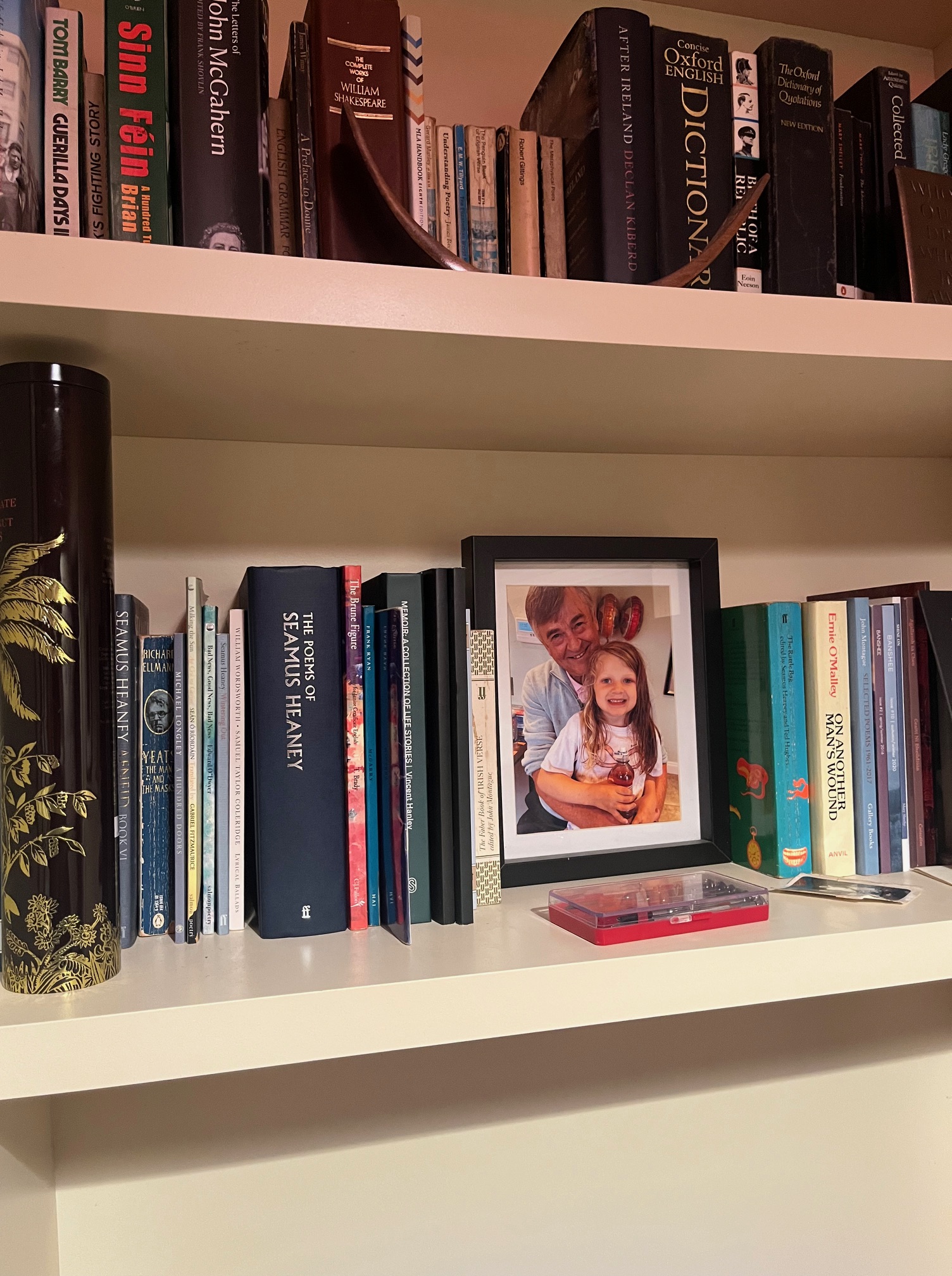
Reading allows you to borrow someone else’s brain and have a conversation with the most consequential minds in history. However, it’s a learned skill and requires discipline, and you have to set aside time for it. Keep your phone in another room. Always carry a book with you and steal 5-10 minute intervals when you can and avoid audiobooks like the plague! Nothing beats having an actual book in your hands – Kindle, the iPad and other virtual books don’t really count – except in emergencies. Keep as many physical copies (trophies) surrounding you as possible, especially if they are as beautifully produced as Faber and Faber and Picador books. (Faber has done much to make Claire Keegan’s novellas collector’s items; they are so exquisitely produced). The aim is to gradually amass a treasured library over time. These aren’t just books, but tangible links to the very best of literature, history and culture, offering the reader authentic sources beyond the internet’s scattered AI-flawed information.
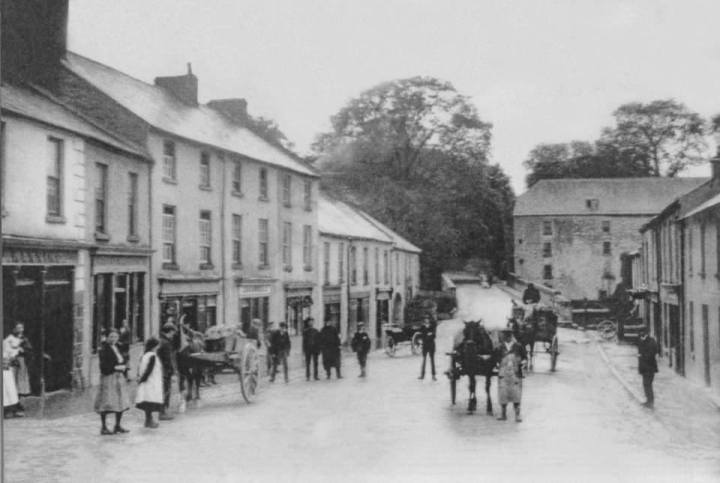
Bridge Street, Croom, taken in 1901. Image source: askaboutireland.ie
Abstract: Where did Michael Hartnett get the inspiration for the title of his collection, A Farewell to English? We believe that Aindrias Mac Craith’s most iconic song, Slán le Máighe (Farewell to the Maigue), was an influence and reference point for Hartnett’s ‘Farewell’, as well as being the inspiration for both the naming of the title poem of Hartnett’s collection, A Farewell to English, and, indeed, the naming of the collection itself.
A Christmas Collaboration: Vincent Hanley and Don Hanley
Michael Hartnett’s A Farewell to English caused quite a stir in literary circles back in 1975. It was seen by some as a bold change of direction for Hartnett, by then an established poet in the Irish literary scene and equally it was seen by others as a self-inflicted literary act of seppuku or self-immolation. Famously (infamously!) on June 4th, 1974, Hartnett had walked onto the stage of the Peacock Theatre in Dublin, at an event organised by the Goldsmith Press, and made one of the most intriguing, quixotic statements ever made by an established Irish poet. At that event, Michael Hartnett informed the audience of his resolution to cease writing and publishing in English and, from then on, to write and publish solely in Irish. He said his ‘road towards Gaelic’ had ‘been long and haphazard’ and until then ‘a road travelled without purpose’ but reassured his audience that he had realised and come to terms with his identity while acknowledging that his ‘going into Gaelic simplified things’ for him and provided answers which some considered to be naive but at least gave him ‘somewhere to stand’ (Walsh, 7). The statement was received largely negatively by critics and contemporaries, at best a bizarre misstep soon to be forgotten, at worst an ideologically motivated rebuke to the Irish poets writing in English at the time.
This dramatic ‘Farewell’ has always been somewhat problematic. Many of his detractors at the time expected him, once he had made this momentous decision, to stick rigidly to his promise as if it had been set in stone. Inevitably, they criticised him and chided him when his ambitious project seemed to peter out in the mid-80s. Perhaps this reaction can be seen as an effort by his critics to finally ‘pigeonhole’ the poet and hold him accountable. However, Michael Hartnett’s variety as a poet – balladeer, satirist, love poet, translator, poet in Irish as well as English, and his complicated bibliography, with numerous compilations, collections and selections, as well as individual volumes from several different publishers, always had the effect of obscuring his achievement or hiding its core elements.
An artist moves from obsession to obsession, from one project to another, and nothing is ever set in stone; ‘Farewells’ are never ‘Adieu’, more ‘Au Revoir’; new beginnings are inevitable. Hartnett was no different; he shifted from English to Irish and back again, he moved from city to country and back again; from the hillside in Glendarragh to Emmett Road in Inchicore, where, for good measure, he composed an extended haiku sequence in English. As Peter Sirr points out, this is the ‘kind of creative restlessness that fed Hartnett as a poet but that sometimes made critics scratch their heads’ (Sirr, 294). That said, when assessing Hartnett’s ‘Farewell’, we think it is fair to say it is best realised by the poems and ballads themselves (both in English and Irish), which more fully express the motivating poetic philosophy which led to the theatrical stunt on the Peacock stage, rather than the stunt itself!
To appraise the decision to bid a farewell to English, therefore, we must look to the collection and the title poem of the collection. If the concluding poem for which the collection is named is to be read as explanation, as well as a statement of intent, it is not a disillusionment with language, but rather with the use of that language in Ireland, and the cultural significance which that use carries. Hartnett’s decision, and the poem itself, are loaded with inferences within a political and postcolonial context. The poem’s significance, however, lies in the fact that it is not a poem against a language, but the political and dogmatic meanings which we have attached to that language.
His poem, ‘A Visit to Croom, 1745’, appears in that 1975 edition of A Farewell to English and is placed immediately before the title poem in the collection. The poem consists of strikingly vivid imagery and there are a myriad of great historical undertones present; echoes of Séan Ó Tuama’s inn, with its bardic school of poetry is conveyed in bold, flamboyant brush strokes; echoes too of great battles, the Boyne, Athlone, Aughrim, the Siege of Limerick, the ill-fated Treaty of Limerick, Sarsfield and The Wild Geese. In the poem Hartnett, the travelling spailpín, places himself back in Croom, probably in Ó Tuama’s hostelry, on his lonely journey back into the Gaelic tradition. He has trudged fourteen miles, in the shoes of those phantoms he visualises at Doody’s Cross, ‘in straw-roped overcoat’ to get here and all for nothing. ‘Five Gaelic faces’ greet him, and all he can hear is ‘a Gaelic court talk broken English of an English king’. His anger and disappointment are palpable,
It was a long way
to come for nothing.
Then the opening scene in ‘A Farewell to English’ takes place in yet another hostelry, Windle’s Pub in Glensharrold, Carrickerry, a few miles outside Newcastle West, where he introduces us to the raven-haired barmaid, Mary Donovan, who spurs him to verse, ‘her mountainy body tripped the gentle / mechanism of verse’ (Collected Poems, 141). This imagined segment of the poem is used as a device through which Hartnett comments upon his poetic inspiration and process, as well as his relationship with the Irish language: ‘the minute interlock / of word and word began, the rhythm formed’ (Collected Poems, 141). The weight which the poet gives to ideas of tradition within his creative process is clear here, suggesting the importance which ideas of authenticity play. Such shibboleths are never treated as unassailable, however, but rather made tangible through tactile imagery of sinking into, and sifting through, the morass of tradition: ‘I sunk my hands into tradition / sifting the centuries for words’ (Collected Poems, 141). However, because of his somewhat faltering Irish, he is forced to resort to age-old cliches to describe the barmaid using well-worn semi-classical phrases, ‘mánla, séimh, dubhfholtach, álainn, caoin’. Harnett then rebukes himself for doing so – ‘What was I doing with these foreign words?’ (Collected Poems, 141). His project, his new direction, is to find a new poetic voice in Irish, not to rehash old clichés, and by doing so, come to Irish not as a ‘foreigner’ but as a fellow of Aindrias Mac Craith and the Maigue poets and in doing so, make his own contribution to the bardic tradition that has inspired him.
Then in the second section, he describes an encounter on the road which hovers somewhere between reality and dream, aisling (the Irish word for a vision) or epiphany. The incident takes place at Doody’s Cross as the poet walks out one summer Sunday evening from Newcastle West to the cottage in Camas. He is on his way to meet up with his uncle, Dinny Halpin. He sits down ‘on a gentle bench of grass’ to rest his weary feet after his exertions when he sees approaching him three spectral figures from the Bardic Gaelic past – Andrias Mac Craith, Aodhagán Ó Rathaille, and Daíbhí Ó Bruadair. These ‘old men’ walked on ‘the summer road’ with
sugán belts and long black coats
with big ashplants and half-sacks
of rags and bacon on their backs.
They pose as a rather pathetic group, ‘hungry, snot-nosed, half-drunk’ and they give him a withering glance before they take their separate ways to Croom, Meentogues and Cahirmoyle, the locations of their patronage, ‘a thousand years of history / in their pockets’. Here, Hartnett is situating himself as their direct descendant and the inheritor of their craft. The enormity of this epiphany occurs at Doody’s Cross in Camas; the enormity of the task that lies ahead also terrifies and haunts him.
One of that pathetic trio at Doody’s Cross in Camas was Aindrias MacCraith (c. 1710 – 1795). He was well known by his nickname, An Mangaire Súgach (The Merry Pedlar), which had been given to him by his mentor and great friend, Séan Ó Tuama an Ghrinn (c. 1708 – 1775). MacCraith was a roving Hedge School master, setting up school wherever he could find a few pupils, then moving on when numbers fell. From the accounts that have come down to us, we learn that the Mangaire was a quintessential Limerick Rake; fond of sport, good company and deep drinking, and getting into more than one scrape with the clergy on account of his various indiscretions.
Mannix Joyce, that great local historian and chronicler of The Poets of the Maigue, recalls that,
‘For all his waywardness, he was a gifted singer. That poor wretch of a man, so often seen reeling from the tavern to the miserable hovel he called home, was one of the sweetest poets an age of song was to produce, a man whose poems will endure as long as the Irish language lives. He was a real lyricist, not unlike Burns and in his songs, he gives us an insight into his wild and vagrant life. He had a profound knowledge of the Irish language, and his poetry is full of magic and melody. He belonged to that strange Hidden Ireland of the 18th century, that Ireland that flowered with such profusion of poetry under the blasting winter winds of oppression. If he was careless and intemperate, much of it was due to a hellish code of laws then being enacted for the utter degradation of the old race’ (Limerick Leader, 13th October 1945).
Rake that he was, he could often be found in the company of Séan Clárach Mac Domhnaill, convenor of the Maigue School of Poetry and composer of Mo Ghile Mear, originally from Charleville, who has been described as the ‘chief Jacobite Poet in Ireland’. Séan Ó Tuama, Fr. Nicholas O’Donnell, and those other poets of the Maigue were often to be found in his company, declaiming the hero-tales of Greece and Rome and discussing current European politics. Again, Joyce acknowledges the great contribution of those Maigue Poets during the harshest of Penal times:
‘Those remarkable men arose in an age when learning of every kind was banned in Ireland and sprang from a people dubbed as ignorant and illiterate by their oppressors. They were the last guardians of the thousand-year-old ure of the Gael, and with their passing the Irish language, the repository of that ancient ure, faded and died in the rich plains of Limerick’ (ibid).
One of Aindrias McCraith’s best-known songs begins with the line: ‘Slán is céad ón taobh so uaim’. The song is usually referred to by the title: ‘Slán le Máighe’ (‘Farewell to the Maigue’), or ‘Slán Chois Mháighe’ (‘Farewell to Coshma)’, the name of the local Barony. As mentioned already, Aindrias had a predilection for that dangerous combination of wine, women and song, and after one of many such indiscretions, he was exiled by the parish priest of Croom to Ballyneety, the place where Patrick Sarsfield destroyed the Williamite siege train in 1690. His sad, poignant lament from there is addressed to his great friend Seán Ó Tuama, who, along with MacCraith, was one of the leading lights of the Court of Poetry which assembled in the village of Croom (‘Cromadh an tSuaicheas’, ‘Croom of the Merriment’), with its headquarters in the inn which was run by Ó Tuama and his wife, Muireann. (The song is one of the great Irish slow airs and can be sung to the air of ‘The Bells of Shandon’).
Slán is céad ón daobh seo uaim
Cois Máighe na gaor na graobh na gcruach …
(A hundred and one farewells from this place from me / To Coshma of the berries, the trees, the ricks).
Then there was the pathetic refrain:
Och ochón, is breoite mise,
Can chuid gan chóir gan choip gan chiste.
Gan sult gan seod gan sport gan spionnadh,
O seoladh mé chun uaighnis.
(Alas, alas, sick am I / Without portion, without justice, without company, without money / Without enjoyment, without treasure, without sport, without vigour / Since I was sent away to loneliness).
John O’ Shea and Anna Jane Ryan play Slán le Máighe (Farewell to the Maigue) live at Nun’s Island theatre in Galway.
Only ten miles separate Croom from Ballyneety in County Limerick, yet an important boundary line lies between them. Croom, in County Limerick, is located in the barony of Cois Máighe (Coshma), whereas Ballyneety is located in the barony of Uí Chonaill Gabhra (Connello). So, the journey from one village to the other involved moving from one Barony to another; the equivalent in those days of moving from one jurisdiction to another. The title of the song (and its associated tune) is usually given in English as ‘Farewell to the Maigue’, as if the poet were saying goodbye to the river itself, which flowed majestically through his beloved place.
MacCraith’s ‘Farewell’, despite its sublime lyrics and haunting slow-air melody, is not meant to be taken at face value; it is meant as a ‘Slán go fóill’, as inconsequential a ‘Farewell’ as a French ‘Au Revoir’. He is, undoubtedly, showing off his great skill as a poet, but the reality is that he is being asked to take a temporary leave-of-absence from Croom until the current controversy abates. By its language and use of form, it is at once intentionally self-serious, theatrical and iconoclastic. Hartnett echoes this tone and mirrors this pose in his ‘Farewell’ – at times theatrical, self-serious, bombastic – but also, in a flash, heartfelt, exposed, human.
Unfortunately, Aindrias MacCraith did eventually have to bid a sad final farewell to his good friend and mentor, Séan Ó Tuama. It is doubtful if the Mangaire Súgach would ever have written a verse of poetry were it not for the encouragement and friendship of Séan Ó Tuama. He had written nothing before he came to Croom, and after the death of Ó Tuama, he lapsed into silence again. He left Croom and sang no more. He had outlived Séan Clárach (d. 1754) by almost 40 years and his friend, Séan Ó Tuama, by nearly 20. He had seen the last of the great Maigue School of Poetry, and his declining years were saddened by the decay of the old language in the district where once it flourished.
Of the three phantoms that accost Hartnett at Doody’s Cross in those early magical sections of ‘A Farewell to English’, Hartnett translated the work of Ó Rathaille and Ó Bruadair but not MacCraith, one of his great influences from the old dispensation, the Gaelic bardic past. However, we believe that MacCraith does play an important role in the naming of Hartnett’s poem, ‘A Farewell to English’. We know that Hartnett was obsessed with Croom, as the last bastion of the old Gaelic Schools of poetry. He took great pride in the fact that he was the only modern Irish poet to have been born in Croom – he spent his first few days in St. Stephen’s Maternity Hospital, located in the village! This near obsession with Croom and the Filí na Máighe (The Maigue Poets) may, therefore, have had some influence on Hartnett’s choice of title for ‘A Farewell to English’. Our theory is that Hartnett borrowed the title of Aindrias MacCraith’s most iconic and poignant poem, ‘Slán le Máighe’, for his own ‘farewell’ and self-imposed exile in West Limerick, where he had come to ‘court the language of my people’. MacCraith had been forced to move to nearby Ballyneety for a time because of his indiscretions, and in 1974, Hartnett decamped from the Dublin literary scene and set up home in rural West Limerick, ‘in exile out foreign in Glantine’.
Those ten years spent in Glendarragh were among the most productive of his career – it may not have been a permanent ‘Farewell’, but it was a productive one. It is obvious that this decision to ‘go into the Gaelic’ had been simmering for some time. Indeed, 1975 saw a flourish of publications, including A Farewell to English but also the iconic Cúlú Íde / The Retreat of Ita Cagney. Then, probably his most accomplished collection in Irish, Adharca Broic, was published in 1978, followed by An Phurgóid in 1983, Do Nuala: Foighne Crainn in 1984 and his fourth collection in Irish, An Lia Nocht, appeared in 1985. In parallel to this ‘serious’ output, he was writing and entertaining the locals with ballads, some serious or semi-serious like ‘A Ballad on the State of the Nation’, which was distributed as a one-page pamphlet like the ballads of old and even included original linocuttings by local artist Cliodhna Cussen. Other ballads were more contentious and even semi-libellous (or fully slanderous!), such as ‘The Balad (sic) of Salad Sunday’ and ‘The Duck Lovers Dance’. These latter creations were written under the very appropriate nom de plume, ‘The Wasp’! As time passed, Hartnett’s ‘farewell’, similar to MacCraith’s, was seen for what it was, a ‘Slán go fóill’.
During this period, he also undertook the translation of Daibhi Ó Brudair’s poems, which were published in 1985, and his obsession with these seventeenth-century precursors continued with his later translations of Aodhagán Ó Rathaille (1993) and Pádraigín Haicéad (1999). Finally, following his departure from Glendarragh, the collection A Necklace of Wrens (a collection of poems in Irish with translations in English by the poet himself) was published in 1987.
The inability of critics to pigeonhole Hartnett has been one of the major problems in sustaining his immense legacy. In turn, Hartnett’s continual search for a spiritual and cultural home has not made it easy. And his restlessness did not end. Once back in Dublin, there were more new beginnings, more farewells. Hartnett seemed to make yet another new beginning with Poems to Younger Women (1988). Then again, in Selected and New Poems (1994), those long poems such as ‘Sibelius in Silence’ or ‘The Man who Wrote Yeats, the Man who Wrote Mozart’, and ‘He’ll to the Moor’ mark still new accomplishments in his overall oeuvre. The truth, of course, is as Peter Sirr asserts, Michael Hartnett, ‘is the sum of all of these identity shifts, and to consider any one of these aspects in isolation is to miss the overall picture of a complex, restless and rewarding poet’ (Sirr, 294).
A half-century of hindsight allows us to have a clearer perspective. His very theatrical ‘Farewell’ from the stage of The Peacock Theatre needs to be understood, as he and Aindrias MacCraith meant it to be – merely a ‘Slán go Fóill’ – as inconsequential and as temporary as a French ‘Au Revoir’.
Postscript
Hartnett’s draft of his ‘curse’ on the Féile na Máighe committee. Note these are from 1973, and it is clear that he is already working on a draft of Cúlú Íde / The Retreat of Ita Cagney.
In the late 60s and 70s, there was a very successful festival held annually in Croom, celebrating the work of the Maigue Poets. I came across this little gem while doing a bit of research in NLI back in February 2025. Hartnett was mightily peeved that he had not been invited as often as he felt he should. His papers contain a draft of a curse he put on the organising committee, written in Irish in the old Gaelic script. It transpired that he hadn’t been invited to the 1973 Féile, nor indeed to the 1972 or 1971 iterations either. He was not pleased, and so, in true bardic fashion, he placed a poetic curse on the organisers. Translated, it reads:
Whereas, I was born in Áth Cromadh an tSúbhacais thirty-two years ago, and as I am a poet who is famous the length and breadth of all of Ireland, even in British Ulster, and that I have received invitations to numerous poetry festivals in England and America and since I did not receive an invitation from my own people to the festival in the place of my birth this year or last year or the year before last, I hereby curse that festival – cuirim mo mhallacht orthu agus mallacht mo mhallachta,
Is mise,
Míchéal Ó hAirtnéada
(arna nglaoghtar Michael Hartnett sa Sacsbhearla, Priomhfíle Múmhan)
References:
Hartnett, Michael. A Farewell to English, Oldcastle County Meath, Gallery Press, 1975.
Hartnett, Michael. Cúlú Íde / The Retreat of Ita Cagney, Goldsmith Press, 1975
Hartnett, Michael. Adharca Broic, Oldcastle, County Meath. Gallery Press, 1978
Hartnett, Michael. An Phurgóid, Coiscéim, 1983.
Hartnett, Michael. Do Nuala, Foidhne Chuainn, Coiscéim, 1984.
Hartnett, Michael. An Lia Nocht, Coiscéim, 1985.
Hartnett, Michael. Ó Bruadair, Oldcastle: Gallery Press, 1985.
Hartnett, Michael. A Necklace of Wrens: Poems in Irish and English, Oldcastle County Meath, Gallery Press, 1987.
Hartnett, Michael. Poems to Younger Women, Oldcastle, County Meath, Gallery Press, 1988.
Hartnett, Michael. Ó Rathaille: The Poems of Aodhaghán Ó Rathaille, Oldcastle: Gallery Press, 1999.
Hartnett, Michael. Selected and New Poems, Oldcastle, County Meath, Gallery Press, 1994.
Hartnett, Michael. Collected Poems, Oldcastle: The Gallery Press, 2001.
Michael Hartnett Papers, National Library of Ireland, 35,879/1, 35,879/2 (1)
Mannix Joyce / Mainchín Seoighe, folklorist and local historian from Tankardstown, Kilmallock, taken from his weekly column in The Limerick Leader called Odds and Ends, 13th October, 1945.
Sirr, Peter. Michael Hartnett, in Dawe G, ed. The Cambridge Companion to Irish Poets. Cambridge Companions to Literature. Cambridge University Press; 2017, (Chapter 22: p. 294 – 306).
Walsh, Pat. A Rebel Act: Michael Hartnett’s Farewell to English, Mercier Press, Cork, 2012.



 Reviews Rants and Rambles
You must be logged in to post a comment.