Some Glendarragh Poems of Michael Hartnett: Poems from the Hearth

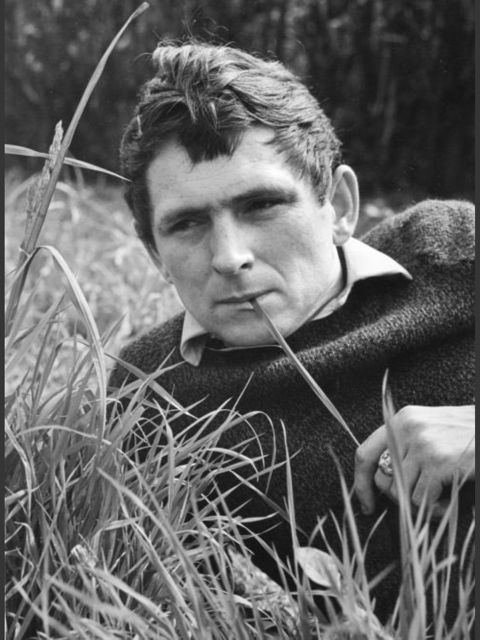
A pensive Hartnett ‘among (his) nameless weeds’. Photographer unknown.

As I have mentioned already in another post here, the decade from 1975 to 1985 in Glendarragh, Templeglantine, was arguably the most productive of Hartnett’s career.  Indeed, the output from that little cottage in the shade of ‘Tom White’s green hill’ in Glendarragh was prodigious.  The first poems to be published were his collection A Farewell to English, which was published in 1975, and thus began his long-lasting association with Peter Fallon and The Gallery Press.  The same year saw the publication of The Retreat of Ita Cagney / Cúlú ÍdeAdharca Broic was published in 1978, followed by An Phurgóid in 1983, Do Nuala: Foighne Crainn in 1984 and his fourth collection in Irish, An Lia Nocht, appeared in 1985.  During this period, he also undertook the translation of Daibhí Ó Brudair’s poems, which were published in 1985.  Many of his better Glendarragh poems are contained in the 1987 collection, A Necklace of Wrens.  This collection, following his return to Dublin, contains all poems in Irish with their English translation that Hartnett wanted preserved for posterity, and it was edited by Peter Fallon.

During this decade, 1975 to 1985, in parallel to this ‘serious’ output, he was writing and entertaining the locals with ballads, some serious or semi-serious like ‘A Ballad on the State of the Nation’, which was distributed as a one-page pamphlet like the ballads of old and even included original linocuttings by local artist Cliodhna Cussen. Other ballads were more contentious and even semi-libellous (or fully slanderous!), such as ‘The Balad (sic) of Salad Sunday’ and ‘The Duck Lovers Dance’.  These latter creations were written under the very appropriate nom de plume, ‘The Wasp’!  His most memorable local work was, of course, ‘Maiden Street Ballad’, a poem he composed for his father as a Christmas present in 1980.

These three intimate family poems were written in Glendarragh, Templeglantine and first appeared in his collection, Adharca Broic, in 1978.  Two of the poems are written for his children: Lara, who was born in 1968 and Niall, who was born in 1971.  These two poems with English translations also appear in his 1987 collection A Necklace of Wrens.   The third poem, Dán do Rosemary, was not included in this collection, and the reason for its exclusion is obvious.  As early as 1978, the tensions and stresses which eventually led to their separation in 1985 were beginning to show.   They were both navigating the inevitable separation, which eventually led to his departure for Dublin and Inchicore that year.  His gift for love poetry is again in evidence, as it had been back in 1968 with the publication of Anatomy of a Cliché.  Unfortunately, the clock had come full circle, and his final poem to Rosemary is one of abject apology and regret and wistful hopes for their post-separation lives.

The poem reads as a sad indictment of the way artists were treated in this country in the 70s and 80s.  They lead a ‘miserable life’, ‘for our lack of money / scrimping and scraping’.    He apologises profusely and admits that their marriage is ‘pitiless, loveless’, which has affected ‘your soft fragile (English) heart’.  Their small rural cottage is ‘run-down’, with ‘walls of clay, tear-stained’, ‘the place is falling apart’.  He takes full responsibility for their sorry plight and admits that he is ‘blundering, tactless, clueless’.  I have said elsewhere that at this time, Newcastle West was booming during the construction phase of the Aughenish Alumina Plant near Askeaton in County Limerick.  Newcastle’s twenty-six pubs were doing a roaring trade, and he apologises to his wife because he is ‘always acting the yob in the pub’. If anything, this poem in the original Irish is far more confessional and personal than most of his poetry up to this time.

The poem concludes on a far more positive and hopeful note.  He tells Rosemary that he has ‘abandoned English, but I never turned my back on you’.  This is a time for reappraisal, and he hopes to ‘relearn my craft from fresh woodland’ – he was living at the time in a townland called Glendarragh – the glen of the oak.  He ends on a hopeful note: he hopes that the future will bring Rosemary happiness and that her ‘worth will be appreciated’.  The final line is so sad and poignant – he hopes that ‘we both reach our America’.  The sadness of this final line arises from the fact that some seven years later, they both parted and went their separate ways.

Cliodhna Cussen, a fellow native of Newcastle West, has an interesting point to make about this poem:

‘Nuair a dhirigh Michéal ar an nGaeilge níor cuireadh aon rófháilte roimhe.  Bhí ceisteanna á n-ardú i dtaobh chaighdeán a chuid Gaeilge, ceisteanna a árdaíodh i dtaobh an Riordánaigh 30 bliain níos túisce. Ach léiríonn Michéal a anam, a chuspóir, agus a ghrá sa tseoid sin de dhán, ‘Dán do Rosemary’, ina bhfuil a chumas agus a chroí nochtaithe aige’.

 When Michael began writing in Irish, he didn’t receive great encouragement from Gaelgóirí.  There were questions about the standard of his Irish, just as there had been about Sean Ó Riordán some thirty years earlier.  But in this gem of a poem, ‘Poem for Rosemary’, Hartnett reveals his soul, his motive, his love – indeed, his supreme craft and heart are laid bare.’ (My own translation).

His poem for his son Niall, Dán do Niall, 7 (‘Poem for Niall, 7’), again shows his honesty and courage, although it does tend to descend into cliché at times.  Like King Canute and his futile attempts to hold back the tide, he wishes that his son wouldn’t have to leave this safe place in ‘Bird Nest country’, their home in Glendarragh.  He tries to warn his son about the many dangers that exist in the outside world and does so by making reference to nature.  This advice is somewhat reminiscent of the advice spoken by Polonius to his son Laertes in Shakespeare’s Hamlet: ‘This above all: to thine own self be true, And it must follow, as the night the day, Thou canst not then be false to any man’.  This suggests that integrity begins with honesty to oneself, and Hartnett gives us a modern take on this when he advises, ‘Be happy but be tough. ’

There is great poignancy in the final stanza when he states that he will be there for his son ‘in spite of death’.  Niall was 28 when his father died in 1999 at the age of 58, and the second line of this stanza adorns the poet’s headstone in Calvary Cemetery in Newcastle West: ‘mar labhraíonn dúch is labhraíonn pár’, ‘for ink speaks and paper speaks’.  The poet is saying that he will be present and live on in his body of work even after his death.  The reality is that he wasn’t there for many of the landmark celebrations in his son’s life, his graduations, his wedding, the birth of his grandchildren and so the promise he makes, ‘and some day I’ll buy you porter!’ sounds very hollow indeed to a young man who must now take on the onerous mantle of preserving and promoting his father’s rich and varied legacy at such a young age.

Hartnett’s grave in Calvary Cemetery, Churchtown, Newcastle West. The inscription reads: ‘Beadsa ann d’anneoin an bháis, mar labhraíonn dúch is labhraíonn pár’, (‘I will be there in spite of death, for ink speaks and paper speaks.’

His Dán do Lara, 10, (‘Poem for Lara, 10’), is a masterpiece.  The sunshine and nature in this poem are at odds with the penury and hardship of the poet’s existence in 1978, nestling below ‘Tom White’s green hill’ in Glendarragh, Templeglantine.  Flame-haired Lara is compared to a rowan tree in autumn, her voice disturbing the larks, ‘in the green grass’.  She is surrounded by nature in all its glory, ‘a crowd of daisies playing with you, a crowd of rabbits dancing with you’.  The blackbird and the goldfinch are there for her amusement and playtime.  Then the master of metaphor compares his daughter: ‘You are perfume, you are honey, a wild strawberry.’    The poem ends with the poet’s wish for his young daughter:

Little queen of the land of books            

may you be always thus                           

may you ever be free                                             

from sorrow-chains.

Interestingly, the poet compares his daughter to a queen in ‘the land of books’; this seems to set the seal on Lara’s perfection. Obviously, a poet would value literature and reading, and his choice of this image is significant as it tells us that Lara has another, deeper side to her – she is not just interested in the outdoors and a lover of nature.

His final wish for Lara is that she will grow up to be as beautiful and graceful as her mother, Rosemary.  He hopes that she will inherit her mother’s beautiful soul as well as ‘the beauty of her face.’

It is fitting that these three poems, written in that little rural cottage in Glendarragh, feature family and the travails of being a husband and a parent.  I have examined many of his papers in the National Library of Ireland on Kildare Street, and it is undeniable that hand-in-hand with arranging his poems and latest projects, there is ample evidence of the presence of young people, Lara and Niall, in the many doodles and scribbles on the margins of those frayed notebooks.


Doodles with Dad – the joys of being a poet with young children!


The Yoplait Experiment and other Adventures

In or around 1973, I participated in one of the great social engineering experiments ever conducted by the emerging Sociology Department in UCC.  This experiment had its epicentre in that den of iniquity known as the Kampus Kitchen.  The aim of the experiment was to discover if a whole cohort of Munster’s finest could survive on nothing other than copious quantities of Yoplait yoghurt with added orange peel during the course of an academic year.

The Kampus Kitchen was a student restaurant and multi-purpose venue at University College Cork (UCC), located in what is now known as the Kane Building. It was a popular space for students, serving as a restaurant, exam hall, study area, and even a live music venue in the 1970s. Construction of the building was finished in 1971, and the Kampus Kitchen was a beloved student spot for many years after.   All student life was present and, if my memory serves me right, it was always full.  There, would-be student politicians faced the wrath of a rebellious student body, while eager Third Eng and Second Year Commerce made hasty battle plans before taking to the ‘field’ for their Quarry Cup game.

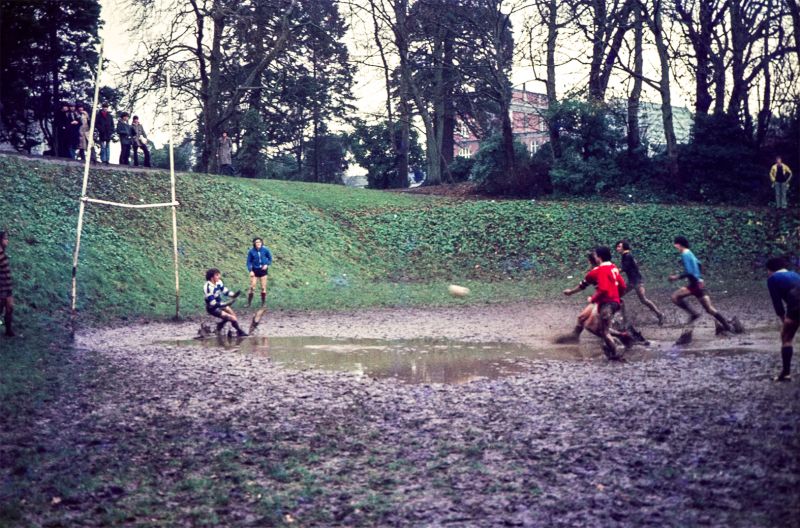
The Quarry Cup at University College Cork (UCC) was an historic inter-class soccer competition that was named after an actual hollowed out limestone quarry and a natural amphitheatre at the heart of the college. The Quarry was to UCC what the Colosseum was to the ancient Romans, a place for heroics and for heroes to display their skill, their bravery and their greatness. This oval-shaped field, with elevated banks, attracted large crowds on game days. The competition began in 1952, making it UCC’s oldest and most successful inter-class soccer competition. To call it a soccer competition was a great disservice to the Beautiful Game because, depending on how the game was going, various elements of Gaelic Football, Rugby Union, and even American Football were often called into play.  Most Quarry Cup games were fiercely contested, with up to 40 faculty teams taking part in the nine-a-side knockout competition.  Games invariably ended in mud-bath conditions.  Alas, the Quarry and its associated cup are now a piece of UCC’s history, with the new imposing Boole Library built right on top of that ‘field of dreams’. For the record, the last team to win the Quarry Cup was a Med. team captained by John Lynch.

Yoplait was the new culinary delight in those halcyon days.  It had begun in France in 1965 when six dairy co-ops merged to market their yoghurt products under one brand. The brand launched with the six-petaled flower logo, each petal representing an original co-op.

Yoplait’s first international expansion was through a franchising agreement with Switzerland in 1969.  The brand reached the United States and Canada in 1971.  In 1973, Yoplait began to be marketed in Ireland under a franchise agreement.

Yoplait initially produced plain-flavoured yoghurt and cream but released its first fruit-flavoured yoghurts in 1967. By 1973, the marketing gurus had decided to give their product away as a kind of first-ever loss-leader to hungry hordes of University students, knowing that when they graduated and got jobs in 1980s Ireland, Yoplait would be on everyone’s shopping list.  Sure enough, today they have become the leading kids brand, as Petits Filous fly off the supermarket shelves as Mum’s and kids’ favourite fromage frais.

Sure enough, by 1978, yoghurt had rightfully taken its place as one of our staple dairy products.  For my sins, after my first full year teaching in Newcastle West, I applied for and was allowed to correct Intermediate  Certificate Geography.  Now, where exam scripts are concerned, it never failed to amaze me the chances chancers will take when rote learning hits the cold reality of the North face of The Eiger! That fateful summer, I learnt that the name of the shipyard in Belfast was Harland and Wolff Tone and that, along with cheese and butter and Yoplait yoghurt, Milk of Magnesia was from now on also to be considered a dairy product!

However, my stint as an examiner that year ended in total disaster! I had learnt the ropes of being an Examiner during those hazy six weeks in June and July, and despite what would be considered today as abysmal postal and telephone communication, I managed to keep my Advising Examiner happy. When I had finished my work, I was meant to take my bag of scripts to the nearest train station for dispatch back to Athlone. I duly delivered my heavy bag of scripts in my trusty Ford Capri to Limerick Junction train station, and I brought my young impressionable brother, Thomas, and one or two of my sisters along for the drive.

Now, car aficionados will know that my top-of-the-range Ford Capri with its 1.6 overhead cam petrol engine, which had languished at the very back of Murphy’s garage in Cahirciveen until it had been recently rescued by my brother Mike, had four pedals instead of the usual three. The fourth pedal, a wonder of Ford ingenuity and engineering, was used to work the intermittent wipers.

Anyway, as we were nearing the Milk Woman’s Cross on our return journey, I began to mess with the pedals and lo and behold, to Thomas’s amazement, the wipers came on by some magic, even though it wasn’t even raining at the time. I repeated this trick a few times and then turned in the gate to our home. Not only had I totally confused Thomas, but unfortunately, I had also confused myself, and instead of pressing on the brakes, I foolishly pressed the accelerator and drove my lovely Capri into the cast-iron stanchion at the butt of our haybarn, doing untold damage to my pride and joy in the process. I earned a grand total of £178 for my correcting efforts that Summer, and Mike McCoy, our local panel beater in Knockaderry, charged me £250 to fix my wounded pride!

The Yoplait Experiment may not have been the only one to thrive in that magical place.  I’m not a great conspiracy theorist, but it strikes me now as too much of a coincidence that there were a number of payphones on campus – in those days of no communications – that could be tampered with so that all calls home were free of charge.  My home number was Kilfinane 126.  Don’t ask me how the scam worked – or was allowed to work – or how I managed to get through to home – but on one occasion, I remember getting my sister, Eileen, who was busy studying for her Leaving Cert, to transcribe a full English essay over that phone line without interruption.  I stood there on a glorious exam swotting May evening, reading my hastily cobbled together essay.  If I remember correctly, the title of that essay was: ‘In the land of the blind, the one-eyed man is king’!

I’m tempted to indulge in just one final conspiracy theory here! I’m convinced that that essay was surreptitiously’harvested’ by that fledgling Sociology Department in UCC, and when the time was ripe, years later, now working from the dungeon-like basement in the new Boole Library, built over that Quarry where once the famous Quarry Cup was played out, they used it as a blueprint for their first global experiment.  It wasn’t the Russians who interfered with those elections in that faraway land of free and brave men, it was nerdy boffins from the Sociology Department in UCC!  They even added a very ingenious subplot: not only was this newly elected King one-eyed, but he had no clothes!

                               Typical Quarry Cup conditions – not for the faint-hearted!

Random Epiphanies….

An epiphany is that moment when the penny drops, when the scales fall away from your eyes; that ‘light bulb moment’ when the mystery is solved; when the poem gives up its secret; that Eureka Moment when you realise you’ve been conned for most of your life.

The Bible has many such moments, from Eve and the apple in Genesis to Paul’s conversion on his way to Damascus in the New Testament.  As Christians, we celebrate the Feast of the Epiphany each year on January 6th, which focuses on the moment Christ is revealed to the non-Jewish world; when the Magi, guided by a star, come from the East to visit their Redeemer.

Epiphanies are mental moments when we are given instant clarity, which can turn into motivation to change and charge forward. But not all epiphanies are created equally. Some demand a deep inward search, while others fly in and out of our lives swiftly, silently, almost unnoticed.

It’s great to have an epiphany, but what you do with that new clarity is what matters most. Most of our habits are so ingrained in our lives that changing behaviour is very difficult. Most epiphanies force us to see situations and ourselves in a new light. The next step takes great courage; taking that step to live out your epiphany is when real transformation happens. In my own life, I have had some powerful moments. So, here are a few examples of some of my totally random light bulb moments…..

  • I normally don’t do conspiracy theories, BUT I firmly believe the young Viet Cong soldier who tortured American Vietnam hero and veteran, John McCain, for seven years, when made redundant, went back to the fledgling Hoi ChiMinh University and did a doctoral thesis on the benefits of manually induced electro muscle therapy – this was then picked up in Austria or Switzerland and sanitised. Today, it’s known as DRY NEEDLING. IMHO, the overuse of dry needling by overzealous, sadistic physiotherapists will be the rock that modern physiotherapy will perish on.
  • Donald Trump has never, ever put America first. Indeed, most politicians of all nationalities and all political hues invariably put themselves first.  However, a stopped clock is right at least twice a day, and Donald Trump was spot-on when he coined the phrase, Fake News.
  • In a related epiphany, have you ever noticed that all the major News Corporations are now owned by billionaire oligarchs and moguls?  I wonder why.  I have come to realise that much of what passes for news in today’s world is fake – atrocity after atrocity goes unreported, and not just because all the journalists have been killed by sniper fire – those who sit at home back in the studio have their hands tied behind their backs for fear they might incur the wrath of the current government.
  • On a slightly lighter note, did you ever notice that shampoo bottles are designed so that you will always use more than you need? You only realise this when the bottle is nearly empty.
  • The Catholic Church in Ireland provided an education and health system for Irish people a century before the fledgling state was formed – they deserve to be cut some slack by the newly canonised neo-liberals. That Church, to which I belong, has been under persistent attack for most of this century.
  • There are 756 steps between Oscar’s Restaurant and Servitar Puerto Azul Apartments in Puerto Rico, Gran Canaria!
  • Last year, for the first time since we settled in Knockaderry back in 1979, we had no swallows nesting in our garage by the road. In years past, we’ve had multiple pairs, but last year, 2024, was the first year we had no nest. It struck me then that swallows are the modern version of the canary down the mine. Thankfully, this year, after a very nervous wait, a lone pair arrived on May 20th – five weeks behind schedule. They built their nest and hatched four beautiful chicks for us to admire and cherish. The world is very fragile but not yet fully broken!
  • Global Warming never came to Knockaderry – but Climate Change is a real problem!
  • I’ve always contended that common sense wasn’t that common, but now I’m convinced that logic is irreparably damaged, and Warmongers now see themselves as Peacekeepers.   There’s one who has financed and supplied most of the munitions for an ongoing genocide who claims to have brokered peace in nine global conflicts this year alone.  Give that man the Nobel Peace Prize now, or else!!
  • Your role as a parent is never done. There is never a time, in good times and in bad, when you have full peace of mind, when you no longer need to worry. In reality, as a parent, you are only ever as happy as your saddest child.
  • Your career as a politician or as the manager of your local hurling team always ends in failure! No matter how successful you’ve been at winning championships or leagues or simply avoiding dreaded relegation, the time will come when you lose the dressing room. The people have spoken, and you must inevitably bow to the tyranny of the ballot box or your local GAA AGM!
  • Modern democracy is as fragile as a wasp’s nest, papery and brittle, and in my lifetime, it has been emasculated by billionaires and Russian oligarchs for their own ends.
  • Your health is your wealth. It is a universal truth that we take too much for granted, like being able to put on your socks or pull up your pants or get out of bed in the morning.
  • Cork GAA and its supporters are so well-served by the quality of their sports journalists.  No other county can claim to have writers who, week in week out, report the club scene and the intercounty scene in hurling and football to such a high standard.  Names like Tony Leen, John Fogarty, Maurice Brosnan, Michael Moynihan, Eoghan Cormican, Paul Rouse, Kieran Shannon and Cathal Dennehy are among my favourites.  And all of those stand on the shoulders of the giants who went before them in the old Cork Examiner: Jim O’Sullivan, Michael Ellard, the great P.D. Mehigan, better known as Carbery, and my own favourite word wizard,  Kevin Cashman.  In my book, he was one of hurling’s finest ever writers who prized exactitude and calm knowledge, in the same way he esteemed seeing a hurler’s correct technique create lethal elegance.

Finally, to put some order on this randomness, here are eight epiphanies that have certainly changed my life for the better, and maybe they can help you in your own journey.

  1. You aren’t what people say you are.

What matters most is what you say and feel about yourself. You get to choose. You can let others define you and tell you who you are, or you can show them who you are. Be you. The world needs you as you are.

  1. Plan B is often better than Plan A.

The most freeing moment in your life is when you let go of what you think is best for you. Stop holding on to what is no longer working: that job, that relationship, that dream. If it feels like hard work and is causing you more pain than gain, it is time to let go.

  1. You are not the number on the scale.

At the end of your life, after all those weight struggles, food wars, the obsession with new diets, and trying to look a certain way, it will have no relevance. You are more than a set of grades. The only thing that matters is what is in your heart. How you make people feel and how you make YOU feel is more important than how you look.

  1. The journey is more important than the goal.

Setting and reaching goals is important, but the actual process of becoming, growing, learning, and morphing into who we need to become is the real sweet stuff that makes for a wonderful life. Enjoy the journey as much as the reward.

  1. Being alone doesn’t mean you will be lonely.

The fear of being alone strikes the heart and makes many people panic. But when you learn to love your own company, you will see that you are never really lonely.

  1. It will never be all done.

The to-do lists, the chores, and the things we race around to get done will never be done. It is called life. Situations, chores, and to-do lists will always unfold. Instead of focusing on the end result, be in the process and celebrate what you have accomplished, as our wonderful Limerick Hurling team does.

  1. Emotional pain, indeed, all pain, shows up to point out to us what we need to change.

Sadness, depression, and heartache are gentle reminders to probe deeper into our lives. In the Summer of 2024, I had six weeks of agony inflicted on me by an inflamed bursa in my left hip from climbing ladders and clipping hedges. So, look at what is not working and be open to living your life in new ways. No more climbing ladders for me!

  1. Finally, if you’re lucky, you don’t have to find your purpose; it will find you.

The transition period between who you are and where you are going can be painful, but on your journey of finding purpose, recognise that there is purpose in the pain. Each step you take is helping you carve out more of who you really are.

Dán do Lara, 10, le Michéal Ó hAirtnéide

Dán do Lara, 10

Fuinseog trí thine

gruaig do chinn

ag mealladh fuiseoige

le do ghlór binn

i bhféar glas,

is scata nóiníní

ag súgradh leat

is scata coiníní

ag damhsa leat

an lon dubh

is a órghob

mar sheoid leat

lasair choille

is a binneas

mar cheol leat.

Is cumhracht tusa,

is mil, is sú talún:

ceapann na beacha féin

gur bláth sa pháirc thú.

A bhanríon óg thír na leabhair

go raibh tú mar seo go deo

go raibh tú saor i gconaí

ó slabhra an bhróin.


Seo mo bheannacht ort, a chailín

is is tábhachtach mar bheannú é –

go raibh áilleacht anama do mháthar leat

is áilleacht a ghné.


Poem for Lara, 10                     

An ashtree on fire                                                          

the hair of your head                         

coaxing larks                                    

with your sweet voice                        

in the green grass,                            

a crowd of daisies                              

playing with you                               

a crowd of rabbits                              

dancing with you                              

the blackbird                                    

with its gold bill                                

is a jewel for you                               

the goldfinch                                     

with its sweetness                             

is your music.                                   

You are perfume,                               

you are honey,                                  

a wild strawberry:                             

even the bees think you                     

a flower in the field.                          

Little queen of the land of books                  

may you be always thus                    

may you ever be free                                   

from sorrow-chains.


Here’s my blessing for you, girl,                  

and it is no pretty grace –                                     

may you have the beauty of your mother’s soul      

and the beauty of her face.       

Note:  This poem, along with Dán do Niall, 7, and Dán do Rosemary, Lara’s mother,  first appeared in Michael Hartnett’s first collection in Irish, Adharca Broic, in 1978.  The poem, along with Dán do Niall, 7, later appeared in A Necklace of Wrens in 1987, with both poems given an English translation by the poet himself.      Both collections, Adharca Broic and A Necklace of Wrens (edited by Peter Fallon), were published by The Gallery Press.


Dán do Niall, 7, le Michéal Ó hAirtnéide

Dán do Niall, 7

Mo thrua nach mairfidh tú go deo

i dtír na nead, Tír na nÓg,

tír mhíorúiltí faoi chlocha

tír sheangán:

tír na dtaibhsí dearga, tír fholláin.

Mas, tá an saol ag feitheamh leat

le foighne sionnaigh ag faire cearc:

cearca bana d’aigne úire –

scata fiáin

ag scríobadh go sonasach i bpáirc.

Más é an grá captain do chroí

bíse teann ach fós bí caoin:

ainmhí álainn é an sionnach rua

ach tá fiacla aige atá gan trua.

Seachain é, ach ná goin:

bí sonasach ach bí righin.

Beadsa ann d’ainneoin an bháis,

mar labhraíonn dúch is labrraíonn pár:

Beidh me ann in am an bhróin,

in am an phósta, am an cheoil:

Beidh mé ann is tú i d’fhear óg –

ólfad pórtar leatsa fós.

Poem for Niall, 7                                          

 A pity you’ll not always be

In Bird-Nest country, Tír na nÓg,

land of miracles under stones,

red-phantom land, a safe place.

For world waits for you,

patient fox watching hens:

white chicks of your fresh mind –

a white flock

scratching in a happy field.

If love commands your heart

Temper strength with gentleness:

A lovely dog the red fox is

but his teeth are pitiless.

Avoid him, do not harm him:

be happy but be tough.

I will be there in spite of death

for ink speaks and paper speaks:

I will be there in the sorrowful times

When music plays at wedding feast.

I will be there as you grow older –

And some day I’ll buy you porter!

 Note: This poem to his son, Niall, first appeared in Michael Hartnett’s first collection in Irish, Adharca Broic, which was published in 1978 by Peter Fallon’s Gallery Press.     It was published again in the 1987 collection, A Necklace of Wrens, this time with an English translation.


Dán do Rosemary   le Michéal Ó hAirtnéide

Dán do Rosemary                                               


As an saol lofa seo                                                               

gabhaim leat leithscéal:                                         

as an easpa airgid atá                                             

ár siorsheilg thar pháirc                                                     

ár bpósta mar Fhionn                                             

gan trua gan chion                                                  

ag bagairt ar do shacs-chroí bog ceannúil.          

Gabhaim leat leithscéal                                         

as an teach cloch-chlaonta                                     

as fallaí de chré is de dheora déanta –                 

do dheora boga:                                                       

an chlog leat ag cogarnach                                     

ag insint bréag,                                                        

an teallach ag titim as a chéile.                             

Téim chugat ar mo leithscéal féin:                       

m’anam tuathalach, m’aigne i gcéin,                    

an aois i ngar dom, le dán i ngleic,                       

i mo gheocach sa tabhairne ag ól is ag reic.        

Thréig mé an Béarla                                               

ach leatsa níor thug me cúl:                                   

caithfidh mé mo cheird                                          

a ghearradh as coill úr:                                          

mar tá mo gharrán Béarla                                     

cran-nochta seasc:                                                                                      

ach tá súil agam go bhfuil                                      

lá do shonais ag teacht.                                          

Cuirfidh mé síoda do mhianta ort lá.                   

Aimseoimid beirt ár Meiriceá.                              

Poem for Rosemary

For this miserable life

I apologise:

for our lack of money

scrimping and scraping,

our marriage like Fionn’s

pitiless, loveless,

affecting your soft fragile heart.

I apologise

for our run-down house,

its clay walls, tear stained –

with your soft tears:

the clock is ticking

telling you lies,

the place is falling apart.

I go to you with my apology:

blundering, tactless, clueless,

with a poem in my fist,

and I always acting the yob in the pub.

I abandoned English

but I never turned my back on you:

I now must relearn my craft

from fresh woodland:

because my English copse

is leafless and bare:

but I remain hopeful

that your days of happiness are near.

Your worth will be appreciated yet.

I hope we both reach our America.

Note: This poem is taken from Michael Hartnett’s first collection in Irish, Adharca Broic, which was published in 1978 by Peter Fallon’s Gallery Press. 

Brandon Creek Epiphany – and a Rant!

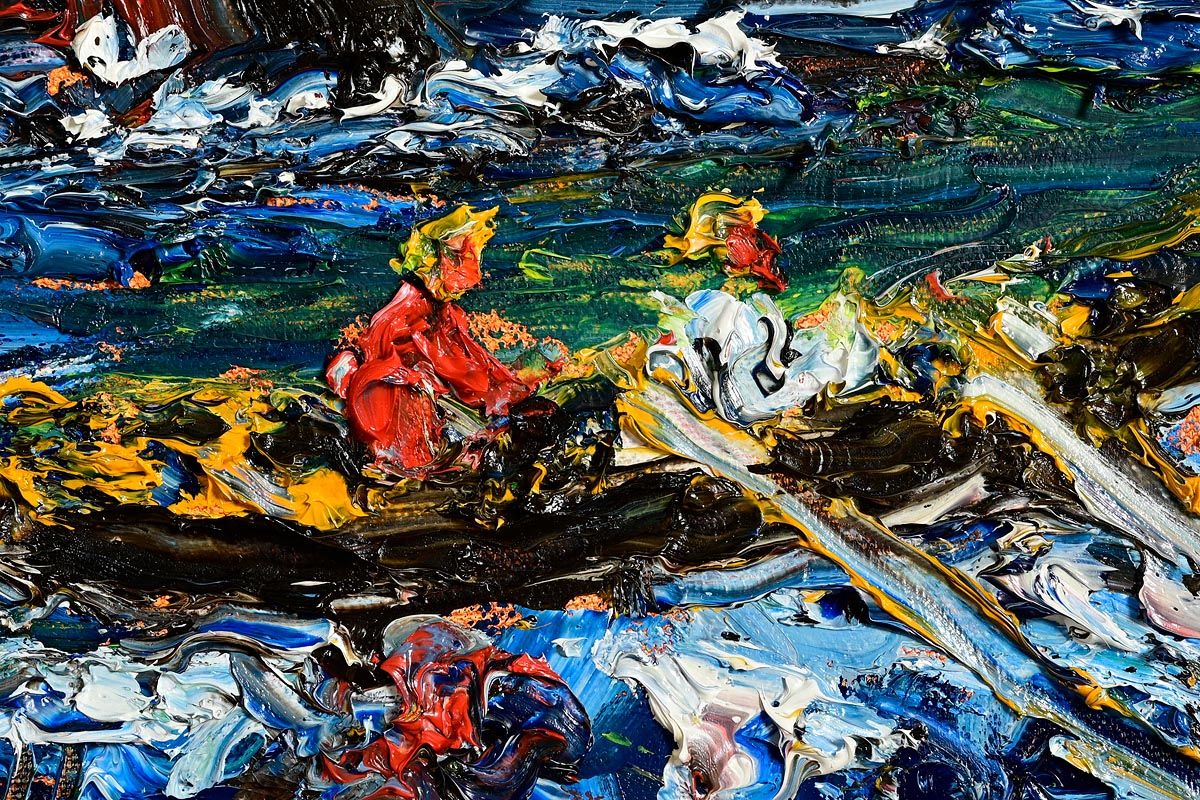
‘Brandon Creek, West of Dingle’ by Liam O’Neill/Morgan O’Driscoll.

The title of this blog is ‘Reviews, Rants and Rambles’ and since 2015, there have been many reviews and rambles but very few rants – so here’s one:  We are living through the craziest of times.  Like Macbeth after his confrontation with the witches, ‘ Nothing is but what is not, ’ and global leaders have taken their chainsaws to the truth.  Irony is everywhere: billionaires and huge multinational corporations try with all their ingenuity to destroy all borders so that their profits are maximised, while at the same time their political buddies stoke nationalistic fervour and division and demonise immigrants and those who cross borders to a better life.  Globalism is the buzzword, but global efforts to combat impending Doomsday scenarios and pandemics have been seen to be pathetic attempts at cooperation. Rant over.

The summer of 2024 was yet another Climate Change paradox in Ireland.   The Jetstream seemed to be stuck in some Groundhog Day cycle during June, July and most of August. There were no two days the same; no long sunny spells, rain was never far away, although rainfall amounts were below normal levels.  Towards the end of August, a temporary high moved in over Ireland and Kate and I decided to take full advantage. On Friday, August 30th, Don’s birthday, we decamped to Dingle.

On Saturday morning, we decided to head out west towards Baile na nGall, and on the way, we stopped off at Brandon Creek to explore this unheralded and largely forgotten gem on the Wild Atlantic Way. On that morning, it was indeed sensational, and a revelation and my words are inadequate to describe the beauty and tranquillity of the place. We parked our car in an unofficial grassy layby near the top of the narrow roadway leading to the Creek and the neglected pier. The narrow single-lane path descended to a very rustic bridge over the creek. The solitude was magical and eerie. I couldn’t help but think that in another era, this narrow roadway would have been used to collect guns and other contraband smuggled into this isolated cove in the dead of night.

Maybe this scenario from bygone days was prompted by the many rebel songs and ballads and stirring sea shanties we had listened to the night before from the marvellous local group, Tintéan, in Murphy’s pub in Dingle. They had entertained a very diverse and varied audience with a two-and-a-half-hour session of rousing rebel songs, some of which even the Wolf Tones wouldn’t include on their concert playlist for fear of offending someone! The Irish diaspora was there in force from Ohio, Connecticut, and Washington; I even had trouble distinguishing between the Canadian and South Florida accents! Then there were couples from Spain, Germany, and Sweden and holidaymakers from Derry, Tipperary, Limerick and Kerry.

As we walked down the steep incline to the pier, there was much evidence of neglect and some evidence that, at one time, the now rusty winch had been used to haul the local currachs with their catches up onto the pier. I walked to the end of the pier and could hear the quiet, rhythmic gurgling of seawater in the hollow caverns at its base. I imagined what it would be like in the throes of an Atlantic storm. It was hard to believe that it was from this very location around 600 AD that Saint Brendan the Navigator was reputed to have set out and discovered America.

There is much talk today, especially across the water, about the problems caused by small boats precariously being used to bring immigrants to Britain’s shores. St. Brendan and his hardy crew of monks not only made it to Iceland and probably Newfoundland and Labrador, but they also made it home again! There is some anecdotal evidence and much more scientific evidence that the people living today in those far-off regions carry West Kerry genes, so the monastic concept of celibacy must have been an optional requirement in those early days!

I also remembered that in the 1970s, the explorer, writer and filmmaker, Tim Severin, tried to recreate St. Brendan’s voyage in an effort to prove that the 6th-century Irish saint could have reached the Americas 900 years before Columbus.

On May 17th, 1976, Severin and his three fellow crewmen rowed out of this same Brandon Creek to begin what would prove to be a 7,200km epic journey. I remember avidly following their progress as Severin and his crew first sailed to the Aran Islands and from there to Iona, the Hebrides, and the Faroe Islands, before sailing on to Iceland and Greenland and from Greenland to Newfoundland.

On June 26th, 1977, some 13 months after leaving Brandon Creek, Severin and his crew sailed into Musgrave Harbour on Peckford Island, Newfoundland and were welcomed as heroes by the locals who fully appreciated the navigational feat.  Amazingly, there is nothing on the pier in Brandon Creek today to remember those heroic feats of yesteryear.

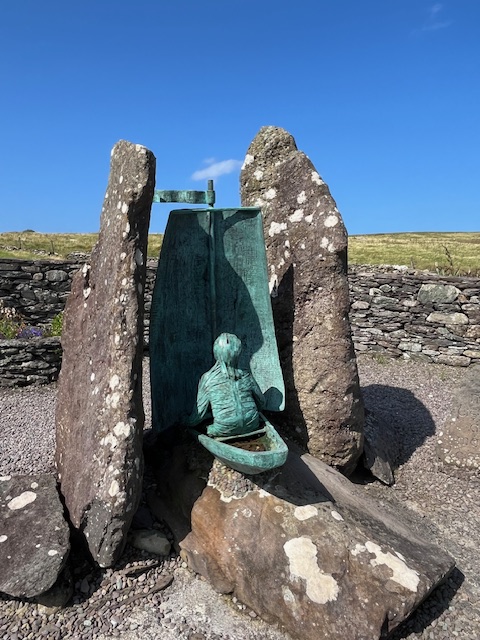
Kate and I made our return journey up the steep, narrow incline with visions of the stormy gunrunning scene from Ryan’s Daughter playing in my head. As we reached our car after the slow climb, I noticed what seemed like a half-hidden art installation surrounded by low walls of local stonework. At first, I took it to be yet another of the numerous shrines and grottos that lie scattered all over this Gaeltacht region, but this was different. While I was exploring this very unobtrusive, unflagged surprise, Kate had struck up a conversation with a woman whose car was also parked nearby. I continued on my way and came upon a copper-green sculpture depicting a lone sailor navigating between two standing stones, which, I presume, were meant to represent the perils encountered on an ocean voyage. The sailor seemed to be sailing blind as his view forward was blocked by the fragile sail on his lowly currach. I presume the sculpture was meant to depict the voyage of St. Brendan in his frail craft all those centuries ago. There was an inscription in Irish on a red sandstone flag nearby, which read ‘Ná ligamís ár maidí le sruth’.  I wanted to remember this, so I took a note of it on my phone.

I returned to the car where Kate was waiting, and she told me of her conversation with the woman she had met. The woman had set out that morning at 6 a.m. on her own and had climbed the nearby Mount Brandon. It had taken her three hours to climb to the summit and three hours to make her descent. Because she was muddy and splattered from the climb, she had decided to go for a swim down in Brandon Creek before heading home.  Needless to say, we were both in awe of this woman’s achievements. This hardy soul epitomised for us the strength and resilience of the locals in this almost-forgotten outpost of our country. I then told Kate what I had got up to and the marvellous discovery I had come across, something not mentioned in any of the Bord Fáilte brochures in nearby cosmopolitan Dingle. I told her about the inscription I had come across and translated the hopeful message as best I could.

Sometimes when we begin to doubt our ability to solve personal or global issues like climate change, the inscription from that beautiful, wild and neglected place has, for me, the feel of a powerful call to arms:

‘Ná ligamís ár maidí le sruth’

‘We must never rest on our oars’


Irish Weather

Wet and windy Status Yellow weather with wintry showers on the way!

I have grown accustomed to the slow, relaxed rhythm of the seasons changing in Knockaderry. I look out from my front door at a verdant tree-filled valley with its rim of hills on the horizon, stretching from Barna to Broadford and Freemount and beyond. The people in these border regions of Limerick, Cork and Kerry are prone to exaggeration, so the hills are known locally as The Mullaghareirk Mountains. This is from the old Irish, which translates as ‘the hills with the view’. The area is also known as Sliabh Luachra, which translates as ‘the hills of the rushes’, famous for its poets, polkas and slides, its sets, and half sets. The valley that I look out on is also an ancient valley with an equally ancient name, Mágh Ghréine, ‘the valley of the sun’.

Any discussion of Irish weather risks the odd cloudburst of cliche, often fuelled by naive American tourists who believe everything they read in their Aer Lingus in-flight magazine. However, we have to admit that in Ireland we have weather, while every other place on the face of the planet has a climate. Proof of this is the recent European Commission’s decision to stop talking about Global Warming and focus instead on the term Climate Change – albeit only when they realised that Global Warming didn’t apply to Ireland. Here in Ireland, it’s either Baltic or the sun is splitting the stones, usually on the same day.

The main problem here is that most of us don’t welcome rain like the people in sub-Saharan Africa would a deluge. Our inner weathervane says things like, ‘It looks like rain’, or ‘It’s trying to rain’, or ‘It’s boiling for rain’, or ‘It’s a soft day’, or even better, ‘It’s a grand soft day’ if you’re an American tourist in Adare. We say, ‘It’s lashing rain’, ‘The heavens opened’, ‘Twas bucketing rain’, ‘Twas pissing rain’, and when it rains when you’re just going to bale the hay, we say, ‘Twas only a sun shower’, just perfect rainbow weather!

I have looked out from my porch on many an April evening and admired the sheets of rain being blown towards Ahalin across Stack’s big field. I’m also reminded of Austin Clarke, my favourite Irish weather poet, who talks of ‘the mist becoming rain’. In my opinion, our biggest problem in Ireland is when we get a settled period of very fine Summer weather, the farmers invariably start praying for rain on day three, and everyone knows the strength of their lobbying power with the Man Above!

For years, my weather watching was linked to my job, just like farmers and fishermen and such. You’d hear people talking about ‘Exam Weather’ each June, and ‘Back-to-School Weather’, which always consisted of a mini heatwave in September. Invariably, the farmers were also using this long-awaited window of opportunity to literally make hay while the sun shone.

Each year for thirty-odd years in June and July, I undertook a mini-Purgatory for my sins by correcting Leaving Cert exam papers. The six or seven-week period was usually filled with sunshine and heatwaves and Munster Finals in Thurles and holidays in Ballybunion for some, while I feverishly tried to meet completely unrealistic deadlines set by mandarins in far-off Athlone. That left August to eke out a wet week in Schull, with the prospect of torrential floods from burnt-out hurricanes in the Caribbean scorching in from the Atlantic while we diligently painted smooth stones which we had earlier retrieved from the beaches in Glandore or Ballydehob, while it lashed rain from leaden skies. Since those days, I always, for some morbid reason, expect news reports in August to announce the annual destruction and flooding caused by the monsoon season in India and Bangladesh.

May has always been my favourite month. It’s probably because of my love of gardening, but May puts on a great show in the garden before the harsh wind and rain wreak havoc with those delicate leaves, shoots and grasses. I’m always reminded of Thomas Hardy’s lines in his poem, ‘Afterwards’:

And the May month flaps it’s glad green leaves like wings,

Delicate-filmed as new-spun silk …….

 I have a May Garden, and by late April or early May, the climbing Dublin Bay red roses are abloom by the south-facing front door, and the bluebells and the Aubretia are cascading as they do. I marvel at the delicate new leaves on the beech trees that I got as a present from a dear cousin back in the 80s. My two oak trees, which we bought in Van Veen’s Nursery, are late as usual, and the sycamore that grew from a tiny seedling dominates the plot. Even though we continually moan about our Irish Weather, we also rely on it to supply us with a variety of joyful vitamins and feel-good hormones. Because of our unique weather, we have endless green fields, flowers, forests, lakes and pastures. And I love that special time when the thunder and lightning strike after one of those rare Azores Highs, when you can breathe in the calm smell of rain! Sunshine is delicious, rain is refreshing, wind braces us, and snow is exhilarating; there is really no such thing as bad weather in Ireland, only an endless variety of different kinds of good weather.

Showers most days next week, says Carlow Weather!

The Last Vision of Eoghan Rua Ó Súilleabháin by Michael Hartnett

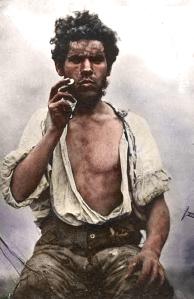
An unknown Spailpín Fánach circa 1858. A colourised image by Matt Loughrey from a black and white photograph originally collected by Sean Sexton.

The Last Vision of Eoghan Rua Ó Súilleabháin

The cow of morning spurted                Do thál bó na maidine
milk-mist on each glen                          ceo bainne ar gach gleann
and the noise of feet came                    is tháinig glór cos anall
from the hills’ white sides                     ó shleasa bána na mbeann.
I saw like phantoms                                Chonaic mé, mar scáileanna,
my fellow-workers                                   mo spailpíní fánacha,
and instead of spades and shovels      is in ionad sleán nó rámhainn acu
they had roses on their shoulders.     bhí rós ar ghualainn chách.

Translated by Michael Hartnett from his original Irish poem.

Commentary

This gem of a poem was first published as part of Hartnett’s first collection in Irish, Adharca Broic, in 1978.  The poem also appears in Hartnett’s 1987 collection, A Necklace of Wrens, with an English translation by the poet himself. Of the twenty-three poems in A Necklace of Wrens, thirteen are included from that first collection in Irish, Adharca Broic, with English translations by the poet. Peter Fallon, his publisher and editor, has stated that the poems included in A Necklace of Wrens were the only Irish poems that Hartnett wanted to be preserved after his ten-year sojourn in West Limerick. This collection was followed a year later by Poems to Younger Women, entirely in English. Theo Dorgan tells us that both these collections show ‘a startling return to the power and complexity we might have expected had the poet not turned aside from English in 1975’.

‘The Last Vision of Eoghan Rua Ó Súilleabháin’ offers a modern perspective on the traditional Aisling (vision) poem genre. The poem blends traditional imagery with contemporary twentieth-century realism, transforming the spectral ‘fellow-workers’, the ‘spailpíní fánacha’ of the original, into figures with ‘roses on their shoulders’ instead of spades, suggesting a hopeful, transformed vision of labour and society, rather than the lament for lost Gaelic order typical of historical Aisling poems.

Here, the focus shifts from the old political lament of older Aisling poems to a more modern, grounded, hopeful vision, using the image of the rose, the international symbol of the Labour Movement, of which Hartnett was a card-carrying member.  While the original poems lamented historical events like the Flight of the Earls and the hoped-for return of Bonny Prince Charlie and the Stuarts to power, Hartnett’s poem shifts the focus to a contemporary sense of disillusionment and emotional turmoil. Hartnett does use the image of a new day dawning to reinforce the hopeful possibility of better days ahead, however, while Hartnett’s translation adapts the ancient Aisling form in a contemporary context, in my view, this Aisling is heavily laden with irony, if not cynicism, because of Labour’s perceived inability to improve the lot of the working class and its failure to gain long-term popular mainstream support, particularly in the post-World War II era.

The title and the poem itself reference the Aisling genre, a poetic form that developed in Gaelic poetry in the 17th and 18th centuries.  Readers familiar with Irish poetry will also be aware that in these old Aisling poems, Ireland was often depicted as a woman: sometimes young and beautiful, sometimes old and haggard. In the final poem in his first collection in Irish, Adharca Broic, Hartnett reprints his iconic poem, Cúlú Íde, in which he portrays Íde (Ita Cagney in the English version) as a strong, formidable woman, and he endows her with many of the traditional characteristics of the spéirbhéan (the spirit woman) from the original Aisling poems.  She is depicted as a modern Bean Dubh an Ghleanna, Gráinne Mhaol, Roisín Dubh or Caithleen Ní Houlihan – in effect, a symbolic representation of the new Ireland.

This modern Aisling, ‘The Last Vision of Eoghan Rua Ó Súilleabháin’ also features striking imagery, such as the ‘cow of morning’ that ‘spurted milk-mist on each glen’. The image of the cow, the Droimeann Donn Dílis, was also a stock reference to represent Ireland in Jacobite poetry and the hoped-for return of the Stuart dynasty, which, many at the time believed, would benefit Ireland. This initial image creates a surreal and elemental atmosphere, setting a new tone for the vision. The crucial shift occurs when these workers have ‘roses on their shoulders’ instead of ‘spades and shovels,’ symbolising a transformed, idealised vision of labour, where it is no longer depicted as hardship or indentured slavery but as something beautiful and dignified.

The rose, particularly the red rose, later became a symbol for the Labour Movement through the slogan ‘bread and roses,’ which represents the dual desire for both the means to live (bread) and a life of dignity and fulfilment (roses). This symbol is associated with the fight for social and economic justice and is used by many social democratic and labour parties, such as the Labour Party in Ireland and the UK.

The ‘phantoms’ seen by the speaker are described as ‘fellow-workers’, ‘comrades’ even, transforming traditional imagery of spectral figures into more tangible, relatable characters associated with Labour.   The older, traditional variety are the sad spectral figures that accost Hartnett one summer’s evening as he heads from his home in Newcastle West to meet his uncle Dinny Halpin in Camas.  The episode is recounted for us in the second section of his iconic poem, ‘A Farewell to English’,

These old men walked on the summer road

sugán belts and long black coats

with big ashplants and half-sacks

of rags and bacon on their backs.

These spectral figures were a pathetic vision, ‘hungry, snotnosed, half-drunk’.  These ragged poets, Andrias Mac Craith, also known as An Mangaire Súgach, The Merry Peddlar,  (along with his contemporary, Sean Ó Tuama an Ghrinn, who also hailed from Croom, the seat of one of the last ‘courts’ of  Gaelic poetry),  Aodhagán Ó Rathaille from Meentogues near Rathmore in the Sliabh Luachra area (also the birthplace of Eoghan Rua Ó Súilleabháin), and Dáithí Ó Bruadair, who was on his way from Springfield Castle, the seat of the Fitzgeralds, to Cahirmoyle, the seat of his other great patron, John Bourke), represented the sad remnants of a glorious past.

The ‘phantom’ figures leave Hartnett resting ‘on a gentle bench of grass’, leaving him to ponder his own future as their direct descendant:

They looked back once,

black moons of misery

sickling their eye-sockets,

a thousand years of history

in their pockets.

Eoghan Rua Ó Súilleabháin, the putative author of this Aisling and a real-life spailpín in his own right, lived a life which was the stuff of legend and lore, and, indeed, it has many similarities with Hartnett’s own rakish life.  Many of the stories surrounding him may very well be apocryphal, to say the least.  However, he and his fellow parishioner, Aodhagán Ó Rathaille, are most famous for their mastery of the Aisling genre.

Eoghan Rua was born in 1748 in Meentogues, in the mountainous Sliabh Luachra area, in southwestern Ireland. By the time of his birth, most of the native Irish in the southwest had been reduced to landless poverty. However, the area boasted of having one of the last ‘classical schools’ of Irish poetry, descended from the ancient, rigorous schools that had trained bards and poets for generations. In these last few remnants of the bardic schools, Irish poets competed for attention and rewards, and learned music, English, Latin and Greek.

Eoghan Rua (the Rua refers to his red hair) was witty and charming but had the misfortune to live at a time when an Irish Catholic had no professional future in his own country because of the anti-Catholic Penal Laws. He also had a reckless character and threw away the few opportunities he was given. For example, at the age of eighteen, he opened his own school; however, we are told that ‘an incident occurred, nothing to his credit, which led to the break-up of his establishment.’

Eoghan Rua then became a spailpín, an itinerant farm worker, until he was 31 years old. He was then conscripted into the British Navy under interesting circumstances. Ó Súilleabháin was then working for the Nagles, a wealthy Anglo-Irish family.  They were Catholic and Irish-speaking, and had their seat in Kilavullen along the Blackwater valley near Fermoy, County Cork. (The Nagles were themselves an unusual family. The mother of the Anglo-Irish politician Edmund Burke was one of the Nagles, as was Nano Nagle, the founder of the charitable Presentation order of nuns. She was declared venerable in the Catholic Church on 31 October 2013 by Pope Francis).

Daniel Corkery relates that, ‘I have had it told to myself that one day in their farmyard Eoghan Rua heard a woman, another farm-hand, complain that she had need to write a letter to the master of the house, and had failed to find anyone able to do so. ‘I can do that for you’, Eoghan said, and though doubtful, she consented that he should. Pen and paper were brought to him, and he sat down and wrote the letter in four languages: in Greek, in Latin, in English, and in Irish. ‘Who wrote this letter?’ the master asked the woman in astonishment. The red-headed young labourer was brought before him, questioned, and thereupon set to teach the children of the house.  However, again owing to Eoghan Rua’s bad behaviour, he had to flee the house, the master pursuing him with a gun’. Legend says he was forced to flee when he got a woman pregnant: some say that it was Mrs Nagle herself!

Ó Súilleabháin escaped to the British Army barracks in Fermoy, and he soon found himself aboard a Royal Navy ship in the West Indies, ‘one of those thousands of barbarously mistreated seamen’.  He sailed under Admiral Sir George Rodney and took part in the famous 1782 sea Battle of the Saintes against French Admiral Comte de Grasse. The British won, and to ingratiate himself with the Admiral, Ó Súilleabháin wrote an English-language poem, Rodney’s Glory, lauding the Admiral’s prowess in battle and presented it to him. Ó Súilleabháin asked to be set free from service, but this request was denied him.

Much of Eoghan Rua’s life is unknown and clouded in mystery and intrigue. He returned after his wartime exploits to his native Sliabh Luachra and opened a school again. Soon afterwards, at 35, he died from a fever that set in after he was struck by a pair of fire tongs in an alehouse quarrel by the servant of a local Anglo-Irish family. ‘The story of how, after the fracas in Knocknagree in which he was killed, a young woman lay down with him and tempted him to make sure he was really dead, was passed on with relish’.

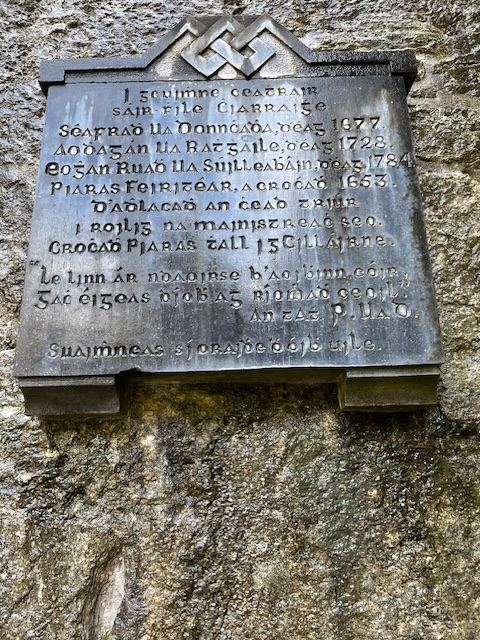
There is some confusion as to where he is buried.  Some claim he was buried in midsummer 1784, in Nohoval Daly graveyard (or Nohoval Lower Graveyard), which is located on the Cork side of the River Blackwater on the R582 Knocknagree to Rathmore road.  Others claim that he was buried in the cemetery of Muckross Abbey, Killarney, along with two other great Kerry poets, Séafradh Ua Donnchadha, who died in 1677, and Aodhagán Ó Rathaille, who died in 1728.  There is a plaque on the wall of Muckross Abbey today that commemorates this event.  The plaque also pays tribute to another great Kerry poet, Piaras Feiritéar, who was hanged ‘thall i gCill Áirne’, ‘over in Killarney’, in 1653.  The plaque also has an inscription which is attributed to an tAthair Pádraig Ó Duinnín, the great lexicographer, most famous for compiling the Foclóir Gaeilge–Béarla (Irish-English Dictionary), first published in 1904. He, too, was from Meentogues, the birthplace of both Ó Suilleabhán and Ó Rathaille.

The plaque on the wall of Muckross Abbey in Killarney claims that Eoghan Rua is buried in the Abbey cemetery, along with Aodhagán Ó Rathaille and Séafradh Ua Donnchadha.

It was said of Eoghan Rua that,

Perhaps there never was a poet so entirely popular– never one of whom it could be more justly said volitar vivus per ora virum [He soars, alive in the mouths of the people]. His songs were sung everywhere…. Munster was spellbound for generations…. The present generation, to whom the Irish language is not vernacular, in reading these poems should bear in mind that they were all intended to be sung, and to airs then perfectly understood by the people, and that no adequate idea can be informed of their power over the Irish mind, unless they are heard sung by an Irish-speaking singer to whom they are familiar.

There is much to admire in this short poem.  Indeed, I feel I am but scratching the surface.  However, short and concise as it is, I feel it has relevance to a modern audience eager to bridge the gap to a harrowing era in Irish literary history.  Indeed, the poem’s tone is one of elegy, lament, and perhaps a quiet resignation to loss, reflecting the disorienting experience of a changing world.

In his wide-ranging essay, which gives an overview of Hartnett’s work, ‘A Singular Life: The Poet Michael Hartnett’, Theo Dorgan points out that although he never translated the totem figures, Mac Craith and Ó Tuama,

‘he could and did think of himself as the favoured inheritor of a tradition, and also as one obliged to be loyal to that tradition. This sense of obligation would become the sign and signature of his work’.

That life’s work in both languages serves as a bridge between Ireland’s rich poetic past and its modern present. His poetry and translations from the Irish have given him firsthand knowledge of traditional Irish forms, such as the Aisling, and he uses these in very innovative ways in his contemporary poetry.  By taking a traditional form such as the Aisling and imbuing it with modern themes, Hartnett allows a new generation to connect with a classical poetic tradition while grappling with the emotional and political undercurrents of their own time.

The startling achievement of this short eight-line poem is that Hartnett manages to crystallise all the tropes and traditions of the Aisling genre while at the same time staying relevant to a modern audience.  This Aisling alone proves that he is a worthy successor to the ‘phantoms’, those spectral figures who confronted him at Doody’s Cross, ‘a thousand years of history in their pockets’.

References

Dorgan, Theo. ‘A Singular Life: The Poet Michael Hartnett’, from The Poets and Poetry of Munster: One Hundred Years of Poetry from South Western Ireland, ed. Clíona Ní Ríordáin and Stephanie Schwerter (December 2022/January 2023).

Hartnett, Michael. Adharca Broic, Loughcrew: Gallery Press, 1978.

Hartnett, Michael. A Necklace of Wrens: Poems in Irish and English, editor Peter Fallon, Loughcrew: Gallery Press, 1987.

Hartnett, Michael. Poems to Younger Women, Loughcrew: Gallery Press, 1988.

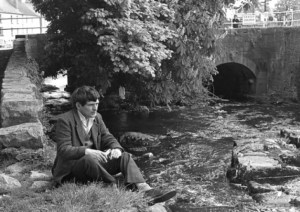
Michael Hartnett in pensive mood by the River Arra in Newcastle West in the 1970s. Photo credit to Limerick Leader Photo Archives