English must be a nearly impossible language to learn – but then again, maybe this applies to all languages. We’ve all heard of the phrases, “It was all Greek to me” or even, “It was all double Dutch”. However, in my opinion, nowhere is this more apparent than in Ireland, where, as Bing Crosby used to croon, “They speak a language the strangers do not know”. I suppose there is a good reason we call language our “mother tongue”. My mother-in-law, Lord rest her, had hundreds of phrases and words I hear very rarely nowadays. I find myself explaining some of them with the words, “as my mother-in-law always used to say”.
These phrases were used over and over; so, I suppose I shouldn’t be surprised that many of my wife’s sayings also defy explanation. For example, if I were getting notions above my station, she would tell me that I was “like the gander that got up on the ditch to die”! If you argued with this unfair assessment of your character, she’d say that I was ‘sailing very close to the wind’ and if it was Winter, she’d tell me that ‘I was skating on very thin ice’!
According to her mother, a harsh wind would “skin you,” while a critical person had “a tongue like a lash”. Someone inclined to give out was likely, “to ate you without salt’. If she said someone had “a lack in him”, in her lexicon it meant that he had no common sense or empathy – maybe he was, “a bit simple”. If there was a big crowd at the card game in the local hall she’d tell us “They were there from the lighthouse”.
Of someone who had changed beyond recognition, she would say she “wouldn’t know him, or the sky over him” because she hadn’t seen him in “donkey’s years”. If someone was cunning, he probably “knew more than his prayers”. She rarely, if ever, swore, but invoked “Jesus, Mary, and Joseph” regularly, on the grounds that it was a prayer. I believed that one for years! Reference to prayer also occurred when someone was annoying, “I said prayers for that fella, I can tell you.” It meant the opposite, naturally!
Someone who was mean, was “tight”, he would “mind mice at crossroads”. A mean person “wouldn’t give you the steam off his piss”. A disputatious person would be capable of “making trouble in heaven”, or if cranky of, “fighting with his fingernails” or being “as cross as a bag of cats” – in truth, “he’d bate the Maker” and anyway he was “a horrible disciple” and “he’d break your melt”. Skinny people were as “thin as a rake”, whereas a heavy person was “gone out of the way altogether”, sure he was “a big falbo” or a “big, awkward fostook of a fellow”.
When she made too much food, she would muse that she had made enough “to feed a thrashing”. I think that phrase came from the custom of neighbours getting together to help one another, to ‘comhar’ (from the Irish word cabhair, meaning to help) to save oats or barley, with the original expression being “threshing”. This gathering of close neighbours was also referred to by her as “a meitheal”. Indeed, many of her finest gems were left-overs from a bygone age where Gaelic was the spoken language – until that was beaten out of us and made to seem very vulgar and unfashionable in the nineteenth century. Sure, maybe that was all “pure baloney”!
Breda O’Brien, writing in The Irish Times some time ago, said her mother couldn’t put a sentence together in Irish, but something that was a mess was “trína chéile”, and a stupid man was “an amadán” or a “right bacach”, and a silly woman was still “an óinseach”, and of course, just as she always pointed out, delph invariably smashed into “smidiríní”. Ah, but she was in the ha’penny place compared to my mother-in-law, Breda from Monegea, who told me one Christmas that she was, “as full as a tick” – an old word for a mattress filled with duck feathers! No one could ever accuse her of being shy or introverted; she had a huge heart and fierce, unflinching loyalty to her family and friends. It is not just their wonderfully expressive words that I miss, and not just long-gone Christmas memories that make me want to shed a tear.
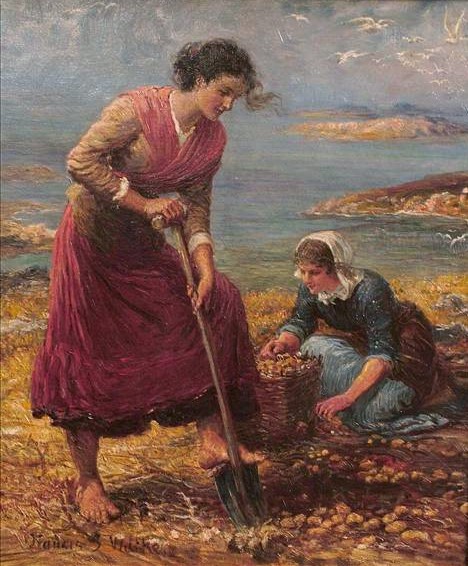
So, if by chance, in the near future, you visit Ireland, you can be assured that there are still strong women, “in the uplands digging praties, speaking a language the strangers do not know”!
 Reviews Rants and Rambles
You must be logged in to post a comment.