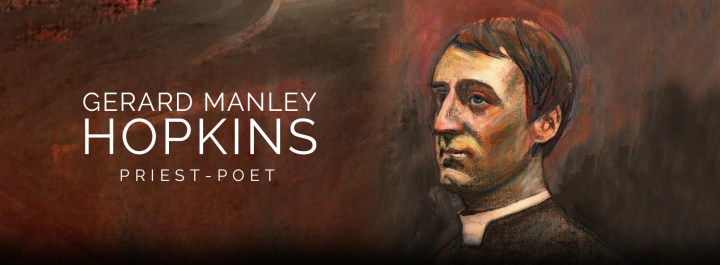
Humour me as I indulge in a little bit of poetic nostalgia! I love the poetry of Fr. Gerard Manley! As a teacher of English literature, you are always conscious of introducing poets and novelists to a younger cohort who come from many and varied backgrounds. Like Roddy Doyle in his Barrytown trilogy, you have to cut your cloth according to its measure! Father Gerrah speaks to all ages and backgrounds – but he is an acquired taste. In these horrible Trumpian days, his poetry, even his Terrible Sonnets, has given me great hope. For me, his poetry is timeless; he is a poet for all ages. The world surrounded Hopkins with visions of God’s glory, and the poet responded by capturing those moments in imagery that is both original and quite remarkable in its range. In his early poetry, Hopkins employs imagery to expose God’s glory in nature’s elements, while the later poetry gives us dramatic images of near desolation and despair.
As well as his poetry, his life story has long fascinated me. He was born in Essex in 1844, the eldest son of a prosperous middle-class family. He was educated at Highgate School and Balliol College, Oxford, where he studied Classics and began his lifelong friendship with Robert Bridges. In 1866, he converted to the Catholic Church, and two years later, he joined the Jesuit Order, having come to admire the work of the recently canonised Saint, Cardinal John Henry Newman. He was ordained a Jesuit in 1877 and served as a priest in several parishes, including slum districts in Liverpool and Glasgow. From 1882 to 1884, he taught at Stonyhurst College and in 1884, he became Classics Professor at the fledgling University College, Dublin. What fascinates me about the man and the poet is that he was hardly known as a poet, except for one or two friends, during his lifetime. He lived and died in the nineteenth century, yet his poems were not published until 1918, nearly thirty years after his death. They were published in a volume edited by his great friend, Robert Bridges.
In Roddy Doyle’s novel The Van, Darren is making valiant efforts to study Hopkins’s poetry for his Leaving Cert. He is introduced as ‘the clever one’ in the family, a teenage son who is trying to find a place to study in the kitchen, highlighting the domestic chaos of the Rabbitte household. He reads ‘Inversnaid’ and wonders when Tippex had been invented and concludes, ‘Gerrah Manley Hopkins had definitely been sniffing something.’ Unfortunately, he was also struggling to make sense of a wide range of other Gerard Manley Hopkins poems on the course, such as ‘God’s Grandeur,’ ‘Spring,’ ‘The Windhover,’ ‘Felix Randal,’ ‘I wake and feel the fell of dark,’ and Inversnaid .
In The Windhover, Hopkins uses recurring images of royalty. The high-flying solitary falcon is a monarch of the sky, surging with the poet’s spirit through the steady air. The poet uses chivalric terms such as ‘dauphin’ and ‘minion’ to capture the elegant and dignified ‘striding’ falcon, the prince of the daylight. God, too, is seen as a ‘chevalier’. These images carry connotations of medieval romance and chivalry, and perhaps the virtuous struggle of the falcon in the air is symbolic of the Christian knight, Christ the chevalier, overcoming the pervasive threat of evil. This conflict in the poem is dramatised through imagery that suggests the supremacy of the falcon in flight, and its control and mastery that ‘rebuffed the big wind’.
Another feature of Hopkins’s images here is the way in which they are loaded with possibilities. It is as if Hopkins intended to create multiple ideas in some of his images, each interesting and valid in its own way. For example, the image of the falcon on a ‘rein’ may represent the motion of a horse at the end of a trainer’s long rein. However, the term, being ambiguous, could also suggest the spiral climb of the bird. Perhaps Hopkins is encouraging us to ‘Buckle’ several ideas in our engagement with the poem. What is not in doubt, at any rate, is the powerful and original representation, through the falcon, of Christ’s beauty and nobility.
Hopkins uses a very different image in describing the precision of the falcon’s flight, where he says, ‘As a skate’s heel sweeps smooth on a bow-bend’. This image also conveys the speed of the bird’s flight. Other original images include that of ‘blue-bleak embers’ representing self-sacrifice and the ‘plough down sillion’ that evokes the hardship and perhaps tedium of daily labour.
In ‘The Windhover’, therefore, Hopkins employs images of flight, of majesty, of sacrifice and of glory ranging from a ‘dauphin’ to a ‘skate’s heel’, from a ‘fire’ to ‘blue-bleak embers’. Such remarkable and wide-ranging imagery reflects the vivid and precise response of the poet’s imagination to the sight of the falcon at dawn. More importantly, perhaps, the imagery reveals that the moment created a response of deep spiritual insight. There is nothing particularly novel in taking a falcon as subject matter. The good news for us is that this sight of a hovering falcon has, thankfully, become a common sight once again. However, what is original here is the way Hopkins engages with the falcon, observes it and concentrates on it in a deeper way and articulates what it revealed to him through an interesting range of original imagery. Let it be your own mindfulness exercise today as you ramble the rural highways and byways.
However, particularly in his The Terrible Sonnets, there is another, more disturbing effect created by Hopkins’s wide-ranging use of imagery. We know that he wrestled with doubt, particularly during his final years, which he spent teaching in Dublin and, in my opinion, these poems could have been written this January, or as we were told, schools were closing because of this bloody pandemic in March 2020! In ‘I Wake and Feel the Fell of Dark’, he states that God exists; he is always certain of that, but why does he appear to be so far away, apparently unresponsive and uncaring to a man whose letters are ‘dead’? Hopkins’s increasingly sinister images explore the bounds of human suffering and despair.
In this sonnet, the conspicuous absence of daylight reminds us how far the poet has come from the glorious sunshine and colour in Spring or ‘The Windhover’. There is little evidence of ‘couple-colour’ in ‘the black hours’ Hopkins has spent with his torment, suffering ‘yet longer light’s delay’. The delay of light represents, of course, the delay of hope – all is now ‘gall’ and ‘heartburn’. Quite remarkably, taste is evoked as a description of the poet’s state – he didn’t have Covid, so! He becomes bitterness itself, born out of his near despair. Yet perhaps this is God’s will that he suffer the ‘curse’ with which his ‘bones’ and ‘flesh’ must contend. He compares his tormented spirit to sour dough, which needs to be transformed.
In his sonnet, “No worst, there is none’, Hopkins outlines the intensity of his pain in the opening quatrain and then proceeds to seek significant comfort, but in vain. This sonnet is particularly interesting in that many of its images echo through earlier poems where the mood was less despondent. The poet’s sense of despair is emphasised in quatrain two in an unusual but particularly poignant image of his cries heaving ‘herds-long’, gathering at the gate of heaven, perhaps, but not being admitted or even acknowledged. Where is the comfort that Hopkins himself had administered to Felix Randal? The poet then refers to an ‘age-old anvil’, a sounding board which winces and rings out his pain. This very original image of the anvil reminds us again of Felix and his work in the forge, except on this occasion, the poet is the raw material that Christ is beating into shape.
In the sestet, the poet refers to a natural landscape, the mountains. In earlier poems, ‘wilderness’ filled him with joy. Here, however, the steep cliffs, a nightmarish metaphor, represent the spiritual torment and physical suffering that the poet has had to endure, day in, day out. The only comfort is the relief of sleep. But in ‘I wake and feel the fell of dark’, the poet awakens to the oppressive darkness of night and yearns for the respite of daylight. The dark night is itself symbolic of dark periods in the poet’s life when hope of spiritual ecstasy may have seemed very distant.
In Hopkins’s poetry, therefore, the range of imagery is certainly quite extensive, his originality unquestioned. Imagery ignites the poet’s celebration, and it ignites his desolation. In his own unique Trumpian-like darkness, there is no flash of colour, of light, no ’dapple-dawn-drawn’ inspiration to lift his thoughts, no sparks, no flashes, no gold in his oval office. In 1889, only weeks before his death, Hopkins wrote ‘Thou art indeed just, Lord’. In the poem, images of fertility in nature abound: building, breeding, waking, growing. Yet, the concluding appeal, expressed again through a vivid and most appropriate image, is that as Spring renews nature, so God may send his ‘roots rain’. And as my mother always said, where there’s life, there’s hope! Hopkins himself would probably have said, where there’s prayer, there’s hope. So, as I’ve said somewhere else, even the so-called Terrible Sonnets are that terrible after all!
At the end of The Van, Darren is doing well in school and is a success, in contrast to his father, Jimmy Sr., who has been laid off again and is struggling financially. Darren, who is still ‘doing very well in school’, expresses regret for his remark that ‘the State’ and not his father has put the dinner on the table, suggesting a deeper understanding of his father’s situation and a desire for reconciliation.
For that flash of empathy and compassion alone, we surely have to thank ‘Gerrah Manley Hopkins’ for that!
 Reviews Rants and Rambles
A lovely post Vincent. GMH was on the syllabus when I did A Level English, almost 50 years ago! I’ve loved him ever since, although I don’t take the book down from the shelves nearly often enough (and thank you for the incentive to do so now). My favourites are The Starlight Night and As Kingfishers Catch Fire, although I have to confess I’ve always preferred his first verses to the spiritual musings of subsequent verses.
LikeLiked by 1 person
His later verses are very despondent alright, Lucy. I have a theory that the reason for this was that he was by then living in the Jesuit house in Milltown, in Dublin, a hotbed of debate and Irish Nationalism in the 1860s, 1870s. The joys of being an Englishman abroad!
LikeLike
I’m afraid my intention was more superficial than you understand Vincent. I meant the 2nd and subsequent verses of each poem of the two poems I named! Sister Francis (St Mary’s Shaftesbury) would be very disappointed in me were she still around.
LikeLiked by 1 person
Except for the lack of physical hand-holding, this was like sitting down with Fr. for a few moments! Thank you!
LikeLike
Quite right too!
LikeLike