Bishop Brendan Leahy launches Diocesan #Synod2016

Homily  of Bishop Brendan Leahy

St. John’s Cathedral

December 7th, 2014


Bishop Leahy

Today we are launching the Limerick Diocesan Synod and commissioning Delegates to it.  It is a significant day in the life of the Diocese.  Our liturgy seems just tailor-made for the occasion.

The Gospel presents the figure of John the Baptist.  At the time of John the Baptist, Jesus’ cousin, there was a sense of spiritual wilderness creeping into the people of Israel.  It was something they had experienced before and were now witnessing again.  Precisely at that time, John the Baptist was chosen to be the instrument in the hands of God to prepare the way of Jesus.  We can see that God made himself ‘need’ John the Baptist to prepare for his coming.  God is indeed the shepherd who feeds his flock and leads them but he makes himself dependent on us; he makes himself need our help.  Indeed, we can say that God is the expert of doing things not on his own but ‘together’ with others.

Just as in the case of John the Baptist, God counts on the contribution of each one of us too to prepare the way for his Son Jesus Christ to be seen, heard and encountered again in our world, in our country, and in our diocese.  We too are living in a spiritual wilderness of sorts – we’ve been through difficult and confusing times in the Church; there have been many cultural and social changes in recent years; the shape of our Church’s structures are in transition; we’ve seen internal divisions among us and we know that young people often don’t find what they are looking for in the Church as we present it today.

Our Diocesan Synod is to be a time when we clearly commit ourselves again to do our part to prepare the way for Jesus to come again in a new way among us at all levels of Church and indeed in society.  With the Synod, all of us together, clergy and lay, are being offered this opportunity to regenerate and build up the Church of the future in our diocese.  Let’s not miss this appointment with history.*

It’s undeniable that our Church has been rocked.  It has stumbled badly but it has not fallen.  While the Church reeled, faith remained precious.  Yet the Church is in need of repair.  It’s what the Lord told St. Francis in his time and tells us again now in our time.   We need to look at it again, reimagine and re-arrange, not to the way it was before but to something new.  Something that fits the present day.  We need to rebuild and repair, listening to what the Spirit is saying to the Church today.*

But that rebuild and repair, with Pope Francis as a guiding architect and his hand directed by the Holy Spirit, is not something fort the clergy alone to carry out.  Far from it.  The Church of tomorrow must be inclusive, regenerated by us all together, clergy and laity; those of great faith and those of challenged faith, working hand in hand to create a refreshed space where the windows are open and new air breathes in.  I ask everyone in the Diocese to get involved in this.*

The 2016 Synod will effectively be the moment to draw up new plans for our diocese so that it is ready for what I believe can be a new dawn breaking for the Church, a dawn we will all greet together.

Sisters and brothers gathered here in St. John’s Cathedral today, especially those of you who are being commissioned as Delegates to the Synod, let’s learn from the figure of John the Baptist.  He didn’t focus on himself; he was humble; he was full of hope in Jesus’ gift of the Holy Spirit and looked forward to the new dawn.

He didn’t focus on himself.  He wanted to help others turn around, turn away from sin and put god in the first place in their lives.  You too will now go out to help one another and others to prepare the way of Our Lord Jesus Christ.  There will be many paths to be made straight – paths of wounded hearts; paths of confused minds; paths of disappointed spirits; paths of rejected outreach.  Through listening with your hearts full of mercy and patience, you can transform crooked pathways into opportunities to show something new is happening; Jesus is coming in a new way to heal wounds, bring light and clarity, sow seeds of hope and mercy.

John the Baptist was humble.  In his day, undoing the straps of someone’s sandals was considered the most menial of jobs fit only for slaves.  John the Baptist didn’t even see himself fit to undo the strap of Jesus’ sandals.  This reveals something of the humility of his soul.  To be humble is to consider others as greater than ourselves, as St. Paul tells us.  John the Baptist lived this out in his relationship with Jesus.  But each of us can consider others greater than ourselves in the sense that in each neighbour we meet we are encountering Jesus in that neighbour.  It will be important for us to be humble and approach our Synod in a spirit of serving |Jesus in our neighbour.

John the Baptist was a man of hope,  believing in a better future and in the work of the Holy Spirit.  He pointed out that Jesus would baptise us with the Holy Spirit.  For us too, we can say that the Jesus who wants to come in a new way among us brings the Holy Spirit in abundance.  So there’s no need to be afraid or downhearted about the future.  As Pope Francis puts it, let’s not say our times are harder than previous times; they are just different.  Mary, the mother of Jesus, the ‘undoer of knots’ was always full of hope.  As the Second Reading reminds us, with the Lord ‘a day’ can mean a thousand years, and a thousand years is like a day.  he can act much faster than we might think if we let him.

In a moment, we will be commissioning the Delegates to the Synod.  As we set off on our Synodal journey, the Delegates will declare publically before us all, their intention to live their Baptismal vocation with renewed faith, hope and love.  Above all, they will promise to love one another as Our Lord has taught us in giving us the New Commandment: “A new commandment I give you: love one another”.  Let’s all join with them as they make this commitment, promising to share each other’s joys and sufferings, giving our lives out of love for one another.  We can take it as a form of pact that binds us together in a new way preparing the way of the Lord who is coming to dwell among us anew.

* my emphasis

Christmas in Maiden Street – ‘in the good old days’!


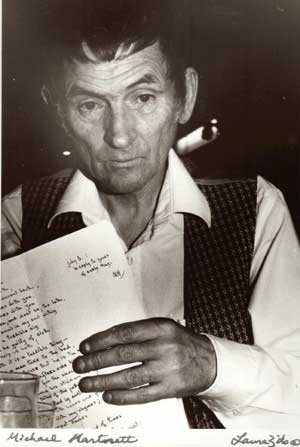
 This piece of incisive and insightful social commentary, describing life in Newcastle West in the 1950’s, first appeared in Magill magazine in December 1977 and later in the Journal of the Newcastle West Historical Society, The Annual Observer, in July 1979. Hartnett,the poet, was back in town and the dam burst of memory and nostalgia was beginning, culminating with the bitter sweet Maiden Street Ballad, written as a Christmas present for his father, Denis Hartnett, in December 1980.

Christmas in Maiden Street
By Michael Hartnett

image


A shouting farmer with a shotgun, a few patch-trousered urchins, soaked, snotty and unrepentant, running across wet fields, arms full of holly. The long walk on the railway tracks, the sleepers treacherous and slimy, the dark station, the lamp posts with their glittering circular rainbows. We stopped at the shops’ red windows to admire toys we could never have. A few drunks waltzed by, happy and moronic. An open lorry went by to jeers and obscenities; the pluckers, shawled and snuff-nosed, on their way to a flea-filled poultry store to pluck turkeys at nine pence a head.

Candles and paraffin-lamps did not brighten the darkness in kitchens in Maiden Street – they only made the gloom amber. The purloined holly hung on holy pictures. There were no balloons, no paper chains, no Christmas trees. Coal was bought by the half-stone, butter by the quarter-pound, and tea by the half-ounce. The country people trotted by on donkey and cart or pony and trap with ‘The Christmas’ stones of sugar, pounds of tea. Women in shawls and second-hand coats from America stood at half-doors, their credit exhausted, while the spectre of Santa Claus loomed malevolently over the slates and thatch.

Members of Charitable Institutions distributed turf and boots, God Blessing the meagre kitchens, as hated as the rent-man. They stood well-dressed on the stone floors, were sirred and doffed at. They paid their workers slave wages. They looked without pity at the nailed together chairs, the worn oilcloth-topped tables, the dead fires.

Outside, the rain fell and blew along the street. The tinkers fought. Bonfires died out in the drizzle. We were washed and put to bed, happy and under-nourished. The oldest went to Midnight Mass. The Latin was magic, the organ, the big choir. It always seemed like a romantic time to die.

It was a Christmas of tin soldiers, tin aeroplanes and cardboard gimcracks. We were Cisco, Batman, Johnny McBrown all that day. Our presents – ‘purties’ we called them – seldom lasted longer than that day. It never snowed. There was no turkey, no plum-pudding, no mince-pies. The Victorian Christmas was not yet compulsory. The very poor managed roast meat, usually mutton. We often rose to two cocks. The goose was common. There was a fruit-cake, jelly and custard; the dinner of the year. I never remember drink being in the house. There were never visitors, nor were we encouraged to visit anyone. If the day had been anyway fine, we were to be found on the footpath or in the puddles, knuckles blue.

The Wren’s Day always brought frost. Small warm heads came from under rough blankets to the sound of flutes and banjos and bodhrans far up the street. We donned boot polish and lipstick and old dresses and went out to follow the Wren, tuneless chancers. We sang and giggled our way to a few bob and a glass of lemonade. The back kitchens of the pubs filled up with musicians, the musicians filled up with porter and their wives filled up with apprehension. In a few hours, winter took over again.

There will never be Christmasses like those again, I hope to God.


MichaelHartnett

OUT OF THE MOUTHS OF BABES…..

Out of the mouths of babes comes wisdom – of a sort!  For thirty years I spent my summers correcting Leaving Cert English scripts and it never failed to amaze me the chances chancers will take when rote learning hits the cold reality of the North face of The Eiger!  I began my work with the Department in June 1978 and I corrected Junior Cert Geography that year.  I learnt that  the name of the shipyard in Belfast was called Harland and Wolf Tone and that along with cheese and butter and yoghurt (which had just arrived on the shop shelves) milk of magnesia was also a dairy product!

English, however, was the gift that kept on giving!  Shakespeare usually threw up numerous gems of lucidity and erudition.  I learnt, for the first time, that  Othello, ‘although his exterior may be black he is pure and good on the inside’.  Desdemona is very forgiving also, to the point where ‘she shows great love for Othello even after he has suffocated her’.  King Lear suffered because, ‘he wanted to keep his revenue and all his followers’.   Also, ‘in those days you didn’t divide your kingdom – you left a will’.  In a moment of weakness Lear is overheard talking to The Fool on the Heath: ‘Go in man you’ll catch your death out here’.  Whereas Hamlet, ‘is the victim of exaggerated procrastination complex’ and as well as that he suffered from ‘an anti disposition’ and then later ‘an antique disposition’.  I can visualise vividly  in my mind’s eye harried teachers on cold winter’s mornings explaining what an arras was only for that information to be completely corrupted by June: ‘He killed Polonius through the arse’ and in another script sponsored by Toyota, ‘Hamlet stabbed Polonius behind the Yaris’.  Also Hamlet was only mad North North West so therefore according to the mathematicians, he ‘was only one sixteenth mad’.

Yeats always yielded up a great variety of hoary old chestnuts.  Indeed I was reliably informed that in that great poem Among School Children, ‘the chestnut tree may not be called the bole, blossom or the branch – it is all three.’  Everybody also seemed to know that, ‘he stalked Maud Gonne, proposing to her many times’.  Elsewhere in a rather revealing Freudian (or Faustian) slip Maud Gonne is referred to as, ‘Mad Gun McBride’.   The poem Sailing to Byzantium can apparently, ‘be summed up in four words: ‘perne in a gyre’.  The poem The Fisherman is about, ‘a man in Connemara clothes living in a shed on the top of a hill’.  In this great poem Yeats apparently is struggling to reconcile the opposing images, trying to describe, ‘the ideal man versus the reel man’.  One candidate suggested that Yeats was a sad case because, ‘he was plagued with immortality and involved in politics.’

O’Casey’s plays also provided rich seams of unintended humour, double entendres and other heaven sent certainties. One candidate mentioned the fact that, ‘Johnny is no longer able to work because of an accident where he lost an arm and now he walks with a limp’ and continued to dig a deep hole by saying, ‘a job on a building site wouldn’t strain his arms because it’s not his legs he’s mixing it with.’  Captain Boyle was not understood at all, ‘there is nothing attractive or endearing about Captain Boyle, he is literally a boyle on the butt of humanity’.  It is also suggested that, ‘he attends drinking seminars in a local pub’.   Summing up Juno and the Paycock one candidate suggests that, ‘Joxer is the parasite and Boyle is the dope (sic)’.  Bessy Burgess in The Plough and the Stars is described as, ‘a pearl containing oyster of a woman’!   She has a sharp tongue in her head and she says, ‘that Mrs. Gogan’s wedding vowels are not valid’.  Christy Mahon in The Playboy of the Western World is beautifully described as having. ‘small feet which is a sign of great breathing’.  These candidates may not have gone down in English – most of them anyway! – but they will definitely go down in history!

Lord of the Flies by William Golding always gave rise to unexpected surprises.  The boys, ‘find they are on an island inhabited by pigs and bugs’  and, ‘they have to defend for themselves’ and then we discover that, ‘any pigment of control is lost when Piggy dies’.

Personal essays also provided an amazing array of views on the vagaries of teenage life: the following are some of the many gems which brought a smile to my face.

  • Summer holidays from school are great – your only worry is have you put enough sun screen on your nose.
  • Life is like meeting the man of your dreams and then meeting his beautiful wife!
  • It was a buzzing party so there were no straight people there…..
  • In Second Year there were thirty-one of us in our class – I was the one!!
  • Waiting for the school bus is a mating ritual…..
  • The mood is electrical…..
  • There was a climatic moment as the aria was played……..
  • Dreaming is actually one of the things I’m good at…..
  • The internet is a gateway to child pornography and a perverse culture used by losers and sad cases….

I could go on and on but suffice it to say that all these slips of the pen brightened up my hazy July days and needless to say they were all – well nearly all! – rewarded accordingly!  I will give the final word to one young statistician who summed up our national predicament quite succinctly: ‘We are a 100 per cent white, 95 per cent Catholic and 110 per cent naïve country’.  Out of the mouths of babes…….

image

Just a thought…….

 There is a motif running through modern Irish literature where somebody starts out unable to speak, and finishes in a condition of great eloquence.  In James Joyce’s Portrait of the Artist as a Young Man on the first page, Baby Stephen is lisping, he’s mispronouncing words, he cannot speak, but that novel, a sort of central classical Irish novel, ends with Stephen about whom the story was being told, taking over the story and telling it himself in his own eloquent way.

Similarly, in J. M. Synge’s Playboy of the Western World, the hero when we first meet him, is a stuttering lout in a ditch, he can’t speak and he comes out of the ditch into the pub, and he starts telling a story which is partly a lie and partly of course the truth.  And he becomes more and more eloquent.  The more eloquent he becomes the more he discovers he has an identity, that he is a person.

More recently Brian Friel also uses this more nuanced device in Translations where, as the play opens, Manus is teaching Sarah to speak in the local hedge school in Ballybeg.  Her speech defect is so bad that all her life she has been considered to be dumb and she herself has accepted this.  She is described in the Stage Directions as being ‘waiflike’ and she, ‘could be any age from seventeen to thirty-five’.  She is used in the play to symbolise the vexed issue, a preoccupation of Friel’s, of communication, language and Irish identity.  In the play Sarah is perpetually spoken for, she then gradually finds her voice only to lose it again. She never achieves the eloquence of Stephen Dedalus or Christy Mahon.  Towards the end of the play she  refuses to speak to Captain Lancey and maybe this act can be interpreted as regressing back to her previous state or maybe as an act of resistance to his colonising influence……..

This enforced silence is also a feature of more recent Irish writing.   A well-known saying in the North during ‘The Troubles’ was, ‘Whatever you say, say nothing’.   Seamus Heaney used the phrase as the title and the theme of one of his most impressive poems on the North of Ireland:

‘The famous Northern reticence, the tight gag of place

And times: yes, yes.  Of the ‘wee six’ I sing

Where to be saved you only must save face

And whatever you say, say nothing.’

There is a natural reserve built in to any discussion about politics or about happenings where there may be conflict.  Nowhere is this depicted better than in Seamus Deane’s brilliant novel about the Northern Ireland conflict, Reading in the Dark.

Canal Bank Walk by Patrick Kavanagh


Leafy with-love banks and the green waters of the canal
Pouring redemption for me, that I do
The will of God, wallow in the habitual, the banal,
Grow with nature again as before I grew.
The bright stick trapped, the breeze adding a third
Party to the couple kissing on an old seat,
And a bird gathering materials for the nest for the Word
Eloquently new and abandoned to its delirious beat.
O unworn world enrapture me, encapture me in a web
Of fabulous grass and eternal voices by a beech,
Feed the gaping need of my senses, give me ad lib
To pray unselfconsciously with overflowing speech
For this soul needs to be honoured with a new dress woven
From green and blue things and arguments that cannot be proven.


 In a lecture entitled ‘Man and Poet’, Kavanagh said:

‘We are in too great a hurry.  We want a person or thing to yield their pleasures and their secrets to us quickly for we have other commitments.  But it is the days when we are idle, when nothing appears to be happening, which provide us, when no one is looking, with all that is memorable’.

The Canal Bank sonnets are unhurried poems in which Kavanagh’s idleness yields precious, unforgettable experiences.  ‘Canal Bank Walk’ is, in effect, the natural poetic sequel to ‘Advent’.

Anthony Cronin has described Patrick Kavanagh as an intensely private man who lived his life in public places, a man who thought mediocrity the enemy of genius, the enemy of life.  He did live a public life as journalist and man about town but Kavanagh also claimed that, ‘the only subject that is of any great importance is – Man-in-this-world-and-why’.  He also believed that, ‘Parochialism is universal; it deals with the fundamentals’ and that great beauty and profound truths can be discovered in apparently ordinary places.

‘Canal Bank Walk’ is written in the traditional 14-line sonnet form.  In this poem, Kavanagh combines both the Petrarchan and Shakespearean sonnets, using the same methods as in ‘Inniskeen Road’.

Religion is a dominant feature in Kavanagh’s poetry, both as a theme and as a source of imagery.  Religion features thematically in ‘Advent’, ‘Canal Bank Walk’,  and ‘A Christmas Childhood’.

His  attitude to the environment changed dramatically following his operation for lung cancer.  He said: ‘As a poet I was born in or about 1955, the place of my birth being the banks of the Grand Canal’.  ‘Canal Bank Walk’ is the first poem Kavanagh wrote after coming out of hospital in 1955.  He claims to have undergone a mystical experience through hospitalisation and recovery.  His whole view of life and of poetry has now changed.  From now on his poetry will be about celebration, about joy, about appreciating the wonderful world God has made.  He has been reborn; his new-born soul is being baptised in, ‘the green waters of the canal’.  Canal water is no longer canal water.  He sees it now, not through material eyes but through spiritual eyes.  He is baptised and from now on will do, ‘the will of God’; and the will of God is that he steep himself in the ordinary world – ‘Wallow in the habitual’.  He will go back to his original innocence, to a state of ‘oneness’ with nature, with God’s creation.  He will  ‘grow again with nature’ as he did before experience corrupted him and wonder died (see ‘Advent’).  There won’t be any more intellectualising.  He will just settle for the world of the senses, the world of sight and sound.  Now that he is renewed and at one with nature, he has eyes for the very ordinary things – ‘the bright stick trapped’, ‘the couple kissing ‘, ‘the bird building’.

The couple are not alone on the seat, the ‘breeze’ adds a third party and is symbolic of his new found gift of observation of ordinary things.  He sees the bird, ‘gathering materials for the nest’ and looks on this ordinary sight with spiritual eyes and the ordinary is transformed – it takes on a religious significance: the bird is preparing the stable at Bethlehem where the Word will be made Flesh, where God will reveal Himself in the form of new life.  Everything will now be brand new; he has just been born as it were; a world that has grown stale through experience and familiarity is new again – ‘eloquently new and abandoned to its delirious beat’.  It’s an ‘unworn world’ – brand new.

He wants to be ensnared in this world of the senses, in this world of sight and sound, in the world of, ‘fabulous grass and eternal voices by a beech’ – the voices of nature no doubt.  He uses the image of the web to suggest his wish to be captivated by nature, he doesn’t want to escape back to a world of analysis and ‘testing’.  ‘Feed the gaping need of my senses’ – he will gladly settle for the world of the senses – no need for the sophistication of intellectualising – ‘to look on is enough in the business of love’.  He wants to pray (as children do) ‘unselfconsciously’, without restraint.  He sees his soul being dressed in a new dress ‘of green and blue things’ – the green of the earth and the blue of the sky – the totality of creation – the world of the senses.

 Kavanagh’s poetry is a record of a journey that brought him from Monaghan to the banks of the Grand Canal, a journey of discovery and exploration in which he reveals himself as one who found the ordinary, extraordinary, and that, ‘the things that really matter (are) casual, insignificant little things’.  Even in the city the images are rural and we are treated to a virtual cornucopia of happy, summery images of grass, trees, breezes and birds.  The poet, Harry Clifton, has said that, ‘In Kavanagh’s finest work, it is almost always high summer’.

In ‘Canal Bank Walk’ it is obvious that Kavanagh is capable of great lyrical intensity.  There is great lyrical, gentle but impassioned quality in lines such as, ‘O unworn world enrapture me’ or, ‘Feed the gaping need of my senses’ and a sense of being totally at ease.  Kavanagh’s language can be what Patrick Crotty calls ‘grittily realistic’ (especially in ‘The Great Hunger’) but there is also a colloquial rhythm in such lines as, ‘There’s a dance in Billy Brennan’s barn tonight’ or, ‘That was the year of the Munich bother’ and there is also a great lyrical quality here in ‘Canal Bank Walk’ where ‘pouring’ and ‘overflowing’ seem to describe the poem’s rhythm and mood:

 ‘For this soul needs to be honoured with a new dress woven

From green and blue things and arguments that cannot be proven.’

This is a beautiful  unhurried poem in which the poet’s idleness yields precious, unforgettable experiences.

image


Advent by Patrick Kavanagh

Advent

We have tested and tasted too much, lover-
Through a chink too wide there comes in no wonder.
But here in the Advent-darkened room
Where the dry black bread and the sugarless tea
Of penance will charm back the luxury
Of a child’s soul, we’ll return to Doom
The knowledge we stole but could not use.

And the newness that was in every stale thing
When we looked at it as children: the spirit-shocking
Wonder in a black slanting Ulster hill
Or the prophetic astonishment in the tedious talking
Of an old fool will awake for us and bring
You and me to the yard gate to watch the whins
And the bog-holes, cart-tracks, old stables where Time begins.

O after Christmas we’ll have no need to go searching
For the difference that sets an old phrase burning-
We’ll hear it in the whispered argument of a churning
Or in the streets where the village boys are lurching.
And we’ll hear it among decent men too
Who barrow dung in gardens under trees,
Wherever life pours ordinary plenty.
Won’t we be rich, my love and I, and please
God we shall not ask for reason’s payment,
The why of heart-breaking strangeness in dreeping hedges
Nor analyse God’s breath in common statement.
We have thrown into the dust-bin the clay-minted wages
Of pleasure, knowledge and the conscious hour-
And Christ comes with a January flower.

– by Patrick Kavanagh

Most Irish adults over 30 will be familiar with Soundings, the Interim (!) Anthology of poetry edited by the late great Augustine Martin, which was used for many years as a Leaving Cert Poetry Anthology.  ‘Advent’ is one of the many gems which lie within its covers and surely this poem qualifies for what Seamus Heaney describes as one of the many, ‘lyrics which now belongs in the common mind as if they were prenatal possessions’.  On the centenary of Kavanagh’s birth in October 2004, Heaney praised him for his, “indefectible gift for discovering the mystical body of the world in the bits and pieces of every day.”  Nowhere is this more evident than in this beautiful seasonal poem.

In this poem Kavanagh experiments with the sonnet form.  It is an amalgam of two sonnets, but the stanza pattern is neither Petrarchan nor Shakespearean.  The opening two stanzas each contain seven lines, and are meant to represent the period of Advent before Christmas. The third stanza representing an entire sonnet is meant to represent the changes that will follow after this period of penance  has ended – here Advent is seen as a ‘mini-Lent’.  In actual fact maybe we are reading too much into the fact that there are 28 lines in the poem and 28 days in the Season of Advent itself!

‘Advent’ uses religion both as a theme and as its main source of imagery. The theme of the poem is penance-forgiveness-grace, which reflects the theology surrounding the Catholic church’s season of Advent and the Nativity.  He desires to return to the state of childish innocence and Christmas surely brings out the child in all of us!  His reasons, I think, are twofold: after this period of denial and fasting – a 1950’s version of detox! – he will become a better Christian and he will also become a better poet if he can look at the world again through the eyes of a child.  This theme is followed up in  ‘Canal Bank Walk’  where the idea of redemption is introduced, as Kavanagh draws analogies between the waters of baptism and the water of the canal.

‘Advent’, therefore,  is a very religious poem – religious at a personal level.  Kavanagh feels that experience has corrupted him – he has ‘tested and tasted too much’.  ‘Tested and tasted’ indicate seeking pleasure for the mind (Knowledge and analysis) and pleasure for the body.  He has lost his innocence.  Now he wants to recapture that lost state.  He is going to do it through penance, by self-denial and sacrifice, through ‘the dry black bread’ and ‘the sugarless tea of penance’.  He will ‘coax back the luxury of a child’s soul’.  By this he means that he will try to rediscover the innocence of a child and the ability to wonder.  He wants, as it were, to begin again in innocence – to be, in effect, the very first Born-Again-Christian in 1950’s Catholic Ireland!   He wants to bring back the newness that was in the world before things grew stale through over-familiarity.  A ‘black slanting Ulster hill’ will be new again;  the boring chat of a tedious old man will become wonderful.  The whole ordinary, ‘banal’, common world of reality is renewed; wonderful now will be ‘whins’, ‘bogholes’, ‘cart-tracks’, ‘old stables’.

When he has been purified and renewed through penance and self-denial he won’t have to go searching for the newness and the wonder in ordinary things; the whole world will be new and alive and fresh and cliché free – ‘We’ll have no need to go searching for the difference that sets an old phrase burning’.  There will be wonder and newness all around in the very ordinary things – ‘in the whispered argument of a churning’ or in a sight as common as a few local lads holding up the wall, or in the sight of,  ‘men barrowing dung to gardens under trees’.  There will be wonder and newness where things are growing – ‘where-ever life pours ordinary plenty’.   This childlike inquisitiveness will also do wonders for his poetic inspiration – he will now have no end of subjects to write about.

Now he will be rich – spiritually rich.  He does not intend to destroy this wonder by questioning, by analysis, by asking the why of things.  He will be content to revel in wonder.  No more intellectualising… ‘..to look on is enough in the business of love’.  He has abandoned the process of analysis, he has thrown all that into the dust-bin, and he can see Christ all around …’in the January flower’.  He can do this because now he has spiritual eyes – he has been renewed through penance and self-denial.

Therefore, this poem is a search for lost innocence, an attempt to recapture the ability to wonder – ‘discovering the mystical body of the world in the bits and pieces of every day’.

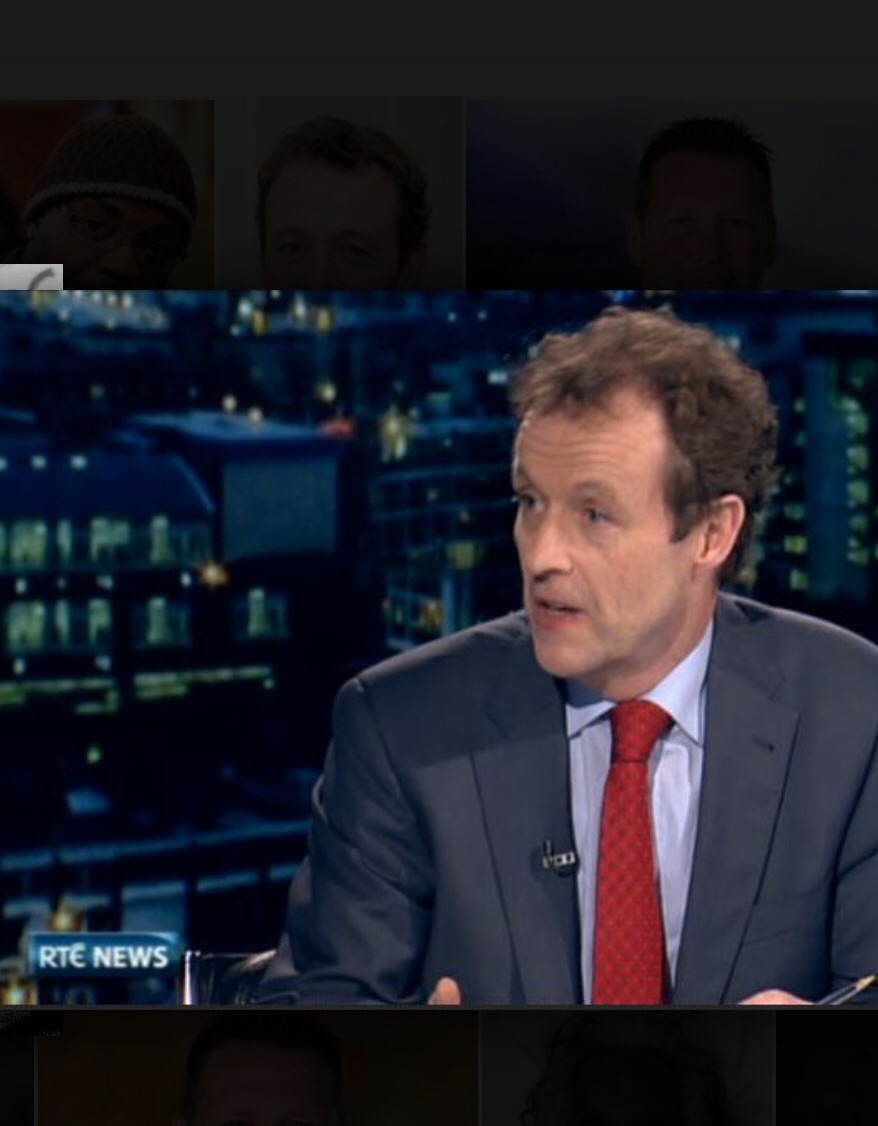
Joe Little RTE News..


image


Cardinal Raymond Burke, recently demoted by Pope Francis from his post in the Vatican, addressed a Conference in Limerick on Saturday, November 15th., on the issue of same sex marriage. This Conference was attended by 200 people and was the subject of a news report on the main Nine O’Clock News on RTE Television on Saturday night. It emerged that RTE were not actually allowed in to film or pick up some sound bites, although Joe Little did manage a twenty second garbled interview with the Cardinal. Most of the footage used seemed to come from the recent Synod in Rome.

Up the road, at the exact same time, in Mary Immaculate College another bishop, Bishop Brendan Leahy, was busy addressing 350 delegates representing all parishes and organisations in his diocese. Bishop Leahy has recently convoked a Diocesan Synod (the first in Ireland since 1955) to help chart the future direction of the Limerick Diocese. The journey began on Saturday and the Synod itself will take place on the 8th., 9th., and 10th. of April 1916.

Was Bishop Leahy interviewed by Joe Little?

Did RTE send Joe and a crew to capture the buzz of excitement in the packed Limetree Theatre in Mary I with their cameras?

Seemingly, RTE don’t do good news stories!

A History of Loneliness by John Boyne – Review by Vincent Hanley

image

John Boyne’s central character in A History of Loneliness is very wishy washy – he is, in effect, the embodiment of a blasphemous blessed trinity of monkeys – he sees no evil, he hears no evil, he speaks no evil. He is completely overshadowed in the novel by the monstrous presence of the notorious Tom Cardle, who bestrides the novel like a venomous, predatory, fiendish and malignant Brendan Smyth. Over the course of the novel Odran Yates shows himself to be, naïve, innocent and clueless. It cannot be claimed, as Tom Cardle accuses him towards the end of the novel, that Odran Yates has been complicit in the events that effected his family and his Church – if anything, the only accusation we can make is that he has been like the proverbial ostrich with his head in the sand for most of his priestly life.

The blurb at the beginning of the novel suggests that, ‘Fr. Odran Yates is a good man’ – not so. As the novel unfolds he is depicted as weak and insipid, he lacks passion, a real calling; he allows evil to flourish by his silence. I find very little to admire in Fr. Yates and this is obviously the author’s main aim. Fr. Yates’ narrative voice is akin to Heaney’s phrase in “Harvest Bow”, ‘gleaning the unsaid off the palpable’. We are forced to continuously read between the lines – his greatest sins are sins of omission. This is a deliberate ploy by the author. In Odran Yates we are presented with the embodiment of the unquestioning functionary who never questions authority. Are we therefore to presume that this is John Boyne’s thesis: that this insidious and widespread abuse continued on a vast scale because ‘good men’ like Fr. Yates stayed quiet – like good children of the 50’s they were seen but never heard?

This new and ambitious novel is set in Ireland, mainly in Dublin and Wexford, also in Rome and Lillehammer, Norway. The first thing that struck me, despite the mainly Irish setting, was that many of the family names are English – Yates, Cooper, Cordington, Camwell, Cardle, etc.

The relevance of the title of the novel, A History of Loneliness, is never nailed down. Loneliness is first mentioned on p442 and then again at the very end when Tom Cardle uses the phrase, ‘But then I have a history of loneliness. Don’t you?’, to Odran after his release from prison. This, I presume, suggests that the priestly vocation is a lonely road to undertake and that this loneliness has led us to the present impasse. To me, this is a very narrow and stereotypical and simplistic explanation for the horrors which have been revealed over the past number of years and is also based on a faulty understanding of priestly celibacy.

Boyne decides not to tell his story chronologically and this leads to some confusion, tooing and froing, backwards and forwards. The novel begins in 2001, then moves to 2006, 1964, 1980, 1972, 2010, 1973, 2011, 1978, 1990, 2007, 1994, 1978, 2008, 2012, and ends in 2013. Boyne is at his best in the 2000’s and his depiction of Ireland and its society is very realistic – as are his descriptions of events in Rome and Norway. However, his depiction of Ireland in the 60’s and 70’s, 80’s is less assured and this reader fumed at much of the lazy stereotypes used by the author. This material grated heavily on my nerves and, to me, was very exaggerated, stereotyped and, quite honestly, lacked credibility. Remember most of his readers will have lived through the years from the mid-fifties and many, like this reader, expected more. To me, it became obvious that the writer, far from trying to depict a sad and despicable period in the history of the Catholic Church in Ireland, has his own axe to grind.

The ‘Irish Mammy’, for example, is depicted in a very stereotypical fashion – ‘Our mammies had set us down one day and told us that we had vocations and so there we were, ready to dedicate our lives to God’. His own mother, ‘..had an epiphany one night while she was watching the Late Late Show’ to the effect that Odran was blessed with a calling from God. In general he suggests that all women in the 50’s lived rather sad lives – ‘.. and after all, that is what women did in those days: they went to school. They got a job, they found a husband, and they left the job and retired to the home to look after the family.’

His exaggerated strereotyping of women, priests, guards and politicians leaves a sour taste. On p.428 we are again presented with a less than credible scenario when he is leaving Pearse Street Garda station and the duty sergeant behind the desk hisses the word ‘Paedo’ as Odran leaves the station! Is this realistic or am I the naïve one? Politicians too are ridiculed as they come under the microscope, ‘Charles Haughey’s terrible crooked head grinning out from the front page with an expression that said that while he had not quite emptied the pockets of the Irish people just yet, he soon would.’

However, in my view, there is a noticeable improvement in the novel beginning with Chapter Six: 2010. There is less clichéd characterisation, less lazy stereotyping. Unfortunately, at this stage, we’re on p. 257 (iPad edition). Many readers will have by this point given up in frustration or disappointment.

However, Boyne has a number of ‘purple patches’ in the novel when the writing is superb; the Rome episodes, the episode when his parishioner, Ann Sullivan, brings her son to the priest, and nearly all the events depicted in the 2000’s are very credible, particularly the radio interview between Cardinal Cordington and Liam Scott and later his eventual journey to Lillehammer and his moving reconciliation with his nephew Aidan.

The episode where Ann Sullivan brings her son who has announced to her that he is gay is an excellent piece of writing. This shows John Boyne and his central character, at their best. Ann brings her son to the priest and during the conversation he mentions that he has a nephew who is gay and he recounts to the mother discussions he has had with Jonas concerning his awakening sexuality. Odran asks his nephew how he knew he was gay and Jonas replies, ‘that he had known since he was nine years old, that the video of a song called ‘Pray’ by Take That had set off the alarm bells.’ This is excellent, this is the John Boyne I remember – the writer who has the uncanny ability to make me feel compassion, even for a Nazi, once upon a time!

As well as Tom Cardle and Cardinal Cordington, Boyne’s other bête noir in the novel is John Paul II. There are numerous unflattering references to the Polish Pope – there is a very vehement and sustained attack on him – presumably because ‘he knew everything and did nothing’. He refers to him as ‘that Polish prick’. There are numerous examples of this vitriol, but I will recount just one: it occurs shortly after Odran’s ordination in Rome, which was performed by John Paul II. His sister, Hannah, was wearing a pale green shawl at the ordination and it slipped slightly as she came forward to be presented to the Pope, ‘and the Holy Father reached out immediately, an expression of near disgust on his face’. He is later described as being ‘a hater of women’.

Indeed, it would seem that Boyne is very harsh on the modern Church and its efforts to come to terms with the scandals that have befallen it. His depiction of lay involvement in the Church, for example, is very inaccurate – ‘the men helped to write the parish newsletter, but the women delivered it; the men organised the church social evenings, but the women cleaned up when they were over….etc.’

For me, the ending of the novel is disappointing and does not follow logically from what goes before. Odran now realises that he has wasted his life, that he, ‘had known everything, right from the start, and never acted on any of it’, that he, ‘was just as guilty as the rest of them’. I find this ending highly disconnected from what has gone before, it is a disappointing conclusion to an otherwise excellent read. Therefore, for me, the novel is somewhat of a curate’s egg of a novel – good in parts!However, the definitive narrative of Ireland’s disgrace remains to be captured in an honest and realistic way – maybe the film version of A History of Loneliness will hopefully better achieve this balance?

Errata:

  • Chapter Three:1964, his mother pays a specialist 40 pence – surely it should have been 3 shillings and 4 pence – he even confuses himself by flipping backwards and forwards across the decades!!!
  • ‘he enrolled as a novitiate in St. Patrick’s College’ – should read he enrolled as a novice in the novitiate in St. Patrick’s College….!
  • On p.502 Tom Cardle (in 1990!) takes £6 from the collection box….

Speechless Without the Bard


image

The English language may have ‘seen better days’ but ‘for better or for worse’, even ‘blinking idiots’ still quote Shakespeare liberally, albeit without knowing it. Indeed, if it were not for these bon mots we’d be nearly speechless.

We have all come across Shakespeare in school, we may even have seen one of his plays on television or in the cinema, yet there are few of us – even those of few words – who don’t quote Shakespeare almost every day. Once in a while we know we’re doing so, but most of the time we use his words to season our speech without knowing the source. Some of his expressions have changed a little with 400 years of everyday use, though even these can easily be traced to him.

If this doesn’t make sense to you and you say, it’s Greek to me, you are quoting Shakespeare. If you think my point is without rhyme or reason and you say I’m a laughing stock or a blinking idiot or bloody minded or a rotten apple or a stony-hearted villain or even the devil incarnate, you are also quoting him. And if you bid me good riddance or send me packing or wish I was hoist with his own petard or dead as a doornailat one fell swoop – you are still quoting him.

When we say that it’s a mad world or not in my book or neither here nor there or last but not least, these phrases – and all the others in bold print here – are Shakespeare’s. And when we use such expressions such as poor but honest or as luck would have it or what’s done is done, we’re equally indebted to him. Whether you are holding your tongue or simply tongue-tied, you just can’t get away from the fact (the more fool you are) that you are quoting Shakespeare. But maybe that was the unkindest cut of all. And if you think this remark smells to heaven, you’re at it once more.

Be that as it may – and though you still insist that I’m living in a fool’s paradisewe can have too much of a good thing. And there we go quoting him again. For the long and the short of it is that we’d be nearly speechless without Shakespeare.

When we talk of someone showing his heels or having no stomach for a fight or leading a charmed life; when we speak of cold comfort or grim necessity or bag and baggage or the mind’s eye, we’re quoting him. When we refer to our salad days or our heart of hearts or our heart’s desire; when we deplore the beginning of the end we’re doing the same.

If we claim to be more sinned against than sinning; if we act more in sorrow than in anger; if our wish is father to the thought; if something we’ve lost has vanished into thin air, we’re borrowing from the Bard. If we refuse to budge an inch or suffer from green-eyed jealousy; if we’ve played fast and loose; if we’ve been a tower of strength or hoodwinked or in a pickle, we’re still doing so.

If you have knitted your brows or stood on ceremony or made a virtue of necessity or danced attendance on or laughed yourself into stitches or had short shrift, you’re using Shakespeare’s words. If you say you haven’t slept a wink or are as sound as a bell or can only die once or that your family is eating you out of house and home, you’re not being very original.

When you state that love is blind or there is method in his madness (or someone has made you mad) or the truth will come to light or the world is my oyster, you are also borrowing your bon mots from the Bard. If you have seen better days or think it is early days yet or high time; if you lie low till the crack of doom, because you suspect foul play; if you tell the truth and shame the devil, even if it involves your own flesh and blood and you believe the game is up, you are at the same game as before!

If you have your teeth set on edge or have a tongue in your head, then by Jove or Tut, tut or for goodness sake or what the dickens or but me no buts – it’s all one to me, for you are simply quoting Shakespeare.

Besides these and many more of our everyday phrases, we are also indebted to him for a host of words. Accommodation, assassination, dexterously, obscene, premeditated, reliance, allurement, alliance, antipathy, critical, armada, demonstrate, dire, emphasis, emulate, horrid, initiate, mediate, modest, vast and submerged are only a few that made their first appearance in his plays.

Indeed, it is obvious that Shakespeare was a man who loved to experiment with words. Most of all he had an extraordinary ability to write memorable combinations of words. Scores of his phrases, as we have seen, have entered the English language and some have even become clichés. One play alone, Hamlet, is a treasure house of ‘quotable quotes’ or, as someone once said, it is ‘full of quotations’! Among them are the following: Frailty thy name is woman!…..The primrose path of dalliance… Something is rotten in the state of Denmark  … Brevity is the soul of wit…… I must be cruel, only to be kind …  The rest is silence.

The English-speaking world is indeed indebted to William Shakespeare more than to any writer in any language who ever lived. “He was not of an age,” said his contemporary Ben Jonson, “but for all time”.

Adapted from an article by Paul Hurley in The Irish Times

FullSizeRender (3)