Introducing ‘The Great Gatsby’

 great-gatsby-dust-jacket-01

A novel of the ‘Roaring Twenties’

This novel lays claim to being (probably) the most memorable fictional evocation of  America of the ‘roaring twenties’, the jazz-age America which came to such a devastating end with the Wall Street Crash at the end of that crazy decade.  Gatsby, Fitzgerald’s finest achievement, is interesting as the record of an era and  of the disillusionment felt by thoughtful, sensitive people with established institutions and beliefs and in their sense of moral chaos in America after the Great War of 1914-1918.

Such was Fitzgerald’s success in expressing what was widely regarded as the spirit of the twenties that he was virtually credited with inventing the period.  It was inevitable that he should be honoured with such dubious titles of distinction as ‘the laureate of the jazz age’ and ‘the novelist of the American dream’.  It is true that he is remarkably successful in rendering some of the essential features of an exciting time.   Sometimes it seems that Gatsby captures the moment and renders a more convincing account of the ‘Roaring Twenties’ than many a historical document.

The fragile, rich, drifting world of the twenties was the emotional heart of Fitzgerald’s life, the source of his happiness as well as his misery.  Gatsby is a reflection of his passionate involvement in the issues of his day, but also of his ambivalent attitude to what he saw and experienced.  It is, however, more than that.  In 1950, the critic Lionel Trilling remarked that  The Great Gatsby was still as fresh and as relevant as when it first appeared in 1925, and that it had even gained in stature and relevance, something that could be said of few American novels of its time.  Sixty five years after Trilling’s comment, there is little evidence that interest in the novel has in any way declined.  Indeed, its popularity has been enhanced by Hollywood film producers who have brought the novel and the era to the silver screen with great success and acclaim.

The American Dream

The Great Gatsby is, like many American novels, about an American dream, one dreamed by the romantic, wealthy bootlegger who gives the book its title.  Gatsby’s dream begins when, as a poor young man, he falls in love with Daisy, a girl whose charm, youth and beauty are coloured and made glamorous in his eyes by a lifetime of wealth, whose very voice, he notes, ‘is full of money’.  His dream that Daisy may become accessible to one of his class and background is nourished by two circumstances: the war makes him an officer, and his post-war activities elevate him to riches.  Gatsby must, however, learn that such things will not bring Daisy wholly within his reach and that however ardently he may pursue it, his dream cannot be realised simply because he wills it.

Class differences

In Gatsby, Fitzgerald is dealing with an important social theme.  He is fascinated by class distinctions and their relationship with the possession of wealth.  This places him firmly in the tradition of the great classical novelists.  The English novel originated in an age (the early eighteenth century) when class structures were drastically disturbed.  Most of the major English novelists have since continued to be absorbed by class differences, and to draw heavily on these and their influences on human behaviour and attitudes.  Think of the dominance of class and money in the novels of Jane Austen.  Although there is an evident ambiguity in Fitzgerald’s attitude to those who possess great wealth, the established rich, they still represent what Lionel Trilling calls, ‘the nearest thing to an aristocracy that America could offer him’.  Fitzgerald deals with the trappings and symbols of this American aristocracy, the great one being money.  In one of his stories, The Rich Boy, there is this telling comment:

Let me tell you about the very rich.  They are different from you and me.  They possess and enjoy early, and it does something to them.

Readers of Gatsby will recognise that it is mainly about what money does to those who possess it in abundance.

There are, of course, two main versions of wealth in The Great Gatsby, dramatically contrasted throughout.  This contrast gives the book much of its interest.  Gatsby himself is the newly-rich tycoon, the boy from Dakota who thought he had to get rich quickly to win the love of a rich girl.  His wealth gives him a vulgar neo-Gothic mansion, an incredible car, and garish clothes; it causes him to assume uncharacteristic stances and attitudes, including ‘an elaborate formality of speech’.  All of these things placed side by side with the grace and ease associated with the representatives of the established rich, Daisy and Tom Buchanan, appear ludicrous.  Gatsby is, from one point of view, a vulgar upstart who purchases his standing in society by giving mammoth parties patronised by all and sundry.  (Check out Fitzgerald’s descriptions of these parties).  His great wealth, for all his efforts,  cannot imitate the effects produced by that of the Buchanans.

The world of the Buchanans

But the contrast is not entirely, or even mainly, in favour of the established rich.  Gatsby, for all his lavish vulgarity, turns out all right in the end in the eyes of the reader; the Buchanans do not.  Gatsby is using his money as an instrument with which to achieve something, to further his aim of enriching his life; he has a capacity for wonder, for excitement, not shared by the Buchanans.  Their wealth and that of their associate Jordan Baker is sterile, which induces a tired, bored attitude to life.  “We ought to plan something,” yawns Jordan, ‘sitting down at the table as if she were getting out of bed’; and again, “You see I think everything’s terrible anyhow … Everybody thinks so.”

What Fitzgerald establishes in the scenes involving the Buchanans is that their money has drained away their emotions.  Daisy’s pattern of living, based as it has always been on the security of possession, has given her the habit of retreating in the face of responsibility into ‘their money or their vast carelessness’.  This aspect of the mentality of the established rich is more than once contrasted with Gatsby’s heroic, if ludicrous, romantic idealism.  He watches outside the Buchanan house after the accident, seeking to shelter Daisy from its unpleasant consequences.  She is seated with Tom over a plate of cold chicken and two bottles of ale (‘an unmistakable air of natural intimacy about the picture’) when Nick arrives.  Gatsby looks at the latter ‘as though his presence marred the sacredness of the vigil’.  The vulgar tycoon can also be the chivalrous, incorruptible upholder of ideals, however, mistaken these may be.

Gatsby’s world

The superficial beautiful world of Tom and Daisy is just as ludicrous in its way as the one Gatsby creates around himself.  Gatsby’s world is, of course, a pathetic attempt to reproduce that of people like the Buchanans; by aping its surface, he fondly imagines that he can capture its heart.  His provision for himself of an acceptable background is part of the elaborate, absurd pretence.  As he reveals these fictional details, his speech becomes stiff and stilted, he chokes and swallows on the phrases:

I am the son of some wealthy people in the Middle west – all dead now.  I was brought up in America but educated at Oxford, because all my ancestors have been educated there for many years.  It is a family tradition.

Almost all of this is false, of course, the truth being less flattering: ‘An instinct towards his future glory had led him to the small Lutheran college of St Olaf’s in Southern Minnesota’.  His stay at Oxford is short and undistinguished.  But the attitudes of the Buchanans are exposed by Fitzgerald to as pitiless a scrutiny.  Here is a sample of what passes for thinking among them on ‘serious’ issues:

This idea is that we’re all Nordics.  I am, and you are, and you are, and – After an infinitesimal hesitation he included Daisy with a slight nod, and she winked at me again – And we’ve produced all the things that go to make civilisation – oh, science and art and all that.  Do you see?

The narrator Nick caraway remarks at the beginning that one of the things his father told him was that ‘a sense of the fundamental decencies is parcelled out unequally at birth.’  It is, oddly enough, in the socially deprived Gatsby rather than the long-established Buchanans that the ‘fundamental decencies’ are most in evidence.

 Balancing two worlds in the novel

‘The test of a first-class intelligence,’ Fitzgerald remarked, ‘is the ability to hold two opposed ideas in the mind at the same time and still retain the ability to function.’  In The Great Gatsby, he holds contrasting ideas simultaneously on some major aspects of his material and successfully integrates opposing arguments and points of view.  The most obvious instance of this is when he oscillates between imaginative identification with the splendours of rich society and a recurring tendency towards objective analysis of its limitations.  The boredom, limited emotional range and narrowness of mind of the Buchanan set is very cleverly conveyed in the dialogue, but against this, he can also convey in a very sensuous way the attractions of being very wealthy:

All night the saxophones wailed the hopeless comment of the ‘Beale Street Blues’; while a hundred pairs of golden and silver slippers shuffled the shining dust.  At the grey tea hour there were always rooms that throbbed incessantly with the low, sweet fever, while fresh faces drifted here and there like rose petals blown by the sad horns around the floor.

But a more significant tension is that between the responses called forth by the two sides of Gatsby’s nature, as they are revealed in a few critical episodes and mediated to us through the play of Nick’s judgement of the events and his responses to them.  The central passage of the novel, taken in conjunction with Gatsby’s own account of his background, provides a good example of the ambivalence with which the hero is regarded by his creator:

I suppose he’d had the name ready for a long time, even then.  His parents were shiftless and unsuccessful farm people – his imagination had never really accepted them as his parents at all.  The truth was that Jay Gatsby of West Egg, Long Island, sprang from his Platonic conception of himself.  He was a son of god – a phrase which, if it means anything, means just that – and he must be about His Father’s business, the service of a vast, vulgar, and meretricious beauty.  So he invented just the sort of Jay Gatsby that a seventeen-year-old boy would like to invent, and to this conception, he was faithful to the end.

The obscene, gargantuan vulgarity of his weekend parties is evoked with sober irony:

Every Friday, five crates of oranges and lemons arrived from a fruiterer in New York – every Monday these same oranges and lemons left his back door in a pyramid of pulpless halves.  There was a machine in the kitchen which could extract the juice of two hundred oranges in half an hour if a little button was pressed two hundred times by a butler’s thumb!

 Gatsby as a tragic figure

If this were all there was to Gatsby, we would read the novel as a satire on contemporary manners.  Fitzgerald’s first publishers did, indeed, call the book a satire, but it is only incidentally so: principally in the contribution of the minor characters, and in the occasional comment on the incongruous activities of the major ones.  But the story and the main character are tragic.  The tragic implications of story and character arise chiefly from Gatsby’s redeeming qualities.  Like Fitzgerald himself, Gatsby is a romantic, and in the end meets the fate of all romantics: disillusion, a sense of inadequacy in the face of experience, a deeply felt sense of failure.  His romantic dream is centred on Daisy, an unworthy object as he finds out too late.

Gatsby’s romanticism is stressed throughout the book.  It sometimes involves an endearingly childlike attitude to experience, a sentimental attachment to anything associated with those he loves, not found in any of the other characters.  ‘If it wasn’t for the mist,’ he tells Daisy, ‘we could see your house across the bay.  You always have a green light that burns all night at the end of your dock.’  This green light acquires a symbolic force.  In a famous passage at the close of the novel, we are reminded of the sense of wonder Gatsby experienced when he first noticed the light at the end of daisy’s dock; it comes to stand as a memorial to his romantic idealism:

Gatsby believed in the green light, the orgastic future that year by year recedes before us.  It eluded us then, but that’s no matter – to-morrow we will run faster, stretch out our arms farther …  And one fine evening – So we beat on, boats against the current, borne back ceaselessly into the past.
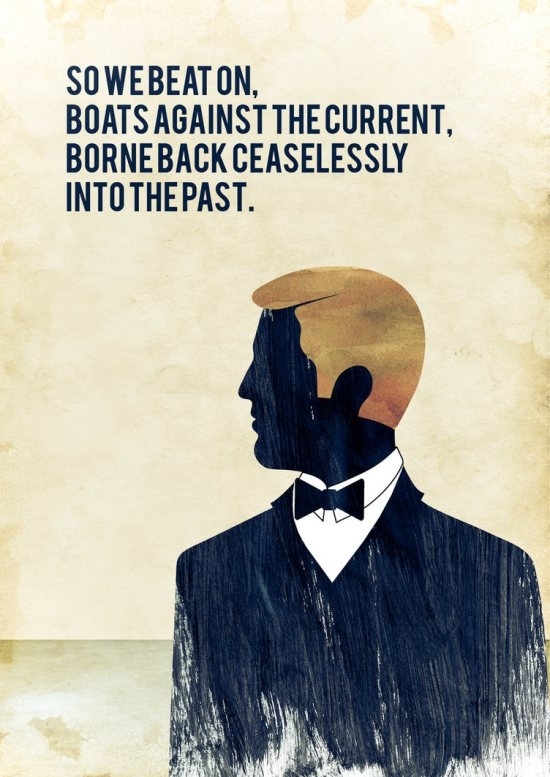
gatsby

A sense of the past

Gatsby has the characteristic romantic preoccupation with the past.  This is beautifully evoked by Fitzgerald in a telling passage, which reveals some of the hidden springs of his failure and of his tragedy.  His great delusion is a sad and common one: that the past can be restored and duplicated, and the effects of the passage of time erased.  Gatsby wants Daisy to abandon Tom Buchanan so that, after she is free, she may go back with him to Louisville to be married from her house, ‘just as if it were five years ago’.  When caraway tells him he can’t repeat the past like this he can see no reason whatever why: ‘I’m going to fix everything just as it was before.’  His longing to do so is perfectly comprehensible.  His life has been disordered since his parting with Daisy: he wants to ‘recover something, some idea of himself, perhaps, that had gone into loving Daisy’.  He returns in his poignant day-dream to a starting place, to a scene with Daisy, described in heightened, poetic, emotionally-charged language, that can make sober realities pale into unimportance.  The incident takes on almost an absolute value, for us readers as well as for Gatsby.  Little wonder that he wants to begin again from such a point:

One autumn night, five years before, they had been walking down the street when the leaves were falling, and they came to a place where there were no trees and the sidewalk was white with moonlight.  They stopped here and turned toward each other.  Now it was a cool night with that mysterious excitement in it which comes at the two changes of the year …

His vain hope of recapturing such a past is finally extinguished by Tom Buchanan’s exposure of his activities during the intervening years.  The romantic cavalier is mercilessly stripped of his glamour: ‘He and Wolfstein bought up a lot of side-street drug stores here and in Chicago and sold grain alcohol over the counter … I picked him for a bootlegger the first time I saw him.’  Tom reduces Gatsby’s thrilling aspirations to the level of the sordid: ‘I think he realises that his presumptuous little flirtation is over.’  The end of the quest for lost happiness is tellingly rendered:

But with every word she was drawing further and further into herself, so he gave that up, and only the dead dream fought on as the afternoon slipped away, trying to touch what was no longer tangible, struggling unhappily, undespairingly, towards that lost voice across the room.

Fitzgerald the moralist

Scott Fitzgerald was at heart a moralist.  He once gave as his reason for writing fiction ‘a desire to preach at people in some acceptable form’.  Moralists often find their natural outlet in satire, and Fitzgerald was gifted with a keen satiric eye and a keen sense of the absurdities of human nature.  Tom’s defence of ‘civilisation’ against the ‘inferior’ races provides a good example.  There are more good satiric portraits of minor figures like Catherine and Mr. McKee:

Her eyebrows had been plucked and then drawn on again at a more rakish angle, but the efforts of nature toward the restoration of the old alignment gave a blurred air to her face … He informed me that he was in ‘the artistic game’, and I gathered later that he was a photographer and had made a dim enlargement of Mrs. Wilson’s mother which hovered like an ectoplasm on the wall.  His wife was shrill, languid, handsome and horrible.

But these, and the description of the massive vulgarity of the Gatsby residence are isolated patches; Fitzgerald was much more attracted to the affirmation of what he saw as the good than to the denunciation of the bad.  The positives celebrated in The Great Gatsby are the simple virtues: the hopeful, wondering, questioning attitudes of mid-Western America, o the ‘broad, sprawling, swollen towns beyond the Ohio’, over against which, in rich contrast, is the urban sophistication, culture, boredom and corruption of the jaded East.

 Flaws in the novel

The significance of the title of the book in relation to all this is often missed.  Gatsby is great is so far as he stands for the simplicity of heart Fitzgerald identified with the mid-West; he is a vulgar, contemptible figure in so far as he revels in the notoriety that his worldly success lends to his name.  He is, of course, a man of limited understanding, failing at once to appreciate his own real claims to recognition (his idealism, his high romantic aspirations) and to recognise his error in thinking that he really belongs to the world he has entered.  In its way, too, the novel is limited in its treatment of its central figure.  After all, we are expected to find the supreme value of the story and its hero in its romantic aspirations, in his ‘heightened sensitivity to the promises of life’.  There is no voice in the novel, no point of view which seems to question the adequacy of this attitude.  To many readers, it must seem a poor enough one in face of the complexities of actual living.  What is perhaps more disturbing is that the novelist himself seems to find Gatsby’s romantic stance entirely adequate.  A remark of his seems to bear this out:

That’s the whole burden of the novel, the loss of those illusions that give such colour to the world so that you don’t care whether things are true or false as long as they partake of the magical glory.

If this is the best that can be set over against the amoral world of the established rich, many readers will leave the book down with a sense of disappointment.

Merits of The Great Gatsby

Against this, however, one must stress the considerable virtues of The great Gatsby: its poetic quality (Fitzgerald was a devoted reader of T.S. Eliot, who influenced him here), its almost flawless structure, Fitzgerald’s mastery of technique.  His use of detail to suggest symbolic meaning is particularly impressive.  Here it is interesting to note that one of the best symbols in the book, the grotesque eyes of T.J. Eckleburg’s billboard came to him by chance.  His publisher had a dust jacket designed for The Great Gatsby, a poor quality picture intended to suggest, by means of two enormous eyes, Daisy brooding over an amusement-park version of New York.  Fitzgerald’s brilliant reworking of this in the book is a tribute to his intuitive skill.  Again, the slow, gradual presentation of Gatsby is a tour de force.  We are more than half-way through the book before we know the important things about him.  The evocation of atmosphere and background is memorable and utterly satisfying; a detail or two will often suffice to fix indelibly a scene, a character or a mood:

With an effort Wilson left the shade and support of the doorway, and, breathing hard, unscrewed the cap of the tank.  In the sunlight his face was green.

One must not ignore the intelligent use by Fitzgerald of Carraway as narrator; a good deal of the colour and subtlety of the novel arises from the response of the narrator’s judgement and feelings to the events he describes.

Finally, the power and impact of the book are greatly enhanced by Fitzgerald’s concentration of his story and theme into a relatively few telling scenes.

About the Author....

f__scott_fitzgerald_2_by_echaz

Francis Scott Key Fitzgerald (September 24, 1896 – December 21, 1940), known professionally as F. Scott Fitzgerald, was an American novelist and short story writer, whose writing gives us a memorable fictional evocation of  America of the ‘roaring twenties’ and  of the Jazz Age. He is widely regarded as one of the greatest American writers of the 20th century.  Fitzgerald is considered a member of the “Lost Generation” of the 1920s. He finished four novels: This Side of ParadiseThe Beautiful and DamnedThe Great Gatsby (his best known), and Tender Is the Night.  A fifth, unfinished novel, The Love of the Last Tycoon, was published posthumously.  Fitzgerald also wrote numerous short stories, many of which treat themes of youth and promise, and age and despair (Wikipedia).


An Introduction to ‘The Catcher in the Rye’


download (5)


This novel, first published on this day, 16th July in 1951, by the enigmatic J. D. Salinger, belongs to a category of fiction made popular by writers as diverse as Dickens and Joyce.  It is Bildungsroman, or novel about upbringing and education – a novel of maturation.  The heroes of novels of this type are invariably young people or children seeking to find their identities and roles in the big bad world.  Nineteenth-century examples are David Copperfield (1850) and Great Expectations (1861), both by Charles Dickens.  The most famous twentieth-century example is James Joyce’s Portrait of the Artist as a Young Man (1916).  Probably the most famous example from American fiction before Catcher in the Rye was the classic The Adventures of Huckleberry Finn by Mark Twain.  Many of these novels go far beyond the treatment of the educational development of the central figure, and concern themselves with profound spiritual and moral experiences.

 The Catcher in the Rye is the story of the efforts of an adolescent American to relate to a grown-up world that he finds deeply flawed and fundamentally unsympathetic.  The central figure, Holden Caulfield, leaves his boarding school and spends a weekend in New York City.  Here he finds himself alone in what he sees as a grown-up world of corruption, unkindness and hypocrisy.  The main theme of the novel is Holden’s resistance to growing up into this kind of world, which, as he sees it, undermines youthful innocence and integrity.  The novel has no real plot.  It consists mainly of the observations of Holden on his experiences, particularly on the ‘phoniness’ of those he encounters.  His attempt to reconcile himself to the values of the adult world is a failure.  He retreats from this failure into mental illness, and writes his story while under psychiatric treatment.

Resistance to loss of innocence

The title of the novel is a glance at Holden’s dream of protecting other, younger children from the curse of maturity, of saving such innocents before the world corrupts them.  One of Robert Burns’s most famous songs has the line, ‘If a body meet a body coming through the rye’, Holden has misheard the words and thinks the line should go, ‘If a body catch a body coming through the rye’.  He uses the mistaken version as a slogan for his own dream-activity.  He will catch the innocent children who play in the ryefield because they are in danger of falling over the unseen edge of a cliff.  His vision of his saving role is pathetic in its futility:

 ‘I thought it was “If a body catch a body”,’ I said.  ‘Anyway, I keep picturing all these little kids playing some game in this big field of rye and all.  Thousands of little kids, and nobody’s around – nobody big, I mean – except me.  And I’m standing on the edge of some crazy cliff.  What I have to do, I have to catch everybody if they start to go over the cliff – I mean if they’re running and they don’t look where they’re going.  I have to come from somewhere  and catch them.  That’s all I’d do all day.  I’d just be the catcher in the rye and all.  I know it’s crazy, but that’s the only thing I’d really like to be.  I know it’s crazy.’

 An uncaring adult world

Part of Holden’s depression arises from his awareness of himself as an innocent abroad in a world of phoney values, a world which, like Holden himself, needs love but does not know where to find it.  It is, in many of its manifestations, a world that believes that it can get on without love, or even without decency.  What passes for love in the adult world through which he moves is little better than selfish exploitation.  Most of those with whom he comes in contact are crudely dismissive of him and his concerns (the taxi-drivers, for example), try to exploit him for money, like the offensive pimp in the hotel, or seem ready to abuse him sexually, like Antolini, his former schoolmaster, to whom he turns in desperate need for help and advice.  It is not surprising that Holden cannot form a viable or stable relationship with adult society.  That society cannot give him the love and affection for which he craves.  These values seem to be associated in his mind with two things: death and the innocence that disappeared with the loss of childhood.

The death-motif and its association with love appear from time to time in Holden’s references to his much-loved brother, whose death from leukemia has blighted his family.  His longing to preserve innocence in a world given over to destroying it makes him the idealist who rubs obscenities off walls so that small girls will not have to see them.  In The Catcher in the Rye, Salinger, who clearly approves of his hero, raises fundamental questions about man’s inhuman treatment of his fellow-men.  What, we are forced to ask, makes New York an abode of indifferent, uncaring individuals?  Is the answer to be found in some radical flaw at the heart of human nature, or in society?  The novel suggests that human nature is not primarily to blame for the sufferings which Holden and others like him have to endure.  Salinger conveys a sense that the world is populated by fallible, foolish, pompous, careless, morally weak individuals rather than by evil ones, and that human beings are potentially loving and joyful if only society will permit them to satisfy these basic longings.  It was this aspect of The Catcher in the Rye that caused it to appeal most widely to a generation of American students in the nineteen-fifties.  As Anthony Burgess has pointed out, the novel was,

‘a symptom of a need, after a ghastly war and during a ghastly peace, for the young to raise a voice of protest against what the adult world was doing, or failing to do’.

Holden’s depression

The Catcher in the Rye has a single unifying theme: the nervous breakdown or intensifying depression of a sixteen-year-old boy.  The progress of Holden’s psychiatric illness is chronicled not from its origins but through its critical phase.  This is done with remarkable understanding of how depression actually works, and how it affects behaviour and the processes of thought.  Salinger is particularly impressive in his handling of the correlation between depressive illness and physical symptoms.  As his depression intensifies, Holden experiences psychosomatic symptoms, which feature a morbid fear of painful death (‘I figured I’d be dead in a couple of months because I had cancer’) and much physical distress (‘The thing is, if you get very depressed about something, it’s hard as hell to swallow’).  What we learn about him from his own narrative of his life makes his depressed state comprehensible enough.  The death of his much-loved brother Allie from leukaemia is one major influence on his mental and emotional states, leaving him with a grievance against the unfairness of things.  His emotional difficulties are not eased by his relationship with his parents.  His mother has been depressed since Allie’s death, and is not a positive force in his life, while his father, preoccupied with being successful, never discusses problems with him.

Holden is thus deprived of the parental guidance every adolescent needs.  His lack of emotional stability is not surprising.  The boarding school to which he is sent is no substitute for his parents.  His primary need is for the kind of understanding and sympathy that will see him through a difficult period in his life.  Whenever he seeks this from his acquaintances he is rebuffed or ignored.   As he ruefully remarks, Stradlater is not interested in a person’s ‘lousy childhood’, while Ackley will respond only if yelled at.  Both Ackley and Stradlater make little of the few achievements that might give Holden some badly needed self-confidence and self-esteem.  When Holden puts a heartfelt question to his history instructor (‘Everybody goes through phases and all, don’t they?’), the latter cannot answer him.  His old girl-friend Sally Hayes can do no better than the others in providing the understanding he needs if he is to keep depression at bay.  Carl Luce, an ex-schoolmate now at Columbia University, responds coldly and unfeelingly to Holden’s plea for help in sorting out his mental and emotional confusion, callously advising him to see a psychiatrist.

As a final despairing gesture, Holden turns to a man he respects, his teacher Mr. Antolini.  The latter can help him no more than the others could.  He lectures him at length, but fails to notice how deeply disturbed he is.  At this stage, Holden is at breaking-point, descending to deeper levels of depression, while Antolini is telling him that an academic education will give him an idea what size of mind he has.  Salinger provides some obvious pointers to Holden’s lack of mental stability in his numerous self-contradictions.  Our hero tells Antolini, for example, that a teacher at Pencey, ‘was intelligent and all, but you could tell he didn’t have too much brains’.  He also claims that there were a couple of classes he didn’t attend for a while, but that he didn’t cut any.  The outcome of the episode with Antolini is that Holden is more depressed than ever.  Convinced that society has finally failed him, he decides to run away and pretend to be a deaf mute, so avoiding, ‘any goddam stupid useless conversations with anybody’.  He will make no further efforts to gain the understanding of other people, and will renounce the ‘phoney’ world.

Phoebe, an agent of redemption

If he is to be redeemed from his hopelessly depressed state, this must now be through the voluntary, unsolicited intervention of somebody else.  His sister Phoebe becomes the agent of his redemption from total despair.  When Phoebe insists on running away with him, he comes to the conclusion that he cannot take responsibility for her, and decides that he must go home, not for his own sake, but for hers.  This gesture of submission is rewarded with a fleeting spell of intense happiness, lovingly described.  The sight of Phoebe going round and round on the carousel fills him with inexplicable joy and tranquility, although the contradictory account of how he fares in the rain is a sinister indication of his confused mental state:

‘My hunting hat really gave me quite a lot of protection, in a way, but I got soaked anyway.  I didn’t care, though.  I felt so damn happy all of a sudden, the way old Phoebe kept going round and round.  I was damn near bawling.  I felt so damn happy, if you want to know the truth.  I don’t know why.  It was just that she looked so damn nice, the way she kept going round and round, in her blue coat and all.  I wish you could’ve been there’.

 After his painful quest, involving disappointment, frustration, bitterness, depression and disillusionment, Holden has at last found something beautiful in a world he has so often condemned as ‘phoney’.  This does not necessarily mean that he novel has a happy ending.  We know that the carousel will have to stop, and Holden and his sister will have to return to the world from which all his instincts have been urging him to escape.  The best things that life has to offer him are the few fleeting moments of exaltation he has experienced watching Phoebe on the carousel.

Holden’s distorted view of the world.

The Catcher in the Rye is often read as a sympathetic account of a good-natured, sensitive boy confronted by a cruel, dishonest world, populated by freaks, exploiters and phoneys.  The following is typical of his view of other people:

 I was surrounded by jerks.  I’m not kidding.  At this other tiny table, right to my left, was this funny-looking guy and this funny-looking girl.

It is clear from the novel that Salinger likes Holden and expects his readers to like him, but the question must be asked, how likable is he?  Does he deserve to be taken at his own valuation as an idealist who suffers at the hands of others?  Are we to applaud his trenchant exposures of virtually all those who cross his path?

The presentation of Holden involves an obvious paradox: the childlike idealist with the vulnerable, sensitive nature can appear heartless and cruel in his comments on almost everybody else.  There is the curious fact that although he is constantly protesting against the phoniness of almost everybody else, he himself is far from exempt from this fault.  In this context, phoniness means hypocrisy, empty, insincere moralising and fraudulent attitudes and behaviour.  It is true that Holden is upset by such things; as he puts it, they cause him to ‘puke’.  The only people he can think of as being free from phoniness are his sister Phoebe, the two nuns he meets in the sandwich bar, and children in general.  Were he also to look more closely at himself, he would have to acknowledge that he shares the qualities he condemns in others.  He often tells lies, often pretends to be someone he is not, and can be quite bitter in his comments on his friends, while at the same time pleading for charity and kindness towards himself.

The key to Holden’s character is his mental confusion.  This shows itself particularly in his inability to see people and their activities in proportion.  Again, his lack of a proper sense of proportion expresses itself in an outrageously exaggerated habit of speaking.  By referring to almost everybody and everything in grossly inflated language, he can make relatively innocuous circumstances sound wicked and dangerous.

It is not enough for him to describe a woman who sits next to him at the cinema as the slightly inconsiderate person she is; he feels obliged to describe her as being ‘about as kind-hearted as a goddam wolf’.  He doesn’t like Ossenburger the undertaker, and takes exception to the man’s religious inclinations.  His dislike vents itself in great crude fantasies in which Ossenburger features as a monstrous fraud who shoves corpses into a sack and dumps them in the river, who prays fervently to Jesus to send him more corpses and who bores a captive audience with ‘about fifty corny jokes’.  He describes places and their atmospheres in the same wildly exaggerated fashion, particularly when their impact on him is unfavourable.  A hotel lobby cannot seem merely stale-smelling to him; it must convey the impression of ‘fifty million dead cigars’.  No wonder Phoebe tells him, ‘You don’t like anything that’s happening.’  This is because his view of reality is hopelessly distorted; his depressed state makes him so utterly negative about experience that he cannot see that even the worst people and situations have some redeeming qualities.

 ob_7d3cd6_wc-1a-catcherintherye

Exploring the Poetry of Adrienne Rich (1929 – 2012)

 Adrienne Rich (1)

THIS IS A PERSONAL REVIEW OF SOME THEMES AND ISSUES WHICH FEATURE IN THE POETRY OF ADRIENNE RICH. YOU SHOULD CONSIDER THESE IDEAS, THEN RE-EXAMINE THE POEMS MENTIONED FOR EVIDENCE TO SUBSTANTIATE OR CONTRADICT THESE INTERPRETATIONS.  IN OTHER WORDS MAKE YOUR OWN OF THESE NOTES, ADD TO THEM OR DELETE FROM THEM AS YOU SEE FIT.

THE FOLLOWING SELECTION IS SUGGESTED BECAUSE THEY DEAL WITH THE MAJOR THEMES WHICH RECUR IN RICH’S POETRY:

  • Storm Warnings,
  • The Uncle Speaks in the Drawing Room,
  • Living in Sin,
  • The Roofwalker,
  • Trying to Talk to a Man,
  • Diving into the Wreck,
  • From a Survivor.

YEATS SAID OF HIS POETRY THAT IT WAS ‘BUT THE CONSTANT STITCHING AND RESTITCHING OF OLD THEMES’.  CHECK THIS OUT FOR YOURSELF IN RELATION TO ADRIENNE RICH!  

YOUR AIM SHOULD BE TO PICK YOUR OWN FAVOURITES (THREE OR FOUR) FROM THIS SELECTION AND GET TO KNOW THEM VERY WELL. 


Adrienne Rich (2)

_______________ o __________________


MAJOR THEMES IN RICH’S POETRY


Relationships

Rich is best known as a feminist writer and many of her poems deal with the oppression of women by men.  Marriage, in particular, is seen as a tool by which women are kept under the thumb of men.  ‘From a Survivor’ emphasises how women can be mastered or controlled by their husbands.  The speaker suggests that her husband’s body was ‘the body of a God’ and that it had ‘power’ over her life.

Similarly, in ‘Trying to Talk to a Man’, the speaker again suggests that her husband might have dominated her life: ‘Your dry heat feels like power / your eyes are stars of a different magnitude’.  ‘Living in Sin’, too, touches on this topic although here the couple are simply living together.  Here it is the woman in the relationship who does all the work (What’s new?), who makes the bed and tidies the apartment: she ‘pulled back the sheets and made the bed and found / a towel to dust the tabletop’.  The man with whom she’s living, meanwhile, seems to contribute little to the upkeep of the household.  This can be taken as yet another instance, therefore, of a woman being dominated or controlled by man.  It is another poem in which Rich emphasises the fundamental inequality of marriage and of relationships between men and women.

‘The Roofwalker’ is another poem that presents marriage in a negative light.  In this poem the speaker realises that her marriage has been a terrible mistake, that she has wasted a great deal of time and energy creating a life that is not suited to her: ‘Was it worthwhile to lay / with infinite exertion / a roof I can’t live under?’  The life she has made for herself, this seemingly comfortable existence that centres on a happy marriage and healthy children, is a life she was pressured into: ‘A life I didn’t choose / chose me’.  Now she is prepared to leave this life behind, to abandon the comfortable structure of her marriage and brave the world beyond this comfortable shell.  She will become, she says, ‘like naked man fleeing / across the roofs’.

It is important to note, however, that Rich can also be positive about marriage and relationships.  There is also room in her poetry for straightforward romance and love.  In ‘From a Survivor’, for instance, she emphasises that her husband’s body is ‘as vivid to me / as it ever was’ suggesting the deep love she felt for this man who is now tragically dead.  ‘Trying to Talk with a Man’ also stresses the deep emotional bond that existed between Rich and her husband with its deeply moving litany of memories and intimate moments that the couple shared; ‘whole LP collections, films we starred in / playing in the neighbourhoods, bakery windows / full of dry, chocolate-filled Jewish cookies/ the language of love-letters……’

The Personal and the Political

One of the best-known aspects of Rich’s poetry is the way it blends political and personal concerns.  Again and again she finds unexpected parallels between her personal traumas and political events that take place in the wider world.  This technique is used in an especially moving way in ‘Trying to Talk with a Man’.  The disintegration of the couple’s relationships is depicted against the backdrop of the violence and fury of a nuclear test in the Nevada desert: ‘Out here in the desert we are testing bombs / that’s why we came here’.  As we read the poem we realise that external violence of the nuclear test is a metaphor for the internal or emotional violence of the couple’s break-up: ‘talking of the danger / as if it were not ourselves / as if we were testing anything else’.

Women in a Patriarchal Society

The poetry of Adrienne Rich (like the poetry of Boland and Plath) documents the struggles and difficulties that women endure in the modern world.  Many of these difficulties are the result of the nature of the society in which we live.  Rich suggests fairly forcefully that we live in a man’s world.  The consequence of this for women is that they are never given the opportunities to achieve and optimise their potential or even communicate their true feelings and desires.  In ‘Diving into the Wreck’, Rich uses the dive into the dark depths of the sea to symbolise her efforts to penetrate the murky waters of history in order to see what lies at the bottom.  She has read about what might be there in a ‘book of myths’ but she wants to find out for herself.  What she finds is a ‘wreck’, an old ship that is battered and broken, but ‘whose silver, copper, vermeil cargo lies / obscurely inside barrels’.  It seems that this ship is a symbol of the origins of who we are and how we understand ourselves.  Down here with the wreck the speaker of the poem seems to lose all solid notions of what it means to be a woman.  Her gender becomes ambiguous and gender definitions become fluid and vague.  (Could you tell if a diver in a wet suit is male or female from a distance under water?)  The suggestion seems to be that the roles of men and women in society have a history, they are not established in fact, are not absolutely intrinsic to who we are.  If we can get back to the origins, to the beginning, when these definitions were first established we might be able to re-define and re-determine roles.  Why, the poet asks, should we live our lives according to definitions that we had no role in creating, that were established way back before we were even born.  ‘Diving into the Wreck’ suggests that there may be possibilities of rediscovering and re-learning who we are, if we are willing to try:

                               We are, I am, you are

by cowardice or courage

the one who find our way

back to this scene

carrying a knife, a camera

a book of myths

in which

our names do not appear

Forces for Change

The idea of an outside force, something that is potentially dangerous and capable of affecting our lives, is present in a number of Rich’s poems.  In many of her earlier poems Rich gives the impression that she is at the mercy of elements that she can’t quite control.  In ‘Storm Warnings’, for example, Rich portrays the weather as a powerful force for change that threatens her fragile home.  All she can do is close the windows and lock the doors against the storm that is brewing outside.  As the poem points our, even with our fancy new-fangled technologies and our weather reports, we are unable to control the weather.  We might be able to predict what is going to happen, but we are powerless to prevent it happening.  Time and darkness are two other forces that we are unable to control.  She also seems to suggest that there are elements of our own lives that we are powerless to change also.  As Rich points out: ‘Weather abroad / And weather in the heart alike come on / Regardless of prediction’.  By this she seems to be talking about the depression and other moods that we suffer from throughout our lives.

The notion of an external force is also at play in ‘The Uncle Speaks in the Drawing Room’ which contains the speech of a rich man whose lifestyle is put under threat by the presence of an angry mob at his gate.  We are not aware of the mob’s grievance but its presence remains a potent and ominous force in the poem.  Again there is a suggestion that the world contains elements that are beyond our control, no matter how wealthy and powerful we might be.  As I have said on many occasions, change is a fact of life, and the only people who welcome change are babies with wet nappies.  The speaker in this poem, the uncle seems oblivious to the reality of the growing social unrest that is taking place around him.  One could say that he’s in denial – and as I often say the Nile is not just a river in Egypt!!!!!

Roofwalker - Adrienne Rich (3)

Sample Answer:

‘The poetry of Adrienne Rich shows us the relationship between men and women in all their glory and despair’.

With reference to the above statement say whether the poetry of Rich appealed to you.


Adrienne Rich was the poet on the Leaving Cert course whose work most appealed to me.  There were several reasons for this.  For me the most important aspect of Rich’s work was her depiction of relationships in a way that seemed very real.  Her poems take account of the fact that love so often goes wrong yet they also offer hope that the anguish of a failed relationship can be overcome.  I also enjoyed the feminist aspect of Rich’s work.  Her depiction of women being dominated by the men in their lives is as relevant today as it was when Rich first presented it.

In my opinion, too many poems and pop songs present an idealistic or overly romantic view of love.  Rich, however, is having none of this.  She is fully aware that all too often relationships don’t work out the way we want them to.  As she puts it in ‘From a Survivor’, every couple believes they are ‘special’: ‘Like everybody else we thought of ourselves as special’.  Yet no couple is immune to the ‘failure of the race’.  Every relationship will experience turbulence and difficulty.  In ‘The Roofwalker’ for instance, the speaker invests a great deal of time and energy in a relationship only to realise that she does not really belong with this man.  The life they have created together is not for her.  ‘Was it worth while’, she asks to ‘lay – / with infinite exertion – / a roof I can’t live under?’  This tragic waste of time and effort in the  cause of a failed relationship was something I could really relate to.

I could also identify somewhat with the situation depicted in ‘Living in Sin’.  This poem also shows us a woman whose relationship has not worked out as she expected.  This young woman believed she would have a perfect life with her lover in their studio apartment.  She imagined there would be ‘no dust upon the furniture of love’.  However, life in the studio has turned out to be quite miserable.  The apartment is dirty and unpleasant; ‘Half-heresy, to wish the taps less vocal, / the panes relieved of grime’.  Her lover appears distant and uncaring, and hardly speaks to her each morning before going ‘out for cigarettes’.  It is hardly unsurprising, therefore, that this young woman is filled with mental anguish, is haunted by the ‘minor demons’ of sorrow and disappointment.

Yet Rich’s most moving account of a relationship in crisis is surely ‘Trying to Talk with a Man’.  What impresses me most about this poem is the way it captures just how difficult it can be to communicate at the end of a relationship, with Rich brilliantly describing the lovers ‘surrounded by a silence … that came with us /and is familiar’.  This silence expands like a cancer at the heart of the couple’s relationship, forcing them to ‘give up’ the things they shared, such as  ‘the language of love-letters’ and ‘afternoons on the riverbank / pretending to be children’.

A strong belief in women’s liberation is also central to Rich’s poetry as she developed as a writer.  Many of her poems, including ‘Living in Sin’, focus on the inequality between women and men that exists at the heart of so many relationships.  The young woman in this poem seems to do all the housework while her boyfriend lounges about the place uselessly.  Though he is allegedly an artist of some kind he appears to do little artistic work, only sounding a ‘dozen notes upon the keyboard’ before heading ‘out for cigarettes’

However, Rich’s poetry also offers a lot of hope.  In both ‘The Roofwalker’ and ‘From a Survivor’ she shows that it is possible for a woman to reverse bad decisions and escape a relationship or way of life that is unsuitable to her.  In ‘From a Survivor’ the speaker has ‘made the leap’ and escaped her failing marriage.  Now her husband is no longer like a god to her and her new life is like a ‘succession of brief, amazing moments’.  ‘The Roofwalker’ also deals with this possibility of escape and shows the speaker desiring to leave behind a life she ‘didn’t choose’.  Yet this poem stresses how unnerving and intimidating it can be to leave a stable relationship behind.  To do so is to be exposed and vulnerable as ‘a naked man /fleeing across the roofs’.  I thought this was one of Rich’s finest images, brilliantly capturing feelings of vulnerability and isolation in an image that is both moving and amusing.

While Rich’s philosophy is important, it is her use of images, in my opinion, that makes her truly great as a poet.  Her use of metaphors is very eye-catching and there is a lovely example of this in ‘Living in Sin’ where a beetle is described as ‘an envoy from the moldings’.  There is also another excellent metaphor in this poem where the morning is compared to a ‘relentless milkman coming up the stairs’.  I found both of these images amusing but they also filled me with a certain unease and discomfort.  There is also a startling set of metaphors in ‘The Roofwalker’ that really appealed to me, where builders on a roof are described as sailors on a deck; the sky is depicted as ‘a torn sail’, and the night as a black wave about to descend.

To sum up, then, my admiration for Rich’s poems stems from the fact that she is not afraid to confront unpleasant realities such as the heartbreak that accompanies the failure of a relationship and the oppression of women.  Yet she is not a poet who is content to simply dwell on the negative.  Her work also offers hope, hope that the anguish of failed love can be overcome, that women can escape the traps in life they set for themselves and that they can gain power all of their own.

image

Sample Answer:

‘Adrienne Rich’s poetry is interesting both for its themes and its language’.  Discuss.

 I am in complete agreement with this statement.  Rich is one of the most important and provocative voices in modern day literature.  Her themes are always relevant and she often challenges us with her ideas on, for example,  male-female relationships and the role of women in society.  While her feminist perspective means that her work has an obvious attraction for a female audience, her appeal is not confined to one gender.  Her language is generally clear and direct and her images striking and memorable.

An idea that she often explores is the complex reality of male-female relationships.  ‘Living in Sin’ is interesting primarily because of its realistic depiction of male-female relationships.  Most people could relate to the experience of the woman who finds that the reality of living with her partner in a small studio apartment falls short of the romantic dream.  In her naivety, the woman had given no thought to the mundane realities of day-to-day life with her partner.  This idea is expressed in everyday language, ‘She had thought the studio would keep itself’.  Inevitably, harsh reality reveals the unglamorous truth: noisy dripping taps, grimy windows, scraps of leftover food and empty bottles.  Worst of all, she encounters a beetle among the saucers – the beetle is described in a memorably humorous image as an ‘Envoy from a village in the moldings’.  Aside from the grim physical environment, the woman has to cope with her partner’s lethargy and general indifference.  He seems to be a musician or composer, but lacks the motivation to practice his music, ‘sounded a dozen notes upon the keyboard, / declared it out of tune, shrugged at the mirror, /rubbed at his beard, went out for cigarettes’.  The shrugging image perfectly captures her partner’s apathetic attitude.  This poem provides us with an insight into sexual stereotyping – the man makes no attempt to tackle any domestic tasks and it is the woman who cleans the apartment.  Despite her disillusionment, the woman does not leave her indifferent boyfriend and the depressing apartment, ‘By evening she was back in love again’.  However, the next phrase (‘though not as wholly’) qualifies this statement, reminding us that her initial optimism about the relationship is beginning to fade away gradually.

Anyone of us who have found ourselves in a relationship, which is falling apart, will easily relate to ‘Trying to Talk with a Man’.  In this poem the speaker and her partner have gone into the desert ostensibly to witness (and protest about) the detonation of a nuclear bomb – however, we get the impression that the underlying purpose of this journey is to take stock of their relationship.  An excellent visual image suggests how the woman is growing in insight, ‘Sometimes I feel an underground river / forcing its way between deformed cliffs / an acute angle of understanding’.

This poem also highlights Rich’s effective use of metaphor and imagery to convey her themes.  The images of a ghost town and the desert effectively suggest the silent, barren nature of the couple’s relationship.  While the troubled lovers are ‘surrounded by a silence’ that sounds like the silence of the deserted town, the poet realises that the silence has come with them – it is ‘a familiar’ silence. The speaker acknowledges the extent of their problems in language that is admirably simple and direct, ‘Out here I feel more helpless / with you than without you’.    What I found interesting about this poem was the man’s unwillingness to discuss the problems at the heart of the relationship.  He talks only of external events such as the danger of nuclear testing, making no attempt to address the danger surrounding the relationship, ‘Talking of the danger / as if it were not ourselves’.  This poem stands out in my mind because it underlines an almost universal truth – women are more emotionally aware and more emotionally honest than men.

‘From a Survivor’ is a deeply personal poem describing the poet’s failed marriage.  What I found interesting – and indeed uplifting – about this poem was the affectionate nature of the poet’s reflection on her late husband and the fact that her brave ‘leap’ away from her marriage enabled her to find true joy.  The conversational language employed by Rich gives this poem a wonderful sense of immediacy, ‘I don’t know who we thought we were / that our personalities / could resist the failures of our race’.  The poet reminds us of the optimism that attends the early stages of romantic relationships, ‘Like everybody else, we thought of ourselves as special’.  She never anticipated that their marriage, like so many others, would not stand the test of time.  Despite the tensions of their marriage, the poet’s affection for her late husband endures, ‘Your body is as vivid to me / as it ever was’.  It was also encouraging to learn that, having come through a difficult period, the poet retains the capacity to find joy in life – she speaks of having experienced ‘a succession of brief amazing moments’.  Another aspect of this poem that I found interesting was the insight it provided into the changing nature of male-female relationships.  Social and cultural changes brought about largely by the active feminist movement mean that the poet now has a clearer perspective on her marriage.  When she married, marriage was an intrinsically unequal institution (and who wants to live in an institution….!), with the woman expected to be obedient to her husband.  In the past the poet had seen her husband as ‘a god / …with power over my life’.  As Rich grew as a person and as a poet, she ‘no longer’ viewed her husband as god-like.

In conclusion, Rich’s poetry is interesting both for its ideas and the way in which these ideas are expressed.  She explores issues that are relevant to the modern reader in language that is generally clear and accessible, making very effective use of imagery to express her themes.


 adrienne-rich-(4)


‘Of Mice and Men’: Brief Analysis of Characters, Metaphors and Themes.


Courtesy of carra-lucia - books .co.uk
Courtesy of carra-lucia – books .co.uk

The title that Steinbeck finally chose for his novel emphasises the unpredictable nature of existence as well as its promise, George and Lennie’s blasted dream to ‘live of the fatta the lan’.  Taken from a poem by Robert Burns, the Scottish poet, the novel’s title suggests the transitory quality of even ‘best laid schemes’.  Burns’s poem tells of an unfortunate field mouse whose home is flattened by a plough:

But Mousie, thy art no thy lane,

In proving foresight may be vain:

The best laid schemes o’ mice an’ men

Gang aft a-gley

An’ lea’e us nought but grief an’ pain

For promised joy.

___________________________________________

Steinbeck 

CHARACTER PROFILES

GEORGE: George is the story’s main protagonist, a small, quick man with well-defined features.  A migrant ranch worker, George dreams of one day saving enough money to buy his own place and be his own boss, living off the land.  The hindrance to his objective is his mentally handicapped companion, Lennie, with whom he has travelled and worked since Lennie’s Aunt Clara, whom George knew, died.  The majority of George’s energy is devoted to looking after Lennie, whose blunders prevent George from working toward his dream, or even living the life of a normal rancher.  Thus, George’s conflict arises in Lennie, to whom he has the ties of long-time companionship that he so often yearns to break in order to live the life of which he dreams.  This tension strains George into demonstrating various emotions, ranging from anger to patience to sadness to pride and to hope.

LENNIE:  George’s companion, the source of the novel’s conflict.  Lennie, enormous, ungainly, and mentally slow, is George’s polar opposite both mentally and physically. Lennie’s ignorance and innocence and helplessness, his childish actions, such as his desire to pet soft things, contrast his physical bulk, making him likeable to readers.  Although devoid of cruel intentions, Lennie’s stupidity and carelessness cause him to unwittingly harm animals and people, which creates trouble for both him and George.  Lennie is tirelessly devoted to George and delights in hearing him tell of the dream of having a farm, but he does not desire the dream of the American worker in the same way that George does.  His understanding of George’s dream is more childish and he grows excited at the possibility of tending the future rabbits, most likely because it will afford him a chance to pet their soft fur as much as he wishes.  Nevertheless, a dream is a dream, different for everyone, and George and Lennie share the similar attribute of desiring what they haven’t got.  Lennie, however, is helpless to attain his dream, and remains a static character throughout, relying on George to fuel his hope and save him from trouble.

CANDY:  He is the old, one-handed swamper who is the first to befriend George and Lennie at Soledad.  He is humble and weary and seems to be at the end of his line after Carlson shoots his last possession and companion, his old, blind, dog.  ‘When they can me here I wisht somebody’d shoot me’, Candy confesses to George and Lennie, hoping for a similar fate as his dog.  But when he hears the two talking of their little place, Candy offers all his money and his meagre services to be in on the dream.  His substantial sum of money and the fact that he knows of a place make it impossible for George to refuse him.  Candy clings to this hope of a future as a drowning man would to a piece of driftwood.  It rekindles life within him, but it also becomes an obsession, and in his excitement and indignation, he lets the secret slip to both Crooks and Curley’s wife.  And when Lennie kills Curley’s wife and shatters the reality of the dream, Candy becomes hopeless and full of anguish, the broken shell of a man.

CURLEY:  He is the boxer, the son of the boss, the angry and hot-headed obstacle to George’s attempt to keep Lennie out of trouble at Soledad.  Insecure because of his size and over-protective of his wife, Curley is eager to fight anyone he perceives as a threat to his self-image.  Lennie unwittingly incurs Curley’s antagonism simply because of his size, and the reader immediately braces for future confrontation.  Curley remains undeveloped, forever little and forever mean, poking his head in at various points in the novel, either to look for his wife or to stir up trouble on account of her.

CURLEY’S WIFE:  Nameless and flirtatious, Curley’s wife is perceived by Candy to be the cause of all that goes wrong at Soledad: ‘Ever’body knowed you’d mess things up.  You wasn’t no good’, he says to her dead body in his grief.  The workers, George included, see her as having ‘the eye’ for every guy on the ranch, and they cite this as the reason for Curley’s insecurity and hot-headed temperament.  But Curley’s wife adds complexity to her own characterisation, confessing to Lennie that she dislikes Curley because he is angry all the time and saying that she comes around because she is lonely and just wants someone to talk to.  Like George and Lennie, she once had a dream of becoming an actress and living in Hollywood, but it went unrealised, leaving her full of self-pity, married to an angry man, living on a ranch without friends, and viewed as a trouble-maker by everyone.

CROOKS:  called such because of a crooked spine, Steinbeck does not develop Crooks, the Negro stable buck, until Chapter Four, describing him as a ‘proud, aloof man.  He kept his distance and demanded that other people keep theirs’.  Crooks is bitter, indignant, angry, and ultimately frustrated by his helplessness as a black man in a racist culture.  Wise and observant, Crooks listens to Lennie’s talk of the dream of the farm with cynicism.  Although tempted by Candy, Lennie and George’s plan to buy their own place, Crooks is constantly reminded (in this case by Curley’s wife) that he is inferior to whites and, out of pride, he refuses to take part in their future farm.

SLIM:  The tall, jerkline skinner whom Steinbeck describes as something of a living legend: ‘He moved with a majesty only achieved by royalty and master craftsmen.  He was a jerkline skinner, the prince of the ranch, capable of driving ten, sixteen, even twenty mules with a single line to the leaders.  He was capable of killing a fly on the wheeler’s butt with a bull whip without touching the mule.  There was gravity in his manner and a quiet so profound that all talk stopped when he spoke ….. His hatchet face was ageless.  He might have been thirty-five or fifty.  His ear heard more than was said to him, and his slow speech had overtones not of thought, but of understanding beyond thought.’  Slim lingers in the shadow of this overwhelming description throughout the novel.  He serves as the fearless, decision-maker when conflicts arise among the workers and wins the confidence of George, offering advice, comfort, and quiet words of wisdom.

______________________________________

Speed Read 'Of Mice and Men' (Courtesy of www.irisreading.com)

 METAPHOR ANALYSIS

 CANDY’S DOG:  ‘A dragfooted sheepdog, gray of muzzle, and with pale, blind old eyes’, Candy’s dog is a far cry from his sheepherding days.  Carlson says to Candy, in regard to the dog: ‘Got no teeth, he’s all stiff with rheumatism.  He ain’t no good to you, Candy. An’ he ain’t no good to himself.  Why’n’t you shoot him, Candy?  And Candy is left with no other option, but to shoot his longtime companion.  This sub-plot is an obvious metaphor for what George must do to Lennie, who proves top be no good to George and no good to himself.  Steinbeck re-emphasises the significance of Candy’s dog when Candy says to George that he wishes someone would shoot him when he’s no longer any good.  And when Carlson’s gun goes off, Lennie is the only other man not inside the bunk house, Steinbeck having placed him outside with the dog, away from the other men, his gun shot saved for the novel’s end.

THE CRIPPLES:  Four of Steinbeck’s characters are handicapped: Candy is missing a hand, Crooks has a crooked spine, Lennie is mentally slow, and Curley acquires a mangled hand in the course of the novel.  They are physical manifestations of one of the novel’s major themes: the schemes of men go awry.  Here, to reiterate the point, Steinbeck has the actual bodies of his characters go awry.  It is as if nature herself is often doomed to errors in her scheme.  And whether they be caused at birth, or by a horse, or by another man, the physical deformities occur regardless of the handicapped person’s will or desire to be otherwise, just as George and Lennie’s dream goes wrong despite how much they want it to be fulfilled.

 SOLITAIRE:  George is often in the habit of playing solitaire, a card game that requires only one person, while he is in the bunk house.  He never asks Lennie to play cards with him because he knows that Lennie would be incapable of such a mental task.  Solitaire, which means alone, is a metaphor for the loneliness of the characters in the novel, who have no one but themselves.  It is also a metaphor for George’s desire to be ‘solitaire’, to be no longer burdened with Lennie’s company, and his constant playing of the game foreshadows his eventual decision to become a solitary man.

THE DEAD MOUSE AND THE DEAD DOG: These two soft, furry creatures that Lennie accidentally kills are both metaphors and foreshadowing devices.  As metaphors, they serve as a physical representation of what will happen to George and Lennie’s dream: they (Lennie in particular) will destroy it.  Lennie never intends to kill the thing he loves, the soft things he wants more than anything, but they die on him nonetheless.  The dead mouse is also an allusion to the novel’s title – Of Mice and Men, a reminder that dreams will go wrong, even the desire to pet a mouse.  And because bad things come in threes, Lennie’s two accidental killings of animals foreshadow the final killing of Curley’s wife, an accident that seals his fate and ruins the dream for him, George and Candy.

___________________________________

Steinbeck 6

THEME ANALYSIS

When discussing the various themes in Steinbeck’s novel, we would do well to first examine the title, which is an allusion to a line from one of Robert Burns’s poems: ‘The best laid schemes o’ mice an’ men gang aft aglay.’  Translated into modern English, this line reads: ‘The best laid schemes of mice and men often go awry.’  This cynical statement is at the heart of the novel’s action and serves as a foreshadowing prophecy of all that is to come.  For, indeed, the novel’s two main characters do have a scheme, a specific dream of changing their current way of life in order to have their own place and work only for themselves.  The tragedy, of course, lies in the fact that no matter how elaborately our heroes plan, regardless of how intensely they hope and dream, their plan does not find fulfilment.

This is a novel of defeated hope and the harsh reality of the American Dream.  George and Lennie are poor homeless migrant workers, doomed to a life of wandering and toil in which they are never able to reap the fruits of their labour.  Their desires may not seem so unfamiliar to any other American: a place of their own, the opportunity to work for themselves and harvest what they sow with no one to take anything from them or give them orders.  George and Lennie desperately cling to the notion that they are different from other workers who drift from ranch to ranch because, unlike the others, they have a future and each other.  But characters like Crooks and Curley’s wife serve as reminders that George and Lennie are no different from anyone who wants something of his or her own.

All the characters (all the ones that Steinbeck has developed, at least) wish to change their lives in some fashion, but none are capable of doing so; they all have dreams, and it is only the dream that varies from person to person.  Curley’s wife has already had her dream of being an actress pass her by and now must live a life of empty hope.  Crooks’ situation hints at a much deeper oppression than that of the white worker in America – the oppression of the black people.  Through Crooks, Steinbeck exposes the bitterness, the anger, and the helplessness of the black American who struggles to be recognised as a human being, let alone have a place of his own.  Crooks’ hopelessness underlies that of George and Lennie’s and Candy’s and Curley’s wife.  But all share the despair of wanting to change the way they live and attain something better.  Even Slim, despite his Zen-like wisdom and confidence, has nothing to call his own and will, by every indication, remain a migrant worker until his death.  Slim differs from the others in the fact that he does not seem to want something outside of what he has, he is not beaten by a dream, he has not laid any schemes.  Slim seems to have somehow reached the sad conclusion indicated by the novel’s title, that to dream leads to despair.

Another key element is the companionship between George and Lennie.  The two men are not unique for wanting a place and a life of their own, but they are unique in that they have each other.  Their companionship contrasts with the loneliness that surrounds them – the loneliness of the homeless ranch worker, the loneliness of the outcast black man, the loneliness of Curley’s wife, the loneliness of the old, helpless cripple – and it arouses curiosity in the characters that they encounter, Slim included.  And indeed, the reader becomes curious as to their friendship as well.  And can we call it friendship?  Lennie would call George a friend, but George would perhaps be hard-pressed to admit the same of Lennie.  As he tells Slim, he has simply become so used to having Lennie around that he, ‘can’t get rid of him’.  Despite his annoyance, George also demonstrates protectiveness, patience, and pride when it comes to Lennie.  He is perhaps motivated to stay with Lennie by a sense of guilt, or responsibility, or pity, or a desire to not be alone himself.  Most likely it is a combination of all these motivations.  Yet it seems strange that George would choose to remain with Lennie, given the danger that Lennie poses for the both of them.  George is not blind to the fact that life would be easier without Lennie, and he often yearns for independence when Lennie becomes troublesome, creating a major source of tension in the novel.  This tension is not resolved until the final gunshot by the riverside, when the strain of Lennie’s company makes it impossible for George to survive with his companion.

By killing Lennie, George eliminates a monumental burden and a threat to his own life (Lennie, of course, never threatened George directly, but his actions endangered the life of George, who took responsibility for him).  The tragedy is that George, in effect, is forced to shoot both his companion, who made him different from the other lonely workers, as well as his own dream, and he is forced to admit that it has gone hopelessly awry.  His new burden is now hopelessness and loneliness, the life of the homeless ranch worker.  Slim’s comfort at the end (‘You hadda George’), indicates the sad truth that one has to surrender one’s dream in order to survive, not the easiest thing to do in America, the Land of Promise, the land of the Free and the Home of the Brave.

Courtesy of www.slideshare.net
(Courtesy of http://www.slideshare.net)