Analysis of “The Forge” by Seamus Heaney

The Forge, situated on the Hillhead Road, near Castledawson and dates from the 19th Century. (www.georgemcintyre.tripod.com)


The Forge
by Seamus Heaney

All I know is a door into the dark.
Outside, old axles and iron hoops rusting;
Inside, the hammered anvil’s short-pitched ring,
The unpredictable fantail of sparks
Or hiss when a new shoe toughens in water.
The anvil must be somewhere in the centre,
Horned as a unicorn, at one end and square,
Set there immoveable: an altar
Where he expends himself in shape and music.
Sometimes, leather-aproned, hairs in his nose,
He leans out on the jamb, recalls a clatter
Of hoofs where traffic is flashing in rows;
Then grunts and goes in, with a slam and flick
To beat real iron out, to work the bellows.

“The Forge” appears in Seamus Heaney’s second volume of poetry, Door into the Dark (1969), and the title of the collection is taken from the first line of this poem.  Like many other poems by Heaney this poem explores and glorifies country crafts, many of which are now redundant.  This, in time, may pose problems for those younger generations who come to explore the poems of Heaney and other great poets: few of our young people have reason to visit the forge today, fewer still know what a diviner did and in these ecological times turf is no longer our default fuel! However, not too long ago, the forge was an essential part of Irish rural life and farmers, in particular, used the services of the blacksmith to shoe their horses and make and repair their ploughs and iron gates and other farm utensils.  Indeed in harsher, more troubled times the forge also doubled as an ‘armaments factory’ where ancient pikes, and rudimentary spears and swords were forged and tempered in a clandestine way and often ‘hidden in the thatch’!

Many of his earlier poems evoke, “a hard, mainly rural life with rare exactness,” according to critic Michael Wood[1]. These early poems use descriptions of rural labourers digging, turf-cutting, divining for water, purging unwanted farm animals, and their many and varied other tasks and contemplations of natural phenomena — and they are filtered through childhood and adulthood.

‘The Forge’ was owned and worked by local blacksmith Barney Devlin and it had been handed down to him by his father before him.  Heaney used to pass by this mysterious cornucopia of scrap metal, farm machinery and the obligatory three or four strong farm horses on his way to school at Hillhead near Bellaghy, in rural County Derry.  Heaney’s boyhood fascination with the mysterious goings on at the local forge is compounded by the eerie darkness of its interior.  Later when he began to write, he uses the forge and the work of the blacksmith as an extended analogy or metaphor for his own artistic development and creations – as he does also in “Digging” and other poems.

‘The Forge’ is a sonnet with a clear division into an octave (the first eight lines) and a sestet (the final six lines). While the octave, apart from its initial reference to the narrator, focuses solely on the inanimate objects and occurrences inside and outside the forge, the sestet describes the blacksmith himself, and what he does. Interestingly, the transition from the octave to the sestet is a run-on or enjambment containing one of the key metaphors of the poem, the anvil as altar:

Set there immovable: an altar

Where he expends himself in shape and music.

The poem can be read as elegy to the past, and a lament to the lost tradition of the blacksmith. The anvil is constructed as an altar, and the blacksmith is beating out “real iron”, which the world in 1969, was beginning to dispense with, as cars and tractors began to whizz by ‘flashing in rows’ to the few and far between main dealers!

In one of the many other ways of reading this poem, the blacksmith figure can also be compared to the creative role of the poet as one who opens “door[s] into the dark”, “expends himself in shape and music”, and who “grunts” with the exertion of forging his poems.  Heaney drags us back into the earliest reaches of civilization.  The blacksmith, after all, was one of the most important members of the  agricultural community – he kept horses shod, he kept ploughshares sharp after having cast them in the first place; he was able to transmute iron and other metals into the tools humans needed to build civilization.

Heaney’s  blacksmith evokes Vulcan, the Roman God of the forge. He doesn’t speak – he only “grunts”, and is described as “leather-aproned, hairs in his nose,” like a caricature from Chaucer.  He is powerful as well, able “to beat real iron out.” It’s also wonderful the way Heaney compares the blacksmith’s forge to a church.  The anvil sits in the centre, “immoveable: an altar / Where he expends himself in shape and music.”  And yet, this is all pretty subtle in the poem. It’s not overtly religious; it allows the reader to stick to a literal interpretation about a man whose job is disappearing as the world changes around him, while also allowing a reader who wants to grasp those deeper images another path into the poem.

We have focussed much on the forge and the blacksmith so far but it is essential that we also concentrate on the wordsmith and his craftsmanship at work here also.   One effect of this is to enable us to experience the anvil or altar as a magical point of transition between the material and immovable world of objects and the fluid, musical world of human consciousness. We have already mentioned that this is a sonnet, but even here the poet is experimenting and the rhyme scheme of the sonnet is: abba cddc efgfef, which is a departure from the standard Shakespearean (abab cdcd efef gg) or Petrarchan (abba abba cde cde).

Heaney uses the extended analogy of the forge as a centre of creativity and he posits the thesis that the blacksmith’s work is synonymous with the creative work of the poet. He uses the beautiful simile “horned as a unicorn” to compare the anvil at the centre to the mythical ancient unicorn.   He also cleverly introduces the metaphor of the anvil as altar, comparing the poet’s devotion to the creation of a poem to religious worship or prayer. The poet uses juxtaposition to contrast the exterior of the forge, which may symbolise the mundane, unpoetic world of modern life (“the traffic is flashing in rows”), which the blacksmith/poet seems to scorn in favour of the remembered past (“recalls a clatter of hoofs”) and the supposedly more real activity of beating “real iron out” inside the forge, i.e. poetic activity. There is also the sharp contrast made between the old and the new – the “clatter of hoofs” and “traffic .. flashing in rows”.   The poem abounds with examples of alliteration and assonance, “a door into the dark”, “outside, old axles”.  Another grace note used by the poet is the combination of repeated long syllables with assonance, as in “new shoe” and “beat real iron out”.  The noisy, boisterous forge is brought to life also by numerous examples of onomatopoeia: “hiss”, “clatter”, “grunt”, “slam”, “flick”.  In truth, whether one is a wordsmith or a blacksmith, a playwright or a wheelwright, one has to stand amazed at the sensual delights conjured up by phrases like, “the hammered anvil’s short-pitched ring”, or “the unpredictable fantail of sparks”.

For me the satisfaction of reading Seamus Heaney’s work is the way in which he leads you from the local, from the parish of Anahorish, from his homestead in Mossbawn, or later Glanmore, outwards in space and time, proving Kavanagh’s theory that the local is universal.  In Ireland, our greatest poets are poets of place and they depict the people who live in those places ‘warts and all’, and despite some criticism that Heaney labours the analogy here in this poem, I agree wholeheartedly with P.R. King [2] when he states:

The precise and unadorned diction of the poem represents as honest a piece of craftsmanship as the subject he describes … (The Forge) is accurate, it comes alive as it records the last moments of a dying craft, and after it has been read it lingers in the mind.
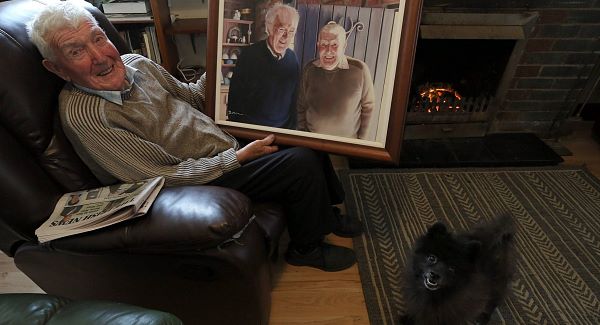
Barney Devlin (95) with a prized painting of himself and Seamus Heaney. His father is the blacksmith referred to by Heaney in The Forge.
Barney Devlin (95), the inspiration for this poem, in his home with a prized painting of himself and the poet,  Seamus Heaney. (www.breakingnews.com)

[1] Michael Wood, in Parnassus (copyright © by Parnassus: Poetry in Review), Spring/Summer, 1974

[2] King, Peter R., Nine Contemporary Poets: A Critical Introduction, London: Methuen, 1979. (Selections from the work of Philip Larkin, Charles Tomlinson, Thom Gunn, Ted Hughes, Sylvia Plath, Seamus Heaney, Douglas Dunn, Tom Paulin, and Paul Mills).

Some ‘Grace Notes’ on Macbeth

The term ‘Grace Note’ comes to us from the world of Irish Traditional music where they are used as embellishments, added extras to further personalise the tune.  Here they are used in a similar fashion – maybe becoming the difference between a H1 and an H2!

macbeth-and-lady-macbeth-dee-timm

Throughout the play Macbeth there is almost a grotesque obsession with violent and unnatural images of children and babies (as well as apparitions of a bloody child and of a child crowned), for instance:

Come to my women’s breasts…….I have given suck, and know

How tender ‘tis to love the babe that milks me….

None of woman born shall harm Macbeth..

There are also many images of barrenness, for instance:

Upon my head they placed a fruitless crown

And put a barren sceptre in my grip,

Thence to be wrenched with an unlineal hand,

No son of mine succeeding.

Even though Macbeth is obsessed at the thought of the children of another man succeeding him, he himself does not have any children (Macduff states that he cannot properly avenge the murder of his own children, since Macbeth ‘has no children’).  Lady Macbeth mentions that she has ‘given suck’, but here she may be referring to children from a previous marriage – or maybe any children the Macbeths have had are now dead.  With this in mind, the voices of the witches that he hears could almost be those of his children that have died or possibly the voices of his imaginary children whom he wants to inherit the throne.  (In some productions of the play the witches have been played by children.  This is not too farfetched – after all, nowadays, when we think of witches, an image of an eccentric woman on a broomstick or a child dressed up in a pointy hat and cloak at Halloween readily comes to mind.)

IMAGES OF TIME AND SPEED

By Shakespeare’s standards, Macbeth is a short play.  There are no major sub-plots, and the events of the central story unfold at an alarmingly fast pace.  Macbeth returns home in Act 1 to prepare for the arrival of the king at very short notice, while Lady Macbeth summons him to ‘Hie thee hither’ and a messenger who has already travelled so quickly is ‘almost dead for breath’.  The images of travel, speed and breathlessness create a sense of unbearable urgency in the play.  Characters are obsessed by time passing – Macbeth himself seems to realise how Time ultimately is in control of his actions, when he addresses Time:

 Time, thou anticipatest my dread exploits.

Later he refers to Murder as something which moves with        ‘stealthy pace’     and he acknowledges that

Come what come may,

               Time and the hour runs through the roughest day.

Macbeth’s reaction of distant resignation to the death of his wife begins with the famous deliberation on time,

Tomorrow, and tomorrow, and tomorrow…….

IMAGES OF BLOOD

In Macbeth, the word ‘blood’ is mentioned 24 times, and ‘bloody’ is mentioned 15 times!  Once blood has been shed, there is quite a gothic obsession with it, as Macbeth and his wife are haunted by images of blood.  This horrified reaction to the blood they have shed is altered, when Macbeth realises that he cannot turn the clock back, saying –

I am in blood

Stepp’d in so far that, should I wade no more

Returning were as tedious as go o’er.

This image of wading through blood which creeps up your body surely has influenced countless Hollywood directors down the years e.g. in films such as The Shining.

Lady Macbeth might have control over her husband in the early stages of the play, but she cannot control her own mind which is plagued with bloody images, washing her hands of invisible blood, and saying –

Yet who would have thought the old man

               To have had so much blood in him.

Perhaps most selflessly and poignantly, Macduff refers to the decline of Scotland with a different use of blood imagery when he says –

Bleed, bleed, poor country.

IMAGES OF SLEEP

In the middle of the night (with its ‘bloody and invisible hand’). The Macbeths murder Duncan, taking his sleep from him.  Ironically, sleep is also taken from them, as Macbeth hears the words

Macbeth shall sleep no more.

For not only has Duncan been murdered in h is sleep, but sleep itself has been slain

Macbeth does murder sleep – the innocent sleep,

              Sleep that knits up the ravelled sleeve of care,

The death of each day’s life, sore labour’s bath,

              Balm of hurt minds, great nature’s second course,

              Chief nourisher in life’s feast.

In Act 3 Scene 2, Macbeth lives in ‘restless ecstasy’ and sees life as a ‘fitful fever’, while in Act 3 Scene 4, one of the last things Lady Macbeth says to her husband before she loses her reason is  ‘you lack the season of all natures, sleep’.  In the same scene, when asked, ‘What is the night?’, she can only reply, ‘Almost at odds with morning, which is which’ – life has become one long waking nightmare for her.

Macbeth has murdered sleep, and the next time we see Lady Macbeth, she cannot sleep as she wanders about trying to clean her ‘bloodstained’ hands.  It seems that the murdering of sleep by Macbeth results directly in his wife’s inability to find peace or repose.

In Macbeth, Shakespeare is so fascinated by night-time and darkness, he uses the word ‘night’ 38 times and ‘sleep’ 26 times!

THE MACBETHS’ MARRIAGE

In Macbeth, Lady Macbeth is stronger initially, but cannot cope after Duncan is murdered; while this first murder is difficult for her husband, subsequent murders hardly cost him a thought.  We know from life and literature (and the tabloids!) that in the aftermath of any major tragic event, the relationships of those involved can either grow stronger or break down – Shakespeare seems to be interested in how the latter situation can come about in this play.

Their separation seems to start in Act 3 Scene 1, when Macbeth gets rid of Lady Macbeth so that he can talk to the murderers, then she returns to see why her husband is spending so much time alone and brooding.  She seems happy to have achieved her goal – the crown, while Macbeth is obsessed by trying to prevent another’s offspring from succeeding him.  Once their aims are different, they grow apart, which suggests theirs is a marriage based on shared political intrigue and desire, rather than love.  As the play progresses, there are very few terms of endearment or fond words expressed (unlike the early scenes).  In fact, Lady Macbeth only refers to Macbeth as her ‘husband’ once (just after the murder of Duncan) – perhaps since she is vulnerable and in need of support at that point.  Also, Lady Macbeth’s constant jibes at her husband’s lack of manhood and inability (as she sees it) to follow through on his desires could refer to more than just his political manoeuvres – if you catch my drift!

 POLITICS

As Macbeth establishes his dictatorship, and his enemies subsequently try to destroy it, political manoeuvres and cunning manipulation abound.  A number of observations about how characters deal with each other are interesting to note:

  • Note how Macbeth persuades the murderers to kill Banquo
  • How Ross tries to find out how Macduff will respond after Duncan is murdered
  • How Malcolm (when he is approached by Macduff in England) pretends not to have any interest in the throne (or, indeed, to be at all suited to it), in order to put Macduff’s loyalty to the test (showing just how paranoid and untrusting everyone has become during Macbeth’s reign of terror).
  • How Ross does not tell Lady Macduff everything and then later seems to withhold information from Macduff about his family – possibly because he wants to enrage him so much to ensure that Macduff will fight against Macbeth? (In the Second Age Production we saw it was interesting that Ross was depicted as the third murderer who comes to help the witches’ prophesy be fulfilled, by helping Fleance to flee.)

In Macbeth, it is Duncan – the King – who seems most notably deceived by show (as, indeed, in many of his plays, Shakespeare is intrigued by appearances which hide reality).  Duncan is a bad judge of character – he had placed great faith in the previous Thane of Cawdor –

He was a gentleman on whom I built

               An absolute trust.

Then almost immediately he makes the very same mistake with Macbeth and his wife, not noticing the serpent under the ‘innocent flower’.  He is oblivious to Macbeth’s potential for evil and unable to see below the surface or to realise Macbeth’s ability to hide with a ‘false face’ what ‘the false heart doth know’.

Banquo, on the other hand, becomes suspicious of his friend, as he starts to see through the façade Macbeth has tried to create for himself, and then realises Macbeth has ‘played most foully’ for his achievements.

HERO OR VILLAIN?

This is the great on-going debate.  For Elizabethan audiences there was but one answer.  For modern-day audiences things are not so clear-cut.  However, in his defence, despite the fact that Macbeth does not seem to mind whom he destroys – surely the sign of a villain – he does have many (initial) crises of conscience which may just about redeem him and allow him the dignified status of ‘tragic hero’.  His sense of regret and awareness of what he has lost can be seen in Act 5 Scene 3, when he has been abandoned by all but a handful of employees, and is without ‘honour, love, obedience, troops of friends’.

Arena-Illustration-Euan-Cook-Macbeth-03