An Analysis of the Poetry of John Montague (1929 – 2016)

Great-Book016C-PMF-John-Montague-poet-no-border
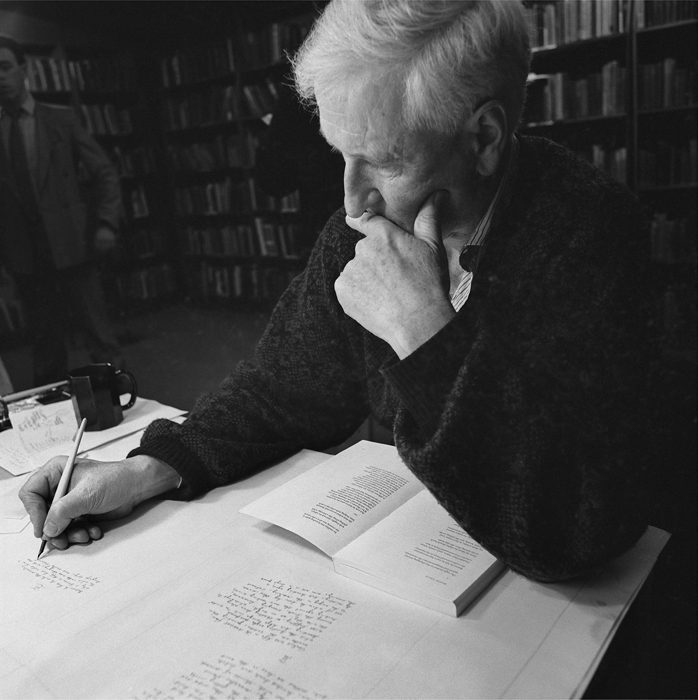
The poet John Montague at work.

THIS IS A PERSONAL REVIEW OF SOME THEMES AND ISSUES WHICH FEATURE IN THE POETRY OF JOHN MONTAGUE. YOU SHOULD CONSIDER THESE IDEAS, THEN RE-EXAMINE THE POEMS MENTIONED FOR EVIDENCE TO SUBSTANTIATE OR CONTRADICT THESE INTERPRETATIONS. IN OTHER WORDS, MAKE YOUR OWN OF THESE NOTES, ADD TO THEM OR DELETE FROM THEM AS YOU SEE FIT.

THE FOLLOWING SELECTION IS SUGGESTED BECAUSE THEY DEAL WITH THE MAJOR THEMES AND STYLISTIC DEVICES WHICH RECUR IN MONTAGUE’S POETRY:
• The Locket (TL)
• The Cage (TC)
• Like Dolmens Round my Childhood the Old People (LDRMC)
• The Wild Dog Rose (TWDR)
• The Same Gesture (TSG)
• Windharp (W)
• A Welcoming Party (AWP)

HE SAID HIMSELF THAT WRITING POETRY WAS ‘LIKE THE DROPPING OF A ROSE PETAL INTO THE GRAND CANYON, A FUTILE ACT’. MAYBE, HOWEVER, YOUR VIEW OF LIFE HAS BEEN CHANGED BY READING HIS POETRY AND MAYBE THE GRAND CANYON IS SWEETER FOR THAT ROSE PETAL AND MAYBE THE WORLD IS A BETTER PLACE BECAUSE OF JOHN MONTAGUE’S POETRY!

YOUR AIM SHOULD BE TO PICK YOUR OWN FAVOURITES FROM THIS SELECTION AND GET TO KNOW THEM VERY WELL.

John Montague
Garbh Fhaiche = The Rough Field = Garvahey

Relevant Background

• John Montague was born in Brooklyn, New York early in 1929.
• He was son of James Montague, an Ulster Catholic, from County Tyrone, who had immigrated to America in 1925 after involvement in republican activities.
• His mother was Molly Carney, but she played little part in his life after his birth. Yet she marred John’s life by her absence from it.
• James Montague had the typical exile’s optimistic hope of benefiting from the American Dream.
• But when his wife, Molly, arrived three years later with their two first sons, James could provide nothing better than the Brooklyn slums for their family home.
• Regarding his background, John Montague’s grandfather was a Justice of the Peace, schoolmaster, farmer, postmaster and director of several firms.
• John had a typical Brooklyn kid’s early childhood, playing with coins on tram- lines and seeing early Mickey Mouse movies.
• Because of the economic effects of the Depression era John Montague was shipped back in 1933 at the age of four to his family home at Garvaghey, in County Tyrone.
• John Montague’s mother rejected him after a painful birth. This rejection and marriage problems were contributory causes to the decision to send John to be fostered from the age of four by two aging unmarried aunts.
• Later, when his mother ended her marriage and returned to Ulster, she continued to ignore John, a fact which deeply hurt him and affected both his speech and his ability to socialise with women.
• However, the switch from city kid to country-village boy in Ulster benefited John and proved to be a ‘healing’ as he called it in a poem not on the course.
• With the help of his imagination, he adopted to life on a farm that doubled as the local rural post-office. Because of this he got to know the local characters and gossip very well. We see this in ‘Like Dolmens’ and ‘The Wild Dog Rose’.
• He was first taught in Garvaghey national school.
• For secondary education John went to an austere boarding school run by strict priests in Armagh. There, against his will, John learned about the long tradition of Irish poetry from an influential teacher.
• While studying for his degree in Dublin after World War Two, John found Dublin to be a very old fashioned place, with the atmosphere over-controlled, especially by priests.
• Afterwards he went to work and complete his education in American Universities. He honed his poetic skills while in America.
• John Montague then got married and lived for a time in France where he continued to write poetry and to write short stories. There for a while he became a friend of the renowned Irish playwright, Samuel Beckett.
• He worked as Paris correspondent for The Irish Times for three years. He spent a total of twelve years living in France.
• After journalism, he began a long career as a university lecturer and poet. He has lectured at universities in France, Ireland, Canada, and the United States.
• He is the author of numerous collections of his own poems and editor of anthologies of works of other poets.
• He has received many awards, including the Irish-American Cultural Institute’s Award for Literature, the American Ireland Fund Literary Award and a Guggenheim Fellowship.
• In 1987, Montague was awarded an honorary doctorate by the State University of New York. The State Governor Mario M. Cuomo praised Montague for his outstanding literary achievements and his contributions to the people of New York.
• In 1998, he was named the first Irish Professor of Poetry. This is a position he held for three years, equally divided among The Queen’s University in Belfast, Trinity College Dublin, and University College Dublin.
• He now divides his time between West Cork and France.
• John Montague has a major international reputation as an Irish poet, the first major Northern Irish Catholic poet.
• He is a poet who describes private feelings as well as public themes.
• Much of his poetry centres on his personal family history and the culture and history of Catholics in Northern Ireland, including the twenty-five year long period of the Troubles.
• For example, his greatest poem ‘The Rough Field’ is set on the farm where he was reared from the age of four and was influenced by the people he grew up among. Three course poems e.g. ‘Like Dolmens Round My Childhood’ come from ‘The Rough Field’.
• The Civil Rights Movement in 1960s Northern Ireland also influenced John Montague. His did a public reading of his poem ‘New Siege’ outside Armagh Jail in 1970 to support a jailed civil rights protestor, the nationalist Bernadette Devlin.
• As an adult he spent some time trying to recapture the American experience, a search reflected in some of his poems.
• Separation from his father all his life affected him emotionally as we read in his poem ‘The Cage’.
• The pain of rejection by his mother was even more traumatic for his personal development as we read in the poem ‘The Locket’.
• John Montague is renowned internationally as one of the major Irish poets of the twentieth century.

  • Montague died at the age of 87 in Nice on 10 December 2016 after complications from a recent surgery. He is survived by his wife Elizabeth Wassell, daughters Oonagh and Sibyl and grandchildren Eve and Theo.
john-montague

MAJOR THEMES IN MONTAGUE’S POETRY

Childhood:  Like many poets on our course, Montague is fascinated with the subject of childhood. AWP describes the relative safety and comfort of a childhood in Ireland during the war. While the rest of Europe was plunged into destruction, Ireland remained safely on the ‘periphery of incident’. While young boys were fighting and dying all over Europe the young poet was free to ‘belt a football through the air’. Yet the ‘drama of unevent’ that constituted the war years in Ireland is briefly shattered for the poet when he encounters the newsreel of the death camps and discovers the grim reality of ‘total war’.

What might be described as a darker aspect of childhood is explored in LDRMC. There is a sense in this poem that the Irelands of Montague’s youth was a dark and haunted place, a land where ancient beliefs and superstitions still survived. We get a sense that during his childhood many people still believed in myths and magic, in ghosts, curses and supernatural demons; ‘Ancient Ireland, indeed! I was reared by her bedside, / The rune and the chant, evil eye and averted head/ Fomorian fierceness of family and local feud.’ For an imaginative child growing up in this society, it was easy to believe that magic still existed, that ancient monsters such as the Fomorians still roamed the land, in the dark countryside just beyond the reach of the farmhouse lights.

A similar theme is evident in TWDR where the poet describes his childhood terror of an old woman that lived in his locality. This poor and seemingly quite ugly old woman terrified the young poet with her ‘hooked nose’, her ragged clothes and the pack of dogs that always surrounded her. To him, she seemed a kind of witch, a terrifying supernatural figure who ‘haunted my childhood’. Yet while Montague’s poetry described this ‘Ancient Ireland’ it also records it’s passing away. As the country became more modern and Europeanised the old legends and superstitions no longer exerted the same power. As he grows up he can see the old legends and superstitions for what they were. This is particularly evident in TWDR where he realises that the ‘cailleach’ that so terrified him in his youth is only human after all and he ends up chatting to her by the roadside, reminiscing and gossiping ‘in ease’ about the people of the parish.

Violence: Montague’s work is haunted by the threat and the possibility of violence. This is particularly evident in ‘A Welcoming Party’ (AWP) where the young speaker is left greatly troubled by his encounter with images of the holocaust. He pulls no punches in his depiction of the horrors of war. His description of the holocaust victims here has been described as disgusting, bizarre and disturbing. Their mouths are described as ‘burnt gloves’, their bodies are depicted as nests full of insect eggs and their hands are depicted as begging bowls.

‘The Wild Dog Rose’ (TWDR), meanwhile, presents violence in an Irish context. The depiction of the attempted rape of the old woman is almost as shocking as that of the holocaust victims. The drunken labourer invades the old woman’s home whirling his boots in an attempt to ‘crush the skulls’ of her dogs. There is something truly horrific about the image of him wrestling her to the ground and ‘rummaging’ in her ‘tasteless trunk’ of a body. Yet this violent scene serves an important symbolic function, representing the violence and misery that had been visited upon Ireland over the centuries. The violation of the old woman echoes many ancient Irish songs and poems in which a woman, representing the land of Ireland, is violated by some ruthless villain who represents the foreign oppressor.

The hidden side of human personalities: John Montague contemplates the vulnerable underside of people who may appear harsh on the surface. ‘Maggie Owens… all I could find was her lonely need to deride’ [LDRMC] ‘Mary Moore… a by-word for fierceness… dreamed of gipsy love-rites’ [LDRMC] Montague also senses how a human hurt can deform a life. ‘the cailleach, that terrible figure who haunted my childhood but no longer harsh, a human being merely, hurt by event’ [TWDR] He reveals the real personality behind the public smiles of his father. ‘My father… extending his smile to all sides of the good (all white) neighbourhood… the least happy man I have known’ [TC] Montague is aware of the duality of our gestures in different contexts. An everyday movement of the hand in public, in traffic, that is mechanical in effect, can be deeply intimate in effect in the privacy of lovemaking, ‘changing gears with the same gesture as eased your snowbound heart and flesh’ [TSG]

John Montague is able to forgive his mother for rejecting him because he sees her pain and senses the different personality she had before her life turned harsh. ‘my double blunder… poverty… yarning of your wild young days… the belle of your small town… landed up mournful and chill’ [TL]

The impact of family on his life: As we have discovered, Montague’s family situation was far from ideal. Like thousands of Irish people, his parents were forced to emigrate to America where they struggled to survive in the face of extremely difficult circumstances. The consequences of this struggle are movingly portrayed in ‘The Cage’ (TC). The battle with poverty and the effort to make a home in a new society have clearly scarred the poet’s father who is described as ‘the least happy man I have known’. His deep unhappiness is evident in his alcoholism. Each night he is compelled to drink himself into oblivion as if only this will numb the pain of his existence, ‘the only element he felt at home in any longer: brute oblivion’.

Yet the poet’s mother, it seems, suffered even more. He claims that the brutal circumstances of her life – emigration, poverty, a loveless marriage – damaged her in some fundamental way, leaving her ‘wound’ in a ‘cocoon of pain’. She is unable to bond with her son and eventually sends him back to Ireland – causing great psychological damage to both herself and her son, so much so that in ‘The Locket’ (TL), he refers to her as a ‘fertile source of guilt and pain’.

The harshness of life: John Montague portrays the suffering of lonesome, impoverished locals from the hills around Garvaghey (Garbh Fhaiche = rough field = Garvahey). ‘When he died his cottage was robbed… driving cattle from a miry stable… forsaken by both creeds… Fomorian fierceness of family and local feud’ [LDRMC] He depicted the suffering of his father, a prisoner of poverty in New York. ‘ my father, the least happy man I have known…the lost years… released from his grille… drank neat whiskey until… brute oblivion.’ [TC] Montague spells out the extent of his mother’s physical pain and anguish. ‘ source of guilt and pain… the harsh logic of a forlorn woman’ [TL] He portrays the life-long loneliness and the brutal rape of a seventy-year-old spinster. ‘the cailleach… hurt by event… loneliness, the monotonous voice in the skull that never stops… he rummages while she battles for life bony fingers reaching desperately to push against his bull neck…’ [TWDR] Montague also portrays the horror of concentration camps. ‘From nests of bodies like hatching eggs flickered insectlike hands and legs’ [AWP]

A sense of place: Montague observes and draws the landscape of his childhood. ‘the cottage, circled by trees, weathered to admonitory shapes of desolation…where the dog rose shines in the hedge’ [TWDR] ‘a bend in the road which still shelters primroses’ [TC] ‘ a crumbling gatehouse. Famous as Pisa for its leaning gable’ [LDRMC] ‘From main road to lane to broken path’ [LDRMC] Montague pinpoints the essence of nature’s music as created by the wind in the Irish landscape. ‘seeping out of low bushes and grass, heatherbells and fern, wrinkling bog pools, scraping tree branches…’ [W] Montague evokes the horror of Auschwitz. ‘a welcoming party of almost shades… an ululation, terrible, shy’ [AWP] He also neatly depicts the irrelevance of Ireland geo-politically in the 1960s. ‘to be always at the periphery of incident’. He mentions what would strike an Irish visitor to New York. ‘listening to a subway shudder the earth.’ [TC] Montague sums up the essence of a Brooklyn neighbourhood. ‘(all-white) neighbourhood belled by St Theresa’s church.’ [TC] Montague evokes the intimacy of the marriage bedroom. ‘a secret room of golden light… healing light… gesture … eased your snowbound heart and flesh.’ [TSG]

Isolation and separation: Montague’s parents suffered separation and social isolation. ‘My father… brute oblivion’ [TC] Like his father, his mother suffered from self-imposed oblivion. ‘the harsh logic of a forlorn woman resigned to being alone’ [TL] Montague with great sympathy captures the reason for an odd old lady’s personality. ‘the only true madness is loneliness, the monotonous voice in the skull that never stops because never heard’ [TWDR] Her isolation means that she seeks no redress from the authorities for rape. She suffers with a stoicism born of a folk version of religion. ‘she tells me a story so terrible I try to push it away… I remember the Holy Mother of God and all she suffered.’ [TWDR] Montague captures the isolation of his scattered elderly rural neighbours. ‘Jamie McCrystal sang to himself… Maggie Owens… even in her bedroom, a she-goat cried… Billy Eagleson… forsaken by both creeds… ‘ [LDRMC]

Human love: Montague is quite famous within the literary world as a poet of love. Intense descriptions of erotic love, in particular, recur in many of his poems. We see this in ‘The Same Gesture’ (TSG) where the couple’s lovemaking is unashamedly celebrated: ‘It is what we always were- / most nakedly are’. Lovemaking is presented as something spiritual and holy. The couples’ hands moving on each other’s skin, we’re told, is like something from a religious ceremony: ‘the shifting of hands is a rite’. Love and sexual intimacy are depicted as having a powerful healing quality: ‘Such intimacy of hand / and mind is achieved / under its healing light’. Oneness is also celebrated, the notion that two lovers can somehow forget themselves and blend into one: ‘We barely know our / selves there.’

TSG, too, is intensely aware of the fragility of love. Emotional and sexual intimacy can be a spiritual and ‘healing’ thing. Yet a relationship can also become bitter and sour leading to hatred and even violence. The poem suggests that in this modern age love and intimacy are becoming more and more difficult to maintain. In this busy world where time and space are such a precious commodity, it can be easy to lose sight of what matters. The pressures of ‘work, phone, drive through late traffic’ must not cause us to neglect our relationships. Love, the poem implies, requires private space, a ‘secret room’ if it is to flourish if its ‘healing light’ is to shine. In the modern world, however, such space is increasingly difficult to come by.

Nature: As with other poets like Kavanagh and Frost, Montague’s work is regularly inspired by the natural world. This is very evident in ‘Windharp’ (W), in particular where he lovingly describes the Irish landscape with its ‘heather bells and fern, / wrinkling bog pools’. In this phrase we see Montague’s powers of description at their best: we can easily imagine the ripples on a bog pool resembling wrinkles on a piece of cloth.

A love of the Irish landscape is also evident in LDRMC with its celebration of the folk who live among the mountains and glens of rural County Tyrone. TWDR, too, displays the poet’s love of nature with its meticulous description of the tender wildflowers with their ‘crumbling yellow cup / and pale bleeding lips’. Yet the harsher aspects of nature are also lovingly rendered, such as the old woman’s rough field with its ‘rank thistles’ and ‘leathery bracken’. He observes nature’s beauty in eloquent language, ‘Gulping the mountain air with painful breath’ [LDRMC] ‘weathered to admonitory shapes of desolation by the mountain winds’ [TWDR]

Montague personifies the effects of climate on the Irish landscape as ‘ a hand ceaselessly combing and stroking the landscape’ [W]. He is also aware that not all that is beautiful is strong, ‘dog rose… at the tip of a slender, tangled, arching branch… weak flower, offering its crumbling yellow cup and pale bleeding lips fading to white’ [TWDR]

It is unsurprising, therefore, given Montague’s obvious love of the Irish landscape that he describes it as something ‘you never get away from’. Even when you leave the country, he claims, the sound of the wind through the Irish countryside, that ‘restless whispering’, will still somehow echo in your ears.
CmdOvCqWEAAQrlf
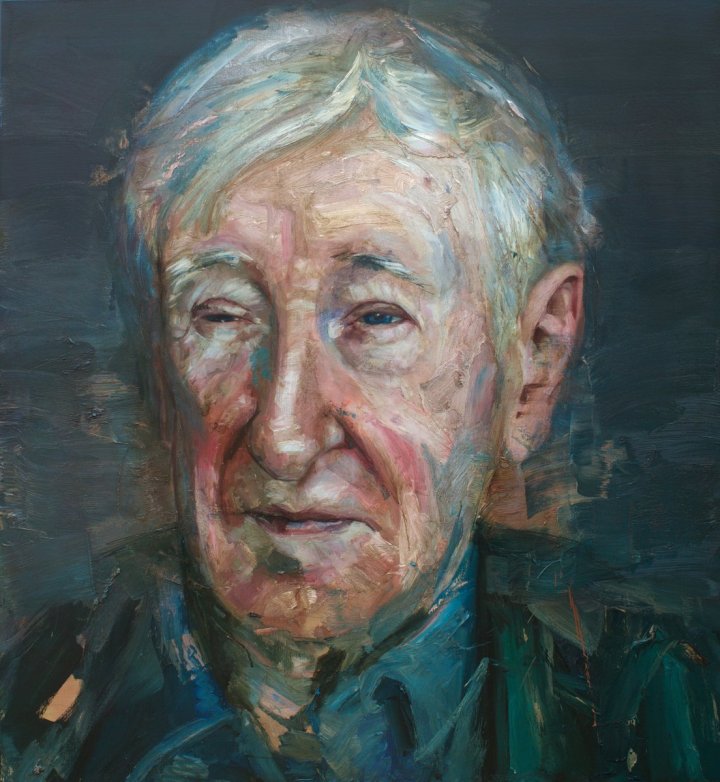
‘Portrait of John Montague’ / 2015-16 / 127x117cm / oil on canvas by Colin Davidson

MAIN ELEMENTS OF MONTAGUE’S STYLE

Form John Montague is a lyric poet. He uses various stanza forms in the poems selected for the Leaving Certificate. He favours a poem of between four and seven stanzas with either six or seven lines per stanza. However, he deviates from this at times. He doesn’t tend to follow a definite rhyming pattern. Many of his poems have rhyme, though he is not strict about this. You are as likely to see half-rhyme as rhyme.

Speaker: In most of Montague’s poems the speaker is the poet himself. Most of his material comes from his lived experience and direct observations. He is a poet of the self, a romantic poet in that sense. He uses poetry to arrive at perceptions about his parents, partners, memories and the impact on him of national and international events.

Tone: Montague’s various tones range from pain to empathy, admiration and wonder. The word which applies to much of his poetry is compassionate. His tone is often one of intelligent detachment. At times he is capable of sarcasm. His tone can sometimes sound haunted, guilty even for the actions of others. He is capable of rueful and frustrated irony as illustrated in the final line of ‘A Welcoming Party’.

Language: Montague’s language is personal and anecdotal. He addresses the reader in conversational English. The need for rhythm and a regular beat may lead to the omission of obvious words or the changing of word order or phrase order. His most striking feature is his use of adjectives, sometimes in a group of three. It is worth commenting on his adjectives and how they convey meaning, express tone and achieve mood. ‘Windharp’ is a very eloquent poem in which to investigate the effect of adjectives. The fourth stanza of ‘The Wild Dog Rose’ is a powerful example of Montague’s talent for selecting adjectives.

Montague’s choice of verb is often apt and evocative. The use of the verb ‘rummages’ in its context in ‘The Wild Dog Rose’ is both horrifying and touching in its graphic violence. A clear example of Montague’s ability to use a pithy phrase is found in ‘A Welcoming Party’ when he refers to Ireland’s remoteness from what matters in the world at large: ‘to be always at the periphery of incident’. He defines the ‘Irish dimension’ of his childhood as ‘drama of unevent’. Montague matches language to meaning.

Imagery: As partly a narrative type of poet, many of Montague’s images are descriptions of actual memories, colourful pictures from his lived experience or the experience of others like Minnie Kearney narrated first to him and then to the reader as a third-person account. A particularly graphic example of the latter is found in ‘The Wild Dog Rose’. The poem contains an uncensored example of violence, a detail of which is the following: ‘the thin mongrels rushing out, but yelping as he whirls with his farm boots to crush their skulls’. The effect of the word ‘yelping’ on the reader is strong here. Consider the locket around his mother’s neck as a graphic image from his life.

Montague also chooses striking comparison images to convey his intelligent perceptions. The image of a cage for his father’s work booth is an example of Montague’s clear but intelligent metaphors. Likewise, his simile of the dolmen is profound and carries many resonances. The detailed image of the dog rose from the third section of ‘The Wild Dog Rose’ is an illustration of Montague’s descriptive powers and of his ability to use an actual image as a symbol of human fragility.

Verbal music: For Montague’s lyrical music you will find various sound repetitions, rhymes and half-rhymes, alliteration, assonance, onomatopoeia, consonance and sibilance in all his poems. For assonance listen to the ‘u’ sounds in ‘A Welcome Party’ especially in lines seven to ten. This enhances the effect of a group wail or lamentation as suggested by the word ‘ululation’.

A useful example of onomatopoeia is found in line two of ‘Windharp’, where the words imitate the breezes in the bushes and grass: ‘ the restless whispering’. This is a case of assonance ‘e’ and sibilance combining to create a musical effect that reinforces meaning.

For a more detailed illustration of verbal music examine the precise examples provided in the notes on three individual poems by John Montague in the Leaving Cert English Ordinary Section on Skoool.ie .
images (3)

SAMPLE ANSWER:  Give your personal response to the poetry of John Montague.

 I am a big fan of John Montague because I find his poetry very emotional and moving.  Much of this emotion comes from the depiction in his poems of human relationships.  In poem after poem, he explores the difficulties that can exist in human relationships.  Several of his poems reveal the tensions and difficulties that can dog even the most successful of romances.  Family pressures, too, are movingly explored in these poems.  Yet what I found most attractive about Montague’s work is its emphasis on the fact that these difficulties can be overcome or reconciled.

 Montague is quite famous within the literary world as a poet of love.  Intense descriptions of erotic love, in particular, recur in many of his poems.  We see this in ‘The Same Gesture’ (TSG) where the couple’s lovemaking is unashamedly celebrated: ‘It is what we always were- / most nakedly are’.  Lovemaking is presented as something spiritual and holy.  The couples’ hands moving on each other’s skin, we’re told, is like something from a religious ceremony: ‘the shifting of hands is a rite’.  Love and sexual intimacy are depicted as having a powerful healing quality: ‘Such intimacy of hand / and mind is achieved / under its healing light’.  Oneness is also celebrated, the notion that two lovers can somehow forget themselves and blend into one: ‘We barely know our / selves there.’

In ‘The Same Gesture’, too, the poet is intensely aware of the fragility of love.  Emotional and sexual intimacy can be a spiritual and ‘healing’ thing.  Yet a relationship can also become bitter and sour leading to hatred and even violence.  The poem suggests that in this modern age love and intimacy are becoming more and more difficult to maintain.  In this busy world where time and space are such a precious commodity, it can be easy to lose sight of what matters.  The pressures of ‘work, phone, drive through late traffic’ must not cause us to neglect our relationships.  Love, the poem implies, requires private space, a ‘secret room’ if it is to flourish if its ‘healing light’ is to shine.  In the modern world, however, such space is increasingly difficult to come by.

One of his most emotional poems is ‘The Locket’, where he describes his difficult relationship with his mother.  He tells us that his mother has been a ‘fertile source of guilt and pain’ for him throughout his life.  According to the poet, his mother regarded his birth as a ‘double blunder’.  The first part of this ‘double blunder’ stemmed from the fact that the poet was born a boy when she really wanted a girl.  Secondly, Montague was turned the wrong way in the womb, making the process of his birth extremely difficult for her.  According to the poem, this ‘double blunder’ caused the mother to reject her son.  She was never really affectionate to him and ‘sent him away’ when he was four years old.  He was sent back to Ireland where he lived with his aunts.

It seems that even in later years the mother could not bear to be around her child.  When she returned to Ireland she did not reclaim her son and instead went to live in a different village a few miles away from where he lived.  As a young man Montague would ‘cycle down’ to visit her, but eventually, she told him to stop coming: ‘I start to get fond of you, John, / and then you are up and gone.’  I found this aspect of the poem extremely moving and felt very sorry for the young Montague.  I felt he had done nothing to deserve this harsh treatment from his mother.  After all, it was not his fault he was born ‘the wrong sex’ and the ‘wrong way round’.  I found the mother’s behaviour somewhat cruel and felt that she had unfairly created feelings of ‘guilt and pain’ for her son.

‘The Cage’ also explores the poet’s feelings of ‘guilt and pain’ and in this case, the negative emotions stem from his difficult relationship with his father.  He describes his father as the ‘least happy man I have known’.  This unhappy man spent his days working in the dark and noise of the New York subway: ‘listening to a subway shudder the earth’.  He was an alcoholic who would drink himself into ‘brute oblivion’.  Only when obviously drunk was he in any way happy.  According to the poem, this was the ‘only element / he felt at home in any longer.’

One of the most moving aspects of Montague’s poetry is his depiction of his reconciliation with his parents.  When his mother dies he discovers that she loved him after all and that for years she had worn a locket that contained his picture: ‘an oval locket / with an old picture in it, / of a child in Brooklyn’.  Similarly, the poet eventually comes to terms with his troubled father and they walk ‘together / across fields of Garvaghey / to see hawthorn on the Summer / hedges’.  I found it very tragic, however, that both reconciliations came too late.  For the poet’s mother was unable to express her love for him while she was alive and it is only after her death that he learns of it.  The poet’s reconciliation with his father also comes too late.  For no sooner has the father returned to Ireland and spent some time with his son than the son himself must depart: ‘when wary Odysseus returns / Telemachus should leave’.  The poet seems to be forever haunted by this unhappy man and his failure to ever really connect with him and still sees his father’s ‘bald head’ when he descends into subway stations.

Another poem that showcases reconciliation is ‘The Wild Dog Rose’.  As a child, the poet was terrified by the old woman who lived near his house, imagining her to be a terrifying witch with a ‘great hooked nose’, her ‘mottled claws’ and her eyes that were ‘ staring blue’ and ‘sunken’.  I really like the way Montague captures the feelings of mystery and terror the boy experiences at the sight of this weird old lady who ‘haunted my childhood’.  As in ‘The Cage’ and ‘The Locket’ there is a focus on reconciliation in this poem when Montague comes back as a fully grown young man to visit the ‘cailleach’.  Now his feelings of ‘awe’ and ‘terror’ have been replaced by ‘friendliness’.  The poet and the old woman stand by the roadside talking about old times: ‘we talk in ease at last, / like old friends’.  Gradually he is reconciled with this old woman that scared him so much: ‘memories have wrought reconciliation between us’.

To sum up, then, the main reason I like Montague’s poetry so much is the convincing way in which it reveals human emotions.  The poems very movingly portray negative emotions such as pain, guilt, fear and sorrow.  Yet they also show how these negative emotions can be healed and overcome through a process of reconciliation.  I find these aspects of his work very moving indeed.


 john-montague

 JOHN MONTAGUE – SOME GRACE NOTES…..

“The only thing unchanging in life is change.”

  • John Montague is a poet of emotion and of place. Memory, love, Ireland and elsewhere play a significant part in his work.  The seven poems highlighted here tell of his fascination with his sense of his past and native place (LDRMC); his father (TC); his mother (TL); an old woman in his native place who tells him of an attempted rape (TWDR); Ireland’s landscape (WH); the complexities of love (TSG); and his awakening boyhood consciousness (AWP).  According to Montague ‘the only thing unchanging in life is change’ (and a very eminent English teacher constantly reminded his class that ‘the only people who welcome change are babies with wet nappies’!) and his poetry is a chronicle of that change in his own life.
  • The poems we have studied chart Montague’s boyhood, schooldays, early love, and relationships.  Unhappiness and hurt feature in many of his poems.  He speaks of himself as ‘An unwanted child, a primal hurt’ and admits that ‘my work is riddled with human pain’.  However, he also writes tenderly and sensitively about landscape and love.  He sees himself as the first poet of Ulster Catholic background since the Gaelic poets of the eighteenth century.
  • Critic, Peter Sirr, describes Montague as ‘Public and private, internationalist and intensely focused on Ireland’.  He says that Montague’s poetry results from ‘a complex and troubled journey’ and his poetry is ‘haunted, edgy and constantly in search of framing structures to make sense of its different worlds.’  That complex and troubled journey began in Brooklyn and moved through Ireland, North and South, later France and America, before returning to Cork and West Cork.  Family and personal history and Ireland’s history became subject matter for the poetry and his poetic techniques were influenced not only by Irish but by French and American poetry.
  • In an 1988 interview with Dennis O’Driscoll, Montague compared the making of poems to fishing, ‘trying to get the fish out on to the bank’ and he likened the making of poems to the dropping of a rose petal into the Grand Canyon.  Many of his poems are intensely personal.  He shares with us his understanding of intimate, private things and he also writes of life’s harshness and disappointments.
  • Frost will always be associated with Vermont and Kavanagh will always be associated with Inniskeen and indeed, Montague will likewise always be associated with Garvahey (from the Irish ‘garbh fhaiche’ meaning ‘rough field’).  It was his adopted place and he has made this place his own.  ‘Among the welter of the world’s voices,’ he says, ‘in the streets, on the airwaves, in the press, you find your own voice, yet this does not isolate you, but restores you in your people.  Across the world the unit of the parish is being broken down by global forces, and from Inniskeen to Garvahey, from Bellaghey to Ballydehob, to the Great Plains of America, an older lifestyle, based on the seasons, is being destroyed.  But it can still be held in the heart and in the head.’
  • In his Inaugural Lecture of the Irish Chair of Poetry on 14 May 1998, John Montague said: ‘So you wander round the world to discover the self you were born with’ and in that same lecture he agrees with Frank O’Connor who ‘argues that the strength of the storyteller often comes from the pressure behind him of a community which has not achieved definition, a submerged population’.
  • In Peter Sirr’s words: ‘The need to unify the different levels of experience, the recognition that the personal and the political are necessarily meshed, are part of what makes Montague valuable’ and Montague identifies Ireland’s ‘three great losses in the nineteenth century’ as defining: ‘First the loss of people.  Ireland had 8 million people in 1840.  A third of those died or left.  Second, the loss of the Irish language.  Those who remained had to learn to speak English and it happened in ten years.  Third, the loss of the music.  Those who played music at the crossroads were driven out to America and there was fifty years of silence.’

Though his poetry contains striking and memorable images of scars and wounds, ‘I think the ultimate function of the poet is to praise’, says Montague.

My favourite Novel of all Time… Reading in the Dark by Seamus Deane

download

STUDY NOTES

ON

READING IN THE DARK *

BY SEAMUS DEANE
*Page references are from the Vintage, 1997 edition

This has to be one of my favourite novels of all time – definitely the best book never to win The Booker!  There you go – I’ve put my cards on the table for all to see.  This incredibly well-crafted novel is set in Derry over a 16-year period from 1945 to 1961, the book presents a child’s view of the tensions in the city during that time.  Throughout the book we are reminded of the conflict that surrounds the narrator.

An example of the narrator’s direct involvement is shown in the story of the St. Patrick’s Day riot where the police baton-charged a march and were enticed down a long street where half a barrel of oil was poured onto the street as they approached.  Two police cars skidded sharply under a hail of stones and one burst into flames.  Here the writer emphasises the hazards and dangers of the time and shows the children’s thrill at getting the better of the police.

The reader learns to piece the story together of a tense historical period, where secrets about past deeds are buried and rarely, if ever, revealed even to those who are closest to those who participated in them.  Few direct references are made to the actual events of the time, with the exception of the 12th of July celebrations, commemorating the triumph of the Protestant armies at the Battle of the Boyne; the Apprentice Boys march on the 12th of August, celebrating the liberation of the city of Derry from a besieging Catholic army in 1689; and the 18th of December, the burning of Lundy’s effigy.  These are briefly mentioned and used as landmarks to guide the structure of the book.  Deane also refers to the church festivities on the 15th of August which were turned into a political event as time went on.  With knowledge of these events, many aspects of the boy’s story are more meaningful to the reader who can then understand the significance of many apparently general comments.

The unnamed narrator is a young boy, who describes the years of his growing up in Derry in the 1940s and ‘50s.  He is the third oldest of seven children in a working-class Catholic family.  The story traces the family’s complicated history which reveals many secrets surrounding the mysterious disappearance of Eddie, his father’s brother. Eddie had been accused of being a police informer and had been unable to prove his innocence.  He was executed by the IRA in a remote farmhouse under the orders of the narrator’s maternal grandfather.  However, it emerged later that the real informer had been McIlhenny, his aunt Kate’s husband, and therefore Eddie had been killed in error.

The boy’s mother knew this, and when she found out she warned McIlhenny in time for him to escape to America.  She did this because she had had a relationship with him in the past before he married her sister.  Her husband did not know this.  He was unaware that his brother had not been an informer and dies at the end of the novel, grieving for the trouble he thought his brother had brought upon the family.

The boy’s mother has had to endure her husband’s suffering, unable to tell him the awful truth.  When she learns that it was her own father who organised Eddie’s execution, she cannot cope with what she knows.  She becomes emotionally crippled with guilt and helplessness and begins to disintegrate emotionally and psychologically.  Now only the boy knows the full story and like his mother he is bound to silence.  He uncovers the truth bit by bit but it is a large burden of knowledge for a young boy to carry.

 THEMES AND ISSUES

The Theme of Secrecy:  A well-known saying in the North of Ireland is, ‘Whatever you say, say nothing’.  This saying reflects the troubled times in the North.  Seamus Heaney used the phrase as the title and the theme of one of his most impressive poems on the Northern Troubles which raged from 1969 until 1998.

There is a natural reserve built in to any discussion about politics or about happenings where there may be conflict.  This is very much the case in many novels written about the Northern situation, and Deane’s novel is no exception.  There is very little direct discussion about what has happened to Eddie.   Much of the information comes to the boy in a vague, roundabout way and it takes the boy’s perceptive abilities to link the threads together.

Secrets abound in the novel, and as the human mind is naturally curious, the boy is determined to find out what is obviously being hidden from him.  The boy knows that his grandfather is a possible source of information, especially now that his health is deteriorating and he appears close to death.  The boy is often sent in to sit with his grandfather and eventually, he tells him that Eddie was executed as an informer, but that there was more to it,  ‘He shut his eyes and he told me, he told me.  He, Grandfather, had ordered the execution.  But he was wrong.  Eddie had been set up.  He had not been an informer at all’ (p. 126).

Meanwhile, unaware that the boy already knows something, it takes quite some time before the boy’s father can bring himself to tell his sons the truth, as he understands it, about his own brother.  In a quiet country church, he finally managed to do it.  ‘Eddie was never killed in that shoot-out,’ he said suddenly and looked away from us immediately … ‘No, he wasn’t killed in the distillery.  He was an informer.  His own people killed him.’  Now he had said it all, and a great shame and sorrow was weighing his head down towards the front of the pew’ (p. 133).

To be an informer was one of the worst possible crimes that any person could commit – to inform on your own people for a few pounds was unforgivable.   Families who had informers in their ranks could never be trusted and life could be and was often made a misery for anyone related to an informer.

‘He was talking all the time, forcing it out of himself, and Liam’s face was white as a star beside him.  Informer.  Betrayed his companions.  Why he did it could not be known.  His brother.  Thank God his parents were not alive to see it.  It was so stale a secret, like a gust of bad breath, and the way the three of us were crouched together in the middle pew of the church, like conspirators, with the sun beginning to warble again, it was like a false relief, as though the church were a machine that had stopped throbbing to let the world come in again around its becalmed silence’  (p. 134).

The boy’s mother is also very protective of the awful secrets that she has to carry and she is determined not to reveal them to any other person.  Again, secrecy is vital, as the revelation of what she has done would do irreparable damage to her husband and to her sister.  The boy can see this worry in her because he shares some, but not all of what she knows.

‘We were pierced together by the same shaft.  But she didn’t know that.  Nor was I going to say anything unless she did.  And even then, when it had all been told, I had the sense of something being held back, something more than she knew, something Grandfather had cut out’ (p. 127).

It is this desperate clinging onto awful secrets which fuels the whole novel.  As the plot unfolds, the enormity of the secrets is impressed upon the reader.  The action of the novel escalates and this keeps the reader turning the pages to find out if a secret will be told.  Feelings, which accompany secrecy, intensify as the story goes on.  Fear, intense shame, guilt and helplessness are all present.

The Theme of Family Relationships:  One of the main themes of this book is the topic of family relationships, which are under strain partly due to the times they live in.  The boy’s relationship with each parent changes as the story unfolds.  He rarely asks questions yet he is given information from various sources.  By piecing the fragments together he realises that neither parent knows exactly what happened, yet he is prevented from interfering and informing them by an awareness of the pain that this would cause them.

Each piece of the jigsaw puzzle he finds causes further alterations in the boy’s relationship with both parents.  Sometimes one parent will tell him a little, giving him the impression that they trust him.  At other times, he learns something from outside the family, which draws him away and makes him more reserved with them.  It is only when his grandfather tells him on his deathbed that he had ordered Eddie’s execution and that Eddie had been set up, that things begin to change radically for the boy, ‘I left him and went straight home, where I could never talk to my father or my mother properly again’ (p. 126).

The boy knows that his mother is struggling to live with the knowledge that her husband is unaware that his innocent brother was murdered under her father’s instructions as punishment for a crime that he had not committed.  She has also had a relationship with McIlhenny, her sister’s husband, and her husband is unaware of this too.  McIlhenny was, in fact, the informer who had framed Eddie, her husband’s brother, and she was the one who had alerted him before he escaped to Chicago.  As a result of her actions she is tortured by a mixture of guilt and grief.

It does not help when she realises that her son knows the truth.  This heightens the strain between mother and son.  Instead of sharing the burden, they become isolated from and wary of each other.  The father cannot understand why their relationship has suddenly deteriorated.  Near the end of the book, the boy’s mother finds the strain of keeping this secret too much for her, and she begins to disintegrate emotionally.  Even though he did his best to reassure her that he would never say anything, she wished he were not there,  ‘Why don’t you go away?’ she asked me.  ‘Then maybe I could look after your father properly for once, without your eyes on me’ (p. 224).

Father and son do not have a particularly close relationship: there are many unspoken barriers between them.  His father is bitterly ashamed of having an informer in the family and rarely speaks about his brother Eddie.  A few brief glimpses into the past show that as children, the boy’s father and Eddie had been close friends, which made the blow even harder when Eddie was accused of betraying the family.  At one point, he is unable to prevent himself from hitting his son when he speaks disrespectfully of Eddie.  He was angry with his son for antagonising the police and challenging him.

‘Was there something amiss with me?  No, I told him, there’s something amiss with the family.  The police were on top of us long before I was born.  If he wanted to blame someone, let him blame Eddie, not me.  He hit me so fast, I saw nothing.  My shoulder felt hot and broken.  I got up, hating him, although I could feel the tears coming as the pain increased through the numbness’ (p. 102).

Another piece of the family history which adds further strain to family relationships, is the fact that his mother’s father killed a policeman in his youth in retaliation for a close friend’s death.  Unshakable alibis enabled him to escape the punishment.  This is something that the family must live with and they are constantly reminded of it in subtle and not so subtle ways whenever they come into contact with the police.  One incident is the repeated persecution of the boy’s mother by Sergeant Burke when the children are at school.  As a family living with the guilt of murders committed or organised by other members, they have difficulty maintaining steady or open relationships due to the burden of secrecy imposed on them.  Like Macbeth and Lady Macbeth, who had blood on their hands and troubled consciences, this family, even though the main members concerned did not actually commit the crime, are tainted by it and must live with the consequences.

Deane depicts the family in a very credible manner.  The absence of significant conversation and the conveying of information through a child’s thoughts and reflections show all too clearly how the family structure is being worn down.  Yet, at the same time, the family shows a resilience and a determination to keep going despite all that has happened and is happening, perhaps because of some inner strength, never acknowledged.

The Theme of Growing Up:  This novel is narrated in the form of an autobiography and it shows a progressive change in the boy’s outlook on life from the time he discovers what has happened to his family in the past.

Here the main character’s development is rather a painful one as the boy begins to realise the extent of the tragic happenings in his family and he has to try and accept that they are irredeemable.  His uncle cannot be resurrected and his grandfather has always had two murders on his conscience.  His mother has been betrayed in love and his father believes he has been betrayed by his own brother.

All of the above have a significant impact on the boy.  As an observer from the outside, the boy watches his parents and because he cannot do anything to heal their wounds he simply retreats into himself.  ‘But knowing what I did separated me from them both.’  For much of the time he is alone, alienated by what he knows and unable to confide in anyone, least of all in a family member.  Isolation from those around him is a noticeable part of his growing up (as it is in our other texts).  At no point does he relate an in-depth conversation with any member of his family about his family.  He is very much on his own with his thoughts and with his efforts to link up the things he knows by using his own initiative.

He is an avid reader and often reads late into the night, finding solace in books,

‘I’d switch off the light, get back in bed, and lie there, the book still open, re-imagining all that I had read, the various ways the plot might unravel, the novel opening into endless possibilities in the dark’ (p. 20).

Reading was for him a way of opening the doors of his imagination and allowing it to run free.  As a child he had the ability to think things out in detail.  This ability helped him piece the truth together from the flimsy snippets of information he had acquired.

As he grows up, he becomes more and more distant from his parents because this is the only way with which he could cope with what he knows,

‘I went away to university in Belfast, glad to have so mishandled everything that I had created a distance between my parents and myself that had become my only way of loving them’ (p. 22).

In a sense, this attempt was successful as ten years on, much of what had once been clear in his mind had become more vague.  The years passed and the memories began to become so confused and muddled, that he wondered at times if he had dreamt it all.

The novel ends in 1971 with the musings of a young adult who is home again for his father’s funeral.  It is a desperately sad ending as the family’s grief is for more than just the loss of a member; the father dies still unaware of the dreadful truth.  The chief mourners, his wife and son, have a lot to lament.  It is left to the reader to surmise how the young man is now feeling; relief that his father dies without knowing that his brother had died in error, anger that he could never be told, or guilt that he knew all along?  Or is it just an intense, heartbreaking sadness?  Deane deliberately ends the story with a sparse use of language. What is left unsaid speaks volumes, we are left as Seamus Heaney says in “Harvest Bow”, ‘gleaning the unsaid off the palpable’.   Isn’t this always the case?

LITERARY GENRE

Type: Social Realism/Autobiography/Memoir:  In Reading in the Dark, fiction and fact, myth and history combine to create a hybrid between two modes of writing, autobiography and fiction.  If the reader did not know it was a novel, he or she might be forgiven for assuming that it was purely autobiographical.  For the narrator, there are two worlds: the city of Derry and its haunting secrets of the past and the wealth of legends that haunt his childhood.  Both worlds, real and unreal, are cleverly intertwined in the novel, which gives strength to the impact of the book.

In some respects, it also takes the form of a detective novel, if the suspense of finding out the truth about the real murderer and the real informer are taken into consideration.  However, it would be insulting to the author to dismiss it as such, because it contains far more than that.  Much of what happens to the family is a glimpse into the fabric of life in Northern Ireland at the time, and it is based on real happenings.  It is therefore socially realistic.  It is also a novel with a tragic ending, yet it does not completely fit the general definition of tragedy.

Essentially then, Reading in the Dark combines two genres, a socially realistic novel and tragic fiction, with a hint of a detective novel and political thriller thrown in for good measure!

The Structure of the Novel:  The book is written as a first person narrative.  A complex situation is presented from a young boy’s point of view and he comments on each happening ass it occurs.  The plot is clearly drawn and extremely well ordered.  It is written chronologically and meticulously dated.  This is important as part of the plot hangs on the accuracy of dates when the boy is trying to figure out who knows what and when.  This also emphasises the clarity of the boy’s memories.  Each chapter is sub-divided into different sections, which are short and condensed, and each section has its own significant link with the overall plot of the novel.

While the novel takes us through a 16-year period from 1945 to 1961, it does refer back to a period twenty years earlier to when Eddie disappeared in 1922 after the attack on the distillery, to 1926 when McIlhenny left for Chicago, to when his parents first met in 1930 and to when they got married in 1935.  This period is mentioned a number of times to remind the reader that this was a turbulent time, both for the family and for the province.  With this technique, Deane controls the plot so that the reader’s curiosity is aroused in the first few pages and maintained throughout.  Answers are given bit by bit, moving from the present to the past and back again.  The plot twists and turns as the true story gradually emerges.  The reader is challenged to work out what is happening each time that the boy gathers a new piece of information.

Old stories and fables are included at strategic points, which adds to the fictional aspect of the novel.  The child finds it hard to know what to believe as the legends of the past spill over into reality.  It becomes difficult to distinguish between truths and untruths as many of the family secrets are hazy and vague and take on the ghostly qualities of legends.  The chapter, Field of the Disappeared, illustrates this perfectly.  The boy is unsure whether the old tale is true or not, but it is here that Eddie is linked up with a ghostly legend.

Ghosts haunt the story from the very first page.  The boy’s mother is transfixed in the stairway watching a ghost she believes to be inhabiting the family’s house.  Her conscience torments her and memories of her past come back to haunt her.  Ghostly spirits are woven through the stories which the boy hears from adults and the ghostly memories of dead family members echo through the pages.  Yet for the narrator at the end of the novel, things are not as vague as they seem,

‘Hauntings are, in their way, very specific.  Everything has to be exact, even the vaguenesses.  My family’s history was like that too.  It came to me in bits, from people who rarely recognised all they had told’ (p. 225).

In the chapter,  All of It? (p. 182) everything finally comes to light (see p. 187), and the boy assembles all that he knows.  The enormity of what he has to carry becomes evident to the reader.  This chapter is appropriately placed close to the end of the novel, which unifies its structure.

The Style of the Novel:  Deane uses a beautifully poetic style of writing to create a tightly written story.  His writing is primarily clear and direct.  The opening lines of the novel illustrate this:

‘On the stairs there was a clear plain silence.  It was a short staircase, fourteen steps in all, covered in lino from which the original pattern had been polished away to the point where it had the look of a faint memory’ (p. 5).

The writing can be very factual and distant at the most emotional times, for example in the Pistol chapter when he is severely beaten.  ‘So they beat us too, Liam and me, across the table from him.  I remember the sweat and rage on his face as he looked’ (p. 28).  The description of the beating is related in a very matter of fact way.  In Roses the boy rips up the back garden coldly, methodically, almost in a trance or in a frenzy.  The incident is again presented in a factual way with emotions well disguised or hidden.  Yet this is what makes it all the more effective,

‘But as the nausea and dread died in me and I saw the broken roses hanging down in the choking dust, I gave up and stood there in a trance, hearing the front door open and my mother’s voice and the children babbling and running’ (p. 105).

Often a memorable image will follow on from what is presented in a factual manner,

‘Walking on that concreted patch where the bushes had been was like walking on hot ground below which voices and roses were burning, burning’ (p. 108).

Deane also generates suspense extremely well at intervals.  There is a great sense of excitement here:

‘The police and B Specials raced down after us, under a hail of stones thrown at the cars and the jeeps they rode in or ran alongside.  Advertising hoardings at the side of the street took the first volley of our missiles as the two leading cars hit the oil.  A giant paper Coca-Cola bottle was punctured, along with the raised chin of a clean-shaven Gilette model.  The cars swung and hurtled into the side walls, shredding stones from them like flakes of straw.  The oil glittered in the sudsy swathe of the tyres, and one car lit up in a blue circle of flames as the police ran from it.  The whole street seemed to be bent sideways, tilted by the blazing hoardings into the old Gaelic football ground’ (p. 36).

This notion of the street bending sideways extends the chaotic picture even further.

Some striking images are used to convey conflict to the reader:

‘It was a city of bonfires …………….. The night sky reddened around the rising furls of black tyre-smoke that exploded every so often in high soprano bursts of paraffined flame.  The acrid odour would gradually give way to the more fragrant aroma of soft-burning trees that drifted across the little houses in their serried slopes, gravelled streets falling down from the asphalted Lone Moor Road that for us marked the limit between the city proper and the beginning of the countryside that spread out into Donegal four miles away’ (p. 33).

This is a beautiful piece of sensual writing: the sounds, sights and smells reach across to the reader.

Another memorable image in which Derry is brought vividly to life in this way is, ‘the shadows on the gable wall shrivelled as the fires burnt low to their red intestines’ (p.  34) and another example, ‘The dismembered streets lay strewn all around the ruined distillery where Uncle Eddie had fought, aching with a long, dolorous absence’ (p. 34).

There are many haunting descriptions in the book.  Katie’s story especially is an excellent example of this:

‘The greenish light came into  the room in mid-air and spread all over it, and with that came this whispering of voices, a man’s and a woman’s, whispering, whispering, furious, almost as if they were spitting in anger, except that the voices were dry, whipped up like swirlings of dust in a wind’ (p. 69).

In many ways, it is this haunting quality of the book which remains in the reader’s mind long after the book has been put down.  (Warning: Katie’s Story should not be read late at night!  Be warned!).

Deane also has an accurate way of describing people.  Crazy Joe, the local crackpot, ‘had a sculpted, clean appearance.  His medallion face fronted his large head like a mask, and the head itself, perched on his tiny body, swung and vibrated all the time like an insect’s’ (p. 81).

There is little use of direct speech in the novel, and when it is used, it is as a vehicle for important parts of the story, for example when the boy’s father tells him what he believes really happened to Eddie.  It is well used when Katie is telling the children a story and commenting on it, as this makes it more immediate.  Deane is particularly economical in his use of dialogue, which serves to emphasise Northern reticence about sensitive issues – Remember, ‘Whatever you say, say nothing’.

CULTURAL CONTEXT

This novel is essentially a child’s account of growing up in a world of conflict.  In Derry during ‘the Troubles’, your religion, your family history in ‘The Troubles’ and your own behaviour all ‘labelled’ you.  Religion is rarely mentioned directly but this does not mean that it was unimportant.  We know that it was a huge cultural factor at the time.  Often what is left unsaid is more powerful than what is said, as much may be implied.  In the chapter Fire it is pointed out that Protestants had more excuses to celebrate than Catholics – this is only one of a few direct reference to Protestants in the book.  Priests make a brief appearance, for example Fr. O’Neill, when he marched the boy down to the local police station to ‘apologise’ for throwing a stone at a police car.  There are other references to priests, such as Fr. Nugent, the Spiritual Director who knows all about the facts of life, Fr. Gildea, the Maths teacher and Fr. Moran who comes to hear his grandfather’s confession before he dies.

Family history, however, was a significant factor in the way in which people were treated in the community.  People were judged by their connections.  This family had a cousin in gaol because of connections in the IRA, an uncle who was ‘known’ to be an informer and a grandfather who managed to escape punishment for murdering a policeman.  Therefore they were a ‘marked’ family and the boy was often treated more harshly because of this ‘history’.  There were a number of incidents involving Sergeant Burke.

One clear incident was where the boy was foolish enough to throw a stone at a police car to escape being beaten by bullies.  As a result he was taken by the police and for punishment, deliberately classed as an informer, to embarrass him by public humiliation.  This was particularly difficult for him, because his father’s brother was widely believed to have been an informer, making it even harder for him to disprove the rumour.  It was a clever ruse by the police who knew what would hurt most – to disgrace the family by bringing up the sins of the past.  Sergeant Burke had a strong reason for his intense dislike and ruthless persecution of the family.  The policeman, Billy Mahon, who had been killed by the boy’s maternal grandfather, was his colleague and close friend.

The small, closely-knit community also magnified the errors people made.  The boy’s mother once told him something worth thinking about: ‘People in small places make big mistakes.  Not bigger than the mistakes of other people.  But that there is less room for big mistakes in small places.  She smiled ironically’ (p. 211).  Here she may have been referring to mistakes in love, but the saying applies to the disappearance of Eddie and McIlhenny, as well.

A strong feature of the culture of the time is people’s belief in old tales and stories.  One story is told of a local couple who married and the husband went away to sea and was presumed dead.  The sailor’s spirit comes back to torment his wife who had taken up with another man while he was away.  The priest drove the spirit out, yet at night, the image of a child in pain could be seen in the window.  The house concerned was a local one, so people continued to tell that story and the boy is entranced by it.

Another story was about an enchanted field, known as ‘The Field of the Disappeared’.  Here the souls of all those from the area who had drowned or disappeared came together three or four times a year on certain holy days to cry like birds and look down on the fields where they had been born.  Any human who entered the field would suffer the same fate.  Birds did not fly over the field.  The boy’s father told his sons this story as they looked across the field.  This reminded the boy of his uncle Eddie whom he knew was on his father’s mind – perhaps his lost soul may come here too?

Katie’s story was told to him by his aunt, his mother’s sister.  A young woman was looking after two orphans, a boy and a girl, who both became possessed by some spirit and were never seen again.  The woman reported this, but she was not believed by the local priest who suspected that she was going mad and seeing things until he saw it himself.  Stories such as these show the resilient beliefs in the supernatural that were in the community, and they come up frequently in Deane’s book.

GENERAL VISION/VIEWPOINT

Overall, this book is a product of Derry’s troubled times and it is not unique.  It is not a completely hopeless view of life at the time, but the book has a tragic and traumatic outcome and there is little present to alleviate it.  In the last section of the book his father dies, and his mother remains haunted by what she has done.  A young English soldier was shot dead outside their door by a sniper during a street search, bringing the conflict literally onto their doorstep.  Ironically, the barricades are beginning to come down as his father’s funeral is about to go ahead.  Sadly the family barricades never did come down, and this makes it even more tragic when the actual political barricades are lifted.

Deane parallels the personal story with the political developments that are taking place in the community. The secrets and mistaken beliefs that divide a family are symbolic of the secrets and divisions that divide a whole people.  The author is not a detached observer: the gap between Seamus Deane and the narrator is so narrow as to be almost indistinguishable.  The reader is invited to sympathise with the boy in the unique position he finds himself in.  We, the readers, are expected to do our fair share of ‘reading in the dark’ also!


A Word About the Author Seamus Deane
Born in Derry, Northern Ireland, in 1940, Deane was brought up as part of a Catholic nationalist family. He attended St. Columb’s College in Derry, where he befriended fellow-student Seamus Heaney, Queen’s University Belfast (BA and MA) and Pembroke College, Cambridge University (PhD). He is a member of the Royal Irish Academy and a founding director of the Field Day Theatre Company.
seamus deane Reading in the Dark (published in 1996) was his first novel and it  won the 1996 Guardian Fiction Prize and the 1996 South Bank Show Annual Award for Literature, is a New York Times Notable Book, won the Irish Times International Fiction Prize and the Irish Literature Prize in 1997, besides being shortlisted for the Booker Prize in 1996.   The novel has been translated into more than 20 languages.  Since the publication  of Reading in the Dark in 1996 Deane has garnered for himself the reputation of being one of Ireland’s pre-eminent academic scholars and literary critics and has also edited the very influential Field Day Anthology of Irish Writing.


Just a thought…….

 There is a motif running through modern Irish literature where somebody starts out unable to speak, and finishes in a condition of great eloquence.  In James Joyce’s Portrait of the Artist as a Young Man on the first page, Baby Stephen is lisping, he’s mispronouncing words, he cannot speak, but that novel, a sort of central classical Irish novel, ends with Stephen about whom the story was being told, taking over the story and telling it himself in his own eloquent way.

Similarly, in J. M. Synge’s Playboy of the Western World, the hero when we first meet him, is a stuttering lout in a ditch, he can’t speak and he comes out of the ditch into the pub, and he starts telling a story which is partly a lie and partly of course the truth.  And he becomes more and more eloquent.  The more eloquent he becomes the more he discovers he has an identity, that he is a person.

More recently Brian Friel also uses this more nuanced device in Translations where, as the play opens, Manus is teaching Sarah to speak in the local hedge school in Ballybeg.  Her speech defect is so bad that all her life she has been considered to be dumb and she herself has accepted this.  She is described in the Stage Directions as being ‘waiflike’ and she, ‘could be any age from seventeen to thirty-five’.  She is used in the play to symbolise the vexed issue, a preoccupation of Friel’s, of communication, language and Irish identity.  In the play Sarah is perpetually spoken for, she then gradually finds her voice only to lose it again. She never achieves the eloquence of Stephen Dedalus or Christy Mahon.  Towards the end of the play she  refuses to speak to Captain Lancey and maybe this act can be interpreted as regressing back to her previous state or maybe as an act of resistance to his colonising influence……..

This enforced silence is also a feature of more recent Irish writing.   A well-known saying in the North during ‘The Troubles’ was, ‘Whatever you say, say nothing’.   Seamus Heaney used the phrase as the title and the theme of one of his most impressive poems on the North of Ireland:

‘The famous Northern reticence, the tight gag of place

And times: yes, yes.  Of the ‘wee six’ I sing

Where to be saved you only must save face

And whatever you say, say nothing.’

There is a natural reserve built in to any discussion about politics or about happenings where there may be conflict.  Nowhere is this depicted better than in Seamus Deane’s brilliant novel about the Northern Ireland conflict, Reading in the Dark.