Amongst Women by John McGahern

McGahern (1)

AMONGST WOMEN

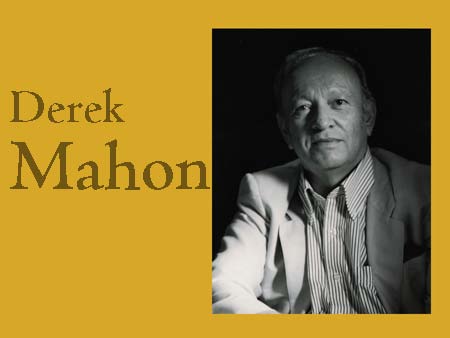
 John McGahern

 About John McGahern (1934 – 2006)

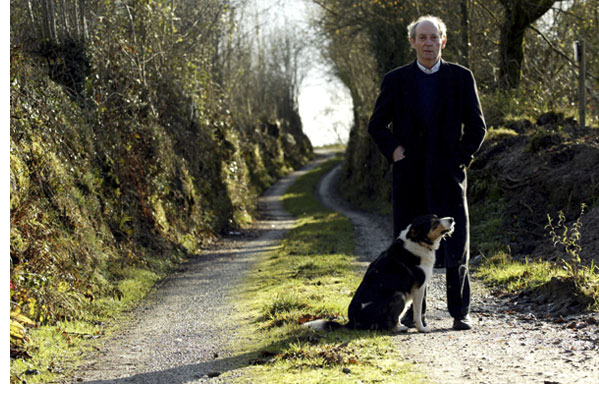
One of Ireland’s most widely read authors John McGahern was born on November 12th, 1934.  The family lived in Leitrim until his mother’s death in 1945, when they moved to their father’s home at the police barracks in Cootehall, County Roscommon.  In his early twenties McGahern worked as a teacher and wrote an unpublished novel, The End and the Beginning of Love.  His first published novel, The Barracks (1963), won the AE Memorial Award and earned him an Arts Council Macauley Fellowship.  His next novel, The Dark (1965), was widely praised and drew comparisons to James Joyce, but it also offended the Archbishop of Dublin and the state censor, who banned the book and he was also sacked from his teaching position.

He refused, however, to capitalise on this notoriety, instead continuing to publish quietly.  Three novels followed – The Leavetaking (1974), The Pornographer (1979), and Amongst Women (1990; winner of the Irish Times Award and short-listed for the Booker Prize).  McGahern’s four volumes of short stories were published in The Collected Stories in 1992.

His final novel That They May Face the Rising Sun (published in the United States as By the Lake) is an elegiac portrait of a year in the life of a rural lakeside community. McGahern himself lived on a lakeshore and drew on his own experiences whilst writing the book. Lyrically written, it explores the meaning in prosaic lives. He claimed that “the ordinary fascinates me” and “the ordinary is the most precious thing in life”.  The main characters have – just like McGahern and his second wife, Madeline Green – returned from London to live on a farm. Most of the violence of the father-figure has disappeared now, and life in the country seems much more relaxed and prosperous than in The Dark or Amongst Women.

During his writing career, he served as a visiting professor at Colgate University and the University of Victoria, British Columbia, and he was writer-in-residence at Trinity College, Dublin in 1989.  He died from cancer in the Mater Hospital in Dublin on 30 March 2006, aged 71. He is buried in St Patrick’s Church Aughawillan alongside his mother.
 McGahern (3)

Historical and Literary Background

This novel is set in Ireland in the years following the Irish War of Independence.  We hear references to reviving Monaghan Day, which is obviously a tradition of the time.  The story is set in the country and outlines the position of the family of the time.  It may be worth mentioning that Patrick Kavanagh’s The Great Hunger was written about rural life in Ireland about this time also.  Are there any similarities between Moran and the character of Paddy Maguire?

During these years, post War of Independence and pre World War II, McGahern tells us family bonds were strong.  The Moran family is united, in spite of their father’s erratic temperament.  Luke is the only exception to this happy picture of family solidarity.

Women married securely in this society.  Secure jobs such as the civil service were recommended.  Study at the university was not financially possible for Sheila.  The profession of doctor is also not acceptable within this family because the doctors had emerged as the bigwigs in the country that Moran had fought for during the war.

We also see the faithful practice of the rosary.  This is a prayer that is said by the family every night.  Moran makes use of this to assert his dominance over the family while refusing to face his own shortcomings.

One of Moran’s big fears is being poor.  For this reason he is miserly with money and even though he eventually gets two pensions he still exerts a tight control over the finances.  He also takes pride in the land he owns.  He uses the land as a refuge, many times escaping from the house to work furiously at hay-making or reaping whenever he loses control of himself.

At the end, on his death, Moran is given the typical Republican burial with the tricolour draped over his coffin. (Check the front cover of the novel!)
John-McGahern (4)
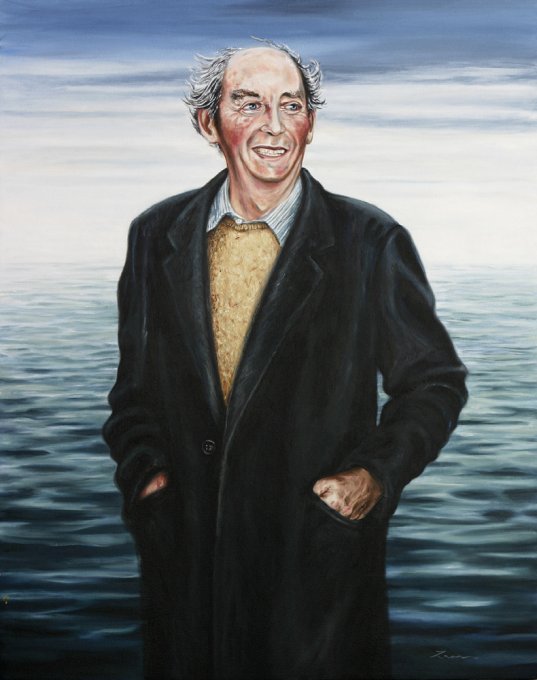
Dr. John McGahern by Zaan Claassens

THE STORY

The story is based on the Moran family who live in Mohill, Co. Leitrim.  The house is called Great Meadow.  The story is told in flashback and is framed at beginning and end with Moran in a depressed state and wishing for death.  Moran is an old Republican who was a guerrilla leader in the War of Independence.  His wife is dead and he is left to bring up their five children; three girls and two boys.  Luke is the oldest and he has gone to work in London because he will not tolerate his father’s violent behaviour.  Moran can never forget the authority he wielded during the war and tries to behave in the same way within his household.  He continually uses the rosary to regain control and power over his family.  Moran marries a girl called Rose Brady when he is beginning to get old.  Initially Rose is very idealistic about the marriage, but she soon discovers the true nature of Moran and his capacity for violence and dark moods.

Rose is a very selfless person who clearly loves Moran in spite of his strong character and difficult temperament.  She encourages the girls to become independent and achieve the best they can in life.  Maggie settles in London and eventually marries, as does Sheila.  Mona gets a good job in the civil service and remains single.  Michael, the youngest, leaves and marries.  Luke’s refusal to return to Great Meadow, the family home, frustrates and angers Moran greatly.  All the rest of the family visit him regularly in spite of the fact that he has been domineering and violent.  They are all happy together and have learned to accept Moran’s peculiar temperament.  Moran dies at the conclusion.  Everyone except Luke turns up at his funeral and acclaim him as a truly great and heroic man

McGahern (2)

 LITERARY GENRE

This is a novel of social realism, which is written in the third person omniscient narrative voice.  It can, therefore, be classed as a social document that is set in Ireland in the period following the War of Independence.  There are no official chapters; the narrative is broken into sections separated by a short space.  Much of the story is told through dialogue, which gives a vivid insight into the various characters.   The first section is written towards the conclusion of the story when Moran becomes sick.  The rest of the story gives an extended account in flashback about the life of the Moran family in Great Meadow.

There is a great similarity between Amongst Women and William Shakespeare’s great tragedy, King Lear.  By insisting that each of his daughters proclaim her love for him to win her share of his kingdom, Lear sets in motion a plot that reveals the complex dynamic at work among an elderly patriarch and his three daughters.  Like King Lear, Amongst Women investigates the love between a father and his children, the struggle to maintain strength in advancing age, and the difficulty of negotiating between independence and an identity tied to family roots.
mcgahern (5)

THEMES AND ISSUES

There are a number of themes and issues raised in the novel.  The main themes dealt with here are:

  • Power/Control/Patriarchy
  • The Family
  • The Role of Women

Power/Control/Patriarchy

Moran has been a guerrilla fighter in the War of Independence.  He never got used to the failure of that war, and so he tries all his life to master his family and dominate them.  It is only when he feels he is in control and the centre of things that he can manage to deal with issues in life.  Much of his power is achieved through violence and physical abuse.  He also uses the rosary as a weapon to establish his control in the house.  When he marries Rose Brady things change slowly but subtly.  He verbally abuses her several times but her firm reaction chastens him and shows him the need for self-control.  When there are difficulties with young Michael who begins to drink and womanise, Moran threatens to use physical violence to control him, as he had once done with Luke.  Michael runs away to England and gets a job.  Moran is left on his own with Rose and simply becomes more introverted and depressed.  As an old man he loses the ability to exert control through his mood swings and violence.  He changes and writes a letter of apology to his oldest son Luke who has left him a long time ago.

***

 Amongst Women can be seen as a critique of patriarchy.  McGahern connects nationalism, Catholicism and patriarchy in an unholy trinity.  In the novel McGahern is turning away from the Big House novel, that had played such a big part in earlier Irish fiction, to what might be termed the small house novel, portraying rural Catholic family life.  In the novel death frames the novel, but the intervening narrative is an extended flashback to family life in Great Meadow with Moran bestriding his little kingdom as a crusty, would-be Colossus.  The relationship between him and his wife and children is the principal focus of this plotless novel.  The focus is on scenes in which some or all of the family are assembled and the narrative moves in and out of the consciousness of various members of the group.   In this novel, for the first time in his writing, the subject of patriarchy assumes a central theme.

‘Only women could live with Daddy,’ Moran’s alienated son, Luke, comments, and the novel, to some extent, endorses this viewpoint.  Moran is first encountered ‘amongst women’, an ailing old man fussed over by his wife and three daughters.  The theme of the relationship between power and gender is announced in the opening sentence.  Moran’s physical weakness has transformed relations between him and his womenfolk to one of fear on his part and dominance on theirs.  However, even at his most physically incapacitated, Moran has still not lost his hold over his daughters: he ‘was so implanted in their lives, that they had never left Great Meadow’ (p.1).

The narrative pulse of Amongst Women is one of homecoming and leave-taking: welcomes and farewells at the train station; cars turning in the open gate of Great Meadow under the poisonous yew; children leaving home to embark on their adult lives, all but one drawn back with increasing frequency as the years pass; happy family reunions and the sad final reunion at Moran’s funeral.  Initially the rhythm is homecoming, and the verb ‘come’ is repeated seven times on the first page.  The reader is being drawn into this world where Moran is at the centre.  By the end of the second paragraph we have been introduced to its setting and principal characters: the ‘once powerful’ Moran, his second wife, Rose, his three daughters, Maggie, Mona, and Sheila, his younger son, Michael, and the eldest, Luke, distinguished from the rest by his refusal to come back to Great Meadow.

Patriarchy in Amongst Women can be seen to derive to a great extent from patriotism.  Moran is the hero of the War of Independence, who has failed to make a successful career in the Irish army in peacetime, directs his frustrated drive for power into a diminished form of home rule.  His status as a former guerrilla fighter is repeatedly emphasised at the outset by the device of juxtaposing two episodes which celebrate his youthful exploits as leader of a flying column, thereby ensuring that all his subsequent conduct is ‘placed’ in the light of this wartime experience.  Monaghan Day, a fair day in late February when he received an annual visit from McQuaid, his former lieutenant, and the two reminisced over their youthful heroics, is Moran’s equivalent of Remembrance Day.  The novel opens with his daughters’ revival of Monaghan Day when Moran is old and ill.  On this occasion he deglamourises his role as freedom fighter and refers to his flying column as ‘a bunch of killers’ (p.5).  That he has never lost his own killer instinct is demonstrated next morning when he rises from his sickbed to shoot a jackdaw.  His targets may have diminished, but he is still prepared to resort to violence to assert his limited power.  The incident rather pathetically demonstrates his present impotence, yet he himself uses it to illustrate his connection between intimacy and mastery:

The closest I ever got to any man was when I had him in the sights of my rifle and I never missed. (p.7)

Moran is at pains to tell his wife and daughters that his flying column did not shoot women or children, treating both categories as minors or inferiors.

Beginning on P. 8 we are given another flashback to the last Monaghan Day.  In this episode Moran’s bullying of his teenage daughters is contrasted with his inability to gain power over McQuaid.  He terrorises his daughters, so that in his presence they ‘sink into a beseeching drabness, cower as close to being invisible’ (p.8) as possible, but it is obvious now that his power does not extend outside his own family.  McQuaid, who has long outstripped Moran in terms of worldly achievement, is happy to indulge in war memories for an evening, but he is unwilling to perpetuate his former role of junior officer.  His visit brings something of the secular, commercial outlook of modern Ireland into the pious, traditional world of Great Meadow.  Here again the rhythms of arrival and departure are evident as the annual ritual of Monaghan Day is brought to an end with McQuaid’s abrupt exit.  Henceforth, the cars that turn ‘into the open gate under the yew tree’ will convey returning Morans.  From here on Great Meadow becomes a house hospitable only to its own family.

As has been said already, Amongst Women offers a penetrating critique of patriarchy.  McGahern goes even further and shows that patriarchy as a refuge of the socially ill-adjusted and emotionally immature man and asks probing questions about the cult of family.  Moran has transformed his inadequacies into a show of strength by making his home his castle.  Denied a role as founding father in the Irish state he sets up his own dominion.  Actually, Great Meadow, bought with his redundancy pay from the army, should be a monument to Moran’s failure to live up to his youthful promise.  Though it is not an ancestral home it becomes, under his regime, a family seat, more cut off from the life of the surrounding village than any Big House.  Because of an inability to relate to his fellow-villagers, Moran turns his family into a closed community and the absence of any outside contacts further strengthens his own paternal supremacy.  He successfully indoctrinates his children with the idea that such reclusiveness denotes exclusiveness, that to be ‘proud’ and ‘separate’ is a mark of distinction, to be friendly and extroverted a sign of commonness.  House and family are connected in exhortations to his daughters: ‘Be careful never to do anything to let yourselves or the house down.’ (p. 82).  He thus forges an association between family and farmstead, roots his children in a ‘perpetual place’.  As the founder of a new dynasty Moran acts as if he were self-propagated and never refers to his own parents.  His cult of family does not include any filial loyalties which might conflict with the prior claim of being a Moran of Great Meadow, so he actively discourages his wife’s visits to her family home.

Moran’s family is an extension, a ‘larger version’ of himself.  When he promotes the values of home and family he is obliquely bolstering his own self-importance.  The ‘good of the family’ provides him with a virtuous, unselfish motivation for suiting himself.  When he is about to remarry, for instance, he tells his daughter Maggie that he is doing so in the best interests of the family, though it has just been revealed to the reader that his only motive is his own future welfare.  He also repeatedly stresses that all his children are equal, further emphasising his own unique superiority.  The ex-officer promotes esprit de corps, though his theatre of operations is a hayfield and not a battlefield: ‘Together we can do anything.’  Such affirmation of solidarity and de-emphasising of individual differences serve to bind the family into ‘something very close to a single presence.’

In view of the novel’s critique of patriarchy it is interesting to note the effect this has on his daughters at the end of the novel.  Turning the page at the end of the novel, we are given a glimpse of what ‘becoming Daddy’ means.  A reversal of gender roles takes place as brother and husbands, seen from a patriarchal perspective, are transformed into wives.  It is obvious that Moran’s honorary male daughters have inherited his contempt for the feminine, which they associate with levity and amusement:

‘Will you look at the men.  They’re more like a crowd of women,’ Sheila said, remarking on the slow frivolity of their pace.  ‘The way Michael, the skit, is getting Sean and Mark to laugh you’d think they were coming from a dance’ (p. 184)

Their exclusiveness as Morans of Great Meadow is such that it does not even embrace their own husbands and children.

It is also worthwhile to consider here the links between Catholicism and patriarchy.  These links are forged in the novel by its most repetitive narrative ritual and the family prayer from which it derives its title.  Moran’s devotion to the rosary is explained on familial and patriarchal grounds.  ‘The family that prays together stays together,’ he observes, quoting the Rosary-crusader priest, Father Peyton.  As in many Irish homes, (in the past?)  the rosary in the Moran household is a public prayer that reinforces a hierarchical social structure: it is presided over by the head of the family and the five decades are allocated from eldest to youngest in descending order of importance.  Though the rosary repeatedly pronounces Mary as ‘Blessed … amongst women’,  because she was chosen to be the mother of Christ, in the Moran household, the character, blessed amongst women, is Moran himself.  He even manages to die ‘amongst women’, since his son Michael is temporarily absent!  The Rosary is peculiarly identified with Moran and it is a very clever device used by McGahern to emphasise the narrative repetitiveness, which is a feature of this novel.  Over and over again the newspapers are spread on the floor, Moran spills his beads from his little black purse, and all kneel in prayer.  The stability conferred by ritual and repeated phraseology underscores the disruptions and changes that the passage of time brings to Great Meadow.

Yet we should not be over negative in our assessment of Moran and his little kingdom.  He does exhibit some inherent attractive qualities.  Indeed his portrait is the most imaginatively generous picture of a father in McGahern’s many novels and short stories.  He radiates enormous energy and this surely can be seen as a redeeming feature.  He also shows great anguish for the son who is lost to him and he also shows a certain bafflement and frustration in the face of oncoming death.  In particular he is associated with the annual haymaking, an activity shared by the whole family.  From distant London or Dublin, Great Meadow in summer appears a therapeutic, pastoral world: ‘The remembered light on the empty hayfields would grow magical, the green shade of the beeches would give out a delicious coolness as they tasted again the sardines between slices of bread: when they were away the house would become the summer light and shade above their whole lives’ (p.85).  Such memories turn Moran’s children into true Romantics, sustained ‘amid the din of town and cities’ by images of their fatherland.

Therefore, McGahern manages to balance the attractive and the repellent aspects of patriarchy in this novel.  The glorious revolution that brought about the Irish State is so remote by the time of Moran’s death that the fellow revolutionary who tends to the faded tricolour on the coffin seems as old as Fionn or Oisín.  Nevertheless, the legacy of the War of Independence, seen by some as a triumphalist, masculine ethic of dominance, has been passed on to the next generation.

Irish people everywhere seem to have an often inexplicable affection for their country, whether they be urban, suburban, rural or living in Boston.  This love for ‘the ould sod’ is turned on its head here in this novel in McGahern’s examination of home, farm and fatherland.  Idyllic though Great Meadow often appears, access to it involves passing under ‘the poisonous yew.’

The Family

In Amongst Women we see the powerful bond of the family and how it can withstand so many difficulties.  Even though Moran is stubborn and mercurial in temperament, the family remain strongly bound together.  Together they feel invincible in the face of the outside world, and when they gather together at Great Meadow, each member feels bound by this strong family unit.

 The novel pulls us into a tight family circle with its first sentence – ‘As he weakened, Moran became afraid of his daughters’ (p.1).  A ‘once powerful man’ (p.1), Michael Moran was an officer in the Irish War of Independence in the 1920’s.  He was intelligent, fierce and deadly, but like many soldiers after a war, he felt displaced, unwilling to continue in the military during peacetime and unable to make a good living in any other way.  ‘The war was the best part of our lives,’ Moran asserts.  ‘Things were never so simple and clear again’ (p.6).  While the army provided the security of structure, rules, and clear lines of power, Moran’s life after the war has consisted of raising two sons and three daughters on a farm and scraping out a living with hard manual labour.  A widower, Moran confuses his identity with the communal identity of his family in a gesture that divides and conquers.  Moran’s daughters are ‘a completed world’ separate from ‘the tides of Dublin and London’ (p.2).  As such, he can control them, as when he discourages one from accepting a university scholarship.  No longer powerful, Moran is repeatedly described as withdrawing into himself ‘and that larger self of family’ (p.12) in order to channel his aggressions into a shrunken realm he attempts to control.  He can be tender with his children, but he also berates and beats them.  His adjustment from guerrilla fighter to father is never complete, and the question of how to maintain authority over children while allowing them room to grow is central to the novel.

Nowhere is this struggle between dependence and independence more pronounced than in the character of Luke, the oldest son who runs away from Moran’s overbearing authority, never to return.  Rejecting his father, Ireland, and all of the violence and provincialism he associates with both, Luke flees to England.  He ignores all but one of Moran’s many letters, and he doesn’t return to Ireland except at the end of the novel when his sister gets married.  ‘Please don’t do anything to upset Daddy,’ one of the sisters pleads, typically trying to placate her father.  ‘Of course not I won’t exist today,’ Luke replies (p.152).  His best weapon against Moran’s control is absence.  Whereas the daughters, ‘like a shoal of fish moving within a net’ (p.79), find individuality painful compared to the protection of their familial identity, Luke gains strength in departure.  ‘I left Ireland a long time ago’ (p.155), Luke announces gravely.  As it does for Stephen Dedalus in James Joyce’s A Portrait of the Artist as a Young Man, life in Ireland seems like imprisonment.

‘I’m afraid we might all die in Ireland if we don’t get out fast’ (p.155-156), says Moran’s younger son, Michael.  Like other Irish writers, McGahern asks whether exile offers the only hope for freedom and individuality.  How does the political turmoil which has long suffused Irish history affect the smaller unit of the family?  How do other elements of Irish life contribute to familial dysfunction?  In the claustrophobic world McGahern portrays, escape proves sustaining for a character like Luke, but it is not an unequivocal good.  Luke is strong but cruel like his father.  His sisters, on the other hand, not only fail to break away from the family, but by the time of their father’s death, ‘each of them in their different ways had become Daddy’ (p.183).  Their identification with and loyalty to Moran threatens to subsume them, but it also gives them a kind of strength, as Michael seems to understand: ‘In the frail way that people assembled themselves he, like the girls, looked to Great Meadow for recognition, for a mark of his continuing existence’ (p.147).

The Role of Women

(This theme has obviously to be examined in the light of what has already been said about Patriarchy.)

With the exception of Moran and his young son Michael, this story centres on many women characters.  Rose Brady is the main character who makes life bearable for everyone in Great Meadow.  At every stage she is deeply loyal to Moran and never allows herself to criticise him or his fickle actions in front of  the others.  She loves him deeply and when he treats her badly she is quick to assert her rights.  She does this in a quiet but strong way.  She becomes a strong moral power in the house, and through this strength she manages to control Moran and get him to change his bad temperament subtly.

When Moran marries Rose it is obvious that he never intended a marriage of equals.  She is to serve as a loyal and devoted second in command and at some future date, when his children have departed, to become his sole subordinate.  Rose, a woman in her late thirties at the time of her marriage, is ideally suited to the role of compliant wife and surrogate mother.  Her previous profession has been that of valued servant: a children’s nursemaid, and the valet her former master would have chosen had his wife permitted it.  She has acquired the social skills that please employers, learned to indulge their whims.  That she is good at ironing takes on a metaphorical significance, since she has spent much of her married life ‘smoothing’ out household difficulties.  She is attracted by Moran’s aloofness and, ironically, she sees marriage as an opportunity to become mistress of her own establishment.  For all his local notoriety as a strategist in the war, Moran doesn’t seem to be able to exercise much control in the matter of his marriage.  He is continually out-manoeuvred by Rose, who mounts a shrewd, tactical campaign to get her way when he would prefer to retreat or delay.

Once married, Rose proves to be an angel of the house: a kind, caring, capable homemaker, whose warmth and good humour contrast sharply with Moran’s sudden rages and unpredictable mood swings.  Her genuine interest in each child’s welfare contrasts with Moran’s inability to value his children’s individual identity and autonomy.  However, it must be said that Rose colludes in perpetuating Moran’s patriarchal regime.  She is unfailingly loyal to him and she refuses to entertain his children’s criticism of his petulant behaviour.  In his children’s presence she always refers to Moran as ‘Daddy’, the title by which he himself insists that they address him.

Rose’s strategy is to become indispensable to the household.  The tea-ceremony on her first evening is very revealing of the future status quo.  She takes on the role of a kind of superior servant, co-opting the girls as helpers, and humouring her disgruntled husband by treating him ‘like a lord’:

Rose and the girls smiled as the tea and the plates circled around him.  They were already conspirators.  They were mastered and yet they were controlling together what they were mastered by. (p.46)

Later on this is viewed in a more negative way:

Then, like a shoal of fish moving within a net, Rose and the girls started to clear the table. (p. 79)

Here the women are seen as victims, trapped in the tense atmosphere which Moran generates.  A shift in power relations has occurred and Rose is no longer in control.  Her status is now equal with that of Moran’s children.

The power struggle between Rose and her husband centres on two episodes.  In the first he is compelled to apologise and she is rewarded with a mini-honeymoon, but she has been made aware of his ‘darkness’ and decides to concentrate her strategy on diverting his attacks – cutting him off at the pass, so to speak.  In the second episode he embarks on a prolonged campaign to crush her and she attempts to conciliate and pacify him, until she discovers that she can ‘give up no more ground and live’ (p.71).  Her tactic now is to threaten to leave him, a shrewd stroke; since she knows that Moran is already obsessed with Luke’s departure.  This power struggle between the two is several times alluded to in military terms.  It is a ‘hidden battle’ from which she, apparently, emerges victorious, her objective having been to ensure her ‘place in the house could never be attacked or threatened again’ (p73).  What she has settled for, however, is the limited right to be treated like a member of Moran’s family, to swim like a fish in his net.

Moran’s daughters adapt to life by avoiding confrontation.  Indeed, there seem to be very limited options in counteracting Moran’s dominance.  Compliance, continual confrontation, or departure are the three choices facing Moran’s household.   The strategy of the womenfolk, at least, is to ‘slip away’ or try to appear invisible.  Such evasion is a tactical manoeuvre, a recognition of their own defencelessness.  Beneath their cringing exterior, Mona and Sheila each conceals a forceful character.  Mona is ‘unnaturally acquiescent’, ‘full of hidden violence’; Sheila, even as a young child, knows better than ‘to challenge authority on poor ground’.  They bide their time until their jobs in the Civil Service set them free from Moran’s daily oppression, though Sheila comes near to confrontation before surrendering her opportunity to attend university.  They show their attitude to parental domination in their advice to Michael, to make the best of it until he has finished school and is in a position to choose a career of his own.

In view of their unhappy childhood why do Moran’s children, with the exception of Luke, turn Great Meadow into a place of pilgrimage and their father into a cult figure?  What McGahern presents in Amongst Women is the charisma of patriarchy, which consists in its exercise of sole and absolute authority, the power to approve or disapprove, endorse or withdraw support, affirm or reject, and thereby, to nurture an emotional dependency.  Though in their last years at home, the Moran children flourish under Rose’s benign dispensation, their primary relationship is with their father.  Because his second marriage does not occur until his daughters are in their teens, Rose’s advent does not alter Moran’s status as a dominant single parent, the permanent emotional focus of their lives.  They never allude to their dead mother, and the novel ignores the ‘umbilical debt’, according her no influence whatever on their upbringing.

A large part of the fascination the handsome Moran holds for Rose and for his daughters is sexual.  Rose loves him; his daughters also experience an ‘oedipal’ attachment.  He is their ‘first man’.  He looks on their husbands and male friends as rivals and is content when these prove ‘no threat’ to his primal place in their affections.  Neither Maggie nor Sheila marry dominant men, and Mona resists marriage altogether.  Sheila is the only one to violate this ‘incestuous’ relationship with her father when she leaves him in the hayfield to go indoors and makes love to Sean.

As the novel ends the reader’s sympathies are drawn towards the ailing and dying Moran, so that we share the family’s grief at his death.  His corpse is taken to the church on a ‘heartbreakingly lovely May evening’ and buried on a morning when the ‘Plains were bathed in sunshine’ and ‘the unhoused cattle were grazing greedily on the early grass’ (p.182).  The sadness of this final parting from the fertile spring world is rendered all the more poignant by the baffled love Moran experiences for his own land in old age.  He is shown walking it, ‘field by blind field’, ‘like a blind man trying to see’.  In his last month he repeatedly escapes from his sickbed to stare at the beauty of his meadow.  At the end of his life Moran eventually arrives at a deep appreciation of the ‘amazing glory he is part of’ (p.179).  Maybe this final epiphany is the blessing he always craved and was unable to receive, a blessing hinted at in the name Rose?

barrie_cooke
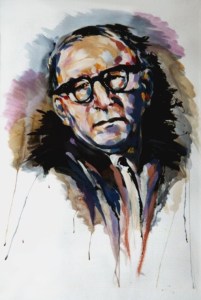
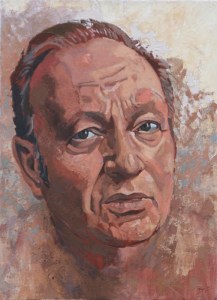
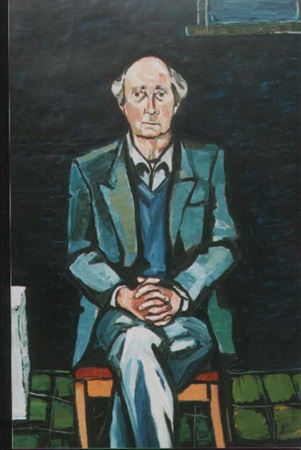
John McGahern, oil on canvas, by Barrie Cooke, 1997/8.

GENERAL VISION AND VIEWPOINT

This is a realistic novel, which traces the history of an Irish rural family in the early twentieth century.  McGahern focuses on one family and one house and we follow the subtle changes that take place in the comings and goings of various members of the family.  He has created a microcosm in Great Meadow from which to view and comment on the changes which have come about after the War of Independence.  Even though there is a timeless quality to the novel and no dates are mentioned we are being asked to pass judgement on the new State that has emerged and was beginning to find its feet under the influence of the 1937 Constitution.  De Valera’s vision of this New Ireland eulogised the role of women as mothers and home-makers and he painted an idealised picture of life in the Irish countryside:

A land whose countryside would be bright with cosy homesteads, whose fields and villages would be joyous with sounds of industry, the romping of sturdy children, the contests of athletic youths, the laughter of comely maidens; whose firesides would be the forums of the wisdom of serene old age.

McGahern in Leitrim and Kavanagh in Monaghan both knew that the realities of life for poor, farm families were radically different from this version offered by de Valera.

McGahern shows  that the power of family bonds to withstand all difficulties is clearly evident throughout every aspect of this story.  At the centre of this story is Moran and his wielding of mesmeric power over his children but it obvious also that Rose Brady is truly the moral centre of the novel.  It is she who silently manages to improve things within the Moran household, and by doing this she controls a good deal of the violence latent in Moran.  It is her undoubted love and loyalty to Moran and her spirit of self-sacrifice in the household, which creates this extraordinary bond of strength which each of the members feel among themselves.

The implication at the conclusion is that Moran’s family is stronger than ever in their love and allegiance to one another.  They truly recognise that Moran played a central part in all their lives.  Their attendance at his funeral strengthens this bond between them even more.  They realise that each one of them, in different ways, has truly imbibed Moran’s beliefs and values.  They remain loyal to his person and beliefs in spite of everything.  Only Luke remains obstinate in his decision not to return home – a reminder that even he has inherited a great deal of stubbornness and pride from his father.

BIBLIOGRAPHY

Sampson, Denis. 1993, Outstaring Nature’s Eye – The Fiction of John McGahern. The Lilliput Press, Dublin.

Quinn, Antoinette. 1991, A Prayer For My Daughters: Patriarchy in Amongst Women in The Canadian Journal of Irish Studies (Special Issue on John McGahern), Volume 17, Number 1, July, 1991
John-McGahern(6)

Read also ‘Close Analysis of John McGahern’s ‘That They May Face the Rising Sun’ here

Maiden Street

image
Photograph courtesy of Niall Hartnett

Maiden Street

By Michael Hartnett

Full of stolen autumn apples

we watched the tinkers fight it out,

the cause, a woman or a horse.

Games came in their seasons,

horseshoes, bowling, cracking nuts,

Sceilg, marbles – frozen knuckled,

Bonfire Night, the skipping-rope

And small voices on the golden road

At this infant incantation:

        ‘There’s a lady from the mountains

Who she is i cannot tell,

All she wants is gold and silver

And a fine young gentleman’.


We could make epics with our coloured chalks

traced in simple rainbows on the road,

or hunt the dreaded crawfish in the weeds

sunk in galleons of glass and rust,

or make unknown incursions on a walk

killing tribes of ragworth that were yellow-browed:

we were such golden children, never to be dust

singing in the street alive and loud:

        ‘There’s a lady from the mountains

Who she is I cannot tell,

All she wants is gold and silver

And a fine young gentleman’.      


Commentary:  In the preface to the beautiful, bitter sweet ‘Maiden Street Ballad’, which Hartnett wrote as a Christmas present for his father, Denis Hartnett, in December 1980, he writes:

Everyone has a Maiden Street.  It is the street of strange characters, wits, odd old women and eccentrics; in short the street of youth.

This earlier poem published in 1967 is one of Michael Hartnett’s most romantic, sentimental and nostalgic poems about the street where he was reared as a child in the 1940’s.  It is a poem brimming with childhood games and activities – all outdoors by the way!  The games ‘came in their seasons’, throwing horseshoes, bowling, cracking chestnuts, playing sceilg and then there was street entertainment as they watched ‘the tinkers fight it out’.

Hartnett himself in an article in The Irish Times in the 1970’s explains the games that were played in Maiden Street in his early years:

Old customs survived for a long time.  I played ‘Skeilg’ once a year, chasing unmarried girls with ropes through the street, threatening to take them to Skeilg Mhicíl; I lit bonfires along the street on Bonfire Night; I put pebbles in a toisín (a twisted cone of paper in which shopkeepers sold sweets) and threw it on the road.  If anyone picked it up and opened it, you lost your warts, a pebble for each one in the paper, and the person who picked up the paper took the warts from me of his own free will.

Each stanza comes to an end with a lyrical, lilting skipping-rope incantation.  The poet looks back with nostalgia to a time of childhood innocence and the grinding poverty experienced by all in Lower Maiden Street during the ‘40’s is set aside for a time at least.

While the games and activities mentioned in the first stanza are mainly autumnal, those of the second stanza take place in high summer – similar to Kavanagh’s Canal Bank poems.  Here the children play in the road drawing with coloured chalks on the footpath or fishing for minnows or crayfish in the Arra as it flows down North Quay and continues on parallel to Maiden Street.  They fished using jam-jars or tin cans and they imagined them to be Spanish ‘galleons’ bobbing in the stream.  The imagination of the young children is again highlighted as the young urchins from the ‘golden road’ carry out military-like incursions into the surrounding countryside, with sticks for swords, as they kill ‘tribes of ragworth’, the yellow  perennial weeds which were the bane of every farmer’s life in the country.  The stanza then ends with the beautiful, poignant phrase:

            ‘We were such golden children, never to be dust’

Many poets, such as Seamus Heaney and Dylan Thomas, have also romanticised their childhood and maybe its just that human nature has decreed that we look back on our childhood through rose-tinted glasses.  However, our memory is never a good witness: Hartnett’s mood here resembles Dylan Thomas in Fern Hill; childhood is forever remembered as high summer and ‘it was all shining, it was Adam and maiden’.   There is a fairytale, Garden of Eden, ‘Mossbawn kitchen’ element to this poem also with its lilting chorus and his references to the ‘golden road’ in stanza one and the ‘golden children’ in stanza two.

The object of this poem, and also the much longer ‘Maiden Street Ballad’, is to evoke and preserve ‘times past’ and to do so without being too sentimental and maudlin.  Hartnett has said elsewhere that, ‘Maiden Street was no Tír na nÓg’, and he admonishes us that:

Too many of our songs (and poems) gloss over the hardships of the ‘good old  days’ and omit the facts of hunger, bad sanitation and child-neglect.

It is quite obvious that he hasn’t taken his own advice when writing this poem!  He has written eloquently about the hardship and poverty experienced during those early years, particularly in his prose writing where he shows a great aptitude as an incisive and insightful social commentator.  However here in this poem, the poet, now in his twenties, recalls a happy childhood, living in his own imaginative world playing on ‘the golden road’ or along the banks of the Arra River.

image

  ‘Such golden children never to be dust….’

Further Reading:

Check out my take on the etymology of the street name here

The Early Poetry of Thomas Kinsella

thomas-kinsella (2)

The Early Poetry of Thomas Kinsella

(with particular focus on ‘Another September’ and ‘Mirror in February’)

In the years after Yeats there was a general change in the direction of Anglo-Irish poetry.  In his desire to establish an Irish poetic tradition, Yeats had confined himself, for the most part, to subjects of Irish interest, and poets who directly succeeded him were very influenced by his poetry and the underlying philosophy of cultural nationalism which he espoused.  Thus, an older poet like Austin Clarke is very obviously an imitator of Yeats both in his subject choice and in his treatment of it.  Indeed, Clarke’s subject matter is principally confined to three main areas and may be summarised as follows: his judgements on the old heroic Ireland of the past (‘The Blackbird of Derrycairn’), his response to the general contemporary issue of Ireland itself (‘The Lost Heifer’), and his perceptive, lyrical treatment of the theme of love (‘The Planter’s Daughter’).

In the 1950’s, however, a new generation of Irish poets began to emerge.  Born in 1928, Thomas Kinsella belongs to this generation of writers; unlike Clarke, his main concern as a poet was not to limit himself to Irish topics but to explore a wider range of ideas and themes.  In 1892 Yeats had called for the creation of a national literature which would be distinct from all other literatures written in the English language.  Consequently, poets who succeeded Yeats found a constant need to express themselves as being fundamentally Irish, and the nature of their relationship with Ireland was one of their dominant concerns.  By 1950, however, Anglo-Irish poetry had found a permanent place for itself in modern English literature.  The new generation of writers were therefore not restricted to the old stances.  They did not feel it necessary to constantly assert allegiance to subjects of Irish interest, nor were they emotionally involved with dead leaders and causes as Yeats and Clarke had been.  Indeed, their most vivid memories were not of Wolfe Tone or the Fenian, John O’Leary, but of the contemporary holocaust in Europe, and the futile hero-worship of the modern world.  With Thomas Kinsella, therefore, we have one of the first to move into this different area of awareness and exploration.

Kinsella’s considerable talent as a poet has been well documented in many recent studies (e.g. Andrew Fitzsimons, The Sea of Disappointment: Thomas Kinsella’s Pursuit of the Real. UCD Press, 2008). His early work shows his skill at exploring states of feeling, especially feelings that are painful or acute.  His early poems also contain some moment of illumination, or epiphany, as he increases his awareness of some thought, idea, or reality he has previously overlooked.  This emphasis on reflection gives his poems many of the qualities of meditations: they are often, as he called them himself, ‘detailed explorations of private miseries’.  In these poems he usually begins with some simple situation which he advances towards complexity and which he attempts to incorporate into a coherent personal philosophy.

In both ‘Another September’ and ‘Mirror in February’ the speaker is presented as a solitary, humble figure who is confronted with an overwhelming significance in some simple aspect of life.  Though many of Kinsella’s poems deal explicitly with members of his own family he is essentially a poet of abstract ideas and concepts.  Also, throughout his early works nature always figures prominently.  He is conscious of the passing of time and of the seasons, the birth, death and decay of all life, even his own.

In ‘Mirror in February’ he connects his realisation of the decay inherent in modern man with his personal understanding of nature, while in ‘Another September’ he expresses his work as a poet in simple rural terms, ‘this … consciousness that plants its grammar in her yielding weather’.  Both these poems reveal certain similarities; each shares a common effort to find meaning and direction, and both are portraits of a defeated personality.  In ‘Another September’ the speaker is plunged into the bizarre, disorientated and isolated world of his wife’s past.  He is concerned with her immediate rural background, with the ways and customs of the people who still live there, with the culture they have formed from which he is excluded.  But beyond these reflections lie considerations about truth and justice, especially in the idea of a spectral woman who haunts him throughout the poem.  In ‘Mirror in February’ the poet’s self-portrait is made up of naturalistic and personal details through which he contemplates his muted, tragic story.  He experiences a sudden crisis of identity; there is a sense of loss in the feeling that his hold on youth is frail and tenuous.  In the end there is a gallant expression of hope as a faint optimism hesitantly breaks through.  Both poems succeed through a close attention to detail and through the use of natural images to expose the unpleasant and pitiful details of the poet’s life.

The material of each poem is different but the method is the same.  A theme is projected through the narrator, who alternates between apprehension of his immediate surroundings and memories or ideas that impinge upon his mind.  His recurring theme is the gulf between appearance and reality.  In ‘Mirror in February’ he regrets the loss of his youth: but the loss he is even more painfully aware of involves what he appears to be and what he actually is, ‘For they are not made whole that reach the age of Christ’.  The poem moves towards the acceptance of his condition even though his relationship with the world is one of steady and unavoidable decay.  Similarly, ‘Another September’ attempts to find some meaning in chaos.  This poem is also a projection of a state of feeling: the chaos is trivial in a wider sense, but is endowed with significance within the context of the poem.  The theme has possibly a wider application than ‘Mirror in February’, which deals with the poet’s immediate awareness of time.  In ‘Another September’, on the other hand, the initial meditation on his wife’s past gives rise to a meditation on women in general, and then to a consideration of the serious moral concepts that are usually represented as women, ‘Down the lampless darkness they came, moving like women: Justice, Truth, such figures’.  No firm conclusions are made in this poem: it is not ‘rounded off’ with a simple assertion as ‘Mirror in February’ is.  Indeed, the poem ends not with conclusions but with images, the meaning of which are not completely understood by the poet.  The theme of ‘Mirror in February’ is clear enough.  In ‘Another September’, however, the poet is presented with half-formed, shadowy ideas which trouble his consciousness and on which no firm judgements can be pronounced.

‘Another September’ describes an incident of particular importance in Kinsella’s life.  He has returned with his wife to the country house in which she grew up, and the opening stanza gives the poem a particular rural setting: ‘Dreams fled away, this country bedroom…’.  The time is early morning, just after dawn on a damp autumn day, and the poet wakes up in unfamiliar surroundings.  He first becomes conscious of the coldness (‘raw with the touch of dawn’), then of the silence (‘Nearer the river sleeps St. John’s’).  Nature, too, is still sleeping: the garden draws, ‘long pitch black breaths’, and the orchard exhales ‘rough sweetness’.  The poem is set in autumn, a time of ‘minor peace’; for the hard-working country people when the chores of summer are over and the fruits of their labour can be enjoyed.  The harvest is strongly suggested in this opening stanza, and the images provide a sense of simple rural abundance.  The trees are ripe with pears and apples, the rough soil is ‘windfall-sweetened’, the people are momentarily free from labour and secure from all intruders, ‘Locked fast inside a dream with iron gates’.  Being a Dubliner, it is as though Kinsella is experiencing these things for the first time.  This country scene is completely new to him, and he tends to see it in poetic terms.

The presence of autumn is strongly suggested in the images of the first stanza: in the second, it is personified as a domestic animal which, ‘rubs her kind hide against the bedroom wall’.  This sort of imagery is very common in modern poetry.  T.S. Eliot, in particular, specialised in far-fetched, arresting images, which have much of the impact of extended metaphysical conceits.  There is indeed a strong comparison between Kinsella’s description of autumn in this poem and Eliot’s description of the fog in the second section of ‘The Love Song of J. Alfred Prufrock’, ‘The yellow fog that rubs its back upon the window-pane’.  In Kinsella’s poem the image is meant to suggest friendliness and familiarity.  Country people live close to nature; they measure time not by the clock but by the seasons.  As such, autumn represents another aspect of their lives and is ‘long used to handling’ by them.  For Kinsella on the other hand – a city dweller for whom the seasons have no real significance – autumn is seen, prosaically, as ‘weather’.

The main topic of the poem is introduced here. The farm-house and the surrounding countryside are familiar features of his wife’s past; the life they represent belongs to his wife, not to him.  In the first stanza the farm is quiet and peaceful, safe from all intruders.  Here, however, Kinsella begins to realise that he himself is an intruder; he feels isolated and estranged in these new surroundings.  He is only ‘half-tolerated’ by the autumn morning, personified here as a friendly domestic animal which only ‘half-tolerates’ the caresses of a stranger.  The comparisons suggested here are difficult but comprehensible: it is as though a large domestic animal has entered the room sensing that an old forgotten friend has returned after many years’ absence.  Immediately, it is confronted by a stranger who tries to win favour by a vain display of friendship.  However, the poet’s overtures of friendship are ignored: it is not for his sake but for his wife’s, ‘this unspeaking daughter’ that the morning dawns so beautifully.  This use of personification in the poem is meant to suggest a sense of drama.  Indeed, what is difficult in the second stanza is not so much what the poet has to express, but the manner in which he expresses it.  He could just as easily have said that he felt out of place in the small rural community where his wife grew up, but this unremarkable statement would lack the strong sense of urgency that Kinsella wishes to suggest.  Also, by introducing characters in the second stanza Kinsella not only makes us see his personal situation in terms of drama – almost like a short scene from a play – but he also prepares for the important characterisations at the end of the poem.  He continues for the moment with simple poetic description:

                   Wakeful moth-wings blunder near a chair,

                   Toss their light shell at the glass, and go

                   To inhabit the living starlight.

At this point his attention is suddenly directed back to his wife who seems remote and unfamiliar in these strange surroundings.  Almost at once his image of her fades, ‘wanes’, and is replaced by other threatening images, ‘bearing daggers and balances’.

The ending to the poem presents some difficulty of interpretation but its meaning is usually explained as follows: Kinsella’s visit to the house where his wife grew up makes him conscious of those aspects of her life that had previously been ignored.  The poem represents, as it were, a moment of insight into her past which he had never before considered.  Following this epiphany he realises how women’s achievements in general, and their contribution to history, have also frequently been ignored.  Throughout the poem his wife is presented in quiet, placid descriptions: ‘a fragrant child’, ‘unspeaking daughter’, ‘stranded hair stirs on the still linen’.  The final feminine images, however, suggest vigour and movement, representing that part of womanhood which is characterised by energy and endurance.  Down through history, ‘down the lampless darkness’, the deeds of women have been unknown and unrecognised.  Kinsella therefore sees the images as threatening him with retribution, ‘bearing daggers and balances’, and seeking recognition for their personal deeds and achievements.

The situation described at the start of ‘Mirror in February’ is somewhat similar to that of ‘Another September’.  Indeed, both poems are composed of certain personal details and are in some sense autobiographical.  Again Kinsella relies on simple rural description in an effort to create a sense of atmosphere.  It is a damp spring morning; outside the upturned soil is ready for the seed; the trees are dark and still leafless.  The poet is going about the familiar morning chore of dressing and shaving, his mind occupied ‘by some compulsive fantasy’, when suddenly he notices his reflection in the mirror.  In the cold light of morning he is brought back to reality and he considers his advancing years.  His features reveal the relentless progress of time: his eyes are dark and exhausted; his mouth is dry and down-turned.

This moment of revelation, this epiphany, is extended into the second stanza.  The poem is set in springtime, the start of another year.  It is time to look to the future, to take stock, a time to ‘learn’.  In the second line of this stanza the cyclical nature of life is represented in an interesting paradox, ‘this untiring, crumbling place of growth’.  Life and death, he realises, are part of the great system of creation.  Things mature and die in an endless process of death and destruction.  Within the context of the poem, however, this realisation is the cause of some concern for the poet.  The slow, relentless progress of time has not brought him to perfection as it has in the case of Christ.  Instead he has achieved little, apart from a comfortable mediocrity.  The phrase ‘and little more’ is deliberately ambiguous.  The obvious meaning is that he is a ‘little more’ than the age of Christ, and the poem describes a moment of painful revelation for a person who suddenly realises that the best years of his life have slipped away and middle-age is approaching.  Another possible meaning to the phrase is suggested by Maurice Harmon.  What this critic suggests is not so much the idea of time passing, but of time lost: the poet laments that he has merely ‘looked’ his last on youth, almost like an observer, and done ‘little more’ to accomplish anything of importance.  This interpretation certainly fits in with the general tone of the second and third stanzas where the idea of worthwhile achievement is suggested in the extreme comparison with Christ’s life.  In contrast to Christ’s supreme achievements the poet has accomplished little, and he strays into the middle years of his life with little hope of attaining anything of note.  At this point he generalises about life: ‘they are not made whole / That reach the age of Christ’.  In the second stanza life is visualised in terms of sacrifice, and the idea implied is that it only becomes meaningful when seen in goal-directed terms.

In the third stanza this idea is repeated and is made more explicit in the striking references to nature.  Looking through the window the poet sees that the fruit trees have been severely pruned.  He uses this simple observation from nature as the occasion for an important comment on life.  The trees in the garden have withstood these brutal attacks upon them so that they may bear more and better fruit.  The basic idea expressed here is that nothing worthwhile is accomplished  without sacrifice, and that suffering contributes in a mysterious way to the perfection of a person’s character.  Just as Christ attained his destiny through suffering, and just as trees are pruned to make them more productive, so men too must suffer ‘mutilations’ if they wish their lives to be meaningful and enriched.  Unlike Christ, however, man does not submit to suffering willingly: he avoids hardships at each opportunity and cowers, ‘quails’, under every blow of fortune.

One aspect of the kind of suffering Kinsella imagines is described in this poem.  In his moment of anguish he tries to make light of the serious thoughts that weigh upon his mind.  He folds his towel with as much grace as he can manage.  He is no longer young, and unlike the trees he is not ‘renewable’, but he takes comfort in the fact that everybody shares in the same fate.  Life is continuous and irreversible: in the last line, therefore, he attempts to face up to his predicament with courage and conviction.

Kinsella (1)

Stony Grey Soil by Patrick Kavanagh

Patrick Kavanagh - Stony Grey Soil (1)

Stony Grey Soil

by Patrick Kavanagh

O stony grey soil of Monaghan
The laugh from my love you thieved;
You took the gay child of my passion
And gave me your clod-conceived.

You clogged the feet of my boyhood
And I believed that my stumble
Had the poise and stride of Apollo
And his voice my thick tongued mumble.

You told me the plough was immortal!
O green-life conquering plough!
The mandril stained, your coulter blunted
In the smooth lea-field of my brow.

You sang on steaming dunghills
A song of cowards’ brood,
You perfumed my clothes with weasel itch,
You fed me on swinish food

You flung a ditch on my vision
Of beauty, love and truth.
O stony grey soil of Monaghan
You burgled my bank of youth!

Lost the long hours of pleasure
All the women that love young men.
O can I stilll stroke the monster’s back
Or write with unpoisoned pen.

His name in these lonely verses
Or mention the dark fields where
The first gay flight of my lyric
Got caught in a peasant’s prayer.

Mullahinsa, Drummeril, Black Shanco-
Wherever I turn I see
In the stony grey soil of Monaghan
Dead loves that were born for me.

Kavanagh spent the first half of his life farming ‘the stony grey soil’ of his native Monaghan.  In Ireland in the 1930’s and ‘40’s this usually meant a life of dull, hard work.   He recalls the hardship, misery and austerity in this poem and also, of course, in his major opus, ‘The Great Hunger’.  In ‘Stony Grey Soil’ Kavanagh regrets having wasted his youth in a barbarous, bleak place.  The very title, ‘Stony Grey Soil’ suggests a hard, harsh, dull, unimaginative world – not an ideal environment for a poet.

In this poem, Kavanagh sees himself as a victim who was deprived, deceived, lied to, cheated and robbed by his homeplace and the way of life it imposed on him.  The poem is an outpouring of anger and accusations against Monaghan for what it did to the poet.  The soil of Monaghan is personified in the poem in very unflattering terms.  Because he is personifying Monaghan, he has to use metaphor extensively.  The soil is represented as a thief, a cheat, a depriver, a liar, a burglar; it is seen as one who ‘flung a ditch’ on his vision; as one who weighed down his feet to prevent his flight into the world of poetic imagination.

In harsh metaphor after harsh metaphor, he pours out a sustained and strident angry tirade against the place where he feels his youth was wasted and his potential inhibited and stunted.  Monaghan and the farming way of life is a thief, ‘the laugh from my love you thieved’.  It is a cheat, it dealt falsely with him, ‘you took the gay child of my passion and gave me your clod conceived’.  It gave him poison for perfume, ‘you perfumed my clothes with weasel-itch’.  It is a liar, ‘you told me the plough was immortal’.  The soil and the rural way of life are seen as a robber, ‘you burgled my bank of youth’.  It tried to blind his vision and limit his potential, ‘you flung a ditch on my vision of beauty love and truth’.

To summarise, Kavanagh is bitterly attacking and blaming Monaghan and the drudgery of farm life.  It stole the fun and humour of his youth and gave him instead the ‘clod-conceived’, which suggests perhaps, practical, pragmatic ideas about crops and cattle.  His ambition and self-belief were ruined.  He was aware of his own potential; he believed that he had ‘the stride of Apollo’ but Monaghan dragged him down and ‘clogged the feet of my boyhood’.

Monaghan flung a ditch on his vision.  It limited and confined him, instead of providing inspiration it fed him ‘on swinish food’.  This is a particularly harsh metaphor, suggesting that the whole atmosphere of farming life was totally without any aesthetic dimension.  The people among whom he lived his life are represented as ‘cowards’ brood’.  This seems to suggest that they were slave-minded and without the courage to break out of their dull, drab routine.  Hardly fit company for a poet!

We have seen how Kavanagh’s bitterness is shown in the harsh metaphors which he uses to describe his victimisation.  The tone of the poem – in particular the first five stanzas – is extremely bitter.  Perhaps it could best be described as accusatory.  Notice the recurring accusations in the repeated ‘you’: ‘you thieved’, ‘you took’, ‘you clogged’, ‘you told’, ‘you fed’, ‘you perfumed’, ‘you flung’, ‘you burgled’.  We all know that if you want to start an argument the best word to use to begin it is ‘you’!

However, the poet is unable to sustain this tirade to the bitter end and in the final three stanzas he relents and his great love for his native place surfaces at last.  The accusatory ‘you’ occurs no more and now he is sadly reflective, almost nostalgic (which suggests that the poem is written from a distance in both time and place).  He mentions the hallowed place names of his native place with reverence, almost as if in a religious litany: ‘Mullahinsha, Drummeril, Black Shanco’.  He is, after all, mourning what might have been.  At a very human level he is regretting the romances that never formed part of his young manhood.  Wherever he looks in Monaghan he sees ‘dead loves’ that were born for him.  These represent not only the romantic loves that never happened in that barren place but also all his unfulfilled potential as a poet.

‘Oh, can I still stroke the monster’s back or write with unpoisoned pen…’

Inniskeen Road: July Evening

Inniskeen road (1)
Bikes on the Road to Billy Brennan’s Barn, Inniskeen – courtesy of http://www.fisherbelfast.wordpress.com

Inniskeen Road: July Evening


By Patrick Kavanagh

The bicycles go by in twos and threes –

There’s a dance in Billy Brennan’s barn tonight,

And there’s the half-talk code of mysteries

And the wink-and-elbow language of delight.

Half-past eight and there is not a spot

Upon a mile of road, no shadow thrown

That might turn out a man or woman, not

A footfall tapping secrecies of stone.


I have what every poet hates in spite

Of all the solemn talk of contemplation.

Oh, Alexander Selkirk knew the plight

Of being king and government and nation.

A road, a mile of kingdom. I am king

Of banks and stones and every blooming thing.


Copyright © Estate of Katherine Kavanagh

In his early poems Kavanagh experimented with a dreamy, transcendental sort of poetry.  He seemed to want to escape from his own real world.  He didn’t feel that his own world was a fit subject for poetry, or that poetic thought could be expressed in ordinary language.  All this has changed when he comes to write ‘Inniskeen Road: July Evening’ in 1936.

This is one of the first examples of realism in Kavanagh’s poetry.  For the first time he has found the courage to use his own specific world and his own position within that world as the subject matter for poetry.  In this poem he writes about his own local place – a world in which he was both an insider and an outsider.  He belongs because he was born there and lives there.  He doesn’t belong because, as a poet, he is isolated, he is different.  In this poem he writes eloquently about this anomaly.

This poem is about a local and personal experience.  It’s the first time that Kavanagh uses actual place names and personal names in his poetry.  There is a specific place, Inniskeen Road, and a specific time, July Evening at half-past-eight and the centre of local activity is Billy Brennan’s Barn.  It’s the first time that Kavanagh’s own local world comes to life in his poetry and marks a major watershed in his poetry where from now on realism is at the heart of all his work.  He writes about his own real, personal situation in the real world of Inniskeen Road during a summer barn dance.  To make the poem even more real, he uses the present tense throughout – it’s as if the action is happening as he speaks.

THEME:  This poem is about the isolation of the poet.  A poet is different from other people: he is not interested in material matters such as the price of cattle, the progress of crops or the results of football matches.  The poet lives in the world of imagination and because of this he is often considered as an outsider; he is isolated – a loner – he does not fit in to ordinary society.  So the price the poet pays for his gift of poetry is the pain of isolation.

This poem recounts a local barn dance and the whole neighbourhood has gone for an evening’s enjoyment. Kavanagh has not gone – perhaps for fear of being laughed at.  The tone of the octet (first 8 lines)is thoughtful as well as being bitter.  There is a sense of loneliness in it – ‘and there is not a spot upon a mile of road…’ He feels a palpable sense of being excluded by the other young people’s ‘half-talk code of mysteries’ and by their ‘wink and elbow language of delight’.

In the sestet (final 6 lines) the tone is again very bitter when he considers his own isolation and compares his lot (similar to Elizabeth Bishop in ‘Crusoe in England’) with that of Alexander Selkirk, the prototype for Daniel Defoe’s Robinson Crusoe – ‘Oh, Alexander Selkirk knew the plight…’.  Listen to the bitterness of the final line: ‘I am king of banks and stones and every blooming (God damned) thing’.

LANGUAGE:  Kavanagh is the poet of ordinary language.  He has no place for poetic diction or flowery language.  Instead he uses ordinary, colloquial language.  This use of ordinary speech is part of his simplicity; he does not try to impress; he is not looking over his shoulder at the literary critics.  Here he is content with himself and with his language: there is a country barn dance in ‘Billy Brennan’s barn’, ‘the bicycles go by in twos and threes’, there is ‘the half talk code of mysteries’ and also he notices ‘the wink and elbow language of delight’, capturing perfectly the closely-knit peasant atmosphere of the local dance.

STRUCTURE:  In the first quatrain (4 lines) Kavanagh focuses on the togetherness, the closely-knit community spirit of the place – the cyclists going along the stony road to the local dance.  They are so closely-knit they don’t even have to speak to be understood, they wink, use ‘half-code’, and nudge each other in an excited way – they communicate in code, they gesture and signal each other.  This creates a huge obstacle for the reticent, isolated poet.

In the second quatrain the road is deserted.  We sense the poet who has probably noticed all the earlier excitement from a safe distance, hidden from view, now is overcome with a sense of isolation and the silence on the roadway is unbearable, ‘not a footfall tapping secrecies of stone’ – he might as well be on a deserted island.

In the sestet Kavanagh further contemplates his own situation and his plight as a poet. The break between the octet and the sestet on the page symbolises Kavanagh’s separateness from the community.  For him, the price he must pay for being a poet is to be considered an outsider.  This notion is typically Irish and goes back many years when the Bardic poets had great standing and power in the community: they could make or break a lord or lady and were often paid to praise a patron or denigrate an enemy.  This is the price Kavanagh must pay for his poetic gift and he calls this state a ‘plight’.  He makes the comparison with Alexander Selkirk, a man who was marooned on a deserted island.  Of course, Selkirk was set ashore voluntarily, so Kavanagh is not totally a reluctant loner.  But he is honest; honest enough to admit that poetic solitude is not some grandiose, blessed, exalted state.  He rejects the ‘solemn talk of contemplation’.  Here he is distancing himself from pretentious phoney literary attitudes and poses.

RHYMING SCHEME: This is a Shakespearean sonnet and therefore it has the classic Shakespearean rhyming scheme: ABAB CDCD EFEF GG.  However, Kavanagh is experimenting here and even though the sonnet has a Shakespearean rhyming scheme, the sonnet is laid out in the classic Petrarchan pattern of octet followed by sestet.  As we have referred to earlier he cleverly uses the break between octet and sestet to show his own separateness and isolation from the community; to show his plight as an outsider.

SUMMARY:

  • First published in 1936
  • First published example of Kavanagh’s realism
  • Poetry could be written about the local and the ordinary
  • This is a personal poem – Kavanagh’s own situation – his plight as poet – insider and outsider
  • Honesty – ‘solemn talk of contemplation’ – distances himself from phoney literary attitudes and posing
  • Ordinary world – a road, bicycles, a barn dance
  • Conversational tone – ordinary diction can be used in poetry
Inniskeen road (2)
Platform Dance http://www.newryjournal.co.uk

An Overview of Patrick Kavanagh’s Poetry

Those hungry hills....
Those hungry hills….


In Chapter 3 of his novel Tarry Flynn, Kavanagh describes a summer sunset and, though sunsets have often been written about, when Kavanagh does it, like all true artists, he makes it his own:

‘The summer sun was going down in a most wonderful yellow ball behind the hills of Drumnay.  It turned the dirty upstairs windows of Cassidy’s house into stained glass.’

Here the beauty of the evening sun is captured with all the simplicity of a child’s painting: the sun is ‘a most wonderful yellow ball’; the local place and people are named and the ordinariness of dirty windows is put before us.  But Kavanagh’s way of setting the world has transformed those windows into beautiful things of praise.

It is important to note that almost all the poems by Kavanagh on the Leaving Cert Syllabus contain references to place and the people who make those places special.  As Michael Schmidt puts it, in Kavanagh’s poetry, ‘Naming of places and things is of almost magical significance’.  He writes in praise and celebration, for the most part, but in the extract from ‘The Great Hunger’, a darker relationship with place is explored.  In Sean O’Brien’s words, ‘The Great Hunger’ depicts farming as, ‘hard labour and the bachelor male condition as sexually frustrated’.  By contrast, in ‘Epic’ and ‘Advent’ the countryside is written about with affection and the rural images in his city poem, ‘Canal Bank Walk’, are happy, summery images of grass, trees, breezes and birds.  Harry Clifton thinks that ‘In Kavanagh’s finest work, it is almost always high summer’ – for example ‘Inniskeen Road’ and the Canal Bank Sonnets are gloriously set in mid-July.

In many of Kavanagh’s poems, he is the outsider and the speaker in the poem is aware that this has advantages and disadvantages.  He himself felt that:

‘A poet is never one of the people.  He is detached, remote, and the life of small-time dances and talk about football would not be for him.  He might take part but could not belong.’

‘Inniskeen Road’ and ‘Epic’ are poems which highlight the position of the poet; he feels cut off, at a remove from his neighbours, and yet the poems hint at how he is also content with his lot.  In ‘Raglan Road’, the painful memories of unrequited love give way to the poet’s own belief in himself and yet, in ‘Lines Written…’, he chooses what has been described by Antoinette Quinn as, ‘an unegotistical tomb, a monument to his poetics rather than to his person’ where, ‘future visitors are asked to sit with their backs to the memorial description, reading instead the scene before them’.

Kavanagh’s own experience of life is at the heart of a Kavanagh poem.  He writes directly out of his own experience – rural life, farming, childhood memories, unrequited love, illness and convalescence, his love of nature, his gratitude to God.  When he writes ‘I’, he is almost always writing in his own voice and, even when he writes in the third person, as when he writes about Patrick Maguire and what Kavanagh called ‘the prison of a farmer’s life’ in ‘The Great Hunger’, he also includes the voice of a concerned, involved narrator which creates a closer link between the harsh, bleak world of the poem and the reader.

But the world of Kavanagh’s poetry is above all celebratory.  Poems such as ‘Advent’, ‘The Hospital’ and the Canal Bank sonnets are all love poems to place.  Here when Kavanagh looks, he sees ‘the newness that was in every stale thing’ and he delights in the ordinary, the natural, the physical world ‘of bog-holes, cart tracks, old stables’, ‘dreeping hedges’, ‘square cubicles in a row’, ‘The main gate that was bent by a heavy lorry, / The seat at the back of a shed that was a suntrap’, the trapped stick, the grass, canal water ‘stilly / Greeny at the heart of summer’.  In a lecture entitled ‘Man and Poet’, Kavanagh said:

‘We are in too great a hurry.  We want a person or thing to yield their pleasures and their secrets to us quickly for we have other commitments.  But it is the days when we are idle, when nothing appears to be happening, which provide us when no one is looking with all that is memorable’.

The Canal Bank sonnets are unhurried poems in which Kavanagh’s idleness yields precious, unforgettable experiences.

Anthony Cronin has described Patrick Kavanagh as an intensely private man who lived his life in public places, a man who thought mediocrity the enemy of genius, the enemy of life.  He did live a public life as journalist and man about town but Kavanagh also claimed that ‘the only subject that is of any great importance – Man-in-this-world-and-why’.  He also believed that, ‘Parochialism is universal; it deals with the fundamentals’ and that great beauty and profound truths can be discovered in apparently ordinary places.

John McGahern tells of how the forty-one-year-old Patrick Kavanagh once pointed out a particular grass and said: ‘I love that grass.  I’ve known it since I was a child.  I’ve often wondered if I’d be different if I had been brought up to love better things’.  In the end, though, he did believe in Ballyrush and Gortin, in ordinary things, for it was in the ordinary that not only meaning could be found but that Kavanagh discovered the extraordinary.  He had, in the end, come to the discovery that, ‘The material itself has no special value; it is what our imagination and our love does to it’.

Kavanagh is capable of great lyrical intensity.  There is great lyrical, gentle but impassioned quality in lines such as ‘O unworn world enrapture me’ or ‘Feed the gaping need of my senses’ and a sense of being totally at ease.  Kavanagh’s language can be what Patrick Crotty calls ‘grittily realistic’ (especially in ‘The Great Hunger’) but there is also a colloquial rhythm in such lines as ‘There’s a dance in Billy Brennan’s barn tonight’ or ‘That was the year of the Munich bother’ and there is also a great lyrical quality in ‘Canal Bank Walk’ where ‘pouring’ and ‘overflowing’ seem to describe the poem’s rhythm and mood:

‘For this soul needs to be honoured with a new dress woven

From green and blue things and arguments that cannot be proven.’

Kavanagh has an extraordinary ability to create fresh, surprising images

  • ‘the wink-and-elbow language of delight’;
  • ‘a footfall tapping secrecies of stone’;
  • ‘I am king / Of banks and stones and every blooming thing’;
  • ‘The sleety winds fondle the rushy beards of Shancoduff’;
  • ‘Mass-going feet / Crunched the wafer-ice on the pot-holes’;
  • ‘The wind leans from Brady’s, and the coltsfoot leaves are holed with rust’;
  • ‘And Christ comes with a January flower’;
  • ‘we tripped lightly along the ledge / Of the deep ravine’;
  • ‘Homer’s ghost came whispering to my mind’; ‘the inexhaustible adventure of a gravelled yard’;
  • ‘a bird gathering materials for the nest for the Word’;
  • ‘A swan goes by head low with many apologies’.

Kavanagh’s poetry is a record of a journey that brought him from Monaghan to the banks of the Grand Canal, a journey of discovery and exploration in which he reveals himself as one who found the ordinary, extraordinary, and that ‘the things that really matter as casual, insignificant little things’.  He offers us a version of himself in his poem ‘If Ever You Go To Dublin Town’:  ‘If ever you go to Dublin town / In a hundred years or so’ he says, ‘Inquire for me in Baggot Street / And what I was like to know’ and he goes on to tell us that he was ‘a queer one’, ‘dangerous’, ‘a nice man’, ‘eccentric’, ‘a proud one’, ‘a vain one’, ‘slothful’ and it ends:

He knew that posterity had no use

 For anything but the soul,

 The lines that speak the passionate heart,

 The spirit that lives alone.

 O he was a lone one

Fol dol the di do,

Yet he lived happily

I tell you.


from “The Great Hunger” by Patrick Kavanagh

The Poetry of Patrick Kavanagh

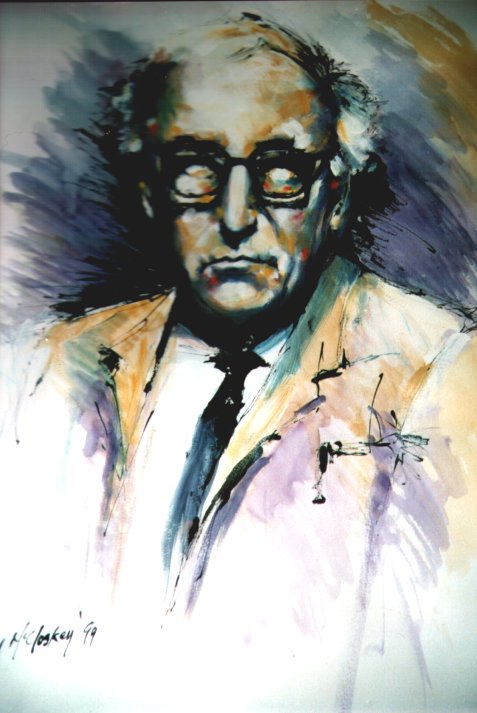
Patrick Kavanagh by Paul McCloskey
Patrick Kavanagh by Paul McCloskey.  http://www.paulmccloskey.ie

Kavanagh was born on the 21st. of October 1904, in the village of Inniskeen, Co. Monaghan.  His father was a shoemaker and had a small farm of land.  Kavanagh received only primary school education and at the age of thirteen, he became an apprentice shoemaker.  He gave it up 15 months later, admitting that he didn’t make one wearable pair of boots!  For the next 20 years Kavanagh would work on the family farm, before moving to Dublin in 1939.  From his early years on, he was a man who was out of place.  When in Monaghan Kavanagh was a dreamer in a world of realists who were concerned with what seemed to him to be the mundane and banal aspects of life.  In Dublin he stood out as the man up from the bog, who didn’t understand the complexities of city life.  He was seen as gauche and unrefined.  Ironically in Monaghan he was seen as effeminate for having an interest in poetry.

Kavanagh’s interest in literature and poetry marked him out as different from other people in his local place.  In a society that was insular and agricultural, a man’s worth was measured by the straightness of the furrow he could plough, rather than the lines of poetry he could write.  Kavanagh’s first attempts to become a published poet resulted in the publication of some poems in a local newspaper in the early 1930’s, and in the publishing of his autobiographical novel, Tarry Flynn, in 1939.  Urged on by his brother Peter, who was a Dublin-based teacher, Kavanagh moved to the city to establish himself as a writer.  At that time, the Dublin Literary Society was dominated by an educated Anglo-Irish group with whom Kavanagh had nothing in common; among them were Oliver St. John Gogarty and Douglas Wylie.  They saw Kavanagh as a country bumpkin and referred to him as ‘that Monaghan boy’.

His early years in Dublin were unproductive as he struggled for recognition.  In 1947 his first major collection, ‘Soul for Sale’, was published.  These poems were the product of his Monaghan youth.  In the early 1950’s Kavanagh and his brother Peter published a weekly newspaper called ‘Kavanagh’s Weekly’; it failed because the editorial viewpoint was too narrow.  In 1954 Kavanagh became embroiled in an infamous court case.  He accused ‘The Leader’ newspaper of slander.  The newspaper decided to contest the case and employed the former Taoiseach, John A. Costello, as their defence counsel; Kavanagh decided to prosecute the case himself, and he was destroyed by Costello.  The court case dragged on for over a year and Kavanagh’s health began to fail.  In 1955 he was diagnosed as having lung cancer and had a lung removed; he survived, and the event was a major turning point in his life and career.  In 1958 he published ‘Come Dance with me Kitty Stobling’.  In 1959 he was appointed by John A. Costello to the faculty of English in UCD.  His lectures were popular, but often irrelevant to the course.  In the early 1960’s he visited Britain and the USA; in 1965 he married Katherine Maloney.  He died in 1967 from an attack of bronchitis.

Kavanagh’s reputation as a poet is based on the lyrical quality of his work, his mastery of language and form and his ability to transform the ordinary and the banal into something of significance.  He is an acute observer of things and situations, and this allows him to make things that may seem ordinary and unimportant into something deserving of a place in poetry.

He is constantly using his work to make sense of the natural world, be it in Dublin or Monaghan.  More importantly, Kavanagh is always trying to assess his own place in this world.  He often approaches a poem from a point of doubt, where he is unsure about where he belongs, and uses the poem to come to a resolution.  The best example of this is in the poem ‘Epic’.  He is also trying to praise God and nature in his poems.  Indeed his Monaghan poems are not so much about the area, but about how it effects him and his work.  It would not be unfair to say that Kavanagh is very self-obsessed.  But in his defence it surely can be said that because of this he is writing about what he knows best!

www.arthurspub.ie
http://www.arthurspub.ie

KAVANAGH’S TECHNIQUE AND STYLE

Language:  In attempting to create a sense of the mystery and magic of a child’s mind, Kavanagh’s use of language is a vital ingredient in his work.  He uses words in a new fashion.  He fuses words together, such as ‘clay-minted’ and most famously ‘leafy-with-love’.  These phrases and words give extras energy to his poetry and provide it with vigour.

Imagery:  Kavanagh’s use of imagery is a very important aspect of his language.  In ‘Advent’ he alludes to the Nativity: ‘…  old stables where time begins’.  In ‘Inniskeen Road’ he refers to Alexander Selkirk.  Colloquial language is an intrinsic element of Kavanagh’s style.  His phrasing is conversational and many of his phrases owe their origin to his Monaghan background: ‘Among simple decent men too who barrow dung’; ‘every blooming thing’.

Structure – Form:  The poems on our course display Kavanagh’s ability in the sonnet form, which is a structural feature of ‘Inniskeen Road’, ‘Advent’, ‘Lines Written….’, and ‘Canal Bank Walk’.  In ‘Inniskeen Road’, Kavanagh combines features of the Petrarchan and Shakespearean forms.  The sonnet is divided into an octet and a sestet like the Petrarchan sonnet.  In the octet the poet paints a picture and the problems are posed.  The poet’s personal response is contained in the sestet.  However, the opening stanza can be subdivided into two quatrains following the Shakespearean form, each containing a separate picture of Monaghan life.  The sestet also can be divided into a quatrain and a rhyming couplet, therefore mirroring the Shakespearean division into three quatrains followed by a rhyming couplet. The rhyme scheme of the poem is also Shakespearean: abab,  cdcd,  efef,  gg.

In ‘Advent’ Kavanagh also experiments with the sonnet form.  The poem is an amalgam of two sonnets, but the stanza pattern is neither Petrarchan nor Shakespearean.  The opening two stanzas each contain seven lines, and are meant to represent the period of advent, before Christmas. The third stanza representing an entire sonnet is meant to represent the changes which will follow after this period of penance (advent)  has ended.

‘Canal Bank Walk’ is written in the traditional 14-line sonnet form.  In this poem, Kavanagh combines both the Petrarchan and Shakespearean sonnets, using the same methods as in ‘Inniskeen Road’.

‘Lines Written… ‘ is fashioned completely in the Petrarchan style.  Both the thought pattern and the rhyming scheme follow an octet-sestet pattern.

Patrick Kavanagh in O'Brien's Bar, Dublin. www.tcd.ie
Patrick Kavanagh in O’Brien’s Bar, Dublin. http://www.tcd.ie

MAJOR THEMES

Religion

Religion is a dominant feature in Kavanagh’s poetry, both as a theme and as a source of imagery.  Religion features thematically in ‘Advent’, ‘Canal Bank Walk’,  and ‘A Christmas Childhood’.  ‘Advent’ uses religion both as a theme and as its main source of imagery.  The theme of the poem is penance-forgiveness-grace, which reflects the theology surrounding the Catholic church’s season of Advent and the Nativity.  He desires to return to the state of childish innocence.  His reasons are twofold: he will become a better Christian and he will also become a better poet if he can look at the world through the eyes of a child.  This theme is followed up in ‘Canal Bank Walk’ where the idea of redemption is introduced, as Kavanagh draws analogies between the waters of baptism and the water of the canal.

Rural and Urban

Although Kavanagh arrived in Dublin in 1939, leaving between behind the sixteen acres of stony grey Monaghan soil, it was not until the mid-50’s that his adopted city provided him with material for his poetic genius.  The summer of 1955 and the banks of the Grand Canal in Dublin are the time and place which moved Kavanagh to write ‘Canal Bank Walk’ and ‘Lines Written…’.

Kavanagh’s attitude to the environment changed dramatically following his operation for lung cancer.  He said: ‘As a poet I was born in or about 1955, the place of my birth being the banks of the Grand Canal’.  This new appreciation of the environment, his vision of Eden, is evident in his novel ‘Tarry Flynn’, (1939) where he wrote: ‘O the rich beauty of the weeds in the ditches, Tarry’s heart cried: the lush Nettles and Docks and tufts of grass.  Life pouring out in critical abundance’.  In the novel he also wrote: ‘Without ambition, without desire, the beauty of the world pared in thought his unresting mind.’  These two sentences describe exactly the mood of Kavanagh in ‘Canal Bank Walk’ and ‘Lines Written…’.  Here the environment is glorified in a pantheistic manner.  Kavanagh (not unlike Wordsworth before him) uses hyperbole to demonstrate the magnificence of Nature, as experienced by the innocent mind of a child or of the poet reformed to the state of grace.  The opposing attitudes expressed by Kavanagh to the environment of Monaghan and Dublin reflect more on his state of mind than on the environments themselves.  In 1963 he did recognise the beauty of the Monaghan countryside when he wrote:

‘Thirty-years before, Shank Duff’s water-fill could have done the trick for me, but I was too thick to realise it.’

Another portrait of Kavanagh by Paul McCloskey. www.paulmccloskeyart.com
Another portrait of Kavanagh by Paul McCloskey. http://www.paulmccloskey.ie

A Summary of Features found in Kavanagh’s Poetry

  • Kavanagh presents a realistic portrayal of rural life and resists any idealised depiction of peasant culture or customs.
  • He is a very accomplished celebrant of the ordinary and the commonplace.
  • In his poetry, the past is his past and the present is that of his immediate environment as he lives it.
  • One of his main themes is the authentic engagement with his own people and his native place.
  • His work after 1950 centres on the poet’s watching over ordinary things with affection and love.
  • He makes use of conversational rhythms and everyday colloquial phrases but can combine these with literary and biblical allusions.
  • For Kavanagh, community experiences, places and events serve as viable and valuable subjects on which to work with his imagination.
  • A tone of celebration and a sense of wonder and mystery pervade much of his later poems such as the ‘Canal Bank’ sonnets.
  • However, some of the earlier poems evoke a sense of loss and loneliness, coupled with resentment and occasional despair. This is especially evident in his long poem, ‘The Great Hunger’.
  • Kavanagh’s imagery is richly suggestive, often colourful, evocative and vibrant.
  • He also makes interesting use of hyperbole, paradox and irony in his work.
  • There is a wonderful sense of clarity and assurance in his later sonnets. The light is brilliant and the language is sacramental.


Enjoy the voices of Kavanagh and the great Luke Kelly sing one of the great love songs of all time! (Put together by Peter Doherty).

Michael Hartnett’s ‘Christmas in Maiden Street’

This piece of incisive and insightful social commentary, written by the poet himself, describing life in Newcastle West in the 1950’s, first appeared in Magill magazine in December 1977 and later in the Journal of the Newcastle West Historical Society, The Annual Observer, in July 1979. Hartnett, the poet, was back in town and the dam burst of memory and nostalgia was beginning, culminating with the bitter sweet Maiden Street Ballad, written as a Christmas present for his father, Denis Hartnett, in December 1980.

Christmas in Maiden Street
By Michael Hartnett

5551343337_fda62f0416_z - Copy

A shouting farmer with a shotgun, a few patch-trousered urchins, soaked, snotty and unrepentant, running across wet fields, arms full of holly. The long walk on the railway tracks, the sleepers treacherous and slimy, the dark station, the lamp posts with their glittering circular rainbows. We stopped at the shops’ red windows to admire toys we could never have. A few drunks waltzed by, happy and moronic. An open lorry went by to jeers and obscenities; the pluckers, shawled and snuff-nosed, on their way to a flea-filled poultry store to pluck turkeys at nine pence a head.

Candles and paraffin-lamps did not brighten the darkness in kitchens in Maiden Street – they only made the gloom amber. The purloined holly hung on holy pictures. There were no balloons, no paper chains, no Christmas trees. Coal was bought by the half-stone, butter by the quarter-pound, and tea by the half-ounce. The country people trotted by on donkey and cart or pony and trap with ‘The Christmas’ stones of sugar, pounds of tea. Women in shawls and second-hand coats from America stood at half-doors, their credit exhausted, while the spectre of Santa Claus loomed malevolently over the slates and thatch.

Members of Charitable Institutions distributed turf and boots, God Blessing the meagre kitchens, as hated as the rent-man. They stood well-dressed on the stone floors, were sirred and doffed at. They paid their workers slave wages. They looked without pity at the nailed together chairs, the worn oilcloth-topped tables, the dead fires.

Outside, the rain fell and blew along the street. The tinkers fought. Bonfires died out in the drizzle. We were washed and put to bed, happy and under-nourished. The oldest went to Midnight Mass. The Latin was magic, the organ, the big choir. It always seemed like a romantic time to die.

It was a Christmas of tin soldiers, tin aeroplanes and cardboard gimcracks. We were Cisco, Batman, Johnny McBrown all that day. Our presents – ‘purties’ we called them – seldom lasted longer than that day. It never snowed. There was no turkey, no plum-pudding, no mince-pies. The Victorian Christmas was not yet compulsory. The very poor managed roast meat, usually mutton. We often rose to two cocks. The goose was common. There was a fruit-cake, jelly and custard; the dinner of the year. I never remember drink being in the house. There were never visitors, nor were we encouraged to visit anyone. If the day had been anyway fine, we were to be found on the footpath or in the puddles, knuckles blue.

The Wren’s Day always brought frost. Small warm heads came from under rough blankets to the sound of flutes and banjos and bodhrans far up the street. We donned boot polish and lipstick and old dresses and went out to follow the Wren, tuneless chancers. We sang and giggled our way to a few bob and a glass of lemonade. The back kitchens of the pubs filled up with musicians, the musicians filled up with porter and their wives filled up with apprehension. In a few hours, winter took over again.

There will never be Christmasses like those again, I hope to God.


MichaelHartnett

Analysis of “The Forge” by Seamus Heaney

The Forge, situated on the Hillhead Road, near Castledawson and dates from the 19th Century. (www.georgemcintyre.tripod.com)


The Forge
by Seamus Heaney

All I know is a door into the dark.
Outside, old axles and iron hoops rusting;
Inside, the hammered anvil’s short-pitched ring,
The unpredictable fantail of sparks
Or hiss when a new shoe toughens in water.
The anvil must be somewhere in the centre,
Horned as a unicorn, at one end and square,
Set there immoveable: an altar
Where he expends himself in shape and music.
Sometimes, leather-aproned, hairs in his nose,
He leans out on the jamb, recalls a clatter
Of hoofs where traffic is flashing in rows;
Then grunts and goes in, with a slam and flick
To beat real iron out, to work the bellows.

“The Forge” appears in Seamus Heaney’s second volume of poetry, Door into the Dark (1969), and the title of the collection is taken from the first line of this poem.  Like many other poems by Heaney this poem explores and glorifies country crafts, many of which are now redundant.  This, in time, may pose problems for those younger generations who come to explore the poems of Heaney and other great poets: few of our young people have reason to visit the forge today, fewer still know what a diviner did and in these ecological times turf is no longer our default fuel! However, not too long ago, the forge was an essential part of Irish rural life and farmers, in particular, used the services of the blacksmith to shoe their horses and make and repair their ploughs and iron gates and other farm utensils.  Indeed in harsher, more troubled times the forge also doubled as an ‘armaments factory’ where ancient pikes, and rudimentary spears and swords were forged and tempered in a clandestine way and often ‘hidden in the thatch’!

Many of his earlier poems evoke, “a hard, mainly rural life with rare exactness,” according to critic Michael Wood[1]. These early poems use descriptions of rural labourers digging, turf-cutting, divining for water, purging unwanted farm animals, and their many and varied other tasks and contemplations of natural phenomena — and they are filtered through childhood and adulthood.

‘The Forge’ was owned and worked by local blacksmith Barney Devlin and it had been handed down to him by his father before him.  Heaney used to pass by this mysterious cornucopia of scrap metal, farm machinery and the obligatory three or four strong farm horses on his way to school at Hillhead near Bellaghy, in rural County Derry.  Heaney’s boyhood fascination with the mysterious goings on at the local forge is compounded by the eerie darkness of its interior.  Later when he began to write, he uses the forge and the work of the blacksmith as an extended analogy or metaphor for his own artistic development and creations – as he does also in “Digging” and other poems.

‘The Forge’ is a sonnet with a clear division into an octave (the first eight lines) and a sestet (the final six lines). While the octave, apart from its initial reference to the narrator, focuses solely on the inanimate objects and occurrences inside and outside the forge, the sestet describes the blacksmith himself, and what he does. Interestingly, the transition from the octave to the sestet is a run-on or enjambment containing one of the key metaphors of the poem, the anvil as altar:

Set there immovable: an altar

Where he expends himself in shape and music.

The poem can be read as elegy to the past, and a lament to the lost tradition of the blacksmith. The anvil is constructed as an altar, and the blacksmith is beating out “real iron”, which the world in 1969, was beginning to dispense with, as cars and tractors began to whizz by ‘flashing in rows’ to the few and far between main dealers!

In one of the many other ways of reading this poem, the blacksmith figure can also be compared to the creative role of the poet as one who opens “door[s] into the dark”, “expends himself in shape and music”, and who “grunts” with the exertion of forging his poems.  Heaney drags us back into the earliest reaches of civilization.  The blacksmith, after all, was one of the most important members of the  agricultural community – he kept horses shod, he kept ploughshares sharp after having cast them in the first place; he was able to transmute iron and other metals into the tools humans needed to build civilization.

Heaney’s  blacksmith evokes Vulcan, the Roman God of the forge. He doesn’t speak – he only “grunts”, and is described as “leather-aproned, hairs in his nose,” like a caricature from Chaucer.  He is powerful as well, able “to beat real iron out.” It’s also wonderful the way Heaney compares the blacksmith’s forge to a church.  The anvil sits in the centre, “immoveable: an altar / Where he expends himself in shape and music.”  And yet, this is all pretty subtle in the poem. It’s not overtly religious; it allows the reader to stick to a literal interpretation about a man whose job is disappearing as the world changes around him, while also allowing a reader who wants to grasp those deeper images another path into the poem.

We have focussed much on the forge and the blacksmith so far but it is essential that we also concentrate on the wordsmith and his craftsmanship at work here also.   One effect of this is to enable us to experience the anvil or altar as a magical point of transition between the material and immovable world of objects and the fluid, musical world of human consciousness. We have already mentioned that this is a sonnet, but even here the poet is experimenting and the rhyme scheme of the sonnet is: abba cddc efgfef, which is a departure from the standard Shakespearean (abab cdcd efef gg) or Petrarchan (abba abba cde cde).

Heaney uses the extended analogy of the forge as a centre of creativity and he posits the thesis that the blacksmith’s work is synonymous with the creative work of the poet. He uses the beautiful simile “horned as a unicorn” to compare the anvil at the centre to the mythical ancient unicorn.   He also cleverly introduces the metaphor of the anvil as altar, comparing the poet’s devotion to the creation of a poem to religious worship or prayer. The poet uses juxtaposition to contrast the exterior of the forge, which may symbolise the mundane, unpoetic world of modern life (“the traffic is flashing in rows”), which the blacksmith/poet seems to scorn in favour of the remembered past (“recalls a clatter of hoofs”) and the supposedly more real activity of beating “real iron out” inside the forge, i.e. poetic activity. There is also the sharp contrast made between the old and the new – the “clatter of hoofs” and “traffic .. flashing in rows”.   The poem abounds with examples of alliteration and assonance, “a door into the dark”, “outside, old axles”.  Another grace note used by the poet is the combination of repeated long syllables with assonance, as in “new shoe” and “beat real iron out”.  The noisy, boisterous forge is brought to life also by numerous examples of onomatopoeia: “hiss”, “clatter”, “grunt”, “slam”, “flick”.  In truth, whether one is a wordsmith or a blacksmith, a playwright or a wheelwright, one has to stand amazed at the sensual delights conjured up by phrases like, “the hammered anvil’s short-pitched ring”, or “the unpredictable fantail of sparks”.

For me the satisfaction of reading Seamus Heaney’s work is the way in which he leads you from the local, from the parish of Anahorish, from his homestead in Mossbawn, or later Glanmore, outwards in space and time, proving Kavanagh’s theory that the local is universal.  In Ireland, our greatest poets are poets of place and they depict the people who live in those places ‘warts and all’, and despite some criticism that Heaney labours the analogy here in this poem, I agree wholeheartedly with P.R. King [2] when he states:

The precise and unadorned diction of the poem represents as honest a piece of craftsmanship as the subject he describes … (The Forge) is accurate, it comes alive as it records the last moments of a dying craft, and after it has been read it lingers in the mind.

Barney Devlin (95) with a prized painting of himself and Seamus Heaney. His father is the blacksmith referred to by Heaney in The Forge.
Barney Devlin (95), the inspiration for this poem, in his home with a prized painting of himself and the poet,  Seamus Heaney. (www.breakingnews.com)

[1] Michael Wood, in Parnassus (copyright © by Parnassus: Poetry in Review), Spring/Summer, 1974

[2] King, Peter R., Nine Contemporary Poets: A Critical Introduction, London: Methuen, 1979. (Selections from the work of Philip Larkin, Charles Tomlinson, Thom Gunn, Ted Hughes, Sylvia Plath, Seamus Heaney, Douglas Dunn, Tom Paulin, and Paul Mills).

Derek Mahon – An Overview

d mahon

Mahon’s poetry does not flinch from exposing human inadequacy, especially, but not exclusively, the pathology of the Northern Protestant people.  Oates’s heroic gesture in ‘Antarctica’, the naked aggression in ‘As It Should Be’, the narrow bigotry in ‘Ecclesiastes’, and Bruce Ismay’s self-absorption in ‘After the Titanic’ – all are testament to human shortcomings.  However, while Mahon deplores the ‘stiff rhetorical intransigence’ of his people (as Seamus Deane puts it), he also sympathises with them in their isolation and fading presence.

For Mahon poetry is essentially an artistic activity: it is more concerned with shape and form than with content or politics.  Like the great modernist poets T.S. Eliot and W.B. Yeats, he takes pleasure in and is consoled by the order and formality of poetry – an order that is notably absent from many of the livers he describes.  This might suggest that his poetry is removed from everyday concerns, and indeed he sometimes yearns for what he calls poetry’s ‘palace and porcelain’ – a place or state that is elegant, decorative, and decorous.

However, this desire is only one of the warring instincts within him.  Mahon has also suggested that poetry is capable of improving humankind.  He has invoked Shelley’s claim that poetry enlarges the circumference of the imagination, which is ‘the great instrument of moral good.’  Looked at in this way, poetry is an unacknowledged legislator of the world, not isolated from it.

In the opinion of one critic, Gerald Dawe, Mahon’s primary concern is to understand the imagination and find a place for it in the modern world.  Mahon himself maintains that poetry can contribute to the creation of a life that is nearer the ideal.  ‘A good poem is a paradigm (model or example) of good politics,’ he has written – ‘of people talking to each other, with honest subtlety, at a profound level.  It is a light to lighten the darkness.’

Seamus Deane remarks that Mahon’s poetry ‘expresses a longing to be free from history’; but his poems on civility and barbarity (the greatest of which is probably ‘A Disused Shed in County Wexford’) contradict that longing.  He has had good reason to yearn to be ‘through with history,’ since he belongs to a country that has violently enacted its versions of history, with deadly effect.  However, history is not his only preoccupation.  His themes also include the age-old conflict between the individual and his community.  In Mahon’s case, poetry is also especially a statement about what it means to be a poet today, distanced from, but implicated in, the historical world.  So he does not escape from history; instead it is incorporated or woven into the oasis of peace and aesthetic order that is each poem.

What are the main characteristics of his style?  He displays a combination of brevity and detail, and this is achieved with a cadenced precision.  How effective and economical a description is ‘a writhing glimmer of fish’ in ‘Day Trip to Donegal’, for example!  In addition, his elegant and playful rhymes and adroit control of assonance are impressive.  He endorses traditional poetic forms, such as the sonnet and the villanelle, and yet subverts them.  His pared-down vernacular idiom is combined with a prodigious learning, which Mahon wears lightly and which makes an oblique and understated appearance in the poems.

The voices of his poems – and they are many – are sophisticated yet possessed of a heartfelt, if weary, empathy with their subjects.  They are often still, small voices, educated but understated, learned but not pedantic, always self-aware and often self-mocking.  They are the voices of men of conscience who are implicated in the guilt of being human beings.  (Women figure only in a small, marginal way in the selection of poems by Mahon on the modern Leaving Cert course, for example.)  Their agonised intelligence is often close to despair, but they still go on.  The critic Terence Brown uses the phrase ‘terminal pathos’ to describe this distinctive note in Mahon’s poetry, which can also be found, incidentally, in the work of Samuel Beckett.  Brown is referring to that quality of poetic speech that can excite in the reader extreme pity or sorrow.

However, the poems are not all delivered in a tone of mortal sadness.  Central to Mahon’s poetry is the use of irony.  Often his meanings have a different or opposite tendency to that expressed by the words used.  When he rails against bigotry and hatred in ‘Ecclesiastes’, and against violence in ‘Rathlin’, he is severely critical, but his gentle mockery in ‘Grandfather’ is impish and mischievous.  He tempers the cruel precision of his observations with compassion, amusement, and pain.  Witty and darkly humorous, he relishes the absurd and the lyrical simultaneously, as this extract from ‘After the Titanic’ illustrates:

                                    a pandemonium of

                                    Prams, pianos, sideboards, winches,

                                    Boilers, bursting and shredded ragtime.

The settings for his poems range from the readily identifiable Portrush and Belfast to the metaphorical sites of past political failures and violence, like Kinsale and Rathlin Island, and the psychic wasteland of Antarctica.  Harshness predominates.  Surfaces are unyielding, climates are bracing.  Even cities may be empty, as in ‘Ecclesiastes’, or their citizens voluntarily withdraw into isolation, as in ‘Grandfather’.  We sense that, although the poems are set ‘in one place only’, the feelings they evoke are universal.  Always there is a consciousness of the vastness of the universe and the limitations of human struggle.  The reader is aware that, whatever the setting of a particular poem, it engages in dialogue with or provides a foil to, that desperate, barren place, Belfast, which so informs Mahon’s imagination.

Frequently places are viewed from elsewhere, from a distance that may be historical, geographical, or ironic.  The titles of the first and last books from which the poems on the Leaving Cert course are taken, Night-Crossing and Antarctica testify to his shifting ground.  Frequently too the speaker is a traveller, a tourist or a reporter, traversing difficult country.  The unyielding terrain becomes a metaphor for the existential, regional or global anxieties from which he suffers.

In certain poems there is an inkling of an ‘elsewhere’ that is nearer the ideal state than that now inhabited.  That place or state is suggested by, for example, post-historical Rathlin Island, now a bird sanctuary, or by the glimpse of Co. Donegal beyond the shores from Portrush, or by those faraway places where a thought might grow.  It is beyond reach, and the speaker is often aware of its fictional nature, as he is in ‘The Chinese Restaurant in Portrush’.

Estranged loners crowd the poems.  In works such as ‘After the Titanic’ and ‘Rathlin’ their distance from other humans, whether temporal or spatial, gives some idea of the extent of their isolation.  Sometimes, as in ‘Day Trip to Donegal’ and ‘A Disused Shed’, their alienation is suggested by his comparing them to fish or fungi.

Mahon holds a special affection for scapegoats and failures, such as the murdered dreamer in ‘As It Should Be’, or Bruce Ismay in ‘After the Titanic’, seeing in their particular brand of failure a kind of successful avoidance of the mundane.  As he writes in a 1997 poem, ‘The greatest men fail, or seem to have failed.’

A distinctively Mahon outsider is the detached observer, at one remove from reality yet part of it.  He is to be found, for instance, in ‘A Chinese Restaurant in Portrush’, ‘Day Trip to Donegal’, and ‘A Disused Shed in County Wexford’.  His role is to interpret and comment on the poem’s action, as would the chorus of a classic Greek play, or to lament man’s inhumanity, as did Old Testament prophets such as Jeremiah.  Unlike a Greek chorus, however, Mahon’s outsider is implicated in the conditions and predicaments the poems express.  His watchful presence also ignites an inquiry into the relationship between the poet and the historical world around him.

Mahon has a special gift for selecting telling images of the commonplace, material world and investing them with resonance.  Tied-up swings, Peruvian mines, burnt-out hotels, a red bandana – the images are acutely visual and activate a series of associations in our minds.  Mahon is at pains to catch the quality of light that falls on his landscapes and has a visual artist’s awareness of shape and colour.  ‘The Chinese Restaurant in Portrush’, for example, is replete with precise visual detail – such as open doors, the girl swinging her bag, the chow mein, the photograph of Hongkong, the yacht – which he then invests with significance.

Derek Mahon is one of the most important poets writing in Ireland today.  His poetry is memorable because his technical excellence, contemporary idiom and serious subject matter combine with an urbane yet passionate sensitivity.

At the heart of the ridiculous, the sublime... www.likesuccess.com
At the heart of the ridiculous, the sublime… http://www.likesuccess.com

DEREK MAHON – A MODERN DAY ENIGMA?

‘There must be three things in combination, I suggest, before the poetry can happen: soul, song and formal necessity’ writes Mahon, and his own work most surely meets these requirements.  Mahon’s poetry has the sensibility of a thinking, feeling self, a music and a mastery of construction; ‘Grandfather’ is a sonnet, ‘Antarctica’ a villanelle and, in general, his organisation of his stanzas, his line length and rhyme are very impressive.  He is a formalist, he believes in pattern and structure and has said: ‘Look at rap – that’s the best poetry being written in America at the moment; at least it rhymes.’

Derek Mahon writes about landscape, seascape; he writes about what Edna Longley calls the ‘conflict between poetry and the ethos of Protestant Ulster’ (this is very evident in ‘Ecclesiastes’).  He is very much a poet of place (Donegal, Co. Wexford, Portrush, Rathlin, Antarctica, Kinsale), he is also a philosophical poet, a poet of ideas and a poet with a broad literary background.  The literary, philosophical aspect of his work can be seen in his poem ‘Heraclitus on Rivers’, when he writes:

 The very language in which the poem

                                      Was written, and the idea of language,

                                      All these will pass away in time.

‘For Mahon, the past is significantly present’ says Thomas Kinsella and this can be seen particularly in ‘Rathlin’ and ‘A Disused Shed in Co, Wexford’.  His sympathetic nature is evident in ‘After the Titanic’, ‘The Chinese Restaurant in Portrush’, and ‘Antarctica’.  In these three poems Mahon demonstrates his ability to enter into the lives of others.  In one he speaks in the voice of Bruce Ismay; in another he imagines what the owner of the restaurant is thinking, feeling, dreaming and in ‘Antarctica’ he recreates a scene from an Antarctic expedition where an individual makes an extraordinary choice for the benefit of others.  He is drawn to solitary, forgotten figures and in his poetry Mahon often reveals himself to be a solitary, observing figure.

Sean O’Brien points out that, ‘For the most part Mahon’s world exists outdoors’ and the, ‘wide-open spaces are, naturally enough, rather thinly populated, but even when Mahon writes about the city … it is somewhere whose population is hardly to be seen.’   Belfast, for example, in ‘Ecclesiastes’, is ‘the / dank churches, the empty streets, / the shipyard silence. The tied-up swings’.  There is also, however, a sense of beauty and celebration in Mahon’s response to the physical world, as in his description of Donegal, (‘the nearby hills were a deeper green / Than anywhere in the world’) or Kinsale (‘sky-blue slates are steaming in the sun’).

He is a very visual poet, as captured in such details as

  • ‘the grave / Grey of the sea’,
  • ‘the empty streets, / The shipyard silence, the tied-up swings’,
  • ‘a pandemonium of /Prams, pianos, sideboards, winches / Boilers bursting’,
  • ‘Between ten sleeping lorries / And an electricity generator’,
  • ‘a flutter / Of wild flowers in the lift-shaft’,
  • ‘one / By one the gulls go window shopping’,
  • ‘The whole island a sanctuary where amazed / Oneiric species whistle and chatter’,
  • ‘The tent recedes beneath its crust of rime’,
  • ‘yachts tinkling and dancing in the bay’.

‘The strongest impression made on me when I read any poem by Derek Mahon’ says Eamon Grennan, ‘is the sense that I have been spoken to; that the poem has established its presence in the world as a kind of speech … What I hear in these poems is a firm commitment to speech itself, to the act of civil communication enlivened, in this case, by poetic craft’.  The poems on our course speak to us in a voice that is calm, reflective, self-aware and never self-important.  The speaker sometimes uses ‘I’, sometimes ‘we’ or ‘us’, and all the time the reader is invited into the poem.  Mahon’s poems ask us to reflect on a range of themes:

  • the dispossessed and neglected in ‘A Disused Shed in Co. Wexford’,
  • loneliness and longing in ‘The Chinese Restaurant in Portrush’,
  • history’s legacy in ‘Rathlin’,
  • the solitary selflessness in ‘Antarctica’,
  • changing times viewed optimistically in ‘Kinsale’,
  • from an individual’s mystery and elusiveness in ‘Grandfather’,
  • uncertainty and failure in ‘Day Trip to Donegal’,
  • guilt and suffering in ‘After the Titanic’,
  • cultural inheritance and community in ‘Ecclesiastes’,
  • threat and violence in ‘As it Should Be’.

His best known poem, seen by many as his greatest masterpiece, is ‘A Disused Shed in Co. Wexford’.  There the mushrooms become a symbol of lost voices struggling to be saved and the poems references to Peru, India, Treblinka and Pompeii allow the poem a huge historical and cultural framework and create what Hugh Haughton calls ‘a wonderful long perspective of historical time’.  When Declan Kiberd says that Mahon ‘has the mind of a conscience-stricken anthropologist’, we can see what he means when we read this particular poem.

*******

 In his recent poetry (not on the course!), especially in The Yellow Book, Mahon casts a cold eye on our consumer driven society and our image-obsessed world.  He writes of how now ‘Everywhere aspires to the condition of pop music, / the whole noise of late-century consumerism’ and of how our lives are affected by ‘road rage / spy cameras, radio heads, McDonalds, rowdytum, / laser louts and bouncers, chat shows, paparazzi, / stand up comedians and thug journalists’.  But the same poet can also write a poem called ‘Everything Is Going To Be Alright’ where he offers the following heartening lines:

The sun rises in spite of everything

                             And the far cities are beautiful and bright.

In the 1991 Field Day Anthology of Irish Writing, Declan Kiberd describes Derek Mahon as ‘the most underrated Irish poet of the century’ and Michael Schmidt, in his Lives of the Poets, says that Mahon’s work has been ‘consistently undervalued for fifty years, not that neglect has seemed to bother or inhibit him.’  Derek Mahon is more interested in his poetry than in his reputation.  He knows that,

  The lines flow from the hand unbidden

                        And the hidden source is the watchful heart.

Derek Mahon by Anthony Palliser from Portraits d'Irlande
Derek Mahon by Anthony Palliser from Portraits d’Irlande

SAMPLE ANSWER:

‘Derek Mahon’s imagery is vivid, evocative and striking.’

Discuss this statement using some of the poetry you have studied to support or refute this viewpoint.


In his poetry, Derek Mahon engages with the ordinary, sometimes the unique, always the actual experiences of life.  His observations are of real places and real people; he refers to real events in an outdoor world of shorelines, rocks, hills, moorland, and island.

Mahon is a very imaginative and perceptive poet.  He responds to objects and landscapes in ways that are surprising and at times remarkable.  Usually he communicates his very personal observations in imagery that is vivid, evocative and striking.  In his poems, however, the use of landscape transcends the mere descriptive.  Landscape and seascape frequently reflect the poet’s insight, his hope, his frustration and his despair.  Much of this deeper resonance is achieved through imagery.

Mahon is a very visual writer.  His images vary from the domestic, where his grandfather bangs ‘around the house like a four-year old’, to the sublime where ‘A thousand mushrooms crowd to a keyhole. / This is the one star in their firmament’.  One of the principal functions of his imagery is to evoke moments of private and public suffering that have been ignored or forgotten.  On of the most striking images in his poems is that in ‘A Disused Shed in Co. Wexford’ where mushrooms wait ‘in a foetor / Of vegetable sweat since civil war days’.  For those who have not yet shed their ‘pale flesh’ into the earth, their long, tortuous existence, has almost destroyed their hope of ever being heard, ‘so long / Expectant that there is left only the posture’.  The extended image encompasses words such as ‘nightmares’, ‘prisoners’, ‘rached by drought’, to portray the chilling misery and despair of thousands who have died or survived in squalor.  These vivid images also evoke the terrible realisation that the poet is speaking of human suffering and torment, displacing their lives and their hurt on to the mushrooms in a striking association of men and object.  The power of the image is unquestionable, for it leaves us with diverse feelings of revulsion and of guilt for what has occurred in our history, the history of humankind, and for the unforgivable way in which the plight of the innocents has been forgotten.

This ability to use natural objects, such as mushrooms, to represent the human experiences and the poet’s own feelings and perspectives on those experiences, is also evident where Mahon evokes the elements of the Irish landscape.  In ‘Rathlin’, the poet once again recalls historical violence on an island that is now a ‘sanctuary’ of peace and ‘through with history’.  However, this refuge also witnessed ‘unspeakable violence’ and ‘screams of the Rathlin women’ when blood was shed in territorial battles.  Mahon connects the past with the present, and Rathlin with Belfast in the image of the bombs that ‘doze in the housing estates’.  It is a chilling reminder that violence has shattered the ‘dream-time’, the lives of men, women and children.

Mahon’s concern for the future helps us to understand his frustration in ‘Ecclesiastes’ when he witnesses ‘tied-up swings’, and listens to Godspeak from people who ‘love the January rains’ when people ‘darken the dark doors’ of ‘dank churches’.  Mahon deplores those who can ‘promise nothing under the sun’.  These vivid images of a bleak, oppressive urban landscape reflect the poet’s desolation, and his anger that ‘people still await’ understanding, forgiveness, and encouragement to embrace the ‘heat of the world’.  Sadly, the elemental rain beats down relentlessly.

Or does it?  In one of his later poems, ‘Kinsale’, there is a welcome and long-awaited moment of light and hope.  The poet himself seems to savour the parting of clouds in the opening lines when he says, ‘The kind of rain we knew is a thing of the past – / Deep-delving, dark, deliberate.’  The image of the yachts ‘tinkling and dancing’ is not only striking in its beauty but it is also positively uplifting.  There is a renewal of energy, of possibility.  It has come as a welcome respite, and not just to the reader, for the poet too utters his relief in the phrase ‘at last’.  The sun, that eternal image of hope, promises ‘a future forbidden to no-one’.

Derek Mahon is, therefore, a poet with a precise and imaginative eye.  He is capable of creating imagery that is vivid, evocative and striking.  His images reveal for us the bleak condition of society and of man yet the final note is more hopeful.  Like his mushrooms, perhaps, Mahon’s poems ‘have come so far in darkness’; but ‘contemplate at last / shining windows, a future forbidden to no one’.

quote-it-s-practically-my-subject-my-theme-solitude-and-community-the-weirdness-and-terrors-derek-mahon-112-0-038

FINAL WORDS ON MAHON’S POETRY

  • His Themes include the darker side of life where Mahon reveals private and public suffering, pain, and violence. He also examines landscapes and seascapes and the way people interact with such places.  Alienation is another recurring theme.  Some poems also explore the area of personal sacrifice while in ‘Kinsale’ a belief in the future concludes the selection on a more hopeful note.
  • Mahon can explore subjects that are not usually considered material for poetry, such as mushrooms, a derelict shed and a Chinese restaurant. His observations are very precise without being pretentious.  He also delves into the mindset of those who suffer, those who fail, and those who are fanatical in their politics or their religion.
  • Mahon employs a range of poetic forms. He can create very precise short stanza forms or longer, quite formal stanzas.  In the poems on our course he uses the couplet, tercet, quatrain, sonnet and villanelle.  Many of his longer stanzas are written in blank verse.
  • Rhyme is often internal although end-rhyme is also used. Mahon can make very effective use of alliteration and assonance.
  • The atmosphere that emerges from his poems is threatening, violent, and intimidating but there is also a definite feeling of love, sincerity and hope in other poems.
  • Mahon’s imagery shows his precise observations and gives a painterly quality to his poetry. Images are frequently related to the poet’s own experiences.  Colloquial language is another feature of his style.