A History of Loneliness by John Boyne – Review by Vincent Hanley

image

John Boyne’s central character in A History of Loneliness is very wishy washy – he is, in effect, the embodiment of a blasphemous blessed trinity of monkeys – he sees no evil, he hears no evil, he speaks no evil. He is completely overshadowed in the novel by the monstrous presence of the notorious Tom Cardle, who bestrides the novel like a venomous, predatory, fiendish and malignant Brendan Smyth. Over the course of the novel Odran Yates shows himself to be, naïve, innocent and clueless. It cannot be claimed, as Tom Cardle accuses him towards the end of the novel, that Odran Yates has been complicit in the events that effected his family and his Church – if anything, the only accusation we can make is that he has been like the proverbial ostrich with his head in the sand for most of his priestly life.

The blurb at the beginning of the novel suggests that, ‘Fr. Odran Yates is a good man’ – not so. As the novel unfolds he is depicted as weak and insipid, he lacks passion, a real calling; he allows evil to flourish by his silence. I find very little to admire in Fr. Yates and this is obviously the author’s main aim. Fr. Yates’ narrative voice is akin to Heaney’s phrase in “Harvest Bow”, ‘gleaning the unsaid off the palpable’. We are forced to continuously read between the lines – his greatest sins are sins of omission. This is a deliberate ploy by the author. In Odran Yates we are presented with the embodiment of the unquestioning functionary who never questions authority. Are we therefore to presume that this is John Boyne’s thesis: that this insidious and widespread abuse continued on a vast scale because ‘good men’ like Fr. Yates stayed quiet – like good children of the 50’s they were seen but never heard?

This new and ambitious novel is set in Ireland, mainly in Dublin and Wexford, also in Rome and Lillehammer, Norway. The first thing that struck me, despite the mainly Irish setting, was that many of the family names are English – Yates, Cooper, Cordington, Camwell, Cardle, etc.

The relevance of the title of the novel, A History of Loneliness, is never nailed down. Loneliness is first mentioned on p442 and then again at the very end when Tom Cardle uses the phrase, ‘But then I have a history of loneliness. Don’t you?’, to Odran after his release from prison. This, I presume, suggests that the priestly vocation is a lonely road to undertake and that this loneliness has led us to the present impasse. To me, this is a very narrow and stereotypical and simplistic explanation for the horrors which have been revealed over the past number of years and is also based on a faulty understanding of priestly celibacy.

Boyne decides not to tell his story chronologically and this leads to some confusion, tooing and froing, backwards and forwards. The novel begins in 2001, then moves to 2006, 1964, 1980, 1972, 2010, 1973, 2011, 1978, 1990, 2007, 1994, 1978, 2008, 2012, and ends in 2013. Boyne is at his best in the 2000’s and his depiction of Ireland and its society is very realistic – as are his descriptions of events in Rome and Norway. However, his depiction of Ireland in the 60’s and 70’s, 80’s is less assured and this reader fumed at much of the lazy stereotypes used by the author. This material grated heavily on my nerves and, to me, was very exaggerated, stereotyped and, quite honestly, lacked credibility. Remember most of his readers will have lived through the years from the mid-fifties and many, like this reader, expected more. To me, it became obvious that the writer, far from trying to depict a sad and despicable period in the history of the Catholic Church in Ireland, has his own axe to grind.

The ‘Irish Mammy’, for example, is depicted in a very stereotypical fashion – ‘Our mammies had set us down one day and told us that we had vocations and so there we were, ready to dedicate our lives to God’. His own mother, ‘..had an epiphany one night while she was watching the Late Late Show’ to the effect that Odran was blessed with a calling from God. In general he suggests that all women in the 50’s lived rather sad lives – ‘.. and after all, that is what women did in those days: they went to school. They got a job, they found a husband, and they left the job and retired to the home to look after the family.’

His exaggerated strereotyping of women, priests, guards and politicians leaves a sour taste. On p.428 we are again presented with a less than credible scenario when he is leaving Pearse Street Garda station and the duty sergeant behind the desk hisses the word ‘Paedo’ as Odran leaves the station! Is this realistic or am I the naïve one? Politicians too are ridiculed as they come under the microscope, ‘Charles Haughey’s terrible crooked head grinning out from the front page with an expression that said that while he had not quite emptied the pockets of the Irish people just yet, he soon would.’

However, in my view, there is a noticeable improvement in the novel beginning with Chapter Six: 2010. There is less clichéd characterisation, less lazy stereotyping. Unfortunately, at this stage, we’re on p. 257 (iPad edition). Many readers will have by this point given up in frustration or disappointment.

However, Boyne has a number of ‘purple patches’ in the novel when the writing is superb; the Rome episodes, the episode when his parishioner, Ann Sullivan, brings her son to the priest, and nearly all the events depicted in the 2000’s are very credible, particularly the radio interview between Cardinal Cordington and Liam Scott and later his eventual journey to Lillehammer and his moving reconciliation with his nephew Aidan.

The episode where Ann Sullivan brings her son who has announced to her that he is gay is an excellent piece of writing. This shows John Boyne and his central character, at their best. Ann brings her son to the priest and during the conversation he mentions that he has a nephew who is gay and he recounts to the mother discussions he has had with Jonas concerning his awakening sexuality. Odran asks his nephew how he knew he was gay and Jonas replies, ‘that he had known since he was nine years old, that the video of a song called ‘Pray’ by Take That had set off the alarm bells.’ This is excellent, this is the John Boyne I remember – the writer who has the uncanny ability to make me feel compassion, even for a Nazi, once upon a time!

As well as Tom Cardle and Cardinal Cordington, Boyne’s other bête noir in the novel is John Paul II. There are numerous unflattering references to the Polish Pope – there is a very vehement and sustained attack on him – presumably because ‘he knew everything and did nothing’. He refers to him as ‘that Polish prick’. There are numerous examples of this vitriol, but I will recount just one: it occurs shortly after Odran’s ordination in Rome, which was performed by John Paul II. His sister, Hannah, was wearing a pale green shawl at the ordination and it slipped slightly as she came forward to be presented to the Pope, ‘and the Holy Father reached out immediately, an expression of near disgust on his face’. He is later described as being ‘a hater of women’.

Indeed, it would seem that Boyne is very harsh on the modern Church and its efforts to come to terms with the scandals that have befallen it. His depiction of lay involvement in the Church, for example, is very inaccurate – ‘the men helped to write the parish newsletter, but the women delivered it; the men organised the church social evenings, but the women cleaned up when they were over….etc.’

For me, the ending of the novel is disappointing and does not follow logically from what goes before. Odran now realises that he has wasted his life, that he, ‘had known everything, right from the start, and never acted on any of it’, that he, ‘was just as guilty as the rest of them’. I find this ending highly disconnected from what has gone before, it is a disappointing conclusion to an otherwise excellent read. Therefore, for me, the novel is somewhat of a curate’s egg of a novel – good in parts!However, the definitive narrative of Ireland’s disgrace remains to be captured in an honest and realistic way – maybe the film version of A History of Loneliness will hopefully better achieve this balance?

Errata:

  • Chapter Three:1964, his mother pays a specialist 40 pence – surely it should have been 3 shillings and 4 pence – he even confuses himself by flipping backwards and forwards across the decades!!!
  • ‘he enrolled as a novitiate in St. Patrick’s College’ – should read he enrolled as a novice in the novitiate in St. Patrick’s College….!
  • On p.502 Tom Cardle (in 1990!) takes £6 from the collection box….

ENLIGHTENED, Ciaran O’Sullivan’s new Art Exhibition, Red Door Gallery, Newcastle West.

20140501-135545.jpg

OPENING ADDRESS
By Vincent Hanley

I have known Ciaran since he came to teach Art in SMI nearly seven years ago now. As time has passed we have come to treasure him as a teacher and as the distinguished artist that he has become. He has that rare quality of being both an artist and a teacher who inspires his students. Not only can he talk the talk but, as we see here tonight, he can also walk the walk! I have also witnessed the quiet, serene way he uses Art as therapy – he has the ability to reach out to the most troubled and difficult student.

This is a red letter day for The Red Door Gallery. This exhibition, I’m sure you’ll agree, would grace any gallery with its depth and quality. This beautiful space is indeed a fitting addition to the cultural life of our town and is indeed a tribute to David and Clare Geary and their visionary project here at The Red Door.

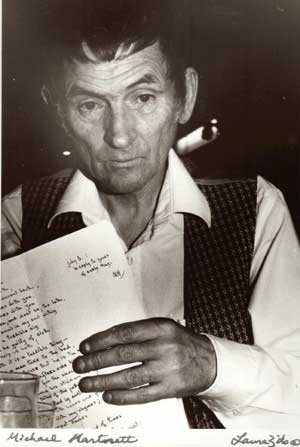
The title of the exhibition is Enlightened and it is a fitting title for the weekend of celebrations here in NCW as we honour and celebrate the life and work of Michael Hartnett. The title was chosen for a number of reasons but chiefly as a compliment to Hartnett by his fellow artist, Ciaran. Both men fit the bill as enlightened artists – open minded, imaginative, questioning, insightful, philosophical.

Just a few words about Ciaran’s artistic process. It is ironic, in this day and age, when many say that photography will eventually replace painting as an art form, that many of these paintings are derived from photographs. From simple photographs taken in his back garden in Co. Louth or at other family occasions, these works of art have developed and taken on a life of their own.

Like Heaney, Ciaran adds layer after layer of emotion, of colour, tone and texture to create something unique and intimate and personal. He, like Heaney, “digs down and down for the good turf”. In another of Heaney’s poems, The Forge, he describes the creative process as “the unpredictable fantail of sparks”. It is obvious that in Ciaran’s lonely, artistic attic/forge the sparks have been flying in recent times!

This exhibition follows on seamlessly from Ciaran’s earlier work. I’m sure you have been amazed and mesmerised with the richness of colour, texture and tone in these paintings – and then we do a double take and we begin to notice the people, the images within. The paintings evoke a mood and here tonight the artist finally, nervously hands his work over to us the viewer.

Like Hartnett, Ciaran’s work immortalises ordinary people, people close to him, family members. Sometimes there is realism, sometimes we’re shown things as through a glass darkly. I’m reminded here again of Hartnett’s description of childhood in Maiden Street during the bad old days of the Fifties and despite the poverty he was still able to say of his childhood that – “We were such golden children never to be dust, singing in the street alive and loud…”

There have been two great seismic changes in Ciaran’s life since his last exhibition – marriage and fatherhood. Setting up home with Carol and the arrival of Paddy have taken precedence but now, as you can see, we are surrounded here this evening with the results of his labours – in particular, the beautiful family portrait behind you. His paintings, I feel, have been enriched and exhibit a new vibrancy because of these life changing events.

We need artists like Ciaran and Hartnett in our lives and we shouldn’t wait until they’re dead to celebrate their genius. Mark Patrick Hederman, Abbot of Glenstal and great friend to this Eigse Festival, uses a lovely analogy to describe artists – he says that artists are like the dove that Noah released from the Ark after 40 days to check if the waters were receding. Eventually the third dove brought back an olive branch – we need trailblazers and scouts like that to go before us, to take the risks, and help us explore our unchartered waters.

I hope that tonight and over the coming days hordes of people will come and in quietness and silence be uplifted by this exhibition. In his poem ‘Secular Prayers’, Hartnett longs to be able “to look at lovely things and not be dumb”.  It is the same with us this evening. Go from here and spread the word. The exhibition will remain open until the 26th of April here in The Red Door Gallery, Newcastle West.

The Testament of Mary by Colm Toibin

imageReviewed by Vincent Hanley

This is a very slim apochraphal epistle-type novella from Colm Toibin. It is told from Mary’s perspective and, apart from Toibin, the only other Irish authors capable of such a consummate tour de force would, in my opinion, be Emma O’Donoghue, Edna O’Brien or even Sr. Stanislaus Kennedy herself.

The story begins with Mary under a kind of house arrest similar to a latter day Aung San Suu Kyi. She is catered for, spied on and continually interviewed and interrogated by unnamed men who seek to control her story. These men are responsible for spreading the message of her dead son, the turbulent priest, with his rag-tag group of misfit followers. Traditionally, of course, we associate this role with St. John the Evangelist, the Beloved Disciple and St. Paul, the convert who became the chief propagandist of the new religion. Here however, these ominous, shadowy men are faceless and nameless.

The great irony of Toibin’s narrative is that Mary, now living out her final days in Ephesus, is not a Christian and her devotion is to the Pagan goddess Artemis, goddess of fertility and bounty, childbirth and virginity and protector of young girls!

In my view Toibin displays an amazing insight into the psyche of motherhood in this revisionist epistle. Obviously as an Irishman he is very well placed to give us his revealing insights! Most of us familiar with the story of Mary and Church teaching focus largely on the Annunciation and the Immaculate Conception. This narrative ignores these momentous events and rather concentrates on three events in the life of her son; the story of Lazarus, the Wedding at Cana and, of course the very graphically described Crucifixion.

Mary treats her pregnancy as normal, everyday, she cherishes in her final days the memory of those blessed days. However, the men, her guardians, who have spirited her away to Ephesus, have a very different perspective, and our religion, our competing stories, reflect a situation where Mary’s pregnancy is one of a kind, otherworldly, out of the ordinary. Toibin’s ‘epistle’ gives us a much needed feminist outlook on those momentous events in those hysterical times as the Good News is managed and propagated from small town Galilee to a worldwide male dominated audience.

Mary’s ‘testament’ is sparse and succinct, uttered to her scribe – Toibin – in sotto voce until her guardians ask her to embellish her story and then her voice is more shrill and strident. Her motive seems to be to set the record straight – her account acts as memoir, witness statement extraordinaire, and it has the ring of truth to it – the whole truth and nothing but the truth. It moves between night and day, fact and dream and while some memories are graphic and detailed like her version of the Crucifixion or the aftermath of Lazarus’ coming forth, other major grey areas are skimmed over and there is a scarcity of detail, notably of course when dealing with the Resurrection – much to the annoyance and exasperation of her guardians.

These are examples of the subtleties of Toibin’s touch – he never pushes the bounds of our credulity, he doesn’t offend sensitive sensibilities in this area. However, there is evidence aplenty of subtle twenty first century nuances – finally a woman speaks!

Mary, as depicted by the author, is extremely suspicious of those with learning and those who can write. However, she correctly recognises and senses the power of the written word and she is lucky to have found a modern medium for her message in Colm Toibin in this one chapter and no verses gem of a read.

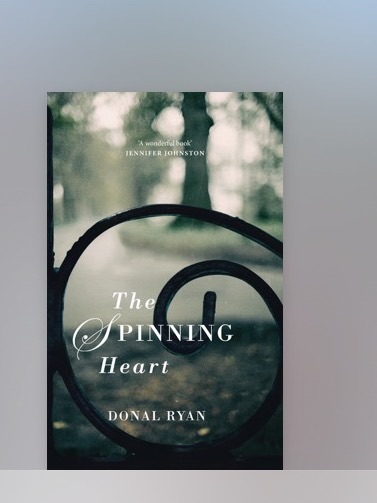
The Spinning Heart by Donal Ryan


image Donal Ryan doesn’t do rose tinted glasses and it is clear that the Irish Tourist Board aren’t going to be part funding the film version of this close to the bone realistic depiction of post Celtic Tiger Ireland. The novel has been long listed for the Mann Booker Prize and having read it the judges are unlikely to jump on a plane to explore the delights of Coolcappa, Moyross, Portroe, or the many uninviting ghost estates littering the Irish countryside.

The story of the novel unfolds and is presented to us via the inner monologues of twenty one characters living in a small rural community – twenty are alive while one character speaks from beyond the grave, still trapped in his squalid kitchen because ‘the Vatican done away with Purgatory’. This unique exposition reveals the incomplete story to the reader. Even at the end there are many loose ends, unanswered questions, unfinished plotlines. We are presented with numerous psychological profiles, each private self far different from the public personae on view. This disturbing epiphany is unsettling to say the least and is testimony to the searing perceptions and wry humour of this new shining star in the Irish literary firmament.

The events of the novel are ordinary and commonplace – apart maybe from the abduction of a young child from a crèche and the murder of an old bitter man. We are given insights into the lives of many affected by the economic crash, including a young Russian emigre stranded in a landscape where all dreams have died. Indeed, the characters in this novel have all gone three rounds with the Harvest Fair bucking bronco and they have all landed on their arse or their head. There are echoes and flashbacks to Synge’s masterpiece – Old Mahon, Christy and indeed Pegeen Mike are all here in this grubby modern Ireland. Themes of disappointment, regret, frustrated parental expectation, toxic shame, despair and depression are the new reality in this modern Littleton – or Ballybeg even!

The schitzophrenic, confessional nature of the novel lends to inevitable confusion in the reader. The characters struggle to cope in a world without moral compass or government. The priest and the Garda play bit parts but are rarely consulted or heeded. The author very cleverly sprinkles references to the present throughout the novel – we come across references to the whiners on Liveline, the State Pathologist, Dr. Marie Cassidy, the Abbeylara Incident and Donal Og Cusack ‘coming out of the closet below in Cork’!

Really, the more one thinks and reflects on the novel, the more one has to acknowledge the subtlety and genius of the author. He has managed to chronicle an era ‘warts and all’ and he has done so from a variety of perspectives with a weird and wonderful motley cast of distinctive voices.