Politics and me!

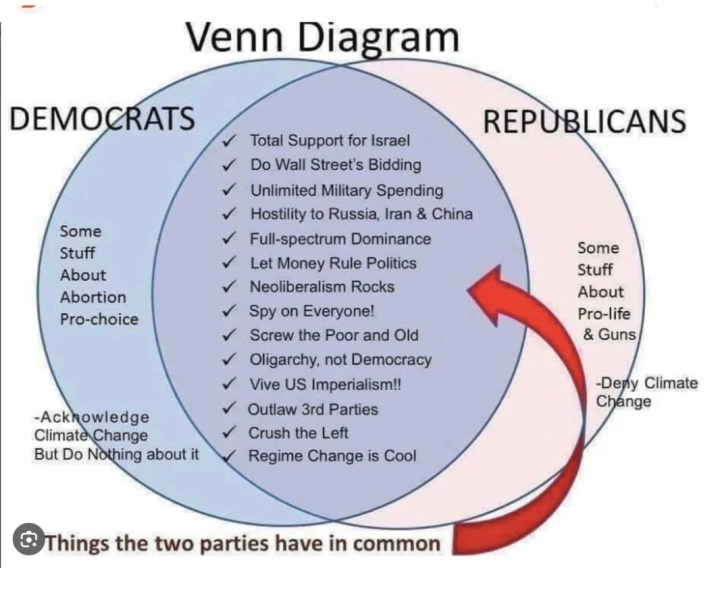
The huge differences between Democrats and Republicans!

I was never that good at Maths, and I’m so old that my Maths education consisted mainly of Geometry, Algebra and Trigonometry!  Some of my teachers may even have been Greek; at least it was all Greek to me! However, if I were to represent where I stand politically, I’d probably use the more modern Venn Diagram. One bubble would represent the constituency covered by Christian Democrats, while the other bubble would represent the area covered by Social Democratic thought and policy. The oval intersection in the centre of this diagram is where I have stood politically since the ‘70s.

Firstly, two stories from the past. The first one I heard from my mother and her sister, my Aunty Meg.  One evening in the Spring of 1932, shortly after Fianna Fáil had come to power, and a mere nine years since the end of the bitter Civil War, they were both on their way home from their National School in Glenroe. As they were passing a local farmer on the road, they shouted out, ‘Up Dev!’ which was the great political slogan of the day, following Eamonn De Valera’s victory in the General Election which had just taken place on March 9th that year.  However, the following morning, both were brought before the class, and Aunty Meg was beaten about the head by her teacher, so that she was rendered profoundly deaf for the rest of her life.  When their father, my Grandad, found this out, he went immediately to the school, withdrew his two youngest daughters and transferred them both to the convent school in Kilfinnane, five miles away, where they completed their education.

I also have a clear memory of the General Election in 1957.  I remember my Grandad waiting patiently outside our home in Rapala, in the March sunshine, to be collected by local members of the Fianna Fáil political party who would take him to the Polling Booth in nearby Glenroe so that he could cast his vote in the General Election. I, even as a five-year-old, could sense how important this was to him.  He was dressed in his best Sunday outfit, his flat cap, waistcoat and jacket, his trusty pipe, and his walking stick, ready for road!  This was a regular occurrence in the ‘50s, and even in the ‘60s, when there were few cars, and the local activists of all political hues, who had cars, did everything in their power to maximise the vote! De Valera and Grandad’s beloved Fianna Fáil won the election, and so Grandad was very happy with that result.

So, my family would always have been traditionally staunch Fianna Fáil supporters, a support that had its origins in the horrible Civil War from whose ashes arose our fledgling Republic in 1923, the year my mother was born in Glenroe. However, since I became politically aware, I have always been drawn to the policies of Fine Gael, especially having read, while at University, Declan Costello’s Just Society document, which he had produced in the mid-60s.

Later, Garret FitzGerald’s Constitutional Crusade received my full support, and even though he never did seem to be cut out for the rough and tumble of Irish politics, I agreed with his liberal views and philosophy and the need to accelerate the separation of Church and State for once and for all. Following decades of deep conservatism at the top echelons of Irish life, FitzGerald in the ‘80s embarked on a bold odyssey to modernise and liberalise not only his own party but the country at large. However, his often-futile efforts, despite his Economics background, to fix the economic depression of the ‘80s met with less success, and, I suppose, thereby lies the enigma of a political visionary.  In more modern times, visionary leaders of all political hues in Irish politics are in short supply.

One of my go-to commentators on Irish life since I began reading The Irish Times in the ‘70s, Fintan O’Toole, has recently stated that he believes Irish society is now firmly socially democratic. The big cultural shift was the breaking of the hegemony that had dominated the State – the tight alliance of Fianna Fáil and the Catholic Church. Demographically, Ireland is experiencing a very rapid catch-up after the long depredations of famine and mass emigration. Socially, the population has become both urbanised and highly educated. Added to this, the huge growth of the private sector economy has created an undeniable imperative for a greatly expanded State to provide infrastructure, housing, healthcare and education.

What we have, then, is a very broad consensus on the need for classic social democratic policies. Most people want to see an active State that builds houses, creates equal access to health and education, works to eliminate poverty and supports both those who need care and those (mostly women) who provide it.  For this reason, I believe, Fine Gael, the political party that I have given my support to, is under serious threat today both at home and in Europe. This can be seen better in the European context, where they are aligned with the main Christian Democrat alliance in the European Parliament, the European People’s Party. Herein lies the threat: most Christian Democratic parties in Europe, to counter the threat from the far right, are themselves moving to the right in their pronouncements and their policies, especially on issues like immigration. These parties are being outflanked by the far right, and so, the middle ground is shifting to the right. Fine Gael is still considered a conservative party in Ireland, but in Europe, their associates are coming to view them as more Social Democrat than Christian Democrat – the centre cannot hold!

Politics has become very confusing in my lifetime. If I had a vote in American elections, my gut instinct would always have been to vote Democrat – yet today Democrats espouse many policies I find objectionable, such as being pro-abortion. Republicans, on the other hand, are pro-life, and so, God forbid, should I vote for Trump? If I were a British voter, I would find it easy not to vote for the Conservatives because of their extreme right-wing self-serving tendencies, but then I can’t warm to Keir Starmer and his version of the modern Labour Party either. Maybe we should do what we do in Ireland and ignore Left and Right, Conservative and Liberal, Republican and Democrat and simply have a Civil War and for the next 100 years vote for those on our particular side of that conflict!

Ironically, in this day and age, Democrats of every hue pay mealy-mouthed lip service to democracy. In Europe, we have built an immovable, stubborn and unwieldy bureaucracy in Brussels, and there is a perceptible democratic deficit. Decisions are made by consensus and take forever.   Parallel to this, we have a pipeline of edicts and policies and over-regulation being handed down and implemented unquestioningly by local ‘sovereign’ parliaments in 30 member states.  The stark reality is that despite its great wealth, Europe as an entity is weak and irrelevant, paralysed by conflicting national interests, when compared to the big players, Trump, Putin and Xi Jinping.  Even when it comes to its own security, the EU struggles to be a central player.

Westminster, the Mother of Parliaments, gave us the concept that those who sat to the right of the Speaker were the Government and those who sat to the left of the Speaker were in Opposition. Yet today, the idea of robust parliamentary debate has almost vanished in our Houses of Parliament. Consensus politics is everywhere. For example, it was almost impossible to find an opposition voice in our Dáil to any of the recently proposed amendments to our Constitution. And in the recent Presidential Election, a pro-life candidate seeking a nomination failed to find the required 20 Seanad members to ratify her nomination, while our main political party, after much skulduggery, chose a non-party candidate to disastrous effect, thus undermining the office of President.  Is it that all political parties agree because of the obvious virtue of the various proposals, or is it that the quality of those seeking nomination is so poor? Is their silence because of fear of being ridiculed and mocked because they are out of step? The question I ask is, who represents me? How come the people whom I voted for refuse to represent my position? Who speaks up for those who oppose these proposed measures?

My greatest dystopian fear is that there is a kind of elite consensus at work in our world and that, in effect, the lauded ideal of democracy is, in fact, long dead. This ‘elite consensus’ is agreed upon in such shady places as the World Economic Summit in Davos and other elite gatherings where the agenda is agreed upon and handed down to governments to implement. In recent years, it has been quite unnerving and unsettling to see our Taoisigh and Finance Ministers strutting in these undemocratic assemblies, cheek to jowl with billionaires, oligarchs and moguls of one hue or another. In my opinion, our political leaders have no place at such gatherings.

Lately, our government has increasingly hidden behind the very undemocratic Citizens’ Assemblies. These assemblies are meant to inform the government about proposed new legislation or other controversial issues. Nobody knows how these Assemblies are put together, or how their numbers are decided, yet our government continues to give them huge prominence in the determination of policy and legislation. If controversial decisions are arrived at, the government can wring their hands in phoney despair and claim that this, after all, must be what the people want and, thereby, distance themselves from any culpability.

The NGO Merry-go-round

Government-funded NGOs distort lobbying. In recent times in this country, we have had the ludicrous situation where the government have relied on, and paid, the National Women’s Council of Ireland to campaign for the removal of wording which refers to ‘women’, ‘mothers’, ‘marriage’, and ‘home’ from our Constitution – these terms are now considered old fashioned, gender-specific, and possibly offensive to some! These amendments were, in the main, poorly drafted and poorly thought through in terms of their future legal consequences and broader implications. Yet, this is how cosy consensus works: proposals are put to the people, who are generally disinterested and uninformed, and the government hopes that a low turnout will see the amendments carried. This surely is a travesty of democracy. I say this mainly because, in recent years, I find myself on the losing side in all these battles, similar to my unlimited heartbreak while following the Limerick hurlers until they began winning All-Irelands again in 2018!

The old concept of majority rule is now defunct. We are everywhere surrounded by vocal minorities, and the silent majority is being manipulated furtively, dangerously and relentlessly by social media and mainstream media, which has lost all vestiges of independence and objectivity. Newspapers and television stations have almost all been bought up by billionaire moguls and oligarchs for their nefarious ends. We are surrounded by a multiplicity of influencers whose sole objective is self-interest and self-promotion.

I remember back in 1984, the year our daughter Mary was born, thinking to myself that things weren’t that bad after all. Orwell’s chilling novel, 1984, had come and gone, and his dystopian predictions had been well off the mark. Of course, I was wrong. I remember again waking on November 8th 2016, to the news that Donald Trump was almost certainly going to be elected the 45th President of the United States of America.  I had followed the seemingly interminable election campaign and had been amazed by his distortions, lies, deliberate misinformation and fake news, and now this buffoon, this bankrupt, had his finger on the levers of power in the most powerful country in our world. For me, the insanity, the instability began that day and has since spread like a pandemic to infect politics worldwide.

There is unfinished business here in Ireland, also. In the coming years, the country will have to face up to the challenge of reunification and try, in a peaceful way, to right the wrongs of the past. Seeking consensus won’t cut the mustard, and wise and strong leadership will be needed to bridge the gap to a new and better future for all on our beloved island. In truth, we have come a long way since the days of ‘Ourselves Alone’. We are now an outward-looking nation, and, despite its many perceived shortcomings, Europe has been good for us.  Yet, the very notion of a Border Poll has been kicked down the road by even the most rabid Republican parties for fear it will offend some group or other.  If a week is a long time in politics, then one hundred years is an eternity.

It is very hard to have to say that our present government, and its political administration, are in deep paralysis and stasis since it came to power over a year ago.  For years, on the global stage, we have resembled a recalcitrant college student who wants to experience the college atmosphere but prefers to spend his time in The Stables and The Scholars Club, even The Terrace, without ever going to a lecture or meeting the least onerous deadline.  We haven’t met a deadline, set by ourselves or Europe, in years, and we are paralysed by regulations which we have agreed to when we try to respond to any crisis, notably housing for our young people or the climate emergency.  Added to this, the cosy consensus of ‘a rotating Taoiseach’ is not working, and my favoured political party has not chosen its leaders well in recent years.  Too many talented politicians are simply biding their time until lucrative opportunities arise at some global think tank, bank or other.

For most of my lifetime, I have admired from afar the United States of America and the United Kingdom. I have long been assured and comforted by their perceived role as leaders and policemen of the free world and their reliance on ‘a rules-based world order’ of multilateral organisations, such as the UN and the International Criminal Court.  It saddens me to have to admit that their stature in my eyes has been diminished and shattered by their actions and inactions in this 21st century. Being complicit in genocide is the least of their crimes.

The bottom line is that a whole range of sacrosanct core principles are being tampered with – even decimated: our democracy, our sovereignty, and our neutrality.  America has gone rogue, and the checks and balances have been cast aside.  Where is Congress? Where are the lawmakers and law upholders of the great American Senate?  And what of the Stock Markets, that supposedly great regulator and our ultimate wind vane of economic insanity? Why are they not freaking out at developing events?  What has their reaction been to all this upheaval and instability? There is a feeding frenzy ongoing, and all are gorging themselves at Trump’s Trough.

How easily all these safeguards have been cast aside by those who are putting personal aggrandisement before the common good.  Government-backed armed militias roam the streets of American cities, shooting dead American housewives collecting their kids from kindergarten.  To quote W.B Yeats, in The Second Coming, a prescient poem for our time also,

…. Things fall apart; the centre cannot hold;

Mere anarchy is loosed upon the world,

The blood-dimmed tide is loosed, and everywhere

The ceremony of innocence is drowned ….

 Social anarchy and massive destruction are made worse by the collapse of moral values among the leaders of nations: ‘The best lack all conviction, while the worst / Are full of passionate intensity’.  Back in 1919, Yeats predicted that evil would triumph in the public sphere because those political leaders who might be expected to defend humane values (and basic human rights) lack the determination to resist those who preach violence and intolerance.

It is undisputed that all wars and all politics are, in fact, local. Sometimes our political leaders forget this universal truth to their cost. Like Patrick Kavanagh in his beautiful sonnet, Epic, ‘Gods make their own importance’ and the boundary dispute between the Duffys and the McCabes and their ‘pitchfork-armed claims’ is as important as any other conflict making headlines in the morning papers. My advice to those who purport to represent me is to get out of their ivory towers and retrieve the better parts of what we used to call in Ireland ‘parish pump politics’, namely listening to the people who voted them into their positions of power in the first place and to forcibly represent those views on the floor of the Dáil.

Finally, despite my pessimism and present disillusionment with politics and politicians, it is a source of great pride to me that, down the years, at least three of the brave politicians, and one brave Minister, who have regularly called to my door seeking my vote have, at one time, sat before me in class!
The Yoplait Experiment and other Adventures

In or around 1973, I participated in one of the great social engineering experiments ever conducted by the emerging Sociology Department in UCC.  This experiment had its epicentre in that den of iniquity known as the Kampus Kitchen.  The aim of the experiment was to discover if a whole cohort of Munster’s finest could survive on nothing other than copious quantities of Yoplait yoghurt with added orange peel during the course of an academic year.

The Kampus Kitchen was a student restaurant and multi-purpose venue at University College Cork (UCC), located in what is now known as the Kane Building. It was a popular space for students, serving as a restaurant, exam hall, study area, and even a live music venue in the 1970s. Construction of the building was finished in 1971, and the Kampus Kitchen was a beloved student spot for many years after.   All student life was present and, if my memory serves me right, it was always full.  There, would-be student politicians faced the wrath of a rebellious student body, while eager Third Eng and Second Year Commerce made hasty battle plans before taking to the ‘field’ for their Quarry Cup game.

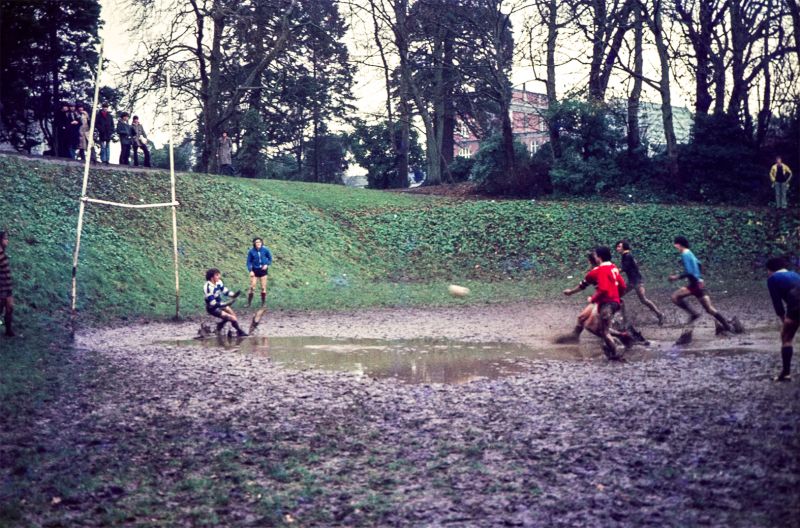
The Quarry Cup at University College Cork (UCC) was an historic inter-class soccer competition that was named after an actual hollowed out limestone quarry and a natural amphitheatre at the heart of the college. The Quarry was to UCC what the Colosseum was to the ancient Romans, a place for heroics and for heroes to display their skill, their bravery and their greatness. This oval-shaped field, with elevated banks, attracted large crowds on game days. The competition began in 1952, making it UCC’s oldest and most successful inter-class soccer competition. To call it a soccer competition was a great disservice to the Beautiful Game because, depending on how the game was going, various elements of Gaelic Football, Rugby Union, and even American Football were often called into play.  Most Quarry Cup games were fiercely contested, with up to 40 faculty teams taking part in the nine-a-side knockout competition.  Games invariably ended in mud-bath conditions.  Alas, the Quarry and its associated cup are now a piece of UCC’s history, with the new imposing Boole Library built right on top of that ‘field of dreams’. For the record, the last team to win the Quarry Cup was a Med. team captained by John Lynch.

Yoplait was the new culinary delight in those halcyon days.  It had begun in France in 1965 when six dairy co-ops merged to market their yoghurt products under one brand. The brand launched with the six-petaled flower logo, each petal representing an original co-op.

Yoplait’s first international expansion was through a franchising agreement with Switzerland in 1969.  The brand reached the United States and Canada in 1971.  In 1973, Yoplait began to be marketed in Ireland under a franchise agreement.

Yoplait initially produced plain-flavoured yoghurt and cream but released its first fruit-flavoured yoghurts in 1967. By 1973, the marketing gurus had decided to give their product away as a kind of first-ever loss-leader to hungry hordes of University students, knowing that when they graduated and got jobs in 1980s Ireland, Yoplait would be on everyone’s shopping list.  Sure enough, today they have become the leading kids brand, as Petits Filous fly off the supermarket shelves as Mum’s and kids’ favourite fromage frais.

Sure enough, by 1978, yoghurt had rightfully taken its place as one of our staple dairy products.  For my sins, after my first full year teaching in Newcastle West, I applied for and was allowed to correct Intermediate  Certificate Geography.  Now, where exam scripts are concerned, it never failed to amaze me the chances chancers will take when rote learning hits the cold reality of the North face of The Eiger! That fateful summer, I learnt that the name of the shipyard in Belfast was Harland and Wolff Tone and that, along with cheese and butter and Yoplait yoghurt, Milk of Magnesia was from now on also to be considered a dairy product!

However, my stint as an examiner that year ended in total disaster! I had learnt the ropes of being an Examiner during those hazy six weeks in June and July, and despite what would be considered today as abysmal postal and telephone communication, I managed to keep my Advising Examiner happy. When I had finished my work, I was meant to take my bag of scripts to the nearest train station for dispatch back to Athlone. I duly delivered my heavy bag of scripts in my trusty Ford Capri to Limerick Junction train station, and I brought my young impressionable brother, Thomas, and one or two of my sisters along for the drive.

Now, car aficionados will know that my top-of-the-range Ford Capri with its 1.6 overhead cam petrol engine, which had languished at the very back of Murphy’s garage in Cahirciveen until it had been recently rescued by my brother Mike, had four pedals instead of the usual three. The fourth pedal, a wonder of Ford ingenuity and engineering, was used to work the intermittent wipers.

Anyway, as we were nearing the Milk Woman’s Cross on our return journey, I began to mess with the pedals and lo and behold, to Thomas’s amazement, the wipers came on by some magic, even though it wasn’t even raining at the time. I repeated this trick a few times and then turned in the gate to our home. Not only had I totally confused Thomas, but unfortunately, I had also confused myself, and instead of pressing on the brakes, I foolishly pressed the accelerator and drove my lovely Capri into the cast-iron stanchion at the butt of our haybarn, doing untold damage to my pride and joy in the process. I earned a grand total of £178 for my correcting efforts that Summer, and Mike McCoy, our local panel beater in Knockaderry, charged me £250 to fix my wounded pride!

The Yoplait Experiment may not have been the only one to thrive in that magical place.  I’m not a great conspiracy theorist, but it strikes me now as too much of a coincidence that there were a number of payphones on campus – in those days of no communications – that could be tampered with so that all calls home were free of charge.  My home number was Kilfinane 126.  Don’t ask me how the scam worked – or was allowed to work – or how I managed to get through to home – but on one occasion, I remember getting my sister, Eileen, who was busy studying for her Leaving Cert, to transcribe a full English essay over that phone line without interruption.  I stood there on a glorious exam swotting May evening, reading my hastily cobbled together essay.  If I remember correctly, the title of that essay was: ‘In the land of the blind, the one-eyed man is king’!

I’m tempted to indulge in just one final conspiracy theory here! I’m convinced that that essay was surreptitiously’harvested’ by that fledgling Sociology Department in UCC, and when the time was ripe, years later, now working from the dungeon-like basement in the new Boole Library, built over that Quarry where once the famous Quarry Cup was played out, they used it as a blueprint for their first global experiment.  It wasn’t the Russians who interfered with those elections in that faraway land of free and brave men, it was nerdy boffins from the Sociology Department in UCC!  They even added a very ingenious subplot: not only was this newly elected King one-eyed, but he had no clothes!

                               Typical Quarry Cup conditions – not for the faint-hearted!

Random Epiphanies….

An epiphany is that moment when the penny drops, when the scales fall away from your eyes; that ‘light bulb moment’ when the mystery is solved; when the poem gives up its secret; that Eureka Moment when you realise you’ve been conned for most of your life.

The Bible has many such moments, from Eve and the apple in Genesis to Paul’s conversion on his way to Damascus in the New Testament.  As Christians, we celebrate the Feast of the Epiphany each year on January 6th, which focuses on the moment Christ is revealed to the non-Jewish world; when the Magi, guided by a star, come from the East to visit their Redeemer.

Epiphanies are mental moments when we are given instant clarity, which can turn into motivation to change and charge forward. But not all epiphanies are created equally. Some demand a deep inward search, while others fly in and out of our lives swiftly, silently, almost unnoticed.

It’s great to have an epiphany, but what you do with that new clarity is what matters most. Most of our habits are so ingrained in our lives that changing behaviour is very difficult. Most epiphanies force us to see situations and ourselves in a new light. The next step takes great courage; taking that step to live out your epiphany is when real transformation happens. In my own life, I have had some powerful moments. So, here are a few examples of some of my totally random light bulb moments…..

  • I normally don’t do conspiracy theories, BUT I firmly believe the young Viet Cong soldier who tortured American Vietnam hero and veteran, John McCain, for seven years, when made redundant, went back to the fledgling Hoi ChiMinh University and did a doctoral thesis on the benefits of manually induced electro muscle therapy – this was then picked up in Austria or Switzerland and sanitised. Today, it’s known as DRY NEEDLING. IMHO, the overuse of dry needling by overzealous, sadistic physiotherapists will be the rock that modern physiotherapy will perish on.
  • Donald Trump has never, ever put America first. Indeed, most politicians of all nationalities and all political hues invariably put themselves first.  However, a stopped clock is right at least twice a day, and Donald Trump was spot-on when he coined the phrase, Fake News.
  • In a related epiphany, have you ever noticed that all the major News Corporations are now owned by billionaire oligarchs and moguls?  I wonder why.  I have come to realise that much of what passes for news in today’s world is fake – atrocity after atrocity goes unreported, and not just because all the journalists have been killed by sniper fire – those who sit at home back in the studio have their hands tied behind their backs for fear they might incur the wrath of the current government.
  • On a slightly lighter note, did you ever notice that shampoo bottles are designed so that you will always use more than you need? You only realise this when the bottle is nearly empty.
  • The Catholic Church in Ireland provided an education and health system for Irish people a century before the fledgling state was formed – they deserve to be cut some slack by the newly canonised neo-liberals. That Church, to which I belong, has been under persistent attack for most of this century.
  • There are 756 steps between Oscar’s Restaurant and Servitar Puerto Azul Apartments in Puerto Rico, Gran Canaria!
  • Last year, for the first time since we settled in Knockaderry back in 1979, we had no swallows nesting in our garage by the road. In years past, we’ve had multiple pairs, but last year, 2024, was the first year we had no nest. It struck me then that swallows are the modern version of the canary down the mine. Thankfully, this year, after a very nervous wait, a lone pair arrived on May 20th – five weeks behind schedule. They built their nest and hatched four beautiful chicks for us to admire and cherish. The world is very fragile but not yet fully broken!
  • Global Warming never came to Knockaderry – but Climate Change is a real problem!
  • I’ve always contended that common sense wasn’t that common, but now I’m convinced that logic is irreparably damaged, and Warmongers now see themselves as Peacekeepers.   There’s one who has financed and supplied most of the munitions for an ongoing genocide who claims to have brokered peace in nine global conflicts this year alone.  Give that man the Nobel Peace Prize now, or else!!
  • Your role as a parent is never done. There is never a time, in good times and in bad, when you have full peace of mind, when you no longer need to worry. In reality, as a parent, you are only ever as happy as your saddest child.
  • Your career as a politician or as the manager of your local hurling team always ends in failure! No matter how successful you’ve been at winning championships or leagues or simply avoiding dreaded relegation, the time will come when you lose the dressing room. The people have spoken, and you must inevitably bow to the tyranny of the ballot box or your local GAA AGM!
  • Modern democracy is as fragile as a wasp’s nest, papery and brittle, and in my lifetime, it has been emasculated by billionaires and Russian oligarchs for their own ends.
  • Your health is your wealth. It is a universal truth that we take too much for granted, like being able to put on your socks or pull up your pants or get out of bed in the morning.
  • Cork GAA and its supporters are so well-served by the quality of their sports journalists.  No other county can claim to have writers who, week in week out, report the club scene and the intercounty scene in hurling and football to such a high standard.  Names like Tony Leen, John Fogarty, Maurice Brosnan, Michael Moynihan, Eoghan Cormican, Paul Rouse, Kieran Shannon and Cathal Dennehy are among my favourites.  And all of those stand on the shoulders of the giants who went before them in the old Cork Examiner: Jim O’Sullivan, Michael Ellard, the great P.D. Mehigan, better known as Carbery, and my own favourite word wizard,  Kevin Cashman.  In my book, he was one of hurling’s finest ever writers who prized exactitude and calm knowledge, in the same way he esteemed seeing a hurler’s correct technique create lethal elegance.

Finally, to put some order on this randomness, here are eight epiphanies that have certainly changed my life for the better, and maybe they can help you in your own journey.

  1. You aren’t what people say you are.

What matters most is what you say and feel about yourself. You get to choose. You can let others define you and tell you who you are, or you can show them who you are. Be you. The world needs you as you are.

  1. Plan B is often better than Plan A.

The most freeing moment in your life is when you let go of what you think is best for you. Stop holding on to what is no longer working: that job, that relationship, that dream. If it feels like hard work and is causing you more pain than gain, it is time to let go.

  1. You are not the number on the scale.

At the end of your life, after all those weight struggles, food wars, the obsession with new diets, and trying to look a certain way, it will have no relevance. You are more than a set of grades. The only thing that matters is what is in your heart. How you make people feel and how you make YOU feel is more important than how you look.

  1. The journey is more important than the goal.

Setting and reaching goals is important, but the actual process of becoming, growing, learning, and morphing into who we need to become is the real sweet stuff that makes for a wonderful life. Enjoy the journey as much as the reward.

  1. Being alone doesn’t mean you will be lonely.

The fear of being alone strikes the heart and makes many people panic. But when you learn to love your own company, you will see that you are never really lonely.

  1. It will never be all done.

The to-do lists, the chores, and the things we race around to get done will never be done. It is called life. Situations, chores, and to-do lists will always unfold. Instead of focusing on the end result, be in the process and celebrate what you have accomplished, as our wonderful Limerick Hurling team does.

  1. Emotional pain, indeed, all pain, shows up to point out to us what we need to change.

Sadness, depression, and heartache are gentle reminders to probe deeper into our lives. In the Summer of 2024, I had six weeks of agony inflicted on me by an inflamed bursa in my left hip from climbing ladders and clipping hedges. So, look at what is not working and be open to living your life in new ways. No more climbing ladders for me!

  1. Finally, if you’re lucky, you don’t have to find your purpose; it will find you.

The transition period between who you are and where you are going can be painful, but on your journey of finding purpose, recognise that there is purpose in the pain. Each step you take is helping you carve out more of who you really are.

Brandon Creek Epiphany – and a Rant!

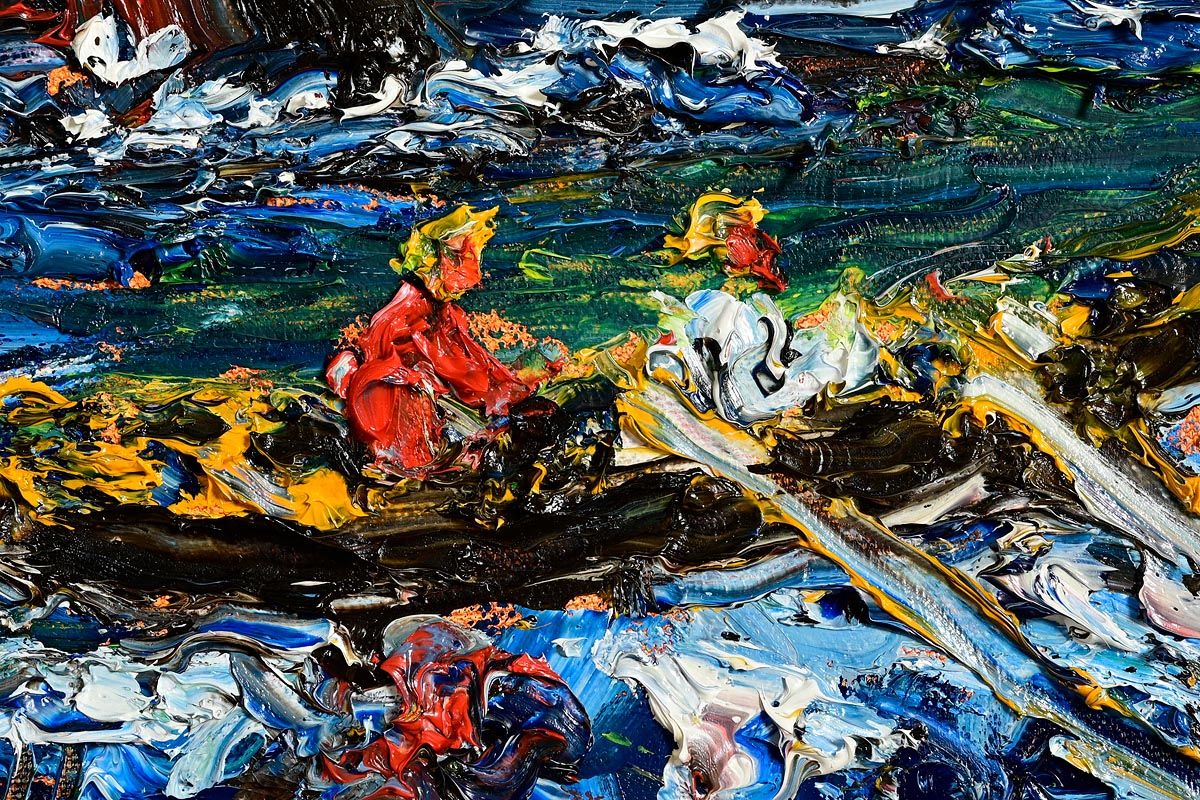
‘Brandon Creek, West of Dingle’ by Liam O’Neill/Morgan O’Driscoll.

The title of this blog is ‘Reviews, Rants and Rambles’ and since 2015, there have been many reviews and rambles but very few rants – so here’s one:  We are living through the craziest of times.  Like Macbeth after his confrontation with the witches, ‘ Nothing is but what is not, ’ and global leaders have taken their chainsaws to the truth.  Irony is everywhere: billionaires and huge multinational corporations try with all their ingenuity to destroy all borders so that their profits are maximised, while at the same time their political buddies stoke nationalistic fervour and division and demonise immigrants and those who cross borders to a better life.  Globalism is the buzzword, but global efforts to combat impending Doomsday scenarios and pandemics have been seen to be pathetic attempts at cooperation. Rant over.

The summer of 2024 was yet another Climate Change paradox in Ireland.   The Jetstream seemed to be stuck in some Groundhog Day cycle during June, July and most of August. There were no two days the same; no long sunny spells, rain was never far away, although rainfall amounts were below normal levels.  Towards the end of August, a temporary high moved in over Ireland and Kate and I decided to take full advantage. On Friday, August 30th, Don’s birthday, we decamped to Dingle.

On Saturday morning, we decided to head out west towards Baile na nGall, and on the way, we stopped off at Brandon Creek to explore this unheralded and largely forgotten gem on the Wild Atlantic Way. On that morning, it was indeed sensational, and a revelation and my words are inadequate to describe the beauty and tranquillity of the place. We parked our car in an unofficial grassy layby near the top of the narrow roadway leading to the Creek and the neglected pier. The narrow single-lane path descended to a very rustic bridge over the creek. The solitude was magical and eerie. I couldn’t help but think that in another era, this narrow roadway would have been used to collect guns and other contraband smuggled into this isolated cove in the dead of night.

Maybe this scenario from bygone days was prompted by the many rebel songs and ballads and stirring sea shanties we had listened to the night before from the marvellous local group, Tintéan, in Murphy’s pub in Dingle. They had entertained a very diverse and varied audience with a two-and-a-half-hour session of rousing rebel songs, some of which even the Wolf Tones wouldn’t include on their concert playlist for fear of offending someone! The Irish diaspora was there in force from Ohio, Connecticut, and Washington; I even had trouble distinguishing between the Canadian and South Florida accents! Then there were couples from Spain, Germany, and Sweden and holidaymakers from Derry, Tipperary, Limerick and Kerry.

As we walked down the steep incline to the pier, there was much evidence of neglect and some evidence that, at one time, the now rusty winch had been used to haul the local currachs with their catches up onto the pier. I walked to the end of the pier and could hear the quiet, rhythmic gurgling of seawater in the hollow caverns at its base. I imagined what it would be like in the throes of an Atlantic storm. It was hard to believe that it was from this very location around 600 AD that Saint Brendan the Navigator was reputed to have set out and discovered America.

There is much talk today, especially across the water, about the problems caused by small boats precariously being used to bring immigrants to Britain’s shores. St. Brendan and his hardy crew of monks not only made it to Iceland and probably Newfoundland and Labrador, but they also made it home again! There is some anecdotal evidence and much more scientific evidence that the people living today in those far-off regions carry West Kerry genes, so the monastic concept of celibacy must have been an optional requirement in those early days!

I also remembered that in the 1970s, the explorer, writer and filmmaker, Tim Severin, tried to recreate St. Brendan’s voyage in an effort to prove that the 6th-century Irish saint could have reached the Americas 900 years before Columbus.

On May 17th, 1976, Severin and his three fellow crewmen rowed out of this same Brandon Creek to begin what would prove to be a 7,200km epic journey. I remember avidly following their progress as Severin and his crew first sailed to the Aran Islands and from there to Iona, the Hebrides, and the Faroe Islands, before sailing on to Iceland and Greenland and from Greenland to Newfoundland.

On June 26th, 1977, some 13 months after leaving Brandon Creek, Severin and his crew sailed into Musgrave Harbour on Peckford Island, Newfoundland and were welcomed as heroes by the locals who fully appreciated the navigational feat.  Amazingly, there is nothing on the pier in Brandon Creek today to remember those heroic feats of yesteryear.

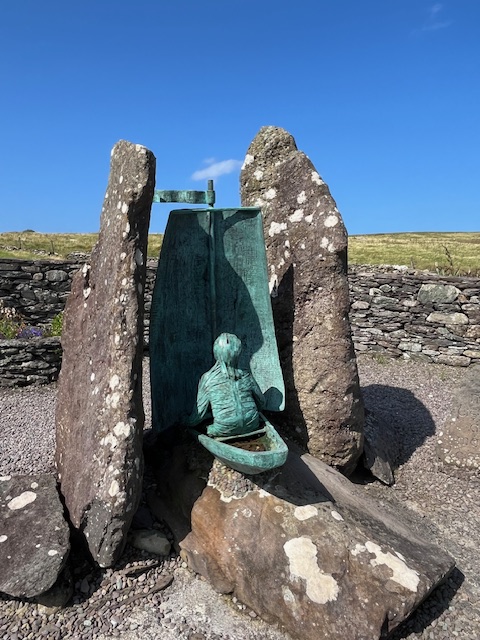
Kate and I made our return journey up the steep, narrow incline with visions of the stormy gunrunning scene from Ryan’s Daughter playing in my head. As we reached our car after the slow climb, I noticed what seemed like a half-hidden art installation surrounded by low walls of local stonework. At first, I took it to be yet another of the numerous shrines and grottos that lie scattered all over this Gaeltacht region, but this was different. While I was exploring this very unobtrusive, unflagged surprise, Kate had struck up a conversation with a woman whose car was also parked nearby. I continued on my way and came upon a copper-green sculpture depicting a lone sailor navigating between two standing stones, which, I presume, were meant to represent the perils encountered on an ocean voyage. The sailor seemed to be sailing blind as his view forward was blocked by the fragile sail on his lowly currach. I presume the sculpture was meant to depict the voyage of St. Brendan in his frail craft all those centuries ago. There was an inscription in Irish on a red sandstone flag nearby, which read ‘Ná ligamís ár maidí le sruth’.  I wanted to remember this, so I took a note of it on my phone.

I returned to the car where Kate was waiting, and she told me of her conversation with the woman she had met. The woman had set out that morning at 6 a.m. on her own and had climbed the nearby Mount Brandon. It had taken her three hours to climb to the summit and three hours to make her descent. Because she was muddy and splattered from the climb, she had decided to go for a swim down in Brandon Creek before heading home.  Needless to say, we were both in awe of this woman’s achievements. This hardy soul epitomised for us the strength and resilience of the locals in this almost-forgotten outpost of our country. I then told Kate what I had got up to and the marvellous discovery I had come across, something not mentioned in any of the Bord Fáilte brochures in nearby cosmopolitan Dingle. I told her about the inscription I had come across and translated the hopeful message as best I could.

Sometimes when we begin to doubt our ability to solve personal or global issues like climate change, the inscription from that beautiful, wild and neglected place has, for me, the feel of a powerful call to arms:

‘Ná ligamís ár maidí le sruth’

‘We must never rest on our oars’


Irish Weather

Wet and windy Status Yellow weather with wintry showers on the way!

I have grown accustomed to the slow, relaxed rhythm of the seasons changing in Knockaderry. I look out from my front door at a verdant tree-filled valley with its rim of hills on the horizon, stretching from Barna to Broadford and Freemount and beyond. The people in these border regions of Limerick, Cork and Kerry are prone to exaggeration, so the hills are known locally as The Mullaghareirk Mountains. This is from the old Irish, which translates as ‘the hills with the view’. The area is also known as Sliabh Luachra, which translates as ‘the hills of the rushes’, famous for its poets, polkas and slides, its sets, and half sets. The valley that I look out on is also an ancient valley with an equally ancient name, Mágh Ghréine, ‘the valley of the sun’.

Any discussion of Irish weather risks the odd cloudburst of cliche, often fuelled by naive American tourists who believe everything they read in their Aer Lingus in-flight magazine. However, we have to admit that in Ireland we have weather, while every other place on the face of the planet has a climate. Proof of this is the recent European Commission’s decision to stop talking about Global Warming and focus instead on the term Climate Change – albeit only when they realised that Global Warming didn’t apply to Ireland. Here in Ireland, it’s either Baltic or the sun is splitting the stones, usually on the same day.

The main problem here is that most of us don’t welcome rain like the people in sub-Saharan Africa would a deluge. Our inner weathervane says things like, ‘It looks like rain’, or ‘It’s trying to rain’, or ‘It’s boiling for rain’, or ‘It’s a soft day’, or even better, ‘It’s a grand soft day’ if you’re an American tourist in Adare. We say, ‘It’s lashing rain’, ‘The heavens opened’, ‘Twas bucketing rain’, ‘Twas pissing rain’, and when it rains when you’re just going to bale the hay, we say, ‘Twas only a sun shower’, just perfect rainbow weather!

I have looked out from my porch on many an April evening and admired the sheets of rain being blown towards Ahalin across Stack’s big field. I’m also reminded of Austin Clarke, my favourite Irish weather poet, who talks of ‘the mist becoming rain’. In my opinion, our biggest problem in Ireland is when we get a settled period of very fine Summer weather, the farmers invariably start praying for rain on day three, and everyone knows the strength of their lobbying power with the Man Above!

For years, my weather watching was linked to my job, just like farmers and fishermen and such. You’d hear people talking about ‘Exam Weather’ each June, and ‘Back-to-School Weather’, which always consisted of a mini heatwave in September. Invariably, the farmers were also using this long-awaited window of opportunity to literally make hay while the sun shone.

Each year for thirty-odd years in June and July, I undertook a mini-Purgatory for my sins by correcting Leaving Cert exam papers. The six or seven-week period was usually filled with sunshine and heatwaves and Munster Finals in Thurles and holidays in Ballybunion for some, while I feverishly tried to meet completely unrealistic deadlines set by mandarins in far-off Athlone. That left August to eke out a wet week in Schull, with the prospect of torrential floods from burnt-out hurricanes in the Caribbean scorching in from the Atlantic while we diligently painted smooth stones which we had earlier retrieved from the beaches in Glandore or Ballydehob, while it lashed rain from leaden skies. Since those days, I always, for some morbid reason, expect news reports in August to announce the annual destruction and flooding caused by the monsoon season in India and Bangladesh.

May has always been my favourite month. It’s probably because of my love of gardening, but May puts on a great show in the garden before the harsh wind and rain wreak havoc with those delicate leaves, shoots and grasses. I’m always reminded of Thomas Hardy’s lines in his poem, ‘Afterwards’:

And the May month flaps it’s glad green leaves like wings,

Delicate-filmed as new-spun silk …….

 I have a May Garden, and by late April or early May, the climbing Dublin Bay red roses are abloom by the south-facing front door, and the bluebells and the Aubretia are cascading as they do. I marvel at the delicate new leaves on the beech trees that I got as a present from a dear cousin back in the 80s. My two oak trees, which we bought in Van Veen’s Nursery, are late as usual, and the sycamore that grew from a tiny seedling dominates the plot. Even though we continually moan about our Irish Weather, we also rely on it to supply us with a variety of joyful vitamins and feel-good hormones. Because of our unique weather, we have endless green fields, flowers, forests, lakes and pastures. And I love that special time when the thunder and lightning strike after one of those rare Azores Highs, when you can breathe in the calm smell of rain! Sunshine is delicious, rain is refreshing, wind braces us, and snow is exhilarating; there is really no such thing as bad weather in Ireland, only an endless variety of different kinds of good weather.

Showers most days next week, says Carlow Weather!

My Pipe Smoking Days …..

Hard at work grading Higher Level English papers each July.

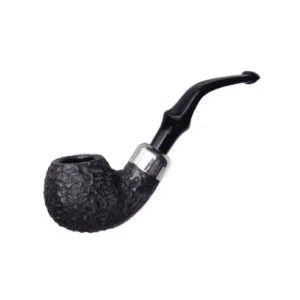
I come from a long line of pipe smokers. My Dad smoked the pipe, and from a young age, I wallowed in the wafted aroma of Mick McQuaid, or Condor or Mellow Virginia. My Grandad also smoked the pipe; it was ever-present in his mouth, and I also noticed that he used a cap on his pipe to prolong the smoke. I have to confess, before I go any further, that of all the vices I’ve explored in my lifetime, pipe smoking was my favourite! I began to smoke the pipe at the age of 27 – around the time I got married! In the beginning, before addiction set in, I was an occasional smoker. I smoked a Dutch tobacco called Clan, which was very popular, and it had a beautiful, scented flavour. I was very active at the time, playing football with Newcastle West and hurling with Knockaderry. I continued to rationalise with myself that my pipe smoking had no impact whatsoever on my fitness and, after all, it would have been far worse if I had been smoking cigarettes!

Giving it a try, I entered one of the most compelling, habit-forming subcultures I’d ever found. There are plenty of rabbit holes to go down in life, though few that hold you there so avidly as pipe smoking. Part of it was the tobacco, as different from the cigarette kind as you can imagine. In those early years, I mainly smoked nice light, sometimes aromatic, mellow Virginias. My Aunty Meg spoiled me rotten by bringing me back 16-ounce packets of scented Cherry Brandy flavoured tobacco from her many journeys to New York. I later discovered the time-consuming rituals associated with various plug tobaccos before eventually settling on Yachtsman, my favourite of all. I became an expert mixer of tobaccos and would often add some of my Cherry Brandy mix with my Yachtsman plug to make it go farther. If suppressed memory serves me at all, the mixture was Divine!

Fr. Dan Lane was curate in Newcastle West in the late 80s and early 90s, and we were firm friends. Dan smoked cigarettes mainly, and when he wanted to give them up, which was often, he dabbled with the pipe. Each year, Fr Dan organised a pilgrimage to Lourdes for the Fifth-Year girls in the parishes of NewcastleWest and Abbeyfeale. The pilgrimage set out for Lourdes each year on Easter Sunday and returned a week later. Each year, he would bring copious amounts of tobacco, far exceeding his own Duty Free allowance of cigarettes and pipe tobacco on his return journey.

I remember one evening in 1986, Fr. Dan arrived out to Knockaderry laden down with two Duty-Free bags of pipe tobacco. His doctor had again advised him that he should quit smoking, so he wanted to get rid of the temptation and give his stash a good home. Obviously, I was delighted, and by my estimation, I wouldn’t have to buy tobacco again until Christmas! Later, I went through the treasure trove and found packets of my old favourite Clan, along with pouches of Holland House, Condor, Mellow Virginia, Mick  McQuaid, and some tins of Erinmore and Three Nuns. I’m reminded here of Brendan Behan’s joke about the availability of tobacco while he was in prison. He said that the warden’s favourite brand was Three Nuns – none yesterday, none today and none tomorrow!

Gradually, I became an expert, collecting all the necessary paraphernalia: my beloved Kapp and Peterson Numbers 303, 314 or 317 sandblasted briar pipes, a sleek pipe lighter, pipe cleaners, rustic tampers, a pipe pouch, a small penknife, and a leather airtight tobacco pouch. The pipe was the most essential item, however, and I sourced mine and, in later years, my plug tobaccos from the erudite Eleanor at M. Cahill and Sons Tobacco Shop, 47 Wickham Street in Limerick.

Kapp and Peterson, from their famous shop in Nassau Street in Dublin, were then, and still are, the oldest continuously operating briar pipe factory in the world. They had built up a reputation both here and abroad and they were proud of their tradition and their legacy of craftsmanship dating back over 150 years. A Peterson pipe wasn’t just a utilitarian tool; it was a piece of history you carried with you on your travels, a faithful companion to accompany you through all of life’s travails.

My favourite pipe! Eschewing the robust, muscular aesthetic that defines so much of the Kapp and Peterson style, this classic bent Donegal Rocky 80s briar pipe design is an elegant, timeless shape that haunts my frequent tobacco dreams!!

Pipe smoking is a messy business. Oftentimes, stale dottle became wedged in the pipe bowl from a previous smoke, and this required cleaning with a penknife. Tobacco dust and ash permeate everything and everywhere, and often the smoker doesn’t realise that all those in the vicinity can smell smoke fumes from his clothes, from his breath. Pipe smokers are forever fidgety around their pipe; it requires constant attention and frequent relighting, not to mention the endless ceremonial preparation for yet another smoke.

I have a few very serious confessions to make now that I am a reformed smoker. I cringe when I think that I continually smoked the pipe in the car without a care or any consideration for Kate or my two darlings, Mary and Don, who were in the backseat without gasmasks, seatbelts or any of the modern safety methods that had not yet become legal and essential. I smoked while I was carrying them to music lessons, to matches, to training sessions. I smoked in the house after school; I smoked all day in the study during those long summers correcting Leaving Cert English. I smoked in restaurants, in pubs, and in the street, without a thought for anyone other than my own enjoyment and satisfaction.

Eventually, after many false dawns, I gave up smoking the pipe on the 12th of October 2008. There were several factors which precipitated this major decision. I was due to go to Croom in November that year to have a hip replacement, so I told myself that I needed to be fit and healthy! On March 29, 2004, Tánaiste Michéal Martin, representing the Irish government, introduced the first national comprehensive legislation banning smoking in all workplaces, including bars and restaurants. I was beginning to get the message in 2008! In truth, my momentous decision had been hastened by the repeated price hikes in tobacco in successive Budgets, which were making smoking a very, very expensive hobby. I couldn’t justify it any longer, and so, even though I had just purchased a brand-new Peterson on the 1st of October that year, I went ‘cold turkey’ and never looked back.

On that fateful day, I was aware that I was consciously making a decision to exclude myself from an elite club. Pipe smokers had always traditionally been considered different, and membership of this convivial fraternity was considered to be something special. In our heyday, we were seen as wise, contemplative men who sat and smoked and read serious, leather-bound literature, as well as a world of rugged outdoorsmen, canoeists, fly fishermen and clipper ship captains who puffed their pipes as they pored over nautical charts before sailing ‘round the Horn.  Those halcyon days, unfortunately, are all now, but a hazy pipe dream in the smoky recesses of treasured memories!  I conclude with the immortal words of C.S. Lewis: “A pipe gives a wise man time to think and a fool something to stick in his mouth.”

My Hearing Aids – A Modern Day Saga

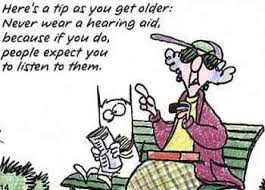
My deafness became a major issue in 2021. Up to that time, there had been the odd rumbling of discontent, mainly from my long-suffering wife.  I had up to then been able to successfully argue that I wasn’t really deaf and that I was just a bit heedless. My beloved wife could not understand that if she said something in the bedroom, how it was that I couldn’t hear what she said while I was watching television in the sitting room. My wife is a wonderful woman, and I love her dearly, but her big failing is expecting me to make sense of her muffled mumblings from another room. Anyway, she eventually convinced me that I was deaf after all, and so began the search for a remedy.

I believe that there is a world of difference between being deaf and being heedless. I know in my heart that I have the average hearing loss of a normal 73-year-old. Unfortunately, age has also dulled my eyesight and several other bodily organs and functions, which, because of their delicate nature, I won’t elaborate on here. Suffice it to say that there are times when I become engrossed in reading a good book or watching a compilation video highlighting how Limerick won the All-Ireland in 2018, and then again for good measure in 2020, 2021, 2022 and 2023! Preparing a blog post also takes high levels of concentration and tunnel vision at times.

Anyway, to cut a long story short, it cost me €6,100 to solve my problem! Reluctantly, I joined the Hidden Hearing family. I later learnt that the reason it’s called Hidden Hearing is because there are so many hidden costs associated with the purchase of so-called ‘hidden’ hearing aids. My state-of-the-art hearing aids were of the behind-the-ear variety and were anything but hidden.

First off, I went to a Hidden Hearing clinic for a hearing test. I was asked to bring along someone whose voice I recognised easily from another room, so I brought Kate. The audiologist put pods in my ears and played a series of beeps at various sound frequencies, and if I heard one, I was supposed to press a button. This test was carried out overlooking a busy street in Newcastle West, with car and van noise intruding on my hearing test. In further mitigation, because of COVID-19 restrictions in place at the time, all present wore face masks. I’m sure I missed some beeps because the audiologist’s frown grew more sombre by the second, and eventually, he too convinced me that I was in fact profoundly deaf – especially when he put Kate in an adjacent room and had her read some comments out loud which I was asked to repeat. I failed that test, too, and they both helped convince me that I was indeed a hopeless case and the only solution would be for me to purchase the newest, most scientifically proven hearing aids on the market. I headed straight for the Credit Union.

Once my hearing had been tested, I felt under pressure to purchase from Hidden Hearing and was not told of any other competitors in the hearing aid field. I also felt pressured by the sales assistant to pay more than I could comfortably afford.  In hindsight, I often wondered why they didn’t redo the test once the hearing aids had been fitted and adjusted to my particular needs. Surely, I would have passed with flying colours!  I was urged to always wear my new hearing aids, or my hearing – the little that was left – would disappear as well. It had something to do with the brain, they said. In the days and weeks that followed, I wore my hearing aids on long walks and found that the Bluetooth was indeed state-of-the-art, far better than my AirPods. To their credit, they were also brilliant when my phone rang, and I found taking calls much easier and clearer in fairness. In my own mind, of course, I was still convinced that my hearing was just fine. I could still hear the birds in the morning without my hearing aids; I could hear the jets seven miles above me as they flew over my house as I lay in bed; I could still hear the comforting soft patter of rain on the windows and on the roof in the dead of night.

Again, because of my advanced years, I use reading glasses to read, and if I mislay my glasses, there is a mini crisis because I’m actually blind without them. As a precaution, I make sure that I have a backup pair of glasses always at hand, just in case. Now, the same was not true for my hearing aids. I failed to notice any improvements in my hearing when I wore them in public, particularly in crowded settings.

I was under the impression that once I had purchased my hearing aids, they would last a lifetime. Foolish me! The particular hearing aids I had purchased carried a three-year warranty, and as that deadline approached, I began receiving increased communication from Hidden Hearing. They informed me that there had been enormous advances since I had last purchased my now antiquated behind-the-ear hearing aids and that I could avail of various special offers as a valued ‘patient’ of Hidden Hearing. They would even allow me €2,000 for my old, outdated hearing aids, even if they were broken (or, in my case, rarely used) when I would trade them in for their new state-of-the-art in-ear upgrade! To add insult to injury, when the warranty lapsed on my old hearing aids, it would cost me €140 per ear for them to examine the hearing aids each time there was a problem. The vultures were circling, and the concept of built-in obsolescence took on a whole new meaning for this naive, deaf person. I wondered if I would have to make another journey to the Credit Union.

I resolved to battle on, to half-hear Fr Raphael, our new Nigerian curate, giving his Sunday homily; to nod sympathetically at another sob story in the crowded pub; to catch the end of a request from Kate as she mumbled away in another room. I even began to believe that the Nile is not just a river in Egypt!

In Praise of Ryanair – Faint Praise Indeed!

My favourite airline logo!

For retirees like us, Ryanair has been our ticket to the sun, allowing us to travel and expand our horizons. Since its establishment in 1984, Ryanair has evolved from a small airline, operating short-haul flights from Waterford to London Gatwick, to become Europe’s largest carrier.

They have revolutionised air travel in many ways, not all for the good. I remember before their arrival turning up at check-in desks with our two big cases full to the brim, ready to cope with all eventualities. Ryanair quickly sorted that one out!

Early days, staff were very abrasive, and hand luggage caused all kinds of problems. Later, your 10kg bag had to fit into a contraption at the boarding gate, and staff would regularly weigh bags to certify that they were within the required limits.

Today, everything has been monetised. Even before you board your flight, you are encouraged to join and avail yourself of Ryanair Prime.  Prime members get free reserved seats, free travel insurance and access to 12 member-only seat sales, one each month. Prime members can save €560 per annum, and all this for just €79 per annum!  Then, from the moment you book your flight, you are encouraged to spend more money on Priority Boarding, securing your seat, flight insurance, airport transfer, car rental, etc., etc.

However, despite the early growing pains and having to listen to their abrasive CEO, who is even a greater pain, they did what it said on the tin. They got you to your destination from your local airport with minimum fuss or frills. I always marvel at fellow travellers who moan and grumble at the shortcomings of the carrier because they knew exactly what they were signing up for before they ever booked their flights. Another not insignificant reason for my allegiance to Ryanair as our carrier of choice has much to do with the anachronistic concept of ‘the old school tie’. One of my classmates in Secondary School was none other than Michael Cawley, who, for many years, was Deputy Chief Executive of Ryanair. He couldn’t hurl or play football, but in time, he became a great accountant!

The sheer joy and excitement on my granddaughter Maeve’s face during her first Ryanair flight says it all!

I remember one wet Saturday evening in November, sitting in one of the restaurants in Shannon Airport, having gone through security. Kate and I were having a drink before boarding our flight. We were on our way to Lanzarote for a week’s break when, right on cue, an announcement was made that our Ryanair flight would be delayed due to a technical issue with a door on the plane. We were chatting away when a pilot and his first officer asked if they could sit at our table. The pilot was a large, brash American, and his co-pilot was French. We exchanged pleasantries and continued with our conversation.  However, it was increasingly difficult to avoid overhearing the pilot as he venomously and vigorously attacked his employer, who was uncaring, untrustworthy, willing to cut corners, expecting him to work ungodly hours and follow crazy schedules. He would much prefer to work for Wells Fargo or DHL or some other cargo carrier than work for that insufferable bastard, Michael O’Leary of Ryanair! We couldn’t help but listen as he continued to berate and belittle his employer. Finally, our flight was called, and we began to gather up our bags, and he asked us where we were headed. We told him we were headed to Porta del Carmen, and he said he hoped we would have a relaxing flight.   Furthermore, he informed us that he would be our captain on the flight!

Ryanair’s pricing policy is a total mystery to me. They tell us that those who book early get the lowest fares, but this is patently untrue. I know of no other product to hand whose price fluctuates from hour to hour depending on a secret, unbreakable algorithm. I know of no other transport company that can have 300 people on the same flight and no two of them have paid the same price for their ticket. It’s truly bonkers!

Experience a Ryanair flight delay and every piece of consumer protection law which has been meticulously pored over in the hallowed halls of Brussels and Strasbourg is stretched to breaking point. I have been delayed in the stairwell of any number of airports, twiddling my thumbs and avoiding eye contact with the hordes of disgruntled fellow travellers who know to the minute when compensation kicks in and Michael O’Leary will personally have to pay out. Then, with a familiar beep, a message flashes up on your Ryanair App to inform you that you are now entitled to €4 to be spent in all the Cafés and Burgerking outlets, which, coincidentally, are all on the other side of Passport Control. And because it’s now near midnight in Las Palmas, they’re all now closed anyway!  Sometimes that message doesn’t appear until you are home, snuggled up in bed following a five-hour delay to your flight.

Look, it makes perfect sense to me: if some careless baggage handler messes with the cargo hold door and it won’t close properly at 10 o’clock on a Summer’s evening in Nice or Malaga, and the pilot will not take off until the fault is rectified, airport authorities are duty-bound to send for an engineer. Now, at 10 o’clock, most self-respecting engineers are at home or in the pub if it’s a Friday night, and they are not going to come all the way back to the airport for half an hour’s overtime, are they? No, mark my words, that minor little problem will take at least four hours to rectify to everyone’s satisfaction. This rule of thumb, of course, applies to all carriers and not just Ryanair.

And it’s futile to give out or moan or threaten or make a resolution never to fly with Ryanair again. In my long experience, despite the odd hiccup, they’re the best in the business!

Monetise! Monetise! Monetise!

“Roosters” by Elizabeth Bishop – A poem whose time has come again?

a81272433929a0bd7338bab6924ff600

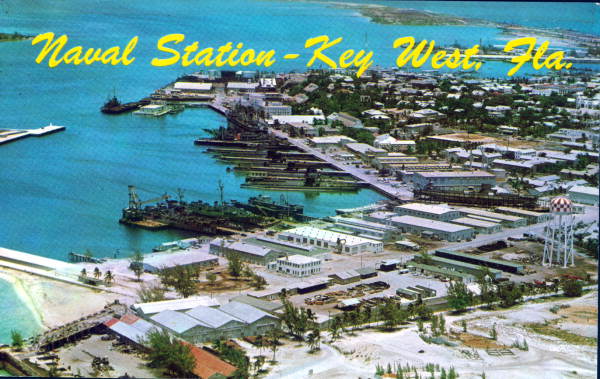
Taking recent political events in America into account, especially the election of Donald Trump to the White House for a second term and with his incessant sabre-rattling in the inter-regnum period after his election,  this poem seems to me to be one whose time has finally come round again!  In 1938, as another war threatened to engulf the world, Elizabeth Bishop stopped off in Key West for almost a decade on her slow, leisurely migration South.  In 1941, shortly after the tragic events of Pearl Harbour, she produced this classic poem, a poem which many claim depicts American chauvinism at its worst and a poem that was read with interest by millions of returning soldiers and marines as they undertook the challenging reintegration back into civilian life after its publication in 1946 as part of her collection North and South – a collection of quintessential Bishop poems about waking up and the sea.

It is one of her ‘long narrow poems’ (44 stanzas), yet Colm Tóibín in his analysis of the poem states rather controversially that, ‘it is important to insist that the poem “Roosters” is about roosters’.  He further insists that ‘more exactly, it is about roosters in Key West’.  This may be so but even a cursory reading, in these revisionist times, will no doubt point up the presence of many other important sub-themes which are scrutinised and analysed here by the poet, such as militarism, male/female roles, war-mongering, forgiveness, and waking up to reality.  However, her treatment of the roosters is generally subtle, though not always so, and I have to agree with Tóibín’s final assessment that, ‘she managed to write one of the great poems about power and cruelty by not doing so.’

The poem was written at a time when the navy was gearing up for a war in Europe and other far-flung theatres of war.  Key West had been chosen as a new navy base and she was at one stage, much to her annoyance, forced to rent her beloved property to navy personnel.  In other areas of Key West, property was being purchased compulsorily and some houses were being demolished.  Therefore, it is no wonder that the poem has been read as an anti-war poem and a poem condemning arbitrary authority, ‘what right have you to give / commands and tell us how to live.’

The poem opens in Key West with the town waking to a morning light which she characterises as militarised, the morning is ‘gun-metal blue dark’.  The poet and her lover, the ‘we’ of the opening stanza, are rudely awakened from their slumbers by a martial rooster. This initial call is soon echoed by others and within a short time, there is a cacophony of strident roosters calling the sleepy Key West community to face a new day.  In a letter to Marianne Moore, Bishop wrote that she wanted the opening to represent the baseness of military warfare, and had in mind, too, Picasso’s Guernica.  From the weaponized colour of dawn to the macho “first crow of the first cock,” Bishop lures us into the poem as if from sleep, from non-consciousness, and forces us to face our own new (political) reality post the November election!!

The macho roosters, symbolic of American chauvinism, ready themselves for another day of domination, of seeing off rivals, and indulging in some megaphone diplomacy.  They are depicted as ‘stupid’, using their ‘traditional cries’ and she personifies their behaviour, ‘their protruding chests’, ‘their green-gold medals dressed’; she ridicules their efforts ‘to command and terrorise the rest’.  One of the many things that makes Bishop’s anti-war argument in “Roosters” so interesting is her rare lack of reticence to disclose the struggles of women to survive against the rhythms of male competition, rivalry, discord, the taking up of arms and combat.   She is anything but subtle here and, in my opinion, it is one of the times when her customary reticence and use of understatement goes out the window.  This is very evident in her unflattering depiction of the roosters’ wives:

The many wives

Who lead hens’ lives

Of being courted and despised;

She uses the traditional image of the ‘tin rooster’ as a weather vane on ‘our little wooden northern houses’ to introduce the concept of militarism again.  She uses military imagery to depict their battles and skirmishes.  The roosters make ‘sallies’, setting out their territory, ‘marking out maps’, and the image of a great operations centre with maps ‘like Rand McNally’s’ with ‘glass-headed pins’ and military uniforms is created with imagery like ‘oil-golds and copper greens’.  The roosters are compared to the ‘scarlet majors’ in Sassoon’s anti-war poem, ‘Base Details’, who send their “glum heroes up the line to death”.   Again they are personified, they are ‘screaming’ at the inhabitants of Key West to ‘Get up! Stop dreaming!’.  The poet refers to the idea that the Greeks used these ‘very combative’ birds for their cock fighting spectacles.

There follows more imagery of roosters fighting, flying, dying – the blood has gone to their heads, which are ‘charged with all your fighting blood’.  She disapproves of their ‘virile presence’ and their paradoxical ‘vulgar beauty’.  Bishop is playing with us here: is she not saying, ‘Whatever else we say about these roosters, they’re not chicken’!

All my adult life I have been aware of America as having a predisposition to enter conflicts all over the world.  My memories of the ’60s and ’70s are of harrowing television clips from Vietnam, Cambodia, and Laos.  In recent years, especially since 2003, America has been mired in military intervention, military deployments and full-blown wars which seem to be unwinnable despite the seeming one-sided nature of the contests. Even now in 2025, there are Trumpian rumours of expansionism towards Canada, Panama, Greenland, and even lowly Mexico.  Nothing, Bishop’s poem reminds us, is ever won from war.  This poem is a perfect example of her honesty and here she shows her nerve to review human nature honestly and she also portrays a steely resistance to duplicity and coercion.

Bishop, up to this point, has looked at roosters from many different angles but now she focuses on an association between the rooster and St. Peter in the Gospel account of the denial of Jesus before his Crucifixion:

And Peter remembered the word of Jesus, which said unto him, Before the cock crow, thou shalt deny me thrice. And he went out, and wept bitterly.

In the Latin version of the Bible “gallus canit” means “the cock crowed,” and “flet Petrus” means “Peter wept.”  So this is one of the reasons why roosters are so often used ‘on basilica and barn’ to depict, not so much Peter’s denial and humanity’s overall frailty, but the unconditional forgiveness offered by Christ.  The climax of the poem is beautifully rendered as we witness the literally “cocky” roosters subside in the last part of the poem to become an image of peace, ‘The cocks are now almost inaudible’.   Morning has returned, with immense hope, to the world.  By the poem’s end, the rooster crows and Peter weeps as the poem shifts from remorse to salvation to inescapable hope—like a re-enactment of civilisation’s transformation from militancy to humility—so that the rooster’s call is a symbol of forgiveness.

The final five stanzas take us back to the beginning – morning has broken and the master craftswoman uses beautiful slender ‘l’ sounds to depict a new dawn, a new beginning:

In the morning

A low light is floating

In the backyard and gilding

Colm Tóibín so rightly asserts that ‘In ‘Roosters’, she … managed to produce one of the great poems about the morning’.  ‘The sun climbs in’ and transforms ‘the broccoli leaf by leaf’ and ‘the tiny floating swallow’s belly’.  She uses the beautiful simile ‘like wandering lines in marble’ to depict the creeping rays of sunshine.  The only discordant note to this otherwise idyllic, hopeful ending is the ambiguous role played by the sun – it can be seen as either an ‘enemy’ or a ‘friend’.

This literary tour de force broke new ground in its attitude to, and treatment of, war and pacifism on the one hand and the sometimes fraught relations between men and women in a post-war world on the other.  If there is hope, and the poem ends with a new dawn, then Bishop is bold enough to suggest that it lies with women.  She sees a future America where hope lies in the power of women to seize a greater share in mapping out the future destiny of the nation and wrestle it away from stubborn, war-mongering men.  I said at the beginning of this piece of commentary that I thought this was a poem whose time had come again – I hope America has not lost their chance to carry out Bishop’s manifesto with the recent defeat of another strong female candidate in the Presidential Election.  Time will tell but it adds to the cachet of this poem that it has had the power to continue to shape America from its first publication in 1941 until the present day.

pc5785

Works Cited:

Bishop, Elizabeth. The Complete Poems, 1927 – 1979.  New York: Farrar, Strauss and Giroix, 1983

Tóibín, Colm. On Elizabeth Bishop, Princeton and Oxford: Princeton University Press, 2015. Digital

See also Reviews Rants and Rambles:  Themes and Issues in the Poetry of Elizabeth Bishop

Reviews Rants and Rambles: Commentary on Sandpiper by Elizabeth Bishop

English is in Terminal Decline…. Again!


shel-english 


*****

The concerns that English is difficult to learn and is  in decline is almost as old as the language itself.   The average schoolchild can hardly write, one author has recently warned. Well, not that recently perhaps. It was William Langland, author of “Piers Plowman“, who wrote that, “There is not a single modern schoolboy who can compose verses or write a decent letter.” He died in 1386.

English has been getting worse ever since. In 1387, Ranulph Higden, a Benedictine monk and historian, found the culprit in language mixing: “By commiyxtion and mellyng, furst wiþ Danes and afterward wiþ Normans, in menye þe contray longage ys apeyred and som useþ strange wlaffyng chyteryng, harryng, and garryng grisbyttyng.” That is to say (in case your Middle English is rusty) that English speakers had taken to “strange, articulate utterance, chattering, snarling and harsh teeth-gnashing”, bad habits he put down to the mixing together of Anglo-Saxons, Vikings and Norman French.

The wailing throughout the history of the language, by people convinced that the end is nigh, can be a bit exhausting over a full survey. But it holds a lesson: language is not constant. Change is—and anxiety about change is constant too. Indeed, I believe that the only people who welcome change are babies with wet nappies!  In 1577 Richard Stanihurst praised the English spoken by old English settlers in Ireland. Because of their distance from the mother country, they had not been affected by, “habits redolent of disgusting newness”.

A century later, in 1672, John Dryden, a poet and essayist, waxed especially operatic on the decline of English—and not just schoolboys’ English, but that of the greats:

It is not their plots which I meant, principally, to tax; I was speaking of their sense and language; and I dare almost challenge any man to shew me a page together, which is correct in both. … [M]alice and partiality set apart, let any man who understands English, read diligently the works of Shakspeare and Fletcher; and I dare undertake that he will find in every page either some solecism of speech, or some notorious flaw in sense.

Another half-century on, another great writer was at the decline game, this time Jonathan Swift:

our Language is extremely imperfect; that its daily Improvements are by no means in proportion to its daily Corruptions; and the Pretenders to polish and refine it, have chiefly multiplied Abuses and Absurdities; and, that in many Instances, it offends against every Part of Grammar.

Swift’s only comfort was that French was declining nearly as rapidly as English. (That didn’t stop him from proposing an English academy, along the lines of the Académie Française, to stop the decline.)

Anxiety sells, and so warnings about the state of the language accelerated as dictionary-and grammar-book writers sought—and found—a mass market. Samuel Johnson hoped to give the language some stability, but realised that trying to stop change was like trying to “lash the wind”. But many of his contemporaries were not so generous. Robert Lowth, probably the most influential English grammarian of all time, began his 1762 book with a quotation from Cicero complaining about the rubbish Latin that the Roman statesman heard in the streets around him. Lowth went on to use examples from Shakespeare, Milton and the King James Bible as “false syntax” illustrating errors, complaining that even, “Our best authors have committed gross mistakes, for want of a due knowledge of English grammar.”

Perhaps the stern Victorians, at least, mastered English? They did not; the poet Arthur Hugh Clough complained in 1852 that, “Our own age is notorious for slovenly or misdirected habits of composition.” Americans in their young republic were also already going into decline, too: Adams Sherman Hill, a Harvard professor of rhetoric, found, “the work of even good scholars disfigured by bad spelling, confusing punctuation, ungrammatical, obscure, ambiguous, or inelegant expressions” in 1879. Charles Henshaw Ward, another American, blamed the usual suspects, the school pupils, in 1917: “Every high school is in disrepair because its pupils are so ignorant of the merest rudiments.”

Perhaps the greatest writer to be persuaded of declinism was George Orwell, who wrote in 1946 that, “Most people who bother with the matter at all would admit that the English language is in a bad way.”  The essay in which he tried to stop the rot did little good, at least as far as his successors were concerned. Dwight McDonald wrote in his 1962 review of Webster’s third New International Dictionary about modern permissive attitudes, “debasing our language by rendering it less precise”. In 1973 “Newsweek” explained, “Why Johnny can’t write” on its cover. That same year, a young Lynne Truss finished school in England. She would go on to sound the alarm in what would become the modern stickler’s book-length battle-cry, 2003’s “Eats, Shoots & Leaves”.

This is in no way limited to English. I have just been sent a press release for a book called “Bin ich der einzigste hiere, wo Deutsch kann?” (“Am I the Only One Who Speaks German Here?”) with a few hard-to-translate mistakes in the German title. German has also been in decline for a while: 1974 saw the publication of Die Leiden der Jungen Wörter, “The Sorrows of Young Words” (a pun on Goethe’s Die Leiden des Jungen Werthers, the “Sorrows of Young Werther”.) Even Jakob Grimm (1785-1863) thought that German had been more expressive and elegant hundreds of years before his time.

Have young people too lazy to learn to write been with us since the very beginning? A collection of proverbs in Sumerian—the world’s first written language—suggests that they have: “A junior scribe is too concerned with feeding his hunger,” contends one.  Another states: “He does not pay attention to the scribal art.”  It seems that the slovenly teenager, not to mention the purse-lipped schoolmaster, is at least 4,000 years old!

– based on article in The Economist

400_F_47288107_cKEsbxX5qjrpaoTuqhXMxYCfEcqq4nsX