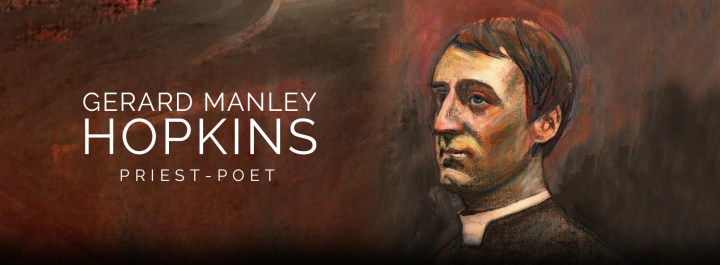
I am a big Gerrah Manley Hopkins fan!

Humour me as I indulge in a little bit of poetic nostalgia!  I love the poetry of Fr. Gerard Manley!  As a teacher of English literature, you are always conscious of introducing poets and novelists to a younger cohort who come from many and varied backgrounds.  Like Roddy Doyle in his Barrytown trilogy, you have to cut your cloth according to its measure!  Father Gerrah speaks to all ages and backgrounds – but he is an acquired taste.  In these horrible Trumpian days, his poetry, even his Terrible Sonnets, has given me great hope.  For me, his poetry is timeless; he is a poet for all ages.   The world surrounded Hopkins with visions of God’s glory, and the poet responded by capturing those moments in imagery that is both original and quite remarkable in its range.   In his early poetry, Hopkins employs imagery to expose God’s glory in nature’s elements, while the later poetry gives us dramatic images of near desolation and despair.

As well as his poetry, his life story has long fascinated me. He was born in Essex in 1844, the eldest son of a prosperous middle-class family.  He was educated at Highgate School and Balliol College, Oxford, where he studied Classics and began his lifelong friendship with Robert Bridges.  In 1866, he converted to the Catholic Church, and two years later, he joined the Jesuit Order, having come to admire the work of the recently canonised Saint, Cardinal John Henry Newman.  He was ordained a Jesuit in 1877 and served as a priest in several parishes, including slum districts in Liverpool and Glasgow.  From 1882 to 1884, he taught at Stonyhurst College and in 1884, he became Classics Professor at the fledgling University College, Dublin.  What fascinates me about the man and the poet is that he was hardly known as a poet, except for one or two friends, during his lifetime.    He lived and died in the nineteenth century, yet his poems were not published until 1918, nearly thirty years after his death.  They were published in a volume edited by his great friend, Robert Bridges.

In Roddy Doyle’s novel The Van, Darren is making valiant efforts to study Hopkins’s poetry for his Leaving Cert.  He is introduced as ‘the clever one’ in the family, a teenage son who is trying to find a place to study in the kitchen, highlighting the domestic chaos of the Rabbitte household. He reads ‘Inversnaid’ and wonders when Tippex had been invented and concludes, ‘Gerrah Manley Hopkins had definitely been sniffing something.’  Unfortunately, he was also struggling to make sense of a wide range of other Gerard Manley Hopkins poems on the course, such as ‘God’s Grandeur,’ ‘Spring,’ ‘The Windhover,’ ‘Felix Randal,’ ‘I wake and feel the fell of dark,’ and  Inversnaid

In The Windhover, Hopkins uses recurring images of royalty.  The high-flying solitary falcon is a monarch of the sky, surging with the poet’s spirit through the steady air.  The poet uses chivalric terms such as ‘dauphin’ and ‘minion’ to capture the elegant and dignified ‘striding’  falcon, the prince of the daylight.  God, too, is seen as a ‘chevalier’.  These images carry connotations of medieval romance and chivalry, and perhaps the virtuous struggle of the falcon in the air is symbolic of the Christian knight, Christ the chevalier, overcoming the pervasive threat of evil.  This conflict in the poem is dramatised through imagery that suggests the supremacy of the falcon in flight, and its control and mastery that ‘rebuffed the big wind’. 

Another feature of Hopkins’s images here is the way in which they are loaded with possibilities.  It is as if Hopkins intended to create multiple ideas in some of his images, each interesting and valid in its own way.  For example, the image of the falcon on a ‘rein’ may represent the motion of a horse at the end of a trainer’s long rein.  However, the term, being ambiguous, could also suggest the spiral climb of the bird.  Perhaps Hopkins is encouraging us to ‘Buckle’ several ideas in our engagement with the poem.  What is not in doubt, at any rate, is the powerful and original representation, through the falcon, of Christ’s beauty and nobility.

Hopkins uses a very different image in describing the precision of the falcon’s flight, where he says, ‘As a skate’s heel sweeps smooth on a bow-bend’.  This image also conveys the speed of the bird’s flight.  Other original images include that of ‘blue-bleak embers’ representing self-sacrifice and the ‘plough down sillion’ that evokes the hardship and perhaps tedium of daily labour. 

In ‘The Windhover’, therefore, Hopkins employs images of flight, of majesty, of sacrifice and of glory ranging from a ‘dauphin’ to a ‘skate’s heel’, from a ‘fire’ to ‘blue-bleak embers’.  Such remarkable and wide-ranging imagery reflects the vivid and precise response of the poet’s imagination to the sight of the falcon at dawn.  More importantly, perhaps, the imagery reveals that the moment created a response of deep spiritual insight.  There is nothing particularly novel in taking a falcon as subject matter. The good news for us is that this sight of a hovering falcon has, thankfully, become a common sight once again.  However, what is original here is the way Hopkins engages with the falcon, observes it and concentrates on it in a deeper way and articulates what it revealed to him through an interesting range of original imagery.  Let it be your own mindfulness exercise today as you ramble the rural highways and byways.

However, particularly in his The Terrible Sonnets, there is another, more disturbing effect created by Hopkins’s wide-ranging use of imagery. We know that he wrestled with doubt, particularly during his final years, which he spent teaching in Dublin and, in my opinion, these poems could have been written this January, or as we were told, schools were closing because of this bloody pandemic in March 2020!  In ‘I Wake and Feel the Fell of Dark’, he states that God exists; he is always certain of that, but why does he appear to be so far away, apparently unresponsive and uncaring to a man whose letters are ‘dead’?  Hopkins’s increasingly sinister images explore the bounds of human suffering and despair. 

In this sonnet, the conspicuous absence of daylight reminds us how far the poet has come from the glorious sunshine and colour in  Spring or ‘The Windhover’.  There is little evidence of ‘couple-colour’  in ‘the black hours’ Hopkins has spent with his torment, suffering ‘yet longer light’s delay’.  The delay of light represents, of course, the delay of hope – all is now ‘gall’ and ‘heartburn’.  Quite remarkably, taste is evoked as a description of the poet’s state – he didn’t have Covid, so!  He becomes bitterness itself, born out of his near despair.  Yet perhaps this is God’s will that he suffer the ‘curse’ with which his ‘bones’ and ‘flesh’ must contend.  He compares his tormented spirit to sour dough, which needs to be transformed.

In his sonnet, “No worst, there is none’, Hopkins outlines the intensity of his pain in the opening quatrain and then proceeds to seek significant comfort, but in vain.  This sonnet is particularly interesting in that many of its images echo through earlier poems where the mood was less despondent.  The poet’s sense of despair is emphasised in quatrain two in an unusual but particularly poignant image of his cries heaving ‘herds-long’, gathering at the gate of heaven, perhaps, but not being admitted or even acknowledged.  Where is the comfort that Hopkins himself had administered to Felix Randal?  The poet then refers to an ‘age-old anvil’, a sounding board which winces and rings out his pain. This very original image of the anvil reminds us again of Felix and his work in the forge, except on this occasion, the poet is the raw material that Christ is beating into shape. 

In the sestet, the poet refers to a natural landscape, the mountains.  In earlier poems, ‘wilderness’ filled him with joy.  Here, however, the steep cliffs, a nightmarish metaphor, represent the spiritual torment and physical suffering that the poet has had to endure, day in, day out.  The only comfort is the relief of sleep.  But in ‘I wake and feel the fell of dark’, the poet awakens to the oppressive darkness of night and yearns for the respite of daylight.  The dark night is itself symbolic of dark periods in the poet’s life when hope of spiritual ecstasy may have seemed very distant.

In Hopkins’s poetry, therefore, the range of imagery is certainly quite extensive, his originality unquestioned.  Imagery ignites the poet’s celebration, and it ignites his desolation.  In his own unique Trumpian-like darkness, there is no flash of colour, of light, no ’dapple-dawn-drawn’ inspiration to lift his thoughts, no sparks, no flashes, no gold in his oval office.  In 1889, only weeks before his death, Hopkins wrote ‘Thou art indeed just, Lord’.  In the poem, images of fertility in nature abound: building, breeding, waking, growing.   Yet, the concluding appeal, expressed again through a vivid and most appropriate image, is that as Spring renews nature, so God may send his ‘roots rain’.  And as my mother always said, where there’s life, there’s hope!  Hopkins himself would probably have said, where there’s prayer, there’s hope.  So, as I’ve said somewhere else, even the so-called Terrible Sonnets are that terrible after all!

At the end of The Van, Darren is doing well in school and is a success, in contrast to his father, Jimmy Sr., who has been laid off again and is struggling financially.  Darren, who is still ‘doing very well in school’, expresses regret for his remark that ‘the State’ and not his father has put the dinner on the table, suggesting a deeper understanding of his father’s situation and a desire for reconciliation.

For that flash of empathy and compassion alone, we surely have to thank ‘Gerrah Manley Hopkins’ for that!


Journey of the Magi by T.S. Eliot

773777-6
Journey of the Magi by Graham Pope

Journey of the Magi

The Gospel of Matthew is the only one of the four canonical gospels to mention the Magi. Matthew 2:1–2 has it that they came “from the east” to worship the “king of the Jews”.  We know that St. Matthew wrote his Gospel with a Jewish audience in mind and so, therefore, he begins his Gospel account with an elaborate genealogy that places Jesus as an ancestor of King David and Abraham. Here already Matthew shows his special interest and the intended audience for his Gospel and so he presents Jesus as a King, better than David, and a teacher greater than Moses.

It is Matthew who tells us about the Three Wise Men (Eliot’s Magi) who came to worship, bringing gifts fit for a king.  Matthew, in his powerful birth account, presents Jesus, in fulfillment of the prophecies and hopes of the Hebrew Scriptures, as the King of the Jews who has been given all authority in Heaven and Earth. He is Emmanuel, God with us.  Matthew, however, is making a powerful distinction for his Jewish audience – the Magi represent those outsiders, those wise men, magicians, or astrologers from the East, from Persia or other civilisations or religions who will now be saved by this Christ child.  The Good News of Matthew, therefore, is that this Christ has come for all people and not just for the Chosen People of Israel.  Eliot sees in the Magi a metaphor for his own conversion – he too has made a long and tortuous journey and has finally made his decision to bow down before the Christian God.

This poem, ‘Journey of the Magi’, published in 1927, was the first of a series of poems written by Eliot for his publisher, Faber and Faber, composed for special booklets or greeting cards which were issued in the late 1920s and early 1930s.

 ‘Journey of the Magi’ – one of the great classic Christmas poems – is told from the perspective of one of the Magi (commonly known as the ‘Three Wise Men’, though the Bible makes no mention of their number or gender – it does mention that they brought three gifts, gold, frankincense, and myrrh). The poem examines the implications that the advent of Christ had for the other religions of the time, and it emphasizes this pivotal moment in human history.  In the Christian calendar, the coming of the Wise Men or Magi is celebrated on January 6th – the Twelfth Day of Christmas.  It is often referred to as the Feast of the Epiphany, when Jesus is revealed to all, Jew and Gentile, as the Saviour of the World.

 This is an apocryphal account of the journey made by the Three Wise Men which eventually led them to a humble stable in Bethlehem where the Christ Child lay.  It is narrated to us by one of their number, perhaps over a glass of wine, after their return home.  The story, and it is a beautifully told story, is told not in Biblical language, but in the language of everyday speech and with an amount of detail not found in the Gospel story of St. Matthew.

 The opening quotation comes from one of Bishop Lancelot Andrewes’ Nativity Sermons, preached at Christmas during the 1620s. The speaker, one of the Magi, talks about the difficulties encountered by the Magi during their eventful journey to see the infant Christ. It is unconventional in that it focuses on the details of the journey: their longing for home (and for the ‘silken girls’ bringing the sweet drink known as ‘sherbet’), their doubts about the point of the journey they’re undertaking, the unfriendly people in the villages where they stop over for the night, and so on. The hardships of the journey are recounted in some detail.  The details underline the absurdity of the journey in the first place but stress the strong impulses that made them undertake the journey in the middle of winter. The hardship is further stressed by the sharp juxtaposition between what they faced on their journey and what they had left behind in their ‘palaces’. 

 Eventually, the Magi arrive at the place where the infant Christ is to be found. The weary travelers trek through a ‘temperate valley’ – a kind of Garden of Eden – and eventually arrive at a tavern with its drunkenness and gambling. The description of the valley is akin to a movie still – the camera pans slowly over the landscape lingering on sharply etched details such as the running stream, the watermill, the three trees, and the old white horse.  Then the camera moves on and picks out the gamblers and the empty wine skins.  There is no mention of Bethlehem or the stable in this account and the narrator simply states that they ‘arrived at evening, not a moment too soon / finding the place; it was (you may say) satisfactory’.  Neither is there mention of the star which – the Gospels and a million children’s nativity plays tell us – guided the Magi to the spot where Christ lay in a manger. The words ‘not a moment too soon’ are important here because the narrator seems to realize that they, like Simeon later, because of their advanced years, were unlikely to survive to witness the Crucifixion or the Resurrection of Christ and that they can only count themselves lucky to have witnessed the beginning of this powerful movement.

 The poem ends with the poem’s speaker reflecting on the journey years later, saying that if he had the chance he would do it again, but he remains unsure about the precise significance of the journey and what they found when they arrived. Was it the birth of a new world (Christianity) or the death of an old one (i.e. the Magi’s own world)? The speaker then reveals that, since he returned home following his visit to see the infant Christ, he and his fellow Magi have felt uneasy living among their own people, who now seem to be ‘an alien people clutching their gods’ (in contrast to the worshippers of the newly arrived Jesus, who worship one god only, in the form of the Messiah). The speaker ends by telling us that he is resigned to die now, glad of ‘another death’ (his own) to complement the death of his cultural and religious beliefs, which have been destroyed by his witnessing the baby Jesus.

 Jesus himself, however, is absent from this poem. One reason for this may be that we are, of course, all too familiar with the story of the Nativity and we don’t need reminding here.  Another possible reason is that the focus here in this account is on the journey, the quest, and the hardship of the search.  Eliot places himself here among and alongside the Persian astrologers as they seek out the face of the baby Christ. The poet empathises with the ‘Wise Men’ who are seeing their once deeply held beliefs being called into question by this new Messiah.

 No study of the poem would be complete without reference to the imagery used by the poet.  In carrying out such an analysis we also need to remember that the narrator is one of a band of ‘wise men’, ‘astrologers’ who are learned in the study of signs and omens.  Sadly, it seems, the Magi miss the significance of almost all the images mentioned in the poem!  Much of the imagery foreshadows Christ’s later life: the three trees suggesting Christ’s crucifixion on Calvary; the vine, to which Jesus will liken himself; the pieces of silver foreshadowing the thirty pieces of silver Judas Iscariot will receive for betraying him; the wine-skins foreshadowing the wine that Jesus would beseech his disciples to drink in memory of him at the Last Supper. Even though the narrator is a priest or astrologer, someone trained to look for the significance in the things around him, to read and interpret signs as symbols or omens, he fails to pick up on what they foreshadow.  We, however, living in a Christian (or even a post-Christian) society, can read their significance all too well. At the poem’s end, the narrator is left feeling perplexed and troubled by his visit and by the advent of Christ: he wonders whether Christ’s birth has been a good thing since his arrival in the world has finally signalled the death of his own old religion and the religion of his people. Now, he and his fellow Magi, like Simeon in Eliot’s other great religious poem, A Song for Simeon, are left world-weary and they welcome the end.

 So, therefore, ‘Journey of the Magi’ is partly about belonging, about social, tribal, and religious belonging: the speaker of the poem reflects sadly that the coming of Christ has rendered his own gods and his own tribe effete, displaced, destined to be overtaken by the advent of Christ – and, with him, Christianity. It is tempting to see the poem – written in the year Eliot converted to Anglo-Catholicism – as a metaphor for Eliot’s own feelings concerning secularism and the Christian religion. In the space of the century since its publication, Christianity has itself been rendered effete in the face of Darwinism, modern physics, secular philosophy, and whatever the hell is going on in 2023!  And so, therefore, this poem, about a people’s conversion from one religion to another, is equally bound up with Eliot’s own conversion to Christianity.

isp_eliot_sketch_color
T.S. Eliot portrait by Baltimore Maryland artist Jerry Breen.


The Religious Poetry of T. S. Eliot (with a particular focus on ‘Journey of the Magi’ and ‘A Song for Simeon’)

isp_eliot_sketch_color
T.S. Eliot portrait by Baltimore Maryland artist Jerry Breen.


‘Journey of the Magi’ (1927) and ‘A Song for Simeon’ (1928) both arose from the poet’s spiritual struggles which eventually gave rise to his conversion to the Church of England.  In an essay first published in 1931, Eliot gives us a fairly vivid account of the process of conversion as he understands it:

The Christian thinker proceeds by rejection and elimination.  He finds the world to be so and so, but he finds its character to be inexplicable by any non-religious theory.  Among religions, he finds Christianity accounts most satisfactorily for the world, and thus he finds himself inexorably committed to the dogma of the Incarnation (Selected Essays, 408).

This description helps us understand Eliot’s personal development during the 1920s, and helps us see how his conversion was not a sudden transformation but an inevitable culmination of a long drawn out process.  His early poetry had been pervaded by a lament for his loss of faith and sometimes hinted that it might someday be recovered.  Thus, even a decidedly secular poem such as ‘The Love Song of J. Alfred Prufrock’ is interspersed with familiar Christian references.  In the poem we see references to Lazarus: ‘I am Lazarus, come back from the dead’.  Later we come upon a reference to St. John the Baptist: ‘though I have seen my head …. brought in upon a platter’.  Part of the greatness of Eliot’s Prufrock is that it depicts in a very honest way a personal state of mind and it also serves as an example of normal human misery and Roaring Twenties angst.  In the second section of Prufrock (‘The yellow fog that rubs its back…’) there is a beautiful, extended image of Prufrock’s own individual awareness.  For him, normal day-to-day apprehension is like a fog, but occasionally he feels that just beyond his field of vision there is a different order of reality – a parallel universe.

In ‘A Song for Simeon’ this order of reality is described and clearly defined.  What first strikes us is that Eliot very often has a peculiar tendency to express religious ideas in predominantly secular terms.  Both ‘A Song for Simeon’ and ‘Journey of the Magi’ rely on this relationship between biblical and secular language.  Thus, ‘A Song for Simeon’ is based on the story of Simeon in St. Luke’s Gospel, (Luke 2:25 – 35) while ‘Journey of the Magi’ is modelled on St. Matthew’s account (Matthew 2: 1 – 12).  Both poems could be described as apocryphal, reminiscent of other written accounts of the life and works of Jesus during his life on earth, such as The Gospel of St. Thomas and others, which were seen by Church authorities as being of questionable provenance. 

773777-6
Journey of the Magi by Graham Pope

‘JOURNEY OF THE MAGI’ (1927)

St. Matthew begins his Gospel account with an elaborate genealogy that places Jesus as an ancestor of King David and Abraham. Here already Matthew shows his special interest and the intended audience for his Gospel. He is writing for a Jewish audience and presents Jesus as a King, better than David and a teacher greater than Moses.

It is Matthew that tells us about the Three Wise Men (Eliot’s Magi) that came to worship, bringing gifts fit for a king.  Matthew, in his powerful birth account, presents Jesus, in fulfillment of the prophecies and hopes of the Hebrew Scriptures, as the King of the Jews who has been given all authority in Heaven and Earth. He is Emmanuel, God with us.  Matthew, however, is making a powerful distinction for his Jewish audience – the Magi represent those outsiders, those wise men, magicians, or astrologers from the East, from Persia who will now be saved by this Christ child.  The Good News of Matthew, therefore, is that this Christ has come for all people and not just for the Chosen People of Israel.  Eliot sees in the Magi a metaphor for his own conversion – he too has made a long and tortuous journey and has finally made his decision to bow down before the Christian God.

‘Journey of the Magi’ – one of the great classic Christmas poems – is told from the perspective of one of the Magi (commonly known as the ‘Three Wise Men’, though the Bible makes no mention of their number or gender – although it does mention that they brought three gifts, gold, frankincense, and myrrh). The poem examines the implications that the advent of Christ had for the other religions of the time, and it emphasizes this pivotal moment in human history.  In the Christian calendar, the coming of the Wise Men or Magi is celebrated on January 6th – the Twelfth Day of Christmas.  It is often referred to as the Feast of the Epiphany, when Jesus is revealed to all, Jew and Gentile, as the Saviour of the World.

This is an apocryphal account of the journey made by the Three Wise Men which eventually led them to a humble stable in Bethlehem where the Christ Child lay.  It is narrated to us by one of their number, perhaps over a glass of wine, after their return home.  The story, and it is a beautifully told story, is told not in Biblical language, but in the language of everyday speech and with an amount of detail not found in the Gospel story of St. Matthew.

The opening quotation comes from one of Bishop Lancelot Andrewes’ Nativity Sermons, preached at Christmas during the 1620s. The speaker, one of the Magi, talks about the difficulties encountered by the Magi during the course of their journey to see the infant Christ. It is unconventional in that it  focuses on the details of the journey: their longing for home (and for the ‘silken girls’ bringing the sweet drink known as ‘sherbet’), their doubts about the purpose of the journey they’re undertaking, the unfriendly people in the villages where they stop over for the night, and so on. The hardships of the journey are recounted in some detail.  The details underline the absurdity of the journey in the first place but stress the strong impulses that made them undertake the journey in the middle of winter. The hardship is further stressed by the sharp juxtaposition between what they faced on their journey and what they had left behind in their ‘palaces’. 

Eventually, the Magi arrive at the place where the infant Christ is to be found. The weary travellers trek through a ‘temperate valley’ – a kind of Garden of Eden – and eventually arrive at a tavern with its drunkenness and gambling. The description of the valley is akin to a movie still – the camera pans slowly over the landscape lingering on sharply etched details such as the running stream, the watermill, the three trees, and the old white horse.  Then the camera moves on and picks out the gamblers and the empty wineskins.  There is no mention of Bethlehem or the stable in this account and the narrator simply states that they ‘arrived at evening, not a moment too soon / finding the place; it was (you may say) satisfactory’.  Neither is there any mention of the star which – the Gospels and a million children’s Nativity Plays tell us – guided the Magi to the spot where Christ lay in a manger. The words ‘not a moment too soon’ are important here because the narrator seems to realize that they, like Simeon later, because of their advanced years, were unlikely to survive to witness the Crucifixion or the Resurrection of Christ and that they can only count themselves lucky to have witnessed the beginning of this powerful new religious movement.

The poem ends with its narrator reflecting on the journey some years later, saying that if he had the chance he would do it all again, but he remains unsure about the precise significance of the journey and what they found when they arrived. Was it the birth of a new world (Christianity) or the death of an old one (i.e. the Magi’s own world)? The speaker then reveals that, since he returned home following his visit to see the infant Christ, he and his fellow Magi have felt uneasy living among their own people, who now seem to be ‘an alien people clutching their gods’ (in contrast to the worshippers of the newly arrived Jesus, who worship one God only, in the form of the Messiah). The speaker ends by telling us that he is resigned to die now, glad of ‘another death’ (his own) to complement the death of his cultural and religious beliefs, which have been destroyed by his witnessing the baby Jesus.

Jesus himself, however, is absent from this poem. One reason for this may be that we are, of course, all too familiar with the story of the Nativity and we don’t need reminding here.  Another possible reason is that the focus here in this account is on the journey, the quest, and the hardship of the search.  Eliot places himself here among and alongside the Persian astrologers as they seek out the face of the baby Christ. The poet empathises with the ‘Wise Men’ who are seeing their once deeply held beliefs being called into question by this new Messiah.

No study of the poem would be complete without reference to the imagery used by the poet.  In carrying out such an analysis we also need to remember that the narrator is one of a band of ‘wise men’, ‘astrologers’ who are learned in the study of signs and omens.  Sadly, it seems, the Magi miss the significance of almost all the images mentioned in the poem!  Much of the imagery foreshadows Christ’s later life: the three trees suggesting Christ’s crucifixion on Calvary; the vine, to which Jesus will liken himself; the pieces of silver foreshadowing the thirty pieces of silver Judas Iscariot will receive for betraying him; the wine-skins foreshadowing the wine that Jesus would beseech his disciples to drink in memory of him at the Last Supper. Even though the narrator is a priest or astrologer, someone trained to look for the significance in the things around him, to read and interpret signs as symbols or omens, he fails to pick up on what they foreshadow.  We, however, living in a Christian (or even a post-Christian) society, can read their significance all too well – and modern society, despite the aid of hindsight’s 20/20 vision seems equally oblivious to the significance of those momentous events in Bethlehem. At poem’s end, the narrator is left feeling perplexed and troubled by his visit and by the advent of Christ: he wonders whether Christ’s birth has been a good thing since his arrival in the world has finally signalled the death of his own old religion and the religion of his people. Now, he and his fellow Magi, like Simeon, are left world-weary and longing for life’s end.

So, therefore, ‘Journey of the Magi’ is partly about belonging, about social, tribal, and religious belonging: the speaker of the poem reflects sadly that the coming of Christ has rendered his own gods and his own tribe effete, displaced, destined to be overtaken by the advent of Christ and Christianity. It is tempting to see the poem – written in 1927, the year Eliot converted to the Anglican faith – as a metaphor for Eliot’s own feelings concerning secularism and the Christian religion, Christianity having itself been rendered effete in the face of Darwin, modern physics, and secular philosophy. The poem, about a people’s conversion from one religion to another, is equally bound up with Eliot’s own conversion.

Ron-DiCianni-Simeons-Moment-Full
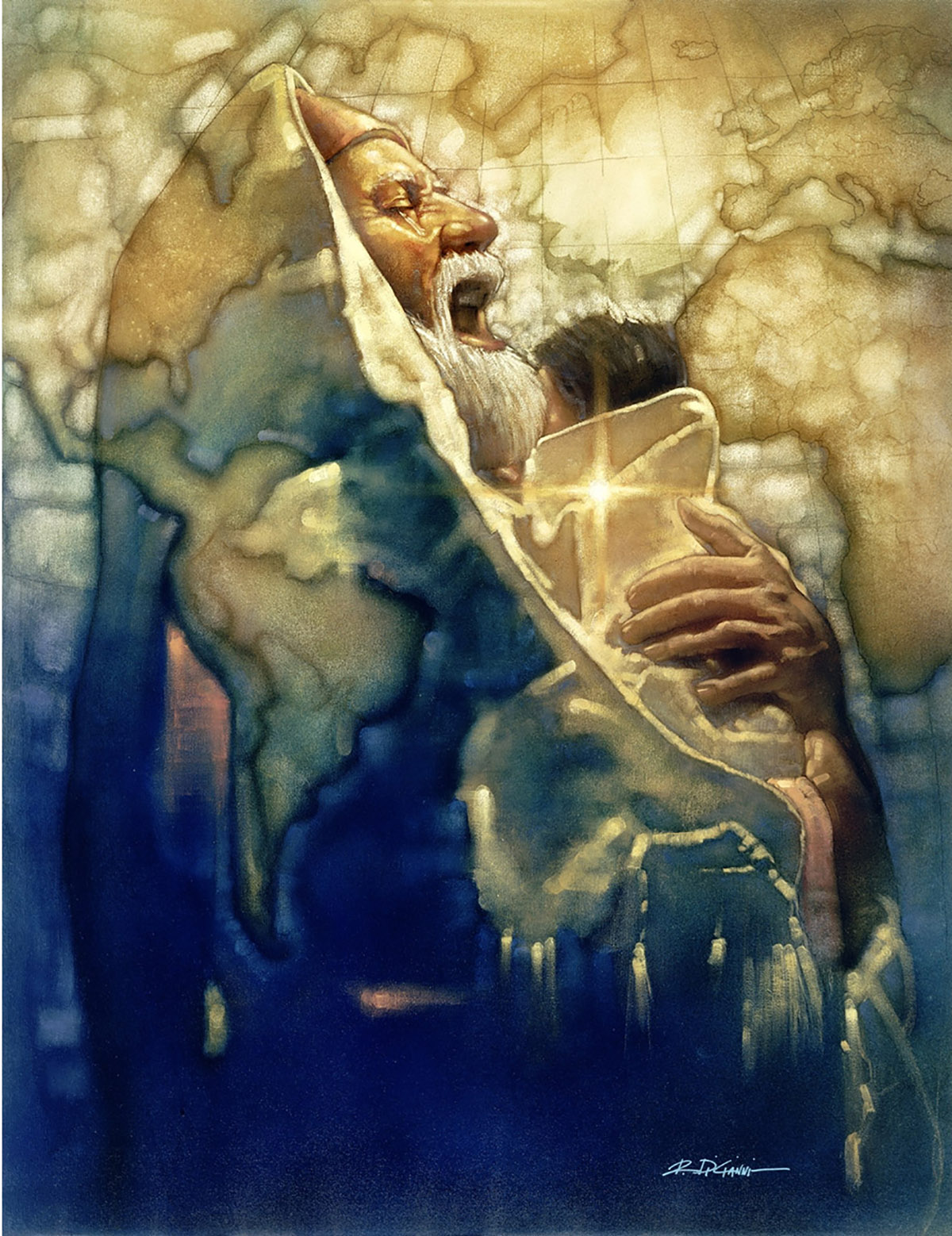
Simeon’s Moment by Ron DiCianni

 ‘A SONG FOR SIMEON’ (1928)

‘A Song for Simeon’ relies heavily on the account given in the second chapter of Luke’s Gospel and phrases from this gospel echo throughout the poem.  Simeon comes to see the Christ child as he is being presented in the Temple by Mary and Joseph and he utters his famous Nunc dimittis: ‘Lord, now lettest thou thy servant depart in peace, according to thy word.  For my eyes have seen thy salvation, which thou hast prepared before the face of all people’.  Joseph and Mary marvel at this and Simeon addresses Mary: ‘This child is set for the fall and rise of many in Israel; and for a sign which shall be spoken against; Yea, a sword shall pierce through thy own soul also, that the thoughts of many hearts may be revealed’. 

The poem is not, however, a simple restatement of Simeon’s prophecy.  Indeed, the purpose of the religious references is not to analyse religious experience into a series of logical or dogmatic statements, but to reflect a state of mind.  Eliot diminishes somewhat Simeon’s role as a prophet and brings into focus his human characteristics.  The poem, therefore, has considerable realism.  Simeon is tired and old; like all ordinary men, he neither longs for martyrdom nor for the ‘ultimate vision’ of Christ’s triumph on earth.  He just wants to die peacefully, with no heroics and no rhetoric.  Eliot’s ‘Song’, unlike the original in Luke, is the ordinary prayer of a tired old man who has accomplished his task on earth and who hopes for God’s salvation.  This tone of contemplative piety is maintained until the end, ‘Let thy servant depart / Having seen thy salvation’.  Throughout the poem, the coming of Christ is seen as a victory over the powers of darkness.  Yet, characteristically, the advent of Christ is also seen as involving a painful transformation of attitude. 

This idea is central to all of Eliot’s religious poetry and in particular to ‘A Song for Simeon’; namely that all Christians must endure hardship and suffering in this life if they are truly Christ’s followers.  The quiet strength of the poem enables the allusions to suffering to be used in such a way that the reader is forced to pause and to consider.  Take for example the reference ‘And a sword shall pierce thy heart / Thine also’.  In his address to Mary, Simeon foretells her grief and that of Christ.  But here in their new context, the words extend in meaning to cover the sufferings of all Christians who bear the derision as well as share in the glory of the passion and resurrection.  Thus, Eliot suggests, every Christian enacts the martyrdom of Christ in his own life: this, now and in the future,  will be a prime condition of his life as a Christian. 

Simeon’s case, however, is a special one.  He is the only Christian whose life does not involve participation in the suffering and death of Christ (He will, after all, be dead long before the Crucifixion) – ‘Not for me the martyrdom … / Not for me the ultimate vision’.  Eliot sees Simeon standing at that unique crossroads in human history when the pagan world gives way to the Christian.  Simeon grew up in the old dispensation, and yet he has the foresight to welcome the new Christian age but he knows that he cannot share in it.  He has to be content with the ‘ultimate vision’, the consolation of recognising that he has achieved salvation in the figure of the Christ child whom he has held momentarily in his arms.

Any close analysis of this poem must involve some mention of Eliot’s use of symbols.  As his interest in religious topics increased he continued to invent a symbolic language so as to express his ideas in poetry.  What he does in ‘A Song for Simeon’ is to translate his experience partly into traditional Christian images, and partly into his own private symbols.  Throughout the poem, the presence of familiar Christian references is obvious enough.  Groups of them appear in the third stanza:

Before the time of cords and scourges and lamentation

Grant us thy peace.

Before the stations of the mountain of desolation,

Before the certain hour of maternal sorrow,

Low at this birth season of decrease,

Let the Infant, the still unspeaking the unspoken Word,

Grant Israel’s consolation

To one who has eighty years and no tomorrow.

Next to these familiar images, however, Eliot places various symbols which express very forcefully the waning of the old pagan world and the imminent coming of Christianity.  Stanza One, in particular, is filled with images drawn from nature.  The Roman world, the world of the old dispensation, continues to move in its accustomed way: the hyacinths are ‘blooming in bowls’, but the light of the old beliefs represented here by the winter sun is weak and fading – ‘The winter sun creeps by the snow hills’.  In the fourth line, Simeon is introduced to us using natural imagery – ‘My life is light, waiting for the death wind’.

Another significant feature of Eliot’s poetry after his conversion is his discovery of heroes – as opposed to anti-heroes like Prufrock.  Indeed, one modern critic has summarised Eliot’s religious poetry as ‘explorations of the meaning and nature of heroism’.  In ‘a Song for Simeon’, heroism is seen primarily in a Christian context.  Throughout the poem the coming of Christ is associated with images of desolation and hardship; he is the ‘wind that chills towards the dead land’; he brings ‘cords and scourges and lamentation’; he announces salvation to all men in terms of death and suffering.  The placid images of stanza one  (‘hyacinths’, ‘feather’, ‘dust and sunlight’, ‘snow hills’) give way to images of torment that represent the lives of all succeeding generations of Christians.  Death is the source of life (‘this birth season of decrease’).  This, says Eliot, is the law of sacrifice and renunciation, a law which can be seen mirrored in nature and which is the essence of the Christian way.  This is the essence of the challenge which Eliot outlines in ‘A Song for Simeon’.

Like Simeon, Eliot has longed to find Peace – ‘Grant us thy peace’.  Peace (Shalom) was a sacred word for Jews denoting a positive state of wholeness and productivity rather than our merely negative notion of an absence of hostilities.  It is in this wider sense that Eliot means the word to be understood.  Indeed, the entire poem must be seen in a Christian context, if its message is to be fully understood and appreciated.

________ *************________

Therefore, these two poems, ‘Journey of the Magi’ and ‘A Song for Simeon’, deal with different journeys: the Magi come from the East and traverse difficult landscape at an inhospitable time of the year to seek out their new Messiah.  The hardships experienced on their journey are emphassised by words like ‘cold’, ‘worst time of year’, ‘the ways deep’, ‘weather sharp’, ‘dead of winter’.  Simeon, too, has ‘walked many years in this city’ in order to carry out his religious and charitable works (‘Kept faith and fast, provided for the poor’).  Simeon also foresees persecuted Christians fleeing ‘from the foreign faces and the foreign swords’.  This is closely followed by the stark image of Christ’s journey to Calvary – probably the most poignant expression of the journey-metaphor in all of Eliot’s poetry:

Before the time of cords and scourges and lamentation

Grant us thy peace,

Before the stations of the mountain of desolation.

 Both poems are set in winter representing not only the old age of the narrators but also signifying the end of the ‘old dispensations’ and the advent of the new.  There is also, of course, the underlying notion of the journey which the poet has undertaken during the course of his conversion to his new faith.

To sum up, we can say that ‘A Song for Simeon’ and ‘Journey of the Magi’ mark a decisive turning point in Eliot’s religious faith.  They also mark a change in his poetic style as well as a total shift in his outlook on life. 

 Works Cited

Eliot, T.S., “The Pensées of Pascal”, Selected Essays (3rd Edition), London: Faber and Faber, 1951.


Bishop Brendan Leahy launches Diocesan #Synod2016

Homily  of Bishop Brendan Leahy

St. John’s Cathedral

December 7th, 2014


Bishop Leahy

Today we are launching the Limerick Diocesan Synod and commissioning Delegates to it.  It is a significant day in the life of the Diocese.  Our liturgy seems just tailor-made for the occasion.

The Gospel presents the figure of John the Baptist.  At the time of John the Baptist, Jesus’ cousin, there was a sense of spiritual wilderness creeping into the people of Israel.  It was something they had experienced before and were now witnessing again.  Precisely at that time, John the Baptist was chosen to be the instrument in the hands of God to prepare the way of Jesus.  We can see that God made himself ‘need’ John the Baptist to prepare for his coming.  God is indeed the shepherd who feeds his flock and leads them but he makes himself dependent on us; he makes himself need our help.  Indeed, we can say that God is the expert of doing things not on his own but ‘together’ with others.

Just as in the case of John the Baptist, God counts on the contribution of each one of us too to prepare the way for his Son Jesus Christ to be seen, heard and encountered again in our world, in our country, and in our diocese.  We too are living in a spiritual wilderness of sorts – we’ve been through difficult and confusing times in the Church; there have been many cultural and social changes in recent years; the shape of our Church’s structures are in transition; we’ve seen internal divisions among us and we know that young people often don’t find what they are looking for in the Church as we present it today.

Our Diocesan Synod is to be a time when we clearly commit ourselves again to do our part to prepare the way for Jesus to come again in a new way among us at all levels of Church and indeed in society.  With the Synod, all of us together, clergy and lay, are being offered this opportunity to regenerate and build up the Church of the future in our diocese.  Let’s not miss this appointment with history.*

It’s undeniable that our Church has been rocked.  It has stumbled badly but it has not fallen.  While the Church reeled, faith remained precious.  Yet the Church is in need of repair.  It’s what the Lord told St. Francis in his time and tells us again now in our time.   We need to look at it again, reimagine and re-arrange, not to the way it was before but to something new.  Something that fits the present day.  We need to rebuild and repair, listening to what the Spirit is saying to the Church today.*

But that rebuild and repair, with Pope Francis as a guiding architect and his hand directed by the Holy Spirit, is not something fort the clergy alone to carry out.  Far from it.  The Church of tomorrow must be inclusive, regenerated by us all together, clergy and laity; those of great faith and those of challenged faith, working hand in hand to create a refreshed space where the windows are open and new air breathes in.  I ask everyone in the Diocese to get involved in this.*

The 2016 Synod will effectively be the moment to draw up new plans for our diocese so that it is ready for what I believe can be a new dawn breaking for the Church, a dawn we will all greet together.

Sisters and brothers gathered here in St. John’s Cathedral today, especially those of you who are being commissioned as Delegates to the Synod, let’s learn from the figure of John the Baptist.  He didn’t focus on himself; he was humble; he was full of hope in Jesus’ gift of the Holy Spirit and looked forward to the new dawn.

He didn’t focus on himself.  He wanted to help others turn around, turn away from sin and put god in the first place in their lives.  You too will now go out to help one another and others to prepare the way of Our Lord Jesus Christ.  There will be many paths to be made straight – paths of wounded hearts; paths of confused minds; paths of disappointed spirits; paths of rejected outreach.  Through listening with your hearts full of mercy and patience, you can transform crooked pathways into opportunities to show something new is happening; Jesus is coming in a new way to heal wounds, bring light and clarity, sow seeds of hope and mercy.

John the Baptist was humble.  In his day, undoing the straps of someone’s sandals was considered the most menial of jobs fit only for slaves.  John the Baptist didn’t even see himself fit to undo the strap of Jesus’ sandals.  This reveals something of the humility of his soul.  To be humble is to consider others as greater than ourselves, as St. Paul tells us.  John the Baptist lived this out in his relationship with Jesus.  But each of us can consider others greater than ourselves in the sense that in each neighbour we meet we are encountering Jesus in that neighbour.  It will be important for us to be humble and approach our Synod in a spirit of serving |Jesus in our neighbour.

John the Baptist was a man of hope,  believing in a better future and in the work of the Holy Spirit.  He pointed out that Jesus would baptise us with the Holy Spirit.  For us too, we can say that the Jesus who wants to come in a new way among us brings the Holy Spirit in abundance.  So there’s no need to be afraid or downhearted about the future.  As Pope Francis puts it, let’s not say our times are harder than previous times; they are just different.  Mary, the mother of Jesus, the ‘undoer of knots’ was always full of hope.  As the Second Reading reminds us, with the Lord ‘a day’ can mean a thousand years, and a thousand years is like a day.  he can act much faster than we might think if we let him.

In a moment, we will be commissioning the Delegates to the Synod.  As we set off on our Synodal journey, the Delegates will declare publically before us all, their intention to live their Baptismal vocation with renewed faith, hope and love.  Above all, they will promise to love one another as Our Lord has taught us in giving us the New Commandment: “A new commandment I give you: love one another”.  Let’s all join with them as they make this commitment, promising to share each other’s joys and sufferings, giving our lives out of love for one another.  We can take it as a form of pact that binds us together in a new way preparing the way of the Lord who is coming to dwell among us anew.

* my emphasis