Philosophical Thoughts on Glenroe and Knockaderry

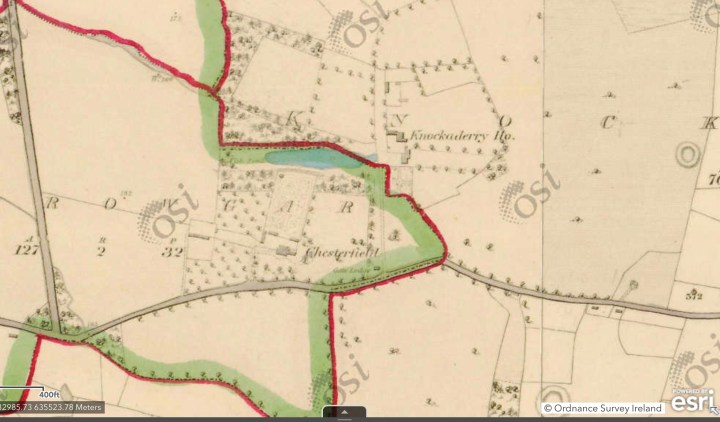
This is a detail from the 1840 historic map showing the sculpted and structured gardens surrounding Knockaderry House, the birthplace of Sophie Peirce, and the nearby Chesterfield House. It was unusual that two ‘Great Houses’ like these would be in such close proximity to each other.

Glenroe, my native place, sits on the border between Limerick and Cork and hurling and athletics were always very strong in the area. In Canon Sheehan’s famous novel, Glenanaar, there is a fabulous account of a hurling match between neighbouring border rivals which took place in or around 1840. The game, which attracted a huge crowd, was played between the Cork side, known as The Shandons, and the Limerick side, known as The Skirmishers. The game is being fiercely contested until the captain of The Skirmishers is taken ill, and he can play no further part in the battle. There is a famous intervention by a local, known as The Yank, who has recently returned to his native place after spending many years in the USA. The Yank agrees to replace the injured captain of The Skirmishers, and he saves the day and a hard-fought victory is won. After the heroics of The Yank, an onlooker is heard to say that ‘there was nothing seen like that since Terence Casey single-handedly bate the parishes of Ardpatrick and Glenroe’.

********

Knockaderry, too, has flirted with fiction.  Séan Ó Faoláin was one of the most influential figures in 20th-century Irish culture. A short-story writer of international repute, he was also a leading commentator, critic and novelist. He was the son of Bridget Murphy from Loughill East and Denis Whelan, an RIC constable who had been stationed in the RIC barracks in the village of Knockaderry in the 1890s. Every summer until he was 17, the young Ó Faoláin came to Rathkeale, to Knockaderry and to Loughill East on his holidays. He wrote with great passion about these local places in his autobiography, Vive Moi – and his first novel, in 1933, A Nest of Simple Folk, was based on that disputed territory over the hill betweenà Knockaderry village and Rathkeale, encompassing the landmarks and characters of Loughill East, Balliallinan Kilcolman, Duxtown and as far as Wilton Hill.  Ó Faoláin called his home in Killiney, Co. Dublin, Knockaderry

**********

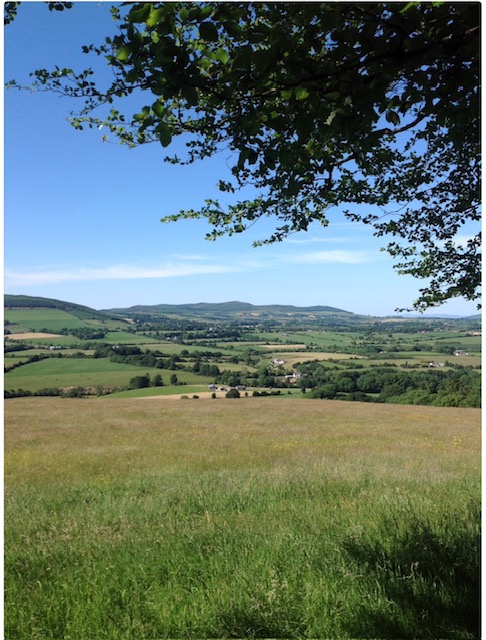
Glenroe and Knockaderry have long been central to my life. When I left Glenroe to go to boarding school in 1965, I really didn’t intend ever to return there unless I had a very good reason. Yet, fate played a hand, and my daughter Mary met and married Mike O’Brien, and they set up a home which nestles halfway between the parish church and the school. So, in recent years, I have come to cherish the second chance that I have been given. Likewise, I quickly fell in love with Knockaderry when I arrived there in 1977 to take up my first real teaching job in nearby Newcastle West. Both places hold a special place in my heart. Both places would be perfect settings for a good novel!

I love reading, and as a teacher of English literature, I have been doubly blessed in having the honour of introducing my students to some of the great fictional works written. Being a Harper Lee fan, I remember waiting for the much-anticipated publication of Go Set a Watchman in 2015. Written before her only other published novel, the Pulitzer Prize-winning To Kill a Mockingbird (1960), Go Set a Watchman was initially promoted as a sequel by its publishers. It is now accepted that it was a first draft of To Kill a Mockingbird, with many passages in that book being used again. The title alludes to Jean Louise Finch’s view of her father, Atticus Finch, as the moral compass (“watchman”) of Maycomb, Alabama, and has a theme of disillusionment, as she discovers the extent of the bigotry in her home community. Go Set a Watchman tackles the racial tensions brewing in the South in the 1950s and delves into the complex relationship between father and daughter. It includes treatments of many of the characters who appear in To Kill a Mockingbird.

I had already formed a mustard seed theory in my brain that the real-life Monroeville, Alabama, of her youth became the fictional Maycomb, Alabama, of her novels. To me, Maycomb didn’t seem too different to my own special places. Lee had set her novels here for a reason: she deliberately selected her setting, and in effect, the fictional Maycomb becomes another Narnia or Middle Earth – a microcosm of all that is good and bad in 1930s America. She tells us that one went to Maycomb, ‘to have his teeth pulled, his wagon fixed, his heart listened to, his money deposited, his soul saved, his mules vetted’. She describes it as an isolated place; in effect, it is an Everyplace – the place, ‘had remained the same for a hundred years, an island in a patchwork sea of cotton fields and timber land’. It is, in effect, a remote backwater bypassed by progress, the perfect playground of her youth, the perfect setting for a novel and the perfect cauldron for change.

In Go Set a Watchman, she says that Maycomb County is ‘a wilderness dotted with tiny settlements’; it is, ‘so cut off from the rest of the nation that some of its citizens, unaware of the South’s political predilection over the past ninety years, still voted Republican.’ It is so remote, ‘no trains went there’. In actual fact, Maycomb Junction, ‘a courtesy title’, was located in Abbott County, twenty miles away! However, she tells us that the ‘bus service was erratic and seemed to go nowhere, but the Federal Government had forced a highway or two through the swamps, thus giving the citizens an opportunity for free egress.’ However, Lee tells us that few took advantage of this opportunity! Then, in one of those Harper Lee epiphany moments, one of those lightning bolts she releases now and then, she perceptively describes her hometown, and, indeed, my own home place, whether it be Glenroe or Knockaderry, as a place where, ‘If you did not want much, there was plenty.’

In To Kill a Mockingbird, she continues in the same rich vein. Maycomb is a ‘tired old town’. People moved slowly, ‘they ambled across the square, shuffled in and out of the stores around it, took their time about everything’. She tells us that, ‘There was no hurry, for there was nowhere to go, nothing to buy and no money to buy it with, nothing to see outside the boundaries of Maycomb County’, a scenario somewhat reminiscent of modern-day Knockaderry or Glenroe!

Similar to Maycomb, the setting of George Eliot’s novel, Silas Marner, has many similar echoes. The Raveloe described by Eliot is reminiscent of my beloved Knockaderry! She tells us that it ‘was a village where many of the old echoes lingered, undrowned by new voices.’ She further describes it as being, ‘Not …. one of those barren parishes lying on the outskirts of civilisation —inhabited by meagre sheep and thinly-scattered shepherds: on the contrary, it lay in the rich central plain of what we are pleased to call Merry England’. However, like Maycomb and Knockaderry and Glenroe, it was off the beaten track, ‘it was nestled in a snug well-wooded hollow, quite an hour’s journey on horseback from any turnpike, where it was never reached by the vibrations of the coach-horn, or of public opinion’. In Chapter One, Eliot declared it to be a place where bad farmers are rewarded for bad farming!

This description of Raveloe also holds great echoes with The Village as depicted in Jim Crace’s (supposedly last?!) novel, Harvest. The narrator, Walter Thirsk, tells us that, ‘these fields are far from anywhere, two days by post-horse, three days by chariot before you find a market square.’ Harvest dramatises one of the great under-told narratives of English history: the forced enclosure of open fields and common land from the late medieval era on, whereby subsistence agriculture was replaced by profitable wool production, and the peasant farmers were gradually dispossessed and displaced. ‘The sheaf is giving way to sheep’, as Crace puts it here, and an immemorial connection between people and their local environment is being broken – their world is crumbling around them. Great changes are coming and, as everyone knows by now, the only people who welcome change are babies with wet nappies!

Brian Friel’s use of Ballybeg (small town) as the setting for many of his plays and short stories is also similar in vein to these others. In ‘Philadelphia Here I Come!’, Gar Public tells us that Ballybeg is, ‘a bloody quagmire, a backwater, a dead-end’. Friel, like Lee, Eliot, and Crace, is deceptive because he is dealing with familiar things and familiar characters – shopkeepers, housekeepers, and parish priests – a very familiar rural Ireland fixed in its own time. Friel’s use of Public Gar’s alter ego – Private Gar – allows us the opportunity to see behind the superficiality of so much of this world of small-town life.

In many ways, Friel’s major theme is the failure of people to communicate with each other on an intimate level. In his play, ‘Philadelphia, Here I Come!’, we are introduced to the typically Irish practice of verbal non-communication! He, like Harper Lee, George Eliot, and Jim Crace, forces us to examine the nature of society. In Ireland, our society in the 40’s and 50’s was dominated by the church, the politician, and the schoolmaster. Ultimately, the world that Gar is leaving has failed him and his generation. But Friel is too subtle to allow us to imagine that the world Gar is about to enter in Philadelphia will be any better.

These meandering rambles are an attempt to place myself at the beginning of a work of fiction, to stand for a moment in the author’s shoes, so to speak, and see the world from their point of view. From my limited reading, it seems to me that many authors deliberately choose a world untrodden, less travelled as the setting for their novels and plays. I have mentioned some here in this piece, but I’m sure this is just the tip of the iceberg, and you will be able to reference many examples from your own reading.

Ideally, the setting for all these classics is always remote, secluded, off the map, and cut off from change and advancement. This microcosm is then filled with characters and fictional dilemmas, action and inaction. I have always been truly fascinated and awed by each author’s unique ability and ingenuity in creating and imagining these hidden worlds in their heads, and thus allowing us to enter the world of their texts. Knockaderry and Glenroe, apart from their initial flirtations with Séan Ó Faoláin and Canon Sheehan in past centuries, patiently await their twenty-first-century novelist to arrive!

Believe me, the characters are there!

… and it seems that a twenty-first-century novelist has arrived to put Knockaderry on the map! June O Sullivan’s second novel tells the amazing tale of Knockaderry woman, Sophie Peirce, the first true female trailblazer in aviation. The novel, soon to be published, recounts Sophie’s epic solo flight from Cape Town to London in 1928.

Some Glendarragh Poems of Michael Hartnett: Poems from the Hearth

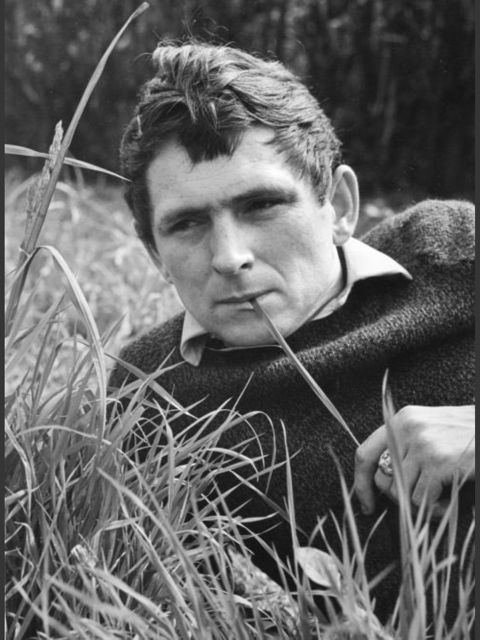
A pensive Hartnett ‘among (his) nameless weeds’. Photographer unknown.

As I have mentioned already in another post here, the decade from 1975 to 1985 in Glendarragh, Templeglantine, was arguably the most productive of Hartnett’s career.  Indeed, the output from that little cottage in the shade of ‘Tom White’s green hill’ in Glendarragh was prodigious.  The first poems to be published were his collection A Farewell to English, which was published in 1975, and thus began his long-lasting association with Peter Fallon and The Gallery Press.  The same year saw the publication of The Retreat of Ita Cagney / Cúlú ÍdeAdharca Broic was published in 1978, followed by An Phurgóid in 1983, Do Nuala: Foighne Crainn in 1984 and his fourth collection in Irish, An Lia Nocht, appeared in 1985.  During this period, he also undertook the translation of Daibhí Ó Brudair’s poems, which were published in 1985.  Many of his better Glendarragh poems are contained in the 1987 collection, A Necklace of Wrens.  This collection, following his return to Dublin, contains all poems in Irish with their English translation that Hartnett wanted preserved for posterity, and it was edited by Peter Fallon.

During this decade, 1975 to 1985, in parallel to this ‘serious’ output, he was writing and entertaining the locals with ballads, some serious or semi-serious like ‘A Ballad on the State of the Nation’, which was distributed as a one-page pamphlet like the ballads of old and even included original linocuttings by local artist Cliodhna Cussen. Other ballads were more contentious and even semi-libellous (or fully slanderous!), such as ‘The Balad (sic) of Salad Sunday’ and ‘The Duck Lovers Dance’.  These latter creations were written under the very appropriate nom de plume, ‘The Wasp’!  His most memorable local work was, of course, ‘Maiden Street Ballad’, a poem he composed for his father as a Christmas present in 1980.

These three intimate family poems were written in Glendarragh, Templeglantine and first appeared in his collection, Adharca Broic, in 1978.  Two of the poems are written for his children: Lara, who was born in 1968 and Niall, who was born in 1971.  These two poems with English translations also appear in his 1987 collection A Necklace of Wrens.   The third poem, Dán do Rosemary, was not included in this collection, and the reason for its exclusion is obvious.  As early as 1978, the tensions and stresses which eventually led to their separation in 1985 were beginning to show.   They were both navigating the inevitable separation, which eventually led to his departure for Dublin and Inchicore that year.  His gift for love poetry is again in evidence, as it had been back in 1968 with the publication of Anatomy of a Cliché.  Unfortunately, the clock had come full circle, and his final poem to Rosemary is one of abject apology and regret and wistful hopes for their post-separation lives.

The poem reads as a sad indictment of the way artists were treated in this country in the 70s and 80s.  They lead a ‘miserable life’, ‘for our lack of money / scrimping and scraping’.    He apologises profusely and admits that their marriage is ‘pitiless, loveless’, which has affected ‘your soft fragile (English) heart’.  Their small rural cottage is ‘run-down’, with ‘walls of clay, tear-stained’, ‘the place is falling apart’.  He takes full responsibility for their sorry plight and admits that he is ‘blundering, tactless, clueless’.  I have said elsewhere that at this time, Newcastle West was booming during the construction phase of the Aughenish Alumina Plant near Askeaton in County Limerick.  Newcastle’s twenty-six pubs were doing a roaring trade, and he apologises to his wife because he is ‘always acting the yob in the pub’. If anything, this poem in the original Irish is far more confessional and personal than most of his poetry up to this time.

The poem concludes on a far more positive and hopeful note.  He tells Rosemary that he has ‘abandoned English, but I never turned my back on you’.  This is a time for reappraisal, and he hopes to ‘relearn my craft from fresh woodland’ – he was living at the time in a townland called Glendarragh – the glen of the oak.  He ends on a hopeful note: he hopes that the future will bring Rosemary happiness and that her ‘worth will be appreciated’.  The final line is so sad and poignant – he hopes that ‘we both reach our America’.  The sadness of this final line arises from the fact that some seven years later, they both parted and went their separate ways.

Cliodhna Cussen, a fellow native of Newcastle West, has an interesting point to make about this poem:

‘Nuair a dhirigh Michéal ar an nGaeilge níor cuireadh aon rófháilte roimhe.  Bhí ceisteanna á n-ardú i dtaobh chaighdeán a chuid Gaeilge, ceisteanna a árdaíodh i dtaobh an Riordánaigh 30 bliain níos túisce. Ach léiríonn Michéal a anam, a chuspóir, agus a ghrá sa tseoid sin de dhán, ‘Dán do Rosemary’, ina bhfuil a chumas agus a chroí nochtaithe aige’.

 When Michael began writing in Irish, he didn’t receive great encouragement from Gaelgóirí.  There were questions about the standard of his Irish, just as there had been about Sean Ó Riordán some thirty years earlier.  But in this gem of a poem, ‘Poem for Rosemary’, Hartnett reveals his soul, his motive, his love – indeed, his supreme craft and heart are laid bare.’ (My own translation).

His poem for his son Niall, Dán do Niall, 7 (‘Poem for Niall, 7’), again shows his honesty and courage, although it does tend to descend into cliché at times.  Like King Canute and his futile attempts to hold back the tide, he wishes that his son wouldn’t have to leave this safe place in ‘Bird Nest country’, their home in Glendarragh.  He tries to warn his son about the many dangers that exist in the outside world and does so by making reference to nature.  This advice is somewhat reminiscent of the advice spoken by Polonius to his son Laertes in Shakespeare’s Hamlet: ‘This above all: to thine own self be true, And it must follow, as the night the day, Thou canst not then be false to any man’.  This suggests that integrity begins with honesty to oneself, and Hartnett gives us a modern take on this when he advises, ‘Be happy but be tough. ’

There is great poignancy in the final stanza when he states that he will be there for his son ‘in spite of death’.  Niall was 28 when his father died in 1999 at the age of 58, and the second line of this stanza adorns the poet’s headstone in Calvary Cemetery in Newcastle West: ‘mar labhraíonn dúch is labhraíonn pár’, ‘for ink speaks and paper speaks’.  The poet is saying that he will be present and live on in his body of work even after his death.  The reality is that he wasn’t there for many of the landmark celebrations in his son’s life, his graduations, his wedding, the birth of his grandchildren and so the promise he makes, ‘and some day I’ll buy you porter!’ sounds very hollow indeed to a young man who must now take on the onerous mantle of preserving and promoting his father’s rich and varied legacy at such a young age.

Hartnett’s grave in Calvary Cemetery, Churchtown, Newcastle West. The inscription reads: ‘Beadsa ann d’anneoin an bháis, mar labhraíonn dúch is labhraíonn pár’, (‘I will be there in spite of death, for ink speaks and paper speaks.’

His Dán do Lara, 10, (‘Poem for Lara, 10’), is a masterpiece.  The sunshine and nature in this poem are at odds with the penury and hardship of the poet’s existence in 1978, nestling below ‘Tom White’s green hill’ in Glendarragh, Templeglantine.  Flame-haired Lara is compared to a rowan tree in autumn, her voice disturbing the larks, ‘in the green grass’.  She is surrounded by nature in all its glory, ‘a crowd of daisies playing with you, a crowd of rabbits dancing with you’.  The blackbird and the goldfinch are there for her amusement and playtime.  Then the master of metaphor compares his daughter: ‘You are perfume, you are honey, a wild strawberry.’    The poem ends with the poet’s wish for his young daughter:

Little queen of the land of books            

may you be always thus                           

may you ever be free                                             

from sorrow-chains.

Interestingly, the poet compares his daughter to a queen in ‘the land of books’; this seems to set the seal on Lara’s perfection. Obviously, a poet would value literature and reading, and his choice of this image is significant as it tells us that Lara has another, deeper side to her – she is not just interested in the outdoors and a lover of nature.

His final wish for Lara is that she will grow up to be as beautiful and graceful as her mother, Rosemary.  He hopes that she will inherit her mother’s beautiful soul as well as ‘the beauty of her face.’

It is fitting that these three poems, written in that little rural cottage in Glendarragh, feature family and the travails of being a husband and a parent.  I have examined many of his papers in the National Library of Ireland on Kildare Street, and it is undeniable that hand-in-hand with arranging his poems and latest projects, there is ample evidence of the presence of young people, Lara and Niall, in the many doodles and scribbles on the margins of those frayed notebooks.

A detail from the beautiful sculpture in the Square, Newcastle West, by the sculptor, Rory Breslin, showing Hartnett clasping a copy of the 1987 collection, A Necklace of Wrens.


Random Epiphanies….

An epiphany is that moment when the penny drops, when the scales fall away from your eyes; that ‘light bulb moment’ when the mystery is solved; when the poem gives up its secret; that Eureka Moment when you realise you’ve been conned for most of your life.

The Bible has many such moments, from Eve and the apple in Genesis to Paul’s conversion on his way to Damascus in the New Testament.  As Christians, we celebrate the Feast of the Epiphany each year on January 6th, which focuses on the moment Christ is revealed to the non-Jewish world; when the Magi, guided by a star, come from the East to visit their Redeemer.

Epiphanies are mental moments when we are given instant clarity, which can turn into motivation to change and charge forward. But not all epiphanies are created equally. Some demand a deep inward search, while others fly in and out of our lives swiftly, silently, almost unnoticed.

It’s great to have an epiphany, but what you do with that new clarity is what matters most. Most of our habits are so ingrained in our lives that changing behaviour is very difficult. Most epiphanies force us to see situations and ourselves in a new light. The next step takes great courage; taking that step to live out your epiphany is when real transformation happens. In my own life, I have had some powerful moments. So, here are a few examples of some of my totally random light bulb moments…..

  • I normally don’t do conspiracy theories, BUT I firmly believe the young Viet Cong soldier who tortured American Vietnam hero and veteran, John McCain, for seven years, when made redundant, went back to the fledgling Hoi ChiMinh University and did a doctoral thesis on the benefits of manually induced electro muscle therapy – this was then picked up in Austria or Switzerland and sanitised. Today, it’s known as DRY NEEDLING. IMHO, the overuse of dry needling by overzealous, sadistic physiotherapists will be the rock that modern physiotherapy will perish on.
  • Donald Trump has never, ever put America first. Indeed, most politicians of all nationalities and all political hues invariably put themselves first.  However, a stopped clock is right at least twice a day, and Donald Trump was spot-on when he coined the phrase, Fake News.
  • In a related epiphany, have you ever noticed that all the major News Corporations are now owned by billionaire oligarchs and moguls?  I wonder why.  I have come to realise that much of what passes for news in today’s world is fake – atrocity after atrocity goes unreported, and not just because all the journalists have been killed by sniper fire – those who sit at home back in the studio have their hands tied behind their backs for fear they might incur the wrath of the current government.
  • On a slightly lighter note, did you ever notice that shampoo bottles are designed so that you will always use more than you need? You only realise this when the bottle is nearly empty.
  • The Catholic Church in Ireland provided an education and health system for Irish people a century before the fledgling state was formed – they deserve to be cut some slack by the newly canonised neo-liberals. That Church, to which I belong, has been under persistent attack for most of this century.
  • There are 756 steps between Oscar’s Restaurant and Servitar Puerto Azul Apartments in Puerto Rico, Gran Canaria!
  • Last year, for the first time since we settled in Knockaderry back in 1979, we had no swallows nesting in our garage by the road. In years past, we’ve had multiple pairs, but last year, 2024, was the first year we had no nest. It struck me then that swallows are the modern version of the canary down the mine. Thankfully, this year, after a very nervous wait, a lone pair arrived on May 20th – five weeks behind schedule. They built their nest and hatched four beautiful chicks for us to admire and cherish. The world is very fragile but not yet fully broken!
  • Global Warming never came to Knockaderry – but Climate Change is a real problem!
  • I’ve always contended that common sense wasn’t that common, but now I’m convinced that logic is irreparably damaged, and Warmongers now see themselves as Peacekeepers.   There’s one who has financed and supplied most of the munitions for an ongoing genocide who claims to have brokered peace in nine global conflicts this year alone.  Give that man the Nobel Peace Prize now, or else!!
  • Your role as a parent is never done. There is never a time, in good times and in bad, when you have full peace of mind, when you no longer need to worry. In reality, as a parent, you are only ever as happy as your saddest child.
  • Your career as a politician or as the manager of your local hurling team always ends in failure! No matter how successful you’ve been at winning championships or leagues or simply avoiding dreaded relegation, the time will come when you lose the dressing room. The people have spoken, and you must inevitably bow to the tyranny of the ballot box or your local GAA AGM!
  • Modern democracy is as fragile as a wasp’s nest, papery and brittle, and in my lifetime, it has been emasculated by billionaires and Russian oligarchs for their own ends.
  • Your health is your wealth. It is a universal truth that we take too much for granted, like being able to put on your socks or pull up your pants or get out of bed in the morning.
  • Cork GAA and its supporters are so well-served by the quality of their sports journalists.  No other county can claim to have writers who, week in week out, report the club scene and the intercounty scene in hurling and football to such a high standard.  Names like Tony Leen, John Fogarty, Maurice Brosnan, Michael Moynihan, Eoghan Cormican, Paul Rouse, Kieran Shannon and Cathal Dennehy are among my favourites.  And all of those stand on the shoulders of the giants who went before them in the old Cork Examiner: Jim O’Sullivan, Michael Ellard, the great P.D. Mehigan, better known as Carbery, and my own favourite word wizard,  Kevin Cashman.  In my book, he was one of hurling’s finest ever writers who prized exactitude and calm knowledge, in the same way he esteemed seeing a hurler’s correct technique create lethal elegance.

Finally, to put some order on this randomness, here are eight epiphanies that have certainly changed my life for the better, and maybe they can help you in your own journey.

  1. You aren’t what people say you are.

What matters most is what you say and feel about yourself. You get to choose. You can let others define you and tell you who you are, or you can show them who you are. Be you. The world needs you as you are.

  1. Plan B is often better than Plan A.

The most freeing moment in your life is when you let go of what you think is best for you. Stop holding on to what is no longer working: that job, that relationship, that dream. If it feels like hard work and is causing you more pain than gain, it is time to let go.

  1. You are not the number on the scale.

At the end of your life, after all those weight struggles, food wars, the obsession with new diets, and trying to look a certain way, it will have no relevance. You are more than a set of grades. The only thing that matters is what is in your heart. How you make people feel and how you make YOU feel is more important than how you look.

  1. The journey is more important than the goal.

Setting and reaching goals is important, but the actual process of becoming, growing, learning, and morphing into who we need to become is the real sweet stuff that makes for a wonderful life. Enjoy the journey as much as the reward.

  1. Being alone doesn’t mean you will be lonely.

The fear of being alone strikes the heart and makes many people panic. But when you learn to love your own company, you will see that you are never really lonely.

  1. It will never be all done.

The to-do lists, the chores, and the things we race around to get done will never be done. It is called life. Situations, chores, and to-do lists will always unfold. Instead of focusing on the end result, be in the process and celebrate what you have accomplished, as our wonderful Limerick Hurling team does.

  1. Emotional pain, indeed, all pain, shows up to point out to us what we need to change.

Sadness, depression, and heartache are gentle reminders to probe deeper into our lives. In the Summer of 2024, I had six weeks of agony inflicted on me by an inflamed bursa in my left hip from climbing ladders and clipping hedges. So, look at what is not working and be open to living your life in new ways. No more climbing ladders for me!

  1. Finally, if you’re lucky, you don’t have to find your purpose; it will find you.

The transition period between who you are and where you are going can be painful, but on your journey of finding purpose, recognise that there is purpose in the pain. Each step you take is helping you carve out more of who you really are.

My Pipe Smoking Days …..

Hard at work grading Higher Level English papers each July.

I come from a long line of pipe smokers. My Dad smoked the pipe, and from a young age, I wallowed in the wafted aroma of Mick McQuaid, or Condor or Mellow Virginia. My Grandad also smoked the pipe; it was ever-present in his mouth, and I also noticed that he used a cap on his pipe to prolong the smoke. I have to confess, before I go any further, that of all the vices I’ve explored in my lifetime, pipe smoking was my favourite! I began to smoke the pipe at the age of 27 – around the time I got married! In the beginning, before addiction set in, I was an occasional smoker. I smoked a Dutch tobacco called Clan, which was very popular, and it had a beautiful, scented flavour. I was very active at the time, playing football with Newcastle West and hurling with Knockaderry. I continued to rationalise with myself that my pipe smoking had no impact whatsoever on my fitness and, after all, it would have been far worse if I had been smoking cigarettes!

Giving it a try, I entered one of the most compelling, habit-forming subcultures I’d ever found. There are plenty of rabbit holes to go down in life, though few that hold you there so avidly as pipe smoking. Part of it was the tobacco, as different from the cigarette kind as you can imagine. In those early years, I mainly smoked nice light, sometimes aromatic, mellow Virginias. My Aunty Meg spoiled me rotten by bringing me back 16-ounce packets of scented Cherry Brandy flavoured tobacco from her many journeys to New York. I later discovered the time-consuming rituals associated with various plug tobaccos before eventually settling on Yachtsman, my favourite of all. I became an expert mixer of tobaccos and would often add some of my Cherry Brandy mix with my Yachtsman plug to make it go farther. If suppressed memory serves me at all, the mixture was Divine!

Fr. Dan Lane was curate in Newcastle West in the late 80s and early 90s, and we were firm friends. Dan smoked cigarettes mainly, and when he wanted to give them up, which was often, he dabbled with the pipe. Each year, Fr Dan organised a pilgrimage to Lourdes for the Fifth-Year girls in the parishes of NewcastleWest and Abbeyfeale. The pilgrimage set out for Lourdes each year on Easter Sunday and returned a week later. Each year, he would bring copious amounts of tobacco, far exceeding his own Duty Free allowance of cigarettes and pipe tobacco on his return journey.

I remember one evening in 1986, Fr. Dan arrived out to Knockaderry laden down with two Duty-Free bags of pipe tobacco. His doctor had again advised him that he should quit smoking, so he wanted to get rid of the temptation and give his stash a good home. Obviously, I was delighted, and by my estimation, I wouldn’t have to buy tobacco again until Christmas! Later, I went through the treasure trove and found packets of my old favourite Clan, along with pouches of Holland House, Condor, Mellow Virginia, Mick  McQuaid, and some tins of Erinmore and Three Nuns. I’m reminded here of Brendan Behan’s joke about the availability of tobacco while he was in prison. He said that the warden’s favourite brand was Three Nuns – none yesterday, none today and none tomorrow!

Gradually, I became an expert, collecting all the necessary paraphernalia: my beloved Kapp and Peterson Numbers 303, 314 or 317 sandblasted briar pipes, a sleek pipe lighter, pipe cleaners, rustic tampers, a pipe pouch, a small penknife, and a leather airtight tobacco pouch. The pipe was the most essential item, however, and I sourced mine and, in later years, my plug tobaccos from the erudite Eleanor at M. Cahill and Sons Tobacco Shop, 47 Wickham Street in Limerick.

Kapp and Peterson, from their famous shop in Nassau Street in Dublin, were then, and still are, the oldest continuously operating briar pipe factory in the world. They had built up a reputation both here and abroad and they were proud of their tradition and their legacy of craftsmanship dating back over 150 years. A Peterson pipe wasn’t just a utilitarian tool; it was a piece of history you carried with you on your travels, a faithful companion to accompany you through all of life’s travails.

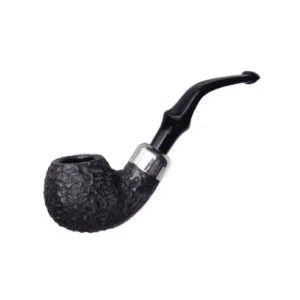
My favourite pipe! Eschewing the robust, muscular aesthetic that defines so much of the Kapp and Peterson style, this classic bent Donegal Rocky 80s briar pipe design is an elegant, timeless shape that haunts my frequent tobacco dreams!!

Pipe smoking is a messy business. Oftentimes, stale dottle became wedged in the pipe bowl from a previous smoke, and this required cleaning with a penknife. Tobacco dust and ash permeate everything and everywhere, and often the smoker doesn’t realise that all those in the vicinity can smell smoke fumes from his clothes, from his breath. Pipe smokers are forever fidgety around their pipe; it requires constant attention and frequent relighting, not to mention the endless ceremonial preparation for yet another smoke.

I have a few very serious confessions to make now that I am a reformed smoker. I cringe when I think that I continually smoked the pipe in the car without a care or any consideration for Kate or my two darlings, Mary and Don, who were in the backseat without gasmasks, seatbelts or any of the modern safety methods that had not yet become legal and essential. I smoked while I was carrying them to music lessons, to matches, to training sessions. I smoked in the house after school; I smoked all day in the study during those long summers correcting Leaving Cert English. I smoked in restaurants, in pubs, and in the street, without a thought for anyone other than my own enjoyment and satisfaction.

Eventually, after many false dawns, I gave up smoking the pipe on the 12th of October 2008. There were several factors which precipitated this major decision. I was due to go to Croom in November that year to have a hip replacement, so I told myself that I needed to be fit and healthy! On March 29, 2004, Tánaiste Michéal Martin, representing the Irish government, introduced the first national comprehensive legislation banning smoking in all workplaces, including bars and restaurants. I was beginning to get the message in 2008! In truth, my momentous decision had been hastened by the repeated price hikes in tobacco in successive Budgets, which were making smoking a very, very expensive hobby. I couldn’t justify it any longer, and so, even though I had just purchased a brand-new Peterson on the 1st of October that year, I went ‘cold turkey’ and never looked back.

On that fateful day, I was aware that I was consciously making a decision to exclude myself from an elite club. Pipe smokers had always traditionally been considered different, and membership of this convivial fraternity was considered to be something special. In our heyday, we were seen as wise, contemplative men who sat and smoked and read serious, leather-bound literature, as well as a world of rugged outdoorsmen, canoeists, fly fishermen and clipper ship captains who puffed their pipes as they pored over nautical charts before sailing ‘round the Horn.  Those halcyon days, unfortunately, are all now, but a hazy pipe dream in the smoky recesses of treasured memories!  I conclude with the immortal words of C.S. Lewis: “A pipe gives a wise man time to think and a fool something to stick in his mouth.”