My Pipe Smoking Days …..

Hard at work grading Higher Level English papers each July.

I come from a long line of pipe smokers. My Dad smoked the pipe, and from a young age, I wallowed in the wafted aroma of Mick McQuaid, or Condor or Mellow Virginia. My Grandad also smoked the pipe; it was ever-present in his mouth, and I also noticed that he used a cap on his pipe to prolong the smoke. I have to confess, before I go any further, that of all the vices I’ve explored in my lifetime, pipe smoking was my favourite! I began to smoke the pipe at the age of 27 – around the time I got married! In the beginning, before addiction set in, I was an occasional smoker. I smoked a Dutch tobacco called Clan, which was very popular, and it had a beautiful, scented flavour. I was very active at the time, playing football with Newcastle West and hurling with Knockaderry. I continued to rationalise with myself that my pipe smoking had no impact whatsoever on my fitness and, after all, it would have been far worse if I had been smoking cigarettes!

Giving it a try, I entered one of the most compelling, habit-forming subcultures I’d ever found. There are plenty of rabbit holes to go down in life, though few that hold you there so avidly as pipe smoking. Part of it was the tobacco, as different from the cigarette kind as you can imagine. In those early years, I mainly smoked nice light, sometimes aromatic, mellow Virginias. My Aunty Meg spoiled me rotten by bringing me back 16-ounce packets of scented Cherry Brandy flavoured tobacco from her many journeys to New York. I later discovered the time-consuming rituals associated with various plug tobaccos before eventually settling on Yachtsman, my favourite of all. I became an expert mixer of tobaccos and would often add some of my Cherry Brandy mix with my Yachtsman plug to make it go farther. If suppressed memory serves me at all, the mixture was Divine!

Fr. Dan Lane was curate in Newcastle West in the late 80s and early 90s, and we were firm friends. Dan smoked cigarettes mainly, and when he wanted to give them up, which was often, he dabbled with the pipe. Each year, Fr Dan organised a pilgrimage to Lourdes for the Fifth-Year girls in the parishes of NewcastleWest and Abbeyfeale. The pilgrimage set out for Lourdes each year on Easter Sunday and returned a week later. Each year, he would bring copious amounts of tobacco, far exceeding his own Duty Free allowance of cigarettes and pipe tobacco on his return journey.

I remember one evening in 1986, Fr. Dan arrived out to Knockaderry laden down with two Duty-Free bags of pipe tobacco. His doctor had again advised him that he should quit smoking, so he wanted to get rid of the temptation and give his stash a good home. Obviously, I was delighted, and by my estimation, I wouldn’t have to buy tobacco again until Christmas! Later, I went through the treasure trove and found packets of my old favourite Clan, along with pouches of Holland House, Condor, Mellow Virginia, Mick  McQuaid, and some tins of Erinmore and Three Nuns. I’m reminded here of Brendan Behan’s joke about the availability of tobacco while he was in prison. He said that the warden’s favourite brand was Three Nuns – none yesterday, none today and none tomorrow!

Gradually, I became an expert, collecting all the necessary paraphernalia: my beloved Kapp and Peterson Numbers 303, 314 or 317 sandblasted briar pipes, a sleek pipe lighter, pipe cleaners, rustic tampers, a pipe pouch, a small penknife, and a leather airtight tobacco pouch. The pipe was the most essential item, however, and I sourced mine and, in later years, my plug tobaccos from the erudite Eleanor at M. Cahill and Sons Tobacco Shop, 47 Wickham Street in Limerick.

Kapp and Peterson, from their famous shop in Nassau Street in Dublin, were then, and still are, the oldest continuously operating briar pipe factory in the world. They had built up a reputation both here and abroad and they were proud of their tradition and their legacy of craftsmanship dating back over 150 years. A Peterson pipe wasn’t just a utilitarian tool; it was a piece of history you carried with you on your travels, a faithful companion to accompany you through all of life’s travails.

My favourite pipe! Eschewing the robust, muscular aesthetic that defines so much of the Kapp and Peterson style, this classic bent Donegal Rocky 80s briar pipe design is an elegant, timeless shape that haunts my frequent tobacco dreams!!

Pipe smoking is a messy business. Oftentimes, stale dottle became wedged in the pipe bowl from a previous smoke, and this required cleaning with a penknife. Tobacco dust and ash permeate everything and everywhere, and often the smoker doesn’t realise that all those in the vicinity can smell smoke fumes from his clothes, from his breath. Pipe smokers are forever fidgety around their pipe; it requires constant attention and frequent relighting, not to mention the endless ceremonial preparation for yet another smoke.

I have a few very serious confessions to make now that I am a reformed smoker. I cringe when I think that I continually smoked the pipe in the car without a care or any consideration for Kate or my two darlings, Mary and Don, who were in the backseat without gasmasks, seatbelts or any of the modern safety methods that had not yet become legal and essential. I smoked while I was carrying them to music lessons, to matches, to training sessions. I smoked in the house after school; I smoked all day in the study during those long summers correcting Leaving Cert English. I smoked in restaurants, in pubs, and in the street, without a thought for anyone other than my own enjoyment and satisfaction.

Eventually, after many false dawns, I gave up smoking the pipe on the 12th of October 2008. There were several factors which precipitated this major decision. I was due to go to Croom in November that year to have a hip replacement, so I told myself that I needed to be fit and healthy! On March 29, 2004, Tánaiste Michéal Martin, representing the Irish government, introduced the first national comprehensive legislation banning smoking in all workplaces, including bars and restaurants. I was beginning to get the message in 2008! In truth, my momentous decision had been hastened by the repeated price hikes in tobacco in successive Budgets, which were making smoking a very, very expensive hobby. I couldn’t justify it any longer, and so, even though I had just purchased a brand-new Peterson on the 1st of October that year, I went ‘cold turkey’ and never looked back.

On that fateful day, I was aware that I was consciously making a decision to exclude myself from an elite club. Pipe smokers had always traditionally been considered different, and membership of this convivial fraternity was considered to be something special. In our heyday, we were seen as wise, contemplative men who sat and smoked and read serious, leather-bound literature, as well as a world of rugged outdoorsmen, canoeists, fly fishermen and clipper ship captains who puffed their pipes as they pored over nautical charts before sailing ‘round the Horn.  Those halcyon days, unfortunately, are all now, but a hazy pipe dream in the smoky recesses of treasured memories!  I conclude with the immortal words of C.S. Lewis: “A pipe gives a wise man time to think and a fool something to stick in his mouth.”
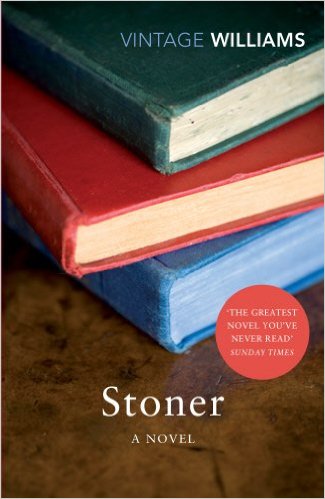
Stoner by John Williams – A Belated Review


51nu26tHj-L._SX323_BO1,204,203,200_

Better late than never I suppose!  But then it seems I’m in good company!  My son suggested Stoner as part of my required reading on a recent week of rest and relaxation, good food and daily rambles by the sea.  His only comments were that it was achingly sad and that it came with a glowing imprimatur from John McGahern.  He was right – it is a stunning page-turner of a book, depicting the life, and indeed the death, of William Stoner, who lived his life in the quad and in the rooms and classrooms adjacent to Jesse Hall in Columbia University, Missouri.  Stoner’s time at the fledgling University, as student and as instructor and finally professor, spans a half century from 1914 and the outbreak of the Great War until the mid-nineteen fifties when another war, the Korean War, threatens to thin the ranks in Columbia’s hallowed halls for a third time in the one century.

John Williams’ novel is a deceptive masterpiece of writing – he manages by inference and sustained inner dialogue and by being confessional to evoke an era and to allow us close as he suffers the slings and arrows of a life which has been enriched by the study of literature.  His lack of confidence in his own ability as a teacher, his constant self-doubt and soul-searching in his own ability, struck a resonant chord with me – the hours of preparation, the repetition of courses, the grading of tests, the hours of mentoring and supervising post grads as they finalise their dissertations and theses, all necessary but removing him from his own specialisation, Renaissance Literature.

William Stoner is an unglamorous, hardworking academic who marries badly, is estranged from his child, toils manfully teaching sophomores and freshmen, year in year out, as his parents before him toiled in the arid, unproductive soil of their Missouri farmholding. Then he dies and is forgotten: a failure, an anti-hero.

A feature of the novel for me was the seamless continuity, the effortless move from one life period to the next as the story unfolds. We pass from Great War to The Roaring Twenties to the Wall Street Crash to Depression to World War as the backdrop to a humdrum life lived well.  Stoner’s life is ordinary, he doesn’t achieve a great deal, nor is he remembered often by his students or colleagues. Stoner isn’t a novel about a man achieving great heights or altering the world, it’s far more personal than that. The novel examines the quiet moments of a person’s life, their small victories and crushing defeats. A life may seem unremarkable on paper, but look a little closer and you will always find hidden depths. John Williams is, in effect, exploring the concept of heroism in twentieth century America.

As we read we find ourselves, then, to use Heaney’s phrase, ‘gleaning the unsaid off the palpable’ as the story unfolds, or to use Stoner’s phrase, we become aware of, “the epiphany of knowing something through words that could not be put in words.” I can only vouch for the fact that there are moments in its reading when the hairs on the nape of my neck stood on edge and I was transported to glimpse eternity through the darkening view from an office window on a winter’s evening as the shades of night come down.

 The novel’s values seem old-fashioned, and William Stoner is cocooned within the university milieu, cloistered would probably be a better description.  He finds his calling and labours conscientiously with little acclaim or recognition.  There are echoes of C.S. Lewis’s work in Oxford here and I also find echoes of Steinbeck and Salinger in John Williams’s depiction of a world view which no longer exists but is attractive for its simplicity and old world charm.

At times in my reading, I was left with the nagging suspicion that the novel is autobiographical and depicts and mirrors Williams’s own academic odyssey. I don’t know enough about John Williams’s life to support or refute this theory but if true his wife, his ‘Edith’, must be glad that the novel has remained obscure and neglected!  It definitely is a paean to his idea of a university and he extols the virtues of university life, a life sharply juxtaposed with the shortcomings and periodic savagery of the world outside the hallowed halls. I am also reminded of Heaney’s beautiful ‘Villanelle for an Anniversary’, commissioned for the three-hundredth anniversary of Harvard University, which evokes the pioneering work of the founder of that great university:

A spirit moved. John Harvard walked the yard,

The atom lay unsplit, the west unwon,

The books stood open and the gates unbarred.

The novel is a kind of masterclass in creative writing.  At times it is subtle and at other times – in its structure, for example – it can be almost brutal, cruelly juxtaposing characters, indeed at times tending to caricature rather than characterise.   For me, the craftsmanship is reminiscent of George Eliot or Dickens.  The juxtaposition of the two women in Willaim Stoner’s life is a very good example of this.  There are no shades of grey here!  Edith and Katherine Driscoll are cruelly juxtaposed as in a melodrama. Edith, has been raised in an emotional vacuum, taught only useless ornamental skills, sheltered as wholly as possible from reality, and “her moral training … was negative in nature, prohibitive in intent, and almost entirely sexual” – effectively cultivated to become a brittle, conniving hysteric. Also, to add to the unsubtlety of the novel’s structure, two of Stoner’s antagonists are disfigured and maimed: Hollis Lomax, Stoner’s bête noir and academic adversary and Lomax’s protégé, Charles Walker.

Stoner isn’t an easy read – not because it’s dense or abstruse but because, as I’ve mentioned earlier, it’s so painful and achingly sad. In a vengeful act, Stoner’s wife, Edith, undertakes a deliberate campaign to separate him from his daughter, the one person he truly loves. Later on, after his daughter has been lost to him, Stoner finds real love again with a young student, Katherine Driscoll, his intellectual equal – and once again an enemy, seeing his happiness, sets out to take it from him. At the university, his superior, Hollis Lomax, contrives to make his teaching life a hell, a horrendous endurance test, a battle of wills.  Williams contrives to forcibly deprive his hero of happiness in his marriage, his daughter, his lover, even his vocation. Here again, there are echoes of Silas Marner and it all feels grindingly inevitable, like the notion of the gods in Tennyson’s ‘Lotus Eaters’ or a Greek tragedy.

Part of the novel’s greatness is that it sees life whole and as it is, without delusion yet without despair. The confessional inner dialogue is sustained and Stoner realises at the last that he found what he sought at the university not in books but in his love and study of them. His life has not been in vain, he has had a Pauline conversion and has discovered the joys of literature and he has also loved and lost in his relationships with his parents, his wife, Edith, his daughter, Grace, and his lover, Katherine. The book’s conclusion, such as it is, is that there is nothing better in this life. The line, “It hardly mattered to him that the book was forgotten and served no use; and the question of its worth at any time seemed almost trivial,” in reference to his own published text on Renaissance Literature, could be seen as the novel’s own epitaph. As he slips quietly towards oblivion he gives us one of the most beautiful sentences in the novel, as his book falls from lifeless fingers into silence:

“The fingers loosened, and the book they had held moved slowly and then swiftly across his still body and fell into the silence of the room.”

 Every word is perfect.

**************

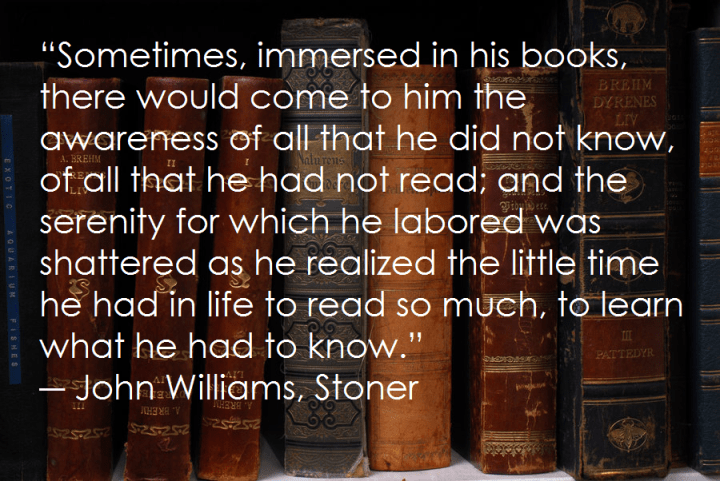
After finishing Stoner, my son thrust the Vintage copy into my hands and told me I just had to read it straight away.  Now, days later having finished it myself, I sit here at my laptop desperately trying to find the right words to describe how John Williams’ novel Stoner has affected me.  I’m speechless, I’m in awe,  I’m wide awake, and all I know for sure is that my head is buzzing way too much for me to get to sleep.

Stoner-Quote


Death and Deceit in Hamlet


 Hamlet (2)


Critics, it seems, have never been in any doubt as to what is the main theme in Hamlet.  Wilson Knight declares that, ‘the theme of Hamlet is death’, while C. S. Lewis has no doubt that, ‘death is the subject of Hamlet’.  Fintan O’Toole in his book Shakespeare is Hard but so is Life, agrees and provides another interesting theory when he says, ‘Hamlet is a play about death.  Or rather, it is a play about the survival of the individual in the face of death’ (p.45).  He goes on to say that in Hamlet, ‘death is the picture, not the frame’.  The cynic in me always wants to point out that when ‘the hurly burly’s done’ there are so many princes and courtiers dead in Elsinore that the next King of Denmark  is from Norway!  (This is akin to the FAI’s ‘Grandfather Rule’ for eligibility for Irish soccer team selection)!

Hamlet’s own final summary of what has happened in the play lends weight to such statements; he talks of:

Carnal, bloody and unnatural acts,

                        Of accidental judgements, casual slaughters,

                        Of deaths put on by cunning and forced cause… V, ii, 379

It might be said that in all Shakespeare’s tragedies death is inevitably a major concern (Hamlet, Macbeth, Othello, Lear, Coriolanus, all die), but it is in Hamlet that it receives its most elaborate and extended treatment.  The play broods deeply on the nature and significance of man’s life.  Wilson Knight points to the almost obsessive preoccupation of the hero, Hamlet, with death: ‘Life that is bound for the disintegration of the grave, love that does not survive the loved one’s life – both in their insistence on death as the primary fact of nature, are branded on the mind of Hamlet, burned into it, searing it with agony’ (The Wheel of Fire, p. 31).  For Claudius, the fact of death is something to be presented in the form of platitudes (‘All that lives must die’).  But for Hamlet, it is an ever-present reality.  Death is at the heart of the two main plots: Hamlet’s bereavement and his consequent mental suffering are paralleled in Ophelia’s loss of her father and her subsequent madness.  Violent death, violent grief and its quick termination in The Murder of Gonzago are a reflection of the events and emotions involving the King Hamlet-Claudius-Gertrude triangle.  Five characters are killed and Ophelia buried before our eyes.  The plot is set in motion by a particularly hideous death, graphically described by its ghostly victim.  The activities of Fortinbras involve the slaughter of thousands of men.  Hamlet sends Rosencrantz and Guildenstern to their deaths.

The treatment of death in Hamlet is more ambitious and adventurous than in the other tragedies of Shakespeare.  In these, death is the end.  Their characters, as C. S. Lewis remarks, ‘think of dying: no one thinks, in these plays of being dead.  In Hamlet, we are kept thinking about it all the time whether in terms of the soul’s destiny or the body’s.  Purgatory, Hell, Heaven, the wounded name, the rights – or wrongs – of Ophelia’s burial, and the staying power of a tanner’s corpse: and beyond this, beyond all Christian and pagan maps of the hereafter, comes a curious groping and tapping of thoughts, about what dreams may come’ (The Prince or the Poem?’).  We are told by the Ghost of terrors beyond the grave, where spirits are daily ‘confined to fast in fires’, and are made to confront the possibility of such terrors by Hamlet himself as he contemplates ‘ the dread of something after death / The undiscovered country’.  The repulsive bodily effects of death are given detailed exposition by Hamlet as he comments on the corpse of Polonius.  Hamlet is much preoccupied with morbid reflections on bodily decay after death, particularly in the graveyard scene, visualising with no little relish how a king (one like Claudius) may go in progress ‘through the guts of a beggar’.

We know from the time when Claudius and Laertes formulate their plants against Hamlet’s life that his death is imminent; the long scene of Ophelia’s funeral keeps the issue in suspense for a time, but the same scene keeps the death theme before our minds. Death in Hamlet is presented in many forms.  That of Polonius is gruesome. He is killed like a rat behind the curtain, his body is lugged about and thought of by Hamlet as being eaten by worms even before it is buried. Ophelia’s death by contrast, is a beautiful tableau; her own song is her requiem; she is garlanded with flowers in the stream and in the grave.  The graveyard scene is one of the most potent evocations of the nature of life and death in all literature.  The tone is largely humorous, but behind the jokes of the singing gravedigger is a powerful affirmation of the permanence of the grave.  ‘Who builds stronger than either the mason, the shipwright or the carpenter?’ asks the second gravedigger.  ’A grave-maker’ replies the first; ‘the houses he makes last till doomsday’. Just as he is saying this, Hamlet, the manner of whose death, we know, is already planned, comes upon the scene, and the skulls the gravedigger unearths leads him to meditate most movingly or mortality.

The graveyard scene is marked by one singular stroke of inspiration easy to miss on a casual reading or watching.  Hamlet’s conversation with the gravedigger raises the subject of his own birth.  When Hamlet asks him how long he has been at the trade, it transpires that ‘it was that very day that young Hamlet was born’ (V,i,145).  The terrible inevitability of death is suddenly brought into a new focus; the very day on which Hamlet came into the world, a gravedigger began his occupation.  To add a further chilling emphasis to the point, the procession that soon enters the graveyard includes the King and Laertes, who plan to end Hamlet’s life.

Two of Hamlet’s soliloquies look on death from another aspect: as a welcome escape from the weariness of the world.  This emphasis is present even before the encounter with the Ghost:

  O that this too, too, solid flesh would melt,

                            Thaw, and resolve itself into a dew,

                            Or that the Everlasting had not fixed

                            His cannon ‘gainst self-slaughter…(1,ii.129)

This world-weariness intensifies after he has learned the full truth about his uncle.  Nobody, he reflects, would willingly endure ‘the whips and scorns of time’, would continue to ‘grunt and sweat under a weary life’ were he not restrained from suicide by the dread of an uncertain hereafter.  Thus he rejects suicide as an option because in suicide the afterlife would be unknown, unpredictable.  However, by Act V he is ready for what lies ahead, and he tells Horatio, ‘the readiness is all’ (Act V, Sc ii, 165).  He is ready for his death and as Fintan O’Toole also concludes, ‘he has rehearsed it,  (and) it will be all right on the night’ (p. 57).

DECEIT AND SUBTERFUGE – APPEARANCE VERSUS REALITY

This meditation connects the death-theme to another: the relation of reality to appearance.  Critics who have analysed the image-pattern in Hamlet have pointed out that Shakespeare makes crucial use of images derived from art to express ideas of concealment and exposure.  One such image used by Claudius in an aside perfectly, expresses this theme:

The harlot’s cheek, beautied with plastering art

                 Is not more ugly to the thing that helps it

                 Than is my deed to my most painted word

111,i, 51

Then Ophelia enters, ‘the celestial, and my soul’s idol, the most beautified Ophelia’ of Hamlet’s love letter. Her purpose here, however, is to act a part, to be false to herself, to let herself be used by Claudius and her father to trick Hamlet.  The words used by Polonius as he prepares Ophelia for the interview with hamlet belong to the pattern of images of appearance contrasted with reality: ‘Tis to much proved, that with devotion’s visage / And pious action, we do sugar o’er / The devil himself’ (III, I, 47).  Hamlet’s famous attack on her extends to a denunciation of all female efforts to conceal reality (‘I have heard of your paintings, too…’).  Art, of course, can also penetrate beneath appearance to uncover the reality, as in the Play Scene, which exposes the King’s concealed guilt.

All through the play the characters and the audience are disturbed by the problematic nature of appearance versus reality.  The very mechanism that sets the action going, the Ghost of Hamlet’s father, is, in the eyes of those who encounter it, of dubious origin and significance.  It may be, to use Hamlet’s words, ‘a spirit of health or a goblin damn’d’; it may be, Horatio thinks, some fiend sent to lure Hamlet to his ruin.  And yet, this phantom heralds some painful realities for Hamlet and the court of Claudius.  Appearances in that court blatantly contradict realities.  Claudius can smile and smile and yet be a villain; Polonius can appear a tedious, garrulous old fool and still be a scheming, dangerous instigator of mischief.  Rosencrantz and Guildenstern can hide treacherous intent under the mask of friendship.  Hamlet’s ‘antic disposition’ is, he assures his friends, merely an appearance, a convenience; this is not how it seems to Claudius and Polonius, who go to most elaborate lengths to probe what they feel is its hidden significance.  Claudius discovered at prayer by hamlet is, perhaps the most striking instance of the pattern of appearance versus reality in the play.  Consider the appearance.  For all Hamlet can see, the act being performed by Claudius has every mark of genuine devotion, ‘some relish of salvation’.  If he dies now at the avenger’s hand, his soul will be saved.  But then we discover the reality, though Hamlet does not.  Claudius cannot really pray at all.  If the reasons Hamlet gives for not wanting to kill the king at this moment are genuine, they are based on a pardonable misreading of appearances, which totally contradict the reality underneath.

Like almost everybody else, Hamlet gets caught up in the general pattern of concealment, deceit, disguise and pretence, much as he condemns these traits in others, particularly in his mother.  He reminds her that her mourning for his father was nothing but a show, whereas his outward show of grief corresponds to what is within (‘I know not seems….’).  Soon, however, Hamlet will be telling his friends that he will be assuming his own kind of disguise, his ‘antic disposition’, with a view to concealing his real self from the world.  Again, in relation to this, it becomes a matter for much debate how real Hamlet’s ‘madness’ is: how much is feigned, how much unfeigned.

Works Cited

Knight, G. Wilson. “The Embassy of Death: An Essay on Hamlet.”  In The Wheel of Fire: Interpretations of Shakespearian Tragedy. London: Routledge, 2001. (17-49).

Lewis, C. S.: “Hamlet: The Prince or the Poem”, in selected literary essays, ed. Walter Hooper, (Cambridge: Cambridge Univesity press, 1969), p.98

O’Toole, Fintan, Shakespeare is Hard, But so is Life: A Radical Guide to Shakespearian Tragedy, Granta Books, 2002. Print.