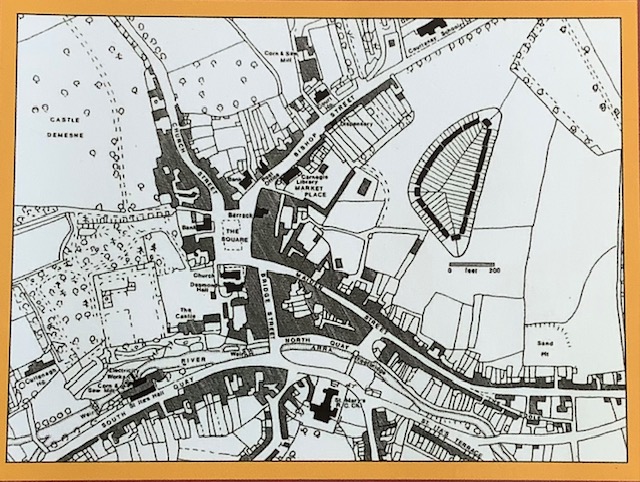
Michael Hartnett’s ‘Move to The Park’

IMG_5066
Inset of New Houses just before occupancy, September 1951. (Courtesy of Dr Pat O’Connor, The New Houses: A Memoir, p.9)

In late 1980, Hartnett began work on his best ballad, which is most loved and recited to this day, the ‘Maiden Street Ballad’.  The ballad stretches out for 47 verses and is a compendium of much of what he had written in prose about Newcastle West in articles for The Irish Times, for Magill magazine and for the local Annual Observer, the annual publication of the Newcastle West Historical Society during the 60s and early 70s.  There are also echoes of other local poems such as ‘Maiden Street’ and ‘Epitaph for John Kelly, Blacksmith’ included among the verses of the ballad.

‘Maiden Street Ballad’ was published by local entrepreneur Davy Cahill’s The Observer Press ‘with the help of members of Newcastle West Historical Society’.  Copies of the original are much sought after on eBay and elsewhere to this day.  It carried a very eloquent dedication, ‘This ballad was composed by Michael Hartnett in Glendarragh, Templeglantine, County Limerick in December 1980 as a Christmas present for his father Denis Harnett (sic)’. 

‘Maiden Street Ballad’ contains a number of autobiographical segments.  The early stanzas tell us about his childhood days where they rented accommodation first in Connolly Terrace and then in nearby Church Street before making the move to Lower Maiden Street where they rented a room from Legsa Murphy.

We rented a mansion down in Lower Maiden Street,

Legsa Murphy our landlord, three shillings a week,

the walls were of mud and the roof it did leak

and our mice nearly died of starvation.

Probably one of the most notorious segments is the ten ribald verses from 27 to 37 which describe a virtual pub crawl of all of Newcastle West’s 26 public houses which were doing business in 1980.  (Michael Hartnett’s 26 Pubs at Christmas!)   In another significant segment from verses 16 to 23, he eloquently documents the move from Lower Maiden Street to the new housing scheme in Assumpta Park.  These verses portray Hartnett at his best, they are witty, caustic, and often slanderous; his use of hyperbole pokes fun at his friends and those neighbours who were part of that mass exodus from the slums of Maiden Street and The Coole.

Hartnett says that the street finally ‘gave up the ghost’ in September 1951 when most of the inhabitants were rehoused in one of the 60 new houses in Assumpta Park.  Hartnett describes the operation, likening it to the hazardous Exodus of the Israelites escaping from Egypt to the Promised Land!  Unlike the ‘pub crawl’ sequence which describes in great detail the quirks and peccadillos of numerous characters, including many of his own family, there are only two people mentioned in the ‘move to The Park’ sequence – only passing reference is made to Dick Fitz and Mike Hart, two great stalwarts of the area.  Rather this segment describes his people, his neighbours, the real old stock of the town in a richly comic and exaggerated way.

In the late 40s and early 50s, the local authority had built up to 60 social houses to relieve the squalor, poverty and slum-like conditions in Maiden Street and The Coole.   They were built in an area of the town known as Hungry Hill, although the new development was officially called Assumpta Park.  The Hartnett family were but one of the lucky families to be given a new house and they moved into Number 28 in 1951.  Hartnett tells us that the ‘old street finally gave up the ghost’ and the mud-walled, galvanised cabins were abandoned down in The Coole and the people were tempted to move ‘to the Hill’s brand new houses’.   The ‘New Houses’ stood on a hill high and exposed above the town at the outer edge of a terminal moraine.  The original sixty houses were finally allocated on the 15th of September, 1951.  Dr Pat O’Connor, the author of ‘The New Houses: A Memoir’, whose family were allocated Number 24, remembers that ‘doors were still without numbers and entrances without gates’.  There was no street lighting or footpaths so it must have been a very eerie place to move to.

The relocation is described in almost Biblical terms with a delicious mixed cocktail of the Exodus story and the story of Noah’s Ark:

and some of the ass-cars were like Noah’s Ark

with livestock and children and spouses.

As well as the Bible, Hartnett is also influenced here by the writings of John Steinbeck and his iconic descriptions of the Great Depression in The Grapes of Wrath as well as the writing of Sean O’Casey and Brendan Behan who wrote about the tenements in Dublin and the gradual movement of people from places like Henrietta Street to Crumlin and Cabra in the 1940s, and Ballyfermot and Artane in the 50.

IMG_5068
The Park upon first occupancy, September 1951. (O’Connor, 12)

Hartnett is a very astute commentator on the social ills of his day and the Maiden Street Ballad, and this segment in particular, shows the level of poverty and deprivation experienced by the people in that part of the town in the early 50s.  They brought with them their ‘flourbags’, ‘their ‘tea chests’ and ‘three-legged stools’ and their ‘jam-crocks in good working order’.  At that time many of the households were so poor that they were unable to afford the bare necessities such as cups and saucers.  Jam was sold in one-pound and two-pound glass jars and these were used as substitutes for tea cups and milk glasses in most households.  Dr Pat O’Connor tells us that the new occupants had come from ‘the tattered tails of the town, where congestion and dereliction were rife, but (where) the sense of neighbourhood intimacy was well defined’.  Hartnett describes the move in a very light-hearted way, and he follows up by saying that they also brought their fleas, bed bugs and mice with them because they felt they were almost part of the family.  And now that they’ve moved up in the world the fleas also go to Ballybunion each year on holiday with their host families ‘though hundreds get drowned in the waves there’.

Many found it very difficult to make the necessary adjustments to their new surroundings and the poet pokes fun at their efforts to adapt to such new luxuries as piped water, electricity, toilets and bathtubs.  The novelty of two-storey houses had also to be grappled with – three bedrooms upstairs and a hallway, kitchen, scullery and bathroom downstairs.  Apocryphal stories circulated that one of the legendary early occupants, Forker O’Brien, famously used the bannisters as kindling for the fire!  Indeed, Hartnett would have us believe that many continued with the practices that had been commonplace in their former residences:

In nineteen fifty-one people weren’t too smart:

in spite of the toilets, they pissed out the back,

washed feet in the lavat’ry, put coal in the bath

and kept the odd pig in the garden.

They burnt the bannisters for to make fires

and pumped up the Primus for the kettle to boil,

turned on all the taps, left the lights on all night –

but these antics I’m sure you will pardon.

Hartnett continues in his light-hearted vein, and he lists the great improvements that have come about in peoples’ lives in the years following their relocation.  They are respected now and indeed have earned the respect of their fellow townspeople, and they have made great strides to better their situation.  Many can now boast of having regular employment, and motor cars and many even go on foreign holidays each year ‘in the Canaries’.  The poet’s sense of pride in his own local place is very evident in this section of the ballad and he compares other places he has visited in his travels, but none can compare to his native Newcastle West.

I have seen some fine cities in my traveller’s quest.

put Boston and London and Rome to the test,

but I wouldn’t give one foot of Newcastle West

for all of their beauty and glamour.

In those early days access to The Park was very limited and usually meant a long walk down through the Market Yard or Scanlon’s Lane or down New Road (now Sheehan’s Road) if one wanted to visit friends in Maiden Street or go to Mass on a Sunday.  Eventually, representations were made to local Councillors and with the second phase of houses being built in 1955 a Mass Path was constructed which gave residents easier access to the old haunts in Maiden Street and also easy access to the parish church, as the name suggests.  The residents of Maiden Street and The Coole were accustomed to being looked down on by the more well-to-do residents of the town and even now, as Dr Pat O’Connor points out, even though the residents of Assumpta Park were in a more exalted and elevated location they found that ‘by a curious process of inversion the people of the town (still) looked down on us’!
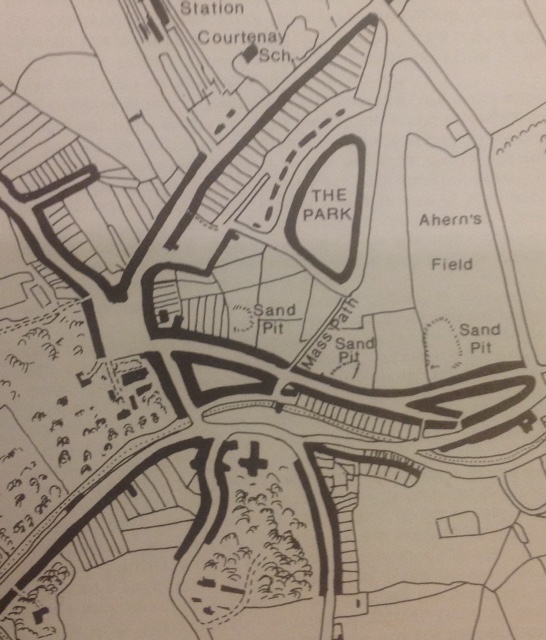
Maiden Street (2)
Detail from the map by Dr Pat O’Connor showing Assumpta Park and the Mass Path in relation to Maiden Street and the church.  Note also the three sandpits still in use at the time – Musgraves (now Whelan’s), O’Gorman’s, and Ahern’s.

Stanzas 22 and 23 paint a moving, nostalgic picture with the poet’s rose-tinted lens firmly in place.  We are invited to picture an idyllic scene almost straight out of Thomas Gray’s Elegy Written in a Country Churchyard.  It is high summer in Assumpta Park and the visibility is so good you can see Rooska to the north and the Galtees forty miles away to the east straddling the Limerick, Tipperary and Cork borders.  All is peaceful and neat and tidy and quiet ‘and the dogs lie asleep in the roadway’.  The stanza ends with a beautiful echo of a line from Act 3, Scene 2 of Macbeth – “Light thickens, and the crow/ Makes wing to th’ rooky wood.”  (I once heard Noel O’Connor, that great unsung hero and fount of wisdom, say that there’s a quote in Macbeth to solve every problem and cover every possible situation and permutation).  Hartnett, in a more benign and domesticated mood, gives us his variation on Macbeth’s more bloody intent:

and the crows to the tree tops fly home in black rows

and the women wheel out their new go-cars.

 Dr Pat O’Connor believed that making a new home in The Park was hardest on the women.  Yet, as usual, they were the quintessential homemakers.   In 1951 scarcely any worked outside the home, often supplementing family income by keeping lodgers or by fostering children, many of whom grew up seamlessly within the various families.

Hartnett’s love for this place is nourished by innocent childhood memories.  After all, the poem is meant as a Christmas present for his now ailing father and so he paints a picture which we are invited to contrast with the poverty and squalor of earlier childhood.  Hartnett is now forty years of age and remembering life as a ten-year-old in his favourite place, his home in 28 Assumpta Park:

when the smell of black pudding it sweetens the air

and the scent of back rashers it spreads everywhere

and the smoke from the chimneys goes fragrant and straight

to the sky in the Park in the evening.

The residents of Assumpta Park, then and now, are indeed lucky to have as their chroniclers Dr Pat J. O’Connor, one of the most pre-eminent human geographers of his generation, and Michael Hartnett one of Ireland’s great twentieth-century poets.  Both have left us their differing yet unique perspectives of an era of great change and of a wonderful social engineering project that worked.  Hartnett would definitely point to it as an example that the present government should try to emulate!

231147404_3994158964029080_5415516130120616571_n
A group of workers photographed on-site during the building of the second phase of the houses in 1955.  Photo courtesy of Newcastle West Olden Times Facebook Page.  These houses were built by Edmond Power.  Included above: Jack Power (back left), alongside Jackie Brouder, Edmond Power (back right), Mike Harte (front left), Mossy Hurley with child (front right), with Jer Hough and Tommy Fox in line alongside.

Works Cited:

O’Connor, Patrick J. The New Houses: A Memoir. Oidhreacht na Mumhan Books, 2009

Postscript

I came across this little-known poem of Hartnett’s recently which further details the trauma that was involved in the ‘Move to The Park’.  There is an Irish version as well.

Off to the New Houses

I was there when the street expired.

When the cabins were put under lock and key;

Gloom and delight were left imprisoned,

The birth-room, the death-room;

And under the floor and on the wall

The mouse and the spider were lonely.


Donkey and trap, wheel-barrow, hand-cart

Safely transporting our ancestral bedding,

My father’s mug, my mother’s sugar-bowl:

We shifted all under cover of night.

And under the floor and on the wall

The mouse and the spider were lonely.


We shifted all that mattered

Except the heart of the old tortured street:

After a pause for porter, my father and his friends went

To move it to us at once.

It was bigger than ten cows’ hearts,

Weals and wounds and scabs all over it.

But its history and grief notwithstanding

There was a living pulse of blood there still.

Late in the night it was put on a cart

And they pulled it across a field

But the heart expired before journey’s end

And we still can’t wash out the bloodstains.

And still under the floor and on the wall

The mouse and the spider are lonely.

Michael Hartnett


Pulled Pork and Poetry at Éigse Michael Hartnett 2018

Éigse 2018

‘Like many Irish children, I was reared on a diet of folktale, Republicanism and mediocre ballads’.[1]

Éigse Michael Hartnett 2018 has a rich and varied schedule of events which will take place this year from the 12th to the 14th of April. Éigse is proud to welcome John Boyne, Mike McCormack, Declan Kiberd, Emma Langford, Robyn Rowland, and others to Newcastle West for the first time.  This year is also special because Michael’s family, his wife Rosemary, son Niall and daughter Lara will be present for the celebrations.

As part of this year’s Éigse, the organisers have included an interesting food element in recognition of the burgeoning food industry in the town and also as a celebration of the town’s rich agricultural hinterland. The event, which will take place in Desmond Complex on Saturday the 14th of April at 12.30pm,  and is titled ‘Pulled Pork and Poetry’.  It features a cookery demonstration by Tom Flavin, Executive Chef, the Strand Hotel and Pigtown Festival committee member, accompanied by readings from Hartnett’s Collected Poems by Limerick poet and short fiction writer, Edward O’Dwyer. (See Éigse programme for full details).  The organisers are indebted to Tom Flavin and Edward O’Dwyer for their enthusiastic support for this venture. 

The following blog post seeks to explore the link between Michael Hartnett, food, cooking and the kitchens he survived and graced in Lower Maiden Street, Camas and further afield.

 ******

Michael Hartnett returned to his native Newcastle West in the mid-1970’s and bought a cottage in the townland of Glendarragh in the parish of Templeglantine.  The ‘townie’ lamented that now he was forced to live ‘in exile out foreign in ‘Glantine’.  In June 1974 he had made his famous proclamation from the stage of the Peacock Theatre in Dublin that henceforth he would write only in Irish.  In the Autumn of 1977, he was commissioned to write a piece for the upcoming Christmas edition of Magill Magazine which was owned and edited at the time by Hartnett’s friend, Vincent Browne, a fellow West Limerick man making a name for himself in publishing circles in Dublin.

The piece was written and published and showed Hartnett to be a very incisive, insightful and acerbic social commentator.  It was entitled ‘Christmas in Maiden Street’ and evoked memories of life in Lower Maiden Street in the years immediately after the ending of World War Two and is a chilling reminder of the austerity endured during those years.  Poverty and hardship were rife and families struggled to make ends meet.  In the article, he recalls that ‘candles and paraffin-lamps did not brighten the darkness in kitchens in Maiden Street’.  There were no luxuries and the necessities of life were very scarce: ‘coal was bought by the half-stone, butter by the quarter pound, and tea by the half-ounce’.  As Christmas drew near ‘the spectre of Santa Claus loomed malevolently over the slates and thatch’.

For the poor of Maiden Street, the great feast of Christmas was an extra strain.  Members of local charitable institutions visited ‘the meagre kitchens’, ‘the nailed-together chairs, the worn oilcloth topped tables, the dead fires’ and were ‘as hated as the rent-man’.  He tells us that the Victorian Christmas had not yet arrived in Newcastle West:

‘there was no turkey, no plum pudding, no mince-pies … the very poor managed roast meat, usually mutton.  We often rose to two cocks.  The goose was common.  There was a fruit cake, jelly and custard; the dinner of the year.’

The article ends with the bitter hope that ‘There will never be Christmasses like those again, I hope to God’.

This vein of bittersweet nostalgia culminated in December 1980 with the publication of the Maiden Street Ballad, written as a Christmas present for his father Denis Harnett.  This 47 verse poem also contains details of the hardships and austerity suffered by the people who lived in Lower Maiden Street and The Coole.

Nineteen forty-one was a terrible year,

the bread it was black and the butter was dear;

you couldn’t get fags and you couldn’t tea –

we smoked turf-dust and had to drink porter.

He goes on to tell his audience that ‘we were hungry and poor down in Lower Maiden Street / a fact I will swear on the Bible’.  Elsewhere he states that his peers ‘were raggy and snot-nosed and needy’.  The only relief for the Harnett family came in the form of their grandmother, Bridget Halpin, who lived on a small farm five miles away in Camas.

The day of the pension my Nan came to town

In a flurry of hairpins with her shawl wrapped around,

With a dozen of eggs and maybe a half-crown

And a bag of new spuds in her ass-car.

He goes on to recount his childhood diet and it is clear that most of the produce was grown on that small farm in Camas by his Uncle Dinny Halpin and transported to town in his grandmother’s ass and cart!

We had turnips for dinner, we had turnips for tea,

and half-stones of pandy piled up on our plates;

we feasted on cabbage, we fattened on kale

and a feed of boiled meat if we smelt it!

Later he was to immortalise Bridget Halpin in his beautiful poem ‘Death of an Irishwoman’ using, at times, very unflattering language.  He tells us that ‘she ate monotonous food’ such as the rural staples of the time bacon and cabbage.  In her final days, he tells us she was reduced to eating ‘thin diminishing porridge / in a stone-cold kitchen’.  For the poet, Bridget Halpin represents an Irishness which is out of step with modernity and ambivalent to any aesthetic conceptions of the world, ‘Ignorant, in the sense / she ate monotonous food / and thought the world was flat’, and defined by an intuitive spirituality, ‘pagan, in the sense / she knew the things that moved / at night were neither cats nor dogs’.   In an interview with Victoria White published in The Irish Times, Hartnett embellished this idea, that his close antecedents existed in a pre-modern Ireland where the Irish language still predominated, ‘My grandfather couldn’t speak English, and if you couldn’t, you couldn’t get a good price for a pig.  If the pig was worth two and six and you came back with one and six, you got lashed’ (White 14). That Hartnett links the pre-modern sensibility which Irish represents for him with economic loss and subsequent physical pain encapsulates the colonial dynamic which saw the abandonment of Irish as a spoken language more broadly within the country.  In this context Hartnett’s assertion at the very point of his departure from writing in English takes on a further resonance:

… I will not see

great men go down

who walked in rags

from town to town

finding English a necessary sin

the perfect language to sell pigs in. 

Bridget Halpin’s cold kitchen, which is described so well in his poem ‘A Small Farm’, describes the quintessential Irish rural kitchen of the 1950’s:

Here were rosary beads,

A bleeding face,

The glinting doors

That did encase

Their cutler needs,

Their plates, their knives,

The cracked calendars

Of their lives.

 It stands in direct contrast to the warmth of Heaney’s Aunt Mary’s kitchen in Mossbawn and at the same time, Bridget Halpin’s kitchen bears great similarities to Moran’s kitchen in Great Meadow as depicted in John McGahern’s Amongst Women.  In the 1940’s and 1950’s country farming society is built on manners, manners which are best seen at the dinner table.  Hartnett’s later poetry and his attitude to food and cooking are heavily influenced by his formative years spent in Bridget Halpin’s kitchen in Camas.  In his, as yet, limited experience kitchens are seen as scant, depressing places.  Food is frugal and evokes a sense of lacking, not plenty.

Rural Camas in the early 1950’s still moved in a slow, seasonal rhythm.  The annual ritual of killing the pig is described beautifully in the poem ‘Pigkilling’.  Characteristically, Hartnett executes (pun intended!) the poetic tactic emphatically, the human actors in the ritual themselves becoming animalistic, drenched in the animal’s blood:

his smiling head

sees a delicate girl

up to her elbows

in a tub of blood (Collected Poems 125)

Hartnett, the central character in the poem, uses the pig’s bladder as a plaything: ‘I kicked his golden bladder / in the air’.  Killing the pig was one of those joyful rituals in the rural community.  During the killing of the pig, the blood was collected in a bucket for the making of puddings. The carcass would then be hung from a hook in the shed with a basin under its head to catch the drip, and a potato was often placed in the pig’s mouth to aid the dripping process. After a few days, the carcass would be dissected.  The body was washed and then each piece that was to be preserved was carefully salted and placed neatly in a barrel and hermetically sealed.    It was customary in parts of the midlands to add brown sugar to the barrel at this stage, while in other areas juniper berries were placed in the fire when hanging the hams and flitches (sides of bacon), wrapped in brown paper, in the chimney for smoking (Sharkey 166). While the killing was predominantly men’s work, it was the women who took most responsibility for the curing and smoking. Black Puddings have always been popular in Irish cuisine. The pig’s intestines were washed well and soaked in a stream, and a mixture of onions, lard, spices, oatmeal and flour were mixed with the blood and the mixture was stuffed into the casing and boiled for about an hour and then allowed to cool.  It was customary that neighbours were then given some of this black pudding, fresh pork and sausages in the aftermath of every pigkilling putting into practice the old Irish proverb: Faoi scáth a chéile a mhaireann na ndaoine’ – (we all live in each other’s shadow).

Years later, his friend and fellow poet Tony Curtis noted presciently about Hartnett that, ‘While I couldn’t say he loved eating, he did love cooking’ (Curtis 170).  From various interviews and recorded anecdotes regarding his attitude to food (as opposed to drink!) I would guess that food and cooking for Hartnett was a sort of therapy.  While cooking for family or friends the metronomic carrying out of simple physical tasks allowed him to turn off the cerebral for a while at least.  Dennis O’Driscoll in an interview conducted with Michael Hartnett in the Poetry Ireland offices on 12th December 1986 comments on his eclectic culinary tastes and we get a further glimpse of Hartnett the culinary enthusiast.

Most of my personal encounters with Michael were as random as dreams: chance meetings on the streets around his shopping and drinking haunts in central Dublin… Michael might be carrying a rattlebag of fresh oysters or a newly-minted circle of Lombardian focaccia.  His tastes in poetry, as in food, could range far beyond Munster.[2]

Later in the interview, O’Driscoll asks Hartnett if he is content as a writer and if there was something else he would have liked to have been.  Hartnett replies:

I am a chef manqué all right; I trained as a chef for a while.  Again that involves creation and the poaching of other men’s recipes and ideas.  But as I started to write poetry, or verse at least, when I was thirteen years old, any ambitions I had in any other direction were pre-empted by that immediately.[3]

On a totally different level Dermot Bolger who delivered the Michael Hartnett Memorial Lecture during Éigse Michael Hartnett in April 2017 recounted an incident which took place at his local chipshop in Finglas:

It was after midnight when we reached Finglas but Macari’s chipshop remained open on Clune Road.  Years later in Inchicore Haiku Michael wrote:

In local chippers

Queueing for carbohydrates

A dwarfed people.

We queued for our late-night carbohydrates.  Critics can elaborate on Michael’s gift as a poet and contextualise his work.  My interest here is putting down memories for his son and daughter and what struck me was how Michael enthralled the late-night queue and staff in that Finglas chipshop.  He wasn’t attention seeking; they were simply drawn into his quiet magnetism.  The staff had no idea who he was but afterwards always asked for news of my friend in the countryman’s cap.[4]

In the sonnet ‘The Poet Dreams and Resolves’ he paints the very clichéd image of the artist at work, alone but not lonely.  He requires few luxuries only ‘an adequate supply / of stout and spirits (or of stout only) / and some cigarettes, and writing paper, / and a little cheap food, ….’.  This (self-perpetuated) image of Hartnett as a frugal monk, requiring only the very basics to live and create mirrors this ascetic existence dwelling ‘in the shade of Tom White’s green hill / in exile out foreign in ‘Glantine’ during the late ‘70’s and early 80’s.

It is clear that Michael Hartnett had a very varied relationship with Irish cuisine from the relatively vulgar turnips and pandy of earlier days in Newcastle West and Camas to the later more urbane ‘rattlebag of oysters’ in central Dublin.  Section 3 of ‘A Farewell to English’ centres on Hartnett’s dissatisfaction with the cultural, political, and literary misappropriation and misuse of the Irish language.  In it, he rather cheekily attacks W.B Yeats, the most pre-eminent Irish poet and Nobel Laureate of a previous generation, ‘Chef Yeats that master of the use of herbs’.  Yeats’s use of Gaelic literary traditions and myth is criticized.  However, the main reason I mention it here is because the language and imagery used by Hartnett is that of a master chef – ‘pinch of saga’, ‘soupcon of philosophy’, ‘carefully stirred’, ‘Anglo- Saxon stock’, ‘Cuchulainn’s marrow bones to marinate’, ‘simmered slow’ and Hey Presto, like the witches in Macbeth who dance about their cauldron, we concoct ‘the celebrated Anglo-Irish stew’.

As Éigse Michael Hartnett 2018 draws near we hope to likewise celebrate Hartnett’s genius with good poetry, good food (and some drink!) in the company of his family, friends and myriad followers.

Works Cited

Curtis, Tony. A Life in Poetry, p. 170.

Hartnett, Michael. Collected Poems, Oldcastle: The Gallery Press, 2001.

Hartnett, Michael. ‘Wrestling with Ó Bruadair’, in Mac Reamoinn, S., The Pleasures of Gaelic Poetry (London: Allen Lane, 1982).

Sharkey, Olive. Old Days Old Ways: An Illustrated Folk History of Ireland. Dublin: The O’Brien Press, 1985.

White, Victoria. “Heartbreak in Two Languages” The Irish Times, (15th December 1994).

https://www.irishtimes.com/newspaper/archive/1994/1215/Pg014.html#Ar01400

Footnotes

[1] Hartnett, M., ‘Wrestling with Ó Bruadair’, in Mac Reamoinn, S., The Pleasures of Gaelic Poetry (London: Allen Lane, 1982), p.65.

2.  This interview first appeared in Poetry Ireland Review (Autimn 1987).

3.   Ibid.

[4] ‘An Enthralling Companion’ – a commemorative article by Dermot Bolger which appeared in The Irish Times on Wednesday, October 12th, 2005. Read the article here

image