Michael Hartnett’s ‘Move to The Park’

IMG_5066
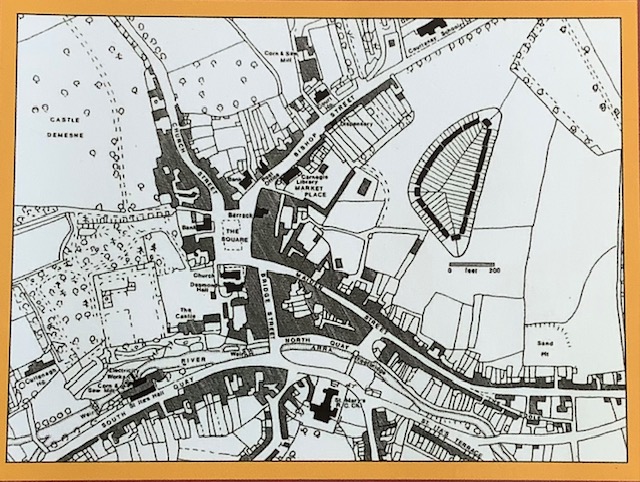
Inset of New Houses just before occupancy, September 1951. (Courtesy of Dr Pat O’Connor, The New Houses: A Memoir, p.9)

In late 1980, Hartnett began work on his best ballad, which is most loved and recited to this day, the ‘Maiden Street Ballad’.  The ballad stretches out for 47 verses and is a compendium of much of what he had written in prose about Newcastle West in articles for The Irish Times, for Magill magazine and for the local Annual Observer, the annual publication of the Newcastle West Historical Society during the 60s and early 70s.  There are also echoes of other local poems such as ‘Maiden Street’ and ‘Epitaph for John Kelly, Blacksmith’ included among the verses of the ballad.

‘Maiden Street Ballad’ was published by local entrepreneur Davy Cahill’s The Observer Press ‘with the help of members of Newcastle West Historical Society’.  Copies of the original are much sought after on eBay and elsewhere to this day.  It carried a very eloquent dedication, ‘This ballad was composed by Michael Hartnett in Glendarragh, Templeglantine, County Limerick in December 1980 as a Christmas present for his father Denis Harnett (sic)’. 

‘Maiden Street Ballad’ contains a number of autobiographical segments.  The early stanzas tell us about his childhood days where they rented accommodation first in Connolly Terrace and then in nearby Church Street before making the move to Lower Maiden Street where they rented a room from Legsa Murphy.

We rented a mansion down in Lower Maiden Street,

Legsa Murphy our landlord, three shillings a week,

the walls were of mud and the roof it did leak

and our mice nearly died of starvation.

Probably one of the most notorious segments is the ten ribald verses from 27 to 37 which describe a virtual pub crawl of all of Newcastle West’s 26 public houses which were doing business in 1980.  (Michael Hartnett’s 26 Pubs at Christmas!)   In another significant segment from verses 16 to 23, he eloquently documents the move from Lower Maiden Street to the new housing scheme in Assumpta Park.  These verses portray Hartnett at his best, they are witty, caustic, and often slanderous; his use of hyperbole pokes fun at his friends and those neighbours who were part of that mass exodus from the slums of Maiden Street and The Coole.

Hartnett says that the street finally ‘gave up the ghost’ in September 1951 when most of the inhabitants were rehoused in one of the 60 new houses in Assumpta Park.  Hartnett describes the operation, likening it to the hazardous Exodus of the Israelites escaping from Egypt to the Promised Land!  Unlike the ‘pub crawl’ sequence which describes in great detail the quirks and peccadillos of numerous characters, including many of his own family, there are only two people mentioned in the ‘move to The Park’ sequence – only passing reference is made to Dick Fitz and Mike Hart, two great stalwarts of the area.  Rather this segment describes his people, his neighbours, the real old stock of the town in a richly comic and exaggerated way.

In the late 40s and early 50s, the local authority had built up to 60 social houses to relieve the squalor, poverty and slum-like conditions in Maiden Street and The Coole.   They were built in an area of the town known as Hungry Hill, although the new development was officially called Assumpta Park.  The Hartnett family were but one of the lucky families to be given a new house and they moved into Number 28 in 1951.  Hartnett tells us that the ‘old street finally gave up the ghost’ and the mud-walled, galvanised cabins were abandoned down in The Coole and the people were tempted to move ‘to the Hill’s brand new houses’.   The ‘New Houses’ stood on a hill high and exposed above the town at the outer edge of a terminal moraine.  The original sixty houses were finally allocated on the 15th of September, 1951.  Dr Pat O’Connor, the author of ‘The New Houses: A Memoir’, whose family were allocated Number 24, remembers that ‘doors were still without numbers and entrances without gates’.  There was no street lighting or footpaths so it must have been a very eerie place to move to.

The relocation is described in almost Biblical terms with a delicious mixed cocktail of the Exodus story and the story of Noah’s Ark:

and some of the ass-cars were like Noah’s Ark

with livestock and children and spouses.

As well as the Bible, Hartnett is also influenced here by the writings of John Steinbeck and his iconic descriptions of the Great Depression in The Grapes of Wrath as well as the writing of Sean O’Casey and Brendan Behan who wrote about the tenements in Dublin and the gradual movement of people from places like Henrietta Street to Crumlin and Cabra in the 1940s, and Ballyfermot and Artane in the 50.

IMG_5068
The Park upon first occupancy, September 1951. (O’Connor, 12)

Hartnett is a very astute commentator on the social ills of his day and the Maiden Street Ballad, and this segment in particular, shows the level of poverty and deprivation experienced by the people in that part of the town in the early 50s.  They brought with them their ‘flourbags’, ‘their ‘tea chests’ and ‘three-legged stools’ and their ‘jam-crocks in good working order’.  At that time many of the households were so poor that they were unable to afford the bare necessities such as cups and saucers.  Jam was sold in one-pound and two-pound glass jars and these were used as substitutes for tea cups and milk glasses in most households.  Dr Pat O’Connor tells us that the new occupants had come from ‘the tattered tails of the town, where congestion and dereliction were rife, but (where) the sense of neighbourhood intimacy was well defined’.  Hartnett describes the move in a very light-hearted way, and he follows up by saying that they also brought their fleas, bed bugs and mice with them because they felt they were almost part of the family.  And now that they’ve moved up in the world the fleas also go to Ballybunion each year on holiday with their host families ‘though hundreds get drowned in the waves there’.

Many found it very difficult to make the necessary adjustments to their new surroundings and the poet pokes fun at their efforts to adapt to such new luxuries as piped water, electricity, toilets and bathtubs.  The novelty of two-storey houses had also to be grappled with – three bedrooms upstairs and a hallway, kitchen, scullery and bathroom downstairs.  Apocryphal stories circulated that one of the legendary early occupants, Forker O’Brien, famously used the bannisters as kindling for the fire!  Indeed, Hartnett would have us believe that many continued with the practices that had been commonplace in their former residences:

In nineteen fifty-one people weren’t too smart:

in spite of the toilets, they pissed out the back,

washed feet in the lavat’ry, put coal in the bath

and kept the odd pig in the garden.

They burnt the bannisters for to make fires

and pumped up the Primus for the kettle to boil,

turned on all the taps, left the lights on all night –

but these antics I’m sure you will pardon.

Hartnett continues in his light-hearted vein, and he lists the great improvements that have come about in peoples’ lives in the years following their relocation.  They are respected now and indeed have earned the respect of their fellow townspeople, and they have made great strides to better their situation.  Many can now boast of having regular employment, and motor cars and many even go on foreign holidays each year ‘in the Canaries’.  The poet’s sense of pride in his own local place is very evident in this section of the ballad and he compares other places he has visited in his travels, but none can compare to his native Newcastle West.

I have seen some fine cities in my traveller’s quest.

put Boston and London and Rome to the test,

but I wouldn’t give one foot of Newcastle West

for all of their beauty and glamour.

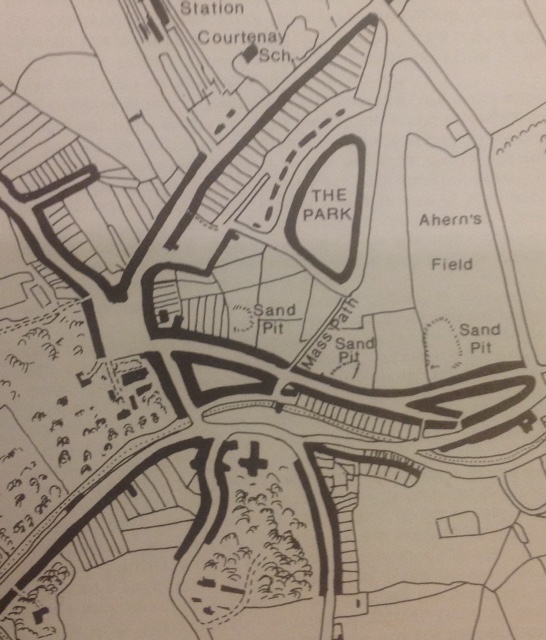
In those early days access to The Park was very limited and usually meant a long walk down through the Market Yard or Scanlon’s Lane or down New Road (now Sheehan’s Road) if one wanted to visit friends in Maiden Street or go to Mass on a Sunday.  Eventually, representations were made to local Councillors and with the second phase of houses being built in 1955 a Mass Path was constructed which gave residents easier access to the old haunts in Maiden Street and also easy access to the parish church, as the name suggests.  The residents of Maiden Street and The Coole were accustomed to being looked down on by the more well-to-do residents of the town and even now, as Dr Pat O’Connor points out, even though the residents of Assumpta Park were in a more exalted and elevated location they found that ‘by a curious process of inversion the people of the town (still) looked down on us’!
Maiden Street (2)
Detail from the map by Dr Pat O’Connor showing Assumpta Park and the Mass Path in relation to Maiden Street and the church.  Note also the three sandpits still in use at the time – Musgraves (now Whelan’s), O’Gorman’s, and Ahern’s.

Stanzas 22 and 23 paint a moving, nostalgic picture with the poet’s rose-tinted lens firmly in place.  We are invited to picture an idyllic scene almost straight out of Thomas Gray’s Elegy Written in a Country Churchyard.  It is high summer in Assumpta Park and the visibility is so good you can see Rooska to the north and the Galtees forty miles away to the east straddling the Limerick, Tipperary and Cork borders.  All is peaceful and neat and tidy and quiet ‘and the dogs lie asleep in the roadway’.  The stanza ends with a beautiful echo of a line from Act 3, Scene 2 of Macbeth – “Light thickens, and the crow/ Makes wing to th’ rooky wood.”  (I once heard Noel O’Connor, that great unsung hero and fount of wisdom, say that there’s a quote in Macbeth to solve every problem and cover every possible situation and permutation).  Hartnett, in a more benign and domesticated mood, gives us his variation on Macbeth’s more bloody intent:

and the crows to the tree tops fly home in black rows

and the women wheel out their new go-cars.

 Dr Pat O’Connor believed that making a new home in The Park was hardest on the women.  Yet, as usual, they were the quintessential homemakers.   In 1951 scarcely any worked outside the home, often supplementing family income by keeping lodgers or by fostering children, many of whom grew up seamlessly within the various families.

Hartnett’s love for this place is nourished by innocent childhood memories.  After all, the poem is meant as a Christmas present for his now ailing father and so he paints a picture which we are invited to contrast with the poverty and squalor of earlier childhood.  Hartnett is now forty years of age and remembering life as a ten-year-old in his favourite place, his home in 28 Assumpta Park:

when the smell of black pudding it sweetens the air

and the scent of back rashers it spreads everywhere

and the smoke from the chimneys goes fragrant and straight

to the sky in the Park in the evening.

The residents of Assumpta Park, then and now, are indeed lucky to have as their chroniclers Dr Pat J. O’Connor, one of the most pre-eminent human geographers of his generation, and Michael Hartnett one of Ireland’s great twentieth-century poets.  Both have left us their differing yet unique perspectives of an era of great change and of a wonderful social engineering project that worked.  Hartnett would definitely point to it as an example that the present government should try to emulate!

231147404_3994158964029080_5415516130120616571_n
A group of workers photographed on-site during the building of the second phase of the houses in 1955.  Photo courtesy of Newcastle West Olden Times Facebook Page.  These houses were built by Edmond Power.  Included above: Jack Power (back left), alongside Jackie Brouder, Edmond Power (back right), Mike Harte (front left), Mossy Hurley with child (front right), with Jer Hough and Tommy Fox in line alongside.

Works Cited:

O’Connor, Patrick J. The New Houses: A Memoir. Oidhreacht na Mumhan Books, 2009

Postscript

I came across this little-known poem of Hartnett’s recently which further details the trauma that was involved in the ‘Move to The Park’.  There is an Irish version as well.

Off to the New Houses

I was there when the street expired.

When the cabins were put under lock and key;

Gloom and delight were left imprisoned,

The birth-room, the death-room;

And under the floor and on the wall

The mouse and the spider were lonely.


Donkey and trap, wheel-barrow, hand-cart

Safely transporting our ancestral bedding,

My father’s mug, my mother’s sugar-bowl:

We shifted all under cover of night.

And under the floor and on the wall

The mouse and the spider were lonely.


We shifted all that mattered

Except the heart of the old tortured street:

After a pause for porter, my father and his friends went

To move it to us at once.

It was bigger than ten cows’ hearts,

Weals and wounds and scabs all over it.

But its history and grief notwithstanding

There was a living pulse of blood there still.

Late in the night it was put on a cart

And they pulled it across a field

But the heart expired before journey’s end

And we still can’t wash out the bloodstains.

And still under the floor and on the wall

The mouse and the spider are lonely.

Michael Hartnett


Michael Hartnett’s Travails in St. Ita’s Secondary School

Hartnett by the Bridge in Newcastle West
Michael Hartnett in pensive mood by the River Arra in Newcastle West in the 1970s. Photo credit to Limerick Leader Photo Archives

Michael Hartnett began Secondary School in September 1956.  He arrived in St. Ita’s Secondary School with a burgeoning reputation.  By that time he had had his first poem published in the Limerick Weekly Echo as far back as the 18th of June 1955. He was then thirteen and still a student in the Courtenay Boys National School. The poem was entitled ‘Camas Road’, and it described in particular detail the rural vista of the West Limerick townland of Camas at evening: ‘A bridge, a stream, a long low hedge, / A cottage thatched with golden straw’ (Book of Strays 67).  He sat his Intermediate Certificate in June 1959 and later in mid-September the results were published in the Limerick Leader and Hartnett from 28 Assumpta Park was first on the list having received a full set of seven honours.

Patrick J. O’Connor, later to be Dr. Patrick J. O’Connor, who for most of his academic life lectured and published extensively on human geography at the University of Limerick, entered the school as a first year in September 1959 and has vivid memories of the young Hartnett and saw him, in particular, as a shining role model to be emulated.  He describes Hartnett at that time as ‘a small, slight figure, bookish, often solitary, never a participant in play in the field opposite his house’.

In his evocative memoir, The New Houses, O’Connor also suggests that Hartnett, despite his excellent academic record, did not find favour with the school’s Principal and Manager, Jim Breen.  O’Connor held Jim Breen in high esteem and he says that he, ‘made a distinctively personal contribution during the lean years that saw a blossoming of second level education in this country.’  He goes on to say that he, ‘asserted a strong presence and, being a big man physically, he rarely had to repeat anything.  He was a strict disciplinarian, meticulous in attention to detail, but never petty or vindictive.  He led by example in the sense that his own work bore the stamp of discipline and commitment.’  The sight of his green Volkswagen Beetle, registration number AIU 524, was enough to elicit an instant quickening in the step of many a tardy pupil.

According to O’Connor, Mike Hartnett ‘was the target of persistent monitoring on the part of the headmaster, Jim Breen’.  Mike was a voracious reader and it seems that not all of his reading material was on the Prescribed English Syllabus and some of the literary works did not always find favour with the erstwhile headmaster.  According to O’Connor, it was the ‘skewed subject content that bothered Jim Breen’.  He made repeated raids on Hartnett’s gabháil of books.  Following these repeated attacks O’Connor says that in his eyes, ‘From the status of heroic scholar Michael Hartnett sank into disrepute’ as a result of this regular attention paid to him by the headmaster!

It seems he didn’t fare any better with his English teacher, Willie O’Donnell. According to Pat O’Connor, O’Donnell taught English at senior cycle level and employed strategies supremely well suited to cope with the rigours of the examination system.  A man well acquainted with the technicalities of language, he had a particular fondness for the double entendre, and one of his most favoured concerned the numbers of students from the school who would, ‘go down in history’!  Seemingly, he persistently charged his young student, Hartnett, with the indictable offence ‘of meditating the Muse’.  It was only a matter of time before the Empire struck back and Hartnett it seems planned and executed a number of retributions on Willie O’Donnell.  Even long after he had left the influence of St Ita’s, indeed long after he had left UCD, and while carrying out periodic commissions for The Irish Times in the Sixties and Seventies, he made a number of pointed references to his former school which were not seen as complimentary by management.  For example, in an article in The Irish Times on November 11th, 1968 he writes:

I left the national school in 1956 and lost an ally (Frank Finucane).  Secondary school came then, and I wrote many poems (all, fortunately, lost) and made a new enemy, my English teacher.  For five years I was beaten more often for ‘meditating the Muse’, as he called it than for lack of learning.  But my poetry changed for the better, not because of the school, but because I partook of an old Irish custom: the girl I loved at the time entered a convent.  This and the claustrophobia of Newcastle West, its rich and its poor, its bullying priest, turned me to write about myself …….. I was a poor man’s son in a secondary school, a place I had no right to be, as I was often reminded.

Harnett was never forgiven for all these indiscretions, by Jim Breen.  Even when he returned as a recognised poet to Newcastle West in the 1970s and lived for a decade ‘out foreign in Glantine’ he was not welcomed back with open arms to his old alma mater while Jim held sway – even when Michael’s son, Niall, was a student in the school in the early Eighties.

There was, however, one teacher in the school who recognised Hartnett’s latent talent and who was most attuned to this rebel without a cause and that was Dave Hayes. As a teacher, Dave Hayes brought style and panache to bear on the teaching of Latin.  According to Pat O’Connor, he was, ‘unquestionably a classical scholar of stature.’  This assessment was reinforced later during Dr O’Connor’s first year in UCD, when a well-known lecturer and future Minister for Education, John Wilson no less, could, in his view, ‘do no better than stand in the long shadow of Dave Hayes’.  Dave Hayes was probably responsible for ensuring that Hartnett continued his Secondary education in St.  Ita’s until he was nearly twenty years of age.  His earlier scholastic promise failed to develop, however, and he eventually left St. Ita’s with honours only in Irish and English – much to the chagrin of his father, Denis.

Jim Breen retired as Principal in 1977 but continued as Manager and owner of the school until his death in 1984.   Following his death, Des Healy, who had become Principal of the school on the untimely death of Noel Ruddle in 1981, took over the reins as Manager up until the school closed its doors on 29th May 1992.  Des Healy was a past pupil of the school and, indeed, had been a classmate of Hartnett’s during their time in school.  Des remained a lifelong friend of the poet, Michael Hartnett.

I will end this post with a true story.  Honestly!  I was there!  As I mentioned earlier,  Des was Principal of St. Ita’s Secondary School in the 1980s and Michael’s son Niall was a student in the school up until about 1985.  To add to the intrigue Michael’s brother Dinny was the local postman at the time.  One morning Des received a postcard from the poet delivered by hand to the school by Dinny the Postman.  The postcard, which no doubt had also been read by Dinny prior to delivery, read as follows:

Dear Des,

If I ever have any more children I won’t be sending them to your school.  This has nothing to do with the quality of education provided in your school – it’s just the principal of the thing.

I remain,

Yours truly,

Michael Hartnett

Des
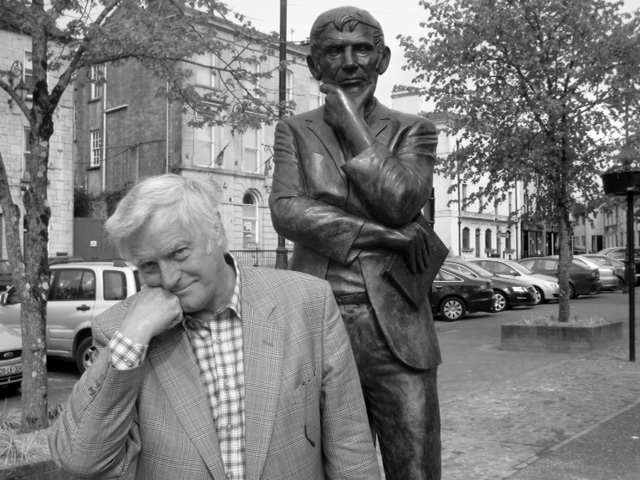
Des Healy (former Principal of St. Ita’s Secondary School) poses by the statue of his friend Michael Hartnett in The Square, Newcastle West.

Works Cited

Hartnett, Michael, A Book of Strays, ed. Peter Fallon, Gallery Press, 2002.

O’Connor, Patrick J., The New Houses – A Memoir, Oireacht na Mumhan Books, 2009.

O’Connor, Patrick J., Hometown: A Portrait of Newcastle West, Co. Limerick.  Oireacht na Mumhan Books, 1998.

Further Reading

Read also blog post ‘Happy Memories of St. Ita’s Secondary School’  here..

Happy Memories of St. Ita’s Secondary School!

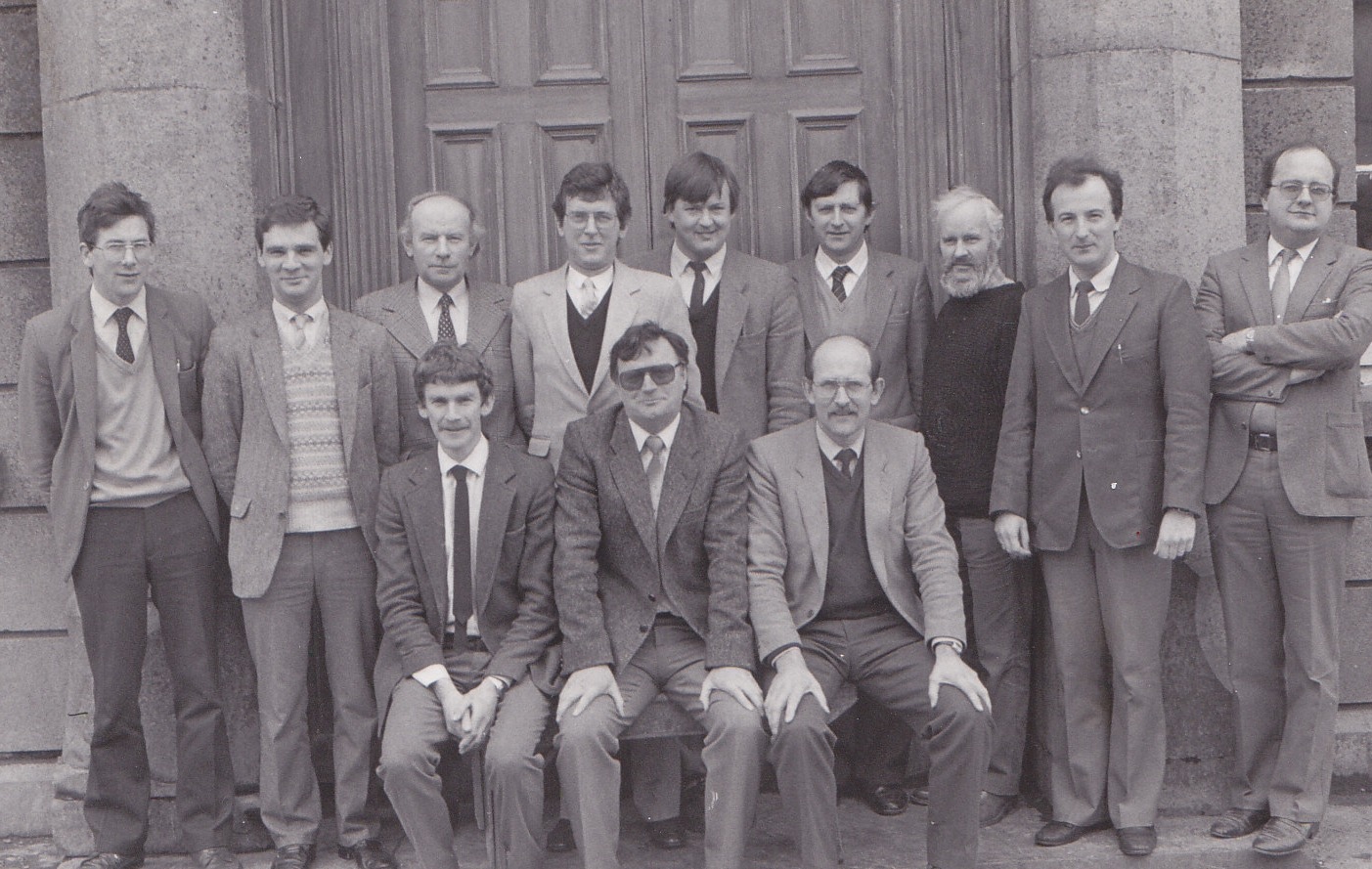
St. Ita's Secondary School Staff 1986.  Missing from the photograph is the then Deputy Principal, Donncha Ó Murchú.  The appearance of this staff photo, taken in 1986, in Facebook earlier this year provoked a virtual avalanche of nostalgia and all the memories and nicknames resurfaced once again like recurring cold sores!
St. Ita’s Secondary School Staff 1986. Missing from the photograph is the then Deputy Principal, Donncha Ó Murchú. The appearance of this staff photo, taken in 1986, in Facebook earlier this year provoked a virtual avalanche of nostalgia and all the memories and nicknames resurfaced once again like recurring cold sores!

There is a stark universal truth that I have discovered and it is true today more than ever before: a school is only as good as its teachers.   For fifteen years of my teaching career I taught in a school that would have been condemned as unfit for purpose or human habitation in Dickens’ time.  Indeed, there are those who think that Dickens modelled Mr. Gradgrind’s school in Hard Times on St. Ita’s in Newcastle West!  However, all who ever entered its hallowed halls would probably admit that it was a great school and is proof positive that modern facilities are not the only requirement for a good education.

 I was also reminded of ‘the good old days’ recently on reading an article by Dr. Pat O’Connor, an illustrious past pupil of the school, which appeared in a commemorative booklet produced to celebrate the Fiftieth Anniversary of the school’s opening in 1986.  He attended St. Ita’s from 1959 until he sat his Leaving Cert in 1964.  He says that, “these were happy, constructive, creative times, and the school provided the milieu for a learning odyssey which continued throughout the palmy decade of the 60’s”.

 The official name for the school was St. Ita’s Secondary School, in deference, I think, to the fact that Jim Breen and Dave Hayes both hailed from Killeedy, the one remaining St. Ita’s stronghold. However, the school was variously called ‘The Library’ (the building had originally been a Carnegie Library) and later ‘Jim Breen’s School’ as a local compliment and mark of respect to the man who became Manager and Principal of the school for nearly fifty years – the school becoming synonymous with his name.

 Pat O’Connor is lavish in his praise for Jim Breen and he says that he, ‘made a distinctively personal contribution during the lean years that saw a blossoming of second level education in this country.’  He goes on to say that he, ‘asserted a strong presence and, being a big man physically, he rarely had to repeat anything.  He was a strict disciplinarian, meticulous in attention to detail, but never petty or vindictive.  He led by example in the sense that his own work bore the stamp of discipline and commitment.’  The sight of his green Volkswagen Beetle, registration number AIU 524, was enough to elicit an instant quickening in the step of many a tardy pupil.

 In those early years he gathered around him a small band of doughty men who came armed with a rich diversity of teaching skills.  Tim Murphy was one of those early arrivals.  Pat O’Connor remembers him as, ‘a quiet spoken, amiable mentor, thoughtful, and on occasion, thought provoking.’  He remembers with affection the prayer which Tim introduced to the Leaving Cert class of 1964.  Given a sufficiency of faith, it had, he said, never been known to fail!

 Another of that small band of teachers, Dave Hayes, brought style and panache to bear on the teaching of Latin.  According to Pat O’Connor he was, ‘unquestionably a classical scholar of stature.’  This assessment was reinforced later during Dr. O’Connor’s first year in UCD, when a well-known lecturer and future Minister for Education, John Wilson  no less, could, in his view, ‘do no better than stand in the long shadow of Dave Hayes’.

 Willie O’Donnell taught English at senior cycle level and employed strategies supremely well suited to cope with the rigours of the examination system.  A man well acquainted with the technicalities of language, he had a particular fondness for the double entendre, and one of his most favoured concerned the numbers of students from the school who would, ‘go down in history’!

 Donncha Ó Murchú arrived on the scene as a very young man in September 1959.  No sooner had he arrived than he was subjected to the kind of initiation rites that pupils like to try out on young inexperienced teachers.  However, Pat O’Connor remembers that Donncha proved to be a doughty survivor who had a marvellous feel for history.

 Pat remembers the arrival of Noel Ruddle to the school in 1963 and considered him to be the consummate teacher who introduced the new age of science to the school.  He was enthusiastic, bright, analytical and able.  Noel went on to become Principal of the school in 1977, although his time at the helm was cut tragically short through illness.

 In the 80’s numbers burgeoned, thanks in no small part to Donagh O’Malley and his introduction of ‘Free Education’ in 1967. After Noel Ruddle’s untimely passing in 1981 the baton was passed to Des Healy who became Principal and later Manager after the death of Jim  Breen in the summer of 1984.  He was supported in its final years before amalgamation by Paddy Geary, Dave McEnery, Paul Edmonds, Donncha Ó Murchú, Pat Hayes, Mike Kennedy, James Egan, Andrew Ryan, Barry O’Brien, Tommy Devine, Sean Flanagan, Mary O’Shaughnessy  along with the author of this tribute.  However, by then the  need for proper, modern educational facilities became a clamour which could no longer be ignored and plans for an amalgamation of schools in the town was proposed and acted upon by a vibrant committee during the 80’s, culminating in the opening of the new Scoil Mhuire agus Íde in September 1992. For many the traumatic move to Boherbuí was lessened in its severity by the knowledge that Paddy Geary, St. Ita’s to his core, was to become the Principal of the new educational adventure in Newcastle West.

 A word of caution to all as we remember those days:  in invoking and trying to preserve the past we can’t allow ourselves to be too maudlin and sentimental.  As Michael Hartnett, Newcastle’s Poet Laureate, (himself a past pupil of the school) points out:  ‘too many of our songs gloss over the hardships of the “good old days” and omit the facts of hunger, bad sanitation and child neglect’.

 Most of us who experienced and survived the building, the poor sanitation, the lack of proper toilets, know that all this only added to its mystique; the telephone was not installed until 1986!  All who entered under its portals were rendered immune forever from all contagious diseases following their exposure to the culture of the place!

 In conclusion there is another stark universal truth that I discovered while teaching in St. Ita’s:  a school is only as good as the students who pass through its doors.  In this respect, as with its teaching staff down the years, St. Ita’s was truly blessed.

Last Day in St. Ita's - Friday 29th. May, 1992
Last Day in St. Ita’s – Friday 29th. May, 1992