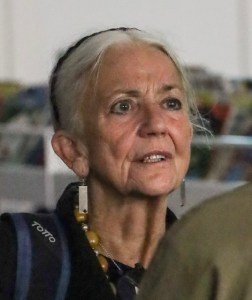
Paula Meehan in full flow, delivering her eloquent ‘Letter to Michael Hartnett’ on the Opening Night of Éigse Michael Hartnett, 2025. The photograph is by Dermot Lynch
As part of our preparations for Éigse 2025 we decided to ask Paula Meehan to be our special guest on Opening Night, 2nd of October. Her remit was to ‘speak from the heart about her memories of Michael Hartnett’. She did so by framing her thoughts in the form of ‘A Letter to Michael Hartnett’ – a wonderful prose poem. This was written on the 1st of October 2025, the night before the Éigse in his name opened in his native Newcastle West, County Limerick. The result is truly magnificent and deserves to be shared with Michael’s family, his many friends and ardent followers who didn’t make it to the Library in Newcastle West on that momentous night.
Dearest Michael,
Tomorrow I will rise with the sun and take to the road, and by eight-ish I will stand to speak of you before a crowd of your devotees in your home town where your name will be on everyone’s lips. Being blessed for the most part — but you have to allow, as you’d say yourself: there’s always the one.
The Éigse, founded in your name, will be opened with ceremonials and celebrations through all the arts, on its twenty-fifth birthday. If fate allows, I’ll be there to sing your praises, to sing them to the high heavens, where I hope you reside with the cherubim and seraphim, your ears ringing with their choral magic. I’ll say you were and are of greatness wrought. I’ll offer gratitude for the poems you carried, for the pure music of your shining spirit. So many of us will be gathered in your name and cherishing all you stand for.
I’ll be aware, too, of your black sardonic eye on proceedings somewhere in the otherwhere of elsewhere; aware especially of how you hated poets going on, and on. And weren’t afraid to let them know. Now as I enter my anecdotage and my crankitude, I can hear your voice in my ear:
‘Just tell them I’m not the worst.’
That’s what you whispered one night as I rose to introduce you to students in a small back room, over fifty years ago. After the reading they would have died for you, each and every one of them, so thoroughly had you enchanted them. I remember the joke you told them at the end of your reading: ‘What do you get if you cross a donkey with a bag of onions? A ride that would bring tears to your eyes’.
‘Come to the Éigse,’ said Norma Prendiville, ‘and speak from the heart about Michael for twenty minutes.’ Michael, I’ll speak from the heart you broke. You broke the hearts of all of us who loved you.
You were our purest poet. Our own Orpheus.
Even Eavan Boland, who reckoned there was no Orpheus in Ireland, came to understand the Orphic nature of your lyric. I extract from ‘Irish Poetry’, the poem she dedicated to you, where she tells how over a pot of tea one winter’s evening you —
began to speak of our own gods.
Our heartbroken pantheon:
No Attic light for them and no Herodotus.
But thin rain and dogfish and the stopgap
of the sharp cliffs they spent their winters on.
And the pitch-black Atlantic night. And how the sound of a bird’s wing in a lost language sounded.
You made the noise for me. Made it again. Until I could see the flight of it: suddenly
the silvery, lithe rivers of your south-west
lay down in silence. And the savage acres no one could predict
were all at ease, soothed and quiet and
listening to you, as I was. As if to music, as if to peace.
Eavan, who always referred to you as Mikey, with great fondness.
I first met you, Michael, in Grogan’s Castle Lounge in South William Street in my native city of Dublin. The poet’s horror hole a friend called it, a poet already sober, a rare enough thing in Grogan’s Castle Lounge. In those days fadó, fadó.
It is nineteen eighty-three and I am just back home to Dublin. I have been studying for a Masters of Fine Arts degree, in Washington State in the far Northwest of the United States. I brought two slim volumes with me when I left for the States – poets I had never met in person, but I considered them poetical mother and father to my craft or sullen art.
The books were Eavan Boland’s 1980 volume In Her Own Image and your 1975 volume A Farewell to English. When I met you that first time in Grogans, introduced by Tommy Smith, I told you I had the whole of the title poem, dedicated to Brendan Kennelly, by heart. Go on so, said you, prove it. I did. By heart. With only a few wobbles.
I think you were gobsmacked. You asked to see poems for, you said, I must be a poet. I showed you one I had in my pocket — do young poets still carry new poems on their person? Maybe on their mobile phones ….. I showed you one and you said it wasn’t very good. I showed you another and you said that was much better. The real thing. Of course, I paid no heed to your critique. Isn’t arrogance a protective force when you’re a baby poet?
If I had the whole poem by heart then, I have only fragments now, but it comes back to me when I need it. It gets me through as much as it gets through to me, the beautiful, sustained meditation on our politics. our culture, our colonised minds. Your masterpiece of scorn and hurt and resistance.
In the choppy waves of loneliness in an American university the poems kept me on some kind of even keel. They were part of the reason I came back to Ireland despite the terrible prospects.
‘What are you going home for? Sure all the kids are going the other way?’ ’What are you coming home for. There’s no work here.’
The era of last one to leave the country turn out the lights. The era of redundancies, butter vouchers, dole queues, heroin hitting the poor communities of the inner city like a juggernaut, moving statues, The Kerry Babies, Anne Lovett, The Heavy Gang. The Troubles live on TV every night.
You understood I came home to get the poems I needed to get.
What did we talk of on those walks by the Camac River, that palindromic waterway? Oh, you could fascinate from Akhmatova to Zozimus. You were dazzling in your erudition. You had the names, and the naming and so took possession of every blooming thing, of every wingèd thing and creature of the riparian zone. In two tongues.
I found blessing and curse in every poem. You were countryman. You were cosmopolite. You were ancient. You were avant garde. You were honey. You were vitriol.
Kind. Ferocious. Wicked. Lonely. So lonely, Michael, for your boy and your girl, for Niall and Lara, your beautiful children.
I carried your poem ‘Death of an Irishwoman’ like a holy fire. You understood that the most important culture bearers come in humble guise, like the Zen master scrubbing the kitchen floor of the monastery. Your ‘ignorant’ grandmother Bridget Halpin, who gave you Irish, who handed you the tool you would use to decolonise your mind. Decolonise our minds.
You were the wounded healer.
Death of an Irishwoman
Ignorant, in the sense she ate monotonous food and thought the world was flat, and pagan, in the sense she knew the things that moved at night were neither dogs nor cats but púcas and darkfaced men, she nevertheless had fierce pride. But sentenced in the end to eat thin diminishing porridge in a stone-cold kitchen she clenched her brittle hands around a world she could not understand. I loved her from the day she died. She was a summer dance at the crossroads. She was a card game where a nose was broken. She was a song that nobody sings. She was a house ransacked by soldiers. She was a language seldom spoken. She was a child’s purse, full of useless things.
I carried that poem into workshops, workshops in universities, in prisons (sometimes on the same day). I read it with women prisoners, with the political prisoners in Portlaoise, with the men in Arbour Hill High Security Prison, in recovery programmes. I brought it into art colleges, into classrooms all over the country, into other countries.
Everyone has loved someone from the day they died. Some creature. Some thing.
Only last week at a workshop in Kilmore Quay, I read that poem and there was a gasp, an audible intake of breath on the line, ‘I loved her from the day she died.’ She will never die, your grandmother, bearer of Irish, cultural heroine, your grandmother Bridget Halpin.
Those last few years of your life, your ever faithful friend Tony Curtis would drive myself and Theo (Dorgan) out to Dundrum, where you lived close by what you called The Sentimental Hospital, known to the rest of us as The Central Mental Hospital. You were dying in the loving care of Angela Liston.
The October of your going was radiant and glorious. But the day of your funeral it lashed. Early to the town for the burial, we took shelter in a pub. A man came in and said there’s a fierce crowd in for a funeral. Dinny Hartnett, the postman, his brother the poet is after dying. You would have liked that, Michael. You would like that the woman in the Pound Shop gave us armfuls of umbrellas, all the umbrellas in the shop, and wouldn’t take any money. Sure bring them back when the funeral’s over.
I did a poetry reading in Limerick a while back, in the City Gallery under Eddie Maguire’s magnificent portrait of you, the one on the front of your Collected Poems. Una McCarthy, who has recently retired as Director of the Gallery, had fought a long, hard battle to wrest the funding for it and get it back to Limerick from a private collection in the United States. You hung there, your black eyes boring into me, as intensely as they had in life. You could read minds, an uncanny gift. You were drawn to the wounded in bar or street. I saw people open to you like flowers – they felt your nobility of spirit, your deeply empathetic heart.
Michael, I hope wherever you are that this Éigse energy in the streets of the town of your birth will touch you. Your name is on every tongue. You are cast in bronze in the marketplace. The rain flows down your beautiful face, mingles with the tears you shed for your mother, for your father in his blanket of snow.
I send this letter into the void, dear Michael, in gratitude, devotion and fond memory.
Sincerely,
P. Meehan
Paula Meehan. Photograph by Dermot Lynch
About the Author
Paula Meehan was born in Dublin in 1955, the eldest of six children. She attended a number of primary schools, finishing her primary education at the Central Model Girls’ School off Gardiner Street. She began her secondary education at St. Michael’s Holy Faith Convent in Finglas but was expelled for organising a protest march against the regime of the school. She studied for her Intermediate Certificate on her own and then went to Whitehall House Senior College, to study for her Leaving Certificate.
Outside school, she was a member of a dance drama group, became involved in band culture and, around 1970, began to write lyrics. Gradually composing song lyrics would give way to writing poetry.
At Trinity College, Dublin, (1972–1977) she studied English, History and Classical Civilization, taking five years to complete her Bachelor of Arts degree. This included one year off, spent travelling through Europe. While a student she was involved in street theatre and various kinds of performance.
After college she travelled again, spending long stretches in Greece, Germany, Scotland and England. She was offered a teaching fellowship at Eastern Washington University where she studied (1981–1983) in a two-year programme which led to a Master of Fine Arts degree in Poetry. She returned to Dublin in 1983.
Meehan has also written poetry for film, for contemporary dance companies and for collaborations with visual artists; her poems have been put to music by songwriters (including Christy Moore). Her poetry has been extensively published in translation, including substantial collections in French and German.
The 2015 Poetry Competition ‘A Poem for Ireland’ shortlisted her 1991 poem ‘The Statue of the Virgin at Granard Speaks’ in the final ten poems. She selected poems for and introduced the Candlestick Press anthology Ten Poems from Ireland in 2017. Meehan was a judge for the 2020 Griffin Poetry Prize.
In September 2013, Meehan was installed as the Ireland Professor of Poetry by President Michael D. Higgins.
In 2023, she was elected an honorary fellow of Trinity College Dublin.
This photograph was taken near Old Barna Railway Bridge by Dermot Lynch, Limerick Leader.
The Retreat of Ita Cagney / Cúlú Íde was first published in 1975 by the Goldsmith Press, shortly after Michael Hartnett’s pronouncement from the stage of the Peacock Theatre in Dublin that he would henceforth write only in Irish. Appropriately, the publication contains an Irish version and an English version of the poem, as perhaps befitted the poet’s conflicted state. The Irish version, Cúlú Íde, was published again as the final poem in his first full collection in Irish, Adharca Broic, in 1978 and again, in both Irish and English, in his 1987 collection, A Necklace of Wrens. In effect, this poem serves as a Rubicon: the last English poem he would publish, for the time being at least, and the first of his Irish poems. The poet is in transition and is now back in West Limerick and in this poem, he explores deep and ancient resentments and wrongs. Allan Gregory says that the poem, in its bilingual format, ‘expresses to the reader themes of social and historical oppression, sex, pregnancy and birth, protection, exposure and secrecy, and is the finest poem in this period of Hartnett’s writing’ (McDonagh/Newman 145).
Hartnett has documented the ‘schizophrenia’ associated with this new poetic direction and he has said that this poem, in particular, caused him great distress:
‘The Retreat of Ita Cagney, for example, almost broke my heart and indeed my mind to write, because both languages became so intermeshed. I would sit down and write a few lines of the poem unthinkingly. I’d come back to it and see that it was half in English and half in Irish or a mixture. … One is not a translation of the other. They are two versions of the same poem, but what the original language is I don’t know’ (O’Driscoll 146).
Whatever the mental turmoil generated by the artistic struggles of the poet, the resulting poem is one of Hartnett’s most powerful from this period of his career. In his review of the poem following publication, fellow Munster poet, Brendan Kennelly, says it was,
‘a probing, dramatic exploration of a woman’s loneliness and isolation in a callous and hostile society. This, to my mind, is Hartnett’s finest achievement to date: he pays a relentless imaginative attention to this woman’s fate, and he presents with admirable dramatic balance her loneliness, independence and state of severed happiness. In this condition, Ita Cagney becomes a visionary critic of the society that hounds and isolates her’ (Poetry Ireland Review, Issue 15, p. 26).
The Retreat of Ita Cagney is a pained celebration of a woman’s enforced isolation due to her refusal to conform to the demands of her society. We can surmise that in delving into Ita Cagney’s situation, the poet finds common cause with another rural outcast in light of his own recent ‘retreat’ to Glendarragh to dwell ‘in the shade of Tom White’s green hill / in exile out foreign in ‘Glantine’ (A Book of Strays 41). This lonely cottage in Glendarragh was, for the next ten years, to serve as basecamp for what Declan Kiberd describes as ‘retracing his way to the common source’ (McDonagh/ Newman 37). However, far from being a ‘retreat’ to obscurity, as some of his critics predicted, his return to West Limerick precipitated what was arguably the most productive period of his career. Adharca Broic was published in 1978, followed by An Phurgóid in 1983, Do Nuala: Foighne Crainn in 1984 and his fourth collection in Irish, An Lia Nocht, appeared in 1985. During this period, he also undertook the translation of Daibhi Ó Brudair’s poems, which were published in 1985.
The publication of this dual language version of The Retreat of Ita Cagney / Cúlú Íde in 1975 was a bold step by Hartnett. For added effect, the Irish version was printed in the Old Gaelic script (An Cló Gaelach), which was by then obsolete and no longer being used in schools, as it had been up to the 1960s. This probably also had the effect of further isolating the poet and limiting his audience. However, as he told Elgy Gillespie in an interview in March 1975: ‘Listen, it’s impossible to limit my audience, it’s so small already’ (Gillespie 10). However, academic John Jordon wrote a positive review of Cúlú Íde, suggesting that it was ‘a small-town mini-epic, so redolent of Hardy’ (Jordon 7). Cúlú Íde was again published as part of Hartnett’s first collection in Irish, Adharca Broic, in 1978. This time, he chose Peter Fallon’s Gallery Books, and this new publishing relationship was to last until A Book of Strays was published posthumously by the same publisher in 2002. Adharca Broic received generally positive reviews, and Allan Gregory declared that the twenty-one lyrical poems in the collection ‘oozed with the confidence of a speaker who felt that at last he was being heard’ (McDonagh/Newman 146).
In this analysis, I will focus mainly on the English version of the poem with occasional forays into the Irish version, especially where they diverge. There are some similarities between The Retreat of Ita Cagney and Farewell to English. Both poems have a sequence structure, and The Retreat of Ita Cagney is divided into nine dramatic scenes. Both poems were published in 1975. However, there is one major difference: whereas Farewell to English is a public poem with political overtones, The Retreat of Ita Cagney is an intensely private poem. Though it begins with a quintessential public event, the traditional Irish funeral, it quickly transitions to the act of retreat alluded to in its title. On the face of it, it is a ‘retreat’ from a public event to a more private life, and Hartnett teases out the societal and psychological implications that this act brings about. However, the poem itself may also be read as an act of ‘retreat’ for the poet, away from public pronouncements towards a more private poetry that would focus on his own domestic life. If critics presumed that the blunt polemic of Farewell to English would be a constant in his writing in Irish The Retreat of Ita Cagney would seem to set them straight. As with Ita, Hartnett’s ‘retreat’ was a once-off symbolic gesture and as such, there was no need to repeat the tonic; rather, the wisdom or otherwise of that choice would be borne out by the life retreated to, and of course, for Hartnett, the poems which would come from living that life to its fullest.
The English version is composed in free-verse, while the Irish version is more formal and adheres to the classical conventions of the Dánta Grá (McDonagh/Newman 144). This divergence in styles between the two languages is perhaps a direct reason for the mental turmoil he encountered during the composition of this poem – there is a constant battle raging between the more disordered English version and the more tamed and formalised Irish version.
As well as being a poet of international standing, Hartnett was also a master translator, having translated the Tao, the Gypsy Ballads of Lorca, and later the poems of Ó Haicéad and Ó Bruadair, which will forever stand the test of time. Here we find him ‘translating’ his own work, and the effort induced in him a kind of artistic schizophrenia. Declan Kiberd argues that in this way, Hartnett suffered from a kind of ‘double vision’:
Every poet senses that all official languages are already dead languages. That was why Hartnett said farewell to English while knowing that Irish was itself dead already too. As he wrote himself in ‘Death of an Irishwoman’, ‘I loved her from the day she died’. Likewise, with English – no sooner did Hartnett write it off than he felt all over again its awesome power, for it had become again truly strange to him, as all poetic languages must (McDonagh/Newman 38).
This poem, then, is an initial effort to find his voice – in two languages.
In this, his last poem in English pro tem and his first poem in Irish, the poet very dramatically tells us the story of a recent widow (the Irish version says that she has been married only a year) who leaves her home in the dead of night and goes to live in secret with another man in his West Limerick cottage and bears him a child out of wedlock much to the disapproval of the locals and the Church.
The poem is not set in any recognisable historic timeframe, but maybe there were echoes of some such local ‘scandalous’ incident in the ether when the poet made his return to West Limerick in and around 1975. However, the poem stands on its own, and there doesn’t need to have been any particular incident which inspired the poet to take on this subject matter. Hartnett’s prose writing and poetry show him to be a very insightful social commentator, and it is not hard to find echoes of Kavanagh’s The Great Hunger in this poem. Here, however, the main subject is a formidable woman, which further helps to give the lie to the accepted stereotypes of the day. Readers familiar with Irish poetry will also be aware that in the old Aisling poems, Ireland was often depicted as a woman: sometimes young and beautiful, sometimes old and haggard. In effect, Ita Cagney can be read as a modern Bean Dubh an Ghleanna, Gráinne Mhaol, Roisín Dubh or Caithleen Ní Houlihan – a symbolic representation of Ireland. Hartnett concisely captures a portrait of the society to which he had returned in the 1970s, but crucially chooses to depict Ita’s inner life and not merely as a cypher without agency, whilst also refusing to idealise rural Ireland by showing the repressive and oppressive views which pertained at that time, especially towards women.
The Retreat of Ita Cagney is a more focused portrayal of small-farm Ireland than the broader panorama offered by Patrick Kavanagh’s The Great Hunger. That said, they are very similar and both Ita Cagney and Maguire have to cope with the two conflicting forces of spirituality and sexual mores in the world of their time. Maguire’s idea of sex is deformed, largely due to Church teaching and a repressive society in the Ireland of the 1930s and 40s. In contrast, Ita Cagney’s sexuality liberates her and The Retreat of Ita Cagney is a more recent reminder to all and a typical Hartnett barbed rebuff to De Valera’s notorious St. Patrick’s Day broadcast of 1943 in which he fantasised about a rural Ireland ‘joyous with sounds of industry, the romping of sturdy children, the contests of athletic youths, the laughter of comely maidens; whose firesides would be the forums of the wisdom of serene old age’ (Moynihan 466-9). Whereas Maguire is beaten down and is forced to live within the strictures imposed by the Catholic Church and the 1937 Constitution, in a sense, Ita Cagney benefits from the work of such women as Nell McCafferty, Mary Kenny, and others in bringing about significant change in how young couples lived their married lives as a result of the McGee v. Attorney General Case. This landmark case was heard in the Supreme Court in 1973 (two years before the publication of this poem) and established the right to privacy in marital affairs, giving women the right to avail of contraception, thereby giving them control over their own bodies.
Another factor which may be relevant here also was that while Kavanagh was a bachelor (and almost certainly a virgin) when he wrote The Great Hunger, Michael Hartnett was happily married (at the time) and living with his wife Rosemary and their two young children, Niall and Lara, ‘in exile out foreign in Glantine’. Patrick Kavanagh wrote about the destitution and despair of Irish country life of the 40s and 50s, and though Michael Hartnett knew that world also from his childhood (for example, in A Small Farm), he depicts a changing Ireland in The Retreat of Ita Cagney, an Ireland where women play a more central role.
Section 1
The poem opens in a very dramatic style. We are present at an old-style Irish wake – a scene very common in Hartnett’s poetry (Collected Poems 103). The narrator informs us that ‘their barbarism did not assuage the grief’. These ‘barbarians’ paradoxically are dressed in ‘polished boots’ and ‘Sunday clothes’ and accompanied by the ‘drone of hoarse melodeons’ – all typical features of a traditional Irish wake. It is nighttime, and it is raining. The poet uses rich similes to describe the atmosphere; ‘snuff lashed the nose like nettles’ and the local keeners fulfilled their ‘toothless praising of the dead / spun on like unoiled bellows’. Now we are introduced to Ita Cagney, the dead man’s widow. Her name is a Saint’s name; Ita or Íde is synonymous with West Limerick, particularly West Limerick’s ancient past. Her grief at the death of her husband has taken her by surprise, and she gives a hint as to their relationship when she says, ‘the women who had washed his corpse / were now more intimate with him / than she had ever been.’ This may suggest a great disparity in ages between them, although the Irish version gives a slightly different perspective on her grief when it reveals that they had only been married a year: ‘a bhean chéile, le bliain anois’ (his wife, now for only a year). Now, on a whim, she leaves the raucous wake and beats her hasty retreat. This is emphasised by the metaphor, ‘the road became a dim knife’. She has not planned this move, but ‘instinct neighed around her / like a pulling horse’.
Section 2
The second movement follows the strict requirements of the Dánta Grá, and there are striking stylistic differences between the English and Irish versions. The Irish version consists of eight quatrains, each describing Ita Cagney’s classical appearance. The English version is in free-verse and describes in minute detail Ita Cagney’s head from ‘her black hair’ to her throat, which ‘showed no signs of age’. Her hair is black save for a single rib of grey which stands out ‘like a steel filing on a forge floor’. The poet here is obviously calling on his Maiden Street childhood and scenes from John Kelly’s forge, which he had already immortalised in verse (Collected Poems 104).
He then describes her brow, her eyebrows, her eyes, ‘her long nose’, ‘her rose-edged nostrils’, her upper lip, her chin and jawline and finally her throat. The reason for this detail is to give us a sense of the formidable woman at the centre of this poem. She is described as having an almost aristocratic beauty. Having described her head in exact detail, the final singular line comes as an anti-climax: ‘The rest was shapeless, in black woollen dress’. The overriding sense, however, is of a woman in black as befits a woman in mourning, but a woman nonetheless with a kind of Patrician beauty, a sense of being noble in her bearing beyond her class: ‘Her long nose was almost bone / making her face too severe’. Ironically, from my own limited meetings with Michael Hartnett, he too had this aura of nobility, and even some extant photographs of the poet show that he wore his hair like a Senator of Rome – in my eyes, at least, it is imaginable that he too saw himself as a Patrician character!
I would point out also that there is a difference between the way Hartnett describes Ita Cagney and the way he introduces us to the raven-haired barmaid in the first section of Farewell to English. The barmaid, Mary Donavan, worked behind the bar in Windle’s pub in Glensharrold, a few miles outside Newcastle West. She is described with exaggerated classical phrases such as ‘mánla, séimh, dubhfholtach, álainn, caoin’. Gabriel Fitzmaurice tells us that ‘here we have the poet Michael Hartnett, possessing his locality, his muse, and his lost language’ (Limerick Leader, 1999). Here in this poem, however, Hartnett does not indulge in this kind of hyperbole in his description of Ita Cagney. She is not idealised or clichéd, and Michael Hartnett is at pains to describe her as a real person, and this realism makes the symbolism richer and more complex. Deep unhappiness and sadness have furrowed her brow: ‘One deep line, cut by silent days of hate’. Her first marriage was obviously not a happy one, and there is even a hint that it was an arranged marriage as was the custom in the past: her ‘eyes / that had looked on bespoke love / seeing only to despise’.
Section 3
In this section of the poem, Ita has reached her destination – by accident or design, we do not know. She has turned her back on a society that doesn’t value her, and in a sense, the poem is about breaking with convention – as the poet himself has also recently done. Ita Cagney has rejected the old world of snuff and melodeons and observance of religious rituals, and she is about to embrace a more sensual world. The half-door of this isolated cottage is opened by a man ‘halving darkness bronze’. The ‘bronze’ light of the gaslight gives way to ‘gold the hairs along his nose’. He is wearing classic labourer’s garb, a blue-striped shirt without a collar with a stud at the neck, which ‘briefly pierced a thorn of light’. This chink of light in the dark night echoes Patrick Kavanagh’s ‘Advent’ where he says ‘through a chink too wide there comes in no wonder’. Whereas Kavanagh, in his poetry, comes across as the quintessential 1950s Catholic, Michael Hartnett, in contrast, sees the ‘chink’ or open doorway as a new beginning in Ita Cagney’s life and not something to abstain from.
The poet uses juxtaposition here also to sharply contrast the male-dominated kitchen with its ‘odours of lost gristle / and grease along the wall’ and the arrival of a female whose ‘headscarf laughed a challenge’. The man closes the door on the world and both begin a relationship which will last ‘for many years’. Again, here we are reminded of the parallels that exist between Ita and the poet who had only recently turned his back on the Dublin literary scene and a burgeoning poetic reputation and had moved with his young family to rural West Limerick to follow his own ‘exquisite dream’ (Walsh 100).
Section 4
In this section, the couple have both decided ‘to live in sin’, ignoring the religious and social mores of the time. Their experience has taught them that having a big wedding for the sake of the neighbours ‘later causes pain’. Ita has already learnt to her cost that a very public wedding can, within a year, end ‘in hatred and in grief’. The expenses incurred in buying ‘the vain white dress’, in having to pay ‘the bulging priest’ and endure ‘the frantic dance’ is not for them. For them, it would be akin to undergoing physical torture, as the insincere well-wishes of their neighbours would ‘land / like careful hammers on a broken hand’. Anyway, in this house, organised religion was not important; here, ‘no sacred text was read’. Instead, life was rudimentary and simple: ‘He offered her food: they went to bed’. Here, there was no ‘furtive country coupling’, hiding affections from friends and the priest. Their only sin was that they had chosen ‘so late a moment to begin’.
This is the sensual ideal: their ‘Love’ doesn’t have to be transmuted and elevated to a higher level by the clergy; they don’t seek anyone’s blessing or approval for their actions. However, they are aware that there are consequences to their decision and that their actions will offend the locals and particularly the local clergy: ‘shamefaced chalice, pyx, ciborium / clanged their giltwrapped anger in the room’. The couple have made their bed and now they must lie in it. They have decided to defy society and do their own thing.
Section 5
Section five sees the woman in labour and being taken by donkey and cart (or pony and trap) to the local town to be delivered. It is nighttime and it is raining. She is shielded by her shawl and oilskins to protect her, but all these layers cannot deflect the ‘direct rebuke and pummel of the town’. The couple’s secret intimacy now becomes a public matter as they have to call on outside help with the delivery. Even now, at this delicate moment as Ita prepares to give birth, disapproval is vehement:
and sullen shadows mutter hate
and snarl and debate
and shout vague threats of hell.
However, the ‘new skull’ will not wait, and ‘the new skull pushes towards its morning’, and Ita’s hopes and dreams are for the future as a new beginning and a new dispensation beckons.
Section 6
Section six is both a love song and a lament. Ita Cagney addresses her newborn with love and trepidation. She knows what will be said, and she will try and protect her son from the venom and vitriol which she knows will come because of her actions. Her newborn is described lovingly with his ‘gold hair’ and ‘skin / that smells of milk and apples’. She wishes to cocoon her baby son and protect him from all the wickedness of the outside world as if he were in Noah’s Ark. However, she knows in her heart that just as in the Bible story, ‘a dove is bound to come’ with messages from the outside world, bringing from the people words / and messages of hate’. She knows that the ‘stain’ of what she has done will be passed like a baton of toxic shame, the preferred Irish weapon to ensure conformity, to the next generation:
They will make you wear my life
Like a hump upon your back.
She is also tormented by the fear that her son may come to blame her for the hatred he will be forced to endure, and that he may internalise that hatred and that the cycle of hatred will continue.
Section 7
Section seven has echoes of the Garden of Eden. The child is growing up in splendid isolation in the West Limerick countryside. The language is sensual and earthy, ‘each hazel ooze of cowdung through the toes, / being warm, and slipping like a floor of silk…’. There are echoes here also of earlier Hartnett poems depicting his own idyllic childhood, ‘we were such golden children, never to be dust’ (Collected Poems 102). The young boy grows up and learns the lore of the countryside, gathering mushrooms ‘like white moons of lime’ and working the land with his father. His mother watches him grow ‘in a patient discontent’. The seasons come and go, spring, autumn, harvest, Christmas and their little cottage becomes ‘resplendent with these signs’. There are echoes of an Edenic existence, unspoilt and idyllic, as ‘apples with medallions of rust / englobed a thickening cider on the shelf’.
Section 8
In section eight, Ita speaks in a confessional manner. She is preparing for Christmas and decorating her little cottage with the traditional homemade crepe decorations. She is in a reflective mood, and Hartnett uses a beautiful image to convey her reverie as she watches ‘the candles cry / O salutaris hostia’. There is a potent mix of residual religious imagery in these lines; the Christmas candles remind Ita of the traditional Catholic hymn sung at Benediction. The hymn invites us to ask for God’s help to persevere in our often difficult spiritual journey. The next image is also very traditional, and every small farmhouse in Ireland contained at one time a red Sacred Heart lamp with its flickering flame:
I will light the oil –lamp till it burns
like a scarlet apple
This is clearer in the Irish version and stands as a good example of how both versions complement each other:
Anocht lasfad lampa an Chroí Ró-Naofa
agus chífead é ag deargadh
mar úll beag aibí
We notice here that while Ita Cagney may reject the public rites associated with the Catholic Church, she still maintains elements of the traditional Christian practices. In some sense, I think we are also being given a glimpse of Michael Hartnett’s own views on religion here. Traditional religious symbols and half-forgotten phrases from old Latin hymns are residual echoes of his own early religious experience: and for Michael Hartnett, and for many others of his generation, Catholicism was very much a child’s thing (see ‘Crossing the Iron Bridge’ ).
There then follows Ita’s ‘confession’ where she declares that she has not insulted God but that she has offended the ‘crombie coats and lace mantillas, / Sunday best and church collections’ – she has offended public morality and her chief offence has been that her happiness has not been blessed by the church and condoned by society at large. This is the climax of the drama and encapsulates the enduring tension that exists between the rights of the individual in society and the pressures on that individual to conform to acceptable social mores, especially as it applies to sexual love. As Allan Gregory sees it, ‘The poem shows, with imaginative sympathy and ethical discernment, how Ita Cagney, a widow, lives in a new free union, unblessed by the church and how, because of this, she is feared and loathed by society’ (McDonagh/Newman 145).
Section 9
The final movement in the poem sees the neighbours advance in a concerted ‘rhythmic dance’ to lay siege to Ita’s cottage. The language is violent and carries connotations of evictions carried out in the neighbourhood by the landlord class in the not-too-distant past. We are told that ‘venom breaks in strident fragments / on the glass’ and ‘broken insults clatter on the slates’. The neighbours are described as a ‘pack’, a mob, who ‘skulk’ and disappear into the foothills in order to regroup and to muster their forces for a final onslaught – waiting ‘for the keep to fall’. Ita, a virtual prisoner in her own home, protects ‘her sleeping citizen’ and imagines the final attack ‘on the speaking avenue of stones / she hears the infantry of eyes advance’. The Irish version gives us further food for thought and is even more redolent with echoes of recent Irish history. In the Irish version, the phrase ‘she guards her sleeping citizen’ is rendered as ‘í féin istigh go scanrach / ag cosaint a saighdiúrín’ (herself inside terrified / protecting her little soldier boy’). Furthermore, the final line ‘she hears the infantry of eyes advance’ is translated as ‘ó shúile dearga na yeos’. This word ‘yeos’ refers to the yeomanry, the infamous English Redcoats, and carries very loaded associations in the Gaelic folk memory – they were as hated as the Black and Tans or the Auxiliaries were in more recent history. The use of these words, especially in the Irish version of the poem, emphasises and reinforces again the themes of social and historical oppression which are central to Hartnett’s thesis in this major statement of intent.
Conclusion
This poem was the first to be written by Hartnett during the transitional phase in the mid-seventies after he had set up home in Glendarragh. He realises that little has changed since he wrote ‘A Small Farm’ – all the ‘perversions of the soul’ are still to be found in Camas and Rooska and Sugar Hill and Carrickerry. However, he does seem to hint in this poem that a better way is possible if we are brave enough to take it, like Ita Cagney, like Michael Hartnett himself, and like Mary McGee.
If we accept that Ita Cagney’s ‘retreat’ is a parallel for his own ‘retreat’ from English, then it seems that he is prophesying tough times ahead for himself and his new artistic direction. His ‘retreat’ will not be received well by either side. In earlier poems, he has depicted the old Gaelic world, represented by Brigid Halpin and Camas, as a perverse, pagan and ignorant place. He will have to be as strong-willed and stubborn as Ita Cagney has been in order to survive, but for Hartnett, as for Ita, embracing the life retreated to is worth this sacrifice.
The poem depicts Ita Cagney as the modern-day Saint Ita / Naomh Íde, and an able successor to his grandmother Bridgid Halpin, who, according to Hartnett, never adjusted to the ‘new’ Ireland which emerged in the twentieth century. Hartnett looks towards the hills and the wooded slopes of the Mullach a Radharc Mountains for answers to an age-old torment which has been a blemish on the Irish psyche. And he sees that there is hope – Ita Cagney, a young widow, ‘retreats’ to a new life, and though her union is unblessed by the church, she is prepared to defend her decision despite the disapproval of society. She becomes, as Kennelly suggests, ‘a visionary critic of the society that hounds and isolates her’. In effect, she was, like Hartnett himself, a half-century at least before her time, and she deserves to be feted as the patroness of a more modern and liberated Ireland, which she longed for instinctually. Those instincts beckoned her to forsake her old life of convention and conformity and create a new beginning and a new world for herself where love reigned over hate, victorious.
Works Cited
Fitzmaurice, Gabriel. ‘Let’s drink to the soul of Michael Hartnett’, in The Limerick Leader, October 23rd, 1999.
Hartnett, Michael. The Retreat of Ita Cagney (Cúlú Íde). Dublin: Goldsmith Press, 1975.
Hartnett, Michael. Adharca Broic, Gallery Books, Oldcastle, County Meath, 1978.
Hartnett, Michael. Collected Poems, ed Peter Fallon, Gallery Books, Gallery Press, Oldcastle, County Meath, 2001.
Hartnett, Michael. A Book of Strays, Gallery Books, Oldcastle, County Meath, 2002.
Hartnett, Michael. ‘Why write in Irish?’, Irish Times, (26th August 1975).
Gillespie, Elgy. ‘Michael Hartnett’, The Irish Times, (5th March 1975), p.10
Jordan, J., Review, Irish Independent (3rd February 1979), p.7.
Kennelly, Brendan. reviewing Michael Hartnett, Collected Poems, Volume I, Poetry Ireland Review Issue 15.
O’Driscoll, Dennis. Interview, Metre Magazine, II (2001).
McDonogh, John and / Newman, Stephen. (eds), Remembering Michael Hartnett, Four Courts Press, Dublin, 2006.
Moynihan, Maurice. Speeches and Statements of Eamon de Valera, Dublin, 1980.
Walsh, Pat. A Rebel Act: Michael Hartnett’s Farewell to English, Mercier Press, Cork, 2012.
Other Works Referenced
Patrick Kavanagh, The Great Hunger: A Poem, Cuala, 1942, Irish University Press, 1971.
I would like to acknowledge the considerable assistance given to me by my son, Don Hanley, a Hartnett scholar in his own right, in the preparation and editing of this blog post – one of the many welcome positives emerging from the COVID-19 Lockdown!
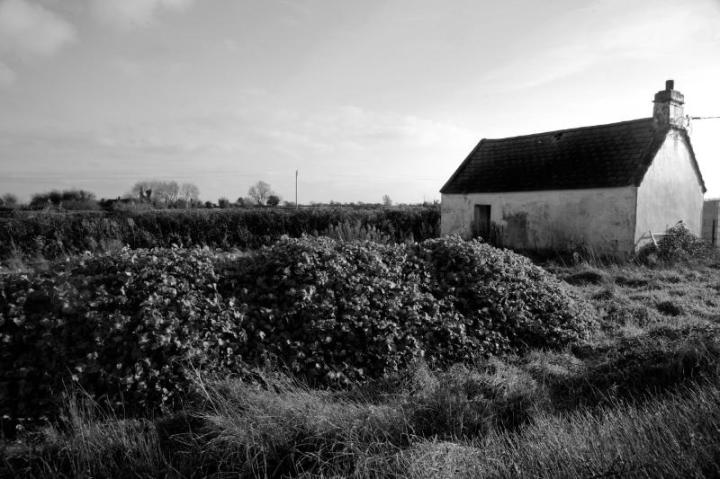
Brigid Halpin’s cottage in Camas. The photograph was taken in 2017 before renovations began by the new owners. Photograph by Dermot Lynch, Limerick Leader.
“I felt a sense of being in the presence of a man who, while an integral part of the small community he loved, was also marked apart as special.”
Dermot Bolger movingly remembers his friend the poet Michael Hartnett who died 16 years ago this month. This is an edited version of a commemorative piece which appeared in The Irish Times on Wednesday, October 12th 2005.
In Ireland there is nothing better for making new friends than an early death and, because in death Michael Hartnett has acquired so many friends, I should firstly say that I didn’t know him well enough to claim any special friendship. I was far younger than him and even though I edited and published three of his books I never lost my awestruck sense of being privileged to be in his company. I was a sensation I felt as a young man on the first night we met and a sensation I still experienced on the last morning he phoned me some weeks before his death on October 13th 1999.
The first book of poems I bought, while still a schoolboy, was the small New Writers Press 1970 edition of Michael’s Selected Poems. On the cover he looks little more than a schoolboy himself. That book had a huge effect on me and remains among my most precious possessions. I first met Michael around 1980 when I ran literature events in the ramshackle building housing Dublin’s Grapevine Art Centre. John F Deane had bravely established a new organisation called Poetry Ireland, and Michael travelled from Limerick to give a benefit reading for it. his opening words to me were to inquire if I knew of a bed for the night, and my opening words to somebody whom I viewed as a hero was to offer him one in Finglas.
It was after midnight when we reached Finglas but Macari’s chipshop remained open on Clune Road. Years later in Inchicore Haiku Michael wrote:
In local chippers
Queueing for carbohydrates
A dwarfed people.
We queued for our late-night carbohydrates. Critics can elaborate on Michael’s gift as a poet and contextualise his work. My interest here is putting down memories for his son and daughter and what struck me was how Michael enthralled the late-night queue and staff in that Finglas chipshop. He wasn’t attention seeking; they were simply drawn into his quiet magnetism. The staff had no idea who he was but afterwards always asked for news of my friend in the countryman’s cap.
In 1984 I wound up sitting in a pub between Michael and Michael Smith, who had published that earlier Selected Poems. Both Michaels became emphatic that not only should I re-issue the long out-of-print Selected Poems, but that the new volume should include every English language poem he had written up to and including his Farewell to English. Michael Hartnett assured me not to worry about copyright issues, he would take care of that. I was young and naïve, but even in my innocence I should have been slightly worried when he explained how he cleared copyright permission for his wonderful translations of Lorca’s Gypsy Ballads. He phoned Lorca’s brother in New York, explained that he was once deported from Franco’s Spain and after he had read aloud one translation the voice at the other end said, “Spread the word”!
Within a few months I was sitting down in his small cottage in Glendarragh, Templeglantine, near Newcastle West in Limerick going through old suitcases of poems with Michael and discovering material either never published or published once in magazines and then forgotten. I spent two of the most memorable days of my life there working on Volume 1 of his Collected Poems and still like to recall Michael as he was then.
After the executions of the Easter Rising leaders in 1916, a British Army officer declared that while they all died like men, Thomas McDonagh died like a prince. Wandering with Michael through Newcastle West or sitting down to eat with his family, I felt a similar sense of being in the presence of a man who, while an integral part of the small community which he loved and understood, was also marked apart as special.
But soon the world that I had glimpsed in Newcastle West was to implode. Alone in Ireland while his family visited Australia, Michael seemed to drift irredeemably into the engulfing tide of alcohol that had always been a problem. Aware that he had the proofs for me of some translations, I tracked his progress across Ireland and finally located him and the proofs in Dublin. He handed me the proofs carried for weeks in his inside pocket and, ever the optimist, asked if by any chance I could loan him €5,000.
At that time the entire assets of Raven Arts Press consisted of a leaking gas heater and a cat, so I brought him for lunch instead and then to a double-bill of afternoon films. The first – Ruben Ruben – was a comedy about a poet with a drink problem on a reading tour in America. Michael chuckled through it. The second – Francis Ford Coppola’s Rumblefish – was shot entirely in moody black and white. The only object filmed in colour was a solitary fighting fish in a glass tank. Leaving the cinema and knowing that I could keep him from the pub no longer, I commented to Michael on this cinematic trick. Michael gripped my arm and, with the relief of a man who had known the delusional tricks of delirium tremens, whispered, “Oh thank God, you saw the fish too.”
Soon he was living in a bedsit in Inchicore with his marriage over. His face, which had never aged, was suddenly old. His chief defence against fate remained his sense of humour. I brought him over some small sum of money for something. There were virtually no possessions in that room where he had started writing the Haiku sequence that broke his silence in English. But his sense of hospitality would not let me leave empty-handed. He asked if I possessed a copy of the tiny 1969 edition of his poem The Hag of Beare and insisted on giving me the only copy he still possessed – Number 1 of that precious numbered edition.
He brought the manuscript of Inchicore Haiku to my small office in Phibsborough, driven over by two new Inchicore friends with impenetrable Dublin accents. We launched it in the Richmond House in Inchicore, a whirlwind night. But if that was a celebratory night in a crowded pub, which cloaked his personal pain displayed in the book, I saw far less happy occasions for him in Dublin pubs in the following years. I know of nothing romantic about drink and the damage it does. I do know that his new partner, Angela Liston, prolonged his life and brought some stability to a man now gripped by addiction.
His publishing affairs became complicated and so I drew up a contract between us, giving him back all rights to his work on condition that I acquired non-exclusive rights to his cheese-grater joke: “A man gives his blind friend a cheese-grater for Christmas, meets him in January and asks if he liked his present. ‘No’, the friend replied, “I tried to read it but it was just too violent.’”
Occasionally after that, he would phone for a chat. On the last morning he phoned, he told me how he had recently visited one of the men who drove him to my office years before. The man was dying of cancer, his mouth covered by an oxygen mask, and he grew upset because the words he kept trying to say were indistinguishable.
Michael leaned over and said: “I know you’re upset because you’re dying and I can’t understand what you are saying, but I must tell you that with your accent, even when you were well I could never understand a word you said anyway.”
The man gave up trying to speak and laughed instead. It takes courage to make a dying man laugh, but Michael Hartnett had courage in spades. Courage, stubbornness and demons. I had no idea he was soon to die, but something made me tell him that one of the proudest moments of my life – something I could unreservedly look back on as truly worthwhile – was editing his Collected Poems.
He accepted the compliment, told me his latest joke and then recited an extraordinary raw and heart-felt poem he had written for Angela Liston. It was the last time I heard his voice and I can hear it still, with his laugh at the end which contained all that pain, humanity and unbroken dignity:
I have been kicked around the place
Been mocked and been pissed on
But I find my way home to you, Angela Liston
And my wrinkled, anxious forehead
Amazingly has been kissed on
And I am blessed by you Angela Liston.
He died on October 13th, 1999. His Complete Poems and Translations have since been superbly edited and published by Peter Fallon and The Gallery Press. When I last passed through Newcastle West I stopped at dawn in Maiden Street where he was reared. It was deserted but every shop window had a poster for Éigse Michael Hartnett, with his haunting quizzical eyes staring out. Those eyes and that voice haunt me still.



 Reviews Rants and Rambles
You must be logged in to post a comment.