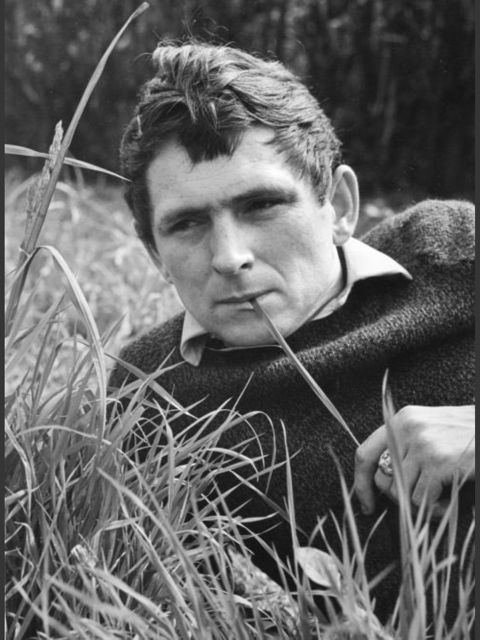
As I have mentioned already in another post here, the decade from 1975 to 1985 in Glendarragh, Templeglantine, was arguably the most productive of Hartnett’s career. Indeed, the output from that little cottage in the shade of ‘Tom White’s green hill’ in Glendarragh was prodigious. The first poems to be published were his collection A Farewell to English, which was published in 1975, and thus began his long-lasting association with Peter Fallon and The Gallery Press. The same year saw the publication of The Retreat of Ita Cagney / Cúlú Íde. Adharca Broic was published in 1978, followed by An Phurgóid in 1983, Do Nuala: Foighne Crainn in 1984 and his fourth collection in Irish, An Lia Nocht, appeared in 1985. During this period, he also undertook the translation of Daibhí Ó Brudair’s poems, which were published in 1985. Many of his better Glendarragh poems are contained in the 1987 collection, A Necklace of Wrens. This collection, following his return to Dublin, contains all poems in Irish with their English translation that Hartnett wanted preserved for posterity, and it was edited by Peter Fallon.
During this decade, 1975 to 1985, in parallel to this ‘serious’ output, he was writing and entertaining the locals with ballads, some serious or semi-serious like ‘A Ballad on the State of the Nation’, which was distributed as a one-page pamphlet like the ballads of old and even included original linocuttings by local artist Cliodhna Cussen. Other ballads were more contentious and even semi-libellous (or fully slanderous!), such as ‘The Balad (sic) of Salad Sunday’ and ‘The Duck Lovers Dance’. These latter creations were written under the very appropriate nom de plume, ‘The Wasp’! His most memorable local work was, of course, ‘Maiden Street Ballad’, a poem he composed for his father as a Christmas present in 1980.
These three intimate family poems were written in Glendarragh, Templeglantine and first appeared in his collection, Adharca Broic, in 1978. Two of the poems are written for his children: Lara, who was born in 1968 and Niall, who was born in 1971. These two poems with English translations also appear in his 1987 collection A Necklace of Wrens. The third poem, Dán do Rosemary, was not included in this collection, and the reason for its exclusion is obvious. As early as 1978, the tensions and stresses which eventually led to their separation in 1985 were beginning to show. They were both navigating the inevitable separation, which eventually led to his departure for Dublin and Inchicore that year. His gift for love poetry is again in evidence, as it had been back in 1968 with the publication of Anatomy of a Cliché. Unfortunately, the clock had come full circle, and his final poem to Rosemary is one of abject apology and regret and wistful hopes for their post-separation lives.
The poem reads as a sad indictment of the way artists were treated in this country in the 70s and 80s. They lead a ‘miserable life’, ‘for our lack of money / scrimping and scraping’. He apologises profusely and admits that their marriage is ‘pitiless, loveless’, which has affected ‘your soft fragile (English) heart’. Their small rural cottage is ‘run-down’, with ‘walls of clay, tear-stained’, ‘the place is falling apart’. He takes full responsibility for their sorry plight and admits that he is ‘blundering, tactless, clueless’. I have said elsewhere that at this time, Newcastle West was booming during the construction phase of the Aughenish Alumina Plant near Askeaton in County Limerick. Newcastle’s twenty-six pubs were doing a roaring trade, and he apologises to his wife because he is ‘always acting the yob in the pub’. If anything, this poem in the original Irish is far more confessional and personal than most of his poetry up to this time.
The poem concludes on a far more positive and hopeful note. He tells Rosemary that he has ‘abandoned English, but I never turned my back on you’. This is a time for reappraisal, and he hopes to ‘relearn my craft from fresh woodland’ – he was living at the time in a townland called Glendarragh – the glen of the oak. He ends on a hopeful note: he hopes that the future will bring Rosemary happiness and that her ‘worth will be appreciated’. The final line is so sad and poignant – he hopes that ‘we both reach our America’. The sadness of this final line arises from the fact that some seven years later, they both parted and went their separate ways.
Cliodhna Cussen, a fellow native of Newcastle West, has an interesting point to make about this poem:
‘Nuair a dhirigh Michéal ar an nGaeilge níor cuireadh aon rófháilte roimhe. Bhí ceisteanna á n-ardú i dtaobh chaighdeán a chuid Gaeilge, ceisteanna a árdaíodh i dtaobh an Riordánaigh 30 bliain níos túisce. Ach léiríonn Michéal a anam, a chuspóir, agus a ghrá sa tseoid sin de dhán, ‘Dán do Rosemary’, ina bhfuil a chumas agus a chroí nochtaithe aige’.
When Michael began writing in Irish, he didn’t receive great encouragement from Gaelgóirí. There were questions about the standard of his Irish, just as there had been about Sean Ó Riordán some thirty years earlier. But in this gem of a poem, ‘Poem for Rosemary’, Hartnett reveals his soul, his motive, his love – indeed, his supreme craft and heart are laid bare.’ (My own translation).
His poem for his son Niall, Dán do Niall, 7 (‘Poem for Niall, 7’), again shows his honesty and courage, although it does tend to descend into cliché at times. Like King Canute and his futile attempts to hold back the tide, he wishes that his son wouldn’t have to leave this safe place in ‘Bird Nest country’, their home in Glendarragh. He tries to warn his son about the many dangers that exist in the outside world and does so by making reference to nature. This advice is somewhat reminiscent of the advice spoken by Polonius to his son Laertes in Shakespeare’s Hamlet: ‘This above all: to thine own self be true, And it must follow, as the night the day, Thou canst not then be false to any man’. This suggests that integrity begins with honesty to oneself, and Hartnett gives us a modern take on this when he advises, ‘Be happy but be tough. ’
There is great poignancy in the final stanza when he states that he will be there for his son ‘in spite of death’. Niall was 28 when his father died in 1999 at the age of 58, and the second line of this stanza adorns the poet’s headstone in Calvary Cemetery in Newcastle West: ‘mar labhraíonn dúch is labhraíonn pár’, ‘for ink speaks and paper speaks’. The poet is saying that he will be present and live on in his body of work even after his death. The reality is that he wasn’t there for many of the landmark celebrations in his son’s life, his graduations, his wedding, the birth of his grandchildren and so the promise he makes, ‘and some day I’ll buy you porter!’ sounds very hollow indeed to a young man who must now take on the onerous mantle of preserving and promoting his father’s rich and varied legacy at such a young age.

His Dán do Lara, 10, (‘Poem for Lara, 10’), is a masterpiece. The sunshine and nature in this poem are at odds with the penury and hardship of the poet’s existence in 1978, nestling below ‘Tom White’s green hill’ in Glendarragh, Templeglantine. Flame-haired Lara is compared to a rowan tree in autumn, her voice disturbing the larks, ‘in the green grass’. She is surrounded by nature in all its glory, ‘a crowd of daisies playing with you, a crowd of rabbits dancing with you’. The blackbird and the goldfinch are there for her amusement and playtime. Then the master of metaphor compares his daughter: ‘You are perfume, you are honey, a wild strawberry.’ The poem ends with the poet’s wish for his young daughter:
Little queen of the land of books
may you be always thus
may you ever be free
from sorrow-chains.
Interestingly, the poet compares his daughter to a queen in ‘the land of books’; this seems to set the seal on Lara’s perfection. Obviously, a poet would value literature and reading, and his choice of this image is significant as it tells us that Lara has another, deeper side to her – she is not just interested in the outdoors and a lover of nature.
His final wish for Lara is that she will grow up to be as beautiful and graceful as her mother, Rosemary. He hopes that she will inherit her mother’s beautiful soul as well as ‘the beauty of her face.’
It is fitting that these three poems, written in that little rural cottage in Glendarragh, feature family and the travails of being a husband and a parent. I have examined many of his papers in the National Library of Ireland on Kildare Street, and it is undeniable that hand-in-hand with arranging his poems and latest projects, there is ample evidence of the presence of young people, Lara and Niall, in the many doodles and scribbles on the margins of those frayed notebooks.

 Reviews Rants and Rambles
You must be logged in to post a comment.