Christmas Family Traditions

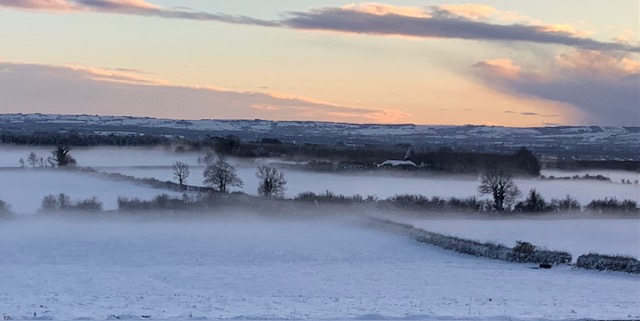
Winter scene looking out from our front door in Kiltanna.

Childhood memories are mostly of sunny days, but maudlin memories of those Christmases from the late 50s and early 60s still linger.  It was so innocent and naïve, in a way, it was as if Christmas hadn’t been invented yet!  It was a Christmas of cowboy ‘cap’ guns and other useless ‘purties’ – they seldom lasted longer than a day.  We always had a turkey, our own free- range turkey, before it became trendy.  We even had a surplus, and I remember my mother sending turkeys by post to her sisters in England!   We usually had a Christmas cake from Upton’s in Ballylanders.  There was trifle, plum pudding, jelly and custard, the dinner of the year. I never remember drink being in the house. There were never visitors, nor were we encouraged to visit anyone. If the day had been anyway fine, Michael and I were to be found on the road with our hurleys, knuckles blue.

Christmas back then was more about the crib than about Santa.  The church was central to the festivities, and the midnight Mass and the Latin were magical.  There were no decorations, no Christmas tree and holly hung from the holy pictures.  Later, Michael and I usually liberated a Sitka Spruce sapling from a nearby forestry. One year, we brought one from Ballintubber through the fields for fear of detection, having cut it down with a bread knife!  Before electricity came to Rapala in 1958, the gloom was amber with the glow from paraffin lamps.  We were exceedingly lucky to have had exceptional parents, and so, despite their own strapped circumstances, we were always at the centre of Christmas Day as children. Mam and Dad worked far harder than we then realised to create an experience that modelled what it meant to care for others: with kindness, generosity, consideration and love. Even still, to this day, that tradition continues, and children don’t notice the carefully oiled machine that shudders into life to create the magic of a good Christmas, and hopefully that will never change.
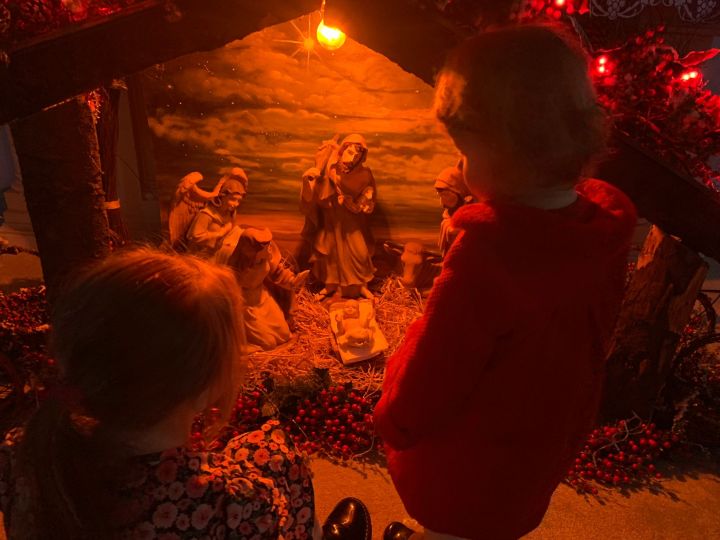
Maeve and Anna visit the crib in Our Lady of Ransom Church in Glenroe.

I remember one Christmas in particular – the winter of ‘62 – ‘63 was long and memorable – it snowed and forgot to stop.   It began snowing at Christmas time, and the snow and ice remained on the ground for months. If my memory serves me, we didn’t return to school that year until late March! In the meantime, the snow lay on the ground, and people coped as best they could.

Looking back on it now, we were lucky that, as a family, we were nearly entirely self-sufficient and had no use or need whatsoever for convenience stores or supermarkets! I was a Mass server, and each morning I would get up and walk through the drifted snow to serve Mass in our local Church, nearly two miles away in Glenroe. Mass was in Latin at that time, and both Fr. Carroll, who was the Parish Priest, and the Mass servers faced the altar with their backs to the congregation, and the ten-year-old Mass servers made the responses in Latin. The congregation were silent throughout. The Vatican Council, Vatican II, had been convened at the time by the saintly Pope John XXIII, and great changes were around the corner – but not yet! You know what I always say about change: the only people who welcome it are babies with wet nappies!

I remember those mornings being joined on my trek to the Church by Hanny O’Dwyer, who was an extremely devout and holy woman who had already walked nearly two miles to get to my house. At least two of her brothers were priests in England or Scotland, and she attended Mass daily. That year, she was accompanied some mornings by her sister-in-law, who had recently married her brother, James, who was a farmer in nearby Ballintubber.

I have uncomfortable memories of being embarrassed by a new pair of shoes which had arrived in a parcel full of all kinds of ‘goodies’ from Aunty Mary just before Christmas that year.  My mother forced me to wear them on Sundays and when serving Mass.  Now in 1963, the problem was that these were a pair of slip-on shoes, and the only people I had ever seen wear slip-on shoes were women.  I felt that everyone in the church was looking at my new shiny black shoes. Little did I know that they were the coming fashion and that, for once, I was years ahead of my time!

The most shocking memory I have of that winter was the funeral of a local man. His name was Hayes, and for all I knew, he may have been a relation. He died, and I remember my Dad telling me that the snow drifts were up to the gable end of the farmhouse where he lived in Ballintubber. The neighbours had to shovel the snow away to make a pathway for people to enter the house. I have a vivid memory of the funeral cortege passing our house, and the coffin was being carried on the buckrake at the back of a red tractor. I was shocked at this sight, and I thought it was very disrespectful to the old man who had died.  In hindsight, however, it was probably the only practical way that he could have been taken to the Church.

In January 1963, I can still see in my mind’s eye, Mam and Dad and all six of their children looking out the front window as that funeral passed.   Later that year, in November, the seventh member of our family, Noreen, arrived hale and hearty, and the world has been a better place since!

John Montague, one of my favourite poets, has a haunting poem called ‘Like Dolmens Round My Childhood’. The poem describes the old people, his neighbours, who lived in a land where ancient beliefs and superstitions still survived. We get the sense that during his childhood, these vulnerable people still believed in myths and magic, curses, and the fierceness of local feuds.  Ghosts still roamed the land, in the dark countryside just beyond the reach of the farmhouse lights.

Looking back now, I realise that this was also true of my native place, and I am amazed at the number of old people that I knew and who knew me. These, often vulnerable, saintly people regularly passed my door, or I met them on my journey to and from school each day. People like Josie McGrath, Hanny Kelly and her brother Mick, Hanny O’Dwyer on her way to Mass, Jack Connell, ‘The Cuckoo’, who brought the post, Lew Walsh and his chestnut horse and trap, or his wife who, like Miss Havisham in Great Expectations, scared the life out of us on our way home from school in the evening, as she glared out at us from behind the hedge.

I remember stopping and talking to Syke Meade and his neighbour Bill English, on our way from school, as they leaned against the ditch looking up towards Bawnard. For as long as I knew him, Syke wore a long black overcoat and Wellington boots, whether it was Sunday or Monday, Summer or Winter. He was gifted at hooping hurleys, and Dad always brought him supplies of metal hoops from the discarded packaging from the cheese factory in Mitchelstown. Bill English was a gentle giant of a man, although he had a pronounced limp from an accident in his youth. Dad loved to have him in the yard when the hay was being brought home because of his great strength and height. There are other names too: Tom Lee and his son Mick and daughter Alice, Mick Quane and his daughter Anne, ‘John George’, Joe and Babe Hennessy, Tom and Mick Howard, Josie Tobin and the fierce Mrs McGrath.

I also have fond memories of Joseph Meade, who lived under the road down near The Battery bridge and also of his sister Betty. At that time Joseph worked as a farm labourer with the O’Dwyers, and we would often meet each morning on our way to the creamery in Darrragh. Joseph’s father had one or two cows, and he grazed them each day along the sides of the road, ‘the long acre’ we called it, between his own house and Lew Walshes. No greater example is needed to illustrate the differences that existed between those times and today.

Montague, the great poet of emotion and of place, sums up those long-gone times. I, too, am fascinated by those faded memories and the love of my native place, which has resurfaced as I reminisce. Just like Montague, I too bow to those ‘Gaunt figures of fear and friendliness’, because ‘For years they (have) trespassed on my dreams’.

That myriad cast of characters was part and parcel of the ‘village’ that raised me.  And it is only fitting that today a new generation should develop their own customs and new family Christmas traditions for this new age:  poring over Smyth’s Catalogues and coping with (multiple) Elves on the Shelf, even trips to Lapland to visit Santa.  But budgeting for Santa and tomorrow, and next year, at the kitchen table, is strictly for adults. All children should just feel cared for, excited, and part of the beloved traditions that make up their family’s festive season, being swept along by the ambience and anticipation that only Christmas can bring.
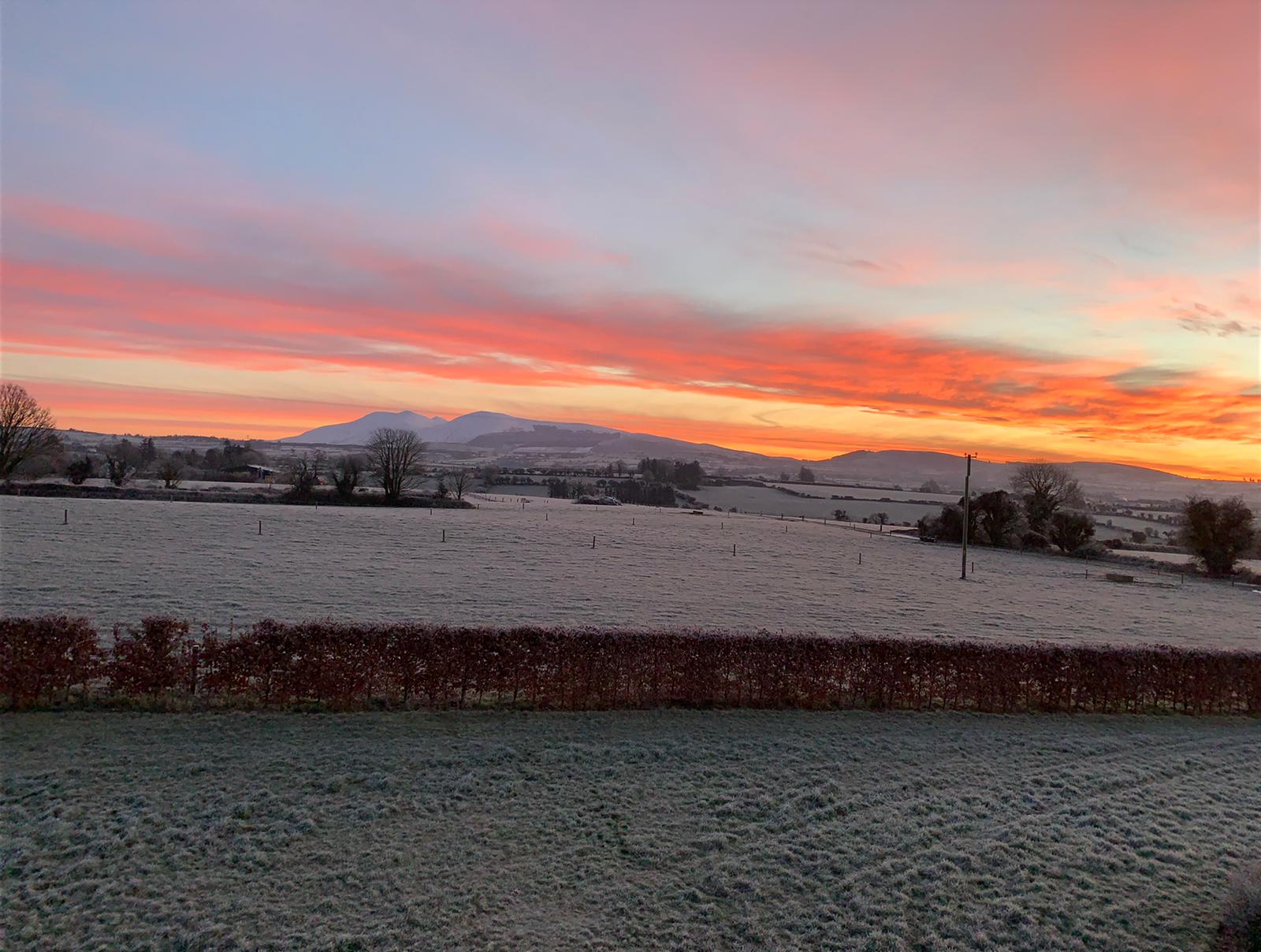
A Christmas Childhood sunrise over the Galtees.

Philosophical Thoughts on Glenroe and Knockaderry

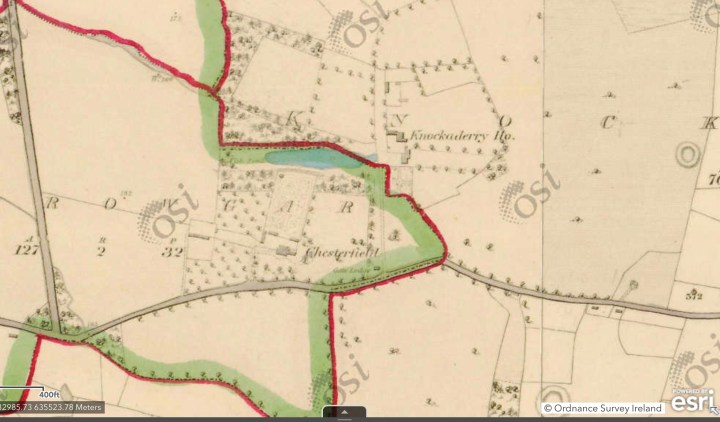
This is a detail from the 1840 historic map showing the sculpted and structured gardens surrounding Knockaderry House, the birthplace of Sophie Peirce, and the nearby Chesterfield House. It was unusual that two ‘Great Houses’ like these would be in such close proximity to each other.

Glenroe, my native place, sits on the border between Limerick and Cork and hurling and athletics were always very strong in the area. In Canon Sheehan’s famous novel, Glenanaar, there is a fabulous account of a hurling match between neighbouring border rivals which took place in or around 1840. The game, which attracted a huge crowd, was played between the Cork side, known as The Shandons, and the Limerick side, known as The Skirmishers. The game is being fiercely contested until the captain of The Skirmishers is taken ill, and he can play no further part in the battle. There is a famous intervention by a local, known as The Yank, who has recently returned to his native place after spending many years in the USA. The Yank agrees to replace the injured captain of The Skirmishers, and he saves the day and a hard-fought victory is won. After the heroics of The Yank, an onlooker is heard to say that ‘there was nothing seen like that since Terence Casey single-handedly bate the parishes of Ardpatrick and Glenroe’.

********

Knockaderry, too, has flirted with fiction.  Séan Ó Faoláin was one of the most influential figures in 20th-century Irish culture. A short-story writer of international repute, he was also a leading commentator, critic and novelist. He was the son of Bridget Murphy from Loughill East and Denis Whelan, an RIC constable who had been stationed in the RIC barracks in the village of Knockaderry in the 1890s. Every summer until he was 17, the young Ó Faoláin came to Rathkeale, to Knockaderry and to Loughill East on his holidays. He wrote with great passion about these local places in his autobiography, Vive Moi – and his first novel, in 1933, A Nest of Simple Folk, was based on that disputed territory over the hill betweenà Knockaderry village and Rathkeale, encompassing the landmarks and characters of Loughill East, Balliallinan Kilcolman, Duxtown and as far as Wilton Hill.  Ó Faoláin called his home in Killiney, Co. Dublin, Knockaderry

**********

Glenroe and Knockaderry have long been central to my life. When I left Glenroe to go to boarding school in 1965, I really didn’t intend ever to return there unless I had a very good reason. Yet, fate played a hand, and my daughter Mary met and married Mike O’Brien, and they set up a home which nestles halfway between the parish church and the school. So, in recent years, I have come to cherish the second chance that I have been given. Likewise, I quickly fell in love with Knockaderry when I arrived there in 1977 to take up my first real teaching job in nearby Newcastle West. Both places hold a special place in my heart. Both places would be perfect settings for a good novel!

I love reading, and as a teacher of English literature, I have been doubly blessed in having the honour of introducing my students to some of the great fictional works written. Being a Harper Lee fan, I remember waiting for the much-anticipated publication of Go Set a Watchman in 2015. Written before her only other published novel, the Pulitzer Prize-winning To Kill a Mockingbird (1960), Go Set a Watchman was initially promoted as a sequel by its publishers. It is now accepted that it was a first draft of To Kill a Mockingbird, with many passages in that book being used again. The title alludes to Jean Louise Finch’s view of her father, Atticus Finch, as the moral compass (“watchman”) of Maycomb, Alabama, and has a theme of disillusionment, as she discovers the extent of the bigotry in her home community. Go Set a Watchman tackles the racial tensions brewing in the South in the 1950s and delves into the complex relationship between father and daughter. It includes treatments of many of the characters who appear in To Kill a Mockingbird.

I had already formed a mustard seed theory in my brain that the real-life Monroeville, Alabama, of her youth became the fictional Maycomb, Alabama, of her novels. To me, Maycomb didn’t seem too different to my own special places. Lee had set her novels here for a reason: she deliberately selected her setting, and in effect, the fictional Maycomb becomes another Narnia or Middle Earth – a microcosm of all that is good and bad in 1930s America. She tells us that one went to Maycomb, ‘to have his teeth pulled, his wagon fixed, his heart listened to, his money deposited, his soul saved, his mules vetted’. She describes it as an isolated place; in effect, it is an Everyplace – the place, ‘had remained the same for a hundred years, an island in a patchwork sea of cotton fields and timber land’. It is, in effect, a remote backwater bypassed by progress, the perfect playground of her youth, the perfect setting for a novel and the perfect cauldron for change.

In Go Set a Watchman, she says that Maycomb County is ‘a wilderness dotted with tiny settlements’; it is, ‘so cut off from the rest of the nation that some of its citizens, unaware of the South’s political predilection over the past ninety years, still voted Republican.’ It is so remote, ‘no trains went there’. In actual fact, Maycomb Junction, ‘a courtesy title’, was located in Abbott County, twenty miles away! However, she tells us that the ‘bus service was erratic and seemed to go nowhere, but the Federal Government had forced a highway or two through the swamps, thus giving the citizens an opportunity for free egress.’ However, Lee tells us that few took advantage of this opportunity! Then, in one of those Harper Lee epiphany moments, one of those lightning bolts she releases now and then, she perceptively describes her hometown, and, indeed, my own home place, whether it be Glenroe or Knockaderry, as a place where, ‘If you did not want much, there was plenty.’

In To Kill a Mockingbird, she continues in the same rich vein. Maycomb is a ‘tired old town’. People moved slowly, ‘they ambled across the square, shuffled in and out of the stores around it, took their time about everything’. She tells us that, ‘There was no hurry, for there was nowhere to go, nothing to buy and no money to buy it with, nothing to see outside the boundaries of Maycomb County’, a scenario somewhat reminiscent of modern-day Knockaderry or Glenroe!

Similar to Maycomb, the setting of George Eliot’s novel, Silas Marner, has many similar echoes. The Raveloe described by Eliot is reminiscent of my beloved Knockaderry! She tells us that it ‘was a village where many of the old echoes lingered, undrowned by new voices.’ She further describes it as being, ‘Not …. one of those barren parishes lying on the outskirts of civilisation —inhabited by meagre sheep and thinly-scattered shepherds: on the contrary, it lay in the rich central plain of what we are pleased to call Merry England’. However, like Maycomb and Knockaderry and Glenroe, it was off the beaten track, ‘it was nestled in a snug well-wooded hollow, quite an hour’s journey on horseback from any turnpike, where it was never reached by the vibrations of the coach-horn, or of public opinion’. In Chapter One, Eliot declared it to be a place where bad farmers are rewarded for bad farming!

This description of Raveloe also holds great echoes with The Village as depicted in Jim Crace’s (supposedly last?!) novel, Harvest. The narrator, Walter Thirsk, tells us that, ‘these fields are far from anywhere, two days by post-horse, three days by chariot before you find a market square.’ Harvest dramatises one of the great under-told narratives of English history: the forced enclosure of open fields and common land from the late medieval era on, whereby subsistence agriculture was replaced by profitable wool production, and the peasant farmers were gradually dispossessed and displaced. ‘The sheaf is giving way to sheep’, as Crace puts it here, and an immemorial connection between people and their local environment is being broken – their world is crumbling around them. Great changes are coming and, as everyone knows by now, the only people who welcome change are babies with wet nappies!

Brian Friel’s use of Ballybeg (small town) as the setting for many of his plays and short stories is also similar in vein to these others. In ‘Philadelphia Here I Come!’, Gar Public tells us that Ballybeg is, ‘a bloody quagmire, a backwater, a dead-end’. Friel, like Lee, Eliot, and Crace, is deceptive because he is dealing with familiar things and familiar characters – shopkeepers, housekeepers, and parish priests – a very familiar rural Ireland fixed in its own time. Friel’s use of Public Gar’s alter ego – Private Gar – allows us the opportunity to see behind the superficiality of so much of this world of small-town life.

In many ways, Friel’s major theme is the failure of people to communicate with each other on an intimate level. In his play, ‘Philadelphia, Here I Come!’, we are introduced to the typically Irish practice of verbal non-communication! He, like Harper Lee, George Eliot, and Jim Crace, forces us to examine the nature of society. In Ireland, our society in the 40’s and 50’s was dominated by the church, the politician, and the schoolmaster. Ultimately, the world that Gar is leaving has failed him and his generation. But Friel is too subtle to allow us to imagine that the world Gar is about to enter in Philadelphia will be any better.

These meandering rambles are an attempt to place myself at the beginning of a work of fiction, to stand for a moment in the author’s shoes, so to speak, and see the world from their point of view. From my limited reading, it seems to me that many authors deliberately choose a world untrodden, less travelled as the setting for their novels and plays. I have mentioned some here in this piece, but I’m sure this is just the tip of the iceberg, and you will be able to reference many examples from your own reading.

Ideally, the setting for all these classics is always remote, secluded, off the map, and cut off from change and advancement. This microcosm is then filled with characters and fictional dilemmas, action and inaction. I have always been truly fascinated and awed by each author’s unique ability and ingenuity in creating and imagining these hidden worlds in their heads, and thus allowing us to enter the world of their texts. Knockaderry and Glenroe, apart from their initial flirtations with Séan Ó Faoláin and Canon Sheehan in past centuries, patiently await their twenty-first-century novelist to arrive!

Believe me, the characters are there!

… and it seems that a twenty-first-century novelist has arrived to put Knockaderry on the map! June O Sullivan’s second novel tells the amazing tale of Knockaderry woman, Sophie Peirce, the first true female trailblazer in aviation. The novel, soon to be published, recounts Sophie’s epic solo flight from Cape Town to London in 1928.

Semple Stadium Glory Days

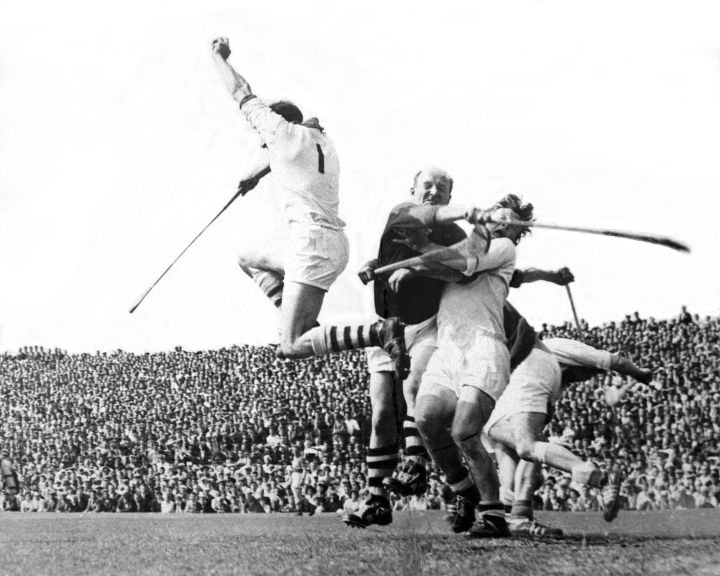
One of the greatest GAA photos of all time. Goalmouth ‘shemozzle’ from that Munster semi-final in Thurles in 1962. Waterford’s Ned Power saves despite the close attention of Christy Ring. Also in the picture are Tom Cunningham (W), Austin Flynn (W), and Liam Dowling (C). The scene is brilliantly captured by photographer Louis MacMonagle. Photo courtesy of the Irish Examiner archive.

Some like Anfield, some prefer Wembley or the Camp Nou or Santiago Bernabéu; some prefer Thomond Park or Cardiff Arms, but my favourite ‘field of dreams’ is Semple Stadium in Thurles, County Tipperary, where the GAA was founded over 140 years ago.  It has been at the heart of hurling since its opening in 1910.  Tipperary people, harking back to long-gone glory days in the 60s, refer to it as the Field of Legends, but I’d say Limerick people would have something to say about that after our recent run of success since 2018!

Close your eyes …. Think of summer. What do you see? I see midges swooping and dancing through a languid sunset. I see heat-drenched Limerick jerseys shuffling through the streets of Thurles, where bellows of banter waft along with the whiff of cider that floats from the open doors of packed pubs in Liberty Square. Inside D D Corbett’s, a bitter alcoholic draws tears from the crowd with a soft, sweet rendition of ‘Slievenamon’.

 Anyway, I have been travelling to this Mecca since I was ten years of age. My first visit was on a beautiful Sunday, the 8th of July in 1962. My mother and father, along with most of my brothers and sisters at the time, were walking home from second Mass in Glenroe when Tom and Mick Howard stopped in their black Morris Minor and asked Dad and me if we’d like to go to Thurles with them to see Ringy and the Rebels take on the might of Tom Cheasty, Ned Power and Frankie Walsh’s Waterford.  It was Ring’s last hurrah, and it was appropriate that his last Championship game in the ‘blood and bandages’ of his native Cork should have been in Thurles.  It was here that, for two decades previously, he had adorned the ancient game with his unique and exceptional talent.  I count myself lucky that I was able to sit there with my Dad, a loyal Cork man,  and my hurling mad neighbours, the Howard brothers, on the recently creosoted railway sleepers on the embankment that is now the Old Stand.  However, it was Waterford’s day, and they won by 4 – 10 to 1 – 16.

On a street corner, a humming chip van mumbles its invitation to giddy children as the June sun beats down. The Pecker Dunne sits, perched on a flat stone wall, plucking and strumming, twanging banjo chords as he winks at those who pass. A smile broadens his foggy beard as coins glint and twinkle from the bottom of his banjo case.

I have witnessed other great games there down the years, and I have seen great hurlers adorn the venue. Let’s be blunt – Thurles is the best place to go to see a hurling match, and hurling people also know that if you can’t hurl in Thurles, you won’t hurl anywhere.  I remember listening to Michéal O’Hehir commentate on the 1960 Munster Final in Thurles between an ageing Cork team and Tipperary, who were emerging as a force to be reckoned with.  There’s a story told by John Harrington about the speech Christy Ring gave in the dressing room before the game that day.  He delivered a rousing speech that brought the blood of his teammates to boiling point. However, his words did not find favour with Fr Carthach McCarthy, who was also in the dressing room at the time. “You didn’t find those words in the Bible, Christy”, said Fr. McCarthy, in as disapproving a tone as he could muster.  Ring cast a jaundiced eye at the man of the cloth and replied, “No, Father.  But the men who wrote the Bible never had to play Tipperary.”  Despite his exhortations, Cork lost on the day, 4 -13 to 4 -11.

Hoarse tinkers flog melted chocolate and paper hats on the brow of a humpbacked bridge as we move closer to the field of legends. The drone of kettledrums and bagpipes rises from the Sean Treacy Pipe Band as they parade sweat-soaked warriors around the green, hallowed sod.

John D Hickey, one of the great sports writers of the 50s and 60s, coined the phrase ‘Hell’s Kitchen’ to describe the general vicinity of the Tipperary goalmouth, which Michéal O Hehir, the greatest GAA commentator of all time, referred to as ‘the parallelogram’, or what we today refer to as ‘the square’! This area of the pitch was patrolled in the mid-60s by the Tipperary full-back line at the time, Michael Maher at full-back, flanked by John Doyle and Kieran Carey – probably the greatest full-back line in the history of the game.  As the name suggests, they usually generated the sort of heat that suffocated most full-forward lines, who generally struggled to cope with their unique blend of physicality, hurling skill and a generous helping of the dark arts.  Their dominance continued until the emergence of the youthful Eamonn ‘Blondy’ Cregan and Eamonn Grimes and company, who in 1966 destroyed that Tipp team that were All-Ireland winners in ’61, ’62, ’64, and ‘65. Suffice it to say that Limerick put a stop to Tipperary’s gallop that sunny Sunday, and the young ‘Blondy’ Cregan scored 3 goals and 5 points in a 4 – 12 to 2 – 9 defeat of Tipperary. That day still stands as one of my all-time treasured sporting memories.

A whistle rings on high, ash smacks on ash and the sliothar arrows between the uprights. A crash of thunder and colour erupts from the terraces at the Killinan End and the Town End (the Limerick end!)…… I see the Munster Championship!!

I’ve been in Thurles as a Limerick supporter, as an uninvolved spectator, and I’ve also been there with skin in the game as Don played Minor, Under 21, and Intermediate hurling for Limerick. Limerick have been lucky in this place. A few Munster Senior titles, including 1973, five Under 21 titles in this Millennium alone, and a Centenary Minor title after a replay at the same venue against Kilkenny.  Paddy Downey, writing in The Irish Times, said of the replayed minor final that, ‘it is probably true to say that there never has been a better minor All-Ireland final’.

The 1973 Munster Final was special, and of course, it ended in controversy.  As the final seconds ticked down and the teams were level, Eamonn Grimes won a disputed seventy for Limerick.  The referee, Mick Slattery from Clare, told Richie Bennis that he had to score direct, as the time was up.  Richie held his nerve, the sliothar headed goalwards, the umpire raised the white flag, and the rest is history. Every Tipperary man there that day swears that the ball was wide, but it mattered little; the game was up.  In my view, it was Ned Rea who broke Tipperary hearts that day with his three goals and not Ritchie Bennis with his last gasp point.  Sadly, it was the final swansong for that great Tipperary team.  They stole an All-Ireland in ’71 when they beat Limerick in the rain in Killarney, but they didn’t emerge again as a hurling force until 1989. That day also marked the legendary Jimmy Doyle’s last appearance in a Tipperary jersey.

The Championship is more precious than life for many. I’ve seen grey-haired men gazing into half-empty pints, reeling off the names of the great ones, like prayers. I’m afraid I too follow suit. Ask me who the Minister for Finance is, and your question will be greeted with indifference. I simply couldn’t care less. But ask me where Carlow senior hurlers play and instantly I say, ‘Dr. Cullen Park … to the left at Church Street, up Clarke Street and half a mile out on Tower Road’. Monaghan? ‘Pairc Ui Tieghernan .. on the slope of George’s Hill, overlooking the County town’. Where do Sligo play? ‘Markievicz Park in the heart of Sligo town’. ‘Bless me, father, for I’m a fanatic!’

The major hurling powers took a bit of a break in the mid-90s and allowed the minnows, like Limerick, Clare and Offaly and Wexford, to have their fling.  Don and I were in the New Stand – Árdán Ó Riain – for the ’95 Munster Final on the 9th of July.  It was one of those glorious Thurles days – despite the outcome.    In the end, Clare claimed their first Munster championship since 1932, and only their fourth ever.  I remember Davy Fitz scoring a penalty before half-time, crashing the sliothar high into the town net, before sprinting back to his own goal line.  Despite our disappointment, especially after the humiliating defeat in the All-Ireland Final the previous year to Wexford, you had to give credit to this Clare team.  One could sense the ghosts of 63 years and the curse of Biddy Early evaporating before our eyes.  The release of emotion when Anthony Daly received the cup had to be seen to be believed.  I remember the ‘Shout’ ringing out from the Killinan End and then Tony Considine taking the microphone for his rendition of ‘My Lovely Rose of Clare’.

What else draws the likes of Mike Quilty and Mike Wall, setting them down among roaring, red-faced lunatics in the shadow of the crowded Old Stand? What else exists that plucks the cranky farmer from the milking parlour and flings him into a concrete cauldron eighty miles across the province? Some swear the Apocalypse would not have the same effect….

We waited nearly a full year to gain our revenge – on June 16th, in Limerick this time.  We had been away for a holiday in Carnac in Brittany and came back the day before the game.  All of Limerick had been convulsed by the recent killing of Detective Garda Jerry McCabe, who had been shot and killed in the village of Adare by members of the Provisional IRA on June 7th, during an attempted robbery of a post office van. His colleague, Ben O’Sullivan, had also been seriously injured in the incident.  Being away when tragedy strikes so close is unnerving and surreal.  I spent most of that Saturday hunting for tickets for the fanatics in my household and eventually secured terrace tickets at the City End of Pairc na nGael from Charley Hanley in Croagh, who was Liaison Officer with the Limerick team at the time. The following day, in glorious sunshine, we took our sunburnt revenge.  Hurling legend Ciarán Carey of Patrickswell scored one of the greatest ever winning points in the history of Gaelic Games, in front of an attendance of 43,534. Result: Limerick 1-13, Clare 0-15.

 May and the chirp of the sparrow, you can be guaranteed we’d be stuck in that long snake of traffic, as it slithered its way to Cork, Limerick, Thurles and other far-flung fields.

 The modern Munster championship has changed many an inherited dynamic. The regularity with which Limerick now go to Semple Stadium to play Tipperary is a very modern phenomenon.  There was a time when if you played two Munster rivals, you would be through to an All-Ireland semi-final – not anymore.  Now you must beat all the Munster counties at least once in the Munster Round Robin Pool of Death.  Limerick have won five All-Irelands in this way since 2018.  Two Munster counties in an All-Ireland Final is no longer a rarity.

.… But oh to be a hurler…  If the truth be known, I couldn’t hurl spuds to ducks. The boss of my hurley has seen the arse of a Friesian cow more often than it has the crisp leather stitching of an O’Neill’s sliothar! Okay, I’ve had my own All-Irelands up against the gable end and in and around the mother’s flower beds, but that’s as far as it went for me.

What is most amazing about Thurles is that no matter who is playing, they all seem to troop back into the town and mingle in the Square in the shade of Hayes’s Hotel for hours afterwards.  As Kevin Cashman, that Prince of Sportswriters from my generation, remarked, ‘the pubs of Thurles on a big match day have something that no other pubs can give.  It has been called ‘atmosphere’, ‘bond’, ‘fraternity’, and much more – it’s magic in the air’.  The ghosts of Mackey, Clohessy, the Doyles, John Keane, Jimmy Smyth, and Ring become as real as what you have just witnessed. And now we have new heroes like Nickie Quaid, Declan Hannon, Cian Lynch, Barry Nash, Kyle Hayes, Patrick Horgan, Tony Kelly, Shane O’Donnell, the Mahers, and Austin Gleeson to keep the flame alight for future generations.  As Kevin Cashman puts it, ‘This is their Elysian field and the turf, and the grass and even the steel and the concrete of this place are the keepers of their youth and the youth of all of us, who shaped them’.

The terrace is where the real nectar of hurling comes to a head – when every Joe Soap in the country stands together on the same patch of cement with their eyes fixed on the same lush, green carpet…..

References

Harrington, John, Doyle: The Greatest Hurling Story Ever Told (2011).

Highly Recommended

 O’Donnchú, Liam. Semple Stadium: Field of Legends, Dublin: O’Brien Press,  2021