Philosophical Thoughts on Glenroe and Knockaderry

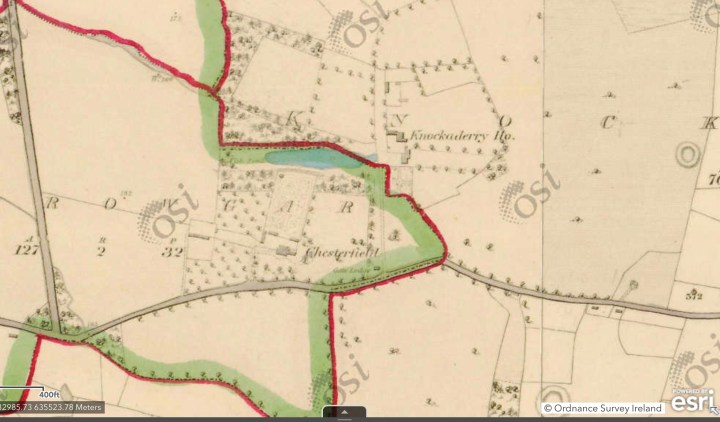
This is a detail from the 1840 historic map showing the sculpted and structured gardens surrounding Knockaderry House, the birthplace of Sophie Peirce, and the nearby Chesterfield House. It was unusual that two ‘Great Houses’ like these would be in such close proximity to each other.

Glenroe, my native place, sits on the border between Limerick and Cork and hurling and athletics were always very strong in the area. In Canon Sheehan’s famous novel, Glenanaar, there is a fabulous account of a hurling match between neighbouring border rivals which took place in or around 1840. The game, which attracted a huge crowd, was played between the Cork side, known as The Shandons, and the Limerick side, known as The Skirmishers. The game is being fiercely contested until the captain of The Skirmishers is taken ill, and he can play no further part in the battle. There is a famous intervention by a local, known as The Yank, who has recently returned to his native place after spending many years in the USA. The Yank agrees to replace the injured captain of The Skirmishers, and he saves the day and a hard-fought victory is won. After the heroics of The Yank, an onlooker is heard to say that ‘there was nothing seen like that since Terence Casey single-handedly bate the parishes of Ardpatrick and Glenroe’.

********

Knockaderry, too, has flirted with fiction.  Séan Ó Faoláin was one of the most influential figures in 20th-century Irish culture. A short-story writer of international repute, he was also a leading commentator, critic and novelist. He was the son of Bridget Murphy from Loughill East and Denis Whelan, an RIC constable who had been stationed in the RIC barracks in the village of Knockaderry in the 1890s. Every summer until he was 17, the young Ó Faoláin came to Rathkeale, to Knockaderry and to Loughill East on his holidays. He wrote with great passion about these local places in his autobiography, Vive Moi – and his first novel, in 1933, A Nest of Simple Folk, was based on that disputed territory over the hill betweenà Knockaderry village and Rathkeale, encompassing the landmarks and characters of Loughill East, Balliallinan Kilcolman, Duxtown and as far as Wilton Hill.  Ó Faoláin called his home in Killiney, Co. Dublin, Knockaderry

**********

Glenroe and Knockaderry have long been central to my life. When I left Glenroe to go to boarding school in 1965, I really didn’t intend ever to return there unless I had a very good reason. Yet, fate played a hand, and my daughter Mary met and married Mike O’Brien, and they set up a home which nestles halfway between the parish church and the school. So, in recent years, I have come to cherish the second chance that I have been given. Likewise, I quickly fell in love with Knockaderry when I arrived there in 1977 to take up my first real teaching job in nearby Newcastle West. Both places hold a special place in my heart. Both places would be perfect settings for a good novel!

I love reading, and as a teacher of English literature, I have been doubly blessed in having the honour of introducing my students to some of the great fictional works written. Being a Harper Lee fan, I remember waiting for the much-anticipated publication of Go Set a Watchman in 2015. Written before her only other published novel, the Pulitzer Prize-winning To Kill a Mockingbird (1960), Go Set a Watchman was initially promoted as a sequel by its publishers. It is now accepted that it was a first draft of To Kill a Mockingbird, with many passages in that book being used again. The title alludes to Jean Louise Finch’s view of her father, Atticus Finch, as the moral compass (“watchman”) of Maycomb, Alabama, and has a theme of disillusionment, as she discovers the extent of the bigotry in her home community. Go Set a Watchman tackles the racial tensions brewing in the South in the 1950s and delves into the complex relationship between father and daughter. It includes treatments of many of the characters who appear in To Kill a Mockingbird.

I had already formed a mustard seed theory in my brain that the real-life Monroeville, Alabama, of her youth became the fictional Maycomb, Alabama, of her novels. To me, Maycomb didn’t seem too different to my own special places. Lee had set her novels here for a reason: she deliberately selected her setting, and in effect, the fictional Maycomb becomes another Narnia or Middle Earth – a microcosm of all that is good and bad in 1930s America. She tells us that one went to Maycomb, ‘to have his teeth pulled, his wagon fixed, his heart listened to, his money deposited, his soul saved, his mules vetted’. She describes it as an isolated place; in effect, it is an Everyplace – the place, ‘had remained the same for a hundred years, an island in a patchwork sea of cotton fields and timber land’. It is, in effect, a remote backwater bypassed by progress, the perfect playground of her youth, the perfect setting for a novel and the perfect cauldron for change.

In Go Set a Watchman, she says that Maycomb County is ‘a wilderness dotted with tiny settlements’; it is, ‘so cut off from the rest of the nation that some of its citizens, unaware of the South’s political predilection over the past ninety years, still voted Republican.’ It is so remote, ‘no trains went there’. In actual fact, Maycomb Junction, ‘a courtesy title’, was located in Abbott County, twenty miles away! However, she tells us that the ‘bus service was erratic and seemed to go nowhere, but the Federal Government had forced a highway or two through the swamps, thus giving the citizens an opportunity for free egress.’ However, Lee tells us that few took advantage of this opportunity! Then, in one of those Harper Lee epiphany moments, one of those lightning bolts she releases now and then, she perceptively describes her hometown, and, indeed, my own home place, whether it be Glenroe or Knockaderry, as a place where, ‘If you did not want much, there was plenty.’

In To Kill a Mockingbird, she continues in the same rich vein. Maycomb is a ‘tired old town’. People moved slowly, ‘they ambled across the square, shuffled in and out of the stores around it, took their time about everything’. She tells us that, ‘There was no hurry, for there was nowhere to go, nothing to buy and no money to buy it with, nothing to see outside the boundaries of Maycomb County’, a scenario somewhat reminiscent of modern-day Knockaderry or Glenroe!

Similar to Maycomb, the setting of George Eliot’s novel, Silas Marner, has many similar echoes. The Raveloe described by Eliot is reminiscent of my beloved Knockaderry! She tells us that it ‘was a village where many of the old echoes lingered, undrowned by new voices.’ She further describes it as being, ‘Not …. one of those barren parishes lying on the outskirts of civilisation —inhabited by meagre sheep and thinly-scattered shepherds: on the contrary, it lay in the rich central plain of what we are pleased to call Merry England’. However, like Maycomb and Knockaderry and Glenroe, it was off the beaten track, ‘it was nestled in a snug well-wooded hollow, quite an hour’s journey on horseback from any turnpike, where it was never reached by the vibrations of the coach-horn, or of public opinion’. In Chapter One, Eliot declared it to be a place where bad farmers are rewarded for bad farming!

This description of Raveloe also holds great echoes with The Village as depicted in Jim Crace’s (supposedly last?!) novel, Harvest. The narrator, Walter Thirsk, tells us that, ‘these fields are far from anywhere, two days by post-horse, three days by chariot before you find a market square.’ Harvest dramatises one of the great under-told narratives of English history: the forced enclosure of open fields and common land from the late medieval era on, whereby subsistence agriculture was replaced by profitable wool production, and the peasant farmers were gradually dispossessed and displaced. ‘The sheaf is giving way to sheep’, as Crace puts it here, and an immemorial connection between people and their local environment is being broken – their world is crumbling around them. Great changes are coming and, as everyone knows by now, the only people who welcome change are babies with wet nappies!

Brian Friel’s use of Ballybeg (small town) as the setting for many of his plays and short stories is also similar in vein to these others. In ‘Philadelphia Here I Come!’, Gar Public tells us that Ballybeg is, ‘a bloody quagmire, a backwater, a dead-end’. Friel, like Lee, Eliot, and Crace, is deceptive because he is dealing with familiar things and familiar characters – shopkeepers, housekeepers, and parish priests – a very familiar rural Ireland fixed in its own time. Friel’s use of Public Gar’s alter ego – Private Gar – allows us the opportunity to see behind the superficiality of so much of this world of small-town life.

In many ways, Friel’s major theme is the failure of people to communicate with each other on an intimate level. In his play, ‘Philadelphia, Here I Come!’, we are introduced to the typically Irish practice of verbal non-communication! He, like Harper Lee, George Eliot, and Jim Crace, forces us to examine the nature of society. In Ireland, our society in the 40’s and 50’s was dominated by the church, the politician, and the schoolmaster. Ultimately, the world that Gar is leaving has failed him and his generation. But Friel is too subtle to allow us to imagine that the world Gar is about to enter in Philadelphia will be any better.

These meandering rambles are an attempt to place myself at the beginning of a work of fiction, to stand for a moment in the author’s shoes, so to speak, and see the world from their point of view. From my limited reading, it seems to me that many authors deliberately choose a world untrodden, less travelled as the setting for their novels and plays. I have mentioned some here in this piece, but I’m sure this is just the tip of the iceberg, and you will be able to reference many examples from your own reading.

Ideally, the setting for all these classics is always remote, secluded, off the map, and cut off from change and advancement. This microcosm is then filled with characters and fictional dilemmas, action and inaction. I have always been truly fascinated and awed by each author’s unique ability and ingenuity in creating and imagining these hidden worlds in their heads, and thus allowing us to enter the world of their texts. Knockaderry and Glenroe, apart from their initial flirtations with Séan Ó Faoláin and Canon Sheehan in past centuries, patiently await their twenty-first-century novelist to arrive!

Believe me, the characters are there!

… and it seems that a twenty-first-century novelist has arrived to put Knockaderry on the map! June O Sullivan’s second novel tells the amazing tale of Knockaderry woman, Sophie Peirce, the first true female trailblazer in aviation. The novel, soon to be published, recounts Sophie’s epic solo flight from Cape Town to London in 1928.

Some Glendarragh Poems of Michael Hartnett: Poems from the Hearth

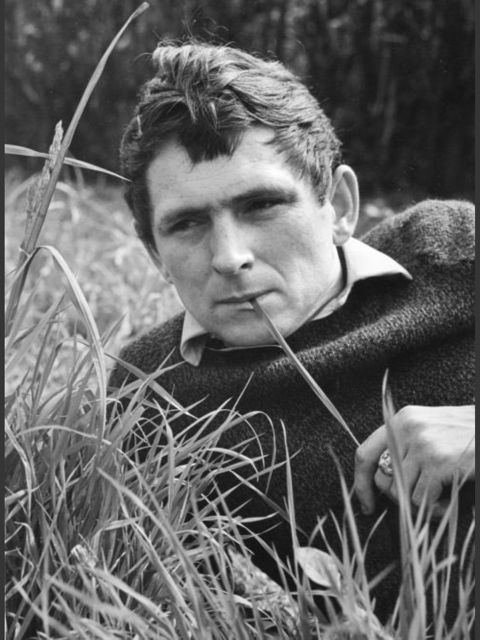
A pensive Hartnett ‘among (his) nameless weeds’. Photographer unknown.

As I have mentioned already in another post here, the decade from 1975 to 1985 in Glendarragh, Templeglantine, was arguably the most productive of Hartnett’s career.  Indeed, the output from that little cottage in the shade of ‘Tom White’s green hill’ in Glendarragh was prodigious.  The first poems to be published were his collection A Farewell to English, which was published in 1975, and thus began his long-lasting association with Peter Fallon and The Gallery Press.  The same year saw the publication of The Retreat of Ita Cagney / Cúlú ÍdeAdharca Broic was published in 1978, followed by An Phurgóid in 1983, Do Nuala: Foighne Crainn in 1984 and his fourth collection in Irish, An Lia Nocht, appeared in 1985.  During this period, he also undertook the translation of Daibhí Ó Brudair’s poems, which were published in 1985.  Many of his better Glendarragh poems are contained in the 1987 collection, A Necklace of Wrens.  This collection, following his return to Dublin, contains all poems in Irish with their English translation that Hartnett wanted preserved for posterity, and it was edited by Peter Fallon.

During this decade, 1975 to 1985, in parallel to this ‘serious’ output, he was writing and entertaining the locals with ballads, some serious or semi-serious like ‘A Ballad on the State of the Nation’, which was distributed as a one-page pamphlet like the ballads of old and even included original linocuttings by local artist Cliodhna Cussen. Other ballads were more contentious and even semi-libellous (or fully slanderous!), such as ‘The Balad (sic) of Salad Sunday’ and ‘The Duck Lovers Dance’.  These latter creations were written under the very appropriate nom de plume, ‘The Wasp’!  His most memorable local work was, of course, ‘Maiden Street Ballad’, a poem he composed for his father as a Christmas present in 1980.

These three intimate family poems were written in Glendarragh, Templeglantine and first appeared in his collection, Adharca Broic, in 1978.  Two of the poems are written for his children: Lara, who was born in 1968 and Niall, who was born in 1971.  These two poems with English translations also appear in his 1987 collection A Necklace of Wrens.   The third poem, Dán do Rosemary, was not included in this collection, and the reason for its exclusion is obvious.  As early as 1978, the tensions and stresses which eventually led to their separation in 1985 were beginning to show.   They were both navigating the inevitable separation, which eventually led to his departure for Dublin and Inchicore that year.  His gift for love poetry is again in evidence, as it had been back in 1968 with the publication of Anatomy of a Cliché.  Unfortunately, the clock had come full circle, and his final poem to Rosemary is one of abject apology and regret and wistful hopes for their post-separation lives.

The poem reads as a sad indictment of the way artists were treated in this country in the 70s and 80s.  They lead a ‘miserable life’, ‘for our lack of money / scrimping and scraping’.    He apologises profusely and admits that their marriage is ‘pitiless, loveless’, which has affected ‘your soft fragile (English) heart’.  Their small rural cottage is ‘run-down’, with ‘walls of clay, tear-stained’, ‘the place is falling apart’.  He takes full responsibility for their sorry plight and admits that he is ‘blundering, tactless, clueless’.  I have said elsewhere that at this time, Newcastle West was booming during the construction phase of the Aughenish Alumina Plant near Askeaton in County Limerick.  Newcastle’s twenty-six pubs were doing a roaring trade, and he apologises to his wife because he is ‘always acting the yob in the pub’. If anything, this poem in the original Irish is far more confessional and personal than most of his poetry up to this time.

The poem concludes on a far more positive and hopeful note.  He tells Rosemary that he has ‘abandoned English, but I never turned my back on you’.  This is a time for reappraisal, and he hopes to ‘relearn my craft from fresh woodland’ – he was living at the time in a townland called Glendarragh – the glen of the oak.  He ends on a hopeful note: he hopes that the future will bring Rosemary happiness and that her ‘worth will be appreciated’.  The final line is so sad and poignant – he hopes that ‘we both reach our America’.  The sadness of this final line arises from the fact that some seven years later, they both parted and went their separate ways.

Cliodhna Cussen, a fellow native of Newcastle West, has an interesting point to make about this poem:

‘Nuair a dhirigh Michéal ar an nGaeilge níor cuireadh aon rófháilte roimhe.  Bhí ceisteanna á n-ardú i dtaobh chaighdeán a chuid Gaeilge, ceisteanna a árdaíodh i dtaobh an Riordánaigh 30 bliain níos túisce. Ach léiríonn Michéal a anam, a chuspóir, agus a ghrá sa tseoid sin de dhán, ‘Dán do Rosemary’, ina bhfuil a chumas agus a chroí nochtaithe aige’.

 When Michael began writing in Irish, he didn’t receive great encouragement from Gaelgóirí.  There were questions about the standard of his Irish, just as there had been about Sean Ó Riordán some thirty years earlier.  But in this gem of a poem, ‘Poem for Rosemary’, Hartnett reveals his soul, his motive, his love – indeed, his supreme craft and heart are laid bare.’ (My own translation).

His poem for his son Niall, Dán do Niall, 7 (‘Poem for Niall, 7’), again shows his honesty and courage, although it does tend to descend into cliché at times.  Like King Canute and his futile attempts to hold back the tide, he wishes that his son wouldn’t have to leave this safe place in ‘Bird Nest country’, their home in Glendarragh.  He tries to warn his son about the many dangers that exist in the outside world and does so by making reference to nature.  This advice is somewhat reminiscent of the advice spoken by Polonius to his son Laertes in Shakespeare’s Hamlet: ‘This above all: to thine own self be true, And it must follow, as the night the day, Thou canst not then be false to any man’.  This suggests that integrity begins with honesty to oneself, and Hartnett gives us a modern take on this when he advises, ‘Be happy but be tough. ’

There is great poignancy in the final stanza when he states that he will be there for his son ‘in spite of death’.  Niall was 28 when his father died in 1999 at the age of 58, and the second line of this stanza adorns the poet’s headstone in Calvary Cemetery in Newcastle West: ‘mar labhraíonn dúch is labhraíonn pár’, ‘for ink speaks and paper speaks’.  The poet is saying that he will be present and live on in his body of work even after his death.  The reality is that he wasn’t there for many of the landmark celebrations in his son’s life, his graduations, his wedding, the birth of his grandchildren and so the promise he makes, ‘and some day I’ll buy you porter!’ sounds very hollow indeed to a young man who must now take on the onerous mantle of preserving and promoting his father’s rich and varied legacy at such a young age.

Hartnett’s grave in Calvary Cemetery, Churchtown, Newcastle West. The inscription reads: ‘Beadsa ann d’anneoin an bháis, mar labhraíonn dúch is labhraíonn pár’, (‘I will be there in spite of death, for ink speaks and paper speaks.’

His Dán do Lara, 10, (‘Poem for Lara, 10’), is a masterpiece.  The sunshine and nature in this poem are at odds with the penury and hardship of the poet’s existence in 1978, nestling below ‘Tom White’s green hill’ in Glendarragh, Templeglantine.  Flame-haired Lara is compared to a rowan tree in autumn, her voice disturbing the larks, ‘in the green grass’.  She is surrounded by nature in all its glory, ‘a crowd of daisies playing with you, a crowd of rabbits dancing with you’.  The blackbird and the goldfinch are there for her amusement and playtime.  Then the master of metaphor compares his daughter: ‘You are perfume, you are honey, a wild strawberry.’    The poem ends with the poet’s wish for his young daughter:

Little queen of the land of books            

may you be always thus                           

may you ever be free                                             

from sorrow-chains.

Interestingly, the poet compares his daughter to a queen in ‘the land of books’; this seems to set the seal on Lara’s perfection. Obviously, a poet would value literature and reading, and his choice of this image is significant as it tells us that Lara has another, deeper side to her – she is not just interested in the outdoors and a lover of nature.

His final wish for Lara is that she will grow up to be as beautiful and graceful as her mother, Rosemary.  He hopes that she will inherit her mother’s beautiful soul as well as ‘the beauty of her face.’

It is fitting that these three poems, written in that little rural cottage in Glendarragh, feature family and the travails of being a husband and a parent.  I have examined many of his papers in the National Library of Ireland on Kildare Street, and it is undeniable that hand-in-hand with arranging his poems and latest projects, there is ample evidence of the presence of young people, Lara and Niall, in the many doodles and scribbles on the margins of those frayed notebooks.

A detail from the beautiful sculpture in the Square, Newcastle West, by the sculptor, Rory Breslin, showing Hartnett clasping a copy of the 1987 collection, A Necklace of Wrens.


Dán do Niall, 7, le Michéal Ó hAirtnéide

Dán do Niall, 7

Mo thrua nach mairfidh tú go deo

i dtír na nead, Tír na nÓg,

tír mhíorúiltí faoi chlocha

tír sheangán:

tír na dtaibhsí dearga, tír fholláin.

Mas, tá an saol ag feitheamh leat

le foighne sionnaigh ag faire cearc:

cearca bana d’aigne úire –

scata fiáin

ag scríobadh go sonasach i bpáirc.

Más é an grá captain do chroí

bíse teann ach fós bí caoin:

ainmhí álainn é an sionnach rua

ach tá fiacla aige atá gan trua.

Seachain é, ach ná goin:

bí sonasach ach bí righin.

Beadsa ann d’ainneoin an bháis,

mar labhraíonn dúch is labrraíonn pár:

Beidh me ann in am an bhróin,

in am an phósta, am an cheoil:

Beidh mé ann is tú i d’fhear óg –

ólfad pórtar leatsa fós.

Poem for Niall, 7                                          

 A pity you’ll not always be

In Bird-Nest country, Tír na nÓg,

land of miracles under stones,

red-phantom land, a safe place.

For world waits for you,

patient fox watching hens:

white chicks of your fresh mind –

a white flock

scratching in a happy field.

If love commands your heart

Temper strength with gentleness:

A lovely dog the red fox is

but his teeth are pitiless.

Avoid him, do not harm him:

be happy but be tough.

I will be there in spite of death

for ink speaks and paper speaks:

I will be there in the sorrowful times

When music plays at wedding feast.

I will be there as you grow older –

And some day I’ll buy you porter!

 Note: This poem to his son, Niall, first appeared in Michael Hartnett’s first collection in Irish, Adharca Broic, which was published in 1978 by Peter Fallon’s Gallery Press.     It was published again in the 1987 collection, A Necklace of Wrens, this time with an English translation.


The Last Vision of Eoghan Rua Ó Súilleabháin by Michael Hartnett

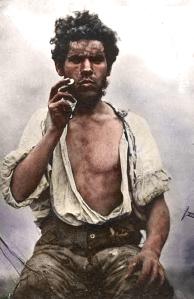
An unknown Spailpín Fánach circa 1858. A colourised image by Matt Loughrey from a black and white photograph originally collected by Sean Sexton.

The Last Vision of Eoghan Rua Ó Súilleabháin

The cow of morning spurted                Do thál bó na maidine
milk-mist on each glen                          ceo bainne ar gach gleann
and the noise of feet came                    is tháinig glór cos anall
from the hills’ white sides                     ó shleasa bána na mbeann.
I saw like phantoms                                Chonaic mé, mar scáileanna,
my fellow-workers                                   mo spailpíní fánacha,
and instead of spades and shovels      is in ionad sleán nó rámhainn acu
they had roses on their shoulders.     bhí rós ar ghualainn chách.

Translated by Michael Hartnett from his original Irish poem.

Commentary

This gem of a poem was first published as part of Hartnett’s first collection in Irish, Adharca Broic, in 1978.  The poem also appears in Hartnett’s 1987 collection, A Necklace of Wrens, with an English translation by the poet himself. Of the twenty-three poems in A Necklace of Wrens, thirteen are included from that first collection in Irish, Adharca Broic, with English translations by the poet. Peter Fallon, his publisher and editor, has stated that the poems included in A Necklace of Wrens were the only Irish poems that Hartnett wanted to be preserved after his ten-year sojourn in West Limerick. This collection was followed a year later by Poems to Younger Women, entirely in English. Theo Dorgan tells us that both these collections show ‘a startling return to the power and complexity we might have expected had the poet not turned aside from English in 1975’.

‘The Last Vision of Eoghan Rua Ó Súilleabháin’ offers a modern perspective on the traditional Aisling (vision) poem genre. The poem blends traditional imagery with contemporary twentieth-century realism, transforming the spectral ‘fellow-workers’, the ‘spailpíní fánacha’ of the original, into figures with ‘roses on their shoulders’ instead of spades, suggesting a hopeful, transformed vision of labour and society, rather than the lament for lost Gaelic order typical of historical Aisling poems.

Here, the focus shifts from the old political lament of older Aisling poems to a more modern, grounded, hopeful vision, using the image of the rose, the international symbol of the Labour Movement, of which Hartnett was a card-carrying member.  While the original poems lamented historical events like the Flight of the Earls and the hoped-for return of Bonny Prince Charlie and the Stuarts to power, Hartnett’s poem shifts the focus to a contemporary sense of disillusionment and emotional turmoil. Hartnett does use the image of a new day dawning to reinforce the hopeful possibility of better days ahead, however, while Hartnett’s translation adapts the ancient Aisling form in a contemporary context, in my view, this Aisling is heavily laden with irony, if not cynicism, because of Labour’s perceived inability to improve the lot of the working class and its failure to gain long-term popular mainstream support, particularly in the post-World War II era.

The title and the poem itself reference the Aisling genre, a poetic form that developed in Gaelic poetry in the 17th and 18th centuries.  Readers familiar with Irish poetry will also be aware that in these old Aisling poems, Ireland was often depicted as a woman: sometimes young and beautiful, sometimes old and haggard. In the final poem in his first collection in Irish, Adharca Broic, Hartnett reprints his iconic poem, Cúlú Íde, in which he portrays Íde (Ita Cagney in the English version) as a strong, formidable woman, and he endows her with many of the traditional characteristics of the spéirbhéan (the spirit woman) from the original Aisling poems.  She is depicted as a modern Bean Dubh an Ghleanna, Gráinne Mhaol, Roisín Dubh or Caithleen Ní Houlihan – in effect, a symbolic representation of the new Ireland.

This modern Aisling, ‘The Last Vision of Eoghan Rua Ó Súilleabháin’ also features striking imagery, such as the ‘cow of morning’ that ‘spurted milk-mist on each glen’. The image of the cow, the Droimeann Donn Dílis, was also a stock reference to represent Ireland in Jacobite poetry and the hoped-for return of the Stuart dynasty, which, many at the time believed, would benefit Ireland. This initial image creates a surreal and elemental atmosphere, setting a new tone for the vision. The crucial shift occurs when these workers have ‘roses on their shoulders’ instead of ‘spades and shovels,’ symbolising a transformed, idealised vision of labour, where it is no longer depicted as hardship or indentured slavery but as something beautiful and dignified.

The rose, particularly the red rose, later became a symbol for the Labour Movement through the slogan ‘bread and roses,’ which represents the dual desire for both the means to live (bread) and a life of dignity and fulfilment (roses). This symbol is associated with the fight for social and economic justice and is used by many social democratic and labour parties, such as the Labour Party in Ireland and the UK.

The ‘phantoms’ seen by the speaker are described as ‘fellow-workers’, ‘comrades’ even, transforming traditional imagery of spectral figures into more tangible, relatable characters associated with Labour.   The older, traditional variety are the sad spectral figures that accost Hartnett one summer’s evening as he heads from his home in Newcastle West to meet his uncle Dinny Halpin in Camas.  The episode is recounted for us in the second section of his iconic poem, ‘A Farewell to English’,

These old men walked on the summer road

sugán belts and long black coats

with big ashplants and half-sacks

of rags and bacon on their backs.

These spectral figures were a pathetic vision, ‘hungry, snotnosed, half-drunk’.  These ragged poets, Andrias Mac Craith, also known as An Mangaire Súgach, The Merry Peddlar,  (along with his contemporary, Sean Ó Tuama an Ghrinn, who also hailed from Croom, the seat of one of the last ‘courts’ of  Gaelic poetry),  Aodhagán Ó Rathaille from Meentogues near Rathmore in the Sliabh Luachra area (also the birthplace of Eoghan Rua Ó Súilleabháin), and Dáithí Ó Bruadair, who was on his way from Springfield Castle, the seat of the Fitzgeralds, to Cahirmoyle, the seat of his other great patron, John Bourke), represented the sad remnants of a glorious past.

The ‘phantom’ figures leave Hartnett resting ‘on a gentle bench of grass’, leaving him to ponder his own future as their direct descendant:

They looked back once,

black moons of misery

sickling their eye-sockets,

a thousand years of history

in their pockets.

Eoghan Rua Ó Súilleabháin, the putative author of this Aisling and a real-life spailpín in his own right, lived a life which was the stuff of legend and lore, and, indeed, it has many similarities with Hartnett’s own rakish life.  Many of the stories surrounding him may very well be apocryphal, to say the least.  However, he and his fellow parishioner, Aodhagán Ó Rathaille, are most famous for their mastery of the Aisling genre.

Eoghan Rua was born in 1748 in Meentogues, in the mountainous Sliabh Luachra area, in southwestern Ireland. By the time of his birth, most of the native Irish in the southwest had been reduced to landless poverty. However, the area boasted of having one of the last ‘classical schools’ of Irish poetry, descended from the ancient, rigorous schools that had trained bards and poets for generations. In these last few remnants of the bardic schools, Irish poets competed for attention and rewards, and learned music, English, Latin and Greek.

Eoghan Rua (the Rua refers to his red hair) was witty and charming but had the misfortune to live at a time when an Irish Catholic had no professional future in his own country because of the anti-Catholic Penal Laws. He also had a reckless character and threw away the few opportunities he was given. For example, at the age of eighteen, he opened his own school; however, we are told that ‘an incident occurred, nothing to his credit, which led to the break-up of his establishment.’

Eoghan Rua then became a spailpín, an itinerant farm worker, until he was 31 years old. He was then conscripted into the British Navy under interesting circumstances. Ó Súilleabháin was then working for the Nagles, a wealthy Anglo-Irish family.  They were Catholic and Irish-speaking, and had their seat in Kilavullen along the Blackwater valley near Fermoy, County Cork. (The Nagles were themselves an unusual family. The mother of the Anglo-Irish politician Edmund Burke was one of the Nagles, as was Nano Nagle, the founder of the charitable Presentation order of nuns. She was declared venerable in the Catholic Church on 31 October 2013 by Pope Francis).

Daniel Corkery relates that, ‘I have had it told to myself that one day in their farmyard Eoghan Rua heard a woman, another farm-hand, complain that she had need to write a letter to the master of the house, and had failed to find anyone able to do so. ‘I can do that for you’, Eoghan said, and though doubtful, she consented that he should. Pen and paper were brought to him, and he sat down and wrote the letter in four languages: in Greek, in Latin, in English, and in Irish. ‘Who wrote this letter?’ the master asked the woman in astonishment. The red-headed young labourer was brought before him, questioned, and thereupon set to teach the children of the house.  However, again owing to Eoghan Rua’s bad behaviour, he had to flee the house, the master pursuing him with a gun’. Legend says he was forced to flee when he got a woman pregnant: some say that it was Mrs Nagle herself!

Ó Súilleabháin escaped to the British Army barracks in Fermoy, and he soon found himself aboard a Royal Navy ship in the West Indies, ‘one of those thousands of barbarously mistreated seamen’.  He sailed under Admiral Sir George Rodney and took part in the famous 1782 sea Battle of the Saintes against French Admiral Comte de Grasse. The British won, and to ingratiate himself with the Admiral, Ó Súilleabháin wrote an English-language poem, Rodney’s Glory, lauding the Admiral’s prowess in battle and presented it to him. Ó Súilleabháin asked to be set free from service, but this request was denied him.

Much of Eoghan Rua’s life is unknown and clouded in mystery and intrigue. He returned after his wartime exploits to his native Sliabh Luachra and opened a school again. Soon afterwards, at 35, he died from a fever that set in after he was struck by a pair of fire tongs in an alehouse quarrel by the servant of a local Anglo-Irish family. ‘The story of how, after the fracas in Knocknagree in which he was killed, a young woman lay down with him and tempted him to make sure he was really dead, was passed on with relish’.

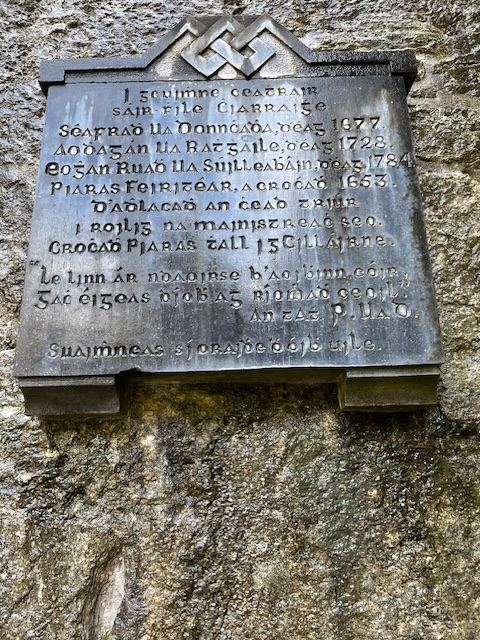
There is some confusion as to where he is buried.  Some claim he was buried in midsummer 1784, in Nohoval Daly graveyard (or Nohoval Lower Graveyard), which is located on the Cork side of the River Blackwater on the R582 Knocknagree to Rathmore road.  Others claim that he was buried in the cemetery of Muckross Abbey, Killarney, along with two other great Kerry poets, Séafradh Ua Donnchadha, who died in 1677, and Aodhagán Ó Rathaille, who died in 1728.  There is a plaque on the wall of Muckross Abbey today that commemorates this event.  The plaque also pays tribute to another great Kerry poet, Piaras Feiritéar, who was hanged ‘thall i gCill Áirne’, ‘over in Killarney’, in 1653.  The plaque also has an inscription which is attributed to an tAthair Pádraig Ó Duinnín, the great lexicographer, most famous for compiling the Foclóir Gaeilge–Béarla (Irish-English Dictionary), first published in 1904. He, too, was from Meentogues, the birthplace of both Ó Suilleabhán and Ó Rathaille.

The plaque on the wall of Muckross Abbey in Killarney claims that Eoghan Rua is buried in the Abbey cemetery, along with Aodhagán Ó Rathaille and Séafradh Ua Donnchadha.

It was said of Eoghan Rua that,

Perhaps there never was a poet so entirely popular– never one of whom it could be more justly said volitar vivus per ora virum [He soars, alive in the mouths of the people]. His songs were sung everywhere…. Munster was spellbound for generations…. The present generation, to whom the Irish language is not vernacular, in reading these poems should bear in mind that they were all intended to be sung, and to airs then perfectly understood by the people, and that no adequate idea can be informed of their power over the Irish mind, unless they are heard sung by an Irish-speaking singer to whom they are familiar.

There is much to admire in this short poem.  Indeed, I feel I am but scratching the surface.  However, short and concise as it is, I feel it has relevance to a modern audience eager to bridge the gap to a harrowing era in Irish literary history.  Indeed, the poem’s tone is one of elegy, lament, and perhaps a quiet resignation to loss, reflecting the disorienting experience of a changing world.

In his wide-ranging essay, which gives an overview of Hartnett’s work, ‘A Singular Life: The Poet Michael Hartnett’, Theo Dorgan points out that although he never translated the totem figures, Mac Craith and Ó Tuama,

‘he could and did think of himself as the favoured inheritor of a tradition, and also as one obliged to be loyal to that tradition. This sense of obligation would become the sign and signature of his work’.

That life’s work in both languages serves as a bridge between Ireland’s rich poetic past and its modern present. His poetry and translations from the Irish have given him firsthand knowledge of traditional Irish forms, such as the Aisling, and he uses these in very innovative ways in his contemporary poetry.  By taking a traditional form such as the Aisling and imbuing it with modern themes, Hartnett allows a new generation to connect with a classical poetic tradition while grappling with the emotional and political undercurrents of their own time.

The startling achievement of this short eight-line poem is that Hartnett manages to crystallise all the tropes and traditions of the Aisling genre while at the same time staying relevant to a modern audience.  This Aisling alone proves that he is a worthy successor to the ‘phantoms’, those spectral figures who confronted him at Doody’s Cross, ‘a thousand years of history in their pockets’.

References

Dorgan, Theo. ‘A Singular Life: The Poet Michael Hartnett’, from The Poets and Poetry of Munster: One Hundred Years of Poetry from South Western Ireland, ed. Clíona Ní Ríordáin and Stephanie Schwerter (December 2022/January 2023).

Hartnett, Michael. Adharca Broic, Loughcrew: Gallery Press, 1978.

Hartnett, Michael. A Necklace of Wrens: Poems in Irish and English, editor Peter Fallon, Loughcrew: Gallery Press, 1987.

Hartnett, Michael. Poems to Younger Women, Loughcrew: Gallery Press, 1988.

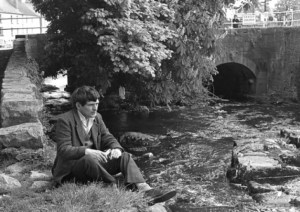
Michael Hartnett in pensive mood by the River Arra in Newcastle West in the 1970s. Photo credit to Limerick Leader Photo Archives

Michael Hartnett’s Legacy

311030211_471914084962595_2001561487708472105_n
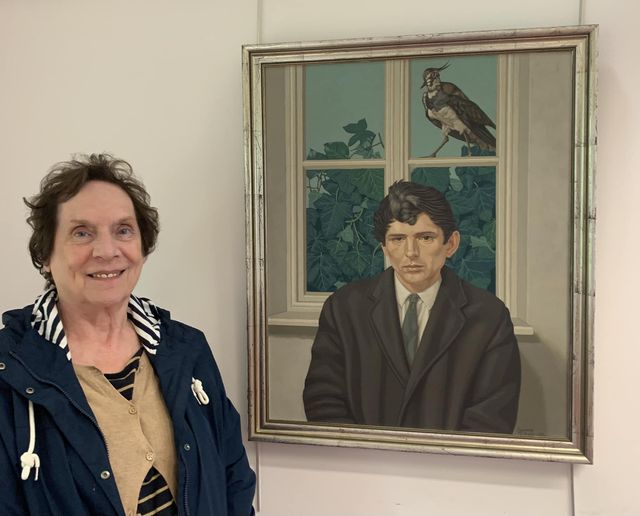
Éigse stalwart, Vicki Nash, pictured next to the 1971 portrait of Michael Hartnett by artist Edward McGuire, which was on display for the opening ceremony of Éigse 2022.

In academic circles, when poetic legacies, such as that of Michael Hartnett, are thrashed out and explored, there is always, of necessity, a legacy BUT.  BUT… he passed away in mid-sentence; his potential was unfulfilled, etc., etc.  We leave such debates to the continuing academic interest in Hartnett, but for those of us who love Michael Hartnett, the debate has already been won.   His core work, what we see in his numerous collections, his brilliant work as a translator, and his lyrical evocation of a Maiden Street upbringing (‘we were such golden children never to be dust’) and his other mischievous local interventions, are timeless and will stand the test of time – no ifs, ands or buts.

For those of us who are true believers, Michael Hartnett’s legacy as one of the central figures in modern Irish poetry is guaranteed. The Éigse Michael Hartnett festival, held annually throughout the town in schools, the library, the Red Door Gallery, the Desmond Complex, St. Ita’s Hospital, the Longcourt House Hotel, and in the ever-dwindling number of local pubs, celebrates that legacy each year. The festival’s wide-ranging and diverse programme creates an atmosphere of warmth and conviviality, perfect for lively gatherings, easy conversation, and spirited debate.

While his memory still lingers among us, however, the pace of change is relentless.  The Newcastle West he wrote so roguishly about has faded into the past, living on only in memory and in his verse.  Many of the central characters in these sagas, such as Tony Sheehan, Peg Devine, Tony Roche, Jimmy Deere, John Bourke, Billy the Barber, Pat Whelan, Ned O’Dwyer or Ned Lynch, are no longer readily remembered by the young people of the town.  Each year, however, they are recalled, remembered and celebrated in Éigse Michael Hartnett.

The Michael Hartnett Poetry Award is now worth a whopping €8,000, and the list of winners over the past twenty-five years is impressive. Many of those poets have gone on to achieve national prominence.  And, in the intervening years since the unveiling of that statue by fellow poet Paul Durcan on April 16th, 2011, Durcan’s hope that the statue would become a meeting place, a rendezvous, for parents and children, for schoolchildren, friends, and lovers has come to be a reality.

Michael Hartnett deserves all these efforts to keep his legacy alive – and, some would argue, the time has come for a more permanent centre to attract tourists and scholars to the town.  The Éigse organisers welcome recent efforts to establish a permanent Arts and Cultural Centre in Newcastle West.  This town needs to be a centre for the continued study of the poet’s work and a recognised repository for his papers and other materials before they are lost forever. It has been done successfully in Bellaghy and Inniskeen, so why not in Newcastle West?

Hartnett’s eclectic legacy is assured: his poetry in Irish and in English; his translations of modern Irish poets and of Ó’Bruadair, Haicéid and Ó Rathaille; his ‘local’ poems in Newcastle West and Inchicore; his engagement with the thorny issue of Irish nationalism and language at a time in the 70s during great political unrest without introducing any of the usual tribal undertones, will always be respected and applauded.

In recent times, we salute those who ensured that Hartnett’s iconic portrait by artist Edward McGuire was purchased by Limerick City and County Council on behalf of Limerick City Gallery of Art.  Like Hartnett himself, the portrait returns after a lengthy exile and will now forever be available to view locally.  However, in our continuing efforts to further Hartnett’s legacy, we can and must do more.

The decade from 1975 to 1985 in Glendarragh, Templeglantine, was arguably the most productive of his career.  Adharca Broic was published in 1978, followed by An Phurgóid in 1983, Do Nuala: Foighne Crainn in 1984 and his fourth collection in Irish, An Lia Nocht, appeared in 1985.  During this period, he also undertook the translation of Daibhi Ó Brudair’s poems, which were published in 1985.    In parallel to this ‘serious’ output, he was writing and entertaining the locals with ballads, some serious or semi-serious like ‘A Ballad on the State of the Nation’, which was distributed as a one-page pamphlet like the ballads of old and even included original linocuttings by local artist Cliodhna Cussen. Other ballads were more contentious and even semi-libellous (or fully slanderous!), such as ‘The Balad (sic) of Salad Sunday’ and ‘The Duck Lovers Dance’.  These latter creations were written under the very appropriate nom de plume, ‘The Wasp’!

It has to be remembered that at this time, Newcastle West and its West Limerick hinterland were booming.  The Alcan plant in Aughinish Island near Askeaton was under construction and every man, woman and child was working there.  Added to this, every spare room was occupied as up to 4,000 workers from all over Ireland were involved in the construction phase of the project.  The idyll of coming back home to a quiet rural backwater conducive to creativity in West Limerick was shattered by this unexpected and localised economic progress.  Ironically, while Michael was enjoying the  Klondike atmosphere in the hostelries of Newcastle West, his wife Rosemary was working as the Personal Assistant to the Managing Director of the newly commissioned Alcan Aluminium site.

This surely goes to the heart of the tragedy of what was Michael Hartnett’s life as a poet.  The literary and academic world tried in vain to accommodate him, although this help and recognition may have come too late to save him from the clutches of alcoholism.  While the annual Éigse sets out to maintain his rich legacy and celebrate his genius, it does tend to sugar-coat his reputation and often the big elephant in the room is ignored.  This must be a continuing source of frustration to his wife, Rosemary, his children and his surviving family members in and around Newcastle West.

The sad reality for Michael and his family was that he did not avail himself fully of the many opportunities that were offered to him in the 1970s and later. Rosemary bemoans the fact that while his contemporaries, such as Montague, Durcan, Kennelly and Heaney all wrote poetry, they also managed to earn a salary, whereas her husband ‘spurned all opportunities to do anything except write poetry and drink!’

He was the first recipient of a bursary from the Irish American Cultural Institute in 1974, which allowed him and his wife, Rosemary, to put a deposit on a cottage in the townland of Glendarragh, Templeglantine.  In that same year, he was awarded both the Irish American Literature Award and the Arts Council Award.  Following his return to West Limerick, he was employed for a brief time as a lecturer in Creative Writing at Thomond College of Physical Education (now the University of Limerick), but his tenure there was patchy and temporary.

Thus, at age 34, one would presume that Michael was free to pursue his calling as a poet and enjoy the countryside ‘out foreign in ‘Glantine’.  A good fairy, his wife Rosemary, paid the mortgage and all the bills and dealt with bureaucratic matters. She did it willingly because she believed in him and loved him and because she did not want her children to starve. 

Sadly, it seems that his obsession with poetry and drink left very little room for any other relationships to thrive and survive, and this included his marriage to Rosemary.  The acclaimed documentary by Pat Collins, A Necklace of Wrens (1999), ends with a very poignant, philosophical reverie as to whether Hartnett saw poetry as a gift or a curse:

It’s very difficult to describe where poetry comes from.  It certainly was given to me, but so were my brown eyes and my big ears.  They are just part of what I am, to coin a phrase.  I believe it’s a gift, certainly, and I’m lucky to have it.  But also it’s a curse, so I’m in two moods about it really.  I could say I did it all myself, which would be a total lie because there’s an entire three or four thousand years of tradition behind me in many languages.  But whether it was given or not, I can’t answer that question.  It just turned up and I turned up to meet it and we met at the crossroads and got married and we’re still married.

Michael Hartnett had a great predilection for romantic yarns. If they weren’t true, he was amused by the way they were taken up, including by the media and even sometimes by academics. Most of these myths, created by Hartnett to suit his own nefarious purposes, are trotted out again and again. One example of what passes for analysis:

At the age of three, Hartnett was sent to live with his grandmother, Bridget Halpin, who lived in Camas, a townland in the parish of Templeglantine, west of Newcastle West.  He was educated in the local primary school, and then in the well-known and enlightened St. Ita’s secondary school in Tarbert, Co. Kerry, run by the redoubtable Jane Agnes McKenna, a school that would later boast both Gabriel Fitzmaurice and Brendan Kennelly as alumni (McDonagh, Newman 15).

Hartnett, himself a master of misinformation and disinformation, would have been very impressed with the inventive mythmaking in this piece.  For the record, Brigid Halpin’s cottage in Camas is situated about a mile from the village of Raheenagh in the parish of Kileedy.  While it is true that he spent some time with his grandmother before beginning school and frequently thereafter for short stays at weekends and during school holidays, he attended Primary School in Newcastle West, first in Scoil Iosef and later in the long-established Courtenay Boys’ School. He then attended the very well-known and enlightened St. Ita’s Secondary School in Newcastle West, which was run by Jim Breen and where his English teacher was Billy O’Donnell.

Many of the myths surrounding Hartnett relate to Brigid Halpin, his grandmother. The reality is that she was not a native Irish speaker; he was not ‘fostered out’ to her for long periods in his childhood, and he did not learn Irish in her lowly cottage in Camas. Neither was she born in 1870, as he suggests in the famous Pat Collins documentary.  We know from Census records that she was a mere 80 years of age when she died alone in St. Ita’s Hospital, Newcastle West, in 1965. These inaccuracies continue to appear in much of what passes for scholarly research and analysis since he passed away in 1999, and, as I pointed out earlier, some of the biggest culprits are local. 

Despite this, Hartnett’s legacy is assured but demands continued and vigorous investigation.  While Declan Kiberd lavishes praise on Hartnett for being ‘the greatest translator of Irish-language poetry in the second half of the twentieth century’, he also bemoans the fact that ‘he is also his country’s most underrated poet (Kiberd, 381).  From the lofty heights where Heaney declares that Hartnett is the ‘authentic heir to the poets of the Maigue’ to those in the many hostelries he visited who dismissed him as an annoyance, there is the growing realisation of the truth in his son Niall’s observation that, ‘My father was many men to many people’ (McDonagh and Newman, 7).  Seamus Heaney remembers the frisson of electric energy which followed a Hartnett book launch – he says it was akin to a ‘power surge’ in the national grid.  He continues:

Yet despite that, his achievement was under-noticed.  Slight of build and disinclined to flaunt himself on the literary scene, he was always more focused on his creative journey than on career moves.  Edward McGuire’s portrait catches this singular intensity, but the response to his writings has been less definitive.’

Hartnett’s son, Niall, in an article in the Sunday Independent, on September 30th, 2024, spells out the current reality:

“His legacy as a poet is hard to gauge. His legacy is still spreading in Ireland, especially through the school system, although slowing in my opinion. But progress internationally is at a snail’s pace, sadly. My hope is that the school-goers of today in Ireland will be the next to carry his torch in the future to a wider audience.” 

And as we celebrate the twenty-fifth anniversary of Hartnett’s passing, we can see that time moves on and new poets emerge and are celebrated each year at Éigse  Michael Hartnett in Newcastle West, and in Listowel and Dromineer and many other far-flung Literary Festivals whose aim is to foster and nurture and give a platform to the young, vibrant successors of Hartnett. 

Twenty-five years on, the judgement of John McDonagh and Stephen Newman made shortly after his passing still holds true:

His body of work is a testament to his lifelong struggle with complacency and a desire to write with honesty and integrity that marks him out as one of the most overlooked yet influential Irish poets of the twentieth century (McDonagh, Newman, 24).

Prophets are never recognised in their own countries.  Until, that is, they make themselves irremovable landmarks on our landscapes and streetscapes.  The once-banished artist returns as a statue in our most cherished Square, an Éigse Literary and Arts Festival to honour him in perpetuity.  Hartnett deserves all these accolades.  He was at times painfully honest, very acerbic at other times, but always truthful until it hurt.  Emerson had him in mind when, in his famous definition of friendship, he states, ‘Better be a nettle in the side of your friend than his echo’, and he concludes with the admonition: ‘Let him be to thee forever a sort of beautiful enemy, untameable and devoutly revered’.

References:

Collins, Pat.  Film documentary A Necklace of Wrens (1999).

Hartnett, Rosemary, in correspondence with the author.

Kiberd, Declan. The Double Vision of Michael Hartnett in After Ireland: Writing the nation from Beckett to the present, Head of Zeus UK, 2017.

McDonagh, J., Newman, S.  (eds). Remembering Michael Hartnett, Four Courts Press Ltd., Dublin, 2006.

Michaelandrosemary
Michael Hartnett, his wife Rosemary and daughter Lara.

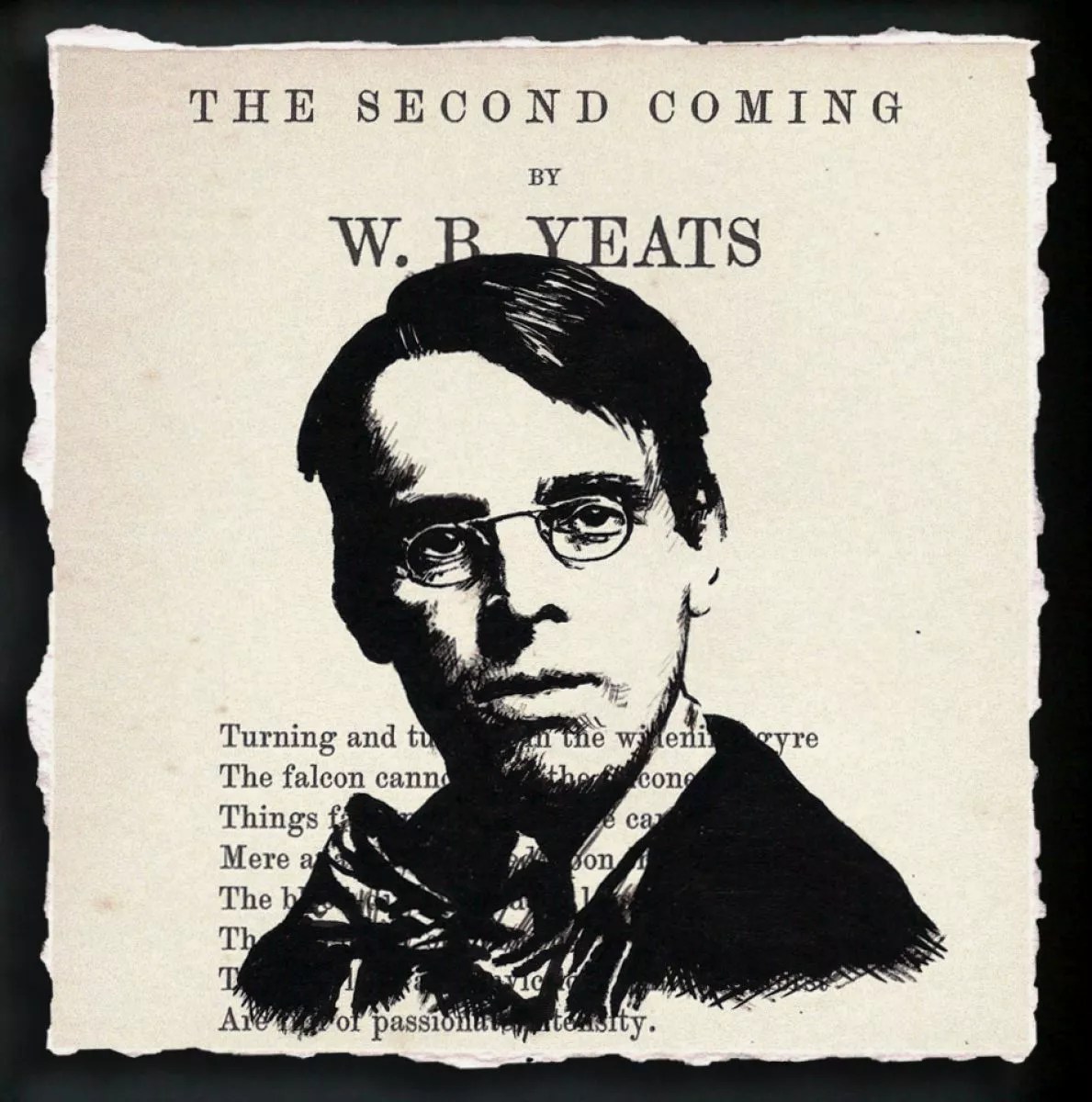
The Second Coming by W.B. Yeats – A Poem for Our Time

2354f8aaf8f740849907452ec6867daf
W.B. Yeats – The Second Coming (2014). Acrylic painting by Peter Walters.

The Second Coming


Turning and turning in the widening gyre

The falcon cannot hear the falconer;

Things fall apart; the centre cannot hold;

Mere anarchy is loosed upon the world,

The blood-dimmed tide is loosed, and everywhere

The ceremony of innocence is drowned;

The best lack all conviction, while the worst

Are full of passionate intensity.

Surely some revelation is at hand;

Surely the Second Coming is at hand.

The Second Coming! Hardly are those words out

When a vast image out of Spiritus Mundi

Troubles my sight: somewhere in sands of the desert

A shape with lion body and the head of a man,

A gaze blank and pitiless as the sun,

Is moving its slow thighs, while all about it

Reel shadows of the indignant desert birds.

The darkness drops again; but now I know

That twenty centuries of stony sleep

Were vexed to nightmare by a rocking cradle,

And what rough beast, its hour come round at last,

Slouches towards Bethlehem to be born?

Source: The Collected Poems of W. B. Yeats (1989)

 Commentary

The Second Coming surely holds the distinction of being the most plundered poem in the English language. To fully understand the poem, we are required to have some biblical knowledge as well as a basic understanding of Yeats’s vision of history.  The biblical reference is twofold: the poem blends Christ’s prediction of his own second coming with St. John’s vision of the coming of the Antichrist, the beast of the Apocalypse.  This is ‘the rough beast’ of the second last line of the poem.  Yeats makes the rough beast even more disturbing and sinister by assigning its place of birth to Bethlehem, the place of Christ’s birth, associated over the course of two thousand years – until recent times – with peace, mercy, gentleness and forgiveness.

To understand Yeats’ cosmology it is essential to read his book, A Vision where he explained his views on history and how it informed his poetry. Yeats saw human history as a series of epochs, what he called “gyres.” He saw the age of classical antiquity as beginning with the Trojan War and then that thousand-year cycle was overtaken by the Christian era, which he suggests is now coming to a close. That is the basis for the final line of the poem, “And what rough beast, its hour come round at last/ Slouches towards Bethlehem to be born?”  In his mystical book, A Vision, he foretold the birth of a new, violent, bestial anti-civilisation and the simultaneous destruction of the two-thousand-year-old Christian cycle.  The second coming of the poem is thus not that of Christ but of his opposite, the slouching, revolting figure of the beast whose birth will herald in a new age of anarchy to be ‘loosed upon the world’ (line 4).  Yeats’s thesis in A Vision is that each epoch or period of history is eventually overthrown by some massive upheaval.  This may explain why Yeats used the phrase “the second birth” instead of “the Second Coming” in some of his first drafts.

It is in this context that the opening lines of the poem should be read: ‘Turning and turning in the widening gyre / The falcon cannot hear the falconer’.  The falcon here is an image of man rapidly losing contact with Christ the falconer as he moves along the widening gyre of history.  The next six lines paint a grim picture of the beginning of a new age, marked by worldwide anarchy and violence (‘The blood-dimmed tide is loosed’).  As the gyre widens, ‘things fall apart; the centre cannot hold’.  The end of the Christian age is granted the revelation of the character of the new age. The tide of violence has already begun to move, and as it does, it begins to drown ‘the ceremony of innocence’ which, in Yeats’s symbolic system, stands for order and harmony as opposed to the personal and social violence of the ‘blood-dimmed tide’.

The ‘vast image out of ‘Spiritus Mundi’ (line 12) is a favourite Yeatsian idea.  According to Yeats, Spiritus Mundi is a storehouse of ideas deriving from the great universal memory common to all humankind, and is also the source of prophecy, since, he believed, history repeats the same predestined cycles every two thousand years or so.

The more terrible events associated with the coming of the Antichrist are all in the future, but in lines 3 – 8, Yeats suggests that his world is already experiencing a foretaste of the grim future heralded by the birth of the ‘rough beast’.  There was plenty of evidence all around him in 1919, the year he composed the poem.  Yeats began The Second Coming during the tense, eventful month of January 1919. The ‘war to end all wars’ was barely over and the Russian Revolution, which dismayed him, was still unfolding, while another war was brewing on his doorstep. On 21 January, the revolutionary Irish parliament met in Dublin to declare independence while, in a quarry in Soloheadbeg in Tipperary, Dan Breen and other members of the IRA killed two officers of the Royal Irish Constabulary ushering in the War of Independence. This war threatened to uproot the Anglo-Irish ascendency and the civilisation it represented, many elements of which appealed to Yeats himself.  Empires and dynasties were all in a state of flux as a result of this anarchy and revolution that had been loosed upon the world. The birth of Yeats’s daughter, Anne, in February, was also fraught with danger. During her pregnancy, his young wife Georgie Hyde-Lees had been stricken by the Spanish flu that was burning through Europe at that time in the wake of the war.  All these events conspired to put Yeats in an apocalyptic frame of mind.

For Yeats, the Incarnation of Christ was a violent, turbulent event, after which ‘twenty centuries of stony sleep / were vexed to nightmare by a rocking cradle’.  This new incarnation, that of the slouching ‘rough beast’ will unleash universal horrors.  Its sinister possibilities are hinted at in the suggestion that even the predatory desert birds, for all their savagery, are ‘indignant’ at its coming.

The poem gives us a frightening account of the fate in store for the post-Christian world.  Social anarchy and massive destruction are made worse by the collapse of moral values among the leaders of nations: ‘The best lack all conviction, while the worst / Are full of passionate intensity’.  He predicts that evil will triumph in the public sphere because those political leaders who might be expected to defend humane values (and basic human rights) lack the determination to resist those who preach violence and intolerance.

As I mentioned earlier, The Second Coming has become perhaps the most plundered poem in the English language – only Heaney’s From ‘The Cure at Troy’  comes a close second, with its ‘let hope and history rhyme’ so beloved of politicians.  At 164 words, The Second Coming consists of almost nothing but quotable lines. Someone reading it for the first time in 2024 might resemble the apocryphal theatregoer who complained that Hamlet was nothing but a bunch of quotations strung together. Whether or not it is Yeats’s greatest poem, it is by far his most useful.  As Auden wrote in “In Memory of WB Yeats” (1939), “The words of a dead man / Are modified in the guts of the living.”  We have to admit, after its first one hundred years, this poem was built to last.

As our world has recently been wrenched out of joint by the Covid-19 pandemic, many people are turning to poetry for wisdom and consolation. However, The Second Coming fulfils a different role, as it has done in crisis after crisis, from the Vietnam War to 9/11, to the genocides in Rwanda or Syria or Gaza,  to the election of Donald Trump and to the looming prospect of his imminent re-election: it provides us with an opportunity to confront chaos and dread, rather than to escape it. This is surely why Fintan O’Toole has proposed the “Yeats Test”: “The more quotable Yeats seems to commentators and politicians, the worse things are.”

bwgqngybqe-1577215055