Aere Perrenius … more lasting than bronze …

Hartnett bronze by artist Rory Breslin in The Square, Newcastle West.

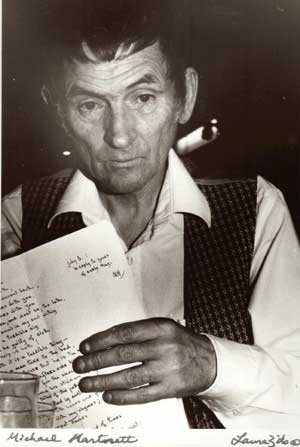
There is a very telling little poem by Michael Hartnett tucked away  in A Book of Strays called ‘Aere Perrenius’.   In it the poet recounts early encounters with Patrick Kavanagh after Hartnett had made his way to Dublin, ‘fresh from Newcastle West  / at twenty, with a sheaf of verse / tucked into my belt’.  It is really a very gentle admonition by the very prescient Hartnett who was already garnering academic interest.  He is saying to those who are required, as part of their academic studies, to rummage through the entrails of a poet’s work to be gentle in their excavations.

The Latin phrase aere perrenius comes to us from Horace.  In the final poem in his third book of Odes, Horace boasts that his poetry will outlive any man-made monument: “Exegi monumentum aere perennius.” (“I have made a monument more lasting than bronze.”). Hartnett would probably have been first  introduced to the  beauty and wisdom of Horace by Dave Hayes, erudite classics scholar and teacher of Latin at St. Ita’s Secondary School, Newcastle West where Hartnett studied for his Leaving Cert in 1950’s.

Hartnett’s poem ‘Aere Perrenius’, is therefore, really a poetic warning to young aspiring academics not to ‘tamper with the facts’ of his verse – or indeed Kavanagh’s verse either!  He mentions these, ‘dull strangers with degrees / who prune, to fit conceptions’.  These aspiring scholars build their theories on fragile ground, ‘give you ancestors and heirs’ and try to ‘bring you into line / with academic aims, / number all your bones / and make false claims.’

Would-be academics who undertake such necessary work should be aware, however, of the poet’s sensitivities.  Hartnett is adamant that he can live with being forgotten but not with being misunderstood or misinterpreted:

It is easy to forgive

a world that forgets

but not a world that changes

with subtle sentences

a life that was and is.

Both Hartnett and Kavanagh have had their fair share of being misunderstood – and for those who are familiar with the ‘history’ of their friendship, many will find Hartnett’s appeal on behalf of his ‘mentor’ very commendable!  He claims to understand Kavanagh, for all his rough edges, ‘the smokescreen of your talk / about fillies, about stallions’. His intimate knowledge of the man from Inniskeen is encapsulated in that uniquely Irish form of the ultimate trusting relationship: ‘I sometimes placed your bets.’

He declares that the bronze statue by the Grand Canal in Dublin’s  Baggott Street is best described by Kavanagh’s own word ‘banal’!  He, unsuccessfully as it happens, hopes that he will never suffer a similar fate.  He issues an appeal to all young, and not so young, aspiring academics to thread softly when they come to investigating and exploring the work  of any poet:

                                                            I’d rather be forgotten out of hand

than wronged in bronze:

let the sad facts stand.

Patrick Kavanagh's bronze commemorative seat near Baggott Street Bridge in Dublin
Patrick Kavanagh’s bronze commemorative seat near Baggott Street Bridge in Dublin

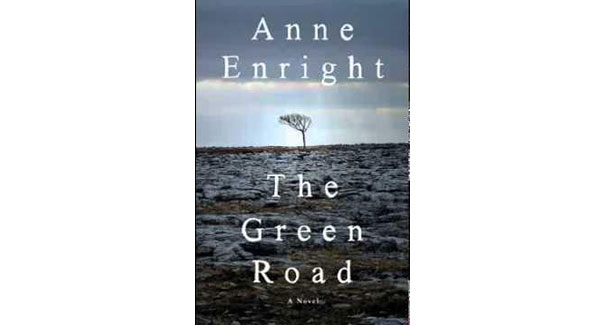
Musings on The Green Road by Anne Enright

BookTheGreenRoad_large

I’ve just finished The Green Road (Jonathan Cape) by Anne Enright, the inaugural Laureate for Irish Fiction.  The blurb accompanying the book states that it is a darkly glinting novel set on Ireland’s Wild Atlantic Way – isn’t everything these days! – a story of fraction and family, of leaving home and coming home, a novel exploring selfishness and compassion, a book about the gaps in the human heart and how we learn to fill them.

The novel is a bit of a slow burner at first, that is until we are introduced to the great Irish matriarch, in this case, Rosaleen Madigan.  Her children, Dan, Emmet, Constance, Hanna, all leave the West of Ireland for lives they could never have imagined in Dublin, New York, Toronto and various third-world towns.  Then Rosaleen announces that she has decided to sell the ancestral home and divide the proceeds.  They all come home for a final Christmas together.

In truth I found the novel to be eerie and close to the bone.  How did Anne Enright obtain such deep insight and information about my own mother!  Her depiction of Rosaleen Madigan is worthy of a Booker on its own – ‘The world she grew up in was so different it was hard to believe she was ever in it.’  Like Michael Harnett’s grandmother, Bridget Halpin, in his poem,  ‘Death of an Irishwoman’, ‘she clenched her brittle hands / around a world / she could not understand.’ I feel the novelist would have benefitted from an editor of the calibre of Harper Lee’s – if so we would now be reading about, ‘Rosaleen Considine at six and Rosaleen Madigan at seventy six’ rather than Rosaleen and all her offspring.

There were also a number of inexcusable typographical errors in my paperback edition, the sign of rushed publication, but surely unforgivable in a Booker nominated novel.

However, despite all my nit-picking, this novel is a must-read for any among you living with – or away from – a strong willed ageing Irish mother!  Anne Enright has done a remarkable job of depicting this woman, a survivor of the Celtic  Tiger era, who decides to cash in her chips and divvy out the proceeds to those who have survived her reign.  Like Lear in his dotage we all are aware of the pitfalls of such a course of action!

My one major criticism of the novel is the ending.  It is as if Anne Enright loses interest in the project and it fades out like a damp squib.  The ending is disappointing and disjointed – skipping about tying up the loose ends.  The characterisation is uneven – with Rosaleen and Constance being strongly drawn while the others are insipid and aimless enough.  This novel won’t win this year’s Booker Prize, indeed it will be lucky to be shortlisted when you compare it to Tom McCarthy’s masterpiece, Satin Island, my current read.

A-very-very-good-writer---009

‘Hands’ by Michael Hartnett

Hartnett by the Bridge in Newcastle West

Hands

By Michael Hartnett
Some white academy of grace
Taught her to dance in perfect ways:
Neck, as locked lily, is not wan
On this great, undulating bird.
 
Are they indeed your soul, those hands,
As frantic as lace in a wind,
Forever unable to fly
From the beauty of your body.
 
And if they dance, your five white fawns,
Walking lawns of your spoken word,
What may I do but let linger,
My eyes on each luminous bone?
 
Your hands are music, and phrases
Escape your fingers as they move,
And make the unmappable lands
Quiet orchestra of your limbs.
 
For I have seen your hands in fields
And called them fluted flowers
Such as the lily is, before
It unleashes its starwhite life:
I have seen your fingernail
Cut the sky
And called it the new moon.

This beautiful love poem was written by Michael Hartnett in 1966 around the time he had met his future wife Rosemary Grantley (whom he married on 4th April, 1966).  It appears in his collection Selected Poems published by New Writer’s Press in 1970 although it was meant for publication in his first collection, Anatomy of a Cliché published by Liam Millar’s Dolmen Press in 1968.  Many of the poems in that collection are dedicated to and inspired by his relationship with Rosemary.   In ‘Hands’, it is obvious that he is trying to impress her with his poetic prowess and yet he appears to be trying to downplay his poetic skills and be nonchalant at the same time!  Those who knew him need no reminding, those who didn’t should be aware that he was a rogue!

 Commenting on the poem the poet himself  has written:

“This is one of the few of my poems that I can say in full.  It is a love poem and was written in 1966.  I like it for reasons both sentimental and professional.  The hands are my wife’s hands: the poem is their equivalent in words.   I avoided the use of obvious rhymes such as wan/swan and used less expected words to finalise the stanzas, but the more usual rhymes can be inferred.”

 The poem opens with a powerful metaphor – Hartnett’s forte – where his wife is compared to a swan, the perennial symbol of faithfulness in Irish poetry.  The poem is titled ‘Hands’ but here he focuses on her neck and compares it to the swan’s.  There is also a simile used to make the comparison and beautiful use of alliteration, ‘locked lily’.  He downplays the importance of keeping a precise rhyming scheme and uses ‘undulating bird’ instead of the more obvious ‘undulating swan’ in the last line of this first stanza.

There is a hint of fragility and nervous tension throughout and in the second stanza he uses the delicate simile, ‘as frantic as lace in a wind’ to describe his wife’s hands.  He uses another powerful metaphor in the third stanza where her  fingers are compared to  ‘five white fawns’.  There is a very distinctive Celtic ethereal quality to the poem and this is emphasised here by his use of internal rhyme where ‘fawns’ rhymes with ‘lawns’ in the middle of the next line.  Again the rhyme is corrupted at the end and the poet uses ‘bone’ instead of the obvious ‘finger’ to end the stanza.

The fourth stanza contains an extended metaphor where the hands are compared to music – ‘phrases escape your fingers as they move’.  He uses the word ‘orchestra’ here also to continue the comparison.  The stanza ends with another example of corrupted rhyming scheme where he has ‘lands’ rhyming with ‘limbs’ instead of the more obvious ‘hands’.

This extended metaphor ends beautifully in the final stanza with his alliterative allusion to ‘fluted flowers’.   The final tour de force metaphor is exquisite: he compares her fingernail to a sliver of new moon in the night sky.

Hartnett’s gift of observation, his closeness to nature and his searing honesty and genius are evident in abundance here in this amazing love poem.  The delicate, fragile images and almost balletic, musical rhythm are echoed in many of his poems  and also in such poems as ‘Poem for Lara, 10’.

Statue of Michael Hartnett in The Square

Christmas in Maiden Street – ‘in the good old days’!


 This piece of incisive and insightful social commentary, describing life in Newcastle West in the 1950’s, first appeared in Magill magazine in December 1977 and later in the Journal of the Newcastle West Historical Society, The Annual Observer, in July 1979. Hartnett,the poet, was back in town and the dam burst of memory and nostalgia was beginning, culminating with the bitter sweet Maiden Street Ballad, written as a Christmas present for his father, Denis Hartnett, in December 1980.

Christmas in Maiden Street
By Michael Hartnett

image


A shouting farmer with a shotgun, a few patch-trousered urchins, soaked, snotty and unrepentant, running across wet fields, arms full of holly. The long walk on the railway tracks, the sleepers treacherous and slimy, the dark station, the lamp posts with their glittering circular rainbows. We stopped at the shops’ red windows to admire toys we could never have. A few drunks waltzed by, happy and moronic. An open lorry went by to jeers and obscenities; the pluckers, shawled and snuff-nosed, on their way to a flea-filled poultry store to pluck turkeys at nine pence a head.

Candles and paraffin-lamps did not brighten the darkness in kitchens in Maiden Street – they only made the gloom amber. The purloined holly hung on holy pictures. There were no balloons, no paper chains, no Christmas trees. Coal was bought by the half-stone, butter by the quarter-pound, and tea by the half-ounce. The country people trotted by on donkey and cart or pony and trap with ‘The Christmas’ stones of sugar, pounds of tea. Women in shawls and second-hand coats from America stood at half-doors, their credit exhausted, while the spectre of Santa Claus loomed malevolently over the slates and thatch.

Members of Charitable Institutions distributed turf and boots, God Blessing the meagre kitchens, as hated as the rent-man. They stood well-dressed on the stone floors, were sirred and doffed at. They paid their workers slave wages. They looked without pity at the nailed together chairs, the worn oilcloth-topped tables, the dead fires.

Outside, the rain fell and blew along the street. The tinkers fought. Bonfires died out in the drizzle. We were washed and put to bed, happy and under-nourished. The oldest went to Midnight Mass. The Latin was magic, the organ, the big choir. It always seemed like a romantic time to die.

It was a Christmas of tin soldiers, tin aeroplanes and cardboard gimcracks. We were Cisco, Batman, Johnny McBrown all that day. Our presents – ‘purties’ we called them – seldom lasted longer than that day. It never snowed. There was no turkey, no plum-pudding, no mince-pies. The Victorian Christmas was not yet compulsory. The very poor managed roast meat, usually mutton. We often rose to two cocks. The goose was common. There was a fruit-cake, jelly and custard; the dinner of the year. I never remember drink being in the house. There were never visitors, nor were we encouraged to visit anyone. If the day had been anyway fine, we were to be found on the footpath or in the puddles, knuckles blue.

The Wren’s Day always brought frost. Small warm heads came from under rough blankets to the sound of flutes and banjos and bodhrans far up the street. We donned boot polish and lipstick and old dresses and went out to follow the Wren, tuneless chancers. We sang and giggled our way to a few bob and a glass of lemonade. The back kitchens of the pubs filled up with musicians, the musicians filled up with porter and their wives filled up with apprehension. In a few hours, winter took over again.

There will never be Christmasses like those again, I hope to God.


MichaelHartnett