The Problem with Hamlet – is Hamlet


 Hamlet (2)

(HAMLET’S CENTRAL IMPORTANCE IN THE PLAY)

‘Hamlet without the Prince’ is a well worn expression for something without significance.  In no play of Shakespeare does so much of the effect depend on a single character.  It is, of course, quite legitimate to discuss Hamlet’s character, to point to his human qualities, his intellectual bent, his habit of repetition, to probe his ’antic disposition’, and so on.  But there is another way of looking at Hamlet and, indeed, at all the tragic heroes.  This is to concentrate not so much on what kind of man Hamlet is, but on what he does, what kind of experience he undergoes, what kind of role he must act out.

This kind of investigation has the merit of revealing an interesting pattern.  A most significant feature of Hamlet’s experience is to pass from one extreme position at the beginning to another at the end, in John Holloway’s phrase, ’from centrality to isolation’ (p. 26).  This, indeed, is a common trend in all of Shakespeare’s great tragedies, whether we speak of Lear on the heath, Macbeth isolated in Dunsinane or Othello on the island of Cyprus.  Likewise, here in Elsinore, all the emphasis at the beginning is on Hamlet’s central importance.  The interest and concern of all the other characters are directed towards him.  At the end of the first scene the participants think of him as the only one to deal with the problem they have encountered.  ‘Let us impact what we have seen to-night’, suggests Horatio, ‘unto the young Hamlet, for upon my life /The spirit, dumb to us, will speak to him’ (1,i, 169).  In the following scene, Claudius and Gertrude accord Hamlet the central place in their deliberations and in their regard, and see him as the man on whom the future of Denmark will depend:  ‘You are the most immediate to our throne / And with no less nobility of love / Than that which dearest father bears his son / Do I impact towards you…’(1, ii, 109).

 Hamlet’s central position continues to be underlined with the progress of the play.  In Act 1, Scene iii, we see that he is the object of Ophelia’s love, and that Laertes is deeply concerned with the relationship.  In the next scene, Hamlet is the only one to whom the Ghost will speak.  Much of the interest in Act 11 is focused on the attempts of Claudius and Polonius to probe Hamlet’s problems.  Hamlet’s privileged centrality at this early point in the play is partly what Ophelia is thinking of when she looks back sadly from a later vantage-point: ‘The expectancy and rose of the fair state / The glass of fashion and the mould of form / The observed of all observers’  (111,i, 152).

There is, then, considerable concern for Hamlet on the part of all those who surround him, but there is an air of unreality about much of it.  The King’s motives are soon suspect: Laertes is not disinterested; Ophelia abandons Hamlet at her father’s instigation.  Hamlet still wants to think of Rosencrantz and Guildenstern as his friends, but their friendship, once genuine, is now a mere pretence.  He is soon to learn that he can no more trust his former schoolfellows than he can ‘adders fanged’.  He is gradually isolated from the comforts of genuine human sympathy; most of those who associate with him (Horatio being the exception), do so for purposes ultimately inimical to his welfare; even Ophelia allows herself to be used by his enemies.   There is a real sense in which Ophelia, Rosencrantz, Guildenstern and even his mother have, as John Holloway puts it, ‘all gone over to the other side’.  This kind of hostility is, of course, a covert one.  It comes into the open in the graveyard scene when Laertes seizes Hamlet by the throat with the cry, ‘The devil take thy soul’ (V, i, 255).  In the end Hamlet distances himself even from the loyal Horatio, rejecting his advice not to engage in the duel.  The last scene of the play finds Hamlet in the curious position of being isolated and central at the one time; as he fights in single combat, he is surrounded by people who are ranged on the side of his enemy.

Hamlet’s progressive isolation is intensified by his having to take on a well defined role, that of revenger.  The demands of the role make him a man apart.  The circumstances of the crime he has to avenge, and the various kinds of involvement of the leaders of his society, including his mother, with the criminal he must kill, make it impossible for him to confide in those who should be his natural companions.  A man who is given the task of avenging on his own a capital crime, and who must purge evil from a whole society, must inevitably stand outside his social group, and pursue a lonely career until his task has been accomplished.  He formally dedicates himself to the role of avenger in Act 1, Scene v: ‘And thy commandment all alone shall live / Within the book and volume of my brain… ‘ (1, v, 102).  He knows what his dedication must involve in human terms:  ‘O cursed spite / The ever I was born to set it right’ (I, v, 188).  He knows that his role as an avenger has set him apart from the others, and imposed intolerable burdens on him:

 For this same lord

                        I do repent; but heaven hath pleas’d it so

                        To punish me with this, and this with me

                        That I must be their scourge and minister…

                                                                                                            111,iv,173

Problems of character and role are at the heart of Hamlet.  One of the favourite themes of critics is Hamlet’s refusal to take decisive action in fulfilment of the ghost’s command.  But this is not his only refusal.  It might be argued that one of the oddest aspects of the play is Hamlet’s refusal to take a serious part in its proceedings.  David Pirie has argued that, ‘the play has to stagger through its five acts without the Prince becoming responsibly involved’ (Critical Quarterly, 1972, p.314).  This line of argument is worth pursuing.  Hamlet himself makes the point that the ‘real’ world of Elsinore, that rank place of corruption, is an unprofitable subject for serious consideration.  His interest in this world, his willingness to participate fully in its concerns, is undermined by his bitter experiences, particularly those involving his mother.  And yet, this melancholy and disillusioned sceptic is cast by various people in a number of roles which he is expected to act out with enthusiasm:

  1. The Ghost has cast him in the role of hero in a revenge play, in which he must kill Claudius and avoid tainting his mind against Gertrude.
  2. Claudius sees him as the central figure in a drama of political intrigue, plotting against the throne, consumed by ambition.
  3. Polonius sees him as the suffering victim a tragedy of frustrated love with Ophelia as the heroine.
  4. The Fortinbras affair tempts Hamlet to accept the role of military hero in a drama of territorial conquest in which he would re-enact his father’s exploits against Norway.

It might be argued that Hamlet rejects all these roles as unworthy of his serious consideration.  This rejection is presented by him directly to the audience in terms of a comparison with the theatre in which they find themselves.  Hamlet discovers all too evident similarities between the dishonest trappings of Elsinore and the stage of the Globe theatre on  which the play is being performed.  There are very many theatrical metaphors and explicit references to the stage and acting in Hamlet.  Consider the following celebrated speech:

‘Indeed it goes so heavily with my disposition that this goodly frame the earth, seems to me a sterile promontory, this most excellent canopy the air, look you, this brave o’erhanging firmament, this majestic roof fretted with golden fire, why it appeareth nothing more but a foul and pestilent congregation of vapours’ (11, ii, 301). 

This speech cannot take on its full significance for a modern reader or a modern audience unless the physical aspects of the Elizabethan theatre are borne in mind.  The ceiling of the Elizabethan inner stage was decorated with painted stars and moon; the auditorium was roofless, hence the references to ‘this canopy’ and ‘this firmament’.  The Elizabethan stage was shaped like a promontory running out into the audience.  Hamlet here expresses his disillusioned withdrawal from his world in terms of the first-hand experiences of the audience.  The concerns of the corrupt world of Elsinore, he is telling his listeners, are no more real to him, no more worthy of his serious attention, than the artificial trappings of the theatre are to them. Indeed, there is a sense in which he finds play-acting preferable to the activities of real life, as his comment on the players and their play makes clear: ‘He that plays the king shall be welcome, his majesty shall have tribute on me, the adventurous knight shall use his foil and target, the lover shall not sigh gratis, and the lady shall say her mind freely’ (II, ii, 317).

Each detail here is an implicit comment on the characters of the real Elsinore play.  What Hamlet is saying is that the only kings who deserve a welcome are player-king’s; usurpers like Claudius, are unworthy of respect.  ‘Foil’ and ‘target’ are a light fencing-sword and light shield, harmless enough weapons compared to the lethal ones of real warriors.  In the kind of play Hamlet would like, lovers like him would find their sighs rewarded rather than have to undergo the humiliation he encounters from those who control Ophelia; and in such a play, the Ophelias will be permitted to express their love without constraint.  Fortinbras, the nearest approach to a real knight that Hamlet knows, is a reckless adventurer whose activities will result in mass slaughter.  His own letters to Ophelia (his ‘groans’) will be read by enemies; their private conversations will be arranged and listened to by eavesdroppers.  Every relationship but one in Elsinore in which Hamlet is involved  strikes a false position. He has to reject  what David Pirie has called the ‘false scripts’ offered to him by the other characters and lure as many of them as he can into a play of his own devising, a play in which, for a change, he can direct matters and replace false seeming by a true representation of events. His adaptation of The Murder of Gonzago into the Mousetrap is much closer to the truth than are the dishonest cat and mouse activities of Claudius and Polonius.

This view of Hamlet’s attitudes to the world of Elsinore, his refusal to accept its standards and to take it seriously, may help to account for his reaction when he finds Claudius at prayer.  Here he has his one undoubted opportunity to carry out his father’s command, but he does not avail of it.  His excuse is a dogmatic statement about sin and the after-life, to the effect that Claudius will go to heaven if he is killed while in the state of grace.  This is less than fully convincing in view of his already declared scepticism on such matters.  A more plausible explanation of his attitude here might be that if he did slay Claudius he would be admitting that action was valid, and thus deny his deep-seated belief that life and action are both meaningless.  What, then of the killing of Polonius and of the Rosencrantz and Guildenstern affair?  One might argue, as David Pirie does, that Hamlet is,

‘sometimes tricked into action by the energy with which other characters pursue their plot.  So in blind anger when he thinks that Claudius has been placed by his mother to eavesdrop on their private talk, he stabs through the arras only to find the wholly inappropriate object of a dead Polonius’.

What Hamlet learns from this episode is what he must have sensed all along, that actions don’t always speak louder than words!

Works Cited

Holloway, John, The Story of the Night: Studies in Shakespeare’s Major Tragedies, Routledge Library Edition, 2005. Print

Pirie, David, “Hamlet without the Prince”, Critical Quarterly 14, (Winter 1972) in Shakespeare’s Wide and Universal Stage, eds. C.B. Cox and D.J. Palmer. (Manchester: Manchester University Press, 1984). Print
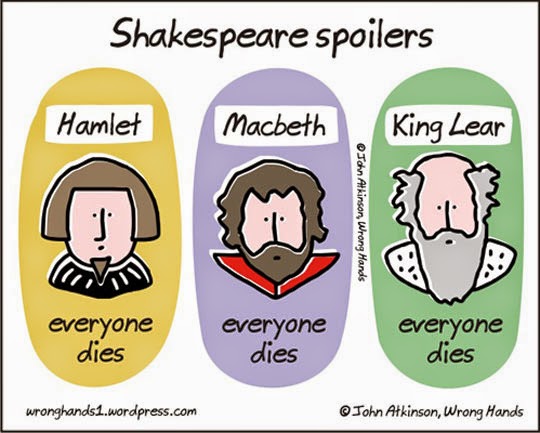
 funny-Shakespeare-spoilers-Hamlet-Macbeth-King-Lear

Hamlet’s Delay

Hamlet (2)


The problem of Hamlet’s delay in killing Claudius is usually considered in relation to his character and circumstances.  We are dealing here with a play and a character which provoke the most contradictory responses from critics.  There are, for example, those who argue that Hamlet never does get around to taking any practical, deliberate measures to carry out the Ghost’s command, that his delay never ends, that when he does finally slay Claudius he does so almost inadvertently, at the end of a fencing-match not arranged by him but by Claudius – that the act of vengeance, in other words, has to be forced upon him or it would never be performed.  This is one extreme position.

By contrast, we have the line of argument that it is meaningless to see a delay in a fiction such as Hamlet merely because something that requires doing is not done at once; naturally it will be done at the end – it is a play after all!  Those who take this point of view argue that we are entitled to stress delay in Hamlet only if the play underlines procrastination.  But, they suggest, apart from the soliloquies, the idea that Hamlet delays can be traced to only two passages.  In the first, we see him turn down a genuine opportunity to kill Claudius when the latter is at prayer (‘Now might I do it pat, now he is praying / And now I’ll do it, and so he goes to heaven… III, iii, 73).  The second passage is the one where the Ghost endorses Hamlet’s own suggestion that he has come his ‘tardy son to chide’ by telling him that he has come to whet his ‘almost blunted purpose’ (III, iv, 111).

The soliloquies, however, make up for any lack of emphasis on delay in the action of the play.  In these, there is a continuous reiteration of self-disgust on Hamlet’s part at his tardiness as an avenger:

                                     ….for it cannot be

                        But I am pigeon-livered, and lack gall

                        To make oppression bitter, or ere this

                        I should have fattened all the region kites

                        With this slave’s offal….(II, ii, 571)


How all occasions do inform against me

                         And spur my dull revenge (IV, iv, 32)


How stand I then,

                         To have a father killed, a mother stained,

                        Excitements of my reason and my blood,

                        And let all sleep….(IV, iv, 56)

It is Hamlet himself, then, who forces on our attention the question that has since engaged every critic who has dealt at any length with the play: why does he take so long to carry out the unambiguous commands of his father’s ghost to kill Claudius?  The following are some of the arguments most commonly put forward:

  • Hamlet is squeamish about blood, and finds violence repulsive. This approach to the problem of the delay has a long history.  Goethe, the great German writer, suggested that Hamlet, having ‘a lovely, pure, noble and most moral nature, without the strength of nerve which forms a hero, sinks beneath a burden which he cannot bear and must not cast away’.  The trouble with this interpretation is that it is too much at odds with some striking features of Hamlet’s behaviour: such violent and daring activities as his pursuit of the Ghost along the battlements, his slaying of Polonius, his remorseless despatching of Rosencrantz and Guildenstern, and also his many violent utterances in soliloquy and dialogue
  • He is prevented until the very end from killing Claudius by external obstacles. This line of argument seems nullified by the ease with which Laertes invades the palace and raises a successful rebellion.
  • Hamlet cannot rouse himself to effective action because his will to act is paralysed by melancholy, apathy, grief or disillusionment, or by a combination of all these. There is much evidence in the play to support such a view, particularly in the soliloquies – ‘How weary, stale, flat and unprofitable / Seem to me all the uses of this world’ (I, ii, 134); ‘It goes so heavily with my disposition that this goodly frame the earth, seems to me a sterile promontory…’ (II, ii, 296).
  • Hamlet has grave doubts about the righteousness of personal revenge. John Lawlor argues that this is the tragic conflict in the play; ‘the hero avers from the deed that is required of him, seeking endlessly the cause of his aversion, calling it by any name but its own, and failing to know it for what it is’.  It is true that Hamlet curses the fate that casts him in the revenger’s role: ‘The time is out of joint; o cursed spite / That ever I was born to set it right’.  It may also be argued that he cannot bring himself to take premeditated vengeance on Claudius.  He gets his opportunity when the latter is at prayer and at his mercy and offers what may seem like an unconvincing excuse for not proceeding with his task.  It is only on the spur of the moment, when he has little or no chance to contemplate the moral implications of vengeance, that he takes decisive action (the killing of Polonius and of the king are acts suddenly forced upon him).  Against this, however, it may be felt that if Hamlet has such strong ethical reservations about vengeance, such reservations might also extend to an act like the sending to certain death of Rosencrantz and Guildenstern, and it is quite clear that he has no qualms about this (‘they are not near my conscience’, V, ii, 58).
  • Before he can proceed to kill Claudius, Hamlet must first find evidence that will make the justice of slaying his uncle apparent to the world, and at the same time satisfy himself that the Ghost has been telling the truth.  The right question to ask, then, is not, why should Hamlet delay his killing, but why should he kill Claudius?  There is much in the play to support this kind of emphasis.  Examination of the text, for example, reveals that Hamlet has no cause to murder Claudius beyond a request to that effect by the Ghost.  After the Ghost’s appearance, Hamlet is convinced that he now has an explanation for an otherwise inexplicable series of events: he has not succeeded to the throne, Claudius having ‘popp’d in between the election and my hopes’ (V, ii, 65) as he later puts it; his mother has consolidated his uncle’s claim to the throne by marrying him within a month.  But the trouble is that the ghost’s revelations lack any kind of proof.  In this context, the end of Hamlet’s soliloquy before the Play Scene is vitally important:


The spirit that I have seen

                        May be a devil; and the devil hath power

                        To assume a pleasing shape; yea, and perhaps

                        Out of my weakness and my melancholy

                        As he is very potent with such spirits

                        Abuses me to damn me; I’ll have grounds

                        More relative than this.  The play’s the thing

                        Wherein I’ll catch the conscience of the King.

(II, ii, 591)

Some commentators dismiss this as simply excuse-making, another opportunity to defer action.  but from Hamlet’s point of view, it is surely reasonable to wait until some kind of proof is forthcoming.  Without proof that Claudius is guilty, where would he stand if, having killed his uncle, he found he had killed an innocent man, or, more plausibly, found it impossible to convince anybody else of the justice of his act.  He is thus in a dilemma, often ignored by critics, a dilemma which may account for the attitude expressed in ‘O what a rogue and peasant slave am I’ (II, ii, 541) and ‘To be or not to be’ (III, i, 56).  When he says just before the Play Scene that he will have ‘grounds more relative than this’, before he proceeds against Claudius, he means that he will be able to relate publicly more convincing reasons for killing his uncle than the ones he has at present.

His troubles in this regard do not, however, end with the Play Scene.  The test that Hamlet makes Claudius undergo (The Murder of Gonzago) is not a solution to his problem.  All this does in reinforce his conviction that Claudius is guilty, but nobody else, apart from Horatio, will be likely to accept any open accusation he may make against his uncle, or to acquiesce easily in the latter’s death at his hands.  There is no prima facie evidence of guilt, and no real chance of finding any.  Certain knowledge of Claudius’ guilt is withheld from the audience until he confesses all in the Prayer Scene (‘O my offence is rank… III, iii, 36).  But Hamlet never gets the kind of proof he requires, and dies without it.

Hamlet senses that vengeance on Claudius will not serve any useful purpose. It will neither restore his dead father nor wipe away what he sees as his mother’s sin.  A variation of this theory is that Hamlet’s mind throughout the play is occupied much more with his mother’s guilt than with his obligation to his dead father, that his desire to awaken her sense of guilt is stronger than his desire to kill Claudius.  Anybody inclined to dismiss this theory out of hand should examine the number of hamlet’s references to Gertrude’s infidelity and bear in mind what he emphasises in the Closet Scene, where her guilt rather than the crime of Claudius commands the greater part of his attention.

  • Another explanation belongs to the realm of depth-psychology (naturally!), and was first proposed by Sigmund Freud (who else?!). According to Freud, Hamlet has an ‘Oedipus Complex’.  Briefly, this means that Hamlet, as a child, bitterly resented having to share his mother’s affections even with his admired father.  His deepest instincts, therefore, rebel against killing his uncle, whose crime has coincided with his own subconscious wishes.  When he denounces Claudius, he is, in effect, denouncing himself.  According to Freud, the true nature of his problem remains hidden from him, so that he cannot fully understand the reasons for his vacillation.  This theory would certainly account for the extreme puzzlement Hamlet expresses in relation to his lack of action.
  • There are those who argue that Hamlet’s philosophical cast of mind inhibits practical action. In favour of this idea is Hamlet’s own testimony – a valuable kind of support.  He sees himself as ‘a dull and muddy-mettled rascal / Like John-a-dreams’ (II, ii, 541).  He finds that ‘the native hue of resolution / Is sicklied o’er with the pale cast of thought’ (III, i, 84).  He talks of his habit of ‘thinking too precisely on the event’ (IV, iv, 41).  He admires the active Fortinbras, whose decisiveness he contrasts with his own inaction.  But this evidence is all from his soliloquies.  He can be as decisive as anyone else at times, as Polonius, Rosencrantz, Guildenstern, Laertes, and Claudius learn to their cost.
  • There is still one other line of approach to be considered which, if accepted, puts the problem of delay into a different perspective from any of those views considered above. This involves considering the kind of play Hamlet is, and considering also what happens in plays of a similar kind.  The major point to make here is that Hamlet is a revenge tragedy, and it is a valuable exercise to examine it in the light of other plays of the same kind.  The essence of any revenge tragedy is that the hero has not created the situation in which he finds himself and which brings about the tragedy.  The initial situation is created by the villain (Claudius here), but it is the villain who also unwittingly creates the situation which brings about his own undoing and the revenger’s triumph.  It is important to note that in revenge tragedies the downfall of the villain is not the result of a successful scheme carried out by the revenger.  Claudius arranges an elaborate performance in order to destroy Hamlet, but is himself destroyed and destroys Gertrude.  The revenger’s role, then, is a waiting one.  Delay is not something we should reproach Hamlet with, or try to account for in terms of this or that kind of ‘flaw’ in his character, but something we should see as part of a pattern which is made clear at the end.


The safest answer then to the question of Hamlet’s delay is that there is no single answer!  There are, as Alfred Harbage has argued, ‘many answers, or combinations of answers, with each member and each combination susceptible to innumerable degrees of emphasis.  The possible range of variation of response is therefore unlimited.  It is useless to debate the extent to which all this was a matter of conscious calculation with Shakespeare’ (Alfred Harbage, As They Liked It).  Many plausible explanations for Hamlet’s actions and lack of action are suggested or implied in the text, but there is no final commitment to any of them.  Single explanations of the delay are based on carefully chosen parts of the available evidence.

Hamlet's Delay

Hamlet’s ‘Antic Disposition’ – That is the Question!


Hamlet (2)


If we are to take his own statement of the case at face value, Hamlet’s ‘antic disposition’ is a disguise for real feelings and intentions, a mere act, something to be assumed and cast off at will, or so he tells Horatio and Marcellus:

    How strange or odd some’er I bear myself

            As I perchance hereafter shall think meet

            To put an antic disposition on….(I, v, 170)

Every audience is bound to be taken aback by this, in the light of all that Hamlet has stood for up to now.  He has made a point of asserting his truth, his anxiety to be what he looks like, to embody the perfect equation of appearance and reality: ‘Seems, madam! Nay it is; I know not seems’ (I, ii, 76).  Now, only a few scenes later, he is preparing to employ the same ‘ambiguous giving out’ as he has so lucidly deplored in his mother and uncle.

There are various ways of looking at his assumption of the ‘antic disposition’.  One may regard it as a useful weapon in the coming struggle with Claudius and his associates; this, apparently, is why Hamlet assumes it in the first place.  It may also be explained as a legacy from the sources used by Shakespeare: in these sources (e.g. Thomas Kyd) the central figure feigned madness in order to allay the suspicions of his enemies while he plotted and executed his revenge.  Again, we may regard the assumption of a mask as evidence that Hamlet has begun to succumb to the general contamination which the fateful crime of Claudius has spread like a poison through the realm (‘Something is rotten in the state of Denmark’).  This interpretation is in tune with the idea, found in all the tragedies, that overwhelming evil, engulfing most of the participants, issues from the initial breach in nature (in this case a brother’s murder).

Once Hamlet has begun to make use of his ‘antic disposition’, we find a pronounced disintegration in his character. It is possible to speak after this of three Hamlets, or at least of three selves in the one Hamlet, one quite normal, the other two abnormal.  The ‘normal’ Hamlet is found in conversation with Horatio, with the gravediggers or with the players, and in the soliloquies.  Hamlet’s two ‘abnormal’ personalities are fairly easily distinguishable.  The first one is, in keeping with his declaration to Horatio and Marcellus, put on and taken off as the occasion requires.  Polonius is the most obvious victim.  Most of his conversations with Polonius are attempts to make the old man as ridiculous as possible; he uses apparently nonsensical statements to fool and embarrass Polonius and to comment on his dubious behaviour.  When he calls him a fishmonger (11, ii, 174) he is using a slang term for a pander (pimp), and thus describing the reprehensible use being made of Ophelia.  We find the same kind of thing later when Hamlet pretends not to recognise Polonius, but pointedly refers to a daughter, that of ‘old Jephtah’ (11, ii, 406), the name he calls Polonius. This clowning reference embodies one of the grimmer ironies of the play.  Jephtah was a Hebrew judge who rashly sacrificed his only daughter.  Polonius will, in his own words, ‘loose his daughter’ to Hamlet, and she, too, will be sacrificed, the victim of the machinations of guilty men.  Hamlet also makes Rosencrantz and Guildenstern bear the weight of his ’antic disposition’ after the Play Scene, to the extent that Guildenstern has to call him to order:  ‘Good my lord, put your discourse into some frame, and start not so wildly from my affair’ (111, iii, 297).

The other ‘abnormal’ Hamlet is a much more disturbed, disturbing and menacing figure.  The explosive irrational side of his nature is exposed and provoked by contrast with those with whom he is involved emotionally.  Here there is no question of an antic disposition easily assumed and as easily discarded.  The passion is genuine, the behaviour unselfconscious and beyond control.  When he is engaged with Claudius, Gertrude, Ophelia or Laertes, for example, or reflects on their dealings with him, he is frequently moved to passionate, raging outbursts of feeling, as in the scene with Ophelia (the ‘Nunnery Scene’- 111, i), and in the fight with Laertes over Ophelia’s grave, which draws the comment, ‘O, he is mad, Laertes’ (V, i, 269) from the King.  It is Gertrude who most powerfully affects his emotional stability from the start of the play. What he sees as her criminal marriage to Claudius is the obsession that destroys his balance and which is liable to turn him into a slave of passion, whatever the prompting of his rational self may suggest; another is his rage against Gertrude in the Closet  Scene (111, iv.).  This is not, as he points out to her, the result of madness (‘My pulse as yours doth temperately beat time’), but of righteous anger at what he sees as her degenerate behaviour with Claudius, and her infidelity to the memory of his father.

It must be said that there are times when Hamlet himself realises how readily he can slide into an unpremeditated and unpredictable rage.  On his way to his mother’s closet he asks himself for self-control (‘O heart, lose not thy nature’).  His comment to Horatio explaining his behaviour towards Laertes tells a good deal about his mercurial temperament: ‘But sure the bravery of his grief did put me / Into a towering passion’ (V, ii, 79).   One of his acts (the killing of Polonius) during a spell of abnormal passion is destined to have fatal consequences for him.  It leaves him open to the same treatment at Laertes’ hands as he is in honour required to mete out to Claudius.  He recognises the logic of this position when he says of Laertes that, ‘by the image of my cause I see / The portraiture of his’ (V, ii 77).

If Hamlet’s basic purpose in assuming his ‘antic disposition’ is to divert suspicion while he plots his uncle’s downfall, it must be said that it is not particularly successful stratagem.  Indeed, his pranks and clowning make Claudius extremely suspicious.  Even before such things become obvious, the King asks Rosencrantz and Guildenstern to spy on Hamlet in order, as he puts it, to, ‘glean whether aught to us unknown afflicts him thus’ (11, ii, 17).  Until the climax, much of the King’s attention is focused on attempts to fathom the meaning of the ‘antic disposition’.  Polonius proposed Ophelia as a reason, but after the ‘Nunnery Scene’, Claudius is satisfied that Hamlet’s condition does not originate with her.  Indeed, he wonders whether what he has witnessed has been a display of madness at all: ‘Love  / His affections do not that way tend / Nor what he spake, though it lacked form a little / Was not like madness’ (111, i, 165).  Another odd feature of Hamlet’s assumption of his ‘antic disposition’ is that having decided to use it as a stratagem, he does not seem particularly concerned whether Claudius sees through it or not.  He knows well that Rosencrantz and Guildenstern have been sent to spy on him, and that they will accurately report his remarks and responses to Claudius, yet he assures them he is ‘but mad north-north-west’ (11, ii 375), meaning that he is quite sane except on one point. He also assures Gertrude, whom he can scarcely trust to keep his disclosure from Claudius, that ‘I essentially am not in madness / But mad in craft’ (111, iv, 187).

Madness is frequently ascribed to Hamlet in the course of the play, from the offer of Polonius to reveal the cause of his ‘lunacy’ to Claudius, to the latter’s various expressions of determination to deal with it: ‘Madness in great ones must not unwatched go’ (III, i, 189); ‘Not stands it safe with us / To let his madness range’ (III, iii, 1).  We find the dangers of madness stressed by Horatio in his warnings to Hamlet against the Ghost, ‘Which might deprive your sovereignty of reason / And draw you into madness’ (I, iv, 73) and by Hamlet himself, rather implausibly, when he excuses himself to Laertes by declaring that ‘His madness is poor Hamlet’s enemy’ (V, ii, 231).  A man who can discuss his own ‘madness’ as objectively as Hamlet can here is not a lunatic, nor is the man who can tell Rosencrantz and Guildenstern that his ‘wit’s diseased’ (III, ii, 310).

Harry Levin proposes a useful formula when he suggests that Hamlet is  ‘thoughtsick rather than brainsick – neurotic rather than psychotic, to state the matter in more clinical terms’ (The Question of Hamlet, p. 113).  Levin’s distinction is useful.  In the neurotic, his emotional or intellectual disorders do not deprive him of contact with reality; the psychotic, on the other hand, is divorced from objective reality.  The psychotic lives in a world of fantasy; the neurotic still lives in the real world.  Most neurotics suffer from some deep-rooted obsession.  Levin takes Hamlet’s confession that he is ‘mad north-north-west’ to mean that his ‘madness’ is liable to come upon him only in response to a particular issue.  He can speak as normally as the next man on almost any theme but one; he is so obsessed with his mother’s remarriage and his hatred of her new husband that he cannot think or speak rationally on these subjects.  This explains much of his odd behaviour towards Ophelia. Gertrude’s conduct has given him an extreme sense of female frailty: when he denounces this in the Nunnery Scene he has before him not his real and appropriate target, Gertrude, but an innocent victim, Ophelia, to whose ears his torrent of abuse sounds quite mad.  There is irony in the Hamlet-Ophelia relationship here.  The soliloquy he has spoken a few moments before (‘To be or not to be’) shows his rational powers at their highest.  Ophelia’s comment on his behaviour (‘O what a noble mind is here o’erthrown – 111, i, 50) will soon prove appropriate to her own condition, not to his, since it is she who will lose her reason after her father’s death at Hamlet’s hands.

An interesting and plausible explanation of the ‘antic disposition’ is that it is a safety-valve for Hamlet’s melancholy, hysteria and seething, pent-up emotions.  One editor has pointed out that just before he assumes his feigned madness he is ’in a state of extreme emotional instability, and with an intellect tottering on its seat’.  The great critic A. C. Bradley suggested that the ‘antic disposition’ is the means Hamlet employs ‘to give some utterance to the load that presses on his heart and brain’.  His mother’s sudden remarriage has plunged him into a profound melancholy, which causes him to see life and the world as absurd and disgusting, possessed only by things ‘rank and gross in nature’ (1, ii, 136).  Then come the startling revelations of the Ghost and the command to revenge.  He must in some way communicate his sense of shocked horror and disillusionment.  Feigning madness gives him a freedom and scope in this direction which would otherwise be denied to him.

No account of Hamlet’s behaviour can be compete without some reference to a central Elizabethan and Jacobean term: melancholy.  Shakespeare was familiar with some of the contemporary literature on this subject, and there is evidence that he made use of this in Hamlet.  Claudius makes explicit reference to the condition:  ‘There’s something in his soul/O’er which his melancholy sits on brood’ (111, i, 167).  One of the obvious symptoms of the melancholy man was his mercurial temperament, ‘some times furious and sometimes merry’.  Hamlet certainly embodies these extremes; his astonishing and sudden changes of mood are a marked feature of his character.  Gertrude accurately defines this feature: ‘And thus awhile the fit will work on him/Anon as patient as the female dove’ (V, i, 283).  She speaks from first-hand experience of her son’s unstable nature, which finds its most extended outlet in his tremendous performance in the ‘Closet Scene’.  Contemporary audiences would not have been surprised at such behaviour; they would have known from many sources, learned and popular, that ‘melancholy is the nurse of frenzy’.

Hamlet (3)

Essay Preparation: The Case For and Against

You might use the following points for an essay on ‘Hamlet’s madness’ or ‘antic-disposition’.  Back up your arguments with suitable quotation from the text.

 Yes, he was mad:

  • Hamlet appears to act mad when he hears of his father’s murder. At the time he speaks ‘wild and whirling words’.  Later on in Act V, Horatio had warned him about losing ‘his sovereignty of reason’.
  • Hamlet’s behaviour throughout towards Ophelia is very erratic. He professes to be the only one who truly loves her in Act V, Scene I, during the fight with Laertes in Ophelia’s grave, but in the Nunnery scene he had told her that he never loved her, when she returns his letters and gifts (signs of when he did).
  • His mood changes abruptly throughout the play e.g. Act I Scene ii and Act II Scene ii.
  • He plays hide and seek with the corpse of a courtier he murdered.
  • He jumps aboard a pirate ship without anyone to back him up.
  • He jumps into Ophelia’s grave, and fights with Laertes.
  • He has Rosencrantz and Guildenstern killed, even though they were not part of his revenge-against-his-father’s-murder plan.
  • He alone sees his father’s ghost in his mother’s chamber. Every other time the ghost appeared someone else has seen it.  During this scene he finally shows his madness, because his mother does not see the ghost (Act III scene iv – line 105).
  • He has violent outbursts towards his mother.
  • Hamlet tells Laertes that he killed Polonius in a ‘fit of madness’. (Act V Scene ii – lines 236 – 250).
  • He kills Polonius and immediately turns to addressing his mother’s sex life.

No, he was sane:

  • Hamlet tells Horatio that he is going to feign madness, and that if Horatio notices any strange behaviour from Hamlet, it is because he is putting on ‘an antic disposition’. (Act I Scene v – lines 166 – 180).
  • Hamlet’s madness only manifests itself when he is in the presence of certain characters. When Hamlet is around Polonius, Claudius, Gertrude, Ophelia, Rosencrantz and Guildenstern, he behaves irrationally.  When Hamlet is around Horatio, Bernardo, Francisco, The Players and the Gravediggers, he behaves rationally.
  • Claudius confesses that Hamlet’s ‘actions although strange, do not appear to stem from madness’ (Act III Scene I – lines 165-167), and there are other quotes about his ‘transformation’.
  • Polonius admits that Hamlet’s actions and words have a ‘method’ to them; there appears to be a reason behind them, ‘pregnant’, they are logical in nature (Act II, Scene ii, lines 206-207).
  • Hamlet’s madness in no way reflects Ophelia’s true madness, he doesn’t become a singer!
  • He informs the spies that he is ‘mad, north-northwest’ – a controlled insanity! He tells his mother that he is not mad, ‘but mad in craft’ (Act III, Scene iv, lines 188-199).
  • Hamlet believes in his sanity at all times. He never doubts his control over his psyche.  He speaks maturely of a ‘divinity that shapes our ends’ in Act V, shows physical composure at the fencing bout, and has enough self-possession when dying to name a successor.

funny-Shakespeare-spoilers-Hamlet-Macbeth-King-Lear

Hamlet: An Introduction

Hamlet (2)

 In his sometimes irreverent guide to some of Shakespeare’s tragedies[1], Fintan O’Toole sums up Hamlet, our noble tragic hero, by asserting that:

Hamlet is a slob, a shirker.  He has a job to do and won’t do it.  He keeps persuading himself that there is a good reason for not getting on with the job in hand.  He is certainly unwell and possibly evil.  The problem of Hamlet is Hamlet.  Hamlet is there to teach us a lesson: when faced with a difficult and unpalatable task, we must stiffen our upper lips, put our consciences in the deep freeze, and get on with it.  Otherwise, we will come to a bad end.

No Shakespeare play gives rise to so many difficulties of interpretation as Hamlet, and none has provoked so many conflicting responses.  O’Toole goes on to give the alternative view saying that while Hamlet is guilty of delay and indecision, this is merely a flaw in his essentially noble nature.  So, students beware!  The one certain lesson that the unwary student can, perhaps, learn is that very few confident assertions can be made about several fundamental aspects of the play, that even the most plausible interpretations tend to run into awkward objections.  Hamlet’s ‘antic disposition’, his delay, his treatment of Ophelia, his attitude to the revenger’s role: these vital matters have stimulated conflicting and incompatible responses and ‘explanations’ for centuries!

The situation is reminiscent of the one described in the poem by John Godfrey Saxe about the six blind men from Hindustan who went to investigate an elephant,

‘that each by observation

 Might satisfy his mind’.

They concluded in turn that the elephant most resembled a wall, a spear, a snake, a tree, a fan and a rope.  Like Hamlet’s critics, each was reporting on a part rather than the whole, which they had no means of conceiving, and each report, like the Hamlet ones, had something to recommend it.  Hamlet, we learn from its critical investigators, is about death, about melancholy, about the ethics of vengeance; the delay is due to Hamlet’s skepticism, his moral scruples, his laziness and procrastination; it is simply a relic from an older play, or he doesn’t really delay at all.  Hamlet is one of Shakespeare’s noblest conceptions, or he is a flawed, sinister figure.  The poet’s final pronouncement will serve us well as we investigate further:

‘Though each was partly in the right

They all were in the wrong’.

Hamlet is a complex, multi-dimensional character as befits arguably Shakespeare’s greatest tragic hero creation.  He feels loyalty towards his murdered father; shows great bravery in confronting the supernatural on the battlements and in accepting the fencing challenge; he is a moral purist; he is an idealist; he has pursued refinements through scholarly study; he destroys the sanity of his former girlfriend; he suffers the ‘melancholy of deep grief’ according to his step-father; he exercises a rapier-like wit; despises showiness and yet treats those lower in rank with courtesy and respect; values true friendship such as Horatio’s; despises flattery, hypocrisy, lust and excessive drinking; accepts a mission to purge Denmark of corruption; impulsively murders Polonius; chillingly plots the deaths of Rosencrantz and Guildenstern; violates the sanctity of Ophelia’s grave; lectures his mother about her sex life; forgives his rival Laertes; brutally executes the usurper Claudius; delays action and indirectly causes a bloodbath in the Court.  Surely, this ‘noble’ hero, as Horatio describes him, is worthy of our close attention?

On the positive side of the argument, Fortinbras finally asserts that Hamlet would have proven ‘most royally’ as the next king but this sounds very like the victorious captain of a Knockaderry team commiserating with the losers on their brave but fruitless performance or is it merely a gracious compliment, such as we often hear at funerals?  When Horatio speaks his final tribute to Hamlet’s nobility though, it commands respect because of the speaker’s record.  Horatio is honest and upright throughout the play, unlike Fortinbras or Laertes.  In Hamlet’s words, Horatio is not ‘passion’s slave’.  His praise of Hamlet therefore deserves some scrutiny.

The issue of whether Hamlet is noble is, however, not always clear-cut.  He accepts an assignment and delays carrying it out, with fatal consequences.  During the course of the play he feigns madness by assuming ‘an antic disposition’ or temporarily becomes mentally ill, or both:  ‘I am but mad north-northwest’.  Insanity and nobility would seem opposites.  However, Hamlet eventually achieves clarity and defines his purpose:

He that hath killed my king, and whor’d my mother;

                         Popp’d in between the election and my hopes;

Thrown out his angle for my proper life, and with such cozenage –

Is’t not perfect conscience to quit him with this arm?

Here he outlines four transgressions by Claudius.  Isn’t he noble in character here?  He is clear minded and on the moral high ground and recognises his moral duty.

Initially, when the Ghost orders his son Hamlet to avenge him, ‘nobility’ is a question of obedience and loyalty.  However, Hamlet needs to find his own proof in order to be able to kill Claudius with a clear conscience – as a true avenger would.  To kill, even an evil man, is a ‘cursed spite’.  Hamlet struggles to find a clear path whereby his conscience will allow him to kill Claudius.  He experiences confusion and suffers psychologically.  He wants to justify becoming the avenger.  Hamlet’s inner struggle makes his character seem noble.  Hamlet may be considered noble in wanting to seek evidence of Claudius’ guilt.

Hamlet eventually achieves ‘perfect conscience’ but this clarity of purpose arrives too late to avert:

                        Carnal, bloody and unnatural acts;

                        Of accidental judgements, casual slaughters;

                        Of deaths put on by cunning and forc’d cause;

                        And in this upshot, purposes mistook

                        Fall’n on the inventors’ heads.

Horatio’s summary of the plot in these words shows the catastrophe that marked the end of the play.  The phrase ‘Cunning and forc’d cause’ points to the evil of those around Hamlet.  Are we meant to assume then that Hamlet is the opposite of these evil and selfish characters?  But if, on the other hand, he had held to the Ghost’s initial word and killed the ‘villain’ Claudius and saved all that carnage, would he still be ‘noble’?

What is meant by this term, ‘noble’ anyway?  We have come to consider decency and integrity as essential elements of a ‘noble’ character.  What do we find in the course of the play?  The Ghost, Polonius, Laertes, Hamlet and Humankind in general are all depicted as ‘noble’ by some character or another throughout the play.  The variety of characters, to which the word ‘noble’ is applied, gives rise to confusion about its true significance.  Claudius claims there is ‘nobility’ in the affection he bears Hamlet.  This is a piece of hollow rhetoric, used to persuade the court and Gertrude of Claudius’ commitment to family values.  Therefore, if ‘noble’ is a mutual trait of Hamlet and Claudius it is hardly flattering to Hamlet in the context it is used in this scene (Act I, Scene ii).

We have come to see Polonius as a deceitful, self-serving courtier who is morally redundant and a hypocrite.  After all he is a ‘wretch’d, rash, intruding fool’ who would violate the privacy of his own son, daughter and even that of the Queen for political ends.  And yet, Claudius and Laertes refer to Polonius as a ‘noble father’ in Act IV.  The word ‘noble’ here again seems empty and hypocritical.

Hamlet refers to Laertes as ‘a very noble youth’.  But at that very moment the ‘noble’ Laertes is about to murder him with the dreaded ‘unction’ that he purchased from a ‘mountebank’.  Laertes, then, is the third character in the play to discredit the concept of nobility.

What then of Hamlet?  Does he deserve Horatio’s eulogy at the end of the play?  Well, he doesn’t act nobly all the time.  Ophelia is distraught at his behaviour and he inflicts severe damage on her frail psyche in the Nunnery Scene:

            Why wouldst thou be a breeder of sinners?

   He behaves cruelly towards his mother:

           These words like daggers enter in mine ears.

He impulsively slays Polonius in headstrong over-reaction and then bizarrely hides the corpse – to the Court’s dismay.  Later he callously arranges for the execution of Rosencrantz and Guildenstern, taking it upon himself to dispense summary justice.  For all his hatred of pretense, he plays many deceptive roles, not least his famed ‘antic disposition’.  He also uses deception to trap the king into revealing his guilt in The Mousetrap.  Thus he fights great evil with lesser evil.  He also abuses Polonius, ‘These tedious old fools!’   He has a morbid sense of humour throughout the play, delighting in such ghoulish pranks such as hiding Polonius’ corpse and depicting a beggar digesting the king.  He hurts Ophelia by talking suggestively about ‘country matters’ and he also interferes in his mother’s private life with such crude images as:

            To live in the rank sweat of an unseamed bed,

            Stew’d in corruption, honeying and making love over the nasty sty!

In Act V he explodes in furious rivalry against Laertes and leaps into Ophelia’s grave.  His surrender to endless brooding, ‘thinking too precisely on the event’, multiplies the carnage at the end of the play.  Knowing ‘the time is out of joint’ he could have set ‘it right’ by killing Claudius earlier in the Prayer Scene.  Then many lives would have been spared.  All of these actions, inactions and utterances of Hamlet surely argue the case against his having ‘a noble heart’.

There is, like Fintan O’Toole’s alternative perspective earlier, a counter argument.  Horatio’s praise of Hamlet’s nobility is also well founded.  Hamlet lacks pomp and arrogance: ‘I am very glad to see you’ he announces to Marcellus.  We know that his political clout is due to his great popularity.  Though he is a Prince he greets Horatio as ‘my good friend’.  He feels intense loyalty to his father and to Horatio.  Perhaps his desire to check the veracity of the ghost’s story is far more responsible than believing the ghost who could after all have been the devil in disguise.  He despises false shows of grief: ‘Seems madam? Nay it is.  I know not ‘seems’.  He is sincere and experiences profound and genuine grief and his revulsion of falsehood is put to good and humorous use against such people as Polonius and Osric.  He sees the corruption around him and refuses to compromise his own position: ‘Tis an unweeded garden’.  His complaint about human dishonesty evokes a cynical echo in our modern hearts:

               To be honest, as this world goes,

is to be one man picked out of ten thousand.

Hamlet is an intelligent scholar:

               There are more things in heaven and on earth, Horatio,

               than are dreamt of in your philosophy.

It can be said, therefore, that he has a refined and poetic understanding:

What a piece of work is man!  How noble in reason! How infinite in faculties!  In form and moving how express and admirable!  In action how like an angel!  In apprehension how like a god!  The beauty of the world, the paragon of animals!

In this speech he shows profound empathy for his fellow humans.  He mainly shows intolerance towards deceiving schemers and those who seek self-advancement.

In short, he is a radical thinker who despises the inequality of his day.  Above all he is a man of conscience: ‘Thus conscience does make cowards of us all.’  He seeks to know himself better than any man and he examines every facet of himself.  He despises his own flaw, inaction: ‘I must (like a whore) unpack my heart with words’.  We would agree with Horatio’s final verdict if we believe the praise of Ophelia when she calls Hamlet: ‘The courtier’s, scholar’s, soldier’s, eye, tongue, sword, the expectancy and rose of the fair state.’

Overall then, Hamlet is a mixture of admirable traits and thoughts and less than admirable impulses such as his maltreatment of women and old men.  He struggles for certainty and suffers greatly because certainty is so elusive.  He is fatally flawed by a tendency to procrastinate.  Eventually he achieves spiritual insight:  ’There’s a divinity that shapes our ends’.  He matures as the play develops, learning wisdom from his suffering journey towards self-realisation.  But self-knowledge comes too late to avert tragedy.  If he is noble, he also has to overcome some imperfections.  He is only human after all!

But clearly his sense of morality is enormous.  For much of the play even he couldn’t decide what was ‘nobler in the mind’ to endure or take action.  But we must remember that he was ‘loved of the distracted multitude’ and ‘the observ’d of all observers’.   Does Hamlet possess nobility within his heart?  The answer is yes, but we must qualify this statement with the rider that he is not always a paragon of nobility.  Ultimately it defies us to ‘pluck out the heart of’ his ‘mystery’, to re-use his memorable comment to Rosencrantz and Guildenstern.  But we are ultimately bound to accept Horatio’s tribute to his noble heart as a fitting epitaph for so complicated a tragic hero.

Differences over such matters, great and small, continue to make Hamlet the most challenging of plays, and the most controversial tragedy of them all.

funny-Shakespeare-spoilers-Hamlet-Macbeth-King-Lear

[1] O’ Toole, Fintan, Shakespeare is Hard, but so is Life – A Radical Guide to Shakespearian Tragedy, 2002, Granta Books London – New York


Image Patterns in King Lear


illustrations-violaine-jeremy-11

One of the possible questions on your Leaving Cert Higher Level Paper 2 in June may well demand a good knowledge of the imagery in this great tragedy.  As in all the great Shakespearean tragedies, imagery is very effectively used in King Lear to highlight and illustrate the major themes of the play.

These notes will focus on some of the most important image patterns such as

  • Animal Imagery
  • Images of Violent Suffering and Violent Action
  • Clothes Imagery: Appearance V’s Reality
  • Imagery of Sight and Blindness
  • The Fool’s use of Rich Imagery

Animal Imagery

Animal imagery is dominant in the play.  For many people, these are the images that leave the most lasting impression.  We notice that the animals named are predatory: monsters of the deep, the wolf, the boar, the tiger, the vulture, the serpent, the dragon.  This pattern of vicious animal imagery underlines the theme of predatory humans who feed off one another in Lear’s degenerate kingdom.  The critic A.C. Bradley suggested that as we read the play, ‘the souls of all the beasts in turn seem to have entered the bodies of these mortals, horrible in their venom, savagery, lust, deceitfulness, sloth, cruelty, filthiness’ (Shakespearian Tragedy). Goneril and Regan, in particular, are seen as all-devouring creatures.  The Fool describes their behaviour towards Lear in terms of the cuckoo and its young:

                        “The hedge-sparrow fed the cuckoo so long,

                        That it had its head bit off by its young.”

Goneril and Regan are persistently seen as beasts of prey, or as monsters:

  • More hideous … than the sea-monster” – Act I, iv.
  • “detested kite”, “a serpent’s tooth”, “wolfish visage”, “like a vulture” –Act II, iv
  • “boorish fangs” – Act III, Sc vii
  • “tigers, not daughters” – Act IV, ii

This type of imagery underlines the viciousness of the two characters.  They are seen as creatures that operate by the law of the jungle.  They are very dangerous.  They can devour all that is human and prey on those who are weaker than themselves.

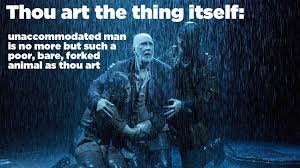
On the heath, ‘unaccommodated man’ comes very close to the animal world – the wolf and owl, the cub-drawn bear, the lion and the belly-pinched wolf.  Poor Tom brings with him the lower and more repulsive animals.  Man no longer uses the animals – “thou owst the worm no silk, the beast no hide, the sheep no wool”.  Man himself seems no more than an animal.  His behaviour suggests this – he is likened either to the monsters of the deep that prey on each other, or to a “poor, bare, forked animal”.  Tom has been “hog in sloth, fox in stealth, wolf in greediness…” (Act III, iv).

In the terrible world of Lear’s vision, man is a beast.  Yet, something may come out of this elemental existence on the heath.  We notice that the animal imagery changes as Lear’s recovery gets underway.  The animals mentioned now are those which convey feelings of pleasure.  In Act V, iii a much-chastened Lear tells Cordelia:

            “We too alone will sing like birds i’ the cage, …”

            “We’ll live and pray, and sing, and tell old tales, and laugh

            At gilded butterflies…..”

These animal images leave two strong impressions.  The primary one is that humanity seems to be reverting to a bestial condition.  Secondly, there is a close association between the animal images and the suggestion of bodily pain, horror and suffering.  As well as savage wolves, tigers and other predators there are ‘darting’ serpents, a ‘sharp-toothed’ vulture, stinging adders, gnawing rats, and whipped, whining, mad and biting dogs.

Therefore, the animal imagery throughout King Lear is a powerful and imaginative expression of the play’s major themes – how predatory human beings destroy decent values by operating the law of the jungle, and how the inevitable result is pain and suffering.

king-lear-movie-poster-1972-1010690481

Images of Violent Suffering and Violent Action

King Lear is the most painful and harrowing of the tragedies.  All through we are conscious of strife, buffeting, strain and bodily suffering to the point of agony.  The images involving the human body are particularly grim.  We have, as Caroline Spurgeon has remarked, the repeated image of the body in ‘anguished movement, tugged, wrenched, beaten, pierced, stung, scourged, scalded, dislocated, flayed, tortured, and finally broken on the rack’ (Shakespeare’s Imagery and What it Tells Us).

Even death is seen by Kent as a welcome release from torture, which is almost the permanent condition of those who live in the Lear universe.  As Lear is dying, Kent makes the appeal:

O, let him pass! He hates him

That would upon the rack of this tough world

Stretch him out longer … (V, iii, 312).

Elsewhere he sees himself wrenched and tortured by an ‘engine’, and his heart about to break ‘into a hundred thousand flaws’.  Gloucester’s ‘flawed heart’ is ‘cracked’ and finally is said to ‘burst smilingly’.  Gloucester’s response to Edmund’s ‘revelations’ about Edgar is full of violent and agitated images.  Within the space of ten lines, Gloucester uses the following: scourged, falls off, cracked, mutinies, machinations, ruinous disorders, discord.  Gloucester himself is subjected to cruel and violent treatment: bound to a chair, plucked by the beard, his beard ‘ravished’ from his chin, ‘tied to a stake’, like a bear ‘to stand the course’.  He has his eyes gouged out, and is ‘thrust out of’ the gates.

The idea that human beings can easily lapse into the condition and behaviour of wild animals is often held out as a possibility in King Lear. Lear is certain that Regan, in his defence, will with her nails, ‘flay that wolfish visage’ of Goneril.  The most striking example of this violent, bestial imagery is Gloucester’s explanation to Regan for sending Lear to Dover:

                        I would not see thy cruel nails

Pluck out his poor old eyes, nor thy fierce sister

In his anointed flesh stick boarish fangs. (III,vii, 56)

Even the generally mild Albany declares that if he were to follow his natural instincts, he would ‘dislocate’ and ‘tear the flesh and bones’ of Goneril.  The generally violenmt tendency of the language and imagery of the play is summed up in Lear’s ironic promise to Cordelia:

He that parts us shall bring a brand from heaven

And fire us hence like foxes.  Wipe those eyes;

The good years shall devour them, flesh and fell

Ere they shall make us weep.  We’ll see ‘em starved first. (V, iii, 22)

tumblr_mli5vds5dJ1qbwhiuo1_1280 

Clothing Imagery: Appearance and Reality

From first to last, there is a steady emphasis in the play on the contrast between man and his clothes.  At the centre of the play, Lear stresses the function of clothing as a symbol of class and wealth, and as a means of hiding perversions of justice:

Through tattered clothes small vices do appear

Robes and furred gowns hide all.  Plate sin with gold

And the strong lance of justice hurtless breaks;

Arm it in rags, a pygmy’s straw doth pierce it. (IV, vi, 164)


Lear is the first to mention clothing imagery when he declares in his opening speech that he will “divest (us) both of rule, interest of territory, cares of state…”.

Clothes become a symbol of luxury – “Thou art a lady…” a desperate Lear tells an obstinate Regan in Act II, iv:

            “If only to go warm were gorgeous,

            Why, nature needs not what thou gorgeous wears’t

            Which scarcely keeps thee warm…”

In the Storm Scene, there is much significance in Lear’s tearing off his clothes and his joining “poor Tom” in the naked state.  This gesture allows Lear to become “unaccommodated man … a poor, bare, forked animal”.  It is only when he experiences this reduced state that Lear can truly identify with the poorest of his subjects.  Naked to the elements, he now knows what it is like to “bide the pelting of the pitiless storm”.

The theme of appearance versus reality is a common one in Shakespearean plays.  In King Lear, the image of clothing and its opposite, nakedness, is the imaginative expression of this theme.  Clothes are seen as a camouflage to hide injustice and to symbolise power and privilege.  It is a much wiser Lear who tells us in Act IV, vi, that things – and people – are not always what they seem.  The outward trappings of wealth and privilege can sometimes conceal corruption.  Likewise, poverty in one’s personal appearance can adversely affect the attitude of others towards us:

            “Through tattered clothes small vices do appear.

            Robes and furr’d gowns hide all.

            Plate sin with gold

            And the strong lance of justice hurtles breaks:

            Arm it in rags, a pigmy’s straw doth pierce it.”

Lear has travelled a long way along the road to wisdom since he was fooled by Goneril’s and Regan’s flattery in Act I.

The imagery of clothing in King Lear is closely linked to the theme of disguise.  Just as “robes and furr’d gowns hide all”, Goneril’s and Regan’s hypocrisy is disguised by their honey’d words at the beginning of the play.  Those who do not resort to disguising their true feelings must suffer – i.e. Cordelia and Kent.  In fact, Kent quickly finds that unless he disguises his appearance, his survival is at risk.  Edgar too must assume a new identity if he is to stay alive – he becomes the naked “poor Tom” who is at the mercy of the elements on the heath.

The image of clothing is, therefore, a central one in King Lear.  It is used most effectively to bring out the theme of appearance versus reality.  The notion of disguise is also linked to the clothes imagery in the play.  A key element in the tragedy is that virtue can only survive if disguised, while vice can parade openly and be rewarded. And we wonder if Shakespeare is still relevant in today’s world!

Blindness in Lear

Imagery of Sight and Blindness

The frequent allusions to eyes, sight, and seeing are significant throughout the play.  They begin as early as the first scene when Lear expels the sincere and loyal Kent: “Out of my sight!”  Notice Kent’s emotional plea in reply:

            “See better, Lear and let me still remain

            The true blank of thine eye.”

These words underline Lear’s lack of insight, i.e. mental sight.  The theme will be developed from this point onwards.  Before long, Lear is forced to acknowledge his lack of insight.  In Act I, iv, he is beginning to see Goneril in her true colours.  The truth about his “thankless child” is painful for him: his “eyes” have deceived him, and in bitterness he wants to cast them out:

            “… Old fond eyes,

               Beweep this cause again, I’ll pluck ye out,

And cast you, with the waters that you loose,

To temper clay….  “

The anguished king returns to this theme again later:

            “Does Lear walk thus?  Speak thus?

            Where are his eyes?”

Lear’s redemption is linked to his painful acquisition of the personal insight to himself and to others which he so blatantly lacks at the beginning of the play. His frequent references to sight, eyes, seeing, illustrate and highlight this theme.

Shakespeare also uses the sight/blindness imagery for another purpose.  Through it he merges the main plot and sub-plot of the play, i.e. Lear’s betrayal by his daughters and Gloucester’s betrayal by Edmund.  Gloucester, like Lear, does not know his children.  He is fooled by Edmund and mistakes Edgar’s honesty for deception.  This truth is brutally conveyed to him by Regan in Act III, vii, as Cornwall plucks out the old man’s eyes.  Paradoxically, Gloucester only begins to acquire insight when his physical sight is taken from him.  Within seconds of his becoming physically blind, in Act III, vii, he sees that Edmund truly “hates” him.  Gloucester’s realisation of his foolishness is poignant:

            “O my follies!  Then Edgar was abused.

            Kind gods, forgive me that and prosper him!”

Gloucester may now be “an eyeless villain” according to Cornwall, but in reality he is a much more “seeing” man than before.  His reply to the Old Man who tells him in Act IV, i, “you cannot see your way” is, therefore, highly symbolic.

            “I have no way, and therefore want no eyes;

            I stumbled when I saw”

Gloucester has acquired knowledge and wisdom.  The loss of his physical sight is meant to be understood in that context.

The parallel between Lear’s predicament and Gloucester’s, between main plot and sub-plot, is highlighted in Lear’s words to the blind Gloucester in Act IV, i,:

            “A man may see how this world goes with no eyes.

            Look with thine ears…”

Edgar sums up the paradox later in the same scene: “Reason in madness!”

Through the imagery of sight/blindness in King Lear, Shakespeare parallels the main plot and sub-plot, and this highlights the paradox at the very centre of the play.

kinglear10

Richness in the Imagery used by the Fool

The Fool in King Lear is one of the most interesting comic characters in all of Shakespeare’s plays.  His language is rich, his thoughts at times profound.  It is worth looking more closely at some of the imagery which he uses.

From the first moment of his appearance in the play, the Fool begins his commentary on Lear’s foolish behaviour.  His first action is to offer Kent his “coxcomb” – his foolish cap.  He explains that Kent has a right to the coxcomb  “for taking one’s part that’s out of favour”.  The Fool then goes on to compare the Truth to a dog that must be whipped out of sight and confined to its kennel.  In the universe of hypocrisy and deception which Lear has now created, Truth, as always, will be the first casualty.

As Act I, iv, progresses, the Fool is relentless in pursuit of Lear and his folly.  Although disguised in the form of nonsense rhymes, the Fool’s message is consistent: the real Fool is Lear himself.  In one of these rhymes, the Fool distinguishes between the Fool who wears “motley”, i.e. the Fool’s uniform, and the real Fool who wears ordinary clothes, i.e. Lear.

At times the Fool is more direct: “thou hadst little wit in thy bald crown, when thou gavest thy golden one away”.  He keeps up this piercing banter until Lear threatens to have him whipped.  The Fool’s response is sharp:

“I marvel what kin thou and thy daughters are: they’ll have me whipped for speaking true, thou’lt have me whipped for lying…. I had rather be any kind o’ thing than a fool: and yet I would not be thee, nuncle; thou hast pared thy wit o’ both sides, and left nothing ‘i the middle”.

As Act I is drawing to a close, Lear is beginning to question his own wisdom in giving everything to his daughters.  Goneril has already complained about the size of his retinue of followers, and the Fool’s premonitions look like becoming a reality.  Lear is troubled, and his appeal to the fool now is urgent:

            “Keep me in temper; I would not be mad!”

From now on, the Fool will also be mindful of his master’s suffering as well as his folly.

In Act II, iv, the Fool’s language is dense with significant imagery.  He keeps up the meaningful rhymes which take the edge off his poignant commentary:

            “Fathers that wear rags

            Do make their children blind,

            But fathers that wear bags

            Shall see their children kind”.

He also uses the imagery of a wheel careering down a hill and out of control to depict Lear’s fate for Kent.  He warns Kent that he will be crushed if he doesn’t release his hold on the “wheel”:

“Let go thy hold when a great wheel runs down a hill, lest it break thy neck with following; …”

When Lear comes to the verge of emotional collapse in this scene, the Fool switches to nonsense to try and retrieve the situation:

Lear:   “O me, my heart, my rising heart! But, down

Fool:   Cry to it, nuncle, as the cockney did to the eels when she put ‘em i’ the paste alive; she knapped ‘em o’ the coxcombs with a stick, and cried “Down, wantons, down!”  ‘Twas her brother that, in pure kindness to his horse, buttered his hay.”

As the climax of the play approaches, there is poignancy in the Fool’s attempts to save his master from total despair.  He relents in his torture of Lear and concentrates instead on urging him to take care of himself:

“O nuncle, court holy-water in a dry house is better than this rain-water out o’ door” …

But the caustic note is not completely gone.  When Kent asks “Who’s there?”, the fool’s reply is deliberately ambiguous:

            “Marry, here’s grace and a codpiece,

            That’s a wise man and a fool”.

One is in no doubt that he means to convey how these roles have been reversed.

Through the imagery of his speech, the Fool acts as a kind of intelligent chorus in King Lear.  He never lets us forget the tragedy of what is happening on the stage.  His loyalty to, and concern for, his master is touching.  He is, perhaps, the play’s most endearing character.


funny-Shakespeare-spoilers-Hamlet-Macbeth-King-Lear


Works Cited

Bradley, A.C., Shakespearean Tragedy. New York: Meridian Books, 1955.

Spurgeon, Caroline F. E., Shakespeare’s Imagery and What It Tells Us, Cambridge Univesity Press, 1935.


Further Reading

Single Text Study Notes on ‘King Lear’

Some Central Themes in Shakespeare’s King Lear

Study Notes on ‘King Lear’

larryavisbrown.homestead.com

These notes are directed mainly at those Leaving Cert students (Higher Level) who are undertaking the study of King Lear as a Comparative Text

HISTORICAL/LITERARY BACKGROUND

Shakespeare’s King Lear was written around the year 1605 and basically sets good (as represented by Cordelia, Edgar and Kent and later Lear) and evil (represented by Goneril, Regan, Cornwall and Edmund) in opposition.  The play has invited its fair share of controversy.  Some critics have called it the finest of Shakespeare’s plays, others have accused the play of being too pessimistic even for a tragedy. Shakespeare’s Elizabethan world (shortly before and after 1600) reflects, in some respects, a very different society to the many other societies and cultures depicted in your other Comparative Texts.

Shakespeare’s tragedy reflects the concerns and aspirations of Elizabethan society.  It also conforms to the conventions of the theatre of this period.  The publication date of King Lear in 1605 places it among the later works of Shakespeare and it must be said that this was a period of rapid change and expansion, ruled over by Elizabeth I, who ascended the throne in 1558 and James I who succeeded her in 1603.

The reign of Elizabeth brought about great change in England which resulted partly from her vibrant personality.  She made the monarchy as lavish a spectacle as Shakespeare made his theatre.  Like Queen Victoria in the 19th. century, Elizabeth’s aim was to make the monarchy a popular and powerful institution.  Unlike Victoria, however, Elizabeth was an exhibitionist who believed in dazzling her subjects with her regal splendour.  Her lavishly decorated dresses (Remember Dame Judy Dench in Shakespeare in Love?), magnificent coach and enormous troupe of servants provided a sense of pageantry for the population who lined the streets hoping to catch a glimpse of her as she made her way to the provincial towns and cities.

The Elizabethan court set new trends in style, art, literature and drama but the main concern of Elizabeth was to create a politically stable and united country.  This concern is illustrated in the desperate measures she took to secure her position on the throne, for example the execution of Mary Queen of Scots in 1587, and the defeat of the Spanish Armada in 1588 and the suppression of the Geraldine Rebellion in Munster and the subsequent beheading of our own Earl of Desmond!

When Elizabeth died in 1603 her successor, James IV of Scotland, was also a keen supporter of the theatre and he bestowed on Shakespeare’s company the privileged title of the ‘King’s Men’.  This privilege ensured the acceptance of Shakespeare and his company within the Royal Court and his continued prosperity as a playwright.

The tragic nature of King Lear is not entirely at odds with the real events which were unfolding in the court of James I.  James was the first monarch to rule (however briefly) over the United Kingdom of England, Scotland and Wales and he was very fond of feasting, drinking, hunting, and the splendid trappings of monarchy.  These examples of James’s character are evident in Lear who is willing to leave the affairs of state in the hands of Goneril and Regan while he enjoys feasting, drinking, hunting and riding with his knights.

www.slideshare.net
http://www.slideshare.net

THE STORY

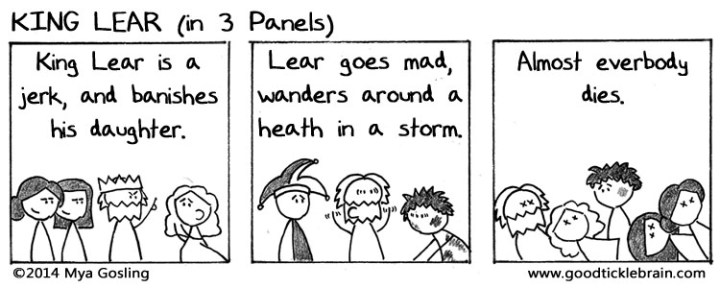
Lear is an old man when the play opens.  He decides to divide up his kingdom by means of a childish love-test based on words.  When Cordelia refuses to co-operate she is stripped of her dowry and banished to France.  Goneril and Regan, his other two daughters, take over the kingship.  These are shrewd operators who have assessed Lear’s flaws fully.  They plot together so that they will not suffer from his senile unpredictability.  Shortly after Lear has abdicated his throne, he moves to Goneril’s house with one hundred knights.  This was one of the conditions of the agreement between them.  Here he has a violent confrontation with Goneril about the number of knights he actually needs.  Regan arrives and the love-test scene is ironically parodied; the two daughters haggling over the number of his knights is a grotesque mimicry of the love test.  Lear is cast out into the storm with his Fool and Kent.

In the parallel plot, the Earl of Gloucester has two sons.  One of them, Edmund, is illegitimate.  Edmund deceives Gloucester about Edgar, his real son, and convinces him he is a villain who is ready to murder him.  Edgar is forced to go on the run and play the role of a mad beggar.  He meets with Lear on the heath in the storm and together they reach some profound insights into human nature.  Later on, Gloucester is blinded by Cornwall, the husband of Regan, for helping Lear.  Gloucester becomes filled with despair and wanders to Dover to commit suicide.  He is saved by Edgar who discloses his identity to him shortly before Gloucester dies, presumably from a heart attack.

Lear becomes reconciled with Cordelia who returns to Britain with an army from France to save him.  Both Lear and Cordelia are imprisoned by Edmund who leads the British army against the King of France.  Cordelia is hanged and Lear dies of a broken heart.

Goneril and Regan become consumed by a passionate lust for Edmund and they kill one another.  Edmund is slain by Edgar.  Only Albany, the husband of Regan, and Edgar survive to sustain and restore order to the gory state of Britain at the conclusion.

shakespeare-lovers.deviantart.com

THEMES AND ISSUES

Love versus Hatred

King Lear deals with the theme of love versus hatred.  Love, in many of the texts texts on the Comparative Course, is a redemptive force and achieved only through suffering and many trials and tribulations.  Cordelia, Lear’s youngest daughter, suffers the contempt and abuse of her sisters who vie for their father’s power and kingdom.

Lear’s oldest daughters, Goneril and Regan, have the same ignoble and cruel nature as many other characters iwe come across on the Comparative Course.  They are jealous of Cordelia because she is her father’s favourite child, a fact which Lear does not try to conceal.  Cordelia is very forthright in her manner.  She believes in love but not at the cost of truth and decency.  When Lear establishes his love test to divide his kingdom, Cordelia is faced with two choices.  Either she lies to her father and tells him she loves him to the exclusion of everyone and everything in the world, or, she tells him the truth, that she loves him as a daughter should love her father, with duty and respect.

She decides to tell the truth, arguing, ‘I love your Majesty according to my bond no more nor less’ (Act I, Scene I).  The word love is used many times and in different contexts in this first scene.  It is obvious that Goneril and Regan abuse the term and take advantage of their father’s desperate need for love.  Lear’s over-indulgent behaviour to his older daughters make them despise him and think only of themselves and how they might prosper at his demise. So Cordelia is banished by her father for speaking the truth.  She acknowledges that had she ‘a still soliciting eye, and such a tongue’ (Act I, Scene I) as her sisters have, she would have benefited from the division of the kingdom.

It is interesting that Cordelia is forced to uproot herself from her home and seek whatever solace she can with strangers, in a strange environment.  Cordelia is immediately betrothed to France, who instantly recognises her virtues.  His intention is to make her Queen of France and he argues that his love for her encompasses his respect for her actions.  However, Cordelia’s trials are only beginning.  The love she bears for her father will be tested later in the play, as will her compassion and forgiveness.

The evil and cruel natures of Goneril and Regan become obvious as soon as Cordelia leaves the court.  Their language is suddenly cruel and vindictive.  They jeer their father for his approaching senility and feebleness of age.  The significance of Regan’s observation that her father had ‘ever but slenderly known himself’ (Act I, scene I) is now apparent to the reader because of his banishment of Cordelia and Kent.

The sub-plot in King Lear is also important in highlighting this theme and we see the deception of Edmund who takes advantage of his father’s kindness and genuine affection, for his own corrupt desires.  He is incapable of love and his references to love in the play are always debased and carnal.  His character is without any moral code.  His desire is to ultimately destroy whatever is good and pure.  His corruption of the purity of love almost destroys the characters closest to him in the play.

Edmund deceives his father and brother by pretending to be a good son and brother.  He deludes both Goneril and Regan, pretending to love them, but caring about neither.  In fact he enjoys watching these women scheme and plot against each other to win his love.

The marriages of Goneril and Regan are symbolic of their unloving and primitive natures.  Goneril’s husband, Albany, is a weak character at the beginning of the play and seems completely overshadowed by his wife’s hunger for power.  However, as the play progresses, Albany’s function changes from that of mere observer of his wife’s actions to a critic of her unnatural behaviour.  Regan and Cornwall’s marriage is based on Regan’s willingness to be as vicious as her husband.  Her love of power is insatiable and she confuses love with sexual intrigue, which is evident in her behaviour towards Edmund.

The unrestrained passions of Goneril and Regan present fascinating character portrayals for the audience of the play.  Goneril and Regan are presented in highly dramatic sequences on stage.  The visual impact of their actions is overwhelming.

Lear experiences hatred initially in his contact with Goneril.   She is indifferent to him and she instructs her servant Oswald to be as negligent of her father as he wishes.  Lear reacts with a terrible anger.  His language is full of hatred and revenge.  Words like ‘thwart’, ‘torment’, and ‘contempt’ are all used against Goneril.  Lear’s anger springs from his sense of injustice at the treatment meted out to him.  Having given everything to his daughters, they turn on him.  The language and images used by Lear indicate their inability either to give or understand love.  They are described as ‘wolves with flaying nails’, ‘serpents’, ‘foxes’, ‘crabs’, ‘vultures’, ‘a boil’, ‘a plague sore’, and ‘an embossed carbuncle’.  These images deprive the daughters of their humanity but, more importantly, they deny their maternal instincts, traditionally associated with nurturing and love.  The ferocious nature of these images prepares the reader for the cruelty of Goneril, Regan, Cornwall and Edmund later in the play.

Eventually Lear rejects Goneril and Regan and sets out on a journey of self-discovery.  It is vital for Lear that he rejects his two cruel daughters if he is to learn that love cannot be bought, that it is not a commodity.  He is helped to make this discovery by some very noble and good characters such as Cordelia, Kent and Edgar who represent the virtues of love and goodness, loyalty and truth.

Gloucester’s rash banishment of Edgar also clearly illustrates that his understanding of love is as shallow as Lear’s.  This flaw in his character means he is at the mercy of his unscrupulous son, Edmund.  The gouging out of Gloucester’s eyes in Act III, scene vii, is particularly violent, but highly dramatic for the audience.  The blinding scene allows the audience to see, on stage, the distinction between sight and insight, truth and pretence.  Gloucester must lose his sight in order to gain insight and once this has happened he is reunited with Edgar, his legitimate son, who loves him.

The ‘mock trial’ which takes place between Lear, the Fool and Edgar in Act III, Scene vi, is very important in the context of helping us understand and analyse the unnatural actions of Goneril and Regan against their father.  It highlights Lear’s inability to accept that the ‘professed’ love of Goneril and Regan in Act I, Scene I, was mere pretence.  Here we see three human beings at their lowest ebb and this pathetic scene helps us to realise what the world would be like without love.  The ‘mock trial’ also allows Edgar to vent his frustration at the corruption of his treacherous brother Edmund.  It helps to contrast those in the play, who love, as Othello says, ‘not wisely but too well’, with those who debase love and seem to prosper by its abuse.

The return of Kent and particularly of Cordelia is very important for the regeneration of Lear.  Kent, having returned in disguise, to serve Lear, suffers the abuse of Lear’s daughters and servants.  Ultimately, however, it is the return of Cordelia that changes Lear.  He is astounded by her forgiveness and overwhelmed by her love for him.

The change in Lear’s character is obvious.  His hysteria has subsided and he speaks with a voice full of conviction and strength.  The audience is roused by the sense of pathos in his actions and language when Cordelia dies.  Carrying her from the place of execution, he lays her before the audience, trying in vain to find evidence of her breathing.  His grief is evident when he admits to killing the ‘slave’ who hanged her.

With her death, Lear’s only source of love is gone, and unable to bear his separation from her for a second time, he dies.  Interestingly Albany, Goneril’s husband, survives the mayhem and corruption of the evil characters in the play.

The shocking demise of Goneril and Regan emphasises their fiendish nature and the fact that they are the personification of evil as it exists in the world.  They prey upon each other and become victims of their own hatred and greed.  Both must die at the end of the play because, like Edmund and Cornwall, they have nothing to offer humanity.  They love only what benefits themselves and destroys others.

rwkaz.deviantart.com

CULTURAL CONTEXT

Britain and the Medieval Renaissance Court form the primary cultural background of this play.  The play deals with the culture of Kingship and Monarchy at that time.  The characters are drawn from the aristocracy or nobility.  These characters are public figures whose actions and subsequent sufferings become universalised.

The plot of the play deals with inter-family relationships and ensuing intrigue, rivalry and conflict.  Lear makes a fatal error regarding the nature of kingship at the beginning of the play: he believes he can abdicate the duties of King and merely retain, ‘the name and addition of a King’.

Lear has been King of Britain for many years, he has no male heir and so roles change and he hands over his authority to Goneril, Regan and their husbands.  In this act of abdication Lear disrupts the social order and causes a general anarchy in his kingdom.

The blinding of Gloucester is a barbaric act which coexists with the Christian insights expressed by Lear in some of the Storm Scenes and at the conclusion of the play.  In prison with Cordelia he sees them both as ‘God’s spies’, taking upon themselves the mystery of things.

The play refers to particular things such as clothes and courtly manners that are an innate part of this cultural environment.  Lear sheds these symbols of wealth – rich clothes and fine speech – in his movement towards truth.  The play shows the human being reaching truth when these false adornments of culture have been stripped away.  Lear sheds his sanity and descends to a state of physical and emotional nakedness before he is finally clothed in the truth.

www.bloggingshakespeare.com
bloggingshakespeare.com

THE GENERAL VISION AND VIEWPOINT

 The term, general vision and viewpoint, may be understood by candidates to mean the broad outlook of the authors of the texts (or of the texts themselves) as interpreted and understood by the reader  – excerpt from Marking Scheme, 2003.

The main thing to remember when discussing this text in relation to others on your Comparative Course is that this is a Shakespearean Tragedy, and hard though it may be to believe, King Lear is the one and only tragic hero of this text.  Traditionally, the conventions of tragedy require certain tragic elements.  Aristotle considered tragedy to be ‘the fall of princes’ and King Lear falls into this category: he is a great king – all kings were great back then – and in the course of the play, because of his foolishness, he makes a great mistake.  Generally, in Shakespearean tragedy, evil is the cause of the catastrophe.  He believed that his tragedies, including King Lear, depicted the struggle between good and evil in the world.

Shakespeare’s tragic heroes all possess definite characteristics.  His tragic hero is always a man of exceptional nature, a great man with a more powerful consciousness, deeper emotions and a more splendid imagination than ordinary men.  He is a sensitive being with a spiritual bias.  He has a divided soul, he is torn by an internal struggle.  However, this tragic hero has some weakness, some flaw that contributes to his downfall.  Aristotle called this internal weakness of the hero the ‘hamartia’, the tragic flaw, an essential element in tragedy.  Lear’s flaw is his gullibility and his pride.  He succumbs to this powerful failing in his nature and is destroyed by it.  His ambition pushes him into a sequence of action which inevitably leads to his death.  Lear attempts the impossible, to give up his kingship and yet he tries to retain the trappings of power, his retinue of knights, the pomp and ceremony that goes with majesty.  However, the inevitable consequences of his actions work themselves out and the result is tragedy.

Aristotle’s criterion for good tragedy was that the members of the audience should experience ‘catharsis’, that is, pity and terror for the tragic hero.  The sensitive, conscience-stricken, tortured King Lear we are introduced to on the heath inspires pity, and we do leave the theatre terrified at the tragic results of Lear’s actions.

Shakespeare, in King Lear and Macbeth and Hamlet, does a wonderful balancing act between the audience having sympathy for the tragic hero while also recognising the reality that evil must be destroyed and good must triumph in the end and order must be restored to the kingdom.

This, therefore, was Shakespeare’s vision for this and all his other great tragedies.  It doesn’t  always sit well with modern audiences because we have differing definitions for ‘heroes’ and indeed for ‘tragedy’ as well.

 King Lear (8)


LITERARY GENRE

As we have already stated above, King Lear is a Shakespearean tragedy.  The general sequence of a tragic work is the story of a hero who is endowed with a fatal flaw.  This flaw causes suffering, the loss of everything and finally death.

In the context of this play, Lear’s main flaw consists of an overbearing pride and blindness to human nature.  Shortly after he has abdicated his kingship he suffers a violent confrontation with Goneril and Regan and he is forced to accept their terms or face humiliation and poverty out on the heath.

In an extreme state of degradation and suffering throughout the storm scenes he learns the meaning of life and grows in humility and self-knowledge.  All of this occurs with the help of his Fool who plays a key role here.

Likewise Gloucester is blind to the reality of human nature and fails to see through the wickedness of his son Edmund.  Ironically it is only when he is physically blinded that he attains a real insight into the truth of things.  Both characters acknowledge their earlier flaws and both develop and learn to see the real truth about people and about themselves.

THE STRUCTURE OF THE PLAY

This play is made up of two plots which echo one another in theme – we get two plays for the price of one!.  The deliberate parallels that are set up between the two plots add to their realism, by giving credibility to a play where the characters and events would be otherwise incredible.  Another effect of this deliberate repetition is to universalise and broaden such themes as filial ingratitude and evil.

The story and theme of the sub-plot is repeated in the main plot.  Two credulous fathers are betrayed by selfish and unscrupulous children.  Both are victims of false appearance.  Both are weak, gullible and poor judges of character.  Both lack sound judgement, both are old men.  The Fool teaches Lear while Edgar teaches Gloucester.

The Fool plays a central role in the structure of the play.  This role is primarily paradoxical – the supposedly wise King is being taught lessons of wisdom and folly by a fool.  We see this mainly in the storm scenes.  He is a foil for Lear and also a form of relief.  He counters Lear’s madness and is used almost like a chorus as he harps all the time on Lear’s transgressions.  So, his role is a curious mixture of faithful service and severe condemnation.  He offers relief to the gloom of the tragedy.

The Fool represents the voice of reality for Lear.  The Fool appears in Act I, Scene iv when Kent has just manifested his loyalty for Lear by attacking Oswald, Goneril’s cunning servant.  Lear is about to pay Kent for his action when the Fool enters and mockingly offers Kent his coxcomb.  The implication here is that Lear is a fool if he thinks he can repay people with money now that he has handed over everything to his wicked children.  The play is full of comments like this, where the Fool mocks Lear’s self-deceit, and essential blindness to human nature.  The Fool is not only Lear’s teacher but he echoes Lear’s conscience.  It is significant that Lear is given few soliloquies in the play; the implication here could be that the Fool articulates all his insights.

The relationship between Lear and his Fool is part of the tragic movement of the play; the movement downwards towards that ultimate exposure and defeat when the King is degraded to the status of the meanest of his servants.  We watch the royal sufferer being progressively stripped, first of his extraordinary power, then of ordinary human dignity, then of the very necessities of life where he is more helpless and abject than any animal.  However, there is a more dreadful consummation than this reduction to physical nakedness.  Lear hardly feels the storm because he is struggling to maintain his mental integrity, his knowledge and his reason which for him are the essential marks of humanity itself.  From the time when his agony begins and he feels his sanity threatened, he gradually becomes aware of the suffering of others: ‘Poor Fool I have one part of my heart that’s sorry for thee yet’.

In the role of the Fool we are confronted with the paradoxical reversal of wisdom and folly.  At the beginning of the play Lear and Gloucester are both blind fools.  When Lear loses his sanity his vision is enlarged; as his wits begin to leave him he begins to see the truth about himself; when they are wholly gone he begins to have spasmodic flashes of insight in which he sees the truth about the world.  The Fool prophetically exclaims that Lear would make a good Fool.  When he loses everything – his kingdom, his sanity, his honour, when he becomes an outcast from society – he attains truth.

In the hour of Lear’s helplessness during the storm on the heath, King and Fool, master and slave, become something different – the bond between them grows deeper.  In the process of madness we become aware of a relationship comprised of opposites – that of wise man and fool.  The essence of this relationship consists in a reversal of accepted values: the supposedly wise man of the opening scenes, the Lear who was in a position to have his slave whipped and exercise his own will without contradiction, has become the fool.  Through his behaviour and language, the Fool offers advice all of which is based on a practical wisdom.  The Fool, therefore, is an all-powerful auxiliary for both the main plot and the sub-plot.

When the Fool leaves the play in the last storm scene, Act IV, Scene vi, we can assume that Lear has grown in moral awareness and it remains for him to be reconciled with Cordelia.

The soliloquy is a fundamental part of the structure of a Shakespearean tragedy.  Shakespeare uses both the public and the private soliloquy in his plays and each type has a different function.  Much of Lear’s soliloquies are public and in them he articulates his condemnation of humankind.  In the Storm Scene, Act III, Scene iv, he becomes aware for the first time in his life of the full reality of poverty within his kingdom, and acknowledges that he has done nothing to remedy the situation.  Likewise Edgar, Edmund and Kent use the public soliloquy to give reasons for the way they are acting.  Edmund is the character who has the most soliloquies and these serve to indicate how he will manipulate events and use opportunities to his own advantage.  All of his soliloquies show him to be exceptionally intelligent, cynical and unprincipled.  Edgar’s three soliloquies serve different functions.  He gives us an insight into the quality of life in the kingdom as it existed under Lear, the Bedlam Beggar who was pelted in the villages and looked upon as mad.  He also plays the role of moraliser or preacher of good and evil in his soliloquies.

THE STYLE OF THE PLAY

LANGUAGE IMAGERY: Shakespeare’s style is richly poetic.  In his plays the important characters speak in verse, while the minor characters use prose.  Language and imagery become an avenue of understanding in the plays of Shakespeare.  A wide variety of images and language patterns are used, largely to communicate the central message and themes of the playwright.

NATURE AND STORM SCENES:  The storm scenes are symbolic of moral discord.  They are five in total.  The storm dovetails personal conflict and external convulsion well.  The storm which has broken out in Lear’s mind is admirably fused with the description of the warring elements.   The external storm is itself a projection of his inner state which is expressed in the form of a single poetic reality.  Throughout the storm scenes Lear bears the main weight of suffering.  He is surrounded by human beings who are each used in a different way to illustrate and illuminate some aspect of his central character.  The Fool, Kent and Edgar bear some of his tragic burden: they show an insight into part of his tragic situation.  Gloucester also shows a parallel fate in his suffering and fall in fortunes.  During the storm, there is a profound sense of man’s infirmity, set against the power and violence of the elements.

It is within the Storm Scenes, in the company of three different types of mad people, that Lear penetrates through to the essential truth of human nature when it is stripped of the false trappings of sophistication.  In the half-naked Edgar he finds the image of ‘Unaccommodated man’.

Certainly, the Storm Scenes are the most dramatic in the play.  Here, the Fool leaves the play and Lear goes mad.  The paradox of the play ‘reason in madness’ is enacted in the storm scenes.

Gloucester’s first stage in moral growth occurs when he goes out into the storm to offer comfort and consolation to Lear.  It is this action which costs him his eyes.

ANIMAL OR BESTIAL IMAGERY:  There is the recurrent idea in the play of animals preying upon one another like monsters of the deep.  The animal or bestial imagery points us to the reality of human beings exploiting and destroying another for their own wicked ends.

Man and woman are continually referred to as beasts or monsters.  Goneril is referred to as ‘a sea monster’, ‘a serpent’, ‘a wolf’, ‘a vulture’, ‘a kite’.  In act III, Scene iv, Lear refers to the sisters as ‘pelican daughters’ who are feeding on their father’s blood.  Edgar calls his brother a ‘toad spotted villain’.

All this type of imagery suggests that when possessed by evil humans lose all trace of their humanity and become as beasts.

IMAGES OF SIGHT AND BLINDNESS: Much of the symbolism or imagery reflect two of the central ideas in the play – sight and blindness.  Since both protagonists begin at a stage of moral blindness with regard to the true nature of their children and of human nature in general, this type of imagery plays a hugely symbolic role in the play.

Shakespeare makes use of irony to dramatise the relationship between moral and physical blindness.  Irony serves several functions in the play.  It illustrates the profound discrepancy between the real nature of things and the mere appearance.  Irony is used to indicate blindness in characters.  Certain characters such as Gloucester, Lear and Edgar are essentially blind to the truth about themselves and others.  So as Lear banishes Kent, his loyal servant and the only person who will tell him the truth, he ironically prays to Apollo, the god of light.

Edmund uses a false letter to frame his brother, then adopts the role of confidante to Edgar by advising him to stay out of Gloucester’s way.  Edgar is blind to the existence of evil and corruption in nature and particularly in his brother Edmund’s nature and so we hear him ironically telling Edmund how, ‘Some villain has done me wrong’ (Act I, Scene ii).

The play is full of ironic reversals: Gloucester gains full insight only after he has been physically blinded; Lear, King of Britain, learns his wisest lessons on human nature and on life, in the context of extreme degradation and in the company of The Fool.

Irony functions as a moral commentary on the wicked characters and is another means of illustrating in a graphic manner the profoundly destructive quality of evil.

dateyvs.com


Some ‘Grace Notes’ on Macbeth

The term ‘Grace Note’ comes to us from the world of Irish Traditional music where they are used as embellishments, added extras to further personalise the tune.  Here they are used in a similar fashion – maybe becoming the difference between a H1 and an H2!

macbeth-and-lady-macbeth-dee-timm

Throughout the play Macbeth there is almost a grotesque obsession with violent and unnatural images of children and babies (as well as apparitions of a bloody child and of a child crowned), for instance:

Come to my women’s breasts…….I have given suck, and know

How tender ‘tis to love the babe that milks me….

None of woman born shall harm Macbeth..

There are also many images of barrenness, for instance:

Upon my head they placed a fruitless crown

And put a barren sceptre in my grip,

Thence to be wrenched with an unlineal hand,

No son of mine succeeding.

Even though Macbeth is obsessed at the thought of the children of another man succeeding him, he himself does not have any children (Macduff states that he cannot properly avenge the murder of his own children, since Macbeth ‘has no children’).  Lady Macbeth mentions that she has ‘given suck’, but here she may be referring to children from a previous marriage – or maybe any children the Macbeths have had are now dead.  With this in mind, the voices of the witches that he hears could almost be those of his children that have died or possibly the voices of his imaginary children whom he wants to inherit the throne.  (In some productions of the play the witches have been played by children.  This is not too farfetched – after all, nowadays, when we think of witches, an image of an eccentric woman on a broomstick or a child dressed up in a pointy hat and cloak at Halloween readily comes to mind.)

IMAGES OF TIME AND SPEED

By Shakespeare’s standards, Macbeth is a short play.  There are no major sub-plots, and the events of the central story unfold at an alarmingly fast pace.  Macbeth returns home in Act 1 to prepare for the arrival of the king at very short notice, while Lady Macbeth summons him to ‘Hie thee hither’ and a messenger who has already travelled so quickly is ‘almost dead for breath’.  The images of travel, speed and breathlessness create a sense of unbearable urgency in the play.  Characters are obsessed by time passing – Macbeth himself seems to realise how Time ultimately is in control of his actions, when he addresses Time:

 Time, thou anticipatest my dread exploits.

Later he refers to Murder as something which moves with        ‘stealthy pace’     and he acknowledges that

Come what come may,

               Time and the hour runs through the roughest day.

Macbeth’s reaction of distant resignation to the death of his wife begins with the famous deliberation on time,

Tomorrow, and tomorrow, and tomorrow…….

IMAGES OF BLOOD

In Macbeth, the word ‘blood’ is mentioned 24 times, and ‘bloody’ is mentioned 15 times!  Once blood has been shed, there is quite a gothic obsession with it, as Macbeth and his wife are haunted by images of blood.  This horrified reaction to the blood they have shed is altered, when Macbeth realises that he cannot turn the clock back, saying –

I am in blood

Stepp’d in so far that, should I wade no more

Returning were as tedious as go o’er.

This image of wading through blood which creeps up your body surely has influenced countless Hollywood directors down the years e.g. in films such as The Shining.

Lady Macbeth might have control over her husband in the early stages of the play, but she cannot control her own mind which is plagued with bloody images, washing her hands of invisible blood, and saying –

Yet who would have thought the old man

               To have had so much blood in him.

Perhaps most selflessly and poignantly, Macduff refers to the decline of Scotland with a different use of blood imagery when he says –

Bleed, bleed, poor country.

IMAGES OF SLEEP

In the middle of the night (with its ‘bloody and invisible hand’). The Macbeths murder Duncan, taking his sleep from him.  Ironically, sleep is also taken from them, as Macbeth hears the words

Macbeth shall sleep no more.

For not only has Duncan been murdered in h is sleep, but sleep itself has been slain

Macbeth does murder sleep – the innocent sleep,

              Sleep that knits up the ravelled sleeve of care,

The death of each day’s life, sore labour’s bath,

              Balm of hurt minds, great nature’s second course,

              Chief nourisher in life’s feast.

In Act 3 Scene 2, Macbeth lives in ‘restless ecstasy’ and sees life as a ‘fitful fever’, while in Act 3 Scene 4, one of the last things Lady Macbeth says to her husband before she loses her reason is  ‘you lack the season of all natures, sleep’.  In the same scene, when asked, ‘What is the night?’, she can only reply, ‘Almost at odds with morning, which is which’ – life has become one long waking nightmare for her.

Macbeth has murdered sleep, and the next time we see Lady Macbeth, she cannot sleep as she wanders about trying to clean her ‘bloodstained’ hands.  It seems that the murdering of sleep by Macbeth results directly in his wife’s inability to find peace or repose.

In Macbeth, Shakespeare is so fascinated by night-time and darkness, he uses the word ‘night’ 38 times and ‘sleep’ 26 times!

THE MACBETHS’ MARRIAGE

In Macbeth, Lady Macbeth is stronger initially, but cannot cope after Duncan is murdered; while this first murder is difficult for her husband, subsequent murders hardly cost him a thought.  We know from life and literature (and the tabloids!) that in the aftermath of any major tragic event, the relationships of those involved can either grow stronger or break down – Shakespeare seems to be interested in how the latter situation can come about in this play.

Their separation seems to start in Act 3 Scene 1, when Macbeth gets rid of Lady Macbeth so that he can talk to the murderers, then she returns to see why her husband is spending so much time alone and brooding.  She seems happy to have achieved her goal – the crown, while Macbeth is obsessed by trying to prevent another’s offspring from succeeding him.  Once their aims are different, they grow apart, which suggests theirs is a marriage based on shared political intrigue and desire, rather than love.  As the play progresses, there are very few terms of endearment or fond words expressed (unlike the early scenes).  In fact, Lady Macbeth only refers to Macbeth as her ‘husband’ once (just after the murder of Duncan) – perhaps since she is vulnerable and in need of support at that point.  Also, Lady Macbeth’s constant jibes at her husband’s lack of manhood and inability (as she sees it) to follow through on his desires could refer to more than just his political manoeuvres – if you catch my drift!

 POLITICS

As Macbeth establishes his dictatorship, and his enemies subsequently try to destroy it, political manoeuvres and cunning manipulation abound.  A number of observations about how characters deal with each other are interesting to note:

  • Note how Macbeth persuades the murderers to kill Banquo
  • How Ross tries to find out how Macduff will respond after Duncan is murdered
  • How Malcolm (when he is approached by Macduff in England) pretends not to have any interest in the throne (or, indeed, to be at all suited to it), in order to put Macduff’s loyalty to the test (showing just how paranoid and untrusting everyone has become during Macbeth’s reign of terror).
  • How Ross does not tell Lady Macduff everything and then later seems to withhold information from Macduff about his family – possibly because he wants to enrage him so much to ensure that Macduff will fight against Macbeth? (In the Second Age Production we saw it was interesting that Ross was depicted as the third murderer who comes to help the witches’ prophesy be fulfilled, by helping Fleance to flee.)

In Macbeth, it is Duncan – the King – who seems most notably deceived by show (as, indeed, in many of his plays, Shakespeare is intrigued by appearances which hide reality).  Duncan is a bad judge of character – he had placed great faith in the previous Thane of Cawdor –

He was a gentleman on whom I built

               An absolute trust.

Then almost immediately he makes the very same mistake with Macbeth and his wife, not noticing the serpent under the ‘innocent flower’.  He is oblivious to Macbeth’s potential for evil and unable to see below the surface or to realise Macbeth’s ability to hide with a ‘false face’ what ‘the false heart doth know’.

Banquo, on the other hand, becomes suspicious of his friend, as he starts to see through the façade Macbeth has tried to create for himself, and then realises Macbeth has ‘played most foully’ for his achievements.

HERO OR VILLAIN?

This is the great on-going debate.  For Elizabethan audiences there was but one answer.  For modern-day audiences things are not so clear-cut.  However, in his defence, despite the fact that Macbeth does not seem to mind whom he destroys – surely the sign of a villain – he does have many (initial) crises of conscience which may just about redeem him and allow him the dignified status of ‘tragic hero’.  His sense of regret and awareness of what he has lost can be seen in Act 5 Scene 3, when he has been abandoned by all but a handful of employees, and is without ‘honour, love, obedience, troops of friends’.

Arena-Illustration-Euan-Cook-Macbeth-03

Speechless Without the Bard


image

The English language may have ‘seen better days’ but ‘for better or for worse’, even ‘blinking idiots’ still quote Shakespeare liberally, albeit without knowing it. Indeed, if it were not for these bon mots we’d be nearly speechless.

We have all come across Shakespeare in school, we may even have seen one of his plays on television or in the cinema, yet there are few of us – even those of few words – who don’t quote Shakespeare almost every day. Once in a while we know we’re doing so, but most of the time we use his words to season our speech without knowing the source. Some of his expressions have changed a little with 400 years of everyday use, though even these can easily be traced to him.

If this doesn’t make sense to you and you say, it’s Greek to me, you are quoting Shakespeare. If you think my point is without rhyme or reason and you say I’m a laughing stock or a blinking idiot or bloody minded or a rotten apple or a stony-hearted villain or even the devil incarnate, you are also quoting him. And if you bid me good riddance or send me packing or wish I was hoist with his own petard or dead as a doornailat one fell swoop – you are still quoting him.

When we say that it’s a mad world or not in my book or neither here nor there or last but not least, these phrases – and all the others in bold print here – are Shakespeare’s. And when we use such expressions such as poor but honest or as luck would have it or what’s done is done, we’re equally indebted to him. Whether you are holding your tongue or simply tongue-tied, you just can’t get away from the fact (the more fool you are) that you are quoting Shakespeare. But maybe that was the unkindest cut of all. And if you think this remark smells to heaven, you’re at it once more.

Be that as it may – and though you still insist that I’m living in a fool’s paradisewe can have too much of a good thing. And there we go quoting him again. For the long and the short of it is that we’d be nearly speechless without Shakespeare.

When we talk of someone showing his heels or having no stomach for a fight or leading a charmed life; when we speak of cold comfort or grim necessity or bag and baggage or the mind’s eye, we’re quoting him. When we refer to our salad days or our heart of hearts or our heart’s desire; when we deplore the beginning of the end we’re doing the same.

If we claim to be more sinned against than sinning; if we act more in sorrow than in anger; if our wish is father to the thought; if something we’ve lost has vanished into thin air, we’re borrowing from the Bard. If we refuse to budge an inch or suffer from green-eyed jealousy; if we’ve played fast and loose; if we’ve been a tower of strength or hoodwinked or in a pickle, we’re still doing so.

If you have knitted your brows or stood on ceremony or made a virtue of necessity or danced attendance on or laughed yourself into stitches or had short shrift, you’re using Shakespeare’s words. If you say you haven’t slept a wink or are as sound as a bell or can only die once or that your family is eating you out of house and home, you’re not being very original.

When you state that love is blind or there is method in his madness (or someone has made you mad) or the truth will come to light or the world is my oyster, you are also borrowing your bon mots from the Bard. If you have seen better days or think it is early days yet or high time; if you lie low till the crack of doom, because you suspect foul play; if you tell the truth and shame the devil, even if it involves your own flesh and blood and you believe the game is up, you are at the same game as before!

If you have your teeth set on edge or have a tongue in your head, then by Jove or Tut, tut or for goodness sake or what the dickens or but me no buts – it’s all one to me, for you are simply quoting Shakespeare.

Besides these and many more of our everyday phrases, we are also indebted to him for a host of words. Accommodation, assassination, dexterously, obscene, premeditated, reliance, allurement, alliance, antipathy, critical, armada, demonstrate, dire, emphasis, emulate, horrid, initiate, mediate, modest, vast and submerged are only a few that made their first appearance in his plays.

Indeed, it is obvious that Shakespeare was a man who loved to experiment with words. Most of all he had an extraordinary ability to write memorable combinations of words. Scores of his phrases, as we have seen, have entered the English language and some have even become clichés. One play alone, Hamlet, is a treasure house of ‘quotable quotes’ or, as someone once said, it is ‘full of quotations’! Among them are the following: Frailty thy name is woman!…..The primrose path of dalliance… Something is rotten in the state of Denmark  … Brevity is the soul of wit…… I must be cruel, only to be kind …  The rest is silence.

The English-speaking world is indeed indebted to William Shakespeare more than to any writer in any language who ever lived. “He was not of an age,” said his contemporary Ben Jonson, “but for all time”.

Adapted from an article by Paul Hurley in The Irish Times

FullSizeRender (3)