Michael Hartnett’s ‘Move to The Park’

IMG_5066
Inset of New Houses just before occupancy, September 1951. (Courtesy of Dr Pat O’Connor, The New Houses: A Memoir, p.9)

In late 1980, Hartnett began work on his best ballad, which is most loved and recited to this day, the ‘Maiden Street Ballad’.  The ballad stretches out for 47 verses and is a compendium of much of what he had written in prose about Newcastle West in articles for The Irish Times, for Magill magazine and for the local Annual Observer, the annual publication of the Newcastle West Historical Society during the 60s and early 70s.  There are also echoes of other local poems such as ‘Maiden Street’ and ‘Epitaph for John Kelly, Blacksmith’ included among the verses of the ballad.

‘Maiden Street Ballad’ was published by local entrepreneur Davy Cahill’s The Observer Press ‘with the help of members of Newcastle West Historical Society’.  Copies of the original are much sought after on eBay and elsewhere to this day.  It carried a very eloquent dedication, ‘This ballad was composed by Michael Hartnett in Glendarragh, Templeglantine, County Limerick in December 1980 as a Christmas present for his father Denis Harnett (sic)’. 

‘Maiden Street Ballad’ contains a number of autobiographical segments.  The early stanzas tell us about his childhood days where they rented accommodation first in Connolly Terrace and then in nearby Church Street before making the move to Lower Maiden Street where they rented a room from Legsa Murphy.

We rented a mansion down in Lower Maiden Street,

Legsa Murphy our landlord, three shillings a week,

the walls were of mud and the roof it did leak

and our mice nearly died of starvation.

Probably one of the most notorious segments is the ten ribald verses from 27 to 37 which describe a virtual pub crawl of all of Newcastle West’s 26 public houses which were doing business in 1980.  (Michael Hartnett’s 26 Pubs at Christmas!)   In another significant segment from verses 16 to 23, he eloquently documents the move from Lower Maiden Street to the new housing scheme in Assumpta Park.  These verses portray Hartnett at his best, they are witty, caustic, and often slanderous; his use of hyperbole pokes fun at his friends and those neighbours who were part of that mass exodus from the slums of Maiden Street and The Coole.

Hartnett says that the street finally ‘gave up the ghost’ in September 1951 when most of the inhabitants were rehoused in one of the 60 new houses in Assumpta Park.  Hartnett describes the operation, likening it to the hazardous Exodus of the Israelites escaping from Egypt to the Promised Land!  Unlike the ‘pub crawl’ sequence which describes in great detail the quirks and peccadillos of numerous characters, including many of his own family, there are only two people mentioned in the ‘move to The Park’ sequence – only passing reference is made to Dick Fitz and Mike Hart, two great stalwarts of the area.  Rather this segment describes his people, his neighbours, the real old stock of the town in a richly comic and exaggerated way.

In the late 40s and early 50s, the local authority had built up to 60 social houses to relieve the squalor, poverty and slum-like conditions in Maiden Street and The Coole.   They were built in an area of the town known as Hungry Hill, although the new development was officially called Assumpta Park.  The Hartnett family were but one of the lucky families to be given a new house and they moved into Number 28 in 1951.  Hartnett tells us that the ‘old street finally gave up the ghost’ and the mud-walled, galvanised cabins were abandoned down in The Coole and the people were tempted to move ‘to the Hill’s brand new houses’.   The ‘New Houses’ stood on a hill high and exposed above the town at the outer edge of a terminal moraine.  The original sixty houses were finally allocated on the 15th of September, 1951.  Dr Pat O’Connor, the author of ‘The New Houses: A Memoir’, whose family were allocated Number 24, remembers that ‘doors were still without numbers and entrances without gates’.  There was no street lighting or footpaths so it must have been a very eerie place to move to.

The relocation is described in almost Biblical terms with a delicious mixed cocktail of the Exodus story and the story of Noah’s Ark:

and some of the ass-cars were like Noah’s Ark

with livestock and children and spouses.

As well as the Bible, Hartnett is also influenced here by the writings of John Steinbeck and his iconic descriptions of the Great Depression in The Grapes of Wrath as well as the writing of Sean O’Casey and Brendan Behan who wrote about the tenements in Dublin and the gradual movement of people from places like Henrietta Street to Crumlin and Cabra in the 1940s, and Ballyfermot and Artane in the 50.

IMG_5068
The Park upon first occupancy, September 1951. (O’Connor, 12)

Hartnett is a very astute commentator on the social ills of his day and the Maiden Street Ballad, and this segment in particular, shows the level of poverty and deprivation experienced by the people in that part of the town in the early 50s.  They brought with them their ‘flourbags’, ‘their ‘tea chests’ and ‘three-legged stools’ and their ‘jam-crocks in good working order’.  At that time many of the households were so poor that they were unable to afford the bare necessities such as cups and saucers.  Jam was sold in one-pound and two-pound glass jars and these were used as substitutes for tea cups and milk glasses in most households.  Dr Pat O’Connor tells us that the new occupants had come from ‘the tattered tails of the town, where congestion and dereliction were rife, but (where) the sense of neighbourhood intimacy was well defined’.  Hartnett describes the move in a very light-hearted way, and he follows up by saying that they also brought their fleas, bed bugs and mice with them because they felt they were almost part of the family.  And now that they’ve moved up in the world the fleas also go to Ballybunion each year on holiday with their host families ‘though hundreds get drowned in the waves there’.

Many found it very difficult to make the necessary adjustments to their new surroundings and the poet pokes fun at their efforts to adapt to such new luxuries as piped water, electricity, toilets and bathtubs.  The novelty of two-storey houses had also to be grappled with – three bedrooms upstairs and a hallway, kitchen, scullery and bathroom downstairs.  Apocryphal stories circulated that one of the legendary early occupants, Forker O’Brien, famously used the bannisters as kindling for the fire!  Indeed, Hartnett would have us believe that many continued with the practices that had been commonplace in their former residences:

In nineteen fifty-one people weren’t too smart:

in spite of the toilets, they pissed out the back,

washed feet in the lavat’ry, put coal in the bath

and kept the odd pig in the garden.

They burnt the bannisters for to make fires

and pumped up the Primus for the kettle to boil,

turned on all the taps, left the lights on all night –

but these antics I’m sure you will pardon.

Hartnett continues in his light-hearted vein, and he lists the great improvements that have come about in peoples’ lives in the years following their relocation.  They are respected now and indeed have earned the respect of their fellow townspeople, and they have made great strides to better their situation.  Many can now boast of having regular employment, and motor cars and many even go on foreign holidays each year ‘in the Canaries’.  The poet’s sense of pride in his own local place is very evident in this section of the ballad and he compares other places he has visited in his travels, but none can compare to his native Newcastle West.

I have seen some fine cities in my traveller’s quest.

put Boston and London and Rome to the test,

but I wouldn’t give one foot of Newcastle West

for all of their beauty and glamour.

In those early days access to The Park was very limited and usually meant a long walk down through the Market Yard or Scanlon’s Lane or down New Road (now Sheehan’s Road) if one wanted to visit friends in Maiden Street or go to Mass on a Sunday.  Eventually, representations were made to local Councillors and with the second phase of houses being built in 1955 a Mass Path was constructed which gave residents easier access to the old haunts in Maiden Street and also easy access to the parish church, as the name suggests.  The residents of Maiden Street and The Coole were accustomed to being looked down on by the more well-to-do residents of the town and even now, as Dr Pat O’Connor points out, even though the residents of Assumpta Park were in a more exalted and elevated location they found that ‘by a curious process of inversion the people of the town (still) looked down on us’!
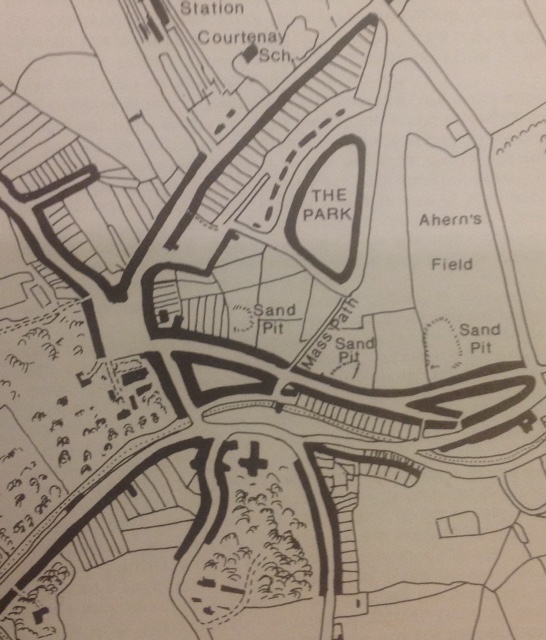
Maiden Street (2)
Detail from the map by Dr Pat O’Connor showing Assumpta Park and the Mass Path in relation to Maiden Street and the church.  Note also the three sandpits still in use at the time – Musgraves (now Whelan’s), O’Gorman’s, and Ahern’s.

Stanzas 22 and 23 paint a moving, nostalgic picture with the poet’s rose-tinted lens firmly in place.  We are invited to picture an idyllic scene almost straight out of Thomas Gray’s Elegy Written in a Country Churchyard.  It is high summer in Assumpta Park and the visibility is so good you can see Rooska to the north and the Galtees forty miles away to the east straddling the Limerick, Tipperary and Cork borders.  All is peaceful and neat and tidy and quiet ‘and the dogs lie asleep in the roadway’.  The stanza ends with a beautiful echo of a line from Act 3, Scene 2 of Macbeth – “Light thickens, and the crow/ Makes wing to th’ rooky wood.”  (I once heard Noel O’Connor, that great unsung hero and fount of wisdom, say that there’s a quote in Macbeth to solve every problem and cover every possible situation and permutation).  Hartnett, in a more benign and domesticated mood, gives us his variation on Macbeth’s more bloody intent:

and the crows to the tree tops fly home in black rows

and the women wheel out their new go-cars.

 Dr Pat O’Connor believed that making a new home in The Park was hardest on the women.  Yet, as usual, they were the quintessential homemakers.   In 1951 scarcely any worked outside the home, often supplementing family income by keeping lodgers or by fostering children, many of whom grew up seamlessly within the various families.

Hartnett’s love for this place is nourished by innocent childhood memories.  After all, the poem is meant as a Christmas present for his now ailing father and so he paints a picture which we are invited to contrast with the poverty and squalor of earlier childhood.  Hartnett is now forty years of age and remembering life as a ten-year-old in his favourite place, his home in 28 Assumpta Park:

when the smell of black pudding it sweetens the air

and the scent of back rashers it spreads everywhere

and the smoke from the chimneys goes fragrant and straight

to the sky in the Park in the evening.

The residents of Assumpta Park, then and now, are indeed lucky to have as their chroniclers Dr Pat J. O’Connor, one of the most pre-eminent human geographers of his generation, and Michael Hartnett one of Ireland’s great twentieth-century poets.  Both have left us their differing yet unique perspectives of an era of great change and of a wonderful social engineering project that worked.  Hartnett would definitely point to it as an example that the present government should try to emulate!

231147404_3994158964029080_5415516130120616571_n
A group of workers photographed on-site during the building of the second phase of the houses in 1955.  Photo courtesy of Newcastle West Olden Times Facebook Page.  These houses were built by Edmond Power.  Included above: Jack Power (back left), alongside Jackie Brouder, Edmond Power (back right), Mike Harte (front left), Mossy Hurley with child (front right), with Jer Hough and Tommy Fox in line alongside.

Works Cited:

O’Connor, Patrick J. The New Houses: A Memoir. Oidhreacht na Mumhan Books, 2009

Postscript

I came across this little-known poem of Hartnett’s recently which further details the trauma that was involved in the ‘Move to The Park’.  There is an Irish version as well.

Off to the New Houses

I was there when the street expired.

When the cabins were put under lock and key;

Gloom and delight were left imprisoned,

The birth-room, the death-room;

And under the floor and on the wall

The mouse and the spider were lonely.


Donkey and trap, wheel-barrow, hand-cart

Safely transporting our ancestral bedding,

My father’s mug, my mother’s sugar-bowl:

We shifted all under cover of night.

And under the floor and on the wall

The mouse and the spider were lonely.


We shifted all that mattered

Except the heart of the old tortured street:

After a pause for porter, my father and his friends went

To move it to us at once.

It was bigger than ten cows’ hearts,

Weals and wounds and scabs all over it.

But its history and grief notwithstanding

There was a living pulse of blood there still.

Late in the night it was put on a cart

And they pulled it across a field

But the heart expired before journey’s end

And we still can’t wash out the bloodstains.

And still under the floor and on the wall

The mouse and the spider are lonely.

Michael Hartnett


The Etymology of ‘Maiden Street’ in Newcastle West


Maiden Street (1)
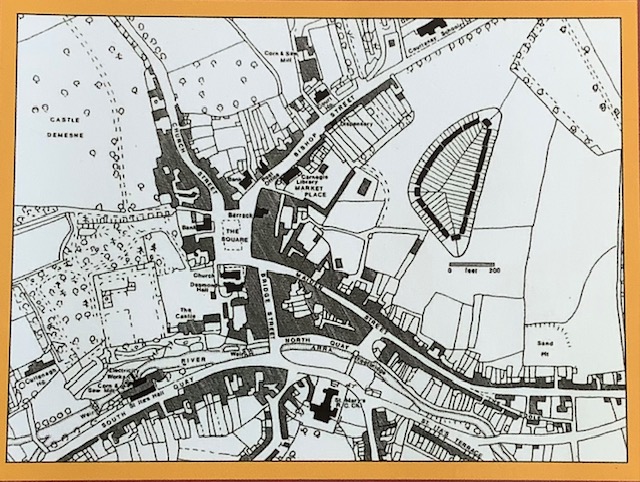
Maiden Street with ‘its necklace of sandpits’ as seen in one of Patrick J. O’Connor’s beautiful maps of Newcastle West (O’Connor: p43).

Maiden Street is the longest and oldest street in Newcastle West.  Sean Kelly, its resident historian, says that it was built piecemeal on the edge of an ancient glacial moraine.  This moraine benefited the town and there were at least three working sand pits in production at one time along the street.  Sean Kelly states that ‘It was a street renowned for its trades of all kinds; shoemaking and repair; tailoring and dressmaking; printing; baking; coopers; tinsmiths; blacksmiths; and harness-makers to name a few.’ Patrick J. O’Connor who has also written eloquently about the street confirms this.  Speaking of the new proprietors who bought out their leases during the sale of the town in 1910 he says that ‘there was colour aplenty in Maiden Street’.  These included Michael ‘Boss’ Culhane who traded in ‘hides, skins, feathers and eggs’!  He also mentions George Latchford who had launched a family business circa 1874 which later developed into the well-known bakery and cinema.  This family business thrived well into the twentieth century under the stewardship of his sons Jackie, Paddy and Willie.

Poverty was rife in Maiden Street – particularly Lower Maiden Street – and Michael Hartnett makes constant reference to this fact in both his prose and poetry:

We rented a mansion down in lower Maiden Street,

Legsa Murphy our landlord, three shillings a week,

the walls were mud and the roof it did leak

and our mice nearly died of starvation.

The etymology of the street name has always posed problems.  Again Sean Kelly says that there is no mention of the street name among the earliest known street names going back to 1584-6, although it was in existence by then, ‘what is clear is the street’s graceful, curvilinear form adorning the earliest available town plan, the Moland Survey of 1709’.  Patrick O’Connor suggests that the street name may be derived ‘from the medieval cult of Mariology (Sráid na Maighdine Mhuire)’ (O’Connor:56).

The lower part of the street was sometimes known as Dock Road, in accord with the low status attributed to it.    The gardens of the houses on the south side abutted on to a track known locally as ‘the back of the Docks’.  At intervals, there were ingresses with steps leading down to the River Arra, where the local women came to do their laundry.

Sean Kelly waxes lyrical about this place: ‘Lengthy, capacious and capricious, Maiden Street was – according to the punchline of a popular rhyme – a favoured place for lodgers’.  And while the name of the street remains an enduring enigma, its lower appendage, the Coole (cúil, from the Irish meaning corner or nook) poses no interpretative problem whatever. Sean Kelly himself often claims to belong to Middle Maiden Street and from the records, there is evidence of these subtle divisions as far back as 1776.  The street had a distinct Upper, Middle and Lower division and was, in effect, a microcosm of the nuanced social divisions also evident elsewhere in the town!

Hartnett, the street’s very own Poet Laureate pokes further fun at the perceived reputation of the street when he writes in the Maiden Street Ballad:

Tis said that in Church Street no church ever stood,

and to walk up through Bishop Street no bishop would,

and tis said about Maiden Street that maidenhood

            was as rare as an asses pullover.

In his Preface to that famous ballad, Hartnett says that ‘Everyone has a Maiden Street.  It is the street of strange characters, wits, odd old women and eccentrics: also a street of hot summers, of hop-scotch and marbles: in short the street of youth’.  However, he also adds a disclaimer saying that ‘Maiden Street was no Tír na nÓg’ and we should not forget that the street was but a ‘memory distorted by time in the minds of all who lived there’.  Generations to come will continue to show their gratitude to the poet for his wonderful evocation of the street of his childhood, the nearest Newcastle West will ever come to having its own Steinbeck or, indeed, its own Cannery Row!  As he said himself: ‘Ballads about places however bad they may be, unite a community and give it a sense of identity’.

In his shorter poem, Maiden Street (1967), there is a reference to the ‘small voices on the golden road’ and later he says about the days of his childhood, ‘we were such golden children, never to be dust’.  This may give us some clues as to the etymology of the name originally given to the street.  Maiden Street runs west to east, so the morning sun shines up the street and so a young poet’s imagination turns it into his very own ‘yellow brick road’ and one wonders if the street was ever called Sraid na Maidine or Morning Street?   

Many of those family names, synonymous with the street, who bought out their leases in 1910 still have links to the town to this day: Reidy’s, Houlihans, Gormans, Morrisons, Mullanes, Byrnes, Aherns, Nashs, Murphys, Fitzgeralds, Bakers, Hartnetts, Quins, Healys, Hartes, Massys, Moones…..

Hartnett says that the street finally ‘gave up the ghost’ in September 1951 when most of the inhabitants were rehoused in one of the 60 new houses in Assumpta Park.  Hartnett describes the operation epically in the Maiden Street Ballad – likening it to the hazardous journey of the Israelites escaping from Egypt to the Promised Land!

XVI

The old street it finally gave up the ghost,

and most of the homes there they got the death-blow

when most of the people were tempted to go

and move to the Hill’s brand new houses.

The moving it started quite soon after dark

and the handcars and wheelbars pushed off to the Park

and some of the asscars were like Noah’s Ark

with livestock and children and spouses.

XVII

For we all took our furniture there when we moved,

our flowerbags and teachests and threelegged stools

and stowaway mice ahide in our boots –

and jamcrocks in good working order.

And our fleas followed after, our own local strain –

they said “We’ll stand by ye whatever the pain,

“for our fathers drew life from yere fathers’ veins”

“and blood it is thicker than water”!

For many, this transition was effortless and opened up a whole new vista while for others the change of location was a step too far and they found it very difficult to settle in their new environs.  Again Hartnett puts this very colourfully:

XIX

In nineteen-fifty one people weren’t too smart:

in spite of the toilets they pissed out the back,

washed feet in the lavatory, put coal in the bath

and kept the odd pig in the garden.

They burnt the bannisters for to make fires

and pumped up the Primus for the kettle to boil,

turned on all the taps, left the lights on all night – 

but these antics I’m sure you will pardon.

Following their move to the Park residents soon found that there was no ready access back down to Maiden Street other than across often wet fields and down through Musgroves and Gorman’s sandpits.  Eventually, after much lobbying of local Councillors, the Mass Path and Mass Steps were constructed. As Patrick O’Connor says, their arrival ‘opened up a vital line of communication to town’.  It is interesting that this vital piece of infrastructure was ostensibly procured under the pretext of providing ready access to the church, hence their name, but many would argue that these steps were more often used to visit other old haunts such as Latchfords and The Siver Dollar!

However, as a final footnote, or maybe to add fuel to fire, and totally in keeping with his mischievous nature, Michael Hartnett, in his ‘scholarly’ notes to the Maiden Street Ballad, has his own theory about the etymology of the street’s name.  He theorises – and only he would get away with this scurrilous suggestion – that  ‘the street was originally called Midden Street’!

Maiden Street (2)
Detail from the same map as above showing Assumpta Park and the Mass Path in relation to Maiden Street and the church (O’Connor: p43).

Works Cited

Hartnett, Michael. The Maiden Street Ballad, The Observer Press, 1980.

O’Connor, Patrick J., Hometown: A Portrait of Newcastle West, Co. Limerick.  Oireacht na Mumhan Books, 1998.

Further Reading

Epitaph for John Kelly, Blacksmith

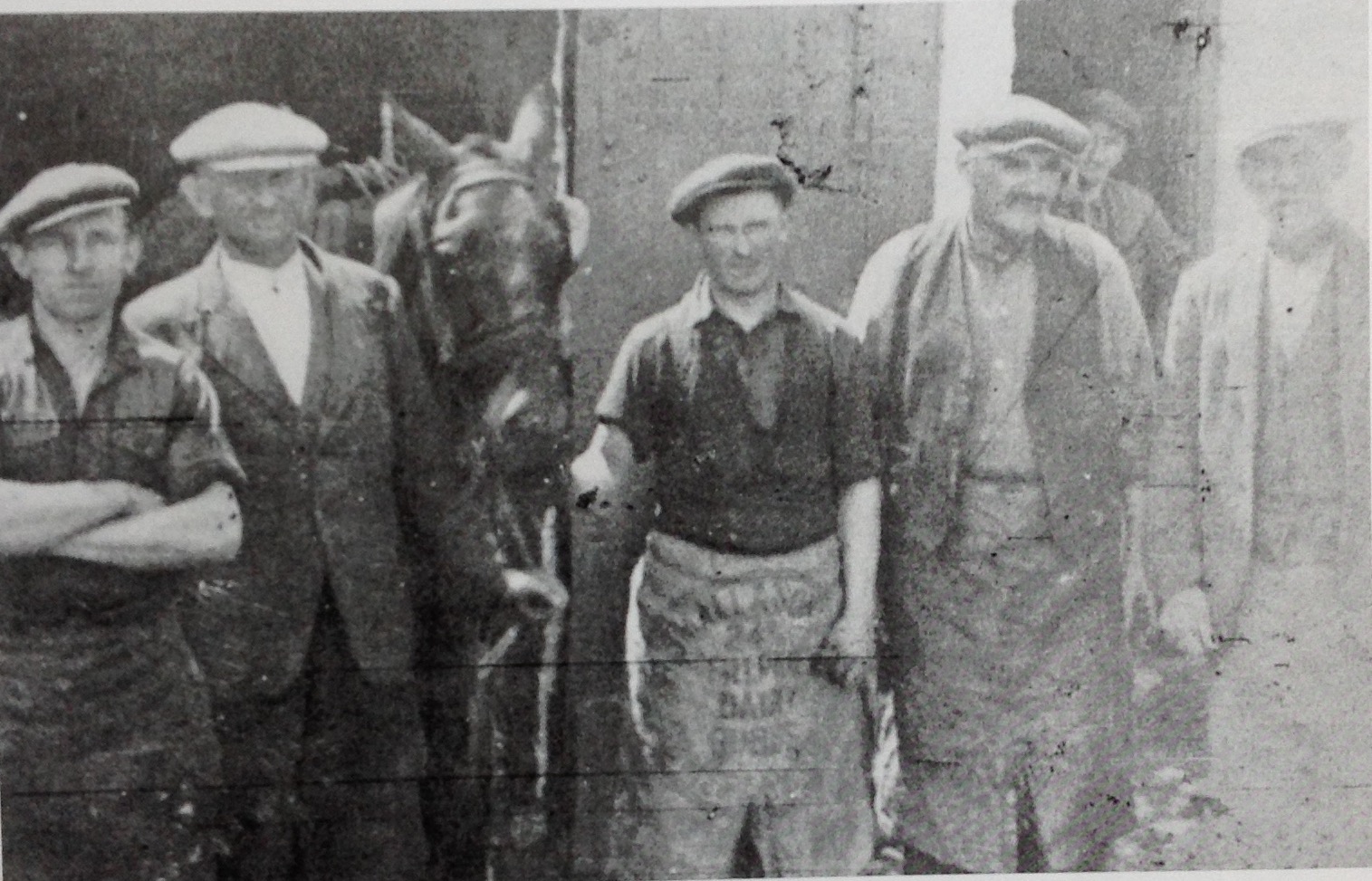
FullSizeRender - John Kelly's forge
Kelly’s Forge in the 1940’s. L to R: J. O’Kelly, D. Nash, C. McAuliffe, S. O’Kelly. C. Fitzgerald (Information credit Newcastle West in Close Up – Snapshots of an Irish Provincial Town published by Newcastle West Historical Society, 2017)

Epitaph for John Kelly, Blacksmith

By Michael Hartnett

Black clothes do not make mourners:

                                      the cries come out of the heart.

And local men at street corners,

                                      who have stood

                                      and watched grained wood

in horse-hearse and motor-hearse,

                                      white plumes of feathers, blue plumes

of smoke, to the dead man’s part

                                      of  town, to the rain-dumbed tombs,

go, talk his life, chapter and verse,

and of the dead say nothing but good.

In Maiden Street

what man will

forget his iron anvil,

in early Monday morning, sweet

as money falling on the footpath flags?

Author’s Note: 
I am grateful to Maighread Medbh for the following keen observation from her blog: “The 1985 edition of Michael Hartnett: Collected Poems, Volume 1, (Dublin: Raven Arts Press, Manchester: Carcanet) printed “to” instead of “go” here (… to the rain-dumbed tombs, / to, talk his life …), which I’ve taken as a typographical error. The original printing, in A Farewell to English (Dublin: Gallery Press, 1978), had “go”.

Commentary:  This poem was written as a tribute to John Kelly, one of the ‘old stock’[1], one of the characters of Maiden Street and the Coole.  The Coole was an area in Newcastle West, which Michael Hartnett referred to as ‘The Claddagh of the town’.  It encompassed an area running parallel to Lower Maiden Street, a lane behind what we now know as The Silver Dollar Bar.

Eigse Michael Hartnett - Sean Kelly
Sean Kelly former teacher and local historian and also the last blacksmith in Maiden Street and son of John Kelly the subject of Michae Hartnett’s Epitaph.

In bygone days, Sean Kelly, John Kelly’s son tells us that there were three forges in Maiden Street – Big Sean Kelly’s forge was located in The Coole on the site of the present St. Vincent de Paul Charity Shop and his son, John Kelly, the subject of this epitaph, had a forge which was located in what Sean Kelly calls, ‘middle Maiden Street’. The third forge was O’Dwyer’s Forge and this was owned and worked by Bill O’Dwyer, father of the late Ned O’Dwyer. These forges were a focal point for the street and for the town, they were places where town and country met, where stories and news and gossip were exchanged, and where tall stories grew legs.  During a fascinating walkabout during Éigse Michael Hartnett this year (2017),  Sean Kelly and John Cussen gave a very interesting history of Maiden Street.  Sean told his listeners that another source of industry in the street during the 19th century and early 20th century were the four natural sandpits which were located along the street – the street being fortuitously located at the end of an ice-age moraine.  Forges were, however, an essential part of Irish rural life and farmers, in particular, used the services of the blacksmith to shoe their horses and make and repair their ploughs and iron gates and other farm utensils.  Indeed in harsher, more troubled times the forge also doubled as an ‘armaments factory’ where ancient pikes, and rudimentary spears and swords were forged and tempered in a clandestine way and often ‘hidden in the thatch’.  In a way, not only is Hartnett lamenting the death of a man here but also, like Heaney in many of his poems, he is lamenting the loss of an ancient craft which, with the progress of time, has become redundant.

In the Annual Observer, the journal of the Newcastle West Historical Society, published in July 1979, Lizzie Sullivan, a long time resident of the Coole, referred to John Kelly’s father and his importance to the area:

“I can’t forget our blacksmith, Big Shaun Kelly.  He had his forge in a part of the Coole.  He was a fine type of a man, big and brave and he had a voice to go with it.  Many a day the youths of the Coole spent in his forge.  They used to love when they were asked to blow the bellows and Shaun would be singing or telling them stories as they made the sparks fly from the anvil.  He used to have them shivering telling them all about Sprid na Bearna and the dead people he met going home on a Winter’s night.  They believed every word he used to tell them”.

This epitaph, however, is composed to honour Big Shaun Kelly’s son, John, and like all epitaphs, this poem is short and sweet.  In the opening stanza, death and funerals are generalised.  Hartnett doesn’t seem to be talking about any particular death but remembers numerous funerals down the years and he refers to the funeral customs observed in the town.  Quiet men standing at ‘street corners’ looked on the ‘grained wood’ of the coffin as it passed, either in ‘horse-hearse’ or ‘motor-hearse’, on its way to the old graveyard in Churchtown.  There amid ‘the rain-dumbed tombs’ it was customary to speak well of the dead:

          go, talk his life, chapter and verse,

and of the dead say nothing but good.

The second stanza presents us with the real epitaph.  It is short, personalised and very well crafted.  Everyone in Maiden Street will remember the ring of the anvil on a ‘Monday morning’ and Hartnett uses a lovely simile to remember his friend: Heaney uses the image of an ‘unpredictable fantail of sparks’ coming from the anvil in his poem, ‘The Forge’, and here those sparks from John Kelly’s anvil are compared to money falling on the ‘footpath flags’.  His exquisite use of assonance and alliteration in these short lines emphasises his poetic craft.  The poem is also noted for its use of compound words such as ‘horse-hearse’, ‘motor-hearse’,  and ‘rain-dumbed tombs’, which hopefully, in time, will be used as an excellent example of alliterative assonantal onomatopoeia!

In ‘Maiden Street Ballad’, Hartnett similarly remembers with fondness the work of John Kelly:

XXXVIII

I awoke one fine morning down in Maiden Street

to John Kelly’s forge-music ringing so sweet,

saw the sparks flying out like thick golden sleet

from the force of his hammer and anvil:

and the red horse-shoes spat in their bucket of steam

and the big horses bucked and their white eyes did gleam

nineteen forty-nine I remember the year –

the first time I got my new sandals.


There is a strong ‘local’ element to Hartnett’s writing – he tells us in Maiden Street Ballad that,

A poet’s not a poet until the day he

                             can write a few songs for his people.

This loyalty to his native place and space and the people who live there is admirable and is acknowledged with gratitude by those same locals to this day.  Seamus Heaney, in his introduction to John McDonagh and Stephen Newman’s collection of essays on Hartnett, entitled Remembering Michael Hartnett, says that,

Solidarity with the local community and a shoulder to shoulder, eye to eye relationship with local people distinguish Hartnett and make him the authentic heir to the poets of the Maigue.

These local people, John Kelly and his father before him included, had a great influence on the young Hartnett as Heaney also points out in that same introduction:

The young Hartnett rang the bell, and images from the world of the smithy would turn up in some of his most haunting work, as when a rib of grey in a woman’s hair is compared to a fine steel, ‘filing on a forge floor’ (‘The Retreat of Ita Cagney’).

But I’ll leave the last word to Lizzie Sullivan remembering Big Shaun Kelly and his contribution to life in Maiden Street and The Coole :

“When the circus was coming to town, Shaun the Smith would be talking for days before it came… It was lovely to see all the fine horses and ponies.  There would be thirty or forty going up to Kelly’s Forge.  Then, when the circus was gone away he would be still talking about it for days.  He would let Sprid na Bearna rest, and all the other ghosts he used to see.  He made many a one happy, especially the young lads listening to him….. God be with the Coole and all the fine people that are gone!

FullSizeRender (12) Big Shaun Kelly
Town Crier Bill Poster and General Carrier John Lenihan pictured at the left of the door of big Sean Kelly’s house in Maiden Street. Sean Kelly is seen smoking his pipe. Information gleaned from Newcastle West in Close Up – Snapshots of an Irish Provincial Town  published by Newcastle West Historical Society (2017).

[1] Hartnett assures us in a footnote to ‘Maiden Street Ballad’ that to qualify as ‘old stock’ a family had to be established in the town for at least three generations.  He goes on to say that the phrase can also be very useful if you meet someone in the street and you can’t remember their name!

Works Cited

McDonagh, John and Newman, Stephen eds. Remembering Michael Hartnett, Four Courts Press: Dublin, 2006

Newcastle West Historical Society publishers of ‘Newcastle West in Close Up – Snapshots of an Irish Provincial Town’ (2017).