The Joys of Walking

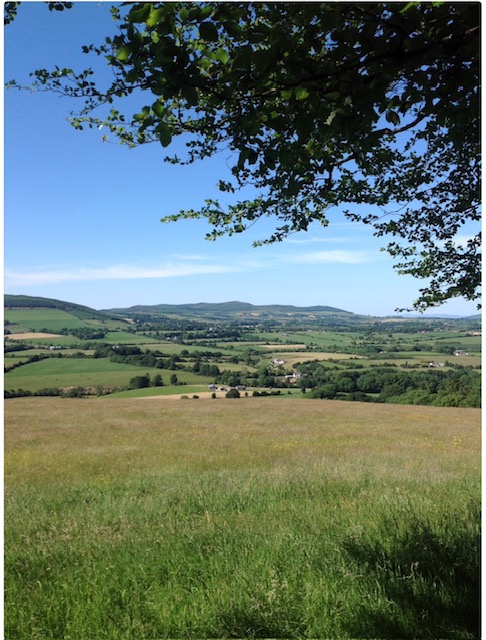
Photo taken looking out from Johnny Hennessy’s memorial on the way up to Castlegale through the old Gabhairín Rua pathway. Beautiful view of Glenroe, Ballintubber and Slievereagh.

I became a serious walker in 2009! For several years before that, I had been severely hampered by arthritis in my left hip. After years of being told that I was too young for a hip replacement, I had the operation in Croom in November 2008. The operation was a complete ‘textbook’ success, according to my very favourite orthopaedic surgeon, Eric Masterson.

The operation gave me a new lease of life and, whereas up to that time walking was a painful chore, now I felt energised and ready to explore. Since then, I have loved to walk – in Summer especially or when the scales tip 215 lbs! I head off, and a trek of twenty kilometres is not unusual. I have visited all my local villages on foot, in their turn, Rathkeale, Ballingarry, Castlemahon, and Kilmeedy. In recent years, since Mary moved to Glenroe, I have gloried in rediscovering the Ballyhouras, and whether it is a trek over Sheehy’s Hill or climbing up to Castlegale or the more arduous Darragh Loop, the trails and loops have brought me great joy. 

Castlegale is a great parish reference point.  Looking south, it dominates the landscape.  I remember my mother telling me that in the landlord days of rents and rackrents, the Gascoignes of Castle Oliver placed a flag on the cairn at the summit of Castlegale to let tenants know their rents were due.  Today, Castlegale is central to some of the many amazing trekking loops which have been developed in recent years by the Ballyhoura Bears and by Ballyhoura Development.  The walk to the summit from Darragh takes you through the beautiful ancient pathway, the Gabhairín Rua.

The Ballyhoura Region itself is a truly mythical landscape – Seefin, Glenosheen, Glenanaar, the Black Dyke, Ardpatrick – these high places carry evidence of cairns or old monastic ruins, a strange mixture of the ancient battles between the old dispensation and the new.  And up in these hills, you come across strange sights as you ramble.  I’ve come across Army Rangers perfecting their orienteering skills, in full combat gear, traversing this God-forsaken wilderness on their way to rendezvous with other members of their regiment. 

The name Seefin (Suí Finn) translates as the ‘Seat of Fionn (Mac Cumhaill)’.  It is so named because, according to tradition, Fionn and his Fianna rested here on their hunting excursions to the other sacred places, like Knockainey (Cnoc Áine), and our other sacred Limerick hill, Knockfierna (Cnoc Fírinne).  Down below Seefin, the highest point in the Ballyhouras, is the quaint Palatine village of Glenosheen, named in honour of Óisin, the son of Fionn.  The village is famous as one of the settlements established by a colony of Irish Palatines, German Protestant refugees, who settled there in the early 18th century.  Some of their historic houses and family names, like Switzer, Teskey, Ruttle, Young, Sparling, Wolf, Baker,  Weekes and the Steepes, are still evident today.  Their main settlement in Limerick was Rathkeale, where they used their expertise to bolster the emerging linen and flax industry in the area. Today, in Rathkeale, there is a fabulous Palatine Museum at the trailhead for the West Limerick Greenway dedicated to their memory.

Glenosheen is also remembered as the birthplace of the famous Joyce Brothers, Patrick Weston Joyce and Robert Weston Joyce.  Patrick Weston Joyce (1827 – 1914) was a distinguished educationalist who, would you believe it, began his teaching career in Glenroe N.S. at the age of eighteen.  He had been educated in numerous well-known and well-endowed Hedge Schools in Kilfinane, Kilmallock and Mitchelstown by the very best travelling scholars.  He taught in a number of schools, including the High School Clonmel, before eventually going on to have a distinguished career at Trinity College, Dublin.  Here, he made a name for himself as a historian, a linguist, and a significant collector of Irish folk music and traditional airs. He held influential positions in the Irish education system and authored numerous works on Irish history, place names, and the Irish language. His efforts helped preserve a vast amount of Irish cultural heritage.  Indeed, the first book I ever read when I was in Fifth Class in Primary School, having recently graduated from comics, was his fabulous collection of old legends, Old Celtic Romances, telling the almost forgotten tales of Fionn and Óisín, Cúchulainn and Diarmuid agus Gráinne.

His brother, Robert Dwyer Joyce (1830 – 1883), was no less famous and distinguished.  He was a medical doctor who achieved renown as a writer, poet, and song lyricist. He was associated with the Fenian movement (1867) and wrote popular ballads, including ‘The Wind that Shakes the Barley’ and ‘The Boys of Wexford’. His literary contributions often centred on Irish themes and history. He also spent time in the United States, where he was well-regarded. 

Further west, and nearer to home, I love trekking on the slopes of Knockfierna, near Ballingarry in County Limerick.  This place is famous for its poignant Famine Village history, where, during Famine times, over a thousand people lived in makeshift homes on the side of the hill.  It is a unique experience to walk among the ruins of the semi-restored cottages, shebeens, and Rambling House.  Today, thanks to the work of Pat O’Donovan and his restoration group, the Knockfierna Famine Trail leads visitors past these preserved cottage ruins, garden plots, and other memorials, offering a moving, reflective experience amidst stunning views of the Golden Vale.  The whole experience showcases both Irish resilience and the devastating impact of the famine. 

Another one of my favourite rambles is in The Castle Demesne in Newcastle West, Co. Limerick, especially when rain threatens.  This beautiful 100+ acre sylvan parkland with walking trails, playgrounds, and picnic spots, surrounding the historic Desmond Castle and its Banqueting Hall in the town square, is heavily wooded, and there is great shade from wind and blustery showers. It is an amazing family-friendly amenity right by the town centre, and it is easily connected to the scenic Limerick Greenway. This historic site, once home to the powerful Earls of Desmond, including the famous third Earl of Desmond, Gearóid Íarla, features centuries of history with stunning parklands for leisurely strolls, rich flora and fauna, and is a central part of Newcastle West’s heritage.  Legend has it that Gearóid disappeared in mysterious circumstances in 1398 while walking in the Demesne grounds, and today he is fabled to live beneath the waters of Lough Gur, near Bruff, over whose waters he is said to appear once every seven years, riding his white steed.

I am also very lucky to have the fabulous Limerick Greenway within striking distance.  I have to say it is becoming more and more dangerous walking on minor country roads; such is the total absence of courtesy, and speed limits are totally ignored.  Thankfully, I now have The Greenway, which was built along the former Limerick to Tralee railway line, and after many years of development, is now a state-of-the-art off-road cycling and walking route that can be accessed through numerous entry points.  The Greenway weaves its way through West Limerick’s traditional agricultural landscape, starting in Rathkeale, on through Ardagh, Newcastle West, Barnagh, Templeglantine and finishing in Abbeyfeale, passing through Tullig Wood, with its mature, serene woodland and native trees, providing a restful calm and balm for all travellers.

Walking by the sea offers therapeutic benefits, combining gentle exercise with stunning views.  There are other benefits, such as stress relief and connecting with nature. Whether one sets out on a relaxing stroll on sandy beaches or undertakes the more vigorous coastal path hikes, one can be enriched by the bracing fresh air, the sound of waves, the prospect of some whale spotting and the occasional sea wreck. It’s a popular way to enjoy leisure time, explore scenic routes, and find peace, like the beautiful hike out past the Diamond Rocks in Kilkee and up Dunlicky or George’s Head. 

One of our favourites is the Ballycotton Cliff Walk, definitely a podcast-free ramble, with majestic sea vistas looking out over the final resting place of the doomed Lusitania.  No trip to Ballycotton is complete without a rewarding visit to nearby Ballymaloe for a coffee and delicacies! Or when in Ardmore, head out past the Cliff House Hotel and the ruins of St. Declan’s Hermitage and Well and enjoy the stunning sea views and ramble back towards the quaint little seaside town via the majestic Round Tower.  It is a stunning looped coastal trail offering beautiful sea views, historical sites, and the chance to spot the Samson crane barge wreck in its lonely final resting place.

Since retirement, we have been making frequent visits to the Canary Islands and especially, Puerto Rico in Gran Canaria. This place, as opposed to Puerto del Carmen, is challenging enough and rambles in the early morning or after four in the evening are recommended. Kate and I have been coming here now for the past twenty years, and each visit uncovers new delights, and improved pathways, steps and roadways. Our favourite walk is the Cliff Walk between Puerto Rico Beach and the man-made Amadores Playa. This is an easy ramble and often a preamble to more strenuous excursions.

We invariably book accommodation on the lower level. Corona Cedral would be our favourite place of all, but we have also stayed in Monte Verde, Letitia del Mar, Maracaibo, and Rio Piedras, with its terracotta terraces overlooking the beach. All these are very central – near the two main Shopping Centres and the beach and its many restaurants.

The only drawback I find with Puerto Rico is its distance from the airport – approximately 40 kilometres. However, Gran Canaria has a first-class public transport system and once free of arrivals and the terminal building, you can go to the bus terminal and get the 91 bus to Puerto Rico for €5.45 – as opposed to €70 for a taxi. Alternatively, Ryanair and others provide reasonably priced shuttle services to and from the airport.

Casting a long shadow before descending those 756 steps!

As one becomes familiar with the area, one becomes more confident in foraging out new trails, loops and challenging treks. The one thing to notice is that there are steps everywhere linking the various levels. The local authority has done fabulous work in the past five years, building a series of steps from the beach to the high point near Puerto Azul apartments. In all, there are 756 steps in this series – individually counted! Depending on your exertions, you can decide to descend the 756 or take on the more daunting challenge and ascend – or even decide to work both into your evening ramble!

Evening walks usually involve thoughts of home and the girls, Maeve, Anna, Muireann and, of course, Mary, Mike and Don. There is a tree on one of the summits which I always associate with them. It grows in the centre of a roundabout down the road from the Europa Centre, and very near the Balcon de Amadores apartment complex, and invariably, when I get this far, I usually give them a ring to check how things are, and to check on Knockaderry’s, Clanna Gael Fontenoy’s, or Limerick’s progress in the Championship.
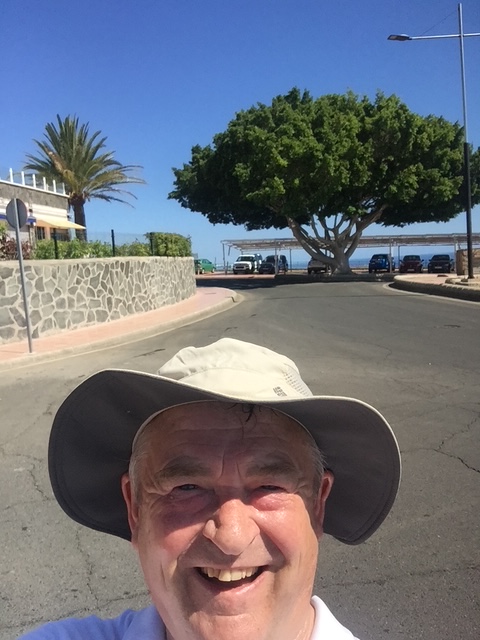
Selfie with a tree!

On Lanzarote, ‘El Varadero de la Tinosa’, is the original village of what is now the thriving Old Town centre of Puerto del Carmen. Today, it is still a centre for fishing, and there is a very strong seafaring tradition in the area.  The beautiful little church sits just feet from the water’s edge, facing the little fishing port.  Today, it is a centre for tourist trips, and there is a regular hourly ferry plying between the port and Puerto Calero – the destination for one of my favourite rambles.  Leaving Casa Roja restaurant, we walk to the end of the boardwalk and to the newly paved area at the top.  There are lovely views out to sea and many viewing areas along this stretch of the walk.

We walk south-east along the coast. The distance is 2.2 kms. approx and the walk, taken at a nice brisk pace, will take you about thirty minutes.  The path now changes to a dirt track, and there is evidence of the remnants of an ancient stone road which runs above a small cliff that permits a glimpse from above of the intertidal area, its coves and small inlets.

We arrive at ‘The Barranco (ravine) del Quiquere’, of interest because its volcanic sides contain engravings from the indigenous world of the island of Lanzarote. We can get a close look at them by taking the track just 50 metres to the north on the right side of the ravine as you walk from Puerto del Carmen. 

The views of the sea and islands of Lobos Island and Fuerteventura to the south enhance the beauty of the landscape in this area, and eventually we arrive at the newly man-made marina of Puerto Calero. This beautiful port and marina are a fitting ending after our cliff walk, and a ramble around the upmarket shops and outlet stores is highly recommended.  There are also numerous high-quality restaurants and at least two hotels nearby.  Puerto Calero is renowned as a headquarters for some round-the-world yacht crews, and after a brief look around, you will see why.

Ralph Waldo Emerson has laid down my walking ground rules: “Few people know how to take a walk. The qualifications are endurance, plain clothes, old shoes, an eye for nature, good humour, vast curiosity, good speech, good silence, and nothing too much.” I am also reminded that numerous other poets, philosophers and novelists have also wandered and wondered. Kierkegaard did so in the countryside near Copenhagen and suggested that it might be good for his niece, Jette, to do likewise. Prompting her in 1847, he came up with a notion I repeat on my own travels: “Above all, do not lose your desire to walk. I walk myself into a state of well-being and walk away from every illness. I have walked myself into my best thoughts, and I know of no thought so burdensome that one cannot walk away from it” (A Letter to Henrietta Lund from Søren Kierkegaard, 1847, trans. Henrik Rosenmeier, 1978).

I haven’t read many of HG Wells’ novels, but there’s another mantra from one of the non-fiction works, Modern Utopia, that I’ll happily take to my grave: “There will be many footpaths in Utopia.” And whether I’m rambling in the Ballyhouras or Ballycotton or above Ashford on the Cob Road or the hills above Bormes les Mimosa, in the Provence-Alpes-Côte d’Azur Region, southeastern France, or in Puerto Rico, my favourite nugget of wisdom is, of course, T.S. Eliot’s evocative words from The Waste Land (1922), surely one of the most beautiful poetic lines ever written, “In the mountains, there you feel free.”

In conclusion, I am often reminded of the lovely Latin phrase, Solvitur ambulando – ‘it is solved by walking’ – sometimes attributed to St. Jerome or Diogenes, or St. Augustine, maybe even Thoreau or Chatwin, inter alios…..

So, put your best foot forward!
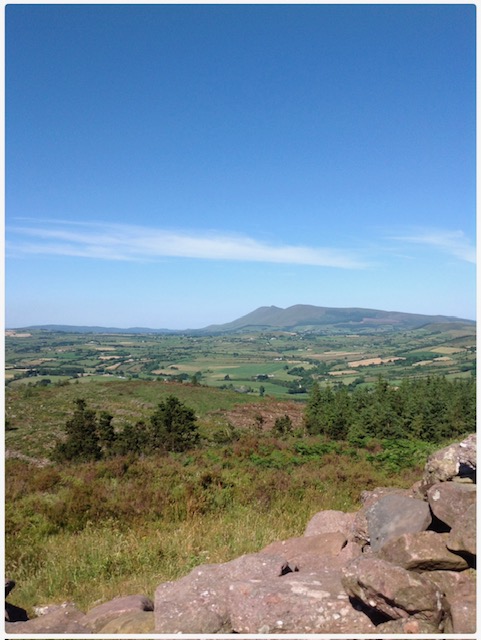
Looking towards the Galtees from the sandstone cairn on the summit of Castlegale.

Semple Stadium Glory Days

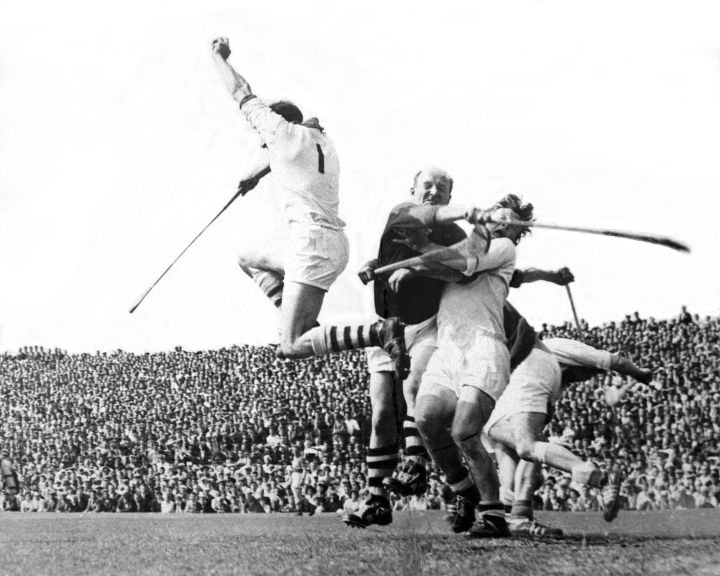
One of the greatest GAA photos of all time. Goalmouth ‘shemozzle’ from that Munster semi-final in Thurles in 1962. Waterford’s Ned Power saves despite the close attention of Christy Ring. Also in the picture are Tom Cunningham (W), Austin Flynn (W), and Liam Dowling (C). The scene is brilliantly captured by photographer Louis MacMonagle. Photo courtesy of the Irish Examiner archive.

Some like Anfield, some prefer Wembley or the Camp Nou or Santiago Bernabéu; some prefer Thomond Park or Cardiff Arms, but my favourite ‘field of dreams’ is Semple Stadium in Thurles, County Tipperary, where the GAA was founded over 140 years ago.  It has been at the heart of hurling since its opening in 1910.  Tipperary people, harking back to long-gone glory days in the 60s, refer to it as the Field of Legends, but I’d say Limerick people would have something to say about that after our recent run of success since 2018!

Close your eyes …. Think of summer. What do you see? I see midges swooping and dancing through a languid sunset. I see heat-drenched Limerick jerseys shuffling through the streets of Thurles, where bellows of banter waft along with the whiff of cider that floats from the open doors of packed pubs in Liberty Square. Inside D D Corbett’s, a bitter alcoholic draws tears from the crowd with a soft, sweet rendition of ‘Slievenamon’.

 Anyway, I have been travelling to this Mecca since I was ten years of age. My first visit was on a beautiful Sunday, the 8th of July in 1962. My mother and father, along with most of my brothers and sisters at the time, were walking home from second Mass in Glenroe when Tom and Mick Howard stopped in their black Morris Minor and asked Dad and me if we’d like to go to Thurles with them to see Ringy and the Rebels take on the might of Tom Cheasty, Ned Power and Frankie Walsh’s Waterford.  It was Ring’s last hurrah, and it was appropriate that his last Championship game in the ‘blood and bandages’ of his native Cork should have been in Thurles.  It was here that, for two decades previously, he had adorned the ancient game with his unique and exceptional talent.  I count myself lucky that I was able to sit there with my Dad, a loyal Cork man,  and my hurling mad neighbours, the Howard brothers, on the recently creosoted railway sleepers on the embankment that is now the Old Stand.  However, it was Waterford’s day, and they won by 4 – 10 to 1 – 16.

On a street corner, a humming chip van mumbles its invitation to giddy children as the June sun beats down. The Pecker Dunne sits, perched on a flat stone wall, plucking and strumming, twanging banjo chords as he winks at those who pass. A smile broadens his foggy beard as coins glint and twinkle from the bottom of his banjo case.

I have witnessed other great games there down the years, and I have seen great hurlers adorn the venue. Let’s be blunt – Thurles is the best place to go to see a hurling match, and hurling people also know that if you can’t hurl in Thurles, you won’t hurl anywhere.  I remember listening to Michéal O’Hehir commentate on the 1960 Munster Final in Thurles between an ageing Cork team and Tipperary, who were emerging as a force to be reckoned with.  There’s a story told by John Harrington about the speech Christy Ring gave in the dressing room before the game that day.  He delivered a rousing speech that brought the blood of his teammates to boiling point. However, his words did not find favour with Fr Carthach McCarthy, who was also in the dressing room at the time. “You didn’t find those words in the Bible, Christy”, said Fr. McCarthy, in as disapproving a tone as he could muster.  Ring cast a jaundiced eye at the man of the cloth and replied, “No, Father.  But the men who wrote the Bible never had to play Tipperary.”  Despite his exhortations, Cork lost on the day, 4 -13 to 4 -11.

Hoarse tinkers flog melted chocolate and paper hats on the brow of a humpbacked bridge as we move closer to the field of legends. The drone of kettledrums and bagpipes rises from the Sean Treacy Pipe Band as they parade sweat-soaked warriors around the green, hallowed sod.

John D Hickey, one of the great sports writers of the 50s and 60s, coined the phrase ‘Hell’s Kitchen’ to describe the general vicinity of the Tipperary goalmouth, which Michéal O Hehir, the greatest GAA commentator of all time, referred to as ‘the parallelogram’, or what we today refer to as ‘the square’! This area of the pitch was patrolled in the mid-60s by the Tipperary full-back line at the time, Michael Maher at full-back, flanked by John Doyle and Kieran Carey – probably the greatest full-back line in the history of the game.  As the name suggests, they usually generated the sort of heat that suffocated most full-forward lines, who generally struggled to cope with their unique blend of physicality, hurling skill and a generous helping of the dark arts.  Their dominance continued until the emergence of the youthful Eamonn ‘Blondy’ Cregan and Eamonn Grimes and company, who in 1966 destroyed that Tipp team that were All-Ireland winners in ’61, ’62, ’64, and ‘65. Suffice it to say that Limerick put a stop to Tipperary’s gallop that sunny Sunday, and the young ‘Blondy’ Cregan scored 3 goals and 5 points in a 4 – 12 to 2 – 9 defeat of Tipperary. That day still stands as one of my all-time treasured sporting memories.

A whistle rings on high, ash smacks on ash and the sliothar arrows between the uprights. A crash of thunder and colour erupts from the terraces at the Killinan End and the Town End (the Limerick end!)…… I see the Munster Championship!!

I’ve been in Thurles as a Limerick supporter, as an uninvolved spectator, and I’ve also been there with skin in the game as Don played Minor, Under 21, and Intermediate hurling for Limerick. Limerick have been lucky in this place. A few Munster Senior titles, including 1973, five Under 21 titles in this Millennium alone, and a Centenary Minor title after a replay at the same venue against Kilkenny.  Paddy Downey, writing in The Irish Times, said of the replayed minor final that, ‘it is probably true to say that there never has been a better minor All-Ireland final’.

The 1973 Munster Final was special, and of course, it ended in controversy.  As the final seconds ticked down and the teams were level, Eamonn Grimes won a disputed seventy for Limerick.  The referee, Mick Slattery from Clare, told Richie Bennis that he had to score direct, as the time was up.  Richie held his nerve, the sliothar headed goalwards, the umpire raised the white flag, and the rest is history. Every Tipperary man there that day swears that the ball was wide, but it mattered little; the game was up.  In my view, it was Ned Rea who broke Tipperary hearts that day with his three goals and not Ritchie Bennis with his last gasp point.  Sadly, it was the final swansong for that great Tipperary team.  They stole an All-Ireland in ’71 when they beat Limerick in the rain in Killarney, but they didn’t emerge again as a hurling force until 1989. That day also marked the legendary Jimmy Doyle’s last appearance in a Tipperary jersey.

The Championship is more precious than life for many. I’ve seen grey-haired men gazing into half-empty pints, reeling off the names of the great ones, like prayers. I’m afraid I too follow suit. Ask me who the Minister for Finance is, and your question will be greeted with indifference. I simply couldn’t care less. But ask me where Carlow senior hurlers play and instantly I say, ‘Dr. Cullen Park … to the left at Church Street, up Clarke Street and half a mile out on Tower Road’. Monaghan? ‘Pairc Ui Tieghernan .. on the slope of George’s Hill, overlooking the County town’. Where do Sligo play? ‘Markievicz Park in the heart of Sligo town’. ‘Bless me, father, for I’m a fanatic!’

The major hurling powers took a bit of a break in the mid-90s and allowed the minnows, like Limerick, Clare and Offaly and Wexford, to have their fling.  Don and I were in the New Stand – Árdán Ó Riain – for the ’95 Munster Final on the 9th of July.  It was one of those glorious Thurles days – despite the outcome.    In the end, Clare claimed their first Munster championship since 1932, and only their fourth ever.  I remember Davy Fitz scoring a penalty before half-time, crashing the sliothar high into the town net, before sprinting back to his own goal line.  Despite our disappointment, especially after the humiliating defeat in the All-Ireland Final the previous year to Wexford, you had to give credit to this Clare team.  One could sense the ghosts of 63 years and the curse of Biddy Early evaporating before our eyes.  The release of emotion when Anthony Daly received the cup had to be seen to be believed.  I remember the ‘Shout’ ringing out from the Killinan End and then Tony Considine taking the microphone for his rendition of ‘My Lovely Rose of Clare’.

What else draws the likes of Mike Quilty and Mike Wall, setting them down among roaring, red-faced lunatics in the shadow of the crowded Old Stand? What else exists that plucks the cranky farmer from the milking parlour and flings him into a concrete cauldron eighty miles across the province? Some swear the Apocalypse would not have the same effect….

We waited nearly a full year to gain our revenge – on June 16th, in Limerick this time.  We had been away for a holiday in Carnac in Brittany and came back the day before the game.  All of Limerick had been convulsed by the recent killing of Detective Garda Jerry McCabe, who had been shot and killed in the village of Adare by members of the Provisional IRA on June 7th, during an attempted robbery of a post office van. His colleague, Ben O’Sullivan, had also been seriously injured in the incident.  Being away when tragedy strikes so close is unnerving and surreal.  I spent most of that Saturday hunting for tickets for the fanatics in my household and eventually secured terrace tickets at the City End of Pairc na nGael from Charley Hanley in Croagh, who was Liaison Officer with the Limerick team at the time. The following day, in glorious sunshine, we took our sunburnt revenge.  Hurling legend Ciarán Carey of Patrickswell scored one of the greatest ever winning points in the history of Gaelic Games, in front of an attendance of 43,534. Result: Limerick 1-13, Clare 0-15.

 May and the chirp of the sparrow, you can be guaranteed we’d be stuck in that long snake of traffic, as it slithered its way to Cork, Limerick, Thurles and other far-flung fields.

 The modern Munster championship has changed many an inherited dynamic. The regularity with which Limerick now go to Semple Stadium to play Tipperary is a very modern phenomenon.  There was a time when if you played two Munster rivals, you would be through to an All-Ireland semi-final – not anymore.  Now you must beat all the Munster counties at least once in the Munster Round Robin Pool of Death.  Limerick have won five All-Irelands in this way since 2018.  Two Munster counties in an All-Ireland Final is no longer a rarity.

.… But oh to be a hurler…  If the truth be known, I couldn’t hurl spuds to ducks. The boss of my hurley has seen the arse of a Friesian cow more often than it has the crisp leather stitching of an O’Neill’s sliothar! Okay, I’ve had my own All-Irelands up against the gable end and in and around the mother’s flower beds, but that’s as far as it went for me.

What is most amazing about Thurles is that no matter who is playing, they all seem to troop back into the town and mingle in the Square in the shade of Hayes’s Hotel for hours afterwards.  As Kevin Cashman, that Prince of Sportswriters from my generation, remarked, ‘the pubs of Thurles on a big match day have something that no other pubs can give.  It has been called ‘atmosphere’, ‘bond’, ‘fraternity’, and much more – it’s magic in the air’.  The ghosts of Mackey, Clohessy, the Doyles, John Keane, Jimmy Smyth, and Ring become as real as what you have just witnessed. And now we have new heroes like Nickie Quaid, Declan Hannon, Cian Lynch, Barry Nash, Kyle Hayes, Patrick Horgan, Tony Kelly, Shane O’Donnell, the Mahers, and Austin Gleeson to keep the flame alight for future generations.  As Kevin Cashman puts it, ‘This is their Elysian field and the turf, and the grass and even the steel and the concrete of this place are the keepers of their youth and the youth of all of us, who shaped them’.

The terrace is where the real nectar of hurling comes to a head – when every Joe Soap in the country stands together on the same patch of cement with their eyes fixed on the same lush, green carpet…..

References

Harrington, John, Doyle: The Greatest Hurling Story Ever Told (2011).

Highly Recommended

 O’Donnchú, Liam. Semple Stadium: Field of Legends, Dublin: O’Brien Press,  2021

Random Epiphanies….

An epiphany is that moment when the penny drops, when the scales fall away from your eyes; that ‘light bulb moment’ when the mystery is solved; when the poem gives up its secret; that Eureka Moment when you realise you’ve been conned for most of your life.

The Bible has many such moments, from Eve and the apple in Genesis to Paul’s conversion on his way to Damascus in the New Testament.  As Christians, we celebrate the Feast of the Epiphany each year on January 6th, which focuses on the moment Christ is revealed to the non-Jewish world; when the Magi, guided by a star, come from the East to visit their Redeemer.

Epiphanies are mental moments when we are given instant clarity, which can turn into motivation to change and charge forward. But not all epiphanies are created equally. Some demand a deep inward search, while others fly in and out of our lives swiftly, silently, almost unnoticed.

It’s great to have an epiphany, but what you do with that new clarity is what matters most. Most of our habits are so ingrained in our lives that changing behaviour is very difficult. Most epiphanies force us to see situations and ourselves in a new light. The next step takes great courage; taking that step to live out your epiphany is when real transformation happens. In my own life, I have had some powerful moments. So, here are a few examples of some of my totally random light bulb moments…..

  • I normally don’t do conspiracy theories, BUT I firmly believe the young Viet Cong soldier who tortured American Vietnam hero and veteran, John McCain, for seven years, when made redundant, went back to the fledgling Hoi ChiMinh University and did a doctoral thesis on the benefits of manually induced electro muscle therapy – this was then picked up in Austria or Switzerland and sanitised. Today, it’s known as DRY NEEDLING. IMHO, the overuse of dry needling by overzealous, sadistic physiotherapists will be the rock that modern physiotherapy will perish on.
  • Donald Trump has never, ever put America first. Indeed, most politicians of all nationalities and all political hues invariably put themselves first.  However, a stopped clock is right at least twice a day, and Donald Trump was spot-on when he coined the phrase, Fake News.
  • In a related epiphany, have you ever noticed that all the major News Corporations are now owned by billionaire oligarchs and moguls?  I wonder why.  I have come to realise that much of what passes for news in today’s world is fake – atrocity after atrocity goes unreported, and not just because all the journalists have been killed by sniper fire – those who sit at home back in the studio have their hands tied behind their backs for fear they might incur the wrath of the current government.
  • On a slightly lighter note, did you ever notice that shampoo bottles are designed so that you will always use more than you need? You only realise this when the bottle is nearly empty.
  • The Catholic Church in Ireland provided an education and health system for Irish people a century before the fledgling state was formed – they deserve to be cut some slack by the newly canonised neo-liberals. That Church, to which I belong, has been under persistent attack for most of this century.
  • There are 756 steps between Oscar’s Restaurant and Servitar Puerto Azul Apartments in Puerto Rico, Gran Canaria!
  • Last year, for the first time since we settled in Knockaderry back in 1979, we had no swallows nesting in our garage by the road. In years past, we’ve had multiple pairs, but last year, 2024, was the first year we had no nest. It struck me then that swallows are the modern version of the canary down the mine. Thankfully, this year, after a very nervous wait, a lone pair arrived on May 20th – five weeks behind schedule. They built their nest and hatched four beautiful chicks for us to admire and cherish. The world is very fragile but not yet fully broken!
  • Global Warming never came to Knockaderry – but Climate Change is a real problem!
  • I’ve always contended that common sense wasn’t that common, but now I’m convinced that logic is irreparably damaged, and Warmongers now see themselves as Peacekeepers.   There’s one who has financed and supplied most of the munitions for an ongoing genocide who claims to have brokered peace in nine global conflicts this year alone.  Give that man the Nobel Peace Prize now, or else!!
  • Your role as a parent is never done. There is never a time, in good times and in bad, when you have full peace of mind, when you no longer need to worry. In reality, as a parent, you are only ever as happy as your saddest child.
  • Your career as a politician or as the manager of your local hurling team always ends in failure! No matter how successful you’ve been at winning championships or leagues or simply avoiding dreaded relegation, the time will come when you lose the dressing room. The people have spoken, and you must inevitably bow to the tyranny of the ballot box or your local GAA AGM!
  • Modern democracy is as fragile as a wasp’s nest, papery and brittle, and in my lifetime, it has been emasculated by billionaires and Russian oligarchs for their own ends.
  • Your health is your wealth. It is a universal truth that we take too much for granted, like being able to put on your socks or pull up your pants or get out of bed in the morning.
  • Cork GAA and its supporters are so well-served by the quality of their sports journalists.  No other county can claim to have writers who, week in week out, report the club scene and the intercounty scene in hurling and football to such a high standard.  Names like Tony Leen, John Fogarty, Maurice Brosnan, Michael Moynihan, Eoghan Cormican, Paul Rouse, Kieran Shannon and Cathal Dennehy are among my favourites.  And all of those stand on the shoulders of the giants who went before them in the old Cork Examiner: Jim O’Sullivan, Michael Ellard, the great P.D. Mehigan, better known as Carbery, and my own favourite word wizard,  Kevin Cashman.  In my book, he was one of hurling’s finest ever writers who prized exactitude and calm knowledge, in the same way he esteemed seeing a hurler’s correct technique create lethal elegance.

Finally, to put some order on this randomness, here are eight epiphanies that have certainly changed my life for the better, and maybe they can help you in your own journey.

  1. You aren’t what people say you are.

What matters most is what you say and feel about yourself. You get to choose. You can let others define you and tell you who you are, or you can show them who you are. Be you. The world needs you as you are.

  1. Plan B is often better than Plan A.

The most freeing moment in your life is when you let go of what you think is best for you. Stop holding on to what is no longer working: that job, that relationship, that dream. If it feels like hard work and is causing you more pain than gain, it is time to let go.

  1. You are not the number on the scale.

At the end of your life, after all those weight struggles, food wars, the obsession with new diets, and trying to look a certain way, it will have no relevance. You are more than a set of grades. The only thing that matters is what is in your heart. How you make people feel and how you make YOU feel is more important than how you look.

  1. The journey is more important than the goal.

Setting and reaching goals is important, but the actual process of becoming, growing, learning, and morphing into who we need to become is the real sweet stuff that makes for a wonderful life. Enjoy the journey as much as the reward.

  1. Being alone doesn’t mean you will be lonely.

The fear of being alone strikes the heart and makes many people panic. But when you learn to love your own company, you will see that you are never really lonely.

  1. It will never be all done.

The to-do lists, the chores, and the things we race around to get done will never be done. It is called life. Situations, chores, and to-do lists will always unfold. Instead of focusing on the end result, be in the process and celebrate what you have accomplished, as our wonderful Limerick Hurling team does.

  1. Emotional pain, indeed, all pain, shows up to point out to us what we need to change.

Sadness, depression, and heartache are gentle reminders to probe deeper into our lives. In the Summer of 2024, I had six weeks of agony inflicted on me by an inflamed bursa in my left hip from climbing ladders and clipping hedges. So, look at what is not working and be open to living your life in new ways. No more climbing ladders for me!

  1. Finally, if you’re lucky, you don’t have to find your purpose; it will find you.

The transition period between who you are and where you are going can be painful, but on your journey of finding purpose, recognise that there is purpose in the pain. Each step you take is helping you carve out more of who you really are.

In Praise of Ryanair – Faint Praise Indeed!

My favourite airline logo!

For retirees like us, Ryanair has been our ticket to the sun, allowing us to travel and expand our horizons. Since its establishment in 1984, Ryanair has evolved from a small airline, operating short-haul flights from Waterford to London Gatwick, to become Europe’s largest carrier.

They have revolutionised air travel in many ways, not all for the good. I remember before their arrival turning up at check-in desks with our two big cases full to the brim, ready to cope with all eventualities. Ryanair quickly sorted that one out!

Early days, staff were very abrasive, and hand luggage caused all kinds of problems. Later, your 10kg bag had to fit into a contraption at the boarding gate, and staff would regularly weigh bags to certify that they were within the required limits.

Today, everything has been monetised. Even before you board your flight, you are encouraged to join and avail yourself of Ryanair Prime.  Prime members get free reserved seats, free travel insurance and access to 12 member-only seat sales, one each month. Prime members can save €560 per annum, and all this for just €79 per annum!  Then, from the moment you book your flight, you are encouraged to spend more money on Priority Boarding, securing your seat, flight insurance, airport transfer, car rental, etc., etc.

However, despite the early growing pains and having to listen to their abrasive CEO, who is even a greater pain, they did what it said on the tin. They got you to your destination from your local airport with minimum fuss or frills. I always marvel at fellow travellers who moan and grumble at the shortcomings of the carrier because they knew exactly what they were signing up for before they ever booked their flights. Another not insignificant reason for my allegiance to Ryanair as our carrier of choice has much to do with the anachronistic concept of ‘the old school tie’. One of my classmates in Secondary School was none other than Michael Cawley, who, for many years, was Deputy Chief Executive of Ryanair. He couldn’t hurl or play football, but in time, he became a great accountant!

The sheer joy and excitement on my granddaughter Maeve’s face during her first Ryanair flight says it all!

I remember one wet Saturday evening in November, sitting in one of the restaurants in Shannon Airport, having gone through security. Kate and I were having a drink before boarding our flight. We were on our way to Lanzarote for a week’s break when, right on cue, an announcement was made that our Ryanair flight would be delayed due to a technical issue with a door on the plane. We were chatting away when a pilot and his first officer asked if they could sit at our table. The pilot was a large, brash American, and his co-pilot was French. We exchanged pleasantries and continued with our conversation.  However, it was increasingly difficult to avoid overhearing the pilot as he venomously and vigorously attacked his employer, who was uncaring, untrustworthy, willing to cut corners, expecting him to work ungodly hours and follow crazy schedules. He would much prefer to work for Wells Fargo or DHL or some other cargo carrier than work for that insufferable bastard, Michael O’Leary of Ryanair! We couldn’t help but listen as he continued to berate and belittle his employer. Finally, our flight was called, and we began to gather up our bags, and he asked us where we were headed. We told him we were headed to Porta del Carmen, and he said he hoped we would have a relaxing flight.   Furthermore, he informed us that he would be our captain on the flight!

Ryanair’s pricing policy is a total mystery to me. They tell us that those who book early get the lowest fares, but this is patently untrue. I know of no other product to hand whose price fluctuates from hour to hour depending on a secret, unbreakable algorithm. I know of no other transport company that can have 300 people on the same flight and no two of them have paid the same price for their ticket. It’s truly bonkers!

Experience a Ryanair flight delay and every piece of consumer protection law which has been meticulously pored over in the hallowed halls of Brussels and Strasbourg is stretched to breaking point. I have been delayed in the stairwell of any number of airports, twiddling my thumbs and avoiding eye contact with the hordes of disgruntled fellow travellers who know to the minute when compensation kicks in and Michael O’Leary will personally have to pay out. Then, with a familiar beep, a message flashes up on your Ryanair App to inform you that you are now entitled to €4 to be spent in all the Cafés and Burgerking outlets, which, coincidentally, are all on the other side of Passport Control. And because it’s now near midnight in Las Palmas, they’re all now closed anyway!  Sometimes that message doesn’t appear until you are home, snuggled up in bed following a five-hour delay to your flight.

Look, it makes perfect sense to me: if some careless baggage handler messes with the cargo hold door and it won’t close properly at 10 o’clock on a Summer’s evening in Nice or Malaga, and the pilot will not take off until the fault is rectified, airport authorities are duty-bound to send for an engineer. Now, at 10 o’clock, most self-respecting engineers are at home or in the pub if it’s a Friday night, and they are not going to come all the way back to the airport for half an hour’s overtime, are they? No, mark my words, that minor little problem will take at least four hours to rectify to everyone’s satisfaction. This rule of thumb, of course, applies to all carriers and not just Ryanair.

And it’s futile to give out or moan or threaten or make a resolution never to fly with Ryanair again. In my long experience, despite the odd hiccup, they’re the best in the business!

Monetise! Monetise! Monetise!