And hear his long scythe whispering to the ground,
And feel a spirit kindred to my own;
So that henceforth I worked no more alone;
But glad with him, I worked as with his aid,
And weary, sought at noon with him the shade;
And dreaming, as it were, held brotherly speech
With one whose thought I had not hoped to reach.
‘Men work together,’ I told him from the heart,
‘Whether they work together or apart.’
Commentary:
Robert Frost is reputed to have said that ‘a poem begins in delight and ends in wisdom’. This statement is definitely true of this beautiful lyric which was written in 1913. He tells us that the poem reflected ‘my position between socialism and individualism’. Indeed, the poem ends with a wonderful epiphany which suggests that he is leaning more towards socialism!
This lovely nature lyric creates a wonderful allegory on the position of the poet and his place in the modern world which, for me, is equally as profound as Heaney’s allegory in ‘Digging’. Frost uses the mower in this poem to represent the artist, the poet, the painter, the creator of beautiful thought-provoking things. The mower has left a tuft of flowers, just as poets leave their life’s work, as a reminder to all who follow that there is beauty in the world. However, very often in Frost’s poetry humans are depicted as isolated figures in the landscape. Not only are they isolated but they represent loneliness, and thereby acquire symbolic status. Loneliness can be seen as a human condition and man’s efforts to communicate effectively are at best difficult as seen in this beautiful lyric. This is why poets and artists are still needed by us to act as our trailblazers and scouts, to go before us, to take the risks, and help us discover the hidden beauty that lies in our meadows and pastures, leaving us many ‘a message from the dawn’.
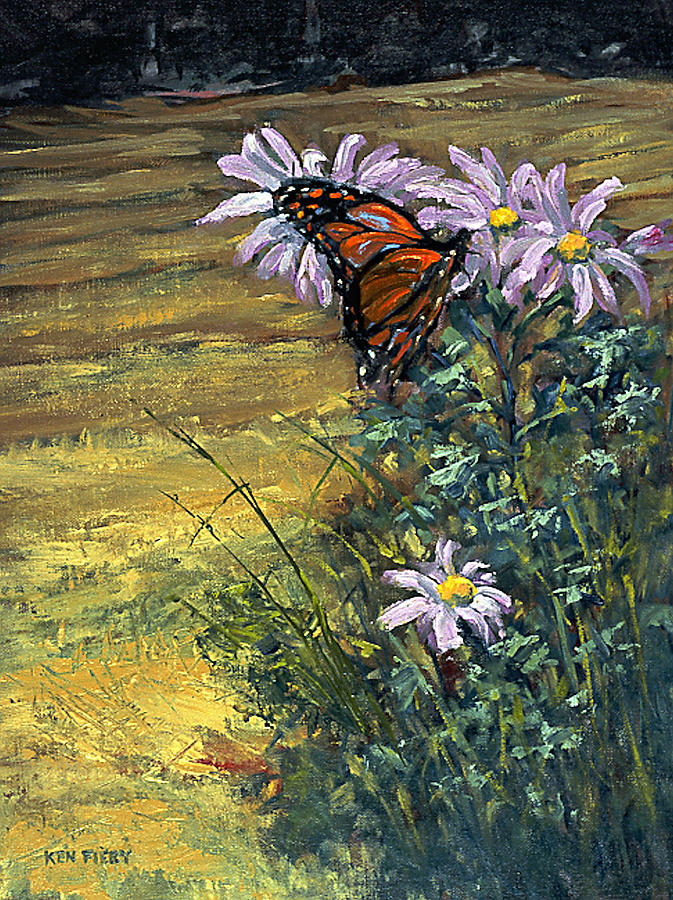
Frost describes how he sets out to ‘turn the grass’ after the mower has earlier cut the meadow with his scythe in the early morning, ‘in the dew before the sun’. He looks in vain for the mysterious mower who has disappeared and has presumably moved on to another meadow. Then unexpectedly ‘a bewildered butterfly’ stumbles on the scene. The poet has a sudden moment of epiphany when he beholds the sight of flowers that have been left untouched by the scythe:
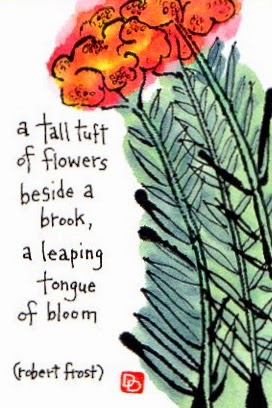
A leaping tongue of bloom the scythe had spared
Beside a reedy brook the scythe had bared.
Even though the two men are working separately the poet realises that in this tuft of flowers which have been spared by the mower is a message from the man who has gone before him. Frost realises that the mower too has a deep appreciation of nature’s beauty and has left the tuft of flowers by the brook as a reminder and as a sign of solidarity. This leads him to believe that he is no longer alone, that in some way he is linked to this enigmatic mower:
And feel a spirit kindred to my own;
So that henceforth I worked no more alone;
So, from an ordinary everyday experience Frost has moved to the appreciation for the need for fellowship in his life:
‘Men work together,’ I told him from the heart,
‘Whether they work together or apart.’
This epiphany strikes Frost like a thunderbolt as he turns the new-mown hay in the meadow but it also strikes the reader and further serves to reinforce for us the simple wonders and powers of nature. ‘A Tuft of Flowers’ highlights for us how joy can return to the poet’s soul through work and companionship with other people, often through little, unremarkable random acts of kindness. It reinforces for me how life can offer many different possibilities for choice and human companionship, and how rich and glorious the whole world of nature is.
James Joyce traces Stephen’s sexual development with great care in A Portrait of the Artist as a Young Man. As an infant Stephen is aware that his mother smells nicer than his father does. As a small schoolboy, he dreams of being kissed by her when sickness makes him long for home. As a young boy, he imagines that he will marry his playmate Eileen when they grow up. It is Eileen’s soft white hands and golden hair that first stirs his romantic boyish notions of idealised womanhood, but the way she puts her hand in his pocket and runs away is the first instance of what his relations with attractive girls are to be. He lacks the maturity to take the initiative in practice or to respond when a girl takes the initiative. Instead, he glamorises the experience in words. For Stephen this mental romanticisation of love is one thing; the experience of living girls is another thing altogether! The two experiences are never brought into harmony. Thus Stephen indulges in these romantic dreams about Dumas’ Mercedes, but it is significant that he pictures himself grandly rejecting her approaches because she had earlier slighted his love. This pose of grand, offended isolation is all too attractive to him.
The first fully recognisable sexual encounter occurs when Stephen goes to the party at Harrold’s Cross. He withdraws from the other children, relishing his isolation, while Emma glances repeatedly and invitingly in his direction. She rouses him to feverish excitement, and after the party, she goes with him to the tram-stop. They stand on the tram steps, he a step above hers, and as they talk she keeps coming up to join him on his step. He knows that she is making an offer; he also knows that the experience is like the occasion when Eileen ran laughing away from him. But for all his sense of her beauty and his knowledge that she is ready to be held and kissed, he does nothing. The failure depresses him. Then, next day, he begins to turn the whole experience – which should have had a living climax – into a literary matter. He tries to write a poem to Emma and consciously brushes the realities of the scene out of his mind. He turns the memory into an exercise in vague, conventionalised poetic verbalism. And after that, he goes and stares at himself in the mirror. His own pose as a romantic poet is more fascinating to him than the living girl who has inspired it.
Two years later, on the occasion of the school play, Stephen works himself up into an excited romantic mood in the belief that he will meet Emma after she has seen the play. Once more the devotion is an uncommunicated obsession based symbolically on a dramatic performance. After the play, in which he excels in the world of imaginary self-projection, Emma is nowhere to be found and he is plunged into despair. Stephen’s awakening sexuality, then, is blocked off from real human relationships and diverted into romantic dreams fed by his reading. The Count of Monte Cristo and Bulwer Lytton’s The Lady of Lyons supply him with imaginary situations of romantic love. As a result, his suppressed physical urges produce a perverted urge to sin and to force someone else into sin. The consequence is that when he meets a prostitute in the street one night, he is readily lured to her room and as she takes the initiative and embraces him he finds not only relief from the urges of lust but a new self-assurance.
For a time sexual experience with prostitutes runs alongside his romantic adoration of the Virgin Mary until the retreat sermons convince him of his wickedness and he repents. We are not told whether, after his loss of faith, he returned to the habit of visiting prostitutes. But clearly, he fails to make a connection between the romantic sexuality in his mind, which is stirred so deeply by the sight of the wading girl, and the life of real contact with women. The wading girl becomes the ideal to move the artist to creative dedication. Real human relationship is not involved.
The fitful references to Emma in the last chapter of the book suggest a very slight interest in living beauty compared to the passionate intellectual interest in the theory of beauty. Though Stephen chooses to imagine that Emma flirts with Father Moran, the sight of her by the library door stirs the thought that she may be innocent and there is another uprush of emotion – but it all goes into dreams and words, not into real contact with her. He writes an extravagantly rhetorical poem to her and pictures himself, the priest of the imagination, listening to her confession. Stephen’s mental life and his concept of himself as the heroic lonely artist are plainly incompatible with a sympathetic understanding of others. He indulges the notion that Emma is consciously rebuffing him and that Cranly is pursuing her when she ignores him outside the library. In consequence, he mentally washes his hands of her: ‘Let her go and be damned.’ But the reader lacks evidence to know how far Stephen is deceiving himself. Indeed the last references to Emma in his diary giver the impression of a girl who is trying hard to make contact with him. She wants to know why she sees so little of him and whether he is writing poems, and his reply is a churlish rebuff calculated to embarrass her. Stephen’s final observation, ‘I liked her and it seems a new feeling to me’, is one of the most revealing sentences in the book. Stephen has expressed a liking for another human being and has conceded that the feeling is a new one to him.
Therefore, it can be said that Stephen’s relationships with girls suffer because of his egotism. He cultivates an image of himself as an isolated artist. His sexual instincts are satisfied with prostitutes. His romantic yearnings are channelled into poems and day-dreams.
Irish writers are often noted both for their irony and for their humour, and Joyce uses a great deal of comic irony in A Portrait of the Artist as a Young Man. Irony is not always comic. It is ironic when a hero kills his own son not knowing who he is, but this irony is wholly tragic. It is ironic that a Christmas party meant to be the occasion of peace and goodwill should turn into a violent family row and a virulent exchange of abuse. It is sad too, and Stephen feels its sadness, but it also has its comic side. We smile when Dante, a rather self-important person conscious of her own dignity, is turned into a screaming virago quivering with rage, and when Mr Dedalus lets off steam in comic abuse of Church dignitaries.
Humorous irony in literature often revolves around the way self-important people are brought down to earth with a bang. In A Portrait of the Artist as a Young Man, Stephen is the main concern of the author and he happens to be a rather self-important and pretentious person. Joyce often punctures his pretentiousness – not in his own eyes and not in the eyes of other characters, but in the reader’s eyes. For instance, when Stephen makes his righteous protest against being unjustly punished by Father Dolan, he pictures himself like some great public figure of history standing up against tyranny. The little boy appealing to his headmaster sees himself in this grand light and when his protest has been accepted, he resolves not to take advantage personally of his vanquished foe, and we smile at his childish self-importance.
Stephen’s romantic dreams often evoke this indulgent smile in the reader. He pictures himself, at the end of a long series of heroic adventures, proudly declining Mercede’s offer of grapes. When he helps to lead a gang of boys, he sets himself apart from the others by not adopting their symbols and uniform, because he has read that Napoleon also remained unadorned. These comic comparisons made by the little boy are rich in ironic humour.
These are of course the kind of imaginative exaggerations which are common to childhood. But they lead to less usual extravagances in the growing artist. When a boy sits down, as Stephen does, to write a poem to a girl, and begins it by imitating Lord Byron’s habit of entitling such poems, but finishes up staring at himself admiringly in the mirror, the gap between supposed intention and reality is wide. Later Stephen imagines a stage triumph before Emma’s eyes and rushes off to claim his due of feminine admiration only to finish up in a squalid corner of the city amid the smell of horse urine. These contrasts are the stuff of irony. So is the contrast between the boy’s glamorous dreams of himself as a romantic lover and the actual experience to which they lead in a city brothel.
The retreat sermons are a sustained ironic piece, and the irony this time is not primarily at the expense of the hero but of the Catholic Church and its clergy. The sermons seem to start reasonably enough but gradually become a burlesque (the Tommy Tiernan treatment!) of the kind of teaching given in retreats. That is to say, they follow the course of traditional moral exhortation but push the examples to such an extreme that the effect is laughable. A further irony is that the ingenuity with which torments are seemingly devised by God and the relish with which they are described by the priest are not congruous with notions of a loving God and a religion of love. Equally ironic is the meticulous and literal way in which Stephen tries to mortify his senses and discipline his mind. The sermons plainly have had the effect on him which the priests had hoped for. Now that Stephen is repentant we naturally warm to him in sympathy, but we still smile at the degree of vanity and self-centeredness he shows in trying to model himself anew.
In some respects, the irony at Stephen’s expense is sharpest in the last chapter of the book. For when he becomes a student his aspirations are aimed higher and higher. The contrast between these aspirations and the reality around him is often laughably sharp. At the end of Chapter 4, for instance, Stephen has enjoyed raptures expressed in language of lyrical beauty. At the beginning of Chapter 5, he is drinking watery tea and chewing crusts of fried bread at a dirty kitchen table. Joyce puts these two episodes together with comic intent. Again Stephen propounds his high doctrine of beauty to his fellow students who, for the most part, have only crude and vulgar witticisms to contribute to the conversation.
Stephen dismisses real living beauty from his mind in order to theorise about beauty with his intellect. Inspired suddenly by Emma’s beauty, he writes a poem in a language utterly removed from the idiom of living human relationships. It is poetry so precious and “high-falutin” that real feeling is left out. The irony of praising Emma so richly in secret and virtually snubbing her when she makes natural friendly approaches is both amusing and rather sad. Not for the first time, we want to shake Stephen to try to knock some sense into him; above all to make him a little more human.
Stephen chooses exile from his native land mainly because of his growing disenchantment with Irish society on many levels. Indeed, his final decision to fly the nets which are impeding his development as an artist is achieved following a series of struggles with authority from which he ultimately decides to flee. His sense of injustice is first stirred when he is a young schoolboy. When Wells asks him if he kisses his mother at bedtime, he discovers that whether he should say Yes or No he will be laughed at. Wells has already shouldered him into the ditch, and this first experience of school bullying makes him ill. Christmas at home, which is expected to be all warmth and friendship and happiness after the chilly misery at school, turns out to be a time of angry political quarrels among adults who are all supposed to be devoted to Ireland. When Stephen returns to school after suffering the misfortune of having his glasses broken he suffers the injustice of being punished for it. Priests are supposed to be good, he thinks, but they get angry and behave cruelly. To make things worse, he later discovers that his bold protest against injustice becomes a subject for laughter among those responsible for the injustice.
Stephen’s confidence in the moral authority of the powers-that-be in Clongowes is thus undermined and this is also accompanied by the undermining in his respect for his father. The visit to Cork reveals Mr Dedalus as a boastful, flattery-loving, gas-bag and feckless drunkard, drinking and boasting while all the time his financial affairs are deteriorating and the home is getting more squalid. Stephen’s boyish attempt, when he gets his prize money, to stem the tide of sordid poverty that seems to be sweeping over his family proves absurdly inadequate. His attempt, after confession, to remodel himself on the pattern of perfection taught by the church, leads to extravagant feats of self-discipline that deny his most powerful aspirations towards life and beauty. When the suggestion is made that he should consider a vocation to the priesthood, an instinctive inner conviction assures him that his future cannot be in subjection to an ordered system like that of the Church. The vision of the wading girl stirs the religious outburst, ‘Heavenly God!’ and we recognise in the way the landscape calls up in him poetic phrases that satisfy his thirst for harmony between the outer world and his inner emotional life, that he is to be a future artist and not a future priest.
It is from a sordid scene at home and past the mad cries from a nunnery that Stephen makes his symbolic progress across Dublin to the university, where study opens up a world of exciting philosophical thought. But even here there is no prospect of ultimate life-long satisfaction. He quickly comes to realise that the university teachers are also limited and unimaginative, and the students’ enthusiasm is stirred by causes with which Stephen cannot sympathise. The idealistic support for the Czar’s peace initiative strikes him as sentimental. He feels unable to commit himself to corporate demands or protests. The enthusiasm of students such as Davin for the cause of national independence, the revival of native culture, the enmity against England seems to require a commitment that mortgages life in advance of living it. Stephen senses his own Irish inheritance, not as a great blessing, but as a series of fetters imposed by history willy-nilly on his generation. Moreover, he knows from the past that Irish nationalist movements tend to lead, not to victorious achievements by the leaders, but to their betrayal and martyrdom.
Stephen himself demands of life, above all, freedom in which he can work creatively as an artist. Closely associated with the demand for freedom is his sensitive responsiveness to beauty in the spoken and written word. He has found in his home an increasing sordidness and crudity that are the antithesis of beauty. He has found in the Church a cruelty hostile to justice and freedom, for the caning with the pandybat at Clongowes is of a piece with the horrendous torments pictured in Father Arnell’s sermons as the future eternal lot of millions of fellow human beings. He has found in the political life of Ireland a collection of inherited attitudes and passions that embitter family relationships, which turn young students into obsessed fanatics, and that claim people’s thoughts and energies before they have had time to develop their own individualities.
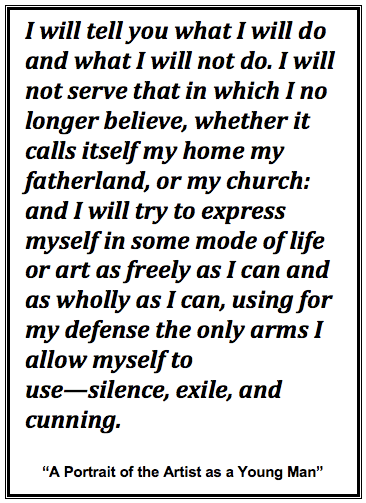
The upshot is that Stephen turns the rebellious slogan of Lucifer, in turning against God, ‘I will not serve’, into his own motto in rejecting the demands of home, fatherland, and Church, and dedicating himself to the task of expressing himself freely as an artist.
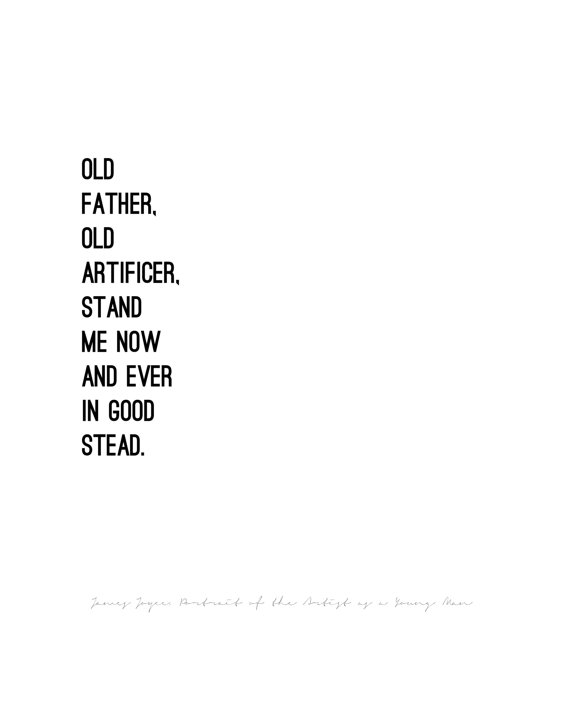
The decision takes shape in his mind in association with thoughts of the career of his mythical ‘ancestor, Daedalus, who found escape in flight from imprisonment in a labyrinth. Stephen has often trod the maze of Dublin streets seeking escape of one kind or another, whether in the confessional or the brothel. Only when he crosses the bridge to Bull Island and stares out to sea does he glimpse the vision of true fulfilment. He cannot find this fulfilment without flight. His mother prays, he says, that, ‘I may learn in my own life and away from home and friends what the heart is and what it feels.’ So he sets out, ‘to encounter for the millionth time the reality of experience and to forge in the smithy of my soul the uncreated conscience of my race.’ His final prayer is not directed to God but to his role model, Daedalus. He prays: ‘Old father, old artificer, stand me now and ever in good stead.’
In 1904 the magazine DANA made an important contribution to world literature by rejecting a short story by a then-unknown Irishman called James Joyce. Joyce sought the advice of George Russell (AE), who suggested that he should rewrite it as a novel. Joyce took his advice so seriously that he eventually produced a huge work of fiction which he titled Stephen Hero. This book was never published during his lifetime; most of it was destroyed by its dissatisfied author who decided to try again, reworking and reducing the material into five chapters. Twenty publishers rejected this new version before it finally appeared in 1916. Joyce gave his first novel the same title as that of the rejected short story: A Portrait of the Artist as a Young Man. In 1944 three years after his death, the surviving fragment of the original novel was published as Stephen Hero.
Brief Bio of James Joyce
Since A Portrait of the Artist as a Young Man is largely autobiographical, it is worth knowing something of the life and works of its author. James Joyce was born in Dublin in 1882, the eldest of eleven children. His father, John Joyce, came from a wealthy Cork family and had inherited a small private income. He was an ardent admirer of Charles Stewart Parnell, for whom he had worked as an election agent. He was rewarded with the post of Tax Collector in Dublin, a lucrative position which allowed him and his growing family to live in considerable comfort and send his eldest son to Clongowes College. However, his fecklessness, his extravagance and his fondness for drink cost him his job and reduced his family to poverty. James was withdrawn from Clongowes and sent to Belvedere College, also run by the Jesuits. He proved a hard-working student, winning a number of scholarships, which in a manner typical of his father he squandered on expensive family outings.
From 1898 to 1902 Joyce was a student at University College Dublin, then run by the Jesuit order. When he graduated with a degree in languages he decided to continue studying as a medical student. However, unhappy at UCD, he went to Paris but returned to Ireland when he received news of his mother’s imminent death. To provide himself with a livelihood he took up a teaching post.
Then he met Nora Barnacle and his life was transformed. He persuaded her to elope with him to Trieste where he worked as a teacher of languages. There his children, Giorgio and Lucia, were born. His brother, Stanislaus, joined them in 1905, giving Joyce invaluable financial and moral support.
Joyce returned to Dublin on two occasions. On his first visit, he tried to set up the first cinema in Ireland, but the project failed. In 1914 he came home again to publish Dubliners, but once again his trip was in vain. Bitterly disappointed at his treatment, Joyce vowed never to set foot in his native land again. He was true to his word.
In 1914 Joyce took his family to Zurich, remaining there for the duration of the Great War. He then returned to Trieste but soon left for Paris, where he was to live until the Second World War forced him to move back to safety in neutral Zurich.
Meanwhile, in 1916 Dubliners was finally published, followed soon afterwards by A Portrait of the Artist as a Young Man. Then on his fortieth birthday, his masterpiece, Ulysses, appeared, and almost immediately established his reputation as the foremost writer of his time.
Joyce’s great success as an author was marred by personal tragedy. His daughter Lucia’s mental health deteriorated to the point where Joyce could not care for her himself and had to have her committed to an institution. In 1931 his father died. All this time his eyesight was weakening, and though he underwent many painful operations, his sight continued to fail until he was almost blind. Having returned to Zurich on the outbreak of the Second World War he continued to write, working on his great experimental novel Finnegan’s Wake. His health continued to decline and he eventually died on 13th January 1941 of a perforated ulcer.
A Note on the Structure of the Novel
The novel, A Portrait of the Artist as a Young Man is a carefully constructed novel divided into five chapters or episodes. Each of these sections deals with an important stage in the development of the hero, Stephen Dedalus, from early childhood to adulthood.
In Chapter One we meet Stephen as a baby-talking infant. We learn of his first years in Clongowes College, where he is unjustly caned by Father Dolan. An important event is the Christmas dinner, during which a bitter argument between Dante and Mr Casey reflects the troubled state of Ireland after the Parnell Split.
In Chapter Two, Stephen’s family suffers a decline in living standards due to Mr Dedalus’ feckless ways and is forced to move from Bray to Blackrock. Young Stephen is taken out of Clongowes and sent to Belvedere College. Important incidents are the encounter with Emma Cleary, the school play, and Stephen’s visit to Cork with his father, Simon. This chapter ends with Stephen’s sexual awakening as seen in the episode with the prostitute.
Chapter Three is largely concerned with religion. Filled with sexual guilt, Stephen listens to the famous sermon on Hell. He resolves to end his sinful life and seeks grace through confession and self-mortification. As a result, he achieves peace of mind and inner calm.
Chapter Four sees Stephen invited to become a Jesuit when his piety is noticed by his teachers. He rejects the call, opting instead for Art. This turning away from religion and back to the world is symbolised by the girl on the beach at the end of this section.
In Chapter Five, Stephen is now a student at University College Dublin. Through his discussions with fellow students, we discover his rejection of nationalism and the nationalistic art that was then in vogue. He expounds for us his theory of aesthetics. The novel ends with his defiant refusal to serve God or country. Instead, he will seek through exile to find the freedom he needs to create his own art.
Major Themes in the Novel
Joyce’s first novel is concerned to show the stages in the development of the artist. We are presented with the hero Stephen Dedalus first as a child, then as a schoolboy, later as a devout Catholic, and finally as a university student. Family, teachers, sex, religion, and country, forge fetters for the would-be artist; to create he must break free and become his own person. This he achieves in the end with his famous declaration: “Non serviam” (I shall not serve), thereby turning his back on his family, his country, and his religion to devote himself totally to his new religion of Art.
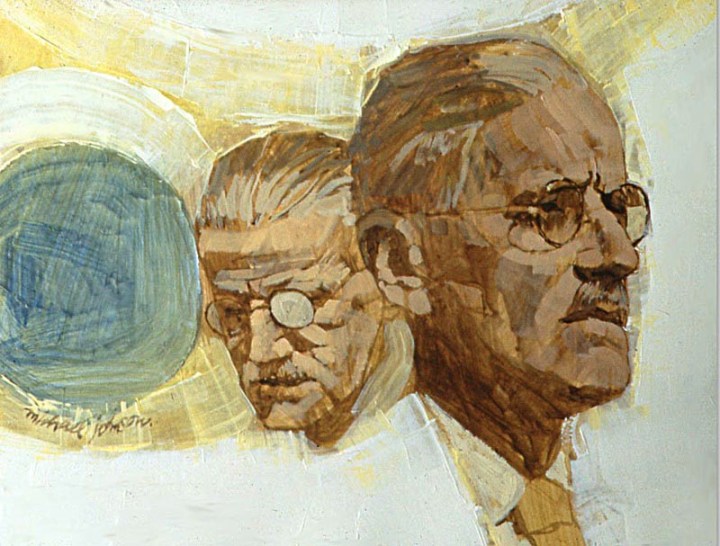
Johnston 21 – Double Portrait of James Joyce
Style and Technique in A Portrait of the Artist as a Young Man
A Portrait of the Artist as a Young Man is a naturalistic novel narrated by an invisible author who remains aloof and apparently removed from his tale. However, the viewpoint through which we see things is clearly Stephen’s. This not only makes him the focus of our attention but it also invites us to sympathise with him throughout. The language is also used to reflect Stephen’s central role and importance. Thus in the opening chapter, we read the prattle of childhood as the infant Stephen tries to come to terms with his surroundings. Later the schoolboy slang reveals his perceptions of life in a boarding school. At all times the language is suited to whatever stage Stephen is then at.
Religious symbols and liturgical terms abound in Chapter Three. They also help in the final chapter to elevate the tone and solemnise the young artist’s preoccupation with aesthetics at that stage. Even though Joyce is at great pains to reject his Catholic faith he displays here a deep appreciation of Catholic rituals. His friend Cranley points out this apparent inconsistency:
It is a curious thing, do you know, how your mind is supersaturated with the religion in which you say you disbelieve.
This accusation, which could also be levelled at many other Irish novelists, is very relevant. They, including James Joyce, seem determined to reject Catholicism because it seems at variance with their artistic imagination. Yet, as Eamon Maher states ‘they cannot avoid being ‘supersaturated’ with its vestiges’.[1]
Symbols, including religious ones, are important to Joyce as a method of heightening his themes and maintaining links throughout the narrative. For example, Stephen’s name reminds us of St. Stephen, the first Christian martyr, and the significance of this is seen in the young man’s willingness to sacrifice all for the sake of his art. His surname, Dedalus, evokes the labyrinth-maker, the inventor, the flier who dared to aspire too high. Other symbols used by Joyce in this novel are water, representing death, cleansing and renewal; the Church as mother; Ireland as the ‘sow that eats her farrow’.
To create a real and convincing background for Stephen, there is a painstaking attention to detail. Names of actual places are numerous in the text, e.g. Clongowes, Belvedere, Lower Mount Street. Real people are also introduced, such as Parnell, and Michael Davitt, W.S. Gilbert. The squalor of Stephen’s home life is vividly captured in Joyce’s description of the meal table. He is not content just to appeal to our sense of sight. We hear the sound of cricket balls hitting bats in Clongowes; we smell horse’s urine, and while we listen to the sermon on Hell in Chapter Three we feel the horrific torments of the Damned.
Walter Pater, the author of Renaissance, who had such an enormous influence on Oscar Wilde and the Aesthetic Movement, also affected Joyce in his attitude to Art. Pater and the followers of the Aesthetic Movement believed that art should be of paramount importance. That Joyce was especially sympathetic to this view is most apparent in the final section of the novel. Another writer much admired by Joyce was Cardinal Newman, the founder of University College Dublin whose style he sought to emulate.
A Detailed Analysis of a Sample Passage from the Novel
“He looked northward to Howth. The sea had fallen below the line of seawrack on the shallow side of the breakwater and already the tide was running out fast along the foreshore. Already one long oval bank of sand lay warm and dry amid the wavelets. Here and there warm isles of sand gleamed above the shallow tides and about the isles and around the long bank and amid the shallow currents of the bridge were lightclad figures, waving and delving.
In a few moments he was barefoot, his stockings folded in his pockets, and his canvas shoes dangling by their knotted laces over his shoulders and picking a pointed salteaten stick out of the jetsam among the rocks, he clambered down the slope of the breakwater.
There was a long rivulet in the strand and as he waded slowly up its course, he wondered at the endless drift of seaweed. Emerald and black and russet and olive, it moved beneath the current, swaying and turning. The water of the rivulet was dark with endless drift and mirrored the highdrifting clouds.
The clouds were drifting above him silently and silently the seatangle was drifting below him; and the grey warm air was still: and a new wild life was singing in his veins.”
Commentary:
This fine piece of writing, which occurs at a crucial point towards the end of Chapter Four, illustrates many of the features of Joyce’s writing style.
Firstly, we notice his attention to detail; e.g.: ‘the pointed salteaten stick’. The word ‘salteaten’, like ‘jetsam’, ‘lightclad’, ‘seatangle’ shows the author’s fondness for coining new words.
Secondly, we view the scene through Stephen’s eyes, and so his feelings as he observes the seascape are subtly revealed, while the narrator himself remains invisible and aloof.
Repetition is another device to concentrate our minds and create connections in the writing. Notice how often we meet the words ‘warm’, ‘silently’, ‘clouds’ and ‘drifting’.
Symbolism is everywhere. The clouds are the difficulties of the past, now seen drifting away; the rivulet is a new life beginning; the sky is the greatness the young artist seeks and aspires to, as well as being associated in our minds with Dedalus.
There is also a sense throughout the piece that we are building towards a climax. The feelings of Stephen are conveyed by words like ‘warm and dry’, ‘new wild life’ and ‘singing’. The final mood is one of joyous freedom.
Sound is also important, as we would quickly realise were we to read the passage aloud. Its lyricism is enhanced by alliteration (‘salteaten stick’) and assonance (‘wild life’). Stephen has arrived at a crucial moment in his life. His decision not to become a Jesuit has just been made, and now he sees his future as an artist calling him like a vocation. It is the turning of the tide for him. He is exhilarated by the prospects ahead: he has now freed himself from the restraints of family, country, and religion. That is why he feels ‘a new wild life was singing in his veins’.
CONCLUSION
Having completed A Portrait of the Artist as a Young Man, Joyce too had arrived at a new stage in his development. He was now forever finished with conventional fiction. Already his mind was preoccupied with the book that was to become his great masterpiece. Ulysses was about to be born, and with its birth, the young exile from Dublin would be hailed as the greatest novelist of the century and one of the greatest innovators of all time.
However, Stephen Dedalus had survived and it is the same Stephen we meet on the first page of Ulysses. However, he is not the hero this time; that role is reserved for Leopold Bloom, but Stephen is second only in importance to him. Thus Joyce links together two of the finest works of fiction ever written. The hero of the rejected short story lived on in the imagination of his creator for more than twenty years to become one of the best known and most written about characters of all time.
[1] Eamon Maher writing in The Ticket in The Irish Times, ‘The half-life and death of the Irish Catholic novel’, Saturday, December 23rd, 2017.
You might also like to read a more detailed character sketch of Stephenhere



 Reviews Rants and Rambles
You must be logged in to post a comment.