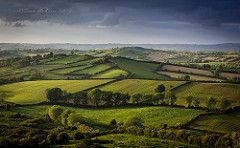
Amongst Women by John McGahern

McGahern (1)

AMONGST WOMEN

 John McGahern

 About John McGahern (1934 – 2006)

One of Ireland’s most widely read authors John McGahern was born on November 12th, 1934.  The family lived in Leitrim until his mother’s death in 1945, when they moved to their father’s home at the police barracks in Cootehall, County Roscommon.  In his early twenties McGahern worked as a teacher and wrote an unpublished novel, The End and the Beginning of Love.  His first published novel, The Barracks (1963), won the AE Memorial Award and earned him an Arts Council Macauley Fellowship.  His next novel, The Dark (1965), was widely praised and drew comparisons to James Joyce, but it also offended the Archbishop of Dublin and the state censor, who banned the book and he was also sacked from his teaching position.

He refused, however, to capitalise on this notoriety, instead continuing to publish quietly.  Three novels followed – The Leavetaking (1974), The Pornographer (1979), and Amongst Women (1990; winner of the Irish Times Award and short-listed for the Booker Prize).  McGahern’s four volumes of short stories were published in The Collected Stories in 1992.

His final novel That They May Face the Rising Sun (published in the United States as By the Lake) is an elegiac portrait of a year in the life of a rural lakeside community. McGahern himself lived on a lakeshore and drew on his own experiences whilst writing the book. Lyrically written, it explores the meaning in prosaic lives. He claimed that “the ordinary fascinates me” and “the ordinary is the most precious thing in life”.  The main characters have – just like McGahern and his second wife, Madeline Green – returned from London to live on a farm. Most of the violence of the father-figure has disappeared now, and life in the country seems much more relaxed and prosperous than in The Dark or Amongst Women.

During his writing career, he served as a visiting professor at Colgate University and the University of Victoria, British Columbia, and he was writer-in-residence at Trinity College, Dublin in 1989.  He died from cancer in the Mater Hospital in Dublin on 30 March 2006, aged 71. He is buried in St Patrick’s Church Aughawillan alongside his mother.
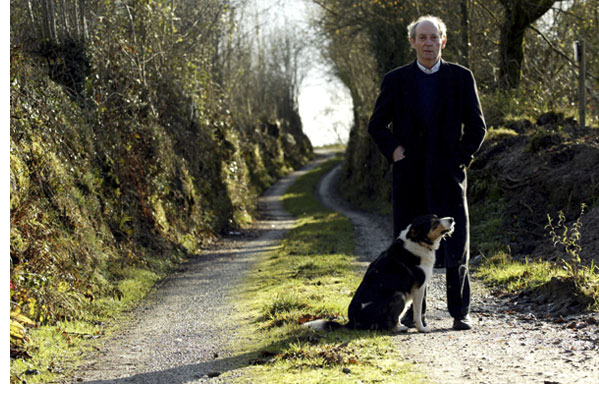
 McGahern (3)

Historical and Literary Background

This novel is set in Ireland in the years following the Irish War of Independence.  We hear references to reviving Monaghan Day, which is obviously a tradition of the time.  The story is set in the country and outlines the position of the family of the time.  It may be worth mentioning that Patrick Kavanagh’s The Great Hunger was written about rural life in Ireland about this time also.  Are there any similarities between Moran and the character of Paddy Maguire?

During these years, post War of Independence and pre World War II, McGahern tells us family bonds were strong.  The Moran family is united, in spite of their father’s erratic temperament.  Luke is the only exception to this happy picture of family solidarity.

Women married securely in this society.  Secure jobs such as the civil service were recommended.  Study at the university was not financially possible for Sheila.  The profession of doctor is also not acceptable within this family because the doctors had emerged as the bigwigs in the country that Moran had fought for during the war.

We also see the faithful practice of the rosary.  This is a prayer that is said by the family every night.  Moran makes use of this to assert his dominance over the family while refusing to face his own shortcomings.

One of Moran’s big fears is being poor.  For this reason he is miserly with money and even though he eventually gets two pensions he still exerts a tight control over the finances.  He also takes pride in the land he owns.  He uses the land as a refuge, many times escaping from the house to work furiously at hay-making or reaping whenever he loses control of himself.

At the end, on his death, Moran is given the typical Republican burial with the tricolour draped over his coffin. (Check the front cover of the novel!)
John-McGahern (4)
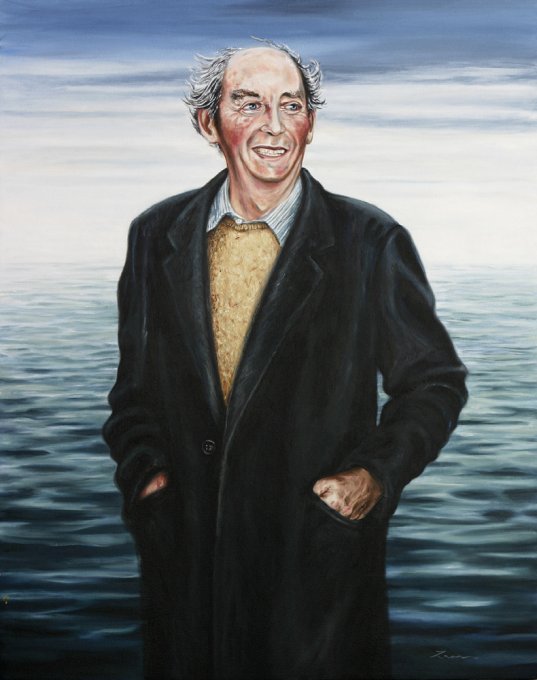
Dr. John McGahern by Zaan Claassens

THE STORY

The story is based on the Moran family who live in Mohill, Co. Leitrim.  The house is called Great Meadow.  The story is told in flashback and is framed at beginning and end with Moran in a depressed state and wishing for death.  Moran is an old Republican who was a guerrilla leader in the War of Independence.  His wife is dead and he is left to bring up their five children; three girls and two boys.  Luke is the oldest and he has gone to work in London because he will not tolerate his father’s violent behaviour.  Moran can never forget the authority he wielded during the war and tries to behave in the same way within his household.  He continually uses the rosary to regain control and power over his family.  Moran marries a girl called Rose Brady when he is beginning to get old.  Initially Rose is very idealistic about the marriage, but she soon discovers the true nature of Moran and his capacity for violence and dark moods.

Rose is a very selfless person who clearly loves Moran in spite of his strong character and difficult temperament.  She encourages the girls to become independent and achieve the best they can in life.  Maggie settles in London and eventually marries, as does Sheila.  Mona gets a good job in the civil service and remains single.  Michael, the youngest, leaves and marries.  Luke’s refusal to return to Great Meadow, the family home, frustrates and angers Moran greatly.  All the rest of the family visit him regularly in spite of the fact that he has been domineering and violent.  They are all happy together and have learned to accept Moran’s peculiar temperament.  Moran dies at the conclusion.  Everyone except Luke turns up at his funeral and acclaim him as a truly great and heroic man

McGahern (2)

 LITERARY GENRE

This is a novel of social realism, which is written in the third person omniscient narrative voice.  It can, therefore, be classed as a social document that is set in Ireland in the period following the War of Independence.  There are no official chapters; the narrative is broken into sections separated by a short space.  Much of the story is told through dialogue, which gives a vivid insight into the various characters.   The first section is written towards the conclusion of the story when Moran becomes sick.  The rest of the story gives an extended account in flashback about the life of the Moran family in Great Meadow.

There is a great similarity between Amongst Women and William Shakespeare’s great tragedy, King Lear.  By insisting that each of his daughters proclaim her love for him to win her share of his kingdom, Lear sets in motion a plot that reveals the complex dynamic at work among an elderly patriarch and his three daughters.  Like King Lear, Amongst Women investigates the love between a father and his children, the struggle to maintain strength in advancing age, and the difficulty of negotiating between independence and an identity tied to family roots.
mcgahern (5)

THEMES AND ISSUES

There are a number of themes and issues raised in the novel.  The main themes dealt with here are:

  • Power/Control/Patriarchy
  • The Family
  • The Role of Women

Power/Control/Patriarchy

Moran has been a guerrilla fighter in the War of Independence.  He never got used to the failure of that war, and so he tries all his life to master his family and dominate them.  It is only when he feels he is in control and the centre of things that he can manage to deal with issues in life.  Much of his power is achieved through violence and physical abuse.  He also uses the rosary as a weapon to establish his control in the house.  When he marries Rose Brady things change slowly but subtly.  He verbally abuses her several times but her firm reaction chastens him and shows him the need for self-control.  When there are difficulties with young Michael who begins to drink and womanise, Moran threatens to use physical violence to control him, as he had once done with Luke.  Michael runs away to England and gets a job.  Moran is left on his own with Rose and simply becomes more introverted and depressed.  As an old man he loses the ability to exert control through his mood swings and violence.  He changes and writes a letter of apology to his oldest son Luke who has left him a long time ago.

***

 Amongst Women can be seen as a critique of patriarchy.  McGahern connects nationalism, Catholicism and patriarchy in an unholy trinity.  In the novel McGahern is turning away from the Big House novel, that had played such a big part in earlier Irish fiction, to what might be termed the small house novel, portraying rural Catholic family life.  In the novel death frames the novel, but the intervening narrative is an extended flashback to family life in Great Meadow with Moran bestriding his little kingdom as a crusty, would-be Colossus.  The relationship between him and his wife and children is the principal focus of this plotless novel.  The focus is on scenes in which some or all of the family are assembled and the narrative moves in and out of the consciousness of various members of the group.   In this novel, for the first time in his writing, the subject of patriarchy assumes a central theme.

‘Only women could live with Daddy,’ Moran’s alienated son, Luke, comments, and the novel, to some extent, endorses this viewpoint.  Moran is first encountered ‘amongst women’, an ailing old man fussed over by his wife and three daughters.  The theme of the relationship between power and gender is announced in the opening sentence.  Moran’s physical weakness has transformed relations between him and his womenfolk to one of fear on his part and dominance on theirs.  However, even at his most physically incapacitated, Moran has still not lost his hold over his daughters: he ‘was so implanted in their lives, that they had never left Great Meadow’ (p.1).

The narrative pulse of Amongst Women is one of homecoming and leave-taking: welcomes and farewells at the train station; cars turning in the open gate of Great Meadow under the poisonous yew; children leaving home to embark on their adult lives, all but one drawn back with increasing frequency as the years pass; happy family reunions and the sad final reunion at Moran’s funeral.  Initially the rhythm is homecoming, and the verb ‘come’ is repeated seven times on the first page.  The reader is being drawn into this world where Moran is at the centre.  By the end of the second paragraph we have been introduced to its setting and principal characters: the ‘once powerful’ Moran, his second wife, Rose, his three daughters, Maggie, Mona, and Sheila, his younger son, Michael, and the eldest, Luke, distinguished from the rest by his refusal to come back to Great Meadow.

Patriarchy in Amongst Women can be seen to derive to a great extent from patriotism.  Moran is the hero of the War of Independence, who has failed to make a successful career in the Irish army in peacetime, directs his frustrated drive for power into a diminished form of home rule.  His status as a former guerrilla fighter is repeatedly emphasised at the outset by the device of juxtaposing two episodes which celebrate his youthful exploits as leader of a flying column, thereby ensuring that all his subsequent conduct is ‘placed’ in the light of this wartime experience.  Monaghan Day, a fair day in late February when he received an annual visit from McQuaid, his former lieutenant, and the two reminisced over their youthful heroics, is Moran’s equivalent of Remembrance Day.  The novel opens with his daughters’ revival of Monaghan Day when Moran is old and ill.  On this occasion he deglamourises his role as freedom fighter and refers to his flying column as ‘a bunch of killers’ (p.5).  That he has never lost his own killer instinct is demonstrated next morning when he rises from his sickbed to shoot a jackdaw.  His targets may have diminished, but he is still prepared to resort to violence to assert his limited power.  The incident rather pathetically demonstrates his present impotence, yet he himself uses it to illustrate his connection between intimacy and mastery:

The closest I ever got to any man was when I had him in the sights of my rifle and I never missed. (p.7)

Moran is at pains to tell his wife and daughters that his flying column did not shoot women or children, treating both categories as minors or inferiors.

Beginning on P. 8 we are given another flashback to the last Monaghan Day.  In this episode Moran’s bullying of his teenage daughters is contrasted with his inability to gain power over McQuaid.  He terrorises his daughters, so that in his presence they ‘sink into a beseeching drabness, cower as close to being invisible’ (p.8) as possible, but it is obvious now that his power does not extend outside his own family.  McQuaid, who has long outstripped Moran in terms of worldly achievement, is happy to indulge in war memories for an evening, but he is unwilling to perpetuate his former role of junior officer.  His visit brings something of the secular, commercial outlook of modern Ireland into the pious, traditional world of Great Meadow.  Here again the rhythms of arrival and departure are evident as the annual ritual of Monaghan Day is brought to an end with McQuaid’s abrupt exit.  Henceforth, the cars that turn ‘into the open gate under the yew tree’ will convey returning Morans.  From here on Great Meadow becomes a house hospitable only to its own family.

As has been said already, Amongst Women offers a penetrating critique of patriarchy.  McGahern goes even further and shows that patriarchy as a refuge of the socially ill-adjusted and emotionally immature man and asks probing questions about the cult of family.  Moran has transformed his inadequacies into a show of strength by making his home his castle.  Denied a role as founding father in the Irish state he sets up his own dominion.  Actually, Great Meadow, bought with his redundancy pay from the army, should be a monument to Moran’s failure to live up to his youthful promise.  Though it is not an ancestral home it becomes, under his regime, a family seat, more cut off from the life of the surrounding village than any Big House.  Because of an inability to relate to his fellow-villagers, Moran turns his family into a closed community and the absence of any outside contacts further strengthens his own paternal supremacy.  He successfully indoctrinates his children with the idea that such reclusiveness denotes exclusiveness, that to be ‘proud’ and ‘separate’ is a mark of distinction, to be friendly and extroverted a sign of commonness.  House and family are connected in exhortations to his daughters: ‘Be careful never to do anything to let yourselves or the house down.’ (p. 82).  He thus forges an association between family and farmstead, roots his children in a ‘perpetual place’.  As the founder of a new dynasty Moran acts as if he were self-propagated and never refers to his own parents.  His cult of family does not include any filial loyalties which might conflict with the prior claim of being a Moran of Great Meadow, so he actively discourages his wife’s visits to her family home.

Moran’s family is an extension, a ‘larger version’ of himself.  When he promotes the values of home and family he is obliquely bolstering his own self-importance.  The ‘good of the family’ provides him with a virtuous, unselfish motivation for suiting himself.  When he is about to remarry, for instance, he tells his daughter Maggie that he is doing so in the best interests of the family, though it has just been revealed to the reader that his only motive is his own future welfare.  He also repeatedly stresses that all his children are equal, further emphasising his own unique superiority.  The ex-officer promotes esprit de corps, though his theatre of operations is a hayfield and not a battlefield: ‘Together we can do anything.’  Such affirmation of solidarity and de-emphasising of individual differences serve to bind the family into ‘something very close to a single presence.’

In view of the novel’s critique of patriarchy it is interesting to note the effect this has on his daughters at the end of the novel.  Turning the page at the end of the novel, we are given a glimpse of what ‘becoming Daddy’ means.  A reversal of gender roles takes place as brother and husbands, seen from a patriarchal perspective, are transformed into wives.  It is obvious that Moran’s honorary male daughters have inherited his contempt for the feminine, which they associate with levity and amusement:

‘Will you look at the men.  They’re more like a crowd of women,’ Sheila said, remarking on the slow frivolity of their pace.  ‘The way Michael, the skit, is getting Sean and Mark to laugh you’d think they were coming from a dance’ (p. 184)

Their exclusiveness as Morans of Great Meadow is such that it does not even embrace their own husbands and children.

It is also worthwhile to consider here the links between Catholicism and patriarchy.  These links are forged in the novel by its most repetitive narrative ritual and the family prayer from which it derives its title.  Moran’s devotion to the rosary is explained on familial and patriarchal grounds.  ‘The family that prays together stays together,’ he observes, quoting the Rosary-crusader priest, Father Peyton.  As in many Irish homes, (in the past?)  the rosary in the Moran household is a public prayer that reinforces a hierarchical social structure: it is presided over by the head of the family and the five decades are allocated from eldest to youngest in descending order of importance.  Though the rosary repeatedly pronounces Mary as ‘Blessed … amongst women’,  because she was chosen to be the mother of Christ, in the Moran household, the character, blessed amongst women, is Moran himself.  He even manages to die ‘amongst women’, since his son Michael is temporarily absent!  The Rosary is peculiarly identified with Moran and it is a very clever device used by McGahern to emphasise the narrative repetitiveness, which is a feature of this novel.  Over and over again the newspapers are spread on the floor, Moran spills his beads from his little black purse, and all kneel in prayer.  The stability conferred by ritual and repeated phraseology underscores the disruptions and changes that the passage of time brings to Great Meadow.

Yet we should not be over negative in our assessment of Moran and his little kingdom.  He does exhibit some inherent attractive qualities.  Indeed his portrait is the most imaginatively generous picture of a father in McGahern’s many novels and short stories.  He radiates enormous energy and this surely can be seen as a redeeming feature.  He also shows great anguish for the son who is lost to him and he also shows a certain bafflement and frustration in the face of oncoming death.  In particular he is associated with the annual haymaking, an activity shared by the whole family.  From distant London or Dublin, Great Meadow in summer appears a therapeutic, pastoral world: ‘The remembered light on the empty hayfields would grow magical, the green shade of the beeches would give out a delicious coolness as they tasted again the sardines between slices of bread: when they were away the house would become the summer light and shade above their whole lives’ (p.85).  Such memories turn Moran’s children into true Romantics, sustained ‘amid the din of town and cities’ by images of their fatherland.

Therefore, McGahern manages to balance the attractive and the repellent aspects of patriarchy in this novel.  The glorious revolution that brought about the Irish State is so remote by the time of Moran’s death that the fellow revolutionary who tends to the faded tricolour on the coffin seems as old as Fionn or Oisín.  Nevertheless, the legacy of the War of Independence, seen by some as a triumphalist, masculine ethic of dominance, has been passed on to the next generation.

Irish people everywhere seem to have an often inexplicable affection for their country, whether they be urban, suburban, rural or living in Boston.  This love for ‘the ould sod’ is turned on its head here in this novel in McGahern’s examination of home, farm and fatherland.  Idyllic though Great Meadow often appears, access to it involves passing under ‘the poisonous yew.’

The Family

In Amongst Women we see the powerful bond of the family and how it can withstand so many difficulties.  Even though Moran is stubborn and mercurial in temperament, the family remain strongly bound together.  Together they feel invincible in the face of the outside world, and when they gather together at Great Meadow, each member feels bound by this strong family unit.

 The novel pulls us into a tight family circle with its first sentence – ‘As he weakened, Moran became afraid of his daughters’ (p.1).  A ‘once powerful man’ (p.1), Michael Moran was an officer in the Irish War of Independence in the 1920’s.  He was intelligent, fierce and deadly, but like many soldiers after a war, he felt displaced, unwilling to continue in the military during peacetime and unable to make a good living in any other way.  ‘The war was the best part of our lives,’ Moran asserts.  ‘Things were never so simple and clear again’ (p.6).  While the army provided the security of structure, rules, and clear lines of power, Moran’s life after the war has consisted of raising two sons and three daughters on a farm and scraping out a living with hard manual labour.  A widower, Moran confuses his identity with the communal identity of his family in a gesture that divides and conquers.  Moran’s daughters are ‘a completed world’ separate from ‘the tides of Dublin and London’ (p.2).  As such, he can control them, as when he discourages one from accepting a university scholarship.  No longer powerful, Moran is repeatedly described as withdrawing into himself ‘and that larger self of family’ (p.12) in order to channel his aggressions into a shrunken realm he attempts to control.  He can be tender with his children, but he also berates and beats them.  His adjustment from guerrilla fighter to father is never complete, and the question of how to maintain authority over children while allowing them room to grow is central to the novel.

Nowhere is this struggle between dependence and independence more pronounced than in the character of Luke, the oldest son who runs away from Moran’s overbearing authority, never to return.  Rejecting his father, Ireland, and all of the violence and provincialism he associates with both, Luke flees to England.  He ignores all but one of Moran’s many letters, and he doesn’t return to Ireland except at the end of the novel when his sister gets married.  ‘Please don’t do anything to upset Daddy,’ one of the sisters pleads, typically trying to placate her father.  ‘Of course not I won’t exist today,’ Luke replies (p.152).  His best weapon against Moran’s control is absence.  Whereas the daughters, ‘like a shoal of fish moving within a net’ (p.79), find individuality painful compared to the protection of their familial identity, Luke gains strength in departure.  ‘I left Ireland a long time ago’ (p.155), Luke announces gravely.  As it does for Stephen Dedalus in James Joyce’s A Portrait of the Artist as a Young Man, life in Ireland seems like imprisonment.

‘I’m afraid we might all die in Ireland if we don’t get out fast’ (p.155-156), says Moran’s younger son, Michael.  Like other Irish writers, McGahern asks whether exile offers the only hope for freedom and individuality.  How does the political turmoil which has long suffused Irish history affect the smaller unit of the family?  How do other elements of Irish life contribute to familial dysfunction?  In the claustrophobic world McGahern portrays, escape proves sustaining for a character like Luke, but it is not an unequivocal good.  Luke is strong but cruel like his father.  His sisters, on the other hand, not only fail to break away from the family, but by the time of their father’s death, ‘each of them in their different ways had become Daddy’ (p.183).  Their identification with and loyalty to Moran threatens to subsume them, but it also gives them a kind of strength, as Michael seems to understand: ‘In the frail way that people assembled themselves he, like the girls, looked to Great Meadow for recognition, for a mark of his continuing existence’ (p.147).

The Role of Women

(This theme has obviously to be examined in the light of what has already been said about Patriarchy.)

With the exception of Moran and his young son Michael, this story centres on many women characters.  Rose Brady is the main character who makes life bearable for everyone in Great Meadow.  At every stage she is deeply loyal to Moran and never allows herself to criticise him or his fickle actions in front of  the others.  She loves him deeply and when he treats her badly she is quick to assert her rights.  She does this in a quiet but strong way.  She becomes a strong moral power in the house, and through this strength she manages to control Moran and get him to change his bad temperament subtly.

When Moran marries Rose it is obvious that he never intended a marriage of equals.  She is to serve as a loyal and devoted second in command and at some future date, when his children have departed, to become his sole subordinate.  Rose, a woman in her late thirties at the time of her marriage, is ideally suited to the role of compliant wife and surrogate mother.  Her previous profession has been that of valued servant: a children’s nursemaid, and the valet her former master would have chosen had his wife permitted it.  She has acquired the social skills that please employers, learned to indulge their whims.  That she is good at ironing takes on a metaphorical significance, since she has spent much of her married life ‘smoothing’ out household difficulties.  She is attracted by Moran’s aloofness and, ironically, she sees marriage as an opportunity to become mistress of her own establishment.  For all his local notoriety as a strategist in the war, Moran doesn’t seem to be able to exercise much control in the matter of his marriage.  He is continually out-manoeuvred by Rose, who mounts a shrewd, tactical campaign to get her way when he would prefer to retreat or delay.

Once married, Rose proves to be an angel of the house: a kind, caring, capable homemaker, whose warmth and good humour contrast sharply with Moran’s sudden rages and unpredictable mood swings.  Her genuine interest in each child’s welfare contrasts with Moran’s inability to value his children’s individual identity and autonomy.  However, it must be said that Rose colludes in perpetuating Moran’s patriarchal regime.  She is unfailingly loyal to him and she refuses to entertain his children’s criticism of his petulant behaviour.  In his children’s presence she always refers to Moran as ‘Daddy’, the title by which he himself insists that they address him.

Rose’s strategy is to become indispensable to the household.  The tea-ceremony on her first evening is very revealing of the future status quo.  She takes on the role of a kind of superior servant, co-opting the girls as helpers, and humouring her disgruntled husband by treating him ‘like a lord’:

Rose and the girls smiled as the tea and the plates circled around him.  They were already conspirators.  They were mastered and yet they were controlling together what they were mastered by. (p.46)

Later on this is viewed in a more negative way:

Then, like a shoal of fish moving within a net, Rose and the girls started to clear the table. (p. 79)

Here the women are seen as victims, trapped in the tense atmosphere which Moran generates.  A shift in power relations has occurred and Rose is no longer in control.  Her status is now equal with that of Moran’s children.

The power struggle between Rose and her husband centres on two episodes.  In the first he is compelled to apologise and she is rewarded with a mini-honeymoon, but she has been made aware of his ‘darkness’ and decides to concentrate her strategy on diverting his attacks – cutting him off at the pass, so to speak.  In the second episode he embarks on a prolonged campaign to crush her and she attempts to conciliate and pacify him, until she discovers that she can ‘give up no more ground and live’ (p.71).  Her tactic now is to threaten to leave him, a shrewd stroke; since she knows that Moran is already obsessed with Luke’s departure.  This power struggle between the two is several times alluded to in military terms.  It is a ‘hidden battle’ from which she, apparently, emerges victorious, her objective having been to ensure her ‘place in the house could never be attacked or threatened again’ (p73).  What she has settled for, however, is the limited right to be treated like a member of Moran’s family, to swim like a fish in his net.

Moran’s daughters adapt to life by avoiding confrontation.  Indeed, there seem to be very limited options in counteracting Moran’s dominance.  Compliance, continual confrontation, or departure are the three choices facing Moran’s household.   The strategy of the womenfolk, at least, is to ‘slip away’ or try to appear invisible.  Such evasion is a tactical manoeuvre, a recognition of their own defencelessness.  Beneath their cringing exterior, Mona and Sheila each conceals a forceful character.  Mona is ‘unnaturally acquiescent’, ‘full of hidden violence’; Sheila, even as a young child, knows better than ‘to challenge authority on poor ground’.  They bide their time until their jobs in the Civil Service set them free from Moran’s daily oppression, though Sheila comes near to confrontation before surrendering her opportunity to attend university.  They show their attitude to parental domination in their advice to Michael, to make the best of it until he has finished school and is in a position to choose a career of his own.

In view of their unhappy childhood why do Moran’s children, with the exception of Luke, turn Great Meadow into a place of pilgrimage and their father into a cult figure?  What McGahern presents in Amongst Women is the charisma of patriarchy, which consists in its exercise of sole and absolute authority, the power to approve or disapprove, endorse or withdraw support, affirm or reject, and thereby, to nurture an emotional dependency.  Though in their last years at home, the Moran children flourish under Rose’s benign dispensation, their primary relationship is with their father.  Because his second marriage does not occur until his daughters are in their teens, Rose’s advent does not alter Moran’s status as a dominant single parent, the permanent emotional focus of their lives.  They never allude to their dead mother, and the novel ignores the ‘umbilical debt’, according her no influence whatever on their upbringing.

A large part of the fascination the handsome Moran holds for Rose and for his daughters is sexual.  Rose loves him; his daughters also experience an ‘oedipal’ attachment.  He is their ‘first man’.  He looks on their husbands and male friends as rivals and is content when these prove ‘no threat’ to his primal place in their affections.  Neither Maggie nor Sheila marry dominant men, and Mona resists marriage altogether.  Sheila is the only one to violate this ‘incestuous’ relationship with her father when she leaves him in the hayfield to go indoors and makes love to Sean.

As the novel ends the reader’s sympathies are drawn towards the ailing and dying Moran, so that we share the family’s grief at his death.  His corpse is taken to the church on a ‘heartbreakingly lovely May evening’ and buried on a morning when the ‘Plains were bathed in sunshine’ and ‘the unhoused cattle were grazing greedily on the early grass’ (p.182).  The sadness of this final parting from the fertile spring world is rendered all the more poignant by the baffled love Moran experiences for his own land in old age.  He is shown walking it, ‘field by blind field’, ‘like a blind man trying to see’.  In his last month he repeatedly escapes from his sickbed to stare at the beauty of his meadow.  At the end of his life Moran eventually arrives at a deep appreciation of the ‘amazing glory he is part of’ (p.179).  Maybe this final epiphany is the blessing he always craved and was unable to receive, a blessing hinted at in the name Rose?

barrie_cooke
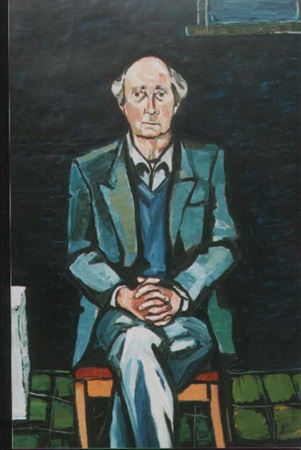
John McGahern, oil on canvas, by Barrie Cooke, 1997/8.

GENERAL VISION AND VIEWPOINT

This is a realistic novel, which traces the history of an Irish rural family in the early twentieth century.  McGahern focuses on one family and one house and we follow the subtle changes that take place in the comings and goings of various members of the family.  He has created a microcosm in Great Meadow from which to view and comment on the changes which have come about after the War of Independence.  Even though there is a timeless quality to the novel and no dates are mentioned we are being asked to pass judgement on the new State that has emerged and was beginning to find its feet under the influence of the 1937 Constitution.  De Valera’s vision of this New Ireland eulogised the role of women as mothers and home-makers and he painted an idealised picture of life in the Irish countryside:

A land whose countryside would be bright with cosy homesteads, whose fields and villages would be joyous with sounds of industry, the romping of sturdy children, the contests of athletic youths, the laughter of comely maidens; whose firesides would be the forums of the wisdom of serene old age.

McGahern in Leitrim and Kavanagh in Monaghan both knew that the realities of life for poor, farm families were radically different from this version offered by de Valera.

McGahern shows  that the power of family bonds to withstand all difficulties is clearly evident throughout every aspect of this story.  At the centre of this story is Moran and his wielding of mesmeric power over his children but it obvious also that Rose Brady is truly the moral centre of the novel.  It is she who silently manages to improve things within the Moran household, and by doing this she controls a good deal of the violence latent in Moran.  It is her undoubted love and loyalty to Moran and her spirit of self-sacrifice in the household, which creates this extraordinary bond of strength which each of the members feel among themselves.

The implication at the conclusion is that Moran’s family is stronger than ever in their love and allegiance to one another.  They truly recognise that Moran played a central part in all their lives.  Their attendance at his funeral strengthens this bond between them even more.  They realise that each one of them, in different ways, has truly imbibed Moran’s beliefs and values.  They remain loyal to his person and beliefs in spite of everything.  Only Luke remains obstinate in his decision not to return home – a reminder that even he has inherited a great deal of stubbornness and pride from his father.

BIBLIOGRAPHY

Sampson, Denis. 1993, Outstaring Nature’s Eye – The Fiction of John McGahern. The Lilliput Press, Dublin.

Quinn, Antoinette. 1991, A Prayer For My Daughters: Patriarchy in Amongst Women in The Canadian Journal of Irish Studies (Special Issue on John McGahern), Volume 17, Number 1, July, 1991
John-McGahern(6)

Read also ‘Close Analysis of John McGahern’s ‘That They May Face the Rising Sun’ here

The Poetry of Dylan Thomas

Dylan-thomas
Dylan Thomas, oil on canvas, by Augustus John, 1938.

THE POETRY OF DYLAN THOMAS

(with particular focus on ‘Fern Hill’ and ‘A Refusal to Mourn’)

Dylan Thomas’s poetry has always attracted diverging views, attracting some readers and repelling others.  In certain ways he is the last of the Romantic poets, and like most poets in that tradition he liked to experiment with words.  He was perhaps the only modern poet to experiment persistently, hence the bewilderment of his audience when his early poems were published in the mid-1930’s.

The poetry of the twentieth century can be divided roughly into two main categories.  There is, first of all, the tradition established by Yeats and Eliot which attempted to comment on and influence major social issues in an effort to bring about reforms.  Yeats’ ‘September 1913’ and Eliot’s ‘The Waste Land’ (1922), are two good examples of this tradition.  Both poets express similar attitudes, namely disgust at the degeneracy of modern life, and both poets advocate a return to past virtues as a means of displacing society’s unpleasant aspects.  For Eliot and Yeats therefore, a significant aspect of a poet’s role was that of social commentator, and with them a tradition was established which continued to be a dominant one throughout the first half of the twentieth century.

The poetry of Dylan Thomas, however, diverges sharply from this tradition and to a large extent he remains outside it.  His poems had so little of the realism of Eliot and Yeats that they took the contemporary literary scene by storm.  Being at heart a Romantic poet, Dylan Thomas preferred to write poems that were completely devoid of social issues and unlike Yeats and Eliot he did not feel the urge to reform the world.  Modern poets in general had come through the Great War with a new sense of function and responsibility.  This sense of conviction, of important work to do in a political or social context, is completely lacking in the works of Dylan Thomas.  Indeed, this lack of an urgent poetic content seemed naive to many early readers, particularly at a time when Europe had emerged tragically from one World War, and seemed likely to get entangled in another.  In ‘Fern Hill’, for example, Dylan Thomas describes his memories of childhood in Wales in the years after the Great War.  The picture he creates, however, is so beautiful and idyllic as to be almost unreal.  The real Wales of the time, many early critics suggested, was in sharp contrast to that described in the poem.

Similarly in ‘A Refusal to Mourn’, a poem which describes the death of a child killed in an air-raid, no reference is made to the terrible atrocities of war.  ‘Fern Hill’ was also criticised in other respects.  Besides its lack of serious content there was the more serious charge of a complete lack of meaning.  Indeed, like much of his poetry, ‘Fern Hill’ was strongly criticised as being almost totally obscure.  Thomas himself realised the problem his poetry in general, and ‘Fern Hill’ in particular, presented to readers.  He remarked how his poems were always rigorously compressed, being ‘as tight packed as a mad doctor’s bag’.  The poet and critic Geoffrey Grigson, who published Thomas’s early work in his influential magazine, New Verse, (where he also published W.H. Auden and Louis McNeice), and who recognised Thomas’s promise was one of the first to comment on its obscurity.  He attacked Thomas for his neglect of a continuous line of meaning, for his use of ‘towering phrases’ which imply so much but say very little, and for his tendency to be ‘over-fantastic’ and obscure.

To understand the poetry of Dylan Thomas one must consider him as a modern exponent of the Romantic tradition.  Indeed, it is only in the context of this tradition that one can really characterise his particular method and identify his major themes.  Throughout the first half of the twentieth century Romantic poetry was steadily in decline.  Eliot, in particular, had dismissed all poetry in the Romantic tradition as obsolete and unacceptable in a modern context.  In its stead he substituted a new urban poetry which is so often full of depression, anger and despair (e.g. ‘The Love song of J. Alfred Prufrock’).  Dylan Thomas, however, completely rejected the modern mode of expression, and returned instead to the Romantic poets for his principal themes and his characteristic method.  Whereas Eliot and Yeats describe a world which is often dark and depressing, Dylan Thomas reaffirms a personal faith in life.  His poetry is subsequently filled with a sense of joy and optimism.

Dylan Thomas’s working life as a poet lasted a little over twenty years but the most extraordinary thing about it was how much of the foundations were laid down in a very short period towards the beginning.  He was writing profusely in his early teens and when he was seventeen he began work on some of the poems for which he is still remembered.  Between the years 1931 and 1935 he drafted, and in many cases actually completed, most of his best poems.  In other words he had already created the most important parts of his work by the age of twenty-one.  Despite his basic differences with T.S. Eliot, he adopted Eliot’s habit of rejecting nothing, and lines or sections that were unsustainable or unsuitable for one poem often found their way into another.  Years later he still continued to draw on material from his adolescent notebooks.  Indeed, out of these notebooks and casual jottings grew the most famous poems he published in his lifetime and those for which he is remembered after his untimely death.  He composed by selecting the best expressions from his notebooks, reordering and perfecting them until he was satisfied with their sequence.

‘Fern Hill’ and ‘A Refusal to Mourn’ are typical examples of Dylan Thomas’s poetic method.  Both poems depend on a common Romantic assumption that the natural world is self-explanatory: things die and are born again in a constant process of death and renewal.  We notice, therefore, how nature is often strongly incorporated into his poems.  In a letter dated March 1935 he speaks of how his, ‘pre-conceived symbolism derived from the cosmic significance of nature’.  Thus, both ‘Fern Hill’ and ‘A Refusal to Mourn’ are overlaid with a strong natural imagery.  He is particularly attracted to natural images, which suggest youth and vitality, but we also find him returning constantly to ideas of transience and death.  Indeed, throughout his poetic career he remained haunted by the reality of death, and perhaps his chief contribution to English poetry was his sustained vision that life and death form part of a great process shared by all created things.  Both ‘Fern Hill’ and ‘A Refusal to Mourn’ begin with the assumption that we start to die from the moment we are born, even indeed from the moment we are conceived.  This continuous process of dying extends to all living things.  The entire thought of ‘Fern Hill’ is based on this idea, though it does not become explicit until the final stanza:

                   Oh as I was young and easy in the mercy of his means,

                   Time held me green and dying

                   Though I sang in my chains like the sea.

In ‘A Refusal to Mourn’ the theme of death is seen in a slightly different context as the poet surmises on the probability of another existence.  Here he suggests that the world into which we are born and in which we die is not the final world; that there is another existence on the other side of things.  Again he expresses his ideas through use of comparisons with natural things.  Nature ‘dies’ each year and renews itself with the return of every spring; but for man there is only one death, ‘After the first death there is no other’.  Yet this realisation of the eternal presence of death does not allow the poet to grieve over the dead child, or to encourage false sentiments by a vain display of tears.  This poem is not so much a discussion of the child’s death, as a presentation of Thomas’s attitude to the idea of death in general.  He thinks of death as a slow, relentless process, rather than as a sudden pathetic end to life.  This process of destruction extends to all living things and he sees no reason to mourn when the process is finally completed.

The poem begins with a great statement as befits some good, cosmic occasion.  The first two stanzas, and the first line of the third, are one sentence with the skeleton grammar: ‘Till doomsday I will not mourn for the dead child’.  Darkness is described as making mankind, ‘fathering’ birds etc.. and ‘humbling’ all.  As such it is more than a personification of death: it is unknown, undeveloped nature from which all life comes and to which it will eventually return.  One critic suggests that darkness might also refer to God the Father who is described in the Book of Genesis as making the world out of nothing.  Water is always used in Thomas’s poetry as a fundamental life-giver.  Here it is joined with the reference to corn and behind each is the idea of change and transformation.  Corn was said by St. Paul to die in the ground before it receives the rain whereby it sprouts again.  In this manner it is transformed into a more perfect element.  The general theme of the poem is clear: all people, no less than this young girl, are transformed by death into more perfect states, and the whole process of dying is a natural precondition for this transformation.  Throughout the poem ordinary words are used to suggest mystic processes: ‘The majesty and burning of the child’s death’; ‘The grains beyond age, the dark veins of her mother’.  Behind this poem is the biblical idea of death as a change of life rather than as an end of it.  In the final stanza, therefore, we are given a great image of the relentless continuance of life as the Thames, bearing the young girl’s spirit, flows away to the sea.

In ‘Fern Hill’ the emphasis is on life rather than on death, yet we see how the pervasive presence of nature is a dominant feature of this poem also.  From the beginning of the poem the boy’s experiences are described in terms of natural images and his simple vitality is seen as a gift of nature soon to be withdrawn.  Phrases like ‘all the sun long, all the moon long’, show how the child measured time by nature , not by the clock, and how each day seems a long savouring of experience.  As the poem progresses, however, the facts of time become more insistent and the pathos of transience can no longer be ignored, ‘The children green and golden / Follow him out of grace’; ‘And wake to the farm forever fled from the childless land’.  The lack of grammar in these stanzas makes them appear, as in Chapter 1 of James Joyce’s, Portrait of the Artist, as if part of a dream-like reflection.  This nostalgic emphasis on childhood is yet another dominant feature of Romantic poetry.  In one of his most famous poems Wordsworth wrote that, ‘Heaven lies about us in our infancy’, an idea to which Dylan Thomas also subscribed.

Wonderfully rich in visual imagery, the words of ‘Fern Hill’ combine together in highly original ways to picture the joyful exhilaration of a child.  This can be the cause of some confusion for readers.  Striking phrases like , ‘happy as the grass was green’, ‘prince of the apple-towns’, or ‘at my sky-blue trades’, are surprising by their novelty and at first it is difficult to be sure what effects are intended.  These unusual images are evocative rather than precise: their purpose is to create a strong emotional atmosphere.  Dylan Thomas deliberately uses all his poetic powers to combine in one image a wider range of associations.  Being essentially a Romantic poet, he is trying to communicate an experience, which is almost beyond expression.  In the repetitions, ‘it is lovely’, ‘it is air / And playing lovely, and watery…’, he seems to be straining after an ecstasy which can never be completely expressed in words.  He is celebrating the divine innocence of childhood which, for him, is a mystery almost beyond analysis.

The second stanza reminds us how for a child roaming the countryside, time moves slowly through long mornings of pleasure.  But much more than this is implied.  The noise of water passing over the pebbles is like Church bells calling the boy to worship.  Dylan Thomas is aware of the power of time but instead of becoming melancholy he sees the joy of his childhood as something for which to be thankful, being itself part of the wonder of creation.  Instead of giving way to regrets he rejoices in what has been.  Thus, the boy’s emotions transform every object he sees: ‘the lilting house’, ‘happy yard’, ‘gay house’.  He is, ‘honoured among foxes and pheasants’, an integral part of all natural things.  But he also achieves an exalted state: he is a ‘prince’, ‘honoured’ and ‘lordly’.  Lines such as ‘the big fields high as a house’ evoke a sense of abundance, of a world of plenty, of which the boy’s youthful joy is but a part.

These expressions of mystery and wonder reach a climax in stanza four.  When he awakes in the morning, the farm appears like the Garden of Eden, a revelation of earthly innocence.  It is typical of Thomas that this awareness is expressed in religious terms:

                   And then to awake, and the farm, like a wanderer white

                   With the dew, come back, the cock on his shoulder: it was all

                   Shining, it was Adam and maiden,

                   The sky gathered again

                   And the sun grew round that very day.

From the beginning of the poem the boy’s simple vitality is seen as a gift of time to be withdrawn.  The final image of the sea repeats the previous evocations of energy and abundance; but like the child it too is confined and restricted in its range by natural forces.

An important characteristic of ‘Fern Hill’ is the manner in which Dylan Thomas develops his ideas through imagery, verbal repetition, and other stylistic devices.  The prose meaning of his poems – their paraphrasable content – is usually simple.  What is difficult, however, is their verbal texture.  In his prose writings he has stressed the importance of metaphor in his poetry, which often causes difficulties of interpretation to arise.  In one of his few statements on his own poems he describes his peculiar method of composition with particular regard to his use of imagery:

‘A poem by itself needs a host of images.  I make sure – though ‘make’ is not the word; I let, perhaps an image be ‘made’ emotionally in me and then apply to it what intellectual and critical forces I possess; I let it breed another, let that image contradict the first; make of the third image bred out of the other two together, a fourth contradictory image and let them all conflict within my imposed formal limits.  The life of any poem of mine cannot move out of the centre; an image must be born and die in another; and any sequence of my images must be a sequence of creations, recreations, destructions, contradictions…’

This concept of the image determines the construction of ‘Fern Hill’.  Sequences of images are linked together without the relationship imposed by ordinary syntax, so as to provide a uniquely original form of poetry.  Words are arranged in terms of their musical effects, and individual stanzas abound with references to music.  In ‘Fern Hill’ these references are numerous, ‘the lilting house’, ‘singing as the farm was home’, ‘the Sabbath rang slowly’, ‘the tunes from chimneys’, ‘it was air / and playing’, ‘all his tuneful turning’, ‘I sang in my chains like the sea’.  The opening stanza expresses the poet’s experiences clearly.  Music, as conceived by the Romantics, is identified with nature.  Words are listed for their sound properties and are densely woven into poetic rhythms.  To these, also, are added colours suggestive of youth and vitality, ‘green’, ‘golden’, ‘white’, ‘blue’.

One of the secrets of Dylan Thomas’s strongly personal style then was his discovery of unsuspected variables in English – again like James Joyce in Ulysses.  Thus, he would write ‘all the sun long’ instead of ‘all day’, ‘once below a time’ instead of ‘once upon a time’, ‘all the moon long’ instead of ‘all night’.  The change to ‘Adam and maiden’ instead of ‘Adam and Eve’ is particularly significant with the connotation of innocence and purity that the first phrase brings.  This gift for revitalising common, general statement was to remain with Thomas all his life.  Indeed, only the great Gerard Manley Hopkins shows a comparable talent for finding similar rich possibilities in worn-out words and phrases.

Dylan thomas (2)


Maiden Street

image
Photograph courtesy of Niall Hartnett

Maiden Street

By Michael Hartnett

Full of stolen autumn apples

we watched the tinkers fight it out,

the cause, a woman or a horse.

Games came in their seasons,

horseshoes, bowling, cracking nuts,

Sceilg, marbles – frozen knuckled,

Bonfire Night, the skipping-rope

And small voices on the golden road

At this infant incantation:

        ‘There’s a lady from the mountains

Who she is i cannot tell,

All she wants is gold and silver

And a fine young gentleman’.


We could make epics with our coloured chalks

traced in simple rainbows on the road,

or hunt the dreaded crawfish in the weeds

sunk in galleons of glass and rust,

or make unknown incursions on a walk

killing tribes of ragworth that were yellow-browed:

we were such golden children, never to be dust

singing in the street alive and loud:

        ‘There’s a lady from the mountains

Who she is I cannot tell,

All she wants is gold and silver

And a fine young gentleman’.      


Commentary:  In the preface to the beautiful, bitter sweet ‘Maiden Street Ballad’, which Hartnett wrote as a Christmas present for his father, Denis Hartnett, in December 1980, he writes:

Everyone has a Maiden Street.  It is the street of strange characters, wits, odd old women and eccentrics; in short the street of youth.

This earlier poem published in 1967 is one of Michael Hartnett’s most romantic, sentimental and nostalgic poems about the street where he was reared as a child in the 1940’s.  It is a poem brimming with childhood games and activities – all outdoors by the way!  The games ‘came in their seasons’, throwing horseshoes, bowling, cracking chestnuts, playing sceilg and then there was street entertainment as they watched ‘the tinkers fight it out’.

Hartnett himself in an article in The Irish Times in the 1970’s explains the games that were played in Maiden Street in his early years:

Old customs survived for a long time.  I played ‘Skeilg’ once a year, chasing unmarried girls with ropes through the street, threatening to take them to Skeilg Mhicíl; I lit bonfires along the street on Bonfire Night; I put pebbles in a toisín (a twisted cone of paper in which shopkeepers sold sweets) and threw it on the road.  If anyone picked it up and opened it, you lost your warts, a pebble for each one in the paper, and the person who picked up the paper took the warts from me of his own free will.

Each stanza comes to an end with a lyrical, lilting skipping-rope incantation.  The poet looks back with nostalgia to a time of childhood innocence and the grinding poverty experienced by all in Lower Maiden Street during the ‘40’s is set aside for a time at least.

While the games and activities mentioned in the first stanza are mainly autumnal, those of the second stanza take place in high summer – similar to Kavanagh’s Canal Bank poems.  Here the children play in the road drawing with coloured chalks on the footpath or fishing for minnows or crayfish in the Arra as it flows down North Quay and continues on parallel to Maiden Street.  They fished using jam-jars or tin cans and they imagined them to be Spanish ‘galleons’ bobbing in the stream.  The imagination of the young children is again highlighted as the young urchins from the ‘golden road’ carry out military-like incursions into the surrounding countryside, with sticks for swords, as they kill ‘tribes of ragworth’, the yellow  perennial weeds which were the bane of every farmer’s life in the country.  The stanza then ends with the beautiful, poignant phrase:

            ‘We were such golden children, never to be dust’

Many poets, such as Seamus Heaney and Dylan Thomas, have also romanticised their childhood and maybe its just that human nature has decreed that we look back on our childhood through rose-tinted glasses.  However, our memory is never a good witness: Hartnett’s mood here resembles Dylan Thomas in Fern Hill; childhood is forever remembered as high summer and ‘it was all shining, it was Adam and maiden’.   There is a fairytale, Garden of Eden, ‘Mossbawn kitchen’ element to this poem also with its lilting chorus and his references to the ‘golden road’ in stanza one and the ‘golden children’ in stanza two.

The object of this poem, and also the much longer ‘Maiden Street Ballad’, is to evoke and preserve ‘times past’ and to do so without being too sentimental and maudlin.  Hartnett has said elsewhere that, ‘Maiden Street was no Tír na nÓg’, and he admonishes us that:

Too many of our songs (and poems) gloss over the hardships of the ‘good old  days’ and omit the facts of hunger, bad sanitation and child-neglect.

It is quite obvious that he hasn’t taken his own advice when writing this poem!  He has written eloquently about the hardship and poverty experienced during those early years, particularly in his prose writing where he shows a great aptitude as an incisive and insightful social commentator.  However here in this poem, the poet, now in his twenties, recalls a happy childhood, living in his own imaginative world playing on ‘the golden road’ or along the banks of the Arra River.

image

  ‘Such golden children never to be dust….’

Further Reading:

Check out my take on the etymology of the street name here

Image Patterns in King Lear


illustrations-violaine-jeremy-11

One of the possible questions on your Leaving Cert Higher Level Paper 2 in June may well demand a good knowledge of the imagery in this great tragedy.  As in all the great Shakespearean tragedies, imagery is very effectively used in King Lear to highlight and illustrate the major themes of the play.

These notes will focus on some of the most important image patterns such as

  • Animal Imagery
  • Images of Violent Suffering and Violent Action
  • Clothes Imagery: Appearance V’s Reality
  • Imagery of Sight and Blindness
  • The Fool’s use of Rich Imagery

Animal Imagery

Animal imagery is dominant in the play.  For many people, these are the images that leave the most lasting impression.  We notice that the animals named are predatory: monsters of the deep, the wolf, the boar, the tiger, the vulture, the serpent, the dragon.  This pattern of vicious animal imagery underlines the theme of predatory humans who feed off one another in Lear’s degenerate kingdom.  The critic A.C. Bradley suggested that as we read the play, ‘the souls of all the beasts in turn seem to have entered the bodies of these mortals, horrible in their venom, savagery, lust, deceitfulness, sloth, cruelty, filthiness’ (Shakespearian Tragedy). Goneril and Regan, in particular, are seen as all-devouring creatures.  The Fool describes their behaviour towards Lear in terms of the cuckoo and its young:

                        “The hedge-sparrow fed the cuckoo so long,

                        That it had its head bit off by its young.”

Goneril and Regan are persistently seen as beasts of prey, or as monsters:

  • More hideous … than the sea-monster” – Act I, iv.
  • “detested kite”, “a serpent’s tooth”, “wolfish visage”, “like a vulture” –Act II, iv
  • “boorish fangs” – Act III, Sc vii
  • “tigers, not daughters” – Act IV, ii

This type of imagery underlines the viciousness of the two characters.  They are seen as creatures that operate by the law of the jungle.  They are very dangerous.  They can devour all that is human and prey on those who are weaker than themselves.

On the heath, ‘unaccommodated man’ comes very close to the animal world – the wolf and owl, the cub-drawn bear, the lion and the belly-pinched wolf.  Poor Tom brings with him the lower and more repulsive animals.  Man no longer uses the animals – “thou owst the worm no silk, the beast no hide, the sheep no wool”.  Man himself seems no more than an animal.  His behaviour suggests this – he is likened either to the monsters of the deep that prey on each other, or to a “poor, bare, forked animal”.  Tom has been “hog in sloth, fox in stealth, wolf in greediness…” (Act III, iv).

In the terrible world of Lear’s vision, man is a beast.  Yet, something may come out of this elemental existence on the heath.  We notice that the animal imagery changes as Lear’s recovery gets underway.  The animals mentioned now are those which convey feelings of pleasure.  In Act V, iii a much-chastened Lear tells Cordelia:

            “We too alone will sing like birds i’ the cage, …”

            “We’ll live and pray, and sing, and tell old tales, and laugh

            At gilded butterflies…..”

These animal images leave two strong impressions.  The primary one is that humanity seems to be reverting to a bestial condition.  Secondly, there is a close association between the animal images and the suggestion of bodily pain, horror and suffering.  As well as savage wolves, tigers and other predators there are ‘darting’ serpents, a ‘sharp-toothed’ vulture, stinging adders, gnawing rats, and whipped, whining, mad and biting dogs.

Therefore, the animal imagery throughout King Lear is a powerful and imaginative expression of the play’s major themes – how predatory human beings destroy decent values by operating the law of the jungle, and how the inevitable result is pain and suffering.

king-lear-movie-poster-1972-1010690481

Images of Violent Suffering and Violent Action

King Lear is the most painful and harrowing of the tragedies.  All through we are conscious of strife, buffeting, strain and bodily suffering to the point of agony.  The images involving the human body are particularly grim.  We have, as Caroline Spurgeon has remarked, the repeated image of the body in ‘anguished movement, tugged, wrenched, beaten, pierced, stung, scourged, scalded, dislocated, flayed, tortured, and finally broken on the rack’ (Shakespeare’s Imagery and What it Tells Us).

Even death is seen by Kent as a welcome release from torture, which is almost the permanent condition of those who live in the Lear universe.  As Lear is dying, Kent makes the appeal:

O, let him pass! He hates him

That would upon the rack of this tough world

Stretch him out longer … (V, iii, 312).

Elsewhere he sees himself wrenched and tortured by an ‘engine’, and his heart about to break ‘into a hundred thousand flaws’.  Gloucester’s ‘flawed heart’ is ‘cracked’ and finally is said to ‘burst smilingly’.  Gloucester’s response to Edmund’s ‘revelations’ about Edgar is full of violent and agitated images.  Within the space of ten lines, Gloucester uses the following: scourged, falls off, cracked, mutinies, machinations, ruinous disorders, discord.  Gloucester himself is subjected to cruel and violent treatment: bound to a chair, plucked by the beard, his beard ‘ravished’ from his chin, ‘tied to a stake’, like a bear ‘to stand the course’.  He has his eyes gouged out, and is ‘thrust out of’ the gates.

The idea that human beings can easily lapse into the condition and behaviour of wild animals is often held out as a possibility in King Lear. Lear is certain that Regan, in his defence, will with her nails, ‘flay that wolfish visage’ of Goneril.  The most striking example of this violent, bestial imagery is Gloucester’s explanation to Regan for sending Lear to Dover:

                        I would not see thy cruel nails

Pluck out his poor old eyes, nor thy fierce sister

In his anointed flesh stick boarish fangs. (III,vii, 56)

Even the generally mild Albany declares that if he were to follow his natural instincts, he would ‘dislocate’ and ‘tear the flesh and bones’ of Goneril.  The generally violenmt tendency of the language and imagery of the play is summed up in Lear’s ironic promise to Cordelia:

He that parts us shall bring a brand from heaven

And fire us hence like foxes.  Wipe those eyes;

The good years shall devour them, flesh and fell

Ere they shall make us weep.  We’ll see ‘em starved first. (V, iii, 22)

tumblr_mli5vds5dJ1qbwhiuo1_1280 

Clothing Imagery: Appearance and Reality

From first to last, there is a steady emphasis in the play on the contrast between man and his clothes.  At the centre of the play, Lear stresses the function of clothing as a symbol of class and wealth, and as a means of hiding perversions of justice:

Through tattered clothes small vices do appear

Robes and furred gowns hide all.  Plate sin with gold

And the strong lance of justice hurtless breaks;

Arm it in rags, a pygmy’s straw doth pierce it. (IV, vi, 164)


Lear is the first to mention clothing imagery when he declares in his opening speech that he will “divest (us) both of rule, interest of territory, cares of state…”.

Clothes become a symbol of luxury – “Thou art a lady…” a desperate Lear tells an obstinate Regan in Act II, iv:

            “If only to go warm were gorgeous,

            Why, nature needs not what thou gorgeous wears’t

            Which scarcely keeps thee warm…”

In the Storm Scene, there is much significance in Lear’s tearing off his clothes and his joining “poor Tom” in the naked state.  This gesture allows Lear to become “unaccommodated man … a poor, bare, forked animal”.  It is only when he experiences this reduced state that Lear can truly identify with the poorest of his subjects.  Naked to the elements, he now knows what it is like to “bide the pelting of the pitiless storm”.

The theme of appearance versus reality is a common one in Shakespearean plays.  In King Lear, the image of clothing and its opposite, nakedness, is the imaginative expression of this theme.  Clothes are seen as a camouflage to hide injustice and to symbolise power and privilege.  It is a much wiser Lear who tells us in Act IV, vi, that things – and people – are not always what they seem.  The outward trappings of wealth and privilege can sometimes conceal corruption.  Likewise, poverty in one’s personal appearance can adversely affect the attitude of others towards us:

            “Through tattered clothes small vices do appear.

            Robes and furr’d gowns hide all.

            Plate sin with gold

            And the strong lance of justice hurtles breaks:

            Arm it in rags, a pigmy’s straw doth pierce it.”

Lear has travelled a long way along the road to wisdom since he was fooled by Goneril’s and Regan’s flattery in Act I.

The imagery of clothing in King Lear is closely linked to the theme of disguise.  Just as “robes and furr’d gowns hide all”, Goneril’s and Regan’s hypocrisy is disguised by their honey’d words at the beginning of the play.  Those who do not resort to disguising their true feelings must suffer – i.e. Cordelia and Kent.  In fact, Kent quickly finds that unless he disguises his appearance, his survival is at risk.  Edgar too must assume a new identity if he is to stay alive – he becomes the naked “poor Tom” who is at the mercy of the elements on the heath.

The image of clothing is, therefore, a central one in King Lear.  It is used most effectively to bring out the theme of appearance versus reality.  The notion of disguise is also linked to the clothes imagery in the play.  A key element in the tragedy is that virtue can only survive if disguised, while vice can parade openly and be rewarded. And we wonder if Shakespeare is still relevant in today’s world!

Blindness in Lear

Imagery of Sight and Blindness

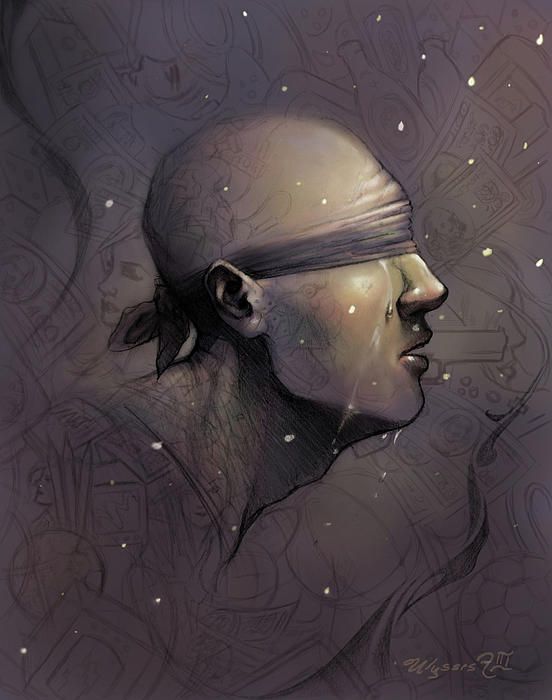
The frequent allusions to eyes, sight, and seeing are significant throughout the play.  They begin as early as the first scene when Lear expels the sincere and loyal Kent: “Out of my sight!”  Notice Kent’s emotional plea in reply:

            “See better, Lear and let me still remain

            The true blank of thine eye.”

These words underline Lear’s lack of insight, i.e. mental sight.  The theme will be developed from this point onwards.  Before long, Lear is forced to acknowledge his lack of insight.  In Act I, iv, he is beginning to see Goneril in her true colours.  The truth about his “thankless child” is painful for him: his “eyes” have deceived him, and in bitterness he wants to cast them out:

            “… Old fond eyes,

               Beweep this cause again, I’ll pluck ye out,

And cast you, with the waters that you loose,

To temper clay….  “

The anguished king returns to this theme again later:

            “Does Lear walk thus?  Speak thus?

            Where are his eyes?”

Lear’s redemption is linked to his painful acquisition of the personal insight to himself and to others which he so blatantly lacks at the beginning of the play. His frequent references to sight, eyes, seeing, illustrate and highlight this theme.

Shakespeare also uses the sight/blindness imagery for another purpose.  Through it he merges the main plot and sub-plot of the play, i.e. Lear’s betrayal by his daughters and Gloucester’s betrayal by Edmund.  Gloucester, like Lear, does not know his children.  He is fooled by Edmund and mistakes Edgar’s honesty for deception.  This truth is brutally conveyed to him by Regan in Act III, vii, as Cornwall plucks out the old man’s eyes.  Paradoxically, Gloucester only begins to acquire insight when his physical sight is taken from him.  Within seconds of his becoming physically blind, in Act III, vii, he sees that Edmund truly “hates” him.  Gloucester’s realisation of his foolishness is poignant:

            “O my follies!  Then Edgar was abused.

            Kind gods, forgive me that and prosper him!”

Gloucester may now be “an eyeless villain” according to Cornwall, but in reality he is a much more “seeing” man than before.  His reply to the Old Man who tells him in Act IV, i, “you cannot see your way” is, therefore, highly symbolic.

            “I have no way, and therefore want no eyes;

            I stumbled when I saw”

Gloucester has acquired knowledge and wisdom.  The loss of his physical sight is meant to be understood in that context.

The parallel between Lear’s predicament and Gloucester’s, between main plot and sub-plot, is highlighted in Lear’s words to the blind Gloucester in Act IV, i,:

            “A man may see how this world goes with no eyes.

            Look with thine ears…”

Edgar sums up the paradox later in the same scene: “Reason in madness!”

Through the imagery of sight/blindness in King Lear, Shakespeare parallels the main plot and sub-plot, and this highlights the paradox at the very centre of the play.

kinglear10

Richness in the Imagery used by the Fool

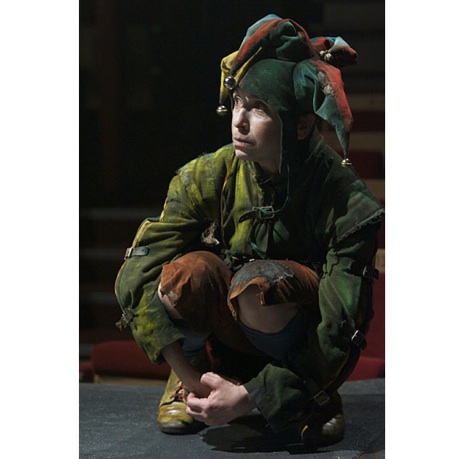
The Fool in King Lear is one of the most interesting comic characters in all of Shakespeare’s plays.  His language is rich, his thoughts at times profound.  It is worth looking more closely at some of the imagery which he uses.

From the first moment of his appearance in the play, the Fool begins his commentary on Lear’s foolish behaviour.  His first action is to offer Kent his “coxcomb” – his foolish cap.  He explains that Kent has a right to the coxcomb  “for taking one’s part that’s out of favour”.  The Fool then goes on to compare the Truth to a dog that must be whipped out of sight and confined to its kennel.  In the universe of hypocrisy and deception which Lear has now created, Truth, as always, will be the first casualty.

As Act I, iv, progresses, the Fool is relentless in pursuit of Lear and his folly.  Although disguised in the form of nonsense rhymes, the Fool’s message is consistent: the real Fool is Lear himself.  In one of these rhymes, the Fool distinguishes between the Fool who wears “motley”, i.e. the Fool’s uniform, and the real Fool who wears ordinary clothes, i.e. Lear.

At times the Fool is more direct: “thou hadst little wit in thy bald crown, when thou gavest thy golden one away”.  He keeps up this piercing banter until Lear threatens to have him whipped.  The Fool’s response is sharp:

“I marvel what kin thou and thy daughters are: they’ll have me whipped for speaking true, thou’lt have me whipped for lying…. I had rather be any kind o’ thing than a fool: and yet I would not be thee, nuncle; thou hast pared thy wit o’ both sides, and left nothing ‘i the middle”.

As Act I is drawing to a close, Lear is beginning to question his own wisdom in giving everything to his daughters.  Goneril has already complained about the size of his retinue of followers, and the Fool’s premonitions look like becoming a reality.  Lear is troubled, and his appeal to the fool now is urgent:

            “Keep me in temper; I would not be mad!”

From now on, the Fool will also be mindful of his master’s suffering as well as his folly.

In Act II, iv, the Fool’s language is dense with significant imagery.  He keeps up the meaningful rhymes which take the edge off his poignant commentary:

            “Fathers that wear rags

            Do make their children blind,

            But fathers that wear bags

            Shall see their children kind”.

He also uses the imagery of a wheel careering down a hill and out of control to depict Lear’s fate for Kent.  He warns Kent that he will be crushed if he doesn’t release his hold on the “wheel”:

“Let go thy hold when a great wheel runs down a hill, lest it break thy neck with following; …”

When Lear comes to the verge of emotional collapse in this scene, the Fool switches to nonsense to try and retrieve the situation:

Lear:   “O me, my heart, my rising heart! But, down

Fool:   Cry to it, nuncle, as the cockney did to the eels when she put ‘em i’ the paste alive; she knapped ‘em o’ the coxcombs with a stick, and cried “Down, wantons, down!”  ‘Twas her brother that, in pure kindness to his horse, buttered his hay.”

As the climax of the play approaches, there is poignancy in the Fool’s attempts to save his master from total despair.  He relents in his torture of Lear and concentrates instead on urging him to take care of himself:

“O nuncle, court holy-water in a dry house is better than this rain-water out o’ door” …

But the caustic note is not completely gone.  When Kent asks “Who’s there?”, the fool’s reply is deliberately ambiguous:

            “Marry, here’s grace and a codpiece,

            That’s a wise man and a fool”.

One is in no doubt that he means to convey how these roles have been reversed.

Through the imagery of his speech, the Fool acts as a kind of intelligent chorus in King Lear.  He never lets us forget the tragedy of what is happening on the stage.  His loyalty to, and concern for, his master is touching.  He is, perhaps, the play’s most endearing character.


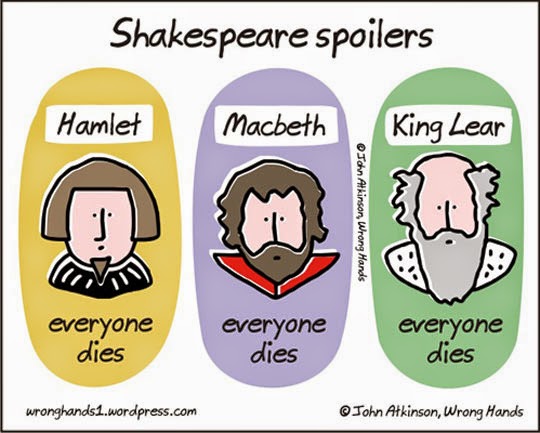
funny-Shakespeare-spoilers-Hamlet-Macbeth-King-Lear


Works Cited

Bradley, A.C., Shakespearean Tragedy. New York: Meridian Books, 1955.

Spurgeon, Caroline F. E., Shakespeare’s Imagery and What It Tells Us, Cambridge Univesity Press, 1935.


Further Reading

Single Text Study Notes on ‘King Lear’

Some Central Themes in Shakespeare’s King Lear

The Early Poetry of Thomas Kinsella

thomas-kinsella (2)

The Early Poetry of Thomas Kinsella

(with particular focus on ‘Another September’ and ‘Mirror in February’)

In the years after Yeats there was a general change in the direction of Anglo-Irish poetry.  In his desire to establish an Irish poetic tradition, Yeats had confined himself, for the most part, to subjects of Irish interest, and poets who directly succeeded him were very influenced by his poetry and the underlying philosophy of cultural nationalism which he espoused.  Thus, an older poet like Austin Clarke is very obviously an imitator of Yeats both in his subject choice and in his treatment of it.  Indeed, Clarke’s subject matter is principally confined to three main areas and may be summarised as follows: his judgements on the old heroic Ireland of the past (‘The Blackbird of Derrycairn’), his response to the general contemporary issue of Ireland itself (‘The Lost Heifer’), and his perceptive, lyrical treatment of the theme of love (‘The Planter’s Daughter’).

In the 1950’s, however, a new generation of Irish poets began to emerge.  Born in 1928, Thomas Kinsella belongs to this generation of writers; unlike Clarke, his main concern as a poet was not to limit himself to Irish topics but to explore a wider range of ideas and themes.  In 1892 Yeats had called for the creation of a national literature which would be distinct from all other literatures written in the English language.  Consequently, poets who succeeded Yeats found a constant need to express themselves as being fundamentally Irish, and the nature of their relationship with Ireland was one of their dominant concerns.  By 1950, however, Anglo-Irish poetry had found a permanent place for itself in modern English literature.  The new generation of writers were therefore not restricted to the old stances.  They did not feel it necessary to constantly assert allegiance to subjects of Irish interest, nor were they emotionally involved with dead leaders and causes as Yeats and Clarke had been.  Indeed, their most vivid memories were not of Wolfe Tone or the Fenian, John O’Leary, but of the contemporary holocaust in Europe, and the futile hero-worship of the modern world.  With Thomas Kinsella, therefore, we have one of the first to move into this different area of awareness and exploration.

Kinsella’s considerable talent as a poet has been well documented in many recent studies (e.g. Andrew Fitzsimons, The Sea of Disappointment: Thomas Kinsella’s Pursuit of the Real. UCD Press, 2008). His early work shows his skill at exploring states of feeling, especially feelings that are painful or acute.  His early poems also contain some moment of illumination, or epiphany, as he increases his awareness of some thought, idea, or reality he has previously overlooked.  This emphasis on reflection gives his poems many of the qualities of meditations: they are often, as he called them himself, ‘detailed explorations of private miseries’.  In these poems he usually begins with some simple situation which he advances towards complexity and which he attempts to incorporate into a coherent personal philosophy.

In both ‘Another September’ and ‘Mirror in February’ the speaker is presented as a solitary, humble figure who is confronted with an overwhelming significance in some simple aspect of life.  Though many of Kinsella’s poems deal explicitly with members of his own family he is essentially a poet of abstract ideas and concepts.  Also, throughout his early works nature always figures prominently.  He is conscious of the passing of time and of the seasons, the birth, death and decay of all life, even his own.

In ‘Mirror in February’ he connects his realisation of the decay inherent in modern man with his personal understanding of nature, while in ‘Another September’ he expresses his work as a poet in simple rural terms, ‘this … consciousness that plants its grammar in her yielding weather’.  Both these poems reveal certain similarities; each shares a common effort to find meaning and direction, and both are portraits of a defeated personality.  In ‘Another September’ the speaker is plunged into the bizarre, disorientated and isolated world of his wife’s past.  He is concerned with her immediate rural background, with the ways and customs of the people who still live there, with the culture they have formed from which he is excluded.  But beyond these reflections lie considerations about truth and justice, especially in the idea of a spectral woman who haunts him throughout the poem.  In ‘Mirror in February’ the poet’s self-portrait is made up of naturalistic and personal details through which he contemplates his muted, tragic story.  He experiences a sudden crisis of identity; there is a sense of loss in the feeling that his hold on youth is frail and tenuous.  In the end there is a gallant expression of hope as a faint optimism hesitantly breaks through.  Both poems succeed through a close attention to detail and through the use of natural images to expose the unpleasant and pitiful details of the poet’s life.

The material of each poem is different but the method is the same.  A theme is projected through the narrator, who alternates between apprehension of his immediate surroundings and memories or ideas that impinge upon his mind.  His recurring theme is the gulf between appearance and reality.  In ‘Mirror in February’ he regrets the loss of his youth: but the loss he is even more painfully aware of involves what he appears to be and what he actually is, ‘For they are not made whole that reach the age of Christ’.  The poem moves towards the acceptance of his condition even though his relationship with the world is one of steady and unavoidable decay.  Similarly, ‘Another September’ attempts to find some meaning in chaos.  This poem is also a projection of a state of feeling: the chaos is trivial in a wider sense, but is endowed with significance within the context of the poem.  The theme has possibly a wider application than ‘Mirror in February’, which deals with the poet’s immediate awareness of time.  In ‘Another September’, on the other hand, the initial meditation on his wife’s past gives rise to a meditation on women in general, and then to a consideration of the serious moral concepts that are usually represented as women, ‘Down the lampless darkness they came, moving like women: Justice, Truth, such figures’.  No firm conclusions are made in this poem: it is not ‘rounded off’ with a simple assertion as ‘Mirror in February’ is.  Indeed, the poem ends not with conclusions but with images, the meaning of which are not completely understood by the poet.  The theme of ‘Mirror in February’ is clear enough.  In ‘Another September’, however, the poet is presented with half-formed, shadowy ideas which trouble his consciousness and on which no firm judgements can be pronounced.

‘Another September’ describes an incident of particular importance in Kinsella’s life.  He has returned with his wife to the country house in which she grew up, and the opening stanza gives the poem a particular rural setting: ‘Dreams fled away, this country bedroom…’.  The time is early morning, just after dawn on a damp autumn day, and the poet wakes up in unfamiliar surroundings.  He first becomes conscious of the coldness (‘raw with the touch of dawn’), then of the silence (‘Nearer the river sleeps St. John’s’).  Nature, too, is still sleeping: the garden draws, ‘long pitch black breaths’, and the orchard exhales ‘rough sweetness’.  The poem is set in autumn, a time of ‘minor peace’; for the hard-working country people when the chores of summer are over and the fruits of their labour can be enjoyed.  The harvest is strongly suggested in this opening stanza, and the images provide a sense of simple rural abundance.  The trees are ripe with pears and apples, the rough soil is ‘windfall-sweetened’, the people are momentarily free from labour and secure from all intruders, ‘Locked fast inside a dream with iron gates’.  Being a Dubliner, it is as though Kinsella is experiencing these things for the first time.  This country scene is completely new to him, and he tends to see it in poetic terms.

The presence of autumn is strongly suggested in the images of the first stanza: in the second, it is personified as a domestic animal which, ‘rubs her kind hide against the bedroom wall’.  This sort of imagery is very common in modern poetry.  T.S. Eliot, in particular, specialised in far-fetched, arresting images, which have much of the impact of extended metaphysical conceits.  There is indeed a strong comparison between Kinsella’s description of autumn in this poem and Eliot’s description of the fog in the second section of ‘The Love Song of J. Alfred Prufrock’, ‘The yellow fog that rubs its back upon the window-pane’.  In Kinsella’s poem the image is meant to suggest friendliness and familiarity.  Country people live close to nature; they measure time not by the clock but by the seasons.  As such, autumn represents another aspect of their lives and is ‘long used to handling’ by them.  For Kinsella on the other hand – a city dweller for whom the seasons have no real significance – autumn is seen, prosaically, as ‘weather’.

The main topic of the poem is introduced here. The farm-house and the surrounding countryside are familiar features of his wife’s past; the life they represent belongs to his wife, not to him.  In the first stanza the farm is quiet and peaceful, safe from all intruders.  Here, however, Kinsella begins to realise that he himself is an intruder; he feels isolated and estranged in these new surroundings.  He is only ‘half-tolerated’ by the autumn morning, personified here as a friendly domestic animal which only ‘half-tolerates’ the caresses of a stranger.  The comparisons suggested here are difficult but comprehensible: it is as though a large domestic animal has entered the room sensing that an old forgotten friend has returned after many years’ absence.  Immediately, it is confronted by a stranger who tries to win favour by a vain display of friendship.  However, the poet’s overtures of friendship are ignored: it is not for his sake but for his wife’s, ‘this unspeaking daughter’ that the morning dawns so beautifully.  This use of personification in the poem is meant to suggest a sense of drama.  Indeed, what is difficult in the second stanza is not so much what the poet has to express, but the manner in which he expresses it.  He could just as easily have said that he felt out of place in the small rural community where his wife grew up, but this unremarkable statement would lack the strong sense of urgency that Kinsella wishes to suggest.  Also, by introducing characters in the second stanza Kinsella not only makes us see his personal situation in terms of drama – almost like a short scene from a play – but he also prepares for the important characterisations at the end of the poem.  He continues for the moment with simple poetic description:

                   Wakeful moth-wings blunder near a chair,

                   Toss their light shell at the glass, and go

                   To inhabit the living starlight.

At this point his attention is suddenly directed back to his wife who seems remote and unfamiliar in these strange surroundings.  Almost at once his image of her fades, ‘wanes’, and is replaced by other threatening images, ‘bearing daggers and balances’.

The ending to the poem presents some difficulty of interpretation but its meaning is usually explained as follows: Kinsella’s visit to the house where his wife grew up makes him conscious of those aspects of her life that had previously been ignored.  The poem represents, as it were, a moment of insight into her past which he had never before considered.  Following this epiphany he realises how women’s achievements in general, and their contribution to history, have also frequently been ignored.  Throughout the poem his wife is presented in quiet, placid descriptions: ‘a fragrant child’, ‘unspeaking daughter’, ‘stranded hair stirs on the still linen’.  The final feminine images, however, suggest vigour and movement, representing that part of womanhood which is characterised by energy and endurance.  Down through history, ‘down the lampless darkness’, the deeds of women have been unknown and unrecognised.  Kinsella therefore sees the images as threatening him with retribution, ‘bearing daggers and balances’, and seeking recognition for their personal deeds and achievements.

The situation described at the start of ‘Mirror in February’ is somewhat similar to that of ‘Another September’.  Indeed, both poems are composed of certain personal details and are in some sense autobiographical.  Again Kinsella relies on simple rural description in an effort to create a sense of atmosphere.  It is a damp spring morning; outside the upturned soil is ready for the seed; the trees are dark and still leafless.  The poet is going about the familiar morning chore of dressing and shaving, his mind occupied ‘by some compulsive fantasy’, when suddenly he notices his reflection in the mirror.  In the cold light of morning he is brought back to reality and he considers his advancing years.  His features reveal the relentless progress of time: his eyes are dark and exhausted; his mouth is dry and down-turned.

This moment of revelation, this epiphany, is extended into the second stanza.  The poem is set in springtime, the start of another year.  It is time to look to the future, to take stock, a time to ‘learn’.  In the second line of this stanza the cyclical nature of life is represented in an interesting paradox, ‘this untiring, crumbling place of growth’.  Life and death, he realises, are part of the great system of creation.  Things mature and die in an endless process of death and destruction.  Within the context of the poem, however, this realisation is the cause of some concern for the poet.  The slow, relentless progress of time has not brought him to perfection as it has in the case of Christ.  Instead he has achieved little, apart from a comfortable mediocrity.  The phrase ‘and little more’ is deliberately ambiguous.  The obvious meaning is that he is a ‘little more’ than the age of Christ, and the poem describes a moment of painful revelation for a person who suddenly realises that the best years of his life have slipped away and middle-age is approaching.  Another possible meaning to the phrase is suggested by Maurice Harmon.  What this critic suggests is not so much the idea of time passing, but of time lost: the poet laments that he has merely ‘looked’ his last on youth, almost like an observer, and done ‘little more’ to accomplish anything of importance.  This interpretation certainly fits in with the general tone of the second and third stanzas where the idea of worthwhile achievement is suggested in the extreme comparison with Christ’s life.  In contrast to Christ’s supreme achievements the poet has accomplished little, and he strays into the middle years of his life with little hope of attaining anything of note.  At this point he generalises about life: ‘they are not made whole / That reach the age of Christ’.  In the second stanza life is visualised in terms of sacrifice, and the idea implied is that it only becomes meaningful when seen in goal-directed terms.

In the third stanza this idea is repeated and is made more explicit in the striking references to nature.  Looking through the window the poet sees that the fruit trees have been severely pruned.  He uses this simple observation from nature as the occasion for an important comment on life.  The trees in the garden have withstood these brutal attacks upon them so that they may bear more and better fruit.  The basic idea expressed here is that nothing worthwhile is accomplished  without sacrifice, and that suffering contributes in a mysterious way to the perfection of a person’s character.  Just as Christ attained his destiny through suffering, and just as trees are pruned to make them more productive, so men too must suffer ‘mutilations’ if they wish their lives to be meaningful and enriched.  Unlike Christ, however, man does not submit to suffering willingly: he avoids hardships at each opportunity and cowers, ‘quails’, under every blow of fortune.

One aspect of the kind of suffering Kinsella imagines is described in this poem.  In his moment of anguish he tries to make light of the serious thoughts that weigh upon his mind.  He folds his towel with as much grace as he can manage.  He is no longer young, and unlike the trees he is not ‘renewable’, but he takes comfort in the fact that everybody shares in the same fate.  Life is continuous and irreversible: in the last line, therefore, he attempts to face up to his predicament with courage and conviction.

Kinsella (1)

Exploring the Poetry of Adrienne Rich (1929 – 2012)

 Adrienne Rich (1)

THIS IS A PERSONAL REVIEW OF SOME THEMES AND ISSUES WHICH FEATURE IN THE POETRY OF ADRIENNE RICH. YOU SHOULD CONSIDER THESE IDEAS, THEN RE-EXAMINE THE POEMS MENTIONED FOR EVIDENCE TO SUBSTANTIATE OR CONTRADICT THESE INTERPRETATIONS.  IN OTHER WORDS MAKE YOUR OWN OF THESE NOTES, ADD TO THEM OR DELETE FROM THEM AS YOU SEE FIT.

THE FOLLOWING SELECTION IS SUGGESTED BECAUSE THEY DEAL WITH THE MAJOR THEMES WHICH RECUR IN RICH’S POETRY:

  • Storm Warnings,
  • The Uncle Speaks in the Drawing Room,
  • Living in Sin,
  • The Roofwalker,
  • Trying to Talk to a Man,
  • Diving into the Wreck,
  • From a Survivor.

YEATS SAID OF HIS POETRY THAT IT WAS ‘BUT THE CONSTANT STITCHING AND RESTITCHING OF OLD THEMES’.  CHECK THIS OUT FOR YOURSELF IN RELATION TO ADRIENNE RICH!  

YOUR AIM SHOULD BE TO PICK YOUR OWN FAVOURITES (THREE OR FOUR) FROM THIS SELECTION AND GET TO KNOW THEM VERY WELL. 


Adrienne Rich (2)

_______________ o __________________


MAJOR THEMES IN RICH’S POETRY


Relationships

Rich is best known as a feminist writer and many of her poems deal with the oppression of women by men.  Marriage, in particular, is seen as a tool by which women are kept under the thumb of men.  ‘From a Survivor’ emphasises how women can be mastered or controlled by their husbands.  The speaker suggests that her husband’s body was ‘the body of a God’ and that it had ‘power’ over her life.

Similarly, in ‘Trying to Talk to a Man’, the speaker again suggests that her husband might have dominated her life: ‘Your dry heat feels like power / your eyes are stars of a different magnitude’.  ‘Living in Sin’, too, touches on this topic although here the couple are simply living together.  Here it is the woman in the relationship who does all the work (What’s new?), who makes the bed and tidies the apartment: she ‘pulled back the sheets and made the bed and found / a towel to dust the tabletop’.  The man with whom she’s living, meanwhile, seems to contribute little to the upkeep of the household.  This can be taken as yet another instance, therefore, of a woman being dominated or controlled by man.  It is another poem in which Rich emphasises the fundamental inequality of marriage and of relationships between men and women.

‘The Roofwalker’ is another poem that presents marriage in a negative light.  In this poem the speaker realises that her marriage has been a terrible mistake, that she has wasted a great deal of time and energy creating a life that is not suited to her: ‘Was it worthwhile to lay / with infinite exertion / a roof I can’t live under?’  The life she has made for herself, this seemingly comfortable existence that centres on a happy marriage and healthy children, is a life she was pressured into: ‘A life I didn’t choose / chose me’.  Now she is prepared to leave this life behind, to abandon the comfortable structure of her marriage and brave the world beyond this comfortable shell.  She will become, she says, ‘like naked man fleeing / across the roofs’.

It is important to note, however, that Rich can also be positive about marriage and relationships.  There is also room in her poetry for straightforward romance and love.  In ‘From a Survivor’, for instance, she emphasises that her husband’s body is ‘as vivid to me / as it ever was’ suggesting the deep love she felt for this man who is now tragically dead.  ‘Trying to Talk with a Man’ also stresses the deep emotional bond that existed between Rich and her husband with its deeply moving litany of memories and intimate moments that the couple shared; ‘whole LP collections, films we starred in / playing in the neighbourhoods, bakery windows / full of dry, chocolate-filled Jewish cookies/ the language of love-letters……’

The Personal and the Political

One of the best-known aspects of Rich’s poetry is the way it blends political and personal concerns.  Again and again she finds unexpected parallels between her personal traumas and political events that take place in the wider world.  This technique is used in an especially moving way in ‘Trying to Talk with a Man’.  The disintegration of the couple’s relationships is depicted against the backdrop of the violence and fury of a nuclear test in the Nevada desert: ‘Out here in the desert we are testing bombs / that’s why we came here’.  As we read the poem we realise that external violence of the nuclear test is a metaphor for the internal or emotional violence of the couple’s break-up: ‘talking of the danger / as if it were not ourselves / as if we were testing anything else’.

Women in a Patriarchal Society

The poetry of Adrienne Rich (like the poetry of Boland and Plath) documents the struggles and difficulties that women endure in the modern world.  Many of these difficulties are the result of the nature of the society in which we live.  Rich suggests fairly forcefully that we live in a man’s world.  The consequence of this for women is that they are never given the opportunities to achieve and optimise their potential or even communicate their true feelings and desires.  In ‘Diving into the Wreck’, Rich uses the dive into the dark depths of the sea to symbolise her efforts to penetrate the murky waters of history in order to see what lies at the bottom.  She has read about what might be there in a ‘book of myths’ but she wants to find out for herself.  What she finds is a ‘wreck’, an old ship that is battered and broken, but ‘whose silver, copper, vermeil cargo lies / obscurely inside barrels’.  It seems that this ship is a symbol of the origins of who we are and how we understand ourselves.  Down here with the wreck the speaker of the poem seems to lose all solid notions of what it means to be a woman.  Her gender becomes ambiguous and gender definitions become fluid and vague.  (Could you tell if a diver in a wet suit is male or female from a distance under water?)  The suggestion seems to be that the roles of men and women in society have a history, they are not established in fact, are not absolutely intrinsic to who we are.  If we can get back to the origins, to the beginning, when these definitions were first established we might be able to re-define and re-determine roles.  Why, the poet asks, should we live our lives according to definitions that we had no role in creating, that were established way back before we were even born.  ‘Diving into the Wreck’ suggests that there may be possibilities of rediscovering and re-learning who we are, if we are willing to try:

                               We are, I am, you are

by cowardice or courage

the one who find our way

back to this scene

carrying a knife, a camera

a book of myths

in which

our names do not appear

Forces for Change

The idea of an outside force, something that is potentially dangerous and capable of affecting our lives, is present in a number of Rich’s poems.  In many of her earlier poems Rich gives the impression that she is at the mercy of elements that she can’t quite control.  In ‘Storm Warnings’, for example, Rich portrays the weather as a powerful force for change that threatens her fragile home.  All she can do is close the windows and lock the doors against the storm that is brewing outside.  As the poem points our, even with our fancy new-fangled technologies and our weather reports, we are unable to control the weather.  We might be able to predict what is going to happen, but we are powerless to prevent it happening.  Time and darkness are two other forces that we are unable to control.  She also seems to suggest that there are elements of our own lives that we are powerless to change also.  As Rich points out: ‘Weather abroad / And weather in the heart alike come on / Regardless of prediction’.  By this she seems to be talking about the depression and other moods that we suffer from throughout our lives.

The notion of an external force is also at play in ‘The Uncle Speaks in the Drawing Room’ which contains the speech of a rich man whose lifestyle is put under threat by the presence of an angry mob at his gate.  We are not aware of the mob’s grievance but its presence remains a potent and ominous force in the poem.  Again there is a suggestion that the world contains elements that are beyond our control, no matter how wealthy and powerful we might be.  As I have said on many occasions, change is a fact of life, and the only people who welcome change are babies with wet nappies.  The speaker in this poem, the uncle seems oblivious to the reality of the growing social unrest that is taking place around him.  One could say that he’s in denial – and as I often say the Nile is not just a river in Egypt!!!!!

Roofwalker - Adrienne Rich (3)

Sample Answer:

‘The poetry of Adrienne Rich shows us the relationship between men and women in all their glory and despair’.

With reference to the above statement say whether the poetry of Rich appealed to you.


Adrienne Rich was the poet on the Leaving Cert course whose work most appealed to me.  There were several reasons for this.  For me the most important aspect of Rich’s work was her depiction of relationships in a way that seemed very real.  Her poems take account of the fact that love so often goes wrong yet they also offer hope that the anguish of a failed relationship can be overcome.  I also enjoyed the feminist aspect of Rich’s work.  Her depiction of women being dominated by the men in their lives is as relevant today as it was when Rich first presented it.

In my opinion, too many poems and pop songs present an idealistic or overly romantic view of love.  Rich, however, is having none of this.  She is fully aware that all too often relationships don’t work out the way we want them to.  As she puts it in ‘From a Survivor’, every couple believes they are ‘special’: ‘Like everybody else we thought of ourselves as special’.  Yet no couple is immune to the ‘failure of the race’.  Every relationship will experience turbulence and difficulty.  In ‘The Roofwalker’ for instance, the speaker invests a great deal of time and energy in a relationship only to realise that she does not really belong with this man.  The life they have created together is not for her.  ‘Was it worth while’, she asks to ‘lay – / with infinite exertion – / a roof I can’t live under?’  This tragic waste of time and effort in the  cause of a failed relationship was something I could really relate to.

I could also identify somewhat with the situation depicted in ‘Living in Sin’.  This poem also shows us a woman whose relationship has not worked out as she expected.  This young woman believed she would have a perfect life with her lover in their studio apartment.  She imagined there would be ‘no dust upon the furniture of love’.  However, life in the studio has turned out to be quite miserable.  The apartment is dirty and unpleasant; ‘Half-heresy, to wish the taps less vocal, / the panes relieved of grime’.  Her lover appears distant and uncaring, and hardly speaks to her each morning before going ‘out for cigarettes’.  It is hardly unsurprising, therefore, that this young woman is filled with mental anguish, is haunted by the ‘minor demons’ of sorrow and disappointment.

Yet Rich’s most moving account of a relationship in crisis is surely ‘Trying to Talk with a Man’.  What impresses me most about this poem is the way it captures just how difficult it can be to communicate at the end of a relationship, with Rich brilliantly describing the lovers ‘surrounded by a silence … that came with us /and is familiar’.  This silence expands like a cancer at the heart of the couple’s relationship, forcing them to ‘give up’ the things they shared, such as  ‘the language of love-letters’ and ‘afternoons on the riverbank / pretending to be children’.

A strong belief in women’s liberation is also central to Rich’s poetry as she developed as a writer.  Many of her poems, including ‘Living in Sin’, focus on the inequality between women and men that exists at the heart of so many relationships.  The young woman in this poem seems to do all the housework while her boyfriend lounges about the place uselessly.  Though he is allegedly an artist of some kind he appears to do little artistic work, only sounding a ‘dozen notes upon the keyboard’ before heading ‘out for cigarettes’

However, Rich’s poetry also offers a lot of hope.  In both ‘The Roofwalker’ and ‘From a Survivor’ she shows that it is possible for a woman to reverse bad decisions and escape a relationship or way of life that is unsuitable to her.  In ‘From a Survivor’ the speaker has ‘made the leap’ and escaped her failing marriage.  Now her husband is no longer like a god to her and her new life is like a ‘succession of brief, amazing moments’.  ‘The Roofwalker’ also deals with this possibility of escape and shows the speaker desiring to leave behind a life she ‘didn’t choose’.  Yet this poem stresses how unnerving and intimidating it can be to leave a stable relationship behind.  To do so is to be exposed and vulnerable as ‘a naked man /fleeing across the roofs’.  I thought this was one of Rich’s finest images, brilliantly capturing feelings of vulnerability and isolation in an image that is both moving and amusing.

While Rich’s philosophy is important, it is her use of images, in my opinion, that makes her truly great as a poet.  Her use of metaphors is very eye-catching and there is a lovely example of this in ‘Living in Sin’ where a beetle is described as ‘an envoy from the moldings’.  There is also another excellent metaphor in this poem where the morning is compared to a ‘relentless milkman coming up the stairs’.  I found both of these images amusing but they also filled me with a certain unease and discomfort.  There is also a startling set of metaphors in ‘The Roofwalker’ that really appealed to me, where builders on a roof are described as sailors on a deck; the sky is depicted as ‘a torn sail’, and the night as a black wave about to descend.

To sum up, then, my admiration for Rich’s poems stems from the fact that she is not afraid to confront unpleasant realities such as the heartbreak that accompanies the failure of a relationship and the oppression of women.  Yet she is not a poet who is content to simply dwell on the negative.  Her work also offers hope, hope that the anguish of failed love can be overcome, that women can escape the traps in life they set for themselves and that they can gain power all of their own.

image

Sample Answer:

‘Adrienne Rich’s poetry is interesting both for its themes and its language’.  Discuss.

 I am in complete agreement with this statement.  Rich is one of the most important and provocative voices in modern day literature.  Her themes are always relevant and she often challenges us with her ideas on, for example,  male-female relationships and the role of women in society.  While her feminist perspective means that her work has an obvious attraction for a female audience, her appeal is not confined to one gender.  Her language is generally clear and direct and her images striking and memorable.

An idea that she often explores is the complex reality of male-female relationships.  ‘Living in Sin’ is interesting primarily because of its realistic depiction of male-female relationships.  Most people could relate to the experience of the woman who finds that the reality of living with her partner in a small studio apartment falls short of the romantic dream.  In her naivety, the woman had given no thought to the mundane realities of day-to-day life with her partner.  This idea is expressed in everyday language, ‘She had thought the studio would keep itself’.  Inevitably, harsh reality reveals the unglamorous truth: noisy dripping taps, grimy windows, scraps of leftover food and empty bottles.  Worst of all, she encounters a beetle among the saucers – the beetle is described in a memorably humorous image as an ‘Envoy from a village in the moldings’.  Aside from the grim physical environment, the woman has to cope with her partner’s lethargy and general indifference.  He seems to be a musician or composer, but lacks the motivation to practice his music, ‘sounded a dozen notes upon the keyboard, / declared it out of tune, shrugged at the mirror, /rubbed at his beard, went out for cigarettes’.  The shrugging image perfectly captures her partner’s apathetic attitude.  This poem provides us with an insight into sexual stereotyping – the man makes no attempt to tackle any domestic tasks and it is the woman who cleans the apartment.  Despite her disillusionment, the woman does not leave her indifferent boyfriend and the depressing apartment, ‘By evening she was back in love again’.  However, the next phrase (‘though not as wholly’) qualifies this statement, reminding us that her initial optimism about the relationship is beginning to fade away gradually.

Anyone of us who have found ourselves in a relationship, which is falling apart, will easily relate to ‘Trying to Talk with a Man’.  In this poem the speaker and her partner have gone into the desert ostensibly to witness (and protest about) the detonation of a nuclear bomb – however, we get the impression that the underlying purpose of this journey is to take stock of their relationship.  An excellent visual image suggests how the woman is growing in insight, ‘Sometimes I feel an underground river / forcing its way between deformed cliffs / an acute angle of understanding’.

This poem also highlights Rich’s effective use of metaphor and imagery to convey her themes.  The images of a ghost town and the desert effectively suggest the silent, barren nature of the couple’s relationship.  While the troubled lovers are ‘surrounded by a silence’ that sounds like the silence of the deserted town, the poet realises that the silence has come with them – it is ‘a familiar’ silence. The speaker acknowledges the extent of their problems in language that is admirably simple and direct, ‘Out here I feel more helpless / with you than without you’.    What I found interesting about this poem was the man’s unwillingness to discuss the problems at the heart of the relationship.  He talks only of external events such as the danger of nuclear testing, making no attempt to address the danger surrounding the relationship, ‘Talking of the danger / as if it were not ourselves’.  This poem stands out in my mind because it underlines an almost universal truth – women are more emotionally aware and more emotionally honest than men.

‘From a Survivor’ is a deeply personal poem describing the poet’s failed marriage.  What I found interesting – and indeed uplifting – about this poem was the affectionate nature of the poet’s reflection on her late husband and the fact that her brave ‘leap’ away from her marriage enabled her to find true joy.  The conversational language employed by Rich gives this poem a wonderful sense of immediacy, ‘I don’t know who we thought we were / that our personalities / could resist the failures of our race’.  The poet reminds us of the optimism that attends the early stages of romantic relationships, ‘Like everybody else, we thought of ourselves as special’.  She never anticipated that their marriage, like so many others, would not stand the test of time.  Despite the tensions of their marriage, the poet’s affection for her late husband endures, ‘Your body is as vivid to me / as it ever was’.  It was also encouraging to learn that, having come through a difficult period, the poet retains the capacity to find joy in life – she speaks of having experienced ‘a succession of brief amazing moments’.  Another aspect of this poem that I found interesting was the insight it provided into the changing nature of male-female relationships.  Social and cultural changes brought about largely by the active feminist movement mean that the poet now has a clearer perspective on her marriage.  When she married, marriage was an intrinsically unequal institution (and who wants to live in an institution….!), with the woman expected to be obedient to her husband.  In the past the poet had seen her husband as ‘a god / …with power over my life’.  As Rich grew as a person and as a poet, she ‘no longer’ viewed her husband as god-like.

In conclusion, Rich’s poetry is interesting both for its ideas and the way in which these ideas are expressed.  She explores issues that are relevant to the modern reader in language that is generally clear and accessible, making very effective use of imagery to express her themes.


 adrienne-rich-(4)


The End and the Beginning – Wislawa Szyborska

us-to-clean-herbicide-from-vietnam-37-years-after-war-20120809

The End and

The Beginning


After every war

someone must do the cleaning-up.

Because the minimum of order

cannot be done without someone.

Someone must clear back the rubble

from the sides of roadways

so that the cars full of corpses

are able to pass.

Someone must go down into

the wet earth and the ash

into the sofa springs

into the shattered glass

and the bloodstained linen.

Someone must drag over the beam

that is going to prop up the wall,

set the pane in the window

and the door on its hinges.

It’s not photogenic

and it takes years.

All the cameras have already left

for another war.

It needs – new bridges

and railway stations.

Sleeves will soon be in tatters

From rolling them up.

Someone, a broom in hand,

still remembers how it was.

Someone listening

Nods his head that was not ripped off.

Somewhere in the vicinity

people are beginning to protest already

that this work is going to bore.

Someone from time to time

unearths from under a bush

arguments eaten away by rust

and sets them on a pile of debris.

Those who knew

what happened here

Have to leave room for those

who know very little.

Then for those who know even less.

Finally for those who know nothing.

In the grass that grew over

the causes and the consequences

someone must daydream

a wheat stem between their teeth

watching the clouds pass.


                                       Wislawa Szyborska

About the Poet…………

w_szymborska (2)

Maria Wisława Anna Szymborska (1923 – 2012) was a Polish poet, essayist, translator and recipient of the 1996 Nobel Prize in Literature. Born in Prowent, which has since become part of Kórnik, she later resided in Kraków until the end of her life. Wikipedia


‘Of Mice and Men’: Brief Analysis of Characters, Metaphors and Themes.


Courtesy of carra-lucia - books .co.uk
Courtesy of carra-lucia – books .co.uk

The title that Steinbeck finally chose for his novel emphasises the unpredictable nature of existence as well as its promise, George and Lennie’s blasted dream to ‘live of the fatta the lan’.  Taken from a poem by Robert Burns, the Scottish poet, the novel’s title suggests the transitory quality of even ‘best laid schemes’.  Burns’s poem tells of an unfortunate field mouse whose home is flattened by a plough:

But Mousie, thy art no thy lane,

In proving foresight may be vain:

The best laid schemes o’ mice an’ men

Gang aft a-gley

An’ lea’e us nought but grief an’ pain

For promised joy.

___________________________________________

Steinbeck 

CHARACTER PROFILES

GEORGE: George is the story’s main protagonist, a small, quick man with well-defined features.  A migrant ranch worker, George dreams of one day saving enough money to buy his own place and be his own boss, living off the land.  The hindrance to his objective is his mentally handicapped companion, Lennie, with whom he has travelled and worked since Lennie’s Aunt Clara, whom George knew, died.  The majority of George’s energy is devoted to looking after Lennie, whose blunders prevent George from working toward his dream, or even living the life of a normal rancher.  Thus, George’s conflict arises in Lennie, to whom he has the ties of long-time companionship that he so often yearns to break in order to live the life of which he dreams.  This tension strains George into demonstrating various emotions, ranging from anger to patience to sadness to pride and to hope.

LENNIE:  George’s companion, the source of the novel’s conflict.  Lennie, enormous, ungainly, and mentally slow, is George’s polar opposite both mentally and physically. Lennie’s ignorance and innocence and helplessness, his childish actions, such as his desire to pet soft things, contrast his physical bulk, making him likeable to readers.  Although devoid of cruel intentions, Lennie’s stupidity and carelessness cause him to unwittingly harm animals and people, which creates trouble for both him and George.  Lennie is tirelessly devoted to George and delights in hearing him tell of the dream of having a farm, but he does not desire the dream of the American worker in the same way that George does.  His understanding of George’s dream is more childish and he grows excited at the possibility of tending the future rabbits, most likely because it will afford him a chance to pet their soft fur as much as he wishes.  Nevertheless, a dream is a dream, different for everyone, and George and Lennie share the similar attribute of desiring what they haven’t got.  Lennie, however, is helpless to attain his dream, and remains a static character throughout, relying on George to fuel his hope and save him from trouble.

CANDY:  He is the old, one-handed swamper who is the first to befriend George and Lennie at Soledad.  He is humble and weary and seems to be at the end of his line after Carlson shoots his last possession and companion, his old, blind, dog.  ‘When they can me here I wisht somebody’d shoot me’, Candy confesses to George and Lennie, hoping for a similar fate as his dog.  But when he hears the two talking of their little place, Candy offers all his money and his meagre services to be in on the dream.  His substantial sum of money and the fact that he knows of a place make it impossible for George to refuse him.  Candy clings to this hope of a future as a drowning man would to a piece of driftwood.  It rekindles life within him, but it also becomes an obsession, and in his excitement and indignation, he lets the secret slip to both Crooks and Curley’s wife.  And when Lennie kills Curley’s wife and shatters the reality of the dream, Candy becomes hopeless and full of anguish, the broken shell of a man.

CURLEY:  He is the boxer, the son of the boss, the angry and hot-headed obstacle to George’s attempt to keep Lennie out of trouble at Soledad.  Insecure because of his size and over-protective of his wife, Curley is eager to fight anyone he perceives as a threat to his self-image.  Lennie unwittingly incurs Curley’s antagonism simply because of his size, and the reader immediately braces for future confrontation.  Curley remains undeveloped, forever little and forever mean, poking his head in at various points in the novel, either to look for his wife or to stir up trouble on account of her.

CURLEY’S WIFE:  Nameless and flirtatious, Curley’s wife is perceived by Candy to be the cause of all that goes wrong at Soledad: ‘Ever’body knowed you’d mess things up.  You wasn’t no good’, he says to her dead body in his grief.  The workers, George included, see her as having ‘the eye’ for every guy on the ranch, and they cite this as the reason for Curley’s insecurity and hot-headed temperament.  But Curley’s wife adds complexity to her own characterisation, confessing to Lennie that she dislikes Curley because he is angry all the time and saying that she comes around because she is lonely and just wants someone to talk to.  Like George and Lennie, she once had a dream of becoming an actress and living in Hollywood, but it went unrealised, leaving her full of self-pity, married to an angry man, living on a ranch without friends, and viewed as a trouble-maker by everyone.

CROOKS:  called such because of a crooked spine, Steinbeck does not develop Crooks, the Negro stable buck, until Chapter Four, describing him as a ‘proud, aloof man.  He kept his distance and demanded that other people keep theirs’.  Crooks is bitter, indignant, angry, and ultimately frustrated by his helplessness as a black man in a racist culture.  Wise and observant, Crooks listens to Lennie’s talk of the dream of the farm with cynicism.  Although tempted by Candy, Lennie and George’s plan to buy their own place, Crooks is constantly reminded (in this case by Curley’s wife) that he is inferior to whites and, out of pride, he refuses to take part in their future farm.

SLIM:  The tall, jerkline skinner whom Steinbeck describes as something of a living legend: ‘He moved with a majesty only achieved by royalty and master craftsmen.  He was a jerkline skinner, the prince of the ranch, capable of driving ten, sixteen, even twenty mules with a single line to the leaders.  He was capable of killing a fly on the wheeler’s butt with a bull whip without touching the mule.  There was gravity in his manner and a quiet so profound that all talk stopped when he spoke ….. His hatchet face was ageless.  He might have been thirty-five or fifty.  His ear heard more than was said to him, and his slow speech had overtones not of thought, but of understanding beyond thought.’  Slim lingers in the shadow of this overwhelming description throughout the novel.  He serves as the fearless, decision-maker when conflicts arise among the workers and wins the confidence of George, offering advice, comfort, and quiet words of wisdom.

______________________________________

Speed Read 'Of Mice and Men' (Courtesy of www.irisreading.com)

 METAPHOR ANALYSIS

 CANDY’S DOG:  ‘A dragfooted sheepdog, gray of muzzle, and with pale, blind old eyes’, Candy’s dog is a far cry from his sheepherding days.  Carlson says to Candy, in regard to the dog: ‘Got no teeth, he’s all stiff with rheumatism.  He ain’t no good to you, Candy. An’ he ain’t no good to himself.  Why’n’t you shoot him, Candy?  And Candy is left with no other option, but to shoot his longtime companion.  This sub-plot is an obvious metaphor for what George must do to Lennie, who proves top be no good to George and no good to himself.  Steinbeck re-emphasises the significance of Candy’s dog when Candy says to George that he wishes someone would shoot him when he’s no longer any good.  And when Carlson’s gun goes off, Lennie is the only other man not inside the bunk house, Steinbeck having placed him outside with the dog, away from the other men, his gun shot saved for the novel’s end.

THE CRIPPLES:  Four of Steinbeck’s characters are handicapped: Candy is missing a hand, Crooks has a crooked spine, Lennie is mentally slow, and Curley acquires a mangled hand in the course of the novel.  They are physical manifestations of one of the novel’s major themes: the schemes of men go awry.  Here, to reiterate the point, Steinbeck has the actual bodies of his characters go awry.  It is as if nature herself is often doomed to errors in her scheme.  And whether they be caused at birth, or by a horse, or by another man, the physical deformities occur regardless of the handicapped person’s will or desire to be otherwise, just as George and Lennie’s dream goes wrong despite how much they want it to be fulfilled.

 SOLITAIRE:  George is often in the habit of playing solitaire, a card game that requires only one person, while he is in the bunk house.  He never asks Lennie to play cards with him because he knows that Lennie would be incapable of such a mental task.  Solitaire, which means alone, is a metaphor for the loneliness of the characters in the novel, who have no one but themselves.  It is also a metaphor for George’s desire to be ‘solitaire’, to be no longer burdened with Lennie’s company, and his constant playing of the game foreshadows his eventual decision to become a solitary man.

THE DEAD MOUSE AND THE DEAD DOG: These two soft, furry creatures that Lennie accidentally kills are both metaphors and foreshadowing devices.  As metaphors, they serve as a physical representation of what will happen to George and Lennie’s dream: they (Lennie in particular) will destroy it.  Lennie never intends to kill the thing he loves, the soft things he wants more than anything, but they die on him nonetheless.  The dead mouse is also an allusion to the novel’s title – Of Mice and Men, a reminder that dreams will go wrong, even the desire to pet a mouse.  And because bad things come in threes, Lennie’s two accidental killings of animals foreshadow the final killing of Curley’s wife, an accident that seals his fate and ruins the dream for him, George and Candy.

___________________________________

Steinbeck 6

THEME ANALYSIS

When discussing the various themes in Steinbeck’s novel, we would do well to first examine the title, which is an allusion to a line from one of Robert Burns’s poems: ‘The best laid schemes o’ mice an’ men gang aft aglay.’  Translated into modern English, this line reads: ‘The best laid schemes of mice and men often go awry.’  This cynical statement is at the heart of the novel’s action and serves as a foreshadowing prophecy of all that is to come.  For, indeed, the novel’s two main characters do have a scheme, a specific dream of changing their current way of life in order to have their own place and work only for themselves.  The tragedy, of course, lies in the fact that no matter how elaborately our heroes plan, regardless of how intensely they hope and dream, their plan does not find fulfilment.

This is a novel of defeated hope and the harsh reality of the American Dream.  George and Lennie are poor homeless migrant workers, doomed to a life of wandering and toil in which they are never able to reap the fruits of their labour.  Their desires may not seem so unfamiliar to any other American: a place of their own, the opportunity to work for themselves and harvest what they sow with no one to take anything from them or give them orders.  George and Lennie desperately cling to the notion that they are different from other workers who drift from ranch to ranch because, unlike the others, they have a future and each other.  But characters like Crooks and Curley’s wife serve as reminders that George and Lennie are no different from anyone who wants something of his or her own.

All the characters (all the ones that Steinbeck has developed, at least) wish to change their lives in some fashion, but none are capable of doing so; they all have dreams, and it is only the dream that varies from person to person.  Curley’s wife has already had her dream of being an actress pass her by and now must live a life of empty hope.  Crooks’ situation hints at a much deeper oppression than that of the white worker in America – the oppression of the black people.  Through Crooks, Steinbeck exposes the bitterness, the anger, and the helplessness of the black American who struggles to be recognised as a human being, let alone have a place of his own.  Crooks’ hopelessness underlies that of George and Lennie’s and Candy’s and Curley’s wife.  But all share the despair of wanting to change the way they live and attain something better.  Even Slim, despite his Zen-like wisdom and confidence, has nothing to call his own and will, by every indication, remain a migrant worker until his death.  Slim differs from the others in the fact that he does not seem to want something outside of what he has, he is not beaten by a dream, he has not laid any schemes.  Slim seems to have somehow reached the sad conclusion indicated by the novel’s title, that to dream leads to despair.

Another key element is the companionship between George and Lennie.  The two men are not unique for wanting a place and a life of their own, but they are unique in that they have each other.  Their companionship contrasts with the loneliness that surrounds them – the loneliness of the homeless ranch worker, the loneliness of the outcast black man, the loneliness of Curley’s wife, the loneliness of the old, helpless cripple – and it arouses curiosity in the characters that they encounter, Slim included.  And indeed, the reader becomes curious as to their friendship as well.  And can we call it friendship?  Lennie would call George a friend, but George would perhaps be hard-pressed to admit the same of Lennie.  As he tells Slim, he has simply become so used to having Lennie around that he, ‘can’t get rid of him’.  Despite his annoyance, George also demonstrates protectiveness, patience, and pride when it comes to Lennie.  He is perhaps motivated to stay with Lennie by a sense of guilt, or responsibility, or pity, or a desire to not be alone himself.  Most likely it is a combination of all these motivations.  Yet it seems strange that George would choose to remain with Lennie, given the danger that Lennie poses for the both of them.  George is not blind to the fact that life would be easier without Lennie, and he often yearns for independence when Lennie becomes troublesome, creating a major source of tension in the novel.  This tension is not resolved until the final gunshot by the riverside, when the strain of Lennie’s company makes it impossible for George to survive with his companion.

By killing Lennie, George eliminates a monumental burden and a threat to his own life (Lennie, of course, never threatened George directly, but his actions endangered the life of George, who took responsibility for him).  The tragedy is that George, in effect, is forced to shoot both his companion, who made him different from the other lonely workers, as well as his own dream, and he is forced to admit that it has gone hopelessly awry.  His new burden is now hopelessness and loneliness, the life of the homeless ranch worker.  Slim’s comfort at the end (‘You hadda George’), indicates the sad truth that one has to surrender one’s dream in order to survive, not the easiest thing to do in America, the Land of Promise, the land of the Free and the Home of the Brave.

Courtesy of www.slideshare.net
(Courtesy of http://www.slideshare.net)

Stony Grey Soil by Patrick Kavanagh

Patrick Kavanagh - Stony Grey Soil (1)

Stony Grey Soil

by Patrick Kavanagh

O stony grey soil of Monaghan
The laugh from my love you thieved;
You took the gay child of my passion
And gave me your clod-conceived.

You clogged the feet of my boyhood
And I believed that my stumble
Had the poise and stride of Apollo
And his voice my thick tongued mumble.

You told me the plough was immortal!
O green-life conquering plough!
The mandril stained, your coulter blunted
In the smooth lea-field of my brow.

You sang on steaming dunghills
A song of cowards’ brood,
You perfumed my clothes with weasel itch,
You fed me on swinish food

You flung a ditch on my vision
Of beauty, love and truth.
O stony grey soil of Monaghan
You burgled my bank of youth!

Lost the long hours of pleasure
All the women that love young men.
O can I stilll stroke the monster’s back
Or write with unpoisoned pen.

His name in these lonely verses
Or mention the dark fields where
The first gay flight of my lyric
Got caught in a peasant’s prayer.

Mullahinsa, Drummeril, Black Shanco-
Wherever I turn I see
In the stony grey soil of Monaghan
Dead loves that were born for me.

Kavanagh spent the first half of his life farming ‘the stony grey soil’ of his native Monaghan.  In Ireland in the 1930’s and ‘40’s this usually meant a life of dull, hard work.   He recalls the hardship, misery and austerity in this poem and also, of course, in his major opus, ‘The Great Hunger’.  In ‘Stony Grey Soil’ Kavanagh regrets having wasted his youth in a barbarous, bleak place.  The very title, ‘Stony Grey Soil’ suggests a hard, harsh, dull, unimaginative world – not an ideal environment for a poet.

In this poem, Kavanagh sees himself as a victim who was deprived, deceived, lied to, cheated and robbed by his homeplace and the way of life it imposed on him.  The poem is an outpouring of anger and accusations against Monaghan for what it did to the poet.  The soil of Monaghan is personified in the poem in very unflattering terms.  Because he is personifying Monaghan, he has to use metaphor extensively.  The soil is represented as a thief, a cheat, a depriver, a liar, a burglar; it is seen as one who ‘flung a ditch’ on his vision; as one who weighed down his feet to prevent his flight into the world of poetic imagination.

In harsh metaphor after harsh metaphor, he pours out a sustained and strident angry tirade against the place where he feels his youth was wasted and his potential inhibited and stunted.  Monaghan and the farming way of life is a thief, ‘the laugh from my love you thieved’.  It is a cheat, it dealt falsely with him, ‘you took the gay child of my passion and gave me your clod conceived’.  It gave him poison for perfume, ‘you perfumed my clothes with weasel-itch’.  It is a liar, ‘you told me the plough was immortal’.  The soil and the rural way of life are seen as a robber, ‘you burgled my bank of youth’.  It tried to blind his vision and limit his potential, ‘you flung a ditch on my vision of beauty love and truth’.

To summarise, Kavanagh is bitterly attacking and blaming Monaghan and the drudgery of farm life.  It stole the fun and humour of his youth and gave him instead the ‘clod-conceived’, which suggests perhaps, practical, pragmatic ideas about crops and cattle.  His ambition and self-belief were ruined.  He was aware of his own potential; he believed that he had ‘the stride of Apollo’ but Monaghan dragged him down and ‘clogged the feet of my boyhood’.

Monaghan flung a ditch on his vision.  It limited and confined him, instead of providing inspiration it fed him ‘on swinish food’.  This is a particularly harsh metaphor, suggesting that the whole atmosphere of farming life was totally without any aesthetic dimension.  The people among whom he lived his life are represented as ‘cowards’ brood’.  This seems to suggest that they were slave-minded and without the courage to break out of their dull, drab routine.  Hardly fit company for a poet!

We have seen how Kavanagh’s bitterness is shown in the harsh metaphors which he uses to describe his victimisation.  The tone of the poem – in particular the first five stanzas – is extremely bitter.  Perhaps it could best be described as accusatory.  Notice the recurring accusations in the repeated ‘you’: ‘you thieved’, ‘you took’, ‘you clogged’, ‘you told’, ‘you fed’, ‘you perfumed’, ‘you flung’, ‘you burgled’.  We all know that if you want to start an argument the best word to use to begin it is ‘you’!

However, the poet is unable to sustain this tirade to the bitter end and in the final three stanzas he relents and his great love for his native place surfaces at last.  The accusatory ‘you’ occurs no more and now he is sadly reflective, almost nostalgic (which suggests that the poem is written from a distance in both time and place).  He mentions the hallowed place names of his native place with reverence, almost as if in a religious litany: ‘Mullahinsha, Drummeril, Black Shanco’.  He is, after all, mourning what might have been.  At a very human level he is regretting the romances that never formed part of his young manhood.  Wherever he looks in Monaghan he sees ‘dead loves’ that were born for him.  These represent not only the romantic loves that never happened in that barren place but also all his unfulfilled potential as a poet.

‘Oh, can I still stroke the monster’s back or write with unpoisoned pen…’

Inniskeen Road: July Evening

Inniskeen road (1)
Bikes on the Road to Billy Brennan’s Barn, Inniskeen – courtesy of http://www.fisherbelfast.wordpress.com

Inniskeen Road: July Evening


By Patrick Kavanagh

The bicycles go by in twos and threes –

There’s a dance in Billy Brennan’s barn tonight,

And there’s the half-talk code of mysteries

And the wink-and-elbow language of delight.

Half-past eight and there is not a spot

Upon a mile of road, no shadow thrown

That might turn out a man or woman, not

A footfall tapping secrecies of stone.


I have what every poet hates in spite

Of all the solemn talk of contemplation.

Oh, Alexander Selkirk knew the plight

Of being king and government and nation.

A road, a mile of kingdom. I am king

Of banks and stones and every blooming thing.


Copyright © Estate of Katherine Kavanagh

In his early poems Kavanagh experimented with a dreamy, transcendental sort of poetry.  He seemed to want to escape from his own real world.  He didn’t feel that his own world was a fit subject for poetry, or that poetic thought could be expressed in ordinary language.  All this has changed when he comes to write ‘Inniskeen Road: July Evening’ in 1936.

This is one of the first examples of realism in Kavanagh’s poetry.  For the first time he has found the courage to use his own specific world and his own position within that world as the subject matter for poetry.  In this poem he writes about his own local place – a world in which he was both an insider and an outsider.  He belongs because he was born there and lives there.  He doesn’t belong because, as a poet, he is isolated, he is different.  In this poem he writes eloquently about this anomaly.

This poem is about a local and personal experience.  It’s the first time that Kavanagh uses actual place names and personal names in his poetry.  There is a specific place, Inniskeen Road, and a specific time, July Evening at half-past-eight and the centre of local activity is Billy Brennan’s Barn.  It’s the first time that Kavanagh’s own local world comes to life in his poetry and marks a major watershed in his poetry where from now on realism is at the heart of all his work.  He writes about his own real, personal situation in the real world of Inniskeen Road during a summer barn dance.  To make the poem even more real, he uses the present tense throughout – it’s as if the action is happening as he speaks.

THEME:  This poem is about the isolation of the poet.  A poet is different from other people: he is not interested in material matters such as the price of cattle, the progress of crops or the results of football matches.  The poet lives in the world of imagination and because of this he is often considered as an outsider; he is isolated – a loner – he does not fit in to ordinary society.  So the price the poet pays for his gift of poetry is the pain of isolation.

This poem recounts a local barn dance and the whole neighbourhood has gone for an evening’s enjoyment. Kavanagh has not gone – perhaps for fear of being laughed at.  The tone of the octet (first 8 lines)is thoughtful as well as being bitter.  There is a sense of loneliness in it – ‘and there is not a spot upon a mile of road…’ He feels a palpable sense of being excluded by the other young people’s ‘half-talk code of mysteries’ and by their ‘wink and elbow language of delight’.

In the sestet (final 6 lines) the tone is again very bitter when he considers his own isolation and compares his lot (similar to Elizabeth Bishop in ‘Crusoe in England’) with that of Alexander Selkirk, the prototype for Daniel Defoe’s Robinson Crusoe – ‘Oh, Alexander Selkirk knew the plight…’.  Listen to the bitterness of the final line: ‘I am king of banks and stones and every blooming (God damned) thing’.

LANGUAGE:  Kavanagh is the poet of ordinary language.  He has no place for poetic diction or flowery language.  Instead he uses ordinary, colloquial language.  This use of ordinary speech is part of his simplicity; he does not try to impress; he is not looking over his shoulder at the literary critics.  Here he is content with himself and with his language: there is a country barn dance in ‘Billy Brennan’s barn’, ‘the bicycles go by in twos and threes’, there is ‘the half talk code of mysteries’ and also he notices ‘the wink and elbow language of delight’, capturing perfectly the closely-knit peasant atmosphere of the local dance.

STRUCTURE:  In the first quatrain (4 lines) Kavanagh focuses on the togetherness, the closely-knit community spirit of the place – the cyclists going along the stony road to the local dance.  They are so closely-knit they don’t even have to speak to be understood, they wink, use ‘half-code’, and nudge each other in an excited way – they communicate in code, they gesture and signal each other.  This creates a huge obstacle for the reticent, isolated poet.

In the second quatrain the road is deserted.  We sense the poet who has probably noticed all the earlier excitement from a safe distance, hidden from view, now is overcome with a sense of isolation and the silence on the roadway is unbearable, ‘not a footfall tapping secrecies of stone’ – he might as well be on a deserted island.

In the sestet Kavanagh further contemplates his own situation and his plight as a poet. The break between the octet and the sestet on the page symbolises Kavanagh’s separateness from the community.  For him, the price he must pay for being a poet is to be considered an outsider.  This notion is typically Irish and goes back many years when the Bardic poets had great standing and power in the community: they could make or break a lord or lady and were often paid to praise a patron or denigrate an enemy.  This is the price Kavanagh must pay for his poetic gift and he calls this state a ‘plight’.  He makes the comparison with Alexander Selkirk, a man who was marooned on a deserted island.  Of course, Selkirk was set ashore voluntarily, so Kavanagh is not totally a reluctant loner.  But he is honest; honest enough to admit that poetic solitude is not some grandiose, blessed, exalted state.  He rejects the ‘solemn talk of contemplation’.  Here he is distancing himself from pretentious phoney literary attitudes and poses.

RHYMING SCHEME: This is a Shakespearean sonnet and therefore it has the classic Shakespearean rhyming scheme: ABAB CDCD EFEF GG.  However, Kavanagh is experimenting here and even though the sonnet has a Shakespearean rhyming scheme, the sonnet is laid out in the classic Petrarchan pattern of octet followed by sestet.  As we have referred to earlier he cleverly uses the break between octet and sestet to show his own separateness and isolation from the community; to show his plight as an outsider.

SUMMARY:

  • First published in 1936
  • First published example of Kavanagh’s realism
  • Poetry could be written about the local and the ordinary
  • This is a personal poem – Kavanagh’s own situation – his plight as poet – insider and outsider
  • Honesty – ‘solemn talk of contemplation’ – distances himself from phoney literary attitudes and posing
  • Ordinary world – a road, bicycles, a barn dance
  • Conversational tone – ordinary diction can be used in poetry
Inniskeen road (2)
Platform Dance http://www.newryjournal.co.uk