Hidden Riches in The Poetry of Adrienne Rich

image

  • Adrienne Rich, perhaps more than any other contemporary poet, crystallised in her work and life, the consciousness of modern women. Her poems are, in this respect, overtly feminist in their outlook.


  • Her poems are confessional in that they often draw from her own life experience. While many poets tend to do this, Rich is unique among the poets on the Leaving Cert course in that she uses these experiences to make political statements.


  • Her poems contain complex images and metaphors – some extended metaphors like ‘Storm Warnings’ – and carefully worked out rhythms that challenge the reader.


  • Rich tends to draw from everyday experiences and events in order to make complex ideas more accessible.


The poems of Adrienne Rich spoke to me in a powerful way. She was definitely one of the most original and thought provoking poets that I have studied. Rich speaks for both herself and her generation in the throes of great change. The poems that I have studied represent many of the new ideas that emerged during her life. Not only do I find these ideas interesting but I believe that I have benefited directly from them.

‘Aunt Jennifer’s Tigers’ speaks to me on many levels. It is an overtly feminist poem exploring the position of married women in society.  However, it is also a great piece of writing. Rich creates contrast for maximum effect; the tigers are “proud and unafraid” unlike Aunt Jennifer who is “terrified”.  The nervousness of the aunt is perfectly conveyed through sound and movement; her “fingers” are “fluttering through her wool”. Her creativity and personality is being suppressed by the marriage she is in: “The massive weight of Uncle’s wedding band/Sits heavily upon Aunt Jennifer’s hand.”

There is a sense that her marriage is ‘weighing’ her down. The dominance of her husband is suggested through the capitalisation of “Uncle”. It is clear that this marriage is an unhappy one; even when her aunt is dead she is, “still ringed with ordeals she was mastered by”. Unfortunately, even though this poem was written over fifty years ago, I can still recognise women like Aunt Jennifer.

However, the poem is not completely pessimistic. I think it does a lot to celebrate the potential of women. Aunt Jennifer may have been repressed and timid but she produced tigers that were “proud and unafraid”.  These tigers live on beyond her death. I think this poem hints at the changing position of women that we see today.

The threat of change is evoked beautifully in ‘The Uncle Speaks in the Drawing Room’. Unsurprisingly, this poem is taken from Rich’s collection called ‘Change of World’. The arrogance of the speaker is displayed in his dismissal of the protesters as a “mob”. Like ‘Aunt Jennifer’s Tigers’, the dominant figure is the “uncle”.  I believe he is a symbol of a patriarchal society that is class-ridden with a sense of privilege and entitlement. References to the “drawing room” and “crystal vase and chandelier” reinforce this idea of an ostentatious, wealthy world removed from the common people.

I felt the anger of the mob as they “talked in bitter tones” and “fingered stones”.  Alliteration is used to great effect as Rich describes the “sullen stare” of the crowd. The strong rhyme and rhythm in the poem is reminiscent of a drumbeat or death march. It increases the tension in an already dramatic poem. The uncle dismisses the threat as “follies that subside”. However, he still fears for his “glass”. The fact that he says, “none as yet dare lift an arm” implies that he believes that they may in time. The speaker ends the poem with a warning about how his generation must guard the treasures of “our kind”. I thought this poem was a clever insight into the minds of those who hold the power in the world. It created vivid pictures for me and I was disappointed when it came to an end.

A poem that deals with change and power in a slightly less dramatic way is ‘Living in Sin’. This poem really spoke to me because I could easily relate to it. As a big fan of the movies, I am consistently bombarded by idealised depictions of love that would probably be impossible to recreate in real life. Rich’s poem gave me an insight into the difference between our romantic expectations and the reality of everyday life.

The poem tells the story of a woman who decides to live with her boyfriend. From the first lines of the poem, we realise that things are far from perfect:  “She had thought the studio would keep itself;/No dust upon the furniture of love.”  It is clear that the woman had not even considered the mundane realities of domestic life. She feels guilty about her resentment of domestic chores because in that society it was “half heresy” not to embrace what was seen as ‘women’s work’. I enjoyed the wry humour in the poem as the woman is disturbed by the reality of her new life when “a pair of beetle-eyes would fix her own”. The pressure on women to conform is conveyed by the fact that her “minor demons” jeer her as she cleans the apartment.

It is interesting that the man whom the woman is tending to seems very far from a romantic hero. In fact, he hardly seems worthy of her. He fails to see the problems in the house. He is lethargic and lacks personality. She “writhes” under “the milkman’s tramp”, a metaphor for life and even though “by evening she is back in love again”, it is not as “wholly” as before. I believe this poem acts as a warning to women everywhere to beware of slipping into a life of domesticity where their needs become subservient to those of others.

Another poem that deals with relationships is ‘From a Survivor’. This poem is a lot more directly personal than ‘Living in Sin’. Rich uses the first person in this poem and it is obvious that this is about her failed marriage to Alfred Conrad. After seventeen years of marriage, the couple separated. Months after their separation, Conrad committed suicide. This poem spoke to me because it is very sad and I think it was courageous of Rich to publish it.

The poem expresses itself simply and the language used is almost conversational. Rich reflects on the “pact of men and women in those days”. The use of the word “pact” suggests some sort of battle, perhaps, referring to the shifting balance of power between the sexes at the time. Rich shared the view of all newly weds that herself and her husband were “special” and could withstand the “failures of the race”.

The poem addresses the fact that her husband is now “wastefully dead”. There is real pathos in the lines: ‘Your body is as vivid to me/As it ever was: even more since my feeling for it is clearer’.

Now that their relationship is over and he is dead, Rich can assess what they had together. When they initially married, the status between man and wife was unequal. The husband was a “god” with the “power” over his wife. This poem really interests me on many levels.  It is a very personal reflection on Rich’s life but it also documents a life that has been left behind. I believe, as a result of pioneering women like Rich, our generation will not suffer such inequalities in our marital relationships.

 In many of her earlier poems Rich gives the impression that she is at the mercy of elements that she can’t quite control.  In ‘Storm Warnings’, for example, Rich, by using a sustained extended metaphor, portrays the weather as a powerful force for change that threatens her fragile home.  All she can do is close the windows and lock the doors against the storm that is brewing outside.  As the poem points our, even with our fancy new-fangled technologies and our weather reports, we are unable to control the weather.  We might be able to predict what is going to happen, but we are powerless to prevent it happening.  Time and darkness are two other forces that we are unable to control.  She also seems to suggest that there are elements of our own lives that we are powerless to change also.  As Rich points out: ‘Weather abroad / And weather in the heart alike come on / Regardless of prediction’.  By this she seems to be talking about the depression and other moods that we suffer from throughout our lives.

 Rich wrote ‘Power’ in 1974. From the beginning of that decade, she had devoted her life increasingly to feminism. Certainly, the conflict of an influential woman existing in a patriarchal society is explored in the poem. The poem first interested me because Marie Curie was famous and known to me for her dedication to science and the priceless discoveries she had made during her life. She was a fascinating woman who was the first person ever to win two Nobel prizes for her discovery of the radioactive elements plutonium and radium.  Her work with these elements led to her eventual death from leukaemia.

The poem follows a ‘stream of consciousness’ method that I found both challenging and interesting. It opens with the discovery of,  “a hundred-year-old cure for fever  or melancholy  a tonic”. This bogus “cure” contrasts with the real cures Curie found in her research.

I was really moved by the description of Curie’s suffering. Rich conveys a vivid picture of the scientist’s “body” being “bombarded” by radiation, her eyes developing “cataracts” and her skin “cracked and suppurating”.  The final image of Curie being “unable” to “hold a test-tube or pencil” is particularly poignant.

There is a sense that she was forced to deny “her wounds” because they came “from the same source as her power”.  It is highly ironic that the work that Curie did made her both famous and sick. One wonders if Rich is making a broader political point here. Is she saying that in a male dominated world, a woman must make serious sacrifices to be successful? The poem brought to mind the problems that many women who have both children and demanding jobs experience today. There is always a sacrifice that has to be made in some way. Whatever the ultimate message, this poem is a powerful testament to both Marie Curie and Rich’s powers both as scientist and poet.

Rich said that she had written,  “directly and overtly as a woman, out of a woman’s body and experience”. Her work was both challenging and thought provoking. I was continually excited and surprised by her unusual perspectives and striking imagery.

Quotation-Adrienne-Rich-life-reading-Meetville-Quotes-213108

Some ‘Grace Notes’ on Macbeth

The term ‘Grace Note’ comes to us from the world of Irish Traditional music where they are used as embellishments, added extras to further personalise the tune.  Here they are used in a similar fashion – maybe becoming the difference between a H1 and an H2!

macbeth-and-lady-macbeth-dee-timm

Throughout the play Macbeth there is almost a grotesque obsession with violent and unnatural images of children and babies (as well as apparitions of a bloody child and of a child crowned), for instance:

Come to my women’s breasts…….I have given suck, and know

How tender ‘tis to love the babe that milks me….

None of woman born shall harm Macbeth..

There are also many images of barrenness, for instance:

Upon my head they placed a fruitless crown

And put a barren sceptre in my grip,

Thence to be wrenched with an unlineal hand,

No son of mine succeeding.

Even though Macbeth is obsessed at the thought of the children of another man succeeding him, he himself does not have any children (Macduff states that he cannot properly avenge the murder of his own children, since Macbeth ‘has no children’).  Lady Macbeth mentions that she has ‘given suck’, but here she may be referring to children from a previous marriage – or maybe any children the Macbeths have had are now dead.  With this in mind, the voices of the witches that he hears could almost be those of his children that have died or possibly the voices of his imaginary children whom he wants to inherit the throne.  (In some productions of the play the witches have been played by children.  This is not too farfetched – after all, nowadays, when we think of witches, an image of an eccentric woman on a broomstick or a child dressed up in a pointy hat and cloak at Halloween readily comes to mind.)

IMAGES OF TIME AND SPEED

By Shakespeare’s standards, Macbeth is a short play.  There are no major sub-plots, and the events of the central story unfold at an alarmingly fast pace.  Macbeth returns home in Act 1 to prepare for the arrival of the king at very short notice, while Lady Macbeth summons him to ‘Hie thee hither’ and a messenger who has already travelled so quickly is ‘almost dead for breath’.  The images of travel, speed and breathlessness create a sense of unbearable urgency in the play.  Characters are obsessed by time passing – Macbeth himself seems to realise how Time ultimately is in control of his actions, when he addresses Time:

 Time, thou anticipatest my dread exploits.

Later he refers to Murder as something which moves with        ‘stealthy pace’     and he acknowledges that

Come what come may,

               Time and the hour runs through the roughest day.

Macbeth’s reaction of distant resignation to the death of his wife begins with the famous deliberation on time,

Tomorrow, and tomorrow, and tomorrow…….

IMAGES OF BLOOD

In Macbeth, the word ‘blood’ is mentioned 24 times, and ‘bloody’ is mentioned 15 times!  Once blood has been shed, there is quite a gothic obsession with it, as Macbeth and his wife are haunted by images of blood.  This horrified reaction to the blood they have shed is altered, when Macbeth realises that he cannot turn the clock back, saying –

I am in blood

Stepp’d in so far that, should I wade no more

Returning were as tedious as go o’er.

This image of wading through blood which creeps up your body surely has influenced countless Hollywood directors down the years e.g. in films such as The Shining.

Lady Macbeth might have control over her husband in the early stages of the play, but she cannot control her own mind which is plagued with bloody images, washing her hands of invisible blood, and saying –

Yet who would have thought the old man

               To have had so much blood in him.

Perhaps most selflessly and poignantly, Macduff refers to the decline of Scotland with a different use of blood imagery when he says –

Bleed, bleed, poor country.

IMAGES OF SLEEP

In the middle of the night (with its ‘bloody and invisible hand’). The Macbeths murder Duncan, taking his sleep from him.  Ironically, sleep is also taken from them, as Macbeth hears the words

Macbeth shall sleep no more.

For not only has Duncan been murdered in h is sleep, but sleep itself has been slain

Macbeth does murder sleep – the innocent sleep,

              Sleep that knits up the ravelled sleeve of care,

The death of each day’s life, sore labour’s bath,

              Balm of hurt minds, great nature’s second course,

              Chief nourisher in life’s feast.

In Act 3 Scene 2, Macbeth lives in ‘restless ecstasy’ and sees life as a ‘fitful fever’, while in Act 3 Scene 4, one of the last things Lady Macbeth says to her husband before she loses her reason is  ‘you lack the season of all natures, sleep’.  In the same scene, when asked, ‘What is the night?’, she can only reply, ‘Almost at odds with morning, which is which’ – life has become one long waking nightmare for her.

Macbeth has murdered sleep, and the next time we see Lady Macbeth, she cannot sleep as she wanders about trying to clean her ‘bloodstained’ hands.  It seems that the murdering of sleep by Macbeth results directly in his wife’s inability to find peace or repose.

In Macbeth, Shakespeare is so fascinated by night-time and darkness, he uses the word ‘night’ 38 times and ‘sleep’ 26 times!

THE MACBETHS’ MARRIAGE

In Macbeth, Lady Macbeth is stronger initially, but cannot cope after Duncan is murdered; while this first murder is difficult for her husband, subsequent murders hardly cost him a thought.  We know from life and literature (and the tabloids!) that in the aftermath of any major tragic event, the relationships of those involved can either grow stronger or break down – Shakespeare seems to be interested in how the latter situation can come about in this play.

Their separation seems to start in Act 3 Scene 1, when Macbeth gets rid of Lady Macbeth so that he can talk to the murderers, then she returns to see why her husband is spending so much time alone and brooding.  She seems happy to have achieved her goal – the crown, while Macbeth is obsessed by trying to prevent another’s offspring from succeeding him.  Once their aims are different, they grow apart, which suggests theirs is a marriage based on shared political intrigue and desire, rather than love.  As the play progresses, there are very few terms of endearment or fond words expressed (unlike the early scenes).  In fact, Lady Macbeth only refers to Macbeth as her ‘husband’ once (just after the murder of Duncan) – perhaps since she is vulnerable and in need of support at that point.  Also, Lady Macbeth’s constant jibes at her husband’s lack of manhood and inability (as she sees it) to follow through on his desires could refer to more than just his political manoeuvres – if you catch my drift!

 POLITICS

As Macbeth establishes his dictatorship, and his enemies subsequently try to destroy it, political manoeuvres and cunning manipulation abound.  A number of observations about how characters deal with each other are interesting to note:

  • Note how Macbeth persuades the murderers to kill Banquo
  • How Ross tries to find out how Macduff will respond after Duncan is murdered
  • How Malcolm (when he is approached by Macduff in England) pretends not to have any interest in the throne (or, indeed, to be at all suited to it), in order to put Macduff’s loyalty to the test (showing just how paranoid and untrusting everyone has become during Macbeth’s reign of terror).
  • How Ross does not tell Lady Macduff everything and then later seems to withhold information from Macduff about his family – possibly because he wants to enrage him so much to ensure that Macduff will fight against Macbeth? (In the Second Age Production we saw it was interesting that Ross was depicted as the third murderer who comes to help the witches’ prophesy be fulfilled, by helping Fleance to flee.)

In Macbeth, it is Duncan – the King – who seems most notably deceived by show (as, indeed, in many of his plays, Shakespeare is intrigued by appearances which hide reality).  Duncan is a bad judge of character – he had placed great faith in the previous Thane of Cawdor –

He was a gentleman on whom I built

               An absolute trust.

Then almost immediately he makes the very same mistake with Macbeth and his wife, not noticing the serpent under the ‘innocent flower’.  He is oblivious to Macbeth’s potential for evil and unable to see below the surface or to realise Macbeth’s ability to hide with a ‘false face’ what ‘the false heart doth know’.

Banquo, on the other hand, becomes suspicious of his friend, as he starts to see through the façade Macbeth has tried to create for himself, and then realises Macbeth has ‘played most foully’ for his achievements.

HERO OR VILLAIN?

This is the great on-going debate.  For Elizabethan audiences there was but one answer.  For modern-day audiences things are not so clear-cut.  However, in his defence, despite the fact that Macbeth does not seem to mind whom he destroys – surely the sign of a villain – he does have many (initial) crises of conscience which may just about redeem him and allow him the dignified status of ‘tragic hero’.  His sense of regret and awareness of what he has lost can be seen in Act 5 Scene 3, when he has been abandoned by all but a handful of employees, and is without ‘honour, love, obedience, troops of friends’.

Arena-Illustration-Euan-Cook-Macbeth-03

A Hurling Farewell…

The following is a fabulous hurling story taken from the archives of the oft lamented hurling website, An Fear Rua.  Michael Walsh captained The Rower-Inistioge to their only Kilkenny county senior hurling title in 1968.  He died on January 10th, 2012.  His son Patrick wrote this moving memoir of his father….

A Hurling Farewell

By
Patrick Walsh

There was no shelter from the unseasonal heavy misty rain on that mild January morning when we turned onto Friar’s Hill. The hearse belching fumes five yards in front of us afforded no cover and we wouldn’t have wanted it any other way. The dark suits, white shirts and black ties of the men were soaked in an instant. The careful preparations of the womenfolk to hair and clothes were drowned in a spiteful but comforting grey mist.

Rain is for funerals. It provides a cloak of darkness for the pain of the bereaved and it allows the sympathisers to somehow share the hurt if only fleetingly. Sunshine is for weddings and heroic summer hurling.

Hurling bubbles in our family’s blood, so for the life of me I couldn’t fathom how I had never seen this book before. On the table stacked high in the bookshop was ‘Kilkenny Senior Hurling Champions 1887 – 2003’ by Dermot Kavanagh. Staring out at me from the pages detailing the 1968 final was my father’s picture with the note identifying him as captain. Tears filled my eyes in the bookshop. That was his Christmas present sorted for what we all knew would probably be his last.

From the middle of November it was obvious that he would never leave the house again. One of his last big days out was to the funeral of a former Kilkenny All Ireland winning captain who was married to his sister. Afterwards, he shared pints and stories over a long afternoon with men he hurled against long ago.

The great bundle of energy that is Sam Carroll said to him,  ‘It will be your turn next year’ referring to the Kilkenny County Board’s policy of honouring the county champions of the past. Without missing a beat he smiled and said he was looking forward to it but both of us knew his deteriorating health would have taken him from us long before then.

These days his limited eyesight was saved for the donation to the bookmakers’ benevolent fund that was his daily trawl through the racing pages. Sitting at his bedside I offered to read to him the pages covering the 1968 final from Dermot Kavanagh’s book. He would never have asked. That was his way.

Before we reached Mill Street we could see them. Lining both sides of the street opposite the Ollie Walsh Memorial were the men of ’68 whom he had led into battle on an April Sunday in ’69 to claim his parish’s one and only Kilkenny Senior Hurling Championship title. Over their shoulders was slung the club jersey which was their battledress on that Sunday nearly forty three years ago. I still think the lid of the coffin lifted as his chest swelled with pride at the sight of these great men gathered to give him a guard of honour along the streets of the neighbouring town he had made his home for over forty years.

A few days after Christmas my mother rang and said he wants to see you urgently but he won’t say what it’s about. I sat on the bed and heard him ask me through shortening breath, to write to Dermot Kavanagh, the author of the book who had also played on the team, to thank him for the acknowledgement of the separate picture identifying him as captain. He had missed the celebratory dinner in New Ross due to illness and his centre-place as captain in the picture of this event, which was also in the book, had been filled by the great Eddie Keher.

He seemed to be opening up so I decided to test the water. With the simple words, ‘What position did you play in against Éire Óg’, an ever increasing torrent of memories flooded his head. He became frustrated as their delivery was slowed by the damming effect of his shortness of breath. I heard for the first time his recollections of the 1968 championship. He was picked out of position, centre back to mark Tommy O’Connell, the Kilkenny star forward, against Éire Óg in the first round.

The quarter final versus Thomastown was postponed until the Spring of ’69 to allow Ollie Walsh to return from an unfair suspension imposed following a Kilkenny v Tipperary brawl in the National Hurling League. Again, he was picked to do a job. Cha Whelan had to be marked, so he started full forward.

Freshford were the opposition for the semi – final and he was picked full forward to stop Pa Dillon, the great but fearsome Kilkenny full back of the 1960’s. In his bed he told me, in slightly less than parliamentary language, that he feared for his life and that if Pa was to walk into the bedroom there and then, he’d still be afraid. I’m too young to remember Pa hurling but I’ve met him at numerous hurling dinners etc and have found him to be one of the most softly spoken, obliging Kilkenny heroes of the past. I’m sure the truth of Pa’s legend is somewhere in between.

Dermot Kavanagh’s touching handwritten letter arrived within two days. After the funeral, he told me that on reading our letter of thanks he just sat down and wrote his reply in one draft.

That night at his bedside I read him Dermot’s reply ….’Believe me it was no problem giving your Dad due acknowledgement. He was a brilliant hurler and sincere servant of the club’…. He ‘was always picked to play on other such greats as Paddy Moran, Martin Coogan and Sean Buckley when the occasion demanded’….’ I can safely say that all the senior statesmen of that team were great men, none more so than him’…’  Probably his greatest outing for the club was last September when at very short notice, and clearly unwell, he led the guard of honour for Pudsey Murphy’s funeral. A tough task but admirably undertaken’.

When I finished reading a smile took over his face and his eyes filled up as he reached out to grip the back of my hand. Nothing was said because nothing needed to be said. That was his way.

The rain relented. It’s possible the sporting gods saw it as a sop to the amount of hurling men that had gathered to bid farewell. The ‘Men of 68’ guard of honour led the cortege to the church and his three sons and three grandsons carried him shoulder high to the altar where the Tom Walsh Cup, which he had received nearly forty three years previously, was waiting for him. We have no picture of him being presented with the cup on county final day or of him being carried shoulder high with it from the field so it’s a sight that will be branded on our memories forever.

At the graveside a face we all knew approached my mother. Before he could offer his condolences she smiled and said,  ‘They tell me he hurled the socks of you’. Seamus Cleere, the prince of Kilkenny centre backs laughed and hugged her. He had been picked centre forward in the county final against Bennettsbridge to stop the great Seamus Cleere. In the ‘Irish Independent’ report of the match neither of them got a mention.

Job done.   He never said anything to us about it. That was his way.

Ghosts and the Supernatural in Hamlet

image


Elizabethan audiences would have been very receptive to the idea of ghosts. Right from the opening lines of Hamlet, the ghost is given a prominent role. In Act I Marcellus asks the question: “What, has this thing appear’d again tonight?” It is clear from the conversation that follows that “this thing” is something to be feared – a “dreaded sight”. It is this mention of the ghost that sets the atmosphere of foreboding for the play. There is a sense of disaster, and this is emphasised when Horatio points out that similar unnatural events preceded the assassination of the Roman Emperor Julius Caesar in ancient Rome:

“The graves stood tenantless and the sheeted dead
Did squeak and gibber in the Roman streets:
As stars with trains of fire and dews of blood,
Disasters in the sun”…

THE GHOST AS A SIGN OF DEEP DISTURBANCE IN THE KINGDOM
Horatio thinks that the appearance of the ghost is a sign that there is something seriously amiss in the state of Denmark. The audience would have believed that ghosts often returned to earth to complete some unfinished business, and would always come in the dark of night. The ghost in Hamlet appears on the stroke of midnight – an ominous hour. Once Hamlet is informed of the apparition of his dead father in the shape of a Ghost, nothing will dissuade him from being present at midnight to see if it will return. He suspects that something is rotten in the State of Denmark, and feels compelled to try to commune with this Ghost who is dressed in the armour of his dead father:

“I’ll speak to it, though hell itself should gape
And bid me hold my peace…..”

THE GHOST: A SOUL IN TORMENT
In Hamlet, the ghost is representative of a supernatural world where restless spirits are in torment because of something which happened when they lived on earth. The frightened talk about the Ghost right from the opening of the play, and then its appearance to the terrified night-watch soldiers, and later to Hamlet himself, establishes an atmosphere of evil beneath the surface. In Act I Scene iv, when the ghost appears to Hamlet, the cautious Horatio is frightened:

“What if it tempt you toward the flood, my lord,
Or to the dreadful summit of the cliff
That beetles o’er his base into the sea,
And there assume some other horrible form
Which might deprive your sovereignty of reason
And draw you into madness?”

But in Hamlet Shakespeare is deliberate in creating a ghost that is not really sinister at all, and so cannot easily be spurned. It would be easier for Hamlet if that were so. This ghost is a restless spirit who crosses the threshold between the physical and the supernatural worlds because it cannot rest in either. This ghost is compelling because it is gentle, even noble. It strikes a deep chord within Hamlet because it is pitiful and pleading. It reminds Hamlet that its murderer gave it no chance to repent for sins committed, and it had to enter the next world without forgiveness or the comfort of the last rites:

“Cut off even in the blossom of my sin,
Unhousel’d, disappointed, unanel’d
No reckoning made, but sent to my account
With all my imperfections on my head:”

THE GHOST’S REQUEST: AN IMPOSSIBLE DEMAND
Hamlet is truly shocked by the revelations, and sees his predicament immediately; to revenge his father’s murder – and lay his soul to rest – he must commit murder. This is an unbearable burden because in order to do his filial duty he must commit the very crime (murder) that he has found so repellent in Claudius. Horatio’s words about the danger of his going mad are prophetic. By the end of the fourth scene of Act I, we know that Marcellus is right: “Something is rotten in the state of Denmark.”

Through no fault of her own, Ophelia is the innocent victim of Hamlet’s terrible predicament. He cannot deal with the burdens laid upon him, and his inner conflict is intense. Ophelia has no one to advise her in her own bewilderment about her lover. Polonius and Laertes have agendas of their own when giving her orders, and she is totally helpless when her beloved Hamlet turns on her and seems to have lost his mind.

The Poetry of Seamus Heaney

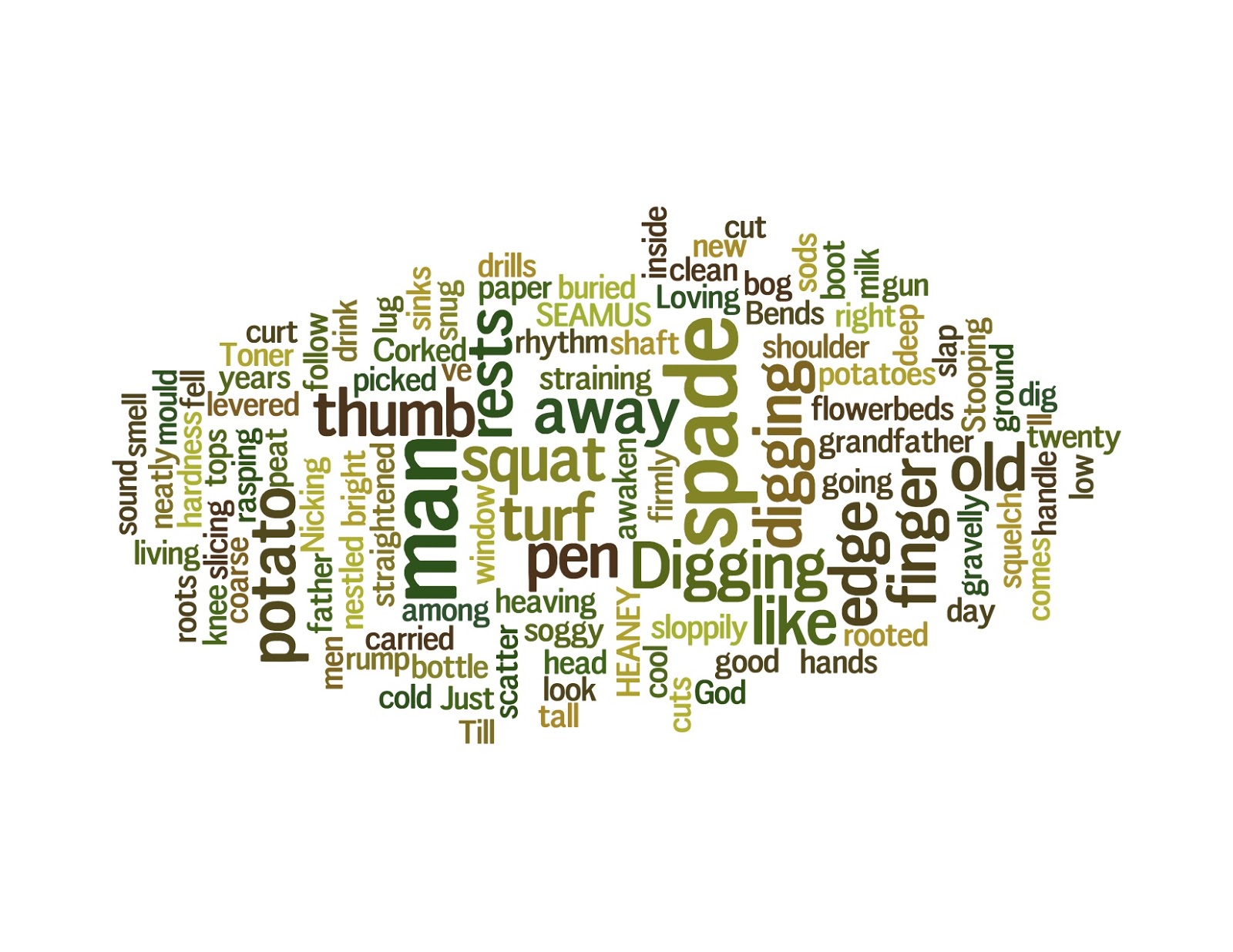
Digging

by Mary Hanley

(Note:  Leaving Cert Poetry questions have in recent years become more sophisticated and focused on particular aspects of the poet’s work.  The first ever question on Heaney simply expected the candidate to give their personal reaction to his poems – today the focus is given in the question and these are the major aspects which you must address in your answer.  This is then policed firmly by the Examiner’s by their application of the PCLM marking criteria.)

Sample Answer:  Would you agree that Seamus Heaney is an essentially backward looking poet, finding answers only in the past?

Soundbites are dangerous and the thesis stated above does not do Heaney or his poetry justice.  I agree that Seamus Heaney is “an essentially backward looking poet”.  However, I remain steadfastly reserved about Heaney “finding answers only in the past”.  This statement does not give the whole scope of his poetry true justice.  It only skims the surface, and using Heaney’s own analogy, if we are to truly understand his work we must go “down and down for the good turf” before we can get a true estimation of his worth.

Irishness, tradition and identity remain the cornerstones of Heaney’s poetry.  He celebrates local craftsmanship – the diviner, the digger, the blacksmith and the breadmaker.  He hankers back to his childhood and the community of that childhood for several reasons.  Indeed, part of the excitement of reading his poetry is the way in which he leads you from the parish of Anahorish in County Derry outwards in space and time, making connections with kindred spirits, both living and dead, so that he verifies for us Patrick Kavanagh’s belief that the local is universal.  For example in ‘The Forge’ he appears at first glance to be looking back with fond nostalgia at the work of the local village blacksmith.  However, the real subject of the poem is the mystery of the creative process.  The work of the forge serves as an extended metaphor for the work and craftsmanship of poetry.  Even the uncouth and uncommunicative blacksmith of his childhood can create!

Heaney has been branded a nostalgic romantic, a poet whose head remains steadfastly stuck in the sand, and a man when confronted with political violence and trauma regresses back in time to the womb-like warmth of his aunt’s kitchen in Mossbawn.  “Sunlight” is seen as a prime example of Heaney’s romanticism and escapism.  This poem was, after all, written at the height of the ‘Troubles’.  Yet, seemingly in denial of such violence, he hankers back to the security of his childhood.  Can it therefore be said that he is essentially a backward looking poet, finding answers only in the past?  Undoubtedly, Heaney travels back in time but it is to find answers for the present day realities.  On another level, this poem is a search for alternative human values, values no longer to be found in present day society.  Heaney can draw strength from his picture of childhood Eden – ‘the helmeted pump’, ‘scones rising to the tick of two clocks’ and ‘love, like a tinsmith’s scoop sunk past its gleam’.

Heaney is a poet, like Kavanagh and Hartnett, who has remained attached to his home place and the values and traditions of his parents.  ‘All I know is a door into the dark’.  Poets, too, have to force themselves to go into the dark, the unknown.  Their craft is multi-faceted.  They are pioneers, working at the frontier of language.  They are translators, translating for us events that we cannot grasp.  He translates the atrocities of Northern Ireland by excavating and exploring the past.  Heaney can travel through ‘the door into the dark’ only by drawing strength from the past.

The bog plays a major role in the poetry of Heaney.  This soft, malleable ground is ‘kind black butter.  Melting and opening underfoot’.  The bog is the memory of the landscape.  It draws us inwards, downwards and backwards through history.  Our bogs are as deep as the American prairies are wide.  Heaney talks about the ‘Great Irish Elk’ and ‘butter sunk under’.  In offering the poet an opportunity to consider its hoard from the past it affords him some deeper understanding of the present.

It is obvious from his poetry that Heaney needs to distance himself from the immediate face of danger.  Unlike Longley, Heaney is not eager to touch it, to write about it, to feel its flank and guess the shape of an elephant.  He needs space.  He uses the rich tapestry of history to give him perspective and a parallel to confront ‘the Troubles’.  In ‘The Tollund Man’ the discovery of a book gives Heaney a new perspective to explore the past and examine the present.  Make no mistake about it, Heaney here is talking about Northern Ireland.  It is difficult to interpret but this poem is a direct response to the continuing murders and violence of the 70’s and 80’s.  Heaney’s style may not be as direct as Longley’s, but I believe it is still very effective.  I believe he is saying here these atrocities, albeit sometimes more brutal, are just modern day versions of an age old custom.  In every society, people are sacrificed to a political or religious goddess, whether it is the goddess Nerthus or Kathleen Ni Houlihan.  One common motif linking the three parts of the poem is that of a journey.  The sacrificial journey of the Tollund Man, the journey of the brothers ‘flecked for miles along the lines’ and the pilgrimage of Heaney in the final part.  I believe there is one more journey to be made and this Heaney skilfully passes on to the reader.  We, the readers, have to make the final journey ourselves to discover and interpret, to read between the lines and around the happenings of the time the poem was written, to get at the true meaning of the poem.  This analogy can be transferred to all of Heaney’s poems.  He doesn’t do all the work for us but the meaning is more valued when we get to the essence of the poem ourselves.

                   ‘Out there in Jutland in the Old Man killing parishes,

I will feel lost, unhappy and at home.’

No one can deny that Heaney is “essentially a backward looking poet”.  Yet he makes no apologies for it.  The influence of Kavanagh and his writings on Monaghan gave him a strength to continue writing about the traditions and customs of his local community.  The cynic may see it as escapism but Heaney finds inspiration about the present in his wealth of memory.  He finds a metaphor for the finely crafted work of the poet in such poems as “The Forge”.  The bog offers Heaney a perspective.  In “Bogland” and “Tollund Man” Heaney finally turns to the security of his youth to find an answer to the shocking realities of violence and death.  It stands as an antidote to the brutal reality of the wider society.  Heaney’s poetry also stands as an antidote, dealing with harsh issues in a gentle retrospective yet effective way.

                   ‘Then grunts and goes in with a slam and flick

To beat real iron out, to work the bellows.’

Therefore, I would be in agreement with The Field Day Anthology of Irish Writing when it says of Heaney’s poetry that it is, ‘excavating in every sense, reaching down into the ground and back into the past’.

Digging by Seamus Heaney copy

Happy Memories of St. Ita’s Secondary School!

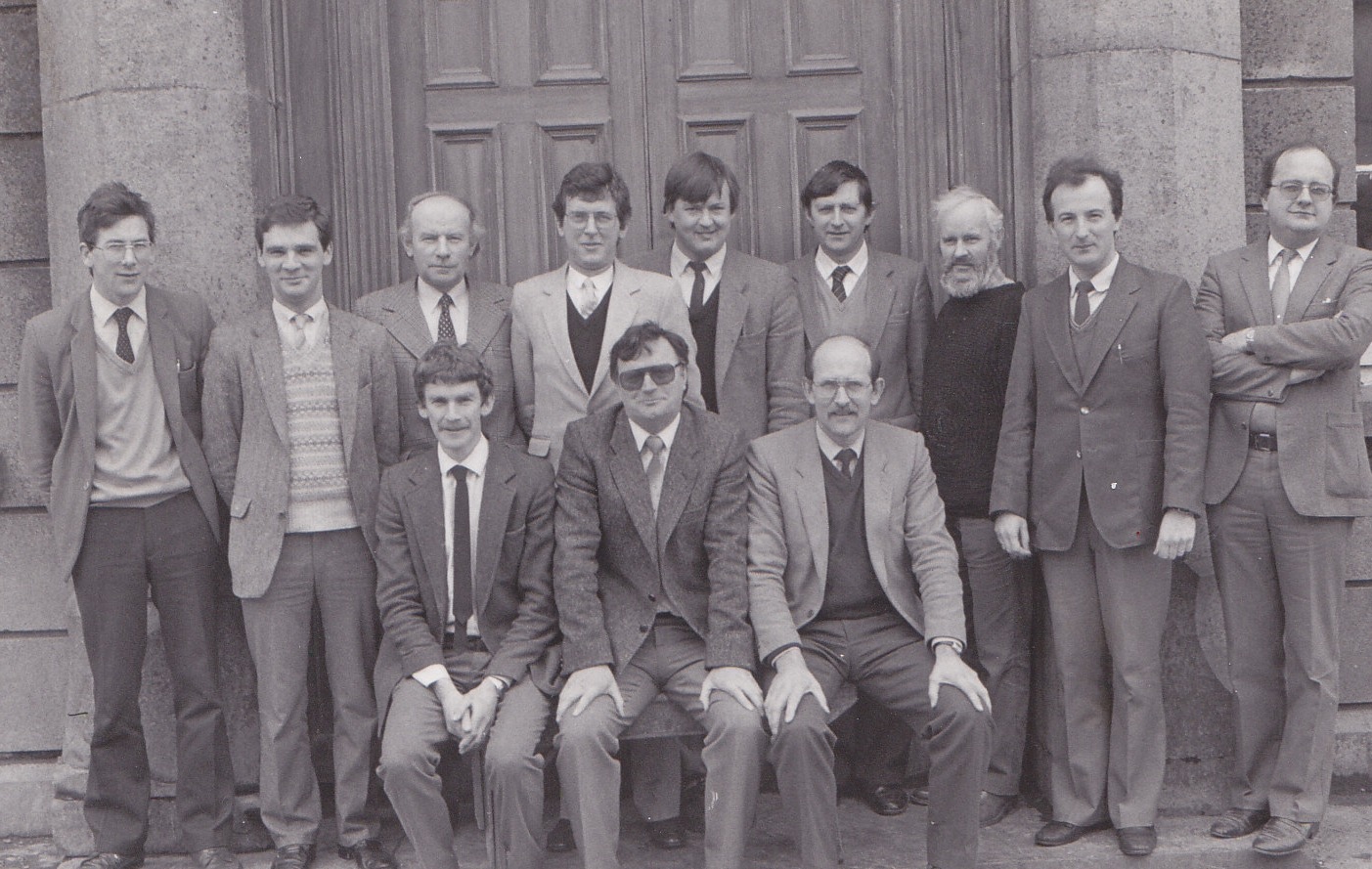
St. Ita's Secondary School Staff 1986.  Missing from the photograph is the then Deputy Principal, Donncha Ó Murchú.  The appearance of this staff photo, taken in 1986, in Facebook earlier this year provoked a virtual avalanche of nostalgia and all the memories and nicknames resurfaced once again like recurring cold sores!
St. Ita’s Secondary School Staff 1986. Missing from the photograph is the then Deputy Principal, Donncha Ó Murchú. The appearance of this staff photo, taken in 1986, in Facebook earlier this year provoked a virtual avalanche of nostalgia and all the memories and nicknames resurfaced once again like recurring cold sores!

There is a stark universal truth that I have discovered and it is true today more than ever before: a school is only as good as its teachers.   For fifteen years of my teaching career I taught in a school that would have been condemned as unfit for purpose or human habitation in Dickens’ time.  Indeed, there are those who think that Dickens modelled Mr. Gradgrind’s school in Hard Times on St. Ita’s in Newcastle West!  However, all who ever entered its hallowed halls would probably admit that it was a great school and is proof positive that modern facilities are not the only requirement for a good education.

 I was also reminded of ‘the good old days’ recently on reading an article by Dr. Pat O’Connor, an illustrious past pupil of the school, which appeared in a commemorative booklet produced to celebrate the Fiftieth Anniversary of the school’s opening in 1986.  He attended St. Ita’s from 1959 until he sat his Leaving Cert in 1964.  He says that, “these were happy, constructive, creative times, and the school provided the milieu for a learning odyssey which continued throughout the palmy decade of the 60’s”.

 The official name for the school was St. Ita’s Secondary School, in deference, I think, to the fact that Jim Breen and Dave Hayes both hailed from Killeedy, the one remaining St. Ita’s stronghold. However, the school was variously called ‘The Library’ (the building had originally been a Carnegie Library) and later ‘Jim Breen’s School’ as a local compliment and mark of respect to the man who became Manager and Principal of the school for nearly fifty years – the school becoming synonymous with his name.

 Pat O’Connor is lavish in his praise for Jim Breen and he says that he, ‘made a distinctively personal contribution during the lean years that saw a blossoming of second level education in this country.’  He goes on to say that he, ‘asserted a strong presence and, being a big man physically, he rarely had to repeat anything.  He was a strict disciplinarian, meticulous in attention to detail, but never petty or vindictive.  He led by example in the sense that his own work bore the stamp of discipline and commitment.’  The sight of his green Volkswagen Beetle, registration number AIU 524, was enough to elicit an instant quickening in the step of many a tardy pupil.

 In those early years he gathered around him a small band of doughty men who came armed with a rich diversity of teaching skills.  Tim Murphy was one of those early arrivals.  Pat O’Connor remembers him as, ‘a quiet spoken, amiable mentor, thoughtful, and on occasion, thought provoking.’  He remembers with affection the prayer which Tim introduced to the Leaving Cert class of 1964.  Given a sufficiency of faith, it had, he said, never been known to fail!

 Another of that small band of teachers, Dave Hayes, brought style and panache to bear on the teaching of Latin.  According to Pat O’Connor he was, ‘unquestionably a classical scholar of stature.’  This assessment was reinforced later during Dr. O’Connor’s first year in UCD, when a well-known lecturer and future Minister for Education, John Wilson  no less, could, in his view, ‘do no better than stand in the long shadow of Dave Hayes’.

 Willie O’Donnell taught English at senior cycle level and employed strategies supremely well suited to cope with the rigours of the examination system.  A man well acquainted with the technicalities of language, he had a particular fondness for the double entendre, and one of his most favoured concerned the numbers of students from the school who would, ‘go down in history’!

 Donncha Ó Murchú arrived on the scene as a very young man in September 1959.  No sooner had he arrived than he was subjected to the kind of initiation rites that pupils like to try out on young inexperienced teachers.  However, Pat O’Connor remembers that Donncha proved to be a doughty survivor who had a marvellous feel for history.

 Pat remembers the arrival of Noel Ruddle to the school in 1963 and considered him to be the consummate teacher who introduced the new age of science to the school.  He was enthusiastic, bright, analytical and able.  Noel went on to become Principal of the school in 1977, although his time at the helm was cut tragically short through illness.

 In the 80’s numbers burgeoned, thanks in no small part to Donagh O’Malley and his introduction of ‘Free Education’ in 1967. After Noel Ruddle’s untimely passing in 1981 the baton was passed to Des Healy who became Principal and later Manager after the death of Jim  Breen in the summer of 1984.  He was supported in its final years before amalgamation by Paddy Geary, Dave McEnery, Paul Edmonds, Donncha Ó Murchú, Pat Hayes, Mike Kennedy, James Egan, Andrew Ryan, Barry O’Brien, Tommy Devine, Sean Flanagan, Mary O’Shaughnessy  along with the author of this tribute.  However, by then the  need for proper, modern educational facilities became a clamour which could no longer be ignored and plans for an amalgamation of schools in the town was proposed and acted upon by a vibrant committee during the 80’s, culminating in the opening of the new Scoil Mhuire agus Íde in September 1992. For many the traumatic move to Boherbuí was lessened in its severity by the knowledge that Paddy Geary, St. Ita’s to his core, was to become the Principal of the new educational adventure in Newcastle West.

 A word of caution to all as we remember those days:  in invoking and trying to preserve the past we can’t allow ourselves to be too maudlin and sentimental.  As Michael Hartnett, Newcastle’s Poet Laureate, (himself a past pupil of the school) points out:  ‘too many of our songs gloss over the hardships of the “good old days” and omit the facts of hunger, bad sanitation and child neglect’.

 Most of us who experienced and survived the building, the poor sanitation, the lack of proper toilets, know that all this only added to its mystique; the telephone was not installed until 1986!  All who entered under its portals were rendered immune forever from all contagious diseases following their exposure to the culture of the place!

 In conclusion there is another stark universal truth that I discovered while teaching in St. Ita’s:  a school is only as good as the students who pass through its doors.  In this respect, as with its teaching staff down the years, St. Ita’s was truly blessed.

Last Day in St. Ita's - Friday 29th. May, 1992
Last Day in St. Ita’s – Friday 29th. May, 1992

The Homesick Garden by Kate Cruise O’Brien

The Homesick Garden

Reviewed by Mary Hanley

The Homesick Garden is a very unusual masterpiece. Antonia’s voice carries us through the novel and her unpretentiously clear way of looking at things evokes a complex mixture of admiration, despair and delight! The novel is a chronicle of life, charting Aunt Grace’s unexpected pregnancy and the way various members of Antonia’s family cope with this bombshell. At times Antonia’s view on life can be agonised but overall her no-nonsense approach is uplifting, “I liked the house silent and calm and bare without the angry little noises made by two people disliking each other.” This is Antonia’s critical view on her parent’s relationship!

 The significance of the title in this novel is not by any means extremely relevant. The Homesick Garden is mentioned in the third chapter, “The second rule is ….. the second rule is my homesick garden.”  More importantly however is the  “homesick-garden-time” when Antonia’s  “Mum went off for a week. She’d been doing a lot of crying around that time. ‘I can’t cope!’ she would shriek.” This time obviously affected Antonia greatly and the homesick garden was never used again ‘after that summer’.

 We meet various zany characters during the course of the novel. Antonia is the watchful young narrator. The novel is literally smattered with theories on life. These theories are brought to the reader through Antonia. I felt that when I reached the end of the novel the trivial pieces of information faded into oblivion while Antonia’s ‘theories’ will certainly stay etched in my memory. This, I feel, is the legacy Antonia leaves us with.

 “Schools do label people because they’re brisk, convenient places and labels are brisk, convenient things. Once you’ve got a label, it sticks. So I was Clever Antonia and Stephen was Odd. If I had won Miss Ireland and Stephen had been declared All-Rounder of the Year, I don’t suppose it would have made much difference at school.”

 Antonia grows during the course of the novel. An example of this is her contrasting views on relationships at both the start and end of the novel, “At my worst, well at my worst I know that I can’t go out with boys”. While, in the concluding paragraph of the novel, Antonia woefully declares that, “As for Stephen, I think I’ll be an old, old woman before he does more than hold my hand in public and he’ll be an older man before I reach out and touch him”!!!   I enjoyed Antonia as a character throughout the novel and even though she didn’t add as she said herself “oomph” to the novel, I believe, she added a whole lot more.

 Elizabeth and Grace are the other main characters and they add an extra dimension to The Homesick Garden. They are interesting in the different methods they use in coping with the same situation. Elizabeth is the classic victim, “Mum has a pretty good figure when she sits up straight but something about Grandma’s biscuity voice makes her round her shoulders and cringe her arms over her front, defending herself again, poor Mum.” She also has a tendency to brush things under the carpet. Firstly, she treats Grace as if “her pregnancy had never been”.  She deals with her problems through the therapeutic method of cleaning with the dastardly Mini Maids and frail window cleaners in tow!  “Cleaning is”, after all, ”better than any other exercise.”

 Grace, on the other hand, aired everything out in the open and when she caused as much uproar in everyone’s life as she possibly could, she just vanished and hibernated for nine months. Grace is a very frank and earthy person and “she just loses her shape in her draperies” and, of course, “She was passionate about privacy”.  She literally let everything go to hell and buried her head in the sand while Elizabeth had to be there to pick up the pieces.

 The major themes running through this novel include the issue of maturation, the problem of abuse is also highlighted, while cleanliness is, yet another theme. The theme of relationships is intricately woven throughout the novel.  At the end of the novel we discover the reason for Elizabeth’s lack of self-confidence in relation to Grandma and the poor relationship she has with Antonia’s father. She had been physically abused by Quentin- a pompous young teenager whose family, the Thompson’s “hob-nobbed” with Grandma. Through Elizabeth, we receive a heart-rending and unsettling account of something that happened over thirty years ago but was still affecting her everyday life, “I was so frightened of it that I kept on forgetting about it. Until the next time.” “Did you get over it? ”, Antonia asked.  ” Maybe I’d have got over it, if I hadn’t trivialised it, made some sort of wrong sense of it, if I’d tried to remember it more often. But I sliced it off, put it in a separate compartment in my mind.” This voice of experience is coming from the Elizabeth who used to “shake and tremble whenever anyone is cross with her”. Ironically, this is a ‘coming to terms with’ novel for Elizabeth, while it is a ‘coming of age’ novel for Antonia.

 Cleanliness, is a strange but relevant theme throughout the novel. Antonia’s father plays an important role in this area. Unfortunately, this poor individual is not given a name! ”Dad is always pompous when he’s nervous”.  He is a very prim and proper man who, “doesn’t even answer the door in an emergency unless he’s shaved and has his socks on, armed to meet the world”!  Well, we all have our problems in life!!! Cleaning can have very peculiar effects on people’s personalities. For Antonia’s father, he just could not stand the Mini Maids working for him, even though he is,  “never very clear about why he can’t put up with them”. For Antonia, ”the kitchen transformed me from Florence Nightingale into Pioneering Woman”!

 I liked this novel. Even though it appeared to be ‘a light read’ it dealt with some important issues. Although The Homesick Garden is Kate’s first novel she already has a renowned track record as the author of many collections of short stories. Kate, I believe, has a natural story telling ability and a knack of engaging the reader with the issues she chooses to explore, “I wish I could say that everything changed, changed utterly, after Mum’s revelation’s and that a terrible beauty was born”. Nothing mind shattering occurred during the course of this novel, yet it was a pleasure to get to know Antonia and her family. I came across a definition for reading today- ‘the intimate act of opening a book and getting lost within the covers’. I feel I accomplished that while reading this enchanting novel.


 About the author….

 Kate Cruise O'BrienKate Cruise O’Brien was born in Dublin in 1948.   She was the youngest daughter of the politician, historian and diplomat Conor Cruise O’Brien and his first wife, Derry born Christine Foster.

Kate studied English in Trinity.  Her first short story, Henry Died, was published in New Irish Writing and won the Hennessy Award in 1971 when she was only 22.  The same year she married Joseph Kearney and they had one son, Alexander.

Her first book, A Gift Horse and Other Stories was published in 1979.  It won the Rooney Prize for Irish Literature.  She worked as a columnist with The Irish Independent during the ’80’s and her second book, The Homesick Garden was published in 1991.

Kate Cruise O’Brien died suddenly in March 1998 and she is buried in Glasnevin Cemetery.


2014 in Review

The WordPress.com stats helper monkeys prepared a 2014 annual report for this blog.

Here’s an excerpt:

A San Francisco cable car holds 60 people. This blog was viewed about 450 times in 2014. If it were a cable car, it would take about 8 trips to carry that many people.

Click here to see the complete report.

Delivering The Post on Christmas Day – in Newcastle West long ago!

Michael Healy served as postman in Newcastle West for 45 years from the early Thirties until the Seventies.  In this article, which he wrote for the Newcastle West Historical Society Journal, The Annual Observer, published in July 1979,  he recounts the vicissitudes of the job and why he wasn’t sorry to see the Christmas Day deliveries come to an end.


THE POST ON CHRISTMAS DAY

By M.J. Healy

Micky Healy with his handcart in Maiden Street in 1936

One of the Post Office services no longer available is the delivery of mail on Christmas Day.  We haven’t had it for many years.  To the older generation this is something to be regretted; a nostalgic yearning for the passing of a custom that lent a Dickensian flavour to the Festival, akin to the star on the Festive Tree, Christmas carols and robins pecking crumbs in the snow.  But, to the unfortunate postman, Christmas Day was the most arduous of the whole year; consequently, the abolition of the Christmas Day deliveries was greeted by all and sundry in the postal service with considerable relief.

Our working day in the early 1930’s began around 7a.m.  It was part of my duty to meet the 7.15 morning train from Limerick and transport the Newcastle mails in a handcart to the Post Office in Bishop Street.  This meant being at the railway station at 7.15 on the dot, summer and winter, as the train halted in Newcastle for a mere ten or twelve minutes and a Post Office Official (the grandiose title for a thirty shilling a week postman) had to be on hand at this ungodly hour for reception of the mails from the carriers, the Great Southern and Western Railway, else he might find himself forced, at his own expense, to follow the train to Listowel to collect the mailbags.  The mail, in the 1930’s, was comparably small; a mere eight or ten sacks.  In those halcyon days, it never entered your head that you might be molested and robbed by a bandit in the dark of a winter’s morning, so the duty was easy for an early riser.

The Christmas Mail was something different.  Before the intrusion of high-pressure brain-washing, there were no appeals for early posting at Christmas, so why post a week earlier?  This meant mail descending in shoals on every Post Office in quantities that would seem impossible for delivery in one day.  Often the increase in numbers could be as high as ten or fifteen times an ordinary Mail.

There being no 7.15 Limerick Train on Christmas morning the Mail was sent to Newcastle in a huge lorry.  Instead of 7.15, the lorry was usually an hour later.  The chaos began trying to take the Mail out of the vehicle.  The volume (comparably) was enormous, sixty or seventy huge bags.  These had to be disentangled from the Abbeyfeale and Listowel Mail, as the lorry driver, on a once-a-year job, hadn’t a notion of making it easier.  The primary aim was to divide the mail for the adjoining sub-offices, which had to be ready around 9.30 or 10 a.m., when the late Dinny McAuliffe R.I.P., or one of the other local hackney drivers, took the mail to Tournafulla, Kilmeedy or Knockaderry etc.

The completion of this task depended on the American Mail.  By some devilish twist of fate the White Star and Cunard Lines seemed to arrive in Cobh just before Christmas to scatter thousands of tons of Christmas Cards all over Munster.  Most people looked forward to hearing from relations in America and in the hungry Thirties the United States’ dollars were doubly welcome.  The American Mail on Christmas Morning was often equal to what you’d normally deliver in a week.

When the Mail was divided, each man had to put his letters and parcels in order for house to house delivery.  As an instance of what this could mean I had one house in my delivery with fourteen children, some grown up some toddlers, they all seemed to get cards and the total for this house on Christmas Day was never less than 70 or 80 items.  And I had almost 200 houses on my delivery.  With this amount of preparation, the day was usually half over before you were ready for the road, and the three or four hours overtime allowed was already squandered leaving only the normal six hours.  If you got going at noon this meant only four or five hours daylight for delivery.

Christmas Day, for Christians, was obviously one of the holiest days of the year, everybody went to Church.  But if you were a Postman – you didn’t – you couldn’t, you had to work.  Knowing the brief period of daylight one started off with little delay.  Even though you probably had nothing to eat since an early 7 o’clock breakfast the temptations of offers of roasted goose or ham or even cups of tea had to be ignored.  Eventually, hunger compelled you to accept some householders hospitality, meanwhile keeping an eye on your watch to waste as little time as possible.  To rural dwellers, the Postman was (and probably still is) treated like a distant cousin or a lifetime friend.  Then it was the custom to show this friendship with hearty Christmas hospitality.  There was a limit to the amount of turkey, ham, goose or fruitcake you could take.  But the bane of this form of conviviality was the man who took your arm in an iron grip and insisted you must have a little drop of something.

The arrival of the Postman with Christmas Mail always aroused intense excitement, especially in households with young people.  Letters were handed around, the children’s toys had to be admired, and somebody always remembered the Postman’s Christmas Box.  Being almost one of the family, nobody minded asking the Postman to do a favour during the year; bring a message from town, call with a message to the Vet or to a neighbour.  These favours were not forgotten at Yuletide and the Christmas Box seemed to give even more pleasure to the donor than the recipient.  But then there was always the few who felt your Christmas Box should be a drop of the hard stuff or a few bottles of stout.  These worthies always seemed to have the kitchen and parlour littered with cases of liquor and if you were unfortunate enough to have had one drink earlier and they smelt it, then it was a personal insult if you didn’t share their generosity.  I have often been told, ‘so-and-so, when he was delivering before the war (the 1914 one), would always have a bit of the goose at Christmas and three or four bottles of stout’.  One of these robust Postmen was reputed to partake of a hearty meal whenever offered and of course three or four or more bottles of Guinness.  Thus fortified, if there was a gramophone or a melodeon player available would often organise a half-set, or waltz the housewife around for a spell before setting off on his rounds again.  With 200 or more houses to deliver one might expect he’d hardly return before the New Year.  Yet he was always home stone sober with all his Mail delivered as early as seven or eight o’clock.  They were giants in those days!

The weather on Christmas Day was always most important, especially on the Post, endeavouring to race with the few hours of daylight one needed a dry road, and dry hands; nothing more messy than handling letters in the rain.  Nature seemed always kind; in 45 years I can hardly recollect 5 wet Christmas Days.

Wet or dry you suddenly realised with horror that darkness was coming.  Usually by then, around five o’clock, one might still have another 40 houses scattered over 7 or 8 miles to deliver.  Then was no time for accepting hospitality, nor indeed for being very genial, when in the dim light of an acetylene lamp you negotiated rough passages, struggled with immovable gates and quarrelled with snarling sheepdogs, who insisted you couldn’t be the Postman at this hour of evening.  Sometimes you might have to knock three or four times before somebody came to a doorway; people were beginning to lose hope of any Christmas Mail after darkness.  One occasion, after waiting impatiently for an answer to repeated knocking, I pushed open the kitchen door to find the whole family on their knees reciting the evening Rosary.  What could I do? At Christmas?  I dropped to my knees and joined in, hoping in my heart they had reached the fourth or fifth decade (actually it was the second)!

Coming home, your path might cross a Postman from a neighbouring route.  Then you thought your day was terrible, listen to his, etc. etc.  Most of the men were back between seven and 8 o’clock and without expecting much sympathy, stories of their various misfortunes were bandied about before finishing work.  One had been bitten by a dog.  Another fell off his bike.  Then there was the man who crossed a footbridge over a stream and coming back walked into the river up to his knees.  He showed you the ends of his pants still wet.  And the punctures – every year somebody got a Christmas Day puncture.  Then there was the man who got home always early on Christmas Night.  He never accepted hospitality and hence didn’t delay on the road.  One particular year we found out why.  He could never eat with his dentures in and of course, had no trouble taking them out at home.  He had the misfortune one Christmas Day of getting so hungry at five o’clock that he accepted an offer of a sandwich and a cup of tea.  Taking out his teeth and putting them aside he hurried the meal and hastened away to finish his route.  What was his horror to discover when he returned to the Post Office that he had forgotten his dentures and horror of horrors he couldn’t remember where he had the meal and where they were left.  He told me it was well into the New Year before he found them.  As he said, ‘You’d be ashamed to inquire from anyone if you left your teeth at their house on Christmas Day’.

I sigh when I hear old people say, ‘Ah sure, it isn’t like Christmas any more without the Christmas Day post’.  And round-eyed youngsters enquire, ‘Did you really have a delivery on Christmas Day?’

We did indeed child!  We did indeed!

FullSizeRender - Post Office NCW
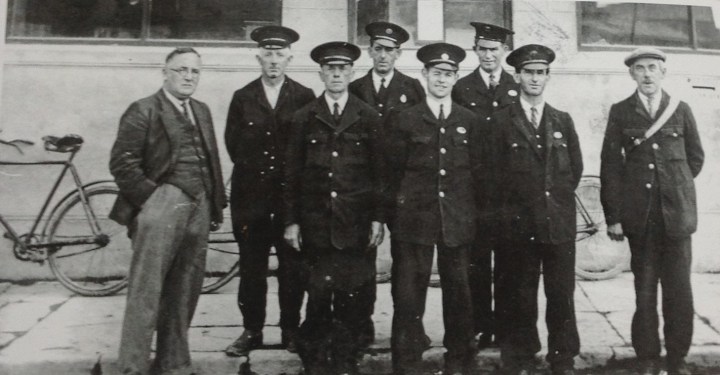
Postmen outside Post Office circa 1935 L to R: Denis Moylan (Postmaster), Dinny Hunt, Pat Keating, Tommy Sheehy, Danny Roche, Charlie Haynes, Jackie Sullivan and Jackie Hunt. Information gleaned from ‘Newcastle West in Close Up – Snapshots of an Irish Provincial Town’ published by Newcastle West Historical Society (2017).


Christmas in Maiden Street – ‘in the good old days’!

Vincent Hanley's avatarReviews Rants and Rambles

 This piece of incisive and insightful social commentary, describing life in Newcastle West in the 1950’s, first appeared in Magill magazine in December 1977 and later in the Journal of the Newcastle West Historical Society, The Annual Observer, in July 1979. Hartnett,the poet, was back in town and the dam burst of memory and nostalgia was beginning, culminating with the bitter sweet Maiden Street Ballad, written as a Christmas present for his father, Denis Hartnett, in December 1980.

Christmas in Maiden Street
By Michael Hartnett

image

A shouting farmer with a shotgun, a few patch-trousered urchins, soaked, snotty and unrepentant, running across wet fields, arms full of holly. The long walk on the railway tracks, the sleepers treacherous and slimy, the dark station, the lamp posts with their glittering circular rainbows. We stopped at the shops’ red windows to admire toys we could never have. A few drunks waltzed by, happy…

View original post 463 more words