The Themes of Pride and Prejudice in ‘Pride and Prejudice’


pride-prejudice-750x290

The Theme of Pride

In Pride and Prejudice, Jane Austen looks at people who are guilty of pride, and the effects it has both on their lives and the lives of others.  Everyone in the book has some degree of pride, but the key characters are often caricatures of proud people: Mr Collins and Lady Catherine de Bourg.  Darcy and Elizabeth develop as characters during the course of the novel and they are also seen to have pride as part of their personality.

Caricatured pride is shown by Austen to be obnoxious.  Lady Catherine is proud because she was born an aristocrat, raised to believe herself to be superior to others.  She is patronising, believes she has a right to know and judge everything and gives petty advice because she needs to feel useful.  She always likes to be the centre of attention, and she expects to be always obeyed.

Lady Catherine is challenged by Elizabeth, who unlike everyone else, is not overawed by her. Lady Catherine is outraged when Elizabeth answers her back at Rosings and later when she barges in to Longbourn.  She tries to bully her at first, ordering her not to marry Darcy and finally insulting her by saying that accepting Darcy will pollute the shades of Pemberley.  She demands instant submission  and when this is not on offer her pride is severely dented.

Mr Collins had long been supplying this need.  He had been raised with ‘humility of manner’, but living at Hunsford has made him a mixture of ‘pride and obsequiousness, self-importance and humility’ and this lapdog servility makes him even more unlikeable in our eyes.  The key scene showing Collins’s pride comes with his proposal to Elizabeth, where he not only assures her he will not despise her for being without a dowry but tells her that she might as well accept him, for he is the best she can expect.

Elizabeth herself, though chiefly signifying prejudice, is guilty of the pride on which this prejudice is based.  Darcy tells her when he proposes, ‘Had not you heart been hurt … (my faults) might have been overlooked’, and in the key chapter that follows, she admits this.  She has been convinced she was right about Bingley’s treatment of Jane, Charlotte’s and Collins’s marriage, Wickham’s goodness and Darcy’s lack of worth.  She learns that her prejudice has been due to her belief in the infallibility of her own judgement.  Also, she realises her vanity has been wounded.

The distinction between pride and vanity is made early in the novel.  Mary comments that ‘pride relates more to our opinion of ourselves, vanity to what we would have others think of us’.  As well as pride, Elizabeth has, therefore, been guilty of vanity.  She has been far too influenced by Wickham’s attention and Darcy’s neglect.  She admits this immediately, making an honest effort from then on to be neither proud nor vain.

The chief representative of pride in the novel is Darcy.  On his introduction in Chapter 3, he is said to be proud.  He seems withdrawn, superior and cynical.  He puts Elizabeth down coldly with a patronising comment about her looks.  Later, despite his infatuation, he feels himself superior to Elizabeth and kindly condescends to ignore her towards the end of her visit to Netherfield so that ‘nothing could elevate her with the hope’ of marrying above herself.  Pride convinces Darcy he is right to interfere in Bingley’s relationship with Jane, and pride keeps him from lowering himself and his family by disclosing Wickham’s bad nature.

By the time he makes his first blighted proposal to Elizabeth, Darcy is firmly established in our minds as the epitome of pride.  The proposal, ‘not more eloquent on the subject of tenderness than of pride’, reveals a Darcy who considers he is doing her a favour.  She is outraged and accuses him of ‘arrogance’ and ‘conceit’.  Were he a lesser character, like Mr Collins, for instance, he would have sulked and moved on to fresher pastures, but Darcy, the hero, ponders Elizabeth’s accusations, realises the truth in them and he resolves to change.  At first, we only see his outward transformation, his gentle behaviour at Pemberley, his assistance to the Bennets after the elopement.  It is only after his second and more successful proposal that we see evidence of his complete change of heart.  Loving Elizabeth has made him realise that people can be good despite their humble origins and that love is not compatible with condescension.

We must remember of course that Darcy was never all bad.  Our view of him as such is largely formed by Elizabeth’s prejudice.  His reputation for being proud largely stems from his being shy and his dislike of socialising.  He may put people down, but he also helps them, as friends and dependants.  Remember his housekeeper’s kindly comments: ‘Some people call him proud; but I am sure I never saw any thing of it’.

By the end of the novel, Darcy still has some pride, but with good reason.  The mature Elizabeth has learnt, as have we, that there is good pride and bad.  ‘Vanity is a weakness’, says Darcy, but with ‘superiority of mind, pride will always be under good regulation’.  Elizabeth, thinking he is guilty of both, smiles.  But Darcy is right.  Vanity, as seen in Lady Catherine, Mr Collins, Elizabeth, and even in Darcy himself, is wrong, but pride, while also being wrong, can be acceptable if properly controlled.  In many ways, Darcy controls his pride.   The Darcy who saves Lydia and marries Elizabeth is a well balanced mature individual.  He is master of Pemberley and Elizabeth sees this in a positive light; he has many good attributes and a capacity to help his family, tenants and friends.  She defends Darcy to her father, telling him that he is proud, but has ‘no improper pride’.

Lady Catherine and Mr Collins don’t change in the course of the novel but Elizabeth and Darcy do. Having learnt a valuable lesson they both are now ready to take up residence at Pemberley and reign supreme at the centre of Austen’s universe!
e8675-pride-and-prejudice-2005-movie-download

THE THEME OF PREJUDICE

In this age of political correctness and media spin the notion of prejudice, as described in the novel, is very pertinent.  In the novel, Jane Austen talks about the idea of ‘universal acknowledgement’, where society in general takes a united (and she infers, a biased) stand, welcoming Bingley because he is an eligible bachelor, rejecting Darcy because he seems proud and favouring Wickham because he flatters and charms.

Against this background of public prejudice, Jane Austen presents several particular illustrations of people who confuse appearance with reality because of their personal bias.

Mrs Bennet is probably the most humorous example of this, seeing the world in terms of the wealth and charm of potential husbands.  Thus, she is blind to Collins’s faults, is deceived by Wickham, and yet cannot see Darcy’s real worth: ‘I hate the very sight of him’.  (Yet, worryingly, she welcomes Wickham as Lydia’s husband even though he nearly ruined her reputation and the reputation of her family).

There are many examples of social prejudice and snobbery dealt with in the novel (and this overlaps with the vice of pride).  Lady Catherine, Collins and the Bingley sisters all fail to see the real Bennets when they judge them early on.  Look at Collins’s proposal and how he constantly reminds Elizabeth of her inferior position in life, echoing the comments of Lady Catherine at Rosings.  The Bingley sisters spend several sessions judging Jane and Elizabeth on their relatives and their wealth.

Darcy, though in the main clear-sighted and intelligent in his approach to life, at first joins in this social snobbery.  His initial opinion of Elizabeth herself was formed by her lack of beauty and then compounded by her lack of connections.  This snobbery led him to influence Bingley away from Jane and to resist his own infatuation for Elizabeth.  It is only when Elizabeth points out his pride, after his first proposal to her, that he realises his mistake and he makes an honest effort to change his behaviour.  By the end of the novel, he respects Elizabeth’s family and sees only the true Elizabeth, not her social standing.

It is Elizabeth who most typifies prejudice for us.  The first time she and Darcy meet he snubs her and this turns her against him.  From then on, instead of attempting to understand him, she reacts only to his proud outer appearance and delights in fuelling her prejudice as much as possible.  At first, she can be pardoned for disliking a man who has insulted her but, as she admits, her reasons were not sound.  She wanted to score points, to seem clever, and to say something witty.

It is not until the first proposal that Elizabeth begins to doubt her judgement.  After all, she has been prejudiced against Darcy because of his insensitive remarks and in the case of Wickham, her judgement has been clouded by sexual attraction and flattery.  In the crucial Chapter 36, Elizabeth considers Darcy’s letter and there follows a careful account of how she overcomes her prejudice.  At first totally biased against Darcy, without ‘any wish of doing him justice’, she then realises that if his account is true, she must have deceived herself.  Notice how by putting the letter away she literally refuses to see the truth.  Almost immediately, however, her strength of character triumphs, she rereads the letter, and Elizabeth now sees the situation clearly.  She admits to being ‘blind, partial, prejudiced’ and achieves insight into the situation and her own character.  She admits her fault to Jane, and by letting Wickham know that she sees the difference between appearance and reality, she makes a public statement of her new self-knowledge.

She sees things in a clearer light from this point on, viewing Pemberley with unbiased eyes and meeting Darcy with an open mind.  She also begins to understand his criticisms of her family, seeing them objectively possibly for the first time in her life.  Finally, she comes to accept Darcy as an acceptable partner and she works hard to overcome her family’s prejudices against him by presenting him in his true light.

Elizabeth has learnt many valuable lessons at the end of this novel: she now knows that ‘first impressions’ are rarely sufficient and she comes to see the reality of true worth, not the appearance of it.  There may be lessons here for us as well.  Our age is obsessed with image, and spin and outward appearances and social snobbery.  Finding our own Elizabeth or Mr Darcy is not going to be easy either!
 

Character Study of Elizabeth Bennet and Mr Darcy in ‘Pride and Prejudice’

pride-prejudice-750x290 

pride-and-prejudice-2

Elizabeth Bennet

Elizabeth is the central character in Pride and Prejudice – indeed it could be said that Elizabeth is Pride and Prejudice.  She is the main focus of our interest, she is the novel’s heroine, even though she makes mistakes and is not particularly heroic.  Her personality, her attitudes and her development throughout the novel bring together the story and all the other characters.  The novel is concerned with pride and with prejudice and she and Darcy are the main players.  She is Mr Bennet’s favourite daughter and her ‘quickness of mind’ is made evident in her witty and teasing conversations, where she often adopts striking and independent views.  (See Chapters 8,9, and 11, when she is looking after Jane at Netherfield, in her conversations with Bingley, his sisters and Darcy).

She likes to laugh at people, including herself.  She shares her capacity for irony with her father and the narrator.  This allows her to stand back and offer judgements on certain situations.  She often says the opposite of what she really means.  In Chapter 6 (p. 27) she says, ‘Mr. Darcy is all politeness’, as a way of avoiding dancing with him after his rude remarks earlier.

A key passage in reviewing Elizabeth’s growth is Chapter 36 when we see her painfully coming to terms with her mistaken understanding of Wickham and Darcy while reading Darcy’s letter.  She is forced here to confront some of her prejudices and earlier judgements, and in doing so realises that she has not been as sharp a reader of character as she has previously supposed.  She blames herself for not having recognises the smack of ‘impropriety’ in Wickham’s behaviour, but had allowed herself to be deceived by his charm.

Elizabeth’s most appealing characteristic is her independent streak, her ‘self-sufficiency’.  She judges things for herself and she is capable of decisive action as when she calmly, yet firmly, stands up to Mrs Bennet over Mr Collins’s proposal.  She argues later that it is this ‘self-sufficiency’ which made Darcy fall in love with her.

However, though formidable at times, Elizabeth is also emotional.  She feels great affection for Jane  and is concerned for Lydia and Kitty.  She is very close to her father, though she is often exasperated by her mother’s behaviour.  She is very kind-hearted and we see this in her relationships with Charlotte and Georgiana.

She is not faultless, however, and her main fault is her prejudice.  As Darcy is Pride, so Elizabeth is the Prejudice of the book’s title.  She may see and judge for herself, but often these judgements are based on appearance rather than reality, on her strong emotions, not on rational thought.  The two main targets for her prejudice are Darcy and Wickham.  She tells us that from the beginning she meant to be ‘uncommonly clever’ in disliking Darcy ‘without any reason’.  In fact, her initial dislike is seen as being justified because Darcy’s first comment was cruel and offensive.  Afterwards, however, she delights in provoking him, and when he is denounced by Wickham, she is more than ready to believe the accusations made about him.  One moment she is stating firmly that she does not think Darcy capable of such inhumanity, the next she is totally accepting Wickham’s story that he is!  From the start, she is ‘out of her senses’ about Wickham’s looks and charm.  For the next twenty chapters (!) she takes Wickham’s side despite warnings from Jane, Mrs Gardiner and Caroline Bingley, all of whom, ironically, Elizabeth considers to be prejudiced!

Darcy’s letter opens her eyes to the truth.  He has already hinted that she only hears what she wants to hear.  She therefore makes a conscious effort to read his letter openly, and on the second reading does so, analysing it rationally and she finally begins to notice Wickham’s inconsistencies and the lack of any real evidence of goodness on his part.  She finally realises how ‘blind, partial, and prejudiced’ she has been.  She also realises that she has been guilty of the same fault she accused Darcy of having – pride.  She, too, has believed herself to be superior to others, and refused to believe she could be wrong, her vanity fuelled by Wickham’s attentions and offended by Darcy’s.  She realises that ‘Till this moment, I never knew myself’.  This is a crucial moment in the novel which marks her realisation of her faults and her decision to change.

Although she is still angry with Darcy, from this point on in the novel we see that she has changed and we see that she does try to see things clearly and without pride.  She admits her faults to Jane, tells Wickham she knows the truth about him, tries to work out her problems honestly and rationally, and from now on values Darcy.  It is her ability to do this which makes her the heroine of the novel.  Faced with the truth about herself, realising she has been badly affected by both her pride and her prejudice, she accepts the fact, thinks about it and acts on her conclusions.  She has, in effect, become a mature adult.

Her views on love and marriage also change.  Jane Austen uses Elizabeth to show us the mature, ideal marriage, and by contrasting through her eyes other, less worthy marriages, we ourselves learn what is best.  Elizabeth, at first, seems very clear about what she expects from a relationship.  As she tells Charlotte, she is not seeking a husband, let alone a rich one.  She despises courtship games, wants to know all about her partner, and when she hears of Charlotte’s engagement, her reaction is ‘impossible!’.  She slowly learns that her prejudice has led her astray.  Her visit to Hunsford shows her that such a marriage is not only possible but a fair compromise.  Darcy’s views, Pemberley, and the elopement show her too that financial and social considerations in marriage are important.  She needs to learn this before she can take a realistic view of marriage as a social union and become the responsible mistress of Pemberley. However, her view of marriage as an equal partnership is a very valid one and her refusal of Mr Collins’s proposal is vindicated.  His marriage to Charlotte works because it is balanced, and all that remains now is for Elizabeth to meet her equal – quite literally she too must meet her match!  Elizabeth needs a real partner, like Darcy.

It is worth your while trying to pinpoint the exact moment at which  Elizabeth falls in love with Darcy.  The fact that she dislikes and provokes him in the early part of the novel may well be a sign of her attraction, but Elizabeth does not admit this.  She claims to find him obnoxious and certainly has no second thoughts about refusing his first patronising proposal.  Not until her visit to Pemberley does she appreciate Darcy’s real worth and his change of heart, and she begins then to feel more for him.  Her view of marriage also begins to change.  She knows that Darcy is correct in his assessment of her family, and Lydia’s elopement only confirms this.  The inequalities between herself and Darcy are eventually overcome, and Elizabeth betters herself by marrying Darcy.  However, she never takes advantage of this.  Seeing Pemberley marks the start of her affection for Darcy because there she begins to appreciate his real character, rather than simply his wealth.

The elopement crystallises Elizabeth’s view of marriage – she now sees the ideal, and realises that Darcy could provide it, ‘answer’ her needs.  His generosity on Lydia’s behalf compounds her feelings and when he returns to Longbourn, Elizabeth is quiet and uncertain; he is now important to her and she knows that she needs his attention and approval.  But first, she must overcome the twin hurdles of Darcy’s family and her own! She defeats Lady Catherine first, defending the right of Darcy and herself to choose their own partner.  Her courage here against the formidable Lady Catherine surely encourages Darcy to propose again.  She then overcomes her own family’s prejudice against Darcy, showing that she is now a truly independent adult and ready to be married.

Her relationship with Darcy is sound.  They communicate well, give each other mutual support and affection and generally are good for one another.  She has found her true partner, with whom she can live at Pemberley, her true home.    At the end of the novel, Elizabeth is the happy heroine, the centre of everything.  She has not only changed herself through her newly found love for Darcy, but she equally has changed Darcy through his love for her.

images

Mr. Darcy

Mr Darcy is the hero of Pride and Prejudice.  He is entitled to be considered a hero because he has the capacity to change and mature and because he is a true partner for our heroine, Elizabeth Bennet.  When we meet him first, however, he seems to be the villain of the book.  He appears at the Meryton ball and is immediately disliked by everyone because he so obviously disapproves of the evening, will not mix, and seems above himself, particularly to Elizabeth.  What we learn about him later supports this view: he is ‘haughty, reserved ……. continually giving offence’.  These ‘first impressions’ are strengthened by more serious criticisms: his condescending manner towards Elizabeth at Netherfield, his actions to Wickham, his influencing of Bingley against Jane.

By the end of Chapter 33 we, like Elizabeth, have come to form a clear but negative view of Darcy.  Then he proposes, but patronisingly, and they quarrel, gaining self-awareness shortly afterwards.  From this point on, Darcy ceases to be an anti-hero  and begins to change.  We also begin to view him differently.  Once the truth behind Wickham’s assertions and the reasoning behind Darcy’s influencing of Bingley are known, Elizabeth begins to reconsider her opinion of Darcy.  The business with Wickham was, of course, a slander.  Darcy seems to have done all that could have been asked of him and more: to have judged Wickham correctly and to have been generous enough not to seek revenge for the planned elopement with his sister.  Over the Jane and Bingley affair, he seems to have acted honestly, if through pride, and his concern for Bingley’s welfare is touching.

We, like Elizabeth, begin to see things in a new light and to reconsider our own opinion of Darcy.  Notice that in fact the very first impression he gave, at the Meryton ball, was good: ‘fine, handsome, noble’.  We learnt too that he was intelligent and clear-sighted, and his conversations with Elizabeth certainly showed his thought and intelligence.  When she finally realises that Darcy is right for her, she comments particularly on his ‘judgement, information, and knowledge of the world’.  We are made increasingly aware also of Darcy’s real kindness and generosity.  He is an affectionate brother, trusted by Georgiana, a wise and generous landlord and a good friend to Bingley.  His free use of money to help first Wickham, then Lydia, is admirable.

In fact, Darcy’s chief fault is his pride, and this he honestly tries to conquer in the course of the novel.  His is the pride in the title of the novel.  He was brought up to be proud, almost trained to it.  At the start of the novel, he triumphantly defends it, though he realises the importance of controlling it, which he feels he can do.  However, he is wrong.  His pride does lead him to behave wrongly – on three occasions.  He conceals Wickham’s faults because he does not wish the name of Darcy to be humiliated.  He is totally convinced of his own good judgement over the matter of Jane and so influences Bingley accordingly.  Over Elizabeth, his pride causes him to despise her family connections, and though at first he resists, the attraction remains; he sees his own proposal as demeaning, without realising the implications of this for his relationship with Elizabeth.

Elizabeth reacts to his proposal with genuine anger, and for the first time in his life, Darcy’s ‘arrogance, conceit, disdain’ are challenged.  This is, of course, the point of change for Darcy.  He later tells Elizabeth that it took him some time to begin to alter, but in fact, by the next morning, he has understood enough to want to justify himself in a letter.  He thinks over his actions, slowly realising ‘how insufficient were all my pretensions to please a woman worthy of being pleased’.  By the time we reach Pemberley, he is eager to show his new persona.  His outward manner, unlike so many in the novel, is a sign of his inward change.  He accepts Elizabeth and her relations, and soon after accepts responsibility for Lydia’s elopement and arranges her marriage.  His final proposal expresses his hopes, but not expectations, of being accepted, and he admits his pride, with gratitude to Elizabeth for humbling him.

We must not, however, judge Darcy too harshly.  He is neither vain nor self-centred.  Much of his pride is valid, the natural result of being master of Pemberley, affording him a self-confidence that allows him to help others.  Equally, Elizabeth has coloured our view!  Much of Darcy’s pride is a figment of her own prejudice.  Her final declaration to her father, that ‘he has no improper pride’, says everything.

Although he represents pride in the novel, he is not without prejudice.  He sees beyond superficial appearance more quickly than Elizabeth but nevertheless dismisses her at first glance on her looks alone.  He soon changes his mind but is still put off by her inferior connections and does not consider her on her true merits.  He learns to recognise his priorities after she has rejected his first proposal, and on his return to Longbourn is not disheartened by his reception, also seeing clearly now what he before judged wrongly – Jane’s true feelings for Bingley.

Darcy is, however, generally more clear-sighted than Elizabeth, and points out to her that she is prejudiced.  This is the point of self-awareness for her and completes the circle whereby both hero and heroine are responsible for the other’s maturity.  It is evident that as Darcy develops and matures so too does his love for Elizabeth.  He is, from the start, Elizabeth’s obvious match; the story of their relationship is the story of the novel.  At first, he dismisses her, then is attracted by her ‘playfulness’ and her kindness to Jane.  His love is immature, though, and after her refusal of his proposal, he is forced to reconsider and reassess what she thinks of him and act on it.  Gradually he develops a genuine regard for her.  During the elopement crisis, his awareness and practical help both reflect and develop the growing affection he feels.  One thing is certain; only when Darcy overcomes his faults and infatuation and acts truly for Elizabeth’s sake can he hope to win her.  When he does, also righting the wrong he has done, by persuading Bingley after all to marry Jane, he proposes again.  He is now in a position to receive the ‘happiness’ he deserves.

Darcy and Elizabeth are the one true model union in the novel.  He is good for her; his pride shows her her own and through him, she learns how prejudiced she is.  He alone can stand up to her, balancing her uncontrolled emotion with his controlled rationality.  He ‘answers’ her totally, as no one else can.  Darcy is thus the hero.  He stands head and shoulders above all the other male characters in the novel.  His personality also contrasts with Elizabeth’s, complementing it, as has been said, and forming a true unity.  As her partner, he is as much the centre of the novel as Elizabeth is, though it is not seen through his eyes.  He represents the male ideal: intelligent, rational, shows good judgement and right action, has a handsome, moneyed appearance but is nevertheless valued for his true inner qualities.  He is indeed the ideal partner for our heroine; he is mature and unlike the New Man (Our 21st. Century Model!) he always considers her before himself!

 matthew-macfadyen-pride-prejudice


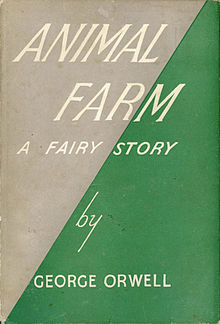
An Introduction to ‘Animal Farm’

Animal_Farm_-_1st_edition


The beast fable

The critic C.S.Lewis once remarked that the qualification for judging any piece of workmanship from a corkscrew to a cathedral ‘is to know what it is, what it was intended to do and how it is meant to be used’.  George Orwell, with nice irony, subtitled Animal Farm ‘A Fairy Tale’.  It is, in fact, an extended allegory.  As a literary term, allegory is not really difficult to grasp.  The writer of allegory describes a subject under the guise of another subject which has apt and suggestive resemblances to the first one.  The allegorical work conveys a meaning other than, and in addition to, the literal meaning.  If we read a story and conclude that beneath its surface meaning another meaning may be discovered and that the real point of the story resides in this other meaning, then we may safely conclude that we have been reading an allegory.  Even the least qualified reader of Animal Farm will no doubt reach such a conclusion.

Animal Farm is a special kind of allegory, the beast fable.  Most of us are familiar with this universal literary form through our reading of Aesop’s Fables.  Those who have read the Fourth Book of Swift’s Gulliver’s Travels will scarcely be surprised to learn that Swift’s talking horses are literary ancestors of Orwell’s talking farm animals.  A fable is a story designed to inculcate a moral about some aspect of human behaviour.  Sometimes (as in the case of Animal Farm) the moral or lesson is implicit in the story; sometimes it is explicitly stated in brief form at the end.  Like other writers of beast fables, Orwell uses animals and birds to represent the deeds and motives of human beings; like them, too, he has his moral lesson to enforce.

Satirical allegory of the Russian Revolution

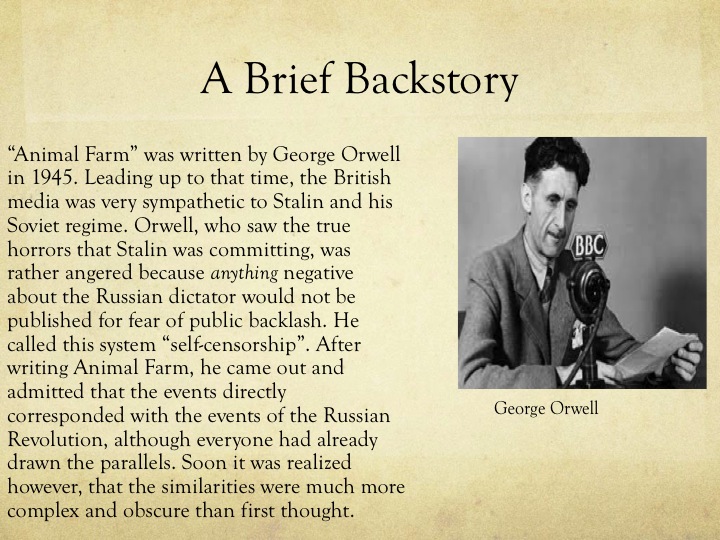
Every account of Animal Farm traces the fairly obvious parallels between the characters and motives of Orwell’s animals and those of the human beings they represent.  It was immediately clear to his original readers (in the mid-1940’s) that Orwell had written a fairly explicit satirical allegory of the Russian Revolution and the rise of Stalin, a circumstance which made it difficult for him to find an English publisher.  The parallels are easily traced.  Major is Lenin, although since he dies before the rising, the identification is not exact.  Napoleon is Stalin, and Snowball is Trotsky, whose quarrel with Stalin after Lenin’s death led to his expulsion from the Communist Party and from Russia.  Molly stands for those Russians who fled the country after 1917.  Boxer is an image of the loyal, uncomplaining proletariat, and Moses an unattractive representation of the Russian Orthodox Church.  The Battle of the Cowshed is clearly the Civil War that followed the 1917 Revolution; Western countries (Jones and his neighbours) sent troops to the aid of the dissenting White Russians.  The Battle of the Windmill is the German invasion of 1941.  Orwell pointed this out in a letter to his publisher.  He felt that at one point in the story he had been unfair to Stalin.  ‘All the animals including Napoleon,’ he wrote in the Windmill episode, ‘flung themselves on their faces.’  This he wanted altered to ‘All the animals except Napoleon flung themselves on their faces,’ pointing out that Stalin, after all, did remain in Moscow during the German invasion.

The moral lesson of the fable

So much for the main parallels between Orwell’s animals and their human counterparts.  What of the moral lesson of the fable?  His experiences during the Spanish Civil War and his close study of Russian politics made Orwell acutely conscious of what he called ‘the barbaric and undemocratic’ methods of Communist governments.  His main concern in Animal Farm was to make people in Western Europe see the Soviet regime for what it really was.

It appeared to him that since 1930 the USSR, far from moving towards socialism, showed clear signs of transforming itself into a hierarchical society in which the rulers (the pigs of the fable) were no more inclined than were the members of any other power elite to surrender their privileges.  Since it was the common view of Western European socialists that a genuinely socialist regime existed in Russia, Orwell saw it as one of his tasks to dispel this misunderstanding in a story that could easily be assimilated by almost anyone, and that would lend itself to easy translation into other languages.

At the end of Animal Farm it is impossible to distinguish the human beings from the pigs, the latter having entered heartily into commercial and social relations with their former enemies and abandoned the major slogan of the Revolution, ‘Four legs good, two legs bad.’  In his preface to the Ukranian edition, Orwell made an interesting (and perhaps surprising) comment on his ending.  A number of readers, he felt, might finish Animal Farm with the impression that it ends in the complete reconciliation of the pigs (the Soviet power elite) and the humans (the Western capitalist leaders).  This,  he pointed out was not his intention.  On the contrary, he meant the book to end on a note of discord.  He wrote it immediately after the Teheran Conference, which everybody thought, had established the best possible relations between the USSR and the West.  ‘I personally,’ Orwell observed with satisfaction, ‘did not believe that such good relations would last long; and, as events have shown, I wasn’t far wrong.’

EPSON scanner image

A novel of universal political truths

Some of the pleasure of reading Animal Farm lies in the reader’s gradual recognition of the parallels with modern Russian history.  The various identifications can be disclosed rather like the answers to a crossword puzzle, or chalked up on the blackboard like so many equations.  But the question arises: once we have made all the identifications what further interest are we likely to have in a work like Animal Farm?  It might be argued that even as an allegory of Soviet politics, the book has lost some of its original point, since Orwell clearly did not contemplate, for example, such developments as those associated with the Krushchev era, or the astonishing course taken by the Soviet system since the coming to power of Gorbachev in 1985.  Fortunately for Orwell’s reputation, his book is likely to attract readers long after the Russian experience has been forgotten, because it has large implications extending beyond the immediate circumstances of any single movement such as the Russian Revolution of 1917.   In several respects, Orwell’s fable embodies universal political truths.  What he describes is what happens sooner or later, to a greater or lesser extent, to all revolutionary movements.  The modern Chinese theory of continuous revolution as a means of preserving intact the ideals of the first revolutionaries is an interesting recognition of the dangers (so convincingly illustrated in Animal Farm) which attended all large-scale efforts at the betterment of the human lot.  Orwell’s book is a comment on the failure, as he saw it, of the Russian Revolution to fulfil the expectations of those who saw it marking a new era of true socialist democracy.  But it can also be read as a disillusioned recognition of the apparently inevitable failure of every great reforming movement to preserve its original momentum.  The French Revolution began in unbounded hope for a better world and petered out in the Jacobin terror.

Limitations of the moral fable

In Animal Farm, as in all moral fables, the author starts off with his abstract truth or idea, and uses his story to illustrate this, to give it life.  All the elements in the story are necessarily subordinated to the pattern dictated by whatever precepts the author desires to enforce on the minds of his readers.  Even these bald statements about the literary genre to which Animal Farm belongs suggest its almost inevitable limitations.  The major landmarks of fiction are exploratory in character; their important discoveries about human life and conduct emerge with the progress of the story.  Writers like the Orwell of Animal Farm, on the other hand, give the impression of having made their discoveries before composing their works.  The problem for all those who write fiction to illustrate pre-conceived ideas is that they must force a disorderly mass of experience into conformity with these ideas, which results inevitably either in some falsification of experience, or in a radically simplified view of it.  Inconvenient facts tend to be rigorously excluded.  Orwell, however, in choosing to illustrate what seems to be a universal human experience, is exempt from charges of distortion, whatever may be said about the limitations of his fable.

Orwell was one of those fortunate writers who recognised his limitations, who knew what suited his special talents and what did not.  Readers of his other novels will quickly realise that he found it extremely difficult to breathe life into his characters, none of whom is really convincing or memorable.  There is a sense in which Orwell is not really a creative writer, but a brilliant publicist, journalist, and apologist for liberal causes, who used the conventional fictional framework for his special purposes.  If he could not create life-like characters in his novels, he could at any rate write a great political fable.  What gives Animal Farm its vitality is not the kind of imaginative power one associates with a great novelist.  Such imaginative power was not really needed in this kind of work.  Orwell’s mind was one, which, like Swift’s, often contemplated the great human questions in political terms; like Swift, he found the beast fable an admirable vehicle for political ideas.  The almost perfect correspondence in Animal Farm between form and content at once helps to explain its astonishing popular success and to ensure its survival as a minor classic.

Slide02


An Introduction to ‘Lord of the Flies’


 de83d5f5f92194bb9cd10bac0c4f0fa8

Background note…

Lord of the Flies was published in 1954 and in it, William Golding sets out to create a disturbing and dystopian view of the world – a social experiment that goes horribly wrong.  The bleak aftermath of the second war to blight the Twentieth Century is still being felt in Britain, Europe and the rest of the world in the early 1950’s.  Images of the Holocaust and Hiroshima, along with personal war memories and experiences and other atrocities were still very raw in people’s minds.  This powerful novel can be included among other dystopian classics such as Aldous Huxley’s Brave New World and George Orwell’s 1984.  This genre of dystopian fiction represents the other extreme from Utopias, fictional representations of ideal political states or ways of life, the classical example here being St. Thomas More’s Utopia, a Latin work written in 1516.

Golding, as you will soon be aware, is very concerned with the pervasive influence of evil forces in our world, and he has few allusions about the counterbalancing forces of good.  It is possible to classify Lord of the Flies as a dystopian fable because in it Golding is casting a jaundiced eye on earlier and more optimistic variations on his theme, the best known of these being R.M. Ballantyne’s The Coral Island.   Lord of the Flies was written as a kind of parody of The Coral Island and Golding makes specific reference to it in his novel.  A very brief comparison with Ballantyne’s book helps us see what Golding is attempting in Lord of the Flies.  In The Coral Island, Ballantyne shipwrecks a group of upright, solid, church-going British boys, and allows them to build a decent imitation of British civilisation in their new and primitive surroundings.  In Lord of the Flies, the shipwreck is now a plane wreck; the boys are still middle-class British Christians.  Even the names of three of Golding’s main characters are similar to those in Ballantyne – Golding’s three central characters – Ralph, Piggy and Jack – are caricatures of Ballantyne’s heroes .  The vital difference between the two novels, however, is that whereas Ballantyne’s is thoroughly optimistic in spirit and outcome, Golding’s outcomes are disillusioning and pessimistic.

The need for social order

Lord of the Flies is a very grim illustration of the kind of situation that, as Golding sees it, must inevitably arise if the sanctions and controls of society are abandoned.  In this kind of situation, the great majority of human beings (whether boys or men) will choose destructive courses.  There will be the few who will choose order, whose acts reflect human decency and goodness, but they will be outnumbered and defeated by the evil tendencies of the many.  The ethos of Ballantyne’s island was that of the boy-scout camp; on Golding’s the greater number of the boys choose to enact the roles of savages, painting themselves, wallowing in an orgy of animal slaughter, sinking into bestial habits, engaging in torture, murder and sacrifice to false gods.

Speaking of false gods prompts a reference to the significance of Golding’s title for the novel.  This refers to Beelzebub, traditionally the most debased and disgusting of all the devils.  The young British Christians, most of all the choirboys, instinctively chose him, rather than the Christian God as the object of their worship.  This choice bears fundamentally on Golding’s views on human nature.  Golding is, above all, a didactic writer and he is trying, therefore, to teach us a moral lesson here.  One of his primary purposes is to expose what he sees as the shallowness of optimistic theories (he would see them as illusions) about human nature.  At one level, his novel can be read as a strenuous rejection of humanistic theories of human perfection.  It enacts an unrepentant belief in the traditional Christian doctrine of Original Sin; the doctrine which teaches that the first sin of Adam, as the old Catechism put it, ‘darkened the understanding, weakened the will, and left us a strong inclination to evil’.

A pessimistic world view?

This traditional view sets Golding apart from many of the modern ‘trendy’ currents of thought.  Few of us have escaped the influence of the romantic view of childhood as a time of glorious innocence; the cult of the noble savage has, since Rousseau, enjoyed widespread support in all kinds of fiction.  It was a common Romantic assumption that man was potentially a noble, upright creature if only he could be freed from the fetters of a corrupt society.  Golding is having none of this!  Not for him the vision of the child emerging in clouds of glory, or the inherent nobility of the savage life.  What he finds instead, is that only the slightest push, or the removal of sanctions or firm restraints, is needed for children, as well as for men, to tumble into unfathomable depths of depravity.  In Lord of the Flies he is trying to show us with what frightening ease man and boy can throw off all his superficial decency (‘off you lendings’ in Lear’s version) and regress back to that primitive state where ‘chaos is come again.’

To return to categories and literary genres for a moment, Lord of the Flies is a fable.  As Golding himself points out, the writer of fables is a moralist: ‘he cannot make a story without a human lesson tucked away in it’, very similar to the parables in the Gospels.  No matter how we look on this novel, however, it would be very difficult to describe Golding’s lesson here as a hopeful one.  For him, men are generally vicious, murderous and liable to extremes of self-degradation and animal behaviour.  What most forcibly strikes us as we read this novel is Golding’s intuition that, at best, civilising conventions and rules are passing things, but that what endures is man’s wild irrationality and his destructive urges.  A passing visit to Sky News or CNN or BBC News may confirm this for us on a daily basis!  Who would choose to live in Aleppo in Syria or the many cities in Iraq who have been condemned to untold barbarity in recent times?

 A realistic novel

Lord of the Flies has proved an extraordinary popular book, both from the point of view of general readership and among academics.  Golding may have conceived his novel as an allegory, but he is also a master of realistic fiction, and the book has a striking impact on the generality of young readers, for whom it is, here in Ireland as well as in Britain, a widely prescribed school text.  Golding was a teacher for a number of years, and has an instinctive understanding of, and feeling for, the characters and mannerisms of schoolboys.  One of the striking features of his method is his success in presenting his young characters in terms of idiom and linguistic habit (compare the under-educated, ill-spoken Piggy in this respect with Ralph and Jack).  The novel, for all its allegorical and symbolic overtones, is rooted firmly in real experience.  Physical sensations are admirably and tellingly rendered; the discomforts, unpleasantness, delights and other sensations associated with life on the island are evoked with astonishing realism.  The beautiful descriptions of island and sea are unforgettable.  Golding’s continuous success with the depiction of the physical realities of life, the rootedness of the book in the solid earth, is perhaps its most memorable feature for younger readers, most of whom, it is safe to suggest, can approach it on a realistic level without bothering unduly about its allegorical implications or its status as a moral fable.  Discussing the wider picture, the novel as fable or allegory or simply realistic novel with an eager English class, is one of the great joys and job satisfactions of the teacher of English Literature!

Symbolism

Academics have naturally tended to focus on the allegorical and symbolic features of the book, following Golding himself, who has strongly emphasised these in his critical comments.  There are numerous examples of symbols in the novel.  The shell or conch discovered by Ralph and Piggy has attracted a wide variety of such interpretations.  It is most obviously to be regarded as a symbol of the forces in the boys striving to uphold civilised standards and values.  The character of Simon attracts a good deal of symbolic weight also.  The pig’s head covered in flies is a symbol or sign of Beelzebub, the Lord of the Flies.  Simon’s hallucination of the monologue from the pig’s head is another symbolic feature.  But whatever importance one may attach to such matters, the vital consideration is that most of the episodes which obviously attract symbolic interpretations also work most successfully at a realistic level, which adds to the great appeal of the novel.

lord-of-the-flies-symbolism

Dream to nightmare

Golding has a remarkable gift for presenting abstract conceptions in compelling concrete terms.  One of the themes of the book that particularly appeals to younger readers is that it enacts a powerfully imagined version of the dream that most children cherish at one time or another of escaping from the restraints of a society controlled by adults.  What Golding does in Lord of the Flies is bring this dream to life.  But what he also does is to turn the dream into a virtual nightmare.  Escape from the stabilising forces of the adult world, instead of bringing about happiness, results in a riot of destructive individualism.  At the beginning, there is a vague, unsatisfactory sense of kinship and comradeship: Ralph and Jack, the two ‘mighty opposites’ of the later parts of the novel, can, at the beginning, look at each other ‘with a shy liking’.  The collapse of this sympathy, the breaking of most of the bonds of human kinship, is the stark reality which haunts Golding’s fable.  And even when the outside world comes to the rescue at the conclusion of the novel it only brings further reminders of disorder and war with the finding of the dead airman and the arrival of an armed warship.  There is little comfort, then, to be drawn from Golding’s dystopian novel: neither a ‘civilised’ environment nor the lack of it, seem to offer much hope of even limited perfection or happiness to human beings.

download (6)


Macbeth: Order violated, order restored….

logo

It is impossible to read Macbeth without being impressed by its repeated emphasis on the prevalence of evil forces in the world.  From the very start of the play an atmosphere of unnatural wickedness is established by the scene which opens with the stage direction Thunder and Lightening.  Enter Three Witches and ends with the reversal of values implied in ‘Fair is foul and foul is fair/ Hover through the fog and filthy air’.  In Macbeth, Shakespeare suggests a symbolic correspondence between three kinds of order:

  • Order within the universe,
  • Order within the commonwealth,
  • Order within the human being.

The disruption of good order in the kingdom is paralleled by the disruption of nature, represented by the storm and the other portents on the night of Duncan’s murder, as well as by the appearance of the witches and of Banquo’s ghost; it has a further parallel in Lady Macbeth’s mental disintegration.  The savvy Elizabethan audiences were only too aware that portents of evil and evidence of disorder in one area were often mirrored by even greater disorders elsewhere.  The themes of unnatural doings, chaos in the natural world and universal disease are constantly suggested in the more memorable images.  Little wonder then that critics, when they come to talk about the impression created by the play, conclude that in none of the tragedies, with the possible exception of Lear, is evil presented so forcibly.  Macbeth has been described as Shakespeare’s ‘most profound and mature vision of evil’, ‘a wrestling of destruction with creation’, ‘a statement of evil’, and so forth.

If any one point is insistently made by the imagery it is that Macbeth’s revolt against lawful authority involves much more than the murder of a king and the usurpation of his throne.  The initial crime is a huge symbolic gesture.  It releases forces of universal disorder.  John Holloway talks of Macbeth’s career as one  ‘of revolt against everything in the world’ (The Story of the Night, 1961, p.61).  Once the first evil step has been taken there is no turning back: men and nature are caught up in a process which causes havoc everywhere until the evil forces have played themselves out.  Images of disease and unnatural happenings give concrete expression to the major themes.  The thought of his plan makes Macbeth’s heart knock at his ribs ‘against the use of nature’ (I, iii, 137); the dead Duncan looks like ‘a breach in nature’ (i.e. as if nature had been wounded by his death in II, iii, 95).  Lady Macbeth’s sleepwalking is described as a ‘great perturbation in nature’ (V, I, 9).  The murder of Duncan (‘the Lord’s anointed temple’ II, iii, 50) is explicitly and repeatedly presented as a monstrous violation of the natural order; it is committed when ‘nature seems dead’ (II, I, 50); in preparation for it Lady Macbeth invokes the aid of those murdering ministers who ‘wait on nature’s mischief’ (i.e. assist the malignant forces in nature and accompanying natural disasters: I, v, 48).  The association between Macbeth’s crime and disruption in nature is further emphasised in the comment on the odd behaviour of the elements following Duncan’s murder: ‘Tis unnatural/ Even like the deed that’s done’ (II, iv, 10).  The same kind of association between evil deeds and disorder within the individual is implied in the Doctor’s comment on Lady Macbeth’s sickness: ‘unnatural deeds/ Do breed unnatural troubles’ (V, I, 72).

The effects on his country and its people of Macbeth’s identification with evil are suggested in a series of disease images, which appear with particular frequency in the last Act.  The point made by these images is that Scotland is sick, and the cause of her disease is Macbeth’s criminal career.  Health and disease are symbolically related to moral good and evil.  Macbeth’s speech to the Doctor is an extended disease metaphor:

                   If thou couldst, doctor, sound

                   The sickness of my land, find her disease,

                   And purge it to a sound and pristine health….

                   What rhubarb, senna, or what purgative drug

                   Would scour these English hence?

                                                                             V, v, 50

It is in relation to this kind of speech that the descriptions of the King’s Evil (IV, iii, 141 – 159) takes on its true importance.  At the hands of the good English king, diseased souls ‘presently amend’ (IV, iii, 138).  At Macbeth’s hands, ‘good men’s lives/ Expire before flowers in their caps,/ Dying or ere they sicken’ (IV, iii, 164).  Macbeth’s cause is ‘distemper’d’ (V, ii, 15).  Malcolm is to be the physician who will heal Scotland: ‘Sovereign’ as used by Lennox means both ‘royal’ and ‘powerfully medicinal’:

          Caithness:     Meet we the medicine of the sickly weal,

                              And with him pour we, in our country’s purge,

                              Each drop of us.

          Lennox:         Or so much as it needs,

   To dew the sovereign flower and drown the weeds.

                                                                                                V, ii, 26

The play depicts the restoration of order as well as its violation.  A whole society is disordered and sickly (‘Bleed, bleed poor country!’ Iv, iii, 32), and the order of nature has been disrupted.  Macbeth’s famous catalogue of dogs (III, I, 91) emphasises the idea of a proper order among animals as well as men; it is a fine stroke of irony on Shakespeare’s part to make the prime enemy of order concede its propriety.  The third movement of the play (which belongs to Malcolm and Macduff in the way that the first did to Duncan and the second to Banquo), shows violated nature preparing itself to put an end to the unnatural disintegration set in train by Macbeth’s acts, the process by which ‘the treasure/ Of nature’s germens tumble all together,/ Even till destruction sicken’ (IV, I, 58).  As Macbeth’s power begins to wane, supernatural aid is invoked on behalf of those who would restore the beneficent order of nature (‘the Powers above/ Put on their instruments…’ IV, iii, 231). The movement of Birnam Wood towards Dunsinane (V, iv, 4) is a vivid emblem of the reassertion of the natural order, ‘a dumbshow of nature overturning anti-nature at the climax of the play’ (John Holloway, op. cit., p.65).

It needs to be emphasised that while Shakespeare makes extensive use of religious, even specifically Christian images and ideas throughout Macbeth (see particularly Iv, iii), this does not mean that the play reaches ‘optimistic’ conclusions about its themes, or that it was written to suggest the superiority of a Christian view of life and action.  We should restrain any tendency we may feel to treat the major characters as diagrammatic illustrations of ‘good’ and ‘evil’ tendencies.  Shakespeare poses too many unanswered questions for us to be able to regard Macbeth as a celebration of the triumph of good over evil; like all genuine tragedies, it maintains a balance of vision.  An element of painful mystery remains even after the fragile triumph of the official forces of good order.  This is well described by Robert Ornstein:

‘If the anguish of the damned sounds musically in the ears of the saved, then there is comfort here for some; otherwise Macbeth is the most unpleasant of the tragedies.  Though order is restored at the close, though evil is purged and Macbeth receives the gift of oblivion, there is no sense of repose or reconciliation in its final scenes’ (The Moral Vision of Jacobean Tragedy, 1960).

Order is restored, as Ornstein points out; a ‘good’ regime is to replace an evil one, but what we have seen happen in Macbeth leaves us with the feeling that destructive forces can just as easily erupt again, and with similar consequences.  It is difficult to see the closing ‘restoration’ as anything more than provisional.  The final speeches of the ‘good’ characters, with their promises of better things to come lack the emotional weight necessary to dispel the gloomy visions conjured up by the Macbeths and their allies. In the Irish political context, this is, in fact, akin to Fine Gael, Fianna Fáil, Labour, The Greens, etc., telling us they will right all the wrongs of the previous Fine Gael,  Fianna Fáil/Progressive Democrats administration.  We all know by now from bitter experience that these election promises are often made to sound very hollow in time!


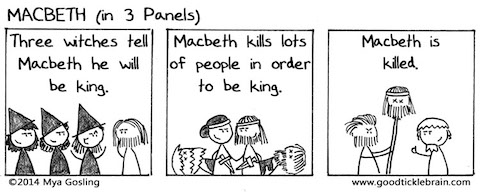
MacbethComic


Macbeth: From Centrality to Isolation

images (9)

When we first encounter Macbeth he is portrayed as the mighty general, the king’s enforcer-in-chief, while the play ends with his inevitable, lonely, solitary death following his doomed, albeit brave, defense of the indefensible. So, it can be said, that the major pattern of the play is Macbeth’s progressive movement from centrality to isolation.  This pattern encompasses the whole play and expresses an essential process in every tragedy: the hero must confront his destiny alone.  Macbeth’s role is that of a man who begins as the central and most admired figure of his society and ends by being totally isolated from it in his lonely fortress in Dunsinane.  His ultimate fate suggests that of a sacrificial victim.  Having caused havoc in society and broken the bonds of nature, he must be isolated and destroyed so that natural and social order can be restored again – for the time being at least!

The opening of the play focuses attention on Macbeth as the heroic object of everyone’s admiration, well earned since he is the saviour of his country.  The captain’s account of his exploits in Act I, ii and the King’s lavish praise in Act I, iv serve to establish his heroic stature and his unique status in society before his fall.  But the images used in these scenes to convey Macbeth’s prowess as a warrior have another, more disturbing, effect.  There is a frightening savagery in some of the more memorable ones: the sword ‘which smoked with bloody execution’; the bloody hero who ‘carved out his passage’ and ‘unseamed’ his enemy as if anxious to ‘bathe in reeking wounds/ Or memorise another Golgotha’ (I, ii 18-22).  These reiterated images suggest Macbeth’s natural capacity – perhaps even his relish – for destruction.  Our first picture of him as provided by the bleeding sergeant is a faithful anticipation of our last one.  The early image of the warrior carving up his enemy with a smoking sword is mirrored in the last one of the ‘dead butcher’ (V, vii, 98) whose severed head is carried on to the stage by Macduff.  Echoes and anticipations of this kind are found everywhere in Macbeth.

Before Duncan’s murder we find the two Macbeths taking the first decisive step which will isolate them from the process of normal living and break the bonds which bind them to human nature and society.  With deliberate formality, Lady Macbeth dedicates herself to the power of evil: ‘Come you spirits/ That tend on mortal thoughts….’ (I, v, 38).  Later, Macbeth makes a similar prayer: ‘Thou sure and firm-set earth,/ Hear not my steps…’ (II, i, 56).  His separation from God is implied in his ‘Wherefore could I not pronounce “Amen”?’ (II, ii, 30).

Duncan’s murder hastens the process of Macbeth’s isolation.  Malcolm and Donalbain flee him (II, iii, 119); Banquo suspects him (III, i, 3).  Even before Banquo’s murder and the social debacle of the Banquet Scene, we have a glimpse of Macbeth estranged from his natural companions: ‘How now, my Lord!  Why do you keep alone,/ Of sorriest fancies your companions making’ (III, ii, 8-9).

The Banquet Scene (III, iv) marks a decisive stage in his alienation from his subjects.  His gradual estrangement even from Lady Macbeth has already been suggested in his failure to let her share in his plan to murder Banquo.  After her supreme efforts in the Banquet Scene she dwindles from being his ‘dearest partner of greatness’ (I, v, 10) to a passive listless, weary listener.  The last time we see him alone with her, at the end of Act III, iv, the collapse of their relationship is pathetically apparent; this is further underlined in his response to the news of her death.  The final movement of Act III, iv  has compelling visual images of Macbeth’s  separation from his subjects, who leave his feast in hasty disorder.  This is not the only abandonment: in the final scene we learn that Fleance has escaped (20), that Macduff ‘denies his person at our great bidding’ (128) and that Macbeth can depend so little on the loyalty of his followers that he must ‘keep a servant fee’d’ in all their houses (131).

The final movement of the play opens with news of growing opposition to Macbeth’s rule, and of intrigue and conspiracy against him.  Macduff has fled (IV, I, 140).  In Act V, Macbeth’s isolation is made explicit in reiterated images of abandonment and loneliness.  He articulates it in some of the greatest poetry of the play: ‘that which should accompany old age,/ As honour, love, obedience, troops of friends,/ I must not look to have’ (V, iii, 24).  The Doctor would desert him if he could (V, iii, 61-2).  We are twice reminded that many of his soldiers have gone over to the enemy, first by himself (‘Were they not forced with those that should be ours,/ We might have met them dareful, beard to beard’ V, v, 5) and later by Malcolm (‘We have met with foes/ That strike beside us’ V, vii, 28).

There is an altogether appropriate image of his final isolation in his defiant ‘They have tied me to a stake; I cannot fly,/But bear-like I must fight the course’ (V, vii, 1).  In a 1962 Stratford production Eric Porter played Macbeth and, as J.R. Brown reports, ‘his death was that of a tired, angry, disarmed fighter: to make this clear he was killed on stage after he had been encircled by the entire army and had lost all his weapons’ (Shakespeare’s Plays in Performance, 1966, p. 185).  The transformation from leader to quarry is here complete.

 The pattern of Macbeth’s isolation, therefore, involves him in more than a progressive physical and mental detachment from other human beings.  He is an exile from the world of daylight, familiar with witches and with apparitions unseen by anybody else, making discoveries about his predicament which he can never share with others who have never dared, as he has, to plunge into darkness.

JDIpeHz6eT_1392758870722

Macbeth is a villain …. but….


Macbeth (3)

Our likely response to the central figure might be summed up in the formula: ‘Macbeth is a villain, an agent of evil, but….’  He commits monstrous deeds and yet we cannot see him as a monster.  On the one hand we are made to feel that his death is justified, and that his enemies triumph in a righteous cause; on the other we are forced to acknowledge that he never entirely loses our sympathy.  One general explanation for this sympathy is that we can understand such a character as Macbeth and pity him because he is doing on a large scale and with more appalling consequences for himself what we can at least imagine ourselves doing in a similar kind of situation.  It is interesting to study the methods used by Shakespeare in dealing with the major technical and artistic problems posed by the materials he has to handle in Macbeth.  Given that tragedy demands our sympathetic interest in the fortunes of the hero, how was Shakespeare to command our sympathy to the end of a play whose hero degenerates from a brave, noble warrior, highly sensitive to the prompting of conscience, into a disloyal, self-seeking killer his enemies see him as?

In the early scenes he is generously endowed with the attributes of a tragic hero.  He is a man who matters in his society, having authority, passions and abilities far greater than those around him, easily earning respect and admiration.  His good qualities are repeatedly underlined in the opening scenes.  What is emphasised most of all throughout Act 1 is how difficult it is to get him to come to terms with the evil he is contemplating.  Lady Macbeth deplores his essential goodness (‘What thou wouldst highly/ That wouldst  thou holily’ I, v, 18).  He hesitates, he agonises, he decides against the murder (‘Chance may crown me ….’ I, iii, 143).  He is conscious of the moral, as well as the political, consequences of killing Duncan (I, vii, 12).  This vacillation earns our sympathy.  Again he refuses to commit the crime (‘We will proceed no further in this business…’ I, vii, 31).  It requires all Lady Macbeth’s ingenuity, her eloquence, her jibes at his manliness (‘When you durst do it, then you were a man’ I, vii, 49) to make him proceed, and when he does, he is racked by guilt and terror (II, ii, 57-64).

If we approach Macbeth’s initial crime in terms of guilt and moral responsibility, we shall find that the play confuses and blurs the issues to some extent. Macbeth is made to seem the victim of ignorance and blindness.  He has had experience of many bloody executions in his career as a soldier; he cannot foresee the fatal effect on his character of murdering his way to the throne.  But two other factors tend even more strongly to confuse the moral issue.  The influence of the witches and their prophecies, however wilfully he misinterprets them, must inevitably appear to the spectator to mitigate his moral responsibility.  Almost any man, as Wayne Booth, the critic, has pointed out, ‘could be thrown off his moral balance by such supernatural confirmations’ (Shakespeare’s Tragic Villain).  The other morally confusing element is Lady Macbeth, one of whose functions in the scenes leading to the murder of Duncan is to distract her husband from weighting the moral issues involved by presenting the crime to him as a straightforward test of cowardice or courage.

It is worth noting how Shakespeare mitigates some of the worst horrors which Macbeth’s career as a murderer must inevitably involve.  What he does at all the critical moments is to dampen as much as possible the unfavourable effects on our attitude to Macbeth of the various atrocities for which he is responsible.  For example, the murder of Duncan is not directly shown, nor is it narrated by any speaker sympathetic to the dead man.  No effort is made by Shakespeare to evoke sympathy for Duncan at Macbeth’s expense.  Instead of hearing the dying cries of the old man, we hear Macbeth’s heartfelt lament at what he has done: the crime is made significant for its effect on the conscience of the criminal, whose responses after the event inevitably evoke some pity for him.

What we see enacted before our eyes is obviously far more telling in its effect than anything we are merely told.  We know that Duncan is a good man: we are told of his generosity, while Macbeth pays tribute to his kingly virtues.  But Shakespeare’s Duncan is not a character who can engage our deepest feelings.  The presentation is such that we focus our attention on Macbeth’s tortured comments on the crime, not on the sufferings of its victim.  We cannot feel the same kind of emotion for Duncan as we can for the man who can heartily envy him in his death that ‘after life’s fitful fever he sleeps well’ (III, ii, 23).  Of course, the quality of the stage-presentation of Duncan can make a difference here.  A comment of Kenneth Tynan’s on the 1962 Stratford production makes this point clear: ‘With Duncan’, he reported, ‘the production makes a bloomer long sanctified by tradition.  Since the play is a study of regicide we ought to feel that the sin Macbeth commits is something vast and mortal, not petty and sneaking.  Ageing though he is, Duncan must have about him an air of magnificence, a quality capable of inspiring awe; only thus can we appreciate the magnitude of the crime.  It should be as if Lear were assassinated.  At Stratford we get the usual saintly old dotard.  How this custom grew up I can only explain in terms of money and prestige: no actor capable of playing Duncan properly would dream of playing so small a part’ (Tynan Right and Left, 1967, p. 116).

It is true that Banquo’s murder is shown on the stage, and that he is a more clearly realised character than Duncan is.  His death is noble and his last gesture unselfish.  But again, the adverse effects of all this on our sympathy for Macbeth are minimised by Shakespeare.  The murder is committed by hirelings, and Macbeth responds to it much as he did to Duncan’s murder: we see him suffer at great length in the Banquet Scene.  We are made to feel that he is paying his share in guilt and self-torture for what he has done, that as he realises, ‘we still have judgement here’ (I, vii, 8).

His acts become progressively more revolting to our moral sense.  It is obviously more difficult for Shakespeare to retain pity for him after the killing of Macduff’s family than it was in the other cases; the presentation of the victims here is sympathetic and detailed.  But Macbeth is nowhere near the scene of the deed, and Lady Macduff’s death is closely followed by the mental collapse of Lady Macbeth. Again as Macbeth anticipated, ‘Bloody instructions being taught, return/ To plague the inventor’ (I, vii, 9).  The essential point, then, about Shakespeare’s presentation of Macbeth’s worst acts is that the perpetrator’s sufferings are made to appear almost proportionate to his crimes, and much more vivid than anything his victims undergo.

One further element in Shakespeare’s presentation must be mentioned.  We see a large and significant part of the action of the play as it is filtered through Macbeth’s consciousness.  We are taken into his mind, we share his point of view.  The play is his tragedy, not that of Duncan or Banquo or Lady Macduff.  Shakespeare gives him the best poetry of the play, and in a poetic drama this is a fact of the highest importance.  In the light of such speeches as ‘My way of life is fall’n into the sere, the yellow leaf…’ (V, iii, 22). Or ‘She should have died hereafter…’ (V, v, 17), one cannot help feeling at times that the worthy enemies gathering to destroy him are uninteresting and insignificant.  Still, Shakespeare has taken some precautions to ensure that these enemies do not appear totally pallid, that they are not altogether overshadowed by his grand eloquence and heroic stance.  Malcolm’s stature has been enhanced by means of the English Scene (IV, iii).  He enters impressively to the beating of drums.  He is given the last word in the play: an impressive enough speech, which does something to counteract the effect of Macbeth’s last great speeches.

Through the play also, Shakespeare uses choric scenes to provide those hostile to Macbeth with the opportunity to comment on his misdeeds.  Such scenes provide the audience with a perspective, apart from Macbeth’s own, through which to view the action.  In Act III, vi, for example, Lennox comments ironically on Macbeth’s behaviour, while the anonymous Lord contrasts the tyranny of his reign with the freedom enjoyed in England under the ‘holy king’ Edward.  It must be admitted, therefore, that Shakespeare performs a very delicate balancing act in his presentation of Macbeth.

56124e0e5c381b2a2cc5b3a3a471d5ed

Macbeth: A Truly Aware Tragic Hero?

macbeth-and-lady-macbeth-dee-timm

A summary of what happens in Macbeth could make the play look like an exciting crime story, but it is what happens within the hero, the development of his understanding of himself and his plight, and his sharing of this with the audience, that lifts it to a higher plane.

When the unexpected results of his actions emerge, the tragic hero questions what has happened to him, and through this questioning learns the vital truth about himself.  This brings him around to facing his destiny and completing it by his death. It is through this recognition that he reaches his tragic vision.  His error was committed in blindness; recognition involves the intrusion of the light, the acknowledgement of the blindness.  Recognition is not simply his knowledge of what has happened to him (in Macbeth’s case that he has been duped by the witches; he recognises his folly in having trusted them), but the new awareness of the unalterably fixed pattern of the miserable life he has created for himself through his deeds, accompanied by a deep sense of loss at the thought of what he has sacrificed and forsaken.  These elements are present in Macbeth’s infinitely poignant soliloquy in Act V:

          I have liv’d long enough: my way of life

          Is fall’n into the sere, the yellow leaf;

          And that which should accompany old age,

          As honour, love, obedience, troops of friends,

          I must not look to have; but in their stead,

          Curses not loud but deep, mouth-honour, breath

          Which the poor heart would fain deny, and dare not.

                                 V, iii, 22

Macbeth arrives at the recognition of having irrecoverably lost, through his own blind deed, the things on which his happiness on earth depended.  He discovers that he cannot arrest the process he has set in motion, and gains an insight into the workings of evil. He realises that evil isolates: his deeds have cut him off from all he treasures.  He is alone in a hell of despair, and is aware of the futility of all he has planned.  It is the fate of the tragic hero to be finally isolated from the ways of ordinary men, but it is in his isolation that he grows in stature and self-awareness, and consequently in the estimation of the audience, that he faces up to his destiny and confronts it.  For Macbeth, this means dying valiantly in battle (V, iii, 32; V, v, 52) rather than taking his own life (V, vii, 30) or running away (V, vii, 1), or being taken prisoner (V, vii, 56).  Those who like to moralise the tragic ending will find in his fate a striking illustration of the saying that ‘all they that live by the sword shall perish by the sword’ (Matthew, Ch. 26: verse 22); it is a fate ironically anticipated by him very early in the play: ‘This even-handed justice/ Commends the ingredients of our poisoned chalice/ To our own lips’ (I, vii, 10).

There are various degrees of recognition in tragedy.  In some (like Othello), recognition is minimal: Othello knows what he has done and what he has lost, but learns little or nothing about himself.  In Macbeth, at the end, the hero’s recognition is considerable, but still far from complete.  He remains puzzled and baffled to the last, failing to grasp the how and why of his fate.

In his case it is interesting to notice that partial recognition comes early in the play, that disillusion sets in long before his fortunes fail: in fact it sets in when he is at the height of his worldly success.  Even before he has murdered Banquo, he can face the unthinkable prospect of having damned his soul (‘mine eternal jewel/ Given to the common enemy of man’ III, i. 67). Earlier still, his sense of what he has done to himself as well as to Duncan is expressed in the richly suggestive, ‘To know my deed twere best not to know myself’ (II, ii, 72).  But if he does sense early on what is happening to him as a result of what he has done, he does not really know what kind of future is in store for him until the point at which he realises that it is as easy for him to go forward in crime as to go back.  The recognition that he cannot control the processes he has set in motion, or alter the course he has set for himself is a tragic one: ‘I am in blood/ Stepp’d in so far that, should I wade no more/ Returning were as tedious as go o’er’ (III, iv, 136).

But the exact moment when Macbeth realises he is doomed is when Macduff relates that he was ‘from his mother’s womb untimely ta’en (V, vii, 44).  He has expressed an earlier, partial, recognition of his fate at the news that Birnam Wood is moving towards Dunsinane (‘I pull in resolution, and begin/ To doubt the equivocation of the fiend’ (V, v, 42).

It is the quality of his response to his destiny and the manner in which he confronts it that determines his essential worth as a tragic hero and that gives him his ultimate tragic status.  The physical death of the tragic hero is a final symbol of his recognition: of the death of his former blind and ignorant self.  Our tragic hero has paid a chilling and costly price for self-awareness.


Scan-100519-0003

Macbeth: A Tragedy


Macbeth (3)

At the outset let’s attempt to define what we mean by ‘Shakespearean Tragedy’.  No one tragedy fits perfectly any one definition of it, but the conventions of tragedy require certain tragic elements.  Aristotle considered tragedy to be ‘the fall of princes’.  Macbeth falls into this category: he is a thane and he becomes king.  Generally, in Shakespearean tragedy, evil is the cause of the catastrophe.  Shakespeare believed that his tragedies, including Macbeth, depicted the struggle between good and evil in the world.

Therefore, the best way to begin the study of any tragedy is to do what we have summarised above: describe the main elements of tragedy itself, say what happens and how it happens, and take stock of the qualities which are usually associated with the tragic hero.  Shakespeare’s tragic hero is always a man (Macbeth, Hamlet, Lear, Othello, etc.) of exceptional nature, a great man with more powerful consciousness, deeper emotions, and more splendid imagination than ordinary men.  He is a sensitive being often torn by an internal struggle.    We see our hero set out on a particular course of action and because of a ‘fatal flaw’ (Aristotle’s ‘hamartia‘) in his character he suffers ‘reversals of fortune’ and brings suffering on himself and others; he brings about his own death and the deaths of many others.  Macbeth succumbs to his powerful failing in his nature and is destroyed by it.  He moves along a preordained path through questioning, to awareness of his wrongdoing and finally to perception.  He undertakes a course of action which is credible and probable and the inevitable direction of the hero’s movement is from prosperity to adversity, from centrality to isolation.  This is well expressed by Chaucer’s Monk:

 Tragedy means a certain kind of story,

As old books tell, of those who fell from glory,

People that stood in great prosperity

And were cast down out of their high degree

Into calamity and so they died.

(The Canterbury Tales, trans. by Nevill Coghill, 1951, p. 212)

An essential tragic requirement is that the hero must be ‘a great man’ – a man of some status in society.  The essential features here are moral stature and greatness of personality.  In Shakespearian tragedy, such qualities are invariably associated with eminent people (Chaucer’s men of ‘high degree’) engaged in great events.  The hero in any tragedy must be a man who can command our earnest good will, a man whose fortunes interest and concern us.  We identify with him in his suffering; he must be a man who reminds us strongly of our humanity, whom we can accept as standing for us  –  (‘There but for the grace of God go I’).  Unless this sympathy for the tragic hero is maintained to the end the dramatist has failed in his essential task.

The tragic hero inevitably meets with disaster due to his unrealised and unforeseen failures.  He consciously sets out to undertake a specific course of action, ‘I am settled, and bend up / Each corporal agent to this terrible feat (Act I, Scene vii).  However, he now has no control over the consequences of his actions.  The notion of blindness is appropriate to his condition here, just as that of recovered sight is appropriate to his later recognition of what he has done and what he has become as a result.  The Golden Rule is that ‘what’s done cannot be undone’.  When he decides to murder Duncan and usurp the throne, Macbeth deprives himself of his freedom: his life now follows a determined and inescapable pattern after the fatal act.  In this regard it should be said that although Macbeth may appear to be – and is commonly described as – a play about ambition and its effects, it is not fundamentally that.  To stress ambition as the source of Macbeth’s tragic error is a case of false emphasis.  What happens is that he is tempted by forces hostile to his good into proving their predictions true.  In his efforts to fulfil a fated plan he is destroyed (just like Oedipus); these efforts lead him to forge a chain of crime from which he cannot break free.

The problem of Macbeth’s ‘motivation’ or lack of it is often given a central place in discussions of the play.  If he does not strongly covet the crown, he has no logical motive for killing Duncan.  Shakespeare does not present him as a man driven by an unquenchable ambition for power.  Indeed critics of the play have found his conduct wildly improbable, his murder of Duncan completely out of character.  When he is first tempted, he is racked by feelings of horror and guilt; the thought of murder makes his heart knock at his ribs and his hair stand on end; he has the conscience of a good man.  The problem, for some critics, is to believe in the transformation of the conscience-stricken figure of the early scenes into the ‘butcher’ and ‘hell-hound’ of the later ones.  His later murders are even more difficult to explain in terms of ‘logical’ motivation.  His fears in Banquo ‘stick deep’, yet surely his real target should be Fleance, since Banquo himself can never, if the witches are to be trusted (and Macbeth trusts them), be a danger.  Still, it is Banquo’s murder, not Fleance’s, which occupies most of his attention.  This goes to show that tragedy, not unlike real life, does not always conform to neat, logical packaging – what is important is that Shakespeare is exploring here the progress of a man towards self-destruction.  We marvel at the fact that he has the capacity to commit acts, which seem to violate his essential good nature.

Central to our definition of tragedy is the process referred to earlier as ‘reversal of fortune’, which is what happens when the hero achieves the opposite effect to what he meant or expected.  In tragedy, as has been stated already, the hero undertakes a specific course of action which leads to suffering and awareness at the end.  In their blindness, both the Macbeth’s believe that if they usurp Duncan’s throne they will live happily ever after; what they actually achieve is almost total misery culminating in ruin.

Aristotle’s final criterion for good tragedy was that the audience would experience ‘catharsis’, that is, be left with a mixture of feelings, of pity and fear at the end of the performance.  This is true of Macbeth, the sensitive, conscience-stricken, tortured Macbeth inspires pity, while the tyrannical Macbeth, ‘in blood stepp’d in so far’ inspires terror.

Shakespeare does a wonderful balancing act in Macbeth. The audience maintain their sympathy for Macbeth, the tragic hero, while also recognising the reality that evil must be destroyed and good must triumph.  This is achieved with Macduff’s final gory victory over Macbeth. Malcolm can now assume his rightful place on the throne.  Order has finally been restored – for the time being at least!

 funny-Shakespeare-spoilers-Hamlet-Macbeth-King-Lear

‘Of Mice and Men’: Brief Analysis of Characters, Metaphors and Themes.


Courtesy of carra-lucia - books .co.uk
Courtesy of carra-lucia – books .co.uk

The title that Steinbeck finally chose for his novel emphasises the unpredictable nature of existence as well as its promise, George and Lennie’s blasted dream to ‘live of the fatta the lan’.  Taken from a poem by Robert Burns, the Scottish poet, the novel’s title suggests the transitory quality of even ‘best laid schemes’.  Burns’s poem tells of an unfortunate field mouse whose home is flattened by a plough:

But Mousie, thy art no thy lane,

In proving foresight may be vain:

The best laid schemes o’ mice an’ men

Gang aft a-gley

An’ lea’e us nought but grief an’ pain

For promised joy.

___________________________________________

Steinbeck 

CHARACTER PROFILES

GEORGE: George is the story’s main protagonist, a small, quick man with well-defined features.  A migrant ranch worker, George dreams of one day saving enough money to buy his own place and be his own boss, living off the land.  The hindrance to his objective is his mentally handicapped companion, Lennie, with whom he has travelled and worked since Lennie’s Aunt Clara, whom George knew, died.  The majority of George’s energy is devoted to looking after Lennie, whose blunders prevent George from working toward his dream, or even living the life of a normal rancher.  Thus, George’s conflict arises in Lennie, to whom he has the ties of long-time companionship that he so often yearns to break in order to live the life of which he dreams.  This tension strains George into demonstrating various emotions, ranging from anger to patience to sadness to pride and to hope.

LENNIE:  George’s companion, the source of the novel’s conflict.  Lennie, enormous, ungainly, and mentally slow, is George’s polar opposite both mentally and physically. Lennie’s ignorance and innocence and helplessness, his childish actions, such as his desire to pet soft things, contrast his physical bulk, making him likeable to readers.  Although devoid of cruel intentions, Lennie’s stupidity and carelessness cause him to unwittingly harm animals and people, which creates trouble for both him and George.  Lennie is tirelessly devoted to George and delights in hearing him tell of the dream of having a farm, but he does not desire the dream of the American worker in the same way that George does.  His understanding of George’s dream is more childish and he grows excited at the possibility of tending the future rabbits, most likely because it will afford him a chance to pet their soft fur as much as he wishes.  Nevertheless, a dream is a dream, different for everyone, and George and Lennie share the similar attribute of desiring what they haven’t got.  Lennie, however, is helpless to attain his dream, and remains a static character throughout, relying on George to fuel his hope and save him from trouble.

CANDY:  He is the old, one-handed swamper who is the first to befriend George and Lennie at Soledad.  He is humble and weary and seems to be at the end of his line after Carlson shoots his last possession and companion, his old, blind, dog.  ‘When they can me here I wisht somebody’d shoot me’, Candy confesses to George and Lennie, hoping for a similar fate as his dog.  But when he hears the two talking of their little place, Candy offers all his money and his meagre services to be in on the dream.  His substantial sum of money and the fact that he knows of a place make it impossible for George to refuse him.  Candy clings to this hope of a future as a drowning man would to a piece of driftwood.  It rekindles life within him, but it also becomes an obsession, and in his excitement and indignation, he lets the secret slip to both Crooks and Curley’s wife.  And when Lennie kills Curley’s wife and shatters the reality of the dream, Candy becomes hopeless and full of anguish, the broken shell of a man.

CURLEY:  He is the boxer, the son of the boss, the angry and hot-headed obstacle to George’s attempt to keep Lennie out of trouble at Soledad.  Insecure because of his size and over-protective of his wife, Curley is eager to fight anyone he perceives as a threat to his self-image.  Lennie unwittingly incurs Curley’s antagonism simply because of his size, and the reader immediately braces for future confrontation.  Curley remains undeveloped, forever little and forever mean, poking his head in at various points in the novel, either to look for his wife or to stir up trouble on account of her.

CURLEY’S WIFE:  Nameless and flirtatious, Curley’s wife is perceived by Candy to be the cause of all that goes wrong at Soledad: ‘Ever’body knowed you’d mess things up.  You wasn’t no good’, he says to her dead body in his grief.  The workers, George included, see her as having ‘the eye’ for every guy on the ranch, and they cite this as the reason for Curley’s insecurity and hot-headed temperament.  But Curley’s wife adds complexity to her own characterisation, confessing to Lennie that she dislikes Curley because he is angry all the time and saying that she comes around because she is lonely and just wants someone to talk to.  Like George and Lennie, she once had a dream of becoming an actress and living in Hollywood, but it went unrealised, leaving her full of self-pity, married to an angry man, living on a ranch without friends, and viewed as a trouble-maker by everyone.

CROOKS:  called such because of a crooked spine, Steinbeck does not develop Crooks, the Negro stable buck, until Chapter Four, describing him as a ‘proud, aloof man.  He kept his distance and demanded that other people keep theirs’.  Crooks is bitter, indignant, angry, and ultimately frustrated by his helplessness as a black man in a racist culture.  Wise and observant, Crooks listens to Lennie’s talk of the dream of the farm with cynicism.  Although tempted by Candy, Lennie and George’s plan to buy their own place, Crooks is constantly reminded (in this case by Curley’s wife) that he is inferior to whites and, out of pride, he refuses to take part in their future farm.

SLIM:  The tall, jerkline skinner whom Steinbeck describes as something of a living legend: ‘He moved with a majesty only achieved by royalty and master craftsmen.  He was a jerkline skinner, the prince of the ranch, capable of driving ten, sixteen, even twenty mules with a single line to the leaders.  He was capable of killing a fly on the wheeler’s butt with a bull whip without touching the mule.  There was gravity in his manner and a quiet so profound that all talk stopped when he spoke ….. His hatchet face was ageless.  He might have been thirty-five or fifty.  His ear heard more than was said to him, and his slow speech had overtones not of thought, but of understanding beyond thought.’  Slim lingers in the shadow of this overwhelming description throughout the novel.  He serves as the fearless, decision-maker when conflicts arise among the workers and wins the confidence of George, offering advice, comfort, and quiet words of wisdom.

______________________________________

Speed Read 'Of Mice and Men' (Courtesy of www.irisreading.com)

 METAPHOR ANALYSIS

 CANDY’S DOG:  ‘A dragfooted sheepdog, gray of muzzle, and with pale, blind old eyes’, Candy’s dog is a far cry from his sheepherding days.  Carlson says to Candy, in regard to the dog: ‘Got no teeth, he’s all stiff with rheumatism.  He ain’t no good to you, Candy. An’ he ain’t no good to himself.  Why’n’t you shoot him, Candy?  And Candy is left with no other option, but to shoot his longtime companion.  This sub-plot is an obvious metaphor for what George must do to Lennie, who proves top be no good to George and no good to himself.  Steinbeck re-emphasises the significance of Candy’s dog when Candy says to George that he wishes someone would shoot him when he’s no longer any good.  And when Carlson’s gun goes off, Lennie is the only other man not inside the bunk house, Steinbeck having placed him outside with the dog, away from the other men, his gun shot saved for the novel’s end.

THE CRIPPLES:  Four of Steinbeck’s characters are handicapped: Candy is missing a hand, Crooks has a crooked spine, Lennie is mentally slow, and Curley acquires a mangled hand in the course of the novel.  They are physical manifestations of one of the novel’s major themes: the schemes of men go awry.  Here, to reiterate the point, Steinbeck has the actual bodies of his characters go awry.  It is as if nature herself is often doomed to errors in her scheme.  And whether they be caused at birth, or by a horse, or by another man, the physical deformities occur regardless of the handicapped person’s will or desire to be otherwise, just as George and Lennie’s dream goes wrong despite how much they want it to be fulfilled.

 SOLITAIRE:  George is often in the habit of playing solitaire, a card game that requires only one person, while he is in the bunk house.  He never asks Lennie to play cards with him because he knows that Lennie would be incapable of such a mental task.  Solitaire, which means alone, is a metaphor for the loneliness of the characters in the novel, who have no one but themselves.  It is also a metaphor for George’s desire to be ‘solitaire’, to be no longer burdened with Lennie’s company, and his constant playing of the game foreshadows his eventual decision to become a solitary man.

THE DEAD MOUSE AND THE DEAD DOG: These two soft, furry creatures that Lennie accidentally kills are both metaphors and foreshadowing devices.  As metaphors, they serve as a physical representation of what will happen to George and Lennie’s dream: they (Lennie in particular) will destroy it.  Lennie never intends to kill the thing he loves, the soft things he wants more than anything, but they die on him nonetheless.  The dead mouse is also an allusion to the novel’s title – Of Mice and Men, a reminder that dreams will go wrong, even the desire to pet a mouse.  And because bad things come in threes, Lennie’s two accidental killings of animals foreshadow the final killing of Curley’s wife, an accident that seals his fate and ruins the dream for him, George and Candy.

___________________________________

Steinbeck 6

THEME ANALYSIS

When discussing the various themes in Steinbeck’s novel, we would do well to first examine the title, which is an allusion to a line from one of Robert Burns’s poems: ‘The best laid schemes o’ mice an’ men gang aft aglay.’  Translated into modern English, this line reads: ‘The best laid schemes of mice and men often go awry.’  This cynical statement is at the heart of the novel’s action and serves as a foreshadowing prophecy of all that is to come.  For, indeed, the novel’s two main characters do have a scheme, a specific dream of changing their current way of life in order to have their own place and work only for themselves.  The tragedy, of course, lies in the fact that no matter how elaborately our heroes plan, regardless of how intensely they hope and dream, their plan does not find fulfilment.

This is a novel of defeated hope and the harsh reality of the American Dream.  George and Lennie are poor homeless migrant workers, doomed to a life of wandering and toil in which they are never able to reap the fruits of their labour.  Their desires may not seem so unfamiliar to any other American: a place of their own, the opportunity to work for themselves and harvest what they sow with no one to take anything from them or give them orders.  George and Lennie desperately cling to the notion that they are different from other workers who drift from ranch to ranch because, unlike the others, they have a future and each other.  But characters like Crooks and Curley’s wife serve as reminders that George and Lennie are no different from anyone who wants something of his or her own.

All the characters (all the ones that Steinbeck has developed, at least) wish to change their lives in some fashion, but none are capable of doing so; they all have dreams, and it is only the dream that varies from person to person.  Curley’s wife has already had her dream of being an actress pass her by and now must live a life of empty hope.  Crooks’ situation hints at a much deeper oppression than that of the white worker in America – the oppression of the black people.  Through Crooks, Steinbeck exposes the bitterness, the anger, and the helplessness of the black American who struggles to be recognised as a human being, let alone have a place of his own.  Crooks’ hopelessness underlies that of George and Lennie’s and Candy’s and Curley’s wife.  But all share the despair of wanting to change the way they live and attain something better.  Even Slim, despite his Zen-like wisdom and confidence, has nothing to call his own and will, by every indication, remain a migrant worker until his death.  Slim differs from the others in the fact that he does not seem to want something outside of what he has, he is not beaten by a dream, he has not laid any schemes.  Slim seems to have somehow reached the sad conclusion indicated by the novel’s title, that to dream leads to despair.

Another key element is the companionship between George and Lennie.  The two men are not unique for wanting a place and a life of their own, but they are unique in that they have each other.  Their companionship contrasts with the loneliness that surrounds them – the loneliness of the homeless ranch worker, the loneliness of the outcast black man, the loneliness of Curley’s wife, the loneliness of the old, helpless cripple – and it arouses curiosity in the characters that they encounter, Slim included.  And indeed, the reader becomes curious as to their friendship as well.  And can we call it friendship?  Lennie would call George a friend, but George would perhaps be hard-pressed to admit the same of Lennie.  As he tells Slim, he has simply become so used to having Lennie around that he, ‘can’t get rid of him’.  Despite his annoyance, George also demonstrates protectiveness, patience, and pride when it comes to Lennie.  He is perhaps motivated to stay with Lennie by a sense of guilt, or responsibility, or pity, or a desire to not be alone himself.  Most likely it is a combination of all these motivations.  Yet it seems strange that George would choose to remain with Lennie, given the danger that Lennie poses for the both of them.  George is not blind to the fact that life would be easier without Lennie, and he often yearns for independence when Lennie becomes troublesome, creating a major source of tension in the novel.  This tension is not resolved until the final gunshot by the riverside, when the strain of Lennie’s company makes it impossible for George to survive with his companion.

By killing Lennie, George eliminates a monumental burden and a threat to his own life (Lennie, of course, never threatened George directly, but his actions endangered the life of George, who took responsibility for him).  The tragedy is that George, in effect, is forced to shoot both his companion, who made him different from the other lonely workers, as well as his own dream, and he is forced to admit that it has gone hopelessly awry.  His new burden is now hopelessness and loneliness, the life of the homeless ranch worker.  Slim’s comfort at the end (‘You hadda George’), indicates the sad truth that one has to surrender one’s dream in order to survive, not the easiest thing to do in America, the Land of Promise, the land of the Free and the Home of the Brave.

Courtesy of www.slideshare.net
(Courtesy of http://www.slideshare.net)