Themes in ‘Silas Marner’

2680841

Theme of Religion

Religion, in various forms, plays a major part in Silas Marner. It dominates the early part of the novel and influences the course of events in a decisive way. It has a significant part to play in the lives and attitudes of the people of Raveloe. George Eliot presents us with a variety of attitudes to religion in the course of the novel and there is always the implied contrast between the differing versions of religious faith and practice presented throughout the novel.

Our first glimpse of organised religion is given to us in the account of the church at Lantern Yard. It is not a flattering account. The doctrines shared by the congregation there are Calvinist in origin. The church is described as ‘a narrow religious sect’. It is inward-looking and very restrictive. Indeed, the whole account of lantern yard is an unsparing look by George Eliot at a variety of Protestant religion of which she was intimately familiar. Some would say that Lantern Yard had little to do with real Christianity and amounted to a serious perversion of religion. This is best illustrated in the drawing of lots, ‘they resolved on praying and drawing lots’. This method yields up a lie and an innocent man must suffer.

The other form of religious practice seen in the novel is that practised by the villagers in Raveloe. Whereas Lantern Yard people took their religious practices with deadly seriousness, those in Raveloe, on the other hand, are much less concerned with the externals of religious practice at any rate. Indeed, such is their anxiety not to appear too righteous some avoid going to church every Sunday! Their attitude to religion is treated with mild humour by George Eliot: the people are not ‘severely regular’ and even the ‘good livers’ go to church with ‘moderate frequency’.

The essential point to make About the form of religion practised in Raveloe is that in spite of its thinness on the side of doctrine and theology, even its closeness to mere superstition, its effects on the lives of the people is generally beneficial. Dolly Winthrop, if questioned on the subject, would probably find it difficult to articulate her religious beliefs, but fundamentally Christian practices come easily to her: ‘We must be going home now. And so I wish you goodbye, Master Marner; and if ever you feel anyways bad in your inside, as you can’t fend for yourself, I’ll come and clean up for you, and get a bit of victual, and willing’.

In contrast, Nancy Lammeter’s outlook on religion is totally different from Dolly’s. Unlike Dolly, Nancy is able to read the Bible; she is presented as usually sitting, on Sundays, with her Bible before her and in many ways, her attitude is nearly as narrow as that of the congregation in Lantern Yard.

His Lantern Yard experience has shaken Silas to the core, and shaken is genuinely held religious beliefs. Towards the end, he decides to revisit Lantern Yard with Eppie to find out if his name has been cleared and to see whether Mr Paston might enlighten him about the practice of the drawing of lots. He finds that Lantern Yard has been swept away, and he, therefore, will never get the answers to his troubling questions: ‘It’s dark to me; I doubt it’ll be dark to the last’. He will never now be fully satisfied with the wrong done to him, but his last years will be lived in a spirit of trust, thanks to the charity of real friends.

silas-and-eppie 

Theme of Redemption

This theme may be divided into two parts, (a) the salvation of Silas Marner from the mental and spiritual disintegration which is taking place within him because of his disillusionment with and rejection of God, and because of his miserliness and withdrawal from society, and (b) the salvation of Godfrey Cass from spiritual destruction because of his secret marriage to Molly Farren and, later, his decision to disown his own child.

There is the notion of the purging of a tragic hero through suffering in the case of both of these characters, but one of them – Godfrey – is, in the end, denied what he demands most.  Yet both of them come to acquire self-knowledge.  Silas says, ‘I’ve had light enough to trusten by; and now she says she’ll never leave me, I think I shall trusten till I die.’  Godfrey, too, has consolation, ‘And I got you Nancy, in spite of all, and yet I’ve been grumbling and uneasy because I hadn’t something else – as if I deserved it.’

Eliot may be trying to point out that, without contact with other human beings, the heart dries up.  Silas rejects the notion of a loving God and of belief in his fellow-man as a result of his experiences in Lantern Yard.  God turned from him in the drawing of the lots; William Dane and Sarah betrayed him at the human level.

In Raveloe ‘there was nothing that called out his love and fellowship toward the strangers he had come amongst, and the future was all dark, for there was no Unseen Love that cared for him.’  Even his simple impulse to help Sally Oates rebounds on him, and he becomes more isolated.  Money now becomes his new God.  What affection he has left is bestowed on inanimate things – a small brown pot and his gold.  He becomes a miser.

The theft of his gold is the beginning of his salvation.  It brings the sympathy of the villagers – especially Dolly Winthrop.  He feels conscious of ‘dependence on their goodwill.’  The coming of Eppie (perhaps an Act of God) brings him consolation for his suffering.  He begins again to trust a human.  He accepts Dolly’s advice that Eppie should be christened, although he does not know what this means.  With Eppie he lives again.  When he brings her to the village he is met with ‘smiling faces and cheerful questioning.’  She has replaced his gold.  He has been out of touch with Nature as he was in Lantern Yard.  It is Eppie who brings him back to it.  There is no more betrayal.  When Godfrey asks Eppie to come with him, she stands with Silas.

Godfrey’s faults are the result of his weakness of character.  He has a ‘natural irresolution’, ‘moral cowardice’, and is ‘indecisive’.  His marriage to Molly is a result of weakness but also of pity for her.  His motives for concealing the marriage are selfish – fear of discovery, his father’s anger, the loss of his inheritance and of Nancy.

His silent reaction to the news that Molly is dead is a sinful fear that she may not be dead.  His rejection of Eppie is a spoken one.  He disowns his moral and paternal obligations and lacks the moral courage to give up Nancy.  He is now living a lie and tries to justify it by assuring himself that he is thinking only of Nancy’s happiness.  He is punished by a childless marriage.  He has, however, a conscience about Eppie and almost accepts his childlessness as a punishment.  Further punishment and suffering come with the shame of Dunstan’s theft, but he accepts God’s will for the first time and admits his secret to Nancy.  He bitterly realises that Nancy would have gladly accepted Eppie had she known the situation.  He is further punished by Eppie’s rejection of him. His redemption comes in his realisation of the truth that ‘there’s debt we can’t pay like money debts.’  He has suffered, but recognises the injustice of it.  He, too, has some consolation in Nancy.

Theme of Social Isolation and Communication

The degrees of isolation and communication through which the central character – Silas – passes are extreme.  One might divide his life into four distinct parts – distinct because he is subject to a change of disposition each time.

  1. There is his period in Lantern Yard.
  2. Then his first fifteen years in Raveloe during which he becomes dedicated to his gold and so more isolated.
  3. Next comes the short period after the theft of his gold when he is deprived of any comfort and has only limited communication with the people of Raveloe.
  4. Finally, Eppie arrives and Silas is no longer isolated.

In Lantern Yard he is immersed in the life of the sect.  He shares the rigid, Calvinistic society of his fellow-believers, the companionship of William Dane and the company of Sarah.  His self-doubting is offset by William’s certainty – although in the end of this period God seems to desert him.  William falsely accuses him of theft and Sarah deserts him, he has been relatively contented.

When he arrives in Raveloe he is a stranger and, so an object of suspicion.  He hates ‘the thought of the past’; there is ‘nothing that calls out his love and fellowship towards the strangers in the village.’  He contributes to his own isolation in his failure to invite anyone to visit him and his failure to mix with others except on business.  The riches of Nature are in contrast with the narrow, frugal life (physical and spiritual) of Lantern Yard.  There is no ‘Unseen Love’ that cares for him.  The children fear him and the villagers wonder at his solitary isolation.  The results of his impulsive desire to help Sally Oates are disastrous. He refuses to exploit the villagers and they drive him back to isolation.  His attempt to establish a relationship has, through no fault of his own, driven a wedge between the villagers and him.  Money now becomes his god.  He still retains a spark of affection but it is for inanimate things like his broken pot.  When his gold is stolen, the disaster seems worse than that of Lantern Yard.  His soul is ‘like a forlorn traveller on an unknown desert.’  Yet his impulse is to go for help.  He goes to the Rainbow Inn.  It is here that he communicates with others.

Afterwards the neighbours try to ‘get through’ to him.  He is not yet one of them, but is affected by their anxiety to help.  He feels that people might help him.  Their kindness may spring from their recognition of suffering – ‘pain and mishap present a far wider range of possibilities than gladness and enjoyment.’  Although he still feels desolate he is now aware that he depends on others.  Yet he is not cheered by Dolly as ‘human love and divine faith have not yet been released in him.’

The coming of Eppie changes everything.  It makes the villagers more actively sympathetic.  She unlocks the door to his happiness within the community when he determines to meet the neighbours for her sake.  He acquires knowledge of life from his new acquaintances.  As he grows older, his eyes ‘seem to have gathered a longer vision as is the way with eyes that have been short-sighted in life.’  This may be symbolic of his spiritual outlook.  Eliot says that a sense of presiding goodness and human trust come with all pure peace and joy.  The human trust is important; he had lost it after Lantern Yard.

He has a bad moment when Eppie speaks of marriage.  Is his gold again being stolen?  But she reassures him.  His final trial comes when Godfrey arrives to ask for Eppie.  Silas’s decision not to stand in her way is heroic, but he has no need to fear; he will never again be isolated.

Godfrey Cass may be included as one whose failure to communicate contributes to his unhappiness.  The Red House atmosphere is not conducive to communication, as love does not exist within it.  His lack of true communication with Nancy prevents him getting to know her until it is almost too late.  He is afraid to tell Squire Cass of his marriage to Molly, a social inferior, because he fears the Squire’s reaction and because he feels that he will lose Nancy.  He again fails to communicate when he denies knowledge of Molly and then rejects his child.  When he finally tells Nancy of the marriage, she tells him that she would have accepted Eppie.  He now realises that his reticence has been for nothing.

Again, when he calls Silas to surrender Eppie, he shows his inability to understand Silas by speaking in terms of bodily warts and money and by painting Eppie’s future as a lady and contrasting it with the rough life before her if she remains with Silas.  It is only when he faces the truth and accepts the justice of his punishment that he is saved.  He now knows himself and is rewarded when Nancy’s eyes and his ‘meet in trust’.

Theme of Chance

In Chapter XI Eliot personally intervenes to comment on Chance – ‘In this point of trusting to some throw of fortune’s dice, Godfrey can hardly be called old-fashioned.  Favourable Chance is the god of all men who follow their own devices instead of obeying a law they believe in.’  she personifies Chance as a deity, ‘the mighty creator of success and its worship is a religion of these people.’

Godfrey is always hopeful that something will turn up to save a dangerous situation.  As a result he finds it hard to make a decision about anything.  So he falls back on ‘casualties’ (accidental happenings).  He fails to admit his marriage to Molly Farren because he feels that, the longer the interval before revelation, the more chances there are of deliverance from some of the unpleasant consequences to which he may have subjected himself.  When Dunstan fails to return from the sale of Wildfire, Godfrey asks himself why he should cut off his hopes by his own admission of his misdeeds.  If Dunstan fails to return soon everything may blow over.  When the Squire tells him to propose to Nancy with the half-threat that the Squire may himself speak to Nancy’s father he flies to ‘his usual refuge, that of hoping for some unforeseen turn of fortune, some favourable chance which would save him from unpleasant consequences – perhaps even justify his insincerity by manifesting its prudence’.  Not until Eppie rejects him does he face the truth and accept the consequences.

 Silas Marner, too, at one stage leans on Chance.  He, like the Lantern Yard brethren, believes that Chance in the form of ‘trial by lot’, reflects God’s judgement.  When his innocence is not borne out, he rejects God.  Later, after Eppie’s coming, he agrees with Dolly that there is good in the world.  He feels that the ‘lots’ were compensated for by Eppie.  ‘There’s dealings with us – there’s dealings.’  Eppie, too, has arrived by Chance.

Theme of Love

Love runs through the novel as a recurring motif.  It is associated with other themes.  Its absence may be noted in Lantern Yard where the devotees have been taught that they are miserable sinners so that they are prepared to believe in the sinfulness of their brethren and to punish it without an impulse of charity or human pity.  Each thinks only of his own salvation.  Lantern Yard also suppresses Silas’s love of Nature.

Yet, in Raveloe, Silas feels ‘a rush of pity’ for Sally Oates.  He also shows grief for his broken pot, but his affection is for inanimate things.  At first the villagers in Raveloe, because of their superstition, contribute to Silas’s loveless life by withholding whatever neighbourliness they might normally bestow on a fellow-human.  His miserliness saps his love for other human beings; gold is his true love.

His love is rekindled, albeit slowly when his gold is stolen.  He feels pity for Jem Rodney whom he accuses of the theft, realising the injustice of the accusation. (This is an echo of what befell himself in Lantern Yard).  His apology is, in effect, a gesture of love.  The kindness of the villagers to someone in trouble is an indication that love is there if he can meet it half-way.  Dolly Winthrop is in the vanguard of human compassion; she is ‘mild and patient’ and helps those who need help.  This is true love.

The coming of Eppie brings true love into Silas’s life; not alone the love she gives to him and the love which he bestows on her, but also the friendship and sympathy of the villagers.  Her pranks and naughtiness make him realise that love makes claims on him, yet he cannot really find it within himself to punish her.  After sixteen years with her, he has acquired the ‘mild, passive happiness of love-crowned age in his face.’  Eliot says that, because of his love and the seclusion of his cottage, she has been preserved from the coarseness of village talk and habits, so that she has a touch of refinement.  In the end, his love for her is repaid by her declaration of love for him and her rejection of Godfrey.  He now asserts his trust in God.

Godfrey and Dunstan have been deprived of love since their mother’s death.  Their father is weak in character and self-indulgent.  He rules his household by fear.  He lacks courtesy and makes no attempt to understand his sons.  Dunstan has no saving graces; he is entirely lacking in love.  Godfrey shows his weakness in marrying Molly Farren, but he is conscious of the harm he has done to her.  He loves Nancy Lammeter and sees her as his loving wife, but even in his love, he has no real knowledge of her and so postpones admitting to her his unfortunate marriage.

Eliot says ‘…..the yoke a man creates for himself by wrong-doing will breed hate in the kindliest nature’, and that the affectionate-hearted Godfrey is becoming bitter and subject to cruel wishes (presumably for the early death of Molly).  When he hears that she is dead, his fear is that she may not really be dead.  He then rejects his own child – Eppie.  This is the antithesis of love.  There is happiness and love in his marriage to Nancy, although it may be asked if Nancy falls short of love in her refusal to adopt the child.  When Godfrey finally admits to his marriage to Molly, their eyes meet ‘ with awe in them, as at a crisis which suspended affection.’  Is there a temporary cessation of love here on Nancy’s part?  She speaks of a chance lost of having a child to love her.  After their abortive attempt to persuade Eppie to live with them, they again look into one another’s eyes.  It is now that, although Eppie has rejected him, he knows that Nancy truly loves him, ‘And I got you, Nancy, in spite of all.

Theme of Nature

Eliot believed that Nature is an influence in developing the human person.  Silas rejects Nature in Lantern Yard, briefly returns to it to aid Sally Oates and then, under the influence of Eppie, finally returns.  Eppie’s wish is for a garden.  This may indicate her simplicity and that Nature is sufficient for her.  It is also possible to discuss human nature under this theme.  (See further notes on Nature Imagery here.)

 The Theme of Knowledge

The theme of Knowledge has some importance in the novel.  There is a suggestion that knowledge of oneself and others, or the lack of it, plays an important part in both characterisation and plot.  Eliot, speaking of the Lantern Yard sect with its constant discussions on the possibility of salvation, says it resembles ‘young winged things fluttering forsaken in the twilight.’  This suggests a misdirected search for knowledge that is in contrast with Dolly Winthrop’s certain trust in ‘Them above’.

The superstition of the villagers in Raveloe that helps keep Silas in isolation is a result of their fear that Silas possesses knowledge that they do not have and their belief that knowledge and skill come from the devil.  When his gold is stolen, the villagers see him as without knowledge and so, godly.

With the coming of Eppie, Silas acquires knowledge from his now sympathetic neighbours. His discussions with Dolly also help him towards religious contentment.  He also gains self-knowledge when Godfrey cannot begin to understand why Silas might not wish to part with Eppie.  Yet Eliot says that it is only the want of sufficient knowledge that allows him to be deliberately unkind.

Godfrey also undergoes a journey towards self-knowledge.  You might try to map this journey yourself using the incidents in the novel.


images-1

Further Reading

You might also like to read

Silas Marner – The Characters

Imagery in ‘Silas Marner’

Fairy-Tale Elements in Silas Marner

Silas Marner by George Eliot is a radically disturbing social document…


Commentary on ‘Sandpiper’ by Elizabeth Bishop

Sandpiper


By Elizabeth Bishop

The roaring alongside he takes for granted,
And that every so often the world is bound to shake.
He runs, he runs to the south, finical, awkward,
In a state of controlled panic, a student of Blake.

The beach hisses like fat. On his left, a sheet
Of interrupting water comes and goes

And glazes over his dark and brittle feet.
He runs, he runs straight through it, watching his toes.

– Watching, rather, the spaces of sand between them
Where (no detail too small) the Atlantic drains
Rapidly backwards and downwards. As he runs,
He stares at the dragging grains.

The world is a mist. And then the world is
Minute and vast and clear. The tide
Is higher or lower. He couldn’t tell you which.

His beak is focussed; he is preoccupied,

Looking for something, something, something.
Poor bird, he is obsessed!
The millions of grains are black, white, tan, and gray
Mixed with quartz grains, rose and amethyst.

A “music video” treatment of the Elizabeth Bishop poem, “Sandpiper” produced by Pink Dog Productions

Commentary: This exquisitely constructed poem sees the poet compare herself in an extended analogy to the lowly sandpiper. The poem is inspired by observations made on a return visit to Nova Scotia in 1965 and in it she personifies the bird, giving it human characteristics and eccentricities.  She tells us that ‘he’ is ‘a student of Blake’, referring to the great English poet and painter, William Blake, who famously celebrated seeing ‘a World in a Grain of Sand / And a Heaven in a Wild Flower’ in his poem, ‘Auguries of Innocence’, which, by the way, is a poem from one of his notebooks now known as The Pickering Manuscript.

We sense the continuous, nervous movement of the bird as ‘he runs to the south’, searching, exploring, discovering.  The bird is ‘finical’ or finicky and ‘awkward’ as it ceaselessly searches for the perfect grain, the discarded morsel.  The movement ‘south’ in turn mimics Bishop’s own migration south from Nova Scotia to Boston to Key West and later further south to Rio de Janeiro and Brazil.

Colm Tóibín in his effortlessly scholarly work, On Elizabeth Bishop, mentions that the ‘search for pure accuracy in her poems forced Bishop to watch the world helplessly, as though there was nothing she could do’.  She shares this trait with many other poets and artists.  This debilitating feature is also evident in Hemingway and Hopkins, this ceaseless search for the perfect word or phrase, and also features and is dramatised in the content and unique structure of Emily Dickinson’s poems with her use of dashes and capitalisation and other structural tricks to highlight the honing and triple distillation of each poem.  It also reminds me of something my son wrote very honestly  in one of his blogs, writing about his own writing process and that famous Irishman, Jack O’Metty!:

I’m the type of person who makes casual reference to Alberto Giacometti in everyday conversations. I have a vivid childhood memory of watching a Euronews cultural vignette which outlined the great sculptor’s methods: starting from a large scale he would pare down and reduce his sculptural figures until almost nothing remained save only the most minimal of features which could be said to represent man.  Giacometti’s problem was knowing when to stop before his clay figures, once larger than himself, disappeared to nothingness.  I use this as a metaphor for my own critical thought.  I consider and consider and pare and reduce until sometimes nothing remains. The trick is to create some academic content before this happens. I don’t always succeed. https://nicholasstreet.wordpress.com.

Many of the places she visited (Nova Scotia, the Straits of Magellan, the Amazon Estuary, Key West, Florida) stand at the boundary between land and sea and this tension between land and sea is very evident here in ‘Sandpiper’ and also in such poems as   ‘At the Fishhouses’, ‘Questions of Travel’ and ‘The Fish’, with the sea viewed as a strange, indifferent, encircling power.  In this poem, the sandpiper patrols that dividing line between sea and land and perhaps this is a metaphor for the conflict between the artist and life.

Bishop is fascinated by geographical extremities: straits, peninsulas, promontories, wharves, bights, mountains, jungle, outback, attracted to the near-isolation of these places.   Colm Tóibín makes the very astute observation that she, ‘made her homes on a single line of longitude, or close to one: Massachusetts, Nova Scotia, New York, Key West, Rio de Janeiro, Boston’.

In 1976, three years before she died, she wrote:

All my life I have lived and behaved very much like that sandpiper – just running along the edges of different countries ‘looking for something’.  I have always felt I couldn’t possibly live very far inland, away from the ocean; and I have always lived near it, frequently in sight of it …. timorously pecking for subsistence along coastlines of the world.

The second stanza opens with the domestic simile, ‘the beach hisses like fat’ and the caesura which follows is meant to demarcate the dividing line between left and right, sea and land, north and south.  A feature of her style is her continuous self-correction and search for exactness and greater precision in her description of the scene:

He runs, he runs straight through it, watching his toes.

– Watching, rather, the spaces of sand between them
Where (no detail too small) the Atlantic drains
Rapidly backwards and downwards.

This is immediately followed by another feature of her poetic work and craft: contradiction and deeper clarification of what has gone before:

The world is a mist. And then the world is
Minute and vast and clear. The tide
Is higher or lower. He couldn’t tell you which.

The poem ends with the poet again personifying the bird and it is clear to us that if we but simply change the gender, she could be talking about herself and the poetic process, just as Heaney does so eloquently in such poems as ‘Digging’ and ‘The Forge’:

His beak is focussed; he is preoccupied,

Looking for something, something, something.
Poor bird, he is obsessed!

Perhaps we can say, ‘Poor bird, (s)he is obsessed!’ with the impossibility of the task which she has undertaken as a poet: It’s as if the sandpiper who has been looking for ‘something, something, something’ suddenly sees the drab beach (with its millions of differing grains of sand as opposed to Blake’s one grain) transformed into a dazzling bejewelled walkway glistening with diversity and riches,

The millions of grains are black, white, tan, and gray
Mixed with quartz grains, rose and amethyst.

Bishop (7)

Works Cited:

Bishop, Elizabeth. The Complete Poems, 1927 – 1979.  New York: Farrar, Strauss and Giroix, 1983

Tóibín, Colm. On Elizabeth Bishop, Princeton and Oxford: Princeton University Press, 2015. Digital

See also Reviews Rants and Rambles:  https://vinhanley.com/2015/08/28/themes-and-issues-in-the-poetry-of-elizabeth-bishop/

The Terrible Sonnets – not so terrible after all!


bighopkins

In his Terrible Sonnets, Hopkins’s shows off his wide-ranging use of imagery. We know that he wrestled with doubt, particularly during his final years which he spent teaching in University College Dublin.  In his attempts to express clearly his meaning it can be said he transformed almost every known literary device used by poets: dramatic opening lines, imagery, irony, ambiguity, puns.  He also invented a few of his own: sprung rhythm, compound adjectives, and his use of foreign, colloquial and archaic words.  The best we can say about his sonnets is that they demonstrate his almost complete disregard for sonnet conventions!

All of his poems, and especially the Terrible Sonnets, were directly inspired by his experiences as a Jesuit priest, and his sonnets are attempts to elaborate his central themes: the value of sacrifice, the transience of mortal beauty, the permanence of evil in an unchristian world and the deep spiritual anguish and desolation which characterises two sonnets in particular: ‘No Worst, there is None’ and ‘I Wake and Feel the Fell of Dark’.  Critics would have us believe that these ‘terrible sonnets’ plumb the depths of despair but yet I believe that despite his battles with desolation and near despair, his sonnets always contain signs of hope, no matter how slender.  After all, despair, in his Catholic catechism was one of the Seven Deadly Sins and I believe that these often harrowing sonnets are dramatisations of the darkness and spiritual anguish which comes with ‘the dark night of the soul’ often mentioned in Ignatian and John of the Cross spirituality.

Therefore, it is my view that while the Terrible Sonnets sometimes plumb the depths of despair they never actually reach rock bottom and each sonnet ends on the slightest sliver of hope.  We must remember again that Fr. Hopkins is a priest, not only that but he is a Jesuit priest, one of Christ’s Storm Troopers, crack SAS commandoes, and so despair is not an option!

In his sonnet ‘No Worst, there is None’, Hopkins outlines the intensity of his pain in the opening quatrain and then proceeds to seek significant comfort, but in vain.  This sonnet is particularly interesting in that many of its images echo through earlier poems where the mood was less despondent.  The poet’s sense of despair is emphasised in quatrain two in an unusual but particularly poignant image of his cries heaving ‘herds-long’, gathering at the gate of heaven perhaps but not being admitted or even acknowledged.  Where is the comfort that Hopkins himself had administered to Felix Randal?  The poet then refers to an ‘age-old anvil’, a sounding board which winces and rings out his pain. This very original image of the anvil reminds us again of Felix and his work in the forge, except on this occasion the poet is the raw material that Christ is beating into shape.  In the sestet, the poet refers to a natural landscape, the mountains.  In earlier poems, ‘wilderness’ filled him with joy.  Here, however, the steep cliffs, a nightmarish metaphor, represent the spiritual torment and physical suffering that the poet has had to endure, day in, day out.  The only comfort is the relief of sleep.  However, as the poem comes to an end, there is slender hope because while the lost souls are as he is, they are worse off because they are dead and at least he is still alive and has time before he dies to repent and live a better life.  This in turn makes him realise that he is not so badly off after all.  The title also, believe it or not, contains a tiny nugget of reassurance: here, he is not saying that this is the worst, but that there IS no worst – as we all know from sometimes bitter experience,  things can always get worse!

In ‘I Wake and Feel the Fell of Dark’ the poet awakens to the oppressive darkness of night and yearns for the respite of daylight.  The dark night is itself symbolic of dark periods in the poet’s life when hope of spiritual ecstasy may have seemed very distant.  So where then is our sliver of hope here in this sonnet?  Well, there are a number of sightings!  For example, when he says, ‘Comforter, where, where is your comforting?’, this is merely echoing Christ’s words on the cross. ‘My God, My God, why have you forsaken me?’ and while it may appear at times in his imagery that Hopkins is literally hanging by his fingernails over the pit and the abyss, yet he does not despair.

In The Terrible Sonnets, he constantly uses numerous tricks to gain our attention and his opening lines are often very dramatic and effective:

            ‘No worst, there is none.  Pitched past pitch of grief’

            ‘I wake and feel the fell of dark, not day.’

The Terrible Sonnets, in particular, specialise in short, hurried, phrases and in the repetition of certain thematic words: ‘Pitched past pitch of grief’; ‘More pangs will, schooled at forepangs’; ‘Let me be fell’; ‘I wake and feel the fell of dark’; ‘O the mind, mind has mountains’; ‘What hours, O what black hours’; ‘Fall, gall themselves, and gash’; ‘I am gall’.

His schooling and studies in theology have convinced him that God exists, he is always certain of that, so why then has He forsaken him and why does he appear to be so far away, apparently unresponsive and uncaring to a man whose letters are ‘dead’?  Hopkins’s increasingly sinister images explore the bounds of human suffering and despair.  In the sonnet ‘I wake and feel the fell of dark’, for example, the conspicuous absence of daylight reminds us how far the poet has come from the glorious sunshine and colour in ‘Spring’, ‘God’s Grandeur’ or ‘The Windhover’.  There is little evidence of ‘couple-colour’ in ‘the black hours’ Hopkins has spent with his torment, suffering ‘yet longer light’s delay’.  The delay of light represents, of course, the delay of hope – all is now ‘gall’ and ‘heartburn’.  Quite remarkably, taste is evoked as a description of the poet’s state.  He becomes bitterness itself, borne out of his despair.  Yet, perhaps this is God’s will that he suffer the ‘curse’ with which his ‘bones’ and ‘flesh’ must contend.  But the poet’s tormented spirit is souring dough, which needs to be infused with spiritual ecstasy.

To conclude, in Hopkins’s poetry, therefore, the range of imagery is certainly quite extensive, his originality unquestioned.  Imagery ignites the poet’s celebration and it ignites his desolation.  In the darkness, there is no flash of colour, of light, no ’dapple-dawn-drawn’ inspiration to lift his thoughts, no sparks, no flashes, no gold.  In 1889, only weeks before his death, Hopkins wrote another sonnet, often linked with the Terrible Sonnets, ‘Thou art indeed just, Lord’.  This sonnet is a hurt protest by the good and devout priest that God allows the wicked to prosper while Hopkins, who has devoted his whole life to the service of God in the slums of cities such as Liverpool and Glasgow and Dublin, suffers the tortures of the damned.  In the poem images of fertility in nature abound: building, breeding, waking, growing.  The poet, however, is depicted in the sterile image of a ‘eunuch’.  Nonetheless, the concluding appeal expressed again through a vivid and most appropriate image, is that as Spring renews nature, so God may send his spiritual ‘roots rain’: surely if he can still pray he is not in despair.   Where there is prayer, there is hope!

 DONNE- a Hymn to God the Father

A Room With a View

a-room-with-a-view-1

THE HISTORICAL/LITERARY BACKGROUND

This review and notes are based on the Merchant Ivory Film of A Room with a View, which  was directed by James Ivory and produced in 1986.  It is based on the novel of the same name, which was written by E.M. Forster in the early 1900s and set in 1907, at the end of the Edwardian era.  This was a moment in British history when Britain was still an imperial power.  It is an old love story with a happy ending (much like Pride and Prejudice).  The film was shot on location in Tonbridge Wells, Kent and in Florence, Italy.  In 1987 the film won three Oscars (and a further six nominations) and also won five BAFTA Awards and one Golden Globe.

THE STORY

Lucy Honeychurch, a young English lady, is on a visit to Florence in Italy, chaperoned by her cousin Miss Charlotte Bartlett.  They had been led to believe that they would have a wonderful view at the Pensione Bertolini, but this is not the case when they arrive.  Another couple, a father and son, overhear them when they express their dissatisfaction and they promptly offer to exchange rooms.  Charlotte is offended at this presumption for her young cousin’s sake, especially when the young man is dangerously attractive.  However, the Reverend Beebe, the rector of Lucy’s parish at home in England, happens to be staying there as well.  He offers to act as an intermediary and the rooms are exchanged without further ado.

The next morning, Charlotte tours the city with Eleanor Lavish, a lady novelist whom she had met at dinner the night before.  Lucy goes for a walk alone and she witnesses a violent street fight where a young man is seriously injured.  She becomes weak and faints from the shock.  Luckily, George Emerson, the young man she had met in the Pensione, is there to help her back to her room.

The following day, the visitors in the Pensione arrange to go sightseeing as a group and the Emersons also are part of the group.  George and Lucy become separated from the others and he kisses her in a cornfield.  Charlotte witnesses what happened between them and after they return to the city she arranges for them to leave their rooms the next day.  The women agree not to tell anyone what has happened to Lucy.

Back in England, Lucy accepts a proposal of marriage from Mr. Cecil Vyse, who is a rather pompous, arrogant snob.  By a chance arrangement, the Emersons take a house in the area, close to the Honeychurch residence.  Lucy’s brother Freddy, and the Rector, Mr. Beebe, invite George to go swimming in a nearby ‘lake’ on his first day in Summer Street.  The men are quite spirited, and they chase each other around the lake for fun.  Unfortunately, this occurs at the same time as the ladies are taking their afternoon walk in the woods and they see the men in all their naked glory!

Now that George has arrived and Freddy befriends him, he is invited to the Honeychurch home regularly to play tennis.  Lucy is perturbed by George’s renewed proximity.  The contrast between George and the stuffy Cecil is very obvious and this unsettles Lucy.

When Charlotte comes to stay with the family, she is very concerned for Lucy in case the presence of George will do harm to her engagement to Cecil.  One day, Cecil is reading and criticising what he considers to be a dreadful novel and both Lucy and George are listening.  The book happens to be by Eleanor Lavish, the woman who stayed in the same pensione in Florence as they did.  The novel is set in Florence and Cecil reads a paragraph describing exactly where and when George kissed Lucy.  On the way back into the house, George kisses Lucy again out of sight of the others.

Lucy is upset by this and hurt that Charlotte has told Eleanor Lavish after they had agreed not to tell anyone about what had occurred in Italy.  Lucy asks George in the presence of Charlotte to leave.  George gives a passionate account of his love for her and tries to make her see that Cecil only cares for her as he would a prize possession.  Lucy denies the fact that she may love George, but all the same, she breaks off her engagement with Cecil soon after this.

When George sees that Lucy will not have him, he decides to leave Summer Street because he cannot bear to be near her.  Lucy is surprised and shocked to see the furniture being removed from the house.  Mr. Emerson talks to her and makes a heartfelt plea to her to stop denying the truth.  Realisation dawns on her that she does love George after all and the film ends with the two lovers on their honeymoon back in the Pensione Bertolini in Florence.  They kiss passionately at the window of A Room with a View.

THEMES 

The themes which we will consider and touch on here are: Love versus hatred, The importance of social class and self-deception and self-realisation.

A Room with a View, deals with the discovery that real love is a powerful and regenerative force: essentially it is a love story with a happy ending.  In the film, Lucy Honeychurch experiences a transition from a superficial understanding of love to a full understanding of its power and potential.  The film uses many devices to illustrate this change:

  • The language of the characters
  • Their actions and gestures
  • The symbolic use of landscape and flowers
  • The metaphor of a room with a view.

Unlike a play and a novel, which rely heavily on the reader’s ability to interpret the subtlety and significance of images or references made in the texts, A Room with a View can guide the viewer to their meaning by using effective cinematography.

In the opening sequence of the film, the courtyard view which Lucy has from her window is very disappointing.  She was expecting a spectacular view of Florence and this indicates to the viewer Lucy’s desire for new experiences.  The room with a view becomes a metaphor for Lucy’s desire to live an exciting and full life.

Lucy’s disappointment with the restricted view is captured by the close-up camera shot of her face.  This is intensified by her costume and by the incessant chatter of her cousin Charlotte.

In the dinner sequence, the camera focuses on a large question mark which George Emerson has arranged with the food on his plate.  He deliberately shows this question mark to Lucy so that it becomes a symbolic representation for the viewer of their quest to find a meaningful and passionate existence.

The film clearly shows, even in the opening sequences, that the conventions which govern English society are useless in Italy.  This is reflected in the open and direct manner of Mr. Emerson who offers Lucy and Charlotte the opportunity to change rooms.  Mr. Emerson’s passionate plea that they should have a view indicates his emotional nature and affinity with the workings of the human heart: ‘I don’t care what I see outside.  My vision is within.  Here is where the birds sing; here is where the sky is blue.’

To emphasise Emerson’s passionate nature even further, the camera focuses on his face, which changes from a look of congeniality when he first suggests the switch, to a rising colour in his cheeks and a pleading look in his eyes.  The shot also captures his emphatic gesture of beating his chest with his fork as he speaks, to indicate that his heart is where he feels life most powerfully.

The dialogue between Lucy, Charlotte, Mr. Beebe and the Misses Alan, as they discuss Mr. Emerson’s proposal, illustrates the conflict between the dictates of society and individual free will.  Miss Catherine Alan’s opinion, that things which are indelicate can sometimes be beautiful, is a philosophy which Lucy adopts for her stay in Italy.

When Charlotte accepts the Emerson’s offer, she takes the larger of the two rooms for herself, explaining to Lucy that it belonged to George: ‘In my small way I am a woman of this world and I know where things can lead to.’

The ambiguity of this statement is apparent and hints at the physical attraction which exists between Lucy and George.  It is also quite a pathetic statement, and though the viewer is not prone to like Charlotte at this stage in the film because of her ramrod stature, her severe hairstyle and her irritating personality, it does evoke a sense of empathy with her for her repressed emotions.

This shot is followed by the image of Lucy lying on the bed the next morning with a vertical strip of sunlight partly illuminating her face and body.  This sensual image is enhanced when she rises from the bed and opens the window onto a panoramic view of Florence.

These images of Lucy along with her passionate piano playing indicate her desire to be free to experience all aspects of life and also to be free from the constraints and petty rules of society.

The sequence of shots in Santa Croce illustrates the Emersons rejection of social norms and the religious hypocrisy of people like the Rev. Cuthbert Eager.  Mr. Emerson even makes fun of Giotto’s frescoes because he sees no truth in them.  While this statement might appear like ignorance to art historians or religious zealots, it is not meant to be blasphemous; rather it reflects his belief that spirituality alone, faith without emotion, cannot sustain the human heart.

 The close-up camera shots which move rapidly from fresco to fresco illustrates their disproportion to real life figures.  These shots can be contrasted with the opening of this sequence where, through a high camera angle, Lucy wanders through the vast space of the church on her own.  This contrast emphasises Lucy’s individualistic nature, which instinctively reacts against society’s expectations.  This point is also highlighted in her dialogue with Mr. Emerson who pleads with her to help his son to stop brooding: ‘I don’t require you to fall in love with my boy but please try to help him’.

The ambiguity of this exchange is further emphasised by Mr. Emerson’s reference to the ‘everlasting why’ which he says George is trying to answer and also to his belief that there is ‘a yes and a yes and a yes’ which lies at the side of the everlasting why.  These statements reflect an inner sensibility in Emerson to recognise an openness to love and passion in his son and most importantly a recognition of these qualities when he finds them in Lucy.  Emerson’s riddles are comparable to the cryptic language of the Fool in King Lear, the purpose of which is to provoke deep, soul-searching contemplation and honest interaction between characters.

While the Santa Croce sequence is taking place, Miss Lavish is leading Charlotte on a tour of the ‘real’ Italy.  The camera follows them down little alleys and side streets, soaking up the atmosphere of Florence.  As they pass down one side street, three local Italian men try to catch their attention.  The individual responses of the women are interesting.  Miss Lavish seems to be oblivious to them but the camera focuses on Charlotte’s face, which reflects a sense of repulsion and scorn.  This reaction illustrates Charlotte’s inability to cope with raw passion and desire.  Miss Lavish, on the other hand, seems to have a rather lax attitude towards the rules which govern society.  They both try to be individualistic, self-sufficient and daring and both are opinionated and headstrong.  There is, however, a sense of innocence about them, as though they know the theory about love but have little actual experience of it.  This is illustrated by the over-sentimentalised love story which Miss Lavish writes, using Lucy and George as her protagonists.  Her philosophy that ‘one has always to be open, wide open to physical sensation’, is applied to Lucy when she describes her as a ‘young English girl transfigured by Italy’.

 The irony of this statement is emphasised in the next sequence which catapults Lucy into this very ‘transfiguration’.  The camera, having cut to Lucy, follows her across the piazza, widening into a high angle shot so that the frame encompasses the width and breadth of the square and Lucy is swallowed up into the crowd.  The camera then focuses on close up shots of various sculptures of classical figures holding decapitated heads and figures bearing swords and clubs, engaged in various acts of barbarity.  These shots, accompanied by ominous background music, are indicative of the terrible violence which Lucy is about to witness.  What looks like a fist fight between two young Italian men, suddenly turns to murder when one of them is stabbed.  The stabbing indicates the evil nature of humanity when passion overrides moral judgement.  It is juxtaposed with Lucy’s discovery of real love and thus serves to contrast the struggle between the destructive power of hatred and the transforming power of love.

 After the brawl in the piazza there is a low camera angle and close up shot of the victim’s face, so that the frame encompasses his mouth which is covered in blood and his eyes which reflect the horror of his attack.  The impact of this scene on Lucy is captured in the slow camera movement which lingers on the victim’s face in a moment of tension and drama, indicated by the swell of dramatic music in the background.  It is as if the blood which drains from the young man’s body is also being drained from Lucy, and the high camera angle which captures her fainting spell illustrates the subconscious impact which the event will evoke in her.  When George Emerson rescues Lucy from the frenzied crowd, the camera cuts back and forth between the victim’s predicament and Lucy’s attempt to disengage herself, both mentally and physically, from George.  Her awkwardness at this point reflects the intimacy that has occurred between them, an intimacy which would be frowned upon by society.

Her attempt at aloofness fails because he tells her that something tremendous has happened between them.  Lucy’s notion that after the upheavals experienced by people in their lives, they return to their old life is rejected by George, who tells her that this is not so with him.  His words are graphically illustrated by their close proximity to each other on the bridge and when he throws her pictures, which are covered in the victim’s blood, into the river.  The camera follows the pictures as they are swept away by the swift flowing waters, metaphorically representing the passion which has been ignited between them.  From this moment onwards every time Lucy and George encounter each other, the viewer is aware of the attraction that lies between them.  This is evident in their gestures and interactions with each other and most particularly in the amorous eye contact made between them.  All these relationships are highly charged with dramatic tension because of their forbidden nature.  They illustrate very effectively the possibility of desire creating strong characters or contemptible individuals.

 In the sequence where the company drive out in two carriages to see a view, the theme of love versus hatred is evident.  As they drive, Rev. Eager reprimands Phaethon, the young Italian coachman, for his intimacy with the young girl who accompanies him.  Their display of affection conflicts with Eager’s clinical unemotive personality and his patronising attitude to Lucy.  Ironically, while he points out various buildings and houses which he recognises, the driver and his companion continue to caress each other and it is obvious that Lucy finds their actions much more interesting than Rev. Eager’s conversation.

 Her curiosity is illustrated when the camera focuses on her as she spies on the lovers through Miss Lavish’s binoculars.  In this interesting shot the camera allows the viewer to see Lucy’s point of view.  The frame is confined to the close-up of the lovers’ kiss.  This emphasis on Lucy’s curiosity parallels her desire to experience passion and prepares the viewer for her climactic encounter with George later on in the sequence.

Later George and Lucy encounter each other in a secluded part of the view and finally succumb to their desires and they embrace passionately.  Their abandonment of proper etiquette is reflected in the scenery, which is untamed and surrounded by luscious greenery.  Ironically, it was Phaethon, the young Italian driver, who guided Lucy to George.  The paralleling of the Italian and his lover with George and Lucy emphasises the importance of love in the film.  The comparison between the Italian’s relaxed image in the carriage when Lucy comes upon him and her sensuous image in bed at the beginning of the film, reiterates her latent desire.

When Charlotte finds George and Lucy embracing, the look of repulsion on her face symbolises her suppression of emotion but when compared to her earlier conversation with Miss Lavish about a woman marrying a lover ten years younger than her, this seems contradictory.  The tone of the lovers’ conversation infers the scandalous nature of such behaviour but it also illustrates the emptiness of Charlotte’s existence; she can only talk about such passion while Lucy actually experiences it with George.  However liberating this experience is for Lucy, it becomes a burden which she must hide from her own conscience, her family and the other guests in the pensione.

It is interesting that after this episode, Charlotte continually orders Lucy away from the window in her room, but symbolically Lucy is drawn back to it again.  It is as if having once experienced such passion she is ensnared by it and wants to explore it more fully.

The sequence which takes place in England allows the viewer to contrast the dull conventionalism of English society with the open and unpretentious society of Italy.  This contrast is reinforced by the formality of Cecil Vyse’s proposal to Lucy.  The stylised position of their bodies as he proposed illustrates the emotional distance between them and is emphasised by the camera movement out through the drawing-room window to give the viewer Mrs. Honeychurch’s point of view of the setting.  The dialogue between Lucy and Cecil cannot be heard because the dialogue Mrs. Honeychurch has with her son has precedence.  Their dialogue implies Freddy’s dislike of Cecil’s pomposity and unsuitability for Lucy.  Her acceptance of Cecil’s proposal is her attempt to purge herself of the memory of George Emerson.

Cecil’s unsuitability for Lucy is reflected very well in Mr. Beebe’s face when Cecil tells him about the engagement.  The camera holds on Mr. Beebe and the viewer witnesses the mingling of his shock and sadness.

Subconsciously Cecil is probably aware of his unsuitability for Lucy because it is inferred when he suggests that she is more comfortable with him in a room than in the open countryside.  It is most definitely evident in the way he kisses her.  This shot reflects his inexperience and sexual indifference to her, while Lucy displays an avid desire for a passionate embrace.  Lucy’s disappointment with Cecil is reflected by the close-up camera shot of Lucy’s face, which highlights her bewilderment at expressing so much unrequited passion.  It is also evident in the dissolving of this frame into the sequence in the Italian countryside where George Emerson first kissed her.

In the London sequence when Cecil and his mother talk about Lucy it is in the tone of having acquired a possession.  This attitude is highlighted when Mrs. Vyse watches the reactions of her guests to Lucy’s piano playing.  The claustrophobic room where this sequence takes place also illustrates that the acquisition of objects is more important to the Vyses than self-knowledge or real feelings.

 The shot which focuses on the faces of Cecil and his mother captures their conspiratorial gaze and also forces Mrs. Vyse to look up at Cecil while he is talking.  This inference of Cecil’s superior attitude is reflected in his dialogue about the education of his children in the future.  The sense of confined space in this frame, suggested by the vast array of ornaments in the room, is paralleled to Lucy’s encounter with Cecil on the landing before she retires to bed.  The sense of awkward anticipation in her gestures underlines her inner frustration with Cecil’s lack of passion.  Their incompatibility is carried into the next sequence which contrasts the Vyses’ home with the Honeychurch’s’ sprawling house and gardens and the horseplay of Freddy and Lucy.

 The arrival of the Emersons in Summer Street propels the theme of love into the foreground of this sleepy, contented little place.  The first suggestion of the upheaval which their arrival will bring about is the swimming sequence.  The close camera shots of Freddy, Mr. Beebe and George Emerson frolicking and carousing about the place naked is symbolic of the raw and primitive passion which exists in human beings and which must find expression.  The seclusion of the frame with the three men surrounded by bushes and trees is contrasted with the long-distance shot of Cecil, Mrs. Honeychurch and Lucy.

 When Lucy, Cecil and Mrs. Honeychurch come face to face with George and Freddy, their reactions are typical.  Only Lucy, who makes a tentative effort to shield her eyes with her umbrella, finds the episode humorous, while Cecil attempts to beat an escape route through the undergrowth with his cane, in order to avoid confrontation.

 Constantly in this film Cecil is used as a medium through which the upper classes are ridiculed and this is obvious in his self-delusion and his blindness about what is really going on around him.  He becomes a source of fun and is ridiculed.  This is illustrated in the sequence where Lucy and George embrace in the garden while Cecil reads Miss Lavish’s book about their first encounter in Italy.   Cecil is incapable of seeing things as they really are.  He is content in his delusion but outside influences force him to suffer for his ignorance.  Cecil is very pompous, dismissive and critical of other people.

 Lucy finally breaks off her engagement with Cecil.  This sequence takes place at night and Lucy’s delivery of the bad news, while she tidies the drawing room, begins politely but increases in vehemence.

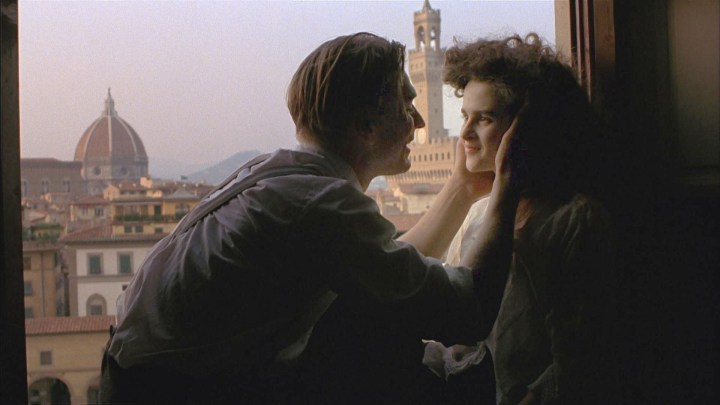
The final sequence of the film reiterates the symbolic importance of a room with a view.  The close-up camera shot of George and Lucy, framed by the open window, against the backdrop of Florence in the distance, captures their love for each other.  The evils which exist in A Room with a View, therefore,  are found in the repression of society, the snobbery of class distinction and the inability to express openly the passions of the heart.

 LITERARY GENRE

This film is a classic romance, a love story with a happy ending.  Before the end, however, both Lucy and George Emerson must overcome obstacles to their love and in the end, they are happily reunited once again.

The viewer is expected to suspend disbelief concerning the numerous rather extravagant coincidences in the plot – the initial confusion over the room, meeting with George at the street fight, the great coincidence that there was a novelist present to enshrine the illicit kiss in fiction, and the even greater coincidence when that novel is read by Cecil in the presence of Lucy and George, etc. ….. !

PLOT

The plot of the film is straightforward.  The heroine and hero meet in a hotel in Florence and are attracted to one another.  The hero falls in love immediately but the heroine will not allow herself to do so.  They meet again in England and eventually marry despite their social backgrounds.

SETTING

The film is set in Florence and Summer Street in England.  It begins and ends in Florence, and it begins and ends with the view from the hotel window as the main focus.  The rest of the film is set in England.  There is only one brief visit to London when Lucy goes to stay with Cecil’s family.

VISUALS

The Florentine scene with the view as the main focus is a striking part of the film.  When the tourists go on their day trip the attractions of the Italian countryside are emphasised.  Art is an important topic and there are many shots of the architecture of Florence.  The stone carvings on the streets and the inside of a church, Santa Croce, are examined.  Pictures in the Art Gallery in London feature and Cecil compares Lucy to a Leonardo painting.  George and Lucy kiss in a beautiful cornfield and later on in a green countryside.  The colour green is evident everywhere.  The lush landscape of England is seen in the season of swimming and tennis parties.

CAMERA SHOTS/ANGLES

There is nothing unusual about the camera shots or angles: they reinforce and aid the leisurely flow of the story.  There is one flashback sequence when Cecil is clumsily venturing to kiss Lucy on the mouth and she cannot help remembering George’s passionate embrace in Italy.  This is shown briefly on screen accompanied by passionate music.  This is a very effective device as the difference between the two men is revealed and from here on in the film, the audience become alienated from Cecil.

There is clever use of camera shots in the cathedral in Florence.  An obedient crowd of tourists rotate their heads in the required direction when their guide indicates an important feature of its architecture.  The camera switches to the particular feature and back to the crowd in readiness for the next swivel of heads.  This happens a few times and it arouses the viewer’s curiosity.

When the men are bathing in the lake near Summer Street their enjoyment of the afternoon is clearly established in the viewers’ minds before the ladies and Cecil are introduced.  The camera changes from the men to the women a couple of times to heighten the suspense of the approaching discovery.

LIGHTING

There are no major changes in the lighting in the film.  Italy and England in the summer time are awash with light.  England indoors is often in shadow, this sometimes varies depending on the scene.  When Lucy is breaking up with Cecil the room is particularly dark.  Most of the shadowy lighting reflects their relationship.

MUSIC

The music varies with the scenes.  When emotional scenes are being shown, it is often subtle, and particularly romantic when Lucy and George are kissing.  There is a strong beat which heightens the drama when the fight occurs.  Near the conclusion, the music reaches a crescendo when Lucy realises who she really loves.

LANGUAGE

The accents of the actors are clearly distinguished.  Cecil Vyse, in particular, has what he considers to be a superior accent.  His speeches are in a haughty tone and this is more exaggerated when he is criticising or demeaning someone.  His affected language makes him both sound and look ridiculous.  Mr. Emerson speaks with a plain and unadorned accent to indicate a more honest character who speaks his mind.  He stands out in contrast to Cecil, and in particular to the company he meets in Florence and in England.

SYMBOLS

The piano is a key symbol in the film.  Lucy plays it regularly, expressing her strongest emotions through her playing.  It is Mr. Beebe who is struck by the fact that her personality does not match the way she plays.  He makes the point that if Lucy lives as she plays, ‘it will be very exciting for us, and for her’.  He suspects that she will break out someday and, ‘One day music and life will mingle.’

CULTURAL CONTEXT

Society is a central issue in the film.  For the Edwardians, social position was everything.   English hypocrisy and pretentiousness is highlighted here.  Social snobbery is rife.  Charlotte’s attitude towards Mr. Emerson in the pensione is a striking example of this.  The Miss Alans, an elderly couple, also illustrate this.  They both sympathise with Charlotte and Lucy for having to endure Mr. Emerson’s insistence on exchanging rooms.  Cecil is depicted as an insufferable snob, who sneers at everything that does not match his standards.  Ironically he shows how social standings and gentility do not always go together.  He is quite rude about Lucy’s brother Freddy because he is not an academic.  He also makes Lucy’s mother feel that she is not good enough for him.

Social snobbery at its worst is evident when Lucy visits Cecil’s home.  When Cecil and his mother discuss Lucy’s potential, it is as if they are discussing the potential of a new household acquisition. In the end, however, Lucy has the courage to overcome the social barriers that divide her and George and she decides to follow her instincts.  Much of the film concentrates on Lucy’s emancipation from the restrictions imposed upon her by the society that surrounds her.

The culture of England and Italy are also contrasted in the film.  The English visitors are restrained by their code of behaviour.  The Italians, who are only briefly introduced, are uninhibited, and are puzzled and slightly amused by the prudish behaviour of the English.  Charlotte Bartlett typifies this particularly English approach.  The rector, Mr. Eager, is also easily horrified at what he considers to be a blatant show of sexuality when he sees the young Italian driver embracing his girlfriend.

Therefore the viewer is presented with two very different cultures in this film: upper-class England and Florence.  England is emotionally restricted, bourgeois and staid.  Certain codes of behaviour are rigidly adhered to and women have to travel with a chaperone.  The stiffness and formality of this lifestyle is represented in the clothes of the time, manners, language and physical movement.  Florence, on the other hand, is rich, relaxed and flamboyant.  The social atmosphere is open and bright with streets full of life and endlessly fascinating.  The viewer sees the beautiful, airy streets and squares, stunning monuments and impressive architecture.

The colour and variety of the Italians engage the viewer, and the contrast between the social mores of the English visitors is marked.  The Italians chat easily to foreigners and just as easily get caught up in violent street fights.

And so, in the end, realisation dawns on Lucy that she does love George after all and the film ends with the two lovers on their honeymoon back in the Pensione Bertolini in Florence.  They kiss passionately at the window of A Room with a View – and like all good love stories, they both live happily ever after!

a-room-with-a-view

Some Personal Thoughts on ‘The Road not Taken’ by Robert Frost

two_roads_in_a_yellow_wood_-robert-frost

The Road Not Taken


by Robert Frost

Two roads diverged in a yellow wood,
And sorry I could not travel both
And be one traveler, long I stood
And looked down one as far as I could
To where it bent in the undergrowth;

Then took the other, as just as fair,
And having perhaps the better claim,
Because it was grassy and wanted wear;
Though as for that the passing there
Had worn them really about the same,

And both that morning equally lay
In leaves no step had trodden black.
Oh, I kept the first for another day!
Yet knowing how way leads on to way,
I doubted if I should ever come back.

I shall be telling this with a sigh
Somewhere ages and ages hence:
Two roads diverged in a wood, and I—
I took the one less traveled by,
And that has made all the difference.

‘The Road not Taken’ has always been a very popular poem and despite 21st Century developments such as Google Maps and iPhones and Sat Navs it still bears a relevance for the modern reader.  Then again not all journeys are easily mapped and some take place off-road!  This lyric poem, a first-person narrative tale, describes  a key moment in the poet’s life.  In the poem, the speaker, whom we can assume is Robert Frost himself, is faced with a choice that appears quite suddenly as he walks along a forest track.  Imagine walking through beautiful woodland in upstate New York or Vermont as the Fall takes hold and imagine at this moment, the route on which you travel diverges into two separate paths.  This mirrors the poet’s dilemma in the poem and he faces a difficult decision that has to be made for the moment, yet may have repercussions that last a lifetime.  This is what makes the decision so difficult.

If you consider, briefly, some decisions you make in your own life, you know that you might make hundreds of choices in any one day, most without even noticing!  Deciding where to go for lunch is usually not too difficult; however, a much more difficult decision is the career to follow after your Leaving Cert or A Levels.  Your choice may affect your life for many years and so you tend to take time and effort in arriving at that decision.

So, Frost comes to a fork in the road.  If taken on a literal level, the choice is simply the path along which to continue.  However, if these paths are seen in a symbolic or allegoric way, then the choice is more challenging.  Great poetry and literature have always given us many examples where life is seen in terms of a journey on which we will meet many twists and turns.  So, therefore, the moment described so beautifully in the poem could be such a moment in anyone’s life.

The poet considers his options carefully.  He looks down both paths, ‘as far as I could’ in an attempt to see what they might offer.  But his view is limited by the bend as the track veers into the undergrowth.  It is, in other words, impossible to foresee what future may lie ahead – and Frost did not seem to have the luxury of a Change-of-Mind slip!  At first, each alternative is equally appealing or ‘just as fair’.  Similarly, both roads diverge into ‘a yellow wood’ – Vermont in all its Autumnal glory!  The first path, however, is a more popular route, while the other less-traveled path is overgrown and ‘wanted wear’.  The choice is clear but not at all simple: the common, easy path or the unusual, more challenging path?  The first road might prove more reliable, even reassuring, for others have gone that way.  The more difficult road, however, may produce a less predictable outcome yet perhaps a more fulfilling and individual one.

The poet is aware that the minor difference between the paths at this time will become major differences as the paths diverge further into the woods and into the future.  Each path is attractive and alluring in its own way, but he cannot travel both.  You can’t have your cake and eat it!  This he regrets.  Nonetheless, he decides.

Even as he travels his chosen path he still wonders about the path he has rejected and hopes to keep ‘the first for another day’.  Yet, he knows in his heart that ‘way leads on to way, / I doubted if I should ever come back’.  The poem, in this way, suggests that we can only hope to explore a very limited number of life’s possibilities.  Finally, the poet ‘sighs’, happy with his choice, yet wondering what if…..?  What experiences might have occurred along the other path?  Certainly, his choice has ‘made all the difference’.  That is gratifying; the decision has had a positive effect on his life and he is thankful for that and overall seems pleased with the road he has chosen.

This poem reminds us that important decisions in life are not exact predictions.  We base our choice on reflection of what might be encountered along the way.  Like Frost, we all hope that our major decisions will make ‘all the difference’ in our lives.  We need to believe they will.

Frost believed that each poem was a ‘little voyage of discovery’; a path to something else, rather than an end in itself.  Perhaps, the road not taken is just such a voyage?

 FROST (7)

Macbeth: Order violated, order restored….

logo

It is impossible to read Macbeth without being impressed by its repeated emphasis on the prevalence of evil forces in the world.  From the very start of the play an atmosphere of unnatural wickedness is established by the scene which opens with the stage direction Thunder and Lightening.  Enter Three Witches and ends with the reversal of values implied in ‘Fair is foul and foul is fair/ Hover through the fog and filthy air’.  In Macbeth, Shakespeare suggests a symbolic correspondence between three kinds of order:

  • Order within the universe,
  • Order within the commonwealth,
  • Order within the human being.

The disruption of good order in the kingdom is paralleled by the disruption of nature, represented by the storm and the other portents on the night of Duncan’s murder, as well as by the appearance of the witches and of Banquo’s ghost; it has a further parallel in Lady Macbeth’s mental disintegration.  The savvy Elizabethan audiences were only too aware that portents of evil and evidence of disorder in one area were often mirrored by even greater disorders elsewhere.  The themes of unnatural doings, chaos in the natural world and universal disease are constantly suggested in the more memorable images.  Little wonder then that critics, when they come to talk about the impression created by the play, conclude that in none of the tragedies, with the possible exception of Lear, is evil presented so forcibly.  Macbeth has been described as Shakespeare’s ‘most profound and mature vision of evil’, ‘a wrestling of destruction with creation’, ‘a statement of evil’, and so forth.

If any one point is insistently made by the imagery it is that Macbeth’s revolt against lawful authority involves much more than the murder of a king and the usurpation of his throne.  The initial crime is a huge symbolic gesture.  It releases forces of universal disorder.  John Holloway talks of Macbeth’s career as one  ‘of revolt against everything in the world’ (The Story of the Night, 1961, p.61).  Once the first evil step has been taken there is no turning back: men and nature are caught up in a process which causes havoc everywhere until the evil forces have played themselves out.  Images of disease and unnatural happenings give concrete expression to the major themes.  The thought of his plan makes Macbeth’s heart knock at his ribs ‘against the use of nature’ (I, iii, 137); the dead Duncan looks like ‘a breach in nature’ (i.e. as if nature had been wounded by his death in II, iii, 95).  Lady Macbeth’s sleepwalking is described as a ‘great perturbation in nature’ (V, I, 9).  The murder of Duncan (‘the Lord’s anointed temple’ II, iii, 50) is explicitly and repeatedly presented as a monstrous violation of the natural order; it is committed when ‘nature seems dead’ (II, I, 50); in preparation for it Lady Macbeth invokes the aid of those murdering ministers who ‘wait on nature’s mischief’ (i.e. assist the malignant forces in nature and accompanying natural disasters: I, v, 48).  The association between Macbeth’s crime and disruption in nature is further emphasised in the comment on the odd behaviour of the elements following Duncan’s murder: ‘Tis unnatural/ Even like the deed that’s done’ (II, iv, 10).  The same kind of association between evil deeds and disorder within the individual is implied in the Doctor’s comment on Lady Macbeth’s sickness: ‘unnatural deeds/ Do breed unnatural troubles’ (V, I, 72).

The effects on his country and its people of Macbeth’s identification with evil are suggested in a series of disease images, which appear with particular frequency in the last Act.  The point made by these images is that Scotland is sick, and the cause of her disease is Macbeth’s criminal career.  Health and disease are symbolically related to moral good and evil.  Macbeth’s speech to the Doctor is an extended disease metaphor:

                   If thou couldst, doctor, sound

                   The sickness of my land, find her disease,

                   And purge it to a sound and pristine health….

                   What rhubarb, senna, or what purgative drug

                   Would scour these English hence?

                                                                             V, v, 50

It is in relation to this kind of speech that the descriptions of the King’s Evil (IV, iii, 141 – 159) takes on its true importance.  At the hands of the good English king, diseased souls ‘presently amend’ (IV, iii, 138).  At Macbeth’s hands, ‘good men’s lives/ Expire before flowers in their caps,/ Dying or ere they sicken’ (IV, iii, 164).  Macbeth’s cause is ‘distemper’d’ (V, ii, 15).  Malcolm is to be the physician who will heal Scotland: ‘Sovereign’ as used by Lennox means both ‘royal’ and ‘powerfully medicinal’:

          Caithness:     Meet we the medicine of the sickly weal,

                              And with him pour we, in our country’s purge,

                              Each drop of us.

          Lennox:         Or so much as it needs,

   To dew the sovereign flower and drown the weeds.

                                                                                                V, ii, 26

The play depicts the restoration of order as well as its violation.  A whole society is disordered and sickly (‘Bleed, bleed poor country!’ Iv, iii, 32), and the order of nature has been disrupted.  Macbeth’s famous catalogue of dogs (III, I, 91) emphasises the idea of a proper order among animals as well as men; it is a fine stroke of irony on Shakespeare’s part to make the prime enemy of order concede its propriety.  The third movement of the play (which belongs to Malcolm and Macduff in the way that the first did to Duncan and the second to Banquo), shows violated nature preparing itself to put an end to the unnatural disintegration set in train by Macbeth’s acts, the process by which ‘the treasure/ Of nature’s germens tumble all together,/ Even till destruction sicken’ (IV, I, 58).  As Macbeth’s power begins to wane, supernatural aid is invoked on behalf of those who would restore the beneficent order of nature (‘the Powers above/ Put on their instruments…’ IV, iii, 231). The movement of Birnam Wood towards Dunsinane (V, iv, 4) is a vivid emblem of the reassertion of the natural order, ‘a dumbshow of nature overturning anti-nature at the climax of the play’ (John Holloway, op. cit., p.65).

It needs to be emphasised that while Shakespeare makes extensive use of religious, even specifically Christian images and ideas throughout Macbeth (see particularly Iv, iii), this does not mean that the play reaches ‘optimistic’ conclusions about its themes, or that it was written to suggest the superiority of a Christian view of life and action.  We should restrain any tendency we may feel to treat the major characters as diagrammatic illustrations of ‘good’ and ‘evil’ tendencies.  Shakespeare poses too many unanswered questions for us to be able to regard Macbeth as a celebration of the triumph of good over evil; like all genuine tragedies, it maintains a balance of vision.  An element of painful mystery remains even after the fragile triumph of the official forces of good order.  This is well described by Robert Ornstein:

‘If the anguish of the damned sounds musically in the ears of the saved, then there is comfort here for some; otherwise Macbeth is the most unpleasant of the tragedies.  Though order is restored at the close, though evil is purged and Macbeth receives the gift of oblivion, there is no sense of repose or reconciliation in its final scenes’ (The Moral Vision of Jacobean Tragedy, 1960).

Order is restored, as Ornstein points out; a ‘good’ regime is to replace an evil one, but what we have seen happen in Macbeth leaves us with the feeling that destructive forces can just as easily erupt again, and with similar consequences.  It is difficult to see the closing ‘restoration’ as anything more than provisional.  The final speeches of the ‘good’ characters, with their promises of better things to come lack the emotional weight necessary to dispel the gloomy visions conjured up by the Macbeths and their allies. In the Irish political context, this is, in fact, akin to Fine Gael, Fianna Fáil, Labour, The Greens, etc., telling us they will right all the wrongs of the previous Fine Gael,  Fianna Fáil/Progressive Democrats administration.  We all know by now from bitter experience that these election promises are often made to sound very hollow in time!


MacbethComic


Macbeth: From Centrality to Isolation

images (9)

When we first encounter Macbeth he is portrayed as the mighty general, the king’s enforcer-in-chief, while the play ends with his inevitable, lonely, solitary death following his doomed, albeit brave, defense of the indefensible. So, it can be said, that the major pattern of the play is Macbeth’s progressive movement from centrality to isolation.  This pattern encompasses the whole play and expresses an essential process in every tragedy: the hero must confront his destiny alone.  Macbeth’s role is that of a man who begins as the central and most admired figure of his society and ends by being totally isolated from it in his lonely fortress in Dunsinane.  His ultimate fate suggests that of a sacrificial victim.  Having caused havoc in society and broken the bonds of nature, he must be isolated and destroyed so that natural and social order can be restored again – for the time being at least!

The opening of the play focuses attention on Macbeth as the heroic object of everyone’s admiration, well earned since he is the saviour of his country.  The captain’s account of his exploits in Act I, ii and the King’s lavish praise in Act I, iv serve to establish his heroic stature and his unique status in society before his fall.  But the images used in these scenes to convey Macbeth’s prowess as a warrior have another, more disturbing, effect.  There is a frightening savagery in some of the more memorable ones: the sword ‘which smoked with bloody execution’; the bloody hero who ‘carved out his passage’ and ‘unseamed’ his enemy as if anxious to ‘bathe in reeking wounds/ Or memorise another Golgotha’ (I, ii 18-22).  These reiterated images suggest Macbeth’s natural capacity – perhaps even his relish – for destruction.  Our first picture of him as provided by the bleeding sergeant is a faithful anticipation of our last one.  The early image of the warrior carving up his enemy with a smoking sword is mirrored in the last one of the ‘dead butcher’ (V, vii, 98) whose severed head is carried on to the stage by Macduff.  Echoes and anticipations of this kind are found everywhere in Macbeth.

Before Duncan’s murder we find the two Macbeths taking the first decisive step which will isolate them from the process of normal living and break the bonds which bind them to human nature and society.  With deliberate formality, Lady Macbeth dedicates herself to the power of evil: ‘Come you spirits/ That tend on mortal thoughts….’ (I, v, 38).  Later, Macbeth makes a similar prayer: ‘Thou sure and firm-set earth,/ Hear not my steps…’ (II, i, 56).  His separation from God is implied in his ‘Wherefore could I not pronounce “Amen”?’ (II, ii, 30).

Duncan’s murder hastens the process of Macbeth’s isolation.  Malcolm and Donalbain flee him (II, iii, 119); Banquo suspects him (III, i, 3).  Even before Banquo’s murder and the social debacle of the Banquet Scene, we have a glimpse of Macbeth estranged from his natural companions: ‘How now, my Lord!  Why do you keep alone,/ Of sorriest fancies your companions making’ (III, ii, 8-9).

The Banquet Scene (III, iv) marks a decisive stage in his alienation from his subjects.  His gradual estrangement even from Lady Macbeth has already been suggested in his failure to let her share in his plan to murder Banquo.  After her supreme efforts in the Banquet Scene she dwindles from being his ‘dearest partner of greatness’ (I, v, 10) to a passive listless, weary listener.  The last time we see him alone with her, at the end of Act III, iv, the collapse of their relationship is pathetically apparent; this is further underlined in his response to the news of her death.  The final movement of Act III, iv  has compelling visual images of Macbeth’s  separation from his subjects, who leave his feast in hasty disorder.  This is not the only abandonment: in the final scene we learn that Fleance has escaped (20), that Macduff ‘denies his person at our great bidding’ (128) and that Macbeth can depend so little on the loyalty of his followers that he must ‘keep a servant fee’d’ in all their houses (131).

The final movement of the play opens with news of growing opposition to Macbeth’s rule, and of intrigue and conspiracy against him.  Macduff has fled (IV, I, 140).  In Act V, Macbeth’s isolation is made explicit in reiterated images of abandonment and loneliness.  He articulates it in some of the greatest poetry of the play: ‘that which should accompany old age,/ As honour, love, obedience, troops of friends,/ I must not look to have’ (V, iii, 24).  The Doctor would desert him if he could (V, iii, 61-2).  We are twice reminded that many of his soldiers have gone over to the enemy, first by himself (‘Were they not forced with those that should be ours,/ We might have met them dareful, beard to beard’ V, v, 5) and later by Malcolm (‘We have met with foes/ That strike beside us’ V, vii, 28).

There is an altogether appropriate image of his final isolation in his defiant ‘They have tied me to a stake; I cannot fly,/But bear-like I must fight the course’ (V, vii, 1).  In a 1962 Stratford production Eric Porter played Macbeth and, as J.R. Brown reports, ‘his death was that of a tired, angry, disarmed fighter: to make this clear he was killed on stage after he had been encircled by the entire army and had lost all his weapons’ (Shakespeare’s Plays in Performance, 1966, p. 185).  The transformation from leader to quarry is here complete.

 The pattern of Macbeth’s isolation, therefore, involves him in more than a progressive physical and mental detachment from other human beings.  He is an exile from the world of daylight, familiar with witches and with apparitions unseen by anybody else, making discoveries about his predicament which he can never share with others who have never dared, as he has, to plunge into darkness.

JDIpeHz6eT_1392758870722

Macbeth is a villain …. but….


Macbeth (3)

Our likely response to the central figure might be summed up in the formula: ‘Macbeth is a villain, an agent of evil, but….’  He commits monstrous deeds and yet we cannot see him as a monster.  On the one hand we are made to feel that his death is justified, and that his enemies triumph in a righteous cause; on the other we are forced to acknowledge that he never entirely loses our sympathy.  One general explanation for this sympathy is that we can understand such a character as Macbeth and pity him because he is doing on a large scale and with more appalling consequences for himself what we can at least imagine ourselves doing in a similar kind of situation.  It is interesting to study the methods used by Shakespeare in dealing with the major technical and artistic problems posed by the materials he has to handle in Macbeth.  Given that tragedy demands our sympathetic interest in the fortunes of the hero, how was Shakespeare to command our sympathy to the end of a play whose hero degenerates from a brave, noble warrior, highly sensitive to the prompting of conscience, into a disloyal, self-seeking killer his enemies see him as?

In the early scenes he is generously endowed with the attributes of a tragic hero.  He is a man who matters in his society, having authority, passions and abilities far greater than those around him, easily earning respect and admiration.  His good qualities are repeatedly underlined in the opening scenes.  What is emphasised most of all throughout Act 1 is how difficult it is to get him to come to terms with the evil he is contemplating.  Lady Macbeth deplores his essential goodness (‘What thou wouldst highly/ That wouldst  thou holily’ I, v, 18).  He hesitates, he agonises, he decides against the murder (‘Chance may crown me ….’ I, iii, 143).  He is conscious of the moral, as well as the political, consequences of killing Duncan (I, vii, 12).  This vacillation earns our sympathy.  Again he refuses to commit the crime (‘We will proceed no further in this business…’ I, vii, 31).  It requires all Lady Macbeth’s ingenuity, her eloquence, her jibes at his manliness (‘When you durst do it, then you were a man’ I, vii, 49) to make him proceed, and when he does, he is racked by guilt and terror (II, ii, 57-64).

If we approach Macbeth’s initial crime in terms of guilt and moral responsibility, we shall find that the play confuses and blurs the issues to some extent. Macbeth is made to seem the victim of ignorance and blindness.  He has had experience of many bloody executions in his career as a soldier; he cannot foresee the fatal effect on his character of murdering his way to the throne.  But two other factors tend even more strongly to confuse the moral issue.  The influence of the witches and their prophecies, however wilfully he misinterprets them, must inevitably appear to the spectator to mitigate his moral responsibility.  Almost any man, as Wayne Booth, the critic, has pointed out, ‘could be thrown off his moral balance by such supernatural confirmations’ (Shakespeare’s Tragic Villain).  The other morally confusing element is Lady Macbeth, one of whose functions in the scenes leading to the murder of Duncan is to distract her husband from weighting the moral issues involved by presenting the crime to him as a straightforward test of cowardice or courage.

It is worth noting how Shakespeare mitigates some of the worst horrors which Macbeth’s career as a murderer must inevitably involve.  What he does at all the critical moments is to dampen as much as possible the unfavourable effects on our attitude to Macbeth of the various atrocities for which he is responsible.  For example, the murder of Duncan is not directly shown, nor is it narrated by any speaker sympathetic to the dead man.  No effort is made by Shakespeare to evoke sympathy for Duncan at Macbeth’s expense.  Instead of hearing the dying cries of the old man, we hear Macbeth’s heartfelt lament at what he has done: the crime is made significant for its effect on the conscience of the criminal, whose responses after the event inevitably evoke some pity for him.

What we see enacted before our eyes is obviously far more telling in its effect than anything we are merely told.  We know that Duncan is a good man: we are told of his generosity, while Macbeth pays tribute to his kingly virtues.  But Shakespeare’s Duncan is not a character who can engage our deepest feelings.  The presentation is such that we focus our attention on Macbeth’s tortured comments on the crime, not on the sufferings of its victim.  We cannot feel the same kind of emotion for Duncan as we can for the man who can heartily envy him in his death that ‘after life’s fitful fever he sleeps well’ (III, ii, 23).  Of course, the quality of the stage-presentation of Duncan can make a difference here.  A comment of Kenneth Tynan’s on the 1962 Stratford production makes this point clear: ‘With Duncan’, he reported, ‘the production makes a bloomer long sanctified by tradition.  Since the play is a study of regicide we ought to feel that the sin Macbeth commits is something vast and mortal, not petty and sneaking.  Ageing though he is, Duncan must have about him an air of magnificence, a quality capable of inspiring awe; only thus can we appreciate the magnitude of the crime.  It should be as if Lear were assassinated.  At Stratford we get the usual saintly old dotard.  How this custom grew up I can only explain in terms of money and prestige: no actor capable of playing Duncan properly would dream of playing so small a part’ (Tynan Right and Left, 1967, p. 116).

It is true that Banquo’s murder is shown on the stage, and that he is a more clearly realised character than Duncan is.  His death is noble and his last gesture unselfish.  But again, the adverse effects of all this on our sympathy for Macbeth are minimised by Shakespeare.  The murder is committed by hirelings, and Macbeth responds to it much as he did to Duncan’s murder: we see him suffer at great length in the Banquet Scene.  We are made to feel that he is paying his share in guilt and self-torture for what he has done, that as he realises, ‘we still have judgement here’ (I, vii, 8).

His acts become progressively more revolting to our moral sense.  It is obviously more difficult for Shakespeare to retain pity for him after the killing of Macduff’s family than it was in the other cases; the presentation of the victims here is sympathetic and detailed.  But Macbeth is nowhere near the scene of the deed, and Lady Macduff’s death is closely followed by the mental collapse of Lady Macbeth. Again as Macbeth anticipated, ‘Bloody instructions being taught, return/ To plague the inventor’ (I, vii, 9).  The essential point, then, about Shakespeare’s presentation of Macbeth’s worst acts is that the perpetrator’s sufferings are made to appear almost proportionate to his crimes, and much more vivid than anything his victims undergo.

One further element in Shakespeare’s presentation must be mentioned.  We see a large and significant part of the action of the play as it is filtered through Macbeth’s consciousness.  We are taken into his mind, we share his point of view.  The play is his tragedy, not that of Duncan or Banquo or Lady Macduff.  Shakespeare gives him the best poetry of the play, and in a poetic drama this is a fact of the highest importance.  In the light of such speeches as ‘My way of life is fall’n into the sere, the yellow leaf…’ (V, iii, 22). Or ‘She should have died hereafter…’ (V, v, 17), one cannot help feeling at times that the worthy enemies gathering to destroy him are uninteresting and insignificant.  Still, Shakespeare has taken some precautions to ensure that these enemies do not appear totally pallid, that they are not altogether overshadowed by his grand eloquence and heroic stance.  Malcolm’s stature has been enhanced by means of the English Scene (IV, iii).  He enters impressively to the beating of drums.  He is given the last word in the play: an impressive enough speech, which does something to counteract the effect of Macbeth’s last great speeches.

Through the play also, Shakespeare uses choric scenes to provide those hostile to Macbeth with the opportunity to comment on his misdeeds.  Such scenes provide the audience with a perspective, apart from Macbeth’s own, through which to view the action.  In Act III, vi, for example, Lennox comments ironically on Macbeth’s behaviour, while the anonymous Lord contrasts the tyranny of his reign with the freedom enjoyed in England under the ‘holy king’ Edward.  It must be admitted, therefore, that Shakespeare performs a very delicate balancing act in his presentation of Macbeth.

56124e0e5c381b2a2cc5b3a3a471d5ed

Macbeth: A Truly Aware Tragic Hero?

macbeth-and-lady-macbeth-dee-timm

A summary of what happens in Macbeth could make the play look like an exciting crime story, but it is what happens within the hero, the development of his understanding of himself and his plight, and his sharing of this with the audience, that lifts it to a higher plane.

When the unexpected results of his actions emerge, the tragic hero questions what has happened to him, and through this questioning learns the vital truth about himself.  This brings him around to facing his destiny and completing it by his death. It is through this recognition that he reaches his tragic vision.  His error was committed in blindness; recognition involves the intrusion of the light, the acknowledgement of the blindness.  Recognition is not simply his knowledge of what has happened to him (in Macbeth’s case that he has been duped by the witches; he recognises his folly in having trusted them), but the new awareness of the unalterably fixed pattern of the miserable life he has created for himself through his deeds, accompanied by a deep sense of loss at the thought of what he has sacrificed and forsaken.  These elements are present in Macbeth’s infinitely poignant soliloquy in Act V:

          I have liv’d long enough: my way of life

          Is fall’n into the sere, the yellow leaf;

          And that which should accompany old age,

          As honour, love, obedience, troops of friends,

          I must not look to have; but in their stead,

          Curses not loud but deep, mouth-honour, breath

          Which the poor heart would fain deny, and dare not.

                                 V, iii, 22

Macbeth arrives at the recognition of having irrecoverably lost, through his own blind deed, the things on which his happiness on earth depended.  He discovers that he cannot arrest the process he has set in motion, and gains an insight into the workings of evil. He realises that evil isolates: his deeds have cut him off from all he treasures.  He is alone in a hell of despair, and is aware of the futility of all he has planned.  It is the fate of the tragic hero to be finally isolated from the ways of ordinary men, but it is in his isolation that he grows in stature and self-awareness, and consequently in the estimation of the audience, that he faces up to his destiny and confronts it.  For Macbeth, this means dying valiantly in battle (V, iii, 32; V, v, 52) rather than taking his own life (V, vii, 30) or running away (V, vii, 1), or being taken prisoner (V, vii, 56).  Those who like to moralise the tragic ending will find in his fate a striking illustration of the saying that ‘all they that live by the sword shall perish by the sword’ (Matthew, Ch. 26: verse 22); it is a fate ironically anticipated by him very early in the play: ‘This even-handed justice/ Commends the ingredients of our poisoned chalice/ To our own lips’ (I, vii, 10).

There are various degrees of recognition in tragedy.  In some (like Othello), recognition is minimal: Othello knows what he has done and what he has lost, but learns little or nothing about himself.  In Macbeth, at the end, the hero’s recognition is considerable, but still far from complete.  He remains puzzled and baffled to the last, failing to grasp the how and why of his fate.

In his case it is interesting to notice that partial recognition comes early in the play, that disillusion sets in long before his fortunes fail: in fact it sets in when he is at the height of his worldly success.  Even before he has murdered Banquo, he can face the unthinkable prospect of having damned his soul (‘mine eternal jewel/ Given to the common enemy of man’ III, i. 67). Earlier still, his sense of what he has done to himself as well as to Duncan is expressed in the richly suggestive, ‘To know my deed twere best not to know myself’ (II, ii, 72).  But if he does sense early on what is happening to him as a result of what he has done, he does not really know what kind of future is in store for him until the point at which he realises that it is as easy for him to go forward in crime as to go back.  The recognition that he cannot control the processes he has set in motion, or alter the course he has set for himself is a tragic one: ‘I am in blood/ Stepp’d in so far that, should I wade no more/ Returning were as tedious as go o’er’ (III, iv, 136).

But the exact moment when Macbeth realises he is doomed is when Macduff relates that he was ‘from his mother’s womb untimely ta’en (V, vii, 44).  He has expressed an earlier, partial, recognition of his fate at the news that Birnam Wood is moving towards Dunsinane (‘I pull in resolution, and begin/ To doubt the equivocation of the fiend’ (V, v, 42).

It is the quality of his response to his destiny and the manner in which he confronts it that determines his essential worth as a tragic hero and that gives him his ultimate tragic status.  The physical death of the tragic hero is a final symbol of his recognition: of the death of his former blind and ignorant self.  Our tragic hero has paid a chilling and costly price for self-awareness.


Scan-100519-0003

Comparisons and Contrasts in Hamlet


Hamlet (2)

Those who have commented on the structure of Hamlet have all made the point that it is a play of contrasting situations, rather like a system of mirrors, in which the same problem is in turn reflected from different points of view.  We are meant to examine the differing approaches of individual characters and Shakespeare assumes we can distinguish which one acts honourably and which one is immoral!  In this play three sons have lost their fathers; Hamlet and Ophelia are afflicted with differing kinds of madness, feigned and real.  The idea of vengeance is seen from several angles; Hamlet, Laertes and Fortinbras have similar missions which they fulfil in differing ways.  Claudius and Polonius conduct parallel investigations into the cause of Hamlet’s behaviour; there are several variations on the son-father theme.  Characters move towards their objects by various kinds of indirection (and ‘by indirection find direction out’).  So, therefore, Polonius uses Reynaldo to find the truth about Laertes; Claudius acts through such intermediaries as Rosencrantz and Guildenstern; Polonius uses Ophelia to sound out Hamlet.

 THE AVENGERS

It can easily be forgotten that Hamlet is not the only avenger in this revenge tragedy.  Laertes, Fortinbras and Pyrrhus all have wrongs to avenge: Laertes the deaths of his father and sister; Fortinbras the death of his father at the hand’s of Hamlet’s father and the loss of Norwegian territory to Denmark, and Pyrrhus the death of his father at the hands of Priam.   The common theme, as Claudius says in another context, is ‘death of fathers’.  Shakespeare presents all three avengers in sharp contrast to Hamlet, and their predicaments echo his.  The Dido play reminds him of his own situation.  Hecuba weeping profoundly for her slain husband Priam must inevitably invite comparison and contrast with Gertrude, who, ‘all tears’, followed King Hamlet’s body, but dried her tears all too soon and married Claudius.

 PYRRHUS THE AVENGER

Pyrrhus, the ‘hellish’ avenger who slays Priam, is presented as an evil man, ‘dread and black’, steeped ‘in the blood of fathers, mothers, daughters, sons’.  He is ‘a painted tyrant’, who enjoys ‘mincing with his sword’ the limbs of Priam.  Pyrrhus kills an old man, the ‘reverend Priam’, in a dubious act of vengeance.  The contrast between him and Hamlet is plain.  Hamlet finds it difficult to kill the man who has secretly murdered his father and destroyed his mother’s honour.  There is even a circumstantial parallel between Pyrrhus as avenger and Hamlet as would-be-avenger.  Pyrrhus suspends his sword momentarily over his victim, and ‘like a neutral to his will and matter’, does nothing, but soon, ‘aroused vengeance sets him new awork’.  Hamlet stands behind the kneeling Claudius in the Prayer Scene, but unlike Pyrrhus, leaves his sword unused.  Morally, Hamlet emerges with credit from this contrast with Pyrrhus.

FORTINBRAS AS AVENGER

The contrast between Hamlet and the other avenger, Fortinbras, is not as sharp, at least on the surface.  Hamlet praises Fortinbras as ‘a delicate and tender prince’, and even names him as his successor.  In one of his soliloquies, he invokes the decisive action of Fortinbras as a reproach to his own inaction, and uses his activities to illustrate a general principle of which he approves, and which he himself would like to embody:

                        Rightly to be great

                        Is not to stir without great argument

                        But greatly to find quarrel in a straw

                        When honour’s at the stake

(IV, iv, 53)

The Hamlet-Fortinbras contrast is, however, an ambivalent one.  In the earliest references to him, Fortinbras appears as a reckless adventurer at the head of a band of brigands, having ‘shark’d up a list of lawless resolutes’  (I, i, 98).  His war with Poland is one of aggression, Hamlet’s comments to the captain show his disgust at the adventure; he sees the Polish was as a disease, ‘the imposthume of much wealth and peace / That inward breaks’ (IV, iv, 26).   In the light of this, the praise he accords Fortinbras in the soliloquy (a ‘spirit with divine ambition puff’d’) is, to say the least, ambiguous.  Fortinbras, to judge from his activities, may be puffed up with ambition and dreams of honour, but unlike Hamlet, he pays very little attention to the injustice or otherwise of his cause.  What Hamlet clearly admires in Fortinbras is his absolute dedication to his role.  His motives for action, and the nature of the action itself, are another matter.  In these, he cannot stand comparison with Hamlet, whose developed awareness of ethical issues is a major feature of his character.

 LAERTES AS AVENGER

Laertes is the most obvious foil to Hamlet, and this is made explicit by hamlet himself when he tells Horatio that ‘by the image of my cause I see / The portraiture of his’, and again, just before the fencing match, ‘I’ll be your foil, Laertes’ (V, ii, 247).  Like hamlet, Laertes has every motive for revenge.  But there the resemblance ends.  When Laertes hears of this father’s death, he quickly raises a rebellion against Claudius.  Moral considerations do not trouble him, as they do Hamlet; he is prepared to cast the moral law aside: ‘To hell, allegiance!  Vows to the blackest devil / Conscience and grace to the profoundest pit’ (IV, v, 117).  When Claudius asks him how far he would go to show himself a true son  of his father, he answers ‘To cut his throat in the church’ (IV, vii, 127), which is Shakespeare’s comment on Hamlet’s failure to do the same to Claudius when he finds him at prayer.  The King points to another contrast between  Hamlet and Laertes when, proposing the use of an unbated foil, he feels that Hamlet, being ‘Most generous and free from all contriving / Will not peruse the foils’ (IV, vii, 136)  the full force of Laertes’ moral degeneracy becomes evident in his plan to kill Hamlet by stealth, and in his revelation that he has procured poison in case he might find use for it: ‘And for that purpose, I’ll anoint my sword / I bought an unction of a mountebank’ (IV, vii, 141).

The function of Laertes in the play seems clear from all of this.  Shakespeare uses him to show the character of the classic avenger of primitive revenge tragedy, an avenger of the kind that Hamlet, by nature, is unable to be.  The audience must be glad that Hamlet is strongly differentiated from the coarse-grained, unreflective, shallow Laertes.  When critics castigate Hamlet for not proceeding more quickly against Claudius, they can scarcely wish him to duplicate the attitudes and proceedings of Laertes, whose moral depravity throws Hamlet’s scrupulousness into welcome relief.

 SUMMARY

The three avengers then, Pyrrhus, Fortinbras and Laertes, are all foils to Hamlet.  All have lost their fathers, all of them have motives for revenge, though none as powerful as Hamlet has.  In spite of this, all three proceed with their task undeterred by moral qualms.  Hamlet is constantly troubled by doubts and hesitations.  Hamlet pays generous tribute to Fortinbras and the ‘very noble youth’ Laertes, tributes which are not really deserved; and which highlight Hamlet’s own generous nature.

 eeb31454bb432e4422109bd16e89ee4a

HORATIO AS A FOIL TO HAMLET

Horatio is also used as a foil to Hamlet.  The most interesting thing about Horatio is not his character as we observe it in the play (he is a vague, shadowy, contradictory figure for much of it) but the noble tribute paid to him by Hamlet.  In this tribute he is the stoical man par excellence, ‘a man that Fortune’s buffets and rewards / Hast taken with equal thanks’ (III, ii, 65).  The part of the tribute most relevant to Hamlet’s own situation seems to be the following lines:

                                    and blest are those

                        Whose blood and judgement are so well comeddled

                        That they are not a pipe for fortune’s finger

                        To sound what stop she please.  Give me that man

                        That is not passion’s slave, and I will wear him

                        In my heart’s core…..                                                   (III, ii, 66)

This, presumably, is to be read as a comment on Hamlet’s own unstable temperament and conduct, his intense frustration, melancholy, despair and liability to sudden anger and rash action.  He is, what Horatio is not, ‘passion’s slave’.  The contrast between Horatio, who can bear the buffets and rewards of fortune with equal thanks and self-control, and Hamlet, who is shaken to the core by circumstances and by the new career as avenger which is thrust on him, is extreme.

 CLAUDIUS AS FOIL TO HAMLET

Claudius is also part of the large pattern of contrasts and oppositions involving hamlet and other characters in the play.  Hamlet recognises his uncle as a formidable antagonist, finding satisfaction in the thought of Rosencrantz and Guildenstern being caught in the great conflict between Claudius and himself:

                                    Tis dangerous when the baser nature comes

                                    Between the pass and fell incensed points

                                    Of mighty opposites…. (V, ii, 60).

The contrast between Hamlet’s agonised indecision and the efficient, swift plotting of Claudius scarcely needs underlining.  Hamlet is, as the king recognises, ‘most generous, and free from all contriving’  (IV, vii, 135).  Claudius himself is an expert contriver.  But in Hamlet, the hidden forces shaping the course of things do not ultimately favour the shrewd contrivers.  Instead these contrivers (Claudius, Polonius, Rosencrantz and Guildenstern, Laertes) are themselves victims of their own contrivances, their ‘purposes mistook, fallen on the inventors’ heads’ (V, ii, 388).  And Hamlet, who contrives nothing against Claudius except the Play Within The Play, has the opportunity for vengeance unwittingly provided for him by Claudius, whose deep plots overreach themselves!

funny-Shakespeare-spoilers-Hamlet-Macbeth-King-Lear