Analysis of Seamus Heaney’s poem ‘The Blackbird of Glanmore’.

The Blackbird of Glanmore

 by Seamus Heaney

On the grass when I arrive,
Filling the stillness with life,
But ready to scare off
At the very first wrong move.
In the ivy when I leave.

 It’s you, blackbird, I love.

I park, pause, take heed.
Breathe. Just breathe and sit
And lines I once translated
Come back: “I want away
To the house of death, to my father

Under the low clay roof.”

And I think of one gone to him,
A little stillness dancer –
Haunter-son, lost brother –
Cavorting through the yard,
So glad to see me home,

My homesick first term over.

And think of a neighbour’s words
Long after the accident:
“Yon bird on the shed roof,
Up on the ridge for weeks –
I said nothing at the time

But I never liked yon bird.”

The automatic lock
Clunks shut, the blackbird’s panic
Is shortlived, for a second
I’ve a bird’s eye view of myself,
A shadow on raked gravel

In front of my house of life.

Hedge-hop, I am absolute
For you, your ready talkback,
Your each stand-offish comeback,
Your picky, nervy goldbeak –
On the grass when I arrive,

In the ivy when I leave.

This beautiful, haunting poem is the last poem in Heaney’s celebrated collection District and Circle – and for a very good reason.  The final words of the poem are ‘when I leave’ and thoughts of death and leaving are scattered throughout the poem.  This may be a poem, therefore, where Heaney confronts his own mortality and we also know that he was very ill during the writing of the poems in this collection.  He tells us elsewhere that in order to understand the North he had to leave it  and after his move South, to gain a greater perspective of his home place, Glanmore became his haven, his ‘house of life’; it became, in effect,  a place of inspiration to rival Mossbawn and Anahorish of his youth.  The poem opens as he returns home to Glanmore in his car and as he pulls up on the driveway he sees a blackbird and he recalls lines he has translated,

 I want away

                              To the house of death, to my father,

Under the low clay roof.

He also recalls another earlier poem Mid Term Break which tells of his young brother who died tragically in a road accident.   It is as if the blackbird, presiding spirit in the background, has brought him full circle, to the last word, ‘when I leave’.

Heaney uses an ingenious structure in this poem, alternating between five-line and one-line stanzas. The single lines create a feeling of a set of refrains (repetition), although they are all different. The repeated structures also create a sense of return, so that the poem keeps coming back to the passing moment in which it is set.  The first and last lines of the first stanza, “On the grass when I arrive” and “In the ivy when I leave” are also the first line and last line of the poem itself.   This clever circular composition emphasises the completeness of the moment. It also suggests the cycle of life – and of course there is also an allusion to the title of the collection District and Circle, a reference to the London Underground.   The tight, united form is echoed by the use of half-rhyme throughout the poem, which is particularly noticeable in the second last stanza: “talkback”, “comeback”,  “goldbeak”.

This is a poem about the act of witnessing.   The poet reminds us that our lives are as much about observation as action and in this poem Heaney explores the act of ‘coming home’ through the ironic presence of a blackbird, a creature sometimes associated with being a harbinger of death.

As mentioned earlier, this poem is also an echo and a remembrance of Heaney’s wonderfully poignant earlier poem Mid Term Break which specifically examined the death of the poet’s younger brother Christopher.   This meeting of texts and meeting here  with the blackbird who we are told, had ironically witnessed the earlier death, reveal how we are all mixed up in each other’s exits and entrances into life and death and we always try to make sense of our world less we slip down into the despairing melancholy of utter absence.

Heaney’s evocation of his brother’s absence through death, and yet continued presence through memory,  is a perfectly compressed elegy to tenderness and love:  A little stillness dancer’.  He is always about, haunting the edge of the poet’s consciousness, at the edge of his thoughts and observations, watching him perhaps too, perfectly preserved through time.

There are places in the poem where the sound of the words suggests an influence from Old English poetry, which used alliteration and combined nouns: “Haunter-son” and “Hedge-hop” illustrate this.   “Hedge-hop” is a perfect description of a blackbird, and its two-syllable alliteration mimics the bird’s movement.  In places Heaney uses the sound of words to create specific effects: the car lock “clunks shut”; here assonance of the ‘uh’ sound emphasises the onomatopoeia of  “clunks”.

The paradoxical (seemingly contradictory) image of the “little stillness dancer” is thought provoking, and captures the idea that the blackbird, even though it stays where it is, is filled with energy and the potential for movement.  Coining metaphors like this is one way in which Heaney creates a fresh look at nature.

The imagery of the translated lines about the “house of death” also repeat the idea of a journey between life and death, confirmed in the narrator’s memory “one gone to him [God]”. The “house of death” is then mirrored and reversed by the phrase “my house of life” towards the end of the poem. Whether it’s a metaphorical or real house, this image undoes the narrator’s sadness, and is a reminder of his good fortune at living a long life.   It seems to me that there are echoes here of Emily Dickinson’s poem,  ‘Because I could not stop for Death’

                        We paused before a House that seemed

                        A Swelling of the Ground-

                        The Roof was scarcely visible-

                        The Cornice-in the Ground-

However, despite these associations with death, the poem favours the energy and life of the blackbird. There is the bird’s “ready talkback”, which suggests cheekiness, and although there is “panic” at the sound of the car lock, it is “shortlived”.

The poem seems to be a mixture of sadness and hope or pleasure in the bird, the memories and the moment.  Blackbirds are often used in Irish poetry as mystical, mythical messengers (cf. Austin Clarke’s great poem, The Blackbird of Derrycairn) and this is picked up by the introduction of the superstitious neighbour, but it is not supported by the pleasure of seeing the blackbird in the rest of the poem. In direct address to the bird at the end of the poem, the narrator tells him he is “absolute/for you”, linking back to the love described in the second stanza.  Like the blackbird, the poem is full of suppressed movement, so that although it is only a moment in time and place, it contains much more, allowing Heaney to reflect on the passing of life, and the circularity of life.

The poem contains numerous snapshot moments of the poet’s personal experiences – some remembered moments are up to  fifty years old. He refers to the reported words of a neighbour who once used ‘Yon bird’ to refer to the death (ghost) of this brother. It becomes clearer from this point that the use of the word ‘bird’ suddenly becomes redolent of death. He uses ‘a bird’s eye view of myself’ to say that he reflected on himself and  on his own impending death, ‘A shadow on raked gravel’, with ‘shadow’ being a metaphor for his death or ghost.

So already at the end of District and Circle in the final poem of that collection, The Blackbird of Glanmore, we have the poet doing what poets do best, confronting one of the great elephants in the room, his own mortality.  Like Dickinson, whom we referred to earlier, the poet seems to have had an intimation of sorts, it’s as if this day in Glanmore is the day,

                        I first surmised the Horses Heads

                        Were toward Eternity-

We are also somewhat disconcerted by the realisation that grieving and bereavement is a life-long process and his young brother Christopher’s memory is always but a wingbeat away.  Like the earlier ‘Sunlight’ poems depicting his aunt’s kitchen in Mossbawn this beautiful poem is deceptive at first but like all of Heaney’s work deserving of a second look!

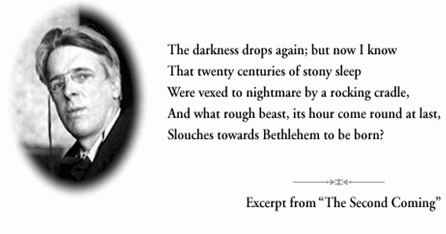
An Overview of Yeats’s Poetry

images

Two poets, one American, one Irish, dominated English Literature during the first half of the twentieth-century: T.S. Eliot and W.B. Yeats.  So powerful is Yeats’s distinctive poetic voice that his poetry has been described as ‘magisterial’, ‘authoritative’, ‘commanding’, ‘formidable’, ‘compelling’, ‘direct’, ‘exhilarating’, and even ‘overbearing’.  Before he died Yeats arranged for an epitaph to be cut in stone ‘by his command’ – and as Seamus Heaney has pointed out ‘command’ is the operative word here!  But there is also in Yeats the voice of the dreamer, the idealist.  We see it in ‘The Lake Isle of Innisfree’, which he began when he was twenty-three.  The life imagined on Innisfree is simple, beautiful and unrealistic and this longing for the ideal is also found in the sixty-one year old Yeats when he sails in his imagination, to Byzantium.

Yeats (like Joyce) lived in a time of extraordinary change.  A world war was fought and Ireland fought for and attained its Independence and went through the scourge of the Civil War; his poetry charts the political turmoil of those times.  Yeats writes about aspects of his private and his public life and sometimes those two aspects of his life overlap.  He is a public poet in a poem such as ‘September 1913’, where he becomes a self-elected spokesman in his condemnation of small-mindedness and the absence of vision.  He played a public role, was committed to Ireland (he refused a knighthood in 1915) and was made a Senator in 1922; one of his early ambitions says Michael Schmidt, was, ‘to reconcile the courteous Protestant heritage with the martyred, unmannerly Roman Catholic tradition in Ireland towards a political end’.  In ‘In Memory of Eva Gore-Booth and Con Markiewicz’ he touches on these themes.  ‘All his life’, writes Augustine Martin, ‘Yeats sought for a harmonious way of life as well as a perfect form of art and he re-invents himself several times during the course of his life and work’.

While it is obvious, having studied a selection of his poems, that many similar themes recur in his poetry, it is also evident that he rarely repeated himself.  In Irish Classics, Professor Declan Kiberd identifies this aspect of Yeats’s poetry and comments:

‘The greatness of Yeats lay in his constant capacity to adjust to ever-changing conditions….As the years passed, he grew simpler in expression, using shorter lines dominated by monosyllables, with more nouns and fewer adjectives.  He said himself that a poet should think like a wise man, but express himself as one of the common people’.

Our poets and songwriters frequently write repeating similar themes and styles.  (Need I mention David Gray?  Eva Cassidy? Morrissey even!).  When Yeats writes about nationalism, his preoccupation with the passing of time and the reality of growing old, his belief in the extraordinary power of art, it could be said that these themes are not startlingly unusual, but it is the way he writes on such topics that makes him unique.  He once described this process memorably as, ‘the stitching and unsticthing’ of old themes.

Imagery, especially his use of symbol, is another striking aspect of his work.  Powerful, memorable images remain with the reader, such as the ‘purple glow’ of noon; the fumbling in ‘a greasy till’; ‘the hangman’s rope’; the nine-and-fifty swans ‘Upon the brimming water’ and the ‘bell-beat of their wings’; the stone in the midst of ‘the living stream’; a creature ‘somewhere in sands of the desert / A shape with lion body and the head of a man’; ‘sages standing in God’s holy fire’; ‘the bees build in the crevices / Of loosening masonry’; ‘Two girls in silk kimonos’, etc., etc.

In ‘Under Ben Bulben’, written five months before he died, he praised the well-made poem and scorned and condemned the shapeless, badly made one.  All his life he valued form and his mastery of rhythm, rhyme and the stanza are testimony to this.  Yeats is intensely personal: he names names and writes about events and happenings that are recorded in newspapers and history books, but he knew that ‘all that is personal soon rots, it must be packed in ice and salt’.  His poems speak to us with great immediacy and directness but they do so in elaborate and musical forms.

‘My poetry is generally written out of despair’ says Yeats.  As he grew older, he searched for ways to overcome his weakening body.  He raged against old age, wrote about it with great honesty and accepted the inevitability of death.  His poetry reminds us of the immortality of art, that ‘Man can embody truth but cannot know it’ and that ‘we begin to live when we have conceived life as a tragedy’.


6135

Hidden Riches in The Poetry of Adrienne Rich

image

  • Adrienne Rich, perhaps more than any other contemporary poet, crystallised in her work and life, the consciousness of modern women. Her poems are, in this respect, overtly feminist in their outlook.


  • Her poems are confessional in that they often draw from her own life experience. While many poets tend to do this, Rich is unique among the poets on the Leaving Cert course in that she uses these experiences to make political statements.


  • Her poems contain complex images and metaphors – some extended metaphors like ‘Storm Warnings’ – and carefully worked out rhythms that challenge the reader.


  • Rich tends to draw from everyday experiences and events in order to make complex ideas more accessible.


The poems of Adrienne Rich spoke to me in a powerful way. She was definitely one of the most original and thought provoking poets that I have studied. Rich speaks for both herself and her generation in the throes of great change. The poems that I have studied represent many of the new ideas that emerged during her life. Not only do I find these ideas interesting but I believe that I have benefited directly from them.

‘Aunt Jennifer’s Tigers’ speaks to me on many levels. It is an overtly feminist poem exploring the position of married women in society.  However, it is also a great piece of writing. Rich creates contrast for maximum effect; the tigers are “proud and unafraid” unlike Aunt Jennifer who is “terrified”.  The nervousness of the aunt is perfectly conveyed through sound and movement; her “fingers” are “fluttering through her wool”. Her creativity and personality is being suppressed by the marriage she is in: “The massive weight of Uncle’s wedding band/Sits heavily upon Aunt Jennifer’s hand.”

There is a sense that her marriage is ‘weighing’ her down. The dominance of her husband is suggested through the capitalisation of “Uncle”. It is clear that this marriage is an unhappy one; even when her aunt is dead she is, “still ringed with ordeals she was mastered by”. Unfortunately, even though this poem was written over fifty years ago, I can still recognise women like Aunt Jennifer.

However, the poem is not completely pessimistic. I think it does a lot to celebrate the potential of women. Aunt Jennifer may have been repressed and timid but she produced tigers that were “proud and unafraid”.  These tigers live on beyond her death. I think this poem hints at the changing position of women that we see today.

The threat of change is evoked beautifully in ‘The Uncle Speaks in the Drawing Room’. Unsurprisingly, this poem is taken from Rich’s collection called ‘Change of World’. The arrogance of the speaker is displayed in his dismissal of the protesters as a “mob”. Like ‘Aunt Jennifer’s Tigers’, the dominant figure is the “uncle”.  I believe he is a symbol of a patriarchal society that is class-ridden with a sense of privilege and entitlement. References to the “drawing room” and “crystal vase and chandelier” reinforce this idea of an ostentatious, wealthy world removed from the common people.

I felt the anger of the mob as they “talked in bitter tones” and “fingered stones”.  Alliteration is used to great effect as Rich describes the “sullen stare” of the crowd. The strong rhyme and rhythm in the poem is reminiscent of a drumbeat or death march. It increases the tension in an already dramatic poem. The uncle dismisses the threat as “follies that subside”. However, he still fears for his “glass”. The fact that he says, “none as yet dare lift an arm” implies that he believes that they may in time. The speaker ends the poem with a warning about how his generation must guard the treasures of “our kind”. I thought this poem was a clever insight into the minds of those who hold the power in the world. It created vivid pictures for me and I was disappointed when it came to an end.

A poem that deals with change and power in a slightly less dramatic way is ‘Living in Sin’. This poem really spoke to me because I could easily relate to it. As a big fan of the movies, I am consistently bombarded by idealised depictions of love that would probably be impossible to recreate in real life. Rich’s poem gave me an insight into the difference between our romantic expectations and the reality of everyday life.

The poem tells the story of a woman who decides to live with her boyfriend. From the first lines of the poem, we realise that things are far from perfect:  “She had thought the studio would keep itself;/No dust upon the furniture of love.”  It is clear that the woman had not even considered the mundane realities of domestic life. She feels guilty about her resentment of domestic chores because in that society it was “half heresy” not to embrace what was seen as ‘women’s work’. I enjoyed the wry humour in the poem as the woman is disturbed by the reality of her new life when “a pair of beetle-eyes would fix her own”. The pressure on women to conform is conveyed by the fact that her “minor demons” jeer her as she cleans the apartment.

It is interesting that the man whom the woman is tending to seems very far from a romantic hero. In fact, he hardly seems worthy of her. He fails to see the problems in the house. He is lethargic and lacks personality. She “writhes” under “the milkman’s tramp”, a metaphor for life and even though “by evening she is back in love again”, it is not as “wholly” as before. I believe this poem acts as a warning to women everywhere to beware of slipping into a life of domesticity where their needs become subservient to those of others.

Another poem that deals with relationships is ‘From a Survivor’. This poem is a lot more directly personal than ‘Living in Sin’. Rich uses the first person in this poem and it is obvious that this is about her failed marriage to Alfred Conrad. After seventeen years of marriage, the couple separated. Months after their separation, Conrad committed suicide. This poem spoke to me because it is very sad and I think it was courageous of Rich to publish it.

The poem expresses itself simply and the language used is almost conversational. Rich reflects on the “pact of men and women in those days”. The use of the word “pact” suggests some sort of battle, perhaps, referring to the shifting balance of power between the sexes at the time. Rich shared the view of all newly weds that herself and her husband were “special” and could withstand the “failures of the race”.

The poem addresses the fact that her husband is now “wastefully dead”. There is real pathos in the lines: ‘Your body is as vivid to me/As it ever was: even more since my feeling for it is clearer’.

Now that their relationship is over and he is dead, Rich can assess what they had together. When they initially married, the status between man and wife was unequal. The husband was a “god” with the “power” over his wife. This poem really interests me on many levels.  It is a very personal reflection on Rich’s life but it also documents a life that has been left behind. I believe, as a result of pioneering women like Rich, our generation will not suffer such inequalities in our marital relationships.

 In many of her earlier poems Rich gives the impression that she is at the mercy of elements that she can’t quite control.  In ‘Storm Warnings’, for example, Rich, by using a sustained extended metaphor, portrays the weather as a powerful force for change that threatens her fragile home.  All she can do is close the windows and lock the doors against the storm that is brewing outside.  As the poem points our, even with our fancy new-fangled technologies and our weather reports, we are unable to control the weather.  We might be able to predict what is going to happen, but we are powerless to prevent it happening.  Time and darkness are two other forces that we are unable to control.  She also seems to suggest that there are elements of our own lives that we are powerless to change also.  As Rich points out: ‘Weather abroad / And weather in the heart alike come on / Regardless of prediction’.  By this she seems to be talking about the depression and other moods that we suffer from throughout our lives.

 Rich wrote ‘Power’ in 1974. From the beginning of that decade, she had devoted her life increasingly to feminism. Certainly, the conflict of an influential woman existing in a patriarchal society is explored in the poem. The poem first interested me because Marie Curie was famous and known to me for her dedication to science and the priceless discoveries she had made during her life. She was a fascinating woman who was the first person ever to win two Nobel prizes for her discovery of the radioactive elements plutonium and radium.  Her work with these elements led to her eventual death from leukaemia.

The poem follows a ‘stream of consciousness’ method that I found both challenging and interesting. It opens with the discovery of,  “a hundred-year-old cure for fever  or melancholy  a tonic”. This bogus “cure” contrasts with the real cures Curie found in her research.

I was really moved by the description of Curie’s suffering. Rich conveys a vivid picture of the scientist’s “body” being “bombarded” by radiation, her eyes developing “cataracts” and her skin “cracked and suppurating”.  The final image of Curie being “unable” to “hold a test-tube or pencil” is particularly poignant.

There is a sense that she was forced to deny “her wounds” because they came “from the same source as her power”.  It is highly ironic that the work that Curie did made her both famous and sick. One wonders if Rich is making a broader political point here. Is she saying that in a male dominated world, a woman must make serious sacrifices to be successful? The poem brought to mind the problems that many women who have both children and demanding jobs experience today. There is always a sacrifice that has to be made in some way. Whatever the ultimate message, this poem is a powerful testament to both Marie Curie and Rich’s powers both as scientist and poet.

Rich said that she had written,  “directly and overtly as a woman, out of a woman’s body and experience”. Her work was both challenging and thought provoking. I was continually excited and surprised by her unusual perspectives and striking imagery.

Quotation-Adrienne-Rich-life-reading-Meetville-Quotes-213108

Canal Bank Walk by Patrick Kavanagh


Leafy with-love banks and the green waters of the canal
Pouring redemption for me, that I do
The will of God, wallow in the habitual, the banal,
Grow with nature again as before I grew.
The bright stick trapped, the breeze adding a third
Party to the couple kissing on an old seat,
And a bird gathering materials for the nest for the Word
Eloquently new and abandoned to its delirious beat.
O unworn world enrapture me, encapture me in a web
Of fabulous grass and eternal voices by a beech,
Feed the gaping need of my senses, give me ad lib
To pray unselfconsciously with overflowing speech
For this soul needs to be honoured with a new dress woven
From green and blue things and arguments that cannot be proven.


 In a lecture entitled ‘Man and Poet’, Kavanagh said:

‘We are in too great a hurry.  We want a person or thing to yield their pleasures and their secrets to us quickly for we have other commitments.  But it is the days when we are idle, when nothing appears to be happening, which provide us, when no one is looking, with all that is memorable’.

The Canal Bank sonnets are unhurried poems in which Kavanagh’s idleness yields precious, unforgettable experiences.  ‘Canal Bank Walk’ is, in effect, the natural poetic sequel to ‘Advent’.

Anthony Cronin has described Patrick Kavanagh as an intensely private man who lived his life in public places, a man who thought mediocrity the enemy of genius, the enemy of life.  He did live a public life as journalist and man about town but Kavanagh also claimed that, ‘the only subject that is of any great importance is – Man-in-this-world-and-why’.  He also believed that, ‘Parochialism is universal; it deals with the fundamentals’ and that great beauty and profound truths can be discovered in apparently ordinary places.

‘Canal Bank Walk’ is written in the traditional 14-line sonnet form.  In this poem, Kavanagh combines both the Petrarchan and Shakespearean sonnets, using the same methods as in ‘Inniskeen Road’.

Religion is a dominant feature in Kavanagh’s poetry, both as a theme and as a source of imagery.  Religion features thematically in ‘Advent’, ‘Canal Bank Walk’,  and ‘A Christmas Childhood’.

His  attitude to the environment changed dramatically following his operation for lung cancer.  He said: ‘As a poet I was born in or about 1955, the place of my birth being the banks of the Grand Canal’.  ‘Canal Bank Walk’ is the first poem Kavanagh wrote after coming out of hospital in 1955.  He claims to have undergone a mystical experience through hospitalisation and recovery.  His whole view of life and of poetry has now changed.  From now on his poetry will be about celebration, about joy, about appreciating the wonderful world God has made.  He has been reborn; his new-born soul is being baptised in, ‘the green waters of the canal’.  Canal water is no longer canal water.  He sees it now, not through material eyes but through spiritual eyes.  He is baptised and from now on will do, ‘the will of God’; and the will of God is that he steep himself in the ordinary world – ‘Wallow in the habitual’.  He will go back to his original innocence, to a state of ‘oneness’ with nature, with God’s creation.  He will  ‘grow again with nature’ as he did before experience corrupted him and wonder died (see ‘Advent’).  There won’t be any more intellectualising.  He will just settle for the world of the senses, the world of sight and sound.  Now that he is renewed and at one with nature, he has eyes for the very ordinary things – ‘the bright stick trapped’, ‘the couple kissing ‘, ‘the bird building’.

The couple are not alone on the seat, the ‘breeze’ adds a third party and is symbolic of his new found gift of observation of ordinary things.  He sees the bird, ‘gathering materials for the nest’ and looks on this ordinary sight with spiritual eyes and the ordinary is transformed – it takes on a religious significance: the bird is preparing the stable at Bethlehem where the Word will be made Flesh, where God will reveal Himself in the form of new life.  Everything will now be brand new; he has just been born as it were; a world that has grown stale through experience and familiarity is new again – ‘eloquently new and abandoned to its delirious beat’.  It’s an ‘unworn world’ – brand new.

He wants to be ensnared in this world of the senses, in this world of sight and sound, in the world of, ‘fabulous grass and eternal voices by a beech’ – the voices of nature no doubt.  He uses the image of the web to suggest his wish to be captivated by nature, he doesn’t want to escape back to a world of analysis and ‘testing’.  ‘Feed the gaping need of my senses’ – he will gladly settle for the world of the senses – no need for the sophistication of intellectualising – ‘to look on is enough in the business of love’.  He wants to pray (as children do) ‘unselfconsciously’, without restraint.  He sees his soul being dressed in a new dress ‘of green and blue things’ – the green of the earth and the blue of the sky – the totality of creation – the world of the senses.

 Kavanagh’s poetry is a record of a journey that brought him from Monaghan to the banks of the Grand Canal, a journey of discovery and exploration in which he reveals himself as one who found the ordinary, extraordinary, and that, ‘the things that really matter (are) casual, insignificant little things’.  Even in the city the images are rural and we are treated to a virtual cornucopia of happy, summery images of grass, trees, breezes and birds.  The poet, Harry Clifton, has said that, ‘In Kavanagh’s finest work, it is almost always high summer’.

In ‘Canal Bank Walk’ it is obvious that Kavanagh is capable of great lyrical intensity.  There is great lyrical, gentle but impassioned quality in lines such as, ‘O unworn world enrapture me’ or, ‘Feed the gaping need of my senses’ and a sense of being totally at ease.  Kavanagh’s language can be what Patrick Crotty calls ‘grittily realistic’ (especially in ‘The Great Hunger’) but there is also a colloquial rhythm in such lines as, ‘There’s a dance in Billy Brennan’s barn tonight’ or, ‘That was the year of the Munich bother’ and there is also a great lyrical quality here in ‘Canal Bank Walk’ where ‘pouring’ and ‘overflowing’ seem to describe the poem’s rhythm and mood:

 ‘For this soul needs to be honoured with a new dress woven

From green and blue things and arguments that cannot be proven.’

This is a beautiful  unhurried poem in which the poet’s idleness yields precious, unforgettable experiences.

image


Advent by Patrick Kavanagh

Advent

We have tested and tasted too much, lover-
Through a chink too wide there comes in no wonder.
But here in the Advent-darkened room
Where the dry black bread and the sugarless tea
Of penance will charm back the luxury
Of a child’s soul, we’ll return to Doom
The knowledge we stole but could not use.

And the newness that was in every stale thing
When we looked at it as children: the spirit-shocking
Wonder in a black slanting Ulster hill
Or the prophetic astonishment in the tedious talking
Of an old fool will awake for us and bring
You and me to the yard gate to watch the whins
And the bog-holes, cart-tracks, old stables where Time begins.

O after Christmas we’ll have no need to go searching
For the difference that sets an old phrase burning-
We’ll hear it in the whispered argument of a churning
Or in the streets where the village boys are lurching.
And we’ll hear it among decent men too
Who barrow dung in gardens under trees,
Wherever life pours ordinary plenty.
Won’t we be rich, my love and I, and please
God we shall not ask for reason’s payment,
The why of heart-breaking strangeness in dreeping hedges
Nor analyse God’s breath in common statement.
We have thrown into the dust-bin the clay-minted wages
Of pleasure, knowledge and the conscious hour-
And Christ comes with a January flower.

– by Patrick Kavanagh

Most Irish adults over 30 will be familiar with Soundings, the Interim (!) Anthology of poetry edited by the late great Augustine Martin, which was used for many years as a Leaving Cert Poetry Anthology.  ‘Advent’ is one of the many gems which lie within its covers and surely this poem qualifies for what Seamus Heaney describes as one of the many, ‘lyrics which now belongs in the common mind as if they were prenatal possessions’.  On the centenary of Kavanagh’s birth in October 2004, Heaney praised him for his, “indefectible gift for discovering the mystical body of the world in the bits and pieces of every day.”  Nowhere is this more evident than in this beautiful seasonal poem.

In this poem Kavanagh experiments with the sonnet form.  It is an amalgam of two sonnets, but the stanza pattern is neither Petrarchan nor Shakespearean.  The opening two stanzas each contain seven lines, and are meant to represent the period of Advent before Christmas. The third stanza representing an entire sonnet is meant to represent the changes that will follow after this period of penance  has ended – here Advent is seen as a ‘mini-Lent’.  In actual fact maybe we are reading too much into the fact that there are 28 lines in the poem and 28 days in the Season of Advent itself!

‘Advent’ uses religion both as a theme and as its main source of imagery. The theme of the poem is penance-forgiveness-grace, which reflects the theology surrounding the Catholic church’s season of Advent and the Nativity.  He desires to return to the state of childish innocence and Christmas surely brings out the child in all of us!  His reasons, I think, are twofold: after this period of denial and fasting – a 1950’s version of detox! – he will become a better Christian and he will also become a better poet if he can look at the world again through the eyes of a child.  This theme is followed up in  ‘Canal Bank Walk’  where the idea of redemption is introduced, as Kavanagh draws analogies between the waters of baptism and the water of the canal.

‘Advent’, therefore,  is a very religious poem – religious at a personal level.  Kavanagh feels that experience has corrupted him – he has ‘tested and tasted too much’.  ‘Tested and tasted’ indicate seeking pleasure for the mind (Knowledge and analysis) and pleasure for the body.  He has lost his innocence.  Now he wants to recapture that lost state.  He is going to do it through penance, by self-denial and sacrifice, through ‘the dry black bread’ and ‘the sugarless tea of penance’.  He will ‘coax back the luxury of a child’s soul’.  By this he means that he will try to rediscover the innocence of a child and the ability to wonder.  He wants, as it were, to begin again in innocence – to be, in effect, the very first Born-Again-Christian in 1950’s Catholic Ireland!   He wants to bring back the newness that was in the world before things grew stale through over-familiarity.  A ‘black slanting Ulster hill’ will be new again;  the boring chat of a tedious old man will become wonderful.  The whole ordinary, ‘banal’, common world of reality is renewed; wonderful now will be ‘whins’, ‘bogholes’, ‘cart-tracks’, ‘old stables’.

When he has been purified and renewed through penance and self-denial he won’t have to go searching for the newness and the wonder in ordinary things; the whole world will be new and alive and fresh and cliché free – ‘We’ll have no need to go searching for the difference that sets an old phrase burning’.  There will be wonder and newness all around in the very ordinary things – ‘in the whispered argument of a churning’ or in a sight as common as a few local lads holding up the wall, or in the sight of,  ‘men barrowing dung to gardens under trees’.  There will be wonder and newness where things are growing – ‘where-ever life pours ordinary plenty’.   This childlike inquisitiveness will also do wonders for his poetic inspiration – he will now have no end of subjects to write about.

Now he will be rich – spiritually rich.  He does not intend to destroy this wonder by questioning, by analysis, by asking the why of things.  He will be content to revel in wonder.  No more intellectualising… ‘..to look on is enough in the business of love’.  He has abandoned the process of analysis, he has thrown all that into the dust-bin, and he can see Christ all around …’in the January flower’.  He can do this because now he has spiritual eyes – he has been renewed through penance and self-denial.

Therefore, this poem is a search for lost innocence, an attempt to recapture the ability to wonder – ‘discovering the mystical body of the world in the bits and pieces of every day’.