An Analysis of the Poetry of John Montague (1929 – 2016)

Great-Book016C-PMF-John-Montague-poet-no-border
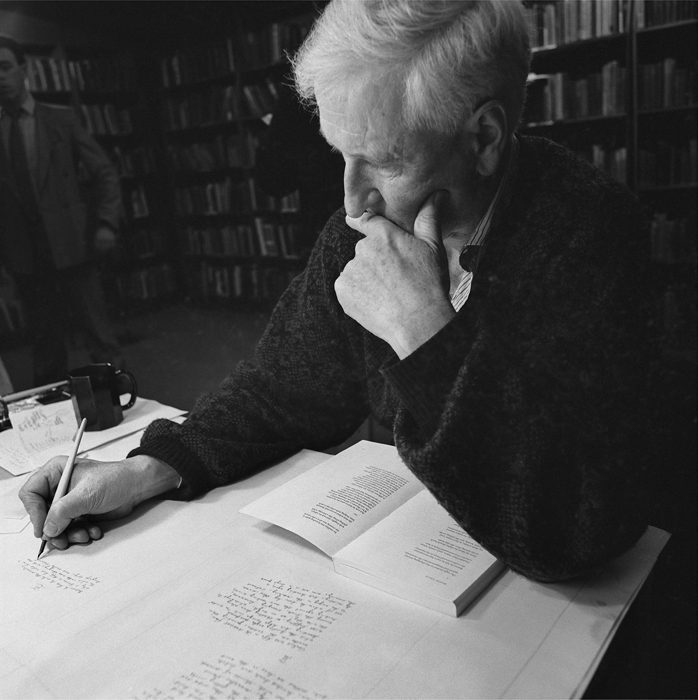
The poet John Montague at work.

THIS IS A PERSONAL REVIEW OF SOME THEMES AND ISSUES WHICH FEATURE IN THE POETRY OF JOHN MONTAGUE. YOU SHOULD CONSIDER THESE IDEAS, THEN RE-EXAMINE THE POEMS MENTIONED FOR EVIDENCE TO SUBSTANTIATE OR CONTRADICT THESE INTERPRETATIONS. IN OTHER WORDS, MAKE YOUR OWN OF THESE NOTES, ADD TO THEM OR DELETE FROM THEM AS YOU SEE FIT.

THE FOLLOWING SELECTION IS SUGGESTED BECAUSE THEY DEAL WITH THE MAJOR THEMES AND STYLISTIC DEVICES WHICH RECUR IN MONTAGUE’S POETRY:
• The Locket (TL)
• The Cage (TC)
• Like Dolmens Round my Childhood the Old People (LDRMC)
• The Wild Dog Rose (TWDR)
• The Same Gesture (TSG)
• Windharp (W)
• A Welcoming Party (AWP)

HE SAID HIMSELF THAT WRITING POETRY WAS ‘LIKE THE DROPPING OF A ROSE PETAL INTO THE GRAND CANYON, A FUTILE ACT’. MAYBE, HOWEVER, YOUR VIEW OF LIFE HAS BEEN CHANGED BY READING HIS POETRY AND MAYBE THE GRAND CANYON IS SWEETER FOR THAT ROSE PETAL AND MAYBE THE WORLD IS A BETTER PLACE BECAUSE OF JOHN MONTAGUE’S POETRY!

YOUR AIM SHOULD BE TO PICK YOUR OWN FAVOURITES FROM THIS SELECTION AND GET TO KNOW THEM VERY WELL.

John Montague
Garbh Fhaiche = The Rough Field = Garvahey

Relevant Background

• John Montague was born in Brooklyn, New York early in 1929.
• He was son of James Montague, an Ulster Catholic, from County Tyrone, who had immigrated to America in 1925 after involvement in republican activities.
• His mother was Molly Carney, but she played little part in his life after his birth. Yet she marred John’s life by her absence from it.
• James Montague had the typical exile’s optimistic hope of benefiting from the American Dream.
• But when his wife, Molly, arrived three years later with their two first sons, James could provide nothing better than the Brooklyn slums for their family home.
• Regarding his background, John Montague’s grandfather was a Justice of the Peace, schoolmaster, farmer, postmaster and director of several firms.
• John had a typical Brooklyn kid’s early childhood, playing with coins on tram- lines and seeing early Mickey Mouse movies.
• Because of the economic effects of the Depression era John Montague was shipped back in 1933 at the age of four to his family home at Garvaghey, in County Tyrone.
• John Montague’s mother rejected him after a painful birth. This rejection and marriage problems were contributory causes to the decision to send John to be fostered from the age of four by two aging unmarried aunts.
• Later, when his mother ended her marriage and returned to Ulster, she continued to ignore John, a fact which deeply hurt him and affected both his speech and his ability to socialise with women.
• However, the switch from city kid to country-village boy in Ulster benefited John and proved to be a ‘healing’ as he called it in a poem not on the course.
• With the help of his imagination, he adopted to life on a farm that doubled as the local rural post-office. Because of this he got to know the local characters and gossip very well. We see this in ‘Like Dolmens’ and ‘The Wild Dog Rose’.
• He was first taught in Garvaghey national school.
• For secondary education John went to an austere boarding school run by strict priests in Armagh. There, against his will, John learned about the long tradition of Irish poetry from an influential teacher.
• While studying for his degree in Dublin after World War Two, John found Dublin to be a very old fashioned place, with the atmosphere over-controlled, especially by priests.
• Afterwards he went to work and complete his education in American Universities. He honed his poetic skills while in America.
• John Montague then got married and lived for a time in France where he continued to write poetry and to write short stories. There for a while he became a friend of the renowned Irish playwright, Samuel Beckett.
• He worked as Paris correspondent for The Irish Times for three years. He spent a total of twelve years living in France.
• After journalism, he began a long career as a university lecturer and poet. He has lectured at universities in France, Ireland, Canada, and the United States.
• He is the author of numerous collections of his own poems and editor of anthologies of works of other poets.
• He has received many awards, including the Irish-American Cultural Institute’s Award for Literature, the American Ireland Fund Literary Award and a Guggenheim Fellowship.
• In 1987, Montague was awarded an honorary doctorate by the State University of New York. The State Governor Mario M. Cuomo praised Montague for his outstanding literary achievements and his contributions to the people of New York.
• In 1998, he was named the first Irish Professor of Poetry. This is a position he held for three years, equally divided among The Queen’s University in Belfast, Trinity College Dublin, and University College Dublin.
• He now divides his time between West Cork and France.
• John Montague has a major international reputation as an Irish poet, the first major Northern Irish Catholic poet.
• He is a poet who describes private feelings as well as public themes.
• Much of his poetry centres on his personal family history and the culture and history of Catholics in Northern Ireland, including the twenty-five year long period of the Troubles.
• For example, his greatest poem ‘The Rough Field’ is set on the farm where he was reared from the age of four and was influenced by the people he grew up among. Three course poems e.g. ‘Like Dolmens Round My Childhood’ come from ‘The Rough Field’.
• The Civil Rights Movement in 1960s Northern Ireland also influenced John Montague. His did a public reading of his poem ‘New Siege’ outside Armagh Jail in 1970 to support a jailed civil rights protestor, the nationalist Bernadette Devlin.
• As an adult he spent some time trying to recapture the American experience, a search reflected in some of his poems.
• Separation from his father all his life affected him emotionally as we read in his poem ‘The Cage’.
• The pain of rejection by his mother was even more traumatic for his personal development as we read in the poem ‘The Locket’.
• John Montague is renowned internationally as one of the major Irish poets of the twentieth century.

  • Montague died at the age of 87 in Nice on 10 December 2016 after complications from a recent surgery. He is survived by his wife Elizabeth Wassell, daughters Oonagh and Sibyl and grandchildren Eve and Theo.
john-montague

MAJOR THEMES IN MONTAGUE’S POETRY

Childhood:  Like many poets on our course, Montague is fascinated with the subject of childhood. AWP describes the relative safety and comfort of a childhood in Ireland during the war. While the rest of Europe was plunged into destruction, Ireland remained safely on the ‘periphery of incident’. While young boys were fighting and dying all over Europe the young poet was free to ‘belt a football through the air’. Yet the ‘drama of unevent’ that constituted the war years in Ireland is briefly shattered for the poet when he encounters the newsreel of the death camps and discovers the grim reality of ‘total war’.

What might be described as a darker aspect of childhood is explored in LDRMC. There is a sense in this poem that the Irelands of Montague’s youth was a dark and haunted place, a land where ancient beliefs and superstitions still survived. We get a sense that during his childhood many people still believed in myths and magic, in ghosts, curses and supernatural demons; ‘Ancient Ireland, indeed! I was reared by her bedside, / The rune and the chant, evil eye and averted head/ Fomorian fierceness of family and local feud.’ For an imaginative child growing up in this society, it was easy to believe that magic still existed, that ancient monsters such as the Fomorians still roamed the land, in the dark countryside just beyond the reach of the farmhouse lights.

A similar theme is evident in TWDR where the poet describes his childhood terror of an old woman that lived in his locality. This poor and seemingly quite ugly old woman terrified the young poet with her ‘hooked nose’, her ragged clothes and the pack of dogs that always surrounded her. To him, she seemed a kind of witch, a terrifying supernatural figure who ‘haunted my childhood’. Yet while Montague’s poetry described this ‘Ancient Ireland’ it also records it’s passing away. As the country became more modern and Europeanised the old legends and superstitions no longer exerted the same power. As he grows up he can see the old legends and superstitions for what they were. This is particularly evident in TWDR where he realises that the ‘cailleach’ that so terrified him in his youth is only human after all and he ends up chatting to her by the roadside, reminiscing and gossiping ‘in ease’ about the people of the parish.

Violence: Montague’s work is haunted by the threat and the possibility of violence. This is particularly evident in ‘A Welcoming Party’ (AWP) where the young speaker is left greatly troubled by his encounter with images of the holocaust. He pulls no punches in his depiction of the horrors of war. His description of the holocaust victims here has been described as disgusting, bizarre and disturbing. Their mouths are described as ‘burnt gloves’, their bodies are depicted as nests full of insect eggs and their hands are depicted as begging bowls.

‘The Wild Dog Rose’ (TWDR), meanwhile, presents violence in an Irish context. The depiction of the attempted rape of the old woman is almost as shocking as that of the holocaust victims. The drunken labourer invades the old woman’s home whirling his boots in an attempt to ‘crush the skulls’ of her dogs. There is something truly horrific about the image of him wrestling her to the ground and ‘rummaging’ in her ‘tasteless trunk’ of a body. Yet this violent scene serves an important symbolic function, representing the violence and misery that had been visited upon Ireland over the centuries. The violation of the old woman echoes many ancient Irish songs and poems in which a woman, representing the land of Ireland, is violated by some ruthless villain who represents the foreign oppressor.

The hidden side of human personalities: John Montague contemplates the vulnerable underside of people who may appear harsh on the surface. ‘Maggie Owens… all I could find was her lonely need to deride’ [LDRMC] ‘Mary Moore… a by-word for fierceness… dreamed of gipsy love-rites’ [LDRMC] Montague also senses how a human hurt can deform a life. ‘the cailleach, that terrible figure who haunted my childhood but no longer harsh, a human being merely, hurt by event’ [TWDR] He reveals the real personality behind the public smiles of his father. ‘My father… extending his smile to all sides of the good (all white) neighbourhood… the least happy man I have known’ [TC] Montague is aware of the duality of our gestures in different contexts. An everyday movement of the hand in public, in traffic, that is mechanical in effect, can be deeply intimate in effect in the privacy of lovemaking, ‘changing gears with the same gesture as eased your snowbound heart and flesh’ [TSG]

John Montague is able to forgive his mother for rejecting him because he sees her pain and senses the different personality she had before her life turned harsh. ‘my double blunder… poverty… yarning of your wild young days… the belle of your small town… landed up mournful and chill’ [TL]

The impact of family on his life: As we have discovered, Montague’s family situation was far from ideal. Like thousands of Irish people, his parents were forced to emigrate to America where they struggled to survive in the face of extremely difficult circumstances. The consequences of this struggle are movingly portrayed in ‘The Cage’ (TC). The battle with poverty and the effort to make a home in a new society have clearly scarred the poet’s father who is described as ‘the least happy man I have known’. His deep unhappiness is evident in his alcoholism. Each night he is compelled to drink himself into oblivion as if only this will numb the pain of his existence, ‘the only element he felt at home in any longer: brute oblivion’.

Yet the poet’s mother, it seems, suffered even more. He claims that the brutal circumstances of her life – emigration, poverty, a loveless marriage – damaged her in some fundamental way, leaving her ‘wound’ in a ‘cocoon of pain’. She is unable to bond with her son and eventually sends him back to Ireland – causing great psychological damage to both herself and her son, so much so that in ‘The Locket’ (TL), he refers to her as a ‘fertile source of guilt and pain’.

The harshness of life: John Montague portrays the suffering of lonesome, impoverished locals from the hills around Garvaghey (Garbh Fhaiche = rough field = Garvahey). ‘When he died his cottage was robbed… driving cattle from a miry stable… forsaken by both creeds… Fomorian fierceness of family and local feud’ [LDRMC] He depicted the suffering of his father, a prisoner of poverty in New York. ‘ my father, the least happy man I have known…the lost years… released from his grille… drank neat whiskey until… brute oblivion.’ [TC] Montague spells out the extent of his mother’s physical pain and anguish. ‘ source of guilt and pain… the harsh logic of a forlorn woman’ [TL] He portrays the life-long loneliness and the brutal rape of a seventy-year-old spinster. ‘the cailleach… hurt by event… loneliness, the monotonous voice in the skull that never stops… he rummages while she battles for life bony fingers reaching desperately to push against his bull neck…’ [TWDR] Montague also portrays the horror of concentration camps. ‘From nests of bodies like hatching eggs flickered insectlike hands and legs’ [AWP]

A sense of place: Montague observes and draws the landscape of his childhood. ‘the cottage, circled by trees, weathered to admonitory shapes of desolation…where the dog rose shines in the hedge’ [TWDR] ‘a bend in the road which still shelters primroses’ [TC] ‘ a crumbling gatehouse. Famous as Pisa for its leaning gable’ [LDRMC] ‘From main road to lane to broken path’ [LDRMC] Montague pinpoints the essence of nature’s music as created by the wind in the Irish landscape. ‘seeping out of low bushes and grass, heatherbells and fern, wrinkling bog pools, scraping tree branches…’ [W] Montague evokes the horror of Auschwitz. ‘a welcoming party of almost shades… an ululation, terrible, shy’ [AWP] He also neatly depicts the irrelevance of Ireland geo-politically in the 1960s. ‘to be always at the periphery of incident’. He mentions what would strike an Irish visitor to New York. ‘listening to a subway shudder the earth.’ [TC] Montague sums up the essence of a Brooklyn neighbourhood. ‘(all-white) neighbourhood belled by St Theresa’s church.’ [TC] Montague evokes the intimacy of the marriage bedroom. ‘a secret room of golden light… healing light… gesture … eased your snowbound heart and flesh.’ [TSG]

Isolation and separation: Montague’s parents suffered separation and social isolation. ‘My father… brute oblivion’ [TC] Like his father, his mother suffered from self-imposed oblivion. ‘the harsh logic of a forlorn woman resigned to being alone’ [TL] Montague with great sympathy captures the reason for an odd old lady’s personality. ‘the only true madness is loneliness, the monotonous voice in the skull that never stops because never heard’ [TWDR] Her isolation means that she seeks no redress from the authorities for rape. She suffers with a stoicism born of a folk version of religion. ‘she tells me a story so terrible I try to push it away… I remember the Holy Mother of God and all she suffered.’ [TWDR] Montague captures the isolation of his scattered elderly rural neighbours. ‘Jamie McCrystal sang to himself… Maggie Owens… even in her bedroom, a she-goat cried… Billy Eagleson… forsaken by both creeds… ‘ [LDRMC]

Human love: Montague is quite famous within the literary world as a poet of love. Intense descriptions of erotic love, in particular, recur in many of his poems. We see this in ‘The Same Gesture’ (TSG) where the couple’s lovemaking is unashamedly celebrated: ‘It is what we always were- / most nakedly are’. Lovemaking is presented as something spiritual and holy. The couples’ hands moving on each other’s skin, we’re told, is like something from a religious ceremony: ‘the shifting of hands is a rite’. Love and sexual intimacy are depicted as having a powerful healing quality: ‘Such intimacy of hand / and mind is achieved / under its healing light’. Oneness is also celebrated, the notion that two lovers can somehow forget themselves and blend into one: ‘We barely know our / selves there.’

TSG, too, is intensely aware of the fragility of love. Emotional and sexual intimacy can be a spiritual and ‘healing’ thing. Yet a relationship can also become bitter and sour leading to hatred and even violence. The poem suggests that in this modern age love and intimacy are becoming more and more difficult to maintain. In this busy world where time and space are such a precious commodity, it can be easy to lose sight of what matters. The pressures of ‘work, phone, drive through late traffic’ must not cause us to neglect our relationships. Love, the poem implies, requires private space, a ‘secret room’ if it is to flourish if its ‘healing light’ is to shine. In the modern world, however, such space is increasingly difficult to come by.

Nature: As with other poets like Kavanagh and Frost, Montague’s work is regularly inspired by the natural world. This is very evident in ‘Windharp’ (W), in particular where he lovingly describes the Irish landscape with its ‘heather bells and fern, / wrinkling bog pools’. In this phrase we see Montague’s powers of description at their best: we can easily imagine the ripples on a bog pool resembling wrinkles on a piece of cloth.

A love of the Irish landscape is also evident in LDRMC with its celebration of the folk who live among the mountains and glens of rural County Tyrone. TWDR, too, displays the poet’s love of nature with its meticulous description of the tender wildflowers with their ‘crumbling yellow cup / and pale bleeding lips’. Yet the harsher aspects of nature are also lovingly rendered, such as the old woman’s rough field with its ‘rank thistles’ and ‘leathery bracken’. He observes nature’s beauty in eloquent language, ‘Gulping the mountain air with painful breath’ [LDRMC] ‘weathered to admonitory shapes of desolation by the mountain winds’ [TWDR]

Montague personifies the effects of climate on the Irish landscape as ‘ a hand ceaselessly combing and stroking the landscape’ [W]. He is also aware that not all that is beautiful is strong, ‘dog rose… at the tip of a slender, tangled, arching branch… weak flower, offering its crumbling yellow cup and pale bleeding lips fading to white’ [TWDR]

It is unsurprising, therefore, given Montague’s obvious love of the Irish landscape that he describes it as something ‘you never get away from’. Even when you leave the country, he claims, the sound of the wind through the Irish countryside, that ‘restless whispering’, will still somehow echo in your ears.
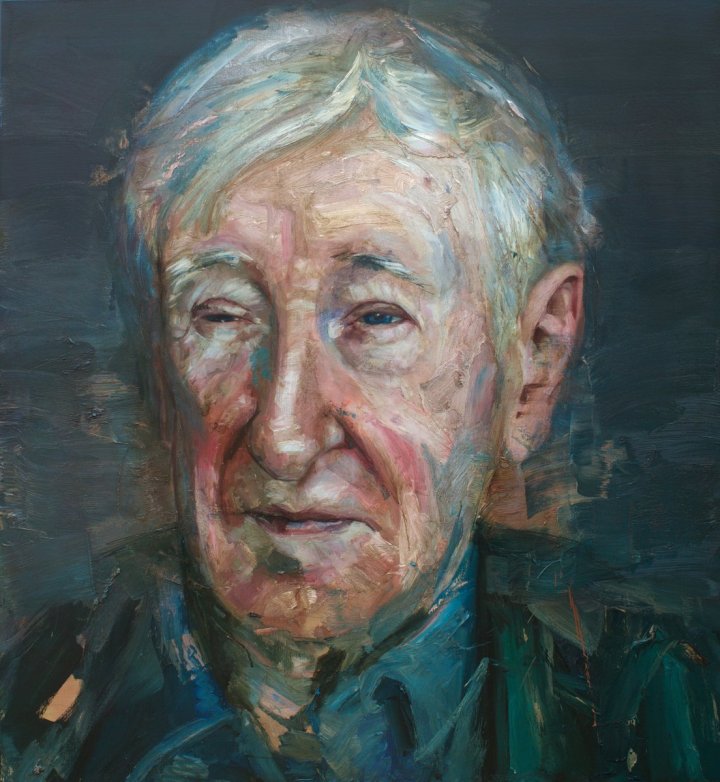
CmdOvCqWEAAQrlf
‘Portrait of John Montague’ / 2015-16 / 127x117cm / oil on canvas by Colin Davidson

MAIN ELEMENTS OF MONTAGUE’S STYLE

Form John Montague is a lyric poet. He uses various stanza forms in the poems selected for the Leaving Certificate. He favours a poem of between four and seven stanzas with either six or seven lines per stanza. However, he deviates from this at times. He doesn’t tend to follow a definite rhyming pattern. Many of his poems have rhyme, though he is not strict about this. You are as likely to see half-rhyme as rhyme.

Speaker: In most of Montague’s poems the speaker is the poet himself. Most of his material comes from his lived experience and direct observations. He is a poet of the self, a romantic poet in that sense. He uses poetry to arrive at perceptions about his parents, partners, memories and the impact on him of national and international events.

Tone: Montague’s various tones range from pain to empathy, admiration and wonder. The word which applies to much of his poetry is compassionate. His tone is often one of intelligent detachment. At times he is capable of sarcasm. His tone can sometimes sound haunted, guilty even for the actions of others. He is capable of rueful and frustrated irony as illustrated in the final line of ‘A Welcoming Party’.

Language: Montague’s language is personal and anecdotal. He addresses the reader in conversational English. The need for rhythm and a regular beat may lead to the omission of obvious words or the changing of word order or phrase order. His most striking feature is his use of adjectives, sometimes in a group of three. It is worth commenting on his adjectives and how they convey meaning, express tone and achieve mood. ‘Windharp’ is a very eloquent poem in which to investigate the effect of adjectives. The fourth stanza of ‘The Wild Dog Rose’ is a powerful example of Montague’s talent for selecting adjectives.

Montague’s choice of verb is often apt and evocative. The use of the verb ‘rummages’ in its context in ‘The Wild Dog Rose’ is both horrifying and touching in its graphic violence. A clear example of Montague’s ability to use a pithy phrase is found in ‘A Welcoming Party’ when he refers to Ireland’s remoteness from what matters in the world at large: ‘to be always at the periphery of incident’. He defines the ‘Irish dimension’ of his childhood as ‘drama of unevent’. Montague matches language to meaning.

Imagery: As partly a narrative type of poet, many of Montague’s images are descriptions of actual memories, colourful pictures from his lived experience or the experience of others like Minnie Kearney narrated first to him and then to the reader as a third-person account. A particularly graphic example of the latter is found in ‘The Wild Dog Rose’. The poem contains an uncensored example of violence, a detail of which is the following: ‘the thin mongrels rushing out, but yelping as he whirls with his farm boots to crush their skulls’. The effect of the word ‘yelping’ on the reader is strong here. Consider the locket around his mother’s neck as a graphic image from his life.

Montague also chooses striking comparison images to convey his intelligent perceptions. The image of a cage for his father’s work booth is an example of Montague’s clear but intelligent metaphors. Likewise, his simile of the dolmen is profound and carries many resonances. The detailed image of the dog rose from the third section of ‘The Wild Dog Rose’ is an illustration of Montague’s descriptive powers and of his ability to use an actual image as a symbol of human fragility.

Verbal music: For Montague’s lyrical music you will find various sound repetitions, rhymes and half-rhymes, alliteration, assonance, onomatopoeia, consonance and sibilance in all his poems. For assonance listen to the ‘u’ sounds in ‘A Welcome Party’ especially in lines seven to ten. This enhances the effect of a group wail or lamentation as suggested by the word ‘ululation’.

A useful example of onomatopoeia is found in line two of ‘Windharp’, where the words imitate the breezes in the bushes and grass: ‘ the restless whispering’. This is a case of assonance ‘e’ and sibilance combining to create a musical effect that reinforces meaning.

For a more detailed illustration of verbal music examine the precise examples provided in the notes on three individual poems by John Montague in the Leaving Cert English Ordinary Section on Skoool.ie .
images (3)

SAMPLE ANSWER:  Give your personal response to the poetry of John Montague.

 I am a big fan of John Montague because I find his poetry very emotional and moving.  Much of this emotion comes from the depiction in his poems of human relationships.  In poem after poem, he explores the difficulties that can exist in human relationships.  Several of his poems reveal the tensions and difficulties that can dog even the most successful of romances.  Family pressures, too, are movingly explored in these poems.  Yet what I found most attractive about Montague’s work is its emphasis on the fact that these difficulties can be overcome or reconciled.

 Montague is quite famous within the literary world as a poet of love.  Intense descriptions of erotic love, in particular, recur in many of his poems.  We see this in ‘The Same Gesture’ (TSG) where the couple’s lovemaking is unashamedly celebrated: ‘It is what we always were- / most nakedly are’.  Lovemaking is presented as something spiritual and holy.  The couples’ hands moving on each other’s skin, we’re told, is like something from a religious ceremony: ‘the shifting of hands is a rite’.  Love and sexual intimacy are depicted as having a powerful healing quality: ‘Such intimacy of hand / and mind is achieved / under its healing light’.  Oneness is also celebrated, the notion that two lovers can somehow forget themselves and blend into one: ‘We barely know our / selves there.’

In ‘The Same Gesture’, too, the poet is intensely aware of the fragility of love.  Emotional and sexual intimacy can be a spiritual and ‘healing’ thing.  Yet a relationship can also become bitter and sour leading to hatred and even violence.  The poem suggests that in this modern age love and intimacy are becoming more and more difficult to maintain.  In this busy world where time and space are such a precious commodity, it can be easy to lose sight of what matters.  The pressures of ‘work, phone, drive through late traffic’ must not cause us to neglect our relationships.  Love, the poem implies, requires private space, a ‘secret room’ if it is to flourish if its ‘healing light’ is to shine.  In the modern world, however, such space is increasingly difficult to come by.

One of his most emotional poems is ‘The Locket’, where he describes his difficult relationship with his mother.  He tells us that his mother has been a ‘fertile source of guilt and pain’ for him throughout his life.  According to the poet, his mother regarded his birth as a ‘double blunder’.  The first part of this ‘double blunder’ stemmed from the fact that the poet was born a boy when she really wanted a girl.  Secondly, Montague was turned the wrong way in the womb, making the process of his birth extremely difficult for her.  According to the poem, this ‘double blunder’ caused the mother to reject her son.  She was never really affectionate to him and ‘sent him away’ when he was four years old.  He was sent back to Ireland where he lived with his aunts.

It seems that even in later years the mother could not bear to be around her child.  When she returned to Ireland she did not reclaim her son and instead went to live in a different village a few miles away from where he lived.  As a young man Montague would ‘cycle down’ to visit her, but eventually, she told him to stop coming: ‘I start to get fond of you, John, / and then you are up and gone.’  I found this aspect of the poem extremely moving and felt very sorry for the young Montague.  I felt he had done nothing to deserve this harsh treatment from his mother.  After all, it was not his fault he was born ‘the wrong sex’ and the ‘wrong way round’.  I found the mother’s behaviour somewhat cruel and felt that she had unfairly created feelings of ‘guilt and pain’ for her son.

‘The Cage’ also explores the poet’s feelings of ‘guilt and pain’ and in this case, the negative emotions stem from his difficult relationship with his father.  He describes his father as the ‘least happy man I have known’.  This unhappy man spent his days working in the dark and noise of the New York subway: ‘listening to a subway shudder the earth’.  He was an alcoholic who would drink himself into ‘brute oblivion’.  Only when obviously drunk was he in any way happy.  According to the poem, this was the ‘only element / he felt at home in any longer.’

One of the most moving aspects of Montague’s poetry is his depiction of his reconciliation with his parents.  When his mother dies he discovers that she loved him after all and that for years she had worn a locket that contained his picture: ‘an oval locket / with an old picture in it, / of a child in Brooklyn’.  Similarly, the poet eventually comes to terms with his troubled father and they walk ‘together / across fields of Garvaghey / to see hawthorn on the Summer / hedges’.  I found it very tragic, however, that both reconciliations came too late.  For the poet’s mother was unable to express her love for him while she was alive and it is only after her death that he learns of it.  The poet’s reconciliation with his father also comes too late.  For no sooner has the father returned to Ireland and spent some time with his son than the son himself must depart: ‘when wary Odysseus returns / Telemachus should leave’.  The poet seems to be forever haunted by this unhappy man and his failure to ever really connect with him and still sees his father’s ‘bald head’ when he descends into subway stations.

Another poem that showcases reconciliation is ‘The Wild Dog Rose’.  As a child, the poet was terrified by the old woman who lived near his house, imagining her to be a terrifying witch with a ‘great hooked nose’, her ‘mottled claws’ and her eyes that were ‘ staring blue’ and ‘sunken’.  I really like the way Montague captures the feelings of mystery and terror the boy experiences at the sight of this weird old lady who ‘haunted my childhood’.  As in ‘The Cage’ and ‘The Locket’ there is a focus on reconciliation in this poem when Montague comes back as a fully grown young man to visit the ‘cailleach’.  Now his feelings of ‘awe’ and ‘terror’ have been replaced by ‘friendliness’.  The poet and the old woman stand by the roadside talking about old times: ‘we talk in ease at last, / like old friends’.  Gradually he is reconciled with this old woman that scared him so much: ‘memories have wrought reconciliation between us’.

To sum up, then, the main reason I like Montague’s poetry so much is the convincing way in which it reveals human emotions.  The poems very movingly portray negative emotions such as pain, guilt, fear and sorrow.  Yet they also show how these negative emotions can be healed and overcome through a process of reconciliation.  I find these aspects of his work very moving indeed.


 john-montague

 JOHN MONTAGUE – SOME GRACE NOTES…..

“The only thing unchanging in life is change.”

  • John Montague is a poet of emotion and of place. Memory, love, Ireland and elsewhere play a significant part in his work.  The seven poems highlighted here tell of his fascination with his sense of his past and native place (LDRMC); his father (TC); his mother (TL); an old woman in his native place who tells him of an attempted rape (TWDR); Ireland’s landscape (WH); the complexities of love (TSG); and his awakening boyhood consciousness (AWP).  According to Montague ‘the only thing unchanging in life is change’ (and a very eminent English teacher constantly reminded his class that ‘the only people who welcome change are babies with wet nappies’!) and his poetry is a chronicle of that change in his own life.
  • The poems we have studied chart Montague’s boyhood, schooldays, early love, and relationships.  Unhappiness and hurt feature in many of his poems.  He speaks of himself as ‘An unwanted child, a primal hurt’ and admits that ‘my work is riddled with human pain’.  However, he also writes tenderly and sensitively about landscape and love.  He sees himself as the first poet of Ulster Catholic background since the Gaelic poets of the eighteenth century.
  • Critic, Peter Sirr, describes Montague as ‘Public and private, internationalist and intensely focused on Ireland’.  He says that Montague’s poetry results from ‘a complex and troubled journey’ and his poetry is ‘haunted, edgy and constantly in search of framing structures to make sense of its different worlds.’  That complex and troubled journey began in Brooklyn and moved through Ireland, North and South, later France and America, before returning to Cork and West Cork.  Family and personal history and Ireland’s history became subject matter for the poetry and his poetic techniques were influenced not only by Irish but by French and American poetry.
  • In an 1988 interview with Dennis O’Driscoll, Montague compared the making of poems to fishing, ‘trying to get the fish out on to the bank’ and he likened the making of poems to the dropping of a rose petal into the Grand Canyon.  Many of his poems are intensely personal.  He shares with us his understanding of intimate, private things and he also writes of life’s harshness and disappointments.
  • Frost will always be associated with Vermont and Kavanagh will always be associated with Inniskeen and indeed, Montague will likewise always be associated with Garvahey (from the Irish ‘garbh fhaiche’ meaning ‘rough field’).  It was his adopted place and he has made this place his own.  ‘Among the welter of the world’s voices,’ he says, ‘in the streets, on the airwaves, in the press, you find your own voice, yet this does not isolate you, but restores you in your people.  Across the world the unit of the parish is being broken down by global forces, and from Inniskeen to Garvahey, from Bellaghey to Ballydehob, to the Great Plains of America, an older lifestyle, based on the seasons, is being destroyed.  But it can still be held in the heart and in the head.’
  • In his Inaugural Lecture of the Irish Chair of Poetry on 14 May 1998, John Montague said: ‘So you wander round the world to discover the self you were born with’ and in that same lecture he agrees with Frank O’Connor who ‘argues that the strength of the storyteller often comes from the pressure behind him of a community which has not achieved definition, a submerged population’.
  • In Peter Sirr’s words: ‘The need to unify the different levels of experience, the recognition that the personal and the political are necessarily meshed, are part of what makes Montague valuable’ and Montague identifies Ireland’s ‘three great losses in the nineteenth century’ as defining: ‘First the loss of people.  Ireland had 8 million people in 1840.  A third of those died or left.  Second, the loss of the Irish language.  Those who remained had to learn to speak English and it happened in ten years.  Third, the loss of the music.  Those who played music at the crossroads were driven out to America and there was fifty years of silence.’

Though his poetry contains striking and memorable images of scars and wounds, ‘I think the ultimate function of the poet is to praise’, says Montague.

‘Hands’ by Michael Hartnett

Hartnett by the Bridge in Newcastle West

Hands

By Michael Hartnett
Some white academy of grace
Taught her to dance in perfect ways:
Neck, as locked lily, is not wan
On this great, undulating bird.
 
Are they indeed your soul, those hands,
As frantic as lace in a wind,
Forever unable to fly
From the beauty of your body.
 
And if they dance, your five white fawns,
Walking lawns of your spoken word,
What may I do but let linger,
My eyes on each luminous bone?
 
Your hands are music, and phrases
Escape your fingers as they move,
And make the unmappable lands
Quiet orchestra of your limbs.
 
For I have seen your hands in fields
And called them fluted flowers
Such as the lily is, before
It unleashes its starwhite life:
I have seen your fingernail
Cut the sky
And called it the new moon.

This beautiful love poem was written by Michael Hartnett in 1966 around the time he had met his future wife Rosemary Grantley (whom he married on 4th April, 1966).  It appears in his collection Selected Poems published by New Writer’s Press in 1970 although it was meant for publication in his first collection, Anatomy of a Cliché published by Liam Millar’s Dolmen Press in 1968.  Many of the poems in that collection are dedicated to and inspired by his relationship with Rosemary.   In ‘Hands’, it is obvious that he is trying to impress her with his poetic prowess and yet he appears to be trying to downplay his poetic skills and be nonchalant at the same time!  Those who knew him need no reminding, those who didn’t should be aware that he was a rogue!

 Commenting on the poem the poet himself  has written:

“This is one of the few of my poems that I can say in full.  It is a love poem and was written in 1966.  I like it for reasons both sentimental and professional.  The hands are my wife’s hands: the poem is their equivalent in words.   I avoided the use of obvious rhymes such as wan/swan and used less expected words to finalise the stanzas, but the more usual rhymes can be inferred.”

 The poem opens with a powerful metaphor – Hartnett’s forte – where his wife is compared to a swan, the perennial symbol of faithfulness in Irish poetry.  The poem is titled ‘Hands’ but here he focuses on her neck and compares it to the swan’s.  There is also a simile used to make the comparison and beautiful use of alliteration, ‘locked lily’.  He downplays the importance of keeping a precise rhyming scheme and uses ‘undulating bird’ instead of the more obvious ‘undulating swan’ in the last line of this first stanza.

There is a hint of fragility and nervous tension throughout and in the second stanza he uses the delicate simile, ‘as frantic as lace in a wind’ to describe his wife’s hands.  He uses another powerful metaphor in the third stanza where her  fingers are compared to  ‘five white fawns’.  There is a very distinctive Celtic ethereal quality to the poem and this is emphasised here by his use of internal rhyme where ‘fawns’ rhymes with ‘lawns’ in the middle of the next line.  Again the rhyme is corrupted at the end and the poet uses ‘bone’ instead of the obvious ‘finger’ to end the stanza.

The fourth stanza contains an extended metaphor where the hands are compared to music – ‘phrases escape your fingers as they move’.  He uses the word ‘orchestra’ here also to continue the comparison.  The stanza ends with another example of corrupted rhyming scheme where he has ‘lands’ rhyming with ‘limbs’ instead of the more obvious ‘hands’.

This extended metaphor ends beautifully in the final stanza with his alliterative allusion to ‘fluted flowers’.   The final tour de force metaphor is exquisite: he compares her fingernail to a sliver of new moon in the night sky.

Hartnett’s gift of observation, his closeness to nature and his searing honesty and genius are evident in abundance here in this amazing love poem.  The delicate, fragile images and almost balletic, musical rhythm are echoed in many of his poems  and also in such poems as ‘Poem for Lara, 10’.

Statue of Michael Hartnett in The Square

Analysis of Seamus Heaney’s poem ‘The Blackbird of Glanmore’.

The Blackbird of Glanmore

 by Seamus Heaney

On the grass when I arrive,
Filling the stillness with life,
But ready to scare off
At the very first wrong move.
In the ivy when I leave.

 It’s you, blackbird, I love.

I park, pause, take heed.
Breathe. Just breathe and sit
And lines I once translated
Come back: “I want away
To the house of death, to my father

Under the low clay roof.”

And I think of one gone to him,
A little stillness dancer –
Haunter-son, lost brother –
Cavorting through the yard,
So glad to see me home,

My homesick first term over.

And think of a neighbour’s words
Long after the accident:
“Yon bird on the shed roof,
Up on the ridge for weeks –
I said nothing at the time

But I never liked yon bird.”

The automatic lock
Clunks shut, the blackbird’s panic
Is shortlived, for a second
I’ve a bird’s eye view of myself,
A shadow on raked gravel

In front of my house of life.

Hedge-hop, I am absolute
For you, your ready talkback,
Your each stand-offish comeback,
Your picky, nervy goldbeak –
On the grass when I arrive,

In the ivy when I leave.

This beautiful, haunting poem is the last poem in Heaney’s celebrated collection District and Circle – and for a very good reason.  The final words of the poem are ‘when I leave’ and thoughts of death and leaving are scattered throughout the poem.  This may be a poem, therefore, where Heaney confronts his own mortality and we also know that he was very ill during the writing of the poems in this collection.  He tells us elsewhere that in order to understand the North he had to leave it  and after his move South, to gain a greater perspective of his home place, Glanmore became his haven, his ‘house of life’; it became, in effect,  a place of inspiration to rival Mossbawn and Anahorish of his youth.  The poem opens as he returns home to Glanmore in his car and as he pulls up on the driveway he sees a blackbird and he recalls lines he has translated,

 I want away

                              To the house of death, to my father,

Under the low clay roof.

He also recalls another earlier poem Mid Term Break which tells of his young brother who died tragically in a road accident.   It is as if the blackbird, presiding spirit in the background, has brought him full circle, to the last word, ‘when I leave’.

Heaney uses an ingenious structure in this poem, alternating between five-line and one-line stanzas. The single lines create a feeling of a set of refrains (repetition), although they are all different. The repeated structures also create a sense of return, so that the poem keeps coming back to the passing moment in which it is set.  The first and last lines of the first stanza, “On the grass when I arrive” and “In the ivy when I leave” are also the first line and last line of the poem itself.   This clever circular composition emphasises the completeness of the moment. It also suggests the cycle of life – and of course there is also an allusion to the title of the collection District and Circle, a reference to the London Underground.   The tight, united form is echoed by the use of half-rhyme throughout the poem, which is particularly noticeable in the second last stanza: “talkback”, “comeback”,  “goldbeak”.

This is a poem about the act of witnessing.   The poet reminds us that our lives are as much about observation as action and in this poem Heaney explores the act of ‘coming home’ through the ironic presence of a blackbird, a creature sometimes associated with being a harbinger of death.

As mentioned earlier, this poem is also an echo and a remembrance of Heaney’s wonderfully poignant earlier poem Mid Term Break which specifically examined the death of the poet’s younger brother Christopher.   This meeting of texts and meeting here  with the blackbird who we are told, had ironically witnessed the earlier death, reveal how we are all mixed up in each other’s exits and entrances into life and death and we always try to make sense of our world less we slip down into the despairing melancholy of utter absence.

Heaney’s evocation of his brother’s absence through death, and yet continued presence through memory,  is a perfectly compressed elegy to tenderness and love:  ‘ A little stillness dancer’.  He is always about, haunting the edge of the poet’s consciousness, at the edge of his thoughts and observations, watching him perhaps too, perfectly preserved through time.

There are places in the poem where the sound of the words suggests an influence from Old English poetry, which used alliteration and combined nouns: “Haunter-son” and “Hedge-hop” illustrate this.   “Hedge-hop” is a perfect description of a blackbird, and its two-syllable alliteration mimics the bird’s movement.  In places Heaney uses the sound of words to create specific effects: the car lock “clunks shut”; here assonance of the ‘uh’ sound emphasises the onomatopoeia of  “clunks”.

The paradoxical (seemingly contradictory) image of the “little stillness dancer” is thought provoking, and captures the idea that the blackbird, even though it stays where it is, is filled with energy and the potential for movement.  Coining metaphors like this is one way in which Heaney creates a fresh look at nature.

The imagery of the translated lines about the “house of death” also repeat the idea of a journey between life and death, confirmed in the narrator’s memory “one gone to him [God]”. The “house of death” is then mirrored and reversed by the phrase “my house of life” towards the end of the poem. Whether it’s a metaphorical or real house, this image undoes the narrator’s sadness, and is a reminder of his good fortune at living a long life.   It seems to me that there are echoes here of Emily Dickinson’s poem,  ‘Because I could not stop for Death’ –

                        We paused before a House that seemed

                        A Swelling of the Ground-

                        The Roof was scarcely visible-

                        The Cornice-in the Ground-

However, despite these associations with death, the poem favours the energy and life of the blackbird. There is the bird’s “ready talkback”, which suggests cheekiness, and although there is “panic” at the sound of the car lock, it is “shortlived”.

The poem seems to be a mixture of sadness and hope or pleasure in the bird, the memories and the moment.  Blackbirds are often used in Irish poetry as mystical, mythical messengers (cf. Austin Clarke’s great poem, The Blackbird of Derrycairn) and this is picked up by the introduction of the superstitious neighbour, but it is not supported by the pleasure of seeing the blackbird in the rest of the poem. In direct address to the bird at the end of the poem, the narrator tells him he is “absolute/for you”, linking back to the love described in the second stanza.  Like the blackbird, the poem is full of suppressed movement, so that although it is only a moment in time and place, it contains much more, allowing Heaney to reflect on the passing of life, and the circularity of life.

The poem contains numerous snapshot moments of the poet’s personal experiences – some remembered moments are up to  fifty years old. He refers to the reported words of a neighbour who once used ‘Yon bird’ to refer to the death (ghost) of this brother. It becomes clearer from this point that the use of the word ‘bird’ suddenly becomes redolent of death. He uses ‘a bird’s eye view of myself’ to say that he reflected on himself and  on his own impending death, ‘A shadow on raked gravel’, with ‘shadow’ being a metaphor for his death or ghost.

So already at the end of District and Circle in the final poem of that collection, The Blackbird of Glanmore, we have the poet doing what poets do best, confronting one of the great elephants in the room, his own mortality.  Like Dickinson, whom we referred to earlier, the poet seems to have had an intimation of sorts, it’s as if this day in Glanmore is the day,

                        I first surmised the Horses Heads

                        Were toward Eternity-

We are also somewhat disconcerted by the realisation that grieving and bereavement is a life-long process and his young brother Christopher’s memory is always but a wingbeat away.  Like the earlier ‘Sunlight’ poems depicting his aunt’s kitchen in Mossbawn this beautiful poem is deceptive at first but like all of Heaney’s work deserving of a second look!

An Overview of Yeats’s Poetry

images

Two poets, one American, one Irish, dominated English Literature during the first half of the twentieth-century: T.S. Eliot and W.B. Yeats.  So powerful is Yeats’s distinctive poetic voice that his poetry has been described as ‘magisterial’, ‘authoritative’, ‘commanding’, ‘formidable’, ‘compelling’, ‘direct’, ‘exhilarating’, and even ‘overbearing’.  Before he died Yeats arranged for an epitaph to be cut in stone ‘by his command’ – and as Seamus Heaney has pointed out ‘command’ is the operative word here!  But there is also in Yeats the voice of the dreamer, the idealist.  We see it in ‘The Lake Isle of Innisfree’, which he began when he was twenty-three.  The life imagined on Innisfree is simple, beautiful and unrealistic and this longing for the ideal is also found in the sixty-one year old Yeats when he sails in his imagination, to Byzantium.

Yeats (like Joyce) lived in a time of extraordinary change.  A world war was fought and Ireland fought for and attained its Independence and went through the scourge of the Civil War; his poetry charts the political turmoil of those times.  Yeats writes about aspects of his private and his public life and sometimes those two aspects of his life overlap.  He is a public poet in a poem such as ‘September 1913’, where he becomes a self-elected spokesman in his condemnation of small-mindedness and the absence of vision.  He played a public role, was committed to Ireland (he refused a knighthood in 1915) and was made a Senator in 1922; one of his early ambitions says Michael Schmidt, was, ‘to reconcile the courteous Protestant heritage with the martyred, unmannerly Roman Catholic tradition in Ireland towards a political end’.  In ‘In Memory of Eva Gore-Booth and Con Markiewicz’ he touches on these themes.  ‘All his life’, writes Augustine Martin, ‘Yeats sought for a harmonious way of life as well as a perfect form of art and he re-invents himself several times during the course of his life and work’.

While it is obvious, having studied a selection of his poems, that many similar themes recur in his poetry, it is also evident that he rarely repeated himself.  In Irish Classics, Professor Declan Kiberd identifies this aspect of Yeats’s poetry and comments:

‘The greatness of Yeats lay in his constant capacity to adjust to ever-changing conditions….As the years passed, he grew simpler in expression, using shorter lines dominated by monosyllables, with more nouns and fewer adjectives.  He said himself that a poet should think like a wise man, but express himself as one of the common people’.

Our poets and songwriters frequently write repeating similar themes and styles.  (Need I mention David Gray?  Eva Cassidy? Morrissey even!).  When Yeats writes about nationalism, his preoccupation with the passing of time and the reality of growing old, his belief in the extraordinary power of art, it could be said that these themes are not startlingly unusual, but it is the way he writes on such topics that makes him unique.  He once described this process memorably as, ‘the stitching and unsticthing’ of old themes.

Imagery, especially his use of symbol, is another striking aspect of his work.  Powerful, memorable images remain with the reader, such as the ‘purple glow’ of noon; the fumbling in ‘a greasy till’; ‘the hangman’s rope’; the nine-and-fifty swans ‘Upon the brimming water’ and the ‘bell-beat of their wings’; the stone in the midst of ‘the living stream’; a creature ‘somewhere in sands of the desert / A shape with lion body and the head of a man’; ‘sages standing in God’s holy fire’; ‘the bees build in the crevices / Of loosening masonry’; ‘Two girls in silk kimonos’, etc., etc.

In ‘Under Ben Bulben’, written five months before he died, he praised the well-made poem and scorned and condemned the shapeless, badly made one.  All his life he valued form and his mastery of rhythm, rhyme and the stanza are testimony to this.  Yeats is intensely personal: he names names and writes about events and happenings that are recorded in newspapers and history books, but he knew that ‘all that is personal soon rots, it must be packed in ice and salt’.  His poems speak to us with great immediacy and directness but they do so in elaborate and musical forms.

‘My poetry is generally written out of despair’ says Yeats.  As he grew older, he searched for ways to overcome his weakening body.  He raged against old age, wrote about it with great honesty and accepted the inevitability of death.  His poetry reminds us of the immortality of art, that ‘Man can embody truth but cannot know it’ and that ‘we begin to live when we have conceived life as a tragedy’.


6135

Hidden Riches in The Poetry of Adrienne Rich

image

  • Adrienne Rich, perhaps more than any other contemporary poet, crystallised in her work and life, the consciousness of modern women. Her poems are, in this respect, overtly feminist in their outlook.


  • Her poems are confessional in that they often draw from her own life experience. While many poets tend to do this, Rich is unique among the poets on the Leaving Cert course in that she uses these experiences to make political statements.


  • Her poems contain complex images and metaphors – some extended metaphors like ‘Storm Warnings’ – and carefully worked out rhythms that challenge the reader.


  • Rich tends to draw from everyday experiences and events in order to make complex ideas more accessible.


The poems of Adrienne Rich spoke to me in a powerful way. She was definitely one of the most original and thought provoking poets that I have studied. Rich speaks for both herself and her generation in the throes of great change. The poems that I have studied represent many of the new ideas that emerged during her life. Not only do I find these ideas interesting but I believe that I have benefited directly from them.

‘Aunt Jennifer’s Tigers’ speaks to me on many levels. It is an overtly feminist poem exploring the position of married women in society.  However, it is also a great piece of writing. Rich creates contrast for maximum effect; the tigers are “proud and unafraid” unlike Aunt Jennifer who is “terrified”.  The nervousness of the aunt is perfectly conveyed through sound and movement; her “fingers” are “fluttering through her wool”. Her creativity and personality is being suppressed by the marriage she is in: “The massive weight of Uncle’s wedding band/Sits heavily upon Aunt Jennifer’s hand.”

There is a sense that her marriage is ‘weighing’ her down. The dominance of her husband is suggested through the capitalisation of “Uncle”. It is clear that this marriage is an unhappy one; even when her aunt is dead she is, “still ringed with ordeals she was mastered by”. Unfortunately, even though this poem was written over fifty years ago, I can still recognise women like Aunt Jennifer.

However, the poem is not completely pessimistic. I think it does a lot to celebrate the potential of women. Aunt Jennifer may have been repressed and timid but she produced tigers that were “proud and unafraid”.  These tigers live on beyond her death. I think this poem hints at the changing position of women that we see today.

The threat of change is evoked beautifully in ‘The Uncle Speaks in the Drawing Room’. Unsurprisingly, this poem is taken from Rich’s collection called ‘Change of World’. The arrogance of the speaker is displayed in his dismissal of the protesters as a “mob”. Like ‘Aunt Jennifer’s Tigers’, the dominant figure is the “uncle”.  I believe he is a symbol of a patriarchal society that is class-ridden with a sense of privilege and entitlement. References to the “drawing room” and “crystal vase and chandelier” reinforce this idea of an ostentatious, wealthy world removed from the common people.

I felt the anger of the mob as they “talked in bitter tones” and “fingered stones”.  Alliteration is used to great effect as Rich describes the “sullen stare” of the crowd. The strong rhyme and rhythm in the poem is reminiscent of a drumbeat or death march. It increases the tension in an already dramatic poem. The uncle dismisses the threat as “follies that subside”. However, he still fears for his “glass”. The fact that he says, “none as yet dare lift an arm” implies that he believes that they may in time. The speaker ends the poem with a warning about how his generation must guard the treasures of “our kind”. I thought this poem was a clever insight into the minds of those who hold the power in the world. It created vivid pictures for me and I was disappointed when it came to an end.

A poem that deals with change and power in a slightly less dramatic way is ‘Living in Sin’. This poem really spoke to me because I could easily relate to it. As a big fan of the movies, I am consistently bombarded by idealised depictions of love that would probably be impossible to recreate in real life. Rich’s poem gave me an insight into the difference between our romantic expectations and the reality of everyday life.

The poem tells the story of a woman who decides to live with her boyfriend. From the first lines of the poem, we realise that things are far from perfect:  “She had thought the studio would keep itself;/No dust upon the furniture of love.”  It is clear that the woman had not even considered the mundane realities of domestic life. She feels guilty about her resentment of domestic chores because in that society it was “half heresy” not to embrace what was seen as ‘women’s work’. I enjoyed the wry humour in the poem as the woman is disturbed by the reality of her new life when “a pair of beetle-eyes would fix her own”. The pressure on women to conform is conveyed by the fact that her “minor demons” jeer her as she cleans the apartment.

It is interesting that the man whom the woman is tending to seems very far from a romantic hero. In fact, he hardly seems worthy of her. He fails to see the problems in the house. He is lethargic and lacks personality. She “writhes” under “the milkman’s tramp”, a metaphor for life and even though “by evening she is back in love again”, it is not as “wholly” as before. I believe this poem acts as a warning to women everywhere to beware of slipping into a life of domesticity where their needs become subservient to those of others.

Another poem that deals with relationships is ‘From a Survivor’. This poem is a lot more directly personal than ‘Living in Sin’. Rich uses the first person in this poem and it is obvious that this is about her failed marriage to Alfred Conrad. After seventeen years of marriage, the couple separated. Months after their separation, Conrad committed suicide. This poem spoke to me because it is very sad and I think it was courageous of Rich to publish it.

The poem expresses itself simply and the language used is almost conversational. Rich reflects on the “pact of men and women in those days”. The use of the word “pact” suggests some sort of battle, perhaps, referring to the shifting balance of power between the sexes at the time. Rich shared the view of all newly weds that herself and her husband were “special” and could withstand the “failures of the race”.

The poem addresses the fact that her husband is now “wastefully dead”. There is real pathos in the lines: ‘Your body is as vivid to me/As it ever was: even more since my feeling for it is clearer’.

Now that their relationship is over and he is dead, Rich can assess what they had together. When they initially married, the status between man and wife was unequal. The husband was a “god” with the “power” over his wife. This poem really interests me on many levels.  It is a very personal reflection on Rich’s life but it also documents a life that has been left behind. I believe, as a result of pioneering women like Rich, our generation will not suffer such inequalities in our marital relationships.

 In many of her earlier poems Rich gives the impression that she is at the mercy of elements that she can’t quite control.  In ‘Storm Warnings’, for example, Rich, by using a sustained extended metaphor, portrays the weather as a powerful force for change that threatens her fragile home.  All she can do is close the windows and lock the doors against the storm that is brewing outside.  As the poem points our, even with our fancy new-fangled technologies and our weather reports, we are unable to control the weather.  We might be able to predict what is going to happen, but we are powerless to prevent it happening.  Time and darkness are two other forces that we are unable to control.  She also seems to suggest that there are elements of our own lives that we are powerless to change also.  As Rich points out: ‘Weather abroad / And weather in the heart alike come on / Regardless of prediction’.  By this she seems to be talking about the depression and other moods that we suffer from throughout our lives.

 Rich wrote ‘Power’ in 1974. From the beginning of that decade, she had devoted her life increasingly to feminism. Certainly, the conflict of an influential woman existing in a patriarchal society is explored in the poem. The poem first interested me because Marie Curie was famous and known to me for her dedication to science and the priceless discoveries she had made during her life. She was a fascinating woman who was the first person ever to win two Nobel prizes for her discovery of the radioactive elements plutonium and radium.  Her work with these elements led to her eventual death from leukaemia.

The poem follows a ‘stream of consciousness’ method that I found both challenging and interesting. It opens with the discovery of,  “a hundred-year-old cure for fever  or melancholy  a tonic”. This bogus “cure” contrasts with the real cures Curie found in her research.

I was really moved by the description of Curie’s suffering. Rich conveys a vivid picture of the scientist’s “body” being “bombarded” by radiation, her eyes developing “cataracts” and her skin “cracked and suppurating”.  The final image of Curie being “unable” to “hold a test-tube or pencil” is particularly poignant.

There is a sense that she was forced to deny “her wounds” because they came “from the same source as her power”.  It is highly ironic that the work that Curie did made her both famous and sick. One wonders if Rich is making a broader political point here. Is she saying that in a male dominated world, a woman must make serious sacrifices to be successful? The poem brought to mind the problems that many women who have both children and demanding jobs experience today. There is always a sacrifice that has to be made in some way. Whatever the ultimate message, this poem is a powerful testament to both Marie Curie and Rich’s powers both as scientist and poet.

Rich said that she had written,  “directly and overtly as a woman, out of a woman’s body and experience”. Her work was both challenging and thought provoking. I was continually excited and surprised by her unusual perspectives and striking imagery.

Quotation-Adrienne-Rich-life-reading-Meetville-Quotes-213108

Canal Bank Walk by Patrick Kavanagh


Leafy with-love banks and the green waters of the canal
Pouring redemption for me, that I do
The will of God, wallow in the habitual, the banal,
Grow with nature again as before I grew.
The bright stick trapped, the breeze adding a third
Party to the couple kissing on an old seat,
And a bird gathering materials for the nest for the Word
Eloquently new and abandoned to its delirious beat.
O unworn world enrapture me, encapture me in a web
Of fabulous grass and eternal voices by a beech,
Feed the gaping need of my senses, give me ad lib
To pray unselfconsciously with overflowing speech
For this soul needs to be honoured with a new dress woven
From green and blue things and arguments that cannot be proven.


 In a lecture entitled ‘Man and Poet’, Kavanagh said:

‘We are in too great a hurry.  We want a person or thing to yield their pleasures and their secrets to us quickly for we have other commitments.  But it is the days when we are idle, when nothing appears to be happening, which provide us, when no one is looking, with all that is memorable’.

The Canal Bank sonnets are unhurried poems in which Kavanagh’s idleness yields precious, unforgettable experiences.  ‘Canal Bank Walk’ is, in effect, the natural poetic sequel to ‘Advent’.

Anthony Cronin has described Patrick Kavanagh as an intensely private man who lived his life in public places, a man who thought mediocrity the enemy of genius, the enemy of life.  He did live a public life as journalist and man about town but Kavanagh also claimed that, ‘the only subject that is of any great importance is – Man-in-this-world-and-why’.  He also believed that, ‘Parochialism is universal; it deals with the fundamentals’ and that great beauty and profound truths can be discovered in apparently ordinary places.

‘Canal Bank Walk’ is written in the traditional 14-line sonnet form.  In this poem, Kavanagh combines both the Petrarchan and Shakespearean sonnets, using the same methods as in ‘Inniskeen Road’.

Religion is a dominant feature in Kavanagh’s poetry, both as a theme and as a source of imagery.  Religion features thematically in ‘Advent’, ‘Canal Bank Walk’,  and ‘A Christmas Childhood’.

His  attitude to the environment changed dramatically following his operation for lung cancer.  He said: ‘As a poet I was born in or about 1955, the place of my birth being the banks of the Grand Canal’.  ‘Canal Bank Walk’ is the first poem Kavanagh wrote after coming out of hospital in 1955.  He claims to have undergone a mystical experience through hospitalisation and recovery.  His whole view of life and of poetry has now changed.  From now on his poetry will be about celebration, about joy, about appreciating the wonderful world God has made.  He has been reborn; his new-born soul is being baptised in, ‘the green waters of the canal’.  Canal water is no longer canal water.  He sees it now, not through material eyes but through spiritual eyes.  He is baptised and from now on will do, ‘the will of God’; and the will of God is that he steep himself in the ordinary world – ‘Wallow in the habitual’.  He will go back to his original innocence, to a state of ‘oneness’ with nature, with God’s creation.  He will  ‘grow again with nature’ as he did before experience corrupted him and wonder died (see ‘Advent’).  There won’t be any more intellectualising.  He will just settle for the world of the senses, the world of sight and sound.  Now that he is renewed and at one with nature, he has eyes for the very ordinary things – ‘the bright stick trapped’, ‘the couple kissing ‘, ‘the bird building’.

The couple are not alone on the seat, the ‘breeze’ adds a third party and is symbolic of his new found gift of observation of ordinary things.  He sees the bird, ‘gathering materials for the nest’ and looks on this ordinary sight with spiritual eyes and the ordinary is transformed – it takes on a religious significance: the bird is preparing the stable at Bethlehem where the Word will be made Flesh, where God will reveal Himself in the form of new life.  Everything will now be brand new; he has just been born as it were; a world that has grown stale through experience and familiarity is new again – ‘eloquently new and abandoned to its delirious beat’.  It’s an ‘unworn world’ – brand new.

He wants to be ensnared in this world of the senses, in this world of sight and sound, in the world of, ‘fabulous grass and eternal voices by a beech’ – the voices of nature no doubt.  He uses the image of the web to suggest his wish to be captivated by nature, he doesn’t want to escape back to a world of analysis and ‘testing’.  ‘Feed the gaping need of my senses’ – he will gladly settle for the world of the senses – no need for the sophistication of intellectualising – ‘to look on is enough in the business of love’.  He wants to pray (as children do) ‘unselfconsciously’, without restraint.  He sees his soul being dressed in a new dress ‘of green and blue things’ – the green of the earth and the blue of the sky – the totality of creation – the world of the senses.

 Kavanagh’s poetry is a record of a journey that brought him from Monaghan to the banks of the Grand Canal, a journey of discovery and exploration in which he reveals himself as one who found the ordinary, extraordinary, and that, ‘the things that really matter (are) casual, insignificant little things’.  Even in the city the images are rural and we are treated to a virtual cornucopia of happy, summery images of grass, trees, breezes and birds.  The poet, Harry Clifton, has said that, ‘In Kavanagh’s finest work, it is almost always high summer’.

In ‘Canal Bank Walk’ it is obvious that Kavanagh is capable of great lyrical intensity.  There is great lyrical, gentle but impassioned quality in lines such as, ‘O unworn world enrapture me’ or, ‘Feed the gaping need of my senses’ and a sense of being totally at ease.  Kavanagh’s language can be what Patrick Crotty calls ‘grittily realistic’ (especially in ‘The Great Hunger’) but there is also a colloquial rhythm in such lines as, ‘There’s a dance in Billy Brennan’s barn tonight’ or, ‘That was the year of the Munich bother’ and there is also a great lyrical quality here in ‘Canal Bank Walk’ where ‘pouring’ and ‘overflowing’ seem to describe the poem’s rhythm and mood:

 ‘For this soul needs to be honoured with a new dress woven

From green and blue things and arguments that cannot be proven.’

This is a beautiful  unhurried poem in which the poet’s idleness yields precious, unforgettable experiences.

image


Advent by Patrick Kavanagh

Advent

We have tested and tasted too much, lover-
Through a chink too wide there comes in no wonder.
But here in the Advent-darkened room
Where the dry black bread and the sugarless tea
Of penance will charm back the luxury
Of a child’s soul, we’ll return to Doom
The knowledge we stole but could not use.

And the newness that was in every stale thing
When we looked at it as children: the spirit-shocking
Wonder in a black slanting Ulster hill
Or the prophetic astonishment in the tedious talking
Of an old fool will awake for us and bring
You and me to the yard gate to watch the whins
And the bog-holes, cart-tracks, old stables where Time begins.

O after Christmas we’ll have no need to go searching
For the difference that sets an old phrase burning-
We’ll hear it in the whispered argument of a churning
Or in the streets where the village boys are lurching.
And we’ll hear it among decent men too
Who barrow dung in gardens under trees,
Wherever life pours ordinary plenty.
Won’t we be rich, my love and I, and please
God we shall not ask for reason’s payment,
The why of heart-breaking strangeness in dreeping hedges
Nor analyse God’s breath in common statement.
We have thrown into the dust-bin the clay-minted wages
Of pleasure, knowledge and the conscious hour-
And Christ comes with a January flower.

– by Patrick Kavanagh

Most Irish adults over 30 will be familiar with Soundings, the Interim (!) Anthology of poetry edited by the late great Augustine Martin, which was used for many years as a Leaving Cert Poetry Anthology.  ‘Advent’ is one of the many gems which lie within its covers and surely this poem qualifies for what Seamus Heaney describes as one of the many, ‘lyrics which now belongs in the common mind as if they were prenatal possessions’.  On the centenary of Kavanagh’s birth in October 2004, Heaney praised him for his, “indefectible gift for discovering the mystical body of the world in the bits and pieces of every day.”  Nowhere is this more evident than in this beautiful seasonal poem.

In this poem Kavanagh experiments with the sonnet form.  It is an amalgam of two sonnets, but the stanza pattern is neither Petrarchan nor Shakespearean.  The opening two stanzas each contain seven lines, and are meant to represent the period of Advent before Christmas. The third stanza representing an entire sonnet is meant to represent the changes that will follow after this period of penance  has ended – here Advent is seen as a ‘mini-Lent’.  In actual fact maybe we are reading too much into the fact that there are 28 lines in the poem and 28 days in the Season of Advent itself!

‘Advent’ uses religion both as a theme and as its main source of imagery. The theme of the poem is penance-forgiveness-grace, which reflects the theology surrounding the Catholic church’s season of Advent and the Nativity.  He desires to return to the state of childish innocence and Christmas surely brings out the child in all of us!  His reasons, I think, are twofold: after this period of denial and fasting – a 1950’s version of detox! – he will become a better Christian and he will also become a better poet if he can look at the world again through the eyes of a child.  This theme is followed up in  ‘Canal Bank Walk’  where the idea of redemption is introduced, as Kavanagh draws analogies between the waters of baptism and the water of the canal.

‘Advent’, therefore,  is a very religious poem – religious at a personal level.  Kavanagh feels that experience has corrupted him – he has ‘tested and tasted too much’.  ‘Tested and tasted’ indicate seeking pleasure for the mind (Knowledge and analysis) and pleasure for the body.  He has lost his innocence.  Now he wants to recapture that lost state.  He is going to do it through penance, by self-denial and sacrifice, through ‘the dry black bread’ and ‘the sugarless tea of penance’.  He will ‘coax back the luxury of a child’s soul’.  By this he means that he will try to rediscover the innocence of a child and the ability to wonder.  He wants, as it were, to begin again in innocence – to be, in effect, the very first Born-Again-Christian in 1950’s Catholic Ireland!   He wants to bring back the newness that was in the world before things grew stale through over-familiarity.  A ‘black slanting Ulster hill’ will be new again;  the boring chat of a tedious old man will become wonderful.  The whole ordinary, ‘banal’, common world of reality is renewed; wonderful now will be ‘whins’, ‘bogholes’, ‘cart-tracks’, ‘old stables’.

When he has been purified and renewed through penance and self-denial he won’t have to go searching for the newness and the wonder in ordinary things; the whole world will be new and alive and fresh and cliché free – ‘We’ll have no need to go searching for the difference that sets an old phrase burning’.  There will be wonder and newness all around in the very ordinary things – ‘in the whispered argument of a churning’ or in a sight as common as a few local lads holding up the wall, or in the sight of,  ‘men barrowing dung to gardens under trees’.  There will be wonder and newness where things are growing – ‘where-ever life pours ordinary plenty’.   This childlike inquisitiveness will also do wonders for his poetic inspiration – he will now have no end of subjects to write about.

Now he will be rich – spiritually rich.  He does not intend to destroy this wonder by questioning, by analysis, by asking the why of things.  He will be content to revel in wonder.  No more intellectualising… ‘..to look on is enough in the business of love’.  He has abandoned the process of analysis, he has thrown all that into the dust-bin, and he can see Christ all around …’in the January flower’.  He can do this because now he has spiritual eyes – he has been renewed through penance and self-denial.

Therefore, this poem is a search for lost innocence, an attempt to recapture the ability to wonder – ‘discovering the mystical body of the world in the bits and pieces of every day’.