One of my favourite, enigmatic sports photos of all time! Mick Mackey (umpire) and Christy Ring have a few words as Ring is forced to leave the fray during the 1957 Munster semi-final.
Reconstructionists
By Michael Hartnett
The GAA decided
the time had come to explain
to very puzzled tourists
the rules of the Hurling Game.
So, as things are quiet in winter,
their decision was to ask
the lads from the Office of Public Works
to help them with their task –
to build an Interpretive Centre;
to unbaffle Icelanders,
Dutchmen, Danes and Turks,
to educate visitors
and not leave them in the dark,
and to site this latest venture –
where else, but in Croke Park!
The day came for unveiling
and there in snow-white ranks
stood shining sheds of limestone,
with Celtic septic tanks
to service all the toilets
with their sparkling tiles and taps;
and there was a lecture room
hung with very detailed maps
to point the way to Thurles
for Libyans, Letts and Lapps;
and a foyer aglow like the Book of Kells
with an undecipherable graph
that’s explained the whole year ‘round
by the full-time staff
of two. And for all the lovely money
a Foreign Currency Exchange
clad in gleaming quartz-stone
left over from Newgrange.
And a genuine Irish siopa té
with genuine soda bread
made brown with genuine turf dust
to sink in your belly like lead
(one slice of that and, d’you know what,
you’ll swear that you’ve been fed!).
The Fathers of the Nation
rejoiced and they were glad
(the Mother of the Nation
Was somewhere west of Chad);
but none of these wise leaders
had foreseen the tiny hitch –
the lads from the Office of Public Works
had built their Temple of Plumbing
in the middle of the pitch!
Note:
This poem, despite its rather enigmatic and unwieldy title, hides a gem of satire underneath! In the poem, Hartnett foresees the building of the Croke Park Museum, which eventually opened its doors to the public in September 1998, just before the poet’s untimely passing in October 1999. In typical Hartnett fashion, he never misses an opportunity to take a wry, satirical sideswipe at the Government and, in this case, its Office of Public Works. Little did he realise that a quarter of a century later, the line Minister for the Office of Public Works would be fellow Newcastle West native, Minister Patrick O’Donovan, whose family once lived next door to Hartnett in Assumpta Park!
Needless to say, today, the Croke Park Museum is a state-of-the-art building and a mecca for locals and tourists alike from diverse locations, including Iceland, Lapland, the Netherlands, Denmark, and Turkey! It is a celebration of the history, development and heritage of Gaelic games and the GAA itself. It houses artefacts related to the Association’s foundation and its most famous players. The museum is home to the original Sam Maguire and Liam MacCarthy Cups.
By the way, his phrase ‘the Mother of the Nation’ is a reference to Mary Robinson, an Irish politician who served as President of Ireland from December 1990 to September 1997. She was this country’s first female President. She has since gone on to work with distinction as an Elder, and she continues to campaign globally on issues of civil rights and climate change.
References
Hartnett, Michael. A Book of Strays, edited by Peter Fallon, Gallery Press, 2002 (reprinted 2015).
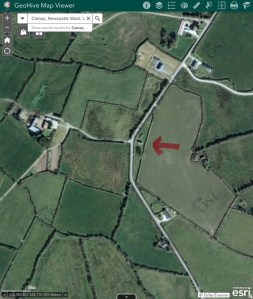
A Geohive Hub aerial view of Bridget Halpin’s cottage in Camas taken in 2006.
Camas is a small nondescript townland nestling in the shadow of the nearby village of Ratheenagh in rural West Limerick. In the Author’s Notes to his Collected Poems (2001), Michael Hartnett tells us that, ‘Camas is a townland five miles south of Newcastle West in County Limerick where I spent most of my childhood’. This local townland proved to be a central element in his early development. There, the young impressionable Hartnett was influenced by his people, particularly his grandmother, Bridget Halpin, and their customs and way of life. Indeed, in the mid-70s, when he tired of the Dublin literary milieu, it was to this same rural West Limerick bastion, nearby Glendarragh in Templeglantine, still steeped in Irish music and culture, to which he returned. It was to this place he came to escape Dublin’s incestuous stranglehold and perhaps to write a new chapter “out foreign in ‘Glantine”.
There are up to fifteen poems by Hartnett which could be considered ‘Camas Poems’. These memory poems are all based on his childhood recollections of those happy times in his grandmother’s kitchen. Students of Hartnett’s poetry should consider studying ‘A Small Farm’ (Collected Poems 15) as one of a series of memory poems that he wrote celebrating his grandmother, Bridget Halpin and the townland of Camas where she lived. The most obvious of these Camas Poems is ‘Death of an Irishwoman’ (Collected Poems 139), which he wrote on the passing of his grandmother in 1965. Others include ‘For My Grandmother Bridget Halpin’ (Collected Poems 52), and ‘Mrs Halpin and the Lightning’ Collected Poems 138) and of course ‘An Múince Dreoilíní ‘/ ‘A Necklace of Wrens’ (A Necklace of Wrens 18), a quintessential memory poem from childhood.
Hartnett’s early poetry creates a delicate balance between description and abstraction, the actual and the figurative. The poem ‘A Small Farm’, the first poem of the Collected Poems (2001), a memory poem dating from Hartnett’s teenage years, establishes this. Abstractions, clichés, their representation through language, and the moment where these are drawn into focus, made specific and immediate, are central. The setting of the ‘small farm’ is described en abstracto: ‘All the perversions of the soul / I learnt on a small farm’ (15). In contrast to other contemporary representations of Irish farm homesteads, most obviously Kavanagh’s ‘Inniskeen’, and Heaney’s ‘Anahorish’, there is no naming of place here. The picture of the farm is rather etched out in generalisation and aphorism, and through the accordant clichés of petty hatred and ignorance, ‘how to do the neighbours harm / by magic, how to hate’ (15), before Hartnett brings the glass into focus, employing idiosyncratic detail which establishes the world of the poem itself. In this way, Hartnett’s particular subjectivity, his way of seeing, is established. It would become his poetic currency:
Here were rosary beads,
a bleeding face,
the glinting doors that did encase their cutler needs,
their plates, their knives, the cracked calendars of their lives. (15)
In the final stanza, Hartnett makes an explicit link between his awakening as a perceiver of social interactions and moments of poetic beauty, with a growing knowledge and identification with the natural world:
I was abandoned to their tragedies and began to count the birds,
to deduce secrets in the kitchen cold,
and to avoid among my nameless weeds
the civil war of that household. (15)
The attentive intellect which ‘counts the birds’ has as yet no language to describe or express his experience of the natural world, his ‘nameless weeds’. Still, he is possessive of it, seeing it as distinct from the human society which he can describe, yet does not identify with.
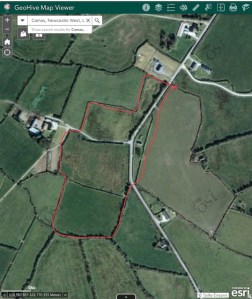
The ‘small farm’ referred to here belonged to his grandmother, Bridget Halpin, and like many other small holdings in Camas, it consisted of a meagre ten acres, three roods and thirteen perches. This woman, Bridget Halpin, would later wield great influence over her young grandson, Michael Hartnett. Indeed, if we are to believe the poet, she was the one who first affirmed his poetic gift when one day he ran into her kitchen in Camas and told her that a nest of young wrens had alighted on his head. Her reply to him was, ‘Aha, you’re going to be a poet!’. (A more detailed genealogy of the Halpin family and the early formative influences on Michael Hartnett can be read here).
Bridget Halpin’s small farm of ten acres, three roods and thirteen perches, which was so vital in the early development of one of our greatest poets. This view is taken from a Geohive Hub aerial view taken in 2006.
Hartnett claimed that he spent much of his early childhood in Bridget Halpin’s cottage in the rural townland of Camas, five miles from his home in nearby Newcastle West. He went on to immortalise this woman in many of his poems, but especially in his beautiful poem, ‘Death of an Irishwoman’. This quiet townland of Camas must therefore be seen as central to his development as a poet, and maybe in time, this early association with Camas will be given its rightful importance, and the little rural townland will vie with Maiden Street or Inchicore as one of Hartnett’s important formative places.
‘Camas Road’, Michael Hartnett’s first ever published work, appeared in the Limerick Weekly Echo on the 18th of June 1955. He was thirteen. The poem describes the rural vista of the West Limerick townland of Camas at evening: ‘A bridge, a stream, a long low hedge, / A cottage thatched with golden straw’ (A Book of Strays 67). Its two eight-line stanzas of alternating rhyme and regular metre contain a litany of natural images, at times idiosyncratically rendered; the ‘timid hare sits in the ditch’, ‘the soft lush hay that grows in fields’. It is a peculiar mix of a poem, apparent images from both the poet’s lived and literary experience, placed side by side. It is contentedly denotative, creating a sense of ease and oneness with the natural world. The movement of sunrise to sunset is perpetually peaceful, its colours oils for the young poet’s palette. The ruminative introspection which elevates Kavanagh’s ‘Inniskeen Road: July Evening’, a poem which can be read in useful parallel to ‘Camas Road’, is not present. At the poem’s turn, as ‘Dark shadows fall o’er land so still’, Hartnett’s only thought and action are of flattened description, the creation of ‘this ode’.
‘Camas Road’ then, though essentially a curiosity which stands outside of Hartnett’s body of work, can be read as a seldom afforded snapshot of Michael Hartnett the poet before he became one. In contrast, his poem ‘A Small Farm’ shows a marked development in his poetic craft. Bridget Halpin, his grandmother, lived there with her son, Denis (Dinny Halpin), in what Hartnett describes as a prolonged state of ‘civil war’,
I was abandoned to their tragedies,
Minor but unhealing.
The word ‘abandoned’ here has many undertones and is important for the poet because he repeats the line twice in the poem. He has told us elsewhere that he was, in effect, ‘fostered out’ by his parents in Maiden Street, Newcastle West, to his grandmother, Bridget Halpin, from a young age and spent much of his childhood in her cottage in Camas. However, there is also the suggestion that while there he was ‘abandoned’ and somewhat neglected as he became an outsider, an unwilling observer of the ‘civil war’ of the household, as Bridget and her son Dinny constantly argued and fought over the minutiae of running a small farm in difficult times in the Ireland of the late 40s and early 50s.
Hartnett saw in his grandmother a remnant of a generation in crisis, still struggling with the precepts of Christianity and still familiar with the ancient beliefs and piseógs of the countryside. For Hartnett, there is also the added heartache that sees his grandmother struggling to come to terms with a lost language that has been cruelly taken from her. This, therefore, is a totally different place when compared to, for example, Kavanagh’s Inniskeen or Heaney’s Mossbawn or Montague’s Garvahey. However, there is an underlying paganism here that is absent from their work, although Montague comes close in his great poem, ‘Like Dolmens Round my Childhood, the Old People’.
For Hartnett, his grandmother represents a generation that lived a life dominated by myth, half-truth, some learning, and limited knowledge of the laws of physics, and therefore, as he points out in ‘Mrs Halpin and the Lightning’,
Her fear was not the simple fear of one
who does not know the source of thunder:
these were the ancient Irish gods
she had deserted for the sake of Christ.
However, Hartnett’s powers of observation and intuition were honed in Camas on Bridget Halpin’s small farm during his frequent visits. He tells us that he learnt much on that small farm during those lean years in the forties and early fifties,
All the perversions of the soul
I learnt on a small farm,
how to do the neighbours harm
by magic, how to hate.
The struggle to make a success and eke out a living was a constant struggle and burden. The begrudgery of neighbours, the ‘bitterness over boggy land’, and the ‘casual stealing of crops’ went side by side with ‘venomous card games’, ‘a little music’ and ‘a little peace in decrepit stables’. The similarities with Kavanagh’s ‘The Great Hunger’ are everywhere, but Hartnett does not name this place; it is an Everyplace. The poem is simply titled, ‘A Small Farm’, so there is no Inniskeen, Drummeril, or Black Shanco here. Still, the harshness and brutality of existence, ‘the cracked calendars / of their lives’ in the 50s in Ireland, is given a universality even more disturbing than the picture we receive from Kavanagh. Yet, it is here in Camas that he first becomes aware of his calling as a poet and, like Kavanagh, it was here that ‘The first gay flight of my lyric / Got caught in a peasant’s prayer’. And so, to avoid the normal household squabbles of his grandmother and her son, he ‘abandons’ them, turns his back on them, and begins to notice the birds and the weeds and the grasses.
The depiction of another agricultural custom is shown in ‘Pigkilling’. The joyful detailing of the killing of a pig at his grandmother’s farm in Camas eschews any characterisation of Hartnett as a simplistically environmental poet, denouncing all human domination over nature. Rather, it depicts the killing as a vital part of the rural community’s relationship with animal-kind, comparable to ritual.
Like a knife cutting a knife
his last plea for life
echoes joyfully in Camas.
This is one of the few Camas Poems that names the place and the central figure of the poem himself uses the pig’s bladder as a plaything: ‘I kicked his golden bladder / in the air’ (Collected Poems 125). Agriculture here is not mechanised but depicted as an ongoing, sustainable facet of rural life: the poem echoes the loss of many of these old rituals and crafts of the past, as Heaney does in his collection, Death of a Naturalist.
The townland of Camas is also central to an episode that the poet recounts for us in his seminal poem, ‘A Farewell to English’ (Collected Poems 141). This encounter hovers somewhere between reality and dream, aisling (the Irish word for a vision) or epiphany. The incident takes place at Doody’s Cross as the poet walks out on a summer Sunday evening from Newcastle West to the cottage in Camas. He is on his way to meet up with his uncle, Dinny Halpin. He sits down ‘on a gentle bench of grass’ to rest his weary feet after his exertions, when he sees approaching him three spectral figures from the Bardic Gaelic past – Andrias Mac Craith, Aodhagán Ó Rathaille, and Daíbhí Ó Bruadair. These ‘old men’ walked on ‘the summer road’ with
sugán belts and long black coats
with big ashplants and half-sacks
of rags and bacon on their backs.
They pose as a rather pathetic group, ‘hungry, snot-nosed, half-drunk’ and they give him a withering glance before they take their separate ways to Croom, Meentogues and Cahirmoyle, the locations of their patronage, ‘a thousand years of history / in their pockets’. Here, Hartnett is situating himself as their direct descendant and the inheritor of their craft, and the enormity of this epiphany occurs at Doody’s Cross in Camas: the enormity of the task that lies ahead also terrifies and haunts him.
Earlier in ‘For My Grandmother, Bridget Halpin’ (Collected Poems 52), he again alludes to the wildness, the paganism, the piseógs that surrounded him during his childhood in Camas. His grandmother’s worldview is almost feral. She looks to the landscape and the birds for information about the weather or impending events,
A bird’s hover,
seabird, blackbird, or bird of prey,
was rain, or death, or lost cattle.
This poorly educated woman reads the landscape and the skies as one would read a book,
The day’s warning, like red plovers
so etched and small the clouded sky,
was book to you, and true bible.
And yet, in his beautiful poem, ‘Bread’ (Collected Poems 53), he evokes and echoes the warmth and nurture of Mary Heaney’s kitchen in Mossbawn. His grandmother’s kitchen in Camas was a comforting place for him, and his early childhood memories are ones of coming home to roost,
and I come here
on tiring wings.
Odours of bread….
The picture we get of the small farm in Camas is rather etched out in generalisation and aphorism, and through the accordant clichés of petty hatred and ignorance, ‘how to do the neighbours harm / by magic, how to hate’, before Hartnett brings the glass into focus, employing idiosyncratic detail which establishes the world of the poem itself. As already mentioned, the cottage on this small farm was a Rambling House, a house where neighbours gathered to tell stories, play music and card games,
venomous card games
across swearing tables
His early poetry, then, creates a delicate balance between description and abstraction, the actual and the figurative. In this way, Hartnett’s particular subjectivity, his way of seeing, is established. In time, it would become his poetic currency. We are invited into the quintessentially old traditional Irish kitchen with its pictures of the Pope, the Sacred Heart, the statue of Our Lady, the Crucifix,
Here were rosary beads,
a bleeding face,
the glinting doors that did encase their cutler needs,
their plates, their knives, the cracked calendars of their lives
In this poem, therefore, Hartnett is following on from Kavanagh in shining a light into the domestic and interior life of rural dwellers not previously considered worthy of attention.
I have to mention one other poem, a quintessential Camas poem, which appears in the collection A Necklace of Wrens, published in 1987 after his return to Dublin. This is a collection of selected poems in Irish with English translations by Hartnett. The poem in question is titled ‘The Country Chapel’, with its Irish translation ‘An Séipéal faoin Tuath’. This memory poem describes the scene outside the country church on any given Sunday. The young, observant Hartnett describes the various characters who have come from the ‘fat meadows’ as ‘sly and happy’. They resemble ‘a set-dance team / by the wall of the old chapel’. They are all strategically placed depending on the various local rows and even their differing sporting and political allegiances, ‘foe avoiding enemy’. This eclectic group of neighbours are beautifully portrayed in the lovely Hartnett metaphor: ‘The congregation is a lonely horse’ who appear to be ‘as awkward as a man /dancing with a nun / on a wedding day’. This may well be a long-lost poetic portrait of the people of Killeedy, Ratheenagh, Ballagh and Kantoher in the mid-40s and 50s.
Bridget Halpin’s ‘small farm’ in Camas may have been small and full of rushes and wild iris, but it helped produce one of Ireland’s leading poets of any century. The influences absorbed in this rural setting, his powers of observation, his knowledge of wildlife and flowers, and his ecocentric bias, are impressive and are all-pervasive in these Camas Poems and, indeed, his poetry in general. Hartnett, the quintessential nature poet, would be delighted and impressed to see the magnificent new Killeedy Eco Park, which has been set up less than a mile from his ‘foster’ home in Camas by the combined efforts of that same local community in Killeedy. It is also significant that the visionary developers of this project have included a Poet’s Corner where Hartnett is remembered, just a stone’s throw from the small farm of his formative years. Here today’s generation in Camas and beyond can now come to ‘count the birds’ and the ‘nameless weeds’.
References
Hartnett, M. Collected Poems, edited by Peter Fallon, Gallery Press, 2001 (Reprinted 2012)
Hartnett, M. A Necklace of Wrens: Poems in Irish and English, The Gallery Press, 1987 (Reprinted 2015).
HARTNETT, M. A Book of Strays, edited by Peter Fallon, The Gallery Press, 2002, (Reprinted 2015).
Statue of a pensive Michael Hartnett in The Square, Newcastle West.
The Irish are a people well-versed in tragedy, suffering, grief and sorrow. Beset by famine, poverty and colonization, the history of Ireland is one that is steeped in immense adversity and sadness. Perhaps this is why the Irish are so particularly adept at mourning the loss of a loved one and saying goodbye. This may explain Hartnett’s fascination with the unique customs and traditions surrounding the Irish Wake, a tradition which is one of the most distinctive and renowned funeral traditions worldwide. Needless to say, alcohol and music, both significant staples of Irish culture, are often heavily featured at a wake. While an Irish Wake is first and foremost a final farewell to the one departed, it can also serve as a potent and bracing reminder to those in attendance that they are still alive and a part of the world. This unique mixture of melancholy and mirth is partly why the Irish Wake is so famous the world over. Such an atmosphere is especially likely if the deceased was elderly or ill for a long period of time. Often the wake of a younger person or a child is a far more sombre affair.
Hartnett’s, Collected Poems, contain several ‘Wake Poems’, including, of course, a wake that he missed, that of his grandmother Bridget Halpin, whom he immortalised in Death of an Irishwoman. He was in Morocco at the time of her death in 1965. There is also his beautiful epitaph for John Kelly; In Memoriam Sheila Hackett, where he laments the passing of an early childhood friend; and reveries on the death of his young infant brother, For Edward Hartnett, ‘All the death room needs …’; and ‘How goes the night boy? …’, in which he plays a ten-year-old Fleance to his father’s Banquo, as they mourn the loss of his sister Patricia in 1951. Both Edward and Patricia died as very young infants, a not unusual occurrence in the late 40s, and early 50s.
At this time in Newcastle West there were over fifty public houses in the town and Maiden Street had its fair share such as Flanagans, McMahons, Cremins, Ahernes, Houghs, O’Gormans, and Flynns. However, custom and culture dictated that when there was a death, what was known as ‘The Corpse House’ became, in effect, another public house for the duration of the funeral obsequies. This explains why the young Hartnett had such ready access to the events surrounding the death of a neighbour in the close-knit community of the Coole and Lower Maiden Street. The death described here stands out because it seems that the young Hartnett arrives in time to witness the old man draw his last breath,
I watched the hand
until a finger moved
and veins above the index knuckle
pulsed.
That was his last movement.
The dead man’s wife is also described, and she comes across as being stoic and somewhat overwhelmed as she has been thrust into the limelight at this public event.
She had a band
of tan tobacco juice
upon her chin.
This poem, Maiden Street Wake, was written in 1968 and so, therefore, it is a memory poem, probably from the late 50s. The young Hartnett was present at this wake, and it may have awakened in him his near obsession with death and wakes and funerals that he revisited many times, especially for his friends in Maiden Street. This wake is reminiscent of the wake that is described so brilliantly in the first sequence of The Retreat of Ita Cagney. In the stage directions for an unpublished dramatic version/libretto of the same story, Hartnett describes the scene, obviously harking back to those wakes he had visited in his youth: ‘There is a sudden confused noise of prayer, glasses clinking, sneezes, melodeon music, a puff of smoke, sobs’. Later, the stage directions relate, ‘The other door opens: smoke, glass-noise, music, sneezes, sobs, rising and falling prayer-sounds’ and again ‘There is the sound of glasses tinkling, praying, sobbing, sneezing. The melodeon takes up the theme, and a puff of blue smoke comes from the doorway’.
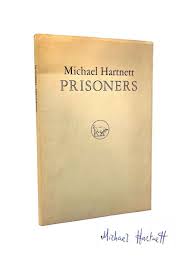
Hartnett places this poem, Maiden Street Wake, alongside his poem Prisoners(both written in 1968) as the only two poems in a limited edition (250 copies) joint venture publication between Deerfield Press and Gallery Press that was published in 1977. Both poems are illustrated by Timothy Engelland and all copies are individually signed by the author. It seems that both poems were in his mind as he embarked on writing The Retreat of Ita Cagney / Cúlú Íde, the first major works, along with Farewell to English, undertaken on his return to West Limerick. Both poems celebrate their 50th Anniversary this year!
Maiden Street Wake may be an account of yet another random wake, one of the many wakes that the very young Hartnett witnessed and attended in Maiden Street during his childhood. Whatever the case may be, the old traditional Irish wake, with its old women keeners, flickering candles, music and drink, tobacco and snuff, as well as ‘soft biscuits and lemonade’ for the children, is used by Hartnett to set the scene for us in the poetic version of The Retreat of Ita Cagney. It is obvious that these events made a lasting impression on the young teenage Hartnett and those events fuelled his imagination and gave rise to some of his best poetry.
He describes the scene at ‘The Corpse House’, a mud-walled cabin in Lower Maiden Street. The dead man is laid out in his bedroom, surrounded by ‘women in shawls, and young children from the street in their ‘summer sandals’. His bed, ‘the breeding ground and cot’, is surrounded by ‘penny candles’ and people file by to pay their last respects. The family have made a great effort to cater for the influx of visitors and the best and ‘finest teacups’ have been brought out for the occasion. The poet uses a beautiful simile to describe the corpse, he is like ‘an alabaster Christ’ laid out in the tomb. For the young Hartnett viewing this traditional custom there is a sense of anticlimax at the end: after waiting their turn, they ‘shufffled round’ and were rewarded later in the meagre kitchen with ‘soft biscuits’ and a glass of the famous local soft drink, Nash’s red lemonade.
The Irish wake has long been the subject of poems, songs, films and stage plays. Hartnett has written several poems in which he explores the old custom in a very sympathetic way. These ‘Wake Poems’, his poems such as A Small Farm and the many poems written to honour his grandmother, Bridget Halpin, all attest to a poet exploring the past, its customs and traditions while seeking to enhance their value and importance lest they be lost.
‘Prisoners’ was a limited edition (250 signed copies) jointly published by Gallery Press, Oldcastle, County Meath and Deerfield Press, Massachusetts. Each copy was signed by the author. The edition consisted of two poems, Prisoners and Maiden Street Wake and was illustrated by Timothy Engelland. It was Hartnett’s last collection of poems in English, written before his collection ‘A Farewell To English’ (1975) but not printed until 1977.
This poem, Prisoners has largely been overlooked, but is of vital importance in the Hartnett canon. The poem, written in 1968, dates from his time spent working as a night telephonist in the Posts and Telegraphs Exchange in Exchequer Street, in Dublin. The poet visits and explores a theme close to his heart, which had bubbled to the surface again and which still sparked his interest on his return to his West Limerick base in 1975. Though it is other-worldly, reminiscent and redolent of a medieval setting, there is a close connection between Prisoners and the iconic The Retreat of Ita Cagney / Cúlú Íde. One poem anticipates the other, and both poems are inspired by events that had taken place in his beloved Maiden Street in or around 1958.
Another poem worthy of mention here is Maiden Street Wake. Hartnett’s Collected Poems contains several ‘Wake Poems’, including, of course, a wake that he missed, that of his grandmother Bridget Halpin immortalised in Death of an Irishwoman. His poem, Maiden Street Wake may be an account of yet another random wake, one of the many wakes that the very young Hartnett witnessed and attended in Maiden Street during his childhood. Whatever the case may be, the old traditional Irish wake, with its old women keeners, flickering candles, music and drink, tobacco and snuff, as well as ‘soft biscuits and lemonade’ for the children, is used by Hartnett to set the scene for us in the poetic version of The Retreat of Ita Cagney. This old traditional Irish wake is also constantly in the background throughout the dramatic version (in English) of the same story. It is obvious that these events made a lasting impression on the young teenage Hartnett and those events fuelled his imagination and gave rise to some of the best poetry he has written either in English or in Irish.
Prisoners explores the plight of a young, unnamed woman who is involved in a relationship with a married man, her ‘human Lord’. This arrangement is a source of local scandal and is frowned upon by society and the townspeople. In his Collected Poems, the poet places Prisoners immediately before The Retreat of Ita Cagney, where the same theme is revisited again, but where now the woman is given a name. The poet also published an Irish retelling of the story in the iconic Cúlu Íde. His papers in the National Library also contain fragments in Irish and English of the poet’s efforts to dramatise the story, efforts that eventually came to nought, but they are testament to his obsession with this story. It is interesting to note that in both Prisoners and The Retreat of Ita Cagney, the poet is sympathetic to the woman’s dilemma.
Whereas The Retreat of Ita Cagney has a sequence structure, Prisoners is a much shorter lyric. However, like The Retreat of Ita Cagney, it is a dramatic exploration of a woman’s loneliness and isolation in a callous and hostile society. The Retreat of Ita Cagney (in both its iterations in English and Irish), is undoubtedly Hartnett’s finest achievement. In Prisoners, and especially in The Retreat of Ita Cagney, as fellow Munster poet, Brendan Kennelly pointed out in his review of the latter poem, Hartnett, ‘pays relentless imaginative attention to this woman’s fate, and he presents with admirable dramatic balance her loneliness, independence and state of severed happiness’. In this condition, he states that ‘Ita Cagney becomes a visionary critic of the society that hounds and isolates her’ (Poetry Ireland Review, Issue 15, p. 26).
The Retreat of Ita Cagney is a pained celebration of an enforced privacy as experienced by the woman at the centre of the story; the title of this poem, Prisoners, paints her dilemma in an equally disturbing light. It opens with images of a self-imposed captivity. The man congratulates himself on being able to keep this ‘wild’ young woman, whom he obviously loves, ‘captive’ from the prying eyes of the town.
There are striking similarities between Sequence 2 in The Retreat of Ita Cagney and the way the poet proceeds to describe the woman who has been isolated and shunned by her neighbours in this poem. The images used follow the strict requirements of the Dánta Grá, and like Ita Cagney, the young woman here is described stylistically and is given classical features:
So her face was white as almond
pale as wax for lack of sunlight
blue skin by her eyes in etchings …
She is described here as waif-like and ghostly because she has not been seen outside – she is literally a prisoner in her own home or castle. Her classical features reveal the stresses and tensions of being ostracised by society, and her beauty is now of little consequence anymore because of her self-imposed house arrest.
In the later poem (1975), Hartnett also describes Ita Cagney in similar symbolic language. However, in contrast, Ita comes across as a strong and formidable woman: he describes Ita Cagney’s head from ‘her black hair’ to her throat, which ‘showed no signs of age’. Her hair is black save for a single rib of grey which stands out ‘like a steel filing on a forge floor’. He then describes her brow, her eyebrows, her eyes, ‘her long nose’, ‘her rose-edged nostrils’, her upper lip, her chin and jawline and finally her throat. The reason for this detail is, I think, to give us a sense of the formidable woman at the centre of this poem.
In Prisoners, the female protagonist is obviously loved and revered by her Lord, who arrives home, like a knight errant, a Gearóid Íarla*, on his trusty grey steed. The reason for the couple’s exclusion is hinted at here: she has abandoned the old gods and the old religion of the townspeople, and she now sings ‘to a new god, to the church of her invention’. It seems that she has abandoned organised religion and its laws, edicts and diktats in favour of a more private and personal one. However, this behaviour and lifestyle choice have led to strained relationships with friends and neighbours and have also led to her being seen as a ‘scarlet’ woman in the town. The only comparison between the old religion and the new is her scarlet dress, similar to the bishop’s garb from the old dispensation.
She has made her choice, and she and her partner have brought a son into this ‘secret world’. The poet then gives her a voice (if not yet a name):
… my Lord God is a human Lord,
not Lord of towns, but Lord of white horses, holy
of the hyacinth, the human Lord of light, of rain.
The word ‘Lord’ is repeated here eight times as in a monastic chant. She invokes the hyacinth, often associated with the sun god, Apollo, as a symbol of peace, commitment and beauty, but also of power and pride. The hyacinth is often found in Christian churches as a symbol of happiness and love. She cries out in anguish in the hope that the gods who ‘speak in rain of trees: send your holy fire to heat me’.
The woman and her partner at the centre of the poem have made their choices and are suffering because of the pressure being brought to bear on them. Their townhouse, towerhouse, keep now resembles a fortress, a prison, and those within, prisoners. Of necessity, the doors are bound ‘with iron chains’ and the besieged family are ‘locked safe inside an open moat of water’. The poet is hopeful that their struggle will succeed and, like his later masterpiece, The Retreat of Ita Cagney’, he is quietly proud of the woman’s heroic stand against the threatening and ominous forces that ranged against her. It is interesting to note that in Celtic mythology, the birch tree is associated with the goddess Brigid and symbolises new beginnings and protection. Their house is protected by birches, and the poet’s hope is emphasised by the beautiful final lyrical line:
The birch-hid dove was silk with peace.
There is one final echo of this poem, Prisoners, in the Irish version Cúlú Íde. In the final sequence (Section 9), Ita finds herself besieged in her ‘keep’ as neighbours move around outside ‘as venom breaks in strident fragments / on the slates’. She ‘hears the infantry of eyes advance’ and so she closely guards her child,
ag cosaint a saighdiúirín
ó uaill leaca an sraide
ó shúile dearga an yeos.
Her child, her ‘saighdiúirín’, her little soldier boy, must be protected from the dreaded yeomen, the hated symbol of the oppressor from a troubled colonial past.
Author’s Note:
* Gerald Fitzgerald, the third Earl of Desmond, known as Gearóid Íarla, was famous as a poet and wizard (1339 – 1398). He inherited his earldom, with its vast estates, in 1359. His castle in Newcastle West was one of his main strongholds, and he spent much of his time there. He successfully combined the Norman and the Gaelic Irish cultures, and he wrote his poetry in Irish. In 1398, it is said he mysteriously disappeared while walking in his Newcastle West demesne and was never seen again. Myth has it that he still lives under the enchanted waters of Lough Gur, in County Limerick, and that every seven years he and his hosts rise to the surface and ride their horses over the lake, and that, when the horse’s silver shoes wear out, he will be set free!
Works Cited
Hartnett, Michael. Collected Poems, ed. Peter Fallon. Gallery Books, Oldcastle, County Meath, 2001. Reprinted 2009 and 2012.
her own cloistered psalms, in her bishoped dress of scarlet.
For she built walls to keep God in,
and waiting there from eyes ahide
at night before her tearful face
at calm crossroads her child did raise,
her child into the secret world.
And she involved a secret Lord,
prayed the holy prayers she made herself,
and sang so: my Lord God is a human Lord,
not Lord of towns, but Lord of white horses, holy
of the hyacinth, the human Lord of light, of rain.
Yes, Lord of sacred anguish, hear
me, and speak in rain of trees: send
your holy fire to heat me. I
cry: my Lord of holy pain, hear.
House of slated roof was their house,
daylight knew no way to hound them out of peace:
the door was closed with iron chains
locked safe inside an open moat of water;
secret in their love they lived there:
the birch-hid dove was silk with peace.
– Michael Hartnett
This poem is vital in the Hartnett canon. The poem, which he wrote in 1968, visits and explores a theme close to Hartnett’s heart. It is later included as the title poem in his last collection in English before his now famous Farewell to English. This was a limited-edition (250 copies) joint venture publication between Deerfield Press and Gallery Press that was published in 1977. The publication includes two poems (Prisoners and Maiden Street Wake), and both poems are illustrated by Timothy Engelland.
Inset of New Houses just before occupancy, September 1951. (Courtesy of Dr Pat O’Connor, The New Houses: A Memoir, p.9)
In late 1980, Hartnett began work on his best ballad, which is most loved and recited to this day, the ‘Maiden Street Ballad’. The ballad stretches out for 47 verses and is a compendium of much of what he had written in prose about Newcastle West in articles for The Irish Times, for Magill magazine and for the local Annual Observer, the annual publication of the Newcastle West Historical Society during the 60s and early 70s. There are also echoes of other local poems such as ‘Maiden Street’ and ‘Epitaph for John Kelly, Blacksmith’ included among the verses of the ballad.
‘Maiden Street Ballad’ was published by local entrepreneur Davy Cahill’s The Observer Press ‘with the help of members of Newcastle West Historical Society’. Copies of the original are much sought after on eBay and elsewhere to this day. It carried a very eloquent dedication, ‘This ballad was composed by Michael Hartnett in Glendarragh, Templeglantine, County Limerick in December 1980 as a Christmas present for his father Denis Harnett (sic)’.
‘Maiden Street Ballad’ contains a number of autobiographical segments. The early stanzas tell us about his childhood days where they rented accommodation first in Connolly Terrace and then in nearby Church Street before making the move to Lower Maiden Street where they rented a room from Legsa Murphy.
We rented a mansion down in Lower Maiden Street,
Legsa Murphy our landlord, three shillings a week,
the walls were of mud and the roof it did leak
and our mice nearly died of starvation.
Probably one of the most notorious segments is the ten ribald verses from 27 to 37 which describe a virtual pub crawl of all of Newcastle West’s 26 public houses which were doing business in 1980. (Michael Hartnett’s 26 Pubs at Christmas!) In another significant segment from verses 16 to 23, he eloquently documents the move from Lower Maiden Street to the new housing scheme in Assumpta Park. These verses portray Hartnett at his best, they are witty, caustic, and often slanderous; his use of hyperbole pokes fun at his friends and those neighbours who were part of that mass exodus from the slums of Maiden Street and The Coole.
Hartnett says that the street finally ‘gave up the ghost’ in September 1951 when most of the inhabitants were rehoused in one of the 60 new houses in Assumpta Park. Hartnett describes the operation, likening it to the hazardous Exodus of the Israelites escaping from Egypt to the Promised Land! Unlike the ‘pub crawl’ sequence which describes in great detail the quirks and peccadillos of numerous characters, including many of his own family, there are only two people mentioned in the ‘move to The Park’ sequence – only passing reference is made to Dick Fitz and Mike Hart, two great stalwarts of the area. Rather this segment describes his people, his neighbours, the real old stock of the town in a richly comic and exaggerated way.
In the late 40s and early 50s, the local authority had built up to 60 social houses to relieve the squalor, poverty and slum-like conditions in Maiden Street and The Coole. They were built in an area of the town known as Hungry Hill, although the new development was officially called Assumpta Park. The Hartnett family were but one of the lucky families to be given a new house and they moved into Number 28 in 1951. Hartnett tells us that the ‘old street finally gave up the ghost’ and the mud-walled, galvanised cabins were abandoned down in The Coole and the people were tempted to move ‘to the Hill’s brand new houses’. The ‘New Houses’ stood on a hill high and exposed above the town at the outer edge of a terminal moraine. The original sixty houses were finally allocated on the 15th of September, 1951. Dr Pat O’Connor, the author of ‘The New Houses: A Memoir’, whose family were allocated Number 24, remembers that ‘doors were still without numbers and entrances without gates’. There was no street lighting or footpaths so it must have been a very eerie place to move to.
The relocation is described in almost Biblical terms with a delicious mixed cocktail of the Exodus story and the story of Noah’s Ark:
and some of the ass-cars were like Noah’s Ark
with livestock and children and spouses.
As well as the Bible, Hartnett is also influenced here by the writings of John Steinbeck and his iconic descriptions of the Great Depression in The Grapes of Wrath as well as the writing of Sean O’Casey and Brendan Behan who wrote about the tenements in Dublin and the gradual movement of people from places like Henrietta Street to Crumlin and Cabra in the 1940s, and Ballyfermot and Artane in the 50.
The Park upon first occupancy, September 1951. (O’Connor, 12)
Hartnett is a very astute commentator on the social ills of his day and the Maiden Street Ballad, and this segment in particular, shows the level of poverty and deprivation experienced by the people in that part of the town in the early 50s. They brought with them their ‘flourbags’, ‘their ‘tea chests’ and ‘three-legged stools’ and their ‘jam-crocks in good working order’. At that time many of the households were so poor that they were unable to afford the bare necessities such as cups and saucers. Jam was sold in one-pound and two-pound glass jars and these were used as substitutes for tea cups and milk glasses in most households. Dr Pat O’Connor tells us that the new occupants had come from ‘the tattered tails of the town, where congestion and dereliction were rife, but (where) the sense of neighbourhood intimacy was well defined’. Hartnett describes the move in a very light-hearted way, and he follows up by saying that they also brought their fleas, bed bugs and mice with them because they felt they were almost part of the family. And now that they’ve moved up in the world the fleas also go to Ballybunion each year on holiday with their host families ‘though hundreds get drowned in the waves there’.
Many found it very difficult to make the necessary adjustments to their new surroundings and the poet pokes fun at their efforts to adapt to such new luxuries as piped water, electricity, toilets and bathtubs. The novelty of two-storey houses had also to be grappled with – three bedrooms upstairs and a hallway, kitchen, scullery and bathroom downstairs. Apocryphal stories circulated that one of the legendary early occupants, Forker O’Brien, famously used the bannisters as kindling for the fire! Indeed, Hartnett would have us believe that many continued with the practices that had been commonplace in their former residences:
In nineteen fifty-one people weren’t too smart:
in spite of the toilets, they pissed out the back,
washed feet in the lavat’ry, put coal in the bath
and kept the odd pig in the garden.
They burnt the bannisters for to make fires
and pumped up the Primus for the kettle to boil,
turned on all the taps, left the lights on all night –
but these antics I’m sure you will pardon.
Hartnett continues in his light-hearted vein, and he lists the great improvements that have come about in peoples’ lives in the years following their relocation. They are respected now and indeed have earned the respect of their fellow townspeople, and they have made great strides to better their situation. Many can now boast of having regular employment, and motor cars and many even go on foreign holidays each year ‘in the Canaries’. The poet’s sense of pride in his own local place is very evident in this section of the ballad and he compares other places he has visited in his travels, but none can compare to his native Newcastle West.
I have seen some fine cities in my traveller’s quest.
put Boston and London and Rome to the test,
but I wouldn’t give one foot of Newcastle West
for all of their beauty and glamour.
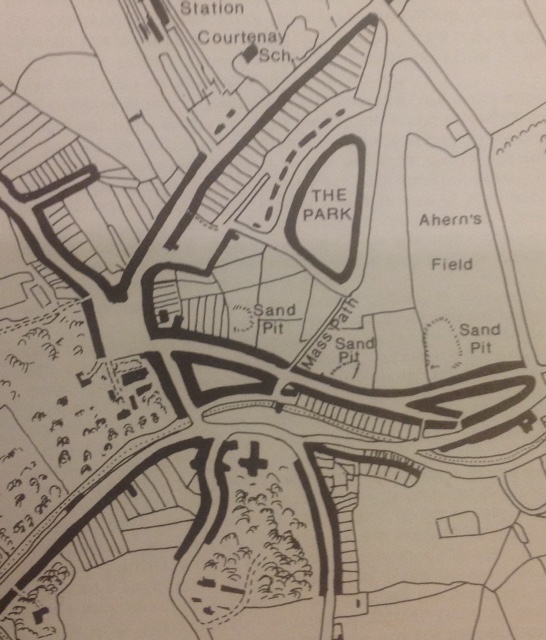
In those early days access to The Park was very limited and usually meant a long walk down through the Market Yard or Scanlon’s Lane or down New Road (now Sheehan’s Road) if one wanted to visit friends in Maiden Street or go to Mass on a Sunday. Eventually, representations were made to local Councillors and with the second phase of houses being built in 1955 a Mass Path was constructed which gave residents easier access to the old haunts in Maiden Street and also easy access to the parish church, as the name suggests. The residents of Maiden Street and The Coole were accustomed to being looked down on by the more well-to-do residents of the town and even now, as Dr Pat O’Connor points out, even though the residents of Assumpta Park were in a more exalted and elevated location they found that ‘by a curious process of inversion the people of the town (still) looked down on us’!
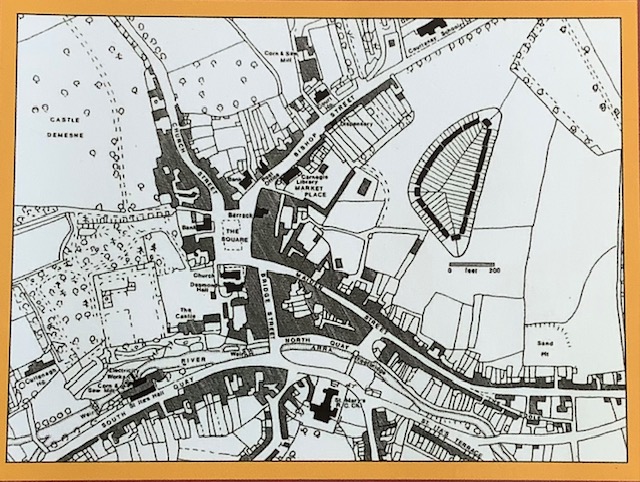
Detail from the map by Dr Pat O’Connor showing Assumpta Park and the Mass Path in relation to Maiden Street and the church. Note also the three sandpits still in use at the time – Musgraves (now Whelan’s), O’Gorman’s, and Ahern’s.
Stanzas 22 and 23 paint a moving, nostalgic picture with the poet’s rose-tinted lens firmly in place. We are invited to picture an idyllic scene almost straight out of Thomas Gray’s Elegy Written in a Country Churchyard. It is high summer in Assumpta Park and the visibility is so good you can see Rooska to the north and the Galtees forty miles away to the east straddling the Limerick, Tipperary and Cork borders. All is peaceful and neat and tidy and quiet ‘and the dogs lie asleep in the roadway’. The stanza ends with a beautiful echo of a line from Act 3, Scene 2 of Macbeth – “Light thickens, and the crow/ Makes wing to th’ rooky wood.” (I once heard Noel O’Connor, that great unsung hero and fount of wisdom, say that there’s a quote in Macbeth to solve every problem and cover every possible situation and permutation). Hartnett, in a more benign and domesticated mood, gives us his variation on Macbeth’s more bloody intent:
and the crows to the tree tops fly home in black rows
and the women wheel out their new go-cars.
Dr Pat O’Connor believed that making a new home in The Park was hardest on the women. Yet, as usual, they were the quintessential homemakers. In 1951 scarcely any worked outside the home, often supplementing family income by keeping lodgers or by fostering children, many of whom grew up seamlessly within the various families.
Hartnett’s love for this place is nourished by innocent childhood memories. After all, the poem is meant as a Christmas present for his now ailing father and so he paints a picture which we are invited to contrast with the poverty and squalor of earlier childhood. Hartnett is now forty years of age and remembering life as a ten-year-old in his favourite place, his home in 28 Assumpta Park:
when the smell of black pudding it sweetens the air
and the scent of back rashers it spreads everywhere
and the smoke from the chimneys goes fragrant and straight
to the sky in the Park in the evening.
The residents of Assumpta Park, then and now, are indeed lucky to have as their chroniclers Dr Pat J. O’Connor, one of the most pre-eminent human geographers of his generation, and Michael Hartnett one of Ireland’s great twentieth-century poets. Both have left us their differing yet unique perspectives of an era of great change and of a wonderful social engineering project that worked. Hartnett would definitely point to it as an example that the present government should try to emulate!
A group of workers photographed on-site during the building of the second phase of the houses in 1955. Photo courtesy of Newcastle West Olden Times Facebook Page. These houses were built by Edmond Power. Included above: Jack Power (back left), alongside Jackie Brouder, Edmond Power (back right), Mike Harte (front left), Mossy Hurley with child (front right), with Jer Hough and Tommy Fox in line alongside.
Works Cited:
O’Connor, Patrick J. The New Houses: A Memoir. Oidhreacht na Mumhan Books, 2009
Postscript
I came across this little-known poem of Hartnett’s recently which further details the trauma that was involved in the ‘Move to The Park’. There is an Irish version as well.
Off to the New Houses
I was there when the street expired.
When the cabins were put under lock and key;
Gloom and delight were left imprisoned,
The birth-room, the death-room;
And under the floor and on the wall
The mouse and the spider were lonely.
Donkey and trap, wheel-barrow, hand-cart
Safely transporting our ancestral bedding,
My father’s mug, my mother’s sugar-bowl:
We shifted all under cover of night.
And under the floor and on the wall
The mouse and the spider were lonely.
We shifted all that mattered
Except the heart of the old tortured street:
After a pause for porter, my father and his friends went
I have been posting English notes on my blog, Reviews Rants andRambles, since I retired as an English teacher and an Advising Examiner for English Higher Level. I have brought all those links together here in one post or blog – an Index of all the posts I’ve written that are relevant to Leaving Cert English Poetry 2025. Bookmark this to save you the trouble of constantly searching the internet each time you want to do some background work on a particular poet or author. It’s imperfect and won’t suit every student, class, or teacher but it’s my version of a ‘Pop-Up-One-Stop Shop’ and you know the drill: just click on the link if it’s relevant to your studies! My choice of poets is personal and you will easily see where my own preferences lie by simply viewing the number of links provided for each text or poet!
However, Caveat Emptor! Leaving Cert Student Beware !! These are resources that you should use wisely. They are my personal responses to the various texts and you should read and consider them and decide to study them if you find them useful.
IN OTHER WORDS, MAKE YOUR OWN OF THEM, ADD TO THEM, OR DELETE FROM THEM AS YOU SEE FIT.
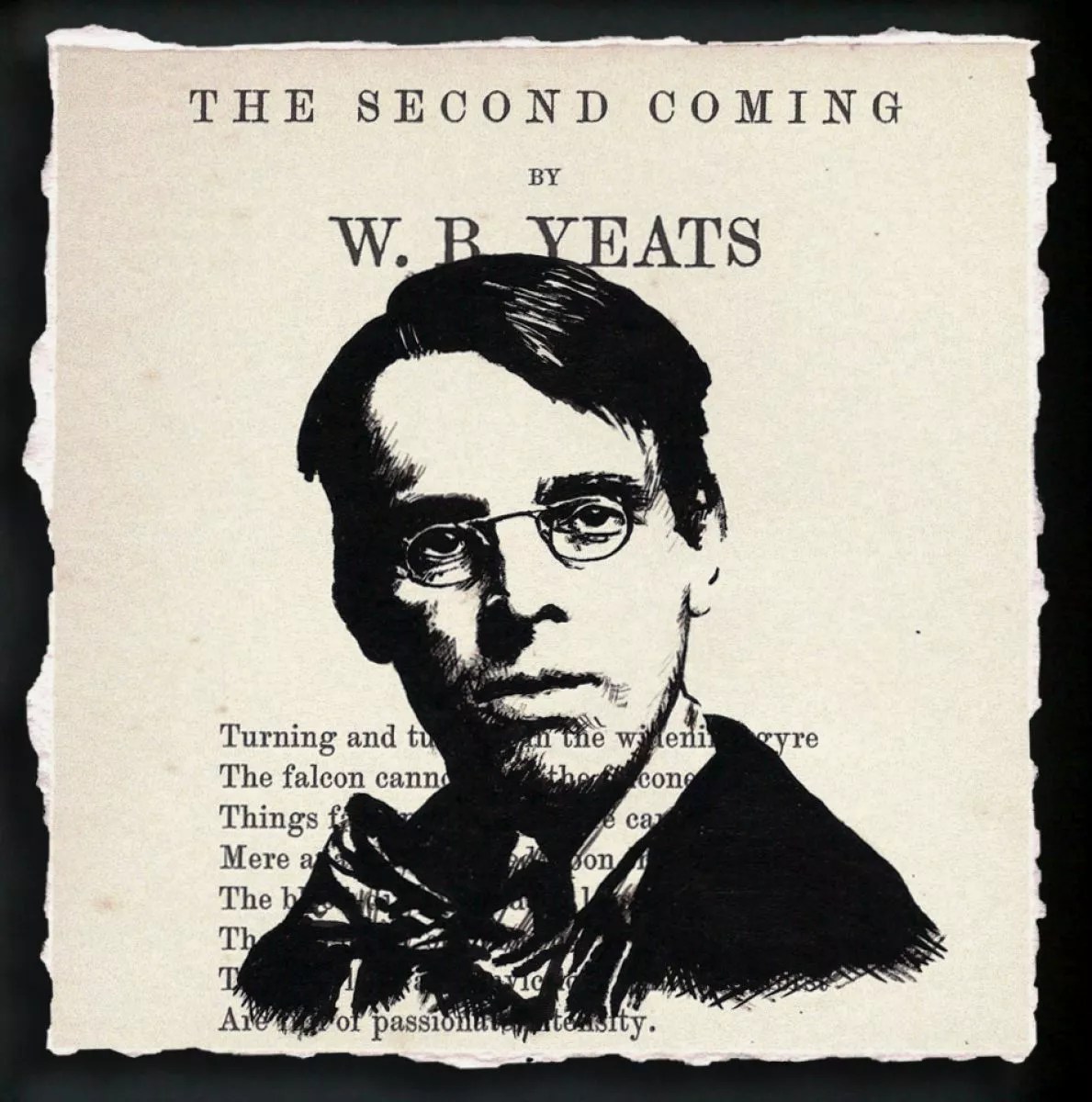
W.B. Yeats – The Second Coming (2014). Acrylic painting by Peter Walters.
The Second Coming
Turning and turning in the widening gyre

The falcon cannot hear the falconer;

Things fall apart; the centre cannot hold;

Mere anarchy is loosed upon the world,

The blood-dimmed tide is loosed, and everywhere

The ceremony of innocence is drowned;

The best lack all conviction, while the worst

Are full of passionate intensity.
Surely some revelation is at hand;

Surely the Second Coming is at hand.

The Second Coming! Hardly are those words out

When a vast image out of Spiritus Mundi

Troubles my sight: somewhere in sands of the desert

A shape with lion body and the head of a man,

A gaze blank and pitiless as the sun,

Is moving its slow thighs, while all about it

Reel shadows of the indignant desert birds.

The darkness drops again; but now I know

That twenty centuries of stony sleep

Were vexed to nightmare by a rocking cradle,

And what rough beast, its hour come round at last,

Slouches towards Bethlehem to be born?
Source:The Collected Poems of W. B. Yeats (1989)
Commentary
The Second Coming surely holds the distinction of being the most plundered poem in the English language. To fully understand the poem, we are required to have some biblical knowledge as well as a basic understanding of Yeats’s vision of history. The biblical reference is twofold: the poem blends Christ’s prediction of his own second coming with St. John’s vision of the coming of the Antichrist, the beast of the Apocalypse. This is ‘the rough beast’ of the second last line of the poem. Yeats makes the rough beast even more disturbing and sinister by assigning its place of birth to Bethlehem, the place of Christ’s birth, associated over the course of two thousand years – until recent times – with peace, mercy, gentleness and forgiveness.
To understand Yeats’ cosmology it is essential to read his book, A Vision where he explained his views on history and how it informed his poetry. Yeats saw human history as a series of epochs, what he called “gyres.” He saw the age of classical antiquity as beginning with the Trojan War and then that thousand-year cycle was overtaken by the Christian era, which he suggests is now coming to a close. That is the basis for the final line of the poem, “And what rough beast, its hour come round at last/ Slouches towards Bethlehem to be born?” In his mystical book, A Vision, he foretold the birth of a new, violent, bestial anti-civilisation and the simultaneous destruction of the two-thousand-year-old Christian cycle. The second coming of the poem is thus not that of Christ but of his opposite, the slouching, revolting figure of the beast whose birth will herald in a new age of anarchy to be ‘loosed upon the world’ (line 4). Yeats’s thesis in A Vision is that each epoch or period of history is eventually overthrown by some massive upheaval. This may explain why Yeats used the phrase “the second birth” instead of “the Second Coming” in some of his first drafts.
It is in this context that the opening lines of the poem should be read: ‘Turning and turning in the widening gyre / The falcon cannot hear the falconer’. The falcon here is an image of man rapidly losing contact with Christ the falconer as he moves along the widening gyre of history. The next six lines paint a grim picture of the beginning of a new age, marked by worldwide anarchy and violence (‘The blood-dimmed tide is loosed’). As the gyre widens, ‘things fall apart; the centre cannot hold’. The end of the Christian age is granted the revelation of the character of the new age. The tide of violence has already begun to move, and as it does, it begins to drown ‘the ceremony of innocence’ which, in Yeats’s symbolic system, stands for order and harmony as opposed to the personal and social violence of the ‘blood-dimmed tide’.
The ‘vast image out of ‘Spiritus Mundi’ (line 12) is a favourite Yeatsian idea. According to Yeats, Spiritus Mundi is a storehouse of ideas deriving from the great universal memory common to all humankind, and is also the source of prophecy, since, he believed, history repeats the same predestined cycles every two thousand years or so.
The more terrible events associated with the coming of the Antichrist are all in the future, but in lines 3 – 8, Yeats suggests that his world is already experiencing a foretaste of the grim future heralded by the birth of the ‘rough beast’. There was plenty of evidence all around him in 1919, the year he composed the poem. Yeats began The Second Coming during the tense, eventful month of January 1919. The ‘war to end all wars’ was barely over and the Russian Revolution, which dismayed him, was still unfolding, while another war was brewing on his doorstep. On 21 January, the revolutionary Irish parliament met in Dublin to declare independence while, in a quarry in Soloheadbeg in Tipperary, Dan Breen and other members of the IRA killed two officers of the Royal Irish Constabulary ushering in the War of Independence. This war threatened to uproot the Anglo-Irish ascendency and the civilisation it represented, many elements of which appealed to Yeats himself. Empires and dynasties were all in a state of flux as a result of this anarchy and revolution that had been loosed upon the world. The birth of Yeats’s daughter, Anne, in February, was also fraught with danger. During her pregnancy, his young wife Georgie Hyde-Lees had been stricken by the Spanish flu that was burning through Europe at that time in the wake of the war. All these events conspired to put Yeats in an apocalyptic frame of mind.
For Yeats, the Incarnation of Christ was a violent, turbulent event, after which ‘twenty centuries of stony sleep / were vexed to nightmare by a rocking cradle’. This new incarnation, that of the slouching ‘rough beast’ will unleash universal horrors. Its sinister possibilities are hinted at in the suggestion that even the predatory desert birds, for all their savagery, are ‘indignant’ at its coming.
The poem gives us a frightening account of the fate in store for the post-Christian world. Social anarchy and massive destruction are made worse by the collapse of moral values among the leaders of nations: ‘The best lack all conviction, while the worst / Are full of passionate intensity’. He predicts that evil will triumph in the public sphere because those political leaders who might be expected to defend humane values (and basic human rights) lack the determination to resist those who preach violence and intolerance.
As I mentioned earlier, The Second Coming has become perhaps the most plundered poem in the English language – only Heaney’s From ‘The Cure at Troy’ comes a close second, with its ‘let hope and history rhyme’ so beloved of politicians. At 164 words, The Second Coming consists of almost nothing but quotable lines. Someone reading it for the first time in 2024 might resemble the apocryphal theatregoer who complained that Hamlet was nothing but a bunch of quotations strung together. Whether or not it is Yeats’s greatest poem, it is by far his most useful. As Auden wrote in “In Memory of WB Yeats” (1939), “The words of a dead man / Are modified in the guts of the living.” We have to admit, after its first one hundred years, this poem was built to last.
As our world has recently been wrenched out of joint by the Covid-19 pandemic, many people are turning to poetry for wisdom and consolation. However, The Second Coming fulfils a different role, as it has done in crisis after crisis, from the Vietnam War to 9/11, to the genocides in Rwanda or Syria or Gaza, to the election of Donald Trump and to the looming prospect of his imminent re-election: it provides us with an opportunity to confront chaos and dread, rather than to escape it. This is surely why Fintan O’Toole has proposed the “Yeats Test”: “The more quotable Yeats seems to commentators and politicians, the worse things are.”
The Gospel of Matthew is the only one of the four canonical gospels to mention the Magi. Matthew 2:1–2 has it that they came “from the east” to worship the “king of the Jews”. We know that St. Matthew wrote his Gospel with a Jewish audience in mind and so, therefore, he begins his Gospel account with an elaborate genealogy that places Jesus as an ancestor of King David and Abraham. Here already Matthew shows his special interest and the intended audience for his Gospel and so he presents Jesus as a King, better than David, and a teacher greater than Moses.
It is Matthew who tells us about the Three Wise Men (Eliot’s Magi) who came to worship, bringing gifts fit for a king. Matthew, in his powerful birth account, presents Jesus, in fulfillment of the prophecies and hopes of the Hebrew Scriptures, as the King of the Jews who has been given all authority in Heaven and Earth. He is Emmanuel, God with us. Matthew, however, is making a powerful distinction for his Jewish audience – the Magi represent those outsiders, those wise men, magicians, or astrologers from the East, from Persia or other civilisations or religions who will now be saved by this Christ child. The Good News of Matthew, therefore, is that this Christ has come for all people and not just for the Chosen People of Israel. Eliot sees in the Magi a metaphor for his own conversion – he too has made a long and tortuous journey and has finally made his decision to bow down before the Christian God.
This poem, ‘Journey of the Magi’, published in 1927, was the first of a series of poems written by Eliot for his publisher, Faber and Faber, composed for special booklets or greeting cards which were issued in the late 1920s and early 1930s.
‘Journey of the Magi’ – one of the great classic Christmas poems – is told from the perspective of one of the Magi (commonly known as the ‘Three Wise Men’, though the Bible makes no mention of their number or gender – it does mention that they brought three gifts, gold, frankincense, and myrrh). The poem examines the implications that the advent of Christ had for the other religions of the time, and it emphasizes this pivotal moment in human history. In the Christian calendar, the coming of the Wise Men or Magi is celebrated on January 6th – the Twelfth Day of Christmas. It is often referred to as the Feast of the Epiphany, when Jesus is revealed to all, Jew and Gentile, as the Saviour of the World.
This is an apocryphal account of the journey made by the Three Wise Men which eventually led them to a humble stable in Bethlehem where the Christ Child lay. It is narrated to us by one of their number, perhaps over a glass of wine, after their return home. The story, and it is a beautifully told story, is told not in Biblical language, but in the language of everyday speech and with an amount of detail not found in the Gospel story of St. Matthew.
The opening quotation comes from one of Bishop Lancelot Andrewes’ Nativity Sermons, preached at Christmas during the 1620s. The speaker, one of the Magi, talks about the difficulties encountered by the Magi during their eventful journey to see the infant Christ. It is unconventional in that it focuses on the details of the journey: their longing for home (and for the ‘silken girls’ bringing the sweet drink known as ‘sherbet’), their doubts about the point of the journey they’re undertaking, the unfriendly people in the villages where they stop over for the night, and so on. The hardships of the journey are recounted in some detail. The details underline the absurdity of the journey in the first place but stress the strong impulses that made them undertake the journey in the middle of winter. The hardship is further stressed by the sharp juxtaposition between what they faced on their journey and what they had left behind in their ‘palaces’.
Eventually, the Magi arrive at the place where the infant Christ is to be found. The weary travelers trek through a ‘temperate valley’ – a kind of Garden of Eden – and eventually arrive at a tavern with its drunkenness and gambling. The description of the valley is akin to a movie still – the camera pans slowly over the landscape lingering on sharply etched details such as the running stream, the watermill, the three trees, and the old white horse. Then the camera moves on and picks out the gamblers and the empty wine skins. There is no mention of Bethlehem or the stable in this account and the narrator simply states that they ‘arrived at evening, not a moment too soon / finding the place; it was (you may say) satisfactory’. Neither is there mention of the star which – the Gospels and a million children’s nativity plays tell us – guided the Magi to the spot where Christ lay in a manger. The words ‘not a moment too soon’ are important here because the narrator seems to realize that they, like Simeon later, because of their advanced years, were unlikely to survive to witness the Crucifixion or the Resurrection of Christ and that they can only count themselves lucky to have witnessed the beginning of this powerful movement.
The poem ends with the poem’s speaker reflecting on the journey years later, saying that if he had the chance he would do it again, but he remains unsure about the precise significance of the journey and what they found when they arrived. Was it the birth of a new world (Christianity) or the death of an old one (i.e. the Magi’s own world)? The speaker then reveals that, since he returned home following his visit to see the infant Christ, he and his fellow Magi have felt uneasy living among their own people, who now seem to be ‘an alien people clutching their gods’ (in contrast to the worshippers of the newly arrived Jesus, who worship one god only, in the form of the Messiah). The speaker ends by telling us that he is resigned to die now, glad of ‘another death’ (his own) to complement the death of his cultural and religious beliefs, which have been destroyed by his witnessing the baby Jesus.
Jesus himself, however, is absent from this poem. One reason for this may be that we are, of course, all too familiar with the story of the Nativity and we don’t need reminding here. Another possible reason is that the focus here in this account is on the journey, the quest, and the hardship of the search. Eliot places himself here among and alongside the Persian astrologers as they seek out the face of the baby Christ. The poet empathises with the ‘Wise Men’ who are seeing their once deeply held beliefs being called into question by this new Messiah.
No study of the poem would be complete without reference to the imagery used by the poet. In carrying out such an analysis we also need to remember that the narrator is one of a band of ‘wise men’, ‘astrologers’ who are learned in the study of signs and omens. Sadly, it seems, the Magi miss the significance of almost all the images mentioned in the poem! Much of the imagery foreshadows Christ’s later life: the three trees suggesting Christ’s crucifixion on Calvary; the vine, to which Jesus will liken himself; the pieces of silver foreshadowing the thirty pieces of silver Judas Iscariot will receive for betraying him; the wine-skins foreshadowing the wine that Jesus would beseech his disciples to drink in memory of him at the Last Supper. Even though the narrator is a priest or astrologer, someone trained to look for the significance in the things around him, to read and interpret signs as symbols or omens, he fails to pick up on what they foreshadow.We, however, living in a Christian (or even a post-Christian) society, can read their significance all too well. At the poem’s end, the narrator is left feeling perplexed and troubled by his visit and by the advent of Christ: he wonders whether Christ’s birth has been a good thing since his arrival in the world has finally signalled the death of his own old religion and the religion of his people. Now, he and his fellow Magi, like Simeon in Eliot’s other great religious poem, A Song for Simeon, are left world-weary and they welcome the end.
So, therefore, ‘Journey of the Magi’ is partly about belonging, about social, tribal, and religious belonging: the speaker of the poem reflects sadly that the coming of Christ has rendered his own gods and his own tribe effete, displaced, destined to be overtaken by the advent of Christ – and, with him, Christianity. It is tempting to see the poem – written in the year Eliot converted to Anglo-Catholicism – as a metaphor for Eliot’s own feelings concerning secularism and the Christian religion. In the space of the century since its publication, Christianity has itself been rendered effete in the face of Darwinism, modern physics, secular philosophy, and whatever the hell is going on in 2023! And so, therefore, this poem, about a people’s conversion from one religion to another, is equally bound up with Eliot’s own conversion to Christianity.
T.S. Eliot portrait by Baltimore Maryland artist Jerry Breen.
This beautiful video has been produced by Danny Barry’s grandson, Dan Barry. The poem is narrated by the poet Michael Hartnett and it is taken from a radio documentary that he did in 1979 for RTE Radio entitled Poems Plain. The programme was produced by Donal Flanagan. The video contains copyrighted material that is being used for educational purposes under the doctrine of ‘fair use’. The use of this material is not intended to infringe upon the copyright owner’s rights. The material is used here solely for educational and non-commercial purposes. Dan Barry has suggested a small but necessary edit to verse four and the printed poem below reflects those changes.
Danny Barry’s poem, ‘The Christmas Tree’, deals with an actual happening. A few men from Maiden Street in Newcastle West decided to erect a Christmas tree in the street. They cut it down in Glenmageen, an area reputed to be haunted by a witch known as Sprid na Barna. Glenmageen is located about four miles south of Newcastle West and people can now visit the townland as they walk or cycle on the new Limerick Greenway. The stories of Sprid na Barna were well known, and the area near the present-day Barna Gardens was greatly feared by the local people. Indeed, it was said that only a few tough men would go home after dark along the road she haunted. Michael Hartnett is fulsome in his praise for the poet:
Danny Barry’s simple evocation of Sprid and her victims is extraordinary. Not because it is great poetry, but because he does not question the truth of the event at all. By the way, the Silver Dollar Saloon, which is a strange Hollywood, Western-type name, is a pub in Newcastle West, which was then run by the Flynn family, and is now run by the Kelly family.
The poem is purely mischievous and no insult should be taken by anyone, dead or alive, concerning the story told by the poet. Danny Barry is ‘ball hopping’ here and there are distinct similarities between this poem and many later written by Michael Hartnett, such as ‘The Balad of Salad Sunday’.
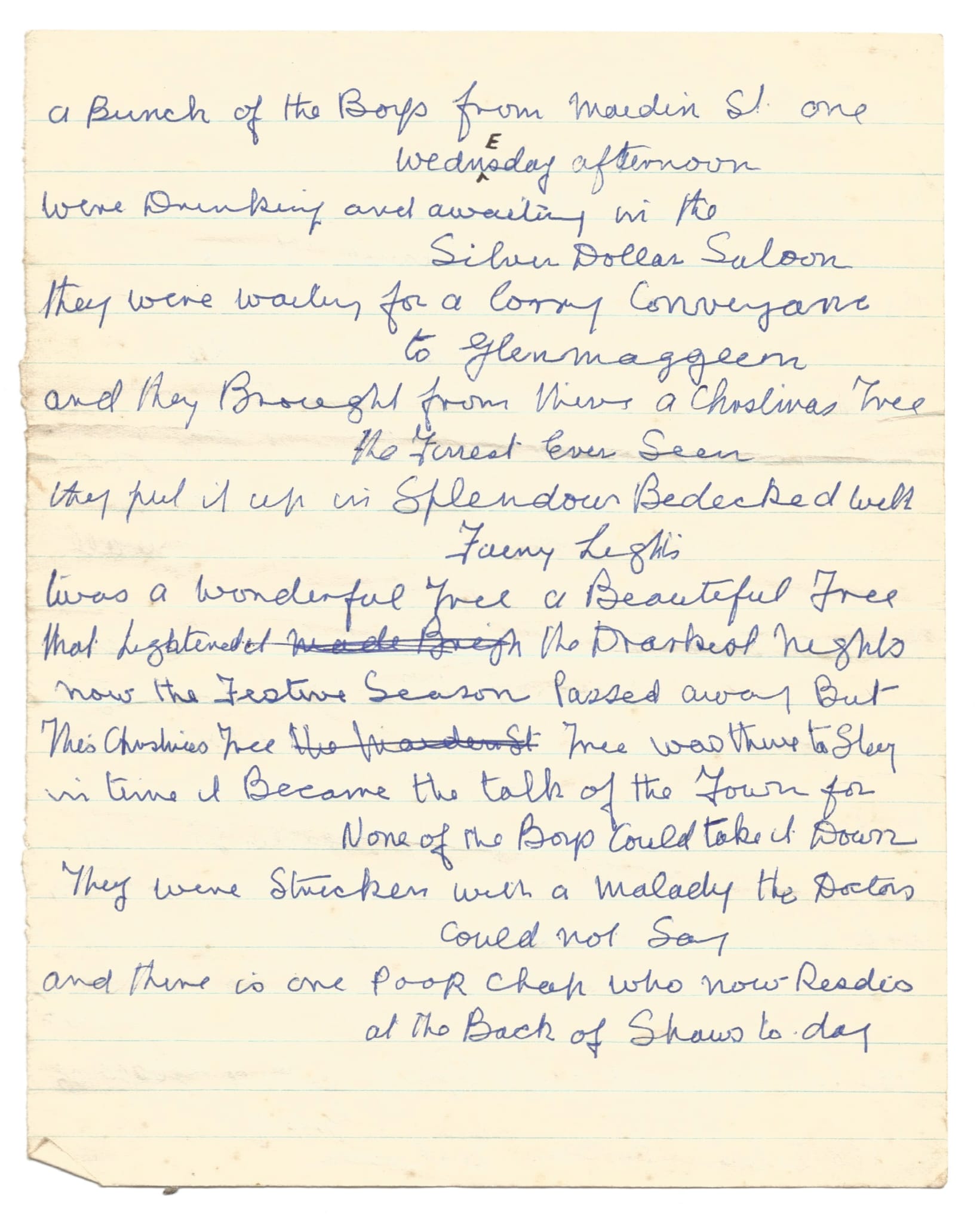
The Christmas Tree
A bunch of the boys from Maiden Street, one Wednesday afternoon,
Were drinking and awaiting in the Silver Dollar Saloon,
Waiting for a lorry to convey them to Glenmageen.
And they brought from there a Christmas tree, the finest ever seen.
They put it up in splendor, bedecked with fairy lights.
It was a wonderful tree, a beautiful tree, that lightened the darkest nights.
Now, the festive season passed away, but this Christmas tree was there to stay.
In time it became the talk of the town, for none of the boys dared take it down.
They were stricken with a malady the doctors could not say,
And there is one poor chap who now resides at the back of Shaw’s today.
Now, you have heard of Sprid na Barna, that very naughty dame,
That evil maid of Glenmageen, of the haunting ghostly fame.
The clergy had to banish her between the tree and the bark.
No more she would haunt and terrify the neighbours after dark.
Now the moral of this ditty I want you all to know
Twas a tree that grew in Glenmageen twenty years ago.
Now what I am trying to tell you will cause you all to frown
That the amadans from Maiden Street have brought auld sprig to town.
Now when the blackthorn blooms again and the sheepdogs howl at the full of moon
You could meet auld sprig with a glass of grog in the Silver Dollar Saloon.
Note: The reference to ‘auld sprig’ in the last line is a local mispronunciation of ‘sprid’
The original manuscript of the poem in Danny Barry’s own handwriting – you can see that it was a work in progress from all the crossing out!












 Reviews Rants and Rambles
You must be logged in to post a comment.