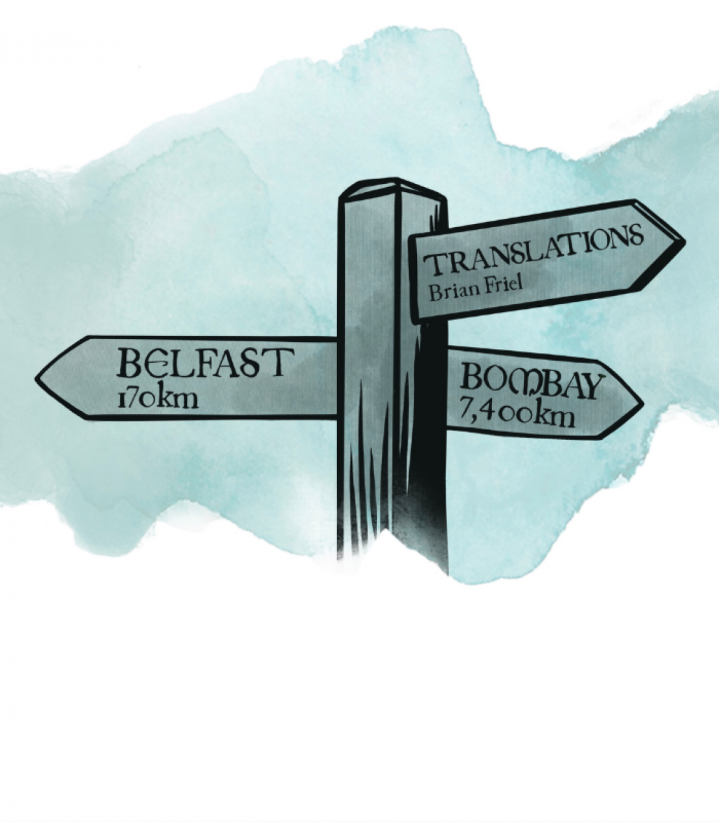
Translations by Brian Friel

translations-featuredTranslations is a three-act play by Irish playwright Brian Friel, written in 1980. It is set in Baile Beag (Ballybeg), in County Donegal which is probably loosely based on his beloved village of Glenties in West Donegal where Friel was a frequent visitor and where he is buried. It is the fictional village, created by Friel as a setting for several of his plays, including Dancing at Lughnasa, although there are many real places called Ballybeg throughout Ireland. Towns like Stradbally and Littleton were other variations and ‘translations’ of the very common original ‘Baile Beag’. In effect, in Friel’s plays, Ballybeg is Everytown.

The original staging of the play, in Derry in 1980, was the inaugural production by the newly formed Field Day Theatre Company, which Brian Friel had founded with the actor Stephen Rea. “It was a poignant play for us because the Troubles in the north of Ireland were still raging,” Rea says. “All the issues were local, but Friel was writing about the bigger picture.”

That inaugural production was at the Guildhall, often seen as a symbol of British authority in the city. “It was pretty different for us to do a play there,” Rea says. “It had a huge impact. That was radical because we didn’t premiere it in Dublin, we didn’t premiere it in Belfast. We did it in Derry, which was very severely affected by the Troubles… When we first did the play, many anti-nationalist people said it was whingeing and moaning about the same old problems. However, because of the continuing war in Ukraine, people can see that the play has a considerable influence and relevance to colonialism worldwide”.

Translations is one of the greatest plays about identity, language, landscape, history – about how we communicate across those divides or fail to – and how a community or nation can navigate times of profound change and dislocation,” said Tánaiste and Minister for Foreign Affairs Micheál Martin when speaking at the grand opening of the Lesya Ukrainka National Academic Drama Theatre production at The Abbey Theatre in July 2023. “Friel wrote it for the Field Day company during one of the darkest periods of the conflict in Northern Ireland – it’s very significant that the national theatre ensemble in Kyiv, and their audiences, have felt that this Irish text resonates with their personal and collective experience as they live through this appalling, illegal war”.

Friel has said that Translations is ‘a play about language and only about language’, but it deals with a wide range of issues, stretching from language and communication to Irish history and cultural imperialism and the effects of colonialism. Friel said that his play ‘should have been written in Irish’ but, despite this fact, he carefully crafted the verbal action in English, which help bring the political questions of the play into focus.

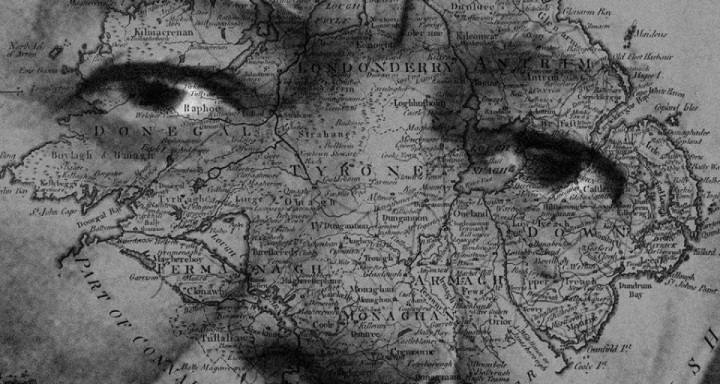
The play traces the impact of an actual historical event, the 1824 – 1846 project to produce a British government-sanctioned ordnance survey map of Ireland. The English Parliament ordered Major Thomas Colby to Ireland in 1824 to undertake a comprehensive survey of the country. His teams of surveyors would produce detailed maps on a six-inch = one-mile scale that would be used to determine land valuations for tax purposes. The maps were finally published in 1846. They cover almost the entire country and include details of even the smallest civil division of the time: the townland.

Translations shows the effect this operation has upon a typical Irish village (Baile Beag), an impact which causes unemployment, theft, flight, threatened evictions, and violence. Here in Ballybeg, Captain Lancey has been tasked with creating an accurate map of Ireland, with English placenames, so that Ireland can be more easily navigated by the British Army, and that land taxes can be more easily charged. These objectives are connected to the British agenda to colonise and modernise the comparatively ancient civilisation of Ireland. Lancey, who has been sent by commanders in London to carry out this project, is described by Yolland in Act Two, Scene One as ‘the perfect colonial Servant’.  Yolland marvels at this hard-working, industrious attitude: ‘Not only must the job be done — it must be done with excellence’.

At face value, this development seemed to be progressive yet in reality it is being used as a weapon of subjugation by a colonial invader. I am reminded of those Pathè News clips from the 40s seen in cinemas at the time and often lampooned by many commentators since of local Home Guard volunteers taking down all road signs in the English countryside so that any of Hitler’s spies who might happen to parachute in would be totally lost. Tragically the huge and ambitious translating project being carried out by the British army sappers which replace all the Irish placenames with new, standardised English ones has the effect of surgically cutting off the natives from their culture – their living geography, history, mythology, and literature – and leaves them stranded and apprehensive in a strange, new world with unfamiliar language labels. This is all the more relevant today because this very tactic is being re-enacted and repeated by Russia in trying to illegally invade and reclaim territory belonging to one of its neighbours.

Translations is set at the time in the nineteenth century when English was becoming the dominant language of Ireland. Using historical metaphor, Friel at once writes an elegant epitaph for Irish as a cultural medium and reflects on the emerging new reality; what it means to be Irish while speaking English. This context is appropriate because it marks the beginning of a more active intervention in Ireland by Britain. The early decades of the 19th century saw the tide turn against the Irish language in Ireland. Already English was spoken in major cities such as Dublin, and the potato blight and mass emigration would combine to reduce the proportion of Irish speakers to about a quarter of Ireland’s population by the end of the century. The decline of Irish was further spurred on by the introduction of the National Schools system in the 1830s, whose origins are hinted at in the play. Maire expresses succinctly the reasons for learning English in Act One: “I don’t want Greek. I don’t want Latin. I want English… I want to be able to speak English because I’m going to America as soon as the harvest’s all saved”. It is hard to argue with the desire of the 19th-century Irish peasant to learn English, as it was the only way for basic economic advancement, and in many cases, survival. The tension between the need to learn the language of the coloniser and the desire to preserve one’s heritage is the central dilemma of Translations.

The play is, appropriately enough, set in a school. While some historians have accused Friel of mythologizing and lionising the Irish Hedge School, his use of it in the play allows him to embrace the full range of Irish education of the early 19th century, giving the audience a limited idea of what it meant to be Irish then. The Hedge School is the place where all education is conducted, from the simplest things, such as Manus teaching the dumb Sarah Johnny Sally to say her name, to Jimmy Jack’s constant poring over Homer in the original Greek. In the town of Baile Beag, students learn in Irish, and they learn the languages and cultures of classical antiquity. Those who do know English only use it, to quote Hugh, the master of the school, “outside the parish… and then usually for the purposes of commerce, a use to which [English] is particularly suited”. We are reminded here of Michael Hartnett’s cutting riposte in his Farewell to English when he too notes the advantages of having English:

… finding English a necessary sin

the perfect language to sell pigs in.

Hugh explains the significance of the Irish language and literature to the inhabitants of Baile Beag to the British surveyor, Lieutenant Yolland, in this half-joking way:

A rich language. A rich literature… full of the mythologies of fantasy and hope and self-deception – a syntax opulent with tomorrows. It is our response to mud cabins and a diet of potatoes; our only method of replying to… inevitabilities.

A major theme of Translations is the replacement of the Ancient with the Modern. This can be seen in the Royal Engineers project to replace the Irish place names with standard English ones. While Irish is the traditional language of the country, it is being replaced by English: a language spoken internationally, one of commerce and progress.

The Irish language represents Ireland’s ancient past, while English represents the replacement of this in favour of something more modern and pragmatic. Maire speaks to this in Act One, when arguing they should all learn English. She quotes Daniel O’Connell, The Liberator, who had only recently (1829) achieved a huge victory for Ireland in Westminster with the passing of the Catholic Emancipation Act which finally gave Catholics freedom to practice their religion in public. In his view, Maire tells us, ‘The old language is a barrier to modern progress’. However, not all the residents of Baile Beag, are as keen to adapt to these modern ways.

Thus, the colonial encounter between the English and Irish is illustrated for us in the play within the cultural realm. From the point of view of the English surveyors, the cultural space of the Irish seems to be inaccessible. Yolland tells his Irish assistant, Owen, for instance, “Even if I did speak Irish, I’d always be an outsider here… I may learn the password but the language of the tribe will always elude me”. Similarly, to the inhabitants of Baile Beag, the English seem strange and distant. Hugh reflects that English succeeds in making Latin verse sound “plebian,” and remarks that the Irish are not familiar with English literature, feeling “closer to the warm Mediterranean”. Maire, for all her love of things English, also reflects that even the English placenames Yolland tells her about “don’t make no sense to me at all”.

The drama revolves around contact between the people of Baile Beag and colonising soldiers, who enter the town to conduct a survey that will “standardise” the place names, meaning, to Anglicize them, either by changing the sounds to approximate those of English – for example, Cnoc Ban to “Knockban,” or by translating them directly – in this case, Cnoc Ban would become “Fair Hill”. Although the villagers welcome the soldiers at first, most of the characters soon become aware of the sinister aspects of this task. As Manus, the son of Hugh and his assistant at the Hedge School, tells his brother Owen, “It’s a bloody military operation”. The task of giving new names to the places of Baile Beag stands in for the full colonisation of Irish life, covering over the previously existing Irish cultural map in order to make “a new England called Ireland,” to use Declan Kiberd’s phrase. Owen, who has been assisting in the colonisation of his own country, draws out the implications:

Lis na Muc, the Fort of the Pigs, has now become Swinefort… And to get to Swinefort you pass through Greencastle and Fair Head and Strandhill and Gort and Whiteplains. And the new school isn’t at Poll na gCaorach – it’s at Sheepsrock. Will you be able to find your way?

It seems that much has been ‘lost in translation’ and the loss of the Irish language reflected in this play is a huge loss for civilisation, none more so than for the Irish themselves. However, Friel’s play also carries an implicit critique of the modern-day use of Irish. If today the vast majority of Irish do not speak Irish, what significance does the quest to preserve or restore the language really have? In Translations, different characters engage in this discussion, with many points made on both sides. The most obvious is Jimmy Jack, who while marginal to the action for the most part is important, especially in this respect. Called “the infant prodigy” by the Hedge School students, Jimmy is anything but – he is in his sixties, does not wash himself, and spends most of his time reading the Greek and Latin classics. His fellow students regard his devotion to the literature of antiquity with bemusement, and he is treated as a buffoon. His infatuation with antiquity, which ends in a literal desire to marry Pallas Athene, serves in the play as a metaphor for a certain kind of cultural nationalist (or Gaelgóir) who continues to use Irish long after it has ceased to be relevant to the Irish themselves. By speaking Irish, and revelling in the glories of Ireland that was, they make themselves as irrelevant to modern Irish life as Jimmy Jack with his Greek, whose only response to the English army’s incursion into Baile Beag is to shout “Thermopylae! Thermopylae!”. The idea seems to be that trying to preserve Irish as a way to evoke the past before colonisation is a futile endeavour and is inadequate for the need of the Irish seeking a new cultural identity. Besides, one suspects that in any case, the glories of Celtic civilisation might never have existed quite in the form one reads about in books, much like life in ancient Greece and Rome could not be judged by reading the Odyssey or the Aeneid.

Close readers of Friel will know that there is this double dimension in all of his work. He purposely sets out to illustrate the same theme from different points of view.  In his play ‘Philadelphia Here I Come!’, for example, we see immigration and ‘escape from the land’ from Gar’s viewpoint and from Lizzie’s point of view. Even here in Translations, Yolland wishes to be part of the more ancient Irish civilisation, and so tries to learn Irish; Maire, on the other hand, wants to become part of modern society, and so feels she must learn English.

The final question that the play poses is a simple one: can Irish civilisation and culture survive after colonisation, after the loss of Irish as a medium and the enforcement of English norms? Friel seems to believe that it does, and his answer is implied in a remark of Hugh from Act Two:

Remember that words are signals, counters. They are not immortal. And it can happen – to use an image you’ll understand – it can happen that a civilisation can be imprisoned in a linguistic contour that no longer matches the landscape of… fact.

One of the many tragedies perpetrated by the English colonisation of Ireland is that the words of Irish no longer match “the landscape of fact,” an act that the play shows us happening very literally. However, to use the words of Hugh once again, Friel is arguing precisely against allowing Irish civilisation to be imprisoned in the linguistic contour it once had. Hugh, drunk and distraught at the end of the play, sees the necessary step one must take to prevent this:

“We must learn these new names… We must learn where we live. We must learn to make them our own. We must make them our new home”.

For the Irish, to accept the new place names as their home and to “learn to make them their own” is to ask them to carry on their civilisation, in a language that was imposed on them by force, it is true – but Friel suggests it is either this, or nothing remains to be called Irish culture. The great irony of course is that modern Irish writers now writing in English have taken a stranglehold on most of the prestigious English literary awards including the Booker Prize in recent years!

In conclusion, the contexts and drama of Translations combine in a remarkable, sophisticated discussion of cultural decline and renewal. Brian Friel uses many characters and events that combine into a central argument: the loss of Irish as a cultural medium was a tragedy, enforced both by literal violence and the “soft power” of English cultural hegemony. However, it is equally a mistake to try and recreate the Irish past, as this would be to condemn Irish civilisation to death and complete the task the coloniser started. His play ends with the proposition that not only can English be used to express a uniquely Irish cultural identity, but that it must be used in this manner if it is to happen at all. That Friel wrote his play in English rather than Irish is more than for the sake of convenience or comprehensibility – it is his way of participating in the task he sets out for the Irish in the very same work.
brian-friel

***********

My own fascination with Translations stems from some research I did back in 2019 on the contentious etymology of the townland of Ahalin (Aughalin) in my own home place of Knockaderry (Cnoc an Doire, the hill of the oak). Dr John O’Donovan, noted historian and the translator of the Annals of the Four Masters, an Irish-speaking scholar and scribe, was the Ordnance Survey’s overall Names Expert used by the Ordnance Survey during their survey conducted between 1824 and 1846.  Like Owen in the play, it was O’Donovan’s responsibility to enter all the Irish versions of names into the Names Books, in addition to the English spelling recommended for the published maps.  For this reason, the Ordnance Survey of Ireland Names Books are sometimes referred to as O’Donovan’s Name Books.

O’Donovan spent July and August 1840 in Limerick and he signed off on his work on the parish of Clonelty and Clouncagh on 25 July 1840.  He was assisted in his work in Limerick by Padraig Ó Caoimh and Antaine Ó Comhraí.

Evidence suggests that in the year 1824, there were three pay Hedge Schools recorded in Knockaderry by official report – two in the village of Knockaderry run by John Mulcahy and John O’Callaghan, and one in Clouncagh run by Edward Conway which was located in the corner of ‘Hartnett’s Field’ on the Begley farm. This was at a time when every field had a name not to mind every townland!  John Croke, a relative of Archbishop Thomas Croke, first patron of the GAA and after whom Croke Park is named, set up a Hedge School in Clouncagh in 1850 in a building set aside for him by William McCann and his family.

The first official National School in the parish assisted by the Board of Commissioners of National Education was established in 1832. The school was located in the village of Knockaderry and John O’Callaghan was appointed headmaster of the Boys’ School and his daughter, Amelia O’Callaghan, was appointed as mistress of the Girls’ School. The first purpose-built National School in the parish opened its doors in 1867 in Ahalin (Áth na Linne, The Ford of the Pool).

You can read further about my own local investigations here:

Ahalin (Achadh Lín)  The Field of the Flax

An Attempt at a Conclusive Etymology of the Placename Ahalin in Knockaderry, County Limerick

The Etymology of the Placename Clouncagh in County Limerick

The Banshees of Inisherin – A Review

the_banshees_of_inisherin_quad_uki

Five years after his brilliant dark comedy “Three Billboards Outside Ebbing, Missouri”, Martin McDonagh has written and directed another brilliant tale about friendship, ambition, and loneliness. “The Banshees of Inisherin” is the best a McDonagh movie has ever looked, every scene has a visual landscape setting and the colour tone has a uniquely pleasing filter throughout.  It pays homage to other ‘Irish’ classics such as “Ryan’s Daughter” and “The Quiet Man” and in its costumes and setting there are very obvious echoes of J. M. Synge’s “The Playboy of the Western World”.

The movie is set on an island off the coast of Ireland about 100 years ago. On the mainland a Civil War is raging, where after long years of colonisation, brother is fighting brother; friends and families are being ruptured and irreparably damaged.  However, the island, the last bastion of innocence, has its own demons and banshees to contend with. Inisherin is an enclosed place, a microcosm, where everything is concentrated and the surrounding sea keeps everything compressed and isolated.  This island has deeply affected its inhabitants and they have each been moulded by it and damaged by its limited horizons.

McDonagh was born in London in 1970 the son of Irish parents from the West of Ireland.  The backdrop to his childhood and early adulthood was dominated by ‘The Troubles’ in Northern Ireland and Britain’s most recent involvement in that sad and tragic episode in Irish history.  The setting for this film, Inisherin, has only recently freed itself from the grip of British colonial domination, and the gossipy postmistress is seen painting the red postbox in the village a garish green, the colour of the new ‘Free State’.  There is evidence of other colonial powers at play also: the island is home to a prominently located Catholic church and the mysterious and magical Latin Mass reminds us of the power of Rome. There is also a grotto to the Virgin Mary which stands where the road diverges.

So, this is Ireland: there’s a pub, a church, a Post Office, a thatched cottage where  Pádraic Ó Súilleabháin (Colin Farrell) lives with his unmarried sister Siobhán; and another hovel where Colm Doherty (Brendan Gleeson) lives alone. Colm, who plays the violin and composes (mediocre) music, has recently become obsessed with the passing of time, with the pressing need to indulge his art in order not to be forgotten. His art now demands total exclusive focus from him, leaving no room for the banality of feelings and former friendships.  Pádraic Ó Súilleabháin (Colin Farrell) can’t figure out why his friend Colm Doherty (Brendan Gleeson) has become hostile and refuses to speak to him.  Colm’s behaviour turns darkly troubled and before long even Pádraic is acting a bit unhinged himself, especially after the departure of his sister, Siobhán, (played superbly by Kerry Condon), to the mainland.   Pádraic’s repeated efforts at reconciliation only strengthen his former friend’s resolve and when Colm delivers a desperate ultimatum, events swiftly escalate, with shocking consequences.

It becomes clear there’s something beneath the surface of their friendship that is struggling to break through to see the light of day. Colm no doubt knows what it is, but Pádraic may not have quite figured it out yet.   Only a few fleeting moments hint at their deep feelings for each other, but it is a subject neither of them can even articulate – much less try to fulfil.

The movie is a study of friendship on the edge of becoming something deeper, but instead, it works its way out in violent, destructive deeds.  The shockingly needless maiming is a metaphor for the Civil War atrocities taking place within earshot of the islanders.  What we have here is what Patrick Kavanagh would call ‘a local row’ and there is another bigger ‘local row’ in progress on the nearby mainland, again as Kavanagh would say, ‘God’s make their own importance’.

The movie tries to resolve its three main subplots and in the end, all three have their perfect conclusions and intersect cleverly. The writing is impeccable and as in “Three Billboards Outside Epping, Missouri” and the earlier “In Bruges”, there is a perfect blend of humour and tragedy. The three stories revolve around Pádraic trying to come to terms with the fact that his best friend Colm has rejected him; his sister Siobhán trying to find a meaningful purpose in her life and Dominic (played by Barry Keoghan), who is fighting his own demons and seeking friendship and intimacy.  Indeed, Barry Keoghan’s performance as the haunted abused, and fragile Dominic is a masterclass and equals John Mill’s performance in the classic “Ryan’s Daughter”.

The wild beauty and desolate qualities of the island are captured in the cinematography and the music is perfectly sewn into the fabric of the film without drowning it. What’s so satisfying about the story, is that you’re left to interpret it for yourself.  This, of course, has caused consternation on Twitter and Live Line and on other platforms because McDonagh leaves people to make up their own minds.

It is a well-told dark (even black) comedy that keeps you wanting more.  McDonagh explores a myriad of largely unexplored themes at a time when Ireland was full of despair, not long after the War of Independence and a long-suffering period that brought about a post-colonial inferiority complex (which still hasn’t been fully addressed to this day). Other motifs touched on include: the struggle to achieve an Irish identity, a repressive church, superstitions, isolation, mass emigration, poverty and to top it all off a brutal civil war. This film does a great job to capture the zeitgeist of the time and to top that off the cinematography, costumes, music, and atmosphere are wonderful.

Both leads, Colin Farrell and Brendan Gleeson, as they did in “In Bruges”, knock it out of the park, and they are ably supported by the two new shining stars of Irish cinema in Barry Keoghan and the beautiful Kerry Condon.  Pat Shortt who plays Jonjo Devine the publican and Jon Kenny who plays his sidekick Gerry add to the ensemble cast and they make valuable contributions to the banter and gossip in the pub scenes.  (And there are also goats, a dog and a donkey, a horse, and some nondescript cattle).

And then there is the war, distant but present, with ominous explosions heard in the distance. And finally, there is the old banshee (a fairy woman), a legendary harbinger of Death in Irish folklore and legend.  At times it’s hard to tell if this is a wonderful dark comedy or a Shakespearean tragedy. Served by a magisterial group of actors and actresses, this film takes you to stunning Irish landscapes and gives you a false sense of security with its comfortable scenery, cute farm animals, and lovely violin tunes in the old local shebeen … until men resort to a classic story of pride and stubbornness, mirroring the sad, pathetic and damaging Civil War being played out on the mainland.

Like a dark children’s tale, the movie seems to be a metaphor for the stupidity of war and humanity’s many contradictions. Colin Farrell, Brendan Gleeson, and a scene-stealing Barry Keoghan as Dominic are just wonderful at creating those flawed and unique men spiralling toward their destiny.

Martin McDonagh has created a fantastic piece of filmmaking here with a very timely message.  The ending, like all black comedies, is pessimistic – Pádraic suggests that scores have not been settled fully – like the war of brothers on the mainland this local skirmish will be played out until the banshee’s prophecy is finally fulfilled.  Dare I say it but Colm’s dog may well be Pádraic’s next target!

“The Banshees of Inisherin” is not perfect and no modern director has the ability to satisfy every critic – and there are many.  Maybe I ascribe far too much credit to McDonagh in this review but I have to say I really enjoyed exploring the intricate layers of meaning suggested in the dialogue and the cinematography.  For me, it is the best movie of the year so far, better even, dare I say it than “An Cailín Ciúin”. It has left me brooding long after the final credits and that’s no bad thing!

banshees-1600x1066-1

‘The Weir’ at The Abbey – A Review

IMG_4630

Colin McPherson’s play, The Weir, first opened in London on July 4th, 1997. It was supposed to run for four weeks but, due to demand, they decided to extend it to five weeks, then eight weeks, then nine weeks, and then finally because of its continuing popularity they moved the show into a larger theatre, the Duke of York’s, in St Martin’s Lane. And it continued to play there for the next two years.  It is currently running at The Abbey Theatre from 26th November until January 14th.

The play began its lengthy gestation in the 1980s when in his mid-teens, Colin McPherson found himself going to visit his grandfather, Jack McPherson, regularly.  The Sligo train from Connolly swept him from his adolescent angst in Dublin to an entirely different world where his grandfather lived alone, near Jamestown in Co. Leitrim.  His grandfather’s little cottage was tucked away, down a dark winding boreen that ran alongside the River Shannon with its weir which gives the play its name. Beside the house was a fairy fort no one dared disturb.

In the evenings, grandfather and grandson would sit by the fire and Colin would be regaled by his grandfather with stories from his living memory: how a stooped man named McFadden had been cured of his ailment by the fairies; but when he returned again, asking for more favours, the fairies sent him away, twice as stooped over as he had been before.

He also told him how the house he grew up in had been built on a fairy road. And how knocking could sometimes be heard at the door in the dead of night. And how, as a boy, when the Civil War raged, he remembered a desperate man came to the door seeking refuge, but he was chased round the back of the house by other men who shot him out there.

The play itself opens as locals gather at the pub on a windy winter’s night.  Local estate agent and hotelier Finbar (Peter Coonan) arrives with blow-in Valerie (an openly vulnerable Jolly Abraham) who has just recently arrived from Dublin. They settle into a storytelling session that turns darker and more personal as they take it in turn to share their experiences of their various brushes with the supernatural.  At times ghostly and mesmerising, their tales draw Valerie into their world – but it is her story, when we finally get to it, which is the most gut-wrenching of all, stemming from the worst kind of tragedy.

The atmosphere is built through an utterly engrossing succession of monologues, in which each character is satisfyingly delineated. Brendan Coyle’s Jack sheds his cranky, contrary mask, while the brilliant Marty Rea conjures a wonderfully distinctive, quirky, but very believable Jim. Peter Cloonan peels away the bravura of Finbar to reveal his vulnerability.  He apologises self-consciously as he feels he has revealed too much, giving the lie to the old stereotype of the brash non-talkative Irishman.

Fact, fiction, history, ghosts, religion, and hearsay are all woven together and for us who were lucky enough to be present at Caitríona McLoughlin’s production of the play in The Abbey Theatre, we were glad that Colin McPherson soaked it all up on those youthful excursions West.  The play is a timely, glowing affirmation of the rural pub and its role as a sanctuary for wounded men – and women – at a time when that very institution is facing extinction.  As the only woman present, Jolly Abraham’s Valerie is distinctive in more ways than one: as a blow-in, an American, and, for those present in the bar, their intended audience.

Caitríona McLaughlin directs with a finely balanced awareness of the comedy of McPherson’s script as well as the darker emotional moments, the necessary silences as well as the endless eyrie stories of fairies and ghosts and family loss, and the resulting deep trauma that ensues.

The production runs straight through for 100 minutes, but our attention is mostly focused on the actors throughout apart from the erratic and distracting musical score. Sarah Bacon’s authentically worn set sits at an angle on the right-hand side of the stage against a stormy sky lit by Jane Cox, whose subtle design also helps focus the formal storytelling set pieces. One small quibble: the Irish have given the world many iconic cultural nuggets including the traditional music session in the ‘local’ and so here the use of live music outside the pub provided by musicians Éamonn Cagney and Courtney Cullen is somewhat disconcerting and jars a little. 

There are obvious parallels that can be detected between McPherson’s play and the earlier J. M. Synge classic The Playboy of the Western World.  That play caused riots when first premiered in the Abbey Theatre on January 26th, 1907, nearly 115 years ago. The Weir has since created its own ripples and there are particular details within the play that firmly locates it in the 1990s, a time of great social and economic change in Ireland like its illustrious forerunner. However, the fact that we can accurately place it in a definitive timeline makes the universality of its themes even more penetrating. Ask anyone who has ever had a pint in Scanlan’s Bar in Knockaderry or in any rural pub in Ireland and they will agree with you, just as this production suggests:  there is no better balm for loneliness than company.

Sadly, Jack McPherson never saw any of his grandson’s plays. He passed away before his grandson managed to get going as a writer, but something of those times he had spent with him in his lonely cottage in Leitrim had lodged somewhere in his subconscious. In this way, it may be that a play like The Weir comes through a writer rather than being intentionally composed. There is the sense that Colin McPherson heard it and wrote it down – and it works!

The Abbey stage has long been the place where such stories were told and present-day Abbey audiences should be very happy that we get to hear these stories commingling here with those riotous echoes from long ago.

IMG_4629
Front Row: Brendan Coyle, Jolly Abraham, Marty Rea. Back Row: Peter Coonan, Sean Fox.

Photo Credit: Ste Murray – Cover Image: Hazel Coonagh

CAST

Valerie – Jolly Abraham,

Finbar – Peter Coonan,

Jack – Brendan Coyle,

Brendan – Sean Fox,

Jim – Marty Rea,

Musician – Éamonn Cagney,

Musician – Courtney Cullen.

An Introduction to ‘Tarry Flynn’ by Patrick Kavanagh

Patrick-Kavanagh-Poster
Patrick Kavanagh – Mixed Media Illustration by award-winning artist Richie Delaney

Tarry Flynn is a novel by Irish poet Patrick Kavanagh, set in 1930s rural Ireland.  The book is based on Kavanagh’s experience as a young farmer-poet in Monaghan.  The novel itself, however, is set in Cavan and is based on the life of a young farmer and his quest for big fields, young women and the meaning of life.

Kavanagh began writing Tarry Flynn in 1940 under the title Stony Grey Soil. It was, however, rejected. After his collection of poetry, A Soul for Sale, containing the poem The Great Hunger, was published to great acclaim in February 1947, he set about revising the novel and spent the summer of 1947 working on it.

At the time the relationship between Church and State was very close and one of the victims of this were the many works of literature, including Tarry Flynn, which were banned.  The politicians and church authorities were fearful that outside influences might adversely affect Catholic morality and so they combined to enforce a very vigorous opposition to liberal ideas and all works of art and literature that were considered at odds with Catholic values.  Central to this policy was the passing of The Public Dance Halls Act 1935 which regulated people’s entertainment and which also included a prohibition on jazz music which was seen to be a bad influence on the Irish people.

The 1937 Constitution had granted a special place to the Catholic Church in the life of the nation and recognised the role of women as mothers and home-makers.  In his speeches and broadcasts De Valera eulogised the role of women and painted an idealised picture of life in the Irish countryside.  As one of the rural, Catholic poor, Patrick Kavanagh knew that the social realities of life for poor, farm families was radically different to this Utopian idyll of self-sufficiency and comely maidens dancing at the crossroads.  In his poetry and in his fiction Kavanagh introduced his readers to male characters who were trapped by religion, by the land and by their mothers.  When works such as The Great Hunger (1942) and Tarry Flynn (1948), were published Kavanagh showed his increasing alienation from the Catholic Church and the artist in him was affronted by the official version of rural Ireland which was being sponsored by the government.  As a consequence, Tarry Flynn was duly banned by the Irish Censorship Board for being, in their words, ‘indecent and obscene’ and it remained out of print until the 1960s.

Tarry Flynn is rural Ireland’s answer to Joyce’s A Portrait of the Artist as a Young Man.  Similar to Joyce’s work the novel is loosely autobiographical, an account of the life and thoughts of an imaginative young man fettered by his family circumstances and his cultural and intellectual milieu. Eventually he leaves his native Drumnay to find the full freedom of self-expression for which he longs.  In A Portrait Joyce’s hero Stephen Dedalus decides that love of one’s country can best be achieved by being absent from it (‘the shortest way to Tara was via Holyhead’).  This anticipates the advice given to Tarry by his wandering uncle that the best way to love a country like this is from a range of not less than three hundred miles! 

However, Tarry, unlike Stephen Dedalus, does not go into exile.  He is content to practice his craft in Ireland, though at a distance from his native place.  His reasons for going have to do not only with his desire to write his poems in an atmosphere of freedom but also with his dislike of the attitudes he finds among his Catholic neighbours.  He loves the fields of Drumnay, poor and unproductive as they are.  He loves his mother too and would like to stay with her but his problem is that he cannot enjoy his rural paradise in peace because it has become associated in his mind with unpleasant individuals who constantly irritate him, and whose values he can never share.  This is how he presents this dilemma to us:

He was sorry for his mother.  He could see that she was in her way a wise mother.  Yet, he had to go.  Why?  He didn’t want to go.  If, on the other hand, he stayed, he would be up against the Finnegans and the Carlins and the Bradys and the Cassidys and the magic of the fields would be disturbed in his imagination.

What is most striking about the novel is the conflict it depicts between Tarry’s hostile, even savage, view of his uncongenial neighbours, and his deep love and reverence for the fields of his youth.  An evening’s walk through these fields is a ‘mystical adventure’.  His uncle wonders how he endures the place, and can scarcely believe that any human being could live his life in so backward a spot.  Tarry, on the other hand, expresses an almost religious devotion for the commonplaces and banalities of farm life.  Standing in the doorway of a stable, his mind sinks in the warm, joyous thought of the earth: ‘The hens standing on one leg in the doorways of the stables and under the trees made him love his native place more and more.’  This deep attachment to the physical realities of the farm is a constantly repeated motif as the time comes for him to make his decision to go with his uncle.  His uncle, ‘did not realise how beautiful Tarry thought the dunghill and muddy haggard and gaps and all that seemed common and mean.’  This very same attitude is found throughout Kavanagh’s poetry.  In the poem, ‘Advent’, for example, the poet’s delight in the simple, everyday things is constantly breaking through, ‘the heart-breaking strangeness in dreeping hedges’ and even the banality of barrowing dung ‘in gardens under trees’ is glorified.

However, in stark contrast to his love of rural sights, sounds and smells, we have his distaste for rural humanity.  Those who populate Drumnay are as diverse and perverse a group of grotesques as were ever assembled in a work of fiction!  Collectively, as when gathered in the local church for Mass, they are repulsive.  Tarry sees them as squalid and grey-faced, with parchment faces and wrinkled necks, their skin the colour of clay, with clay in their hair and clothes.  Looking at them he has the impression that the tillage fields themselves are at Mass.  Individually, they are even worse.  Molly Brady is a ‘fat slob of a girl’ whose characteristic utterance is a wild animal cry.  Tarry staring half-vacantly at his sisters, finds little to choose between them.  All three are about five foot two inches, ‘low-set, with dull clayey faces, each of them like a bag of chaff tied in the middle with a rope – breasts and buttocks that flapped in the wind’.  A neighbouring farmer, Petey Meegan, is a suitor to one of Tarry’s sisters, Mary. He presents no more flattering an image than Mary.  As he approaches, he has to straighten his humped shoulders and quicken his ‘plough-crookened step’.  He looks to be any age between fifty and the ‘age of an old oak’.

The attitudes of Kavanagh’s neighbours are no more attractive than their appearance.  Their outstanding quality seems to be a profound dislike of each other, an ingrained resistance to helping each other succeed, and a determination to prevent gain or advantage accruing to anybody else.  When Tarry has legal problems arising from the purchase of a few acres of land, he knows instinctively that his friend Eusebius is pleased.  In this he is reflecting the delighted, begrudging response of a rural community to a neighbour’s misfortune:

Eusebius danced along the road kicking the pebbles before him.  Tarry had to admit to himself that had their positions been reversed he would have been happy too.  Hating one’s next-door neighbour was an essential part of a small farmer’s religion.  Hate and jealousy made love – even the love of land – an exciting adventure.

A major concern and theme in the novel is Tarry’s inability to establish any lasting relationships or friendships because of his contempt for those around him.  Even his relationships with members of his own family, apart from his mother, are not close, to say the least.  He can look at his sisters in a detached, cynical way, finding in them more to criticise than to praise.  He poses in the novel as a man apart, not only from his family but from society as a whole.  He seems to rejoice in the idea of being an outsider.  In Tarry Flynn, there is a sense in which Kavanagh explores at length the theme of the isolated individual at odds with his society as well as with its members.  Tarry enjoys posing as a minor rural intellectual, daring to be at odds with the dominant parties, in this case, the ceremonies and rituals of the Catholic Church.  It must be acknowledged that his liberal stance takes somewhat childish forms: being deliberately late for Mass, falling asleep during the Rosary, and saying shocking things about priests.  He also enjoys being the local bard, secretly reveling in the isolation of his room in his creative power, safe from hostility, ‘from the net of earthly intrigue’.  In his role as poet, he is pre-eminently the alienated young man, practicing a mysterious craft in which nobody else in the district can participate, not even Mary Reilly.  He imagines her standing before him ‘listening with all the enthusiasm of the convent-bred girl who never fathomed the design behind it’.

Another factor in Tarry’s isolation is his failure to establish a decent natural relationship with any girl.  He entertains lustful thoughts about Molly Brady, but his base desires remain unfulfilled.  His friendship with Mary Reilly is marred by his bumbling awkwardness, his lack of self-confidence and self-esteem.  In his relationship with her, the only girl in the locality he can fully respect and admire, he is inhibited by his disabling sense of being out of the ordinary, and by his defensive pride in his own worth.  He cannot believe that she could possibly value him for what he is, even though her attitude and tone of voice suggest that she can see through his working-class appearance to the worthwhile reality beneath.  He has been labouring for her family when she meets him dressed in the ragged clothes of a farm labourer.  It is clear that she is interested in getting to know him better, and she goes more than half-way to bring this about.  From his reading he knows that ladies had often fallen in love with their workmen, and also knows that he would be happy if he could apply this hopeful scenario to his own case.  In the end, this proves impossible:

What the girl said to him he hardly knew. 

He was listening to his own divided self raising a bedlam in his imagination. He knew that he had insulted her.

‘Will you be at the dance on Sunday night?’ she asked.

‘Dancing is an eejit’s game’, he said.  And he went on to expatiate on the folly of dancing. 

‘What would you say to a bunch of horses that after a hard day’s work spent the night galloping and careering round the field?  I wouldn’t dream of wasting me time at a dance.’

‘I’d love you to come,’ she said sweetly.

‘I wouldn’t bother me bleddy head,’ he said with a loud laugh.

‘Still – ‘  She gave him a gentle smile but he was determined

‘It’s only an eejit’s game,’

‘Sunday night will be a big event, Tarry.  I could see you there.’

‘Indeed you couldn’t and don’t be pretending you could,’ he shouted.  He kept in a twist to conceal as much of his patched clothes as possible.

‘You’ll probably be there all the same,’ she said.

‘I wouldn’t be seen dead at that hall.’

… My God! My God! My God! He cried in his heart when they had parted.  He knew that he had meant nothing of what he had said.  It was all the bravado of a man in ragged clothes.

At moments such as this, Tarry realises that, as he puts it, ‘there was something in him different from other men and women.’  This difference lies not merely in his superior artistic awareness or his advanced intellectual views.  It also has to do with the fact that on vital occasions he always does some peculiar thing that spoils his chances of happiness.

His social failures encourage Tarry to strike various self-pitying poses.  At times he tries, with somewhat ludicrous effect, to present himself as a tragic or sub-tragic hero.  In one of his bouts of self-pity, he sees himself as a star-crossed romantic sufferer, a belated Shelley bleeding upon the thorns of life:

‘I have to carry a cross.  He did not want to carry a cross.  He wanted to be ordinary.  But the more he wanted to shake the burden free, the more weighty did it become and the more it stuck to his shoulders.’

Elsewhere, he sees himself in the image of Joyce’s Dedalus:

‘Some day, he, too, might grow wings and be able to fly away from this clay-stricken place.’

His lapses into self-dramatisation weaken the novel.  Perhaps the most striking example of this is the account of his departure from his mother which is embarrassingly sentimental:

‘Father, Son and Holy Ghost! Where are you going in the good suit?’ cried the mother the next morning when Tarry came down for breakfast.

‘As far as the village.’

‘And with the good suit?’ She eyed her son with a look of annoyance, and then suddenly her eyes flashed in scalded grief.  Her lips moved in prayer.  She spoke in a low whisper.  ‘Oh my God, oh my God.’  Her lips went on moving but there were no words.  Her eyes were wide, soft – and as he stared they darkened in brown earthly sadness. It was her wordlessness smote him. 

An impulse to cry out touched his throat.  Words came to her again.  They came in a spurt, on their own, like he had once seen blood spurt. ‘God help me and every mother.’  And then a storm of sobs swept her and words came in a deluge.  ‘Your nice wee place; your strong farm; your wee room for your writing, your room for your writing.’

‘How will she carry on?’ he kept mumbling.  ‘How will she carry on?’

Kavanagh thought highly of Tarry Flynn as a work of documentary fiction.  Indeed, he claimed that it was ‘not only the best but the only authentic account of life as it was lived in Ireland this century.’  The self-praise may be somewhat heightened, but there is no denying the documentary realism of the book, its fidelity to even the most minute detail.  In his autobiography, The Green Fool, he recalls the same rural world of his young manhood, so faithfully rendered in Tarry Flynn:

‘The Parish Priest was the centre of gravity, he was the only man who was sure to go to Heaven.  Our staple diet was potatoes and oatmeal porridge.  Porridge had only recently taken the place of potatoes and buttermilk as the national supper.  Though little fields and scraping poverty do not lead to grand flaring passions, there was plenty of fire and an amount of vicious neighbourly hatred to keep us awake.’

There is much of this ‘vicious neighbourly hatred’ in Tarry Flynn.  Tarry’s family is bitterly at odds with the Finnegans.  Their land dispute involves a bloody brawl between Tarry and Joe Finnegan.  The power of the Church in a rural parish is also well rendered in the novel.  Even the reading material available to Tarry is prescribed by the Church authorities: the standard work, The Messenger of the Sacred Heart, features the edifying story of a young girl with a religious vocation being sabotaged by a bad man.  A missioner warns him about reading the works of George Bernard Shaw.  Tarry’s mother warns him to attend the mission every evening, reminding him that when the Carlins failed to attend, their luck ‘wasn’t much the better of it.’  The priests set the moral tone of the parish and keep miscreants in check with uncompromising ferocity.  They even preside over the parish entertainment and decide who is to be admitted and excluded.  Like his neighbours, Tarry lives a life of unremitting drudgery.

Even though Tarry is frequently tempted to escape from the claustrophobic environment of Drumnay, and although he finds much to irritate and frustrate him in the way of life he is obliged to lead, the narrative of his early life is not entirely a bitter one.  The harder he works, for example, the more he seems to enjoy it.  He does many backbreaking jobs, but the achievement involved fills him with ‘a profounder passion’ than his love for Mary Reilly.  The ownership of land also fills him with delight, as do his wanderings through the summer landscape:

‘He loved the fields and the birds and the trees, stones and weeds, and through these, he could learn a great deal.’

There is much of this kind of celebration of the joys of nature in Tarry Flynn.  However repulsive Tarry may find many of the humans living in his rural landscape, nothing they say or do can ever quite dim his enthusiasm.

As you may have guessed, there is a considerable variety of tones in Tarry Flynn: satirical, sentimental, celebratory, reverential, self-pitying, but I have to say that the overall impulse is comic.  Much of this comedy derives from Tarry’s reflections on his own enigmatic personality.  His naïve understanding of how other people, especially women, see him is endearingly comic.  He could not understand, he declares, ‘why he was ignored by young women, for he knew he was attractive’.  He comes to the conclusion that women fearfully sense ‘primitive savagery and lust’ beneath his poetic appearance.  To counteract this unfortunate impression, he makes his virtuous nature more obvious, but realises too late that women prefer primitive savages to virtuous men!  His ideas of stimulating conversation with women are equally comic: ‘With women in general he was truthful and sincere and would talk philosophy or Canon Law to them on the slightest provocation.’  Little wonder that he ruefully concludes that ‘women cannot understand honesty in a man.’

_________________ O _______________

Postscript…….

Recent high-powered reports and investigations into institutional abuse culminating in the Final Report of the Commission of Investigation into Mother and Baby Homes which was published by the Irish Government on 12 January 2021 reinforce the grim reality that what have long been termed, particularly by our parents and grand parents, as ‘The Good Old Days’ weren’t that good after all. Tarry Flynn tried in its own way to enlighten people at home and abroad and as a result Kavanagh suffered the ultimate artistic sanction by having his novel banned.  The novel sets out how life was lived in rural Ireland in the 30s and 40s and Kavanagh endeavors to capture this reality in a warts-and-all exposé which contains some very acerbic social commentary.  There has always been a perceived difficulty when non-Irish readers encounter this text because many fail to appreciate Tarry Flynn’s dilemma or they believe that he is merely exaggerating, but it has to be realised that even modern day Irish readers also have this difficulty.  The passage of time has not been kind to Kavanagh here and indeed, in his poetry in general. 

The stark opening sentence of L.P. Hartley’s novel The Go-Between (1953) has great relevance here.  It tells us bluntly that, ‘The past is a foreign country; they do things differently there’.  As a reviewer writing this introduction to the novel, I was very aware that not many modern Irish teenagers coming to this novel for the first time would know, for instance, what a ‘missioner’ was or, for that matter, what a parish mission in the 1940s entailed.

By the 1940s Kavanagh didn’t have to go into exile like Joyce and others before him in order to gain creative perspective because by then Mucker in Monaghan and Pembroke Road in Dublin’s leafy suburbs were already oceans apart.  When the novel was published in 1948 it presented readers with a vivid insider glimpse of the real austerity and deprivations which were widespread in rural Ireland in the 30s and 40s.  Life was hard, uncompromising and suffocating and if we are to believe the narrator he was both inspired and imprisoned by the small fields of his native place.

The novel’s difficulties in interpretation have also been exacerbated by the mesmeric pace of change in Ireland over the past seventy-five years: we have gone from the pony and trap to Hiace vans and lavish SUVs; from rustic bye-roads to urban ring roads, from railways to Greenways.  Our new reality of social media and smartphones and blogs and podcasts, not to mention Covid Lockdowns, have made even the recent past more remote than Neolithic times.  And yet even a casual glance at our newsstands on any given day reinforces the notion that rural tranquility is still a myth, another modern urban legend.  

So, perhaps it is again pertinent to revisit the past, the years before yesterday, to experience again the flickering sepia villages and townlands where mud and drudgery mingle with the body’s stirrings and the olive-green humming of Tarry Flynn’s world. I would highly recommend it, especially to those of a similar vintage to myself!

References:

Murray, Patrick. Modern Fiction, The Educational Company, 1991.

Wikipedia – Tarry Flynn