An Analysis of the Poetry of Thomas Hardy (1840 – 1928)


the-british-culture-of-19th-century-30-638

Nowadays May is my favourite month – not many students would say that! – and my favourite lines from the poetry of Thomas Hardy are the following lines taken from ‘Afterwards’:

And the May month flaps its glad green leaves like 

wings;

Delicate-filmed as new spun silk….

Also by way of introduction to the poetry of Thomas Hardy, the English composer Edward Elgar and Hardy share the same birthday, 2nd June, 1840.  Both were country lads and both contributed greatly in giving us an idea of what life was like in the late nineteenth century.  Listen to Elgar’s Cello Concerto in E minor (YouTube) and if Hardy’s poems are ever made into a Hollywood blockbuster (very unlikely!) wouldn’t that be a beautiful soundtrack!

Helpful Background Information

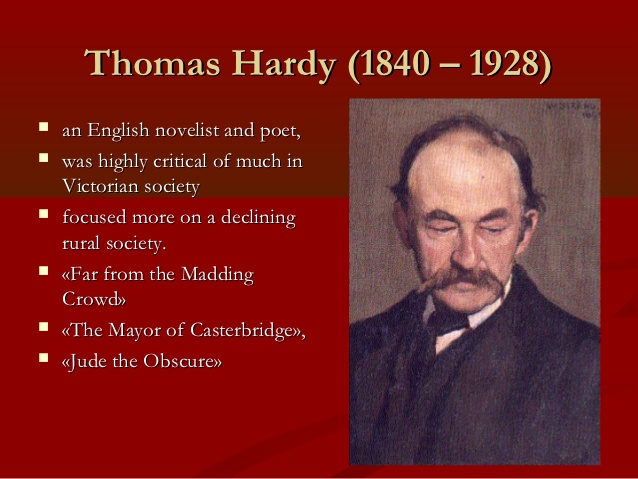
  • Thomas Hardy, English novelist and poet, was born near Dorchester in England. He was one of the great English writers of the 19th and early 20th century.
  • Hardy’s father was a stonemason and influenced Thomas to take up a career as an architect. Gothic architecture influenced Hardy’s poetry. It provided a powerful model for artistic unity and complexity in his works.
  • Hardy derived a love of music from his father and a devotion to literature from his mother. She introduced him to all the folk songs and legends of the Dorchester region as well as to Latin poets and French Romances.
  • He learned French, German, and Latin, sometimes self-taught.
  • Hardy could not afford to study at university. Instead he was apprenticed to a church architect and worked at this trade until he was 34.
  • Hardy wrote continually during the architect phase of his life. He wrote unpublished poems which idealized the rural life. He wrote serialised novels.
  • Success with serialised novels allowed him to give up the architect trade in 1874 and to marry the same year.
  • Over the next 22 years Hardy wrote many novels, all set in the interesting and historic Dorset landscape. He disguised Dorchester as Wessex in his novels and poetry.
  • Beginning at the age of 58, Hardy published many volumes of poetry-over 900 poems in all.
  • His poetry is straight to the point [spare and unadorned]. Though some consider his poetry to be unromantic, Hardy was imaginative and explored interesting feelings, just like the Romantic poets did.
  • Hardy’s most common theme is humanity’s struggle against fate. Hardy is pessimistic in the way he portrays humanity’s futile struggle against cosmic forces. His work has a tragic vision; a sense that human life has to be endured. Hardy’s vision is said to be stoical as it involves an acceptance of fate.
  • Hardy had a vision of a post religious society. He grew up in an era of narrow religious values and certainties. These ideas were beginning to disappear during his mature years as a poet. Instead of the traditional ways of understanding, Hardy realised that science had reshaped humanity’s vision of itself.
  • Hardy favoured the lyric and ballad forms of poetry.
  • Hardy’s poetry explores the themes of rural life and nature, love and loss, cosmic indifference, the ravages of time, the inevitability of death and the inhuman ironies of war.
  • Hardy’s poetry is characterised by fatalistic pessimism, earthy realism, and abstract philosophising. Hardy’s poetry contains great moral conviction.
  • Hardy was fascinated by transience, change, mortality, time, human vanity, war, power, nature, human cruelty and the past.
  • Hardy’s tone is typically ironic. He sees the unexpected twists and surprises that life throws at people.
  • His work provides keen psychological insights. Hardy uses original images that appeal to the reader’s intelligence
  • Hardy’s tone is often bleak and communicates a sense of loss. He is also nostalgic, idealising and longing for the past. Yet he can sometimes view a memory in an ironic or realistic way.
  • A lot of Hardy’s poetry is relatively simple and yet skilful. Yet, some of his poetic writing can be difficult due to old-fashioned words and phrases
  • Some of his poems are regarded as deliberately obscure. Hardy claimed that he often tried to hide his art or craft behind awkwardness. The poems on the course are relatively straight-forward.
  • Hardy’s poems tend to be descriptive, lyrical, and regular in form. He does not tend to experiment with form.

images (5)

THE POETRY OF THOMAS HARDY (1840 – 1928)

 These notes are meant to assist those studying English (Higher Level) for the Leaving Certificate but obviously they can be used by all lovers of poetry – even those who studied Hardy’s poetry in Soundings long ago!  For those studying for the Leaving Cert in June you need to become very familiar with at least six of Thomas Hardy’s poems.  I would recommend that you concentrate on the poems which illustrate his ideas on life, the past, nature and God.  The following is my personal selection (a baker’s half-dozen!):

  • The Darkling Thrush, (TDT)
  • Drummer Hodge, (DH)
  • Channel Firing, (CF)
  • The Convergence of the Twain, (TCOTT)
  • During Wind and Rain, (DWAR)
  • Afterwards, (A)
  • When I set out for Lyonesse. (WISOFL)

Health Warning!!

The points made here in these notes represent one interpretation of his work.  It is important that you develop your own response to each poem; where this differs from the suggestions given here, trust your own judgement!  Become familiar with the poems and with the major themes running through Hardy’s poetry.


 images (4)

Major Themes in Hardy’s Poetry

Time/The Past:  Hardy is keenly aware that civilisations and political arrangements last a limited time, pass and are replaced. Equally he knows that childhood and youth make way for a different future. Hardy frequently glorifies the past in order to emphasise its passing or to contrast it with the present. Sometimes Hardy ironically suggests people don’t learn from the past.

– ‘The Century’s corpse’ [TDT]
– ‘The world is as it used to be:/ All nations striving strong to make/ Red war yet redder’ [CF]
– ‘Again the guns disturbed the hour/Roaring their readiness to avenge, As far inland as    Stourton Tower/And Camelot, and starlit Stonehenge’ [CF]
– ‘Ah, no; the years, the years’ [DWAR]
– ‘He hears it not now, but used to notice such things’ [A]

Fate:  Hardy believes that human lives and events are predestined, though we don’t foresee the outcome. He has a vision that death, decay and mistakes are inevitable in human life. The retrospective view of history is not the only way of understanding events -there are hidden forces that shape our future, long before the destined events occur. Though destiny is inevitable, humans cannot figure it out in advance. Unknown outcomes reshape the plans that people have for themselves. Tragedy, though unforeseen, is never far away. More rarely, Hardy depicts a happy turn of events.

– ‘The Immanent Will that stirs and urges everything Prepared a sinister mate for her-so gaily great-A Shape of Ice’ [TCOTT]
– ‘Alien they seemed to be: No mortal eye could see The intimate welding of their later history’ [TCOTT]
– ‘They were bent by paths coincident On being anon twin halves of one August event’ [TCOTT]
– ‘The Spinner of the Years said “Now” ‘ [TCOTT]
– ‘They are blithely breakfasting all… Ah, no; the years O!’ [DWAR]
– ‘When the Present has latched its postern behind my tremulous stay’ [A]
– ‘No prophet durst declare/Nor did the wisest wizard guess What would bechance at Lyonnesse’ [WISOFL]

Transience/Change:  Hardy shows an awareness of mutability in politics and human affairs. The present differs from the past, often regrettably. Hardy often displays nostalgia for childhood or for a more innocent time. Yet, one thing that doesn’t change in his view is the stupidity of war and human vanity. Sometimes nature illustrates change through its cycles. At other times, forces of nature represent permanence, in contrast to human feelings and prosperity.

– ‘The ancient pulse of germ and birth was shrunken hard and dry’ [TDT]
– ‘It’s gunnery practice out at sea/…The world is as it used to be’ [CF]
– ‘Ah, no; the years O! How the sick leaves reel down in throngs!’ [DWAR]
– ‘He was a man who used to notice such things’ [A]

Family and Relationships:  Though Hardy is often an estranged observer of life, he cherishes intimacy and a sense of belonging. He recognises that these provide human identity. To him, they are essential and universal traits. He idealises family, community and marriage while persisting with his guise as the lone gazer or observer. When Hardy is the speaker, he sometimes seems to be a sensitive individual who internalises his experiences of life through recorded observation and reflection. Sometimes he uses dialogue to dramatise memories of family life. He alters or reworks moments of belonging or intimacy from the past in a romantic way, implying they were sweetly harmonious or more innocent than the present. He glorifies the beginning of his failed marriage as a moment from a medieval romance. He pictures an unknown peasant soldier [a drummer for a war machine] as homely and full of rural family values.

– ‘Young Hodge the Drummer – fresh from his Wessex home’ [DH]
– ‘They are blithely breakfasting all–Men and maidens–yea, Under the summer tree’ [DWAR]
– ‘My radiance rare and fathomless/When I came back from Lyonnesse With magic in my    eyes!’ [WISOFL]

Mortality:  Hardy focuses a lot on death, sometimes to a. morbid extent. Hardy implies that his fellow humans are not conscious of death, though he is always conscious that death is imminent

– ‘They throw in Drummer Hodge, to rest uncoffined’ [DH]
– ‘Foreign constellations west/ Each night above his mound. Young Hodge the Drummer  never knew -/ Fresh from his Wessex home’ [DH]
– ‘They sing their dearest songs-He, she, all of them-yea’ – ‘Ah, no; the years, the years; Down  their carved names the raindrop plows’ [DWAR]
– ‘When my bell of quittance is heard in the gloom’ [A]

Human vanity:  Hardy despises human pride and presumption. He refers with relish to events that show the futility of human schemes. Hardy is didactic in the way he uses mishaps and failures as lessons in the stupidity of human presumption. Hardy mocks the inability of religion to prevent war or better the human condition. He portrays the Christian God as a joker who converses with cows and skeletons. However, he is an enthusiastic advocate of the existence of superior forces or laws in the universe. For Hardy these are scientific rather than theological. These forces show that our grandiose displays of power are frivolous. Hardy delights in narrating reversals to human purpose and above all to smugness. Our hidden destinies frustrate or negate our intentions.

– ‘His homely Northern breast and brain/Grow to some Southern tree ‘ [DH]
– ‘In a solitude of the sea deep from human vanity, And the Pride of Life that planned her,  stilly couches she’ [TCOTT]
– ‘Over the mirrors meant to glass the opulent The sea-worm crawls — grotesque, slimed,  dumb, indifferent’ [TCOTT]
– ‘What does this vaingloriousness down here?’ [TCOTT]
– ‘God cried… they’d have to scour/Hell’s floor for so much threatening’ [CF]
– ‘Instead of preaching forty year/ my neighbour Parson Thirdly said “I wish I had stuck to  pipes and beer”.’ [CF]
– ‘And brightest things that are theirs…. Ah, no; the years, the years’ [DWAR]

War:  Hardy feels war is irrational and cruel. It is not heroic. Individual personality and family identity, two opposites cherished equally by Hardy, have no place in military life. He portrays the disposal of a soldier’s corpse in undignified terms. Hardy regards human being as always ready to participate in the game of warfare, without ever learning a lesson from past wars. Innocents, like the boy Drummer Hodge, are sacrificed meaninglessly. Hardy imagines modern warfare as the apocalypse. He mocks warfare by having God describe warfare as insane. He uses Dorset peasants to create his perspective on war.

– ‘They throw in Drummer Hodge, to rest /uncoffined- just as found’ [DH]
– ‘His homely Northern breast and brain grow to some Southern tree’ [DH]
– ‘We thought it was the Judgement-day’ [CF]
– ‘The world is as it used to be /All nations striving strong to make/ red war yet redder. Mad  as hatters’ [CF]
– ‘Again the guns disturbed the hour, roaring their readiness to avenge’ [CF]

Nature:  Hardy felt a mysterious power and presence in Nature. Hardy was conscious of awesome cosmic forces, the dread power of nature, the ominous signs of nature’s disasters and the amazing beauty of nature.

– ‘And strange-eyed constellation reign’ [DH]
– ‘Winter’s dregs made desolate the weakening eye of day’ [TDT]
– ‘The wind his death-lament’ [TDT]
– ‘Such ecstatic sound’ [TDT]
– ‘Some blessed Hope, whereof he knew and I was unaware’ [TDT]
– ‘In a solitude of the sea’ [TCOTT] ‘In shadowy silent distance grew the Iceberg too’  [TCOTT]
– ‘The only prime/ and real love-rhyme/ that I know by heart, ‘And the May month flaps its  glad green leaves like wings, Delicate-filmed as new-spun silk’ [A]
– ‘The dewfall-hawk comes crossing the shades to alight Upon the wind-warped upland  thorn’ [A]
– ‘He was one who had an eye for such mysteries’ [A]

Hardy’s Style

  • Form
    Hardy writes in a variety of tightly structured forms with well-defined rhyme schemes. Many of his poems are arranged in regular stanzas, with set line length. The course poems show that he mainly favours a line of three beats, sometimes alternating with a four beat line. He relies mainly on varieties of lyric form, sometimes achieving a song-like effect with his refrains and striking rhyme patterns. Hardy’s poems have a strong final line, bringing closure to the lyric through a declaration or a reversal.
  • Speaker
    Hardy is sometimes the autobiographical speaker, though he also uses an abstract observer as the speaker. Hardy also favours dramatic dialogue in some poems, where he uses multiple speakers. He sometimes favours a question and answer format.
  • Tone
    Hardy’s tone ranges from awe to despair. Images of nature are frequently accompanied by a tone of amazement, while images of human foolishness are usually conveyed in a bitter or hopeless tone. In his role of detached observer, Hardy’s tone is frequently full of knowing irony.
  • Irony
    Hardy delights in contrasting human expectation or vanity with fate and reversal. Frequently, Hardy illustrates the cruel irony of people’s lives. Occasionally the reversal in a poem is a happy one, though this is not usually the case. When dealing with war or human pretence, the irony is sarcastic.
  • Language
    There is a lot of variety to Hardy’s use of language. Frequently, Hardy uses archaic or rustic diction and syntax. Sometimes he capitalise words mid-line to emphasise a moral point or an irony. Hardy often uses capital letters for his abstract nouns, a traditional habit of English Poets. Sometimes Hardy uses unusual compound words. Often, Hardy describes a scene or event in a series of adjectives.
  • Imagery
    A lot of Hardy’s imagery is descriptive and real though it is interspersed with figurative imagery. Hardy uses metaphorical language frequently. Some of his images are symbolic of ruin or decay. Hardy often uses nature as a symbol of the passing of time. He sometimes contrasts permanent natural forces with images of change in human life. Hardy also uses certain images ambiguously. He also uses personification.
  • Verbal music
    Hardy uses the typical poetic devices of line rhyme, internal rhyme, alliteration, consonance, sibilance and assonance to beautify his subject or to enhance meaning and tone. He also uses onomatopoeia to create sound effects. He produces both euphony and cacophony to deepen meaning through musical effect. Search the poems and you will find many examples of these traits.

 *****

far-from-the-madding-crowd-by-thomas-hardy-10-728

My Personal Response to the Poetry of Thomas Hardy

Thomas Hardy is unusual in that he was also a very successful novelist, writing such masterpieces as Far From the Madding Crowd, The Mayor of Casterbridge and Tess of the D’Urbervilles and Jude the Obscure.  However, he regarded poetry as a higher form of art and was only drawn to writing novels because it paid better.  He has a very unusual and individual outlook on life and it is often cynical, pessimistic and depressing.

He was born in 1840 and so inherited the mantle of the Romantics but his outlook on nature is often far from ‘romantic’.  As a young man he read a recently published book by Charles Darwin entitled The Origin of the Species.  In this groundbreaking work, which continues to define how we understand the world in which we live, Hardy first became familiar with the theory, which utterly disputed the notion that God created man as a special being in His own likeness.  Darwin’s theory was that the development of all species, including man, was the result of competition among and within each species, which weeds out the less fit.

Because of these new scientific theories, nature began to be viewed differently.  It was no longer really possible to see the natural world as a happy one of co-existence amongst all God’s creatures.  Darwin’s world-picture was different: ‘We behold the face of nature bright with gladness’, he writes in The Origin of the Species, but ‘We forget that the birds which are idly singing round us mostly live on insects or seeds, are thus constantly destroying life; or we forget how largely these songsters, or their eggs, or their nestlings, are destroyed by birds or beasts of prey’.  Hardy was someone, who from a young age was sensitive to the natural world as a place of struggle.  A friend remarked that he was a writer who was ‘sorry for Nature, who feels the earth and the roots, as if he has sap in his veins rather than blood, and could get closer than any other man to the things of the earth’.  Therefore, Darwin’s theory meshed perfectly with Hardy’s own naturally gloomy outlook on life.  He had always thought Nature a cruel thing and in this he differed greatly from Wordsworth and the major poets of the Romantic period who liked to think that the natural world contained a powerful moral force that could raise the spirits and better anyone who took the time to appreciate it.  Instead Hardy spoke of ‘the chronic melancholy which is taking hold of the civilised races with the decline in belief of a beneficent Power’.  As the nineteenth century drew to its close, man was becoming more and more confident in his abilities to shape the world around him.  Darwin basically signalled the demise of religion and the rise of science in the Western world.  Hardy appreciated the optimism that came from these changes, but he was more inclined to write about the grim fact that man was also abandoned on the face of the earth and ultimately at the indifferent mercy of passing time!

As a person and a poet Hardy was obsessed with the past.  He was acutely aware of the passage of time and the changes it visited upon people and the world around them.  ‘During Wind and Rain’ conjures up a golden past, sketching four beautiful images from a family’s past life.  What all these images have in common, and what makes each of them so special, is that they feature a moment of togetherness, a time when the family are gathered close and engaged in some mutual activity, whether it be singing, telling stories or eating breakfast.  This poem provides us with Hardy’s most moving lament for time’s ravages.  The passage of time, we’re told, strips away the family’s happiness just as ‘a rotten rose is ript from the wall’.  (See also ‘The Oxen’ and ‘The Self Unseeing’)

‘When I set out for Lyonesse’ is another poem based around a memory of the past.  Here he writes about one of his most precious memories, the occasion of his first meeting with his first wife Emma Gifford.  Unlike the other memory poems, however, Hardy does not explicitly lament the passage of time.  The poem is straightforwardly happy, with the poet moving from a state of ‘lonesomeness’ to ‘radiance’ thanks to his encounter with this beautiful woman.  This poem also celebrates England’s mythic past, for Lyonesse, according to legend, was associated with King Arthur and his knights.

This respect for England’s past is also evident in ‘Drummer Hodge’ where Hardy uses the old term ‘Wessex’ for the area of England that Hodge is from.  (Many of his novels are also set in this imaginary place).  Ancient England is also mourned in ‘Channel Firing’ where Hardy concludes the poem by listing sites associated with myth and legend: Stourton Tower, Camelot and Stonehenge.  He implies here that the glory and nobility of bygone days has passed out of the world.  Modern man, in comparison, is a debased and violent creature who strives to make ‘red war yet redder’.  ‘The Darkling Thrush’, too, laments the passing of a golden age, in this case the great era of Romantic poetry.  Hardy seems to suggest that as the twentieth century dawns, with its science and machines, the great age of art and literature is sliding into oblivion.  Poetry, he suspects, will have little place in the new technological age.

Hardy’s views on God and religion were constantly changing.  There is very little evidence of an afterlife in his work and this gives it a very pessimistic, even atheistic, outlook.  In ‘Afterwards’ the poet considers what will become of him after his death and he hopes to live on in his neighbours’ memories.  We receive no impression, however, that the poet expects to be welcomed into heaven (or hell, for that matter) once he leaves this world behind.  ‘Drummer Hodge’, too, deals directly with an individual’s death and once more there is no sense that Hodge’s soul will live on after his body has decayed.  The only ‘afterlife’ Hodge experiences is the mingling of his corpse with the South African landscape where he is buried: ‘Yet portion of that unknown plain / Will Hodge forever be’.

In ‘The Darkling Thrush’ Hardy comes across as a conventional scientific atheist.  He seems to lament the fact that scientific discoveries have made it harder and harder for a rational person to believe in God.  The bleakness and coldness in this poem, it has been suggested, spring from its somewhat grim atheistic world-view.  It presents us with a universe that has no God and no afterlife, nothing beyond our tiny human lives.  In ‘The Convergence of the Twain’ Hardy replaces God with something he describes as ‘the Immanent Will’, a cruel and vengeful spirit that rules the universe with an iron fist.  This view is even bleaker than that expressed in ‘The Darkling Thrush’.  The Immanent Will is presented as a particularly nasty piece of work that brings the Titanic to its ruin with the loss of so many lives.  A universe ruled by the Immanent Will, therefore, is an unpleasant place to be.  God does make an appearance in ‘Channel Firing’.  It is important to note, however, that this is by no means a conventional spiritual view of God as a kind and loving father.  Instead Hardy seems to poke fun at Him, presenting him almost as a pantomime character engaged in a bit of banter with the skeletons of the dead.  God complains about humanity almost in the same way as your grandmother sometimes goes on about ‘the youth of today’!!!  In ‘Channel Firing’, then, we find Hardy gently poking fun at a god he can no longer believe in.

Hardy, in keeping with his bleak, pessimistic view of the universe, had a fairly low opinion of humanity as a race.  Mankind’s war-like tendencies, in particular, disgusted him.  He was not a pacifist, however, and he believed that war was necessary in certain circumstances.  What he despised was needless bloodshed caused by human vanity, by each nation’s pointless striving to be the greatest.  The kingdoms of the world, Hardy felt, squabbled like kids in a playground, except that these were quarrels that cost thousands of lives.  His low opinion of mankind is very evident in ‘Channel Firing’, where man’s history is depicted as one endless attempt to make ‘Red war yet redder’.  ‘Drummer Hodge’, meanwhile, depicts how in war it is inevitably poor young men who are sacrificed to further their leaders’ dreams of glory.  ‘The Convergence of the Twain’, too, deals with human vanity, detailing how man dared to defy nature by attempting to create a ship that could not be sunk.  In this case, as is so often the case, mankind’s pride comes before his fall.

‘He was one who had an eye for such mysteries’.

Study Notes on the Poetry of W.B. Yeats

images

THIS IS A PERSONAL REVIEW OF SOME THEMES AND ISSUES WHICH FEATURE IN THE POETRY OF W.B. YEATS. YOU SHOULD CONSIDER THESE IDEAS, THEN RE-EXAMINE THE POEMS MENTIONED FOR EVIDENCE TO SUBSTANTIATE OR CONTRADICT THESE INTERPRETATIONS.  IN OTHER WORDS MAKE YOUR OWN OF THESE NOTES, ADD TO THEM OR DELETE FROM THEM AS YOU SEE FIT.

 THE FOLLOWING SELECTION IS SUGGESTED BECAUSE THEY DEAL WITH THE MAJOR THEMES WHICH RECUR IN YEATS’ POETRY: ‘SEPTEMBER 1913’, ‘EASTER 1916’, ‘SAILING TO BYZANTIUM’, ‘THE SECOND COMING’, ‘IN MEMORY OF EVA GORE-BOOTH AND CON MARKIEWICZ’, ‘THE WILD SWANS AT COOLE’, ‘A STARE’S NEST BY MY WINDOW’, ‘THE LAKE ISLE OF INNISFREE’.

HE SAID HIMSELF THAT HIS POETRY WAS ‘BUT THE CONSTANT STITCHING AND RESTITCHING OF OLD THEMES’.  CHECK THIS OUT FOR YOURSELF!  

 YOUR AIM SHOULD BE TO PICK YOUR OWN FAVOURITES FROM THIS SELECTION AND GET TO KNOW THEM VERY WELL. 

YEATS AND THE NATIONAL QUESTION

Among the issues explored by the poet are:

  •    The heroic past; patriots are risk-takers, rebels, self-sacrificing idealists who are capable of all that ‘delirium of the brave’ (see ‘September 1913’).
  •    How heroes are created, how ordinary people are changed (‘Easter 1916’).
  •    The place of violence in the process of political change; the paradox of the ‘terrible beauty’ (see ‘September 1913’, ‘Easter 1916’).
  •    The place of ‘fanaticism’ and the human effects of it – the ‘stone of the heart’ (see ‘Easter 1916’, ‘September 1913’).
  •    The force of political passion (see ‘Easter 1916’).

YEATS’S NOTIONS OF THE IDEAL SOCIETY 

  • The vital contribution that both the aristocracy and artists make to society; the importance of the Anglo-Irish tradition in Irish society (see ‘September 1913’, ‘In Memory of Eva Gore-Booth and Con Markiewicz’).
  • His contempt for the new middle class and the new materialism (see ‘September 1913’).
  • Aesthetic values and the place of art in society (see ‘Sailing to Byzantium’)
  • The yearnings for order and the fear of anarchy (see ‘The Second Coming’).
  • His views on the proper contribution of women to society (see ‘Easter 1916’).

THEORIES OF HISTORY, TIME AND CHANGE

  •  His notion of thousand-year eras, ‘gyres’, etc. (see ‘The Second Coming’).
  •  The world and its people in constant change and flux (see ‘The Second Coming’, ‘Easter 1916’).
  • Personal ageing, the transience of humanity (see ‘The Wild Swans at Coole’, ‘Sailing to Byzantium’).
  • The yearning for changelessness and immortality (see ‘The Wild Swans at Coole’, ‘Sailing to Byzantium’).
  • The timelessness of art, or the possibility of it (see ‘Sailing to Byzantium’).

 CONFLICTS AT THE CENTRE OF THE HUMAN BEING

  • The conflict between physical desires and spiritual aspirations (see ‘Sailing to Byzantium’).

  • The quest for aesthetic satisfaction (see ‘Sailing to Byzantium’).

  • The search for wisdom and peace, which is not satisfied here (see ‘The Lake Isle of Innisfree’).
  • A persistent sense of loss or failure; loss of youth and passion (see ‘The Wild Swans at Coole’); the loss of poetic vision and insight (see ‘An Acre of Grass’).

wb-yeats-poetry

W. B. YEATS – AN OVERVIEW OF HIS POETRY

Two poets, one American, one Irish, dominated English Literature during the first half of the twentieth-century: T.S. Eliot and W.B. Yeats.  So powerful is Yeats’s distinctive poetic voice that his poetry has been described as ‘magisterial’, ‘authoritative’, ‘commanding’, ‘formidable’, ‘compelling’, ‘direct’, ‘exhilarating’, and even ‘overbearing’.  Before he died Yeats arranged for an epitaph to be cut in stone ‘by his command’ – and as Seamus Heaney has pointed out ‘command’ is the operative word here!  But there is also in Yeats the voice of the dreamer, the idealist.  We see it in ‘The Lake Isle of Innisfree’, which he began when he was twenty-three.  The life imagined on Innisfree is simple, beautiful and unrealistic and this longing for the ideal is also found in the sixty-one year old Yeats when he sails in his imagination, to Byzantium.

Yeats (like Joyce and others) lived in a time of extraordinary change.  A world war was fought and Ireland fought for and attained its Independence and went through the scourge of civil war; his poetry charts the political turmoil of those times.  Yeats writes about aspects of his private and his public life and sometimes those two aspects of his life overlap.  He is a public poet in a poem such as ‘September 1913’, where he becomes a self-elected spokesman in his condemnation of small-mindedness and the absence of vision.  He played a public role, was committed to Ireland (he refused a knighthood in 1915) and was made a Senator in 1922; one of his early ambitions says Michael Schmidt, was ‘to reconcile the courteous Protestant heritage with the martyred, unmannerly Roman Catholic tradition in Ireland towards a political end’.  In ‘In Memory of Eva Gore-Booth and Con Markiewicz’ he touches on these themes.  ‘All his life’, writes Augustine Martin, ‘Yeats sought for a harmonious way of life as well as a perfect form of art and he re-invents himself several times during the course of his life and work’.

While it is obvious to us, having studied a selection of his poems, that many similar themes recur in his poetry, it is also evident that he rarely repeated himself.  In Irish Classics, Professor Declan Kiberd identifies this aspect of Yeats’s poetry and comments: ‘The greatness of Yeats lay in his constant capacity to adjust to ever-changing conditions….As the years passed, he grew simpler in expression, using shorter lines dominated by monosyllables, with more nouns and fewer adjectives.  He said himself that a poet should think like a wise man, but express himself as one of the common people’.

Poets frequently write on similar themes.  (Need I mention David Gray?  Morrissey? Eva Cassidy even?).  When he writes about nationalism, his preoccupation with the passing of time and the reality of growing old, his belief in the extraordinary power of art, it could be said that these themes are not startlingly unusual, but it is the way he writes on such topics that makes him unique.

Imagery, especially his use of symbol, is another striking aspect of his work.  Powerful, memorable images remain with the reader, such as the ‘purple glow’ of noon; the fumbling in ‘a greasy till’; ‘the hangman’s rope’; the nine-and-fifty swans ‘Upon the brimming water’ and the ‘bell-beat of their wings’; the stone in the midst of’ the living stream’; a creature ‘somewhere in sands of the desert / A shape with lion body and the head of a man’; ‘sages standing in god’s holy fire’; ‘the bees build in the crevices / Of loosening masonry’; ‘Two girls in silk kimonos’, etc., etc.

In ‘Under Ben Bulben’, written five months before he died, he praised the well-made poem and scorned and condemned the shapeless, badly made one.  All his life he valued form and his mastery of rhythm, rhyme and the stanza are testimony to this.  Yeats is intensely personal: he names names and writes about events and happenings that are recorded in newspapers and history books, but he knew that ‘all that is personal soon rots, it must be packed in ice and salt’.  His poems speak to us with great immediacy and directness but they do so in elaborate and musical forms.

‘My poetry is generally written out of despair’ says Yeats.  As he grew older, he searched for ways to overcome his weakening body.  He raged against old age, wrote about it with great honesty and accepted the inevitability of death.  His poetry reminds us of the immortality of art, that ‘Man can embody truth but cannot know it’ and that ‘we begin to live when we have conceived life as a tragedy’.

yeats

SAMPLE ANSWER

 ‘Yeats’s poetry examines a powerful series of tensions between youth and age, and order and chaos.’  Discuss this statement and use a selection of poems from your course to support your answer.

I fully agree with this assessment of Yeats’s work.  Indeed, it is easy to find evidence for the opinion that he is ‘a poet of opposites’.  His poetry explores many diverse conflicts at both a personal and national level.  One of the strongest impressions created by his poetry is that of searching.  Sometimes he searches for a means of escape, sometimes for a solution, but the presence of numerous rhetorical questions throughout his poetry reveals a man who was sensitive to the world around him, encountered it with intellectual vigour while remaining true to his heart.

One of the major conflicts in his work is that of youth and age.  Yeats can become melancholic in his awareness of life’s brevity as we see in ‘The Wild Swans at Coole’ where he reflects rather dolefully that ‘The nineteenth autumn has come upon me’.  Time refuses to stand still for a poet who realises that ‘All’s changed since ….  Trod with a lighter tread’ along the autumnal shores of the lake at Coole Park.  A similar acceptance of time’s inexorable progress occurs in ‘Easter 1916’ where horses, birds, clouds and streams ‘Minute by minute they change.’  In the opening stanza of ‘Sailing to Byzantium’ Yeats presents a dramatic affirmation of youth where the young are ‘in one another’s arms’ mesmerised by the ‘sensual music’ of love.  This poem establishes powerful conflicting claims between the younger generations who live in the sensual world and the more sedate singing of the old scarecrow, reincarnated into an eternal art form of the golden bird.  The bird has transcended the decay and infirmities of the transitory world; it may claim to be superior to the ‘Fish, flesh, or fowl’ who have been ‘begotten, born’ but must also die.  However, the rather cold, mechanical song of the golden, immortal bird does not quite match the passionate, vibrant music of the young.  And yet, they too are the ‘dying generations’.  In ‘Sailing to Byzantium’ the old poet, a figure of fun in his own country, leaves the sensual world for the changeless world of Byzantium that is beyond time and passion.  His appeal is to be reincarnated.

A second significant conflict in Yeats’s work is that between order and chaos.  Yeats admired the aristocratic tradition in eighteenth-century Ireland.  The world of the Great House was aligned to his own sense of identity with that particular class.  He felt at home in Lady Gregory’s house at Coole Park and in his poem ‘The Wild Swans at Coole’ he remembers in the opening stanza the tranquil, serene and orderly world of that eighteenth-century estate.  The graceful living of Lisadell is beautifully evoked in the opening images of ‘In memory of Eva Gore-Booth and Con Markievicz’ as he describes ‘The light of evening, Lisadell, / Great windows open to the south, / Two girls in silk kimonos, both /Beautiful, one a gazelle’.  Using an image of nature, Yeats makes the transition from the refined, elegant youth of the girls to their turbulent adult lives when he says ‘a raving autumn shears / Blossoms from the summer’s wreath’.  The remainder of the poem seems to lament the passing of such an ideal world of youth in the women’s futile attempt to find ‘Some vague Utopia’ that aged their beauty until it was ‘skeleton-gaunt’.  The references to conflagration at the end of the poem point to the destruction of the traditional values that were cradled in places such as Lisadell.

In place of such values Yeats presents the birth of ‘mere anarchy’ in the poem ‘The Second Coming’.  This poem is a stark and terrifying vision of disintegrating social order and ominous evil that has been born and ‘loosed upon the world’.  Images of the ‘blood-dimmed tide’ and a ‘rough beast’ slouching towards Bethlehem show how troubled the poet is by the increasing violence and the annihilation of cultural and aristocratic values.  The conflict between order and chaos is the focus of more local manifestations of violence and murder in ‘A Stare’s nest by my Window’.  In the poem, which details the negative impact of civil war, the poet fights his own inner battle against chaos in calling for renewal, rebirth and regeneration in ‘the empty house of the stare’.  However, the hope of a return to some order is filled with ‘uncertainty’; the predominant images in the poem are of destruction where ‘A man is killed, or a house burned’.  The house could well have been a Lisadell or a Coole Park.

Yeats did attempt to resolve some conflicts in his poems but in many cases he had to accept that such a synthesis was not always possible let alone probable.  But he did remain in contact with the world, however imperfect it seemed, and encountered it with his complex temperament that could whisper of grace, youth and beauty or clamour against injustice, old-age and decay.  Perhaps we should be grateful that many conflicts were never resolved, for it was they that evoked his most difficult struggles and his most poignant poetry in granting him ‘an old man’s frenzy’.


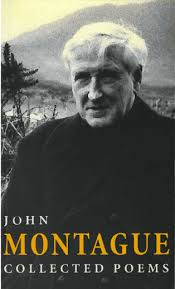
An Analysis of the Poetry of John Montague (1929 – 2016)

Great-Book016C-PMF-John-Montague-poet-no-border
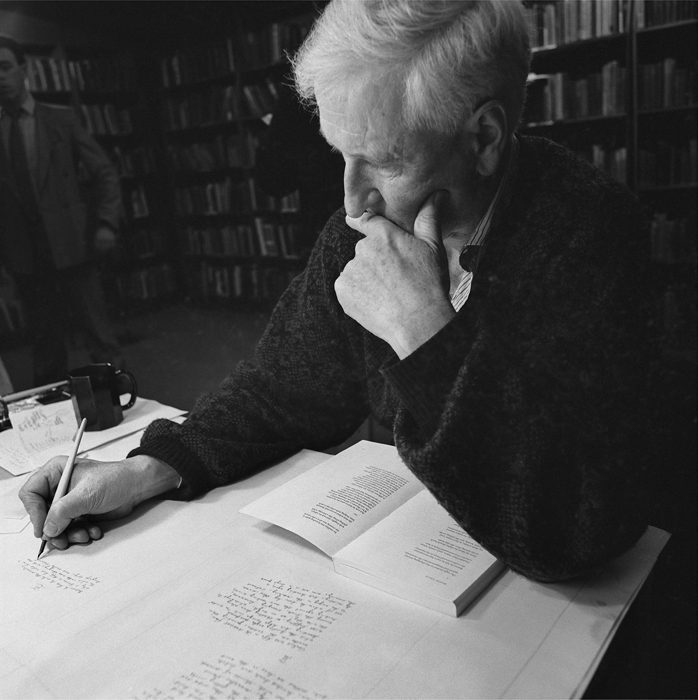
The poet John Montague at work.

THIS IS A PERSONAL REVIEW OF SOME THEMES AND ISSUES WHICH FEATURE IN THE POETRY OF JOHN MONTAGUE. YOU SHOULD CONSIDER THESE IDEAS, THEN RE-EXAMINE THE POEMS MENTIONED FOR EVIDENCE TO SUBSTANTIATE OR CONTRADICT THESE INTERPRETATIONS. IN OTHER WORDS, MAKE YOUR OWN OF THESE NOTES, ADD TO THEM OR DELETE FROM THEM AS YOU SEE FIT.

THE FOLLOWING SELECTION IS SUGGESTED BECAUSE THEY DEAL WITH THE MAJOR THEMES AND STYLISTIC DEVICES WHICH RECUR IN MONTAGUE’S POETRY:
• The Locket (TL)
• The Cage (TC)
• Like Dolmens Round my Childhood the Old People (LDRMC)
• The Wild Dog Rose (TWDR)
• The Same Gesture (TSG)
• Windharp (W)
• A Welcoming Party (AWP)

HE SAID HIMSELF THAT WRITING POETRY WAS ‘LIKE THE DROPPING OF A ROSE PETAL INTO THE GRAND CANYON, A FUTILE ACT’. MAYBE, HOWEVER, YOUR VIEW OF LIFE HAS BEEN CHANGED BY READING HIS POETRY AND MAYBE THE GRAND CANYON IS SWEETER FOR THAT ROSE PETAL AND MAYBE THE WORLD IS A BETTER PLACE BECAUSE OF JOHN MONTAGUE’S POETRY!

YOUR AIM SHOULD BE TO PICK YOUR OWN FAVOURITES FROM THIS SELECTION AND GET TO KNOW THEM VERY WELL.

John Montague
Garbh Fhaiche = The Rough Field = Garvahey

Relevant Background

• John Montague was born in Brooklyn, New York early in 1929.
• He was son of James Montague, an Ulster Catholic, from County Tyrone, who had immigrated to America in 1925 after involvement in republican activities.
• His mother was Molly Carney, but she played little part in his life after his birth. Yet she marred John’s life by her absence from it.
• James Montague had the typical exile’s optimistic hope of benefiting from the American Dream.
• But when his wife, Molly, arrived three years later with their two first sons, James could provide nothing better than the Brooklyn slums for their family home.
• Regarding his background, John Montague’s grandfather was a Justice of the Peace, schoolmaster, farmer, postmaster and director of several firms.
• John had a typical Brooklyn kid’s early childhood, playing with coins on tram- lines and seeing early Mickey Mouse movies.
• Because of the economic effects of the Depression era John Montague was shipped back in 1933 at the age of four to his family home at Garvaghey, in County Tyrone.
• John Montague’s mother rejected him after a painful birth. This rejection and marriage problems were contributory causes to the decision to send John to be fostered from the age of four by two aging unmarried aunts.
• Later, when his mother ended her marriage and returned to Ulster, she continued to ignore John, a fact which deeply hurt him and affected both his speech and his ability to socialise with women.
• However, the switch from city kid to country-village boy in Ulster benefited John and proved to be a ‘healing’ as he called it in a poem not on the course.
• With the help of his imagination, he adopted to life on a farm that doubled as the local rural post-office. Because of this he got to know the local characters and gossip very well. We see this in ‘Like Dolmens’ and ‘The Wild Dog Rose’.
• He was first taught in Garvaghey national school.
• For secondary education John went to an austere boarding school run by strict priests in Armagh. There, against his will, John learned about the long tradition of Irish poetry from an influential teacher.
• While studying for his degree in Dublin after World War Two, John found Dublin to be a very old fashioned place, with the atmosphere over-controlled, especially by priests.
• Afterwards he went to work and complete his education in American Universities. He honed his poetic skills while in America.
• John Montague then got married and lived for a time in France where he continued to write poetry and to write short stories. There for a while he became a friend of the renowned Irish playwright, Samuel Beckett.
• He worked as Paris correspondent for The Irish Times for three years. He spent a total of twelve years living in France.
• After journalism, he began a long career as a university lecturer and poet. He has lectured at universities in France, Ireland, Canada, and the United States.
• He is the author of numerous collections of his own poems and editor of anthologies of works of other poets.
• He has received many awards, including the Irish-American Cultural Institute’s Award for Literature, the American Ireland Fund Literary Award and a Guggenheim Fellowship.
• In 1987, Montague was awarded an honorary doctorate by the State University of New York. The State Governor Mario M. Cuomo praised Montague for his outstanding literary achievements and his contributions to the people of New York.
• In 1998, he was named the first Irish Professor of Poetry. This is a position he held for three years, equally divided among The Queen’s University in Belfast, Trinity College Dublin, and University College Dublin.
• He now divides his time between West Cork and France.
• John Montague has a major international reputation as an Irish poet, the first major Northern Irish Catholic poet.
• He is a poet who describes private feelings as well as public themes.
• Much of his poetry centres on his personal family history and the culture and history of Catholics in Northern Ireland, including the twenty-five year long period of the Troubles.
• For example, his greatest poem ‘The Rough Field’ is set on the farm where he was reared from the age of four and was influenced by the people he grew up among. Three course poems e.g. ‘Like Dolmens Round My Childhood’ come from ‘The Rough Field’.
• The Civil Rights Movement in 1960s Northern Ireland also influenced John Montague. His did a public reading of his poem ‘New Siege’ outside Armagh Jail in 1970 to support a jailed civil rights protestor, the nationalist Bernadette Devlin.
• As an adult he spent some time trying to recapture the American experience, a search reflected in some of his poems.
• Separation from his father all his life affected him emotionally as we read in his poem ‘The Cage’.
• The pain of rejection by his mother was even more traumatic for his personal development as we read in the poem ‘The Locket’.
• John Montague is renowned internationally as one of the major Irish poets of the twentieth century.

  • Montague died at the age of 87 in Nice on 10 December 2016 after complications from a recent surgery. He is survived by his wife Elizabeth Wassell, daughters Oonagh and Sibyl and grandchildren Eve and Theo.

john-montague

MAJOR THEMES IN MONTAGUE’S POETRY

Childhood:  Like many poets on our course, Montague is fascinated with the subject of childhood. AWP describes the relative safety and comfort of a childhood in Ireland during the war. While the rest of Europe was plunged into destruction, Ireland remained safely on the ‘periphery of incident’. While young boys were fighting and dying all over Europe the young poet was free to ‘belt a football through the air’. Yet the ‘drama of unevent’ that constituted the war years in Ireland is briefly shattered for the poet when he encounters the newsreel of the death camps and discovers the grim reality of ‘total war’.

What might be described as a darker aspect of childhood is explored in LDRMC. There is a sense in this poem that the Irelands of Montague’s youth was a dark and haunted place, a land where ancient beliefs and superstitions still survived. We get a sense that during his childhood many people still believed in myths and magic, in ghosts, curses and supernatural demons; ‘Ancient Ireland, indeed! I was reared by her bedside, / The rune and the chant, evil eye and averted head/ Fomorian fierceness of family and local feud.’ For an imaginative child growing up in this society, it was easy to believe that magic still existed, that ancient monsters such as the Fomorians still roamed the land, in the dark countryside just beyond the reach of the farmhouse lights.

A similar theme is evident in TWDR where the poet describes his childhood terror of an old woman that lived in his locality. This poor and seemingly quite ugly old woman terrified the young poet with her ‘hooked nose’, her ragged clothes and the pack of dogs that always surrounded her. To him, she seemed a kind of witch, a terrifying supernatural figure who ‘haunted my childhood’. Yet while Montague’s poetry described this ‘Ancient Ireland’ it also records it’s passing away. As the country became more modern and Europeanised the old legends and superstitions no longer exerted the same power. As he grows up he can see the old legends and superstitions for what they were. This is particularly evident in TWDR where he realises that the ‘cailleach’ that so terrified him in his youth is only human after all and he ends up chatting to her by the roadside, reminiscing and gossiping ‘in ease’ about the people of the parish.

Violence: Montague’s work is haunted by the threat and the possibility of violence. This is particularly evident in ‘A Welcoming Party’ (AWP) where the young speaker is left greatly troubled by his encounter with images of the holocaust. He pulls no punches in his depiction of the horrors of war. His description of the holocaust victims here has been described as disgusting, bizarre and disturbing. Their mouths are described as ‘burnt gloves’, their bodies are depicted as nests full of insect eggs and their hands are depicted as begging bowls.

‘The Wild Dog Rose’ (TWDR), meanwhile, presents violence in an Irish context. The depiction of the attempted rape of the old woman is almost as shocking as that of the holocaust victims. The drunken labourer invades the old woman’s home whirling his boots in an attempt to ‘crush the skulls’ of her dogs. There is something truly horrific about the image of him wrestling her to the ground and ‘rummaging’ in her ‘tasteless trunk’ of a body. Yet this violent scene serves an important symbolic function, representing the violence and misery that had been visited upon Ireland over the centuries. The violation of the old woman echoes many ancient Irish songs and poems in which a woman, representing the land of Ireland, is violated by some ruthless villain who represents the foreign oppressor.

The hidden side of human personalities: John Montague contemplates the vulnerable underside of people who may appear harsh on the surface. ‘Maggie Owens… all I could find was her lonely need to deride’ [LDRMC] ‘Mary Moore… a by-word for fierceness… dreamed of gipsy love-rites’ [LDRMC] Montague also senses how a human hurt can deform a life. ‘the cailleach, that terrible figure who haunted my childhood but no longer harsh, a human being merely, hurt by event’ [TWDR] He reveals the real personality behind the public smiles of his father. ‘My father… extending his smile to all sides of the good (all white) neighbourhood… the least happy man I have known’ [TC] Montague is aware of the duality of our gestures in different contexts. An everyday movement of the hand in public, in traffic, that is mechanical in effect, can be deeply intimate in effect in the privacy of lovemaking, ‘changing gears with the same gesture as eased your snowbound heart and flesh’ [TSG]

John Montague is able to forgive his mother for rejecting him because he sees her pain and senses the different personality she had before her life turned harsh. ‘my double blunder… poverty… yarning of your wild young days… the belle of your small town… landed up mournful and chill’ [TL]

The impact of family on his life: As we have discovered, Montague’s family situation was far from ideal. Like thousands of Irish people, his parents were forced to emigrate to America where they struggled to survive in the face of extremely difficult circumstances. The consequences of this struggle are movingly portrayed in ‘The Cage’ (TC). The battle with poverty and the effort to make a home in a new society have clearly scarred the poet’s father who is described as ‘the least happy man I have known’. His deep unhappiness is evident in his alcoholism. Each night he is compelled to drink himself into oblivion as if only this will numb the pain of his existence, ‘the only element he felt at home in any longer: brute oblivion’.

Yet the poet’s mother, it seems, suffered even more. He claims that the brutal circumstances of her life – emigration, poverty, a loveless marriage – damaged her in some fundamental way, leaving her ‘wound’ in a ‘cocoon of pain’. She is unable to bond with her son and eventually sends him back to Ireland – causing great psychological damage to both herself and her son, so much so that in ‘The Locket’ (TL), he refers to her as a ‘fertile source of guilt and pain’.

The harshness of life: John Montague portrays the suffering of lonesome, impoverished locals from the hills around Garvaghey (Garbh Fhaiche = rough field = Garvahey). ‘When he died his cottage was robbed… driving cattle from a miry stable… forsaken by both creeds… Fomorian fierceness of family and local feud’ [LDRMC] He depicted the suffering of his father, a prisoner of poverty in New York. ‘ my father, the least happy man I have known…the lost years… released from his grille… drank neat whiskey until… brute oblivion.’ [TC] Montague spells out the extent of his mother’s physical pain and anguish. ‘ source of guilt and pain… the harsh logic of a forlorn woman’ [TL] He portrays the life-long loneliness and the brutal rape of a seventy-year-old spinster. ‘the cailleach… hurt by event… loneliness, the monotonous voice in the skull that never stops… he rummages while she battles for life bony fingers reaching desperately to push against his bull neck…’ [TWDR] Montague also portrays the horror of concentration camps. ‘From nests of bodies like hatching eggs flickered insectlike hands and legs’ [AWP]

A sense of place: Montague observes and draws the landscape of his childhood. ‘the cottage, circled by trees, weathered to admonitory shapes of desolation…where the dog rose shines in the hedge’ [TWDR] ‘a bend in the road which still shelters primroses’ [TC] ‘ a crumbling gatehouse. Famous as Pisa for its leaning gable’ [LDRMC] ‘From main road to lane to broken path’ [LDRMC] Montague pinpoints the essence of nature’s music as created by the wind in the Irish landscape. ‘seeping out of low bushes and grass, heatherbells and fern, wrinkling bog pools, scraping tree branches…’ [W] Montague evokes the horror of Auschwitz. ‘a welcoming party of almost shades… an ululation, terrible, shy’ [AWP] He also neatly depicts the irrelevance of Ireland geo-politically in the 1960s. ‘to be always at the periphery of incident’. He mentions what would strike an Irish visitor to New York. ‘listening to a subway shudder the earth.’ [TC] Montague sums up the essence of a Brooklyn neighbourhood. ‘(all-white) neighbourhood belled by St Theresa’s church.’ [TC] Montague evokes the intimacy of the marriage bedroom. ‘a secret room of golden light… healing light… gesture … eased your snowbound heart and flesh.’ [TSG]

Isolation and separation: Montague’s parents suffered separation and social isolation. ‘My father… brute oblivion’ [TC] Like his father, his mother suffered from self-imposed oblivion. ‘the harsh logic of a forlorn woman resigned to being alone’ [TL] Montague with great sympathy captures the reason for an odd old lady’s personality. ‘the only true madness is loneliness, the monotonous voice in the skull that never stops because never heard’ [TWDR] Her isolation means that she seeks no redress from the authorities for rape. She suffers with a stoicism born of a folk version of religion. ‘she tells me a story so terrible I try to push it away… I remember the Holy Mother of God and all she suffered.’ [TWDR] Montague captures the isolation of his scattered elderly rural neighbours. ‘Jamie McCrystal sang to himself… Maggie Owens… even in her bedroom, a she-goat cried… Billy Eagleson… forsaken by both creeds… ‘ [LDRMC]

Human love: Montague is quite famous within the literary world as a poet of love. Intense descriptions of erotic love, in particular, recur in many of his poems. We see this in ‘The Same Gesture’ (TSG) where the couple’s lovemaking is unashamedly celebrated: ‘It is what we always were- / most nakedly are’. Lovemaking is presented as something spiritual and holy. The couples’ hands moving on each other’s skin, we’re told, is like something from a religious ceremony: ‘the shifting of hands is a rite’. Love and sexual intimacy are depicted as having a powerful healing quality: ‘Such intimacy of hand / and mind is achieved / under its healing light’. Oneness is also celebrated, the notion that two lovers can somehow forget themselves and blend into one: ‘We barely know our / selves there.’

TSG, too, is intensely aware of the fragility of love. Emotional and sexual intimacy can be a spiritual and ‘healing’ thing. Yet a relationship can also become bitter and sour leading to hatred and even violence. The poem suggests that in this modern age love and intimacy are becoming more and more difficult to maintain. In this busy world where time and space are such a precious commodity, it can be easy to lose sight of what matters. The pressures of ‘work, phone, drive through late traffic’ must not cause us to neglect our relationships. Love, the poem implies, requires private space, a ‘secret room’ if it is to flourish if its ‘healing light’ is to shine. In the modern world, however, such space is increasingly difficult to come by.

Nature: As with other poets like Kavanagh and Frost, Montague’s work is regularly inspired by the natural world. This is very evident in ‘Windharp’ (W), in particular where he lovingly describes the Irish landscape with its ‘heather bells and fern, / wrinkling bog pools’. In this phrase we see Montague’s powers of description at their best: we can easily imagine the ripples on a bog pool resembling wrinkles on a piece of cloth.

A love of the Irish landscape is also evident in LDRMC with its celebration of the folk who live among the mountains and glens of rural County Tyrone. TWDR, too, displays the poet’s love of nature with its meticulous description of the tender wildflowers with their ‘crumbling yellow cup / and pale bleeding lips’. Yet the harsher aspects of nature are also lovingly rendered, such as the old woman’s rough field with its ‘rank thistles’ and ‘leathery bracken’. He observes nature’s beauty in eloquent language, ‘Gulping the mountain air with painful breath’ [LDRMC] ‘weathered to admonitory shapes of desolation by the mountain winds’ [TWDR]

Montague personifies the effects of climate on the Irish landscape as ‘ a hand ceaselessly combing and stroking the landscape’ [W]. He is also aware that not all that is beautiful is strong, ‘dog rose… at the tip of a slender, tangled, arching branch… weak flower, offering its crumbling yellow cup and pale bleeding lips fading to white’ [TWDR]

It is unsurprising, therefore, given Montague’s obvious love of the Irish landscape that he describes it as something ‘you never get away from’. Even when you leave the country, he claims, the sound of the wind through the Irish countryside, that ‘restless whispering’, will still somehow echo in your ears.

CmdOvCqWEAAQrlf
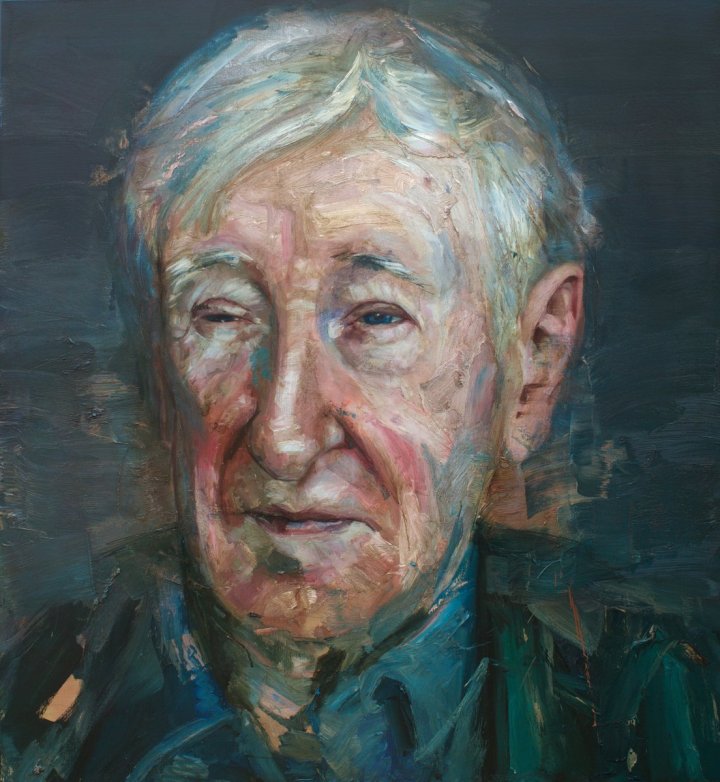
‘Portrait of John Montague’ / 2015-16 / 127x117cm / oil on canvas by Colin Davidson

MAIN ELEMENTS OF MONTAGUE’S STYLE

Form John Montague is a lyric poet. He uses various stanza forms in the poems selected for the Leaving Certificate. He favours a poem of between four and seven stanzas with either six or seven lines per stanza. However, he deviates from this at times. He doesn’t tend to follow a definite rhyming pattern. Many of his poems have rhyme, though he is not strict about this. You are as likely to see half-rhyme as rhyme.

Speaker: In most of Montague’s poems the speaker is the poet himself. Most of his material comes from his lived experience and direct observations. He is a poet of the self, a romantic poet in that sense. He uses poetry to arrive at perceptions about his parents, partners, memories and the impact on him of national and international events.

Tone: Montague’s various tones range from pain to empathy, admiration and wonder. The word which applies to much of his poetry is compassionate. His tone is often one of intelligent detachment. At times he is capable of sarcasm. His tone can sometimes sound haunted, guilty even for the actions of others. He is capable of rueful and frustrated irony as illustrated in the final line of ‘A Welcoming Party’.

Language: Montague’s language is personal and anecdotal. He addresses the reader in conversational English. The need for rhythm and a regular beat may lead to the omission of obvious words or the changing of word order or phrase order. His most striking feature is his use of adjectives, sometimes in a group of three. It is worth commenting on his adjectives and how they convey meaning, express tone and achieve mood. ‘Windharp’ is a very eloquent poem in which to investigate the effect of adjectives. The fourth stanza of ‘The Wild Dog Rose’ is a powerful example of Montague’s talent for selecting adjectives.

Montague’s choice of verb is often apt and evocative. The use of the verb ‘rummages’ in its context in ‘The Wild Dog Rose’ is both horrifying and touching in its graphic violence. A clear example of Montague’s ability to use a pithy phrase is found in ‘A Welcoming Party’ when he refers to Ireland’s remoteness from what matters in the world at large: ‘to be always at the periphery of incident’. He defines the ‘Irish dimension’ of his childhood as ‘drama of unevent’. Montague matches language to meaning.

Imagery: As partly a narrative type of poet, many of Montague’s images are descriptions of actual memories, colourful pictures from his lived experience or the experience of others like Minnie Kearney narrated first to him and then to the reader as a third-person account. A particularly graphic example of the latter is found in ‘The Wild Dog Rose’. The poem contains an uncensored example of violence, a detail of which is the following: ‘the thin mongrels rushing out, but yelping as he whirls with his farm boots to crush their skulls’. The effect of the word ‘yelping’ on the reader is strong here. Consider the locket around his mother’s neck as a graphic image from his life.

Montague also chooses striking comparison images to convey his intelligent perceptions. The image of a cage for his father’s work booth is an example of Montague’s clear but intelligent metaphors. Likewise, his simile of the dolmen is profound and carries many resonances. The detailed image of the dog rose from the third section of ‘The Wild Dog Rose’ is an illustration of Montague’s descriptive powers and of his ability to use an actual image as a symbol of human fragility.

Verbal music: For Montague’s lyrical music you will find various sound repetitions, rhymes and half-rhymes, alliteration, assonance, onomatopoeia, consonance and sibilance in all his poems. For assonance listen to the ‘u’ sounds in ‘A Welcome Party’ especially in lines seven to ten. This enhances the effect of a group wail or lamentation as suggested by the word ‘ululation’.

A useful example of onomatopoeia is found in line two of ‘Windharp’, where the words imitate the breezes in the bushes and grass: ‘ the restless whispering’. This is a case of assonance ‘e’ and sibilance combining to create a musical effect that reinforces meaning.

For a more detailed illustration of verbal music examine the precise examples provided in the notes on three individual poems by John Montague in the Leaving Cert English Ordinary Section on Skoool.ie .

images (3)

SAMPLE ANSWER:  Give your personal response to the poetry of John Montague.

 I am a big fan of John Montague because I find his poetry very emotional and moving.  Much of this emotion comes from the depiction in his poems of human relationships.  In poem after poem, he explores the difficulties that can exist in human relationships.  Several of his poems reveal the tensions and difficulties that can dog even the most successful of romances.  Family pressures, too, are movingly explored in these poems.  Yet what I found most attractive about Montague’s work is its emphasis on the fact that these difficulties can be overcome or reconciled.

 Montague is quite famous within the literary world as a poet of love.  Intense descriptions of erotic love, in particular, recur in many of his poems.  We see this in ‘The Same Gesture’ (TSG) where the couple’s lovemaking is unashamedly celebrated: ‘It is what we always were- / most nakedly are’.  Lovemaking is presented as something spiritual and holy.  The couples’ hands moving on each other’s skin, we’re told, is like something from a religious ceremony: ‘the shifting of hands is a rite’.  Love and sexual intimacy are depicted as having a powerful healing quality: ‘Such intimacy of hand / and mind is achieved / under its healing light’.  Oneness is also celebrated, the notion that two lovers can somehow forget themselves and blend into one: ‘We barely know our / selves there.’

In ‘The Same Gesture’, too, the poet is intensely aware of the fragility of love.  Emotional and sexual intimacy can be a spiritual and ‘healing’ thing.  Yet a relationship can also become bitter and sour leading to hatred and even violence.  The poem suggests that in this modern age love and intimacy are becoming more and more difficult to maintain.  In this busy world where time and space are such a precious commodity, it can be easy to lose sight of what matters.  The pressures of ‘work, phone, drive through late traffic’ must not cause us to neglect our relationships.  Love, the poem implies, requires private space, a ‘secret room’ if it is to flourish if its ‘healing light’ is to shine.  In the modern world, however, such space is increasingly difficult to come by.

One of his most emotional poems is ‘The Locket’, where he describes his difficult relationship with his mother.  He tells us that his mother has been a ‘fertile source of guilt and pain’ for him throughout his life.  According to the poet, his mother regarded his birth as a ‘double blunder’.  The first part of this ‘double blunder’ stemmed from the fact that the poet was born a boy when she really wanted a girl.  Secondly, Montague was turned the wrong way in the womb, making the process of his birth extremely difficult for her.  According to the poem, this ‘double blunder’ caused the mother to reject her son.  She was never really affectionate to him and ‘sent him away’ when he was four years old.  He was sent back to Ireland where he lived with his aunts.

It seems that even in later years the mother could not bear to be around her child.  When she returned to Ireland she did not reclaim her son and instead went to live in a different village a few miles away from where he lived.  As a young man Montague would ‘cycle down’ to visit her, but eventually, she told him to stop coming: ‘I start to get fond of you, John, / and then you are up and gone.’  I found this aspect of the poem extremely moving and felt very sorry for the young Montague.  I felt he had done nothing to deserve this harsh treatment from his mother.  After all, it was not his fault he was born ‘the wrong sex’ and the ‘wrong way round’.  I found the mother’s behaviour somewhat cruel and felt that she had unfairly created feelings of ‘guilt and pain’ for her son.

‘The Cage’ also explores the poet’s feelings of ‘guilt and pain’ and in this case, the negative emotions stem from his difficult relationship with his father.  He describes his father as the ‘least happy man I have known’.  This unhappy man spent his days working in the dark and noise of the New York subway: ‘listening to a subway shudder the earth’.  He was an alcoholic who would drink himself into ‘brute oblivion’.  Only when obviously drunk was he in any way happy.  According to the poem, this was the ‘only element / he felt at home in any longer.’

One of the most moving aspects of Montague’s poetry is his depiction of his reconciliation with his parents.  When his mother dies he discovers that she loved him after all and that for years she had worn a locket that contained his picture: ‘an oval locket / with an old picture in it, / of a child in Brooklyn’.  Similarly, the poet eventually comes to terms with his troubled father and they walk ‘together / across fields of Garvaghey / to see hawthorn on the Summer / hedges’.  I found it very tragic, however, that both reconciliations came too late.  For the poet’s mother was unable to express her love for him while she was alive and it is only after her death that he learns of it.  The poet’s reconciliation with his father also comes too late.  For no sooner has the father returned to Ireland and spent some time with his son than the son himself must depart: ‘when wary Odysseus returns / Telemachus should leave’.  The poet seems to be forever haunted by this unhappy man and his failure to ever really connect with him and still sees his father’s ‘bald head’ when he descends into subway stations.

Another poem that showcases reconciliation is ‘The Wild Dog Rose’.  As a child, the poet was terrified by the old woman who lived near his house, imagining her to be a terrifying witch with a ‘great hooked nose’, her ‘mottled claws’ and her eyes that were ‘ staring blue’ and ‘sunken’.  I really like the way Montague captures the feelings of mystery and terror the boy experiences at the sight of this weird old lady who ‘haunted my childhood’.  As in ‘The Cage’ and ‘The Locket’ there is a focus on reconciliation in this poem when Montague comes back as a fully grown young man to visit the ‘cailleach’.  Now his feelings of ‘awe’ and ‘terror’ have been replaced by ‘friendliness’.  The poet and the old woman stand by the roadside talking about old times: ‘we talk in ease at last, / like old friends’.  Gradually he is reconciled with this old woman that scared him so much: ‘memories have wrought reconciliation between us’.

To sum up, then, the main reason I like Montague’s poetry so much is the convincing way in which it reveals human emotions.  The poems very movingly portray negative emotions such as pain, guilt, fear and sorrow.  Yet they also show how these negative emotions can be healed and overcome through a process of reconciliation.  I find these aspects of his work very moving indeed.


 john-montague

 JOHN MONTAGUE – SOME GRACE NOTES…..

“The only thing unchanging in life is change.”

  • John Montague is a poet of emotion and of place. Memory, love, Ireland and elsewhere play a significant part in his work.  The seven poems highlighted here tell of his fascination with his sense of his past and native place (LDRMC); his father (TC); his mother (TL); an old woman in his native place who tells him of an attempted rape (TWDR); Ireland’s landscape (WH); the complexities of love (TSG); and his awakening boyhood consciousness (AWP).  According to Montague ‘the only thing unchanging in life is change’ (and a very eminent English teacher constantly reminded his class that ‘the only people who welcome change are babies with wet nappies’!) and his poetry is a chronicle of that change in his own life.
  • The poems we have studied chart Montague’s boyhood, schooldays, early love, and relationships.  Unhappiness and hurt feature in many of his poems.  He speaks of himself as ‘An unwanted child, a primal hurt’ and admits that ‘my work is riddled with human pain’.  However, he also writes tenderly and sensitively about landscape and love.  He sees himself as the first poet of Ulster Catholic background since the Gaelic poets of the eighteenth century.
  • Critic, Peter Sirr, describes Montague as ‘Public and private, internationalist and intensely focused on Ireland’.  He says that Montague’s poetry results from ‘a complex and troubled journey’ and his poetry is ‘haunted, edgy and constantly in search of framing structures to make sense of its different worlds.’  That complex and troubled journey began in Brooklyn and moved through Ireland, North and South, later France and America, before returning to Cork and West Cork.  Family and personal history and Ireland’s history became subject matter for the poetry and his poetic techniques were influenced not only by Irish but by French and American poetry.
  • In an 1988 interview with Dennis O’Driscoll, Montague compared the making of poems to fishing, ‘trying to get the fish out on to the bank’ and he likened the making of poems to the dropping of a rose petal into the Grand Canyon.  Many of his poems are intensely personal.  He shares with us his understanding of intimate, private things and he also writes of life’s harshness and disappointments.
  • Frost will always be associated with Vermont and Kavanagh will always be associated with Inniskeen and indeed, Montague will likewise always be associated with Garvahey (from the Irish ‘garbh fhaiche’ meaning ‘rough field’).  It was his adopted place and he has made this place his own.  ‘Among the welter of the world’s voices,’ he says, ‘in the streets, on the airwaves, in the press, you find your own voice, yet this does not isolate you, but restores you in your people.  Across the world the unit of the parish is being broken down by global forces, and from Inniskeen to Garvahey, from Bellaghey to Ballydehob, to the Great Plains of America, an older lifestyle, based on the seasons, is being destroyed.  But it can still be held in the heart and in the head.’
  • In his Inaugural Lecture of the Irish Chair of Poetry on 14 May 1998, John Montague said: ‘So you wander round the world to discover the self you were born with’ and in that same lecture he agrees with Frank O’Connor who ‘argues that the strength of the storyteller often comes from the pressure behind him of a community which has not achieved definition, a submerged population’.
  • In Peter Sirr’s words: ‘The need to unify the different levels of experience, the recognition that the personal and the political are necessarily meshed, are part of what makes Montague valuable’ and Montague identifies Ireland’s ‘three great losses in the nineteenth century’ as defining: ‘First the loss of people.  Ireland had 8 million people in 1840.  A third of those died or left.  Second, the loss of the Irish language.  Those who remained had to learn to speak English and it happened in ten years.  Third, the loss of the music.  Those who played music at the crossroads were driven out to America and there was fifty years of silence.’

Though his poetry contains striking and memorable images of scars and wounds, ‘I think the ultimate function of the poet is to praise’, says Montague.

‘Hands’ by Michael Hartnett

Hartnett by the Bridge in Newcastle West

Hands

By Michael Hartnett
Some white academy of grace
Taught her to dance in perfect ways:
Neck, as locked lily, is not wan
On this great, undulating bird.
 
Are they indeed your soul, those hands,
As frantic as lace in a wind,
Forever unable to fly
From the beauty of your body.
 
And if they dance, your five white fawns,
Walking lawns of your spoken word,
What may I do but let linger,
My eyes on each luminous bone?
 
Your hands are music, and phrases
Escape your fingers as they move,
And make the unmappable lands
Quiet orchestra of your limbs.
 
For I have seen your hands in fields
And called them fluted flowers
Such as the lily is, before
It unleashes its starwhite life:
I have seen your fingernail
Cut the sky
And called it the new moon.

This beautiful love poem was written by Michael Hartnett in 1966 around the time he had met his future wife Rosemary Grantley (whom he married on 4th April, 1966).  It appears in his collection Selected Poems published by New Writer’s Press in 1970 although it was meant for publication in his first collection, Anatomy of a Cliché published by Liam Millar’s Dolmen Press in 1968.  Many of the poems in that collection are dedicated to and inspired by his relationship with Rosemary.   In ‘Hands’, it is obvious that he is trying to impress her with his poetic prowess and yet he appears to be trying to downplay his poetic skills and be nonchalant at the same time!  Those who knew him need no reminding, those who didn’t should be aware that he was a rogue!

 Commenting on the poem the poet himself  has written:

“This is one of the few of my poems that I can say in full.  It is a love poem and was written in 1966.  I like it for reasons both sentimental and professional.  The hands are my wife’s hands: the poem is their equivalent in words.   I avoided the use of obvious rhymes such as wan/swan and used less expected words to finalise the stanzas, but the more usual rhymes can be inferred.”

 The poem opens with a powerful metaphor – Hartnett’s forte – where his wife is compared to a swan, the perennial symbol of faithfulness in Irish poetry.  The poem is titled ‘Hands’ but here he focuses on her neck and compares it to the swan’s.  There is also a simile used to make the comparison and beautiful use of alliteration, ‘locked lily’.  He downplays the importance of keeping a precise rhyming scheme and uses ‘undulating bird’ instead of the more obvious ‘undulating swan’ in the last line of this first stanza.

There is a hint of fragility and nervous tension throughout and in the second stanza he uses the delicate simile, ‘as frantic as lace in a wind’ to describe his wife’s hands.  He uses another powerful metaphor in the third stanza where her  fingers are compared to  ‘five white fawns’.  There is a very distinctive Celtic ethereal quality to the poem and this is emphasised here by his use of internal rhyme where ‘fawns’ rhymes with ‘lawns’ in the middle of the next line.  Again the rhyme is corrupted at the end and the poet uses ‘bone’ instead of the obvious ‘finger’ to end the stanza.

The fourth stanza contains an extended metaphor where the hands are compared to music – ‘phrases escape your fingers as they move’.  He uses the word ‘orchestra’ here also to continue the comparison.  The stanza ends with another example of corrupted rhyming scheme where he has ‘lands’ rhyming with ‘limbs’ instead of the more obvious ‘hands’.

This extended metaphor ends beautifully in the final stanza with his alliterative allusion to ‘fluted flowers’.   The final tour de force metaphor is exquisite: he compares her fingernail to a sliver of new moon in the night sky.

Hartnett’s gift of observation, his closeness to nature and his searing honesty and genius are evident in abundance here in this amazing love poem.  The delicate, fragile images and almost balletic, musical rhythm are echoed in many of his poems  and also in such poems as ‘Poem for Lara, 10’.

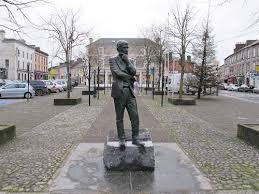
Statue of Michael Hartnett in The Square

THE TOWN THE YOUNG LEAVE

The following article was written by Michael Hartnett for The Irish Times in the early 1970’s.  It shows Harnett to be an astute social historian and keen observer of local mores and foibles – talents he later used to good effect in his ‘local’ poems such as Maiden Street Ballad, The Balad of Salad Sunday, The Duck-Lovers Dance, etc.

download (2) 

THE TOWN THE YOUNG LEAVE

By Michael Hartnett

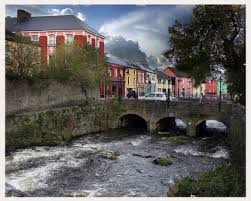
Newcastle West, County Limerick, is an Irish town that is not dying.  It has kept its economic stability at a terrible price, the constant exportation of human beings.  It is the example of a town that is alive because the young leave, a town that would certainly be ruined if those people born in the 30’s and 40’s had stayed at home en masse.  The transportation still continues and it is against this background of population loss that the town has survived and is now slowly regaining the status it had in the 19th century.  It was then the largest market town in the county, outside of Limerick city.  It had woollen, linen and brewing industries, two coal mines were operated in the nearby hills and there was a proposal to cut a canal to the Shannon, fourteen miles away.  The population then, 1837, was 2,908.

The population (that part of it which lives in the town proper) has been more or less the same since, but the industries have gone.  The harshness of the 1840’s led to their death.  The people began to leave, at first from despair but in the past twenty years through pure instinct.  Today the major employers are the local County Council, two bottling plants, the local hospital for the old and the unwanted and a few shopkeepers.  A factory, which has been hoped for for many years, is at last being built, and this should reduce the outflow of the young.  A new school was built in the late 1950’s to replace the old, built in 1826: this old school was the one I attended.  It was unbelievable.  In the summer the swallows built in the large beams inside the rooms, flying in and out all day to feed their young.  One of my favourite pastimes was drowning woodlice in the inkwells, as they fell in ridiculous numbers from the rafters.

Some of the boys who did not live in the town brought their lunches – bread and butter and milk wrapped in newspaper, and these were raided almost every day by the rats who lived under the floor and scampered about, completely ignoring us.  Rat poison was put down, and the entire school was pervaded by the delightful aroma of decaying rats.

Home and Abroad

The Headmaster has given me some information indicative of the trend which has kept the town stable.  The following is a list of the pupils from Newcastle West who were in the Sixth Class in 1955.  On the right are their ultimate destinations.

J. O’Sullivan… Co. Limerick        J. Ambrose…………Dublin

P. Ambrose……. Teacher              M. Ambrose………..Sligo

T. Ambrose……….England           P. Condon….Co. Limerick

S. Corbett………….Dublin              P. Devine…………..U.S.A.

T. Dineen…………England            D. Donoghue……Dublin

T. Driscoll…………Dublin              E. Field……………..Dublin

J. Finucane……….England          D. Flynn……………..At home

T. Gray……………..England           T. Hackett…………England

J. Hartnett……………U.S.A.           D. Healy……………….Kenya

S. Hunt……………..At home           D. Lenihan…………At home

J. Maguire …………Dublin            D. Maguire……………Cork

P. McAuliffe………….Garda          T. Massey…………At home

J. Moore……………At home          T. Moriarty………England

R. Mulcahy……….England           L. Murphy…………At home

J. O’Connor……..Limerick           M. O’Connor………….U.S.A.

M. O’Shea………..England             M. Quaid…………..England

T. Roche…………At home             J. Sexton…………..England

P. Shine………….England             J. O’Sullivan ….Co. Limerick

B. Whelan………Dublin                J. Whelan……………Limerick

P. White…………England

This list spotlights the enemy.  England claims 30%, Dublin 20%, and Ireland, excluding Newcastle West, a total of 40%.  Only 18% have found work in the town – seven out of thirty-nine.       These figures do not apply, of course, to the girls of the town; they also drift away.  The enemy is not England, not Dublin, it is the town itself.  It fails to attract and it fails to employ.  I have met most of those who are in England.  They all say: “If I had a job tomorrow I’d go home.”  But they know there is a problem of integration; they have encountered it when they come home on holidays.  It is mainly of their own making.  They usually mock the ways, the wages, the deadness of the place, and, what is worse they manage to acquire an obnoxious London slang which they imagine to be a better English than that spoken in Newcastle West.  The people at home resent this, rightly.  If the emigrants do come back to stay, the many snide remarks that hint at failure make life unpleasant.  Those to whom I have spoken to in Dublin have no desire at all to go back, but they have not been alienated from their own.  Anyway, to the people of the town ‘to go to England’ suggested poverty; but ‘to go to Dublin’ suggests cleverness at school.   Yet none of the 30% I have mentioned who did go to England were poverty stricken.

Why they go

The reasons for leaving are many, but the main one is shortage of work.  I have spoken to many of my friends in London about these reasons.  I have sat in Kilburn pubs all night and heard nothing else discussed but Newcastle West, and with a deep nostalgia.  One of the immediate reasons, one that arises before the young person’s mind turns to employment is that he has a brother or friend in England.  He has heard of the huge wages (usually untrue) and the freedom from priest and parent; he has seen the cheap but tidy suits his returning friends sport, so as soon as possible he is gone.

He returns usually within a year, to sport himself, and his lies about his wages are in proportion to his misery in London.  He is repulsed.  He comes again a few years later, and this is usually his final attempt.  Many of the fights that happen in pubs involve a local and a visiting emigrant.

I have been told in Kilburn of the social injustices.  Some I have witnessed.  Many are so unapparent to the people at home that they are barely injustices at all.  One young man told me he had left for one reason only: it was a practice in Newcastle West, up to the 1960’s, for the priest to read from the pulpit the names of those people who had paid their dues, markedly omitting those who did not or could not – markedly, because the names were read in street order, so everyone knew who had reneged.  The decency of the good, he said, was turned to pride, and the poor were stigmatised.

Why did the better dressed and richer people sit to the front and middle of the church on Sunday and the poor sit right and left, or stand in the porch?  Why were the poor branded and why could the poor not face their God on Sunday?  Were they less religious than the rich?  He said he lost his religion because he could not walk to the altar rails with a hole in his trousers or kneel to God because of a tattered shoe: “God may have been at my face, but the sneering population were behind me.”  I suggested that he was proud, and that a Christian should be humble.  “Humility should not be enforced,” he said.  He also reminded me of the cult of the “ould stock”: that is, if you or even your grandfather was not born in the town, you were a stranger; on the other hand if you happened to reside there since the founding of the castle by the Knight’s Templar in 1184, your history was known, and you wouldn’t be forgiven if you tried to “marry above your station”.

Images from the past

Newcastle West and its countryside provided me with images.  Its neighbourhood is not spectacular: the mountains are miniature, the woods are copses at best.  But it is soft, beautiful, inland country very green and over-lush in the summer.  It is easy to sit in a city house with chrome and enamel, with all ‘mod cons’ and (perhaps) with that essential anonymity found there, away from parent and priest.  It is easy to laugh, and criticise quaint ways and hypocrisy, but beneath these there is a great part of a ‘hidden Ireland’ preserved and no amount of modernity, no television set, no pointed shoes will make up the loss of the last vestiges of an older Ireland.

“Church Street without a church, Bishop Street without a bishop and Maiden Street without a maiden” goes a Newcastle West saying; and Maiden Street alone was – and is – a microcosm of an Ireland that is dying.  It was the Claddagh of the town.  When I was about ten, I took a friend of mine home.  “Please don’t tell my father I’m down here,” he said, meaning “in Maiden Street”.  He was ten years old.  The town was small – and he had never been “down there” before, nor was he allowed to go there by his parents.  The street was mainly a double row of mud houses, some thatched, a few slated, most covered in sheets of corrugated iron.  This was “Lower” Maiden street.  “Upper” Maiden Street was given over to small shops and public houses.

Before the Corpus Christi procession each year all walls were limewashed in bright yellow, red and white colours, windows were aglow with candles and garish statues and any unsightly object, such as a telegraph pole, was garlanded in ivy or ash branches.  Banners and buntings spread across the houses and on the day, with the ragged band blowing brass hymns, followed by all the townspeople who carried confraternity staffs, the Host under a gold canopy was carried through the town.  It matched any Semana Santa procession in Spain.

The Old Customs

Old customs survived for a long time.  I played ‘Skeilg’ once a year, chasing unmarried girls with ropes through the street, threatening to take them to Skeilg Mhicíl; I lit bonfires along the street on Bonfire Night; I put pebbles in a toisín (a twisted cone of paper in which shopkeepers sold sweets) and threw it on the road.  If anyone picked it up and opened it, I lost my warts, a pebble for each one in the paper, and the person who picked up the paper took the warts from me of his own free will.

Then Maiden Street received a severe but necessary blow.  The houses were small with no sanitation: one fountain served the whole street, most of the floors were mud, with large open hearths with cranes and pothooks to take the cast-iron pots and bastibles.  And, of course, families were large.  In 1951 a new housing estate was opened on a hill overlooking Maiden Street and many of the families, including mine, moved there.  Now we had toilets and taps (six I counted, overjoyed) electricity and upstairs bedrooms.  But Skeilg was never played again.

Better standards of living may improve the health of people, but this price of abandoning poor peoples’ customs must always be paid and the customless bourgeoisie come into existence.  Yet the general spirit has still survived; when the oppression of religion and work are forgotten they find again their old joy and innocence.  This innocence is not to be confused with stupidity: I mean wonderment such as expressed by the old man in a story a friend of mine told me.  My friend went home to Newcastle West from U.C.D. and met, a few miles away on Turn Hill, an old man on the road, a distant relation.  The talk came round to Dublin.  “Where do you stay there?” asked the old man.  The other explained about ‘digs’.  “And you pay four pounds a week for a room only?”  He was surprised.  No, my friend replied, that included food as well.  The old man was amazed.  “Surely they wouldn’t charge you for the bite that goes into your mouth?”

Our entertainment was innocent too but not without a touch of cruelty at times; watching crawfish clawing their way towards the river across the roadway, gambling with passing cars.  And on hot dusty summer evenings (all the summer evenings before adulthood seem hot and dusty) suddenly at the pub not far from our door, there would be the joyous sound of curses and breaking glass – joyous to us because we knew the tinkers were settling some family problem in their own way.  We would sit on the window-sills, eating our rawked apples, while they fought.  We never cheered, nor would any of those who appeared over the half-doors up along the street.  Someone would send for the Gardaí, and then light carts and swift horses would rattle off down towards the Cork road, all the fighters friends before the common enemy.  We sat on, waiting for the last act, when, half an hour later, the fat amiable Garda would come strolling down, to an outburst of non-malicious jeers.  But we were poor too, and there was the misery of drink in many houses.

I often tried to read by the faint light of an old oil-lamp with a huge glass globe which was suspended from the rafters.  The house seemed big at the time, but was really incredibly small, and one had to stoop to enter.  I sat there in the small kitchen-cum-livingroom, innocently working out the problems my father set me: “If it took a beetle a week to walk a fortnight, how long would it take two drunken soldiers to swim out of a barrel of treacle?”  I never worked it out.  Or “How would you get from the top of Church Street to the end of Bridge Street without passing a pub?”  He did supply the answer to that, which indeed is the logical answer for any Irishman: “You don’t pass any – you go into them all!”

 The Mission

Once a year the otherwise idyllic life of the town was ruined by the coming of the ‘Mission’.  It was as if the Grand Inquisitor himself walked through the town pointing out heretics.  I sat in the church on the long seats, sweating with fear at the Hell conjured up by the preaching father, as he roared all sorts of vile accusations at the people.  They sat, silent and red-eared, until he told an ancient joke, probably first told by Paul in Asia Minor, a joke that they had heard year in, year out, for a long time.  But they tittered hysterically, delighted at being able to make a human sound in church.  Outside the ‘Stall’, with its cheap trinkets from Japan, was dutifully looked over by the congregation: phials of Lourdes water, prayer books and all the tokens of religion bought and sold like fish and chips.  But they were not ‘holy’ then, not until the end of the Mission did the preacher bless the huckster’s dross and only then did they become sacred.

Part of the old castle grounds were made public by an Earl of Devon in the nineteenth century.  The overgrown acres were a retreat from the Mission for anyone daring enough to go there during a service.  Getting to the Demesne from the town without being seen was an art in itself (which I cannot divulge lest some young person read this and be led astray), but once gained, it was a haven of quiet trees and overgrown paths and two rivers.  I read much poetry on such nights, watching the shadowy figures of fellow-transgressors hiding in the bushes, a small cloud of blue cigarette smoke over their heads.  I even met a girl there once; easy enough, as the Mission had Men’s Weeks and Women’s Weeks; their sins, I assumed then, were different.

There are as many things to love in a town as there are to hate.  Indeed, the only things I disliked were class and priest-power, but if injustice is not seen to be done, such opinions are merely private prejudices.  I remember, with pity for the man, a priest beating a child about a schoolroom for no good reason.  I remember with joy for myself, my grandmother coming into town on her asscart, her black fringed shawl about her small fresh face, with her stories of pishogues and enchanted fairy forts.  I remember her dancing on the road to a comb-and-paper hornpipe: I remember her illness and her dying and my absence from this, being in London working or drunk in a Dublin pub.  If you cannot mock a place you love, how can you love it fully?  And can you not hate it because it is becoming televisionised, educated and more middle-class every year?  Is Dickie Rock to replace the Wren-boy?

The Wren Boys

Christmas Day was not unique in Newcastle West.  I remember no customs that were not common to today’s commercial carnival, but St. Stephen’s Day – the Wren’s Day – was always exciting and memorable.  One fine frosty morning the sound sleep of our house, after the excess and boredom of Christmas Day, was magically finished by the excitement of bodhrán and the wild tin whistles of a group of ‘Wran Boys’ from Castlemahon.  I saw the masks and the weird costumes through the window and was out of bed, searching my pockets for the pence of Christmas Day.

“The Wran, the wran, the king

of all birds,

St. Stephen’s Day he was caught

in the furze.

Up with the kettle and down

with the pan,

And give us a penny to bury the Wran!”


That was the first and last time I saw a dead wren, complete with nest, held up in a furze bush, hung with red streamers: it was 1949.  The pubs were open that day, and melodeon, pipes, bodhrán, fiddle, drums and tenor voices raced up and down the streets until night.  It was like that for a few years, but again progress stepped in; in 1951 the ‘New Houses’ were opened and for some reason seemed prohibitive to the Wran-boys.  They still kept to the town, but all we got was a few guitars and little boys with lip-stick singing “I’m all shook up,” or some such transient ditty.  A brilliant move, however, was made by some of the townspeople and Wran-boy Competitions were organised every New Year, in which authenticity figured greatly, and which has helped preserve the custom or at least to lengthen its days.

But that small town, the small farmer, is slowly becoming obsolete: even the labourer himself is going.  A small town like Newcastle West is perhaps the pattern of all small towns in Ireland: the pseudo-comforts of so called civilisations like that of the U.S.A. and Britain are being sought after.  Few would deny progress, but then few reckon the cost.

(Reprinted from articles published in The Irish Times.)

 images (2)

Study Notes on A Doll’s House by Henrik Ibsen

 community-players-a-dolls-house-website-header-960x250

Introduction

Before Ibsen, European theatre was at its lowest ebb. It was felt that theatre no longer reflected serious issues. Rather, theatre had become a vehicle for entertainment. Theatre in the early nineteenth century (pre Ibsen) included historical costume drama, melodrama and the Scribean ‘well made’ play. The Scribean ‘well made’ play was first created by the playwright Eugene Scribe (1791-1861).  The Scribean play was a very simplistic problem play that followed a linear pattern.  Act 1 involved the exposition; Act 2 the crisis and Act 3 saw a resolution and a happy ending. The following are some typical characterisations of the Scribean ‘well made’ play:

  • No depth of psychological characterisation
  • Over elaborate intricacies of plot
  • Playwright was seen as entertainer
  • No individualised characters, instead there were traditional ‘stock types’ presented in each Scribean play – the villain, the woman with a past etc.
  • Allegiance to a happy ending which affirms the status quo of society

Ibsen, having come into contact with Zola’s ideas through the Danish critic Georges Brandes changed all this in his plays.  Zola advocated a move towards problem drama and he challenged dramatists  to be truthful and to represent reality truthfully. For Zola, the realist writer should concern himself with everyday reality. Ibsen heeded Zola’s challenge. He combined the classical Greek Tragedy and the Scribean ‘well made’ play to create his own distinctive ‘theatre of realism’.

A Doll’s House was first premiered in Copenhagen in 1879 in the Royal Theatre.  Ibsen’s plays were written for a predominantly middle-class audience.

The Characters

Within the play there are three major groups of characters:

Torvald Helmer and Dr. Rank possess inherited values and they represent the social masquerade within the society of the time. Torvald remains a bewildered or embittered victim of social determinism while Rank is a victim of biological determinism.

Nora is both a ‘doll child’ and a ‘doll wife’ in this social masquerade. However, in Act 3 she succeeds in rejecting the masquerade.

Mrs. Linde and Krogstad learn to move beyond the masquerade and form a relationship based on truth. Contrast Mrs. Linde and Krogstad’s relationship of truth to Nora and Torvald’s marriage.

 The most significant minor character in the play is Anne-Marie. She represents the working class within ‘A Doll’s House’. She is marginalized in terms of economics, class and social morality. Anne-Marie’s character causes us as readers to ask some central questions: Is Anne-Marie a foil for Nora? Is Ibsen advocating liberation for all women or liberation only for some?  ‘A Doll’s House’, therefore, can be described as a feminist text but perhaps it is not feminist enough.

 General Vision and Viewpoint

Ibsen’s contemporaries quite correctly interpreted A Doll’s House as a swingeing attack on conventional bourgeois marriage (although importantly not on marriage per se). It was intended to be a profoundly revolutionary play, deepening the critique of patriarchal attitudes he had initiated in Pillars of Society. As Ibsen saw it, women would spearhead the revolt against the repressive conventions of contemporary society. Men were far more likely to be dominated by the social prejudices of their day because of their role as breadwinner and provider. That is why Nora consciously acts the part of a doll wife, whereas Torvald unthinkingly lives out his role as the authoritarian husband. By the same token, that also explains why Nora achieves insight at the end of the play, while her husband remains bewildered and confused.

 Despite the conscious provocation within it, the play closes on an optimistic note. Nora has left with the positive aim of discovering who and what she is and what she can become. Meanwhile, there is at least a slender ray of hope that Torvald may yet achieve some degree of insight once he has recovered from the initial shock of his wife’s departure. The question he articulates at the end sums up that hope and the difficulty implicit within it: ‘The miracle of miracles…..?’

 It is interesting that the play begins with the door opening to let Helmer into the house, and it concludes with Nora slamming the door in his face.  Throughout the play a certain number of decisions have been taken and choices made by the characters.  For the first time in her life, Nora forces Helmer to face the truth about their marriage.  Roles are reversed.  She recognises that, ‘our home has never been anything but a playroom, where we have never exchanged a serious word on a serious subject’.

 She leaves him, claiming she needs to be freed from the marriage in order to educate herself, and to learn to think about life and its issues.  Helmer is seen as a tragic figure.  He sincerely loved his wife even though he has failed to express it well.  He is left abandoned and alone to look after the family and face the ensuing scandal.  There is a sense that both people need to readdress certain basic issues in their lives such as the reality of what is involved in marriage.

 Visual Symbolism

The play is full of visual suggestions that provide a comment on the action or underline a particular facet of a given character’s responses. We see something of Nora’s extravagance in the Christmas presents she has bought and the excessive tipping of the porter. But in always buying the cheapest clothes we see her resourcefulness in making do. In eating forbidden macaroons she shows her defiance of Torvald, while in asking his advice about her costume for a fancy dress party, we see her skill in flattering and cajoling him. In showing her new silk stockings to Dr Rank, we see her willingness to flirt and exploit her sexuality, but not to the point where it becomes explicit. In her performance of the tarantella, we have an image of the dance of death, an image of the black thoughts filling her mind. The image is reinforced when she pulls a black shawl over her head before attempting to leave the house to commit suicide. Finally, her change of clothes and the donning of everyday dress underlines her determination in the last act of the play to face up to the prosaic reality of her marriage for the very first time.

 Significance of Doors

Ibsen’s first stage direction (p. 23) is both detailed and significant. There are multiple references to ‘doors’, which can be interpreted as a metaphor for the open and closed possibilities within the play. Ibsen frames the play with references to ‘doors’. Nora leaves through the same door, a changed individual, at the end of the play.  (Note again the stage direction p. 104.)

 Living Room

When first confronted with the living room it is hard to find much significance attached to it. It is said to be attractive – as a room in a doll’s house is likely to be. The piano (music), the engravings (art) and the books (literature) suggest that at least one of the inhabitants has cultural interests. That is about all. We should realise that there is difference between being a reader (secondary text) and a spectator or member of the audience (primary text).[1] The latter will neither be immediately aware of what is behind the door in the background nor of the fact that it is ‘a winter’s day’ because, after all, they have not read the stage directions!

 However, when we reread the play (highly advised to reread it!!!!), the setting takes on a greater significance. We can see that the room is an expression of Helmer’s taste rather than Nora’s taste. He is the ruler in this household and he is the one who explicitly voices his aesthetic interests. Therefore, as Helmer is gradually revealed as a man hiding behind his socially impeccable façade, the living room takes on other qualities. The properties we took to be signs of genuine cultural interests now appear to be merely status objects, social icons. Like the play title, Ibsen thus invests the setting with a concealed meaning.

 We may also ascribe the fact that the whole action takes place in one and the same room as a sign that Nora is imprisoned in a doll’s house existence – although the room has ‘no fewer than four doors, one of which leads to a fifth and a sixth’. This raises the question of whether this is an open or a closed environment.

 The Christmas Tree

The tree is a central symbol within the play. The Christmas tree may be seen as a symbol of family happiness and security, a natural product of the forests, which has been prevented from full growth, cut or transplanted, then decorated in a domestic environment, like Nora herself. The Christmas tree is dressed and then stripped – which links it with the later fancy dress ball and the costume Nora first dons and later discards… The ‘real’ tree for the children is to be the dressed tree, not its unadorned version. And this links the notion of dress and costume to that of deception and masquerade, which in turn links with Nora’s deception of Torvald about borrowing money and Dr. Rank’s disguising for twenty long years his true feelings for Nora. This, in turn, makes us aware that some kinds of deception, like hiding the unadorned Christmas tree, can be for potentially good purposes.

 The Theme of Patriarchy

A Doll’s House is a comment on the patriarchal society in which it was written. Nora is enslaved by her economic dependency. Ibsen comments on women’s economic dependency on males through Nora. Nora states, ‘a wife can’t borrow money without her husband’s consent.’  However, Nora’s selfless deed for Torvald was, ‘something to be proud and happy about’. She felt empowered because it was, ‘almost like being a man’.

Torvald sees Nora as a pet, an acquisition.  In Act 1, Nora acquiesces to her doll life. Nora is childish in her desire to please him.  Torvald’s pet names are indicative of the balance of power between Torvald and Nora – ‘my little squanderbird, my little songbird, my poor helpless little darling, my little Miss Independent, my clandestine little sweetheart….’  Beneath Torvald’s superficial sweetness to Nora in the pet names he uses, there is an undercurrent of something more sinister. Through these pet names, Torvald is constantly jibing and inadvertently insulting, ‘his little Miss Independent’.

There is never a genuine reciprocal conversation between Nora and Torvald until the final Act.  Contrast Nora and Torvald’s use of language.  Torvald’s use of language in Act 1 and 3 is the language of male discourse, the language of duty and instruction. Nora’s language in Act 1 is the language of female discourse, of petitioning and helplessness.

Within this patriarchal society we witness female instinct pitted against masculine regulative thinking. Male rationality is pitted against female intuition. In effect, we witness the suppressed female versus the suppressing male.

 The central theme of the play hinges on the ‘two kinds of conscience’ Ibsen speaks of in his preliminary notes: Nora’s individualist ethics versus Helmer’s socially determined ones.  The conflict is as old as drama itself and can be traced all the way back to Sophocles’ Antigone. To Helmer Nora’s forgery is a criminal act that cannot be excused; to Nora it is an act fully justified by the circumstances.  Aware that she has done it to save her husband’s life, Nora is even proud of her action. For once she has been able to do something for her husband – ironically it must be without his knowing it. The forgery is both an act of love and an act of independence, and it is difficult to say what is most important to Nora.

 Reflecting the views of a male society, everyone sees Nora as a child to be cared for like a doll. Limited to a family environment, she has few possibilities to satisfy her need for self-respect. Even her children are taken care of by others.  No wonder she relishes her secret knowledge that she has performed an independent act of extreme altruism, an act that is her pride not least because it creates a balance within the marriage. Seemingly totally dependent on her husband, Nora knows that at least once in his life Helmer has been totally dependent on her.

Sample Essay:  ‘Ibsen’s play A Doll’s House can be interpreted as a patriarchal play’.   Discuss.

 Ibsen’s Theatre of Realism and his play ‘A Doll’s House’ possess a dominant patriarchal theme. Nora, the female protagonist, needs to break the perpetual cycle of living a ‘doll’s life’.  The Nora under the dominant rule of her patriarchal husband is girlishly innocent, however intuitively knows Helmer’s psyche. The play can and has been interpreted as a patriarchal play. However, I prefer to concentrate on Ibsen’s more central task, which is the portrayal of human beings.

Ibsen’s attempt to transform Nora from ‘twittering skylark’ (p.24) to an authentic human being is gradual. Various visual motifs within the play illustrate Nora’s enslaved dependency. In Act Two Helmer’s possession of the key is highly significant:

 ‘Mrs Linde – And your husband has the key?

Nora – Yes, he always keeps it.’ (p.75)

Essentially the main message portrayed in this scene is Helmer’s power to unlock the truth. Nora’s eating of macaroons is a visual defiance of Torvald’s control.

The following highlights the notion of progression and metamorphosis within the play. In Act One Nora presents her longing to say ‘Bloody Hell’ to Torvald. With the rehearsal dance of the tarantella Nora succeeds in visually saying ‘Bloody Hell’. Her defiance of Torvald’s guidelines is proof of her first stage in her metamorphosis. The Pygmalion motif is strong in this scene also:

 ‘I’d never have believed it. You’ve forgotten everything I taught you.’

 Mrs. Linde is a major agent in the plot. Her presence acts as a foil for Nora. Tornqvist states that Mrs. Linde ‘the disinherited widow’ contrasts strikingly to Nora ‘the deliberately disinherited widow’. David Thomas believes that each map out their future in diametrically opposed ways. Indeed, Mrs. Linde finds a marriage based on truth that will not negate her autonomy. Just as Linde seeks to redefine her position in society she implores Nora to do likewise.

 In Act Two Mrs. Linde states, ‘oh we’ll soon put that right – the stitchings come away.’ Mrs. Linde restitches Nora’s dress in a metaphorical sense also. She restitches Nora and the plot. The ‘Nora’ who dances the dance of the tarantella in the restitched dress is an altogether different character to the Nora who danced in Capri and was then truly Torvald’s ‘capricious little Capricienne’.

 With the symbolic slamming of the door Ibsen reveals two things. Primarily the impromptu divorce ceremony is finally completed. However, Nora also is transformed. Kierkegaard’s philosophy implores us to confront the possibilities of attaining authentic selfhood, as does Ibsen in his portrayal of Nora.  Kiekegaard’s book the ‘Either/Or’ (1843) was a major treatise on the crucial role of decision and choice in human existence. Ibsen explores these roles of decision and choice through Nora and her attempts to gain authentic selfhood within this patriarchal society.

Nora succeeds in creating her own subjective truth: ‘I must stand on my own feet if I am to find out the truth about myself and about life’. She has metamorphosed into a Kierkegaardian existentialist. The dread in making that leap of faith has been overridden by her willingness to ‘educate’ herself.

There is no doubt in my mind that the woman question is a metaphor for individual freedom. Templeton in her work Ibsen’s Women (Chapter 5:‘The Poetry of Feminism’) talks about the contamination of feminism in Ibsen’s play. Richard Gilman believes that ‘A Doll’s House’ is pitched beyond sexual differences. The essential task in this play is the description of humanity. Nora states, ‘I believe I am first and foremost a human being’.

Critics argue how can Nora evolve from ‘twittering skylark’ to Soren Kierkegaard in a skirt? The answer is simple. Nora, the existentialist heroine, is latent in her character from the beginning. The soliloquies play a major role in charting her development.

Ibsen’s Theatre of Realism provides a forum for debate. Long after the redundancy of the ‘Scribean well-made play’, Ibsen’s theatre surpasses and transcends this formula.. The reason for Ibsen’s success is his continuation after the arrival of Krogstad’s second letter.  Torvald’s moral weakness is exposed.  His true nature stands clear. He is depicted in the final scenes not as the noble altruist of Nora’s ‘miracle of miracles’ but rather a shallow egoist. The absence of what Todorov describes as the fifth stage of narrative development, the reinstatement of the initial equilibrium, ensures that the play ends resonating with questions rather than answers. What faces Nora after the slamming of the door?  Will Nora feel ‘unspeakably empty’ like Mrs. Linde? There is no ‘happy ever after’ in Ibsen’s masterpiece.  Instead he believes that as readers we are collaborators. ‘The real end is found outside the frame; the poet has indicated the direction we have to go, it is now our task, each for himself to imagine it.’

Works Cited

Ibsen, H., A Doll’s House (with commentary and notes), Methuen Publishing Limited, London, 1994

Templeton, Joan, Ibsen’s Women, Chapter 5: The Poetry of Feminism,  Cambridge: Cambridge University Press, 1997.

Gilman, Richard,  The Making of Modern Drama: A study of Büchner, Ibsen, Strindberg, Chekhov, Pirandello, Brecht, Beckett, Handke (New York, 1974).

Kierkegaard, S., Either/Or: A Fragment of Life (1843), Victor Eremita (Editor). Alastair Hannay (Translator, Introduction), Penguin Classics:London, 1992.

Thomas, D., 1983. Henrik Ibsen. Macmillan Press.

Todorov, Egil, Ibsen-A Doll’s House, Cambridge University Press, 1995

Tornqvist, E., 1995. Ibsen: A Doll’s House. Cambridge University Press

http://www.skoool.ie


[1] By primary text is meant everything that is verbalised in a performance, that is by dialogue; by secondary text that which is verbalised only in the drama text: stage and acting directions, play title, divisional markers (act, scene), cue designations, etc.


780

Reading in the Dark – An Interview with Seamus Deane Revisited

aba1323b-5dcc-4a42-a0c7-88784185b250

“I have confidence that there will be a solution (to the Northern Ireland conflict),  maybe by the year 2020 when we all have 2020 vision”                        – Seamus Deane

Reading in the Dark has attracted enormous critical attention and acclaim: ‘we are in the territory of the power of the word’ (Anne Devlin, The Independent, August 1996); ‘a thriller of such enigmatic depth that even when all is revealed, its mystery does not dissolve … a masterpiece of eloquence distilled’ (Laura Cumming, The Guardian, December 1996).  Reading in the Dark was the 1996 Guardian Fiction Prize-winner and was shortlisted for the 1996 Booker Prize.  A literary critic, poet, and Irish republican, what Seamus Deane wants to represent – growing up in Northern Ireland in the forties and fifties, political treachery, sectarian violence, rumour, hauntings, and family secrets – makes particular demands on the written word, literary forms and on the reader. 

The English & Media Centre interviewed Seamus Deane for their publication and video, Three Modern Novels at A Level.  In the interview extracts that follow, Seamus Deane throws some light on the writing process, family secrets, and Northern Ireland. 

The novel’s landscape is drawn from the intimately domestic, from political history and from Irish legend.  This short, original, and captivating book, composed of many self-contained stories or ‘prose poems’ is described by Terry Eagleton as, ‘a working-class, Republican version of Irish gothic … it occupies some transitional zone between fiction and autobiography’ (New Statesman & Society, August 1996).

The writing process: editing memory

This novel was a long time in the making.  It began as a series of flash memories that were recounted.  Those memories accumulated, and as they accumulated they were written and re-written.  Then I realised that the memories actually had a lot of raw material but, like in a movie, by positioning one piece beside another, each actually became more powerful because of its neighbourhood with the other.  In fact, the novel, since it was told from the point of view of a young boy, couldn’t proceed by large, sustained blocks; the flash image was part of the key to the structure.  The next part of the key was to put the images in certain kinds of sequence that would both make them more powerful in themselves but also attract or seduce the reader into wondering not only what happens next, but what is the relationship between these parts, because you can see a relationship in part, but you can’t see all of it initially, it has to unfold.  I use those sharp pieces almost like arranging crystals into patterns until I finally found a pattern that I thought did justice to the narrative.  And did justice also to the strange experience of the young boy in actually uncovering something piece by piece by piece, and then only towards the end being able to see the whole thing in perspective.

One of the reasons I called it Reading in the Dark is that one of my earliest memories of reading was reading late at night, lying in bed with my three brothers, two at the top, and two at the bottom.  Of course, they would frequently object, and after some altercation, the light would have to be switched off.  So I would lie there in the dark imagining the unfinished novel that I’d been reading.  So I lay there reading in the dark, in that sense.  And then, of course, this is what the kid is doing in the novel, he’s ‘in the dark’ about a family secret and at last, in some ways, he learns to read in that dark, to read the secret, in some ways to his regret.

Differences between poetry and prose

I suppose that, in my limited experience, the outstanding feature in relation to the novel is that the novel must produce a story, a narrative.  It may be difficult to follow parts of the narrative, nevertheless everything, in some sense of the word, must be explained.  Whereas in poetry I think it is possible to leave a great deal unexplained.  Part of the power of poetry is, in fact, in leaving something cryptic and letting it, so to say, leak out slowly in repeated readings for the reader.  But if a novel tries to work like that I think it becomes another kind of narrative.  The narrative element must have a degree of explanation and self-explanation constantly working within it so that the reader knows where he or she is at any given point.

And there is a relationship between the writing of this novel and the writing of poetry for me.  There are a number of poems that I’ve written, published years ago that bear directly upon this novel and in fact, I think I might have raided one of those poems for a phrase or two on occasion.  But once I’d decided to structure the novel in these little carry on pieces then what I wanted to do was to intensify each piece as much as I could so that it would have what poetry very often has, this strange combination of being very exact, very finely edged, and yet at the same time somehow amorphous.  It’s as if you can see something clearly through a mist, that kind of relationship that most poetry can generate.  It’s like a resonance, it’s like striking a musical instrument, striking a key, and then hearing, if you had the ears to hear, that the echo went on and on and on.

Writing the truth

I wanted to present the novel as a reflection of the way in which a child would see the world.  But I also wanted to present the novel as something which is dealing with this strange and elusive thing called the truth.  I wanted to transmit to the reader that there’s certainly a connection between knowing the facts of a situation and knowing the truth of a situation, but that the facts and the truth are not entirely coincident one with the other.  And it’s that strange, sometimes distorted relationship between fact and truth that I wanted to gradually expose, because by the time all the facts are in, the truth of the young boy’s situation, he is in combat with the demons that have been released by those facts, and he doesn’t know.  I mean there are some things he doesn’t really know and can’t know, because they’re not known at the level of fact.  So it’s that kind of interconnection that is part of the reason for the way the novel unfolds and exfoliates, inch by inch, and not, apparently, in chronological sequence.  But there are other sequences besides the chronological and they’re deliberately there, in order to say, the fact is here but the truth of that fact is larger than the fact.

My mother saw one section of the novel before she died.  Her first reaction was, ‘Well, that’s very nicely written.’  And then she said, ‘But of course it’s not true.’  And then she said, ‘When did you hear all of this anyway?’  And I said, ‘Well, in fact, everything you’ve just read I heard from you, you told me all that.’  This was the section about the grandfather and the policeman, who was put over the bridge.  And she said, ‘I didn’t tell you that.’  But I know she did.  Then later she came back to me and said, ‘Well, whatever the case, just don’t ever publish it.’  And I said, ‘Okay.’  But I said to myself silently, not while you’re alive, no, I won’t.  And I couldn’t publish it when other people were alive, not only my parents.  I could have written it, but I couldn’t have published it before their death.

Secrets and lies

I was concerned about exploring a love relationship between my parents, and I was concerned about exploring something in that love relationship that I knew carried a shadow.  From the beginning the mother tells the boy there is a shadow, there’s a shadow on the stairs.  Of course, stories about ghosts and shadows are frequently used, certainly in Ireland, as code stories for other things that are taboo.  Things like stolen children.  Children stolen by the fairies are very often a coded way of talking about a woman who abandoned an unwanted child.

So I knew that in some way the heart of the story was the relationship between the parents.  I knew that in some way that relationship harboured a secret, and as the boy in the novel discovers, it’s a secret of such intimacy that his entering into it is interfering with it, exploring it.  Actually, it damages the relationship between his parents.  That’s where his sense of terrible guilt ultimately comes from.  The two people he loved, not only loved them but loved the fact that they loved one another.  He loved them for loving one another, and then he destroys or damages that love relationship.  I suppose it was that I wanted to explore.  I really think that kind of relationship is, now I’m guessing here, more frequently found in political cultures that are troubled, that have had various forms of oppression visited upon them, and therefore have developed modes of secrecy.  And those modes of secrecy are not just political, they become also personal.  And in the story I’m telling here, the political and the personal are so intertwined that you can’t say where one leaves off and the other begins.

I wanted to write about the process of discovery, but writing about the process of discovery was itself another form of discovery.  It was both retrieval of something that I have known and I had experienced, but was also finally coming to terms with it, and to some extent, it was like an act of self-forgiveness.  I felt how the child in the fiction feels.  In some ways, he has done a profound injustice to both his parents in different ways, and yet he has another feeling that there was no avoiding this.  He is and he is not responsible.  And I suppose the process of the discovery was not only finding out the various pieces of information, but each piece of information also carried its weight of feeling, of emotion, and it was a matter of finding, finally finding, some way of balancing that emotion.  I’m not even sure now whether I’ve done that or not. I’ve had, not exactly second thoughts, but little quivers of doubt that still survive.

Ireland: colonised cultures

The mother’s grief is in some ways aligned to Irish history in that it is something that is real, that is actual and yet that cannot be articulated, cannot fully be represented, even to herself, never mind by herself to others.  That’s a maimed condition that is frequent in colonised societies.  Ireland knows this problem to an unwanted degree by now.  The problem is that in a colonised country you’re always represented by the coloniser, you’re represented in a particular way, you know, through stereotypes of various kinds.

The effect of stereotypes is that they have an almost chemical working; they work within the communities to such a degree that you actually begin to find people behaving according to the stereotype.  The stereotype sometimes can be benign, and sometimes malign, but the problem of being stereotyped is that you’re always being represented by somebody else.  If it’s a powerful culture that is colonising you, you really have very little space to find some alternative way of representing yourself.  You can do it, of course, in a different language, if you have a different language, but if you’re in the Irish condition where you had a language, lost it, and the only language you have is the language in which you’re stereotyped in then you have to take a peculiar position on that language to escape from it.  The mother is, in her grief, taking the shock, and the trauma of history into herself, but can find no escape from it.

Treachery and betrayal: the personal and the political

I am saying something about the nature of political struggle and I’m saying something about the mysterious nature of human relationships.  The constant element within all of the relationships is that of betrayal.  You know, there are a variety of forms of betrayal: there is the outright, coarse McIlhenny kind of betrayal, and then there are all the subtler more seductive modes of treachery which nevertheless are also very deeply destructive.  Within a political culture that operates in its militant mould through, what is in effect, a secret guerrilla army, then you have an army that depends upon secrecy.  The biggest threat to such an army always is betrayal, and it’s a feature of many insurgent movements, and it certainly has been the case in Irish history, that the traitor is a particularly hated, but also a particularly frequent, creature.

If you have something suppressed, if you have great pressure bearing down upon a community, then within that community there are going to be all sorts of ways of dealing with that pressure of which secrecy is one.  And secrecy’s other face is always betrayal.  The terrible problem of betrayal in human relationships is that if you are betrayed by someone whom you loved, one of the first effects of betrayal is to make you feel, ‘I never knew that person’, ‘I don’t know her’, ‘I don’t know him’.  And that person suddenly loses substance and becomes almost shadowy.  That is one of the functions of shadows within this novel.  Something that’s real and yet at the same time unreal, just the way somebody whom you thought you knew can almost instantaneously become unreal to you if you find out that some terrible betrayal has been taking place without your knowledge, and especially if it’s been done over a long time.

Note:  Tony McIlhenny is at the centre of the family secret.  He betrayed everyone – his lover (the narrator’s mother), his wife (Katie, his mother’s sister) and their unborn child, the IRA, and Eddie (the narrator’s uncle), who was mistakenly executed by the IRA as an informer while McIlhenny fled to America.

Fire and darkness: representations of Derry

The North is a gothic place.  Fire, bonfire, violence, ritual, marches, drums, that’s part of the ritual of a very enclosed and a very explosive society.  The North is a place dominated by rituals like Orange marches, and bonfires on the 12th of July, the burning of the effigy of the traitor Lundy every December from a pillar.  That was one of the things I always remember about December.  In fact, Derry is a city that has, as its central story, its great historical story (at least on the Protestant side), of a city besieged by Catholic armies.  This man called Lundy tried to open the gates to the Catholic besiegers.  So every year, in the heart of winter we see the traitor burned from a pillar on a hill.  This giant twenty-foot high figure, always in black, stuffed with rockets, and soaked in petrol, would loll on the pillar before they set fire to it.  I remember a dark December day and this exploding traitor on the pillar.

Then we also have our own bonfires on the 15th. August every year.  The physical darkness of the place is emblematic of the political condition of the place.  All through the novel, there is a link between darkness and fire and intimacy as well as between intimacy and violence.  From that distillery fire forward the young child actually sees the city as a city that is in some sense burning, always burning.  His mother says when she’s in her distress, ‘There’s something always burning there.’  You can hear the sound of a fire in a society that is breaking down.  You can hear the sound of the disintegration if you listen with sufficient care.  So that’s why the city appears so dark because it is a city in a dark condition, a condition of entrapment.

Fantasy and realism: form and conventions

Folklore and legend were important in my own childhood.  For me, there were two major formal elements in the fiction.  There was the kind of element that one would associate with folk telling, and folk stories, and there was the kind of element that one would associate with novels.  Now the difference between those two, as famously has been said by somebody, is that a novel understands answers, and gives an answer to a problem, whereas in a folk story, you don’t seek an answer.  The listener to a folk story actually simply says, ‘Ah, the wonder of it, the world is a strange place.’  The folk story is full of wonder, the novel is much more rational as a form, and I wanted to keep precisely those two things in relation, one to the other, because that, in effect, is what the young boy is experiencing: the sense of wonder and the recognition that the only proper response to what he’s undergoing is really just to shake his head and say, the world is a strange place.

But then the novelistic element that involves some of those ingredients such as the ingredient of the thriller and social realism and so forth, that’s the element that allows him to ask, ‘Why? What happened?  When?  Why did it happen?  Why didn’t somebody do this?’  And that variety of question is scattered all through the novel.  The sense of mystery and wonder that is alongside it is almost an antidote to the questioning intelligence of the young boy.  I keep thinking and speaking of this novel as a matter of balancing, crystallising, and patterning so that the various elements which would normally be in conflict, like the element of folk story and novel, come into harmony.

 Different literacies: oral cultures

The Northern Ireland I grew up in was a place that for my generation was transformed by the socialist legislation passed by the Labour government in the mid-1940s, especially the Free Education Act.  Up until then, it had been really an oral culture rather than a highly literate culture.  I had an actual Aunt Katie, the Katie that is commemorated in this novel.  One of her functions in life as far as I was concerned was to scare me helpless every night with the stories that she would tell.  She would sit on a chair or at the end of the bed, and she would tell stories, some of which she invented, some of which she was passing on, that she had heard.

Later when I went to places like the West of Donegal, to the Irish-speaking areas, I heard some of the Seanachies, as they’re called, the traditional storytellers, telling traditional tales in Irish, and these tales were well known to everybody in the neighbourhood.  The people treated the Seanachies the way you would treat a great singer.  You know the song, you just want to hear this particular rendition of it, and how he or she is going to treat this.  So I remember sitting in a little house in West Donegal, listening to my first Seanachie, and I suddenly realised this is the tradition out of which Katie came.  This is the tradition that was still alive when I was growing up but was beginning to be replaced by the tradition of school, education, university, and that sort of thing.  I think I was pretty fortunate in that respect, for an overlap of several years the two were intermingled.  The oral tradition was very quickly destroyed.  It was dealt the death blow by modern media, though it still survived in a residual way in some parts of the West of Ireland.  But it doesn’t any longer have the natural life that it once did have, can’t have in present conditions.

The importance of language in Irish history and literature

Language is important in Irish history for a variety of reasons.  I mean it has left us in that condition Yeats spoke of once, not of course that Yeats knew the Irish (language), but he says, ‘English is my native language but not my mother tongue.’  That’s a very curious position to be in.  The relationship between the language and the search for the integrity of independence is a story about meaning too, because while, of course, there’s great pressure on the Irish to speak English, the people who are most effective in destroying the Irish language were the Irish themselves.

You know, there was the terrible memento of what they called the tally stick, which was on a string and put around the neck of a schoolchild.  And if the schoolchild spoke Irish a notch was made on the stick, and when the child went home he was beaten for every notch for having spoken Irish because they were trying to persuade them, your economic future is in the English language.  But then of course they realised that this actually was a form of self-mutilation, but too late.  It’s a permanent form of self-mutilation and so the mutilation that goes with colonialism, or goes with oppression, also leads to forms of self-mutilation and one of the areas in which it is most powerfully felt, is in the area of language.

I mean there are all sorts of works of Irish literature which are about, you know, somebody starting, unable to speak, and finishing in a condition of great eloquence.  In James Joyce’s Portrait of the Artist as a Young Man on the first page, Baby Stephen is lisping, he’s mispronouncing words, and he cannot speak, but that novel, a sort of central classical Irish novel, ends with Stephen about whom the story was being told, taking over the story and telling it himself in his own eloquent way.  Similarly, in a simple play like J. M. Synge’s Playboy of the Western World, the hero when we first meet him, is a stuttering lout in a ditch, he can’t speak and he comes out of the ditch into the pub, and he starts telling a story which is partly a lie and partly of course the truth.  And he becomes more and more eloquent.  The more eloquent he becomes the more he discovers he has an identity, he is a person.

There are various other works of Irish literature that are entranced by the notion that you discover your identity through the mastery of language, but behind that, there is the other story, which says to you no-one ever became masterly at something who has not first known incompetence in it.  And that’s especially true for the Irish people in relation to the English language.  The comic way, in which they have often been represented speaking their English language, becomes stereotyped, which largely belongs to the 19th Century when Irish became in effect, two languages, and where they were very often forcing the syntax of the Irish language into English words, and of course sounding very quaint and strange to English ears.  Irish writers became self-conscious, virtuoso players of the English language, a kind of mastery that comes from recognition of previous incompetence.

So there’s a very deep relation between dumbness, aphasia, and eloquence, and something that is not just true in Irish literature, though it’s most definitely true in various other aspects of Irish life, that relationship between astonishing achievement and loss and gain.  In some ways in this novel, the child learns slowly that by the time he achieves eloquence, learns the whole truth, the aphasia, the dumbness, the inner articulacy that characterised both his father and his mother, he has passed from their world into that world.  But it’s a very expensive journey that he’s undertaking, and it’s dubious whether that form of eloquence is something that one should aspire to.  But whether he wants to aspire to it or not, he’s going to get it, it’s inescapable.

That mix of the folkloric, the legendary, the old Irish language, and the connection between the English language, the new legislation, education, and modernity; the relationship between the two is one that is central to the whole way in which the novel produces itself.  It’s a work that is about modernity and it’s about, dare I use the weary old word, tradition and a relationship between them, and the painful emergence from a traditional society into the modern era.

Northern Ireland: the future

I can’t say I feel optimistic about the future of Northern Ireland.  There isn’t much reason to be optimistic right now in early 1997.  I felt perhaps foolishly optimistic for the eighteen months of the ceasefire.  We’ve had twenty-eight years of what Brigadier Kitson calls ‘low-intensity warfare’ in Northern Ireland.  There have been some profound changes, but not one of those changes actually seems to have the potential to reveal a way of solving or even shelving the problem or the problems that beset the place.  I suppose if I have optimism it’s – and this may seem strangely ill-founded to many people – but I  think the solution is actually going to come from the paramilitaries.

It has already begun to emerge, I must say to my own surprise, from the Protestant paramilitaries.  Very slowly but visibly, they are detaching themselves, disengaging themselves from the traditional forms of unionism.  This is not to say that they’re not Unionist, they are, but they’re Unionist in a different way.   And I think equally in the Nationalist Republican side, the IRA, especially if Gerry Adams survives as leader of Sinn Fein, some kind of accommodation can be found between the IRA and UVF.

But, it’s a very frail hope, and of course, it could be extinguished by the next bomb, could be extinguished by another assassination campaign beginning.  In the very worst year, 1972, starting with Bloody Sunday, finishing with what, 640 people assassinated something like that in that year, I remember the feeling that we were trapped in such a cul-de-sac that the violence would simply go on reproducing itself endlessly and that there was simply no escape route.  I don’t think it would ever have quite that feeling of entrapment again but it could.  The possibility of there being a solution, at the moment, is quite remote, but on the other hand, somewhere in me, I have confidence that there will be a solution, maybe by the year 2020 when we all have 2020 vision.


– This interview was taken from The English & Media Magazine, No. 36, Summer 1997.

9992au

My favourite Novel of all Time… Reading in the Dark by Seamus Deane

download

STUDY NOTES

ON

READING IN THE DARK *

BY SEAMUS DEANE
*Page references are from the Vintage, 1997 edition

This has to be one of my favourite novels of all time – definitely the best book never to win The Booker!  There you go – I’ve put my cards on the table for all to see.  This incredibly well-crafted novel is set in Derry over a 16-year period from 1945 to 1961, the book presents a child’s view of the tensions in the city during that time.  Throughout the book we are reminded of the conflict that surrounds the narrator.

An example of the narrator’s direct involvement is shown in the story of the St. Patrick’s Day riot where the police baton-charged a march and were enticed down a long street where half a barrel of oil was poured onto the street as they approached.  Two police cars skidded sharply under a hail of stones and one burst into flames.  Here the writer emphasises the hazards and dangers of the time and shows the children’s thrill at getting the better of the police.

The reader learns to piece the story together of a tense historical period, where secrets about past deeds are buried and rarely, if ever, revealed even to those who are closest to those who participated in them.  Few direct references are made to the actual events of the time, with the exception of the 12th of July celebrations, commemorating the triumph of the Protestant armies at the Battle of the Boyne; the Apprentice Boys march on the 12th of August, celebrating the liberation of the city of Derry from a besieging Catholic army in 1689; and the 18th of December, the burning of Lundy’s effigy.  These are briefly mentioned and used as landmarks to guide the structure of the book.  Deane also refers to the church festivities on the 15th of August which were turned into a political event as time went on.  With knowledge of these events, many aspects of the boy’s story are more meaningful to the reader who can then understand the significance of many apparently general comments.

The unnamed narrator is a young boy, who describes the years of his growing up in Derry in the 1940s and ‘50s.  He is the third oldest of seven children in a working-class Catholic family.  The story traces the family’s complicated history which reveals many secrets surrounding the mysterious disappearance of Eddie, his father’s brother. Eddie had been accused of being a police informer and had been unable to prove his innocence.  He was executed by the IRA in a remote farmhouse under the orders of the narrator’s maternal grandfather.  However, it emerged later that the real informer had been McIlhenny, his aunt Kate’s husband, and therefore Eddie had been killed in error.

The boy’s mother knew this, and when she found out she warned McIlhenny in time for him to escape to America.  She did this because she had had a relationship with him in the past before he married her sister.  Her husband did not know this.  He was unaware that his brother had not been an informer and dies at the end of the novel, grieving for the trouble he thought his brother had brought upon the family.

The boy’s mother has had to endure her husband’s suffering, unable to tell him the awful truth.  When she learns that it was her own father who organised Eddie’s execution, she cannot cope with what she knows.  She becomes emotionally crippled with guilt and helplessness and begins to disintegrate emotionally and psychologically.  Now only the boy knows the full story and like his mother he is bound to silence.  He uncovers the truth bit by bit but it is a large burden of knowledge for a young boy to carry.

 THEMES AND ISSUES

The Theme of Secrecy:  A well-known saying in the North of Ireland is, ‘Whatever you say, say nothing’.  This saying reflects the troubled times in the North.  Seamus Heaney used the phrase as the title and the theme of one of his most impressive poems on the Northern Troubles which raged from 1969 until 1998.

There is a natural reserve built in to any discussion about politics or about happenings where there may be conflict.  This is very much the case in many novels written about the Northern situation, and Deane’s novel is no exception.  There is very little direct discussion about what has happened to Eddie.   Much of the information comes to the boy in a vague, roundabout way and it takes the boy’s perceptive abilities to link the threads together.

Secrets abound in the novel, and as the human mind is naturally curious, the boy is determined to find out what is obviously being hidden from him.  The boy knows that his grandfather is a possible source of information, especially now that his health is deteriorating and he appears close to death.  The boy is often sent in to sit with his grandfather and eventually, he tells him that Eddie was executed as an informer, but that there was more to it,  ‘He shut his eyes and he told me, he told me.  He, Grandfather, had ordered the execution.  But he was wrong.  Eddie had been set up.  He had not been an informer at all’ (p. 126).

Meanwhile, unaware that the boy already knows something, it takes quite some time before the boy’s father can bring himself to tell his sons the truth, as he understands it, about his own brother.  In a quiet country church, he finally managed to do it.  ‘Eddie was never killed in that shoot-out,’ he said suddenly and looked away from us immediately … ‘No, he wasn’t killed in the distillery.  He was an informer.  His own people killed him.’  Now he had said it all, and a great shame and sorrow was weighing his head down towards the front of the pew’ (p. 133).

To be an informer was one of the worst possible crimes that any person could commit – to inform on your own people for a few pounds was unforgivable.   Families who had informers in their ranks could never be trusted and life could be and was often made a misery for anyone related to an informer.

‘He was talking all the time, forcing it out of himself, and Liam’s face was white as a star beside him.  Informer.  Betrayed his companions.  Why he did it could not be known.  His brother.  Thank God his parents were not alive to see it.  It was so stale a secret, like a gust of bad breath, and the way the three of us were crouched together in the middle pew of the church, like conspirators, with the sun beginning to warble again, it was like a false relief, as though the church were a machine that had stopped throbbing to let the world come in again around its becalmed silence’  (p. 134).

The boy’s mother is also very protective of the awful secrets that she has to carry and she is determined not to reveal them to any other person.  Again, secrecy is vital, as the revelation of what she has done would do irreparable damage to her husband and to her sister.  The boy can see this worry in her because he shares some, but not all of what she knows.

‘We were pierced together by the same shaft.  But she didn’t know that.  Nor was I going to say anything unless she did.  And even then, when it had all been told, I had the sense of something being held back, something more than she knew, something Grandfather had cut out’ (p. 127).

It is this desperate clinging onto awful secrets which fuels the whole novel.  As the plot unfolds, the enormity of the secrets is impressed upon the reader.  The action of the novel escalates and this keeps the reader turning the pages to find out if a secret will be told.  Feelings, which accompany secrecy, intensify as the story goes on.  Fear, intense shame, guilt and helplessness are all present.

The Theme of Family Relationships:  One of the main themes of this book is the topic of family relationships, which are under strain partly due to the times they live in.  The boy’s relationship with each parent changes as the story unfolds.  He rarely asks questions yet he is given information from various sources.  By piecing the fragments together he realises that neither parent knows exactly what happened, yet he is prevented from interfering and informing them by an awareness of the pain that this would cause them.

Each piece of the jigsaw puzzle he finds causes further alterations in the boy’s relationship with both parents.  Sometimes one parent will tell him a little, giving him the impression that they trust him.  At other times, he learns something from outside the family, which draws him away and makes him more reserved with them.  It is only when his grandfather tells him on his deathbed that he had ordered Eddie’s execution and that Eddie had been set up, that things begin to change radically for the boy, ‘I left him and went straight home, where I could never talk to my father or my mother properly again’ (p. 126).

The boy knows that his mother is struggling to live with the knowledge that her husband is unaware that his innocent brother was murdered under her father’s instructions as punishment for a crime that he had not committed.  She has also had a relationship with McIlhenny, her sister’s husband, and her husband is unaware of this too.  McIlhenny was, in fact, the informer who had framed Eddie, her husband’s brother, and she was the one who had alerted him before he escaped to Chicago.  As a result of her actions she is tortured by a mixture of guilt and grief.

It does not help when she realises that her son knows the truth.  This heightens the strain between mother and son.  Instead of sharing the burden, they become isolated from and wary of each other.  The father cannot understand why their relationship has suddenly deteriorated.  Near the end of the book, the boy’s mother finds the strain of keeping this secret too much for her, and she begins to disintegrate emotionally.  Even though he did his best to reassure her that he would never say anything, she wished he were not there,  ‘Why don’t you go away?’ she asked me.  ‘Then maybe I could look after your father properly for once, without your eyes on me’ (p. 224).

Father and son do not have a particularly close relationship: there are many unspoken barriers between them.  His father is bitterly ashamed of having an informer in the family and rarely speaks about his brother Eddie.  A few brief glimpses into the past show that as children, the boy’s father and Eddie had been close friends, which made the blow even harder when Eddie was accused of betraying the family.  At one point, he is unable to prevent himself from hitting his son when he speaks disrespectfully of Eddie.  He was angry with his son for antagonising the police and challenging him.

‘Was there something amiss with me?  No, I told him, there’s something amiss with the family.  The police were on top of us long before I was born.  If he wanted to blame someone, let him blame Eddie, not me.  He hit me so fast, I saw nothing.  My shoulder felt hot and broken.  I got up, hating him, although I could feel the tears coming as the pain increased through the numbness’ (p. 102).

Another piece of the family history which adds further strain to family relationships, is the fact that his mother’s father killed a policeman in his youth in retaliation for a close friend’s death.  Unshakable alibis enabled him to escape the punishment.  This is something that the family must live with and they are constantly reminded of it in subtle and not so subtle ways whenever they come into contact with the police.  One incident is the repeated persecution of the boy’s mother by Sergeant Burke when the children are at school.  As a family living with the guilt of murders committed or organised by other members, they have difficulty maintaining steady or open relationships due to the burden of secrecy imposed on them.  Like Macbeth and Lady Macbeth, who had blood on their hands and troubled consciences, this family, even though the main members concerned did not actually commit the crime, are tainted by it and must live with the consequences.

Deane depicts the family in a very credible manner.  The absence of significant conversation and the conveying of information through a child’s thoughts and reflections show all too clearly how the family structure is being worn down.  Yet, at the same time, the family shows a resilience and a determination to keep going despite all that has happened and is happening, perhaps because of some inner strength, never acknowledged.

The Theme of Growing Up:  This novel is narrated in the form of an autobiography and it shows a progressive change in the boy’s outlook on life from the time he discovers what has happened to his family in the past.

Here the main character’s development is rather a painful one as the boy begins to realise the extent of the tragic happenings in his family and he has to try and accept that they are irredeemable.  His uncle cannot be resurrected and his grandfather has always had two murders on his conscience.  His mother has been betrayed in love and his father believes he has been betrayed by his own brother.

All of the above have a significant impact on the boy.  As an observer from the outside, the boy watches his parents and because he cannot do anything to heal their wounds he simply retreats into himself.  ‘But knowing what I did separated me from them both.’  For much of the time he is alone, alienated by what he knows and unable to confide in anyone, least of all in a family member.  Isolation from those around him is a noticeable part of his growing up (as it is in our other texts).  At no point does he relate an in-depth conversation with any member of his family about his family.  He is very much on his own with his thoughts and with his efforts to link up the things he knows by using his own initiative.

He is an avid reader and often reads late into the night, finding solace in books,

‘I’d switch off the light, get back in bed, and lie there, the book still open, re-imagining all that I had read, the various ways the plot might unravel, the novel opening into endless possibilities in the dark’ (p. 20).

Reading was for him a way of opening the doors of his imagination and allowing it to run free.  As a child he had the ability to think things out in detail.  This ability helped him piece the truth together from the flimsy snippets of information he had acquired.

As he grows up, he becomes more and more distant from his parents because this is the only way with which he could cope with what he knows,

‘I went away to university in Belfast, glad to have so mishandled everything that I had created a distance between my parents and myself that had become my only way of loving them’ (p. 22).

In a sense, this attempt was successful as ten years on, much of what had once been clear in his mind had become more vague.  The years passed and the memories began to become so confused and muddled, that he wondered at times if he had dreamt it all.

The novel ends in 1971 with the musings of a young adult who is home again for his father’s funeral.  It is a desperately sad ending as the family’s grief is for more than just the loss of a member; the father dies still unaware of the dreadful truth.  The chief mourners, his wife and son, have a lot to lament.  It is left to the reader to surmise how the young man is now feeling; relief that his father dies without knowing that his brother had died in error, anger that he could never be told, or guilt that he knew all along?  Or is it just an intense, heartbreaking sadness?  Deane deliberately ends the story with a sparse use of language. What is left unsaid speaks volumes, we are left as Seamus Heaney says in “Harvest Bow”, ‘gleaning the unsaid off the palpable’.   Isn’t this always the case?

LITERARY GENRE

Type: Social Realism/Autobiography/Memoir:  In Reading in the Dark, fiction and fact, myth and history combine to create a hybrid between two modes of writing, autobiography and fiction.  If the reader did not know it was a novel, he or she might be forgiven for assuming that it was purely autobiographical.  For the narrator, there are two worlds: the city of Derry and its haunting secrets of the past and the wealth of legends that haunt his childhood.  Both worlds, real and unreal, are cleverly intertwined in the novel, which gives strength to the impact of the book.

In some respects, it also takes the form of a detective novel, if the suspense of finding out the truth about the real murderer and the real informer are taken into consideration.  However, it would be insulting to the author to dismiss it as such, because it contains far more than that.  Much of what happens to the family is a glimpse into the fabric of life in Northern Ireland at the time, and it is based on real happenings.  It is therefore socially realistic.  It is also a novel with a tragic ending, yet it does not completely fit the general definition of tragedy.

Essentially then, Reading in the Dark combines two genres, a socially realistic novel and tragic fiction, with a hint of a detective novel and political thriller thrown in for good measure!

The Structure of the Novel:  The book is written as a first person narrative.  A complex situation is presented from a young boy’s point of view and he comments on each happening ass it occurs.  The plot is clearly drawn and extremely well ordered.  It is written chronologically and meticulously dated.  This is important as part of the plot hangs on the accuracy of dates when the boy is trying to figure out who knows what and when.  This also emphasises the clarity of the boy’s memories.  Each chapter is sub-divided into different sections, which are short and condensed, and each section has its own significant link with the overall plot of the novel.

While the novel takes us through a 16-year period from 1945 to 1961, it does refer back to a period twenty years earlier to when Eddie disappeared in 1922 after the attack on the distillery, to 1926 when McIlhenny left for Chicago, to when his parents first met in 1930 and to when they got married in 1935.  This period is mentioned a number of times to remind the reader that this was a turbulent time, both for the family and for the province.  With this technique, Deane controls the plot so that the reader’s curiosity is aroused in the first few pages and maintained throughout.  Answers are given bit by bit, moving from the present to the past and back again.  The plot twists and turns as the true story gradually emerges.  The reader is challenged to work out what is happening each time that the boy gathers a new piece of information.

Old stories and fables are included at strategic points, which adds to the fictional aspect of the novel.  The child finds it hard to know what to believe as the legends of the past spill over into reality.  It becomes difficult to distinguish between truths and untruths as many of the family secrets are hazy and vague and take on the ghostly qualities of legends.  The chapter, Field of the Disappeared, illustrates this perfectly.  The boy is unsure whether the old tale is true or not, but it is here that Eddie is linked up with a ghostly legend.

Ghosts haunt the story from the very first page.  The boy’s mother is transfixed in the stairway watching a ghost she believes to be inhabiting the family’s house.  Her conscience torments her and memories of her past come back to haunt her.  Ghostly spirits are woven through the stories which the boy hears from adults and the ghostly memories of dead family members echo through the pages.  Yet for the narrator at the end of the novel, things are not as vague as they seem,

‘Hauntings are, in their way, very specific.  Everything has to be exact, even the vaguenesses.  My family’s history was like that too.  It came to me in bits, from people who rarely recognised all they had told’ (p. 225).

In the chapter,  All of It? (p. 182) everything finally comes to light (see p. 187), and the boy assembles all that he knows.  The enormity of what he has to carry becomes evident to the reader.  This chapter is appropriately placed close to the end of the novel, which unifies its structure.

The Style of the Novel:  Deane uses a beautifully poetic style of writing to create a tightly written story.  His writing is primarily clear and direct.  The opening lines of the novel illustrate this:

‘On the stairs there was a clear plain silence.  It was a short staircase, fourteen steps in all, covered in lino from which the original pattern had been polished away to the point where it had the look of a faint memory’ (p. 5).

The writing can be very factual and distant at the most emotional times, for example in the Pistol chapter when he is severely beaten.  ‘So they beat us too, Liam and me, across the table from him.  I remember the sweat and rage on his face as he looked’ (p. 28).  The description of the beating is related in a very matter of fact way.  In Roses the boy rips up the back garden coldly, methodically, almost in a trance or in a frenzy.  The incident is again presented in a factual way with emotions well disguised or hidden.  Yet this is what makes it all the more effective,

‘But as the nausea and dread died in me and I saw the broken roses hanging down in the choking dust, I gave up and stood there in a trance, hearing the front door open and my mother’s voice and the children babbling and running’ (p. 105).

Often a memorable image will follow on from what is presented in a factual manner,

‘Walking on that concreted patch where the bushes had been was like walking on hot ground below which voices and roses were burning, burning’ (p. 108).

Deane also generates suspense extremely well at intervals.  There is a great sense of excitement here:

‘The police and B Specials raced down after us, under a hail of stones thrown at the cars and the jeeps they rode in or ran alongside.  Advertising hoardings at the side of the street took the first volley of our missiles as the two leading cars hit the oil.  A giant paper Coca-Cola bottle was punctured, along with the raised chin of a clean-shaven Gilette model.  The cars swung and hurtled into the side walls, shredding stones from them like flakes of straw.  The oil glittered in the sudsy swathe of the tyres, and one car lit up in a blue circle of flames as the police ran from it.  The whole street seemed to be bent sideways, tilted by the blazing hoardings into the old Gaelic football ground’ (p. 36).

This notion of the street bending sideways extends the chaotic picture even further.

Some striking images are used to convey conflict to the reader:

‘It was a city of bonfires …………….. The night sky reddened around the rising furls of black tyre-smoke that exploded every so often in high soprano bursts of paraffined flame.  The acrid odour would gradually give way to the more fragrant aroma of soft-burning trees that drifted across the little houses in their serried slopes, gravelled streets falling down from the asphalted Lone Moor Road that for us marked the limit between the city proper and the beginning of the countryside that spread out into Donegal four miles away’ (p. 33).

This is a beautiful piece of sensual writing: the sounds, sights and smells reach across to the reader.

Another memorable image in which Derry is brought vividly to life in this way is, ‘the shadows on the gable wall shrivelled as the fires burnt low to their red intestines’ (p.  34) and another example, ‘The dismembered streets lay strewn all around the ruined distillery where Uncle Eddie had fought, aching with a long, dolorous absence’ (p. 34).

There are many haunting descriptions in the book.  Katie’s story especially is an excellent example of this:

‘The greenish light came into  the room in mid-air and spread all over it, and with that came this whispering of voices, a man’s and a woman’s, whispering, whispering, furious, almost as if they were spitting in anger, except that the voices were dry, whipped up like swirlings of dust in a wind’ (p. 69).

In many ways, it is this haunting quality of the book which remains in the reader’s mind long after the book has been put down.  (Warning: Katie’s Story should not be read late at night!  Be warned!).

Deane also has an accurate way of describing people.  Crazy Joe, the local crackpot, ‘had a sculpted, clean appearance.  His medallion face fronted his large head like a mask, and the head itself, perched on his tiny body, swung and vibrated all the time like an insect’s’ (p. 81).

There is little use of direct speech in the novel, and when it is used, it is as a vehicle for important parts of the story, for example when the boy’s father tells him what he believes really happened to Eddie.  It is well used when Katie is telling the children a story and commenting on it, as this makes it more immediate.  Deane is particularly economical in his use of dialogue, which serves to emphasise Northern reticence about sensitive issues – Remember, ‘Whatever you say, say nothing’.

CULTURAL CONTEXT

This novel is essentially a child’s account of growing up in a world of conflict.  In Derry during ‘the Troubles’, your religion, your family history in ‘The Troubles’ and your own behaviour all ‘labelled’ you.  Religion is rarely mentioned directly but this does not mean that it was unimportant.  We know that it was a huge cultural factor at the time.  Often what is left unsaid is more powerful than what is said, as much may be implied.  In the chapter Fire it is pointed out that Protestants had more excuses to celebrate than Catholics – this is only one of a few direct reference to Protestants in the book.  Priests make a brief appearance, for example Fr. O’Neill, when he marched the boy down to the local police station to ‘apologise’ for throwing a stone at a police car.  There are other references to priests, such as Fr. Nugent, the Spiritual Director who knows all about the facts of life, Fr. Gildea, the Maths teacher and Fr. Moran who comes to hear his grandfather’s confession before he dies.

Family history, however, was a significant factor in the way in which people were treated in the community.  People were judged by their connections.  This family had a cousin in gaol because of connections in the IRA, an uncle who was ‘known’ to be an informer and a grandfather who managed to escape punishment for murdering a policeman.  Therefore they were a ‘marked’ family and the boy was often treated more harshly because of this ‘history’.  There were a number of incidents involving Sergeant Burke.

One clear incident was where the boy was foolish enough to throw a stone at a police car to escape being beaten by bullies.  As a result he was taken by the police and for punishment, deliberately classed as an informer, to embarrass him by public humiliation.  This was particularly difficult for him, because his father’s brother was widely believed to have been an informer, making it even harder for him to disprove the rumour.  It was a clever ruse by the police who knew what would hurt most – to disgrace the family by bringing up the sins of the past.  Sergeant Burke had a strong reason for his intense dislike and ruthless persecution of the family.  The policeman, Billy Mahon, who had been killed by the boy’s maternal grandfather, was his colleague and close friend.

The small, closely-knit community also magnified the errors people made.  The boy’s mother once told him something worth thinking about: ‘People in small places make big mistakes.  Not bigger than the mistakes of other people.  But that there is less room for big mistakes in small places.  She smiled ironically’ (p. 211).  Here she may have been referring to mistakes in love, but the saying applies to the disappearance of Eddie and McIlhenny, as well.

A strong feature of the culture of the time is people’s belief in old tales and stories.  One story is told of a local couple who married and the husband went away to sea and was presumed dead.  The sailor’s spirit comes back to torment his wife who had taken up with another man while he was away.  The priest drove the spirit out, yet at night, the image of a child in pain could be seen in the window.  The house concerned was a local one, so people continued to tell that story and the boy is entranced by it.

Another story was about an enchanted field, known as ‘The Field of the Disappeared’.  Here the souls of all those from the area who had drowned or disappeared came together three or four times a year on certain holy days to cry like birds and look down on the fields where they had been born.  Any human who entered the field would suffer the same fate.  Birds did not fly over the field.  The boy’s father told his sons this story as they looked across the field.  This reminded the boy of his uncle Eddie whom he knew was on his father’s mind – perhaps his lost soul may come here too?

Katie’s story was told to him by his aunt, his mother’s sister.  A young woman was looking after two orphans, a boy and a girl, who both became possessed by some spirit and were never seen again.  The woman reported this, but she was not believed by the local priest who suspected that she was going mad and seeing things until he saw it himself.  Stories such as these show the resilient beliefs in the supernatural that were in the community, and they come up frequently in Deane’s book.

GENERAL VISION/VIEWPOINT

Overall, this book is a product of Derry’s troubled times and it is not unique.  It is not a completely hopeless view of life at the time, but the book has a tragic and traumatic outcome and there is little present to alleviate it.  In the last section of the book his father dies, and his mother remains haunted by what she has done.  A young English soldier was shot dead outside their door by a sniper during a street search, bringing the conflict literally onto their doorstep.  Ironically, the barricades are beginning to come down as his father’s funeral is about to go ahead.  Sadly the family barricades never did come down, and this makes it even more tragic when the actual political barricades are lifted.

Deane parallels the personal story with the political developments that are taking place in the community. The secrets and mistaken beliefs that divide a family are symbolic of the secrets and divisions that divide a whole people.  The author is not a detached observer: the gap between Seamus Deane and the narrator is so narrow as to be almost indistinguishable.  The reader is invited to sympathise with the boy in the unique position he finds himself in.  We, the readers, are expected to do our fair share of ‘reading in the dark’ also!


A Word About the Author Seamus Deane
Born in Derry, Northern Ireland, in 1940, Deane was brought up as part of a Catholic nationalist family. He attended St. Columb’s College in Derry, where he befriended fellow-student Seamus Heaney, Queen’s University Belfast (BA and MA) and Pembroke College, Cambridge University (PhD). He is a member of the Royal Irish Academy and a founding director of the Field Day Theatre Company.
seamus deane Reading in the Dark (published in 1996) was his first novel and it  won the 1996 Guardian Fiction Prize and the 1996 South Bank Show Annual Award for Literature, is a New York Times Notable Book, won the Irish Times International Fiction Prize and the Irish Literature Prize in 1997, besides being shortlisted for the Booker Prize in 1996.   The novel has been translated into more than 20 languages.  Since the publication  of Reading in the Dark in 1996 Deane has garnered for himself the reputation of being one of Ireland’s pre-eminent academic scholars and literary critics and has also edited the very influential Field Day Anthology of Irish Writing.


Analysis of Seamus Heaney’s poem ‘The Blackbird of Glanmore’.

The Blackbird of Glanmore

 by Seamus Heaney

On the grass when I arrive,
Filling the stillness with life,
But ready to scare off
At the very first wrong move.
In the ivy when I leave.

 It’s you, blackbird, I love.

I park, pause, take heed.
Breathe. Just breathe and sit
And lines I once translated
Come back: “I want away
To the house of death, to my father

Under the low clay roof.”

And I think of one gone to him,
A little stillness dancer –
Haunter-son, lost brother –
Cavorting through the yard,
So glad to see me home,

My homesick first term over.

And think of a neighbour’s words
Long after the accident:
“Yon bird on the shed roof,
Up on the ridge for weeks –
I said nothing at the time

But I never liked yon bird.”

The automatic lock
Clunks shut, the blackbird’s panic
Is shortlived, for a second
I’ve a bird’s eye view of myself,
A shadow on raked gravel

In front of my house of life.

Hedge-hop, I am absolute
For you, your ready talkback,
Your each stand-offish comeback,
Your picky, nervy goldbeak –
On the grass when I arrive,

In the ivy when I leave.

This beautiful, haunting poem is the last poem in Heaney’s celebrated collection District and Circle – and for a very good reason.  The final words of the poem are ‘when I leave’ and thoughts of death and leaving are scattered throughout the poem.  This may be a poem, therefore, where Heaney confronts his own mortality and we also know that he was very ill during the writing of the poems in this collection.  He tells us elsewhere that in order to understand the North he had to leave it  and after his move South, to gain a greater perspective of his home place, Glanmore became his haven, his ‘house of life’; it became, in effect,  a place of inspiration to rival Mossbawn and Anahorish of his youth.  The poem opens as he returns home to Glanmore in his car and as he pulls up on the driveway he sees a blackbird and he recalls lines he has translated,

 I want away

                              To the house of death, to my father,

Under the low clay roof.

He also recalls another earlier poem Mid Term Break which tells of his young brother who died tragically in a road accident.   It is as if the blackbird, presiding spirit in the background, has brought him full circle, to the last word, ‘when I leave’.

Heaney uses an ingenious structure in this poem, alternating between five-line and one-line stanzas. The single lines create a feeling of a set of refrains (repetition), although they are all different. The repeated structures also create a sense of return, so that the poem keeps coming back to the passing moment in which it is set.  The first and last lines of the first stanza, “On the grass when I arrive” and “In the ivy when I leave” are also the first line and last line of the poem itself.   This clever circular composition emphasises the completeness of the moment. It also suggests the cycle of life – and of course there is also an allusion to the title of the collection District and Circle, a reference to the London Underground.   The tight, united form is echoed by the use of half-rhyme throughout the poem, which is particularly noticeable in the second last stanza: “talkback”, “comeback”,  “goldbeak”.

This is a poem about the act of witnessing.   The poet reminds us that our lives are as much about observation as action and in this poem Heaney explores the act of ‘coming home’ through the ironic presence of a blackbird, a creature sometimes associated with being a harbinger of death.

As mentioned earlier, this poem is also an echo and a remembrance of Heaney’s wonderfully poignant earlier poem Mid Term Break which specifically examined the death of the poet’s younger brother Christopher.   This meeting of texts and meeting here  with the blackbird who we are told, had ironically witnessed the earlier death, reveal how we are all mixed up in each other’s exits and entrances into life and death and we always try to make sense of our world less we slip down into the despairing melancholy of utter absence.

Heaney’s evocation of his brother’s absence through death, and yet continued presence through memory,  is a perfectly compressed elegy to tenderness and love:  ‘ A little stillness dancer’.  He is always about, haunting the edge of the poet’s consciousness, at the edge of his thoughts and observations, watching him perhaps too, perfectly preserved through time.

There are places in the poem where the sound of the words suggests an influence from Old English poetry, which used alliteration and combined nouns: “Haunter-son” and “Hedge-hop” illustrate this.   “Hedge-hop” is a perfect description of a blackbird, and its two-syllable alliteration mimics the bird’s movement.  In places Heaney uses the sound of words to create specific effects: the car lock “clunks shut”; here assonance of the ‘uh’ sound emphasises the onomatopoeia of  “clunks”.

The paradoxical (seemingly contradictory) image of the “little stillness dancer” is thought provoking, and captures the idea that the blackbird, even though it stays where it is, is filled with energy and the potential for movement.  Coining metaphors like this is one way in which Heaney creates a fresh look at nature.

The imagery of the translated lines about the “house of death” also repeat the idea of a journey between life and death, confirmed in the narrator’s memory “one gone to him [God]”. The “house of death” is then mirrored and reversed by the phrase “my house of life” towards the end of the poem. Whether it’s a metaphorical or real house, this image undoes the narrator’s sadness, and is a reminder of his good fortune at living a long life.   It seems to me that there are echoes here of Emily Dickinson’s poem,  ‘Because I could not stop for Death’ –

                        We paused before a House that seemed

                        A Swelling of the Ground-

                        The Roof was scarcely visible-

                        The Cornice-in the Ground-

However, despite these associations with death, the poem favours the energy and life of the blackbird. There is the bird’s “ready talkback”, which suggests cheekiness, and although there is “panic” at the sound of the car lock, it is “shortlived”.

The poem seems to be a mixture of sadness and hope or pleasure in the bird, the memories and the moment.  Blackbirds are often used in Irish poetry as mystical, mythical messengers (cf. Austin Clarke’s great poem, The Blackbird of Derrycairn) and this is picked up by the introduction of the superstitious neighbour, but it is not supported by the pleasure of seeing the blackbird in the rest of the poem. In direct address to the bird at the end of the poem, the narrator tells him he is “absolute/for you”, linking back to the love described in the second stanza.  Like the blackbird, the poem is full of suppressed movement, so that although it is only a moment in time and place, it contains much more, allowing Heaney to reflect on the passing of life, and the circularity of life.

The poem contains numerous snapshot moments of the poet’s personal experiences – some remembered moments are up to  fifty years old. He refers to the reported words of a neighbour who once used ‘Yon bird’ to refer to the death (ghost) of this brother. It becomes clearer from this point that the use of the word ‘bird’ suddenly becomes redolent of death. He uses ‘a bird’s eye view of myself’ to say that he reflected on himself and  on his own impending death, ‘A shadow on raked gravel’, with ‘shadow’ being a metaphor for his death or ghost.

So already at the end of District and Circle in the final poem of that collection, The Blackbird of Glanmore, we have the poet doing what poets do best, confronting one of the great elephants in the room, his own mortality.  Like Dickinson, whom we referred to earlier, the poet seems to have had an intimation of sorts, it’s as if this day in Glanmore is the day,

                        I first surmised the Horses Heads

                        Were toward Eternity-

We are also somewhat disconcerted by the realisation that grieving and bereavement is a life-long process and his young brother Christopher’s memory is always but a wingbeat away.  Like the earlier ‘Sunlight’ poems depicting his aunt’s kitchen in Mossbawn this beautiful poem is deceptive at first but like all of Heaney’s work deserving of a second look!

Knockaderry Clouncagh Drama Group’s Production of “The Loves of Cass McGuire” Reviewed

Sue Mullins as Cass McGuire

Following their  hugely successful production of Jim Nolan’s ‘Moonshine’ last year, the Knockaderry Clouncagh Drama Group, directed by Johnny Corkery, are back once again, this time with yet another poignant Irish play, Brian Friel’s ‘The Loves of Cass McGuire’.  The audience  were  highly entertained but were also at times brought close to tears at the opening performance in The Resource Centre, Knockaderry  of this powerful and deeply moving production of Brian Friel’s play. The play tells the sad delusional story of Cass, (played magnificently by Sue Mullins pictured above),  who is a tired and tipsy woman, who has spent  fifty two years working in a ‘speakeasy’ – a bar of sorts, a block from Skid Row, among downbeats, bums and washed up people in New York city.

Cass McGuire returns to Ireland after all those years in America and her remaining family – a brother (and his family) and her mother – welcome her back but then place her in a nursing home, Eden House, when she gets too difficult to handle. The play focusses on and explores the psychology of Cass as she returns from her emigration and exile and her search for ‘home’.   Gripping, often humorous, but steeped in compassion, Friel scripts a rich and complex portrait of a marginalised emigrant returning home.   We are only too aware of the different perceptions our relatives in America, ‘the Yanks’, have of ‘the ould sod’; the land of leprechauns, Arran sweaters and thatched cottages. We can, therefore, easily empathise with Cass’s dilemma.  She has returned to a world she cannot recognise and the play explores the difficulties she has in coming to terms with a life not as she imagined and the exclusions society now imposes upon her.  Whereas  Friel’s, Philadelphia Here I Come dealt with Gar’s physical act of emigration, this play deals with the psychology of returning and this  marks it out as a very relevant work – indeed, it can be said of Cass, like many a returning exile, she comes back to a home that does not exist except in her fantasy.

The ‘loves’ referred to in the title of the play meanwhile are not love affairs, but rather the love Cass has for people in her life.  Among them Cass’s mother played by Mary Angela Downes, her brother Harry (Colman Duffy), his wife  Alice (Rachel Lenihan) and four children to whom down the years she has sent money and presents and cards,  doing what ‘the Yank’, was expected to do.  She believes her sacrifice for her family will be appreciated, and she dreams of a happy homecoming, but sadly finds she has been deluding herself.   The reality was much different, however, and she wasn’t much thought about in her absence and when she came home, she was seen as a bawdy, loud, embarrassment and put into a home,  the ironically named Eden House.  Eventually this loveless scenario is replaced by a fantasy world of make-believe where a new vision of happiness is constructed from her past.  Cass and the other residents, particularly Trilbe Costelloe (Mary Geaney) and Mr. Ingram (Paddy Mulcahy),  begin rhapsodising about a past that never happened – they lay their dreams before us and ask us to thread softly..  The play, therefore, combines pathos, humour and truth – it is tragic but there is also scope for humour and, typical of Friel, and this production at times, the humour and comedy is of the type that brings the audience to the verge of tears.

This production gives full voice and exposure to the myriad of theatrical devices and innovations used by Friel to push the boundaries of theatre.  In this play Friel plays with conventions of theatre and memory. Cass, (Sue Mullins at her mischievous best),  breaks through the ‘fourth wall’ constantly, emerging on to the stage from the body of the audience.  Furthermore, she  refers directly to the author and title of the play, and she works hard to deny memories of how she got into her current situation, repelling the eerie draw of the other patrons of Eden House, superbly captured in the performances of Mary Geaney and Pat Mulcahy in particular.   My only genuine regret on the night was that Friel was not present to see the production for himself!

Sue Mullins was amazing as Cass and her shouts of bawdy joy and puzzled moments of stillness as she peered out into the audience and a deserted banquet hall, were all part of a memorable tour de force.   Colman Duffy was splendid as the weak but well-meaning Harry and he was well supported by Rachel Lenihan, recently returned from her successful trip to The Globe Theatre in London.  Paddy Mulcahy as Mr. Ingram  and especially Mary Geaney as Trilbe were essential and excellent in establishing and maintaining the poetic mood of this play and in easing Cass’s adjustment to Eden House ‘truth’.  John Young brought much needed laughter (if ironic and knowing) to the story as Pat Quinn.  Owen McMahon as Dom and Alison Lenihan, (in her first live role for the Drama Group),  brought the innocence and dreams of youth to the production.

This production by the Knockaderry Clouncagh Drama Group  gives full rein to a cast lead by strong, forceful female characters, especially the lonely, isolated figure of Cass McGuire played with aplomb by Sue Mullins.   This role and the role of Madge in Philadelphia Here I Come, foreshadows  Friel’s later success with the Mundy sisters in Dancing at Lughnasa – actually if Knockaderry Drama Goup are considering a production for next year’s drama circuit they could do worse than turn to Dancing at Lughnasa – casting would not be a problem anyway!

This is a very powerful play, both humorous and sad, but ultimately uplifting. The play deals with identity, the notion of truth and communication, and how memories both public and private enable us to ride the highs and lows of life. Throughout the play, images from the past flood into Cass’s head and the story unfolds when, she returns to an Ireland and family which have changed utterly from what she had imagined all those years ago. To save herself from these changes, she eventually shares her life, work and experiences with us and those around her – continuously bursting through Friel’s  ‘Fourth Wall’ to engage the audience.  We also meet her brother and family who have remained at home, and we hear their stories. On her entry to Eden House, a “rest home” for older people, Cass encounters Trilbe Costellooe, Mr. Ingram and the new arrival Mrs. Butcher (played by Betty O’Sullivan), who help her see her way to survival.   Those sad stories and memories of other days came home with me after this production.  This is a  powerful and engaging production, not to be missed. Directed deftly by Johnny Corkery,  it combines excellent stage craft, a classic Friel set and a vibrant cast which  brings Friel’s characters to life.

 Rachel Lenihan as AliceMr. Ingram, Trilbe Costelloe and Cass