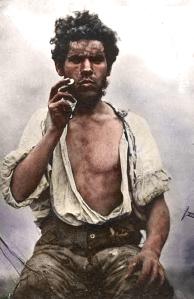
An unknown Spailpín Fánach circa 1858. A colourised image by Matt Loughrey from a black and white photograph originally collected by Sean Sexton.
The Last Vision of Eoghan Rua Ó Súilleabháin
The cow of morning spurted Do thál bó na maidine
milk-mist on each glen ceo bainne ar gach gleann
and the noise of feet came is tháinig glór cos anall
from the hills’ white sides ó shleasa bána na mbeann.
I saw like phantoms Chonaic mé, mar scáileanna,
my fellow-workers mo spailpíní fánacha,
and instead of spades and shovels is in ionad sleán nó rámhainn acu
they had roses on their shoulders. bhí rós ar ghualainn chách.
Translated by Michael Hartnett from his original Irish poem.
Commentary
This gem of a poem was first published as part of Hartnett’s first collection in Irish, Adharca Broic, in 1978. The poem also appears in Hartnett’s 1987 collection, A Necklace of Wrens, with an English translation by the poet himself. Of the twenty-three poems in A Necklace of Wrens, thirteen are included from that first collection in Irish, Adharca Broic, with English translations by the poet. Peter Fallon, his publisher and editor, has stated that the poems included in A Necklace of Wrens were the only Irish poems that Hartnett wanted to be preserved after his ten-year sojourn in West Limerick. This collection was followed a year later by Poems to Younger Women, entirely in English. Theo Dorgan tells us that both these collections show ‘a startling return to the power and complexity we might have expected had the poet not turned aside from English in 1975’.
‘The Last Vision of Eoghan Rua Ó Súilleabháin’ offers a modern perspective on the traditional Aisling (vision) poem genre. The poem blends traditional imagery with contemporary twentieth-century realism, transforming the spectral ‘fellow-workers’, the ‘spailpíní fánacha’ of the original, into figures with ‘roses on their shoulders’ instead of spades, suggesting a hopeful, transformed vision of labour and society, rather than the lament for lost Gaelic order typical of historical Aisling poems.
Here, the focus shifts from the old political lament of older Aisling poems to a more modern, grounded, hopeful vision, using the image of the rose, the international symbol of the Labour Movement, of which Hartnett was a card-carrying member. While the original poems lamented historical events like the Flight of the Earls and the hoped-for return of Bonny Prince Charlie and the Stuarts to power, Hartnett’s poem shifts the focus to a contemporary sense of disillusionment and emotional turmoil. Hartnett does use the image of a new day dawning to reinforce the hopeful possibility of better days ahead, however, while Hartnett’s translation adapts the ancient Aisling form in a contemporary context, in my view, this Aisling is heavily laden with irony, if not cynicism, because of Labour’s perceived inability to improve the lot of the working class and its failure to gain long-term popular mainstream support, particularly in the post-World War II era.
The title and the poem itself reference the Aisling genre, a poetic form that developed in Gaelic poetry in the 17th and 18th centuries. Readers familiar with Irish poetry will also be aware that in these old Aisling poems, Ireland was often depicted as a woman: sometimes young and beautiful, sometimes old and haggard. In the final poem in his first collection in Irish, Adharca Broic, Hartnett reprints his iconic poem, Cúlú Íde, in which he portrays Íde (Ita Cagney in the English version) as a strong, formidable woman, and he endows her with many of the traditional characteristics of the spéirbhéan (the spirit woman) from the original Aisling poems. She is depicted as a modern Bean Dubh an Ghleanna, Gráinne Mhaol, Roisín Dubh or Caithleen Ní Houlihan – in effect, a symbolic representation of the new Ireland.
This modern Aisling, ‘The Last Vision of Eoghan Rua Ó Súilleabháin’ also features striking imagery, such as the ‘cow of morning’ that ‘spurted milk-mist on each glen’. The image of the cow, the Droimeann Donn Dílis, was also a stock reference to represent Ireland in Jacobite poetry and the hoped-for return of the Stuart dynasty, which, many at the time believed, would benefit Ireland. This initial image creates a surreal and elemental atmosphere, setting a new tone for the vision. The crucial shift occurs when these workers have ‘roses on their shoulders’ instead of ‘spades and shovels,’ symbolising a transformed, idealised vision of labour, where it is no longer depicted as hardship or indentured slavery but as something beautiful and dignified.
The rose, particularly the red rose, later became a symbol for the Labour Movement through the slogan ‘bread and roses,’ which represents the dual desire for both the means to live (bread) and a life of dignity and fulfilment (roses). This symbol is associated with the fight for social and economic justice and is used by many social democratic and labour parties, such as the Labour Party in Ireland and the UK.
The ‘phantoms’ seen by the speaker are described as ‘fellow-workers’, ‘comrades’ even, transforming traditional imagery of spectral figures into more tangible, relatable characters associated with Labour. The older, traditional variety are the sad spectral figures that accost Hartnett one summer’s evening as he heads from his home in Newcastle West to meet his uncle Dinny Halpin in Camas. The episode is recounted for us in the second section of his iconic poem, ‘A Farewell to English’,
These old men walked on the summer road
sugán belts and long black coats
with big ashplants and half-sacks
of rags and bacon on their backs.
These spectral figures were a pathetic vision, ‘hungry, snotnosed, half-drunk’. These ragged poets, Andrias Mac Craith, also known as An Mangaire Súgach, The Merry Peddlar, (along with his contemporary, Sean Ó Tuama an Ghrinn, who also hailed from Croom, the seat of one of the last ‘courts’ of Gaelic poetry), Aodhagán Ó Rathaille from Meentogues near Rathmore in the Sliabh Luachra area (also the birthplace of Eoghan Rua Ó Súilleabháin), and Dáithí Ó Bruadair, who was on his way from Springfield Castle, the seat of the Fitzgeralds, to Cahirmoyle, the seat of his other great patron, John Bourke), represented the sad remnants of a glorious past.
The ‘phantom’ figures leave Hartnett resting ‘on a gentle bench of grass’, leaving him to ponder his own future as their direct descendant:
They looked back once,
black moons of misery
sickling their eye-sockets,
a thousand years of history
in their pockets.
Eoghan Rua Ó Súilleabháin, the putative author of this Aisling and a real-life spailpín in his own right, lived a life which was the stuff of legend and lore, and, indeed, it has many similarities with Hartnett’s own rakish life. Many of the stories surrounding him may very well be apocryphal, to say the least. However, he and his fellow parishioner, Aodhagán Ó Rathaille, are most famous for their mastery of the Aisling genre.
Eoghan Rua was born in 1748 in Meentogues, in the mountainous Sliabh Luachra area, in southwestern Ireland. By the time of his birth, most of the native Irish in the southwest had been reduced to landless poverty. However, the area boasted of having one of the last ‘classical schools’ of Irish poetry, descended from the ancient, rigorous schools that had trained bards and poets for generations. In these last few remnants of the bardic schools, Irish poets competed for attention and rewards, and learned music, English, Latin and Greek.
Eoghan Rua (the Rua refers to his red hair) was witty and charming but had the misfortune to live at a time when an Irish Catholic had no professional future in his own country because of the anti-CatholicPenal Laws. He also had a reckless character and threw away the few opportunities he was given. For example, at the age of eighteen, he opened his own school; however, we are told that ‘an incident occurred, nothing to his credit, which led to the break-up of his establishment.’
Eoghan Rua then became a spailpín, an itinerant farm worker, until he was 31 years old. He was then conscripted into the British Navy under interesting circumstances. Ó Súilleabháin was then working for the Nagles, a wealthy Anglo-Irish family. They were Catholic and Irish-speaking, and had their seat in Kilavullen along the Blackwater valley near Fermoy, County Cork. (The Nagles were themselves an unusual family. The mother of the Anglo-Irish politician Edmund Burke was one of the Nagles, as was Nano Nagle, the founder of the charitable Presentation order of nuns. She was declared venerable in the Catholic Church on 31 October 2013 by Pope Francis).
Daniel Corkery relates that, ‘I have had it told to myself that one day in their farmyard Eoghan Rua heard a woman, another farm-hand, complain that she had need to write a letter to the master of the house, and had failed to find anyone able to do so. ‘I can do that for you’, Eoghan said, and though doubtful, she consented that he should. Pen and paper were brought to him, and he sat down and wrote the letter in four languages: in Greek, in Latin, in English, and in Irish. ‘Who wrote this letter?’ the master asked the woman in astonishment. The red-headed young labourer was brought before him, questioned, and thereupon set to teach the children of the house. However, again owing to Eoghan Rua’s bad behaviour, he had to flee the house, the master pursuing him with a gun’. Legend says he was forced to flee when he got a woman pregnant: some say that it was Mrs Nagle herself!
Ó Súilleabháin escaped to the British Army barracks in Fermoy, and he soon found himself aboard a Royal Navy ship in the West Indies, ‘one of those thousands of barbarously mistreated seamen’. He sailed under Admiral Sir George Rodney and took part in the famous 1782 sea Battle of the Saintes against French Admiral Comte de Grasse. The British won, and to ingratiate himself with the Admiral, Ó Súilleabháin wrote an English-language poem, Rodney’s Glory, lauding the Admiral’s prowess in battle and presented it to him. Ó Súilleabháin asked to be set free from service, but this request was denied him.
Much of Eoghan Rua’s life is unknown and clouded in mystery and intrigue. He returned after his wartime exploits to his native Sliabh Luachra and opened a school again. Soon afterwards, at 35, he died from a fever that set in after he was struck by a pair of fire tongs in an alehouse quarrel by the servant of a local Anglo-Irish family. ‘The story of how, after the fracas in Knocknagree in which he was killed, a young woman lay down with him and tempted him to make sure he was really dead, was passed on with relish’.
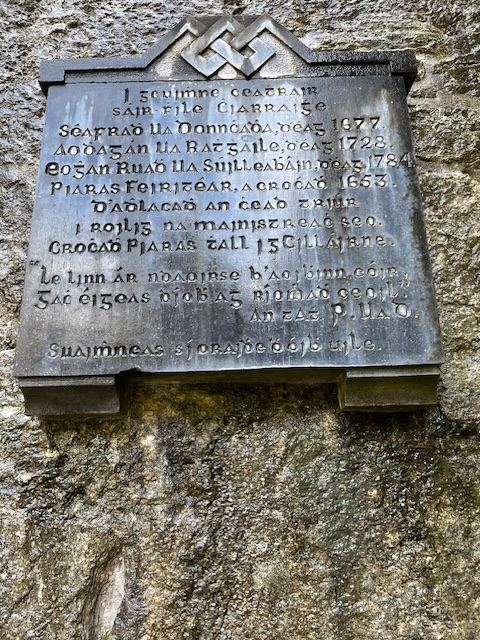
There is some confusion as to where he is buried. Some claim he was buried in midsummer 1784, in Nohoval Daly graveyard (or Nohoval Lower Graveyard), which is located on the Cork side of the River Blackwater on the R582 Knocknagree to Rathmore road. Others claim that he was buried in the cemetery of Muckross Abbey, Killarney, along with two other great Kerry poets, Séafradh Ua Donnchadha, who died in 1677, and Aodhagán Ó Rathaille, who died in 1728. There is a plaque on the wall of Muckross Abbey today that commemorates this event. The plaque also pays tribute to another great Kerry poet, Piaras Feiritéar, who was hanged ‘thall i gCill Áirne’, ‘over in Killarney’, in 1653. The plaque also has an inscription which is attributed to an tAthair Pádraig Ó Duinnín, the great lexicographer, most famous for compiling the Foclóir Gaeilge–Béarla (Irish-English Dictionary), first published in 1904. He, too, was from Meentogues, the birthplace of both Ó Suilleabhán and Ó Rathaille.
The plaque on the wall of Muckross Abbey in Killarney claims that Eoghan Rua is buried in the Abbey cemetery, along with Aodhagán Ó Rathaille and Séafradh Ua Donnchadha.
It was said of Eoghan Rua that,
Perhaps there never was a poet so entirely popular– never one of whom it could be more justly said volitar vivus per ora virum [He soars, alive in the mouths of the people]. His songs were sung everywhere…. Munster was spellbound for generations…. The present generation, to whom the Irish language is not vernacular, in reading these poems should bear in mind that they were all intended to be sung, and to airs then perfectly understood by the people, and that no adequate idea can be informed of their power over the Irish mind, unless they are heard sung by an Irish-speaking singer to whom they are familiar.
There is much to admire in this short poem. Indeed, I feel I am but scratching the surface. However, short and concise as it is, I feel it has relevance to a modern audience eager to bridge the gap to a harrowing era in Irish literary history. Indeed, the poem’s tone is one of elegy, lament, and perhaps a quiet resignation to loss, reflecting the disorienting experience of a changing world.
In his wide-ranging essay, which gives an overview of Hartnett’s work, ‘A Singular Life: The Poet Michael Hartnett’, Theo Dorgan points out that although he never translated the totem figures, Mac Craith and Ó Tuama,
‘he could and did think of himself as the favoured inheritor of a tradition, and also as one obliged to be loyal to that tradition. This sense of obligation would become the sign and signature of his work’.
That life’s work in both languages serves as a bridge between Ireland’s rich poetic past and its modern present. His poetry and translations from the Irish have given him firsthand knowledge of traditional Irish forms, such as the Aisling, and he uses these in very innovative ways in his contemporary poetry. By taking a traditional form such as the Aisling and imbuing it with modern themes, Hartnett allows a new generation to connect with a classical poetic tradition while grappling with the emotional and political undercurrents of their own time.
The startling achievement of this short eight-line poem is that Hartnett manages to crystallise all the tropes and traditions of the Aisling genre while at the same time staying relevant to a modern audience. This Aisling alone proves that he is a worthy successor to the ‘phantoms’, those spectral figures who confronted him at Doody’s Cross, ‘a thousand years of history in their pockets’.
References
Dorgan, Theo. ‘A Singular Life: The Poet Michael Hartnett’, from The Poets and Poetry of Munster: One Hundred Years of Poetry from South Western Ireland, ed. Clíona Ní Ríordáin and Stephanie Schwerter (December 2022/January 2023).
All poets are singular, in the sense that we are all singular, each of us bearing the burden of one life and one life only, but also in the sense that no poet can be comfortably placed in a definite lineage, presented to us as a manifestation in one particular line of tradition. Michael Hartnett was more singular than most. He was of Munster, and he acknowledged Munster forebears, but if this was the place he started from, he was unpredictable and cosmopolitan in his tastes and in the company he would keep; nothing in his background could have predicted or predetermined the poetry he would make, the arc his life would take.
Birth and a people
He was born in 1941, in Croom, County Limerick; he grew up in Newcastle West, in a time of close horizons, small expectations and apparently narrow minds. In those days, for the children of the poor, the prospects were few; the best hope was emigration, offering what the country could not – work and a living, however diminished. For the waywardly gifted, however, there is always the opportunity to carve out one’s own niche, albeit at the sacrifice of comfort and social place as generally understood. The State was barely thirty years old and had already abandoned the revolutionary promise to cherish its children equally when Michael Hartnett stepped outside the boundaries of class and predestiny to discover himself a poet.
He published his first work in a local paper at the age of thirteen, his first poem in The Irish Times when he was still a schoolboy. From the day he left school, he thought of himself first and always as a poet.
A poet of and from a particular place
In an interview with Dennis O’Driscoll, Hartnett says: ‘I’m the only ‘recognised’ living Irish poet who was born in Croom, County Limerick, which was the seat of one of the last courts of poetry in Munster: Seán Ó Tuama and Aindrias Mac Craith. When I was quite young, I became very conscious of these poets, and, so, read them very closely indeed.’[1]
In small places, folk memory runs deep, and a certain cachet endured in the title ‘poet’, with connotations of ‘other’, ‘different’, ‘gifted’, and ‘dangerous’. With the niche already prepared, so to speak, one sees the attraction for a curious young mind, already verbally adept and quick: poetry offered place, ancestry, a degree of acceptance for the chosen path and open horizons for a young man who had already discovered the power of words.
It is hardly uncommon, in a young poet, that she or he would first begin to grow in the shelter of some chosen poet mentor, whose sensibility, or technique, or more usually some amalgam of both, opened a road forward in the craft. When Hartnett first sought such a precursor, he looked at his immediate local context and backwards into another time and another language. What he found there would make no discernible impact on his craft (he never translated the totem figures, Mac Craith or Ó Tuama) but they furnished him with a particular kind of warrant – he could and did think of himself as the favoured inheritor of a tradition, and also as one obliged to be loyal to that tradition. This sense of obligation would become the sign and signature of his work.
Few Irish poets writing in English would own fealty to the tradition of Irish language poetry in the way that Hartnett did; his contemporaries and near-contemporaries chose figures who were perhaps as close to home but were certainly nearer in time, in language and in their themes and subjects. His Irish at the time was meagre, mostly acquired through overhearing Bridget Halpin, his grandmother, speak at late night firesides when the child had been safely put to bed. Much of his childhood was spent in her Camas cottage. He would later claim that she was one of the last native speakers of Irish in the district. While there are grounds for doubting this, his grandmother had a formative influence on the poet’s imagination – he would say that once she saw him with a necklace of wrens circling around his head, leading her to proclaim him a poet. He relished this atavistic sense of recognition, and would celebrate his grandmother in one of his most famous poems, ‘Death of an Irishwoman’[2]:
It is a far more cold-eyed tribute than the earlier, more conventional ‘For my Grandmother, Bridget Halpin’, a sign that Hartnett is willing to acknowledge ancestry but also to strike out in his own particular direction.
Elected Company
Poets will gather about themselves, by elective affinity, those ancestors and companions that they need, not those wished upon them. We are more likely to understand them when we allow them to fly free in their chosen company.
Hartnett’s chosen companions were both eclectic and wayward, the company he chose as he pursued his life in poetry but also formed a consistory to whom he felt himself bound in loyalty and comradeship. Thus, in ‘A Farewell to English’ (and the indefinite article here is significant), these lines:
The plangent concluding lines of Antoine Ó Raifteirí’s poem ‘Cill Aodáin’ are these: ‘S dá mbeinn-se i mo sheasamh i gceartlár mo dhaoine/ D’imeodh an aois díom is bheinn arís óg.” A working translation: “And were I standing right at the heart of my people/ Age would go from me and I would be young again.”
I invoke these lines because to understand Michael Hartnett, it is of the first importance to recognise that ‘mo dhaoine’, ‘my people’, gives us both provenance of the man, and hence of the work, and also the mandate that governed and guided his trajectory on this earth, from first to last.
Hartnett, throughout his life, referred back to his sense of a people, defined and redefined that community to encompass family, neighbours and friends, antecedent poets, and that tribe of audience and influence, an intelligible company chosen by elective affinity. He wrote always for his place and for his people, sometimes as if in a guided trance, but always aware of the bond as both necessary and inescapable. If he was sometimes at home in and sometimes estranged from both place and people, if this community was sometimes balm and sometimes bane, nevertheless, this was the territory in which he lived out his life and to which he felt honour bound.
The territory encompassed by his native Newcastle West and neighbouring Camas and Templeglantine, extending outwards to the province of Munster and on to Dublin, touching on Spain and the Classical world in its farthest rippling, while vertically, so to speak, reaching back for Ó Tuama, Ó Bruadair, Ó Rathaille, Sor Juana Iñes de la Cruz and Federico García Lorca.
He would show a lifelong fidelity to his birthplace, but he had no illusions about the soul-cramping truth of a small place where ambition was suffocated in the cradle. The early poem, ‘A Small Farm’, begins:
The early poems are mannered, veering close to the Symbolism of the Russian Silver Age, marking a territory of savagery, death, and disappointment in a stylised language that only rarely swerves into the high plain speech that would become his signature music.
We hear this true note first and best in Anatomy of a Cliché (1968).[6] There are birds here, but there is also ‘cold rain glisten/hung on each shocked feather’, the feel of the actual intensely experienced, even if birds are sometimes co-opted as metaphor, as in poem XI,
Hartnett had been five years in Dublin when this collection appeared, but as Michael Smith points out: ‘Michael arrived in Dublin as an already published poet who was not looking for, nor needing any, teachers in the art of poetry.’ [8]
Smith tells us that Hartnett enrolled as a student in UCD, thanks to patronage from James Liddy, but ‘Michael almost never attended a lecture’. He found the University congenial, not so much for its teaching, but because it placed him in a company of young poets, including Macdara Woods, Smith, Eamon Grennan, Brian Lynch and, importantly, Paul Durcan. Hartnett and Durcan shared a common belief in poetry as a high calling that demanded surrender, devotion, and a single-mindedness, elevating it above all other duties. It is no reflection on their contemporaries to say that Hartnett and Durcan considered it something of a sacred moral imperative to stand at a slant to the shared social world, to embrace a certain kind of high loneliness. In Hartnett’s case, this high loneliness would be tuned to a keener pitch when, in 1975, he made the momentous decision to switch from writing in English to writing in Irish.
Farewell to English
A Farewell to English,[9] published in that year, was a watershed book for Hartnett. Much of the attention this collection continues to draw is focused on the title poem, at the expense of the complex array of signalling in the poems that lead up to it. There is the acknowledgement of the toxic, particular nexus of alcohol and poverty in ‘The Buffeting’ and in ‘Early One Morning’, self-excoriating poems that are both clinical and merciless in their impact. There is the archetype of the fated and fatal victim in ‘The Oat Woman’, a figure to equal anything Graves, or Pasternak, can conjure, and there is its twin poem, ‘Death By The Santry River’ – both poems are stalked by terror. There is that ferocious political poem ‘USA’, and there are the poems that circle back to the home place – ‘Mrs. Halpin and the Lightning’, ‘Pig Killing’, ‘A Visit to Croom 1745’. Hartnett may be seen to be preparing his case for the title sequence, reaching back to his first circle of belonging, then nodding towards his second circle of elective affinities (in ‘Struts’, for example, with its ‘We are climbing upwards into time/and climbing backwards into tradition’), before he plunges forward into the Grand Declaration. Before we get there, we should take a long, cool look at ‘A Visit to Castletown House’.
The great Palladian mansion, Ireland’s first and still its finest, was built to consolidate and further the social and political designs of William Conolly, speaker of the Irish House of Commons. Begun in 1722, completed in 1727, it was both a residence and a symbol of Irish achievement and ambition. The political congresses envisioned by Conolly never took place there, but the house did come to represent a phase in the evolution of a new kind of politics in Ireland, and much of the thinking about quasi-independence from direct British rule was fostered there. Of course, Castletown House was also a centre of dominance as far as the poorer classes were concerned, a ‘Big House’ carrying all the complex baggage that term implies.
Set in lush countryside on the banks of the wide, slow-moving Liffey, Castletown stood as a monument to what might be called the aristocratic pastoral. Hartnett’s poem moves through that pastoral landscape to an acknowledgement of the building in the “mere secreting wood”, overthrown at the cost of knuckles that bled and bones that broke, to a sharper focus on the pretensions of the nouveaux riches and on to the precise bitterness of the closing five lines:
I stepped into the gentler evening air
and saw black figures dancing on the lawn,
Eviction, Droit de Seigneur, Broken Bones:
and heard the crack of ligaments being torn
and smelled the clinging blood upon the stones. [10]
The poem may be read as a prologue to the title sequence of the collection. The relentless drive to its pitiless conclusion, the brief rehearsals of what were already central themes in the poet’s work, are interrupted by stanza four, introducing a new theme that will manifest with increasing power in later poems such as ‘Sibelius in Silence’: Hartnett’s deep insight into music as a high art.
It would be simplistic to read Hartnett’s turning away into Irish as atavism, as an arbitrary and wilful gesture. He was already an assured presence as a poet in English, a distinctive, recognised and recognisable voice. If he had an inherited sense of the rightful grievances of the poor, the landless and powerless, and the political acumen to understand the power relations that had evolved through Ireland’s colonised history, he had also a cool and sophisticated grasp of high art, as evidenced in this fourth stanza:
Here, on the point of turning away from a language he had already mastered, Hartnett is sounding what will surface as a powerful strain in his later work: his deep understanding of and affinity with a broad European aesthetic. Sections (iii) and (iv) of ‘A Farewell to English’ are satires, in the Gaelic tradition of the ‘aor’, a form of invective that holds up its target to a savage form of ridicule. Dennis O’ Driscoll misses the point when he dismisses these sections as “philistine nonsense”; I think he misses the humour of these sections, the delicate and deliberate brio of exaggeration which Hartnett artfully deploys his point, as he says himself in the interview with O’ Driscoll, is that he was infuriated by the neglect of, and the lip service paid to, the Gaelic language and the Gaelic poetic tradition. In taking a deliberately hyperbolic swipe at the guardians of what had become State culture, he is making a subtler point: you cannot make all-encompassing claims for Irish identity and Irish poetry when what you mean is Irish poetry in English, an Irish identity that manifests only in English. The argument is made most pointedly in section vi), where the second stanza is brutally dismissive of “our Governments”, and follows hard on the heels of the last two lines in the first stanza: “For Gaelic is our final sign that/ we are human, therefore not a herd”. [12]
Sections iii), iv) and vi) are best thought of as a flourish of the matador’s cape, a heightening of the dramatic temperature to mask sober and serious business. Hartnett experienced poetry as a calling; he felt himself bound by an imperative from elsewhere that was a cloudy blend of local tradition in folklore and literature, a sense of his duty to speak for his class, his wide and miscellaneous reading and the imperatives he drew from that reading. He himself offered various reasons for turning away from English, which may be summarised as a reluctance to see the language go down into the dark. But consider, he had little Irish himself, there were already contemporaries such as Caitlín Maude, Nuala Ní Dhomhnaill, Michael Davitt and others who were effectively driving a mini-renaissance in Irish language poetry – the survival of the language did not depend on Hartnett’s frail and hesitant voice, and he was intelligent enough to know this:
We should not forget that the long decay of the Irish language as a vernacular, and as a literary language, was neither an organic nor an unavoidable phenomenon. The former colonial power had an explicit and effective policy for the extirpation of the language, and this, coupled with the brute post-Famine necessity to privilege English to find a foothold in the English-speaking lands towards which forced emigration was inevitably directed, drove what we might call an evolutionary adaptation.
Hartnett, meagre though his store of Irish was, felt impelled to stand for the lost civilisation, the neglected and imperilled element that he thought crucial to Irish identity. How much of his argument was deeply felt, how much was post-hoc rationalisation, will be argued for a long time but need not detain us, since there was a deeper imperative at work. To put it as simply as possible, it is not so much that Hartnett chose Irish as that Irish chose him. The words came “like grey slabs of slate breaking from/an ancient quarry, mánla, séimh, dubhfholtach, álainn, caoin”.[14]
Out of nowhere, the words came to him, and he felt himself summoned:
It was the words themselves, as they drifted into his consciousness, that prompted this radical departure from ‘the gravel of Anglo-Saxon’. He does not suggest that he followed unquestioningly:
What was I doing with these foreign words?
I, the polisher of the complex clause,
wizard of grasses and warlock of birds
midnight-oiled in the metric laws?
Section ii) offers two further imperatives: he sets out to walk to Camas, “half-afraid to break a promise” made to his uncle Dinny Halpin, and on the way he encounters ghosts, “black moons of misery/ sickling their eye-sockets/ a thousand years of history / in their pockets.” These apparitions are walking to “Croom, Meentogues and Cahirmoyle”, which Hartnett glosses: “Croom: area in Co. Limerick associated with Aindrias Mac Craith (d.1795); also, seat of the last ‘courts’ of Gaelic poetry; also, my birthplace. Meentogues: birthplace of Aodhagán Ó Rathaille. Cahirmoyle: site of the house of John Bourke (fl. 1690), patron of Dáibhí Ó Bruadair.” Bracketed by these calls on his fealty, to place, to people and to poetry, he considered he had no choice but to turn to Irish. Many years later he would write: “…I have poems at hand:/ It’s words I cannot find…” [16]
For all the enmeshments of his situation in history, Hartnett turned to Irish primarily because he heard the words that found him out. That this was due to his particular conception of a poet’s proper duty is both clear and unambiguous – but the consequences of his decision were severe. He moved, with his wife Rosemary and their two children, to a small cottage in Templeglantine, the parish of his grandmother. We find again this wish, to situate himself as a poet among his inherited and chosen people, but if Hartnett expected sustenance and a charge of energy, personal and poetical, from this radical dislocation, it cannot be said that his hopes were fulfilled.
Working through Irish
His first publication after the move was in both Irish and English, Cúlú Íde and The Retreat of Ita Cagney.[17] The English text is the stronger of the two, a reflection of the fact that Hartnett’s vocabulary and perhaps grasp of syntactical possibilities in Irish lagged behind his highly developed skills in English, but the bilingual reader will also find a hesitancy in the unfolding of ‘Cúlú Íde’ that is not found in the English version. We should observe here that the English is a version of the Irish, and not a translation.
The Templeglantine years were years of hardship, financial and emotional, for all concerned. Of the work that was produced in that small house, it is likely that only Adharca Broic[18] will stand the test of time. Individual poems still have a luminous clarity (for example, ‘Dán do Lara’), but it is doubtful that Hartnett’s work in Irish can be compared in achievement to that of Nuala Ní Dhomhnaill, for instance, or Biddy Jenkinson, Liam Ó Muirthile or Gabriel Rosenstock. This is hardly to denigrate the work but rather serves to make the point that Hartnett’s poems in English are for the most part of a higher order than his poems in Irish – and he was too good a poet, and too honest with himself, not to recognise this.
Return to English
One might have expected that when he returned to writing in English, he might have taken up where he left off. Instead, his next collection of poems would make use of a form few, if any, have mastered in English, the haiku. Deceptively simple as a form, the haiku relies on triggering a moment of insight in its reader, or a leap into empathetic understanding that is rarely, if ever, an obvious product of the ostensible narrative. Appearing in 1985, the same year as his translations of the great Dáibhí Ó Bruadair, Hartnett’s Inchicore Haiku[19] is a sequence marked by the modesty of its ambitions and of its ostensible subjects. He had always a keen eye for the natural world, but the cumulative impact of this book-length sequence comes from its accumulation of mood and tone – accusing and self-accusing, rueful, sad, disillusioned, occasionally celebratory, the poems mark a quiet, unshowy, return to the notionally abandoned language. No rhetorical flourish, still less an apology for having been away, there is no backward look here, but neither is there the dexterity, the dance with form and thought, that had marked the poems prior to 1975. This is a subdued Hartnett, defeated in his marriage, in retreat from his retreat. He found a new village in Inchicore, and in a sense, a new people with whom he could feel at home, recognised and accepted for himself. Haikus 86 and 87 are instructive:
Not for the first time, Hartnett’s self-identification with the poor and powerless gives him his milieu, his chosen audience and his set of subjects, but now the environment is not West Limerick, but a proletarian quarter of the capital city where dreams and promises come to die:
Very few of these 87 short poems work as classical haiku – they are mostly too direct and declarative. Then again, the Japanese form relies on linguistic resources in Japanese that do not exist in European languages; perhaps it’s best to think of Hartnett’s haiku as simply short poems in a form approximating to the haiku. The energy of the sequence comes from the juxtaposition of deeply felt personal loneliness with a landscape of low expectations, diminished nature, and disempowerment.
Fresh Poems, fresh powers and visions
Two years later came the bilingual A Necklace of Wrens,[25] followed by Poems to Younger Women[26]entirely in English. There is a startling return to the power and complexity we might have expected had the poet not turned aside from English in 1975. There are dark energies, some cruelty and vitriol, some tenderness, a measure of hard-won self-knowledge and graceful tributes, but above all there is a powerful surge of life and ambition in the verse making – the “polisher of the complex clause, /wizard of grasses and warlock of birds/midnight-oiled in the metric laws” is back, and with heightened powers. If the prevailing note is a kind of bleak celebration of endurance, nevertheless, there is brio, too, the brio of the toreador, resigned to danger and even to death, not quite courting it but aware that it is factored into the dance.
There had always been a visionary streak in the poems. With The Killing of Dreams[27] (1992), a note that is dramatically and defiantly struck, and which finds perhaps its most perfect expression in ‘A Falling Out’, where the muse figure is not just inspiratrix but also the pitiless withholder of the gift.
She comes from a familiar, homely environment of “overcoats and caps”, of “porter taps”, and battering hobnail boots, from
…the cobbles of the market square,
where toothless penny ballads rasped the air,
there among spanners, scollops, hones, and pikes,
limp Greyhound cabbage, mending-kits for bikes…[28]
the familiar small town territory where “she tricked from me my childish, sacred vow.” The first stanza recapitulates Hartnett’s first stepping out into poetry, and the second rehearses his immersion in the written tradition, the variousness and wild range of what has been prompted by this powerful muse figure. Hartnett offers as her territory a landscape where ultimately all poets are doomed victims of the urge to create: she takes, and then dismisses, out of hand/ the men and women that she most does bless.[29] Sacred capriciousness is one of the qualities Graves attributes to his White Goddess, but where Graves sees the poet as inescapably bound to her rule, heroically stoic, waiting for when the next bright blow may fall, Hartnett, radically, dismisses his muse:
…at dawn I give her bed a gentle shove
and amputate the antennae of love
and watch the river carry her away
into the silence of a senseless bay
where light ignores the facets of her rings
and where the names are not the names of things.[30]
The poem has the air of a poetic suicide note, opening on initiation, closing on repudiation of the gift, and might well have served to close out the poet’s life and work – but perhaps we might read it better as a gambler’s bluff, a kind of dare? In ‘Didactic’ he tells us, bluntly, “the imagination has no limits./ Art has”. [31]
The eye has turned inward, the poet considers whether or not he has outlived his allotted span, ‘… he flounders out of bounds,/ his panacea mocked by a disease/ it was never meant to cure’.[32] Life as a painful site of anguish has been a subdominant theme since Inchicore Haiku. By now it is coming to dominate his imagination, and in poem after poem we find a casting about for release:
For all that, there is something redemptive in the seven-part sequence ‘Mountains, Fall on Us’, a sustained and unflinching set of poems where the suffering man transcends his “list of childish woes”, and faces the hard facts of his life, as man and poet, with stoic acceptance. In the first part we are given a vulnerable figure, a gay man with aesthetic instincts at the mercy of cruel Spanish Catholicism, its ‘jeering trumpets’ redeemed by ‘some kindly waiter’ who ‘kindly dabbed/the distraught mascara from his face’. The second part evokes the poet’s ‘fatal childish dream’ of the life of ease marked out for him; the third section evokes a muse figure whom we might well trace back, to his Grandmother, whose ‘milestones are novenas for the dead’; in the fourth, we find a frank admission that he sits ‘in a soul I do not want’, living ‘this life which has no joy in it’, and in the fifth section the Alexandrian Cavafy is evoked, whose ‘real poems told of real pain’.
This trying on of roles, of lives, of identities, figures the possibilities open to the imagination which has no limits, but is true to the limits of art. In the final two sections, there is a resolute dismissal of all avenues of escape. In the end, he must hang ‘on the great loneliness/of his forgotten cross’, the outcast and thief who ‘asked for mercy and was snubbed by Christ’.
A man without a people.
In 1991, he translated John of the Cross into Irish.[34] In 1993, he published his lucid translations of Haicéad,[35] and his definitive, nuanced, and sensitive, translation of Aodhagán Ó Rathaille[36] was completed in advance of his death in 1999. Two magisterial poems were left in him; they appeared in Selected and New Poems[37](1994), ‘He’ll to the Moors’; and ‘Sibelius in Silence’. New Poems (1990-1999) added a slight afterthought to the life’s work – followed by the posthumous A Book of Strays in 2002 – but to all intents and purposes, these two long poems wrote the finis.
The slant towards death and silence
In a bravura keynote address to Éigse Michael Hartnett[38] in 2009, Paul Durcan suggested that Hartnett was possessed of a mediaeval Catholic imagination. ‘He’ll to the Moors’ traces the life of the mystic Ramon Lull, from his beginnings as a troubadour and lover, observer of birds and the ordinary minutiae of the natural world, to the polemicist for Christ who found no rest in the world until he was stoned to death in Tunisia. Durcan argues that this ostensible biography is in fact a species of cloaked autobiography; it traces the arc of Hartnett’s life in parallel to that of its subject, from insouciant celebrant of the small things, through the harrowed fields of desire and disputation until, at the end, he achieves the martyrdom that was always his destiny and his apotheosis. Durcan recruited the poet Michael Coady to his characterisation of Hartnett’s imagination:
‘At heart he was perhaps a classically Irish mix of tidal faith and fatalism – intuitively in touch with a deeply buried Mediterranean impulse in the Irish psyche and native language, but one historically and climatically done down by the fateful alliance of puritan incursions from the east and constant troughs of low pressure from the west…’
[Michael Coady’s Sleeve Notes for the Claddagh Records CD of Hartnett reading his own work]
The CD was issued by Claddagh Records, and in the notes we find Coady’s suggestive claim that “as with all true poets, a mysterious potency of verbal enchantment was at the core of his gift.” The shifts in register, the command of the inscape and outscape of his matter, the baffled and heartbroken humanity of the poem, show a poet in full command of a what is still a considerable gift.
At this point, in the full grip of alcoholism and its attendant furies, Hartnett was much occupied with gathering in the threads of his life, as if rehearsing and preparing an exit he felt drawing inexorably closer. He would write poems yet, short lyrics of uneven quality, but before he came to the desolate child’s cry of ‘A Prayer for Sleep’, the final poem in the 2001 Collected Poems, came the panoramic, cold splendour of ‘Sibelius in Silence’. In this poem, Hartnett revisits the handful of themes that haunted him all his life: the artist’s responsibility to the gift, to tradition and to his own people, and then the struggle to be at home in world and nation, self-doubt and the courage to outlast silence, the quarrel with history, and above all the sense that the lone sensibility cannot hope to overcome the brute weight of the world’s indifference. The chosen extended silence of Sibelius echoes Hartnett’s earlier “I have poems to hand/it’s words I cannot find.” Both poet and composer know that, to be true to the strictures of the art, one must find the discipline and courage to seek and withstand the silence out of which everything comes, into which everything must go.
Hartnett was fascinated by the elected silence the composer sought, until he emerged with what he considered the voice itself of the place itself, speaking itself:
I offer you here cold, pure water –
as against the ten-course tone poems,
the indigestible Mahlerian feasts;
as against the cocktails; many hues,
all liquors crammed in one glass –
pure, cold water is what I offer.
(Collected Poems p. 227)
The question is to what degree Hartnett conflates himself with Sibelius. Is Sibelius a mask he put on in order to confront himself, or is the poem intended as an homage, of one troubled soul acknowledging unresolvable ambiguity, in this question that can only be answered with “it is both and neither”.
When we consider the place of the poem in Hartnett’s long contribution to poetry, there is something heartbreakingly final about the concluding lines to what is, in effect, Hartnett’s farewell to poetry:
…that which was part of me has not left me yet –
however etherialised, I still know when it’s there.
I get up at odd hours of the night
or snap from a doze deep in a chair;
I shuffle to the radio, switch on the set,
and pluck, as I did before, Finlandia out of the air.
(p. 228)
He is far from Castletown house, and the plangent evocation of Tortellier; far, too, from the ballads and company of Maiden Street pubs, far from the poems of his Gaelic predecessors, from Lorca, from the austerity of Pasternak and the dark meditations of John of the Cross. One last great effort, a tour de force, and he lays down his pen, as “Into my room across my music-sheets/ sail black swans on blacker rivers”.
[1] Dennis O’Driscoll, The Outnumbered Poet (Loughcrew: The Gallery Press, 2013, P. 199
[2] Michael Hartnett, Collected Poems, ed. Peter Fallon (Loughcrew: The Gallery Press, 2001) p. 139
[34] Michael Hartnett, Dánta Naomh Eoin na Croise (Baile Átha Cliath: Coiscéim, 1991)
[35] Michael Hartnett, Haicéad (Loughcrew: The Gallery Press, 1993)
[36] Michael Hartnett, Ó Rathaille: The Poems of Aodhagán Ó Rathaille (Loughcrew: The Gallery Press, 1999)
[37] Michael Hartnett, Selected and New Poems, (Loughcrew: The Gallery Press, 1994
[38] Paul Durcan, ‘He’ll to the Moors’ (originally given as ‘Michael Hartnett’s Way of the Cross – the Final Quest’, keynote address at Eigse Michael Hartnett, Newcastle West, April 2009).
About the Author:
The poet Theo Dorgan. Source: Fingal Poetry Festival
Theo Dorgan is an Irish poet, writer and lecturer, translator, librettist and documentary screenwriter. He lives in Dublin with his wife, the poet and playwright Paula Meehan.
Dorgan was born in Cork in 1953 and was educated in North Monastery School. He completed a BA in English and philosophy and an MA in English at University College Cork, after which he tutored and lectured at that university, while simultaneously being literature officer at the Triskel Arts Centre in Cork.
After Dorgan’s first two poetry collections, The Ordinary House of Love and Rosa Mundi, went out of print, Dedalus Press reissued these two titles in a single volume, What This Earth Cost Us. He has also published selected poems in Italian, La Case ai Margini del Mundo (Faenza, Moby Dick, 1999).
He has edited The Great Book of Ireland (with Gene Lambert, 1991); Revising the Rising (with Máirín Ní Dhonnachadha, 1991); Irish Poetry Since Kavanagh (Dublin, Four Courts Press, 1996); Watching the River Flow (with Noel Duffy, Dublin, Poetry Ireland/Éigse Éireann, 1999); The Great Book of Gaelic (with Malcolm Maclean, Edinburgh, Canongate, 2002); and The Book of Uncommon Prayer (Dublin, Penguin Ireland, 2007).
He has been the series editor of the European Poetry Translation Network publications and director of the collective translation seminars from which the books arose.
A former director of Poetry Ireland, Dorgan has worked as a broadcaster of literary programmes on both radio and television. He was the presenter of Poetry Now on RTÉ Radio 1, and later for RTÉ Television’s books programme, Imprint. He was the scriptwriter for the television documentary series Hidden Treasures. His Jason and the Argonauts, set to music by Howard Goodall, was commissioned by and premiered at the Royal Albert Hall in London in 2004. A series of text pieces by Dorgan feature in the dance musical Riverdance; he was specially commissioned to create them for the theatrical show. His songs have been recorded by a number of musicians, including Alan Stivell, Jimmy Crowley and Cormac Breathnach.
Dorgan was awarded the Listowel Prize for Poetry in 1992 and the O’Shaughnessy Prize for Irish Poetry in 2010. A member of Aosdána, he was appointed as a member of the Arts Council (An Chomhairle Ealaíon) from 2003 to 2008. He also served on the board of Cork European Capital of Culture 2005.
He was awarded the 2015 Poetry Now Award for Nine Bright Shiners.
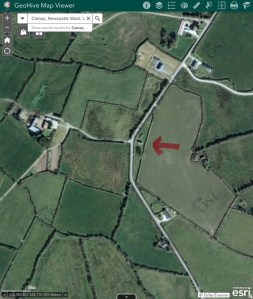
A Geohive Hub aerial view of Bridget Halpin’s cottage in Camas taken in 2006.
Camas is a small nondescript townland nestling in the shadow of the nearby village of Ratheenagh in rural West Limerick. In the Author’s Notes to his Collected Poems (2001), Michael Hartnett tells us that, ‘Camas is a townland five miles south of Newcastle West in County Limerick where I spent most of my childhood’. This local townland proved to be a central element in his early development. There, the young impressionable Hartnett was influenced by his people, particularly his grandmother, Bridget Halpin, and their customs and way of life. Indeed, in the mid-70s, when he tired of the Dublin literary milieu, it was to this same rural West Limerick bastion, nearby Glendarragh in Templeglantine, still steeped in Irish music and culture, to which he returned. It was to this place he came to escape Dublin’s incestuous stranglehold and perhaps to write a new chapter “out foreign in ‘Glantine”.
There are up to fifteen poems by Hartnett which could be considered ‘Camas Poems’. These memory poems are all based on his childhood recollections of those happy times in his grandmother’s kitchen. Students of Hartnett’s poetry should consider studying ‘A Small Farm’ (Collected Poems 15) as one of a series of memory poems that he wrote celebrating his grandmother, Bridget Halpin and the townland of Camas where she lived. The most obvious of these Camas Poems is ‘Death of an Irishwoman’ (Collected Poems 139), which he wrote on the passing of his grandmother in 1965. Others include ‘For My Grandmother Bridget Halpin’ (Collected Poems 52), and ‘Mrs Halpin and the Lightning’ Collected Poems 138) and of course ‘An Múince Dreoilíní ‘/ ‘A Necklace of Wrens’ (A Necklace of Wrens 18), a quintessential memory poem from childhood.
Hartnett’s early poetry creates a delicate balance between description and abstraction, the actual and the figurative. The poem ‘A Small Farm’, the first poem of the Collected Poems (2001), a memory poem dating from Hartnett’s teenage years, establishes this. Abstractions, clichés, their representation through language, and the moment where these are drawn into focus, made specific and immediate, are central. The setting of the ‘small farm’ is described en abstracto: ‘All the perversions of the soul / I learnt on a small farm’ (15). In contrast to other contemporary representations of Irish farm homesteads, most obviously Kavanagh’s ‘Inniskeen’, and Heaney’s ‘Anahorish’, there is no naming of place here. The picture of the farm is rather etched out in generalisation and aphorism, and through the accordant clichés of petty hatred and ignorance, ‘how to do the neighbours harm / by magic, how to hate’ (15), before Hartnett brings the glass into focus, employing idiosyncratic detail which establishes the world of the poem itself. In this way, Hartnett’s particular subjectivity, his way of seeing, is established. It would become his poetic currency:
Here were rosary beads,
a bleeding face,
the glinting doors that did encase their cutler needs,
their plates, their knives, the cracked calendars of their lives. (15)
In the final stanza, Hartnett makes an explicit link between his awakening as a perceiver of social interactions and moments of poetic beauty, with a growing knowledge and identification with the natural world:
I was abandoned to their tragedies and began to count the birds,
to deduce secrets in the kitchen cold,
and to avoid among my nameless weeds
the civil war of that household. (15)
The attentive intellect which ‘counts the birds’ has as yet no language to describe or express his experience of the natural world, his ‘nameless weeds’. Still, he is possessive of it, seeing it as distinct from the human society which he can describe, yet does not identify with.
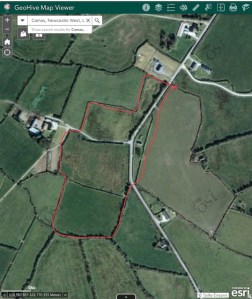
The ‘small farm’ referred to here belonged to his grandmother, Bridget Halpin, and like many other small holdings in Camas, it consisted of a meagre ten acres, three roods and thirteen perches. This woman, Bridget Halpin, would later wield great influence over her young grandson, Michael Hartnett. Indeed, if we are to believe the poet, she was the one who first affirmed his poetic gift when one day he ran into her kitchen in Camas and told her that a nest of young wrens had alighted on his head. Her reply to him was, ‘Aha, you’re going to be a poet!’. (A more detailed genealogy of the Halpin family and the early formative influences on Michael Hartnett can be read here).
Bridget Halpin’s small farm of ten acres, three roods and thirteen perches, which was so vital in the early development of one of our greatest poets. This view is taken from a Geohive Hub aerial view taken in 2006.
Hartnett claimed that he spent much of his early childhood in Bridget Halpin’s cottage in the rural townland of Camas, five miles from his home in nearby Newcastle West. He went on to immortalise this woman in many of his poems, but especially in his beautiful poem, ‘Death of an Irishwoman’. This quiet townland of Camas must therefore be seen as central to his development as a poet, and maybe in time, this early association with Camas will be given its rightful importance, and the little rural townland will vie with Maiden Street or Inchicore as one of Hartnett’s important formative places.
‘Camas Road’, Michael Hartnett’s first ever published work, appeared in the Limerick Weekly Echo on the 18th of June 1955. He was thirteen. The poem describes the rural vista of the West Limerick townland of Camas at evening: ‘A bridge, a stream, a long low hedge, / A cottage thatched with golden straw’ (A Book of Strays 67). Its two eight-line stanzas of alternating rhyme and regular metre contain a litany of natural images, at times idiosyncratically rendered; the ‘timid hare sits in the ditch’, ‘the soft lush hay that grows in fields’. It is a peculiar mix of a poem, apparent images from both the poet’s lived and literary experience, placed side by side. It is contentedly denotative, creating a sense of ease and oneness with the natural world. The movement of sunrise to sunset is perpetually peaceful, its colours oils for the young poet’s palette. The ruminative introspection which elevates Kavanagh’s ‘Inniskeen Road: July Evening’, a poem which can be read in useful parallel to ‘Camas Road’, is not present. At the poem’s turn, as ‘Dark shadows fall o’er land so still’, Hartnett’s only thought and action are of flattened description, the creation of ‘this ode’.
‘Camas Road’ then, though essentially a curiosity which stands outside of Hartnett’s body of work, can be read as a seldom afforded snapshot of Michael Hartnett the poet before he became one. In contrast, his poem ‘A Small Farm’ shows a marked development in his poetic craft. Bridget Halpin, his grandmother, lived there with her son, Denis (Dinny Halpin), in what Hartnett describes as a prolonged state of ‘civil war’,
I was abandoned to their tragedies,
Minor but unhealing.
The word ‘abandoned’ here has many undertones and is important for the poet because he repeats the line twice in the poem. He has told us elsewhere that he was, in effect, ‘fostered out’ by his parents in Maiden Street, Newcastle West, to his grandmother, Bridget Halpin, from a young age and spent much of his childhood in her cottage in Camas. However, there is also the suggestion that while there he was ‘abandoned’ and somewhat neglected as he became an outsider, an unwilling observer of the ‘civil war’ of the household, as Bridget and her son Dinny constantly argued and fought over the minutiae of running a small farm in difficult times in the Ireland of the late 40s and early 50s.
Hartnett saw in his grandmother a remnant of a generation in crisis, still struggling with the precepts of Christianity and still familiar with the ancient beliefs and piseógs of the countryside. For Hartnett, there is also the added heartache that sees his grandmother struggling to come to terms with a lost language that has been cruelly taken from her. This, therefore, is a totally different place when compared to, for example, Kavanagh’s Inniskeen or Heaney’s Mossbawn or Montague’s Garvahey. However, there is an underlying paganism here that is absent from their work, although Montague comes close in his great poem, ‘Like Dolmens Round my Childhood, the Old People’.
For Hartnett, his grandmother represents a generation that lived a life dominated by myth, half-truth, some learning, and limited knowledge of the laws of physics, and therefore, as he points out in ‘Mrs Halpin and the Lightning’,
Her fear was not the simple fear of one
who does not know the source of thunder:
these were the ancient Irish gods
she had deserted for the sake of Christ.
However, Hartnett’s powers of observation and intuition were honed in Camas on Bridget Halpin’s small farm during his frequent visits. He tells us that he learnt much on that small farm during those lean years in the forties and early fifties,
All the perversions of the soul
I learnt on a small farm,
how to do the neighbours harm
by magic, how to hate.
The struggle to make a success and eke out a living was a constant struggle and burden. The begrudgery of neighbours, the ‘bitterness over boggy land’, and the ‘casual stealing of crops’ went side by side with ‘venomous card games’, ‘a little music’ and ‘a little peace in decrepit stables’. The similarities with Kavanagh’s ‘The Great Hunger’ are everywhere, but Hartnett does not name this place; it is an Everyplace. The poem is simply titled, ‘A Small Farm’, so there is no Inniskeen, Drummeril, or Black Shanco here. Still, the harshness and brutality of existence, ‘the cracked calendars / of their lives’ in the 50s in Ireland, is given a universality even more disturbing than the picture we receive from Kavanagh. Yet, it is here in Camas that he first becomes aware of his calling as a poet and, like Kavanagh, it was here that ‘The first gay flight of my lyric / Got caught in a peasant’s prayer’. And so, to avoid the normal household squabbles of his grandmother and her son, he ‘abandons’ them, turns his back on them, and begins to notice the birds and the weeds and the grasses.
The depiction of another agricultural custom is shown in ‘Pigkilling’. The joyful detailing of the killing of a pig at his grandmother’s farm in Camas eschews any characterisation of Hartnett as a simplistically environmental poet, denouncing all human domination over nature. Rather, it depicts the killing as a vital part of the rural community’s relationship with animal-kind, comparable to ritual.
Like a knife cutting a knife
his last plea for life
echoes joyfully in Camas.
This is one of the few Camas Poems that names the place and the central figure of the poem himself uses the pig’s bladder as a plaything: ‘I kicked his golden bladder / in the air’ (Collected Poems 125). Agriculture here is not mechanised but depicted as an ongoing, sustainable facet of rural life: the poem echoes the loss of many of these old rituals and crafts of the past, as Heaney does in his collection, Death of a Naturalist.
The townland of Camas is also central to an episode that the poet recounts for us in his seminal poem, ‘A Farewell to English’ (Collected Poems 141). This encounter hovers somewhere between reality and dream, aisling (the Irish word for a vision) or epiphany. The incident takes place at Doody’s Cross as the poet walks out on a summer Sunday evening from Newcastle West to the cottage in Camas. He is on his way to meet up with his uncle, Dinny Halpin. He sits down ‘on a gentle bench of grass’ to rest his weary feet after his exertions, when he sees approaching him three spectral figures from the Bardic Gaelic past – Andrias Mac Craith, Aodhagán Ó Rathaille, and Daíbhí Ó Bruadair. These ‘old men’ walked on ‘the summer road’ with
sugán belts and long black coats
with big ashplants and half-sacks
of rags and bacon on their backs.
They pose as a rather pathetic group, ‘hungry, snot-nosed, half-drunk’ and they give him a withering glance before they take their separate ways to Croom, Meentogues and Cahirmoyle, the locations of their patronage, ‘a thousand years of history / in their pockets’. Here, Hartnett is situating himself as their direct descendant and the inheritor of their craft, and the enormity of this epiphany occurs at Doody’s Cross in Camas: the enormity of the task that lies ahead also terrifies and haunts him.
Earlier in ‘For My Grandmother, Bridget Halpin’ (Collected Poems 52), he again alludes to the wildness, the paganism, the piseógs that surrounded him during his childhood in Camas. His grandmother’s worldview is almost feral. She looks to the landscape and the birds for information about the weather or impending events,
A bird’s hover,
seabird, blackbird, or bird of prey,
was rain, or death, or lost cattle.
This poorly educated woman reads the landscape and the skies as one would read a book,
The day’s warning, like red plovers
so etched and small the clouded sky,
was book to you, and true bible.
And yet, in his beautiful poem, ‘Bread’ (Collected Poems 53), he evokes and echoes the warmth and nurture of Mary Heaney’s kitchen in Mossbawn. His grandmother’s kitchen in Camas was a comforting place for him, and his early childhood memories are ones of coming home to roost,
and I come here
on tiring wings.
Odours of bread….
The picture we get of the small farm in Camas is rather etched out in generalisation and aphorism, and through the accordant clichés of petty hatred and ignorance, ‘how to do the neighbours harm / by magic, how to hate’, before Hartnett brings the glass into focus, employing idiosyncratic detail which establishes the world of the poem itself. As already mentioned, the cottage on this small farm was a Rambling House, a house where neighbours gathered to tell stories, play music and card games,
venomous card games
across swearing tables
His early poetry, then, creates a delicate balance between description and abstraction, the actual and the figurative. In this way, Hartnett’s particular subjectivity, his way of seeing, is established. In time, it would become his poetic currency. We are invited into the quintessentially old traditional Irish kitchen with its pictures of the Pope, the Sacred Heart, the statue of Our Lady, the Crucifix,
Here were rosary beads,
a bleeding face,
the glinting doors that did encase their cutler needs,
their plates, their knives, the cracked calendars of their lives
In this poem, therefore, Hartnett is following on from Kavanagh in shining a light into the domestic and interior life of rural dwellers not previously considered worthy of attention.
I have to mention one other poem, a quintessential Camas poem, which appears in the collection A Necklace of Wrens, published in 1987 after his return to Dublin. This is a collection of selected poems in Irish with English translations by Hartnett. The poem in question is titled ‘The Country Chapel’, with its Irish translation ‘An Séipéal faoin Tuath’. This memory poem describes the scene outside the country church on any given Sunday. The young, observant Hartnett describes the various characters who have come from the ‘fat meadows’ as ‘sly and happy’. They resemble ‘a set-dance team / by the wall of the old chapel’. They are all strategically placed depending on the various local rows and even their differing sporting and political allegiances, ‘foe avoiding enemy’. This eclectic group of neighbours are beautifully portrayed in the lovely Hartnett metaphor: ‘The congregation is a lonely horse’ who appear to be ‘as awkward as a man /dancing with a nun / on a wedding day’. This may well be a long-lost poetic portrait of the people of Killeedy, Ratheenagh, Ballagh and Kantoher in the mid-40s and 50s.
Bridget Halpin’s ‘small farm’ in Camas may have been small and full of rushes and wild iris, but it helped produce one of Ireland’s leading poets of any century. The influences absorbed in this rural setting, his powers of observation, his knowledge of wildlife and flowers, and his ecocentric bias, are impressive and are all-pervasive in these Camas Poems and, indeed, his poetry in general. Hartnett, the quintessential nature poet, would be delighted and impressed to see the magnificent new Killeedy Eco Park, which has been set up less than a mile from his ‘foster’ home in Camas by the combined efforts of that same local community in Killeedy. It is also significant that the visionary developers of this project have included a Poet’s Corner where Hartnett is remembered, just a stone’s throw from the small farm of his formative years. Here today’s generation in Camas and beyond can now come to ‘count the birds’ and the ‘nameless weeds’.
References
Hartnett, M. Collected Poems, edited by Peter Fallon, Gallery Press, 2001 (Reprinted 2012)
Hartnett, M. A Necklace of Wrens: Poems in Irish and English, The Gallery Press, 1987 (Reprinted 2015).
HARTNETT, M. A Book of Strays, edited by Peter Fallon, The Gallery Press, 2002, (Reprinted 2015).
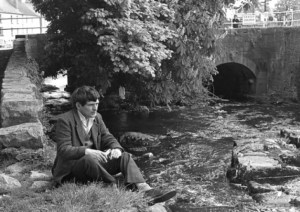
Statue of a pensive Michael Hartnett in The Square, Newcastle West.
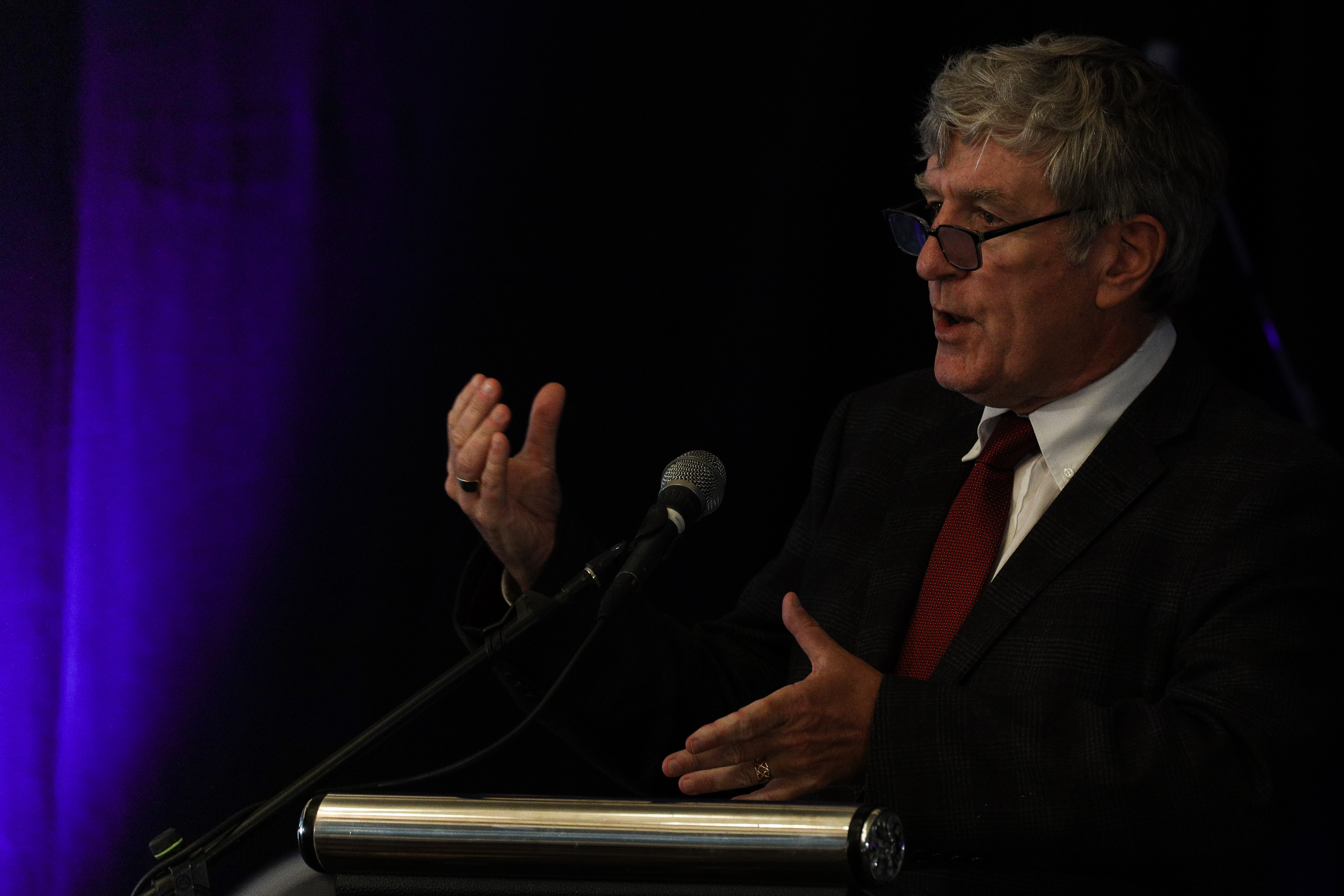
Ambassador Dan Mulhall, addressing the audience during his Michael Hartnett Memorial Lecture at Éigse Michael Hartnett. Photo credit: Dermot Lynch
Rebel Acts: Patrick Kavanagh, John Montague and Michael Hartnett
The Michael Hartnett Memorial Lecture, 2 October 2021
I have always been interested in the fact that Ireland’s era of supreme literary achievement – the time of Yeats and Joyce – coincided with its age of political transformation in the opening decades of the 20th century. This has given me an interest in what I call ‘history poems’, poetry that addresses issues of a political or societal nature.
Was this really a coincidence, or was the flowering of Irish literature in the first third of the 20th century somehow bound up with Ireland’s torrid escape from external rule in the aftermath of the Easter Rising. Were Irish literature and early 20th century Irish history two sides of the same coin?
During my student days in Cork, I was friendly with a number of up-and-coming poets who emerged there under the guidance of John Montague, who taught English at UCC. I refer to Tom McCarthy, Sean Dunne, Theo Dorgan and Pat Crotty. Although I could never write a line of verse myself as I do not have the gift or the courage for self-revelation of the kind that good poetry requires, I had an interest in poetry. It was through that interest that I met Michael Hartnett briefly when he came to UCC to do a reading there in the mid-1970s.
That was about the time when ‘A Farewell to English’ was published and I was intrigued by his caustic evocation of the ‘paradise of files and paper clips’. That seemed especially pertinent to me as I was about to join the Irish civil service. At the time, I was writing an MA thesis which explored the borderlands between literature and history. I made use of ‘A Farewell to English’ in that study in order to point out that our writers continued to have an awkward interface with Irish society and politics in the 1970s. Some of the lines from Hartnett’s poem have stayed in my mind throughout the intervening decades.
Hartnett’s poem reflected the disenchantment I had encountered elsewhere in Ireland’s literary canon. It seemed as if our writers acted as a kind of informal opposition to the conventions, pieties if you will, of independent Ireland.
I have long detected similarities between ‘A Farewell to English’ and Patrick Kavanagh’s ‘The Great Hunger’ and John Montague’s ‘The Rough Field’, three public poems that address key themes from experience as an independent country. In this talk, I want to reflect on those three poems all of which exhibit a crusading tone. Between them they offer a kind of potted history of 20th century Ireland, retold by three acute, articulate observers.
In ‘The Great Hunger’, Patrick Kavanagh excoriates the failings of rural Ireland. John Montague’s ‘Rough Field’ explores the sectarian conflicts and tensions that abounded in his home place, Garvaghey in County Tyrone. In Hartnett’s case, disappointment with the Ireland he knew runs through his poem. Between them, the three poets raise dissenting voices, disaffected from aspects of the Ireland they knew. They tell us something about 20th century Ireland. If journalism is the first draft of history as has been claimed, then literature is perhaps its second draft. Literary evidence also lives on in the public imagination in ways that other parts of our documentary archive does not.
The three poems do not, of course, tell us everything about 20th century Ireland, just as ‘Easter 1916’ does not give a full picture of the 1916 Rising, but that poem does capture something of the essences of the Rising. For their part, Kavanagh, Montague and Hartnett give us snatches of commentary on 20th century Irish life. What do they tell us?
The Great Hunger:
Reading it again in recent weeks, it is hard not to be deeply impressed with ‘The Great Hunger’(1942). It’s one hell of an achievement, even if the world it depicts has an antiquarian feel in the Ireland of Google, Starbuck’s and Amazon etc.
In a 1949 interview with The Bell, Kavanagh bragged that he was “the only man who has written in our time about rural Ireland from the inside” and that was fair comment. What I think he meant was that Yeats and other writers of the literary revival had spied rural Ireland from the outside, idealizing it in the process. Kavanagh had written about it at close quarters from his ungainly perch at Inniskeen in County Monaghan. Kavanagh certainly didn’t follow Yeats’s exhortation to ’sing the peasantry’ or to embrace the dream of ‘the noble and the beggarman’.
What we get in ‘The Great Hunger’ is a furiously gritty immersion in what the poet called
the apocalypse of clay
In every corner of this land.
This is what one critic has called an ‘anti-pastoral’ poem. The poet Brendan Kennelly has described ‘The Great Hunger’ as ‘a necessary realistic outburst from an essentially transcendental imagination.’ The tone is this poem is very different from Kavanagh’s better-known short poems, where his attitude to rural Ireland is more wistful. Here it is fierce. He pulls no punches in his evocation of the sexual frustrations of ‘poor Paddy Maguire’ and his fellow potato gatherers who are like ‘mechanised scarecrows’ ‘broken-backed over the Book of Death’.
Maguire is a man whose spirit:
Is a wet sack flapping about the knees of time.
He is not the ‘wise and simple man’ with the ‘sun freckled face’ as in Yeats’s dream of the ideal Irish countryman in his poem, ‘The Fisherman’. This is reality as Kavanagh saw it, a man bound to his fields,
Lost in a passion that never needs a wife.
Now that he is in his sixties and senses that life has passed him by, Maguire is:
not so sure if his mother was right
When she praised a man who made a field his bride.
Kavanagh’s insider’s account of rural Ireland is a stern antidote to notions of a rural idyll. There are those who see Kavanagh’s poem as a counterpoint to de Valera’s famous 1943 speech dreaming of rural Ireland ‘joyous with the sounds of laughter, the romping of sturdy children, the contests of athletic youths, the laughter of comely maidens, whose firesides would be the forums of the wisdom of serene old age.’ There is nothing serene about the anti-hero of ‘The Great Hunger’ who seems achingly aware of his dismal fate,
In Kavanagh’s version of rural Ireland, ‘life is more lousy than savage’ and those who live there are in ‘the grip of irregular fields’ from which ‘No man escapes.’ For the poet acting as sociologist, at the root of Paddy Maguire’s (and rural Ireland’s) frustrated unhappiness is a socially-enforced suppression of sexuality. In Kavanagh’s view, this is something that Maguire and the people around him bring on themselves.
Later in his life, Patrick Kavanagh sought to disown ‘The Great Hunger’ and its hectoring tone. He insisted that ‘A poet merely states the position and does not care whether his words change anything or not.’ I am not saying that ‘The Great Hunger’ was a harbinger of change, but it was part of a critique of the ‘dreary Eden’ carried out in the 1940s and 1950s through the pages of The Bell edited by Seán O’Faoláin, to which Kavanagh was a contributor.
As a public servant, I tend to trace the roots of modern Ireland to the publication of Economic Development in 1958, which, driven by a desire to stem the flight from rural Ireland that had reached epidemic proportions in mid-1950s, resolved to open up our economy in what turned out to be a game-change for Ireland. ‘The Great Hunger’ helps us to understand the social roots of rural Ireland’s depopulation.
The Rough Field:
The Rough Field was published in 1972, the year I began studying literature at UCC with John Montague as one of my lecturers, but the poems it incorporates were written during the preceding ten years. It has something in common with Kavanagh’s long poem (Montague was an admirer of Kavanagh’s poetry and an advocate for it) in that it explores Ireland’s rural world, in Montague’s case Garvaghey in County Tyrone. It is interesting that Kavanagh, Montague and Hartnett all hail from rural or small-town Ireland, quite different from the urban, and ultimately cosmopolitan backgrounds of Yeats and Joyce, modulated in Yeats’s case by his engagement with Sligo and Coole Park in Galway.
‘The Rough Field’ is a poem of exile and return. Montague, the boy from Garvaghey, having spent years in Dublin, Berkeley and Paris, re-engages with his home place and ‘the unhappiness of its historical destiny’. Like Kavanagh, he doesn’t go all pastoral on us. As he puts it,
No Wordsworthian dream enchants me here ..
But merging low hills and gravel streams,
Oozy blackness of bog-banks, pale upland grass; ..
Harsh landscape that hunts me,
Well and stone, in the bleak moors of dream.
Like ‘The Great Hunger’, ‘The Rough Field’ can be lyrical as remembrance of boyhood wells up:
Those were my first mornings
Fresh as Eden, with dew on the face,
Like first kiss, the damp air:
On dismantled flagstones,
From ash-smoored embers
Hands now strive to rekindle
That once leaping fire.
But the prevailing tone is stark, grim and, as in Kavanagh and indeed Hartnett, there is a side swipe at Yeats, this time his insistence that ‘Ancient Ireland knew it all.’:
Ancient Ireland, indeed! I was reared by her bedside,
Then rune and the chant, evil eye and averted head,
Formorian fierceness of family and local feud.
Perhaps the key line in this collection is when the poet, having brought to light the elemental unpleasantness of sectarian animosities in rural Tyrone, frees himself from the ‘dolmens round my childhood’ that had trespassed on his dreams:
Until once, in a standing circle of stones,
I felt their shadows pass
Into that dark permanence of ancient forms.
Here we have the poet seeking to put his past, and that of his home place, behind him, but can any society ever do that? Creating a kind of ‘permanence’ of historical memory in the public mind, hopefully not a dark one, may be one of the outputs from our Decade of Centenaries, putting our history in a settled place where it can be analysed and debated, but not fought over
Like Michael Hartnett in ‘A Farewell to English’, Montague muses on the ‘shards of a lost tradition’ and reflects on his father’s experience as an exile, one that was all too common to Irish people in the 20th century. He was:
the least happy
man I have known. His face
retained the pallor
of those who work underground:
the lost years in Brooklyn
listening to a subway
shudder the earth.
In the part of ‘The Rough Field’ known as ‘Patriotic Suite’, the poet turns his attention to independent Ireland and its discontents – ‘the gloomy images of a provincial catholicism’. Once at UCC in the mid-1970s, I heard Montague deliver an excoriating putdown of the deficiencies of the Ireland of that time and, drawing on Swift to fillet the ‘yahoos’ he believed were in the ascendant. In this poem he writes that:
All revolutions are interior
The displacement of spirit
By the arrival of fact,
Ceaseless as cloud across sky,
Sudden as sun.
Cheekily, he asks:
Does fate at last relent
With a trade expansion of 5 per cent?
His question is does prosperity help us deal with our demons, a puzzle that is still with us. I celebrate our material advancement as a people since the 1970s, but I accept that things of value can get lost in the process and that economic advancement does not guarantee wellbeing, which is more difficult to measure.
Then Montague brings us into the 1960s, where at ‘the Fleadh Cheoil in Mullingar:
There were two sounds, the breaking
Of glass, and the background pulse
Of music. Young girls roamed
The streets with eager faces,
Pushing for men. Bottles in
Hand, they rowed out for a song.
Puritan Ireland’s dead and gone ,
A myth of O’Connor and O’Faolain.
Montague’s final take on rural Ireland is ambivalent. He acknowledges that:
Only a sentimentalist would wish
to see such degradation again.
..
Yet something mourns.
It is the loss
of a world where action had been wrung
through painstaking years to ritual.
What, in Montague’s view has gone is:
Our finally lost dream of man at home
in a rural setting!
I recognise the issue of rural Ireland’s viability and equilibrium as a continuing priority for us in this century. What, I wonder, will our experience of the pandemic do to the urban/rural balance of our country?
A Farewell to English
This is by far the shortest of three works I discuss in this talk. It starts with a flourish.
Her eyes were coins of porter and her West
Limerick voice talked velvet in the house:
her hair black as the glossy fireplace
wearing with grace her Sunday-night-dance best.
She cut the froth from glasses with a knife
and hammered golden whiskies on the bar.
Now I know this is not a literary term, but that’s what I call ‘great stuff’. It’s a strong opening pitch. It reminds me of Kavanagh’s ‘Raglan Road’. But the poet’s unease emerges early on as he sinks his hands into tradition, ‘sifting centuries for words’, but the words he reaches for with ‘excitement’ and ‘emotion’ are Irish words.
It is clear to me that the poet’s turning away from the English language, ‘the gravel of Anglo-Saxon’ is a reflection of a more generalized disenchantment with the realities of what he calls ‘the clergy cluttered south’. He conjures up an image of Ireland’s leaders queueing up at Dublin Castle in 1922
to make our Gaelic
or our Irish dream come true.
But this ends up with us choosing
to learn the noble art
of writing forms in triplicate.
As it happens, when I joined the Department of Foreign Affairs in 1978, it was common to make 4 or 5 carbon copies of a letter, while ‘cut and paste’ meant using scissors and gum to cut up old documents and rearrange them!
In Hartnett’s vision, modern Ireland is the offspring of a ‘brimming Irish sow’ and ‘an English boar’. He concludes that
We knew we had been robbed
but we were not sure that we lost
the right to have a language
or the right to be the boss.
The image here is of unrealised national ambition and of materialism eclipsing identity.
In another echo of Yeats (‘Irish poets learn your trade’), he insists that
Poets with progress
make no peace or pact.
The act of poetry
is a rebel act.
Justifying his decision to abandon English, he takes the view that
Gaelic is our final sign that
we are human, therefore not a herd.
For Hartnett, therefore, the Irish language was a precious antidote to the stifling conditions he saw around him.
He concludes with a resounding broadside:
I have made my choice
and leave with little weeping:
I have come with meagre voice
to court the language of my people.
Hartnett’s poem confronts one of the unredeemed aspirations of 20th century Ireland, the effort to revive the Irish language. The Gaelic League helped radicalize a generation of Irish people at the turn of the century and became a driver of revolutionary activity. Patrick Pearse, Thomas MacDonagh and Eamon de Valera entered the world of Irish nationalism through the door of the Gaelic League. But the language revival stalled with independence. It flourished in the pronouncements of the State but not in the practice of the people. For Hartnett, I think it was the gulf between the rhetoric and the reality that spurred him to make the radical step of abandoning English, the language of the head – ‘the perfect language to sell pigs in’ – in favour of Irish, the language of the heart. The language question continues to be an important issue in discussions about Irish identity, in answering the ‘who are we’ question.
Conclusion:
When Michael Hartnett described poetry as ‘a rebel act’, he was not referring to the kind of rebellion that was the subject of Yeats’s ‘Easter 1916’. What his words suggest is that a poet’s default posture is dissatisfaction and disenchantment. 20th century Ireland has had a fraught relationship with its writers, Yeats, Synge, Joyce, Sean O’Casey, Sean O’Faolain, Samuel Beckett, Edna O’Brien and many others who strained against the nets of conformity.
What can we derive about 20th-century Ireland from these three long poems? Three things strike me:
The first is the aura of disappointment surrounding the actual fruits of independence. For Kavanagh, this revolved around the stunted condition of rural Ireland. For Montague, it was the failure to resolve sectarian tensions in Ulster and the dullness of life in Ireland compared with the expansiveness he had encountered elsewhere. And for Hartnett, it was the bureaucratization of Irish life and the abandonment of a vital part of our cultural patrimony.
The second is that rural Ireland is the laboratory in which the poets test what they saw as our national failings. The problems of rural Ireland and attempts to remedy them was the mainstay of the nationalist project throughout the 19th century. If independence was the solution to Ireland’s ills, then that ought to have been in evidence in rural society. In the three poems explored in this talk, all with rural settings, Monaghan, Tyrone and West Limerick, disappointment and disenchantment is the prevailing mood.
My third takeaway is that there are are shards of light visible in each poem. In Kavanagh whatever sense of hope the poem contains comes from its celebration of the natural world despite all its harshness. Take for example his image of ‘October playing a symphony on a slack wire’. In one passage, Kavanagh reflects on the fact that
..sometimes when sun comes through a gap
These men know God the Father in a tree:’
In Montague’s poem, it’s the social loosening of the 1960s epitomised by the Fleadh in Mullingar that gives him hope that ‘puritan Ireland’ is on its last legs. For Hartnett, it is the protective glow of Ireland’s language and traditions. Hartnett once referred to Irish as both ‘the soul’s music’ and ‘the bad talk you hear in the pub’. It is ‘a ribald language/anti-Irish’, by which I am sure he meant that its reality confounds traditional images of Irishness.
Given that the default position for these writers is critical, how will Irish literature fare in the more self-satisfied Ireland we now live in? What will the target be of the history poems of our 21st century? Will the present pandemic inspire meditations in verse on the subject of our national condition?
Not all Irish poetry revolves around the ‘bugbear Mr Yeats’, as Michael Hartnett described his eminent predecessor. Far from being an island of bad verse, today’s Ireland continues to produce a good fistful of poetic talent that can shine the light of imagination on our affairs.
Finally, to come back to literature and history, I want to mention a book I will publish in January entitled, Ulysses: A Reader’s Odyssey. I wrote it to mark the centenary of the publication of Joyce’s great novel and to record my own journey with, and through, Ulysses this past forty years. As a historian, I also see Ulysses as an invaluable portrait of an Ireland on the cusp of dramatic political change, an enduring monument in words to our country as it was a century and more ago. We are lucky to have so many wordsmiths, past and present, delving into our national life for, as Yeats once wrote, ‘words alone are certain good’.
Daniel Mulhall
About the Author…..
Ambassador Daniel Mulhall, Ireland’s current Ambassador to the United States delivered this year’s Michael Hartnett Memorial Lecture during the Éigse Michael Hartnett Literary and Arts Festival which took place from September 30th to October 2nd in Newcastle West, County Limerick.
The Ambassador was following in a long line of illustrious speakers who had previously delivered this prestigious lecture, including Donal Ryan, Theo Dorgan, Nuala O’Faolain, Paul Durban, Fintan O’Toole, Declan Kiberd and President Michael D. Higgins.
Daniel Mulhall was born and brought up in Waterford. He pursued his graduate and post-graduate studies at University College Cork where he specialised in modern Irish history and literature. He took up duty as Ireland’s 18th Ambassador to the United States in August 2017.
He joined the Department of Foreign Affairs in 1978 and had his early diplomatic assignments in New Delhi, Vienna (OSCE), Brussels (European Union) and Edinburgh where he was Ireland’s first Consul General, 1998-2001. He served as Ireland’s Ambassador to Malaysia (2001-05), where he was also accredited to Laos, Thailand and Vietnam. From 2009 to 2013, he was Ireland’s Ambassador to Germany. Before arriving in Washington, he served as Ireland’s Ambassador in London (2013-17).
In 2017, he was made a Freeman of the City of London in recognition of his work as Ambassador. In December 2017, he was conferred with an Honorary Doctorate by the University of Liverpool. In 2019, he was honoured with the Freedom of the City and County of Waterford. In November 2019, Ambassador Mulhall was named Honorary President of the Yeats Society in Ireland.
During his diplomatic career, Ambassador Mulhall has also held a number of positions at the Department of Foreign Affairs and Trade, including as Director-General for European Affairs, 2005- 2009. He also served as a member of the Secretariat of the Forum for Peace and Reconciliation (1994- 95). From 1995-98, he was the Department’s Press Counsellor and in that capacity was part of the Irish Government’s delegation at the time of the Good Friday Agreement 1998.
Ambassador Mulhall brings his deep interest in Irish history and literature to the work of diplomatic service in the U.S., describing the strong, historic ties and kinship between the countries as the basis for a vibrant economic and cultural relationship. He has lectured widely on the works of W.B. Yeats and James Joyce. His new book, Ulysses: A Reader’s Odyssey, is due for publication in January 2022. He is also the author of A New Day Dawning: A Portrait of Ireland in 1900 (Cork, 1999) and co-editor of The Shaping of Modern Ireland: A Centenary Assessment (Dublin, 2016).
A keen advocate of public diplomacy, Ambassador Mulhall makes regular use of social media in order to provide insights into the work of the Embassy, to promote all things Irish and to engage with Irish people and those of Irish descent around the world. He provides daily updates on his Twitter account @DanMulhall and posts regular blogs on the Embassy’s website.
The restored 151-year-old bridge which has been reopened to pedestrians in Newcastle West. Picture: Marie Keating, Limerick Leader
The Iron Bridge referred to here is a commemorative footbridge spanning the Arra River. it has been used for generations to facilitate Mass goers making their way on foot to the parish church in Newcastle West from Maiden Street and in more recent times from Assumpta Park, via The Mass Steps. The bridge was erected by the Devon Estate in 1866 to commemorate Edward Curling JP who had been the local agent for the Estate in Newcastle West in the nineteenth century. It is often referred to locally as the Curling Bridge and following recent restoration, the iconic bridge has once again been restored to its former glory.
Crossing the Iron Bridge
By Michael Hartnett
‘My dear brethren, boys and girls, today is a glorious day! Here we have a hundred lambs of our flock, the cream of the town, about to receive the Body and Blood of Christ, about to become Children of God, and to enter into a miraculous Union with Jesus ….’
Into the cobweb-coloured light,
my arms in white rosettes,
I walked up Maiden Street
across the Iron Bridge
to seek my Christ.
‘It will be a wonderful moment when the very Body and Blood of Our Lord Jesus Christ is placed upon your tongues – what joy there will be in Heaven! So many valuable little souls safely into the Fold! Look behind the Altar! There will be angels there, ascending and descending, singing songs of joy…’
Into the incense-coloured light,
my arms in white rosettes,
I walked the marbled floor
apast parental eyes
to seek my Christ.
‘Christ will be standing there in all His Glory, His Virgin Mother will smile and there will be a great singing in Heaven…’
Under the gilded candlelight,
my arms in white rosettes,
my mouth enclosed my God,
I waited at the rail
to find my Christ.
‘There will be the glow of God in your veins, your souls will be at one with Heaven: if you were to die today, angels would open the Gates of Paradise, and with great rejoicing bear you in …’
Back to the human-hampered light,
my arms in white rosettes,
I walked: my faith was dead.
Instead of glory on my tongue
there was the taste of bread.
Commentary
This is a memory poem and the poet – now an adult – remembers his First Holy Communion Day which probably took place in 1948 or so. From an early age, we can see that the young Hartnett is not overly impressed by the flowery hyperbole, the sense of ceremony and ritual in his local parish church in Newcastle West. He tells us that instead of feeling ‘the glow of God in (his) veins’, he says very simply, without any adornment that ‘my faith was dead’.
There are two contrasting voices in this poem – the eloquent words of the priest who speaks in grandiose, biblical phrases and the very sparse, repetitive voice of a young boy of seven. The poem traces the young poet’s journey from his home in Maiden Street, across the Iron Bridge, up the aisle of the church to the altar rails. The poet, like a painter or photographer, notices the differing lights as he progresses: ‘cobweb-coloured light’, ‘incense-coloured light’, ‘gilded candlelight’, and finally ‘human-hampered light’.
The priest’s homily is worthy of our attention. Firstly, we have to remember that for the young listeners and their parents, family and friends these are the only words that they would have understood on this special day because Latin would have been used by the priest for the remainder of the ceremony. Secondly, while the majority of the homily uses classical biblical symbolism the poet impishly has him mix his metaphors here: ‘Here we have a hundred lambs of our flock, the cream of the town’. It is highly unlikely that the priest would have used the phrase ‘the cream of the town’ in this context. However, the allusion to ‘a hundred lambs’ is taken directly from the New Testament parable of the Lost Sheep or The Good Shepherd. Ironically, in the context of the poem the priest is already down to ninety-nine. The poet at seven casts himself as The Lost Sheep of the parish. Little wonder then that later in his seminal poem, ‘A Farewell to English’ he would boldly declare:
Poets with progress
make no peace or pact.
The act of poetry
is a rebel act.
As the poem develops, the exaggerated, formulaic words of the priest are interspersed with the young poet’s reactions – in a word, he is not impressed. The exaggerated language, the sense of ceremony, the ‘white rosettes’ on the sleeves of his good clothes all fail to impress. For months now he had been led to believe that as this day unfolded he would not only ‘seek’ but ‘find’ his Christ. As the ceremony ends his sense of disappointment and anti-climax is palpable.
Instead of glory on my tongue
there was the taste of bread.
As he makes his way on foot with his family across the iron bridge in the early morning he is conscious of the ‘cobweb-coloured light’. This is soon replaced for the young, observant First Communicant by scenes of grandeur in the church with ceremonial incense wafting through sunlight beams and ‘gilded candlelight’. As he makes his return journey, deflated and unmoved by the experience in the church, he is aware of the troubling juxtaposition. Once more he leaves the church, crosses the road and the iron bridge again on his homeward journey to Lower Maiden Street, ‘Back to human-hampered light’.
The poem could be interpreted as Hartnett’s equivalent of Stephen Dedalus’s ‘Non Serviam’ in A Portrait of the Artist as a Young Man; his retrospective rejection of organised religion. Stephen had often trod the maze of Dublin streets seeking escape of one kind or another, and it is only when he crossed the bridge to Bull Island and stared out to sea that he finally glimpses the vision of true fulfilment. He cannot find this fulfilment without flight. So Stephen sets out, ‘to encounter for the millionth time the reality of experience and to forge in the smithy of my soul the uncreated conscience of my race.’ Hartnett also seeks to escape and in ‘A Farewell to English’ we read his own declaration of intent:
I have made my choice
and leave with little weeping:
I have come with meagre voice
to court the language of my people.
So Hartnett, too, rejects the nets which confine and constrict him and in an article written for The Irish Times[1] in 1975 where he endeavoured to explain his reasons for changing to Gaelic, he declared that ‘I have no interest in Conradhs, Cumanns or churches’ – rejecting at one fell swoop well-meaning Irish language organisations, all political parties and the Catholic Church. Years later, in December 1986 in an interview with Dennis O’Driscoll[2] he makes the rather bold, even outrageous, tongue-in-cheek assertion:
I was never a Catholic …… I was fortunate to be born in a house where my father was not a Catholic. He was a socialist with Taoist leanings – though to say this is to talk with hindsight; like all poets, I can foretell the past.
Indeed, his poetry and other writing often contain unflattering references to the Catholic clergy, long before this became de rigueur. In Section 7 of his great poem ‘A Farewell to English,’ he confides in us that his voice is ‘nothing new’. He is not alone in trying to hew out a place for culture ‘in the clergy-cluttered south’. However, for those familiar with his poetry it has to be said that he reserves an even greater opprobrium for bishops!
In St. Michael’s Church
a plush bishop in his frock
confirms poverty.
On his homeward journey after the First Communion ceremony the young Lost Sheep again crosses the Iron Bridge and for him, it is akin to crossing his first Rubicon. Even then at that tender age of seven, like Stephen Dedalus, he has already decided to fly the nets of organised religion and in crossing the iron bridge he symbolically turns his back on all that this entails.
[1] Michael Hartnett. Why Write in Irish? The Irish Times (26th August 1975).
[2] The interview first appeared in Poetry Ireland Review (Autumn 1987).
The Iron Bridge (Curling’s Bridge) as seen in a National Library of Ireland photograph from 1903.
Memories of the Past – Episode 80 filmed by the late John Joe Harrold – First Communion Day in Newcastle West.
Formative Influences on the young Michael Hartnett
Brigid Halpin’s cottage in Camas as it is today. The photograph is by Dermot Lynch.
Bridget Halpin, formerly Bridget Roche, was born in Cahirlane, Abbeyfeale in 1885 to parents John Roche and Marie Moloney. According to parish records in Abbeyfeale, she married Michael Halpin from Camas, near Newcastle West, in Abbeyfeale Church on February 28th,1911 in what was, by all accounts, ‘a made match’ between both families and she then came to live in Camas where the Halpins owned a small farm of ten acres three roods and 13 perches. Later on that year on April 2nd, 1911, the Census returns for Camas in the parish of Monagea, record Michael Halpin, aged 36, living with his new wife Bridget Halpin, then aged 26. Michael’s mother Johanna, aged 74, and her daughter, Michael’s sister, Johanna, aged 23, also lived in the house.
Michael Halpin, Bridget’s husband, was born on 2nd June 1876 in Camas. He was one of thirteen children born to Denis Halpin and Johanna Browne between 1866 and 1890. Denis Halpin, Michael’s father, was born c. 1834 in Cleanglass, in the parish of Killeedy, and he married Johanna Browne on the 18th of February 1865 in the Catholic Church in Tournafulla. He was 31 years of age and Johanna Browne was 25. Living conditions were very harsh and infant mortality was very high and as many as seven of their thirteen children died in their infancy or childhood due, no doubt, to the severity and austerity of the times. Six of their thirteen children survived: Margaret, Kate, Michael, Denis, Cornelius, and Johanna.
This woman, Bridget Halpin, would later wield great influence over her young grandson Michael Hartnett. Indeed, if we are to believe the poet, she was the one who first affirmed his poetic gift when one day he told her that a nest of young wrens had alighted on his head – her reply to him was, ‘Aha, You’re going to be a poet!’. Hartnett claimed that he spent much of his early childhood in Bridget Halpin’s cottage in the rural townland of Camas four miles from his home in nearby Newcastle West. He went on to immortalise this woman in many of his poems but especially in his beautiful poem, “Death of an Irishwoman”. This quiet townland of Camas is seen as central to his development as a poet and central to some of the decisions and seismic changes which he made in his poetic direction in the 1970’s. Maybe in time, this early association with Camas will be given its rightful importance and the little rural townland will vie with Maiden Street or Inchicore as one of Hartnett’s important formative places. This essay, therefore, is an effort to throw some light on this woman and gently probe her background and genealogy and it also seeks to untangle some of the myths, many self-generated, which have grown up around Michael Hartnett himself.
In April 1911 when the Census was compiled, there were four inhabitants of the thatched cottage in Camas: Michael Halpin, his new wife Bridget (née Roche), his mother Johanna and his sister Johanna who was soon to emigrate to the United States in late May 1911. By June of that year, Michael and Bridget Halpin were setting out on their married life together and they also had the care of Michael’s mother, Johanna. Over the coming years, they had six children together, Josie, Mary, Peg, Denis, Bridget (later to be Michael Hartnett’s mother) and Ita. Unfortunately, Michael Halpin died in September 1920 at the age of 44 approx. having succumbed to pneumonia. His daughter Ita was born seven months later on 23rd March 1921. Bridget Halpin was now left with the care of her six young children and their ailing grandmother, Johanna. Johanna Halpin (née Browne) died in Camus on 18th June 1921 aged 80 years of age.
Bridget Halpin’s plight was now stark and the harshness of her existence is often alluded to in her grandson’s poems which feature her. The cottage which was little more than a three-roomed thatched mud cabin built of stone and yellow mud collapsed around 1926. The whole family were taken in, in an extraordinary gesture of neighbourliness, by Con Kiely until a new cottage was built a short distance away by a Roger Creedon for the princely sum of £70. The family moved into their new home in 1931 and this is the structure that still stands today. According to Michael Hartnett himself this cottage, and especially the mud cabin which preceded it, was renowned as a ‘Rambling House’, a cottage steeped in history, music, song, dance, cardplaying and storytelling. Hartnett would have us believe that it was from the loft in this cottage that he began to pick up his first words of Irish from his grandmother and her cronies as they gathered to play cards or tell tall tales.
Bridget Halpin’s youngest daughter, Ita Halpin, later married John Joe Dore, who lived on a neighbouring farm. He was a well-known sportsman, hurling historian and founder member of Killeedy GAA Club. They had one son, Joe Dore, who today is a well-known Traffic Warden in Newcastle West and Abbeyfeale. Today, he is the owner of what was formerly Bridget Halpin’s small farm in Camas, having inherited it from his uncle, Denis Halpin. John Joe Dore died in 2000 aged 85. Bridget Halpin, immortalised by her grandson, Michael Hartnett, in his poem ‘Death of an Irishwoman’ is buried with her daughter Ita Halpin (Dore) in the grounds of the old abbey in Castlemahon Cemetery.
Bridget Halpin’s grave in Castlemahon Cemetery. She is buried with her youngest daughter Ita Dore (nee Halpin). Her husband Michael, her son Denis and her sister Mary Kiely (nee Halpin) are also remembered on the headstone.
Ita Halpin’s sister, Bridget Mary, who was born on 1st May 1918 later married Denis Harnett (born 20th July 1914) from North Quay, Newcastle West on the 28th of June 1941 in Newcastle West and they had six children. Michael Hartnett[1] was the eldest and he had one sister, Mary, and four brothers, William, Denis, Gerard, and John. (Two siblings, Patricia and Edmond, also died as infants). Times were difficult for the Harnett family; they did, however, receive some good fortune when they moved into a house, in the newly built local authority development, Assumpta Park, in the 1950s. Joe Dore, Michael’s first cousin, recalls that during the war years (1941-1945 in Michael’s case) Michael was often brought to Camas in a donkey and cart to be looked after by his grandmother and his Uncle Denis (Dinny Halpin), who was now working ‘the small farm’. Joe Dore recalls that ‘his other brothers came to stay as well, especially Bill, but Michael, being the eldest, was the favourite of his grandmother’ – no doubt because he was her daughter Bridget’s first-born and also that he had been called Michael after her late husband. Joe Dore remembers that ‘Michael was a big boy when I knew him as he was twelve years older than me, as I was the last of the grandchildren to be reared by my grandmother and Uncle Denis also’.
This essay seeks to clarify some of Michael Hartnett’s claims concerning his grandmother, Bridget Halpin. Interestingly, most of these erroneous claims stem quite remarkably from the poet himself! His Wikipedia page tells us that,
… his grandmother, was one of the last native speakers to live in Co. Limerick, though she was originally from North Kerry. He claims that, although she spoke to him mainly in English, he would listen to her conversing with her friends in Irish, and as such, he was quite unaware of the imbalances between English and Irish, since he experienced the free interchange of both languages.
Writing in the Irish Times in August 1975 Hartnett wrote:
My first contact with Gaelic – as a living language – was in 1945 when I went to stay with my grandmother. She was a “native” speaker and had been born in North Kerry in the early 1880s. She rarely used Gaelic for conversation purposes but a good fifty percent of her vocabulary was Gaelic – more especially those words for plants, birds, farm implements, etc. …….. I learnt some two thousand words and phrases from her. It was not until her death in 1967 that I realised I had known a woman who embodied a thousand years of Gaelic history (Hartnett, ‘Why Write in Irish?’, p.133).
We have already noted that Bridget Roche (neé Halpin) was born in Cahirlane, Abbeyfeale, County Limerick. While this area is steeped in Irish culture and music it was not particularly noted for its native Irish speakers in the late 1800s. In the 1901 Census returns for Camas Upper and Camas Lower respondents were asked a question concerning their knowledge of the Irish language. In Camas Upper and Lower 36 people out of a total of 175 counted in the census stated that they were proficient in ‘Irish and English’, including Johanna Halpin, Bridget Halpin’s future mother-in-law. This works out at 20% of respondents. In the 1911 Census returns, the year Bridget Roche married Michael Halpin, respondents were asked the same question and 29 adults responded. In the 1911 Census, there is no division of the townland and the total number enumerated in the Census is lower at 141. The percentage of respondents who said they had proficiency in Irish and English remains at 20%, however. Interestingly, and this may, of course, suggest a certain carelessness in compiling the statistics of the census on behalf of the local enumerator, there is nothing in the returns for the Halpin family to suggest that they are proficient in Irish, although both Johanna and Bridget are marked present.
His often repeated claims about Bridget Halpin’s prowess in the Irish language are, therefore, exaggerated. She obviously had many phrases and sayings in Irish but it is very doubtful if she had the capacity to carry out a conversation in Irish. Therefore, the myth that Michael Hartnett picked up a new language by osmosis or by listening to Bridget, ‘the native Irish speaker’ or her cronies while he lay in the loft during acrimonious card games is largely that, a myth. The reality is that his love of the language was also developed by his study of and admiration for the poets of the Maigue and the Bardic past. It was also helped by his study of Irish in school, in Irish College in Ballingeary and by his association with many poets and dramatists writing in Irish and also by his relationships in the early nineteen-sixties, particularly his relationship and collaboration with Caithlín Maude and his later collaboration in the 1980’s with Nuala Ní Dhomhnaill, translating her first volume, Selected Poems: Rogha Dánta, into English.
Hartnett’s public comments and writings also cause some confusion concerning Bridget Halpin’s age. In the acclaimed documentary directed by Pat Collins in 1999, shortly before Hartnett’s untimely demise, entitled ‘A Necklace of Wrens’, Hartnett states that Bridget Halpin was born in 1870, when in fact we know from Census returns that she was born in 1885. He also states that she was 93 when she died in 1967 when in fact she was a mere 80 years of age when she died in 1965!
It is clear, therefore, that many of these claims regarding his grandmother are greatly exaggerated. For example, he has stated on numerous occasions that he was effectively reared by his grandmother from a young age on her small farm in Camas. However, from school attendance records we learn that Michael Hartnett attended the Courteney Boys National School in Newcastle West on a regular basis from September 1949 when he entered First Class (having attended the Convent School, now Scoil Iosaef, for Junior and Senior Infants) until June 1955 when he completed Sixth Class. His attendance during those years was exemplary, rarely missing a day, this, despite his claims in the documentary, ‘A Necklace of Wrens’, that he was ‘a sickly child, and still am’. He then transferred to St. Ita’s Boys Secondary School, then housed in the Carnegie Library in the town to pursue Secondary Education. His sojourns to Camas would, therefore, only have been at weekends and during school holidays as it was at least a four-mile walk. However, it is not contested that the small farm in Camas and Bridget Halpin, his grandmother, played a very important role in providing sustenance and much-needed nourishment for the young Harnett family in Maiden Street during the 1940’s and 1950’s.
Michael Hartnett’s first cousin, Joe Dore, has clear recollection that ‘the poet’ was a frequent visitor to Camas, ‘except when there was hay to be saved’. John Cussen, local historian and friend of the poet says that,
‘Michael Hartnett and I were in the same class in the Courteney School for several years until 1954 when I went to Boarding School (in Glenstal). We were good friends. He was certainly always living in town at that time. I do not recall him ever talking about his grandmother or his sojourns in Camas with her. We were too busy swopping comics which was all the rage at the time!’
Patrick Kavanagh says in his poem, ‘Come Dance with Kitty Stobling’, ‘Once upon a time / I had a myth that was a lie but it served’. Hartnett, too, had his myths and why not? In the ‘Maiden Street Ballad’ he states:
I have told ye no big lies and most of the truth –
not hidden the hardships of the days of our youth
when we wore lumber jackets and had voucher boots
and were raggy and snot-nosed and needy.
Indeed, prior an interview with the poet Dennis O’Driscoll which took place in the offices of Poetry Ireland on 12th December, 1986, Hartnett in a typically mischievous tone told his interviewer:
I always lie at interviews. I don’t lie as such, but I change my mind so often … I refuse to have what is known in the trade as a ‘coherent metaphysic’ (O’Driscoll, p.140).
So, therefore, we must approach with some caution the various and numerous claims made by the poet concerning his grandmother, Bridget Halpin. One credible explanation for many of these claims is that he wanted to portray his grandmother as the quintessential ‘nineteenth-century woman’ who never came to terms with the political, social and cultural changes which were brewing in Ireland in the late nineteenth century. He saw her as a symbol for all that was lost in the traumatic early years of the Twentieth Century in Ireland. In Hartnett’s view one of the many precious things which was lost, ignored, and abandoned was the Irish language itself and so his poem, “Death of an Irishwoman”, which he described as ‘an apology’ to his grandmother, can also be read as a post-colonial lament. Therefore, it would have been more convenient if she had been born in 1870 rather than 1885. Hartnett always considered Bridget Halpin to be a woman ‘out of her time’. She never came to terms with the New Ireland of the 1920’s, 1930’s, and though her life spanned two centuries she was, in his eyes, still living in the past, ‘Television, radio, electricity were beyond her ken entirely’ (Walsh 13). To her, ‘the world was flat / and pagan’, and in the end,
she clenched her brittle hands
around a world
she could not understand.
He has placed Bridget Halpin on a pedestal for his own good reasons. He saw in her a remnant of a generation in crisis, still struggling with the precepts of Christianity and still familiar with the ancient beliefs and piseogs of the countryside. This is a totally different place when compared to, for example, Kavanagh’s Inniskeen or Heaney’s Mossbawn. There is an underlying paganism here which is absent from Kavanagh’s work, whose poetry, in general, is suffused with orthodox 1950’s Catholic belief, dogma and theology. For Hartnett, his grandmother represents a generation who lived a life dominated by myth, half-truth, some learning, limited knowledge of the laws of physics, and therefore, as he points out in ‘Mrs Halpin and the Thunder’,
Her fear was not the simple fear of one
who does not know the source of thunder:
these were the ancient Irish gods
she had deserted for the sake of Christ.
However, Hartnett’s powers of observation and intuition were honed in Camas on Bridget Halpin’s small farm during his frequent visits. His poem, “A Small Farm”, has great significance for the poet and it is the first poem in his Collected Poems, edited by Peter Fallon and published by The Gallery Press in 2001. He tells us that he learnt much on that small farm during those lean years in the forties and early fifties,
All the perversions of the soul
I learnt on a small farm,
how to do the neighbours harm
by magic, how to hate.
The struggle to make a success and eke out a living was a constant struggle and burden. The begrudgery of neighbours, the ‘bitterness over boggy land’, the ‘casual stealing of crops’ went side by side with ‘venomous cardgames’, ‘a little music’ and ‘a little peace in decrepit stables’ (“A Small Farm”). The similarities with Kavanagh’s, “The Great Hunger”, are everywhere but interestingly Hartnett does not name this place, it is an Everyplace. The poem is simply titled, “A Small Farm” so there is no Inniskeen, Drummeril, or Black Shanco here but the harshness and brutality of existence, ‘the cracked calendars / of their lives’ (ibid) in the fifties in Ireland is given a universality even more disturbing than the picture we receive from Kavanagh. Yet, it is here that he first becomes aware of his calling as a poet and often to avoid the normal household squabbles of his grandmother and her son he ‘abandons’ them and begins to notice the birds and the weeds and the grasses,
I was abandoned to their tragedies
and began to count the birds,
to deduce secrets in the kitchen cold,
and to avoid among my nameless weeds
the civil war of that household.
Later in, “For My Grandmother, Bridget Halpin”, he again alludes to the wildness, the paganism, the piseógs that surrounded him during his childhood in Camas. His grandmother’s worldview is almost feral. She looks to the landscape and the birds for information about the weather or impending events,
A bird’s hover,
seabird, blackbird, or bird of prey,
was rain, or death, or lost cattle.
This poorly educated woman reads the landscape and the skies as one would read a book,
The day’s warning, like red plovers
so etched and small the clouded sky,
was book to you, and true bible.
We know that Michael was in Morocco when Bridget Halpin died in 1965 in St. Ita’s Hospital in Newcastle West where she was being cared for. In this poem there is also a reference to his Uncle Denis (Dinny Halpin) who helped rear him and who was eventually to inherit the small farm from his mother, Bridget when she died,
You died in utter loneliness,
your acres left to the childless.
Hartnett is taking a great risk here, that of alienating those closest to him with his disparaging comments on his relations. We know that this trait of outspokenness was to become a feature of his art; his poetry was often scathing and rebellious. However, in this regard, surely the biggest risk he takes is in the first lines of “Death of an Irishwoman”, when he describes his grandmother, Bridget Halpin, as ‘ignorant’ and ‘pagan’. This is nearly as risky and risqué as Heaney’s bold and brave comparing of his wife to a skunk in the poem of that name! Only a favourite, a truly loved one could get away with such braggadocio! The poem’s ending, however, with its exquisite cascade of metaphors surely makes amends for his earlier gaffe.
Therefore, the townland of Camas and Bridget Halpin’s small farm holds a very special place and influence on Michael Hartnett’s psyche. His first published work appeared in the Limerick Weekly Echo on the 18th of June 1955 while he was still in Sixth Class in the Courteney Boys School. He was thirteen. Entitled “Camas Road”, it describes in particular detail an evening rural vista of the townland of Camas, a place which would feature on numerous other occasions in his poetry, becoming central to his development as a poet. It is similar to Heaney’s “Sunlight” poems representing an idyllic childhood upbringing. Its two eight-line stanzas of alternating rhyme and regular metre contain a litany of natural images, at times idiosyncratically rendered; the ‘timid hare sits in the ditch’, ‘the soft lush hay that grows in fields’. It is a peculiar mix of a poem, seemingly authentic words and images from the poet’s experience placed together with those gleaned from the literary prop-box crafted by Manley Hopkins or Wordsworth, testament, no doubt, to the young poet’s voracious appetite for reading and possibly due to the influence of his teacher, Frank Finucane. It is doubly imitative, drawing upon the romantic tradition of nature poetry, as well as the more local genre, poems written by local poets, people, ‘like Ahern and Barry before me’ – poems written exclusively for local consumption. Thirteen-year-old Hartnett depicts an idyllic setting,
A bridge, a stream, a long low hedge,
A cottage thatched with golden straw,
The harshness of later poems is not evident and the poem serves as a record of his childhood in Camas surrounded by nature and its abundant riches. However, at poem’s end there is a growing awareness that this idyllic phase of his life is coming to an end and he declares rather poignantly,
The sun goes down on Camas Road.
The townland of Camas is also central to an episode that the poet recounts for us in his seminal poem, “A Farewell to English”. This encounter hovers somewhere between reality and dream, aisling (the Irish word for a vision) or epiphany. The incident takes place at Doody’s Cross as the poet walks out one summer’s Sunday evening from Newcastle West to the cottage in Camas. He is on his way to meet up with his uncle, Dinny Halpin. He sits down ‘on a gentle bench of grass’ to rest his weary feet after his exertions when he sees approaching him three spectral figures from the Bardic Gaelic past – Andrias Mac Craith, Aodhagán Ó Rathaille, and Daíbhí Ó Bruadair. These ‘old men’ walked on ‘the summer road’ with
Sugán belts and long black coats
with big ashplants and half-sacks
of rags and bacon on their backs.
They pose as a rather pathetic group, ‘hungry, snot-nosed, half-drunk’ and they give him a withering glance before they take their separate ways to Croom, Meentogues and Cahirmoyle, the locations of their patronage, ‘a thousand years of history / in their pockets’. Here Hartnett is situating himself as their direct descendent and the inheritor of their craft and the enormity of this epiphany occurs at Doody’s Cross in Camas: the enormity of the task that lies ahead also terrifies and haunts Hartnett.
As another part of the myth that he had created, Hartnett always laid great emphasis on the fact that he had been born in Croom. He was immensely proud of this fact. In an interview with Dennis O’Driscoll for Poetry Ireland he stated:
I am the only ‘recognised’ living poet who was born in Croom, County Limerick, which was the seat of one of the last courts of poetry in Munster: Sean Ó Tuama and Andrias MacCraith. When I was quite young, I became very conscious of these poets and, so, read them very closely indeed (Dennis O’Driscoll Interview for Poetry Ireland, p, 143).
Andrias Mac Craith (c. 1709 – c. 1794), in particular, was an important influence on Hartnett. MacCraith had, for a time, very close associations with the town of Croom in County Limerick (although, it is believed, he had been born in Fanstown near Kilmallock). As already mentioned, Hartnett had long dined out on the fortuitous coincidence that he too had strong associations with Croom having been born there. However, he neglects to inform us that most of the babies born in Limerick in 1941 were also born in St. Nessan’s Maternity Hospital in Croom! He would have been in Croom for less than a week before he returned to Lower Maiden Street to the accommodation which his family rented from the eponymous Legsa Murphy who also owned a bakery near Forde’s Corner in Upper Maiden Street. However, in the mid to late 1700’s Andrias MacCraith, who was also known as An Mangaire Sugach or The Merry Pedlar (he was not a pedlar, but a roving schoolmaster), and his fellow poet and innkeeper, Sean Ó Tuama an Ghrinn (Sean O’Tuama The Merrymaker), had transformed Croom into a centre for poetry and the seat of one of the last ‘courts’ of Gaelic poetry. The town became somewhat notorious and became known widely as Cromadh an tSughachais, roughly translated as Croom of the Jubilations – (today it would obviously be known as Croom of the Craic)! Hartnett would have loved this vibrant, anarchic milieu and this is why Mac Craith had such an influence over him. Hartnett saw himself as a natural descendent of these poets and the motivation behind his ‘rebel act’ in 1974 was largely an effort to revive the interest in Irish, and poetry in Irish, which had earlier been generated by these poets who were known collectively as the Maigue Poets, in honour of the River Maigue which runs through Croom. His lovely poem, “A Visit to Croom, 1745” is his effort to recreate the tragic changes that were imminent, he tells us he had walked fourteen miles ‘in straw-roped overcoat’,
…… to hear a Gaelic court
Talk broken English of an English king.
As with almost everything that surrounds Hartnett, therefore, our task is to try to discern fact from fiction, myth from reality. We know that Hartnett was a frequent visitor to Camas until he was twelve or thirteen and that his grandmother, Bridget Halpin, considered him to be her favourite grandson. We also know that there were fragile remnants of a dying language and culture and customs still evident in the area. His later momentous disavowal of his earlier work in English and his abandonment of his standing as an emerging poet in 1974 is not hugely surprising when we consider the influences brought to bear on him during those extremely important formative years in Camas. Surely those beautiful, descriptive, soothing Irish adjectives repeated as a mantra in “A Farewell to English”, ‘mánla, séimh, dubhfholtach, álainn, caoin’, which are used to describe the raven haired buxom barmaid in Moore’s Bar or Windle’s Bar in Carrickerry, could also be used to describe his grandmother, Bridget Halpin herself? The encounter depicted in the second section of the poem, “A Farewell to English”, and referred to earlier, can also be read as an example of Hartnett realising what he suggests artists do in his beautiful poem, “Struts”. He is,
……. climbing upwards into time
And climbing backwards into tradition.
So, Bridget Halpin’s small farm in Camas may have been small and full of rushes and wild iris’s but it helped produce one of Ireland’s leading poets of any century. The influences absorbed in this rural setting, his powers of observation, his knowledge of wildlife and flowers, his ecocentric bias, are impressive and all-pervasive in his poetry. Without prejudice, it also has to be said that he demonstrates a deeper knowledge of all local flora and fauna than could be reasonably expected of a ‘townie’! In his own words, he has told us ‘no big lies’ and, though questionable, there was, we believe, ‘method in his madness’. When we examine closely his impressive body of work we notice that apart from Camas very few other rural places are mentioned or named in his poetry. He later left and went to Dublin, London, Madrid, Morocco but when he had work to finish he came back to rural West Limerick and to another beautiful neighbouring townland, Glendarragh, to embark on the work for which he will, if there is any justice, be best remembered.
*****
He was an ice-cream chimes ringing in an Inchicore estate.
He was the commotion stirred up at a country wake.
He was a game of hopscotch played in Maiden Street.
He was a plaintive flamenco note picked out by a gypsy.
He was the palpitation of hooves at a small-town horse fair.
He was a book-barrow dictionary, teeming with disused words.
He was a neglected cottage where a songbird nests.
He was the full-moon shedding light on Newcastle West.
– Dennis O’Driscoll
Works Cited
‘A Necklace of Wrens’ (Film). Harvest Films. 1999
Hartnett’s Wikipage
Hartnett, Michael. Why Write in Irish? in Metre, Issue 11, Winter 2001 – 2002, p.133
Hartnett, Michael. Collected Poems, Oldcastle: The Gallery Press, 2001.
Ní Dhomhnaill, Nuala. Selected Poems: Rogha Dánta. Translated by Michael Hartnett, Dublin: Raven Arts Press, 1986.
O’Driscoll, Dennis. Michael Hartnett Interview in Metre, Issue 11, Winter 2001 – 2002.
Walsh, Pat. A Rebel Act: Michael Hartnett’s Farewell to English, Cork: Mercier Press, 2012.
Sources: My gratitude is extended to Joe Dore and John Cussen for their invaluable assistance in compiling this piece of research.
[1] Michael Hartnett’s family name was Harnett, but for some reason, he was registered in error as Hartnett on his birth certificate. In later life, he declined to change this as it was closer to the Irish Ó hAirtnéide.
Bridget Halpin’s derelict cottage as it was in early 2017. The cottage is presently undergoing a major extension. (Photo Credit: Dermot Lynch)
You must be logged in to post a comment.