I like to spend my lazy days in the garden. When Kate and I set up home in Knockaderry in 1979, we inherited a garden and a red setter called Kelly. Then there was the recently acquired three-quarters of an acre, which was a very overgrown, forbidding blank canvas. The previous owners had made some effort and had put in a new bed of floribunda roses – the variety was Peace. There were other older roses there also, from previous owners, right back to Miss Airey, the original owner of the house. Miss Airey was a teacher in the old national school in Ahalin, and she built the house in 1935 and lived there with her companion, Mrs Sheehy. There were two or three Queen Elizabeth roses holding pride of place, which had been planted in 1952 to commemorate Queen Elizabeth’s coronation that year. They were still hale and hearty when we arrived in September 1979, and they are still going strong today!
Kelly helped us settle in. He was a beautiful Red Setter who had come all the way from Scarborough with the previous owners, the O’ Rourkes. He slept in the back bedroom, and he ruled the roost. Each afternoon, he escorted the school kids to the bend in the road on their way home from school, at a time when school kids still walked to school. One evening, Frank Moore called to fix our phone, and he rang the doorbell to discover that both Kate and I were still at work. Kelly soon discovered the intruder, and he came and sat in his sitting position, strategically blocking Frank’s escape. He emitted the odd low growl until we arrived home at five o’clock, and Frank was glad to be released from his captivity. Until recently, and especially when Mary and Don were young and still at home, we always had a dog. We had numerous red setters, Susie the Old English Sheepdog, a Lassie-type collie, a Cocker Spaniel named Robbie (Fowler), and a Golden Retriever from hell called Oatie!
However, to be brutally honest, when we took up residence, the garden, like the house, was somewhat of a shambles! I remember distinctly going into the Bank of Ireland branch in Newcastle West in April 1979 to cash my monthly pay cheque, which you had to do in those days. The assistant manager of the bank, Eamonn Mellett, called me over for a chat, and during the conversation, he casually asked me if I was still interested in buying ‘that house out in Knockaderry’! I told him that I was, and he said that if that was the case, the bank would be willing to provide a mortgage for the property. Believe me, that’s how business was done in those days!
Huge amounts of time, effort and study went into planning and developing our garden. I knew that I needed to study up on shrubs, especially roses, or they would surely die! Fair to say I researched the topic to Master’s degree level! I had many favourite textbooks, but my favourites were: The Wisely Book of Gardening published by The Royal Horticultural Society, Be Your Own Rose Expert by Dr D.G. Hessayon, The Gardener’s Book of Hardy Herbaceous Plants by Wendy Carlile, and A Garden for All Seasons published by The Reader’s Digest. Having done all this research, however, long before Google took hold, I finally realised that, unlike many other less finicky shrubs and plants, it’s almost impossible to kill a rose!
There are two great advantages of having gardening as a hobby – it is great therapy and a very humbling experience. Despite the optimistic messages in the glossy magazines, not everything grows, and one always has to take into account that fourth dimension, the fact that some shrubs and trees grow too big, too fast. Today, I look back in wonder at the improvements made over the years and the huge changes that have occurred on our once overgrown and neglected piece of land over the past forty-five years. I have a photo somewhere of a tiny birch sapling that my daughter Mary brought home from school when she was in First Class, and today that birch proudly dominates our driveway in Kiltanna. This is one of the advantages of gardening: we plant seeds and shrubs and trees knowing that another generation will shelter under their magnificent branches in years to come.
Mary’s sapling birch has grown to dominate the driveway in Kiltanna
The second therapeutic value of gardening is especially useful for those who like to be in control of things. Work and relationships may seem at times to be hopelessly beyond our control, but our garden can give us a semblance of control over this small patch of the universe. We can mow and clip and prune and spray and fertilise to our heart’s content and imagine that we are at least the masters of all we survey if we so wish. All is right with the world within the neat borders of our own Eden. This thought has largely been responsible for me maintaining my sanity over the years!
During the COVID pandemic in 2020, I undertook a fairly big project, and between the 9th of May and the 9th of August that year, I constructed a fire pit in the already existing scree garden up the back. I had great help because Don was working from home at the time.
May is my favourite month in the garden. For others, May is a month spoiled by exams and the crippling anxieties associated with school and college, but for me, retired like Charles Lamb of old, I stroll leisurely about – not to and from – admiring my newly budded beech trees, the grasses, the weeds, the purple Aubretia, and marvel, as Thomas Hardy does in his poem, Afterwards:
When the Present has latched its postern behind my tremulous stay,
And the May month flaps its glad green leaves like wings,
Delicate-filmed as new-spun silk, will the neighbours say,
“He was a man who used to notice such things”?
I think it was George Bernard Shaw who wisely said that ‘the best place to find God is in a garden. You can dig for him there’. Indeed, working in a garden brings us close to creation itself – it is an instrument of grace. Earlier, I mentioned that a man has made at least a start on discovering the meaning of human life when he plants shade trees under which he knows full well he will never sit. I consider myself blessed to have sat in the shade of many such trees, including the few surviving Knockaderry oaks on Quilty’s Hill, because someone planted those trees a long, long time ago.
Finally, time spent in the garden is never wasted. Wisdom is given to those who meditate in the garden; the wisdom to realise that no two gardens are the same, and thankfully, no two days are the same in any garden. Like Robert Louis Stevenson, we quickly realise that we shouldn’t judge each day by the harvest we reap but by the seeds that we sow.
The house and garden in Kiltanna, resplendent with the red Dublin Bay climbers. ‘You can’t kill a rose’!
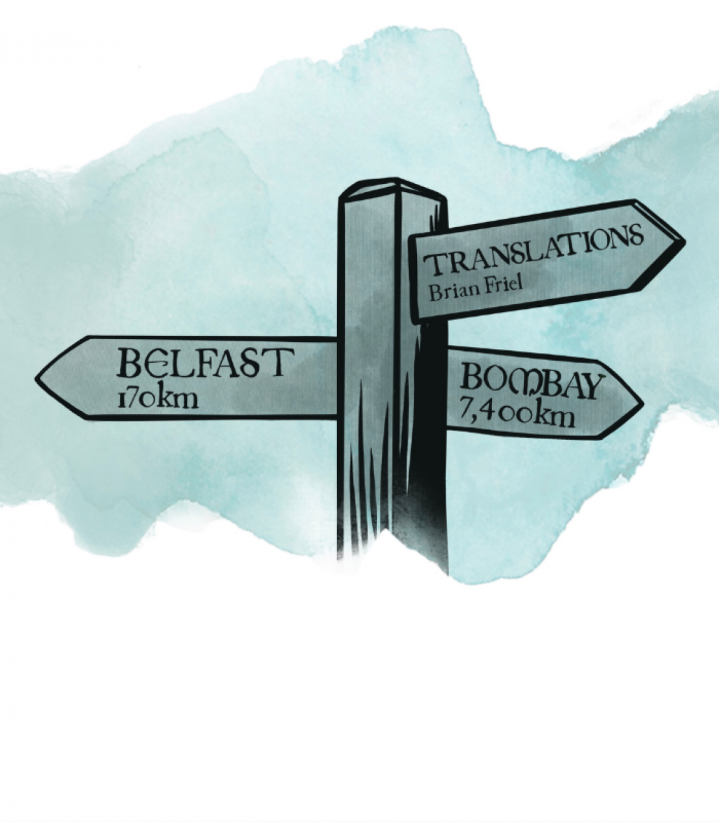
Translations is a three-act play by Irish playwright Brian Friel, written in 1980. It is set in Baile Beag (Ballybeg), in County Donegal which is probably loosely based on his beloved village of Glenties in West Donegal where Friel was a frequent visitor and where he is buried. It is the fictional village, created by Friel as a setting for several of his plays, including Dancing at Lughnasa, although there are many real places called Ballybeg throughout Ireland. Towns like Stradbally and Littleton were other variations and ‘translations’ of the very common original ‘Baile Beag’. In effect, in Friel’s plays, Ballybeg is Everytown.
The original staging of the play, in Derry in 1980, was the inaugural production by the newly formed Field Day Theatre Company, which Brian Friel had founded with the actor Stephen Rea. “It was a poignant play for us because the Troubles in the north of Ireland were still raging,” Rea says. “All the issues were local, but Friel was writing about the bigger picture.”
That inaugural production was at the Guildhall, often seen as a symbol of British authority in the city. “It was pretty different for us to do a play there,” Rea says. “It had a huge impact. That was radical because we didn’t premiere it in Dublin, we didn’t premiere it in Belfast. We did it in Derry, which was very severely affected by the Troubles… When we first did the play, many anti-nationalist people said it was whingeing and moaning about the same old problems. However, because of the continuing war in Ukraine, people can see that the play has a considerable influence and relevance to colonialism worldwide”.
“Translations is one of the greatest plays about identity, language, landscape, history – about how we communicate across those divides or fail to – and how a community or nation can navigate times of profound change and dislocation,” said Tánaiste and Minister for Foreign Affairs Micheál Martin when speaking at the grand opening of the Lesya Ukrainka National Academic Drama Theatre production at The Abbey Theatre in July 2023. “Friel wrote it for the Field Day company during one of the darkest periods of the conflict in Northern Ireland – it’s very significant that the national theatre ensemble in Kyiv, and their audiences, have felt that this Irish text resonates with their personal and collective experience as they live through this appalling, illegal war”.
Friel has said that Translations is ‘a play about language and only about language’, but it deals with a wide range of issues, stretching from language and communication to Irish history and cultural imperialism and the effects of colonialism. Friel said that his play ‘should have been written in Irish’ but, despite this fact, he carefully crafted the verbal action in English, which help bring the political questions of the play into focus.
The play traces the impact of an actual historical event, the 1824 – 1846 project to produce a British government-sanctioned ordnance survey map of Ireland. The English Parliament ordered Major Thomas Colby to Ireland in 1824 to undertake a comprehensive survey of the country. His teams of surveyors would produce detailed maps on a six-inch = one-mile scale that would be used to determine land valuations for tax purposes. The maps were finally published in 1846. They cover almost the entire country and include details of even the smallest civil division of the time: the townland.
Translations shows the effect this operation has upon a typical Irish village (Baile Beag), an impact which causes unemployment, theft, flight, threatened evictions, and violence. Here in Ballybeg, Captain Lancey has been tasked with creating an accurate map of Ireland, with English placenames, so that Ireland can be more easily navigated by the British Army, and that land taxes can be more easily charged. These objectives are connected to the British agenda to colonise and modernise the comparatively ancient civilisation of Ireland. Lancey, who has been sent by commanders in London to carry out this project, is described by Yolland in Act Two, Scene One as ‘the perfect colonial Servant’. Yolland marvels at this hard-working, industrious attitude: ‘Not only must the job be done — it must be done with excellence’.
At face value, this development seemed to be progressive yet in reality it is being used as a weapon of subjugation by a colonial invader. I am reminded of those Pathè News clips from the 40s seen in cinemas at the time and often lampooned by many commentators since of local Home Guard volunteers taking down all road signs in the English countryside so that any of Hitler’s spies who might happen to parachute in would be totally lost. Tragically the huge and ambitious translating project being carried out by the British army sappers which replace all the Irish placenames with new, standardised English ones has the effect of surgically cutting off the natives from their culture – their living geography, history, mythology, and literature – and leaves them stranded and apprehensive in a strange, new world with unfamiliar language labels. This is all the more relevant today because this very tactic is being re-enacted and repeated by Russia in trying to illegally invade and reclaim territory belonging to one of its neighbours.
Translations is set at the time in the nineteenth century when English was becoming the dominant language of Ireland. Using historical metaphor, Friel at once writes an elegant epitaph for Irish as a cultural medium and reflects on the emerging new reality; what it means to be Irish while speaking English. This context is appropriate because it marks the beginning of a more active intervention in Ireland by Britain. The early decades of the 19th century saw the tide turn against the Irish language in Ireland. Already English was spoken in major cities such as Dublin, and the potato blight and mass emigration would combine to reduce the proportion of Irish speakers to about a quarter of Ireland’s population by the end of the century. The decline of Irish was further spurred on by the introduction of the National Schools system in the 1830s, whose origins are hinted at in the play. Maire expresses succinctly the reasons for learning English in Act One: “I don’t want Greek. I don’t want Latin. I want English… I want to be able to speak English because I’m going to America as soon as the harvest’s all saved”. It is hard to argue with the desire of the 19th-century Irish peasant to learn English, as it was the only way for basic economic advancement, and in many cases, survival. The tension between the need to learn the language of the coloniser and the desire to preserve one’s heritage is the central dilemma of Translations.
The play is, appropriately enough, set in a school. While some historians have accused Friel of mythologizing and lionising the Irish Hedge School, his use of it in the play allows him to embrace the full range of Irish education of the early 19th century, giving the audience a limited idea of what it meant to be Irish then. The Hedge School is the place where all education is conducted, from the simplest things, such as Manus teaching the dumb Sarah Johnny Sally to say her name, to Jimmy Jack’s constant poring over Homer in the original Greek. In the town of Baile Beag, students learn in Irish, and they learn the languages and cultures of classical antiquity. Those who do know English only use it, to quote Hugh, the master of the school, “outside the parish… and then usually for the purposes of commerce, a use to which [English] is particularly suited”. We are reminded here of Michael Hartnett’s cutting riposte in his Farewell to English when he too notes the advantages of having English:
… finding English a necessary sin
the perfect language to sell pigs in.
Hugh explains the significance of the Irish language and literature to the inhabitants of Baile Beag to the British surveyor, Lieutenant Yolland, in this half-joking way:
A rich language. A rich literature… full of the mythologies of fantasy and hope and self-deception – a syntax opulent with tomorrows. It is our response to mud cabins and a diet of potatoes; our only method of replying to… inevitabilities.
A major theme of Translations is the replacement of the Ancient with the Modern. This can be seen in the Royal Engineers project to replace the Irish place names with standard English ones. While Irish is the traditional language of the country, it is being replaced by English: a language spoken internationally, one of commerce and progress.
The Irish language represents Ireland’s ancient past, while English represents the replacement of this in favour of something more modern and pragmatic. Maire speaks to this in Act One, when arguing they should all learn English. She quotes Daniel O’Connell, The Liberator, who had only recently (1829) achieved a huge victory for Ireland in Westminster with the passing of the Catholic Emancipation Act which finally gave Catholics freedom to practice their religion in public. In his view, Maire tells us, ‘The old language is a barrier to modern progress’. However, not all the residents of Baile Beag, are as keen to adapt to these modern ways.
Thus, the colonial encounter between the English and Irish is illustrated for us in the play within the cultural realm. From the point of view of the English surveyors, the cultural space of the Irish seems to be inaccessible. Yolland tells his Irish assistant, Owen, for instance, “Even if I did speak Irish, I’d always be an outsider here… I may learn the password but the language of the tribe will always elude me”. Similarly, to the inhabitants of Baile Beag, the English seem strange and distant. Hugh reflects that English succeeds in making Latin verse sound “plebian,” and remarks that the Irish are not familiar with English literature, feeling “closer to the warm Mediterranean”. Maire, for all her love of things English, also reflects that even the English placenames Yolland tells her about “don’t make no sense to me at all”.
The drama revolves around contact between the people of Baile Beag and colonising soldiers, who enter the town to conduct a survey that will “standardise” the place names, meaning, to Anglicize them, either by changing the sounds to approximate those of English – for example, Cnoc Ban to “Knockban,” or by translating them directly – in this case, Cnoc Ban would become “Fair Hill”. Although the villagers welcome the soldiers at first, most of the characters soon become aware of the sinister aspects of this task. As Manus, the son of Hugh and his assistant at the Hedge School, tells his brother Owen, “It’s a bloody military operation”. The task of giving new names to the places of Baile Beag stands in for the full colonisation of Irish life, covering over the previously existing Irish cultural map in order to make “a new England called Ireland,” to use Declan Kiberd’s phrase. Owen, who has been assisting in the colonisation of his own country, draws out the implications:
Lis na Muc, the Fort of the Pigs, has now become Swinefort… And to get to Swinefort you pass through Greencastle and Fair Head and Strandhill and Gort and Whiteplains. And the new school isn’t at Poll na gCaorach – it’s at Sheepsrock. Will you be able to find your way?
It seems that much has been ‘lost in translation’ and the loss of the Irish language reflected in this play is a huge loss for civilisation, none more so than for the Irish themselves. However, Friel’s play also carries an implicit critique of the modern-day use of Irish. If today the vast majority of Irish do not speak Irish, what significance does the quest to preserve or restore the language really have? In Translations, different characters engage in this discussion, with many points made on both sides. The most obvious is Jimmy Jack, who while marginal to the action for the most part is important, especially in this respect. Called “the infant prodigy” by the Hedge School students, Jimmy is anything but – he is in his sixties, does not wash himself, and spends most of his time reading the Greek and Latin classics. His fellow students regard his devotion to the literature of antiquity with bemusement, and he is treated as a buffoon. His infatuation with antiquity, which ends in a literal desire to marry Pallas Athene, serves in the play as a metaphor for a certain kind of cultural nationalist (or Gaelgóir) who continues to use Irish long after it has ceased to be relevant to the Irish themselves. By speaking Irish, and revelling in the glories of Ireland that was, they make themselves as irrelevant to modern Irish life as Jimmy Jack with his Greek, whose only response to the English army’s incursion into Baile Beag is to shout “Thermopylae! Thermopylae!”. The idea seems to be that trying to preserve Irish as a way to evoke the past before colonisation is a futile endeavour and is inadequate for the need of the Irish seeking a new cultural identity. Besides, one suspects that in any case, the glories of Celtic civilisation might never have existed quite in the form one reads about in books, much like life in ancient Greece and Rome could not be judged by reading the Odyssey or the Aeneid.
Close readers of Friel will know that there is this double dimension in all of his work. He purposely sets out to illustrate the same theme from different points of view. In his play ‘Philadelphia Here I Come!’, for example, we see immigration and ‘escape from the land’ from Gar’s viewpoint and from Lizzie’s point of view. Even here in Translations, Yolland wishes to be part of the more ancient Irish civilisation, and so tries to learn Irish; Maire, on the other hand, wants to become part of modern society, and so feels she must learn English.
The final question that the play poses is a simple one: can Irish civilisation and culture survive after colonisation, after the loss of Irish as a medium and the enforcement of English norms? Friel seems to believe that it does, and his answer is implied in a remark of Hugh from Act Two:
Remember that words are signals, counters. They are not immortal. And it can happen – to use an image you’ll understand – it can happen that a civilisation can be imprisoned in a linguistic contour that no longer matches the landscape of… fact.
One of the many tragedies perpetrated by the English colonisation of Ireland is that the words of Irish no longer match “the landscape of fact,” an act that the play shows us happening very literally. However, to use the words of Hugh once again, Friel is arguing precisely against allowing Irish civilisation to be imprisoned in the linguistic contour it once had. Hugh, drunk and distraught at the end of the play, sees the necessary step one must take to prevent this:
“We must learn these new names… We must learn where we live. We must learn to make them our own. We must make them our new home”.
For the Irish, to accept the new place names as their home and to “learn to make them their own” is to ask them to carry on their civilisation, in a language that was imposed on them by force, it is true – but Friel suggests it is either this, or nothing remains to be called Irish culture. The great irony of course is that modern Irish writers now writing in English have taken a stranglehold on most of the prestigious English literary awards including the Booker Prize in recent years!
In conclusion, the contexts and drama of Translations combine in a remarkable, sophisticated discussion of cultural decline and renewal. Brian Friel uses many characters and events that combine into a central argument: the loss of Irish as a cultural medium was a tragedy, enforced both by literal violence and the “soft power” of English cultural hegemony. However, it is equally a mistake to try and recreate the Irish past, as this would be to condemn Irish civilisation to death and complete the task the coloniser started. His play ends with the proposition that not only can English be used to express a uniquely Irish cultural identity, but that it must be used in this manner if it is to happen at all. That Friel wrote his play in English rather than Irish is more than for the sake of convenience or comprehensibility – it is his way of participating in the task he sets out for the Irish in the very same work.
***********
My own fascination with Translations stems from some research I did back in 2019 on the contentious etymology of the townland of Ahalin (Aughalin) in my own home place of Knockaderry (Cnoc an Doire, the hill of the oak). Dr John O’Donovan, noted historian and the translator of the Annals of the Four Masters, an Irish-speaking scholar and scribe, was the Ordnance Survey’s overall Names Expert used by the Ordnance Survey during their survey conducted between 1824 and 1846. Like Owen in the play, it was O’Donovan’s responsibility to enter all the Irish versions of names into the Names Books, in addition to the English spelling recommended for the published maps. For this reason, the Ordnance Survey of Ireland Names Books are sometimes referred to as O’Donovan’s Name Books.
O’Donovan spent July and August 1840 in Limerick and he signed off on his work on the parish of Clonelty and Clouncagh on 25 July 1840. He was assisted in his work in Limerick by Padraig Ó Caoimh and Antaine Ó Comhraí.
Evidence suggests that in the year 1824, there were three pay Hedge Schools recorded in Knockaderry by official report – two in the village of Knockaderry run by John Mulcahy and John O’Callaghan, and one in Clouncagh run by Edward Conway which was located in the corner of ‘Hartnett’s Field’ on the Begley farm. This was at a time when every field had a name not to mind every townland! John Croke, a relative of Archbishop Thomas Croke, first patron of the GAA and after whom Croke Park is named, set up a Hedge School in Clouncagh in 1850 in a building set aside for him by William McCann and his family.
The first official National School in the parish assisted by the Board of Commissioners of National Education was established in 1832. The school was located in the village of Knockaderry and John O’Callaghan was appointed headmaster of the Boys’ School and his daughter, Amelia O’Callaghan, was appointed as mistress of the Girls’ School. The first purpose-built National School in the parish opened its doors in 1867 in Ahalin (Áth na Linne, The Ford of the Pool).
You can read further about my own local investigations here:
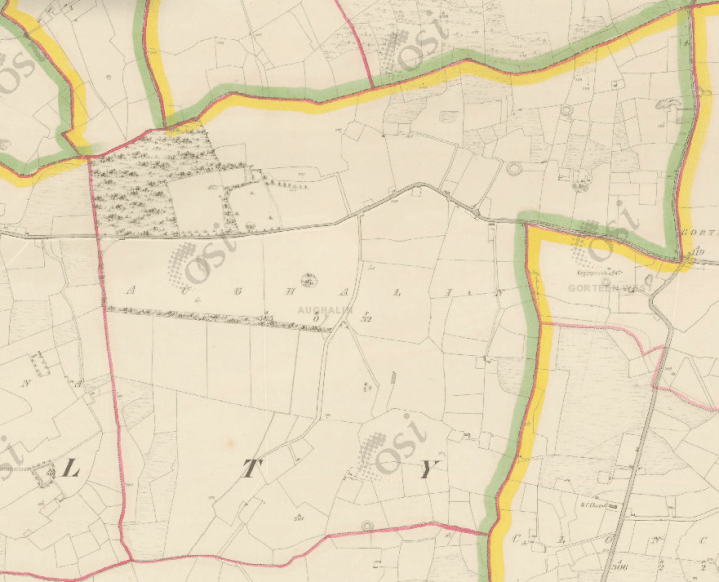
Aughalin, as it appeared on the 6″ Ordnance Survey map, produced c. 1840. Aughalin Wood is clearly outlined as is the residence of the local landlord, Robert Fetherson. Directly to the South of the Knockaderry/Ballingarry road we can see clear evidence of land reclamation and the field layout is very regular. Also note the ‘Screen’ – the linear plantation to aid drainage of the Ruatach.
On October 24th 2017 I published a piece here about the etymology of the townland placename Ahalin (Aughalin) in Knockaderry in West Limerick. You can catch up on the original article here. In it, I focused particularly on the local lore and folk wisdom which still holds that the placename Ahalin (Aughalin) is translated as Acadh Lín (the field of the flax). I was able to trace the fact that this translation came about largely through the teaching and forceful personality of the local Principal teacher in Aughalin National School, Michéal de Burca in the 1930s. In fact, with very little encouragement, local people could tell me that Ahalin meant ‘the field of the flax’ and most were also able to pinpoint its location.
Today there are two English variations of the placename, the more official Aughalin, which appears on the Ordnance Survey maps and the townland has also been referred to as Ahalin since at least 1831 when it appears on the Census Returns.[1] In 1867 a weighty limestone plaque was erected on the new National School recently opened in the area – this read ‘Ahalin National School 1867’. This plaque can still be viewed today embedded in the wall of the newly constructed set-down area and parking lot in the new school in Ahalin.
There is very little problem with the English versions of the townland’s name and both (Aughalin and Ahalin) are accepted locally and are often interchangeable. What is problematic is the current official Irish translation (or re-translation) of the placename being used by the Placenames Commission. P. W. Joyce in the second of his three-volume work on the origin and history of Irish names and places, first published in 1875, tells us that, ‘In the parish of Clonelty, near Newcastle in Limerick, there is a townland taking its name from a ford called Aughalin, the ford (ath) of the lin or pool’ (Joyce, 409). In the Preface to Volume One, Joyce, a learned Limerick man from Ballyorgan, acknowledges the help received from another placenames expert, Dr John O’Donovon, when he says, ‘I have had the advantage of two safe guides, Dr John O’Donovan and the Rev William Reeves, D.D.’ (Joyce, Vol I. vii). John O’Donovan, of whom more anon, visited the parish of Clonelty, present-day Knockaderry, in July 1840 to carry out a survey as part of the original Ordnance Survey mapping exercise carried out in Ireland. He also mentions Aughalin and gives its meaning as ‘the ford of the pond or pool’. This is the obvious literal translation, ‘Áth’ being the Irish for a ford and ‘Linn’ being the Irish for a pool. (Dublin was once Dubh Linn or Blackpool!).
Amazinly, in spite of this information and scholarship and also local knowledge and traditional usage, the official Irish version of the townland is given as Áith Liní in the Placenames (Co. Limerick) Order 2003. In Irish ‘Áith’ means ‘a kiln’ and there is evidence from old maps of the area that there were at least two kilns in the area. However, if we accept that the present anglicised form of the townland, Aughalin, refers to Áith meaning kiln there is still the difficulty that ‘Liní’ has no obvious meaning and no known local connotations or associations.
Surely local lore must count for something in trying to hear the faint whispers of a once rich oral tradition from the past. Gerard Curtin deals with this in the Introduction to Every Field Had a Name when he says:
The survival of hundreds of minor place-names in the south-west County Limerick, in an area that remained Irish speaking for longer than many other areas of the county, shows the extraordinary richness of the topoynmical tradition in Irish.[2]
According to local knowledge and tradition (more than likely promoted by Michéal de Burca who taught and lived in Aughalin from the 1930s until the 1960s), the correct rendering in Irish of the anglicised word Ahalin (or Aughalin) is Achadh Lín which he translated as ‘the field of the flax’. This is the Irish version used locally to this day and the ‘new’ Primary School in Ahalin (opened in October 1963) is known as Scoil Mhuire, Achadh Lín.
My original blog post also tried to research the link between the locality and the growing and milling of flax and found that there was a history of flax growing in the locality and that as far back as 1654 the Limerick Civil Survey records a tuck mill[3] for flax (and later for grain up to 1924) in Ballinoe. This mill was known as Reeves’s Mill. This, in turn, led me to consider other possibilities as to the etymology of the place name and to research the existence of the placename over the centuries. Art Ó Maolfabhail takes such a longer view in his seminal research, Logainmneacha na hÉireann, Imleabhar I: Contae Luimní, where he outlines the etymology of the placename Áith Liní as it has appeared in various documents and other official sources down the years:
1586 it appears as Athlyne in Peyton’s Survey, p. 108
1592 it appears as Allyneghe in F5781
1655 it appears as Athliny in the Limerick Civil Survey IV, 256, and as Athlinye in the Limerick Civil Survey, 298.[4]
1659 it appears as Aheliny in Census of Ireland, c. 1659, 280.[5]
1715 it appears as Athlinny in Clarann na Gníomhas. 16.311.7576
1750 it appears as Aghelinie in Clarann na Gníomhas. 144.378.97897 and again as Aghelinnie in Clarann na Gníomhas. 144.379.97899
1761 it appears as Agaliny in Clarann na Gníomhas. 212.591.140955
1807 it appears as Agalinny or Aghalinagh in Clarann na Gníomhas. 603.137.410629
1840 it appears as Aughalin in O’Donovan’s Field Name Books and áth a linne in pencil in O’Donovan’s Field Name Books.[6] This is the anglicised form which is most commonly seen in the old Ordnance Survey maps of the 19th Century.
In light of other evidence, however, Ó Maolfabhail’s conclusion is disappointing. Having weighed all the evidence, he rejects ‘the ford of the pool’ version favoured by P. W. Joyce and O’Donovan and doesn’t even consider Michéal de Burca’s ‘field of the flax’ version. Instead, he concludes that the official place name translation should be ‘kiln of (unknown)’. He further adds: ‘Ní léir cad dó a sheasann Liní. Toisc gan abhainn a bheith san áit, measadh gurbh oiriúnaí áith (meaning kiln) ná áth (meaning ford)’.
Dr John O’Donovan, noted historian and the translator of the Annals of the Four Masters, an Irish-speaking scholar and scribe, was the Ordnance Survey’s overall Names Expert used by the Ordnance Survey during their survey conducted between 1824 and 1846. It was O’Donovan’s responsibility to enter all the Irish versions of names into the Names Books, in addition to the English spelling recommended for the published maps. For this reason, the Ordnance Survey of Ireland Names Books are sometimes referred to as O’Donovan’s Name Books. O’Donovan spent July and August 1840 in Limerick and he signed off on his work on the parish of Clonelty on 25 July 1840. He was assisted in his work in Limerick by Padraig Ó Caoimh and Antaine Ó Comhraí.[7] Ó Maolfabhail recognises the validity and status of O’Donovan’s work when he acknowledges that by 1840 there were only four other counties to be completed as part of this nationwide survey and therefore O’Donovan had the advantage gained from having completed twenty-five other counties. This experience stood him in good stead in trying to make sense of the etymology of the various placenames (Ó Maolfabhail, xvii).
One of the most important functions of the Ordnance Survey was to name the geographical features, prominent buildings and landmarks of each townland so that these could be included on the Ordnance Survey Maps when they were eventually published. We know from these Name Books that John O’Donovan visited and wrote up the account describing the antiquities and topographical features of the then parishes of Clonelty and Clouncagh in July 1840.
Information for each townland was collected and written into the Name Book under five headings: the received name, the name finally adopted for the townland and the one placed onto the 6-inch Ordnance Survey Map in 1837. The Name Book also provided the Irish form of the name and in many instances what the Irish form of the townlands’ names meant. This was the last stage of the ‘Topographical’ process. The orthography section of the Names Books provides the various spellings for each townland or place and the authority section gives the source from which these variations were derived. This was a controversial part of the Survey, especially in the Irish-speaking areas of Ireland. Thomas Larcom, the head of the Ordnance Survey, and, John O’Donovan, had a clear policy when it came to the variant spellings and meanings of Irish place-names, which was to adopt ‘the version which came closest to the original Irish form of the name’. Thus, it seems, for O’Donovan the presence or absence of topographical features like ponds or pools made little difference to him when settling on a particular name. What mattered to him was to settle on an acceptable form which remained faithful to the original in Irish.
O’Donovan‘s observations on the townland of Aughalin are to be found in these Name Books and a transcribed version can be accessed in the Field Name Books of the County and City of Limerick. It is a collection of more than 1,700 pages of transcribed notes by surveyors during the first Ordnance Survey of County Limerick, c.1840.[8] O’Donovan’s entry for Aughalin is as follows:
Aughalin, Áth a linne, ford of the pond or pool.
Aughalin – is his favoured anglicised version for the townland
-Version found in Tithe Book of Revd. J.Croker
-Version used by Revd. J. Cullinan, P.P.
Ahalin – Version found in Barony Book 1834
-Version found in County Presentment Book 1839
-Also found in Census Return 1831
Ahalina – as in Barony Map
Athliny – as found in Limerick Civil Survey 1654 – 56
In the northeast part of the parish, a quarter of a mile east of Knockaderry Village. It is bounded on the north by Ballybrown townland and the parish of Rathkeale; east by the parish of Cloncagh; south by Kilgolban townland; and west by the townland of Kiltanna. It contains 565 acres, statute measure.
This townland is the property of Robert Featherston, Esq., and has a few portions of heathy pasture in the south and south west extremity. The remainder of the townland is under tillage and pasture. Aughalin Wood is on its north west boundary, and the road from Knockaderry to Ballingarry passes south of this wood through the townland. There are also three ancient forts in the townland, one of which is on its southern boundary. Acreable rent – £1 7s.
It has to be said that O’Donovan is being very diplomatic and circumspect here. The area he refers to as being ‘heathy pasture‘ is, in fact, a large saucer-shaped marshy area known locally as The Rhootachs. Aengus Ó Fionnagáin, lecturer in Irish at the University of Limerick and a noted placenames scholar suggests that the local name given to this area of marshy land could derive from the Irish word ‘ruaiteach’ meaning ‘reddish land’. It is interesting also that O’Donovan makes mention of Aughalin Wood as being another significant topographical feature of the townland. This was a large oak wood and probably where the present-day parish of Knockaderry gets its name – Cnoc an Doire, the hill of the oak (wood).
Another local historian and writer, Gerard Curtin, in his excellent book, Every Field Had a Name – The Place-Names of West Limerick while agreeing with Ó Maolfabhail’s assessment seems to give equal credence to O’Donovan’s translation:
AUGHALIN, Áith Liní, ‘the kiln of (unknown)’ according to Ó Maolfabhail, while O’Donovan (in Field Name Books, p. 440) believed it was from Áth na Linne, ‘ford of the pool’ (Curtin, 71).
Interestingly, Curtin also mentions that the most striking feature of the landscape in Aughalin up to the present day is the marshy area in the southwest of the townland known as The Rhootachs (also Ruatach or Rhootaigh). This is the area which O’Donavon refers to as ‘a few portions of heathy pasture in the south and south-west extremity’. This covered over fifty acres c.1913.
I sent a copy of my original blog post to the Placenames Commission for their views and shortly afterwards received a reply from Dr Conchubhar Ó Crualaoich and in the reply, the popular belief that the townland name, Aughalin/Ahalin derives from ‘the field of the flax’ is totally debunked. He states:
In regard to Aughalin, I refer you to the publication Logainmneacha na hÉireann, Imleabhar I: Contae Luimní, ed. Art Ó Maolfabhail. In that publication one finds a number of historical forms of this place-name such as ‘Athliny’, ‘Aheliny’, ‘Athlinny’, ‘Aghelinie’, and a local version recorded in 1840 namely ‘áth a linne’, which are all incompatible with derivation of the final element from lín ‘of flax’, as that lacks a final vowel. The absence of a final vowel from the later official anglicised form, Aughalin and the variant Ahalin, is doubtless due to the common loss of unstressed final vowels in anglicisation (see Townlands of Wexford ). It is also noteworthy that the historical forms and the local spoken form do not reflect the long vowel in lín. Therefore, Achadh Lín cannot be the precursor to Aughalin in this instance – it is not at one with the overall historical evidence for this place-name.[9]
However, while this historical evidence certainly rules out a final lín ‘of flax’ in the Irish precursor, identity of the final element remains somewhat unclear, although it does reflect Liní, or similar, and it is for this reason, I believe, that the phonetic approximation Liní was recommended in the official Irish form of the name.[10]
However, he also puts forward an alternative theory. He says that more evidence has come to light that the surname Lyn is recorded among the Anglo-Normans in Limerick in 1374. According to Dr Ó Crualaoich:
This could have generated an Irish version such as An Lineach (gen. an Linigh) “the person called Lin < Lyn”- which in turn could be in the precursor to Aughalin, as in Áith an Linigh ‘the kiln of the person called An Lineach (< Lyn)’.
Áith ‘kiln’ is reflected in early historical forms of the name such as ‘Athlyne’ and ‘Athlini’, as áth ‘ford’ is unlikely given the absence of any river of size here.
In this regard, the presence of disused lime-kilns in this townland is notable (see Ordnance Survey 25” map).[11]
While I have not come across any evidence that a family called Lyn ever lived in the area there is the possibility that Lyn could be related to the Gaelic surname Fhloinn (Flynn) – a name common in the area until recently.
Either way, Dr. Conchubhair O Crualaoich’s final conclusion leaves little doubt – in his mind at least – that Ahalin (Aughalin) has not derived from an association with flax:
It can only be restated that the historical evidence for this place-name does not support derivation from Achadh an Lín. The word líon (gen. lín) is reflected in the evidence for a number of place-names, but this is certainly not one of them.[12]
So, it seems that the presently widely accepted local re-translation of Aughalin as ‘The field of the flax’ is just fortuitous because the memory of flax growing in the locality in the 19th century was still somewhat fresh in the collective memory in the 1930s. P. W. Joyce in Volume One of his magnum opus, The Origins and History of Irish Names and Places warns against using recent developments to explain an age-old placename:
It is very dangerous to depend on the etymologies of the people, who are full of imagination and will often quite distort a word to meet some fanciful derivation; or they will account for a name by some silly story obviously of recent invention, and so far as the origin of the name is concerned, not worth a moment’s consideration (Joyce, Vol I, p.5).
When Michéal de Búrca began teaching in Aughalin in the 1930s he used his extensive knowledge of Irish to make the rather tenuous connection with flax. However, we can now say with 20/20 hindsight that he was in error and this was but a modern example of revisionism or the shoehorning of the translation of a placename to appease the zeitgeist of the 1930s and 40s. In 1938 Michéal de Búrca helped coordinate the school’s contribution to the Duchas Schools Collection which was taken up in over 5,000 National Schools during that year. There are very interesting stories and ‘tall tales’ recounted in its pages and it is interesting to note that de Búrca, to add further complications, names the school as Áth an Lín (translated as the ford of the flax). However, in a way, whatever the Placenames Commission may think, his efforts to translate Aughalin or Ahalin, as Acadh Lín or Áth an Lín, are far more evocative than the meaningless Áith Liní, ‘the kiln of (unknown)’ proposed by Ó Maolfabhail and now held up as the ‘official’ version by the Placenames Commission and in the Placenames (Co. Limerick) Order 2003.
We already noted that Aughalin was first recorded in the sixteenth century in Peyton’s Survey of 1586 as ‘Athlyne’ (probably from the Irish Áth Linn, ‘ford of the pool’). There is also no doubt the landscape has changed considerably in the intervening 400 years. The problems which have arisen with the present Irish versions of Aughalin seem to be that a once prominent topographical feature of the landscape – namely a pond or pool – seems to have disappeared or even dried up. Gerard Curtin is of the opinion that as the landscape began to be enclosed from the early eighteenth century great improvements to the land by drainage took place over the following 200 years. We can see in the 25-inch Ordnance Survey Map of 1888-1913 that the fields to the north of this marshy area known as the Rhootachs (or Rhootiagh) are very uniform in size, suggesting planned reclamation. The original 6” map of 1843 also clearly shows what seems to have been an L-shaped screen of trees planted probably with a view to aiding drainage in the area. With this drainage on the periphery of the marsh, the level of water fell over many years. It is more than likely that in the medieval period this marshy area may have contained a body of water, such as a pool or a small lake or pond, particularly at very wet times of the year. The same map shows a crossing/trackway running from northeast to southwest through the marsh enclosed by ditches and is wide enough to drive cattle. O’Donovan would definitely have seen more evidence of this pool or wetland in 1840 than would have been in evidence in the 1930s when Michéal de Burca cast great doubt on the translation of Aughalin as ‘the ford of the pool’ because in his view, ‘there isn’t a pool within miles of this place, and there’s no ford in the place because there’s no river’.[13] In fact, the old Ordnance survey maps indicate a tributary of the Abha na Scáth river rises in The Rhootiagh. More recent maps show that the watercourse begins further to the north, a little south of the Knockaderry to Ballingarry road. This land in question is still known locally as The Rootach and is still very marshy and is presently under extensive forestry plantation. Curtin’s strong belief is that there was a ford through The Rootach from the medieval period, and thus the name, ‘the ford of the pool’ was given to the townland as a whole.[14]
This is a detail from the 25″ Ordnance Survey map produced sometime between 1888 – 1913. It is interesting to compare both maps. Note the school in Aughalin, directly south of Aughalin Wood, which was not in the earlier map and again the uniformity of the fields directly to the south of the school signifying efforts to reclaim and drain the marshy area of ‘heathy pasture’ and make it more productive.
There are, therefore, a number of plausible translations for the placename Aughalin/Ahalin since it was first mentioned in the sixteenth century. We must remember that all these variations were but phonetic representations in English of the Irish placenames then in use. Despite the lack of standardisation down the centuries, two elements remain constant – one is the ‘áth’ and the other is ‘linn’, or similar variations such as ‘liny’, or ‘linnie’. Ironically, the official version in use today is probably the most implausible one of all. Ó Maolfabhail’s safe translation is ‘Áith Liní’ which he translates as ‘the kiln of (someone unknown)’. Likewise, Michéal de Burca’s version of ‘Acadh Lín’ which he translates as ‘The field of the flax’, although still favoured today by locals, is probably stretching the language to breaking point as can be seen from Dr Ó Crualaoich’s assessment.
O’Donovan’s translation (ford of the pond or pool) deserves to be taken seriously because he, at least, visited the area and drew up a report on the antiquities, local history and topography of the parishes of Clonelty and Clouncagh as part of the Ordnance Survey team which undertook the mapping of the area in 1840.[15] It needs to be repeated that John O’Donovan, had a clear policy when it came to the variant spellings and meanings of Irish place-names, and that was to adopt ‘the version which came closest to the original Irish form of the name’. If we follow this logic then we no longer need to focus merely on topographical features and it doesn’t really matter if there is no pond or pool to be seen in the landscape today or even at the time O’Donovan visited the area.
The question, therefore, to be considered is was there a time in the dim and distant past when there was a pond or pool in Aughalin? Michéal de Burca cast doubt on O’Donovan’s and Joyce’s versions because, ‘there isn’t a pool within miles of this place, and there’s no ford in the place because there’s no river’.[16] Ó Maolfabhail follows the same line of argument when he settled on Áith meaning ‘kiln’ instead of Áth meaning ford when he says: ‘Toisc gan abhainn a bheith san áit, measadh gurbh oiriúnaí áith (meaning kiln) ná áth (meaning ford)’ (Ó Maolfabhail, p2). I have mentioned the presence in the old Ordnance Survey maps of a minor tributary of the Abha na Scáth river but really it was little more than a run off stream. However, as Curtin points out there could have been a pond or pool in the area of the Rootach in the past with a causeway or path(s) through it and all this has now disappeared because of land reclamation works and drainage over the centuries.
Therefore, there are no easy answers to our difficulty with the etymology of the placename, Aughalin. The different variations and permutations considered here will definitely not please the local people of the area who for the past three-quarters of a century at least have always translated Aughalin as Acadh Lín (The Field of the Flax). The reason I undertook this investigation in the first place was that I was unhappy with the official Irish translation given on the Logainm.ie website and the Placenames (Co. Limerick) Order 2003 where the townland of Ahalin is given as Aughalin and the official Irish version of the townland is given as Áith Liní. The big mystery for me is how did Ó Maolfabhail totally disregard the findings of such an eminent authority as Dr John O’Donovan in arriving at his final conclusion?
Hopefully, the original meaning of Aughalin/Ahalin, going all the way back to its first mention in Peyton’s Survey of 1586, has not been forever lost in translation! Hopefully, also, to misquote the eminent P.W. Joyce, this present ‘etymology of the people’ is worth more than ‘a moment’s consideration’……
Works Cited
Curtin, Gerard. Every Field Had a Name – The Place-Names of West Limerick. Sliabh Luachra Historical Society, 2012.
Joyce, P.W., The Origin and History of Irish Names and Places. Vol I. London: Longmans, Green and Co. Dublin: M.H. Gill and Son. First Published 1869.
Joyce, P.W., The Origin and History of Irish Names and Places. Vol II. London: Longmans, Green and Co. Dublin: The Talbot Press. First Published 1875.
O’Donovan, John. Field Name Books.
Art Ó Maolfabhail, Logainmneacha na hÉireann Imleabhair: 1 Contae Luimnigh, (Baile Átha Cliath, 1990).
[2] In County Limerick in the 1851 Census the baronies of the south-west, Connello Upper and Glenquin had the most number of Irish speakers, 59.4% and 58.2% respectively. See Breandán Ó Madagáin, An Ghaeilge i Luimneach, 1700 – 1900, (Baile Átha Cliath, 1974) (Curtin, 1).
[3] A tuck mill was used in the woollen industry to improve the quality of the woven fabric by repeatedly combing it, producing a warm worsted fabric.
[4] The Limerick Civil Survey IV, County Limerick (ed. Simington, 1938)
[5] Census of Ireland, c. 1659 (ed. Pender, 1939).
[6] Ó Maolfabhail, xvii, ‘leagan Gaeilge de logainm agus é scriofa le peann luaidhe, foirm gharbh é seo a breacadh síos go direach ó bhéal cainteora Ghaeilge’.
[14] Opinion of Gerard Curtin via email correspondence
[15] O’Donovan’s Ordnance Survey Letters, Limerick, Vol 1 – his report on Clonelty and Clouncagh Church ruins is signed and dated 25th July 1840 – the letters can be viewed online at www.askaboutireland.ie and also on The Royal Irish Academy website.
The Field of the Flax – with a fort or líos in the centre. Above the road is the “neat cottage residence suited for a gentleman’s family” once owned by Mr J.P. Fitzgerald MP. and more recently by the Flynn brothers.
I live in a beautiful area of West Limerick and next door is the townland of Ahalin (or Aughalin). The townland has been referred to in English as Ahalin since at least 1867 when a weighty limestone plaque was erected on the new National School recently opened in the area – this read ‘Ahalin National School 1867’. The retranslation of this placename (Ahalin) into Irish has caused debate for decades. The famous Limerick academic P.W. Joyce in his seminal work, The Origin and History of Irish Placenames published in 1910 by M.H. Gill and Son, has it as ‘the ford of the pool’ and this indeed is one literal translation, ‘Áth’ being the Irish for a ford over a river or stream and ‘Linn’ being the Irish for a pool. (Dublin was once Dubh Linn or Blackpool!). However, as former local headmaster, Michéal de Búrca pointed out to anyone who would listen, ‘there isn’t a pool within miles of this place, and there’s no ford in the place because there’s no river’.
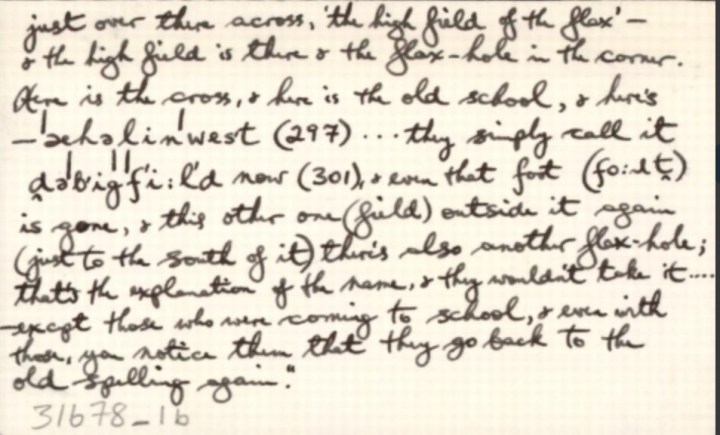
Information given by Michéal de Búrca to Placenames Commission – can be viewed online at Logainm.ie website. https://www.logainm.ie/ga/31678
As you can see above the eponymous Master Burke goes on to give further information regarding the etymology of the placename Aughalin, which had been handed down through the years. He is obviously lecturing the representative of the Placenames Commission who has come a calling and (unfortunately for us) they both seem to be looking at an Ordnance Survey map as they speak:
And there is the correct pronunciation, (Aughalin) it means ‘the field of the flax’ and the flax field is staring them just over there across ‘the high field of the flax’ – and the high field is there and the flax-hole in the corner. Here is the cross (Wall’s Cross), and here is the old school, and here’s ‘achalinwest’ (297) …… they simply call it The Big Field now (301) and even that fort is gone and this other one (field) outside it again (just to the south of it) there’s also another flax-hole (there) ….’.
Amazingly then, in spite of all this overwhelming local knowledge and traditional usage, in the Placenames (Co. Limerick) Order 2003 the townland of Ahalin is given as Aughalin (which is ok) and the official Irish version of the townland is given as Áith Liní (which is not). In Irish ‘Áith’ means ‘a kiln’ and there is some evidence from old maps of the area that there were at least two disused kilns in the area in question. However, ‘Liní’ has no obvious meaning or no local connotations. (To add insult to injury, of course, the same Placenames (Co. Limerick) Order 2003 also refers to Cloncagh instead of the more traditional Clouncagh, and Cluain Cath instead of the more correct Cluain Catha – but that’s a story for another day!)
The more correct rendering in Irish of the anglicised word Ahalin (or Aughalin) is, in fact, Achadh Lín which directly translates as ‘the field of the flax’. This is the Irish version used locally to this day – the new school in Ahalin (opened in October 1963) is known as Scoil Mhuire, Achadh Lín. In fact, if one does even the minimum of research (i.e. talking to the locals) they will without hesitation tell you exactly where ‘the field of the flax’ is situated.
I have long been fascinated by the fact that not too long ago, well maybe at some time during the nineteenth century, flax was grown in the parish of Knockaderry in County Limerick and there was a flax-hole or flax-dam in my own neighbouring townland, and, as Seamus Heaney describes so well in his poem, ‘Death of a Naturalist’ :
All year the flax-dam festered in the heart
Of the townland; green and heavy headed
Flax had rotted there, weighted down by huge sods.
So how come we have a townland in rural County Limerick which is associated with the growing of flax? More than likely it was an endeavour of the local landlords, the D’Arcy family who at one time lived in the townland of Ahalin and later moved to Knockaderry House or maybe the growing of flax was promoted by the Fetherson or Fitzgerald families who also owned substantial estates and were associated with Ahalin.
At the time of Griffith’s Valuation, completed in County Limerick in June 1853, Robert Fetherston held land in Ahalin in the parish of Clonelty[1], barony of Glenquin and at Bruree, barony of Connello Upper, County Limerick. In February 1855 his 565 acres at Ahalin, barony of Glenquin, on which there was a “neat cottage residence suited for a gentleman’s family”, were advertised for sale. This residence and some land were sold to Mr J.D. Fitzgerald[2] Member of Parliament for £2,350. The “cottage” in question was located in the townland of Ahalin directly behind where Mr Dave Downes and family now live. The holding consisted of the main dwelling house, a stable, a coach house, two cow houses, a piggery, a fowl house, a boiling house and a barn.
It is this Mr. Fitzgerald, who was appointed Attorney General for Ireland in 1856 and who served as MP for Clare (1852 – 1860), who gave the land for the first National School in Ahalin, which was opened in 1867. It is also very probable that it is this same Mr Fitzgerald MP, or his agent, who Master Burke is referring to when he says ‘some eejit came in 1867 and he put up on the old school AHALIN N.S. and you could not correct it!’ This suggests that Master Burke would have been happier with ‘Aughalin’ rather than ‘Ahalin’ as the correct anglicisation of the townland – as this is nearest to the Irish version of the placename, Achadh Lín.
In more recent times this cottage was the property of the Flynn brothers. In the returns of the 1901 Census, there were six people living here: Patrick Flynn aged 30, Kate Flynn aged 27, Michael Flynn aged 25, Julia Flynn aged 22, Philip Flynn aged 18 and Martin Flynn aged 12. In the Census returns for 1911, it seems that Michael and Julia have left the family home and Molly Greaney (aged 16) is registered as a General Domestic Servant by the family. The property was still owned by the Flynns up to the late 1950’s and at that time Philip (who was blind) and Martin were the two surviving brothers living in the cottage. It is said locally that they were the first house in the parish to own a radio. Molly O’Neill was their housekeeper up to the end. Before that Cis Harrold was the housekeeper. She was a sister to Mike, Willie and Brian Harrold and an aunt to Batt O’Connor.
As far back as 1654, the Limerick Civil Survey records a tuck mill[3] for flax (and later for grain up to 1924) in nearby Ballinoe. This mill was known as Reeves’s Mill and was located where the Enright’s own land today near Ballinoe Bridge on the Kilmeedy side of Ballinoe Cross near where Johnny Corkery and his family now live. In Bailiúchán na Scol, a folklore project organised by the Folklore Commission in National Schools throughout the country in 1937–38 Nora Nash[4] from Ballinoe and attending the Girls School in Ahalin stated that ‘flour was made locally in Re(e)ves’ Mill in Ballynoe’ and she further states that ‘it is to be seen still at Enright’s where the mill was’. This Mill was built on the banks of the Ábha na Scáth river which rises near Knockfierna and flows through Clouncagh and into the River Deel near Bunoke Bridge.
Reeve’s Corn Mill situated on lands today owned by the Enright family at Ballinoe on the banks of the Ábha na Scáth river.
We also know from research carried out by the Rathkeale Historical Society that as early as 1709 Thomas Southwell (Rathkeale), whose family had inherited some of the old Billingsley/Dowdall estate (mainly centred in Kilfinny), introduced over 120 Palatine refugee families to the townlands of Courtmatrix, Killeheen, Ballingrane and Pallas(kenry). These families augmented an already established English settlement which had been introduced to assist in the development of the linen/flax industry in the West Limerick area.
Local historian, Sean Kelly in the NCW Historical Journal, The Annual Observer, in his excellent article on the history of Phelans Mill (situated where Objekt Design Space have their home accessory store today) states that for a time in the 1800’s this mill (then under the ownership of Robert Quaid and his family) was used as a scutching mill for flax and that there was a flax-dam and bleaching area nearby on the banks of the Arra River near where Dr O’Brien and Dr Barrett once resided and on land which is now owned by Ballygowan Mineral Water Company.
So while flax growing, and the linen industry it supported, was a predominantly Northern Ireland industry, remnants of it were also to be found in Munster and Limerick and even in Knockaderry itself! It is no surprise, therefore, to come across references to flax and the linen industry in the local placenames such as Ahalin. Readers may also be aware of another placename in Limerick, Monaleen, which is from the Irish ‘Móin a Lín’, literally ‘the flax meadow’ or ‘field of flax’.
Flax, itself, was a very labour intensive crop to grow and demanded much skill. The land had to be ploughed, harrowed, cross ploughed, and harrowed again and rolled. The seed was then sown, harrowed in and rolled again. Nature and the elements took over, but the better the seedbed, the better would be the crop. Much depended on the ploughman. Usually, he was a quiet fellow of good skill, much in harmony with his pair of horses. The excellence of linen depended on this quiet fellow, who ploughed a straight furrow. There was much preparation for flax growing and it was said that it took more out of the land than any other crop.
Nature responded, and in due course, thousands of flax stems grew up, three to four feet in height. A tiny blue blossom appeared on their tips, followed by a natural coloured seed pod; and the flax was ready for pulling.
Flax pulling by hand was a back-breaking job, taken on by casual workers, who needed the cash. Hand pulling was necessary because the whole stem, from root to tip, was required to give the longest fibre, for the finest quality linen cloth. The pulled flax was tied up in beats (sheaves) and put in rows or stooks on the flax field. The stooks were collected and put into flax holes, or dams, and kept under water for ten to fourteen days. This was to `rat’ or `rot’ the inside wood part from the outside fibres.
Then began the most difficult job in the making of linen, lifting the heavy, smelly, slimy, wet beats from the flax hole to the bank. Men had to work for hours, up to the waist in this wet clabber, while others took the beats and spread them on the fields to dry or bleach
Spreading was also a back-breaking job, as was lifting some days later, when dry. The flax was ready for scutching, a dusty and dangerous art. This meant the removal of the centre wood part from the outside fibres and was done when the scutcher pressed handfuls of flax against a large four-bladed flail revolving at speed. It cut away the wood part and left the scutcher with handfuls of long blonde fibres, like a young lady’s head of long blonde hair. Many an arm or hand was cut off in this process. The wood part was known as ‘shives’ which were burned as waste.
So, where can we find this ‘high field of the flax’ today or even the flax-hole in the corner of the field? As we have already noted from comments made by Master Burke to the authorities at the time it seems the flax field was situated between Wall’s Cross and the old school in Ahalin. As already mentioned, if one does even the minimum of research in the area locals will without hesitation tell you exactly where ‘the field of the flax’ is situated. Most local sources (whom I have spoken to) say that the ‘flax field’ is today owned by Mickey Magner and the field lies to the left of what is locally known as Ahalin Avenue. In times gone by there was a fort in the middle of this field but all evidence of this fort has since been removed although it can still be seen clearly in some old Ordnance Survey maps of the area.
So, it seems that while evidence of a fort can be obliterated from the landscape the folk memory associated with the growing of flax in the area cannot. The beautiful, enigmatic placename of Aughalin or Achadh Lín and its rich history lives on strongly in the folk memory of the people of Knockaderry to this day.
The Field of the Flax (Achadh Lín) as seen on Google Maps. Notice the faint outline of the fort which was removed still visible in the centre of the field.
[1] Clonelty Parish, roughly corresponding to the parish of Knockaderry today. The townland of Aughalin consisted of 571 acres, 3 roods and 2 perches.
[2] John David Fitzgerald of Dublin was the son of David Fitzgerald, a Dublin merchant. He was Member of Parliament for Ennis 1852-1860 and was appointed Attorney General for Ireland in 1856. At the time of Griffith’s Valuation, he held land in the parish of Quin, barony of Bunratty Upper, County Clare and in the parish of Rathkeale, barony of Connello Lower, County Limerick. In 1860 he married his second wife Jane Mary Matilda Southwell, sister of the 4th Viscount Southwell. In 1882 he was made a life peer as Baron Fitzgerald of Kilmarnock. In the 1870s he owned 1,393 acres in County Clare and 1,324 acres in County Limerick including ‘a gentleman’s cottage’ and land in Aughalin.
[3] The tuck mill was used in the woollen industry to improve the quality of the woven fabric by repeatedly combing it, producing a warm worsted fabric.
[4] Bailiúchán na Scol, Imleabhar 0490, Leathanach 42. Here, just to add to the confusion, the school is named as Áth an Lín (Cailiní), Baile an Gharrdha, (Uimhir Rolla 9633).
Commentary: In the title poem of his first ever collection, Death of a Naturalist, Seamus Heaney gives a very sensuous and sumptuous description of the goings on at his local flax-hole. This hole or ‘flax-dam’ contained the flax which had been harvested and was now being soaked in a man-made hole in the corner of the flax-field in August. When the process was complete the flax was taken out and became the raw material for the thriving linen industry which had long flourished in Northern Ireland but was now showing some signs of decay in the nineteen fifties. The poem has an added resonance for me because I live in a beautiful part of West Limerick and next door to me is the townland of Ahalin, or Achadh Lín in Irish, which means the ‘field of the flax’. Each time I read this poem I am reminded that at some time maybe in the 1800’s or before just over the road from me was our very own flax-field with its festering flax-dam!
In this poem, ‘Death of a Naturalist’, Seamus Heaney gives a brilliant description of the local flax-hole. It is a memory poem, one of the many poems written about his childhood and early school days. Heaney, in this first collection of early poems mines a rich vein of childhood memory. It is, however, embellished memory – childhood through a rosy adult lens. The poem is extremely sensual and evokes the senses of sight and sound and smell to perfection. Indeed, the poem invites the reader to read it aloud such are the myriad examples of assonance and alliteration scattered throughout.
The flax-dam or flax hole came into its own each August when the flax crop was ready for harvest. Flax pulling by hand was a backbreaking job, taken on by casual, often transient workers. Hand pulling was necessary because the whole stem, from root to tip, was required to give the longest fibre, for the finest quality linen cloth. The pulled flax was tied up in beats (sheaves) and put in rows or stooks on the flax field. The stooks were collected and put into flax holes, or dams, and kept under water for ten to fourteen days. This was to `rat’ or `rot’ the inside wood part from the outside fibres.
The ‘flax-dam’ festered and ‘sweltered in the punishing sun’ in high Summer. We can almost hear the bluebottles as they,
‘Wove a strong gauze of sound around the smell’.
Each August the flax was immersed in the flax hole and sods of earth were used to keep it submerged.
The flax hole may have only been used by the farmers during the harvest but of course, it lay there unused all year round. The young poet, as naturalist, is obviously drawn to the pool at other times of the year as well, especially when there were great clots of frogspawn evident each Spring. He also visits in May to see the dragonflies and every July and August to spot the butterflies:
There were dragonflies, spotted butterflies,
But best of all was the warm thick slobber
Of frogspawn that grew like clotted water
In the shade of the banks.
The poet uses onomatopoeia to great effect to aid his description: ‘bubbles gargled’, ‘slobber of frogspawn’, ‘coarse croaking’, ‘the slap and plop’, and the brilliant ‘blunt heads farting’. We are also reminded of his age with the use of the word ‘jampotfuls’ and by the childish simile ‘Poised like mud grenades’.
Like all other budding young naturalists, he is lucky to have a great teacher! ‘Miss Walls’ encourages him and provides him with the necessary information, always appropriate to his age of course!
Miss Walls would tell us how
The daddy frog was called a bullfrog
And how he croaked and how the mammy frog
Laid hundreds of little eggs and this was
Frogspawn.
Her ecology classes sent him out to the meadows to collect samples for the classroom and for the windowsill at home in his kitchen in Mossbawn. Miss Walls also imparted other vital pieces of information which are seized upon by the young eager naturalist:
You could tell the weather by frogs too
For they were yellow in the sun and brown
In rain.
There is a sense of childhood foreboding and fear of the flax hole and the mating frogs which is recreated with great accuracy by the poet – he knew, or he had been told by his elders, that ‘if I dipped my hand the spawn would clutch it’. These stories were obviously very effective in keeping inquisitive young boys away from the vicinity of these dangerous flax dams and he feels threatened and frightened by the scene that confronts him at the flax-dam.
The great slime kings
Were gathered there for vengeance and I knew
That if I dipped my hand the spawn would clutch it.
Indeed, the whole poem can be seen as a metaphor for growing up, laden with imagery that could be interpreted as sexual: we sense a child’s revulsion as he discovers the facts of life and his ensuing loss of innocence. He will never feel the same again about the countryside after this encounter with the bullfrogs! As the poem’s title suggests, therefore, his days as a naturalist are drawing to an end!
Interestingly, a poem very similar to ‘Death of a Naturalist’ called ‘Lint Water’ was published in the Times Literary Supplement on August 5th, 1965. In my view, this poem was not included in Heaney’s first collection Death of a Naturalist (or anywhere else) because of its more blatantly political undertone. In his book, On Seamus Heaney, Roy Foster suggests that ’The quintessential Ulster industry of linen-making provided a metaphor for the poisoning of running water and ….. the idea of a poisoned terrain (also used by Montague for his landmark collection, Poisoned Lands, in 1961) was both irresistible and significant’. His days as a naturalist may be drawing to a close but it is clear here that his political sense has already begun to develop. So, we can see that from a very early stage in his poetic development Heaney is deeply aware that there is indeed something rotten in the state of Denmark. And while the poem ‘Death of a Naturalist’ is a memory of a childhood experience and so merits inclusion in his first collection, in ‘Lint Water’ Heaney signals the way that he would choose to approach and unpick the political and sectarian tensions of his native province as they unfolded in the 1960s and thereafter.
Works Cited:
Foster, R. F., ‘Roy Foster on Seamus Heaney: the Belfast years’, in The Irish Times, Saturday, September 5th, 2020, an extract from his book On Seamus Heaney, published by Princeton University Press, 2020.
… and I knew / That if I dipped my hand the spawn would clutch it.


 Translations is a three-act play by Irish playwright Brian Friel, written in 1980. It is set in Baile Beag (Ballybeg), in County Donegal which is probably loosely based on his beloved village of Glenties in West Donegal where Friel was a frequent visitor and where he is buried. It is the fictional village, created by Friel as a setting for several of his plays, including Dancing at Lughnasa, although there are many real places called Ballybeg throughout Ireland. Towns like Stradbally and Littleton were other variations and ‘translations’ of the very common original ‘Baile Beag’. In effect, in Friel’s plays, Ballybeg is Everytown.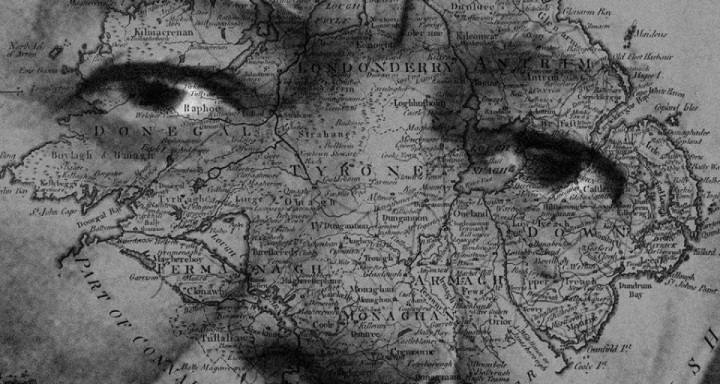




 Reviews Rants and Rambles
You must be logged in to post a comment.