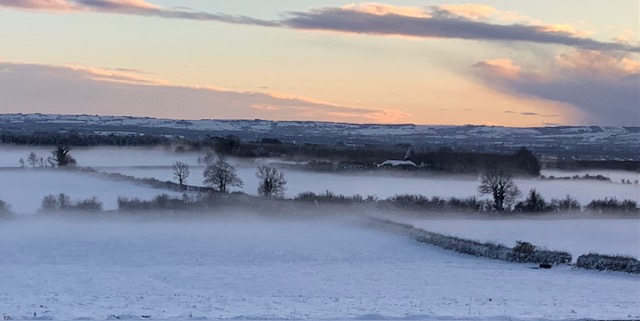
Childhood memories are mostly of sunny days, but maudlin memories of those Christmases from the late 50s and early 60s still linger. It was so innocent and naïve, in a way, it was as if Christmas hadn’t been invented yet! It was a Christmas of cowboy ‘cap’ guns and other useless ‘purties’ – they seldom lasted longer than a day. We always had a turkey, our own free- range turkey, before it became trendy. We even had a surplus, and I remember my mother sending turkeys by post to her sisters in England! We usually had a Christmas cake from Upton’s in Ballylanders. There was trifle, plum pudding, jelly and custard, the dinner of the year. I never remember drink being in the house. There were never visitors, nor were we encouraged to visit anyone. If the day had been anyway fine, Michael and I were to be found on the road with our hurleys, knuckles blue.
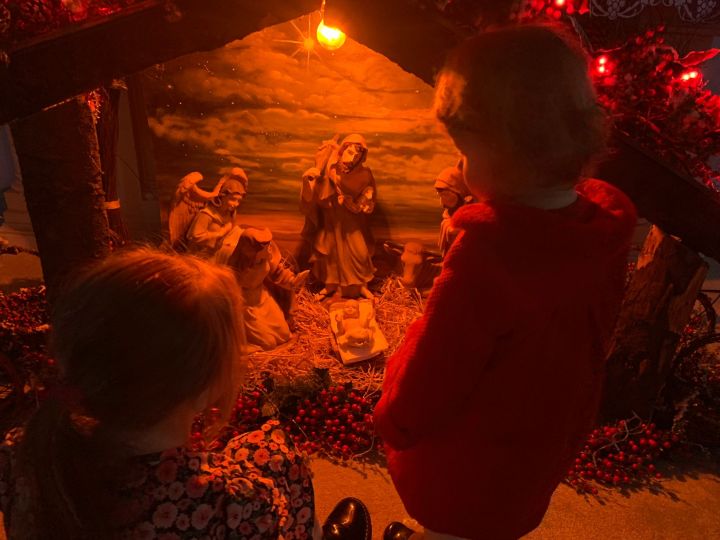
Christmas back then was more about the crib than about Santa. The church was central to the festivities, and the midnight Mass and the Latin were magical. There were no decorations, no Christmas tree and holly hung from the holy pictures. Later, Michael and I usually liberated a Sitka Spruce sapling from a nearby forestry. One year, we brought one from Ballintubber through the fields for fear of detection, having cut it down with a bread knife! Before electricity came to Rapala in 1958, the gloom was amber with the glow from paraffin lamps. We were exceedingly lucky to have had exceptional parents, and so, despite their own strapped circumstances, we were always at the centre of Christmas Day as children. Mam and Dad worked far harder than we then realised to create an experience that modelled what it meant to care for others: with kindness, generosity, consideration and love. Even still, to this day, that tradition continues, and children don’t notice the carefully oiled machine that shudders into life to create the magic of a good Christmas, and hopefully that will never change.
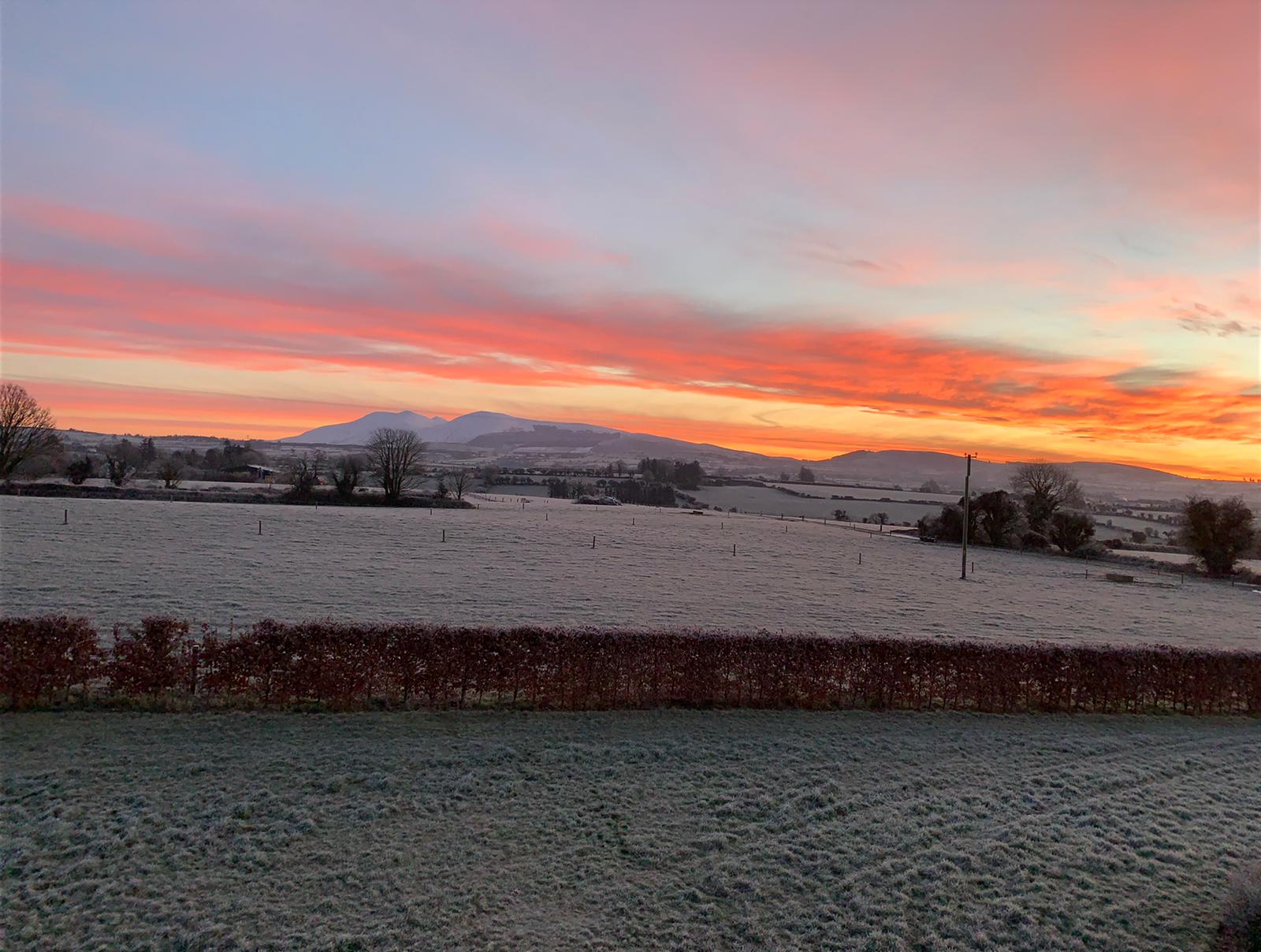
I remember one Christmas in particular – the winter of ‘62 – ‘63 was long and memorable – it snowed and forgot to stop. It began snowing at Christmas time, and the snow and ice remained on the ground for months. If my memory serves me, we didn’t return to school that year until late March! In the meantime, the snow lay on the ground, and people coped as best they could.
Looking back on it now, we were lucky that, as a family, we were nearly entirely self-sufficient and had no use or need whatsoever for convenience stores or supermarkets! I was a Mass server, and each morning I would get up and walk through the drifted snow to serve Mass in our local Church, nearly two miles away in Glenroe. Mass was in Latin at that time, and both Fr. Carroll, who was the Parish Priest, and the Mass servers faced the altar with their backs to the congregation, and the ten-year-old Mass servers made the responses in Latin. The congregation were silent throughout. The Vatican Council, Vatican II, had been convened at the time by the saintly Pope John XXIII, and great changes were around the corner – but not yet! You know what I always say about change: the only people who welcome it are babies with wet nappies!
I remember those mornings being joined on my trek to the Church by Hanny O’Dwyer, who was an extremely devout and holy woman who had already walked nearly two miles to get to my house. At least two of her brothers were priests in England or Scotland, and she attended Mass daily. That year, she was accompanied some mornings by her sister-in-law, who had recently married her brother, James, who was a farmer in nearby Ballintubber.
I have uncomfortable memories of being embarrassed by a new pair of shoes which had arrived in a parcel full of all kinds of ‘goodies’ from Aunty Mary just before Christmas that year. My mother forced me to wear them on Sundays and when serving Mass. Now in 1963, the problem was that these were a pair of slip-on shoes, and the only people I had ever seen wear slip-on shoes were women. I felt that everyone in the church was looking at my new shiny black shoes. Little did I know that they were the coming fashion and that, for once, I was years ahead of my time!
The most shocking memory I have of that winter was the funeral of a local man. His name was Hayes, and for all I knew, he may have been a relation. He died, and I remember my Dad telling me that the snow drifts were up to the gable end of the farmhouse where he lived in Ballintubber. The neighbours had to shovel the snow away to make a pathway for people to enter the house. I have a vivid memory of the funeral cortege passing our house, and the coffin was being carried on the buckrake at the back of a red tractor. I was shocked at this sight, and I thought it was very disrespectful to the old man who had died. In hindsight, however, it was probably the only practical way that he could have been taken to the Church.
In January 1963, I can still see in my mind’s eye, Mam and Dad and all six of their children looking out the front window as that funeral passed. Later that year, in November, the seventh member of our family, Noreen, arrived hale and hearty, and the world has been a better place since!
John Montague, one of my favourite poets, has a haunting poem called ‘Like Dolmens Round My Childhood’. The poem describes the old people, his neighbours, who lived in a land where ancient beliefs and superstitions still survived. We get the sense that during his childhood, these vulnerable people still believed in myths and magic, curses, and the fierceness of local feuds. Ghosts still roamed the land, in the dark countryside just beyond the reach of the farmhouse lights.
Looking back now, I realise that this was also true of my native place, and I am amazed at the number of old people that I knew and who knew me. These, often vulnerable, saintly people regularly passed my door, or I met them on my journey to and from school each day. People like Josie McGrath, Hanny Kelly and her brother Mick, Hanny O’Dwyer on her way to Mass, Jack Connell, ‘The Cuckoo’, who brought the post, Lew Walsh and his chestnut horse and trap, or his wife who, like Miss Havisham in Great Expectations, scared the life out of us on our way home from school in the evening, as she glared out at us from behind the hedge.
I remember stopping and talking to Syke Meade and his neighbour Bill English, on our way from school, as they leaned against the ditch looking up towards Bawnard. For as long as I knew him, Syke wore a long black overcoat and Wellington boots, whether it was Sunday or Monday, Summer or Winter. He was gifted at hooping hurleys, and Dad always brought him supplies of metal hoops from the discarded packaging from the cheese factory in Mitchelstown. Bill English was a gentle giant of a man, although he had a pronounced limp from an accident in his youth. Dad loved to have him in the yard when the hay was being brought home because of his great strength and height. There are other names too: Tom Lee and his son Mick and daughter Alice, Mick Quane and his daughter Anne, ‘John George’, Joe and Babe Hennessy, Tom and Mick Howard, Josie Tobin and the fierce Mrs McGrath.
I also have fond memories of Joseph Meade, who lived under the road down near The Battery bridge and also of his sister Betty. At that time Joseph worked as a farm labourer with the O’Dwyers, and we would often meet each morning on our way to the creamery in Darrragh. Joseph’s father had one or two cows, and he grazed them each day along the sides of the road, ‘the long acre’ we called it, between his own house and Lew Walshes. No greater example is needed to illustrate the differences that existed between those times and today.
Montague, the great poet of emotion and of place, sums up those long-gone times. I, too, am fascinated by those faded memories and the love of my native place, which has resurfaced as I reminisce. Just like Montague, I too bow to those ‘Gaunt figures of fear and friendliness’, because ‘For years they (have) trespassed on my dreams’.
That myriad cast of characters was part and parcel of the ‘village’ that raised me. And it is only fitting that today a new generation should develop their own customs and new family Christmas traditions for this new age: poring over Smyth’s Catalogues and coping with (multiple) Elves on the Shelf, even trips to Lapland to visit Santa. But budgeting for Santa and tomorrow, and next year, at the kitchen table, is strictly for adults. All children should just feel cared for, excited, and part of the beloved traditions that make up their family’s festive season, being swept along by the ambience and anticipation that only Christmas can bring.



 Reviews Rants and Rambles
You must be logged in to post a comment.