A Singular Life: The Poet Michael Hartnett

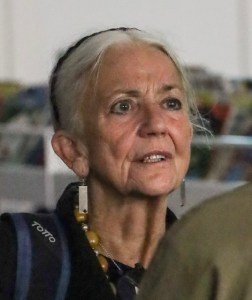
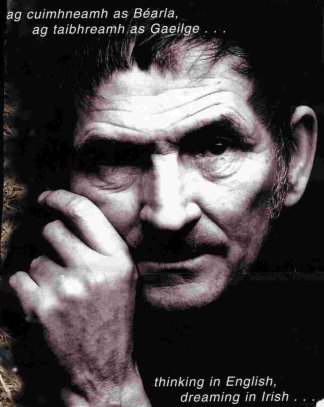
“.. those haunting quizzical eyes staring out.”


A Singular Life: The Poet Michael Hartnett

 Theo Dorgan

All poets are singular, in the sense that we are all singular, each of us bearing the burden of one life and one life only, but also in the sense that no poet can be comfortably placed in a definite lineage, presented to us as a manifestation in one particular line of tradition. Michael Hartnett was more singular than most. He was of Munster, and he acknowledged Munster forebears, but if this was the place he started from, he was unpredictable and cosmopolitan in his tastes and in the company he would keep; nothing in his background could have predicted or predetermined the poetry he would make, the arc his life would take.

  1.  Birth and a people

He was born in 1941, in Croom, County Limerick; he grew up in Newcastle West, in a time of close horizons, small expectations and apparently narrow minds. In those days, for the children of the poor, the prospects were few; the best hope was emigration, offering what the country could not – work and a living, however diminished. For the waywardly gifted, however, there is always the opportunity to carve out one’s own niche, albeit at the sacrifice of comfort and social place as generally understood.  The State was barely thirty years old and had already abandoned the revolutionary promise to cherish its children equally when Michael Hartnett stepped outside the boundaries of class and predestiny to discover himself a poet.

He published his first work in a local paper at the age of thirteen, his first poem in The Irish Times when he was still a schoolboy. From the day he left school, he thought of himself first and always as a poet.

  1.  A poet of and from a particular place

In an interview with Dennis O’Driscoll, Hartnett says: ‘I’m the only  ‘recognised’ living Irish poet who was born in Croom, County Limerick, which was the seat of one of the last courts of poetry in Munster: Seán Ó Tuama and Aindrias Mac Craith. When I was quite young, I became very conscious of these poets, and, so, read them very closely indeed.’[1]

In small places, folk memory runs deep, and a certain cachet endured in the title ‘poet’, with connotations of ‘other’, ‘different’, ‘gifted’, and ‘dangerous’. With the niche already prepared, so to speak, one sees the attraction for a curious young mind, already verbally adept and quick: poetry offered place, ancestry, a degree of acceptance for the chosen path and open horizons for a young man who had already discovered the power of words.

It is hardly uncommon, in a young poet, that she or he would first begin to grow in the shelter of some chosen poet mentor, whose sensibility, or technique, or more usually some amalgam of both, opened a road forward in the craft. When Hartnett first sought such a precursor, he looked at his immediate local context and backwards into another time and another language. What he found there would make no discernible impact on his craft (he never translated the totem figures, Mac Craith or Ó Tuama) but they furnished him with a particular kind of warrant – he could and did think of himself as the favoured inheritor of a tradition, and also as one obliged to be loyal to that tradition. This sense of obligation would become the sign and signature of his work.

Few Irish poets writing in English would own fealty to the tradition of Irish language poetry in the way that Hartnett did; his contemporaries and near-contemporaries chose figures who were perhaps as close to home but were certainly nearer in time, in language and in their themes and subjects. His Irish at the time was meagre, mostly acquired through overhearing Bridget Halpin, his grandmother, speak at late night firesides when the child had been safely put to bed. Much of his childhood was spent in her Camas cottage. He would later claim that she was one of the last native speakers of Irish in the district. While there are grounds for doubting this, his grandmother had a formative influence on the poet’s imagination – he would say that once she saw him with a necklace of wrens circling around his head, leading her to proclaim him a poet. He relished this atavistic sense of recognition, and would celebrate his grandmother in one of his most famous poems, ‘Death of an Irishwoman’[2]:

Ignorant, in the sense 

she ate monotonous food 

and thought the world was flat, 

and pagan, in the sense 

she knew the things that moved 

at night were neither dogs nor cats 

but púcas and darkfaced men, 

she nevertheless had fierce pride. 

But sentenced in the end 

to eat thin diminishing porridge 

in a stone-cold kitchen 

she clenched her brittle hands 

around a world 

she could not understand. 

I loved her from the day she died […][3].   

It is a far more cold-eyed tribute than the earlier, more conventional ‘For my Grandmother, Bridget Halpin’, a sign that Hartnett is willing to acknowledge ancestry but also to strike out in his own particular direction.

  1. Elected Company

Poets will gather about themselves, by elective affinity, those ancestors and companions that they need, not those wished upon them. We are more likely to understand them when we allow them to fly free in their chosen company.

Hartnett’s chosen companions were both eclectic and wayward, the company he chose as he pursued his life in poetry but also formed a consistory to whom he felt himself bound in loyalty and comradeship. Thus, in ‘A Farewell to English’ (and the indefinite article here is significant), these lines:

I say farewell to English verse,

to those I found in English nets:

my Lorca holding out his arms

to love the beauty of his bullets,

Pasternak who outlived Stalin

and died because of lesser beasts;

to all the poets I have loved

from Wyatt and Robert Browning;

to Father Hopkins in his crowded grave…[4]

 The plangent concluding lines of Antoine Ó Raifteirí’s poem ‘Cill Aodáin’ are these: ‘S dá mbeinn-se i mo sheasamh i gceartlár mo dhaoine/ D’imeodh an aois díom is bheinn arís óg.” A working translation: “And were I standing right at the heart of my people/ Age would go from me and I would be young again.”

I invoke these lines because to understand Michael Hartnett, it is of the first importance to recognise that ‘mo dhaoine’, ‘my people’, gives us both provenance of the man, and hence of the work, and also the mandate that governed and guided his trajectory on this earth, from first to last.

Hartnett, throughout his life, referred back to his sense of a people, defined and redefined that community to encompass family, neighbours and friends, antecedent poets, and that tribe of audience and influence, an intelligible company chosen by elective affinity. He wrote always for his place and for his people, sometimes as if in a guided trance, but always aware of the bond as both necessary and inescapable. If he was sometimes at home in and sometimes estranged from both place and people, if this community was sometimes balm and sometimes bane, nevertheless, this was the territory in which he lived out his life and to which he felt honour bound.

The territory encompassed by his native Newcastle West and neighbouring Camas and Templeglantine, extending outwards to the province of Munster and on to Dublin, touching on Spain and the Classical world in its farthest rippling, while vertically, so to speak, reaching back for Ó Tuama, Ó Bruadair, Ó Rathaille, Sor Juana Iñes de la Cruz and Federico García Lorca.

He would show a lifelong fidelity to his birthplace, but he had no illusions about the soul-cramping truth of a small place where ambition was suffocated in the cradle. The early poem, ‘A Small Farm’, begins:

All the perversions of the soul

I learnt on a small farm,

how to do the neighbours harm

by magic; how to hate.

I was abandoned to their tragedies,

minor but unhealing:

and concludes, the repeated line adding emphasis,

I was abandoned to their tragedies

and began to count the birds

to deduce secrets in the kitchen cold,

and to avoid among my nameless weeds

the civil war of that household.[5]


  1. The Early Work

The early poems are mannered, veering close to the Symbolism of the Russian Silver Age, marking a territory of savagery, death, and disappointment in a stylised language that only rarely swerves into the high plain speech that would become his signature music.

We hear this true note first and best in Anatomy of a Cliché (1968).[6]  There are birds here, but there is also ‘cold rain glisten/hung on each shocked feather’, the feel of the actual intensely experienced, even if birds are sometimes co-opted as metaphor, as in poem XI,

my lovely woman, listen:

two birds came together

out of a cold rain,

one, small, but capable of song,

one with strange plumage

not of the local lands [7]

Hartnett had been five years in Dublin when this collection appeared, but as Michael Smith points out: ‘Michael arrived in Dublin as an already published poet who was not looking for, nor needing any, teachers in the art of poetry.’ [8]

Smith tells us that Hartnett enrolled as a student in UCD, thanks to patronage from James Liddy, but ‘Michael almost never attended a lecture’. He found the University congenial, not so much for its teaching, but because it placed him in a company of young poets, including Macdara Woods, Smith, Eamon Grennan, Brian Lynch and, importantly, Paul Durcan. Hartnett and Durcan shared a common belief in poetry as a high calling that demanded surrender, devotion, and a single-mindedness, elevating it above all other duties. It is no reflection on their contemporaries to say that Hartnett and Durcan considered it something of a sacred moral imperative to stand at a slant to the shared social world, to embrace a certain kind of high loneliness. In Hartnett’s case, this high loneliness would be tuned to a keener pitch when, in 1975, he made the momentous decision to switch from writing in English to writing in Irish.

  1. Farewell to English

A Farewell to English,[9] published in that year, was a watershed book for Hartnett. Much of the attention this collection continues to draw is focused on the title poem, at the expense of the complex array of signalling in the poems that lead up to it. There is the acknowledgement of the toxic, particular nexus of alcohol and poverty in ‘The Buffeting’ and in ‘Early One Morning’, self-excoriating poems that are both clinical and merciless in their impact. There is the archetype of the fated and fatal victim in ‘The Oat Woman’, a figure to equal anything Graves, or Pasternak, can conjure, and there is its twin poem, ‘Death By The Santry River’ – both poems are stalked by terror. There is that ferocious political poem ‘USA’, and there are the poems that circle back to the home place – ‘Mrs. Halpin and the Lightning’, ‘Pig Killing’, ‘A Visit to Croom 1745’. Hartnett may be seen to be preparing his case for the title sequence, reaching back to his first circle of belonging, then nodding towards his second circle of elective affinities (in ‘Struts’, for example, with its ‘We are climbing upwards into time/and climbing backwards into tradition’), before he plunges forward into the Grand Declaration. Before we get there, we should take a long, cool look at ‘A Visit to Castletown House’.

The great Palladian mansion, Ireland’s first and still its finest, was built to consolidate and further the social and political designs of William Conolly, speaker of the Irish House of Commons.  Begun in 1722, completed in 1727, it was both a residence and a symbol of Irish achievement and ambition. The political congresses envisioned by Conolly never took place there, but the house did come to represent a phase in the evolution of a new kind of politics in Ireland, and much of the thinking about quasi-independence from direct British rule was fostered there. Of course, Castletown House was also a centre of dominance as far as the poorer classes were concerned, a ‘Big House’ carrying all the complex baggage that term implies.

Set in lush countryside on the banks of the wide, slow-moving Liffey, Castletown stood as a monument to what might be called the aristocratic pastoral. Hartnett’s poem moves through that pastoral landscape to an acknowledgement of the building in the “mere secreting wood”, overthrown at the cost of knuckles that bled and bones that broke, to a sharper focus on the pretensions of the nouveaux riches and on to the precise bitterness of the closing five lines:

I stepped into the gentler evening air

and saw black figures dancing on the lawn,

Eviction, Droit de Seigneur, Broken Bones:

and heard the crack of ligaments being torn

and smelled the clinging blood upon the stones. [10]

The poem may be read as a prologue to the title sequence of the collection. The relentless drive to its pitiless conclusion, the brief rehearsals of what were already central themes in the poet’s work, are interrupted by stanza four, introducing a new theme that will manifest with increasing power in later poems such as ‘Sibelius in Silence’: Hartnett’s deep insight into music as a high art.

It would be simplistic to read Hartnett’s turning away into Irish as atavism, as an arbitrary and wilful gesture. He was already an assured presence as a poet in English, a distinctive, recognised and recognisable voice. If he had an inherited sense of the rightful grievances of the poor, the landless and powerless, and the political acumen to understand the power relations that had evolved through Ireland’s colonised history, he had also a cool and sophisticated grasp of high art, as evidenced in this fourth stanza:

…the music that was played in there –

that had grace, a nervous grace laid bare,

Tortellier unravelling sonatas

pummelling the instrument that has

the deep luxurious sensual sound,

allowing it no richness, making stars

where moons would be, choosing to expound

music as passionate as guitars.[11]

Here, on the point of turning away from a language he had already mastered, Hartnett is sounding what will surface as a powerful strain in his later work: his deep understanding of and affinity with a broad European aesthetic. Sections (iii) and (iv) of ‘A Farewell to English’ are satires, in the Gaelic tradition of the ‘aor’, a form of invective that holds up its target to a savage form of ridicule. Dennis O’ Driscoll misses the point when he dismisses these sections as “philistine nonsense”; I think he misses the humour of these sections, the delicate and deliberate brio of exaggeration which Hartnett artfully deploys his point, as he says himself in the interview with O’ Driscoll, is that he was infuriated by the neglect of, and the lip service paid to, the Gaelic language and the Gaelic poetic tradition. In taking a deliberately hyperbolic swipe at the guardians of what had become State culture, he is making a subtler point: you cannot make all-encompassing claims for Irish identity and Irish poetry when what you mean is Irish poetry in English, an Irish identity that manifests only in English. The argument is made most pointedly in section vi), where the second stanza is brutally dismissive of “our Governments”, and follows hard on the heels of the last two lines in the first stanza: “For Gaelic is our final sign that/ we are human, therefore not a herd”. [12]

Sections iii), iv) and vi) are best thought of as a flourish of the matador’s cape, a heightening of the dramatic temperature to mask sober and serious business. Hartnett experienced poetry as a calling; he felt himself bound by an imperative from elsewhere that was a cloudy blend of local tradition in folklore and literature, a sense of his duty to speak for his class, his wide and miscellaneous reading and the imperatives he drew from that reading. He himself offered various reasons for turning away from English, which may be summarised as a reluctance to see the language go down into the dark. But consider, he had little Irish himself, there were already contemporaries such as Caitlín Maude, Nuala Ní Dhomhnaill, Michael Davitt and others who were effectively driving a mini-renaissance in Irish language poetry – the survival of the language did not depend on Hartnett’s frail and hesitant voice, and he was intelligent enough to know this:

This road is not new.

I am not a maker of new things…


…But I will not see

great men go down

who walked in rags

from town to town

finding English a necessary sin

the perfect language to sell pigs in.


I have made my choice

and leave with little weeping:

I have come with meagre voice

to court the language of my people.[13]

We should not forget that the long decay of the Irish language as a vernacular, and as a literary language, was neither an organic nor an unavoidable phenomenon. The former colonial power had an explicit and effective policy for the extirpation of the language, and this, coupled with the brute post-Famine necessity to privilege English to find a foothold in the English-speaking lands towards which forced emigration was inevitably directed, drove what we might call an evolutionary adaptation.

Hartnett, meagre though his store of Irish was, felt impelled to stand for the lost civilisation, the neglected and imperilled element that he thought crucial to Irish identity. How much of his argument was deeply felt, how much was post-hoc rationalisation, will be argued for a long time but need not detain us, since there was a deeper imperative at work. To put it as simply as possible, it is not so much that Hartnett chose Irish as that Irish chose him. The words came “like grey slabs of slate breaking from/an ancient quarry, mánla, séimh, dubhfholtach, álainn, caoin”.[14]

Out of nowhere, the words came to him, and he felt himself summoned:

I sunk my hands into tradition

sifting the centuries for words. This quiet

excitement was not new: emotion challenged me

to make it sayable.[15]

It was the words themselves, as they drifted into his consciousness, that prompted this radical departure from ‘the gravel of Anglo-Saxon’. He does not suggest that he followed unquestioningly:

What was I doing with these foreign words?

I, the polisher of the complex clause,

wizard of grasses and warlock of birds

midnight-oiled in the metric laws?

Section ii) offers two further imperatives: he sets out to walk to Camas, “half-afraid to break a promise” made to his uncle Dinny Halpin, and on the way he encounters ghosts, “black moons of misery/ sickling their eye-sockets/ a thousand years of history / in their pockets.” These apparitions are walking to “Croom, Meentogues and Cahirmoyle”, which Hartnett glosses: “Croom: area in Co. Limerick associated with Aindrias Mac Craith (d.1795); also, seat of the last ‘courts’ of Gaelic poetry; also, my birthplace. Meentogues: birthplace of Aodhagán Ó Rathaille. Cahirmoyle: site of the house of John Bourke (fl. 1690), patron of Dáibhí Ó Bruadair.”  Bracketed by these calls on his fealty, to place, to people and to poetry, he considered he had no choice but to turn to Irish. Many years later he would write: “…I have poems at hand:/ It’s words I cannot find…” [16]

For all the enmeshments of his situation in history, Hartnett turned to Irish primarily because he heard the words that found him out. That this was due to his particular conception of a poet’s proper duty is both clear and unambiguous – but the consequences of his decision were severe. He moved, with his wife Rosemary and their two children, to a small cottage in Templeglantine, the parish of his grandmother. We find again this wish, to situate himself as a poet among his inherited and chosen people, but if Hartnett expected sustenance and a charge of energy, personal and poetical, from this radical dislocation, it cannot be said that his hopes were fulfilled.

  1. Working through Irish

His first publication after the move was in both Irish and English, Cúlú Íde and The Retreat of Ita Cagney.[17] The English text is the stronger of the two, a reflection of the fact that Hartnett’s vocabulary and perhaps grasp of syntactical possibilities in Irish lagged behind his highly developed skills in English, but the bilingual reader will also find a hesitancy in the unfolding of ‘Cúlú Íde’ that is not found in the English version. We should observe here that the English is a version of the Irish, and not a translation.

The Templeglantine years were years of hardship, financial and emotional, for all concerned. Of the work that was produced in that small house, it is likely that only Adharca Broic [18] will stand the test of time. Individual poems still have a luminous clarity (for example, ‘Dán do Lara’), but it is doubtful that Hartnett’s work in Irish can be compared in achievement to that of Nuala Ní Dhomhnaill, for instance, or Biddy Jenkinson, Liam Ó Muirthile or Gabriel Rosenstock. This is hardly to denigrate the work but rather serves to make the point that Hartnett’s poems in English are for the most part of a higher order than his poems in Irish – and he was too good a poet, and too honest with himself, not to recognise this.

  1.  Return to English

One might have expected that when he returned to writing in English, he might have taken up where he left off. Instead, his next collection of poems would make use of a form few, if any, have mastered in English, the haiku. Deceptively simple as a form, the haiku relies on triggering a moment of insight in its reader, or a leap into empathetic understanding that is rarely, if ever, an obvious product of the ostensible narrative. Appearing in 1985, the same year as his translations of the great Dáibhí Ó Bruadair, Hartnett’s Inchicore Haiku[19] is a sequence marked by the modesty of its ambitions and of its ostensible subjects. He had always a keen eye for the natural world, but the cumulative impact of this book-length sequence comes from its accumulation of mood and tone – accusing and self-accusing, rueful, sad, disillusioned, occasionally celebratory, the poems mark a quiet, unshowy, return to the notionally abandoned language. No rhetorical flourish, still less an apology for having been away, there is no backward look here, but neither is there the dexterity, the dance with form and thought, that had marked the poems prior to 1975. This is a subdued Hartnett, defeated in his marriage, in retreat from his retreat. He found a new village in Inchicore, and in a sense, a new people with whom he could feel at home, recognised and accepted for himself.  Haikus 86 and 87 are instructive:

86

All divided up,

all taught to hate each other.

Are these my people? [20]

87

My dead father shouts

from his eternal Labour:

“These are your people!”[21]

Not for the first time, Hartnett’s self-identification with the poor and powerless gives him his milieu, his chosen audience and his set of subjects, but now the environment is not West Limerick, but a proletarian quarter of the capital city where dreams and promises come to die:

59

The warm dead go by

in mahogany boxes.

“They’re well-housed at last.”[22]

31

All the flats cry out:

“Is there life before dole day?”

The pawnshops snigger.[23]

37

What do bishops take

when the price of bread goes up?

A vow of silence.[24]

Very few of these 87 short poems work as classical haiku – they are mostly too direct and declarative.  Then again, the Japanese form relies on linguistic resources in Japanese that do not exist in European languages; perhaps it’s best to think of Hartnett’s haiku as simply short poems in a form approximating to the haiku. The energy of the sequence comes from the juxtaposition of deeply felt personal loneliness with a landscape of low expectations, diminished nature, and disempowerment.

  1. Fresh Poems, fresh powers and visions

Two years later came the bilingual A Necklace of Wrens,[25] followed by Poems to Younger Women[26] entirely in English. There is a startling return to the power and complexity we might have expected had the poet not turned aside from English in 1975. There are dark energies, some cruelty and vitriol, some tenderness, a measure of hard-won self-knowledge and graceful tributes, but above all there is a powerful surge of life and ambition in the verse making – the “polisher of the complex clause, /wizard of grasses and warlock of birds/midnight-oiled in the metric laws” is back, and with heightened powers. If the prevailing note is a kind of bleak celebration of endurance, nevertheless, there is brio, too, the brio of the toreador, resigned to danger and even to death, not quite courting it but aware that it is factored into the dance.

There had always been a visionary streak in the poems. With The Killing of Dreams[27] (1992), a note that is dramatically and defiantly struck, and which finds perhaps its most perfect expression in ‘A Falling Out’, where the muse figure is not just inspiratrix but also the pitiless withholder of the gift.

She comes from a familiar, homely environment of “overcoats and caps”, of “porter taps”, and battering hobnail boots, from

…the cobbles of the market square,

where toothless penny ballads rasped the air,

there among spanners, scollops, hones, and pikes,

limp Greyhound cabbage, mending-kits for bikes… [28]

the familiar small town territory where “she tricked from me my childish, sacred vow.”   The first stanza recapitulates Hartnett’s first stepping out into poetry, and the second rehearses his immersion in the written tradition, the variousness and wild range of what has been prompted by this powerful muse figure. Hartnett offers as her territory a landscape where ultimately all poets are doomed victims of the urge to create: she takes, and then dismisses, out of hand/ the men and women that she most does bless.[29] Sacred capriciousness is one of the qualities Graves attributes to his White Goddess, but where Graves sees the poet as inescapably bound to her rule, heroically stoic, waiting for when the next bright blow may fall, Hartnett, radically, dismisses his muse:

…at dawn I give her bed a gentle shove

and amputate the antennae of love


and watch the river carry her away

into the silence of a senseless bay

where light ignores the facets of her rings

and where the names are not the names of things.[30]

The poem has the air of a poetic suicide note, opening on initiation, closing on repudiation of the gift, and might well have served to close out the poet’s life and work – but perhaps we might read it better as a gambler’s bluff, a kind of dare? In ‘Didactic’ he tells us, bluntly, “the imagination has no limits./ Art has”. [31]

The eye has turned inward, the poet considers whether or not he has outlived his allotted span, ‘… he flounders out of bounds,/ his panacea mocked by a disease/ it was never meant to cure’.[32] Life as a painful site of anguish has been a subdominant theme since Inchicore Haiku. By now it is coming to dominate his imagination, and in poem after poem we find a casting about for release:

Sometimes, with perfect timing, death steps in

and makes the span of living coincide

with the completion of the work on stone,

but, mostly, age insists and the poet cannot see

the very shaping of his chunk of hill

was deed accomplished, mission done.

He never knows that, in the past, he’d won. [33]

For all that, there is something redemptive in the seven-part sequence ‘Mountains, Fall on Us’, a sustained and unflinching set of poems where the suffering man transcends his “list of childish woes”, and faces the hard facts of his life, as man and poet, with stoic acceptance. In the first part we are given a vulnerable figure, a gay man with aesthetic instincts at the mercy of cruel Spanish Catholicism, its ‘jeering trumpets’ redeemed by ‘some kindly waiter’ who ‘kindly dabbed/the distraught mascara from his face’. The second part evokes the poet’s ‘fatal childish dream’ of the life of ease marked out for him; the third section evokes a muse figure whom we might well trace back, to his Grandmother, whose ‘milestones are novenas for the dead’; in the fourth, we find a frank admission that he sits ‘in a soul I do not want’, living ‘this life which has no joy in it’, and in the fifth section the Alexandrian Cavafy is evoked, whose ‘real poems told of real pain’.

This trying on of roles, of lives, of identities, figures the possibilities open to the imagination which has no limits, but is true to the limits of art. In the final two sections, there is a resolute dismissal of all avenues of escape. In the end, he must hang ‘on the great loneliness/of his forgotten cross’, the outcast and thief who ‘asked for mercy and was snubbed by Christ’.

  1. A man without a people.

In 1991, he translated John of the Cross into Irish.[34]  In 1993, he published his lucid translations of Haicéad,[35] and his definitive, nuanced, and sensitive, translation of Aodhagán Ó Rathaille[36]  was completed in advance of his death in 1999. Two magisterial poems were left in him; they appeared in Selected and New Poems [37](1994), ‘He’ll to the Moors’; and ‘Sibelius in Silence’. New Poems (1990-1999) added a slight afterthought to the life’s work – followed by the posthumous A Book of Strays in 2002 – but to all intents and purposes, these two long poems wrote the finis.

  1. The slant towards death and silence

In a bravura keynote address to Éigse Michael Hartnett[38] in 2009, Paul Durcan suggested that Hartnett was possessed of a mediaeval Catholic imagination. ‘He’ll to the Moors’ traces the life of the mystic Ramon Lull, from his beginnings as a troubadour and lover, observer of birds and the ordinary minutiae of the natural world, to the polemicist for Christ who found no rest in the world until he was stoned to death in Tunisia. Durcan argues that this ostensible biography is in fact a species of cloaked autobiography; it traces the arc of Hartnett’s life in parallel to that of its subject, from insouciant celebrant of the small things, through the harrowed fields of desire and disputation until, at the end, he achieves the martyrdom that was always his destiny and his apotheosis. Durcan recruited the poet Michael Coady to his characterisation of Hartnett’s imagination:

‘At heart he was perhaps a classically Irish mix of tidal faith and fatalism – intuitively in touch with a deeply buried Mediterranean impulse in the Irish psyche and native language, but one historically and climatically done down by the fateful alliance of puritan incursions from the east and constant troughs of low pressure from the west…’

[Michael Coady’s Sleeve Notes for the Claddagh Records CD of Hartnett reading his own work]

The CD was issued by Claddagh Records, and in the notes we find Coady’s suggestive claim that “as with all true poets, a mysterious potency of verbal enchantment was at the core of his gift.” The shifts in register, the command of the inscape and outscape of his matter, the baffled and heartbroken humanity of the poem, show a poet in full command of a what is still a considerable gift.

At this point, in the full grip of alcoholism and its attendant furies, Hartnett was much occupied with gathering in the threads of his life, as if rehearsing and preparing an exit he felt drawing inexorably closer. He would write poems yet, short lyrics of uneven quality, but before he came to the desolate child’s cry of ‘A Prayer for Sleep’, the final poem in the 2001 Collected Poems, came the panoramic, cold splendour of ‘Sibelius in Silence’. In this poem, Hartnett revisits the handful of themes that haunted him all his life: the artist’s responsibility to the gift, to tradition and to his own people, and then the struggle to be at home in world and nation, self-doubt and the courage to outlast silence, the quarrel with history, and above all the sense that the lone sensibility cannot hope to overcome the brute weight of the world’s indifference. The chosen extended silence of Sibelius echoes Hartnett’s earlier “I have poems to hand/it’s words I cannot find.” Both poet and composer know that, to be true to the strictures of the art, one must find the discipline and courage to seek and withstand the silence out of which everything comes, into which everything must go.

Hartnett was fascinated by the elected silence the composer sought, until he emerged with what he considered the voice itself of the place itself, speaking itself:

I offer you here cold, pure water –

as against the ten-course tone poems,

the indigestible Mahlerian feasts;

as against the cocktails; many hues,

all liquors crammed in one glass –

pure, cold water is what I offer.

(Collected Poems p. 227)

The question is to what degree Hartnett conflates himself with Sibelius. Is Sibelius a mask he put on in order to confront himself, or is the poem intended as an homage, of one troubled soul acknowledging unresolvable ambiguity, in this question that can only be answered with “it is both and neither”.

When we consider the place of the poem in Hartnett’s long contribution to poetry, there is something heartbreakingly final about the concluding lines to what is, in effect, Hartnett’s farewell to poetry:

…that which was part of me has not left me yet –

however etherialised, I still know when it’s there.

I get up at odd hours of the night

or snap from a doze deep in a chair;

I shuffle to the radio, switch on the set,

and pluck, as I did before, Finlandia out of the air.

(p. 228)

He is far from Castletown house, and the plangent evocation of Tortellier; far, too, from the ballads and company of Maiden Street pubs, far from the poems of his Gaelic predecessors, from Lorca, from the austerity of Pasternak and the dark meditations of John of the Cross. One last great effort, a tour de force, and he lays down his pen, as “Into my room across my music-sheets/ sail black swans on blacker rivers”.

[1] Dennis O’Driscoll, The Outnumbered Poet (Loughcrew: The Gallery Press, 2013,  P. 199

[2] Michael Hartnett, Collected Poems, ed. Peter Fallon (Loughcrew: The Gallery Press, 2001) p. 139

[3] Ibid.

[4] Ibid., p.33.

[5] Ibid.,p.3.

[6] Michael Hartnett, Anatomy of a Cliché (Dublin: The Dolmen Press, 1968)

[7] Ibid., p.17.

[8] Michael Smith, ‘Remembering Michael Hartnett’ (Dublin: The Irish Times, 16th February 2009)

[9] Michael Hartnett, A Farewell to English (Loughcrew: The Gallery Press, 1975)

[10] Ibid., p.27.

[11] Ibid., p.26.

[12] Ibid., p.34.

[13] Ibid., p.35.

[14] Ibid., p.30.

[15] Ibid.

[16] ‘Impasse’, Collected Poems, p.194

[17] Michael Hartnett, The Retreat of Ita Cagney/Cúlú Ide, (Curragh, Kildare: The Goldsmith Press, 1975)

[18] Michael Hartnett, Adharca Broic (Loughcrew: The Gallery Press, 1978)

[19] Michael Hartnett, Inchicore Haiku (Dublin: Raven Arts Press, 1985)

[20] Ibid., p.35.

[21] Ibid.

[22] Ibid., p.26.

[23] Ibid., p.17.

[24] Ibid., p.19.

[25] Michael Hartnett, A Necklace of Wrens: Poems in Irish and English (Loughcrew: The Gallery Press, 1987)

[26] Michael Hartnett, Poems to Younger Women (Loughcrew: The Gallery Press, 1988)

[27] Michael Hartnett, The Killing of Dreams (Loughcrew: The Gallery Press, 1992)

[28] Ibid., p. 16.

[29] Ibid., p.17.

[30] Ibid.

[31] Ibid., p.26.

[32] Ibid., p.26-27.

[33] Ibid., p.27.

[34] Michael Hartnett, Dánta Naomh Eoin na Croise (Baile Átha Cliath: Coiscéim, 1991)

[35] Michael Hartnett, Haicéad (Loughcrew: The Gallery Press, 1993)

[36] Michael Hartnett, Ó Rathaille: The Poems of Aodhagán Ó Rathaille (Loughcrew: The Gallery Press, 1999)

[37] Michael Hartnett, Selected and New Poems, (Loughcrew: The Gallery Press, 1994

[38] Paul Durcan, ‘He’ll to the Moors’ (originally given as ‘Michael Hartnett’s Way of the Cross – the Final Quest’, keynote address at Eigse Michael Hartnett, Newcastle West, April 2009).

About the Author:

The poet Theo Dorgan. Source: Fingal Poetry Festival

Theo Dorgan is an Irish poet, writer and lecturer, translator, librettist and documentary screenwriter. He lives in Dublin with his wife, the poet and playwright Paula Meehan.

Dorgan was born in Cork in 1953 and was educated in North Monastery School. He completed a BA in English and philosophy and an MA in English at University College Cork, after which he tutored and lectured at that university, while simultaneously being literature officer at the Triskel Arts Centre in Cork.

After Dorgan’s first two poetry collections, The Ordinary House of Love and Rosa Mundi, went out of print, Dedalus Press reissued these two titles in a single volume, What This Earth Cost Us. He has also published selected poems in Italian, La Case ai Margini del Mundo (Faenza, Moby Dick, 1999).

He has edited The Great Book of Ireland (with Gene Lambert, 1991); Revising the Rising (with Máirín Ní Dhonnachadha, 1991); Irish Poetry Since Kavanagh (Dublin, Four Courts Press, 1996); Watching the River Flow (with Noel Duffy, Dublin, Poetry Ireland/Éigse Éireann, 1999); The Great Book of Gaelic (with Malcolm Maclean, Edinburgh, Canongate, 2002); and The Book of Uncommon Prayer (Dublin, Penguin Ireland, 2007).

He has been the series editor of the European Poetry Translation Network publications and director of the collective translation seminars from which the books arose.

A former director of Poetry Ireland, Dorgan has worked as a broadcaster of literary programmes on both radio and television. He was the presenter of Poetry Now on RTÉ Radio 1, and later for RTÉ Television’s books programme, Imprint. He was the scriptwriter for the television documentary series Hidden Treasures. His Jason and the Argonauts, set to music by Howard Goodall, was commissioned by and premiered at the Royal Albert Hall in London in 2004. A series of text pieces by Dorgan feature in the dance musical Riverdance; he was specially commissioned to create them for the theatrical show. His songs have been recorded by a number of musicians, including Alan Stivell, Jimmy Crowley and Cormac Breathnach.

Dorgan was awarded the Listowel Prize for Poetry in 1992 and the O’Shaughnessy Prize for Irish Poetry in 2010. A member of Aosdána, he was appointed as a member of the Arts Council (An Chomhairle Ealaíon) from 2003 to 2008.  He also served on the board of Cork European Capital of Culture 2005.

He was awarded the 2015 Poetry Now Award for Nine Bright Shiners.
Michael Hartnett’s Legacy

311030211_471914084962595_2001561487708472105_n
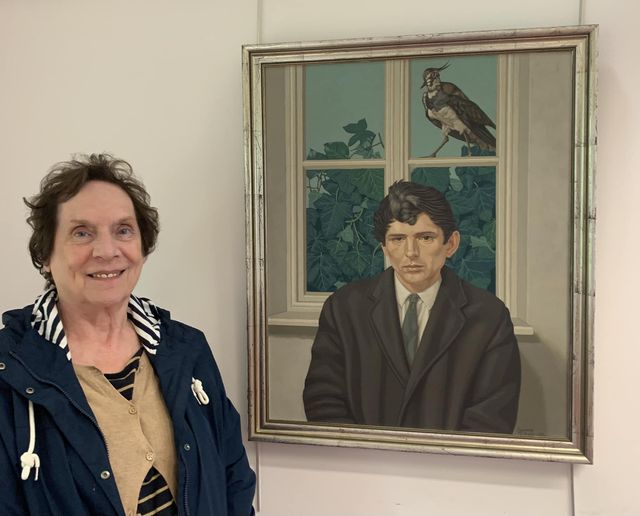
Éigse stalwart, Vicki Nash, pictured next to the 1971 portrait of Michael Hartnett by artist Edward McGuire, which was on display for the opening ceremony of Éigse 2022.

In academic circles, when poetic legacies, such as that of Michael Hartnett, are thrashed out and explored, there is always, of necessity, a legacy BUT.  BUT… he passed away in mid-sentence; his potential was unfulfilled, etc., etc.  We leave such debates to the continuing academic interest in Hartnett, but for those of us who love Michael Hartnett, the debate has already been won.   His core work, what we see in his numerous collections, his brilliant work as a translator, and his lyrical evocation of a Maiden Street upbringing (‘we were such golden children never to be dust’) and his other mischievous local interventions, are timeless and will stand the test of time – no ifs, ands or buts.

For those of us who are true believers, Michael Hartnett’s legacy as one of the central figures in modern Irish poetry is guaranteed. The Éigse Michael Hartnett festival, held annually throughout the town in schools, the library, the Red Door Gallery, the Desmond Complex, St. Ita’s Hospital, the Longcourt House Hotel, and in the ever-dwindling number of local pubs, celebrates that legacy each year. The festival’s wide-ranging and diverse programme creates an atmosphere of warmth and conviviality, perfect for lively gatherings, easy conversation, and spirited debate.

While his memory still lingers among us, however, the pace of change is relentless.  The Newcastle West he wrote so roguishly about has faded into the past, living on only in memory and in his verse.  Many of the central characters in these sagas, such as Tony Sheehan, Peg Devine, Tony Roche, Jimmy Deere, John Bourke, Billy the Barber, Pat Whelan, Ned O’Dwyer or Ned Lynch, are no longer readily remembered by the young people of the town.  Each year, however, they are recalled, remembered and celebrated in Éigse Michael Hartnett.

The Michael Hartnett Poetry Award is now worth a whopping €8,000, and the list of winners over the past twenty-five years is impressive. Many of those poets have gone on to achieve national prominence.  And, in the intervening years since the unveiling of that statue by fellow poet Paul Durcan on April 16th, 2011, Durcan’s hope that the statue would become a meeting place, a rendezvous, for parents and children, for schoolchildren, friends, and lovers has come to be a reality.

Michael Hartnett deserves all these efforts to keep his legacy alive – and, some would argue, the time has come for a more permanent centre to attract tourists and scholars to the town.  The Éigse organisers welcome recent efforts to establish a permanent Arts and Cultural Centre in Newcastle West.  This town needs to be a centre for the continued study of the poet’s work and a recognised repository for his papers and other materials before they are lost forever. It has been done successfully in Bellaghy and Inniskeen, so why not in Newcastle West?

Hartnett’s eclectic legacy is assured: his poetry in Irish and in English; his translations of modern Irish poets and of Ó’Bruadair, Haicéid and Ó Rathaille; his ‘local’ poems in Newcastle West and Inchicore; his engagement with the thorny issue of Irish nationalism and language at a time in the 70s during great political unrest without introducing any of the usual tribal undertones, will always be respected and applauded.

In recent times, we salute those who ensured that Hartnett’s iconic portrait by artist Edward McGuire was purchased by Limerick City and County Council on behalf of Limerick City Gallery of Art.  Like Hartnett himself, the portrait returns after a lengthy exile and will now forever be available to view locally.  However, in our continuing efforts to further Hartnett’s legacy, we can and must do more.

The decade from 1975 to 1985 in Glendarragh, Templeglantine, was arguably the most productive of his career.  Adharca Broic was published in 1978, followed by An Phurgóid in 1983, Do Nuala: Foighne Crainn in 1984 and his fourth collection in Irish, An Lia Nocht, appeared in 1985.  During this period, he also undertook the translation of Daibhi Ó Brudair’s poems, which were published in 1985.    In parallel to this ‘serious’ output, he was writing and entertaining the locals with ballads, some serious or semi-serious like ‘A Ballad on the State of the Nation’, which was distributed as a one-page pamphlet like the ballads of old and even included original linocuttings by local artist Cliodhna Cussen. Other ballads were more contentious and even semi-libellous (or fully slanderous!), such as ‘The Balad (sic) of Salad Sunday’ and ‘The Duck Lovers Dance’.  These latter creations were written under the very appropriate nom de plume, ‘The Wasp’!

It has to be remembered that at this time, Newcastle West and its West Limerick hinterland were booming.  The Alcan plant in Aughinish Island near Askeaton was under construction and every man, woman and child was working there.  Added to this, every spare room was occupied as up to 4,000 workers from all over Ireland were involved in the construction phase of the project.  The idyll of coming back home to a quiet rural backwater conducive to creativity in West Limerick was shattered by this unexpected and localised economic progress.  Ironically, while Michael was enjoying the  Klondike atmosphere in the hostelries of Newcastle West, his wife Rosemary was working as the Personal Assistant to the Managing Director of the newly commissioned Alcan Aluminium site.

This surely goes to the heart of the tragedy of what was Michael Hartnett’s life as a poet.  The literary and academic world tried in vain to accommodate him, although this help and recognition may have come too late to save him from the clutches of alcoholism.  While the annual Éigse sets out to maintain his rich legacy and celebrate his genius, it does tend to sugar-coat his reputation and often the big elephant in the room is ignored.  This must be a continuing source of frustration to his wife, Rosemary, his children and his surviving family members in and around Newcastle West.

The sad reality for Michael and his family was that he did not avail himself fully of the many opportunities that were offered to him in the 1970s and later. Rosemary bemoans the fact that while his contemporaries, such as Montague, Durcan, Kennelly and Heaney all wrote poetry, they also managed to earn a salary, whereas her husband ‘spurned all opportunities to do anything except write poetry and drink!’

He was the first recipient of a bursary from the Irish American Cultural Institute in 1974, which allowed him and his wife, Rosemary, to put a deposit on a cottage in the townland of Glendarragh, Templeglantine.  In that same year, he was awarded both the Irish American Literature Award and the Arts Council Award.  Following his return to West Limerick, he was employed for a brief time as a lecturer in Creative Writing at Thomond College of Physical Education (now the University of Limerick), but his tenure there was patchy and temporary.

Thus, at age 34, one would presume that Michael was free to pursue his calling as a poet and enjoy the countryside ‘out foreign in ‘Glantine’.  A good fairy, his wife Rosemary, paid the mortgage and all the bills and dealt with bureaucratic matters. She did it willingly because she believed in him and loved him and because she did not want her children to starve. 

Sadly, it seems that his obsession with poetry and drink left very little room for any other relationships to thrive and survive, and this included his marriage to Rosemary.  The acclaimed documentary by Pat Collins, A Necklace of Wrens (1999), ends with a very poignant, philosophical reverie as to whether Hartnett saw poetry as a gift or a curse:

It’s very difficult to describe where poetry comes from.  It certainly was given to me, but so were my brown eyes and my big ears.  They are just part of what I am, to coin a phrase.  I believe it’s a gift, certainly, and I’m lucky to have it.  But also it’s a curse, so I’m in two moods about it really.  I could say I did it all myself, which would be a total lie because there’s an entire three or four thousand years of tradition behind me in many languages.  But whether it was given or not, I can’t answer that question.  It just turned up and I turned up to meet it and we met at the crossroads and got married and we’re still married.

Michael Hartnett had a great predilection for romantic yarns. If they weren’t true, he was amused by the way they were taken up, including by the media and even sometimes by academics. Most of these myths, created by Hartnett to suit his own nefarious purposes, are trotted out again and again. One example of what passes for analysis:

At the age of three, Hartnett was sent to live with his grandmother, Bridget Halpin, who lived in Camas, a townland in the parish of Templeglantine, west of Newcastle West.  He was educated in the local primary school, and then in the well-known and enlightened St. Ita’s secondary school in Tarbert, Co. Kerry, run by the redoubtable Jane Agnes McKenna, a school that would later boast both Gabriel Fitzmaurice and Brendan Kennelly as alumni (McDonagh, Newman 15).

Hartnett, himself a master of misinformation and disinformation, would have been very impressed with the inventive mythmaking in this piece.  For the record, Brigid Halpin’s cottage in Camas is situated about a mile from the village of Raheenagh in the parish of Kileedy.  While it is true that he spent some time with his grandmother before beginning school and frequently thereafter for short stays at weekends and during school holidays, he attended Primary School in Newcastle West, first in Scoil Iosef and later in the long-established Courtenay Boys’ School. He then attended the very well-known and enlightened St. Ita’s Secondary School in Newcastle West, which was run by Jim Breen and where his English teacher was Billy O’Donnell.

Many of the myths surrounding Hartnett relate to Brigid Halpin, his grandmother. The reality is that she was not a native Irish speaker; he was not ‘fostered out’ to her for long periods in his childhood, and he did not learn Irish in her lowly cottage in Camas. Neither was she born in 1870, as he suggests in the famous Pat Collins documentary.  We know from Census records that she was a mere 80 years of age when she died alone in St. Ita’s Hospital, Newcastle West, in 1965. These inaccuracies continue to appear in much of what passes for scholarly research and analysis since he passed away in 1999, and, as I pointed out earlier, some of the biggest culprits are local. 

Despite this, Hartnett’s legacy is assured but demands continued and vigorous investigation.  While Declan Kiberd lavishes praise on Hartnett for being ‘the greatest translator of Irish-language poetry in the second half of the twentieth century’, he also bemoans the fact that ‘he is also his country’s most underrated poet (Kiberd, 381).  From the lofty heights where Heaney declares that Hartnett is the ‘authentic heir to the poets of the Maigue’ to those in the many hostelries he visited who dismissed him as an annoyance, there is the growing realisation of the truth in his son Niall’s observation that, ‘My father was many men to many people’ (McDonagh and Newman, 7).  Seamus Heaney remembers the frisson of electric energy which followed a Hartnett book launch – he says it was akin to a ‘power surge’ in the national grid.  He continues:

Yet despite that, his achievement was under-noticed.  Slight of build and disinclined to flaunt himself on the literary scene, he was always more focused on his creative journey than on career moves.  Edward McGuire’s portrait catches this singular intensity, but the response to his writings has been less definitive.’

Hartnett’s son, Niall, in an article in the Sunday Independent, on September 30th, 2024, spells out the current reality:

“His legacy as a poet is hard to gauge. His legacy is still spreading in Ireland, especially through the school system, although slowing in my opinion. But progress internationally is at a snail’s pace, sadly. My hope is that the school-goers of today in Ireland will be the next to carry his torch in the future to a wider audience.” 

And as we celebrate the twenty-fifth anniversary of Hartnett’s passing, we can see that time moves on and new poets emerge and are celebrated each year at Éigse  Michael Hartnett in Newcastle West, and in Listowel and Dromineer and many other far-flung Literary Festivals whose aim is to foster and nurture and give a platform to the young, vibrant successors of Hartnett. 

Twenty-five years on, the judgement of John McDonagh and Stephen Newman made shortly after his passing still holds true:

His body of work is a testament to his lifelong struggle with complacency and a desire to write with honesty and integrity that marks him out as one of the most overlooked yet influential Irish poets of the twentieth century (McDonagh, Newman, 24).

Prophets are never recognised in their own countries.  Until, that is, they make themselves irremovable landmarks on our landscapes and streetscapes.  The once-banished artist returns as a statue in our most cherished Square, an Éigse Literary and Arts Festival to honour him in perpetuity.  Hartnett deserves all these accolades.  He was at times painfully honest, very acerbic at other times, but always truthful until it hurt.  Emerson had him in mind when, in his famous definition of friendship, he states, ‘Better be a nettle in the side of your friend than his echo’, and he concludes with the admonition: ‘Let him be to thee forever a sort of beautiful enemy, untameable and devoutly revered’.

References:

Collins, Pat.  Film documentary A Necklace of Wrens (1999).

Hartnett, Rosemary, in correspondence with the author.

Kiberd, Declan. The Double Vision of Michael Hartnett in After Ireland: Writing the nation from Beckett to the present, Head of Zeus UK, 2017.

McDonagh, J., Newman, S.  (eds). Remembering Michael Hartnett, Four Courts Press Ltd., Dublin, 2006.

Michaelandrosemary
Michael Hartnett, his wife Rosemary and daughter Lara.

Paula Meehan’s ‘Letter to Michael Hartnett’

Paula Meehan in full flow, delivering her eloquent ‘Letter to Michael Hartnett’ on the Opening Night of Éigse Michael Hartnett, 2025. The photograph is by Dermot Lynch

As part of our preparations for Éigse 2025 we decided to ask Paula Meehan to be our special guest on Opening Night, 2nd of October.  Her remit was to ‘speak from the heart about her memories of Michael Hartnett’.  She did so by framing her thoughts in the form of ‘A Letter to Michael Hartnett’ – a wonderful prose poem.  This was written on the 1st of October 2025, the night before the Éigse in his name opened in his native Newcastle West, County Limerick.  The result is truly magnificent and deserves to be shared with Michael’s family, his many friends and ardent followers who didn’t make it to the Library in Newcastle West on that momentous night.


 Dearest Michael,

Tomorrow I will rise with the sun and take to the road, and by eight-ish I will stand to speak of you before a crowd of your devotees in your home town where your name will be on everyone’s lips. Being blessed for the most part — but you have to allow, as you’d say yourself: there’s always the one.

The Éigse, founded in your name, will be opened with ceremonials and celebrations through all the arts, on its twenty-fifth birthday. If fate allows, I’ll be there to sing your praises, to sing them to the high heavens, where I hope you reside with the cherubim and seraphim, your ears ringing with their choral magic. I’ll say you were and are of greatness wrought. I’ll offer gratitude for the poems you carried, for the pure music of your shining spirit. So many of us will be gathered in your name and cherishing all you stand for.

I’ll be aware, too, of your black sardonic eye on proceedings somewhere in the otherwhere of elsewhere; aware especially of how you hated poets going on, and on. And weren’t afraid to let them know. Now as I enter my anecdotage and my crankitude, I can hear your voice in my ear:

‘Just tell them I’m not the worst.’

That’s what you whispered one night as I rose to introduce you to students in a small back room, over fifty years ago. After the reading they would have died for you, each and every one of them, so thoroughly had you enchanted them.  I remember the joke you told them at the end of your reading: ‘What do you get if you cross a donkey with a bag of onions? A ride that would bring tears to your eyes’.

‘Come to the Éigse,’ said Norma Prendiville, ‘and speak from the heart about Michael for twenty minutes.’ Michael, I’ll speak from the heart you broke. You broke the hearts of all of us who loved you.

You were our purest poet. Our own Orpheus.

Even Eavan Boland, who reckoned there was no Orpheus in Ireland, came to understand the Orphic nature of your lyric. I extract from ‘Irish Poetry’, the poem she dedicated to you, where she tells how over a pot of tea one winter’s evening you —

began to speak of our own gods.

Our heartbroken pantheon:

No Attic light for them and no Herodotus.

But thin rain and dogfish and the stopgap

of the sharp cliffs
they spent their winters on.

And the pitch-black Atlantic night.
And how the sound
of a bird’s wing in a lost language sounded.

You made the noise for me.
Made it again.
Until I could see the flight of it: suddenly

the silvery, lithe rivers of your south-west

lay down in silence.
And the savage acres no one could predict

were all at ease, soothed and quiet and

listening to you, as I was.
As if to music, as if to peace.

Eavan, who always referred to you as Mikey, with great fondness.

I first met you, Michael, in Grogan’s Castle Lounge in South William Street in my native city of Dublin. The poet’s horror hole a friend called it, a poet already sober, a rare enough thing in Grogan’s Castle Lounge. In those days fadó, fadó.

It is nineteen eighty-three and I am just back home to Dublin. I have been studying for a Masters of Fine Arts degree, in Washington State in the far Northwest of the United States. I brought two slim volumes with me when I left for the States – poets I had never met in person, but I considered them poetical mother and father to my craft or sullen art.

The books were Eavan Boland’s 1980 volume In Her Own Image and your 1975 volume A Farewell to English. When I met you that first time in Grogans, introduced by Tommy Smith, I told you I had the whole of the title poem, dedicated to Brendan Kennelly, by heart. Go on so, said you, prove it. I did. By heart. With only a few wobbles.

I think you were gobsmacked. You asked to see poems for, you said, I must be a poet. I showed you one I had in my pocket — do young poets still carry new poems on their person? Maybe on their mobile phones …..   I showed you one and you said it wasn’t very good. I showed you another and you said that was much better. The real thing. Of course, I paid no heed to your critique. Isn’t arrogance a protective force when you’re a baby poet?

If I had the whole poem by heart then, I have only fragments now, but it comes back to me when I need it. It gets me through as much as it gets through to me, the beautiful, sustained meditation on our politics. our culture, our colonised minds. Your masterpiece of scorn and hurt and resistance.

In the choppy waves of loneliness in an American university the poems kept me on some kind of even keel. They were part of the reason I came back to Ireland despite the terrible prospects.

‘What are you going home for? Sure all the kids are going the other way?’ ’What are you coming home for. There’s no work here.’

The era of last one to leave the country turn out the lights. The era of redundancies, butter vouchers, dole queues, heroin hitting the poor communities of the inner city like a juggernaut, moving statues, The Kerry Babies, Anne Lovett, The Heavy Gang. The Troubles live on TV every night.

You understood I came home to get the poems I needed to get.

What did we talk of on those walks by the Camac River, that palindromic waterway? Oh, you could fascinate from Akhmatova to Zozimus. You were dazzling in your erudition. You had the names, and the naming and so took possession of every blooming thing, of every wingèd thing and creature of the riparian zone. In two tongues.

I found blessing and curse in every poem. You were countryman. You were cosmopolite. You were ancient. You were avant garde. You were honey. You were vitriol.

Kind. Ferocious. Wicked. Lonely. So lonely, Michael, for your boy and your girl, for Niall and Lara, your beautiful children.

I carried your poem ‘Death of an Irishwoman’ like a holy fire. You understood that the most important culture bearers come in humble guise, like the Zen master scrubbing the kitchen floor of the monastery. Your ‘ignorant’ grandmother Bridget Halpin, who gave you Irish, who handed you the tool you would use to decolonise your mind. Decolonise our minds.

You were the wounded healer.

Death of an Irishwoman

Ignorant, in the sense
she ate monotonous food
and thought the world was flat,
and pagan, in the sense
she knew the things that moved
at night were neither dogs nor cats
but púcas and darkfaced men,
she nevertheless had fierce pride.
But sentenced in the end
to eat thin diminishing porridge
in a stone-cold kitchen
she clenched her brittle hands
around a world
she could not understand.
I loved her from the day she died.
She was a summer dance at the crossroads.
She was a card game where a nose was broken.
She was a song that nobody sings.
She was a house ransacked by soldiers.
She was a language seldom spoken.
She was a child’s purse, full of useless things.

I carried that poem into workshops, workshops in universities, in prisons (sometimes on the same day).  I read it with women prisoners, with the political prisoners in Portlaoise, with the men in Arbour Hill High Security Prison, in recovery programmes. I brought it into art colleges, into classrooms all over the country, into other countries.

Everyone has loved someone from the day they died. Some creature. Some thing.

Only last week at a workshop in Kilmore Quay, I read that poem and there was a gasp, an audible intake of breath on the line, ‘I loved her from the day she died.’ She will never die, your grandmother, bearer of Irish, cultural heroine, your grandmother Bridget Halpin.

Those last few years of your life, your ever faithful friend Tony Curtis would drive myself and Theo (Dorgan) out to Dundrum, where you lived close by what you called The Sentimental Hospital, known to the rest of us as The Central Mental Hospital. You were dying in the loving care of Angela Liston.

The October of your going was radiant and glorious. But the day of your funeral it lashed. Early to the town for the burial, we took shelter in a pub. A man came in and said there’s a fierce crowd in for a funeral. Dinny Hartnett, the postman, his brother the poet is after dying. You would have liked that, Michael. You would like that the woman in the Pound Shop gave us armfuls of umbrellas, all the umbrellas in the shop, and wouldn’t take any money. Sure bring them back when the funeral’s over.

I did a poetry reading in Limerick a while back, in the City Gallery under Eddie Maguire’s magnificent portrait of you, the one on the front of your Collected Poems. Una McCarthy, who has recently retired as Director of the Gallery, had fought a long, hard battle to wrest the funding for it and get it back to Limerick from a private collection in the United States. You hung there, your black eyes boring into me, as intensely as they had in life. You could read minds, an uncanny gift. You were drawn to the wounded in bar or street. I saw people open to you like flowers – they felt your nobility of spirit, your deeply empathetic heart.

Michael, I hope wherever you are that this Éigse energy in the streets of the town of your birth will touch you. Your name is on every tongue. You are cast in bronze in the marketplace. The rain flows down your beautiful face, mingles with the tears you shed for your mother, for your father in his blanket of snow.

I send this letter into the void, dear Michael, in gratitude, devotion and fond memory.

 Sincerely,

P. Meehan

Paula Meehan. Photograph by Dermot Lynch

About the Author

Paula Meehan was born in Dublin in 1955, the eldest of six children. She attended a number of primary schools, finishing her primary education at the Central Model Girls’ School off Gardiner Street. She began her secondary education at St. Michael’s Holy Faith Convent in Finglas but was expelled for organising a protest march against the regime of the school. She studied for her Intermediate Certificate on her own and then went to Whitehall House Senior College, to study for her Leaving Certificate.

Outside school, she was a member of a dance drama group, became involved in band culture and, around 1970, began to write lyrics. Gradually composing song lyrics would give way to writing poetry.

At Trinity College, Dublin, (1972–1977) she studied English, History and Classical Civilization, taking five years to complete her Bachelor of Arts degree. This included one year off, spent travelling through Europe. While a student she was involved in street theatre and various kinds of performance.

After college she travelled again, spending long stretches in Greece, Germany, Scotland and England. She was offered a teaching fellowship at Eastern Washington University where she studied (1981–1983) in a two-year programme which led to a Master of Fine Arts degree in Poetry.  She returned to Dublin in 1983.

Meehan has also written poetry for film, for contemporary dance companies and for collaborations with visual artists; her poems have been put to music by songwriters (including Christy Moore). Her poetry has been extensively published in translation, including substantial collections in French and German.

The 2015 Poetry Competition ‘A Poem for Ireland’ shortlisted her 1991 poem ‘The Statue of the Virgin at Granard Speaks’ in the final ten poems. She selected poems for and introduced the Candlestick Press anthology Ten Poems from Ireland in 2017. Meehan was a judge for the 2020 Griffin Poetry Prize.

In September 2013, Meehan was installed as the Ireland Professor of Poetry by President Michael D. Higgins.

In 2023, she was elected an honorary fellow of Trinity College Dublin.

  • information sourced from Wikipedia

Maiden Street Wake by Michael Hartnett

Maiden Street Wake by Michel Hartnett (1968)

I watched the hand

until a finger moved

and veins above the index knuckle

pulsed.

That was his last movement.

She had a band

of tan tobacco juice

upon her chin.  Her few teeth buckled.

That was all the grief she showed.

In public.

Columned and black with women in shawls,

yellow and pillared with penny candles,

bright-eyed and blue-toed with children

in their summer sandals,

that was the mud house, talkative and lit.

In the bed, the breeding ground and cot,

he wore his best blouse

and would have seen

the finest teacups in his life.

But he was white

as an alabaster Christ

and cold to kiss.

We shuffled round and waited.

Our respects were paid.

And then we ate soft biscuits

and drank lemonade.

Commentary

The Irish are a people well-versed in tragedy, suffering, grief and sorrow.  Beset by famine, poverty and colonization, the history of Ireland is one that is steeped in immense adversity and sadness. Perhaps this is why the Irish are so particularly adept at mourning the loss of a loved one and saying goodbye. This may explain Hartnett’s fascination with the unique customs and traditions surrounding the Irish Wake, a tradition which is one of the most distinctive and renowned funeral traditions worldwide.  Needless to say, alcohol and music, both significant staples of Irish culture, are often heavily featured at a wake. While an Irish Wake is first and foremost a final farewell to the one departed, it can also serve as a potent and bracing reminder to those in attendance that they are still alive and a part of the world. This unique mixture of melancholy and mirth is partly why the Irish Wake is so famous the world over. Such an atmosphere is especially likely if the deceased was elderly or ill for a long period of time.  Often the wake of a younger person or a child is a far more sombre affair.

Hartnett’s, Collected Poems, contain several ‘Wake Poems’, including, of course, a wake that he missed, that of his grandmother Bridget Halpin, whom he immortalised in Death of an Irishwoman.  He was in Morocco at the time of her death in 1965.  There is also his beautiful epitaph for John Kelly; In Memoriam Sheila Hackett, where he laments the passing of an early childhood friend; and reveries on the death of his young infant brother, For Edward Hartnett, ‘All the death room needs …’; and ‘How goes the night boy? …’, in which he plays a ten-year-old Fleance to his father’s Banquo, as they mourn the loss of his sister Patricia in 1951.  Both Edward and Patricia died as very young infants, a not unusual occurrence in the late 40s, and early 50s.

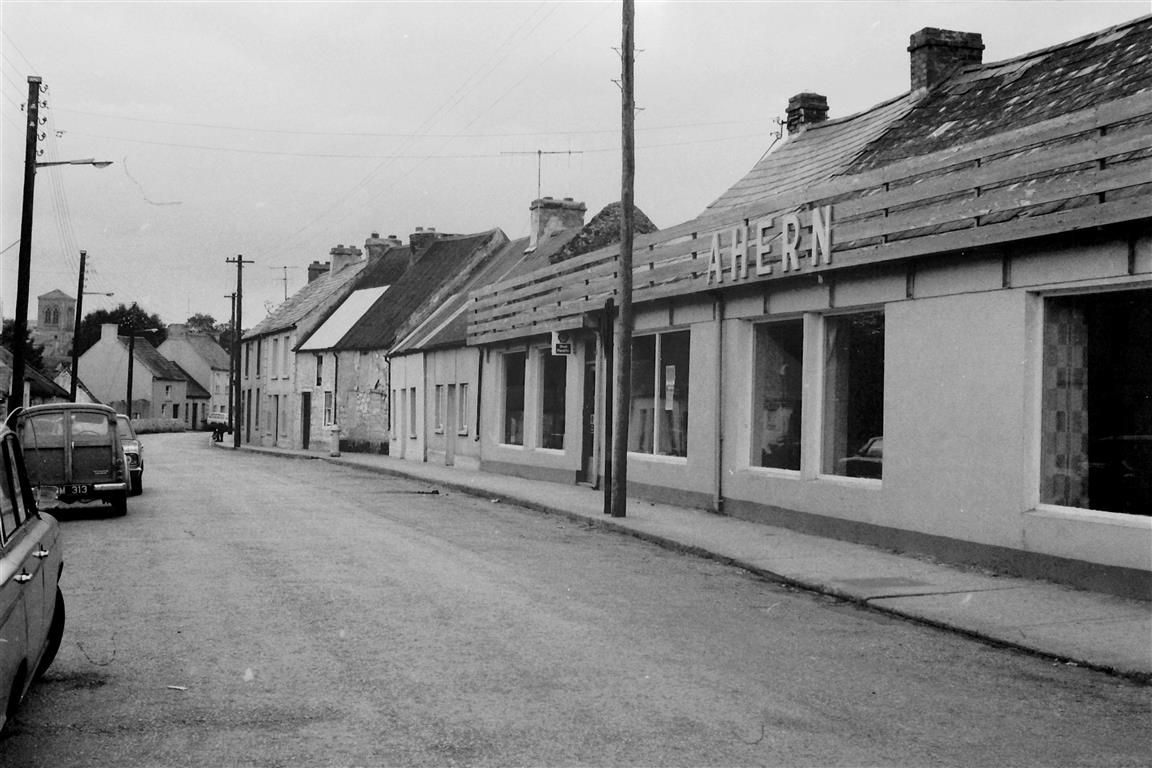
At this time in Newcastle West there were over fifty public houses in the town and Maiden Street had its fair share such as Flanagans, McMahons, Cremins, Ahernes, Houghs, O’Gormans, and Flynns.  However, custom and culture dictated that when there was a death, what was known as ‘The Corpse House’ became, in effect, another public house for the duration of the funeral obsequies.  This explains why the young Hartnett had such ready access to the events surrounding the death of a neighbour in the close-knit community of the Coole and Lower Maiden Street.  The death described here stands out because it seems that the young Hartnett arrives in time to witness the old man draw his last breath,

I watched the hand

until a finger moved

and veins above the index knuckle

pulsed.

That was his last movement.

The dead man’s wife is also described, and she comes across as being stoic and somewhat overwhelmed as she has been thrust into the limelight at this public event.

She had a band

of tan tobacco juice

upon her chin. 

This poem, Maiden Street Wake, was written in 1968 and so, therefore, it is a memory poem, probably from the late 50s.  The young Hartnett was present at this wake, and it may have awakened in him his near obsession with death and wakes and funerals that he revisited many times, especially for his friends in Maiden Street.  This wake is reminiscent of the wake that is described so brilliantly in the first sequence of The Retreat of Ita Cagney.  In the stage directions for an unpublished dramatic version/libretto of the same story, Hartnett describes the scene, obviously harking back to those wakes he had visited in his youth: ‘There is a sudden confused noise of prayer, glasses clinking, sneezes, melodeon music, a puff of smoke, sobs’.  Later, the stage directions relate, ‘The other door opens: smoke, glass-noise, music, sneezes, sobs, rising and falling prayer-sounds’ and again ‘There is the sound of glasses tinkling, praying, sobbing, sneezing.  The melodeon takes up the theme, and a puff of blue smoke comes from the doorway’.

Hartnett places this poem, Maiden Street Wake, alongside his poem Prisoners (both written in 1968) as the only two poems in a limited edition (250 copies) joint venture publication between Deerfield Press and Gallery Press that was published in 1977.  Both poems are illustrated by Timothy Engelland and all copies are individually signed by the author.  It seems that both poems were in his mind as he embarked on writing The Retreat of Ita Cagney / Cúlú Íde, the first major works, along with Farewell to English, undertaken on his return to West Limerick.  Both poems celebrate their 50th Anniversary this year!

Maiden Street Wake may be an account of yet another random wake, one of the many wakes that the very young Hartnett witnessed and attended in Maiden Street during his childhood.  Whatever the case may be, the old traditional Irish wake, with its old women keeners, flickering candles, music and drink, tobacco and snuff, as well as ‘soft biscuits and lemonade’ for the children, is used by Hartnett to set the scene for us in the poetic version of The Retreat of Ita Cagney. It is obvious that these events made a lasting impression on the young teenage Hartnett and those events fuelled his imagination and gave rise to some of his best poetry.

He describes the scene at ‘The Corpse House’, a mud-walled cabin in Lower Maiden Street.  The dead man is laid out in his bedroom, surrounded by ‘women in shawls, and young children from the street in their ‘summer sandals’. His bed, ‘the breeding ground and cot’, is surrounded by ‘penny candles’ and people file by to pay their last respects.  The family have made a great effort to cater for the influx of visitors and the best and ‘finest teacups’ have been brought out for the occasion.  The poet uses a beautiful simile to describe the corpse, he is like ‘an alabaster Christ’ laid out in the tomb.  For the young Hartnett viewing this traditional custom there is a sense of anticlimax at the end: after waiting their turn, they ‘shufffled round’ and were rewarded later in the meagre kitchen with ‘soft biscuits’ and a glass of the famous local soft drink, Nash’s red lemonade.

The Irish wake has long been the subject of poems, songs, films and stage plays.  Hartnett has written several poems in which he explores the old custom in a very sympathetic way.  These ‘Wake Poems’,  his poems such as A Small Farm and the many poems written to honour his grandmother, Bridget Halpin, all attest to a poet exploring the past, its customs and traditions while seeking to enhance their value and importance lest they be lost.

Prisoners by Michael Hartnett

‘Prisoners’ by Michael Hartnett

Brave

To keep as captive

one he loved, this wild woman

not so old, so many years

in quiet place,

unknown to all the town.

So her face was white as almond

pale as wax for lack of sunlight

blue skin by her eyes in etchings,

all her beauty now attainted,

all her loveliness unwanted.

Not to say his love was lessened,

no.  He came home to her same altar

at night, grey horse bore him to the threshold,

quiet rooms, where the woman sang her service,

sang to new gods, to the church of her invention

her own cloistered psalms, in her bishoped dress of scarlet.

For she built walls to keep God in,

and waiting there from eyes ahide

at night before her tearful face

at calm crossroads her child did raise,

her child into the secret world.

And she involved a secret Lord,

prayed the holy prayers she made herself,

and sang so: my Lord God is a human Lord,

not Lord of towns, but Lord of white horses, holy

of the hyacinth, the human Lord of light, of rain.

Yes, Lord of sacred anguish, hear

me, and speak in rain of trees: send

your holy fire to heat me. I

cry: my Lord of holy pain, hear.

House of slated roof was their house,

daylight knew no way to hound them out of peace:

the door was closed with iron chains

locked safe inside an open moat of water;

secret in their love they lived there:

the birch-hid dove was silk with peace.

– Michael Hartnett

This poem is vital in the Hartnett canon.  The poem, which he wrote in 1968, visits and explores a theme close to Hartnett’s heart.   It is later included as the title poem in his last collection in English before his now famous Farewell to English.  This was a limited-edition (250 copies) joint venture publication between Deerfield Press and Gallery Press that was published in 1977.  The publication includes two poems (Prisoners and Maiden Street Wake), and both poems are illustrated by Timothy Engelland.

Michael Hartnett’s ‘Move to The Park’

IMG_5066
Inset of New Houses just before occupancy, September 1951. (Courtesy of Dr Pat O’Connor, The New Houses: A Memoir, p.9)

In late 1980, Hartnett began work on his best ballad, which is most loved and recited to this day, the ‘Maiden Street Ballad’.  The ballad stretches out for 47 verses and is a compendium of much of what he had written in prose about Newcastle West in articles for The Irish Times, for Magill magazine and for the local Annual Observer, the annual publication of the Newcastle West Historical Society during the 60s and early 70s.  There are also echoes of other local poems such as ‘Maiden Street’ and ‘Epitaph for John Kelly, Blacksmith’ included among the verses of the ballad.

‘Maiden Street Ballad’ was published by local entrepreneur Davy Cahill’s The Observer Press ‘with the help of members of Newcastle West Historical Society’.  Copies of the original are much sought after on eBay and elsewhere to this day.  It carried a very eloquent dedication, ‘This ballad was composed by Michael Hartnett in Glendarragh, Templeglantine, County Limerick in December 1980 as a Christmas present for his father Denis Harnett (sic)’. 

‘Maiden Street Ballad’ contains a number of autobiographical segments.  The early stanzas tell us about his childhood days where they rented accommodation first in Connolly Terrace and then in nearby Church Street before making the move to Lower Maiden Street where they rented a room from Legsa Murphy.

We rented a mansion down in Lower Maiden Street,

Legsa Murphy our landlord, three shillings a week,

the walls were of mud and the roof it did leak

and our mice nearly died of starvation.

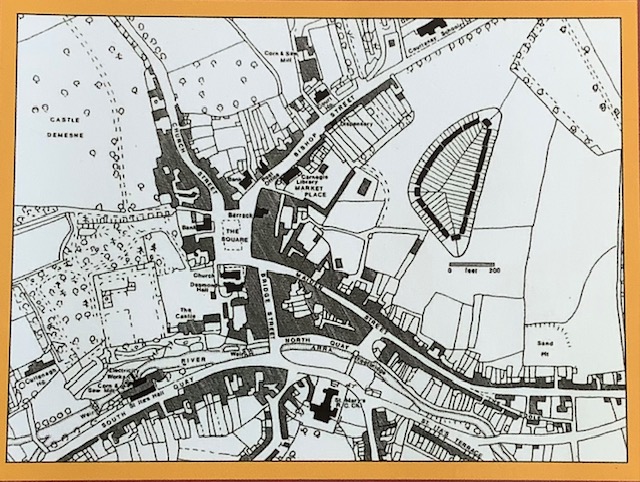
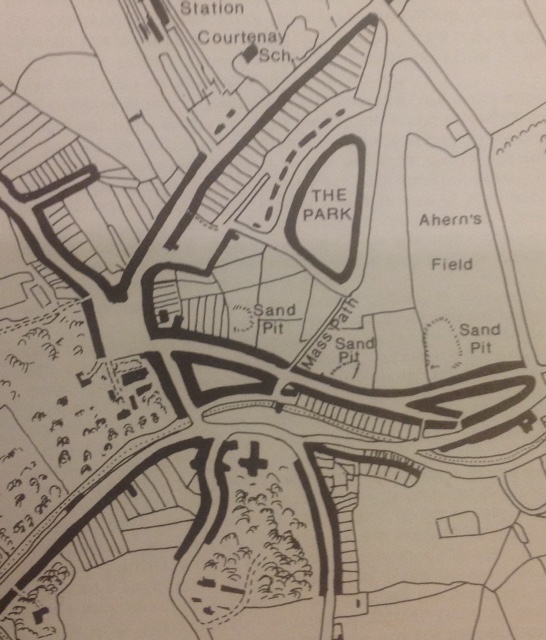
Probably one of the most notorious segments is the ten ribald verses from 27 to 37 which describe a virtual pub crawl of all of Newcastle West’s 26 public houses which were doing business in 1980.  (Michael Hartnett’s 26 Pubs at Christmas!)   In another significant segment from verses 16 to 23, he eloquently documents the move from Lower Maiden Street to the new housing scheme in Assumpta Park.  These verses portray Hartnett at his best, they are witty, caustic, and often slanderous; his use of hyperbole pokes fun at his friends and those neighbours who were part of that mass exodus from the slums of Maiden Street and The Coole.

Hartnett says that the street finally ‘gave up the ghost’ in September 1951 when most of the inhabitants were rehoused in one of the 60 new houses in Assumpta Park.  Hartnett describes the operation, likening it to the hazardous Exodus of the Israelites escaping from Egypt to the Promised Land!  Unlike the ‘pub crawl’ sequence which describes in great detail the quirks and peccadillos of numerous characters, including many of his own family, there are only two people mentioned in the ‘move to The Park’ sequence – only passing reference is made to Dick Fitz and Mike Hart, two great stalwarts of the area.  Rather this segment describes his people, his neighbours, the real old stock of the town in a richly comic and exaggerated way.

In the late 40s and early 50s, the local authority had built up to 60 social houses to relieve the squalor, poverty and slum-like conditions in Maiden Street and The Coole.   They were built in an area of the town known as Hungry Hill, although the new development was officially called Assumpta Park.  The Hartnett family were but one of the lucky families to be given a new house and they moved into Number 28 in 1951.  Hartnett tells us that the ‘old street finally gave up the ghost’ and the mud-walled, galvanised cabins were abandoned down in The Coole and the people were tempted to move ‘to the Hill’s brand new houses’.   The ‘New Houses’ stood on a hill high and exposed above the town at the outer edge of a terminal moraine.  The original sixty houses were finally allocated on the 15th of September, 1951.  Dr Pat O’Connor, the author of ‘The New Houses: A Memoir’, whose family were allocated Number 24, remembers that ‘doors were still without numbers and entrances without gates’.  There was no street lighting or footpaths so it must have been a very eerie place to move to.

The relocation is described in almost Biblical terms with a delicious mixed cocktail of the Exodus story and the story of Noah’s Ark:

and some of the ass-cars were like Noah’s Ark

with livestock and children and spouses.

As well as the Bible, Hartnett is also influenced here by the writings of John Steinbeck and his iconic descriptions of the Great Depression in The Grapes of Wrath as well as the writing of Sean O’Casey and Brendan Behan who wrote about the tenements in Dublin and the gradual movement of people from places like Henrietta Street to Crumlin and Cabra in the 1940s, and Ballyfermot and Artane in the 50.

IMG_5068
The Park upon first occupancy, September 1951. (O’Connor, 12)

Hartnett is a very astute commentator on the social ills of his day and the Maiden Street Ballad, and this segment in particular, shows the level of poverty and deprivation experienced by the people in that part of the town in the early 50s.  They brought with them their ‘flourbags’, ‘their ‘tea chests’ and ‘three-legged stools’ and their ‘jam-crocks in good working order’.  At that time many of the households were so poor that they were unable to afford the bare necessities such as cups and saucers.  Jam was sold in one-pound and two-pound glass jars and these were used as substitutes for tea cups and milk glasses in most households.  Dr Pat O’Connor tells us that the new occupants had come from ‘the tattered tails of the town, where congestion and dereliction were rife, but (where) the sense of neighbourhood intimacy was well defined’.  Hartnett describes the move in a very light-hearted way, and he follows up by saying that they also brought their fleas, bed bugs and mice with them because they felt they were almost part of the family.  And now that they’ve moved up in the world the fleas also go to Ballybunion each year on holiday with their host families ‘though hundreds get drowned in the waves there’.

Many found it very difficult to make the necessary adjustments to their new surroundings and the poet pokes fun at their efforts to adapt to such new luxuries as piped water, electricity, toilets and bathtubs.  The novelty of two-storey houses had also to be grappled with – three bedrooms upstairs and a hallway, kitchen, scullery and bathroom downstairs.  Apocryphal stories circulated that one of the legendary early occupants, Forker O’Brien, famously used the bannisters as kindling for the fire!  Indeed, Hartnett would have us believe that many continued with the practices that had been commonplace in their former residences:

In nineteen fifty-one people weren’t too smart:

in spite of the toilets, they pissed out the back,

washed feet in the lavat’ry, put coal in the bath

and kept the odd pig in the garden.

They burnt the bannisters for to make fires

and pumped up the Primus for the kettle to boil,

turned on all the taps, left the lights on all night –

but these antics I’m sure you will pardon.

Hartnett continues in his light-hearted vein, and he lists the great improvements that have come about in peoples’ lives in the years following their relocation.  They are respected now and indeed have earned the respect of their fellow townspeople, and they have made great strides to better their situation.  Many can now boast of having regular employment, and motor cars and many even go on foreign holidays each year ‘in the Canaries’.  The poet’s sense of pride in his own local place is very evident in this section of the ballad and he compares other places he has visited in his travels, but none can compare to his native Newcastle West.

I have seen some fine cities in my traveller’s quest.

put Boston and London and Rome to the test,

but I wouldn’t give one foot of Newcastle West

for all of their beauty and glamour.

In those early days access to The Park was very limited and usually meant a long walk down through the Market Yard or Scanlon’s Lane or down New Road (now Sheehan’s Road) if one wanted to visit friends in Maiden Street or go to Mass on a Sunday.  Eventually, representations were made to local Councillors and with the second phase of houses being built in 1955 a Mass Path was constructed which gave residents easier access to the old haunts in Maiden Street and also easy access to the parish church, as the name suggests.  The residents of Maiden Street and The Coole were accustomed to being looked down on by the more well-to-do residents of the town and even now, as Dr Pat O’Connor points out, even though the residents of Assumpta Park were in a more exalted and elevated location they found that ‘by a curious process of inversion the people of the town (still) looked down on us’!

Maiden Street (2)
Detail from the map by Dr Pat O’Connor showing Assumpta Park and the Mass Path in relation to Maiden Street and the church.  Note also the three sandpits still in use at the time – Musgraves (now Whelan’s), O’Gorman’s, and Ahern’s.

Stanzas 22 and 23 paint a moving, nostalgic picture with the poet’s rose-tinted lens firmly in place.  We are invited to picture an idyllic scene almost straight out of Thomas Gray’s Elegy Written in a Country Churchyard.  It is high summer in Assumpta Park and the visibility is so good you can see Rooska to the north and the Galtees forty miles away to the east straddling the Limerick, Tipperary and Cork borders.  All is peaceful and neat and tidy and quiet ‘and the dogs lie asleep in the roadway’.  The stanza ends with a beautiful echo of a line from Act 3, Scene 2 of Macbeth – “Light thickens, and the crow/ Makes wing to th’ rooky wood.”  (I once heard Noel O’Connor, that great unsung hero and fount of wisdom, say that there’s a quote in Macbeth to solve every problem and cover every possible situation and permutation).  Hartnett, in a more benign and domesticated mood, gives us his variation on Macbeth’s more bloody intent:

and the crows to the tree tops fly home in black rows

and the women wheel out their new go-cars.

 Dr Pat O’Connor believed that making a new home in The Park was hardest on the women.  Yet, as usual, they were the quintessential homemakers.   In 1951 scarcely any worked outside the home, often supplementing family income by keeping lodgers or by fostering children, many of whom grew up seamlessly within the various families.

Hartnett’s love for this place is nourished by innocent childhood memories.  After all, the poem is meant as a Christmas present for his now ailing father and so he paints a picture which we are invited to contrast with the poverty and squalor of earlier childhood.  Hartnett is now forty years of age and remembering life as a ten-year-old in his favourite place, his home in 28 Assumpta Park:

when the smell of black pudding it sweetens the air

and the scent of back rashers it spreads everywhere

and the smoke from the chimneys goes fragrant and straight

to the sky in the Park in the evening.

The residents of Assumpta Park, then and now, are indeed lucky to have as their chroniclers Dr Pat J. O’Connor, one of the most pre-eminent human geographers of his generation, and Michael Hartnett one of Ireland’s great twentieth-century poets.  Both have left us their differing yet unique perspectives of an era of great change and of a wonderful social engineering project that worked.  Hartnett would definitely point to it as an example that the present government should try to emulate!

231147404_3994158964029080_5415516130120616571_n
A group of workers photographed on-site during the building of the second phase of the houses in 1955.  Photo courtesy of Newcastle West Olden Times Facebook Page.  These houses were built by Edmond Power.  Included above: Jack Power (back left), alongside Jackie Brouder, Edmond Power (back right), Mike Harte (front left), Mossy Hurley with child (front right), with Jer Hough and Tommy Fox in line alongside.

Works Cited:

O’Connor, Patrick J. The New Houses: A Memoir. Oidhreacht na Mumhan Books, 2009

Postscript

I came across this little-known poem of Hartnett’s recently which further details the trauma that was involved in the ‘Move to The Park’.  There is an Irish version as well.

Off to the New Houses

I was there when the street expired.

When the cabins were put under lock and key;

Gloom and delight were left imprisoned,

The birth-room, the death-room;

And under the floor and on the wall

The mouse and the spider were lonely.


Donkey and trap, wheel-barrow, hand-cart

Safely transporting our ancestral bedding,

My father’s mug, my mother’s sugar-bowl:

We shifted all under cover of night.

And under the floor and on the wall

The mouse and the spider were lonely.


We shifted all that mattered

Except the heart of the old tortured street:

After a pause for porter, my father and his friends went

To move it to us at once.

It was bigger than ten cows’ hearts,

Weals and wounds and scabs all over it.

But its history and grief notwithstanding

There was a living pulse of blood there still.

Late in the night it was put on a cart

And they pulled it across a field

But the heart expired before journey’s end

And we still can’t wash out the bloodstains.

And still under the floor and on the wall

The mouse and the spider are lonely.

Michael Hartnett


The Hartnett Files

Hartnett by the Bridge in Newcastle West
Michael Hartnett in pensive mood by the River Arra in Newcastle West in the 1970s. Photo credit to Limerick Leader Photo Archives

I have been posting essays and commentary here over the years on the life and poetry of Michael Hartnett.  The nature of my blog is a bit disjointed and doesn’t have a ready index, so I  have decided to pull together all the Hartnett stuff in this one blog post.  It’s a One-Stop-Shop for Hartnett fans.  All you need to do – I think! – is Bookmark the post, and you can then browse at your leisure.  You know the drill – just click on the link!

General Essays

Michael Hartnett’s Legacy

Exploring Michael Hartnett’s early development as a poet.

Michael Hartnetts 26 Pubs at Christmas!

Michael Hartnett’s ‘Move to The Park

Michael Hartnett’s Travails in St. Itas Secondary School

The Etymology of Maiden Street in Newcastle West

Michael Hartnett’s ‘Christmas in Maiden Street’

Remembering Michael Hartnett

An Enthralling Companion

THE TOWN THE YOUNG LEAVE

Ageless Hartnett!

A Singular Life: The Poet Michael Hartnett

Poetry Analysis

‘A Small Farm’ by Michael Hartnett

The Retreat of Ita Cagney / Cúlú Íde

‘Death of an Irishwoman’ by Michael Hartnett

Maiden Street

‘Hands’ by Michael Hartnett

‘Crossing the Iron’ Bridge by Michael Hartnett

Analysis of ‘Water Baby’ by Michael Hartnett

In Memoriam Sheila Hackett

Epitaph for John Kelly, Blacksmith

Aere Perrenius – more lasting than bronze 

The Mystery of Michael Hartnett’s Entry for the Eurovision Song Contest

Prisoners by Michael Hartnett

An Analysis of  ‘Prisoners‘ by Michael Hartnett

Maiden Street Wake by Michael Hartnett

The Camas Poems of Michael Hartnett

Reconstructionists by Michael Hartnett

The Last Vision of Eoghan Rua Ó Súilleabháin by Michael Hartnett

Dán do Rosemary   le Michéal Ó hAirtnéide

Dán do Niall, 7, le Michéal Ó hAirtnéide

Dán do Lara, 10, le Michéal Ó hAirtnéide

Some Glendarragh Poems of Michael Hartnett: Poems from the Hearth

 Eigse Michael hartnett

Michael Hartnett Memorial Lecture 2021

Words of Encouragement to Those who Work Alone on Ledges

Pulled Pork and Poetry at Éigse Michael Hartnett 2018

The Michael Hartnett Poetry Prize 2018 – The Citations

Treasured Father-Son Memories Recounted at Opening of Éigse Michael Hartnett 2018

Éigse Michael Hartnett 2022

Paula Meehan’s ‘Letter to Michael Hartnett‘ 2025

Hartnett bronze by Rory Breslin
Hartnett bronze by artist Rory Breslin in The Square, Newcastle West.

In Memory of Danny Barry – Newcastle West’s Other Poet

Danny Barry 'The Bard of Bothar Buí'
Danny Barry ‘The Bard of Bothar Buí’

Believe it or not, Michael Hartnett is not the only poet to hail from Newcastle West!  There have always been local balladeers and poets who have pandered to their local audience in the town and in the surrounding parishes.  In Hartnett’s brilliant poem Maiden Street Ballad, he mentions two of these troubadours and he takes pride in saying that he intends to hold people to account ‘like Aherne and Barry before me’.  He will, therefore, follow in the illustrious footsteps of Jack Aherne from Lower Maiden Street and Danny Barry who was born in Bothar Buí.  He will be true to them and speak out like they had done in the generation before him.  In the introductory verses of that famous ballad, Hartnett sets out his stall and warns us in advance of what we are to expect from him:

8

Now before you get settled, take a warning from me

for I’ll tell you some things that you won’t like to hear –

we were hungry and poor down in Lower Maiden Street,

a fact I will swear on the Bible.

There were shopkeepers then, quite safe and secure –

seven Masses a week and then shit on the poor;

ye know who I mean, of that I am sure,

and if they like they can sue me for libel.


9

They say you should never speak ill of the dead

but a poet must say what is inside his head;

let drapers and bottlers now tremble in dread:

they no longer can pay men slave wages.

Let hucksters and grocers and traders join in

for they all bear the guilt of a terrible sin:

they thought themselves better than their fellow men –

now the nettles grow thick on their gravestones.

10

So come all you employers, beware how you act

for a poet is never afraid of a fact:

your grasping and greed I will always attack

like Aherne and Barry before me.

My targets are only the mean and the proud

and the vandals who try to make dirt of this town,

if their fathers were policemen they’d still feel the clout

of a public exposure in poetry.

Danny Barry was born in Bothar Buí in 1911 and lived his whole life in Newcastle West. He married Margaret (Peig) Sayers from Ferriter’s Quarter, Dunquin, and together, they had four children: Breda, Mary, Kevin and Dennis. Danny worked as a summons server and pound keeper in Newcastle West. He was known to many as the “Sheriff” and to others as the “Bard of Bothar Buí”.

Danny Barry Warrant (1)
Danny Barry’s Warrant of Appointment as Summons Server issued by the Circuit Court Office on 15th August 1955

Michael Hartnett believed that Danny Barry of Newcastle West was an example of the local poet at his best. He lived most of his married life at 46 Assumpta Park, just round the corner from Hartnett’s childhood home. He died in 1973 while still in his early 60s. He is still remembered with a shudder by many of the people targeted by his verse.  In praise of Danny’s poetry, Hartnett has said ‘he mocked the foolish, the vain, the craw thumper, the jack-in-office, and the bogus patriot’.

Danny’s son Kevin and Kevin’s sons, Dan and Graham Barry have done sterling work collecting the remnants of their grandfather’s poems in recent years.  Remember these local poets did not publish their work or expect to have it dissected and analysed in academic circles.  They never considered themselves as professional poets in the first place.  Their songs and ballads were written for local consumption, to be recited in their homes, in local bars, in local ‘rambling houses’, or occasionally given a public performance in The Square.  In a recently unearthed radio documentary entitled ‘Poems Plain’, broadcast by Radio Eireann in 1979 and produced at the time by Donal Flanagan, Michael Hartnett praises the work of these local balladeers and especially the work of Danny Barry:

They seldom publish their work. They write about local events. They’re firmly rooted in 19th-century verse forms. They don’t worry about identity, life, love, or any of the big themes that begin with capital letters. As a result, they’re not accepted by the arbiters of literary taste.

So, if these poets don’t write about the big mainstream issues, ‘life or love’, what do they write about?  In the documentary, Hartnett tells his audience that they concentrate on local issues:

They commemorate hurling matches, football matches, disasters and they usually write badly when dealing with these themes. The ballads they produce are virtually interchangeable. Just a few names need to be changed here and there. But when they deal with humorous themes, or when they satirize, they can be brilliant.

In this, Hartnett suggests they form an unbroken line that stretches back into the Gaelic past, especially into the 18th century. The professional poets even then, such as Dáibhí Ó Bruadair, who was lucky and privileged enough to enjoy the patronage of the Fitzgerald family of Springfield Castle in Broadford, County Limerick, despised these local poets, ‘the sráid éigse, he called them, the street poets’.

Thankfully, due mainly to the intervention of Kevin Barry and his sons Dan and Graham and other members of the family much of his best work has been saved for posterity. Along with his other contemporary, the often notorious, Jack Aherne, only the more salubrious of their sound bites are still retained in people’s memories. Some of their surviving verses are still libelous, but as Hartnett says in the documentary, ‘the trouble with poetry is, no matter how vicious, how scandalous, how libelous, it becomes public property once distributed, whether by word of mouth or slipped under people’s doors early in the morning’.  Hartnett, like Barry and Aherne before him, was wont to deliver verses to his neighbours in this manner on his return to Newcastle West in 1975, especially for those who had recently passed away.  His Epitaph for John Kelly, Blacksmith, and In Memoriam Sheila Hackett are but two such examples of poems written following the death of a friend or neighbour.

Hartnett, who took no prisoners in his role as critic, dismisses some of Danny Barry’s work as weak and overly sentimental:

Like all Irish poets, he was in love with places, and his verses are full of place names. But these poems happen also to be his weakest poems. He fell heavily into an almost cloying sentimentality, made more syrupy by echoes from Robert Service and Thomas Moore.

Barry wrote about local places, Newcastle West, Glenastar, Glenmageen, Rooska Hill, the river Arra but Hartnett tells us that ‘his real strength lay in his satires, or in those poems in which he dealt with people’.

One such poem is The Old School in which he mentions two of the teachers, J.D. Musgrave and George Ambrose, who taught in the old Courtenay School.  Master Musgrave was the principal of the school until his retirement in 1915.  The poem was probably written around 1955 at the time when the old school was demolished to be replaced by the present building in Gortboy.  There are slight echoes of Goldsmith’s The Village Schoolmaster here, but the poem is firmly rooted in the 18th century Anglo Irish ballad tradition, as in such songs as The Limerick Rake.

The Old School

Gone are the days when hearts were young and gay

Gone are the boys from the old school away

Gone are the monks the bright boys and the fool

Gone are the days of the old Courtenay School

If you wander back in memory to the days of long ago

When you were young and happy and worry you did not know

Ducking out to the back alley to play a game of ball

Or trying to jump the highest point of Boody Fitz’s wall

Or mooching in the Majors where the breeze was fresh and cool

And these are the happy memories of the old Courtenay School


Gone is J.D. Musgrave a gentleman was he

A student of prognosis he could tell what was to be

‘Twas often said he was severe he made them face the wall

But he was a man of progress he made scholars of them all

And there was Master Ambrose as George he was better known

For nicknames and for wisdom of superiors he had none

There was no one could afford to miss for he had an awful saying

You had better brush it up me boys cause you have sawdust for a brain

He christened many a pupil from his lofty rostrum stool

And no one knew his own name at the old Courtenay school.


So goodbye old school  memories no more your rooms will ring

Of children’s happy voices and the happy songs they sing

My dear old school you are silent now ’cause they took your heart away

No more the tramp of children’s feet soon you will crumble and decay

But I will not forget you and the happy days of yore

Nor will the boys across the seas in far and foreign shore

Our boyhood terms our boyhood joys a lingering memory

That no time or age can yet blot out in our hearts you will always be

For there are many words when spoken cause a tear to dim their eye

But the saddest little word of all is the simple word Goodbye.

Here Danny Barry uses words and misuses words which only a master of verse in the 18th century could have done.  He uses the lovely expression, “a student of prognosis” to describe Master Musgrave. Interestingly, his son, Maurice Musgrave later married Dolly McMahon who ran a public house where Gearoid Whelan now has his establishment.  She is the Dolly Musgrave that Hartnett immortalises in Maiden Street Ballad:

‘twas in Dolly Musgrave’s I drank my first glass

As is obvious from the poem nicknames have always been synonymous with Newcastle West.  Hartnett, himself, in Maiden Street Ballad, describes the many from the town who had to take the emigrant boat to England and elsewhere:

Off went Smuggy and Eye-Tie and Goose-Eye and Dol,

off went Ratty and Muddy and Squealer and Gull;

then the Bullock and Dando and Gallon were gone,

all looking for work among strangers.

The old men who stayed, time soon thinned their ranks –

like Gogga and Ganzie and Dildo and Sank,

and the Major and Bowler felt death’s icy hand;

old Maiden Street went to the graveyard.

Hartnett himself admitted that the list given in the verse above is only a small sample of the nicknames given to the natives of the town.  The nickname ‘Smuggy’ is interesting – it’s from the Irish smugach, meaning ‘snotty’!

In his notes for that great ballad, Hartnett tells us that, ‘it used to be said that if a stranger walked from Forde’s Corner (now Bourke’s Corner at the top of Maiden Street) he’d have a nickname before he got to Leslie’s Ating House’ (where Richard (Dickie) Liston had his sweet shop).  Also in an article written for The Irish Times on 11th November 1968 entitled ‘Poet’s Progress’, he declared that ‘in small towns in Ireland, unless a man has a nickname (a reputation, good or bad), he hardly exists at all’.

Hartnett himself was simply referred to as ‘The Poet’ and he gave his younger brother John the nickname ‘Wraneen’.  In the Maiden Street Ballad, he refers to his brother Denis as ‘Dinny the Postman’.   Dinny, who has sadly only recently passed away, was also often referred to as ‘Halpin’.  In Danny Barry’s poem The Old School, George Ambrose is credited with giving each student a nickname and, Barry uses the poignant and telling phrase, ‘and no one knew his own name at the old Courtenay school’.  I’m sure that this also applied to the teachers!

Hartnett informs us that Barry’s poem, The Christmas Tree, deals with an actual happening. A few men from Maiden Street in Newcastle West decided to erect a Christmas tree in the street. They cut it down in Glenmageen, an area reputed to be haunted by a witch known as Sprid na Barna.  Glenmageen is located about four miles south of Newcastle West and people can now visit the townland as they walk or cycle on the new Limerick Greenway. The stories of Sprid na Barna were well known, and the area near the present-day Barna Gardens was greatly feared by the local people. Indeed, it was said that only a few tough men would go home after dark along the road she haunted. Again Hartnett is fulsome in his praise for the poet:

Danny Barry’s simple evocation of Sprid and her victims is extraordinary.  Not because it is great poetry, but because he does not question the truth of the event at all. By the way, the Silver Dollar Saloon, which is a strange Hollywood, Western-type name, is a pub in Newcastle West, which was then run by the Flynn family, and is now run by the Kelly family.

The poem is called The Christmas Tree. Again I mention Robert Service, and it’s evident in the meter, even the introduction is pure Service.

 The Christmas Tree

A bunch of the boys from Maiden Street, one Wednesday afternoon,

Were drinking and awaiting in the Silver Dollar Saloon,

Waiting for a lorry to convey them to Glenmageen.

And they brought from there a Christmas tree, the finest ever seen.


They put it up in splendour, bedecked with fairy lights.

It was a wonderful tree, a beautiful tree, that lightened the darkest night.

Now, the festive season passed away, but this Christmas tree was there to stay.

In time it became the talk of the town, for none of the boys dared take it down.


They were stricken with a malady the doctors could not say,

And there is one poor chap who now resides at the back of Shaw’s today.

Now, you have heard of Sprid na Barna, that very naughty dame,

That evil maid of Glenmageen, of the haunting ghostly fame.


The clergy had to banish her between the tree and the bark.

No more she would haunt and terrify the neighbours after dark.

Now the moral of this ditty I want you all to know

‘Twas a tree that grew in Glenmageen twenty years ago.


Now what I am trying to tell you will cause you all to frown

That the amadáns from Maiden Street have brought auld sprig* to town.

Now when the blackthorn blooms again and the sheepdogs howl at the full of moon

You could meet auld sprig with a glass of gin in the Silver Dollar Saloon.

*Sprid na Barna was sometimes mispronounced locally as Sprig na Barna

This beautiful video has been produced by Danny Barry’s grandson, Dan Barry. The poem is narrated by the poet Michael Hartnett and it is taken from a radio documentary that he did in 1979 for RTE Radio entitled Poems Plain.  The programme was produced by Donal Flanagan. The video contains copyrighted material that is being used for educational purposes under the doctrine of ‘fair use’. The use of this material is not intended to infringe upon the copyright owner’s rights. The material is used here solely for educational and non-commercial purposes.

Danny Barry perhaps wrote a couple of hundred poems, many of them now lost or mouldering in the cupboards of his victims. A handful, between twenty and twenty-five, have been recovered due to the perseverance of Danny’s family, especially his daughter Mary Flanagan, and in recent times by his grandchildren Dan and Graham Barry.

Michael Hartnett believed that the best poem Danny Barry wrote, is a piece called The Eviction. Again, it is based on a natural happening.  It is full of irony and humour, and of course, the elemental Irish hate for landlords, sheriffs, and bailiffs is very evident.

 The Eviction

My name is Peter Shea, my age is fifty-seven.

The old Dock Road was my abode, a station next to heaven.

I was happy as an angel, with my lot I was content,

But I took the drinking porter, and I could not pay the rent.

So now to all good neighbours, a sad tale I must state.

I was forced to go from my bungalow, beside the Sandpit Gate.


Tom Hartnett was my landlord, and a damn bad one was he.

I only owed him six years’ rent when he kindly summoned me.

I tried to calm his temper, but I could not calm old Tom,

So to ease the situation, I took in sweet Maggie Nom.

Poor Maggie was so gentle and mild in her debate

That she won my heart and I lost my house beside the Sandpit Gate.


It was on a fine September morn, the year was thirty-one,

The sheriff came and flung me out, myself and Maggie Nom.

As he called to his head bailiff, ‘Is there any more to go?’

I said, wait a while your honour, sir, you forgot poor Maggie’s po.

And when he raised the lid off in candour I must state,

I smothered all the neighbours that live around the Sandpit Gate.


So now to finish up my rhyme, there’s one thing I must say

About the smiling face and the charming grace of my darling Gurky Shea.

For when the world frowned at me, she did not hesitate

With me to stay, and perhaps to lay, down by the Sandpit Gate.

Hartnett is effusive in his praise for this poem and as already stated he was by nature a very severe critic.  His verdict here is glowing!

If you compare this poem, with the hundreds similar to it, which were written in Munster in the Irish language 200 years ago, it is easy to see the link between, say, Seán Ó Tuama and Danny Barry. The same love of place, of the cherished phrase, of galloping meters and tumbling rhyme, the same disregard for the very thin skins of the fool and of the oppressor, and amazingly enough, they had the same effect.

Danny Barry could frighten his enemies with a threat of public laughter,  and yet he achieved what all poets try to achieve. Because of the earlier efforts of Danny Barry and Jack Aherne, Michael Hartnett was very conscious of his local audience, and when he returned to Newcastle West in the mid-70s he wrote many ribald verses for that audience culminating in the publication of Maiden Street Ballad in 1980.  Like Hartnett, Danny Barry managed to ‘write a few songs for his people’, he was recognized by them as a poet, he could make his people laugh or sing or tremble, and he was well aware of the fragility of his own meagre attempts in verse. He says in one of his little poems, called Remembrance,

And so it will be when he is gone.

Someone will sing of him in song.

Someone will read what he held dear.

But too late for praise he will not hear.


References and Links:

“Poems Plain – Danny Barry” was a short radio documentary presented by Michael Hartnett on RTE radio in 1979 and produced by Donal Flanagan.  All quotations in this article come from a transcript of the documentary.  Listen to the full radio documentary by clicking on the link below

https://youtu.be/BcckbNKdYn4?si=9IeX-nx_zwYSCG3I

Listen to Hartnett recite ‘The Eviction’ by Danny Barry with photos added by Dan Barry from Sean Kelly’s collection

https://youtu.be/keIVQW6W9qQ?si=ysm79q64-UXq8LF3

Attached are a few more of Sean Kelly’s photos of Maiden Street taken from here https://ncwoldentimes.com/maiden-street-2/.

You might also like to browse through Michael’s own publication of Maden Street Ballad which you can see here: https://ncwoldentimes.com/maiden-street-ballad-2/

The author is indebted in particular to Dan Barry, grandson of Danny Barry, for invaluable background information in the preparation of this blog post.  The Barry family has done amazing work in collecting the scattered remnants of their grandfather’s life’s work.  They have done us all a great service.

undefined

Jack Aherne’s Supermarket in Lower Maiden Street. Jack was also a coal merchant and he also sold sand and gravel from the sandpit behind the store in what was known as Aherne’s Field – now the location for the Lidl Supermarket and the Scanglo factory. When Jack Aherne closed his supermarket the premises were bought by Tom Moran who carried on an electrical business on the site. Jack’s father, also Jack Aherne is the other noted bard and rhymer whom Hartnett refers to in Maiden Street Ballad – ‘like Aherne and Barry before me’. Photograph by Sean Kelly.

Éigse Michael Hartnett 2022

IMG_4599

We are on the final countdown to the Éigse Michael Hartnett Festival for 2022! There is a wide-ranging programme of events between workshops, poetry readings, music, exhibitions, film, book launches, street entertainment, and even a bus tour!

We’ve had some events already with the young people in the town in the schools and the youth organisations.  Colm Keegan has conducted workshops in creative writing in SMI and in Desmond College and the results of their labours will be on view during the Festival weekend. 

Aileen Nix, a local artist, has been working with the local Foróige group in town to produce lanterns for the opening parade.

Edward O’Dwyer also worked with the Foróige group and their poems will be on display around town.

The idea of the Éigse is to recognise Michael Hartnett’s genius and to celebrate his life and his poetry.  As you know he died in 1999 at the age of 58 and there has been an annual Éigse every year since – even during Covid we went online and kept it going. 

This year we are proud to announce that thanks to the generosity of Limerick City and County Council we have been able to increase the value of the annual Michael Hartnett Poetry Award to €8,000 and we are delighted that Eleanor Hooker from Dromineer on the shores of Lough Derg is this year’s deserving winner of the prestigious award.

We received great news yesterday with the confirmation that the recently acquired portrait of Hartnett by Edward McGuire which is now in the City Gallery will be on display in Newcastle West for the opening of this year’s Éigse.

THURSDAY

We kick things off on Thursday the 6th of October at 7.00pm in the Square with a rousing street performance by The Hit Machine Drummers, a kilted brotherhood of rhythmic warriors who enthrall and entertain with dynamic, captivating drumming. They will lead us in a lantern parade with members of the Foroige Youth Club in Newcastle West. The parade will leave the Square and travel down Hartnett’s beloved Maiden Street to the Council Offices down near the Longcourt House Hotel. There this year’s Éigse will be officially opened by the Lord Mayor, Francis Foley who will present this year’s poetry prize to Eleanor Hooker.  Other special guests on the night will be Gerard Stembridge and music from Brian Hartnett.

FRIDAY

On Friday the 7th we begin bright and early with a poetry reading by Eleanor Hooker which takes place upstairs in Marguerites at 11am.

This is followed by lunch with Mark Patrick Hederman former Abbott and Headmaster in Glenstal at 1.00pm at the Desmond Complex, where a light lunch will be served to accompany a reading from Dr. Hederman’s recently published works including Crimson and Gold: Life as a Limerick.

The evening events at the Longcourt House Hotel start at 6.00pm with a belated book launch that fell victim to Covid in 2020.  Keith McCoy will be reading from his debut novel Hello Larry Barry and from his recently published second novel The Jude Crew.  Both novels are set in Newcastle West although The Jude Crew spreads its wings a bit wider.

At 8pm in The Longcourt House Hotel, we have a fantastic poetry reading by two former Michael Hartnett award winners Kerry Hardie and Peter Sirr who were also our judges this year for the Michael Hartnett Poetry Award. The reading will be followed by live music from cellist Núria Vizcaino Estrada from Barcelona and currently studying for her MA in Classical String Performance in UL.

Also on Friday at 8.00pm you can enjoy two film screenings over at the Desmond Complex in partnership with Newcastle West Film Club and Askeaton Contemporary Arts. Based on the novel Foster by Claire Keegan, An Cailín Ciúin, is the acclaimed award -winning Irish-language film that has broken all Irish box office records this year. This will be followed by Seanie Barron: Only in Askeaton, a short film that dips into the life and work of wood artist Seanie Barron and examples of his work will also be on exhibition at the Red Door Gallery throughout the weekend.

SATURDAY

Saturday the 8th begins at the Desmond Complex with the annual Michael Hartnett Memorial Lecture at 11am. This year the lecture is being given by Historian and former Head of Special Projects at the National Archives of Ireland, Caitriona Crowe. Caitriona will deliver the lecture on: How did Ireland do in its decade of centenaries?  So, the lecture should be very thought-provoking and I’m looking forward to that.

This will be followed at 1.30pm by music and memories of Hartnett from uilleann piper and former RTE producer Peter Browne.  He has some great stories to tell about being on tour with Michael Hartnett back in the 80s.

We are particularly happy this year to be taking the Festival outside NCW  in partnership with the Kileedy Development Association and to acknowledge the wonderful work and community building going on in Raheenagh.  So, at 3 p.m. the Hartnett Bus Tour will depart from the Desmond Complex taking in Camas, home of Michael Hartnett’s grandmother Bridget Halpin, whom he immortalised in his beautiful poem ‘Death of an Irishwoman’.  Then it’s on to the Poet’s Corner at Killeedy Eco-Park and finishing with tea and tunes at the Tigh Cheoil in Ashford. 

Saturday evening’s events will begin with a reading from author Mary Costello at 8.00pm at the Longcourt House. She will be reading from her short story collection, The China Factory (2012), and her two novels Academy Street (2014), and The River Capture (2019) which was shortlisted for many awards.

The reading will be followed by live music from Mick Hanly who needs no introduction to Limerick audiences.   He is one of our foremost singer/songwriters, and of course, Mick was born and reared in Limerick.  We expect a big crowd in The Longcourt House Hotel next Saturday night.

SUNDAY

Salad Sunday is a new addition to the Éigse Michael Hartnett programme for 2022 and celebrates one of Michael Hartnett’s most amusing poems, The Balad of Salad Sunday, which pokes fun at an incident in Newcastle West back in the early 80s.

Salad Sunday is intended as a fun, entertaining event for the community and will take place in the Square, the Red Door Gallery, and the Desmond Complex.  Seamus Hennessy will be the MC for the events in the Square and there should be plenty of buskers and food stalls  – so come along and enjoy the craic – hopefully, the weather holds up!!

Our final two events of the weekend are the launch of two new books:  Gabriel Fitzmaurice is launching the new edition of Farewell to Poetry and Tom Moloney is launching his first collection of short stories called Overcoming the Joy and Other Yearnings.  Both take place at 1.00pm and 1.30pm respectively at the Desmond Complex.

As you can see it’s a full programme with something for everyone young and old, so we hope you can join us over the weekend.

Many of the events are free but some need to be booked on Eventbrite although money will also be taken at the door. Check out our website http://www.eigsemichaelhartnett.ie for up-to-date details of all the events.   

Éigse committee 2022: Vicki Nash, Norma Prendeville, Rachel Lenihan, John Cussen, Rose Liston, Rossa McMahon, Mary Carroll, and Vincent Hanley

082795e82fccaf04fa5bfd20023ca6f84136202c28d2a6c14a22add57f427c2e-rimg-w1200-h1800-gmir

A Small Farm by Michael Hartnett

image

A SMALL FARM

By Michael Hartnett

All the perversions of the soul
I learnt on a small farm.
How to do the neighbours harm
by magic, how to hate.
I was abandoned to their tragedies,
minor but unhealing:
bitterness over boggy land,
casual stealing of crops,
venomous cardgames
across swearing tables,
a little music on the road,
a little peace in decrepit stables.
Here were rosarybeads,
a bleeding face,
the glinting doors
that did encase
their cutler needs,
their plates, their knives,
the cracked calendars
of their lives.

I was abandoned to their tragedies
and began to count the birds,
to deduct secrets in the kitchen cold
and to avoid among my nameless weeds
the civil war of that household.

Taken from Collected Poems 2001, Gallery Press – (Collection reprinted 2009)

The ‘small farm’ referred to in this poem is that of his grandmother, Bridget Halpin, formerly Bridget Roche.  According to parish records in Abbeyfeale, she married Michael Halpin from Camas, near Newcastle West, in Abbeyfeale Church on February 28th 1911 in what was, by all accounts, ‘a made match’ between both families and she then came to live in Camas where the Halpins owned a small farm of ten acres three roods and 13 perches.  

This woman, Bridget Halpin, would later wield great influence over her young grandson Michael Hartnett.  Indeed, if we are to believe the poet, she was the one who first affirmed his poetic gift when one day he ran into her kitchen in Camas and told her that a nest of young wrens had alighted on his head.   Her reply to him was, ‘Aha, You’re going to be a poet!’.  Hartnett claimed that he spent much of his early childhood in Bridget Halpin’s cottage in the rural townland of Camas four miles from his home in nearby Newcastle West.   He went on to immortalise this woman in many of his poems but especially in his beautiful poem, ‘Death of an Irishwoman’.  This quiet townland of Camas is seen as central to his development as a poet and maybe in time, this early association with Camas will be given its rightful importance and the little rural townland will vie with Maiden Street or Inchicore as one of Hartnett’s important formative places.  

In subsequent years, Michael Halpin and his wife Bridget had six children, Josie, Mary, Peg, Denis, Bridget (later to be Michael Hartnett’s mother) and Ita.  Unfortunately, Michael Halpin died in September 1920 at the age of 44 approx. having succumbed to pneumonia.  In a heartbreaking twist of fate, his daughter Ita was born seven months later on 23rd March 1921.  Bridget Halpin was now left with the care of her six young children and their ailing grandmother, Johanna.  Johanna Halpin (née Browne) died in Camus on 18th June 1921 aged 80 years of age.

Bridget Halpin’s plight was now stark and the harshness of her existence is often alluded to in her grandson’s poems which feature her.  The cottage which was little more than a three-roomed thatched mud cabin built of stone and yellow mud collapsed around 1926.   The whole family were taken in, in an extraordinary gesture of neighbourliness, by their neighbour Con Kiely until a new cottage was built a short distance away.  The family moved into their new home in 1931 and this is the structure that still stands today.  According to Michael Hartnett this cottage, and especially the mud cabin which preceded it, was renowned as a ‘Rambling House’, a cottage steeped in history, music, song, dance, cardplaying and storytelling.  Hartnett would have us believe that it was from the loft in this cottage that he began to pick up his first words of Irish from his grandmother and her cronies as they gathered to play cards or tell tall tales. (A more detailed genealogy of the Halpin family and the early formative influences on Michael Hartnett can be read here).

The poem ‘A Small Farm’, the first poem of the Collected Poems (2001), creates a delicate balance between description and abstraction.  Students of Hartnett’s poetry should consider studying this poem as one of a series of poems that he wrote celebrating his grandmother, Bridget Halpin and the townland of Camas where she lived.  The most obvious of these poems is ‘Death of an Irishwoman’ which he wrote on the passing of his grandmother in 1965.  Others include, ‘For My Grandmother Bridget Halpin’, and ‘Mrs Halpin and the Lightning’.  Abstractions, clichés, their representation through language, metaphors and the moment where these are drawn into focus, made specific and immediate, are central to these poems. ‘A Small Farm’ is a natural development and shows a more mature, confident and surer treatment of this place than the earlier ‘Camas Road’.

‘Camas Road’, Michael Hartnett’s first published work, appeared in the Limerick Weekly Echo on the 18th of June 1955. He was thirteen. The poem describes in particular detail the rural vista of the West Limerick townland of Camas at evening: ‘A bridge, a stream, a long low hedge, / A cottage thatched with golden straw’ (A Book of Strays 67). Its two eight-line stanzas of alternating rhyme and regular metre contain a litany of natural images, at times idiosyncratically rendered; the ‘timid hare sits in the ditch’, ‘the soft lush hay that grows in fields’. It is a peculiar mix of a poem, apparent images from both the poet’s lived and literary experience placed side by side. It is contentedly denotative, creating a sense of ease and oneness with the natural world. The movement of sunrise to sunset is perpetually peaceful, its colours oils for the young poet’s palette. The ruminative introspective which elevates Kavanagh’s, ‘Inniskeen Road: July Evening’, a poem which can be read in useful parallel to ‘Camas Road’, is not present. At the poem’s turn, as ‘Dark shadows fall o’er land so still’, Hartnett’s only thought and action are of flattened description, the creation of ‘this ode’.

‘Camas Road’ then, though essentially a curio which stands outside of Hartnett’s body of work, can be read as a seldom afforded snapshot of Michael Hartnett the poet before he became one.  In contrast, his poem ‘A Small Farm’ shows a marked development in his poetic craft.  It is well recorded and documented, especially by Hartnett himself, that he spent much of his childhood in his grandmother’s smallholding of ‘ten acres three roods and 13 perches’ in rural Camas about four miles outside Newcastle West and about one mile from the now vibrant village of Raheenagh.  Bridget Halpin, his grandmother, lived there with her son, Denis (Dinny Halpin), in what Hartnett describes as a prolonged state of ‘civil war’,

I was abandoned to their tragedies,

Minor but unhealing.

The word ‘abandoned’ here has many undertones and is important for the poet because he repeats the line twice in the poem.  He has told us elsewhere that he was, in effect, ‘fostered out’ by his parents in Maiden Street, Newcastle West to his grandmother, Bridget Halpin, from a young age and spent much of his childhood in her cottage in Camas.  However, there is also the suggestion that while there he was ‘abandoned’ and somewhat neglected as he became an outsider, an unwilling observer in the ‘civil war’ of the household, as Bridget and her son Dinny constantly argued and fought over the minutiae of running a small farm in difficult times in the Ireland of the late 40s and early 50s.

Hartnett saw in his grandmother a remnant of a generation in crisis, still struggling with the precepts of Christianity and still familiar with the ancient beliefs and piseógs of the countryside.  For Hartnett, there is also the added heartache that sees his grandmother struggling to come to terms with a lost language that has been cruelly taken from her. This, therefore, is a totally different place when compared to, for example, Kavanagh’s Inniskeen or Heaney’s Mossbawn.  However, there is underlying paganism here that is absent from Kavanagh’s work.   

For Hartnett, his grandmother represents a generation who lived a life dominated by myth, half-truth, some learning, and limited knowledge of the laws of physics, and therefore, as he points out in ‘Mrs Halpin and the Lightning’,

Her fear was not the simple fear of one

who does not know the source of thunder:

these were the ancient Irish gods

she had deserted for the sake of Christ.

However, Hartnett’s powers of observation and intuition were honed in Camas on Bridget Halpin’s small farm during his frequent visits.    He tells us that he learnt much on that small farm during those lean years in the forties and early fifties, 

All the perversions of the soul

I learnt on a small farm,

how to do the neighbours harm

by magic, how to hate.

The struggle to make a success and eke out a living was a constant struggle and burden.  The begrudgery of neighbours, the ‘bitterness over boggy land’, and the ‘casual stealing of crops’ went side by side with ‘venomous cardgames’, ‘a little music’ and ‘a little peace in decrepit stables’.  The similarities with Kavanagh’s, “The Great Hunger”, are everywhere but Hartnett does not name this place, it is an Everyplace.  The poem is simply titled, “A Small Farm” so there is no Inniskeen, Drummeril, or Black Shanco here but the harshness and brutality of existence, ‘the cracked calendars / of their lives’  in the fifties in Ireland is given a universality even more disturbing than the picture we receive from Kavanagh.  Yet, it is here in Camas that he first becomes aware of his calling as a poet and, like Kavanagh, it was here that ‘The first gay flight of my lyric / Got caught in a peasant’s prayer’. And so, to avoid the normal household squabbles of his grandmother and her son he ‘abandons’ them, turns his back on them, and begins to notice the birds and the weeds and the grasses,

I was abandoned to their tragedies

and began to count the birds,

to deduce secrets in the kitchen cold,

and to avoid among my nameless weeds

the civil war of that household.

In this final stanza, Hartnett makes an explicit link between his awakening as a perceiver of social interactions and moments of poetic beauty, with a growing knowledge and identification with the natural world about him.  The attentive intellect that ‘counts the birds’, has as yet no language to describe or express his experience of the natural world, his ‘nameless weeds’. Still, he is possessive of it, seeing it as distinct from human society which he can describe, yet does not identify with.

Later in, “For My Grandmother, Bridget Halpin”, he again alludes to the wildness, the paganism, the piseógs that surrounded him during his childhood in Camas.  His grandmother’s worldview is almost feral.  She looks to the landscape and the birds for information about the weather or impending events,

A bird’s hover,

seabird, blackbird, or bird of prey,

was rain, or death, or lost cattle.

This poorly educated woman reads the landscape and the skies as one would read a book,

The day’s warning, like red plovers

so etched and small the clouded sky,

was book to you, and true bible.

The picture of the farm is rather etched out in generalisation and aphorism, and through the accordant clichés of petty hatred and ignorance, ‘how to do the neighbours harm / by magic, how to hate’, before Hartnett brings the glass into focus, employing idiosyncratic detail which establishes the world of the poem itself. As already mentioned, the cottage on this small farm was a Rambling House, a house where neighbours gathered to tell stories, play music and card games,

venomous card games

across swearing tables

His early poetry, then, creates a delicate balance between description and abstraction, the actual and the figurative. In this way, Hartnett’s particular subjectivity, his way of seeing, is established. In time it would become his poetic currency. We are invited into the quintessentially old traditional Irish kitchen with its pictures of the Pope, the Sacred Heart, the statue of Our Lady, the Crucifix,

Here were rosary beads,  

a bleeding face,

the glinting doors that did encase their cutler needs,

their plates, their knives, the cracked calendars of their lives

In this poem, therefore, Hartnett is following on from Kavanagh in shining a light into the domestic and interior life of rural dwellers not previously considered worthy of attention.  Bridget Halpin’s ‘small farm’ in Camas may have been small and full of rushes and wild iris but it helped produce one of Ireland’s leading poets of any century.  The influences absorbed in this rural setting, his powers of observation, his knowledge of wildlife and flowers, his ecocentric bias, are impressive and are all-pervasive in his poetry.  Without prejudice, it also has to be said that he demonstrates a deeper knowledge of all local flora and fauna than could be reasonably expected of a ‘townie’ from Maiden Street or Assumpta Park!  

Indeed, Hartnett, the quintessential nature poet, would be delighted to see the magnificent new recently developed Kileedy  Eco Park which has been set up less than a mile from his ‘foster’ home in Camas by the combined efforts of the local community in Kileedy. It is also significant that the visionary developers of this project have included a Poet’s Corner where Hartnett is remembered just a stone’s throw from the small farm of his formative years. Here today’s generation can now come to ‘count the birds’ and the ‘nameless weeds’.

Eigse_Michael_Hartnett_bus_tour_1-1665418744071.jpg--
Éigse 2022 visited the Eco Park in Raheenagh as part of the Hartnett Bus Tour. They were given a great welcome to the park by Jack O’Connor. The photo was taken at the Poet’s Corner. Photo by Dermot Lynch

References

Hanley, Don. ‘The Ecocentric Element in Michael Hartnett’s
Poetry: Referentiality, Authenticity, Place’,  MA in Irish Writing and Film, UCC, 2016.

Hartnett, Michael. Collected Poems, editor Peter Fallon, Gallery Books, 2001.  Reprinted 2009 and 2012.

Hartnett, Michael. A Book of Strays, editor Peter Fallon, Gallery Books, 2002. Reprinted 2015.

The author would also like to acknowledge the voluminous background information received from Joe Dore, Michael Hartnett’s first cousin and inheritor of Bridget Halpin’s ‘small farm’ of ten acres three roods and thirteen perches.