Where did Michael Hartnett get the idea for the title of A Farewell to English?

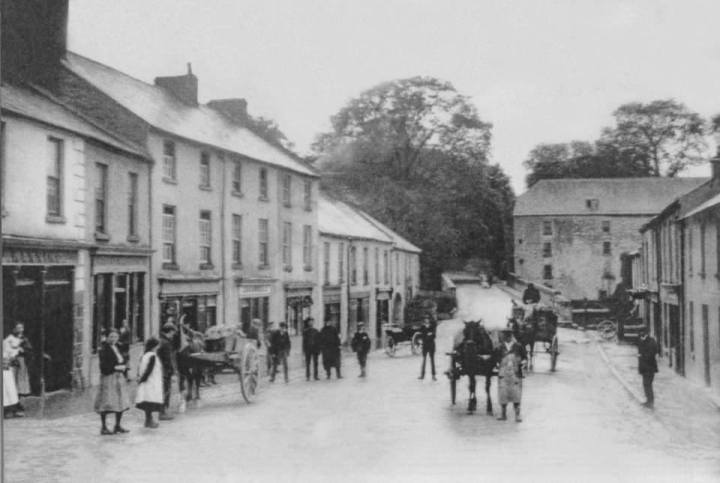
Bridge Street, Croom, taken in 1901. Image source: askaboutireland.ie

Abstract: Where did Michael Hartnett get the inspiration for the title of his collection, A Farewell to English?  We believe that Aindrias Mac Craith’s most iconic song, Slán le Máighe (Farewell to the Maigue), was an influence and reference point for Hartnett’s ‘Farewell’, as well as being the inspiration for both the naming of the title poem of Hartnett’s collection, A Farewell to English,  and, indeed, the naming of the collection itself.

A Christmas Collaboration: Vincent Hanley and Don Hanley

Michael Hartnett’s A Farewell to English caused quite a stir in literary circles back in 1975. It was seen by some as a bold change of direction for Hartnett, by then an established poet in the Irish literary scene and equally it was seen by others as a self-inflicted literary act of seppuku or self-immolation. Famously (infamously!) on June 4th, 1974, Hartnett had walked onto the stage of the Peacock Theatre in Dublin, at an event organised by the Goldsmith Press, and made one of the most intriguing, quixotic statements ever made by an established Irish poet. At that event, Michael Hartnett informed the audience of his resolution to cease writing and publishing in English and, from then on, to write and publish solely in Irish. He said his ‘road towards Gaelic’ had ‘been long and haphazard’ and until then ‘a road travelled without purpose’ but reassured his audience that he had realised and come to terms with his identity while acknowledging that his ‘going into Gaelic simplified things’ for him and provided answers which some considered to be naive but at least gave him ‘somewhere to stand’ (Walsh, 7). The statement was received largely negatively by critics and contemporaries, at best a bizarre misstep soon to be forgotten, at worst an ideologically motivated rebuke to the Irish poets writing in English at the time.

This dramatic ‘Farewell’ has always been somewhat problematic.  Many of his detractors at the time expected him, once he had made this momentous decision, to stick rigidly to his promise as if it had been set in stone. Inevitably, they criticised him and chided him when his ambitious project seemed to peter out in the mid-80s. Perhaps this reaction can be seen as an effort by his critics to finally ‘pigeonhole’ the poet and hold him accountable. However, Michael Hartnett’s variety as a poet – balladeer, satirist, love poet, translator, poet in Irish as well as English, and his complicated bibliography, with numerous compilations, collections and selections, as well as individual volumes from several different publishers, always had the effect of obscuring his achievement or hiding its core elements.

An artist moves from obsession to obsession, from one project to another, and nothing is ever set in stone; ‘Farewells’ are never ‘Adieu’, more ‘Au Revoir’; new beginnings are inevitable.  Hartnett was no different; he shifted from English to Irish and back again, he moved from city to country and back again; from the hillside in Glendarragh to Emmett Road in Inchicore, where, for good measure, he composed an extended haiku sequence in English.  As Peter Sirr points out, this is the ‘kind of creative restlessness that fed Hartnett as a poet but that sometimes made critics scratch their heads’ (Sirr, 294). That said, when assessing Hartnett’s ‘Farewell’, we think it is fair to say it is best realised by the poems and ballads themselves (both in English and Irish), which more fully express the motivating poetic philosophy which led to the theatrical stunt on the Peacock stage, rather than the stunt itself!

To appraise the decision to bid a farewell to English, therefore, we must look to the collection and the title poem of the collection.  If the concluding poem for which the collection is named is to be read as explanation, as well as a statement of intent, it is not a disillusionment with language, but rather with the use of that language in Ireland, and the cultural significance which that use carries. Hartnett’s decision, and the poem itself, are loaded with inferences within a political and postcolonial context. The poem’s significance, however, lies in the fact that it is not a poem against a language, but the political and dogmatic meanings which we have attached to that language.

His poem, ‘A Visit to Croom, 1745’, appears in that 1975 edition of A Farewell to English and is placed immediately before the title poem in the collection.  The poem consists of strikingly vivid imagery and there are a myriad of great historical undertones present; echoes of Séan Ó Tuama’s inn, with its bardic school of poetry is conveyed in bold, flamboyant brush strokes; echoes too of great battles, the Boyne, Athlone, Aughrim, the Siege of Limerick, the ill-fated Treaty of Limerick, Sarsfield and The Wild Geese.  In the poem Hartnett, the travelling spailpín, places himself back in Croom, probably in Ó Tuama’s hostelry, on his lonely journey back into the Gaelic tradition. He has trudged fourteen miles, in the shoes of those phantoms he visualises at Doody’s Cross, ‘in straw-roped overcoat’ to get here and all for nothing.  ‘Five Gaelic faces’ greet him, and all he can hear is ‘a Gaelic court talk broken English of an English king’.  His anger and disappointment are palpable,

It was a long way

to come for nothing.

Then the opening scene in ‘A Farewell to English’ takes place in yet another hostelry, Windle’s Pub in Glensharrold, Carrickerry, a few miles outside Newcastle West, where he introduces us to the raven-haired barmaid, Mary Donovan, who spurs him to verse, ‘her mountainy body tripped the gentle / mechanism of verse’ (Collected Poems, 141).  This imagined segment of the poem is used as a device through which Hartnett comments upon his poetic inspiration and process, as well as his relationship with the Irish language: ‘the minute interlock / of word and word began, the rhythm formed’ (Collected Poems, 141). The weight which the poet gives to ideas of tradition within his creative process is clear here, suggesting the importance which ideas of authenticity play.  Such shibboleths are never treated as unassailable, however, but rather made tangible through tactile imagery of sinking into, and sifting through, the morass of tradition: ‘I sunk my hands into tradition / sifting the centuries for words’ (Collected Poems, 141). However, because of his somewhat faltering Irish, he is forced to resort to age-old cliches to describe the barmaid using well-worn semi-classical phrases, ‘mánla, séimh, dubhfholtach, álainn, caoin’.  Harnett then rebukes himself for doing so – ‘What was I doing with these foreign words?’ (Collected Poems, 141). His project, his new direction, is to find a new poetic voice in Irish, not to rehash old clichés, and by doing so, come to Irish not as a ‘foreigner’ but as a fellow of Aindrias Mac Craith and the Maigue poets and in doing so, make his own contribution to the bardic tradition that has inspired him.

Then in the second section, he describes an encounter on the road which hovers somewhere between reality and dream, aisling (the Irish word for a vision) or epiphany.  The incident takes place at Doody’s Cross as the poet walks out one summer Sunday evening from Newcastle West to the cottage in Camas.  He is on his way to meet up with his uncle, Dinny Halpin.  He sits down ‘on a gentle bench of grass’ to rest his weary feet after his exertions when he sees approaching him three spectral figures from the Bardic Gaelic past – Andrias Mac Craith, Aodhagán Ó Rathaille, and Daíbhí Ó Bruadair.  These ‘old men’ walked on ‘the summer road’ with

sugán belts and long black coats

with big ashplants and half-sacks

of rags and bacon on their backs.

They pose as a rather pathetic group, ‘hungry, snot-nosed, half-drunk’ and they give him a withering glance before they take their separate ways to Croom, Meentogues and Cahirmoyle, the locations of their patronage, ‘a thousand years of history / in their pockets’.  Here, Hartnett is situating himself as their direct descendant and the inheritor of their craft. The enormity of this epiphany occurs at Doody’s Cross in Camas; the enormity of the task that lies ahead also terrifies and haunts him.

One of that pathetic trio at Doody’s Cross in Camas was Aindrias MacCraith (c. 1710 – 1795).  He was well known by his nickname, An Mangaire Súgach (The Merry Pedlar), which had been given to him by his mentor and great friend, Séan Ó Tuama an Ghrinn (c. 1708 – 1775). MacCraith was a roving Hedge School master, setting up school wherever he could find a few pupils, then moving on when numbers fell.  From the accounts that have come down to us, we learn that the Mangaire was a quintessential Limerick Rake; fond of sport, good company and deep drinking, and getting into more than one scrape with the clergy on account of his various indiscretions.

Mannix Joyce, that great local historian and chronicler of The Poets of the Maigue, recalls that,

‘For all his waywardness, he was a gifted singer. That poor wretch of a man, so often seen reeling from the tavern to the miserable hovel he called home, was one of the sweetest poets an age of song was to produce, a man whose poems will endure as long as the Irish language lives. He was a real lyricist, not unlike Burns and in his songs, he gives us an insight into his wild and vagrant life. He had a profound knowledge of the Irish language, and his poetry is full of magic and melody. He belonged to that strange Hidden Ireland of the 18th century, that Ireland that flowered with such profusion of poetry under the blasting winter winds of oppression. If he was careless and intemperate, much of it was due to a hellish code of laws then being enacted for the utter degradation of the old race’ (Limerick Leader, 13th October 1945).

Rake that he was, he could often be found in the company of Séan Clárach Mac Domhnaill, convenor of the Maigue School of Poetry and composer of Mo Ghile Mear, originally from Charleville, who has been described as the ‘chief Jacobite Poet in Ireland’.  Séan Ó Tuama, Fr. Nicholas O’Donnell, and those other poets of the Maigue were often to be found in his company, declaiming the hero-tales of Greece and Rome and discussing current European politics. Again, Joyce acknowledges the great contribution   of those Maigue Poets during the harshest of Penal times:

‘Those remarkable men arose in an age when learning of every kind was banned in Ireland and sprang from a people dubbed as ignorant and illiterate by their oppressors. They were the last guardians of the thousand-year-old ure of the Gael, and with their passing the Irish language, the repository of that ancient ure, faded and died in the rich plains of Limerick’ (ibid).

One of Aindrias McCraith’s best-known songs begins with the line: ‘Slán is céad ón taobh so uaim’. The song is usually referred to by the title: ‘Slán le Máighe’ (‘Farewell to the Maigue’), or ‘Slán Chois Mháighe’ (‘Farewell to Coshma)’, the name of the local Barony.  As mentioned already, Aindrias had a predilection for that dangerous combination of wine, women and song, and after one of many such indiscretions, he was exiled by the parish priest of Croom to Ballyneety, the place where Patrick Sarsfield destroyed the Williamite siege train in 1690.  His sad, poignant lament from there is addressed to his great friend Seán Ó Tuama, who, along with MacCraith, was one of the leading lights of the Court of Poetry which assembled in the village of Croom (‘Cromadh an tSuaicheas’, ‘Croom of the Merriment’), with its headquarters in the inn which was run by Ó Tuama and his wife, Muireann.  (The song is one of the great Irish slow airs and can be sung to the air of ‘The Bells of Shandon’).

Slán is céad ón daobh seo uaim

Cois Máighe na gaor na graobh na gcruach …

 (A hundred and one farewells from this place from me / To Coshma of the berries, the trees, the ricks).

Then there was the pathetic refrain:

Och ochón, is breoite mise,

Can chuid gan chóir gan choip gan chiste.

Gan sult gan seod gan sport gan spionnadh,

O seoladh mé chun uaighnis.

(Alas, alas, sick am I / Without portion, without justice, without company, without money / Without enjoyment, without treasure, without sport, without vigour / Since I was sent away to loneliness).

John O’ Shea and Anna Jane Ryan play Slán le Máighe (Farewell to the Maigue) live at Nun’s Island theatre in Galway.

Only ten miles separate Croom from Ballyneety in County Limerick, yet an important boundary line lies between them. Croom, in County Limerick, is located in the barony of Cois Máighe (Coshma), whereas Ballyneety is located in the barony of Uí Chonaill Gabhra (Connello).  So, the journey from one village to the other involved moving from one Barony to another; the equivalent in those days of moving from one jurisdiction to another. The title of the song (and its associated tune) is usually given in English as ‘Farewell to the Maigue’, as if the poet were saying goodbye to the river itself, which flowed majestically through his beloved place.

MacCraith’s ‘Farewell’, despite its sublime lyrics and haunting slow-air melody, is not meant to be taken at face value; it is meant as a ‘Slán go fóill’, as inconsequential a ‘Farewell’ as a French ‘Au Revoir’. He is, undoubtedly, showing off his great skill as a poet, but the reality is that he is being asked to take a temporary leave-of-absence from Croom until the current controversy abates. By its language and use of form, it is at once intentionally self-serious, theatrical and iconoclastic. Hartnett echoes this tone and mirrors this pose in his ‘Farewell’ – at times theatrical, self-serious, bombastic – but also, in a flash, heartfelt, exposed, human.

Unfortunately, Aindrias MacCraith did eventually have to bid a sad final farewell to his good friend and mentor, Séan Ó Tuama.  It is doubtful if the Mangaire Súgach would ever have written a verse of poetry were it not for the encouragement and friendship of Séan Ó Tuama.  He had written nothing before he came to Croom, and after the death of Ó Tuama, he lapsed into silence again. He left Croom and sang no more. He had outlived Séan Clárach (d. 1754) by almost 40 years and his friend, Séan Ó Tuama, by nearly 20. He had seen the last of the great Maigue School of Poetry, and his declining years were saddened by the decay of the old language in the district where once it flourished.

Of the three phantoms that accost Hartnett at Doody’s Cross in those early magical sections of ‘A Farewell to English’, Hartnett translated the work of Ó Rathaille and Ó Bruadair but not MacCraith, one of his great influences from the old dispensation, the Gaelic bardic past.  However, we believe that MacCraith does play an important role in the naming of Hartnett’s poem, ‘A Farewell to English’.  We know that Hartnett was obsessed with Croom, as the last bastion of the old Gaelic Schools of poetry.  He took great pride in the fact that he was the only modern Irish poet to have been born in Croom – he spent his first few days in St. Stephen’s Maternity Hospital, located in the village!  This near obsession with Croom and the Filí na Máighe (The Maigue Poets) may, therefore, have had some influence on Hartnett’s choice of title for ‘A Farewell to English’.  Our theory is that Hartnett borrowed the title of Aindrias MacCraith’s most iconic and poignant poem, ‘Slán le Máighe’, for his own ‘farewell’ and self-imposed exile in West Limerick, where he had come to ‘court the language of my people’. MacCraith had been forced to move to nearby Ballyneety for a time because of his indiscretions, and in 1974, Hartnett decamped from the Dublin literary scene and set up home in rural West Limerick, ‘in exile out foreign in Glantine’.

Those ten years spent in Glendarragh were among the most productive of his career – it may not have been a permanent ‘Farewell’, but it was a productive one.  It is obvious that this decision to ‘go into the Gaelic’ had been simmering for some time.  Indeed, 1975 saw a flourish of publications, including A Farewell to English but also the iconic Cúlú Íde / The Retreat of Ita Cagney.  Then, probably his most accomplished collection in Irish, Adharca Broic, was published in 1978, followed by An Phurgóid in 1983, Do Nuala: Foighne Crainn in 1984 and his fourth collection in Irish, An Lia Nocht, appeared in 1985.    In parallel to this ‘serious’ output, he was writing and entertaining the locals with ballads, some serious or semi-serious like ‘A Ballad on the State of the Nation’, which was distributed as a one-page pamphlet like the ballads of old and even included original linocuttings by local artist Cliodhna Cussen. Other ballads were more contentious and even semi-libellous (or fully slanderous!), such as ‘The Balad (sic) of Salad Sunday’ and ‘The Duck Lovers Dance’.  These latter creations were written under the very appropriate nom de plume, ‘The Wasp’!  As time passed, Hartnett’s ‘farewell’, similar to MacCraith’s, was seen for what it was, a ‘Slán go fóill’.

During this period, he also undertook the translation of Daibhi Ó Brudair’s poems, which were published in 1985, and his obsession with these seventeenth-century precursors continued with his later translations of Aodhagán Ó Rathaille (1993) and Pádraigín Haicéad (1999).  Finally, following his departure from Glendarragh, the collection A Necklace of Wrens (a collection of poems in Irish with translations in English by the poet himself) was published in 1987.

The inability of critics to pigeonhole Hartnett has been one of the major problems in sustaining his immense legacy.  In turn, Hartnett’s continual search for a spiritual and cultural home has not made it easy.  And his restlessness did not end.   Once back in Dublin, there were more new beginnings, more farewells.  Hartnett seemed to make yet another new beginning with Poems to Younger Women (1988). Then again, in Selected and New Poems (1994), those long poems such as ‘Sibelius in Silence’ or ‘The Man who Wrote Yeats, the Man who Wrote Mozart’, and ‘He’ll to the Moor’ mark still new accomplishments in his overall oeuvre.  The truth, of course, is as Peter Sirr asserts, Michael Hartnett, ‘is the sum of all of these identity shifts, and to consider any one of these aspects in isolation is to miss the overall picture of a complex, restless and rewarding poet’ (Sirr, 294).

A half-century of hindsight allows us to have a clearer perspective.  His very theatrical ‘Farewell’ from the stage of The Peacock Theatre needs to be understood, as he and Aindrias MacCraith meant it to be – merely a ‘Slán go Fóill’ – as inconsequential and as temporary as a French ‘Au Revoir’.

Postscript

Hartnett’s draft of his ‘curse’ on the Féile na Máighe committee. Note these are from 1973, and it is clear that he is already working on a draft of Cúlú Íde / The Retreat of Ita Cagney.

In the late 60s and 70s, there was a very successful festival held annually in Croom, celebrating the work of the Maigue Poets.  I came across this little gem while doing a bit of research in NLI back in February 2025.  Hartnett was mightily peeved that he had not been invited as often as he felt he should.  His papers contain a draft of a curse he put on the organising committee, written in Irish in the old Gaelic script.  It transpired that he hadn’t been invited to the 1973 Féile, nor indeed to the 1972 or 1971 iterations either.  He was not pleased, and so, in true bardic fashion, he placed a poetic curse on the organisers.  Translated, it reads:

Whereas, I was born in Áth Cromadh an tSúbhacais thirty-two years ago, and as I am a poet who is famous the length and breadth of all of Ireland, even in British Ulster, and that I have received invitations to numerous poetry festivals in England and America and since I did not receive an invitation from my own people to the festival in the place of my birth this year or last year or the year before last, I hereby curse that festival – cuirim mo mhallacht orthu agus mallacht mo mhallachta,

Is mise,

Míchéal Ó hAirtnéada

(arna nglaoghtar Michael Hartnett sa Sacsbhearla, Priomhfíle Múmhan)

References:

Hartnett, Michael. A Farewell to English, Oldcastle County Meath, Gallery Press, 1975.

Hartnett, Michael. Cúlú Íde The Retreat of Ita Cagney,  Goldsmith Press, 1975

Hartnett, Michael. Adharca Broic, Oldcastle, County Meath. Gallery Press, 1978

Hartnett,  Michael. An Phurgóid, Coiscéim, 1983.

Hartnett, Michael. Do Nuala, Foidhne Chuainn, Coiscéim, 1984.

Hartnett, Michael. An Lia Nocht,  Coiscéim, 1985.

Hartnett, Michael. Ó Bruadair, Oldcastle: Gallery Press, 1985.

Hartnett, Michael. A Necklace of Wrens: Poems in Irish and English, Oldcastle County Meath,  Gallery Press,  1987.

Hartnett, Michael. Poems to Younger Women, Oldcastle, County Meath, Gallery Press, 1988.

Hartnett, Michael. Haicéad, Oldcastle: Gallery Press, 1993.

Hartnett, Michael. Ó Rathaille: The Poems of Aodhaghán Ó Rathaille, Oldcastle: Gallery Press, 1999.

Hartnett, Michael. Selected and New Poems, Oldcastle,  County Meath,  Gallery Press, 1994.

Hartnett, Michael.  Collected Poems, Oldcastle: The Gallery Press, 2001.

Michael Hartnett Papers, National Library of Ireland, 35,879/1, 35,879/2 (1)

Mannix Joyce / Mainchín Seoighe, folklorist and local historian from Tankardstown, Kilmallock, taken from his weekly column in The Limerick Leader called Odds and Ends, 13th October, 1945.

Sirr, Peter. Michael Hartnett, in Dawe G, ed. The Cambridge Companion to Irish Poets. Cambridge Companions to Literature.  Cambridge University Press; 2017, (Chapter 22: p. 294 – 306).

Walsh, Pat. A Rebel Act: Michael Hartnett’s Farewell to English, Mercier Press, Cork, 2012.

The Retreat of Ita Cagney / Cúlú Íde

5Q5T0274
This photograph was taken near Old Barna Railway Bridge by Dermot Lynch, Limerick Leader.

The Retreat of Ita Cagney / Cúlú Íde was first published in 1975 by the Goldsmith Press, shortly after Michael Hartnett’s pronouncement from the stage of the Peacock Theatre in Dublin that he would henceforth write only in Irish. Appropriately, the publication contains an Irish version and an English version of the poem, as perhaps befitted the poet’s conflicted state. The Irish version, Cúlú Íde, was published again as the final poem in his first full collection in Irish, Adharca Broic, in 1978 and again, in both Irish and English, in his 1987 collection, A Necklace of Wrens.  In effect, this poem serves as a Rubicon: the last English poem he would publish, for the time being at least, and the first of his Irish poems. The poet is in transition and is now back in West Limerick and in this poem, he explores deep and ancient resentments and wrongs. Allan Gregory says that the poem, in its bilingual format, ‘expresses to the reader themes of social and historical oppression, sex, pregnancy and birth, protection, exposure and secrecy, and is the finest poem in this period of Hartnett’s writing’ (McDonagh/Newman 145).

Hartnett has documented the ‘schizophrenia’ associated with this new poetic direction and he has said that this poem, in particular, caused him great distress:

The Retreat of Ita Cagney, for example, almost broke my heart and indeed my mind to write, because both languages became so intermeshed. I would sit down and write a few lines of the poem unthinkingly. I’d come back to it and see that it was half in English and half in Irish or a mixture. … One is not a translation of the other. They are two versions of the same poem, but what the original language is I don’t know’ (O’Driscoll 146).

Whatever the mental turmoil generated by the artistic struggles of the poet, the resulting poem is one of Hartnett’s most powerful from this period of his career. In his review of the poem following publication, fellow Munster poet, Brendan Kennelly, says it was,

‘a probing, dramatic exploration of a woman’s loneliness and isolation in a callous and hostile society. This, to my mind, is Hartnett’s finest achievement to date: he pays a relentless imaginative attention to this woman’s fate, and he presents with admirable dramatic balance her loneliness, independence and state of severed happiness. In this condition, Ita Cagney becomes a visionary critic of the society that hounds and isolates her’ (Poetry Ireland Review, Issue 15, p. 26).

The Retreat of Ita Cagney is a pained celebration of a woman’s enforced isolation due to her refusal to conform to the demands of her society. We can surmise that in delving into Ita Cagney’s situation, the poet finds common cause with another rural outcast in light of his own recent ‘retreat’ to Glendarragh to dwell ‘in the shade of Tom White’s green hill / in exile out foreign in ‘Glantine’ (A Book of Strays 41). This lonely cottage in Glendarragh was, for the next ten years, to serve as basecamp for what Declan Kiberd describes as ‘retracing his way to the common source’ (McDonagh/ Newman 37).  However, far from being a  ‘retreat’ to obscurity, as some of his critics predicted, his return to West Limerick precipitated what was arguably the most productive period of his career.  Adharca Broic was published in 1978, followed by An Phurgóid in 1983, Do Nuala: Foighne Crainn in 1984 and his fourth collection in Irish, An Lia Nocht, appeared in 1985.  During this period, he also undertook the translation of Daibhi Ó Brudair’s poems, which were published in 1985.

The publication of this dual language version of The Retreat of Ita Cagney / Cúlú Íde in 1975 was a bold step by Hartnett. For added effect, the Irish version was printed in the Old Gaelic script (An Cló Gaelach), which was by then obsolete and no longer being used in schools, as it had been up to the 1960s. This probably also had the effect of further isolating the poet and limiting his audience. However, as he told Elgy Gillespie in an interview in March 1975: ‘Listen, it’s impossible to limit my audience, it’s so small already’ (Gillespie 10).  However, academic John Jordon wrote a positive review of Cúlú Íde, suggesting that it was ‘a small-town mini-epic, so redolent of Hardy’ (Jordon 7). Cúlú Íde was again published as part of Hartnett’s first collection in Irish, Adharca Broic, in 1978. This time, he chose Peter Fallon’s Gallery Books, and this new publishing relationship was to last until A Book of Strays was published posthumously by the same publisher in 2002.  Adharca Broic received generally positive reviews, and Allan Gregory declared that the twenty-one lyrical poems in the collection ‘oozed with the confidence of a speaker who felt that at last he was being heard’ (McDonagh/Newman 146).

In this analysis, I will focus mainly on the English version of the poem with occasional forays into the Irish version, especially where they diverge. There are some similarities between The Retreat of Ita Cagney and Farewell to English.  Both poems have a sequence structure, and The Retreat of Ita Cagney is divided into nine dramatic scenes. Both poems were published in 1975.  However, there is one major difference: whereas Farewell to English is a public poem with political overtones, The Retreat of Ita Cagney is an intensely private poem. Though it begins with a quintessential public event, the traditional Irish funeral, it quickly transitions to the act of retreat alluded to in its title. On the face of it, it is a ‘retreat’ from a public event to a more private life, and Hartnett teases out the societal and psychological implications that this act brings about. However, the poem itself may also be read as an act of ‘retreat’ for the poet, away from public pronouncements towards a more private poetry that would focus on his own domestic life.  If critics presumed that the blunt polemic of Farewell to English would be a constant in his writing in Irish The Retreat of Ita Cagney would seem to set them straight.  As with Ita, Hartnett’s ‘retreat’ was a once-off symbolic gesture and as such, there was no need to repeat the tonic; rather, the wisdom or otherwise of that choice would be borne out by the life retreated to, and of course, for Hartnett, the poems which would come from living that life to its fullest.

The English version is composed in free-verse, while the Irish version is more formal and adheres to the classical conventions of the Dánta Grá (McDonagh/Newman 144). This divergence in styles between the two languages is perhaps a direct reason for the mental turmoil he encountered during the composition of this poem – there is a constant battle raging between the more disordered English version and the more tamed and formalised Irish version.

As well as being a poet of international standing, Hartnett was also a master translator, having translated the Tao, the Gypsy Ballads of Lorca, and later the poems of Ó Haicéad and Ó Bruadair, which will forever stand the test of time. Here we find him ‘translating’ his own work, and the effort induced in him a kind of artistic schizophrenia. Declan Kiberd argues that in this way, Hartnett suffered from a kind of ‘double vision’:

Every poet senses that all official languages are already dead languages. That was why Hartnett said farewell to English while knowing that Irish was itself dead already too. As he wrote himself in ‘Death of an Irishwoman’, ‘I loved her from the day she died’. Likewise, with English – no sooner did Hartnett write it off than he felt all over again its awesome power, for it had become again truly strange to him, as all poetic languages must (McDonagh/Newman 38).

This poem, then, is an initial effort to find his voice – in two languages.

In this, his last poem in English pro tem and his first poem in Irish, the poet very dramatically tells us the story of a recent widow (the Irish version says that she has been married only a year) who leaves her home in the dead of night and goes to live in secret with another man in his West Limerick cottage and bears him a child out of wedlock much to the disapproval of the locals and the Church.

The poem is not set in any recognisable historic timeframe, but maybe there were echoes of some such local ‘scandalous’ incident in the ether when the poet made his return to West Limerick in and around 1975. However, the poem stands on its own, and there doesn’t need to have been any particular incident which inspired the poet to take on this subject matter. Hartnett’s prose writing and poetry show him to be a very insightful social commentator, and it is not hard to find echoes of Kavanagh’s The Great Hunger in this poem. Here, however, the main subject is a formidable woman, which further helps to give the lie to the accepted stereotypes of the day. Readers familiar with Irish poetry will also be aware that in the old Aisling poems, Ireland was often depicted as a woman: sometimes young and beautiful, sometimes old and haggard. In effect, Ita Cagney can be read as a  modern Bean Dubh an Ghleanna, Gráinne Mhaol, Roisín Dubh or Caithleen Ní Houlihan – a symbolic representation of Ireland.  Hartnett concisely captures a portrait of the society to which he had returned in the 1970s, but crucially chooses to depict Ita’s inner life and not merely as a cypher without agency, whilst also refusing to idealise rural Ireland by showing the repressive and oppressive views which pertained at that time, especially towards women.

The Retreat of Ita Cagney is a more focused portrayal of small-farm Ireland than the broader panorama offered by Patrick Kavanagh’s The Great Hunger. That said, they are very similar and both Ita Cagney and Maguire have to cope with the two conflicting forces of spirituality and sexual mores in the world of their time. Maguire’s idea of sex is deformed, largely due to Church teaching and a repressive society in the Ireland of the 1930s and 40s. In contrast, Ita Cagney’s sexuality liberates her and The Retreat of Ita Cagney is a more recent reminder to all and a typical Hartnett barbed rebuff to De Valera’s notorious St. Patrick’s Day broadcast of 1943 in which he fantasised about a rural Ireland ‘joyous with sounds of industry, the romping of sturdy children, the contests of athletic youths, the laughter of comely maidens; whose firesides would be the forums of the wisdom of serene old age’ (Moynihan 466-9).  Whereas Maguire is beaten down and is forced to live within the strictures imposed by the Catholic Church and the 1937 Constitution, in a sense, Ita Cagney benefits from the work of such women as Nell McCafferty, Mary Kenny, and others in bringing about significant change in how young couples lived their married lives as a result of the McGee v. Attorney General Case. This landmark case was heard in the Supreme Court in 1973 (two years before the publication of this poem) and established the right to privacy in marital affairs, giving women the right to avail of contraception, thereby giving them control over their own bodies.

Another factor which may be relevant here also was that while Kavanagh was a bachelor (and almost certainly a virgin) when he wrote The Great Hunger, Michael Hartnett was happily married (at the time) and living with his wife Rosemary and their two young children, Niall and Lara, ‘in exile out foreign in Glantine’.  Patrick Kavanagh wrote about the destitution and despair of Irish country life of the 40s and 50s, and though Michael Hartnett knew that world also from his childhood (for example, in A Small Farm), he depicts a changing Ireland in The Retreat of Ita Cagney, an Ireland where women play a more central role.

Section 1
The poem opens in a very dramatic style. We are present at an old-style Irish wake – a scene very common in Hartnett’s poetry (Collected Poems 103). The narrator informs us that ‘their barbarism did not assuage the grief’. These ‘barbarians’ paradoxically are dressed in ‘polished boots’ and ‘Sunday clothes’ and accompanied by the ‘drone of hoarse melodeons’ – all typical features of a traditional Irish wake. It is nighttime, and it is raining. The poet uses rich similes to describe the atmosphere; ‘snuff lashed the nose like nettles’ and the local keeners fulfilled their ‘toothless praising of the dead / spun on like unoiled bellows’. Now we are introduced to Ita Cagney, the dead man’s widow. Her name is a Saint’s name; Ita or Íde is synonymous with West Limerick, particularly West Limerick’s ancient past.  Her grief at the death of her husband has taken her by surprise, and she gives a hint as to their relationship when she says, ‘the women who had washed his corpse / were now more intimate with him / than she had ever been.’ This may suggest a great disparity in ages between them, although the Irish version gives a slightly different perspective on her grief when it reveals that they had only been married a year: ‘a bhean chéile, le bliain anois’ (his wife, now for only a year). Now, on a whim, she leaves the raucous wake and beats her hasty retreat. This is emphasised by the metaphor, ‘the road became a dim knife’. She has not planned this move, but ‘instinct neighed around her / like a pulling horse’.

Section 2
The second movement follows the strict requirements of the Dánta Grá, and there are striking stylistic differences between the English and Irish versions. The Irish version consists of eight quatrains, each describing Ita Cagney’s classical appearance. The English version is in free-verse and describes in minute detail Ita Cagney’s head from ‘her black hair’ to her throat, which ‘showed no signs of age’. Her hair is black save for a single rib of grey which stands out ‘like a steel filing on a forge floor’. The poet here is obviously calling on his Maiden Street childhood and scenes from John Kelly’s forge, which he had already immortalised in verse (Collected Poems 104).

He then describes her brow, her eyebrows, her eyes, ‘her long nose’, ‘her rose-edged nostrils’, her upper lip, her chin and jawline and finally her throat. The reason for this detail is to give us a sense of the formidable woman at the centre of this poem. She is described as having an almost aristocratic beauty. Having described her head in exact detail, the final singular line comes as an anti-climax: ‘The rest was shapeless, in black woollen dress’. The overriding sense, however, is of a woman in black as befits a woman in mourning, but a woman nonetheless with a kind of Patrician beauty, a sense of being noble in her bearing beyond her class: ‘Her long nose was almost bone / making her face too severe’. Ironically, from my own limited meetings with Michael Hartnett, he too had this aura of nobility, and even some extant photographs of the poet show that he wore his hair like a Senator of Rome – in my eyes, at least, it is imaginable that he too saw himself as a Patrician character!

I would point out also that there is a difference between the way Hartnett describes Ita Cagney and the way he introduces us to the raven-haired barmaid in the first section of Farewell to English. The barmaid, Mary Donavan, worked behind the bar in Windle’s pub in Glensharrold, a few miles outside Newcastle West.  She is described with exaggerated classical phrases such as ‘mánla, séimh, dubhfholtach, álainn, caoin’.  Gabriel Fitzmaurice tells us that ‘here we have the poet Michael Hartnett, possessing his locality, his muse, and his lost language’ (Limerick Leader, 1999). Here in this poem, however, Hartnett does not indulge in this kind of hyperbole in his description of Ita Cagney.  She is not idealised or clichéd, and Michael Hartnett is at pains to describe her as a real person, and this realism makes the symbolism richer and more complex. Deep unhappiness and sadness have furrowed her brow: ‘One deep line, cut by silent days of hate’. Her first marriage was obviously not a happy one, and there is even a hint that it was an arranged marriage as was the custom in the past: her ‘eyes / that had looked on bespoke love / seeing only to despise’.

Section 3
In this section of the poem, Ita has reached her destination – by accident or design, we do not know. She has turned her back on a society that doesn’t value her, and in a sense, the poem is about breaking with convention – as the poet himself has also recently done. Ita Cagney has rejected the old world of snuff and melodeons and observance of religious rituals, and she is about to embrace a more sensual world. The half-door of this isolated cottage is opened by a man ‘halving darkness bronze’. The ‘bronze’ light of the gaslight gives way to ‘gold the hairs along his nose’.  He is wearing classic labourer’s garb, a blue-striped shirt without a collar with a stud at the neck, which ‘briefly pierced a thorn of light’.  This chink of light in the dark night echoes Patrick Kavanagh’s ‘Advent’ where he says ‘through a chink too wide there comes in no wonder’.  Whereas Kavanagh, in his poetry, comes across as the quintessential 1950s Catholic, Michael Hartnett, in contrast, sees the ‘chink’ or open doorway as a new beginning in Ita Cagney’s life and not something to abstain from.

The poet uses juxtaposition here also to sharply contrast the male-dominated kitchen with its ‘odours of lost gristle / and grease along the wall’ and the arrival of a female whose ‘headscarf laughed a challenge’. The man closes the door on the world and both begin a relationship which will last ‘for many years’.  Again, here we are reminded of the parallels that exist between Ita and the poet who had only recently turned his back on the Dublin literary scene and a burgeoning poetic reputation and had moved with his young family to rural West Limerick to follow his own ‘exquisite dream’ (Walsh 100).

Section 4
In this section, the couple have both decided ‘to live in sin’, ignoring the religious and social mores of the time. Their experience has taught them that having a big wedding for the sake of the neighbours ‘later causes pain’. Ita has already learnt to her cost that a very public wedding can, within a year, end ‘in hatred and in grief’. The expenses incurred in buying ‘the vain white dress’, in having to pay ‘the bulging priest’ and endure ‘the frantic dance’ is not for them. For them, it would be akin to undergoing physical torture, as the insincere well-wishes of their neighbours would ‘land / like careful hammers on a broken hand’.  Anyway, in this house, organised religion was not important; here, ‘no sacred text was read’.  Instead, life was rudimentary and simple: ‘He offered her food: they went to bed’. Here, there was no ‘furtive country coupling’, hiding affections from friends and the priest. Their only sin was that they had chosen ‘so late a moment to begin’.

This is the sensual ideal: their ‘Love’ doesn’t have to be transmuted and elevated to a higher level by the clergy; they don’t seek anyone’s blessing or approval for their actions. However, they are aware that there are consequences to their decision and that their actions will offend the locals and particularly the local clergy: ‘shamefaced chalice, pyx, ciborium / clanged their giltwrapped anger in the room’.  The couple have made their bed and now they must lie in it. They have decided to defy society and do their own thing.

Section 5
Section five sees the woman in labour and being taken by donkey and cart (or pony and trap) to the local town to be delivered.  It is nighttime and it is raining.  She is shielded by her shawl and oilskins to protect her, but all these layers cannot deflect the ‘direct rebuke and pummel of the town’. The couple’s secret intimacy now becomes a public matter as they have to call on outside help with the delivery.  Even now, at this delicate moment as Ita prepares to give birth, disapproval is vehement:

and sullen shadows mutter hate
and snarl and debate
and shout vague threats of hell.

However, the ‘new skull’ will not wait, and ‘the new skull pushes towards its morning’, and Ita’s hopes and dreams are for the future as a new beginning and a new dispensation beckons.

Section 6
Section six is both a love song and a lament. Ita Cagney addresses her newborn with love and trepidation. She knows what will be said, and she will try and protect her son from the venom and vitriol which she knows will come because of her actions. Her newborn is described lovingly with his ‘gold hair’ and ‘skin / that smells of milk and apples’. She wishes to cocoon her baby son and protect him from all the wickedness of the outside world as if he were in Noah’s Ark.  However, she knows in her heart that just as in the Bible story, ‘a dove is bound to come’ with messages from the outside world, bringing from the people words / and messages of hate’. She knows that the ‘stain’ of what she has done will be passed like a baton of toxic shame, the preferred Irish weapon to ensure conformity, to the next generation:

They will make you wear my life
Like a hump upon your back.

She is also tormented by the fear that her son may come to blame her for the hatred he will be forced to endure, and that he may internalise that hatred and that the cycle of hatred will continue.

Section 7
Section seven has echoes of the Garden of Eden. The child is growing up in splendid isolation in the West Limerick countryside. The language is sensual and earthy, ‘each hazel ooze of cowdung through the toes, / being warm, and slipping like a floor of silk…’. There are echoes here also of earlier Hartnett poems depicting his own idyllic childhood, ‘we were such golden children, never to be dust’ (Collected Poems 102). The young boy grows up and learns the lore of the countryside, gathering mushrooms ‘like white moons of lime’ and working the land with his father. His mother watches him grow ‘in a patient discontent’. The seasons come and go, spring, autumn, harvest, Christmas and their little cottage becomes ‘resplendent with these signs’.  There are echoes of an Edenic existence, unspoilt and idyllic, as ‘apples with medallions of rust / englobed a thickening cider on the shelf’.

Section 8
In section eight, Ita speaks in a confessional manner. She is preparing for Christmas and decorating her little cottage with the traditional homemade crepe decorations. She is in a reflective mood, and Hartnett uses a beautiful image to convey her reverie as she watches ‘the candles cry / O salutaris hostia’. There is a potent mix of residual religious imagery in these lines; the Christmas candles remind Ita of the traditional Catholic hymn sung at Benediction. The hymn invites us to ask for God’s help to persevere in our often difficult spiritual journey. The next image is also very traditional, and every small farmhouse in Ireland contained at one time a red Sacred Heart lamp with its flickering flame:

I will light the oil –lamp till it burns
like a scarlet apple

This is clearer in the Irish version and stands as a good example of how both versions complement each other:

Anocht lasfad lampa an Chroí Ró-Naofa
agus chífead é ag deargadh
mar úll beag aibí

We notice here that while Ita Cagney may reject the public rites associated with the Catholic Church, she still maintains elements of the traditional Christian practices. In some sense, I think we are also being given a glimpse of Michael Hartnett’s own views on religion here.  Traditional religious symbols and half-forgotten phrases from old Latin hymns are residual echoes of his own early religious experience: and for Michael Hartnett, and for many others of his generation, Catholicism was very much a child’s thing (see ‘Crossing the Iron Bridge’ ).

There then follows Ita’s ‘confession’ where she declares that she has not insulted God but that she has offended the ‘crombie coats and lace mantillas, / Sunday best and church collections’ – she has offended public morality and her chief offence has been that her happiness has not been blessed by the church and condoned by society at large. This is the climax of the drama and encapsulates the enduring tension that exists between the rights of the individual in society and the pressures on that individual to conform to acceptable social mores, especially as it applies to sexual love. As Allan Gregory sees it, ‘The poem shows, with imaginative sympathy and ethical discernment, how Ita Cagney, a widow, lives in a new free union, unblessed by the church and how, because of this, she is feared and loathed by society’ (McDonagh/Newman 145).

Section 9
The final movement in the poem sees the neighbours advance in a concerted ‘rhythmic dance’ to lay siege to Ita’s cottage. The language is violent and carries connotations of evictions carried out in the neighbourhood by the landlord class in the not-too-distant past. We are told that ‘venom breaks in strident fragments / on the glass’ and ‘broken insults clatter on the slates’. The neighbours are described as a ‘pack’, a mob, who ‘skulk’ and disappear into the foothills in order to regroup and to muster their forces for a final onslaught – waiting ‘for the keep to fall’.  Ita, a virtual prisoner in her own home, protects ‘her sleeping citizen’ and imagines the final attack ‘on the speaking avenue of stones / she hears the infantry of eyes advance’. The Irish version gives us further food for thought and is even more redolent with echoes of recent Irish history.  In the Irish version, the phrase ‘she guards her sleeping citizen’ is rendered as ‘í féin istigh go scanrach / ag cosaint a saighdiúrín’ (herself inside terrified / protecting her little soldier boy’).  Furthermore, the final line ‘she hears the infantry of eyes advance’ is translated as ‘ó shúile dearga na yeos’. This word ‘yeos’ refers to the yeomanry, the infamous English Redcoats, and carries very loaded associations in the Gaelic folk memory – they were as hated as the Black and Tans or the Auxiliaries were in more recent history. The use of these words, especially in the Irish version of the poem, emphasises and reinforces again the themes of social and historical oppression which are central to Hartnett’s thesis in this major statement of intent.

Conclusion
This poem was the first to be written by Hartnett during the transitional phase in the mid-seventies after he had set up home in Glendarragh. He realises that little has changed since he wrote ‘A Small Farm’ – all the ‘perversions of the soul’ are still to be found in Camas and Rooska and Sugar Hill and Carrickerry.  However, he does seem to hint in this poem that a better way is possible if we are brave enough to take it, like Ita Cagney, like Michael Hartnett himself, and like Mary McGee.

If we accept that Ita Cagney’s ‘retreat’ is a parallel for his own ‘retreat’ from English, then it seems that he is prophesying tough times ahead for himself and his new artistic direction. His ‘retreat’ will not be received well by either side. In earlier poems, he has depicted the old Gaelic world, represented by Brigid Halpin and Camas, as a perverse, pagan and ignorant place. He will have to be as strong-willed and stubborn as Ita Cagney has been in order to survive, but for Hartnett, as for Ita, embracing the life retreated to is worth this sacrifice.

The poem depicts Ita Cagney as the modern-day Saint Ita / Naomh Íde, and an able successor to his grandmother Bridgid Halpin, who, according to Hartnett, never adjusted to the ‘new’ Ireland which emerged in the twentieth century.  Hartnett looks towards the hills and the wooded slopes of the Mullach a Radharc Mountains for answers to an age-old torment which has been a blemish on the Irish psyche. And he sees that there is hope – Ita Cagney, a young widow, ‘retreats’ to a new life, and though her union is unblessed by the church, she is prepared to defend her decision despite the disapproval of society.  She becomes, as Kennelly suggests, ‘a visionary critic of the society that hounds and isolates her’.  In effect, she was, like Hartnett himself, a half-century at least before her time, and she deserves to be feted as the patroness of a more modern and liberated Ireland, which she longed for instinctually. Those instincts beckoned her to forsake her old life of convention and conformity and create a new beginning and a new world for herself where love reigned over hate, victorious.

Works Cited

Fitzmaurice, Gabriel. ‘Let’s drink to the soul of Michael Hartnett’, in The Limerick Leader, October 23rd, 1999.
Hartnett, Michael. The Retreat of Ita Cagney (Cúlú Íde). Dublin: Goldsmith Press, 1975.
Hartnett, Michael. Adharca Broic, Gallery Books, Oldcastle, County Meath, 1978.
Hartnett, Michael. Collected Poems, ed Peter Fallon, Gallery Books, Gallery Press, Oldcastle, County Meath, 2001.
Hartnett, Michael. A Book of Strays, Gallery Books, Oldcastle, County Meath, 2002.
Hartnett, Michael. ‘Why write in Irish?’, Irish Times, (26th August 1975).
Gillespie, Elgy. ‘Michael Hartnett’, The Irish Times, (5th March 1975),  p.10
Jordan, J., Review, Irish Independent (3rd February 1979), p.7.
Kennelly, Brendan. reviewing Michael Hartnett, Collected Poems, Volume I, Poetry Ireland Review Issue 15.
O’Driscoll, Dennis. Interview, Metre Magazine, II (2001).
McDonogh, John and / Newman, Stephen. (eds), Remembering Michael Hartnett, Four Courts Press, Dublin, 2006.
Moynihan, Maurice. Speeches and Statements of Eamon de Valera, Dublin, 1980.
Walsh, Pat. A Rebel Act: Michael Hartnett’s Farewell to English, Mercier Press, Cork, 2012.
Other Works Referenced
Patrick Kavanagh, The Great Hunger: A Poem, Cuala, 1942, Irish University Press, 1971.

I would like to acknowledge the considerable assistance given to me by my son, Don Hanley, a Hartnett scholar in his own right, in the preparation and editing of this blog post – one of the many welcome positives emerging from the COVID-19 Lockdown!

5Q5T0287
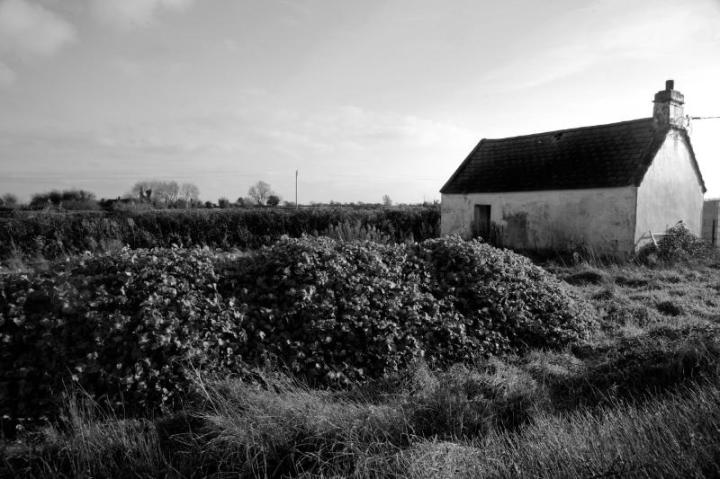
Brigid Halpin’s cottage in Camas. The photograph was taken in 2017 before renovations began by the new owners. Photograph by Dermot Lynch, Limerick Leader.

‘Death of an Irishwoman’ by Michael Hartnett

brigid-halpins-cottage-today
Bridget Halpin’s cottage in Camas as it is today. Photograph is by Dermot Lynch.

Death of an Irishwoman

Ignorant, in the sense
she ate monotonous food

and thought the world was flat,
and pagan, in the sense
she knew the things that moved
at night were neither dogs nor cats
but púcas and darkfaced men,
she nevertheless had fierce pride.
But sentenced in the end
to eat thin diminishing porridge
in a stone-cold kitchen
she clenched her brittle hands
around a world
she could not understand.
I loved her from the day she died.
She was a summer dance at the crossroads.
She was a card game where a nose was broken.
She was a song that nobody sings.
She was a house ransacked by soldiers.
She was a language seldom spoken.
She was a child’s purse, full of useless things.

© 1975, The Estate of Michael Hartnett
From: Collected Poems.Publisher: The Gallery Press, Oldcastle, 2001.

Author’s Notes: 

Púcas: This was the Irish (Gaelic) term for pookas, hobgoblins, fairies.  In the Irish language a man of African descent is described as a fear ghoirm, a “blue man”.  In Irish, “an fear dubh” (“the black man”) exclusively denotes the devil, therefore, the reference to “darkfaced men” in this poem does not have any racial connotations!  

A wake was a social gathering associated with death, usually held before a funeral.   Traditionally, a wake took place in the house of the deceased with the body present.

In 1965 Michael Hartnett was in Morocco when his grandmother, Bridget Halpin, died at the age of 80.  Hartnett had spent his formative years in Halpin’s simple, meagre cottage in Camas soaking up the stories and folklore of the area as she entertained her cronies in the mid to late 1940’s. She had a great array of Irish words in her vocabulary, many related to the animals of the countryside and life on the farm, although she and the family didn’t use Irish in everyday conversation. Nevertheless, her knowledge of Irish had an immense influence on the young Hartnett, who would go on to became as fluent in Irish as he was in English.

Camas is a hugely important place for Hartnett. It was there that his poetic gift was first recognised and cultivated, particularly by his grandmother.  His first ever published poem was called ‘Camas Road’ and was published in The Limerick Weekly Echo on 18th June 1955.  Hartnett was thirteen.  This present poem, ‘Death of an Irishwoman’, is his effort at an apology for not being there at her funeral – ‘I loved her from the day she died’.

Hartnett, probably the finest poet of his generation in the Republic, returned to his West Limerick roots in the mid-1970’s having made his famous declaration from the stage of the Peacock Theatre at an event organised by Goldsmith Press on June 4th, 1974. At that event, Michael Hartnett informed the audience of his resolution to cease writing and publishing in English, stating that his “road towards Gaelic” had “been long and haphazard” and until then “a road travelled without purpose”. He reassured his audience that he had realised and come to terms with his identity while acknowledging that his “going into Gaelic simplified things” for him and provided answers which some considered to be naive but at least gave him “somewhere to stand”.  Hartnett, similar to what Sean Ó Riada had done in the 1960s, left Dublin and found refuge in rural West Limerick.  (Ó Riada had forsaken Dublin for Baile Bhúirne in West Cork).  According to Fintan O’Toole these flights,

“were driven by a deep pessimism: there was no authentic way of being Irish in the cities, in the English language, in a European modernist tradition.  The only future lay in the past, in a reconnection with the real people, the more rural the better “(O’Toole, 189). 

Rediscovering and reinventing himself and the long forgotten echoes of his Gaelic past was, therefore, a central project during those years in the 1970’s. 

Bridget Halpin and her small farm in Camas were central symbols in Hartnett’s search for authenticity.  In Harnett’s mind, she symbolised all that was lost in the traumatic early years of the Twentieth Century in Ireland.  In Hartnett’s view one of the many precious things which was lost, ignored, and abandoned was the Irish language itself and so the poem can be read as a post-colonial lament.  According to Census returns for Camas in 1911, Bridget Halpin was 26, living with her husband Michael, ten years her elder.  This would mean she was born in 1885, a time of cultural revival, coinciding with the founding of the Gaelic League and the Gaelic Athletic Association.  Hartnett always considered her to be a woman ‘out of her time’.  She never came to terms with the New Ireland of the 1920’s, 1930’s, and though her life spanned two centuries she was, in his eyes, still living in the past, ‘Television, radio, electricity were beyond her ken entirely’ (Walsh 13).  To her, ‘the world was flat / and pagan’, and in the end,

she clenched her brittle hands
around a world
she could not understand.

There is a strong sense of regret for a lost generation in this poem and this is particularly in evidence in the poignancy of the line:

I loved her from the day she died.

What follows is a masterclass of poetic skill, the poet cherishes the memory of his lost muse with an epitaph made up exclusively of metaphors:

She was a summer dance at the crossroads.
She was a card game where a nose was broken.
She was a song that nobody sings.
She was a house ransacked by soldiers.
She was a language seldom spoken.
She was a child’s purse, full of useless things.

These metaphors conjure up an almost forgotten rural idyll: dances at the crossroads on summer evenings, the hustle and bustle of the rambling house with its card games and music sessions, slow airs and sean nós singing, sets and half-sets.  Hartnett also veers into the political sphere with reference to The Black and Tans and the fraught Irish language question, which he sees as having been abandoned and neglected by successive governments since the foundation of the State, ‘Our government’s attitude is hostile and apathetic by turns’ (Walsh 126).  His final metaphor:

She was a child’s purse, full of useless things.

captures the futility and frustration felt both by his grandmother and the poet himself at the relentless pace of change.  Safia Moore, in her excellent blog, Top of the Tent, says of this metaphor that it encapsulates the notion of his grandmother as ‘being out of step with the utilitarian, modern world’.

In effect, Hartnett is not only writing the epitaph for his grandmother but for a unique and precious culture which he sees drifting towards oblivion through neglect.  During these years in Newcastle West and in his cottage in nearby Glendarragh, Templeglantine, Hartnett wrote many such epitaphs for local people and their dying country crafts.  This is a facet of Hartnett’s work which began with his grandmother, Mrs Halpin. (See Epitaph for John Kelly, Blacksmith as one example of this).  Therefore, in a way, not only is Hartnett lamenting the death of Mrs Halpin here but also, like Heaney in many of his poems, he is lamenting the loss of ancient crafts and customs which, with the progress of time, have become redundant.  He has returned home to find things falling apart and that Time has thinned the ranks of the stalwarts of the town.  His local poetry, in particular, takes on a nostalgic retrospection and features poems about those who have died, such as ‘Maiden Street Wake’, where he describes one such wake:

We shuffled round and waited.
Our respects were paid.
And then we ate soft biscuits
and drank lemonade.

This period in his life is, therefore, best depicted as a period of intense creativity and a series of well-documented farewells, best characterised by this poignant line from the ‘Maiden Street Ballad’ where he ruefully declares:

old Maiden Street went to the graveyard.

Author’s Note:  Students of Hartnett and aspiring academics will readily verify that Harnett, whether deliberately or mischievously, was a master of misinformation.  The Youtube clip above is a perfect example of this.  As he begins to introduce the poem, ‘Death of an Irishwoman’ he states that his grandmother, Bridget Halpin was born in 1870 when,  in fact, we know through Census returns for 1911 that she was born in 1885.  He also says that she was 93 when she died when, in fact, if the Census returns are to believed, she was a mere 80! Bridget Halpin, immortalised by her grandson, Michael Hartnett, is buried with her daughter Ita Halpin (Dore) in the grounds of the old abbey in Castlemahon Cemetery. Hartnett declares poignantly in the poem: I loved her from the day she died’.

IMG_3602
Bridget Halpin’s grave in Castlemahon Cemetery. She is buried with her youngest daughter Ita Dore (nee Halpin). Her husband Michael, her son Denis and her sister Mary Kiely (nee Halpin) are also remembered on the headstone.

Further Reading

You might like to have a read of a more detailed exploration of Bridget Halpin’s obvious influence on her grandson, Michael Hartnett,  here.

Bibliography

Collins, Pat. ‘A  Necklace of Wrens’ (Film). Harvest Films. 1999.

O’Toole, Fintan.  We Don’t Know Ourselves: A Personal History of Ireland since 1958, London: Head of Zeus, 2021.

Walsh, Pat. A Rebel Act: Michael Hartnett’s Farewell to English, Cork: Mercier Press, 2012