Semple Stadium Glory Days

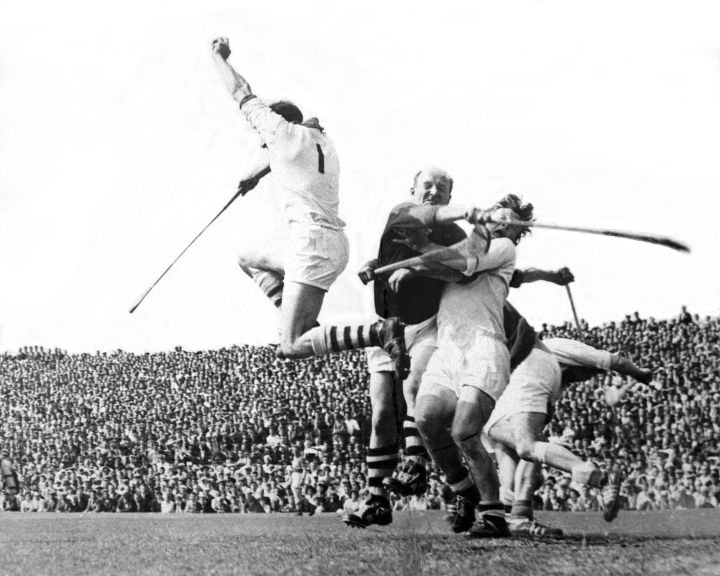
One of the greatest GAA photos of all time. Goalmouth ‘shemozzle’ from that Munster semi-final in Thurles in 1962. Waterford’s Ned Power saves despite the close attention of Christy Ring. Also in the picture are Tom Cunningham (W), Austin Flynn (W), and Liam Dowling (C). The scene is brilliantly captured by photographer Louis MacMonagle. Photo courtesy of the Irish Examiner archive.

Some like Anfield, some prefer Wembley or the Camp Nou or Santiago Bernabéu; some prefer Thomond Park or Cardiff Arms, but my favourite ‘field of dreams’ is Semple Stadium in Thurles, County Tipperary, where the GAA was founded over 140 years ago.  It has been at the heart of hurling since its opening in 1910.  Tipperary people, harking back to long-gone glory days in the 60s, refer to it as the Field of Legends, but I’d say Limerick people would have something to say about that after our recent run of success since 2018!

Close your eyes …. Think of summer. What do you see? I see midges swooping and dancing through a languid sunset. I see heat-drenched Limerick jerseys shuffling through the streets of Thurles, where bellows of banter waft along with the whiff of cider that floats from the open doors of packed pubs in Liberty Square. Inside D D Corbett’s, a bitter alcoholic draws tears from the crowd with a soft, sweet rendition of ‘Slievenamon’.

 Anyway, I have been travelling to this Mecca since I was ten years of age. My first visit was on a beautiful Sunday, the 8th of July in 1962. My mother and father, along with most of my brothers and sisters at the time, were walking home from second Mass in Glenroe when Tom and Mick Howard stopped in their black Morris Minor and asked Dad and me if we’d like to go to Thurles with them to see Ringy and the Rebels take on the might of Tom Cheasty, Ned Power and Frankie Walsh’s Waterford.  It was Ring’s last hurrah, and it was appropriate that his last Championship game in the ‘blood and bandages’ of his native Cork should have been in Thurles.  It was here that, for two decades previously, he had adorned the ancient game with his unique and exceptional talent.  I count myself lucky that I was able to sit there with my Dad, a loyal Cork man,  and my hurling mad neighbours, the Howard brothers, on the recently creosoted railway sleepers on the embankment that is now the Old Stand.  However, it was Waterford’s day, and they won by 4 – 10 to 1 – 16.

On a street corner, a humming chip van mumbles its invitation to giddy children as the June sun beats down. The Pecker Dunne sits, perched on a flat stone wall, plucking and strumming, twanging banjo chords as he winks at those who pass. A smile broadens his foggy beard as coins glint and twinkle from the bottom of his banjo case.

I have witnessed other great games there down the years, and I have seen great hurlers adorn the venue. Let’s be blunt – Thurles is the best place to go to see a hurling match, and hurling people also know that if you can’t hurl in Thurles, you won’t hurl anywhere.  I remember listening to Michéal O’Hehir commentate on the 1960 Munster Final in Thurles between an ageing Cork team and Tipperary, who were emerging as a force to be reckoned with.  There’s a story told by John Harrington about the speech Christy Ring gave in the dressing room before the game that day.  He delivered a rousing speech that brought the blood of his teammates to boiling point. However, his words did not find favour with Fr Carthach McCarthy, who was also in the dressing room at the time. “You didn’t find those words in the Bible, Christy”, said Fr. McCarthy, in as disapproving a tone as he could muster.  Ring cast a jaundiced eye at the man of the cloth and replied, “No, Father.  But the men who wrote the Bible never had to play Tipperary.”  Despite his exhortations, Cork lost on the day, 4 -13 to 4 -11.

Hoarse tinkers flog melted chocolate and paper hats on the brow of a humpbacked bridge as we move closer to the field of legends. The drone of kettledrums and bagpipes rises from the Sean Treacy Pipe Band as they parade sweat-soaked warriors around the green, hallowed sod.

John D Hickey, one of the great sports writers of the 50s and 60s, coined the phrase ‘Hell’s Kitchen’ to describe the general vicinity of the Tipperary goalmouth, which Michéal O Hehir, the greatest GAA commentator of all time, referred to as ‘the parallelogram’, or what we today refer to as ‘the square’! This area of the pitch was patrolled in the mid-60s by the Tipperary full-back line at the time, Michael Maher at full-back, flanked by John Doyle and Kieran Carey – probably the greatest full-back line in the history of the game.  As the name suggests, they usually generated the sort of heat that suffocated most full-forward lines, who generally struggled to cope with their unique blend of physicality, hurling skill and a generous helping of the dark arts.  Their dominance continued until the emergence of the youthful Eamonn ‘Blondy’ Cregan and Eamonn Grimes and company, who in 1966 destroyed that Tipp team that were All-Ireland winners in ’61, ’62, ’64, and ‘65. Suffice it to say that Limerick put a stop to Tipperary’s gallop that sunny Sunday, and the young ‘Blondy’ Cregan scored 3 goals and 5 points in a 4 – 12 to 2 – 9 defeat of Tipperary. That day still stands as one of my all-time treasured sporting memories.

A whistle rings on high, ash smacks on ash and the sliothar arrows between the uprights. A crash of thunder and colour erupts from the terraces at the Killinan End and the Town End (the Limerick end!)…… I see the Munster Championship!!

I’ve been in Thurles as a Limerick supporter, as an uninvolved spectator, and I’ve also been there with skin in the game as Don played Minor, Under 21, and Intermediate hurling for Limerick. Limerick have been lucky in this place. A few Munster Senior titles, including 1973, five Under 21 titles in this Millennium alone, and a Centenary Minor title after a replay at the same venue against Kilkenny.  Paddy Downey, writing in The Irish Times, said of the replayed minor final that, ‘it is probably true to say that there never has been a better minor All-Ireland final’.

The 1973 Munster Final was special, and of course, it ended in controversy.  As the final seconds ticked down and the teams were level, Eamonn Grimes won a disputed seventy for Limerick.  The referee, Mick Slattery from Clare, told Richie Bennis that he had to score direct, as the time was up.  Richie held his nerve, the sliothar headed goalwards, the umpire raised the white flag, and the rest is history. Every Tipperary man there that day swears that the ball was wide, but it mattered little; the game was up.  In my view, it was Ned Rea who broke Tipperary hearts that day with his three goals and not Ritchie Bennis with his last gasp point.  Sadly, it was the final swansong for that great Tipperary team.  They stole an All-Ireland in ’71 when they beat Limerick in the rain in Killarney, but they didn’t emerge again as a hurling force until 1989. That day also marked the legendary Jimmy Doyle’s last appearance in a Tipperary jersey.

The Championship is more precious than life for many. I’ve seen grey-haired men gazing into half-empty pints, reeling off the names of the great ones, like prayers. I’m afraid I too follow suit. Ask me who the Minister for Finance is, and your question will be greeted with indifference. I simply couldn’t care less. But ask me where Carlow senior hurlers play and instantly I say, ‘Dr. Cullen Park … to the left at Church Street, up Clarke Street and half a mile out on Tower Road’. Monaghan? ‘Pairc Ui Tieghernan .. on the slope of George’s Hill, overlooking the County town’. Where do Sligo play? ‘Markievicz Park in the heart of Sligo town’. ‘Bless me, father, for I’m a fanatic!’

The major hurling powers took a bit of a break in the mid-90s and allowed the minnows, like Limerick, Clare and Offaly and Wexford, to have their fling.  Don and I were in the New Stand – Árdán Ó Riain – for the ’95 Munster Final on the 9th of July.  It was one of those glorious Thurles days – despite the outcome.    In the end, Clare claimed their first Munster championship since 1932, and only their fourth ever.  I remember Davy Fitz scoring a penalty before half-time, crashing the sliothar high into the town net, before sprinting back to his own goal line.  Despite our disappointment, especially after the humiliating defeat in the All-Ireland Final the previous year to Wexford, you had to give credit to this Clare team.  One could sense the ghosts of 63 years and the curse of Biddy Early evaporating before our eyes.  The release of emotion when Anthony Daly received the cup had to be seen to be believed.  I remember the ‘Shout’ ringing out from the Killinan End and then Tony Considine taking the microphone for his rendition of ‘My Lovely Rose of Clare’.

What else draws the likes of Mike Quilty and Mike Wall, setting them down among roaring, red-faced lunatics in the shadow of the crowded Old Stand? What else exists that plucks the cranky farmer from the milking parlour and flings him into a concrete cauldron eighty miles across the province? Some swear the Apocalypse would not have the same effect….

We waited nearly a full year to gain our revenge – on June 16th, in Limerick this time.  We had been away for a holiday in Carnac in Brittany and came back the day before the game.  All of Limerick had been convulsed by the recent killing of Detective Garda Jerry McCabe, who had been shot and killed in the village of Adare by members of the Provisional IRA on June 7th, during an attempted robbery of a post office van. His colleague, Ben O’Sullivan, had also been seriously injured in the incident.  Being away when tragedy strikes so close is unnerving and surreal.  I spent most of that Saturday hunting for tickets for the fanatics in my household and eventually secured terrace tickets at the City End of Pairc na nGael from Charley Hanley in Croagh, who was Liaison Officer with the Limerick team at the time. The following day, in glorious sunshine, we took our sunburnt revenge.  Hurling legend Ciarán Carey of Patrickswell scored one of the greatest ever winning points in the history of Gaelic Games, in front of an attendance of 43,534. Result: Limerick 1-13, Clare 0-15.

 May and the chirp of the sparrow, you can be guaranteed we’d be stuck in that long snake of traffic, as it slithered its way to Cork, Limerick, Thurles and other far-flung fields.

 The modern Munster championship has changed many an inherited dynamic. The regularity with which Limerick now go to Semple Stadium to play Tipperary is a very modern phenomenon.  There was a time when if you played two Munster rivals, you would be through to an All-Ireland semi-final – not anymore.  Now you must beat all the Munster counties at least once in the Munster Round Robin Pool of Death.  Limerick have won five All-Irelands in this way since 2018.  Two Munster counties in an All-Ireland Final is no longer a rarity.

.… But oh to be a hurler…  If the truth be known, I couldn’t hurl spuds to ducks. The boss of my hurley has seen the arse of a Friesian cow more often than it has the crisp leather stitching of an O’Neill’s sliothar! Okay, I’ve had my own All-Irelands up against the gable end and in and around the mother’s flower beds, but that’s as far as it went for me.

What is most amazing about Thurles is that no matter who is playing, they all seem to troop back into the town and mingle in the Square in the shade of Hayes’s Hotel for hours afterwards.  As Kevin Cashman, that Prince of Sportswriters from my generation, remarked, ‘the pubs of Thurles on a big match day have something that no other pubs can give.  It has been called ‘atmosphere’, ‘bond’, ‘fraternity’, and much more – it’s magic in the air’.  The ghosts of Mackey, Clohessy, the Doyles, John Keane, Jimmy Smyth, and Ring become as real as what you have just witnessed. And now we have new heroes like Nickie Quaid, Declan Hannon, Cian Lynch, Barry Nash, Kyle Hayes, Patrick Horgan, Tony Kelly, Shane O’Donnell, the Mahers, and Austin Gleeson to keep the flame alight for future generations.  As Kevin Cashman puts it, ‘This is their Elysian field and the turf, and the grass and even the steel and the concrete of this place are the keepers of their youth and the youth of all of us, who shaped them’.

The terrace is where the real nectar of hurling comes to a head – when every Joe Soap in the country stands together on the same patch of cement with their eyes fixed on the same lush, green carpet…..

References

Harrington, John, Doyle: The Greatest Hurling Story Ever Told (2011).

Highly Recommended

 O’Donnchú, Liam. Semple Stadium: Field of Legends, Dublin: O’Brien Press,  2021
Brandon Creek Epiphany – and a Rant!

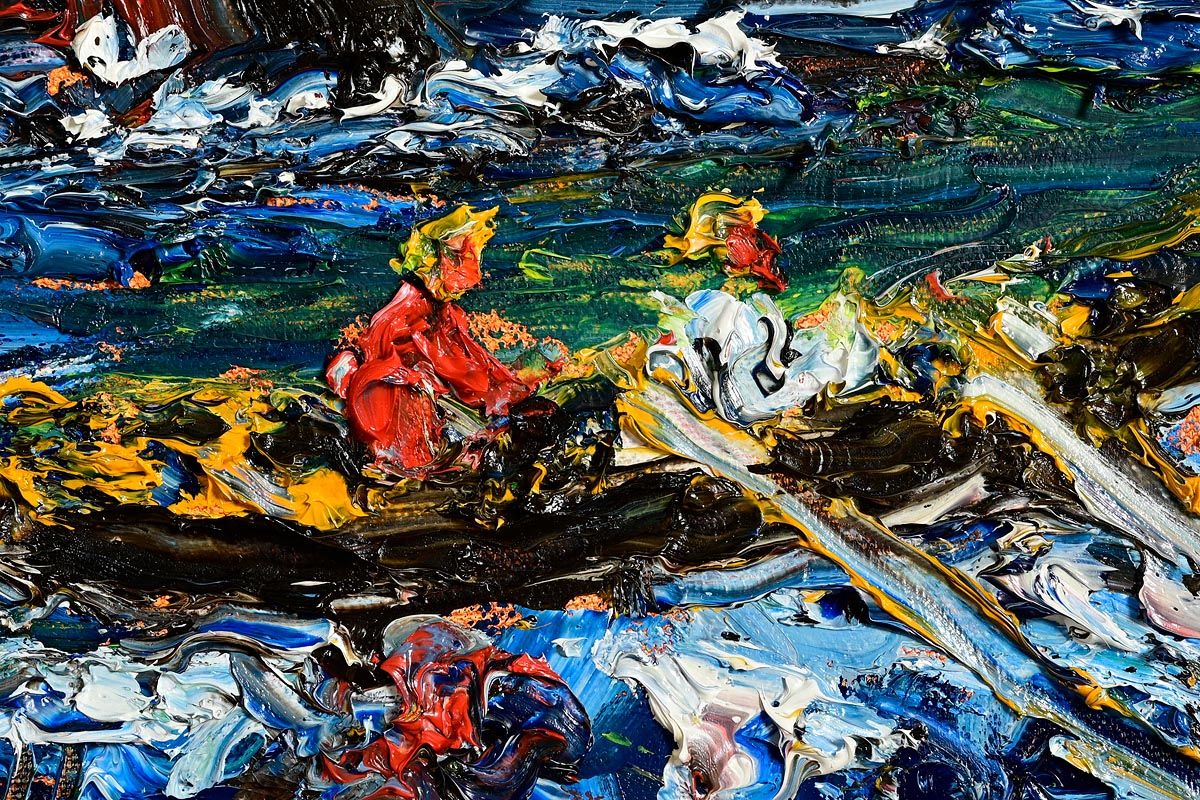
‘Brandon Creek, West of Dingle’ by Liam O’Neill/Morgan O’Driscoll.

The title of this blog is ‘Reviews, Rants and Rambles’ and since 2015, there have been many reviews and rambles but very few rants – so here’s one:  We are living through the craziest of times.  Like Macbeth after his confrontation with the witches, ‘ Nothing is but what is not, ’ and global leaders have taken their chainsaws to the truth.  Irony is everywhere: billionaires and huge multinational corporations try with all their ingenuity to destroy all borders so that their profits are maximised, while at the same time their political buddies stoke nationalistic fervour and division and demonise immigrants and those who cross borders to a better life.  Globalism is the buzzword, but global efforts to combat impending Doomsday scenarios and pandemics have been seen to be pathetic attempts at cooperation. Rant over.

The summer of 2024 was yet another Climate Change paradox in Ireland.   The Jetstream seemed to be stuck in some Groundhog Day cycle during June, July and most of August. There were no two days the same; no long sunny spells, rain was never far away, although rainfall amounts were below normal levels.  Towards the end of August, a temporary high moved in over Ireland and Kate and I decided to take full advantage. On Friday, August 30th, Don’s birthday, we decamped to Dingle.

On Saturday morning, we decided to head out west towards Baile na nGall, and on the way, we stopped off at Brandon Creek to explore this unheralded and largely forgotten gem on the Wild Atlantic Way. On that morning, it was indeed sensational, and a revelation and my words are inadequate to describe the beauty and tranquillity of the place. We parked our car in an unofficial grassy layby near the top of the narrow roadway leading to the Creek and the neglected pier. The narrow single-lane path descended to a very rustic bridge over the creek. The solitude was magical and eerie. I couldn’t help but think that in another era, this narrow roadway would have been used to collect guns and other contraband smuggled into this isolated cove in the dead of night.

Maybe this scenario from bygone days was prompted by the many rebel songs and ballads and stirring sea shanties we had listened to the night before from the marvellous local group, Tintéan, in Murphy’s pub in Dingle. They had entertained a very diverse and varied audience with a two-and-a-half-hour session of rousing rebel songs, some of which even the Wolf Tones wouldn’t include on their concert playlist for fear of offending someone! The Irish diaspora was there in force from Ohio, Connecticut, and Washington; I even had trouble distinguishing between the Canadian and South Florida accents! Then there were couples from Spain, Germany, and Sweden and holidaymakers from Derry, Tipperary, Limerick and Kerry.

As we walked down the steep incline to the pier, there was much evidence of neglect and some evidence that, at one time, the now rusty winch had been used to haul the local currachs with their catches up onto the pier. I walked to the end of the pier and could hear the quiet, rhythmic gurgling of seawater in the hollow caverns at its base. I imagined what it would be like in the throes of an Atlantic storm. It was hard to believe that it was from this very location around 600 AD that Saint Brendan the Navigator was reputed to have set out and discovered America.

There is much talk today, especially across the water, about the problems caused by small boats precariously being used to bring immigrants to Britain’s shores. St. Brendan and his hardy crew of monks not only made it to Iceland and probably Newfoundland and Labrador, but they also made it home again! There is some anecdotal evidence and much more scientific evidence that the people living today in those far-off regions carry West Kerry genes, so the monastic concept of celibacy must have been an optional requirement in those early days!

I also remembered that in the 1970s, the explorer, writer and filmmaker, Tim Severin, tried to recreate St. Brendan’s voyage in an effort to prove that the 6th-century Irish saint could have reached the Americas 900 years before Columbus.

On May 17th, 1976, Severin and his three fellow crewmen rowed out of this same Brandon Creek to begin what would prove to be a 7,200km epic journey. I remember avidly following their progress as Severin and his crew first sailed to the Aran Islands and from there to Iona, the Hebrides, and the Faroe Islands, before sailing on to Iceland and Greenland and from Greenland to Newfoundland.

On June 26th, 1977, some 13 months after leaving Brandon Creek, Severin and his crew sailed into Musgrave Harbour on Peckford Island, Newfoundland and were welcomed as heroes by the locals who fully appreciated the navigational feat.  Amazingly, there is nothing on the pier in Brandon Creek today to remember those heroic feats of yesteryear.

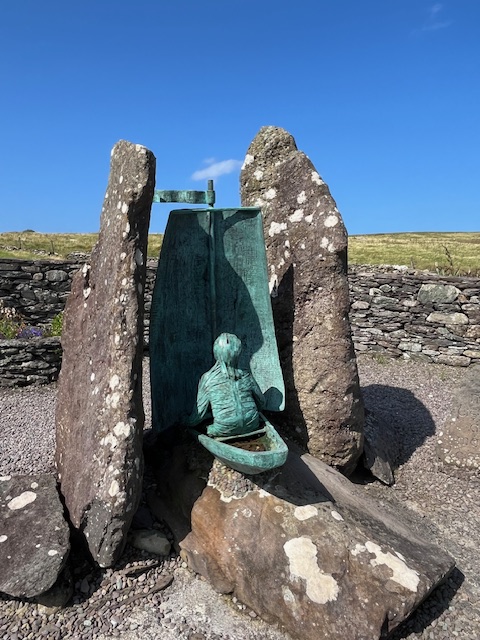
Kate and I made our return journey up the steep, narrow incline with visions of the stormy gunrunning scene from Ryan’s Daughter playing in my head. As we reached our car after the slow climb, I noticed what seemed like a half-hidden art installation surrounded by low walls of local stonework. At first, I took it to be yet another of the numerous shrines and grottos that lie scattered all over this Gaeltacht region, but this was different. While I was exploring this very unobtrusive, unflagged surprise, Kate had struck up a conversation with a woman whose car was also parked nearby. I continued on my way and came upon a copper-green sculpture depicting a lone sailor navigating between two standing stones, which, I presume, were meant to represent the perils encountered on an ocean voyage. The sailor seemed to be sailing blind as his view forward was blocked by the fragile sail on his lowly currach. I presume the sculpture was meant to depict the voyage of St. Brendan in his frail craft all those centuries ago. There was an inscription in Irish on a red sandstone flag nearby, which read ‘Ná ligamís ár maidí le sruth’.  I wanted to remember this, so I took a note of it on my phone.

I returned to the car where Kate was waiting, and she told me of her conversation with the woman she had met. The woman had set out that morning at 6 a.m. on her own and had climbed the nearby Mount Brandon. It had taken her three hours to climb to the summit and three hours to make her descent. Because she was muddy and splattered from the climb, she had decided to go for a swim down in Brandon Creek before heading home.  Needless to say, we were both in awe of this woman’s achievements. This hardy soul epitomised for us the strength and resilience of the locals in this almost-forgotten outpost of our country. I then told Kate what I had got up to and the marvellous discovery I had come across, something not mentioned in any of the Bord Fáilte brochures in nearby cosmopolitan Dingle. I told her about the inscription I had come across and translated the hopeful message as best I could.

Sometimes when we begin to doubt our ability to solve personal or global issues like climate change, the inscription from that beautiful, wild and neglected place has, for me, the feel of a powerful call to arms:

‘Ná ligamís ár maidí le sruth’

‘We must never rest on our oars’


The Last Vision of Eoghan Rua Ó Súilleabháin by Michael Hartnett

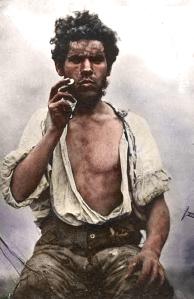
An unknown Spailpín Fánach circa 1858. A colourised image by Matt Loughrey from a black and white photograph originally collected by Sean Sexton.

The Last Vision of Eoghan Rua Ó Súilleabháin

The cow of morning spurted                Do thál bó na maidine
milk-mist on each glen                          ceo bainne ar gach gleann
and the noise of feet came                    is tháinig glór cos anall
from the hills’ white sides                     ó shleasa bána na mbeann.
I saw like phantoms                                Chonaic mé, mar scáileanna,
my fellow-workers                                   mo spailpíní fánacha,
and instead of spades and shovels      is in ionad sleán nó rámhainn acu
they had roses on their shoulders.     bhí rós ar ghualainn chách.

Translated by Michael Hartnett from his original Irish poem.

Commentary

This gem of a poem was first published as part of Hartnett’s first collection in Irish, Adharca Broic, in 1978.  The poem also appears in Hartnett’s 1987 collection, A Necklace of Wrens, with an English translation by the poet himself. Of the twenty-three poems in A Necklace of Wrens, thirteen are included from that first collection in Irish, Adharca Broic, with English translations by the poet. Peter Fallon, his publisher and editor, has stated that the poems included in A Necklace of Wrens were the only Irish poems that Hartnett wanted to be preserved after his ten-year sojourn in West Limerick. This collection was followed a year later by Poems to Younger Women, entirely in English. Theo Dorgan tells us that both these collections show ‘a startling return to the power and complexity we might have expected had the poet not turned aside from English in 1975’.

‘The Last Vision of Eoghan Rua Ó Súilleabháin’ offers a modern perspective on the traditional Aisling (vision) poem genre. The poem blends traditional imagery with contemporary twentieth-century realism, transforming the spectral ‘fellow-workers’, the ‘spailpíní fánacha’ of the original, into figures with ‘roses on their shoulders’ instead of spades, suggesting a hopeful, transformed vision of labour and society, rather than the lament for lost Gaelic order typical of historical Aisling poems.

Here, the focus shifts from the old political lament of older Aisling poems to a more modern, grounded, hopeful vision, using the image of the rose, the international symbol of the Labour Movement, of which Hartnett was a card-carrying member.  While the original poems lamented historical events like the Flight of the Earls and the hoped-for return of Bonny Prince Charlie and the Stuarts to power, Hartnett’s poem shifts the focus to a contemporary sense of disillusionment and emotional turmoil. Hartnett does use the image of a new day dawning to reinforce the hopeful possibility of better days ahead, however, while Hartnett’s translation adapts the ancient Aisling form in a contemporary context, in my view, this Aisling is heavily laden with irony, if not cynicism, because of Labour’s perceived inability to improve the lot of the working class and its failure to gain long-term popular mainstream support, particularly in the post-World War II era.

The title and the poem itself reference the Aisling genre, a poetic form that developed in Gaelic poetry in the 17th and 18th centuries.  Readers familiar with Irish poetry will also be aware that in these old Aisling poems, Ireland was often depicted as a woman: sometimes young and beautiful, sometimes old and haggard. In the final poem in his first collection in Irish, Adharca Broic, Hartnett reprints his iconic poem, Cúlú Íde, in which he portrays Íde (Ita Cagney in the English version) as a strong, formidable woman, and he endows her with many of the traditional characteristics of the spéirbhéan (the spirit woman) from the original Aisling poems.  She is depicted as a modern Bean Dubh an Ghleanna, Gráinne Mhaol, Roisín Dubh or Caithleen Ní Houlihan – in effect, a symbolic representation of the new Ireland.

This modern Aisling, ‘The Last Vision of Eoghan Rua Ó Súilleabháin’ also features striking imagery, such as the ‘cow of morning’ that ‘spurted milk-mist on each glen’. The image of the cow, the Droimeann Donn Dílis, was also a stock reference to represent Ireland in Jacobite poetry and the hoped-for return of the Stuart dynasty, which, many at the time believed, would benefit Ireland. This initial image creates a surreal and elemental atmosphere, setting a new tone for the vision. The crucial shift occurs when these workers have ‘roses on their shoulders’ instead of ‘spades and shovels,’ symbolising a transformed, idealised vision of labour, where it is no longer depicted as hardship or indentured slavery but as something beautiful and dignified.

The rose, particularly the red rose, later became a symbol for the Labour Movement through the slogan ‘bread and roses,’ which represents the dual desire for both the means to live (bread) and a life of dignity and fulfilment (roses). This symbol is associated with the fight for social and economic justice and is used by many social democratic and labour parties, such as the Labour Party in Ireland and the UK.

The ‘phantoms’ seen by the speaker are described as ‘fellow-workers’, ‘comrades’ even, transforming traditional imagery of spectral figures into more tangible, relatable characters associated with Labour.   The older, traditional variety are the sad spectral figures that accost Hartnett one summer’s evening as he heads from his home in Newcastle West to meet his uncle Dinny Halpin in Camas.  The episode is recounted for us in the second section of his iconic poem, ‘A Farewell to English’,

These old men walked on the summer road

sugán belts and long black coats

with big ashplants and half-sacks

of rags and bacon on their backs.

These spectral figures were a pathetic vision, ‘hungry, snotnosed, half-drunk’.  These ragged poets, Andrias Mac Craith, also known as An Mangaire Súgach, The Merry Peddlar,  (along with his contemporary, Sean Ó Tuama an Ghrinn, who also hailed from Croom, the seat of one of the last ‘courts’ of  Gaelic poetry),  Aodhagán Ó Rathaille from Meentogues near Rathmore in the Sliabh Luachra area (also the birthplace of Eoghan Rua Ó Súilleabháin), and Dáithí Ó Bruadair, who was on his way from Springfield Castle, the seat of the Fitzgeralds, to Cahirmoyle, the seat of his other great patron, John Bourke), represented the sad remnants of a glorious past.

The ‘phantom’ figures leave Hartnett resting ‘on a gentle bench of grass’, leaving him to ponder his own future as their direct descendant:

They looked back once,

black moons of misery

sickling their eye-sockets,

a thousand years of history

in their pockets.

Eoghan Rua Ó Súilleabháin, the putative author of this Aisling and a real-life spailpín in his own right, lived a life which was the stuff of legend and lore, and, indeed, it has many similarities with Hartnett’s own rakish life.  Many of the stories surrounding him may very well be apocryphal, to say the least.  However, he and his fellow parishioner, Aodhagán Ó Rathaille, are most famous for their mastery of the Aisling genre.

Eoghan Rua was born in 1748 in Meentogues, in the mountainous Sliabh Luachra area, in southwestern Ireland. By the time of his birth, most of the native Irish in the southwest had been reduced to landless poverty. However, the area boasted of having one of the last ‘classical schools’ of Irish poetry, descended from the ancient, rigorous schools that had trained bards and poets for generations. In these last few remnants of the bardic schools, Irish poets competed for attention and rewards, and learned music, English, Latin and Greek.

Eoghan Rua (the Rua refers to his red hair) was witty and charming but had the misfortune to live at a time when an Irish Catholic had no professional future in his own country because of the anti-Catholic Penal Laws. He also had a reckless character and threw away the few opportunities he was given. For example, at the age of eighteen, he opened his own school; however, we are told that ‘an incident occurred, nothing to his credit, which led to the break-up of his establishment.’

Eoghan Rua then became a spailpín, an itinerant farm worker, until he was 31 years old. He was then conscripted into the British Navy under interesting circumstances. Ó Súilleabháin was then working for the Nagles, a wealthy Anglo-Irish family.  They were Catholic and Irish-speaking, and had their seat in Kilavullen along the Blackwater valley near Fermoy, County Cork. (The Nagles were themselves an unusual family. The mother of the Anglo-Irish politician Edmund Burke was one of the Nagles, as was Nano Nagle, the founder of the charitable Presentation order of nuns. She was declared venerable in the Catholic Church on 31 October 2013 by Pope Francis).

Daniel Corkery relates that, ‘I have had it told to myself that one day in their farmyard Eoghan Rua heard a woman, another farm-hand, complain that she had need to write a letter to the master of the house, and had failed to find anyone able to do so. ‘I can do that for you’, Eoghan said, and though doubtful, she consented that he should. Pen and paper were brought to him, and he sat down and wrote the letter in four languages: in Greek, in Latin, in English, and in Irish. ‘Who wrote this letter?’ the master asked the woman in astonishment. The red-headed young labourer was brought before him, questioned, and thereupon set to teach the children of the house.  However, again owing to Eoghan Rua’s bad behaviour, he had to flee the house, the master pursuing him with a gun’. Legend says he was forced to flee when he got a woman pregnant: some say that it was Mrs Nagle herself!

Ó Súilleabháin escaped to the British Army barracks in Fermoy, and he soon found himself aboard a Royal Navy ship in the West Indies, ‘one of those thousands of barbarously mistreated seamen’.  He sailed under Admiral Sir George Rodney and took part in the famous 1782 sea Battle of the Saintes against French Admiral Comte de Grasse. The British won, and to ingratiate himself with the Admiral, Ó Súilleabháin wrote an English-language poem, Rodney’s Glory, lauding the Admiral’s prowess in battle and presented it to him. Ó Súilleabháin asked to be set free from service, but this request was denied him.

Much of Eoghan Rua’s life is unknown and clouded in mystery and intrigue. He returned after his wartime exploits to his native Sliabh Luachra and opened a school again. Soon afterwards, at 35, he died from a fever that set in after he was struck by a pair of fire tongs in an alehouse quarrel by the servant of a local Anglo-Irish family. ‘The story of how, after the fracas in Knocknagree in which he was killed, a young woman lay down with him and tempted him to make sure he was really dead, was passed on with relish’.

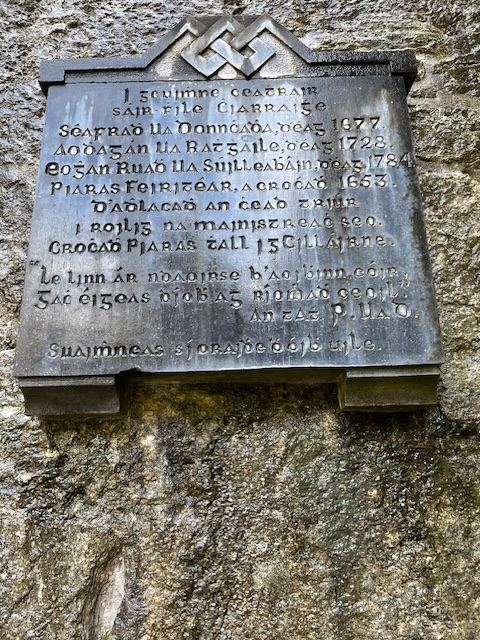
There is some confusion as to where he is buried.  Some claim he was buried in midsummer 1784, in Nohoval Daly graveyard (or Nohoval Lower Graveyard), which is located on the Cork side of the River Blackwater on the R582 Knocknagree to Rathmore road.  Others claim that he was buried in the cemetery of Muckross Abbey, Killarney, along with two other great Kerry poets, Séafradh Ua Donnchadha, who died in 1677, and Aodhagán Ó Rathaille, who died in 1728.  There is a plaque on the wall of Muckross Abbey today that commemorates this event.  The plaque also pays tribute to another great Kerry poet, Piaras Feiritéar, who was hanged ‘thall i gCill Áirne’, ‘over in Killarney’, in 1653.  The plaque also has an inscription which is attributed to an tAthair Pádraig Ó Duinnín, the great lexicographer, most famous for compiling the Foclóir Gaeilge–Béarla (Irish-English Dictionary), first published in 1904. He, too, was from Meentogues, the birthplace of both Ó Suilleabhán and Ó Rathaille.

The plaque on the wall of Muckross Abbey in Killarney claims that Eoghan Rua is buried in the Abbey cemetery, along with Aodhagán Ó Rathaille and Séafradh Ua Donnchadha.

It was said of Eoghan Rua that,

Perhaps there never was a poet so entirely popular– never one of whom it could be more justly said volitar vivus per ora virum [He soars, alive in the mouths of the people]. His songs were sung everywhere…. Munster was spellbound for generations…. The present generation, to whom the Irish language is not vernacular, in reading these poems should bear in mind that they were all intended to be sung, and to airs then perfectly understood by the people, and that no adequate idea can be informed of their power over the Irish mind, unless they are heard sung by an Irish-speaking singer to whom they are familiar.

There is much to admire in this short poem.  Indeed, I feel I am but scratching the surface.  However, short and concise as it is, I feel it has relevance to a modern audience eager to bridge the gap to a harrowing era in Irish literary history.  Indeed, the poem’s tone is one of elegy, lament, and perhaps a quiet resignation to loss, reflecting the disorienting experience of a changing world.

In his wide-ranging essay, which gives an overview of Hartnett’s work, ‘A Singular Life: The Poet Michael Hartnett’, Theo Dorgan points out that although he never translated the totem figures, Mac Craith and Ó Tuama,

‘he could and did think of himself as the favoured inheritor of a tradition, and also as one obliged to be loyal to that tradition. This sense of obligation would become the sign and signature of his work’.

That life’s work in both languages serves as a bridge between Ireland’s rich poetic past and its modern present. His poetry and translations from the Irish have given him firsthand knowledge of traditional Irish forms, such as the Aisling, and he uses these in very innovative ways in his contemporary poetry.  By taking a traditional form such as the Aisling and imbuing it with modern themes, Hartnett allows a new generation to connect with a classical poetic tradition while grappling with the emotional and political undercurrents of their own time.

The startling achievement of this short eight-line poem is that Hartnett manages to crystallise all the tropes and traditions of the Aisling genre while at the same time staying relevant to a modern audience.  This Aisling alone proves that he is a worthy successor to the ‘phantoms’, those spectral figures who confronted him at Doody’s Cross, ‘a thousand years of history in their pockets’.

References

Dorgan, Theo. ‘A Singular Life: The Poet Michael Hartnett’, from The Poets and Poetry of Munster: One Hundred Years of Poetry from South Western Ireland, ed. Clíona Ní Ríordáin and Stephanie Schwerter (December 2022/January 2023).

Hartnett, Michael. Adharca Broic, Loughcrew: Gallery Press, 1978.

Hartnett, Michael. A Necklace of Wrens: Poems in Irish and English, editor Peter Fallon, Loughcrew: Gallery Press, 1987.

Hartnett, Michael. Poems to Younger Women, Loughcrew: Gallery Press, 1988.

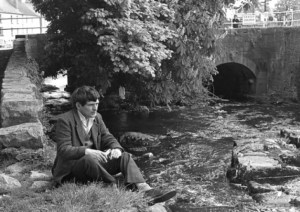
Michael Hartnett in pensive mood by the River Arra in Newcastle West in the 1970s. Photo credit to Limerick Leader Photo Archives

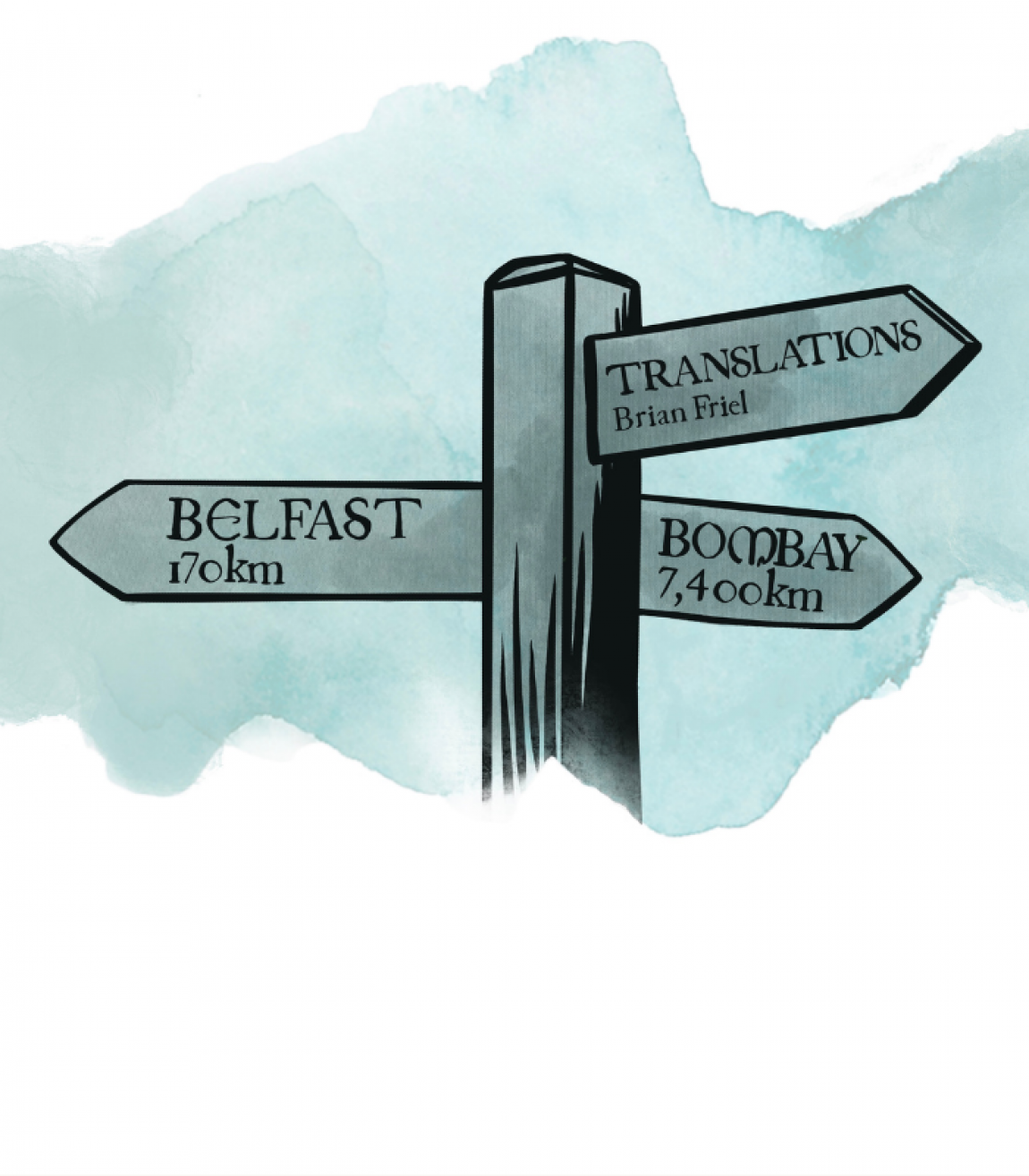
Translations by Brian Friel

translations-featuredTranslations is a three-act play by Irish playwright Brian Friel, written in 1980. It is set in Baile Beag (Ballybeg), in County Donegal which is probably loosely based on his beloved village of Glenties in West Donegal where Friel was a frequent visitor and where he is buried. It is the fictional village, created by Friel as a setting for several of his plays, including Dancing at Lughnasa, although there are many real places called Ballybeg throughout Ireland. Towns like Stradbally and Littleton were other variations and ‘translations’ of the very common original ‘Baile Beag’. In effect, in Friel’s plays, Ballybeg is Everytown.

The original staging of the play, in Derry in 1980, was the inaugural production by the newly formed Field Day Theatre Company, which Brian Friel had founded with the actor Stephen Rea. “It was a poignant play for us because the Troubles in the north of Ireland were still raging,” Rea says. “All the issues were local, but Friel was writing about the bigger picture.”

That inaugural production was at the Guildhall, often seen as a symbol of British authority in the city. “It was pretty different for us to do a play there,” Rea says. “It had a huge impact. That was radical because we didn’t premiere it in Dublin, we didn’t premiere it in Belfast. We did it in Derry, which was very severely affected by the Troubles… When we first did the play, many anti-nationalist people said it was whingeing and moaning about the same old problems. However, because of the continuing war in Ukraine, people can see that the play has a considerable influence and relevance to colonialism worldwide”.

Translations is one of the greatest plays about identity, language, landscape, history – about how we communicate across those divides or fail to – and how a community or nation can navigate times of profound change and dislocation,” said Tánaiste and Minister for Foreign Affairs Micheál Martin when speaking at the grand opening of the Lesya Ukrainka National Academic Drama Theatre production at The Abbey Theatre in July 2023. “Friel wrote it for the Field Day company during one of the darkest periods of the conflict in Northern Ireland – it’s very significant that the national theatre ensemble in Kyiv, and their audiences, have felt that this Irish text resonates with their personal and collective experience as they live through this appalling, illegal war”.

Friel has said that Translations is ‘a play about language and only about language’, but it deals with a wide range of issues, stretching from language and communication to Irish history and cultural imperialism and the effects of colonialism. Friel said that his play ‘should have been written in Irish’ but, despite this fact, he carefully crafted the verbal action in English, which help bring the political questions of the play into focus.

The play traces the impact of an actual historical event, the 1824 – 1846 project to produce a British government-sanctioned ordnance survey map of Ireland. The English Parliament ordered Major Thomas Colby to Ireland in 1824 to undertake a comprehensive survey of the country. His teams of surveyors would produce detailed maps on a six-inch = one-mile scale that would be used to determine land valuations for tax purposes. The maps were finally published in 1846. They cover almost the entire country and include details of even the smallest civil division of the time: the townland.

Translations shows the effect this operation has upon a typical Irish village (Baile Beag), an impact which causes unemployment, theft, flight, threatened evictions, and violence. Here in Ballybeg, Captain Lancey has been tasked with creating an accurate map of Ireland, with English placenames, so that Ireland can be more easily navigated by the British Army, and that land taxes can be more easily charged. These objectives are connected to the British agenda to colonise and modernise the comparatively ancient civilisation of Ireland. Lancey, who has been sent by commanders in London to carry out this project, is described by Yolland in Act Two, Scene One as ‘the perfect colonial Servant’.  Yolland marvels at this hard-working, industrious attitude: ‘Not only must the job be done — it must be done with excellence’.

At face value, this development seemed to be progressive yet in reality it is being used as a weapon of subjugation by a colonial invader. I am reminded of those Pathè News clips from the 40s seen in cinemas at the time and often lampooned by many commentators since of local Home Guard volunteers taking down all road signs in the English countryside so that any of Hitler’s spies who might happen to parachute in would be totally lost. Tragically the huge and ambitious translating project being carried out by the British army sappers which replace all the Irish placenames with new, standardised English ones has the effect of surgically cutting off the natives from their culture – their living geography, history, mythology, and literature – and leaves them stranded and apprehensive in a strange, new world with unfamiliar language labels. This is all the more relevant today because this very tactic is being re-enacted and repeated by Russia in trying to illegally invade and reclaim territory belonging to one of its neighbours.

Translations is set at the time in the nineteenth century when English was becoming the dominant language of Ireland. Using historical metaphor, Friel at once writes an elegant epitaph for Irish as a cultural medium and reflects on the emerging new reality; what it means to be Irish while speaking English. This context is appropriate because it marks the beginning of a more active intervention in Ireland by Britain. The early decades of the 19th century saw the tide turn against the Irish language in Ireland. Already English was spoken in major cities such as Dublin, and the potato blight and mass emigration would combine to reduce the proportion of Irish speakers to about a quarter of Ireland’s population by the end of the century. The decline of Irish was further spurred on by the introduction of the National Schools system in the 1830s, whose origins are hinted at in the play. Maire expresses succinctly the reasons for learning English in Act One: “I don’t want Greek. I don’t want Latin. I want English… I want to be able to speak English because I’m going to America as soon as the harvest’s all saved”. It is hard to argue with the desire of the 19th-century Irish peasant to learn English, as it was the only way for basic economic advancement, and in many cases, survival. The tension between the need to learn the language of the coloniser and the desire to preserve one’s heritage is the central dilemma of Translations.

The play is, appropriately enough, set in a school. While some historians have accused Friel of mythologizing and lionising the Irish Hedge School, his use of it in the play allows him to embrace the full range of Irish education of the early 19th century, giving the audience a limited idea of what it meant to be Irish then. The Hedge School is the place where all education is conducted, from the simplest things, such as Manus teaching the dumb Sarah Johnny Sally to say her name, to Jimmy Jack’s constant poring over Homer in the original Greek. In the town of Baile Beag, students learn in Irish, and they learn the languages and cultures of classical antiquity. Those who do know English only use it, to quote Hugh, the master of the school, “outside the parish… and then usually for the purposes of commerce, a use to which [English] is particularly suited”. We are reminded here of Michael Hartnett’s cutting riposte in his Farewell to English when he too notes the advantages of having English:

… finding English a necessary sin

the perfect language to sell pigs in.

Hugh explains the significance of the Irish language and literature to the inhabitants of Baile Beag to the British surveyor, Lieutenant Yolland, in this half-joking way:

A rich language. A rich literature… full of the mythologies of fantasy and hope and self-deception – a syntax opulent with tomorrows. It is our response to mud cabins and a diet of potatoes; our only method of replying to… inevitabilities.

A major theme of Translations is the replacement of the Ancient with the Modern. This can be seen in the Royal Engineers project to replace the Irish place names with standard English ones. While Irish is the traditional language of the country, it is being replaced by English: a language spoken internationally, one of commerce and progress.

The Irish language represents Ireland’s ancient past, while English represents the replacement of this in favour of something more modern and pragmatic. Maire speaks to this in Act One, when arguing they should all learn English. She quotes Daniel O’Connell, The Liberator, who had only recently (1829) achieved a huge victory for Ireland in Westminster with the passing of the Catholic Emancipation Act which finally gave Catholics freedom to practice their religion in public. In his view, Maire tells us, ‘The old language is a barrier to modern progress’. However, not all the residents of Baile Beag, are as keen to adapt to these modern ways.

Thus, the colonial encounter between the English and Irish is illustrated for us in the play within the cultural realm. From the point of view of the English surveyors, the cultural space of the Irish seems to be inaccessible. Yolland tells his Irish assistant, Owen, for instance, “Even if I did speak Irish, I’d always be an outsider here… I may learn the password but the language of the tribe will always elude me”. Similarly, to the inhabitants of Baile Beag, the English seem strange and distant. Hugh reflects that English succeeds in making Latin verse sound “plebian,” and remarks that the Irish are not familiar with English literature, feeling “closer to the warm Mediterranean”. Maire, for all her love of things English, also reflects that even the English placenames Yolland tells her about “don’t make no sense to me at all”.

The drama revolves around contact between the people of Baile Beag and colonising soldiers, who enter the town to conduct a survey that will “standardise” the place names, meaning, to Anglicize them, either by changing the sounds to approximate those of English – for example, Cnoc Ban to “Knockban,” or by translating them directly – in this case, Cnoc Ban would become “Fair Hill”. Although the villagers welcome the soldiers at first, most of the characters soon become aware of the sinister aspects of this task. As Manus, the son of Hugh and his assistant at the Hedge School, tells his brother Owen, “It’s a bloody military operation”. The task of giving new names to the places of Baile Beag stands in for the full colonisation of Irish life, covering over the previously existing Irish cultural map in order to make “a new England called Ireland,” to use Declan Kiberd’s phrase. Owen, who has been assisting in the colonisation of his own country, draws out the implications:

Lis na Muc, the Fort of the Pigs, has now become Swinefort… And to get to Swinefort you pass through Greencastle and Fair Head and Strandhill and Gort and Whiteplains. And the new school isn’t at Poll na gCaorach – it’s at Sheepsrock. Will you be able to find your way?

It seems that much has been ‘lost in translation’ and the loss of the Irish language reflected in this play is a huge loss for civilisation, none more so than for the Irish themselves. However, Friel’s play also carries an implicit critique of the modern-day use of Irish. If today the vast majority of Irish do not speak Irish, what significance does the quest to preserve or restore the language really have? In Translations, different characters engage in this discussion, with many points made on both sides. The most obvious is Jimmy Jack, who while marginal to the action for the most part is important, especially in this respect. Called “the infant prodigy” by the Hedge School students, Jimmy is anything but – he is in his sixties, does not wash himself, and spends most of his time reading the Greek and Latin classics. His fellow students regard his devotion to the literature of antiquity with bemusement, and he is treated as a buffoon. His infatuation with antiquity, which ends in a literal desire to marry Pallas Athene, serves in the play as a metaphor for a certain kind of cultural nationalist (or Gaelgóir) who continues to use Irish long after it has ceased to be relevant to the Irish themselves. By speaking Irish, and revelling in the glories of Ireland that was, they make themselves as irrelevant to modern Irish life as Jimmy Jack with his Greek, whose only response to the English army’s incursion into Baile Beag is to shout “Thermopylae! Thermopylae!”. The idea seems to be that trying to preserve Irish as a way to evoke the past before colonisation is a futile endeavour and is inadequate for the need of the Irish seeking a new cultural identity. Besides, one suspects that in any case, the glories of Celtic civilisation might never have existed quite in the form one reads about in books, much like life in ancient Greece and Rome could not be judged by reading the Odyssey or the Aeneid.

Close readers of Friel will know that there is this double dimension in all of his work. He purposely sets out to illustrate the same theme from different points of view.  In his play ‘Philadelphia Here I Come!’, for example, we see immigration and ‘escape from the land’ from Gar’s viewpoint and from Lizzie’s point of view. Even here in Translations, Yolland wishes to be part of the more ancient Irish civilisation, and so tries to learn Irish; Maire, on the other hand, wants to become part of modern society, and so feels she must learn English.

The final question that the play poses is a simple one: can Irish civilisation and culture survive after colonisation, after the loss of Irish as a medium and the enforcement of English norms? Friel seems to believe that it does, and his answer is implied in a remark of Hugh from Act Two:

Remember that words are signals, counters. They are not immortal. And it can happen – to use an image you’ll understand – it can happen that a civilisation can be imprisoned in a linguistic contour that no longer matches the landscape of… fact.

One of the many tragedies perpetrated by the English colonisation of Ireland is that the words of Irish no longer match “the landscape of fact,” an act that the play shows us happening very literally. However, to use the words of Hugh once again, Friel is arguing precisely against allowing Irish civilisation to be imprisoned in the linguistic contour it once had. Hugh, drunk and distraught at the end of the play, sees the necessary step one must take to prevent this:

“We must learn these new names… We must learn where we live. We must learn to make them our own. We must make them our new home”.

For the Irish, to accept the new place names as their home and to “learn to make them their own” is to ask them to carry on their civilisation, in a language that was imposed on them by force, it is true – but Friel suggests it is either this, or nothing remains to be called Irish culture. The great irony of course is that modern Irish writers now writing in English have taken a stranglehold on most of the prestigious English literary awards including the Booker Prize in recent years!

In conclusion, the contexts and drama of Translations combine in a remarkable, sophisticated discussion of cultural decline and renewal. Brian Friel uses many characters and events that combine into a central argument: the loss of Irish as a cultural medium was a tragedy, enforced both by literal violence and the “soft power” of English cultural hegemony. However, it is equally a mistake to try and recreate the Irish past, as this would be to condemn Irish civilisation to death and complete the task the coloniser started. His play ends with the proposition that not only can English be used to express a uniquely Irish cultural identity, but that it must be used in this manner if it is to happen at all. That Friel wrote his play in English rather than Irish is more than for the sake of convenience or comprehensibility – it is his way of participating in the task he sets out for the Irish in the very same work.

brian-friel

***********

My own fascination with Translations stems from some research I did back in 2019 on the contentious etymology of the townland of Ahalin (Aughalin) in my own home place of Knockaderry (Cnoc an Doire, the hill of the oak). Dr John O’Donovan, noted historian and the translator of the Annals of the Four Masters, an Irish-speaking scholar and scribe, was the Ordnance Survey’s overall Names Expert used by the Ordnance Survey during their survey conducted between 1824 and 1846.  Like Owen in the play, it was O’Donovan’s responsibility to enter all the Irish versions of names into the Names Books, in addition to the English spelling recommended for the published maps.  For this reason, the Ordnance Survey of Ireland Names Books are sometimes referred to as O’Donovan’s Name Books.

O’Donovan spent July and August 1840 in Limerick and he signed off on his work on the parish of Clonelty and Clouncagh on 25 July 1840.  He was assisted in his work in Limerick by Padraig Ó Caoimh and Antaine Ó Comhraí.

Evidence suggests that in the year 1824, there were three pay Hedge Schools recorded in Knockaderry by official report – two in the village of Knockaderry run by John Mulcahy and John O’Callaghan, and one in Clouncagh run by Edward Conway which was located in the corner of ‘Hartnett’s Field’ on the Begley farm. This was at a time when every field had a name not to mind every townland!  John Croke, a relative of Archbishop Thomas Croke, first patron of the GAA and after whom Croke Park is named, set up a Hedge School in Clouncagh in 1850 in a building set aside for him by William McCann and his family.

The first official National School in the parish assisted by the Board of Commissioners of National Education was established in 1832. The school was located in the village of Knockaderry and John O’Callaghan was appointed headmaster of the Boys’ School and his daughter, Amelia O’Callaghan, was appointed as mistress of the Girls’ School. The first purpose-built National School in the parish opened its doors in 1867 in Ahalin (Áth na Linne, The Ford of the Pool).

You can read further about my own local investigations here:

Ahalin (Achadh Lín)  The Field of the Flax

An Attempt at a Conclusive Etymology of the Placename Ahalin in Knockaderry, County Limerick

The Etymology of the Placename Clouncagh in County Limerick