A Singular Life: The Poet Michael Hartnett

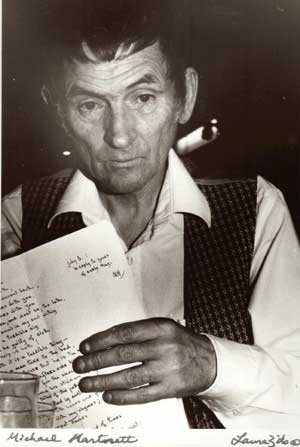
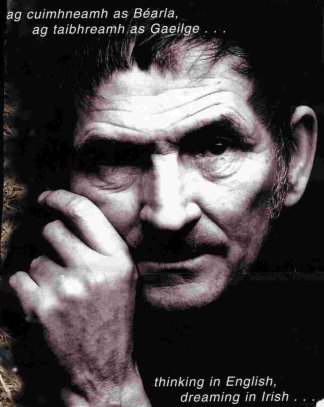
“.. those haunting quizzical eyes staring out.”


A Singular Life: The Poet Michael Hartnett

 Theo Dorgan

All poets are singular, in the sense that we are all singular, each of us bearing the burden of one life and one life only, but also in the sense that no poet can be comfortably placed in a definite lineage, presented to us as a manifestation in one particular line of tradition. Michael Hartnett was more singular than most. He was of Munster, and he acknowledged Munster forebears, but if this was the place he started from, he was unpredictable and cosmopolitan in his tastes and in the company he would keep; nothing in his background could have predicted or predetermined the poetry he would make, the arc his life would take.

  1.  Birth and a people

He was born in 1941, in Croom, County Limerick; he grew up in Newcastle West, in a time of close horizons, small expectations and apparently narrow minds. In those days, for the children of the poor, the prospects were few; the best hope was emigration, offering what the country could not – work and a living, however diminished. For the waywardly gifted, however, there is always the opportunity to carve out one’s own niche, albeit at the sacrifice of comfort and social place as generally understood.  The State was barely thirty years old and had already abandoned the revolutionary promise to cherish its children equally when Michael Hartnett stepped outside the boundaries of class and predestiny to discover himself a poet.

He published his first work in a local paper at the age of thirteen, his first poem in The Irish Times when he was still a schoolboy. From the day he left school, he thought of himself first and always as a poet.

  1.  A poet of and from a particular place

In an interview with Dennis O’Driscoll, Hartnett says: ‘I’m the only  ‘recognised’ living Irish poet who was born in Croom, County Limerick, which was the seat of one of the last courts of poetry in Munster: Seán Ó Tuama and Aindrias Mac Craith. When I was quite young, I became very conscious of these poets, and, so, read them very closely indeed.’[1]

In small places, folk memory runs deep, and a certain cachet endured in the title ‘poet’, with connotations of ‘other’, ‘different’, ‘gifted’, and ‘dangerous’. With the niche already prepared, so to speak, one sees the attraction for a curious young mind, already verbally adept and quick: poetry offered place, ancestry, a degree of acceptance for the chosen path and open horizons for a young man who had already discovered the power of words.

It is hardly uncommon, in a young poet, that she or he would first begin to grow in the shelter of some chosen poet mentor, whose sensibility, or technique, or more usually some amalgam of both, opened a road forward in the craft. When Hartnett first sought such a precursor, he looked at his immediate local context and backwards into another time and another language. What he found there would make no discernible impact on his craft (he never translated the totem figures, Mac Craith or Ó Tuama) but they furnished him with a particular kind of warrant – he could and did think of himself as the favoured inheritor of a tradition, and also as one obliged to be loyal to that tradition. This sense of obligation would become the sign and signature of his work.

Few Irish poets writing in English would own fealty to the tradition of Irish language poetry in the way that Hartnett did; his contemporaries and near-contemporaries chose figures who were perhaps as close to home but were certainly nearer in time, in language and in their themes and subjects. His Irish at the time was meagre, mostly acquired through overhearing Bridget Halpin, his grandmother, speak at late night firesides when the child had been safely put to bed. Much of his childhood was spent in her Camas cottage. He would later claim that she was one of the last native speakers of Irish in the district. While there are grounds for doubting this, his grandmother had a formative influence on the poet’s imagination – he would say that once she saw him with a necklace of wrens circling around his head, leading her to proclaim him a poet. He relished this atavistic sense of recognition, and would celebrate his grandmother in one of his most famous poems, ‘Death of an Irishwoman’[2]:

Ignorant, in the sense 

she ate monotonous food 

and thought the world was flat, 

and pagan, in the sense 

she knew the things that moved 

at night were neither dogs nor cats 

but púcas and darkfaced men, 

she nevertheless had fierce pride. 

But sentenced in the end 

to eat thin diminishing porridge 

in a stone-cold kitchen 

she clenched her brittle hands 

around a world 

she could not understand. 

I loved her from the day she died […][3].   

It is a far more cold-eyed tribute than the earlier, more conventional ‘For my Grandmother, Bridget Halpin’, a sign that Hartnett is willing to acknowledge ancestry but also to strike out in his own particular direction.

  1. Elected Company

Poets will gather about themselves, by elective affinity, those ancestors and companions that they need, not those wished upon them. We are more likely to understand them when we allow them to fly free in their chosen company.

Hartnett’s chosen companions were both eclectic and wayward, the company he chose as he pursued his life in poetry but also formed a consistory to whom he felt himself bound in loyalty and comradeship. Thus, in ‘A Farewell to English’ (and the indefinite article here is significant), these lines:

I say farewell to English verse,

to those I found in English nets:

my Lorca holding out his arms

to love the beauty of his bullets,

Pasternak who outlived Stalin

and died because of lesser beasts;

to all the poets I have loved

from Wyatt and Robert Browning;

to Father Hopkins in his crowded grave…[4]

 The plangent concluding lines of Antoine Ó Raifteirí’s poem ‘Cill Aodáin’ are these: ‘S dá mbeinn-se i mo sheasamh i gceartlár mo dhaoine/ D’imeodh an aois díom is bheinn arís óg.” A working translation: “And were I standing right at the heart of my people/ Age would go from me and I would be young again.”

I invoke these lines because to understand Michael Hartnett, it is of the first importance to recognise that ‘mo dhaoine’, ‘my people’, gives us both provenance of the man, and hence of the work, and also the mandate that governed and guided his trajectory on this earth, from first to last.

Hartnett, throughout his life, referred back to his sense of a people, defined and redefined that community to encompass family, neighbours and friends, antecedent poets, and that tribe of audience and influence, an intelligible company chosen by elective affinity. He wrote always for his place and for his people, sometimes as if in a guided trance, but always aware of the bond as both necessary and inescapable. If he was sometimes at home in and sometimes estranged from both place and people, if this community was sometimes balm and sometimes bane, nevertheless, this was the territory in which he lived out his life and to which he felt honour bound.

The territory encompassed by his native Newcastle West and neighbouring Camas and Templeglantine, extending outwards to the province of Munster and on to Dublin, touching on Spain and the Classical world in its farthest rippling, while vertically, so to speak, reaching back for Ó Tuama, Ó Bruadair, Ó Rathaille, Sor Juana Iñes de la Cruz and Federico García Lorca.

He would show a lifelong fidelity to his birthplace, but he had no illusions about the soul-cramping truth of a small place where ambition was suffocated in the cradle. The early poem, ‘A Small Farm’, begins:

All the perversions of the soul

I learnt on a small farm,

how to do the neighbours harm

by magic; how to hate.

I was abandoned to their tragedies,

minor but unhealing:

and concludes, the repeated line adding emphasis,

I was abandoned to their tragedies

and began to count the birds

to deduce secrets in the kitchen cold,

and to avoid among my nameless weeds

the civil war of that household.[5]


  1. The Early Work

The early poems are mannered, veering close to the Symbolism of the Russian Silver Age, marking a territory of savagery, death, and disappointment in a stylised language that only rarely swerves into the high plain speech that would become his signature music.

We hear this true note first and best in Anatomy of a Cliché (1968).[6]  There are birds here, but there is also ‘cold rain glisten/hung on each shocked feather’, the feel of the actual intensely experienced, even if birds are sometimes co-opted as metaphor, as in poem XI,

my lovely woman, listen:

two birds came together

out of a cold rain,

one, small, but capable of song,

one with strange plumage

not of the local lands [7]

Hartnett had been five years in Dublin when this collection appeared, but as Michael Smith points out: ‘Michael arrived in Dublin as an already published poet who was not looking for, nor needing any, teachers in the art of poetry.’ [8]

Smith tells us that Hartnett enrolled as a student in UCD, thanks to patronage from James Liddy, but ‘Michael almost never attended a lecture’. He found the University congenial, not so much for its teaching, but because it placed him in a company of young poets, including Macdara Woods, Smith, Eamon Grennan, Brian Lynch and, importantly, Paul Durcan. Hartnett and Durcan shared a common belief in poetry as a high calling that demanded surrender, devotion, and a single-mindedness, elevating it above all other duties. It is no reflection on their contemporaries to say that Hartnett and Durcan considered it something of a sacred moral imperative to stand at a slant to the shared social world, to embrace a certain kind of high loneliness. In Hartnett’s case, this high loneliness would be tuned to a keener pitch when, in 1975, he made the momentous decision to switch from writing in English to writing in Irish.

  1. Farewell to English

A Farewell to English,[9] published in that year, was a watershed book for Hartnett. Much of the attention this collection continues to draw is focused on the title poem, at the expense of the complex array of signalling in the poems that lead up to it. There is the acknowledgement of the toxic, particular nexus of alcohol and poverty in ‘The Buffeting’ and in ‘Early One Morning’, self-excoriating poems that are both clinical and merciless in their impact. There is the archetype of the fated and fatal victim in ‘The Oat Woman’, a figure to equal anything Graves, or Pasternak, can conjure, and there is its twin poem, ‘Death By The Santry River’ – both poems are stalked by terror. There is that ferocious political poem ‘USA’, and there are the poems that circle back to the home place – ‘Mrs. Halpin and the Lightning’, ‘Pig Killing’, ‘A Visit to Croom 1745’. Hartnett may be seen to be preparing his case for the title sequence, reaching back to his first circle of belonging, then nodding towards his second circle of elective affinities (in ‘Struts’, for example, with its ‘We are climbing upwards into time/and climbing backwards into tradition’), before he plunges forward into the Grand Declaration. Before we get there, we should take a long, cool look at ‘A Visit to Castletown House’.

The great Palladian mansion, Ireland’s first and still its finest, was built to consolidate and further the social and political designs of William Conolly, speaker of the Irish House of Commons.  Begun in 1722, completed in 1727, it was both a residence and a symbol of Irish achievement and ambition. The political congresses envisioned by Conolly never took place there, but the house did come to represent a phase in the evolution of a new kind of politics in Ireland, and much of the thinking about quasi-independence from direct British rule was fostered there. Of course, Castletown House was also a centre of dominance as far as the poorer classes were concerned, a ‘Big House’ carrying all the complex baggage that term implies.

Set in lush countryside on the banks of the wide, slow-moving Liffey, Castletown stood as a monument to what might be called the aristocratic pastoral. Hartnett’s poem moves through that pastoral landscape to an acknowledgement of the building in the “mere secreting wood”, overthrown at the cost of knuckles that bled and bones that broke, to a sharper focus on the pretensions of the nouveaux riches and on to the precise bitterness of the closing five lines:

I stepped into the gentler evening air

and saw black figures dancing on the lawn,

Eviction, Droit de Seigneur, Broken Bones:

and heard the crack of ligaments being torn

and smelled the clinging blood upon the stones. [10]

The poem may be read as a prologue to the title sequence of the collection. The relentless drive to its pitiless conclusion, the brief rehearsals of what were already central themes in the poet’s work, are interrupted by stanza four, introducing a new theme that will manifest with increasing power in later poems such as ‘Sibelius in Silence’: Hartnett’s deep insight into music as a high art.

It would be simplistic to read Hartnett’s turning away into Irish as atavism, as an arbitrary and wilful gesture. He was already an assured presence as a poet in English, a distinctive, recognised and recognisable voice. If he had an inherited sense of the rightful grievances of the poor, the landless and powerless, and the political acumen to understand the power relations that had evolved through Ireland’s colonised history, he had also a cool and sophisticated grasp of high art, as evidenced in this fourth stanza:

…the music that was played in there –

that had grace, a nervous grace laid bare,

Tortellier unravelling sonatas

pummelling the instrument that has

the deep luxurious sensual sound,

allowing it no richness, making stars

where moons would be, choosing to expound

music as passionate as guitars.[11]

Here, on the point of turning away from a language he had already mastered, Hartnett is sounding what will surface as a powerful strain in his later work: his deep understanding of and affinity with a broad European aesthetic. Sections (iii) and (iv) of ‘A Farewell to English’ are satires, in the Gaelic tradition of the ‘aor’, a form of invective that holds up its target to a savage form of ridicule. Dennis O’ Driscoll misses the point when he dismisses these sections as “philistine nonsense”; I think he misses the humour of these sections, the delicate and deliberate brio of exaggeration which Hartnett artfully deploys his point, as he says himself in the interview with O’ Driscoll, is that he was infuriated by the neglect of, and the lip service paid to, the Gaelic language and the Gaelic poetic tradition. In taking a deliberately hyperbolic swipe at the guardians of what had become State culture, he is making a subtler point: you cannot make all-encompassing claims for Irish identity and Irish poetry when what you mean is Irish poetry in English, an Irish identity that manifests only in English. The argument is made most pointedly in section vi), where the second stanza is brutally dismissive of “our Governments”, and follows hard on the heels of the last two lines in the first stanza: “For Gaelic is our final sign that/ we are human, therefore not a herd”. [12]

Sections iii), iv) and vi) are best thought of as a flourish of the matador’s cape, a heightening of the dramatic temperature to mask sober and serious business. Hartnett experienced poetry as a calling; he felt himself bound by an imperative from elsewhere that was a cloudy blend of local tradition in folklore and literature, a sense of his duty to speak for his class, his wide and miscellaneous reading and the imperatives he drew from that reading. He himself offered various reasons for turning away from English, which may be summarised as a reluctance to see the language go down into the dark. But consider, he had little Irish himself, there were already contemporaries such as Caitlín Maude, Nuala Ní Dhomhnaill, Michael Davitt and others who were effectively driving a mini-renaissance in Irish language poetry – the survival of the language did not depend on Hartnett’s frail and hesitant voice, and he was intelligent enough to know this:

This road is not new.

I am not a maker of new things…


…But I will not see

great men go down

who walked in rags

from town to town

finding English a necessary sin

the perfect language to sell pigs in.


I have made my choice

and leave with little weeping:

I have come with meagre voice

to court the language of my people.[13]

We should not forget that the long decay of the Irish language as a vernacular, and as a literary language, was neither an organic nor an unavoidable phenomenon. The former colonial power had an explicit and effective policy for the extirpation of the language, and this, coupled with the brute post-Famine necessity to privilege English to find a foothold in the English-speaking lands towards which forced emigration was inevitably directed, drove what we might call an evolutionary adaptation.

Hartnett, meagre though his store of Irish was, felt impelled to stand for the lost civilisation, the neglected and imperilled element that he thought crucial to Irish identity. How much of his argument was deeply felt, how much was post-hoc rationalisation, will be argued for a long time but need not detain us, since there was a deeper imperative at work. To put it as simply as possible, it is not so much that Hartnett chose Irish as that Irish chose him. The words came “like grey slabs of slate breaking from/an ancient quarry, mánla, séimh, dubhfholtach, álainn, caoin”.[14]

Out of nowhere, the words came to him, and he felt himself summoned:

I sunk my hands into tradition

sifting the centuries for words. This quiet

excitement was not new: emotion challenged me

to make it sayable.[15]

It was the words themselves, as they drifted into his consciousness, that prompted this radical departure from ‘the gravel of Anglo-Saxon’. He does not suggest that he followed unquestioningly:

What was I doing with these foreign words?

I, the polisher of the complex clause,

wizard of grasses and warlock of birds

midnight-oiled in the metric laws?

Section ii) offers two further imperatives: he sets out to walk to Camas, “half-afraid to break a promise” made to his uncle Dinny Halpin, and on the way he encounters ghosts, “black moons of misery/ sickling their eye-sockets/ a thousand years of history / in their pockets.” These apparitions are walking to “Croom, Meentogues and Cahirmoyle”, which Hartnett glosses: “Croom: area in Co. Limerick associated with Aindrias Mac Craith (d.1795); also, seat of the last ‘courts’ of Gaelic poetry; also, my birthplace. Meentogues: birthplace of Aodhagán Ó Rathaille. Cahirmoyle: site of the house of John Bourke (fl. 1690), patron of Dáibhí Ó Bruadair.”  Bracketed by these calls on his fealty, to place, to people and to poetry, he considered he had no choice but to turn to Irish. Many years later he would write: “…I have poems at hand:/ It’s words I cannot find…” [16]

For all the enmeshments of his situation in history, Hartnett turned to Irish primarily because he heard the words that found him out. That this was due to his particular conception of a poet’s proper duty is both clear and unambiguous – but the consequences of his decision were severe. He moved, with his wife Rosemary and their two children, to a small cottage in Templeglantine, the parish of his grandmother. We find again this wish, to situate himself as a poet among his inherited and chosen people, but if Hartnett expected sustenance and a charge of energy, personal and poetical, from this radical dislocation, it cannot be said that his hopes were fulfilled.

  1. Working through Irish

His first publication after the move was in both Irish and English, Cúlú Íde and The Retreat of Ita Cagney.[17] The English text is the stronger of the two, a reflection of the fact that Hartnett’s vocabulary and perhaps grasp of syntactical possibilities in Irish lagged behind his highly developed skills in English, but the bilingual reader will also find a hesitancy in the unfolding of ‘Cúlú Íde’ that is not found in the English version. We should observe here that the English is a version of the Irish, and not a translation.

The Templeglantine years were years of hardship, financial and emotional, for all concerned. Of the work that was produced in that small house, it is likely that only Adharca Broic [18] will stand the test of time. Individual poems still have a luminous clarity (for example, ‘Dán do Lara’), but it is doubtful that Hartnett’s work in Irish can be compared in achievement to that of Nuala Ní Dhomhnaill, for instance, or Biddy Jenkinson, Liam Ó Muirthile or Gabriel Rosenstock. This is hardly to denigrate the work but rather serves to make the point that Hartnett’s poems in English are for the most part of a higher order than his poems in Irish – and he was too good a poet, and too honest with himself, not to recognise this.

  1.  Return to English

One might have expected that when he returned to writing in English, he might have taken up where he left off. Instead, his next collection of poems would make use of a form few, if any, have mastered in English, the haiku. Deceptively simple as a form, the haiku relies on triggering a moment of insight in its reader, or a leap into empathetic understanding that is rarely, if ever, an obvious product of the ostensible narrative. Appearing in 1985, the same year as his translations of the great Dáibhí Ó Bruadair, Hartnett’s Inchicore Haiku[19] is a sequence marked by the modesty of its ambitions and of its ostensible subjects. He had always a keen eye for the natural world, but the cumulative impact of this book-length sequence comes from its accumulation of mood and tone – accusing and self-accusing, rueful, sad, disillusioned, occasionally celebratory, the poems mark a quiet, unshowy, return to the notionally abandoned language. No rhetorical flourish, still less an apology for having been away, there is no backward look here, but neither is there the dexterity, the dance with form and thought, that had marked the poems prior to 1975. This is a subdued Hartnett, defeated in his marriage, in retreat from his retreat. He found a new village in Inchicore, and in a sense, a new people with whom he could feel at home, recognised and accepted for himself.  Haikus 86 and 87 are instructive:

86

All divided up,

all taught to hate each other.

Are these my people? [20]

87

My dead father shouts

from his eternal Labour:

“These are your people!”[21]

Not for the first time, Hartnett’s self-identification with the poor and powerless gives him his milieu, his chosen audience and his set of subjects, but now the environment is not West Limerick, but a proletarian quarter of the capital city where dreams and promises come to die:

59

The warm dead go by

in mahogany boxes.

“They’re well-housed at last.”[22]

31

All the flats cry out:

“Is there life before dole day?”

The pawnshops snigger.[23]

37

What do bishops take

when the price of bread goes up?

A vow of silence.[24]

Very few of these 87 short poems work as classical haiku – they are mostly too direct and declarative.  Then again, the Japanese form relies on linguistic resources in Japanese that do not exist in European languages; perhaps it’s best to think of Hartnett’s haiku as simply short poems in a form approximating to the haiku. The energy of the sequence comes from the juxtaposition of deeply felt personal loneliness with a landscape of low expectations, diminished nature, and disempowerment.

  1. Fresh Poems, fresh powers and visions

Two years later came the bilingual A Necklace of Wrens,[25] followed by Poems to Younger Women[26] entirely in English. There is a startling return to the power and complexity we might have expected had the poet not turned aside from English in 1975. There are dark energies, some cruelty and vitriol, some tenderness, a measure of hard-won self-knowledge and graceful tributes, but above all there is a powerful surge of life and ambition in the verse making – the “polisher of the complex clause, /wizard of grasses and warlock of birds/midnight-oiled in the metric laws” is back, and with heightened powers. If the prevailing note is a kind of bleak celebration of endurance, nevertheless, there is brio, too, the brio of the toreador, resigned to danger and even to death, not quite courting it but aware that it is factored into the dance.

There had always been a visionary streak in the poems. With The Killing of Dreams[27] (1992), a note that is dramatically and defiantly struck, and which finds perhaps its most perfect expression in ‘A Falling Out’, where the muse figure is not just inspiratrix but also the pitiless withholder of the gift.

She comes from a familiar, homely environment of “overcoats and caps”, of “porter taps”, and battering hobnail boots, from

…the cobbles of the market square,

where toothless penny ballads rasped the air,

there among spanners, scollops, hones, and pikes,

limp Greyhound cabbage, mending-kits for bikes… [28]

the familiar small town territory where “she tricked from me my childish, sacred vow.”   The first stanza recapitulates Hartnett’s first stepping out into poetry, and the second rehearses his immersion in the written tradition, the variousness and wild range of what has been prompted by this powerful muse figure. Hartnett offers as her territory a landscape where ultimately all poets are doomed victims of the urge to create: she takes, and then dismisses, out of hand/ the men and women that she most does bless.[29] Sacred capriciousness is one of the qualities Graves attributes to his White Goddess, but where Graves sees the poet as inescapably bound to her rule, heroically stoic, waiting for when the next bright blow may fall, Hartnett, radically, dismisses his muse:

…at dawn I give her bed a gentle shove

and amputate the antennae of love


and watch the river carry her away

into the silence of a senseless bay

where light ignores the facets of her rings

and where the names are not the names of things.[30]

The poem has the air of a poetic suicide note, opening on initiation, closing on repudiation of the gift, and might well have served to close out the poet’s life and work – but perhaps we might read it better as a gambler’s bluff, a kind of dare? In ‘Didactic’ he tells us, bluntly, “the imagination has no limits./ Art has”. [31]

The eye has turned inward, the poet considers whether or not he has outlived his allotted span, ‘… he flounders out of bounds,/ his panacea mocked by a disease/ it was never meant to cure’.[32] Life as a painful site of anguish has been a subdominant theme since Inchicore Haiku. By now it is coming to dominate his imagination, and in poem after poem we find a casting about for release:

Sometimes, with perfect timing, death steps in

and makes the span of living coincide

with the completion of the work on stone,

but, mostly, age insists and the poet cannot see

the very shaping of his chunk of hill

was deed accomplished, mission done.

He never knows that, in the past, he’d won. [33]

For all that, there is something redemptive in the seven-part sequence ‘Mountains, Fall on Us’, a sustained and unflinching set of poems where the suffering man transcends his “list of childish woes”, and faces the hard facts of his life, as man and poet, with stoic acceptance. In the first part we are given a vulnerable figure, a gay man with aesthetic instincts at the mercy of cruel Spanish Catholicism, its ‘jeering trumpets’ redeemed by ‘some kindly waiter’ who ‘kindly dabbed/the distraught mascara from his face’. The second part evokes the poet’s ‘fatal childish dream’ of the life of ease marked out for him; the third section evokes a muse figure whom we might well trace back, to his Grandmother, whose ‘milestones are novenas for the dead’; in the fourth, we find a frank admission that he sits ‘in a soul I do not want’, living ‘this life which has no joy in it’, and in the fifth section the Alexandrian Cavafy is evoked, whose ‘real poems told of real pain’.

This trying on of roles, of lives, of identities, figures the possibilities open to the imagination which has no limits, but is true to the limits of art. In the final two sections, there is a resolute dismissal of all avenues of escape. In the end, he must hang ‘on the great loneliness/of his forgotten cross’, the outcast and thief who ‘asked for mercy and was snubbed by Christ’.

  1. A man without a people.

In 1991, he translated John of the Cross into Irish.[34]  In 1993, he published his lucid translations of Haicéad,[35] and his definitive, nuanced, and sensitive, translation of Aodhagán Ó Rathaille[36]  was completed in advance of his death in 1999. Two magisterial poems were left in him; they appeared in Selected and New Poems [37](1994), ‘He’ll to the Moors’; and ‘Sibelius in Silence’. New Poems (1990-1999) added a slight afterthought to the life’s work – followed by the posthumous A Book of Strays in 2002 – but to all intents and purposes, these two long poems wrote the finis.

  1. The slant towards death and silence

In a bravura keynote address to Éigse Michael Hartnett[38] in 2009, Paul Durcan suggested that Hartnett was possessed of a mediaeval Catholic imagination. ‘He’ll to the Moors’ traces the life of the mystic Ramon Lull, from his beginnings as a troubadour and lover, observer of birds and the ordinary minutiae of the natural world, to the polemicist for Christ who found no rest in the world until he was stoned to death in Tunisia. Durcan argues that this ostensible biography is in fact a species of cloaked autobiography; it traces the arc of Hartnett’s life in parallel to that of its subject, from insouciant celebrant of the small things, through the harrowed fields of desire and disputation until, at the end, he achieves the martyrdom that was always his destiny and his apotheosis. Durcan recruited the poet Michael Coady to his characterisation of Hartnett’s imagination:

‘At heart he was perhaps a classically Irish mix of tidal faith and fatalism – intuitively in touch with a deeply buried Mediterranean impulse in the Irish psyche and native language, but one historically and climatically done down by the fateful alliance of puritan incursions from the east and constant troughs of low pressure from the west…’

[Michael Coady’s Sleeve Notes for the Claddagh Records CD of Hartnett reading his own work]

The CD was issued by Claddagh Records, and in the notes we find Coady’s suggestive claim that “as with all true poets, a mysterious potency of verbal enchantment was at the core of his gift.” The shifts in register, the command of the inscape and outscape of his matter, the baffled and heartbroken humanity of the poem, show a poet in full command of a what is still a considerable gift.

At this point, in the full grip of alcoholism and its attendant furies, Hartnett was much occupied with gathering in the threads of his life, as if rehearsing and preparing an exit he felt drawing inexorably closer. He would write poems yet, short lyrics of uneven quality, but before he came to the desolate child’s cry of ‘A Prayer for Sleep’, the final poem in the 2001 Collected Poems, came the panoramic, cold splendour of ‘Sibelius in Silence’. In this poem, Hartnett revisits the handful of themes that haunted him all his life: the artist’s responsibility to the gift, to tradition and to his own people, and then the struggle to be at home in world and nation, self-doubt and the courage to outlast silence, the quarrel with history, and above all the sense that the lone sensibility cannot hope to overcome the brute weight of the world’s indifference. The chosen extended silence of Sibelius echoes Hartnett’s earlier “I have poems to hand/it’s words I cannot find.” Both poet and composer know that, to be true to the strictures of the art, one must find the discipline and courage to seek and withstand the silence out of which everything comes, into which everything must go.

Hartnett was fascinated by the elected silence the composer sought, until he emerged with what he considered the voice itself of the place itself, speaking itself:

I offer you here cold, pure water –

as against the ten-course tone poems,

the indigestible Mahlerian feasts;

as against the cocktails; many hues,

all liquors crammed in one glass –

pure, cold water is what I offer.

(Collected Poems p. 227)

The question is to what degree Hartnett conflates himself with Sibelius. Is Sibelius a mask he put on in order to confront himself, or is the poem intended as an homage, of one troubled soul acknowledging unresolvable ambiguity, in this question that can only be answered with “it is both and neither”.

When we consider the place of the poem in Hartnett’s long contribution to poetry, there is something heartbreakingly final about the concluding lines to what is, in effect, Hartnett’s farewell to poetry:

…that which was part of me has not left me yet –

however etherialised, I still know when it’s there.

I get up at odd hours of the night

or snap from a doze deep in a chair;

I shuffle to the radio, switch on the set,

and pluck, as I did before, Finlandia out of the air.

(p. 228)

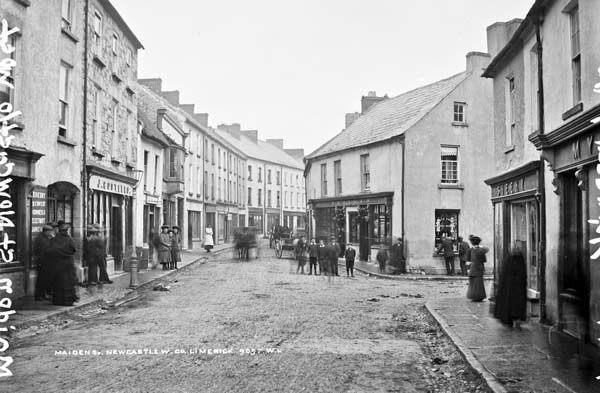
He is far from Castletown house, and the plangent evocation of Tortellier; far, too, from the ballads and company of Maiden Street pubs, far from the poems of his Gaelic predecessors, from Lorca, from the austerity of Pasternak and the dark meditations of John of the Cross. One last great effort, a tour de force, and he lays down his pen, as “Into my room across my music-sheets/ sail black swans on blacker rivers”.

[1] Dennis O’Driscoll, The Outnumbered Poet (Loughcrew: The Gallery Press, 2013,  P. 199

[2] Michael Hartnett, Collected Poems, ed. Peter Fallon (Loughcrew: The Gallery Press, 2001) p. 139

[3] Ibid.

[4] Ibid., p.33.

[5] Ibid.,p.3.

[6] Michael Hartnett, Anatomy of a Cliché (Dublin: The Dolmen Press, 1968)

[7] Ibid., p.17.

[8] Michael Smith, ‘Remembering Michael Hartnett’ (Dublin: The Irish Times, 16th February 2009)

[9] Michael Hartnett, A Farewell to English (Loughcrew: The Gallery Press, 1975)

[10] Ibid., p.27.

[11] Ibid., p.26.

[12] Ibid., p.34.

[13] Ibid., p.35.

[14] Ibid., p.30.

[15] Ibid.

[16] ‘Impasse’, Collected Poems, p.194

[17] Michael Hartnett, The Retreat of Ita Cagney/Cúlú Ide, (Curragh, Kildare: The Goldsmith Press, 1975)

[18] Michael Hartnett, Adharca Broic (Loughcrew: The Gallery Press, 1978)

[19] Michael Hartnett, Inchicore Haiku (Dublin: Raven Arts Press, 1985)

[20] Ibid., p.35.

[21] Ibid.

[22] Ibid., p.26.

[23] Ibid., p.17.

[24] Ibid., p.19.

[25] Michael Hartnett, A Necklace of Wrens: Poems in Irish and English (Loughcrew: The Gallery Press, 1987)

[26] Michael Hartnett, Poems to Younger Women (Loughcrew: The Gallery Press, 1988)

[27] Michael Hartnett, The Killing of Dreams (Loughcrew: The Gallery Press, 1992)

[28] Ibid., p. 16.

[29] Ibid., p.17.

[30] Ibid.

[31] Ibid., p.26.

[32] Ibid., p.26-27.

[33] Ibid., p.27.

[34] Michael Hartnett, Dánta Naomh Eoin na Croise (Baile Átha Cliath: Coiscéim, 1991)

[35] Michael Hartnett, Haicéad (Loughcrew: The Gallery Press, 1993)

[36] Michael Hartnett, Ó Rathaille: The Poems of Aodhagán Ó Rathaille (Loughcrew: The Gallery Press, 1999)

[37] Michael Hartnett, Selected and New Poems, (Loughcrew: The Gallery Press, 1994

[38] Paul Durcan, ‘He’ll to the Moors’ (originally given as ‘Michael Hartnett’s Way of the Cross – the Final Quest’, keynote address at Eigse Michael Hartnett, Newcastle West, April 2009).

About the Author:

The poet Theo Dorgan. Source: Fingal Poetry Festival

Theo Dorgan is an Irish poet, writer and lecturer, translator, librettist and documentary screenwriter. He lives in Dublin with his wife, the poet and playwright Paula Meehan.

Dorgan was born in Cork in 1953 and was educated in North Monastery School. He completed a BA in English and philosophy and an MA in English at University College Cork, after which he tutored and lectured at that university, while simultaneously being literature officer at the Triskel Arts Centre in Cork.

After Dorgan’s first two poetry collections, The Ordinary House of Love and Rosa Mundi, went out of print, Dedalus Press reissued these two titles in a single volume, What This Earth Cost Us. He has also published selected poems in Italian, La Case ai Margini del Mundo (Faenza, Moby Dick, 1999).

He has edited The Great Book of Ireland (with Gene Lambert, 1991); Revising the Rising (with Máirín Ní Dhonnachadha, 1991); Irish Poetry Since Kavanagh (Dublin, Four Courts Press, 1996); Watching the River Flow (with Noel Duffy, Dublin, Poetry Ireland/Éigse Éireann, 1999); The Great Book of Gaelic (with Malcolm Maclean, Edinburgh, Canongate, 2002); and The Book of Uncommon Prayer (Dublin, Penguin Ireland, 2007).

He has been the series editor of the European Poetry Translation Network publications and director of the collective translation seminars from which the books arose.

A former director of Poetry Ireland, Dorgan has worked as a broadcaster of literary programmes on both radio and television. He was the presenter of Poetry Now on RTÉ Radio 1, and later for RTÉ Television’s books programme, Imprint. He was the scriptwriter for the television documentary series Hidden Treasures. His Jason and the Argonauts, set to music by Howard Goodall, was commissioned by and premiered at the Royal Albert Hall in London in 2004. A series of text pieces by Dorgan feature in the dance musical Riverdance; he was specially commissioned to create them for the theatrical show. His songs have been recorded by a number of musicians, including Alan Stivell, Jimmy Crowley and Cormac Breathnach.

Dorgan was awarded the Listowel Prize for Poetry in 1992 and the O’Shaughnessy Prize for Irish Poetry in 2010. A member of Aosdána, he was appointed as a member of the Arts Council (An Chomhairle Ealaíon) from 2003 to 2008.  He also served on the board of Cork European Capital of Culture 2005.

He was awarded the 2015 Poetry Now Award for Nine Bright Shiners.
The Camas Poems of Michael Hartnett

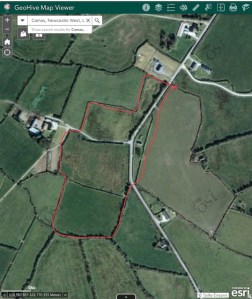
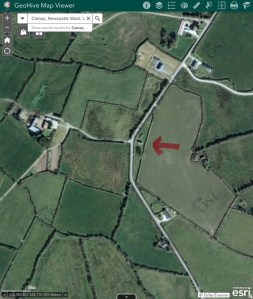
A Geohive Hub aerial view of Bridget Halpin’s cottage in Camas taken in 2006.

Camas is a small nondescript townland nestling in the shadow of the nearby village of Ratheenagh in rural West Limerick.  In the Author’s Notes to his Collected Poems (2001), Michael Hartnett tells us that, ‘Camas is a townland five miles south of Newcastle West in County Limerick where I spent most of my childhood’.   This local townland proved to be a central element in his early development.  There, the young impressionable Hartnett was influenced by his people, particularly his grandmother, Bridget Halpin, and their customs and way of life.  Indeed, in the mid-70s, when he tired of the Dublin literary milieu, it was to this same rural West Limerick bastion, nearby Glendarragh in Templeglantine, still steeped in Irish music and culture, to which he returned.  It was to this place he came to escape Dublin’s incestuous stranglehold and perhaps to write a new chapter “out foreign in ‘Glantine”.

There are up to fifteen poems by Hartnett which could be considered ‘Camas Poems’. These memory poems are all based on his childhood recollections of those happy times in his grandmother’s kitchen.   Students of Hartnett’s poetry should consider studying  ‘A Small Farm’  (Collected Poems 15) as one of a series of memory poems that he wrote celebrating his grandmother, Bridget Halpin and the townland of Camas where she lived.  The most obvious of these Camas Poems is ‘Death of an Irishwoman’ (Collected Poems 139), which he wrote on the passing of his grandmother in 1965.  Others include ‘For My Grandmother Bridget Halpin’ (Collected Poems 52), and ‘Mrs Halpin and the Lightning’ Collected Poems 138) and of course ‘An Múince Dreoilíní ‘/ ‘A Necklace of Wrens’ (A Necklace of Wrens 18), a quintessential memory poem from childhood.

Hartnett’s early poetry creates a delicate balance between description and abstraction, the actual and the figurative. The poem ‘A Small Farm’, the first poem of the Collected Poems (2001), a memory poem dating from Hartnett’s teenage years, establishes this. Abstractions, clichés, their representation through language, and the moment where these are drawn into focus, made specific and immediate, are central. The setting of the ‘small farm’ is described en abstracto: ‘All the perversions of the soul / I learnt on a small farm’ (15). In contrast to other contemporary representations of Irish farm homesteads, most obviously Kavanagh’s ‘Inniskeen’, and Heaney’s ‘Anahorish’, there is no naming of place here. The picture of the farm is rather etched out in generalisation and aphorism, and through the accordant clichés of petty hatred and ignorance, ‘how to do the neighbours harm / by magic, how to hate’ (15), before Hartnett brings the glass into focus, employing idiosyncratic detail which establishes the world of the poem itself. In this way, Hartnett’s particular subjectivity, his way of seeing, is established. It would become his poetic currency:

 Here were rosary beads,

a bleeding face,

the glinting doors that did encase their cutler needs,

their plates, their knives, the cracked calendars of their lives. (15)

In the final stanza, Hartnett makes an explicit link between his awakening as a perceiver of social interactions and moments of poetic beauty, with a growing knowledge and identification with the natural world:

I was abandoned to their tragedies and began to count the birds,

to deduce secrets in the kitchen cold,

and to avoid among my nameless weeds

the civil war of that household. (15)

The attentive intellect which ‘counts the birds’ has as yet no language to describe or express his experience of the natural world, his ‘nameless weeds’. Still, he is possessive of it, seeing it as distinct from the human society which he can describe, yet does not identify with.

The ‘small farm’ referred to here belonged to his grandmother, Bridget Halpin, and like many other small holdings in Camas, it consisted of a meagre ten acres, three roods and thirteen perches. This woman, Bridget Halpin, would later wield great influence over her young grandson, Michael Hartnett.  Indeed, if we are to believe the poet, she was the one who first affirmed his poetic gift when one day he ran into her kitchen in Camas and told her that a nest of young wrens had alighted on his head.   Her reply to him was, ‘Aha, you’re going to be a poet!’.  (A more detailed genealogy of the Halpin family and the early formative influences on Michael Hartnett can be read here).

Bridget        Halpin’s small farm of ten acres, three roods and thirteen perches, which was so vital in the early development of one of our greatest poets. This view is taken from a Geohive Hub aerial view taken in 2006.

Hartnett claimed that he spent much of his early childhood in Bridget Halpin’s cottage in the rural townland of Camas, five miles from his home in nearby Newcastle West.   He went on to immortalise this woman in many of his poems, but especially in his beautiful poem, ‘Death of an Irishwoman’.  This quiet townland of Camas must therefore be seen as central to his development as a poet, and maybe in time, this early association with Camas will be given its rightful importance, and the little rural townland will vie with Maiden Street or Inchicore as one of Hartnett’s important formative places.

‘Camas Road’, Michael Hartnett’s first ever published work, appeared in the Limerick Weekly Echo on the 18th of June 1955. He was thirteen. The poem describes the rural vista of the West Limerick townland of Camas at evening: ‘A bridge, a stream, a long low hedge, / A cottage thatched with golden straw’ (A Book of Strays 67). Its two eight-line stanzas of alternating rhyme and regular metre contain a litany of natural images, at times idiosyncratically rendered; the ‘timid hare sits in the ditch’, ‘the soft lush hay that grows in fields’. It is a peculiar mix of a poem, apparent images from both the poet’s lived and literary experience, placed side by side. It is contentedly denotative, creating a sense of ease and oneness with the natural world. The movement of sunrise to sunset is perpetually peaceful, its colours oils for the young poet’s palette. The ruminative introspection which elevates Kavanagh’s ‘Inniskeen Road: July Evening’, a poem which can be read in useful parallel to ‘Camas Road’, is not present. At the poem’s turn, as ‘Dark shadows fall o’er land so still’, Hartnett’s only thought and action are of flattened description, the creation of ‘this ode’.

‘Camas Road’ then, though essentially a curiosity which stands outside of Hartnett’s body of work, can be read as a seldom afforded snapshot of Michael Hartnett the poet before he became one.  In contrast, his poem ‘A Small Farm’ shows a marked development in his poetic craft.  Bridget Halpin, his grandmother, lived there with her son, Denis (Dinny Halpin), in what Hartnett describes as a prolonged state of ‘civil war’,

I was abandoned to their tragedies,

Minor but unhealing.

The word ‘abandoned’ here has many undertones and is important for the poet because he repeats the line twice in the poem.  He has told us elsewhere that he was, in effect, ‘fostered out’ by his parents in Maiden Street, Newcastle West, to his grandmother, Bridget Halpin, from a young age and spent much of his childhood in her cottage in Camas.  However, there is also the suggestion that while there he was ‘abandoned’ and somewhat neglected as he became an outsider, an unwilling observer of the ‘civil war’ of the household, as Bridget and her son Dinny constantly argued and fought over the minutiae of running a small farm in difficult times in the Ireland of the late 40s and early 50s.

Hartnett saw in his grandmother a remnant of a generation in crisis, still struggling with the precepts of Christianity and still familiar with the ancient beliefs and piseógs of the countryside.  For Hartnett, there is also the added heartache that sees his grandmother struggling to come to terms with a lost language that has been cruelly taken from her. This, therefore, is a totally different place when compared to, for example, Kavanagh’s Inniskeen or Heaney’s Mossbawn or Montague’s Garvahey.  However, there is an underlying paganism here that is absent from their work, although Montague comes close in his great poem, ‘Like Dolmens Round my Childhood, the Old People’.

For Hartnett, his grandmother represents a generation that lived a life dominated by myth, half-truth, some learning, and limited knowledge of the laws of physics, and therefore, as he points out in ‘Mrs Halpin and the Lightning’,

Her fear was not the simple fear of one

who does not know the source of thunder:

these were the ancient Irish gods

she had deserted for the sake of Christ.

However, Hartnett’s powers of observation and intuition were honed in Camas on Bridget Halpin’s small farm during his frequent visits.    He tells us that he learnt much on that small farm during those lean years in the forties and early fifties,

All the perversions of the soul

I learnt on a small farm,

how to do the neighbours harm

by magic, how to hate.

The struggle to make a success and eke out a living was a constant struggle and burden.  The begrudgery of neighbours, the ‘bitterness over boggy land’, and the ‘casual stealing of crops’ went side by side with ‘venomous card games’, ‘a little music’ and ‘a little peace in decrepit stables’.  The similarities with Kavanagh’s ‘The Great Hunger’ are everywhere, but Hartnett does not name this place; it is an Everyplace.  The poem is simply titled, ‘A Small Farm’, so there is no Inniskeen, Drummeril, or Black Shanco here. Still, the harshness and brutality of existence, ‘the cracked calendars / of their lives’  in the 50s in Ireland, is given a universality even more disturbing than the picture we receive from Kavanagh.  Yet, it is here in Camas that he first becomes aware of his calling as a poet and, like Kavanagh, it was here that ‘The first gay flight of my lyric / Got caught in a peasant’s prayer’. And so, to avoid the normal household squabbles of his grandmother and her son, he ‘abandons’ them, turns his back on them, and begins to notice the birds and the weeds and the grasses.

The depiction of another agricultural custom is shown in ‘Pigkilling’.  The joyful detailing of the killing of a pig at his grandmother’s farm in Camas eschews any characterisation of Hartnett as a simplistically environmental poet, denouncing all human domination over nature.  Rather, it depicts the killing as a vital part of the rural community’s relationship with animal-kind, comparable to ritual.

Like a knife cutting a knife

his last plea for life

echoes joyfully in Camas.

This is one of the few Camas Poems that names the place and the central figure of the poem himself uses the pig’s bladder as a plaything: ‘I kicked his golden bladder / in the air’ (Collected Poems 125).  Agriculture here is not mechanised but depicted as an ongoing, sustainable facet of rural life: the poem echoes the loss of many of these old rituals and crafts of the past, as Heaney does in his collection, Death of a Naturalist.

The townland of Camas is also central to an episode that the poet recounts for us in his seminal poem, ‘A Farewell to English’ (Collected Poems 141).  This encounter hovers somewhere between reality and dream, aisling (the Irish word for a vision) or epiphany.  The incident takes place at Doody’s Cross as the poet walks out on a summer Sunday evening from Newcastle West to the cottage in Camas.  He is on his way to meet up with his uncle, Dinny Halpin.  He sits down ‘on a gentle bench of grass’ to rest his weary feet after his exertions, when he sees approaching him three spectral figures from the Bardic Gaelic past – Andrias Mac Craith, Aodhagán Ó Rathaille, and Daíbhí Ó Bruadair.  These ‘old men’ walked on ‘the summer road’ with

sugán belts and long black coats

with big ashplants and half-sacks

of rags and bacon on their backs.

They pose as a rather pathetic group, ‘hungry, snot-nosed, half-drunk’ and they give him a withering glance before they take their separate ways to Croom, Meentogues and Cahirmoyle, the locations of their patronage, ‘a thousand years of history / in their pockets’.  Here, Hartnett is situating himself as their direct descendant and the inheritor of their craft, and the enormity of this epiphany occurs at Doody’s Cross in Camas: the enormity of the task that lies ahead also terrifies and haunts him.

Earlier in ‘For My Grandmother, Bridget Halpin’ (Collected Poems 52), he again alludes to the wildness, the paganism, the piseógs that surrounded him during his childhood in Camas.  His grandmother’s worldview is almost feral.  She looks to the landscape and the birds for information about the weather or impending events,

A bird’s hover,

seabird, blackbird, or bird of prey,

was rain, or death, or lost cattle.

This poorly educated woman reads the landscape and the skies as one would read a book,

The day’s warning, like red plovers

so etched and small the clouded sky,

was book to you, and true bible.

And yet, in his beautiful poem, ‘Bread’ (Collected Poems 53), he evokes and echoes the warmth and nurture of Mary Heaney’s kitchen in Mossbawn.  His grandmother’s kitchen in Camas was a comforting place for him, and his early childhood memories are ones of coming home to roost,

and I come here

on tiring wings.

Odours of bread….

The picture we get of the small farm in Camas is rather etched out in generalisation and aphorism, and through the accordant clichés of petty hatred and ignorance, ‘how to do the neighbours harm / by magic, how to hate’, before Hartnett brings the glass into focus, employing idiosyncratic detail which establishes the world of the poem itself. As already mentioned, the cottage on this small farm was a Rambling House, a house where neighbours gathered to tell stories, play music and card games,

 venomous card games

across swearing tables

His early poetry, then, creates a delicate balance between description and abstraction, the actual and the figurative. In this way, Hartnett’s particular subjectivity, his way of seeing, is established. In time, it would become his poetic currency. We are invited into the quintessentially old traditional Irish kitchen with its pictures of the Pope, the Sacred Heart, the statue of Our Lady, the Crucifix,

Here were rosary beads,  

a bleeding face,

the glinting doors that did encase their cutler needs,

their plates, their knives, the cracked calendars of their lives

 In this poem, therefore, Hartnett is following on from Kavanagh in shining a light into the domestic and interior life of rural dwellers not previously considered worthy of attention.

I have to mention one other poem, a quintessential Camas poem, which appears in the collection A Necklace of Wrens, published in 1987 after his return to Dublin.  This is a collection of selected poems in Irish with English translations by Hartnett.  The poem in question is titled ‘The Country Chapel’, with its Irish translation ‘An Séipéal faoin Tuath’.  This memory poem describes the scene outside the country church on any given Sunday.  The young, observant Hartnett describes the various characters who have come from the ‘fat meadows’ as ‘sly and happy’.  They resemble ‘a set-dance team / by the wall of the old chapel’.  They are all strategically placed depending on the various local rows and even their differing sporting and political allegiances, ‘foe avoiding enemy’.  This eclectic group of neighbours are beautifully portrayed in the lovely Hartnett metaphor: ‘The congregation is a lonely horse’ who appear to be ‘as awkward as a man /dancing with a nun / on a wedding day’.  This may well be a long-lost poetic portrait of the people of Killeedy, Ratheenagh, Ballagh and Kantoher in the mid-40s and 50s.

Bridget Halpin’s ‘small farm’ in Camas may have been small and full of rushes and wild iris, but it helped produce one of Ireland’s leading poets of any century.  The influences absorbed in this rural setting, his powers of observation, his knowledge of wildlife and flowers, and his ecocentric bias, are impressive and are all-pervasive in these Camas Poems and, indeed, his poetry in general.  Hartnett, the quintessential nature poet, would be delighted and impressed to see the magnificent new Killeedy  Eco Park, which has been set up less than a mile from his ‘foster’ home in Camas by the combined efforts of that same local community in Killeedy. It is also significant that the visionary developers of this project have included a Poet’s Corner where Hartnett is remembered, just a stone’s throw from the small farm of his formative years. Here today’s generation in Camas and beyond can now come to ‘count the birds’ and the ‘nameless weeds’.

References

Hartnett, M. Collected Poems, edited by Peter Fallon, Gallery Press, 2001 (Reprinted 2012)

Hartnett, M. A Necklace of Wrens: Poems in Irish and English, The Gallery Press, 1987 (Reprinted 2015).

HARTNETT, M. A Book of Strays, edited by Peter Fallon, The Gallery Press, 2002, (Reprinted 2015).

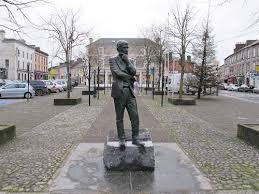
Statue of a pensive Michael Hartnett in The Square, Newcastle West.


Words of Encouragement to Those who Work Alone on Ledges

FullSizeRender (2)

John McAuliffe, joint winner with Doireann Ní Ghriofa of the 2016 Michael Hartnett Poetry Prize says in The Clare Herald, “In  his poem ‘Struts’, Michael Hartnett describes creatures who abide alone, each on their own ‘ledge, / seldom seeing each other — / hearing an occasional shout / above or below / and sometimes and most welcome / seeing fires like silver spirals / jump along the crevices‘. The poem could be describing poets (or academics?), who work alone (on their own ledges) and, every so often, hear good news and celebrate it at events like Éigse in Newcastle West every April.”

“This award is like one of those spiral-like fires. It’s both a confirmation and a great encouragement to receive the award, especially since I’ve been reading and thinking and talking about Michael Hartnett’s poems — the lyrics, the narratives, the ballads — for as long as I’ve been writing,” John said.

This year’s Éigse takes place in Newcastle West with the Official Opening and prize presentation on Thursday 14th April with the keynote address by poet, Rita Ann Higgins, one of this year’s judges along with Gerard Smyth.

Éigse continues throughout the town, in the schools, Library, Red Door Gallery, hospital and pubs until Saturday April 16th – culminating with Colum McCann (in the company of  Colm Mac Con Iomaire who will provide musical accompaniment) reading from his work on Saturday evening at 8pm.

The breadth and diversity of the programme creates an ambience of warmth and conviviality that lends itself to lively gatherings, easy conversation and spirited debate.  In other words……..

Michael Hartnett’s ‘Christmas in Maiden Street’

This piece of incisive and insightful social commentary, written by the poet himself, describing life in Newcastle West in the 1950’s, first appeared in Magill magazine in December 1977 and later in the Journal of the Newcastle West Historical Society, The Annual Observer, in July 1979. Hartnett, the poet, was back in town and the dam burst of memory and nostalgia was beginning, culminating with the bitter sweet Maiden Street Ballad, written as a Christmas present for his father, Denis Hartnett, in December 1980.

Christmas in Maiden Street
By Michael Hartnett

5551343337_fda62f0416_z - Copy

A shouting farmer with a shotgun, a few patch-trousered urchins, soaked, snotty and unrepentant, running across wet fields, arms full of holly. The long walk on the railway tracks, the sleepers treacherous and slimy, the dark station, the lamp posts with their glittering circular rainbows. We stopped at the shops’ red windows to admire toys we could never have. A few drunks waltzed by, happy and moronic. An open lorry went by to jeers and obscenities; the pluckers, shawled and snuff-nosed, on their way to a flea-filled poultry store to pluck turkeys at nine pence a head.

Candles and paraffin-lamps did not brighten the darkness in kitchens in Maiden Street – they only made the gloom amber. The purloined holly hung on holy pictures. There were no balloons, no paper chains, no Christmas trees. Coal was bought by the half-stone, butter by the quarter-pound, and tea by the half-ounce. The country people trotted by on donkey and cart or pony and trap with ‘The Christmas’ stones of sugar, pounds of tea. Women in shawls and second-hand coats from America stood at half-doors, their credit exhausted, while the spectre of Santa Claus loomed malevolently over the slates and thatch.

Members of Charitable Institutions distributed turf and boots, God Blessing the meagre kitchens, as hated as the rent-man. They stood well-dressed on the stone floors, were sirred and doffed at. They paid their workers slave wages. They looked without pity at the nailed together chairs, the worn oilcloth-topped tables, the dead fires.

Outside, the rain fell and blew along the street. The tinkers fought. Bonfires died out in the drizzle. We were washed and put to bed, happy and under-nourished. The oldest went to Midnight Mass. The Latin was magic, the organ, the big choir. It always seemed like a romantic time to die.

It was a Christmas of tin soldiers, tin aeroplanes and cardboard gimcracks. We were Cisco, Batman, Johnny McBrown all that day. Our presents – ‘purties’ we called them – seldom lasted longer than that day. It never snowed. There was no turkey, no plum-pudding, no mince-pies. The Victorian Christmas was not yet compulsory. The very poor managed roast meat, usually mutton. We often rose to two cocks. The goose was common. There was a fruit-cake, jelly and custard; the dinner of the year. I never remember drink being in the house. There were never visitors, nor were we encouraged to visit anyone. If the day had been anyway fine, we were to be found on the footpath or in the puddles, knuckles blue.

The Wren’s Day always brought frost. Small warm heads came from under rough blankets to the sound of flutes and banjos and bodhrans far up the street. We donned boot polish and lipstick and old dresses and went out to follow the Wren, tuneless chancers. We sang and giggled our way to a few bob and a glass of lemonade. The back kitchens of the pubs filled up with musicians, the musicians filled up with porter and their wives filled up with apprehension. In a few hours, winter took over again.

There will never be Christmasses like those again, I hope to God.


MichaelHartnett

Remembering Michael Hartnett

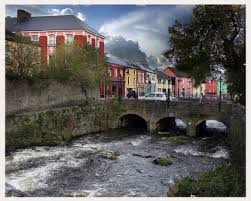
Hartnett by the Bridge in Newcastle West

Michael Hartnett was an esteemed poet from a young age, but his assurance about his creative destiny had its dangers.  In the following edited essay, first published in The Irish Times on February 16th, 2009,  MICHAEL SMITH recalls a significant artist whose early death at 58 on the 13th of October, 1999 can be viewed as an accident of time and place.  

The author, Michael Smith himself, poet and Aosdána member, passed away in November 2014. His contribution to the arts as a teacher, poet, editor, translator and publisher cannot be overstated.  He had a profound impact on the Irish literary scene. He has been described as a classical modernist, a poet of modern life. Born in Dublin in 1942, Michael Smith was the founder of New Writers’ Press in 1967 and had been responsible for the publication of over 100 books and magazines. He was keen to promote the modernist tradition in Irish poetry, publishing the work of Thomas MacGreevy, Brian Coffey, Denis Devlin, Anthony Cronin,  and Michael Hartnett, among others.

******************

As with many relationships, even the most intimate, it is often extremely difficult to pinpoint the original meeting. I can only say that it was in the early stage of our enrolment in UCD that I first met Michael Hartnett. I cannot recall the circumstances of that first meeting. I can’t even remember what academic subjects Michael had chosen. What I do remember is that James Liddy (and perhaps John Jordan) had agreed to pay his first year’s fees. So the lad from Newcastle West in Co Limerick was indeed going to receive some patronage. This patronage was bestowed purely on the strength of his poetry. Michael was recognised as a gifted poet from a relatively early age, and quite rightly so.

Michael almost never attended a lecture, so far as I recall. I was little better myself. The whole novelty of being university students was more than enough for both of us. Study was for others. Unlike Michael, I was deeply rooted in my Dublin working-class background, whereas, for Michael, Dublin was a kind of playground, despite his Limerick working-class background. But that working-class background was something we shared.

I think Michael had no other ambition than to be a poet. I think he gave little thought to how he would survive financially in the future. Was he feckless in this regard? Probably. Did he come to Dublin with the naivety of Kavanagh, expecting wonderful things? I doubt it. He didn’t have that innocence. On the other hand, he wasn’t cynical. John Jordan and James Liddy had accepted him as a gifted poet. The future was in the lap of the Muse.

What memories I have of him are selective, like all memories, I suppose. Often we would walk home together after a drinking session in McDaid’s, where we were usually treated to drinks by James Liddy and his friend, Patrick Clancy. Patrick Kavanagh was still holding vociferous court there at the time. Michael had already had his first confrontation with Kavanagh in the Bailey at the launch of the first issue of Poetry Ireland, edited by John Jordan and published by the Dolmen Press. That confrontation is too notorious to need detailed repetition. Michael made an adverse comment on Kavanagh’s poem (to Kavanagh himself, although Michael didn’t know who he was) that begins: “I am here in a garage in Monaghan.” Kavanagh’s reaction was violent, upturning a table full of drinks.

Michael was living in digs in a cul-de-sac off the North Strand, so our walk home often overlapped. I recall him voicing his strong disapproval of Kavanagh’s raucous behaviour in McDaid’s, saying that if anyone in Newcastle West behaved like that, he would be barred from the pub, and why should a poet be made an exception of.

He had great admiration for Yeats, though, oddly, not so much as a poet but as a businessman. He admired Yeats’s business acumen.

In his digs, under the bed, Michael had a small brown cardboard suitcase which he opened for me once to show me a huge quantity of beautifully scripted poems. I sometimes wonder what happened to all of this material.

There were, of course, other young poets in UCD at the time: Paul Durcan, Macdara Woods, Brian Lynch, Eamon Grennan, Malachy Higgins, to mention just a few names that come to mind.

In the case of the first three, and including myself, James Liddy was undoubtedly the extraordinarily generous mentor, with John Jordan a reserved encourager.

Of all of us, it was Michael who was held in the highest esteem by both John and James. And that esteem was well-deserved, for Michael arrived in Dublin as an already accomplished poet who was not looking for, nor needing any, teachers in the art of poetry. Much has been made of Lorca’s influence on Michael, largely because of his later version of Lorca’s Romancero Gitano, but really it has more to do with the precocity of the early work of both poets.

I have never met any poet who was more assured of himself as a poet than Michael was. It was his destiny. All else seemed of secondary importance. But however impressed by that I was, I sensed a danger in it, recalling Wordsworth’s lines in his poem “Resolution and Independence”:

We poets in our youth begin in gladness;

But thereof come in the end, despondency and madness.

I knew, and indeed Michael knew, that there was no money in poetry (Kavanagh had learnt that years before) and that he would have to earn his living at some stage in the future – but he seemed unconcerned by this. Writing poetry was a lifetime’s work, regardless. I sometimes think that a lot of Michael’s problems of later years came from that dedication. Yes, he did later earn his living in the international telephone exchange on Andrews Street, but he found it boring and was only too glad to escape from it (even during working hours) and head for O’Neill’s of Suffolk Street to drink pints with some other of his escapee colleagues from the exchange.

And Michael was good company, a wonderful raconteur, witty, and possessing a fund of knowledge of all sorts of arcane subjects. He had an extraordinary memory. Yet always it was as the poet that he was treated, in whatever company he found himself. That was the identity he had chosen or had been chosen for him. I think he never abandoned that. And therein lay a danger, the same sort of danger that beset Dylan Thomas, for one cannot always be a poet. There has to be a life apart from being a poet, at least for poets without personal financial resources or the resources of a generous benefactor. Ezra Pound had his wife’s money behind him, and also financial support from his doting father. Neither Michael nor Dylan Thomas had anything of the sort.

For Thomas there was the horrible scrounging and, later, the equally horrible American readings. For Michael, after his stint in the exchange, there was very little, and he seemed to live a hand-to-mouth existence, even when later he returned to Newcastle West with his wife, Rosemary, and their two children. Later, a cnuas from Aosdána came in useful, and some prizes he won and some royalties he managed to squeeze out of publishers.

To attempt to be a professional poet in Ireland in the late 1960s and early 1970s was a recipe for trouble. The days of the literary salons, such as Æ’s, were well and truly over. That left the pub, which unfortunately became Michael’s court, where he met his admirers who provided him with the kind companionship he needed, treating him to drinks and accepting him as a poet.

Was there anything else he might have done, any alternative? There was not at the time any such thing in Ireland as a poet in residence. So Michael made do with what was available.

A poet is not like a novelist who must toil daily and for long hours if he or she is to be productive. For the poet, the Muse is fickle and her visits are not on demand. So the poet must wait, never sure what the future holds for his work. When his own lyrical gift began to fail (though not until he had written some of the best poems written by an Irish poet in his time), Michael turned to translations from the Irish, translation always being a good means of keeping one’s skills honed.

Why did Michael turn to writing his own poetry in Irish? I think that this, too, was part of his attempt to be accepted socially as a professional poet. After all, in the old Gaelic order there had been such an acceptance. That order, however, was long gone and could never be recovered. After his early-evening court sessions in Doheny and Nesbitt’s, his admirers (often cultivated and literary civil servants) would head off to their respectable homes in the suburbs, leaving Michael as an abandoned court jester (which, in due course, he was becoming). Let it be said that there was no malice in this among those who patronised Michael with drink and small loans of money. But they had families at home and a job to do the next day.

Michael’s early death, whatever the medical causes, can be viewed as an accident of time and place. In a sense, he was a martyr to poetry. Gifted, even a genius, but nonetheless a martyr. If only . . . It’s useless now to ponder such possibilities.

MichaelHartnett

THE TOWN THE YOUNG LEAVE

The following article was written by Michael Hartnett for The Irish Times in the early 1970’s.  It shows Harnett to be an astute social historian and keen observer of local mores and foibles – talents he later used to good effect in his ‘local’ poems such as Maiden Street Ballad, The Balad of Salad Sunday, The Duck-Lovers Dance, etc.

download (2) 

THE TOWN THE YOUNG LEAVE

By Michael Hartnett

Newcastle West, County Limerick, is an Irish town that is not dying.  It has kept its economic stability at a terrible price, the constant exportation of human beings.  It is the example of a town that is alive because the young leave, a town that would certainly be ruined if those people born in the 30’s and 40’s had stayed at home en masse.  The transportation still continues and it is against this background of population loss that the town has survived and is now slowly regaining the status it had in the 19th century.  It was then the largest market town in the county, outside of Limerick city.  It had woollen, linen and brewing industries, two coal mines were operated in the nearby hills and there was a proposal to cut a canal to the Shannon, fourteen miles away.  The population then, 1837, was 2,908.

The population (that part of it which lives in the town proper) has been more or less the same since, but the industries have gone.  The harshness of the 1840’s led to their death.  The people began to leave, at first from despair but in the past twenty years through pure instinct.  Today the major employers are the local County Council, two bottling plants, the local hospital for the old and the unwanted and a few shopkeepers.  A factory, which has been hoped for for many years, is at last being built, and this should reduce the outflow of the young.  A new school was built in the late 1950’s to replace the old, built in 1826: this old school was the one I attended.  It was unbelievable.  In the summer the swallows built in the large beams inside the rooms, flying in and out all day to feed their young.  One of my favourite pastimes was drowning woodlice in the inkwells, as they fell in ridiculous numbers from the rafters.

Some of the boys who did not live in the town brought their lunches – bread and butter and milk wrapped in newspaper, and these were raided almost every day by the rats who lived under the floor and scampered about, completely ignoring us.  Rat poison was put down, and the entire school was pervaded by the delightful aroma of decaying rats.

Home and Abroad

The Headmaster has given me some information indicative of the trend which has kept the town stable.  The following is a list of the pupils from Newcastle West who were in the Sixth Class in 1955.  On the right are their ultimate destinations.

J. O’Sullivan… Co. Limerick        J. Ambrose…………Dublin

P. Ambrose……. Teacher              M. Ambrose………..Sligo

T. Ambrose……….England           P. Condon….Co. Limerick

S. Corbett………….Dublin              P. Devine…………..U.S.A.

T. Dineen…………England            D. Donoghue……Dublin

T. Driscoll…………Dublin              E. Field……………..Dublin

J. Finucane……….England          D. Flynn……………..At home

T. Gray……………..England           T. Hackett…………England

J. Hartnett……………U.S.A.           D. Healy……………….Kenya

S. Hunt……………..At home           D. Lenihan…………At home

J. Maguire …………Dublin            D. Maguire……………Cork

P. McAuliffe………….Garda          T. Massey…………At home

J. Moore……………At home          T. Moriarty………England

R. Mulcahy……….England           L. Murphy…………At home

J. O’Connor……..Limerick           M. O’Connor………….U.S.A.

M. O’Shea………..England             M. Quaid…………..England

T. Roche…………At home             J. Sexton…………..England

P. Shine………….England             J. O’Sullivan ….Co. Limerick

B. Whelan………Dublin                J. Whelan……………Limerick

P. White…………England

This list spotlights the enemy.  England claims 30%, Dublin 20%, and Ireland, excluding Newcastle West, a total of 40%.  Only 18% have found work in the town – seven out of thirty-nine.       These figures do not apply, of course, to the girls of the town; they also drift away.  The enemy is not England, not Dublin, it is the town itself.  It fails to attract and it fails to employ.  I have met most of those who are in England.  They all say: “If I had a job tomorrow I’d go home.”  But they know there is a problem of integration; they have encountered it when they come home on holidays.  It is mainly of their own making.  They usually mock the ways, the wages, the deadness of the place, and, what is worse they manage to acquire an obnoxious London slang which they imagine to be a better English than that spoken in Newcastle West.  The people at home resent this, rightly.  If the emigrants do come back to stay, the many snide remarks that hint at failure make life unpleasant.  Those to whom I have spoken to in Dublin have no desire at all to go back, but they have not been alienated from their own.  Anyway, to the people of the town ‘to go to England’ suggested poverty; but ‘to go to Dublin’ suggests cleverness at school.   Yet none of the 30% I have mentioned who did go to England were poverty stricken.

Why they go

The reasons for leaving are many, but the main one is shortage of work.  I have spoken to many of my friends in London about these reasons.  I have sat in Kilburn pubs all night and heard nothing else discussed but Newcastle West, and with a deep nostalgia.  One of the immediate reasons, one that arises before the young person’s mind turns to employment is that he has a brother or friend in England.  He has heard of the huge wages (usually untrue) and the freedom from priest and parent; he has seen the cheap but tidy suits his returning friends sport, so as soon as possible he is gone.

He returns usually within a year, to sport himself, and his lies about his wages are in proportion to his misery in London.  He is repulsed.  He comes again a few years later, and this is usually his final attempt.  Many of the fights that happen in pubs involve a local and a visiting emigrant.

I have been told in Kilburn of the social injustices.  Some I have witnessed.  Many are so unapparent to the people at home that they are barely injustices at all.  One young man told me he had left for one reason only: it was a practice in Newcastle West, up to the 1960’s, for the priest to read from the pulpit the names of those people who had paid their dues, markedly omitting those who did not or could not – markedly, because the names were read in street order, so everyone knew who had reneged.  The decency of the good, he said, was turned to pride, and the poor were stigmatised.

Why did the better dressed and richer people sit to the front and middle of the church on Sunday and the poor sit right and left, or stand in the porch?  Why were the poor branded and why could the poor not face their God on Sunday?  Were they less religious than the rich?  He said he lost his religion because he could not walk to the altar rails with a hole in his trousers or kneel to God because of a tattered shoe: “God may have been at my face, but the sneering population were behind me.”  I suggested that he was proud, and that a Christian should be humble.  “Humility should not be enforced,” he said.  He also reminded me of the cult of the “ould stock”: that is, if you or even your grandfather was not born in the town, you were a stranger; on the other hand if you happened to reside there since the founding of the castle by the Knight’s Templar in 1184, your history was known, and you wouldn’t be forgiven if you tried to “marry above your station”.

Images from the past

Newcastle West and its countryside provided me with images.  Its neighbourhood is not spectacular: the mountains are miniature, the woods are copses at best.  But it is soft, beautiful, inland country very green and over-lush in the summer.  It is easy to sit in a city house with chrome and enamel, with all ‘mod cons’ and (perhaps) with that essential anonymity found there, away from parent and priest.  It is easy to laugh, and criticise quaint ways and hypocrisy, but beneath these there is a great part of a ‘hidden Ireland’ preserved and no amount of modernity, no television set, no pointed shoes will make up the loss of the last vestiges of an older Ireland.

“Church Street without a church, Bishop Street without a bishop and Maiden Street without a maiden” goes a Newcastle West saying; and Maiden Street alone was – and is – a microcosm of an Ireland that is dying.  It was the Claddagh of the town.  When I was about ten, I took a friend of mine home.  “Please don’t tell my father I’m down here,” he said, meaning “in Maiden Street”.  He was ten years old.  The town was small – and he had never been “down there” before, nor was he allowed to go there by his parents.  The street was mainly a double row of mud houses, some thatched, a few slated, most covered in sheets of corrugated iron.  This was “Lower” Maiden street.  “Upper” Maiden Street was given over to small shops and public houses.

Before the Corpus Christi procession each year all walls were limewashed in bright yellow, red and white colours, windows were aglow with candles and garish statues and any unsightly object, such as a telegraph pole, was garlanded in ivy or ash branches.  Banners and buntings spread across the houses and on the day, with the ragged band blowing brass hymns, followed by all the townspeople who carried confraternity staffs, the Host under a gold canopy was carried through the town.  It matched any Semana Santa procession in Spain.

The Old Customs

Old customs survived for a long time.  I played ‘Skeilg’ once a year, chasing unmarried girls with ropes through the street, threatening to take them to Skeilg Mhicíl; I lit bonfires along the street on Bonfire Night; I put pebbles in a toisín (a twisted cone of paper in which shopkeepers sold sweets) and threw it on the road.  If anyone picked it up and opened it, I lost my warts, a pebble for each one in the paper, and the person who picked up the paper took the warts from me of his own free will.

Then Maiden Street received a severe but necessary blow.  The houses were small with no sanitation: one fountain served the whole street, most of the floors were mud, with large open hearths with cranes and pothooks to take the cast-iron pots and bastibles.  And, of course, families were large.  In 1951 a new housing estate was opened on a hill overlooking Maiden Street and many of the families, including mine, moved there.  Now we had toilets and taps (six I counted, overjoyed) electricity and upstairs bedrooms.  But Skeilg was never played again.

Better standards of living may improve the health of people, but this price of abandoning poor peoples’ customs must always be paid and the customless bourgeoisie come into existence.  Yet the general spirit has still survived; when the oppression of religion and work are forgotten they find again their old joy and innocence.  This innocence is not to be confused with stupidity: I mean wonderment such as expressed by the old man in a story a friend of mine told me.  My friend went home to Newcastle West from U.C.D. and met, a few miles away on Turn Hill, an old man on the road, a distant relation.  The talk came round to Dublin.  “Where do you stay there?” asked the old man.  The other explained about ‘digs’.  “And you pay four pounds a week for a room only?”  He was surprised.  No, my friend replied, that included food as well.  The old man was amazed.  “Surely they wouldn’t charge you for the bite that goes into your mouth?”

Our entertainment was innocent too but not without a touch of cruelty at times; watching crawfish clawing their way towards the river across the roadway, gambling with passing cars.  And on hot dusty summer evenings (all the summer evenings before adulthood seem hot and dusty) suddenly at the pub not far from our door, there would be the joyous sound of curses and breaking glass – joyous to us because we knew the tinkers were settling some family problem in their own way.  We would sit on the window-sills, eating our rawked apples, while they fought.  We never cheered, nor would any of those who appeared over the half-doors up along the street.  Someone would send for the Gardaí, and then light carts and swift horses would rattle off down towards the Cork road, all the fighters friends before the common enemy.  We sat on, waiting for the last act, when, half an hour later, the fat amiable Garda would come strolling down, to an outburst of non-malicious jeers.  But we were poor too, and there was the misery of drink in many houses.

I often tried to read by the faint light of an old oil-lamp with a huge glass globe which was suspended from the rafters.  The house seemed big at the time, but was really incredibly small, and one had to stoop to enter.  I sat there in the small kitchen-cum-livingroom, innocently working out the problems my father set me: “If it took a beetle a week to walk a fortnight, how long would it take two drunken soldiers to swim out of a barrel of treacle?”  I never worked it out.  Or “How would you get from the top of Church Street to the end of Bridge Street without passing a pub?”  He did supply the answer to that, which indeed is the logical answer for any Irishman: “You don’t pass any – you go into them all!”

 The Mission

Once a year the otherwise idyllic life of the town was ruined by the coming of the ‘Mission’.  It was as if the Grand Inquisitor himself walked through the town pointing out heretics.  I sat in the church on the long seats, sweating with fear at the Hell conjured up by the preaching father, as he roared all sorts of vile accusations at the people.  They sat, silent and red-eared, until he told an ancient joke, probably first told by Paul in Asia Minor, a joke that they had heard year in, year out, for a long time.  But they tittered hysterically, delighted at being able to make a human sound in church.  Outside the ‘Stall’, with its cheap trinkets from Japan, was dutifully looked over by the congregation: phials of Lourdes water, prayer books and all the tokens of religion bought and sold like fish and chips.  But they were not ‘holy’ then, not until the end of the Mission did the preacher bless the huckster’s dross and only then did they become sacred.

Part of the old castle grounds were made public by an Earl of Devon in the nineteenth century.  The overgrown acres were a retreat from the Mission for anyone daring enough to go there during a service.  Getting to the Demesne from the town without being seen was an art in itself (which I cannot divulge lest some young person read this and be led astray), but once gained, it was a haven of quiet trees and overgrown paths and two rivers.  I read much poetry on such nights, watching the shadowy figures of fellow-transgressors hiding in the bushes, a small cloud of blue cigarette smoke over their heads.  I even met a girl there once; easy enough, as the Mission had Men’s Weeks and Women’s Weeks; their sins, I assumed then, were different.

There are as many things to love in a town as there are to hate.  Indeed, the only things I disliked were class and priest-power, but if injustice is not seen to be done, such opinions are merely private prejudices.  I remember, with pity for the man, a priest beating a child about a schoolroom for no good reason.  I remember with joy for myself, my grandmother coming into town on her asscart, her black fringed shawl about her small fresh face, with her stories of pishogues and enchanted fairy forts.  I remember her dancing on the road to a comb-and-paper hornpipe: I remember her illness and her dying and my absence from this, being in London working or drunk in a Dublin pub.  If you cannot mock a place you love, how can you love it fully?  And can you not hate it because it is becoming televisionised, educated and more middle-class every year?  Is Dickie Rock to replace the Wren-boy?

The Wren Boys

Christmas Day was not unique in Newcastle West.  I remember no customs that were not common to today’s commercial carnival, but St. Stephen’s Day – the Wren’s Day – was always exciting and memorable.  One fine frosty morning the sound sleep of our house, after the excess and boredom of Christmas Day, was magically finished by the excitement of bodhrán and the wild tin whistles of a group of ‘Wran Boys’ from Castlemahon.  I saw the masks and the weird costumes through the window and was out of bed, searching my pockets for the pence of Christmas Day.

“The Wran, the wran, the king

of all birds,

St. Stephen’s Day he was caught

in the furze.

Up with the kettle and down

with the pan,

And give us a penny to bury the Wran!”


That was the first and last time I saw a dead wren, complete with nest, held up in a furze bush, hung with red streamers: it was 1949.  The pubs were open that day, and melodeon, pipes, bodhrán, fiddle, drums and tenor voices raced up and down the streets until night.  It was like that for a few years, but again progress stepped in; in 1951 the ‘New Houses’ were opened and for some reason seemed prohibitive to the Wran-boys.  They still kept to the town, but all we got was a few guitars and little boys with lip-stick singing “I’m all shook up,” or some such transient ditty.  A brilliant move, however, was made by some of the townspeople and Wran-boy Competitions were organised every New Year, in which authenticity figured greatly, and which has helped preserve the custom or at least to lengthen its days.

But that small town, the small farmer, is slowly becoming obsolete: even the labourer himself is going.  A small town like Newcastle West is perhaps the pattern of all small towns in Ireland: the pseudo-comforts of so called civilisations like that of the U.S.A. and Britain are being sought after.  Few would deny progress, but then few reckon the cost.

(Reprinted from articles published in The Irish Times.)

 images (2)

Delivering The Post on Christmas Day – in Newcastle West long ago!

Michael Healy served as postman in Newcastle West for 45 years from the early Thirties until the Seventies.  In this article, which he wrote for the Newcastle West Historical Society Journal, The Annual Observer, published in July 1979,  he recounts the vicissitudes of the job and why he wasn’t sorry to see the Christmas Day deliveries come to an end.


THE POST ON CHRISTMAS DAY

By M.J. Healy

Micky Healy with his handcart in Maiden Street in 1936

One of the Post Office services no longer available is the delivery of mail on Christmas Day.  We haven’t had it for many years.  To the older generation this is something to be regretted; a nostalgic yearning for the passing of a custom that lent a Dickensian flavour to the Festival, akin to the star on the Festive Tree, Christmas carols and robins pecking crumbs in the snow.  But, to the unfortunate postman, Christmas Day was the most arduous of the whole year; consequently, the abolition of the Christmas Day deliveries was greeted by all and sundry in the postal service with considerable relief.

Our working day in the early 1930’s began around 7a.m.  It was part of my duty to meet the 7.15 morning train from Limerick and transport the Newcastle mails in a handcart to the Post Office in Bishop Street.  This meant being at the railway station at 7.15 on the dot, summer and winter, as the train halted in Newcastle for a mere ten or twelve minutes and a Post Office Official (the grandiose title for a thirty shilling a week postman) had to be on hand at this ungodly hour for reception of the mails from the carriers, the Great Southern and Western Railway, else he might find himself forced, at his own expense, to follow the train to Listowel to collect the mailbags.  The mail, in the 1930’s, was comparably small; a mere eight or ten sacks.  In those halcyon days, it never entered your head that you might be molested and robbed by a bandit in the dark of a winter’s morning, so the duty was easy for an early riser.

The Christmas Mail was something different.  Before the intrusion of high-pressure brain-washing, there were no appeals for early posting at Christmas, so why post a week earlier?  This meant mail descending in shoals on every Post Office in quantities that would seem impossible for delivery in one day.  Often the increase in numbers could be as high as ten or fifteen times an ordinary Mail.

There being no 7.15 Limerick Train on Christmas morning the Mail was sent to Newcastle in a huge lorry.  Instead of 7.15, the lorry was usually an hour later.  The chaos began trying to take the Mail out of the vehicle.  The volume (comparably) was enormous, sixty or seventy huge bags.  These had to be disentangled from the Abbeyfeale and Listowel Mail, as the lorry driver, on a once-a-year job, hadn’t a notion of making it easier.  The primary aim was to divide the mail for the adjoining sub-offices, which had to be ready around 9.30 or 10 a.m., when the late Dinny McAuliffe R.I.P., or one of the other local hackney drivers, took the mail to Tournafulla, Kilmeedy or Knockaderry etc.

The completion of this task depended on the American Mail.  By some devilish twist of fate the White Star and Cunard Lines seemed to arrive in Cobh just before Christmas to scatter thousands of tons of Christmas Cards all over Munster.  Most people looked forward to hearing from relations in America and in the hungry Thirties the United States’ dollars were doubly welcome.  The American Mail on Christmas Morning was often equal to what you’d normally deliver in a week.

When the Mail was divided, each man had to put his letters and parcels in order for house to house delivery.  As an instance of what this could mean I had one house in my delivery with fourteen children, some grown up some toddlers, they all seemed to get cards and the total for this house on Christmas Day was never less than 70 or 80 items.  And I had almost 200 houses on my delivery.  With this amount of preparation, the day was usually half over before you were ready for the road, and the three or four hours overtime allowed was already squandered leaving only the normal six hours.  If you got going at noon this meant only four or five hours daylight for delivery.

Christmas Day, for Christians, was obviously one of the holiest days of the year, everybody went to Church.  But if you were a Postman – you didn’t – you couldn’t, you had to work.  Knowing the brief period of daylight one started off with little delay.  Even though you probably had nothing to eat since an early 7 o’clock breakfast the temptations of offers of roasted goose or ham or even cups of tea had to be ignored.  Eventually, hunger compelled you to accept some householders hospitality, meanwhile keeping an eye on your watch to waste as little time as possible.  To rural dwellers, the Postman was (and probably still is) treated like a distant cousin or a lifetime friend.  Then it was the custom to show this friendship with hearty Christmas hospitality.  There was a limit to the amount of turkey, ham, goose or fruitcake you could take.  But the bane of this form of conviviality was the man who took your arm in an iron grip and insisted you must have a little drop of something.

The arrival of the Postman with Christmas Mail always aroused intense excitement, especially in households with young people.  Letters were handed around, the children’s toys had to be admired, and somebody always remembered the Postman’s Christmas Box.  Being almost one of the family, nobody minded asking the Postman to do a favour during the year; bring a message from town, call with a message to the Vet or to a neighbour.  These favours were not forgotten at Yuletide and the Christmas Box seemed to give even more pleasure to the donor than the recipient.  But then there was always the few who felt your Christmas Box should be a drop of the hard stuff or a few bottles of stout.  These worthies always seemed to have the kitchen and parlour littered with cases of liquor and if you were unfortunate enough to have had one drink earlier and they smelt it, then it was a personal insult if you didn’t share their generosity.  I have often been told, ‘so-and-so, when he was delivering before the war (the 1914 one), would always have a bit of the goose at Christmas and three or four bottles of stout’.  One of these robust Postmen was reputed to partake of a hearty meal whenever offered and of course three or four or more bottles of Guinness.  Thus fortified, if there was a gramophone or a melodeon player available would often organise a half-set, or waltz the housewife around for a spell before setting off on his rounds again.  With 200 or more houses to deliver one might expect he’d hardly return before the New Year.  Yet he was always home stone sober with all his Mail delivered as early as seven or eight o’clock.  They were giants in those days!

The weather on Christmas Day was always most important, especially on the Post, endeavouring to race with the few hours of daylight one needed a dry road, and dry hands; nothing more messy than handling letters in the rain.  Nature seemed always kind; in 45 years I can hardly recollect 5 wet Christmas Days.

Wet or dry you suddenly realised with horror that darkness was coming.  Usually by then, around five o’clock, one might still have another 40 houses scattered over 7 or 8 miles to deliver.  Then was no time for accepting hospitality, nor indeed for being very genial, when in the dim light of an acetylene lamp you negotiated rough passages, struggled with immovable gates and quarrelled with snarling sheepdogs, who insisted you couldn’t be the Postman at this hour of evening.  Sometimes you might have to knock three or four times before somebody came to a doorway; people were beginning to lose hope of any Christmas Mail after darkness.  One occasion, after waiting impatiently for an answer to repeated knocking, I pushed open the kitchen door to find the whole family on their knees reciting the evening Rosary.  What could I do? At Christmas?  I dropped to my knees and joined in, hoping in my heart they had reached the fourth or fifth decade (actually it was the second)!

Coming home, your path might cross a Postman from a neighbouring route.  Then you thought your day was terrible, listen to his, etc. etc.  Most of the men were back between seven and 8 o’clock and without expecting much sympathy, stories of their various misfortunes were bandied about before finishing work.  One had been bitten by a dog.  Another fell off his bike.  Then there was the man who crossed a footbridge over a stream and coming back walked into the river up to his knees.  He showed you the ends of his pants still wet.  And the punctures – every year somebody got a Christmas Day puncture.  Then there was the man who got home always early on Christmas Night.  He never accepted hospitality and hence didn’t delay on the road.  One particular year we found out why.  He could never eat with his dentures in and of course, had no trouble taking them out at home.  He had the misfortune one Christmas Day of getting so hungry at five o’clock that he accepted an offer of a sandwich and a cup of tea.  Taking out his teeth and putting them aside he hurried the meal and hastened away to finish his route.  What was his horror to discover when he returned to the Post Office that he had forgotten his dentures and horror of horrors he couldn’t remember where he had the meal and where they were left.  He told me it was well into the New Year before he found them.  As he said, ‘You’d be ashamed to inquire from anyone if you left your teeth at their house on Christmas Day’.

I sigh when I hear old people say, ‘Ah sure, it isn’t like Christmas any more without the Christmas Day post’.  And round-eyed youngsters enquire, ‘Did you really have a delivery on Christmas Day?’

We did indeed child!  We did indeed!

FullSizeRender - Post Office NCW
Postmen outside Post Office circa 1935 L to R: Denis Moylan (Postmaster), Dinny Hunt, Pat Keating, Tommy Sheehy, Danny Roche, Charlie Haynes, Jackie Sullivan and Jackie Hunt. Information gleaned from ‘Newcastle West in Close Up – Snapshots of an Irish Provincial Town’ published by Newcastle West Historical Society (2017).


Christmas in Maiden Street – ‘in the good old days’!


 This piece of incisive and insightful social commentary, describing life in Newcastle West in the 1950’s, first appeared in Magill magazine in December 1977 and later in the Journal of the Newcastle West Historical Society, The Annual Observer, in July 1979. Hartnett,the poet, was back in town and the dam burst of memory and nostalgia was beginning, culminating with the bitter sweet Maiden Street Ballad, written as a Christmas present for his father, Denis Hartnett, in December 1980.

Christmas in Maiden Street
By Michael Hartnett

image


A shouting farmer with a shotgun, a few patch-trousered urchins, soaked, snotty and unrepentant, running across wet fields, arms full of holly. The long walk on the railway tracks, the sleepers treacherous and slimy, the dark station, the lamp posts with their glittering circular rainbows. We stopped at the shops’ red windows to admire toys we could never have. A few drunks waltzed by, happy and moronic. An open lorry went by to jeers and obscenities; the pluckers, shawled and snuff-nosed, on their way to a flea-filled poultry store to pluck turkeys at nine pence a head.

Candles and paraffin-lamps did not brighten the darkness in kitchens in Maiden Street – they only made the gloom amber. The purloined holly hung on holy pictures. There were no balloons, no paper chains, no Christmas trees. Coal was bought by the half-stone, butter by the quarter-pound, and tea by the half-ounce. The country people trotted by on donkey and cart or pony and trap with ‘The Christmas’ stones of sugar, pounds of tea. Women in shawls and second-hand coats from America stood at half-doors, their credit exhausted, while the spectre of Santa Claus loomed malevolently over the slates and thatch.

Members of Charitable Institutions distributed turf and boots, God Blessing the meagre kitchens, as hated as the rent-man. They stood well-dressed on the stone floors, were sirred and doffed at. They paid their workers slave wages. They looked without pity at the nailed together chairs, the worn oilcloth-topped tables, the dead fires.

Outside, the rain fell and blew along the street. The tinkers fought. Bonfires died out in the drizzle. We were washed and put to bed, happy and under-nourished. The oldest went to Midnight Mass. The Latin was magic, the organ, the big choir. It always seemed like a romantic time to die.

It was a Christmas of tin soldiers, tin aeroplanes and cardboard gimcracks. We were Cisco, Batman, Johnny McBrown all that day. Our presents – ‘purties’ we called them – seldom lasted longer than that day. It never snowed. There was no turkey, no plum-pudding, no mince-pies. The Victorian Christmas was not yet compulsory. The very poor managed roast meat, usually mutton. We often rose to two cocks. The goose was common. There was a fruit-cake, jelly and custard; the dinner of the year. I never remember drink being in the house. There were never visitors, nor were we encouraged to visit anyone. If the day had been anyway fine, we were to be found on the footpath or in the puddles, knuckles blue.

The Wren’s Day always brought frost. Small warm heads came from under rough blankets to the sound of flutes and banjos and bodhrans far up the street. We donned boot polish and lipstick and old dresses and went out to follow the Wren, tuneless chancers. We sang and giggled our way to a few bob and a glass of lemonade. The back kitchens of the pubs filled up with musicians, the musicians filled up with porter and their wives filled up with apprehension. In a few hours, winter took over again.

There will never be Christmasses like those again, I hope to God.


MichaelHartnett