Note: This poem is taken from Michael Hartnett’s first collection in Irish, Adharca Broic, which was published in 1978 by Peter Fallon’s Gallery Press.
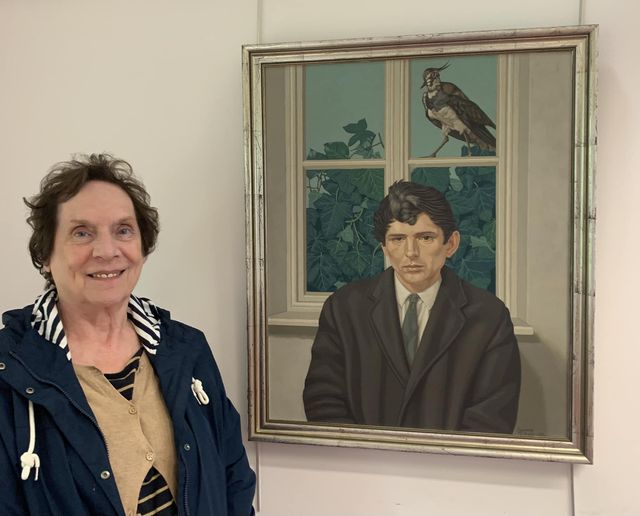
Éigse stalwart, Vicki Nash, pictured next to the 1971 portrait of Michael Hartnett by artist Edward McGuire, which was on display for the opening ceremony of Éigse 2022.
In academic circles, when poetic legacies, such as that of Michael Hartnett, are thrashed out and explored, there is always, of necessity, a legacy BUT. BUT… he passed away in mid-sentence; his potential was unfulfilled, etc., etc. We leave such debates to the continuing academic interest in Hartnett, but for those of us who love Michael Hartnett, the debate has already been won. His core work, what we see in his numerous collections, his brilliant work as a translator, and his lyrical evocation of a Maiden Street upbringing (‘we were such golden children never to be dust’) and his other mischievous local interventions, are timeless and will stand the test of time – no ifs, ands or buts.
For those of us who are true believers, Michael Hartnett’s legacy as one of the central figures in modern Irish poetry is guaranteed. The Éigse Michael Hartnett festival, held annually throughout the town in schools, the library, the Red Door Gallery, the Desmond Complex, St. Ita’s Hospital, the Longcourt House Hotel, and in the ever-dwindling number of local pubs, celebrates that legacy each year. The festival’s wide-ranging and diverse programme creates an atmosphere of warmth and conviviality, perfect for lively gatherings, easy conversation, and spirited debate.
While his memory still lingers among us, however, the pace of change is relentless. The Newcastle West he wrote so roguishly about has faded into the past, living on only in memory and in his verse. Many of the central characters in these sagas, such as Tony Sheehan, Peg Devine, Tony Roche, Jimmy Deere, John Bourke, Billy the Barber, Pat Whelan, Ned O’Dwyer or Ned Lynch, are no longer readily remembered by the young people of the town. Each year, however, they are recalled, remembered and celebrated in Éigse Michael Hartnett.
The Michael Hartnett Poetry Award is now worth a whopping €8,000, and the list of winners over the past twenty-five years is impressive. Many of those poets have gone on to achieve national prominence. And, in the intervening years since the unveiling of that statue by fellow poet Paul Durcan on April 16th, 2011, Durcan’s hope that the statue would become a meeting place, a rendezvous, for parents and children, for schoolchildren, friends, and lovers has come to be a reality.
Michael Hartnett deserves all these efforts to keep his legacy alive – and, some would argue, the time has come for a more permanent centre to attract tourists and scholars to the town. The Éigse organisers welcome recent efforts to establish a permanent Arts and Cultural Centre in Newcastle West. This town needs to be a centre for the continued study of the poet’s work and a recognised repository for his papers and other materials before they are lost forever. It has been done successfully in Bellaghy and Inniskeen, so why not in Newcastle West?
Hartnett’s eclectic legacy is assured: his poetry in Irish and in English; his translations of modern Irish poets and of Ó’Bruadair, Haicéid and Ó Rathaille; his ‘local’ poems in Newcastle West and Inchicore; his engagement with the thorny issue of Irish nationalism and language at a time in the 70s during great political unrest without introducing any of the usual tribal undertones, will always be respected and applauded.
In recent times, we salute those who ensured that Hartnett’s iconic portrait by artist Edward McGuire was purchased by Limerick City and County Council on behalf of Limerick City Gallery of Art. Like Hartnett himself, the portrait returns after a lengthy exile and will now forever be available to view locally. However, in our continuing efforts to further Hartnett’s legacy, we can and must do more.
The decade from 1975 to 1985 in Glendarragh, Templeglantine, was arguably the most productive of his career. Adharca Broic was published in 1978, followed by An Phurgóid in 1983, Do Nuala: Foighne Crainn in 1984 and his fourth collection in Irish, An Lia Nocht, appeared in 1985. During this period, he also undertook the translation of Daibhi Ó Brudair’s poems, which were published in 1985. In parallel to this ‘serious’ output, he was writing and entertaining the locals with ballads, some serious or semi-serious like ‘A Ballad on the State of the Nation’, which was distributed as a one-page pamphlet like the ballads of old and even included original linocuttings by local artist Cliodhna Cussen. Other ballads were more contentious and even semi-libellous (or fully slanderous!), such as ‘The Balad (sic) of Salad Sunday’ and ‘The Duck Lovers Dance’. These latter creations were written under the very appropriate nom de plume, ‘The Wasp’!
It has to be remembered that at this time, Newcastle West and its West Limerick hinterland were booming. The Alcan plant in Aughinish Island near Askeaton was under construction and every man, woman and child was working there. Added to this, every spare room was occupied as up to 4,000 workers from all over Ireland were involved in the construction phase of the project. The idyll of coming back home to a quiet rural backwater conducive to creativity in West Limerick was shattered by this unexpected and localised economic progress. Ironically, while Michael was enjoying the Klondike atmosphere in the hostelries of Newcastle West, his wife Rosemary was working as the Personal Assistant to the Managing Director of the newly commissioned Alcan Aluminium site.
This surely goes to the heart of the tragedy of what was Michael Hartnett’s life as a poet. The literary and academic world tried in vain to accommodate him, although this help and recognition may have come too late to save him from the clutches of alcoholism. While the annual Éigse sets out to maintain his rich legacy and celebrate his genius, it does tend to sugar-coat his reputation and often the big elephant in the room is ignored. This must be a continuing source of frustration to his wife, Rosemary, his children and his surviving family members in and around Newcastle West.
The sad reality for Michael and his family was that he did not avail himself fully of the many opportunities that were offered to him in the 1970s and later. Rosemary bemoans the fact that while his contemporaries, such as Montague, Durcan, Kennelly and Heaney all wrote poetry, they also managed to earn a salary, whereas her husband ‘spurned all opportunities to do anything except write poetry and drink!’
He was the first recipient of a bursary from the Irish American Cultural Institute in 1974, which allowed him and his wife, Rosemary, to put a deposit on a cottage in the townland of Glendarragh, Templeglantine. In that same year, he was awarded both the Irish American Literature Award and the Arts Council Award. Following his return to West Limerick, he was employed for a brief time as a lecturer in Creative Writing at Thomond College of Physical Education (now the University of Limerick), but his tenure there was patchy and temporary.
Thus, at age 34, one would presume that Michael was free to pursue his calling as a poet and enjoy the countryside ‘out foreign in ‘Glantine’. A good fairy, his wife Rosemary, paid the mortgage and all the bills and dealt with bureaucratic matters. She did it willingly because she believed in him and loved him and because she did not want her children to starve.
Sadly, it seems that his obsession with poetry and drink left very little room for any other relationships to thrive and survive, and this included his marriage to Rosemary. The acclaimed documentary by Pat Collins, A Necklace of Wrens (1999), ends with a very poignant, philosophical reverie as to whether Hartnett saw poetry as a gift or a curse:
It’s very difficult to describe where poetry comes from. It certainly was given to me, but so were my brown eyes and my big ears. They are just part of what I am, to coin a phrase. I believe it’s a gift, certainly, and I’m lucky to have it. But also it’s a curse, so I’m in two moods about it really. I could say I did it all myself, which would be a total lie because there’s an entire three or four thousand years of tradition behind me in many languages. But whether it was given or not, I can’t answer that question. It just turned up and I turned up to meet it and we met at the crossroads and got married and we’re still married.
Michael Hartnett had a great predilection for romantic yarns. If they weren’t true, he was amused by the way they were taken up, including by the media and even sometimes by academics. Most of these myths, created by Hartnett to suit his own nefarious purposes, are trotted out again and again. One example of what passes for analysis:
At the age of three, Hartnett was sent to live with his grandmother, Bridget Halpin, who lived in Camas, a townland in the parish of Templeglantine, west of Newcastle West. He was educated in the local primary school, and then in the well-known and enlightened St. Ita’s secondary school in Tarbert, Co. Kerry, run by the redoubtable Jane Agnes McKenna, a school that would later boast both Gabriel Fitzmaurice and Brendan Kennelly as alumni (McDonagh, Newman 15).
Hartnett, himself a master of misinformation and disinformation, would have been very impressed with the inventive mythmaking in this piece. For the record, Brigid Halpin’s cottage in Camas is situated about a mile from the village of Raheenagh in the parish of Kileedy. While it is true that he spent some time with his grandmother before beginning school and frequently thereafter for short stays at weekends and during school holidays, he attended Primary School in Newcastle West, first in Scoil Iosef and later in the long-established Courtenay Boys’ School. He then attended the very well-known and enlightened St. Ita’s Secondary School in Newcastle West, which was run by Jim Breen and where his English teacher was Billy O’Donnell.
Many of the myths surrounding Hartnett relate to Brigid Halpin, his grandmother. The reality is that she was not a native Irish speaker; he was not ‘fostered out’ to her for long periods in his childhood, and he did not learn Irish in her lowly cottage in Camas. Neither was she born in 1870, as he suggests in the famous Pat Collins documentary. We know from Census records that she was a mere 80 years of age when she died alone in St. Ita’s Hospital, Newcastle West, in 1965. These inaccuracies continue to appear in much of what passes for scholarly research and analysis since he passed away in 1999, and, as I pointed out earlier, some of the biggest culprits are local.
Despite this, Hartnett’s legacy is assured but demands continued and vigorous investigation. While Declan Kiberd lavishes praise on Hartnett for being ‘the greatest translator of Irish-language poetry in the second half of the twentieth century’, he also bemoans the fact that ‘he is also his country’s most underrated poet (Kiberd, 381). From the lofty heights where Heaney declares that Hartnett is the ‘authentic heir to the poets of the Maigue’ to those in the many hostelries he visited who dismissed him as an annoyance, there is the growing realisation of the truth in his son Niall’s observation that, ‘My father was many men to many people’ (McDonagh and Newman, 7). Seamus Heaney remembers the frisson of electric energy which followed a Hartnett book launch – he says it was akin to a ‘power surge’ in the national grid. He continues:
Yet despite that, his achievement was under-noticed. Slight of build and disinclined to flaunt himself on the literary scene, he was always more focused on his creative journey than on career moves. Edward McGuire’s portrait catches this singular intensity, but the response to his writings has been less definitive.’
Hartnett’s son, Niall, in an article in the Sunday Independent, on September 30th, 2024, spells out the current reality:
“His legacy as a poet is hard to gauge. His legacy is still spreading in Ireland, especially through the school system, although slowing in my opinion. But progress internationally is at a snail’s pace, sadly. My hope is that the school-goers of today in Ireland will be the next to carry his torch in the future to a wider audience.”
And as we celebrate the twenty-fifth anniversary of Hartnett’s passing, we can see that time moves on and new poets emerge and are celebrated each year at Éigse Michael Hartnett in Newcastle West, and in Listowel and Dromineer and many other far-flung Literary Festivals whose aim is to foster and nurture and give a platform to the young, vibrant successors of Hartnett.
Twenty-five years on, the judgement of John McDonagh and Stephen Newman made shortly after his passing still holds true:
His body of work is a testament to his lifelong struggle with complacency and a desire to write with honesty and integrity that marks him out as one of the most overlooked yet influential Irish poets of the twentieth century (McDonagh, Newman, 24).
Prophets are never recognised in their own countries. Until, that is, they make themselves irremovable landmarks on our landscapes and streetscapes. The once-banished artist returns as a statue in our most cherished Square, an Éigse Literary and Arts Festival to honour him in perpetuity. Hartnett deserves all these accolades. He was at times painfully honest, very acerbic at other times, but always truthful until it hurt. Emerson had him in mind when, in his famous definition of friendship, he states, ‘Better be a nettle in the side of your friend than his echo’, and he concludes with the admonition: ‘Let him be to thee forever a sort of beautiful enemy, untameable and devoutly revered’.
References:
Collins, Pat. Film documentary A Necklace of Wrens (1999).
Hartnett, Rosemary, in correspondence with the author.
Kiberd, Declan. The Double Vision of Michael Hartnett in After Ireland: Writing the nation from Beckett to the present, Head of Zeus UK, 2017.
McDonagh, J., Newman, S. (eds). Remembering Michael Hartnett, Four Courts Press Ltd., Dublin, 2006.
Michael Hartnett, his wife Rosemary and daughter Lara.
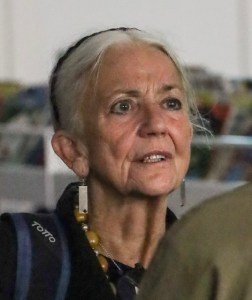
Paula Meehan in full flow, delivering her eloquent ‘Letter to Michael Hartnett’ on the Opening Night of Éigse Michael Hartnett, 2025. The photograph is by Dermot Lynch
As part of our preparations for Éigse 2025 we decided to ask Paula Meehan to be our special guest on Opening Night, 2nd of October. Her remit was to ‘speak from the heart about her memories of Michael Hartnett’. She did so by framing her thoughts in the form of ‘A Letter to Michael Hartnett’ – a wonderful prose poem. This was written on the 1st of October 2025, the night before the Éigse in his name opened in his native Newcastle West, County Limerick. The result is truly magnificent and deserves to be shared with Michael’s family, his many friends and ardent followers who didn’t make it to the Library in Newcastle West on that momentous night.
Dearest Michael,
Tomorrow I will rise with the sun and take to the road, and by eight-ish I will stand to speak of you before a crowd of your devotees in your home town where your name will be on everyone’s lips. Being blessed for the most part — but you have to allow, as you’d say yourself: there’s always the one.
The Éigse, founded in your name, will be opened with ceremonials and celebrations through all the arts, on its twenty-fifth birthday. If fate allows, I’ll be there to sing your praises, to sing them to the high heavens, where I hope you reside with the cherubim and seraphim, your ears ringing with their choral magic. I’ll say you were and are of greatness wrought. I’ll offer gratitude for the poems you carried, for the pure music of your shining spirit. So many of us will be gathered in your name and cherishing all you stand for.
I’ll be aware, too, of your black sardonic eye on proceedings somewhere in the otherwhere of elsewhere; aware especially of how you hated poets going on, and on. And weren’t afraid to let them know. Now as I enter my anecdotage and my crankitude, I can hear your voice in my ear:
‘Just tell them I’m not the worst.’
That’s what you whispered one night as I rose to introduce you to students in a small back room, over fifty years ago. After the reading they would have died for you, each and every one of them, so thoroughly had you enchanted them. I remember the joke you told them at the end of your reading: ‘What do you get if you cross a donkey with a bag of onions? A ride that would bring tears to your eyes’.
‘Come to the Éigse,’ said Norma Prendiville, ‘and speak from the heart about Michael for twenty minutes.’ Michael, I’ll speak from the heart you broke. You broke the hearts of all of us who loved you.
You were our purest poet. Our own Orpheus.
Even Eavan Boland, who reckoned there was no Orpheus in Ireland, came to understand the Orphic nature of your lyric. I extract from ‘Irish Poetry’, the poem she dedicated to you, where she tells how over a pot of tea one winter’s evening you —
began to speak of our own gods.
Our heartbroken pantheon:
No Attic light for them and no Herodotus.
But thin rain and dogfish and the stopgap
of the sharp cliffs they spent their winters on.
And the pitch-black Atlantic night. And how the sound of a bird’s wing in a lost language sounded.
You made the noise for me. Made it again. Until I could see the flight of it: suddenly
the silvery, lithe rivers of your south-west
lay down in silence. And the savage acres no one could predict
were all at ease, soothed and quiet and
listening to you, as I was. As if to music, as if to peace.
Eavan, who always referred to you as Mikey, with great fondness.
I first met you, Michael, in Grogan’s Castle Lounge in South William Street in my native city of Dublin. The poet’s horror hole a friend called it, a poet already sober, a rare enough thing in Grogan’s Castle Lounge. In those days fadó, fadó.
It is nineteen eighty-three and I am just back home to Dublin. I have been studying for a Masters of Fine Arts degree, in Washington State in the far Northwest of the United States. I brought two slim volumes with me when I left for the States – poets I had never met in person, but I considered them poetical mother and father to my craft or sullen art.
The books were Eavan Boland’s 1980 volume In Her Own Image and your 1975 volume A Farewell to English. When I met you that first time in Grogans, introduced by Tommy Smith, I told you I had the whole of the title poem, dedicated to Brendan Kennelly, by heart. Go on so, said you, prove it. I did. By heart. With only a few wobbles.
I think you were gobsmacked. You asked to see poems for, you said, I must be a poet. I showed you one I had in my pocket — do young poets still carry new poems on their person? Maybe on their mobile phones ….. I showed you one and you said it wasn’t very good. I showed you another and you said that was much better. The real thing. Of course, I paid no heed to your critique. Isn’t arrogance a protective force when you’re a baby poet?
If I had the whole poem by heart then, I have only fragments now, but it comes back to me when I need it. It gets me through as much as it gets through to me, the beautiful, sustained meditation on our politics. our culture, our colonised minds. Your masterpiece of scorn and hurt and resistance.
In the choppy waves of loneliness in an American university the poems kept me on some kind of even keel. They were part of the reason I came back to Ireland despite the terrible prospects.
‘What are you going home for? Sure all the kids are going the other way?’ ’What are you coming home for. There’s no work here.’
The era of last one to leave the country turn out the lights. The era of redundancies, butter vouchers, dole queues, heroin hitting the poor communities of the inner city like a juggernaut, moving statues, The Kerry Babies, Anne Lovett, The Heavy Gang. The Troubles live on TV every night.
You understood I came home to get the poems I needed to get.
What did we talk of on those walks by the Camac River, that palindromic waterway? Oh, you could fascinate from Akhmatova to Zozimus. You were dazzling in your erudition. You had the names, and the naming and so took possession of every blooming thing, of every wingèd thing and creature of the riparian zone. In two tongues.
I found blessing and curse in every poem. You were countryman. You were cosmopolite. You were ancient. You were avant garde. You were honey. You were vitriol.
Kind. Ferocious. Wicked. Lonely. So lonely, Michael, for your boy and your girl, for Niall and Lara, your beautiful children.
I carried your poem ‘Death of an Irishwoman’ like a holy fire. You understood that the most important culture bearers come in humble guise, like the Zen master scrubbing the kitchen floor of the monastery. Your ‘ignorant’ grandmother Bridget Halpin, who gave you Irish, who handed you the tool you would use to decolonise your mind. Decolonise our minds.
You were the wounded healer.
Death of an Irishwoman
Ignorant, in the sense she ate monotonous food and thought the world was flat, and pagan, in the sense she knew the things that moved at night were neither dogs nor cats but púcas and darkfaced men, she nevertheless had fierce pride. But sentenced in the end to eat thin diminishing porridge in a stone-cold kitchen she clenched her brittle hands around a world she could not understand. I loved her from the day she died. She was a summer dance at the crossroads. She was a card game where a nose was broken. She was a song that nobody sings. She was a house ransacked by soldiers. She was a language seldom spoken. She was a child’s purse, full of useless things.
I carried that poem into workshops, workshops in universities, in prisons (sometimes on the same day). I read it with women prisoners, with the political prisoners in Portlaoise, with the men in Arbour Hill High Security Prison, in recovery programmes. I brought it into art colleges, into classrooms all over the country, into other countries.
Everyone has loved someone from the day they died. Some creature. Some thing.
Only last week at a workshop in Kilmore Quay, I read that poem and there was a gasp, an audible intake of breath on the line, ‘I loved her from the day she died.’ She will never die, your grandmother, bearer of Irish, cultural heroine, your grandmother Bridget Halpin.
Those last few years of your life, your ever faithful friend Tony Curtis would drive myself and Theo (Dorgan) out to Dundrum, where you lived close by what you called The Sentimental Hospital, known to the rest of us as The Central Mental Hospital. You were dying in the loving care of Angela Liston.
The October of your going was radiant and glorious. But the day of your funeral it lashed. Early to the town for the burial, we took shelter in a pub. A man came in and said there’s a fierce crowd in for a funeral. Dinny Hartnett, the postman, his brother the poet is after dying. You would have liked that, Michael. You would like that the woman in the Pound Shop gave us armfuls of umbrellas, all the umbrellas in the shop, and wouldn’t take any money. Sure bring them back when the funeral’s over.
I did a poetry reading in Limerick a while back, in the City Gallery under Eddie Maguire’s magnificent portrait of you, the one on the front of your Collected Poems. Una McCarthy, who has recently retired as Director of the Gallery, had fought a long, hard battle to wrest the funding for it and get it back to Limerick from a private collection in the United States. You hung there, your black eyes boring into me, as intensely as they had in life. You could read minds, an uncanny gift. You were drawn to the wounded in bar or street. I saw people open to you like flowers – they felt your nobility of spirit, your deeply empathetic heart.
Michael, I hope wherever you are that this Éigse energy in the streets of the town of your birth will touch you. Your name is on every tongue. You are cast in bronze in the marketplace. The rain flows down your beautiful face, mingles with the tears you shed for your mother, for your father in his blanket of snow.
I send this letter into the void, dear Michael, in gratitude, devotion and fond memory.
Sincerely,
P. Meehan
Paula Meehan. Photograph by Dermot Lynch
About the Author
Paula Meehan was born in Dublin in 1955, the eldest of six children. She attended a number of primary schools, finishing her primary education at the Central Model Girls’ School off Gardiner Street. She began her secondary education at St. Michael’s Holy Faith Convent in Finglas but was expelled for organising a protest march against the regime of the school. She studied for her Intermediate Certificate on her own and then went to Whitehall House Senior College, to study for her Leaving Certificate.
Outside school, she was a member of a dance drama group, became involved in band culture and, around 1970, began to write lyrics. Gradually composing song lyrics would give way to writing poetry.
At Trinity College, Dublin, (1972–1977) she studied English, History and Classical Civilization, taking five years to complete her Bachelor of Arts degree. This included one year off, spent travelling through Europe. While a student she was involved in street theatre and various kinds of performance.
After college she travelled again, spending long stretches in Greece, Germany, Scotland and England. She was offered a teaching fellowship at Eastern Washington University where she studied (1981–1983) in a two-year programme which led to a Master of Fine Arts degree in Poetry. She returned to Dublin in 1983.
Meehan has also written poetry for film, for contemporary dance companies and for collaborations with visual artists; her poems have been put to music by songwriters (including Christy Moore). Her poetry has been extensively published in translation, including substantial collections in French and German.
The 2015 Poetry Competition ‘A Poem for Ireland’ shortlisted her 1991 poem ‘The Statue of the Virgin at Granard Speaks’ in the final ten poems. She selected poems for and introduced the Candlestick Press anthology Ten Poems from Ireland in 2017. Meehan was a judge for the 2020 Griffin Poetry Prize.
In September 2013, Meehan was installed as the Ireland Professor of Poetry by President Michael D. Higgins.
In 2023, she was elected an honorary fellow of Trinity College Dublin.
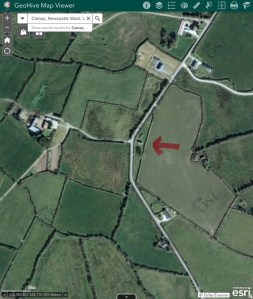
A Geohive Hub aerial view of Bridget Halpin’s cottage in Camas taken in 2006.
Camas is a small nondescript townland nestling in the shadow of the nearby village of Ratheenagh in rural West Limerick. In the Author’s Notes to his Collected Poems (2001), Michael Hartnett tells us that, ‘Camas is a townland five miles south of Newcastle West in County Limerick where I spent most of my childhood’. This local townland proved to be a central element in his early development. There, the young impressionable Hartnett was influenced by his people, particularly his grandmother, Bridget Halpin, and their customs and way of life. Indeed, in the mid-70s, when he tired of the Dublin literary milieu, it was to this same rural West Limerick bastion, nearby Glendarragh in Templeglantine, still steeped in Irish music and culture, to which he returned. It was to this place he came to escape Dublin’s incestuous stranglehold and perhaps to write a new chapter “out foreign in ‘Glantine”.
There are up to fifteen poems by Hartnett which could be considered ‘Camas Poems’. These memory poems are all based on his childhood recollections of those happy times in his grandmother’s kitchen. Students of Hartnett’s poetry should consider studying ‘A Small Farm’ (Collected Poems 15) as one of a series of memory poems that he wrote celebrating his grandmother, Bridget Halpin and the townland of Camas where she lived. The most obvious of these Camas Poems is ‘Death of an Irishwoman’ (Collected Poems 139), which he wrote on the passing of his grandmother in 1965. Others include ‘For My Grandmother Bridget Halpin’ (Collected Poems 52), and ‘Mrs Halpin and the Lightning’ Collected Poems 138) and of course ‘An Múince Dreoilíní ‘/ ‘A Necklace of Wrens’ (A Necklace of Wrens 18), a quintessential memory poem from childhood.
Hartnett’s early poetry creates a delicate balance between description and abstraction, the actual and the figurative. The poem ‘A Small Farm’, the first poem of the Collected Poems (2001), a memory poem dating from Hartnett’s teenage years, establishes this. Abstractions, clichés, their representation through language, and the moment where these are drawn into focus, made specific and immediate, are central. The setting of the ‘small farm’ is described en abstracto: ‘All the perversions of the soul / I learnt on a small farm’ (15). In contrast to other contemporary representations of Irish farm homesteads, most obviously Kavanagh’s ‘Inniskeen’, and Heaney’s ‘Anahorish’, there is no naming of place here. The picture of the farm is rather etched out in generalisation and aphorism, and through the accordant clichés of petty hatred and ignorance, ‘how to do the neighbours harm / by magic, how to hate’ (15), before Hartnett brings the glass into focus, employing idiosyncratic detail which establishes the world of the poem itself. In this way, Hartnett’s particular subjectivity, his way of seeing, is established. It would become his poetic currency:
Here were rosary beads,
a bleeding face,
the glinting doors that did encase their cutler needs,
their plates, their knives, the cracked calendars of their lives. (15)
In the final stanza, Hartnett makes an explicit link between his awakening as a perceiver of social interactions and moments of poetic beauty, with a growing knowledge and identification with the natural world:
I was abandoned to their tragedies and began to count the birds,
to deduce secrets in the kitchen cold,
and to avoid among my nameless weeds
the civil war of that household. (15)
The attentive intellect which ‘counts the birds’ has as yet no language to describe or express his experience of the natural world, his ‘nameless weeds’. Still, he is possessive of it, seeing it as distinct from the human society which he can describe, yet does not identify with.
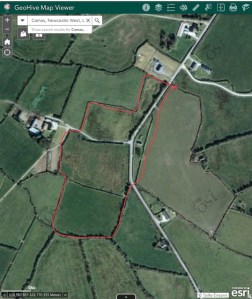
The ‘small farm’ referred to here belonged to his grandmother, Bridget Halpin, and like many other small holdings in Camas, it consisted of a meagre ten acres, three roods and thirteen perches. This woman, Bridget Halpin, would later wield great influence over her young grandson, Michael Hartnett. Indeed, if we are to believe the poet, she was the one who first affirmed his poetic gift when one day he ran into her kitchen in Camas and told her that a nest of young wrens had alighted on his head. Her reply to him was, ‘Aha, you’re going to be a poet!’. (A more detailed genealogy of the Halpin family and the early formative influences on Michael Hartnett can be read here).
Bridget Halpin’s small farm of ten acres, three roods and thirteen perches, which was so vital in the early development of one of our greatest poets. This view is taken from a Geohive Hub aerial view taken in 2006.
Hartnett claimed that he spent much of his early childhood in Bridget Halpin’s cottage in the rural townland of Camas, five miles from his home in nearby Newcastle West. He went on to immortalise this woman in many of his poems, but especially in his beautiful poem, ‘Death of an Irishwoman’. This quiet townland of Camas must therefore be seen as central to his development as a poet, and maybe in time, this early association with Camas will be given its rightful importance, and the little rural townland will vie with Maiden Street or Inchicore as one of Hartnett’s important formative places.
‘Camas Road’, Michael Hartnett’s first ever published work, appeared in the Limerick Weekly Echo on the 18th of June 1955. He was thirteen. The poem describes the rural vista of the West Limerick townland of Camas at evening: ‘A bridge, a stream, a long low hedge, / A cottage thatched with golden straw’ (A Book of Strays 67). Its two eight-line stanzas of alternating rhyme and regular metre contain a litany of natural images, at times idiosyncratically rendered; the ‘timid hare sits in the ditch’, ‘the soft lush hay that grows in fields’. It is a peculiar mix of a poem, apparent images from both the poet’s lived and literary experience, placed side by side. It is contentedly denotative, creating a sense of ease and oneness with the natural world. The movement of sunrise to sunset is perpetually peaceful, its colours oils for the young poet’s palette. The ruminative introspection which elevates Kavanagh’s ‘Inniskeen Road: July Evening’, a poem which can be read in useful parallel to ‘Camas Road’, is not present. At the poem’s turn, as ‘Dark shadows fall o’er land so still’, Hartnett’s only thought and action are of flattened description, the creation of ‘this ode’.
‘Camas Road’ then, though essentially a curiosity which stands outside of Hartnett’s body of work, can be read as a seldom afforded snapshot of Michael Hartnett the poet before he became one. In contrast, his poem ‘A Small Farm’ shows a marked development in his poetic craft. Bridget Halpin, his grandmother, lived there with her son, Denis (Dinny Halpin), in what Hartnett describes as a prolonged state of ‘civil war’,
I was abandoned to their tragedies,
Minor but unhealing.
The word ‘abandoned’ here has many undertones and is important for the poet because he repeats the line twice in the poem. He has told us elsewhere that he was, in effect, ‘fostered out’ by his parents in Maiden Street, Newcastle West, to his grandmother, Bridget Halpin, from a young age and spent much of his childhood in her cottage in Camas. However, there is also the suggestion that while there he was ‘abandoned’ and somewhat neglected as he became an outsider, an unwilling observer of the ‘civil war’ of the household, as Bridget and her son Dinny constantly argued and fought over the minutiae of running a small farm in difficult times in the Ireland of the late 40s and early 50s.
Hartnett saw in his grandmother a remnant of a generation in crisis, still struggling with the precepts of Christianity and still familiar with the ancient beliefs and piseógs of the countryside. For Hartnett, there is also the added heartache that sees his grandmother struggling to come to terms with a lost language that has been cruelly taken from her. This, therefore, is a totally different place when compared to, for example, Kavanagh’s Inniskeen or Heaney’s Mossbawn or Montague’s Garvahey. However, there is an underlying paganism here that is absent from their work, although Montague comes close in his great poem, ‘Like Dolmens Round my Childhood, the Old People’.
For Hartnett, his grandmother represents a generation that lived a life dominated by myth, half-truth, some learning, and limited knowledge of the laws of physics, and therefore, as he points out in ‘Mrs Halpin and the Lightning’,
Her fear was not the simple fear of one
who does not know the source of thunder:
these were the ancient Irish gods
she had deserted for the sake of Christ.
However, Hartnett’s powers of observation and intuition were honed in Camas on Bridget Halpin’s small farm during his frequent visits. He tells us that he learnt much on that small farm during those lean years in the forties and early fifties,
All the perversions of the soul
I learnt on a small farm,
how to do the neighbours harm
by magic, how to hate.
The struggle to make a success and eke out a living was a constant struggle and burden. The begrudgery of neighbours, the ‘bitterness over boggy land’, and the ‘casual stealing of crops’ went side by side with ‘venomous card games’, ‘a little music’ and ‘a little peace in decrepit stables’. The similarities with Kavanagh’s ‘The Great Hunger’ are everywhere, but Hartnett does not name this place; it is an Everyplace. The poem is simply titled, ‘A Small Farm’, so there is no Inniskeen, Drummeril, or Black Shanco here. Still, the harshness and brutality of existence, ‘the cracked calendars / of their lives’ in the 50s in Ireland, is given a universality even more disturbing than the picture we receive from Kavanagh. Yet, it is here in Camas that he first becomes aware of his calling as a poet and, like Kavanagh, it was here that ‘The first gay flight of my lyric / Got caught in a peasant’s prayer’. And so, to avoid the normal household squabbles of his grandmother and her son, he ‘abandons’ them, turns his back on them, and begins to notice the birds and the weeds and the grasses.
The depiction of another agricultural custom is shown in ‘Pigkilling’. The joyful detailing of the killing of a pig at his grandmother’s farm in Camas eschews any characterisation of Hartnett as a simplistically environmental poet, denouncing all human domination over nature. Rather, it depicts the killing as a vital part of the rural community’s relationship with animal-kind, comparable to ritual.
Like a knife cutting a knife
his last plea for life
echoes joyfully in Camas.
This is one of the few Camas Poems that names the place and the central figure of the poem himself uses the pig’s bladder as a plaything: ‘I kicked his golden bladder / in the air’ (Collected Poems 125). Agriculture here is not mechanised but depicted as an ongoing, sustainable facet of rural life: the poem echoes the loss of many of these old rituals and crafts of the past, as Heaney does in his collection, Death of a Naturalist.
The townland of Camas is also central to an episode that the poet recounts for us in his seminal poem, ‘A Farewell to English’ (Collected Poems 141). This encounter hovers somewhere between reality and dream, aisling (the Irish word for a vision) or epiphany. The incident takes place at Doody’s Cross as the poet walks out on a summer Sunday evening from Newcastle West to the cottage in Camas. He is on his way to meet up with his uncle, Dinny Halpin. He sits down ‘on a gentle bench of grass’ to rest his weary feet after his exertions, when he sees approaching him three spectral figures from the Bardic Gaelic past – Andrias Mac Craith, Aodhagán Ó Rathaille, and Daíbhí Ó Bruadair. These ‘old men’ walked on ‘the summer road’ with
sugán belts and long black coats
with big ashplants and half-sacks
of rags and bacon on their backs.
They pose as a rather pathetic group, ‘hungry, snot-nosed, half-drunk’ and they give him a withering glance before they take their separate ways to Croom, Meentogues and Cahirmoyle, the locations of their patronage, ‘a thousand years of history / in their pockets’. Here, Hartnett is situating himself as their direct descendant and the inheritor of their craft, and the enormity of this epiphany occurs at Doody’s Cross in Camas: the enormity of the task that lies ahead also terrifies and haunts him.
Earlier in ‘For My Grandmother, Bridget Halpin’ (Collected Poems 52), he again alludes to the wildness, the paganism, the piseógs that surrounded him during his childhood in Camas. His grandmother’s worldview is almost feral. She looks to the landscape and the birds for information about the weather or impending events,
A bird’s hover,
seabird, blackbird, or bird of prey,
was rain, or death, or lost cattle.
This poorly educated woman reads the landscape and the skies as one would read a book,
The day’s warning, like red plovers
so etched and small the clouded sky,
was book to you, and true bible.
And yet, in his beautiful poem, ‘Bread’ (Collected Poems 53), he evokes and echoes the warmth and nurture of Mary Heaney’s kitchen in Mossbawn. His grandmother’s kitchen in Camas was a comforting place for him, and his early childhood memories are ones of coming home to roost,
and I come here
on tiring wings.
Odours of bread….
The picture we get of the small farm in Camas is rather etched out in generalisation and aphorism, and through the accordant clichés of petty hatred and ignorance, ‘how to do the neighbours harm / by magic, how to hate’, before Hartnett brings the glass into focus, employing idiosyncratic detail which establishes the world of the poem itself. As already mentioned, the cottage on this small farm was a Rambling House, a house where neighbours gathered to tell stories, play music and card games,
venomous card games
across swearing tables
His early poetry, then, creates a delicate balance between description and abstraction, the actual and the figurative. In this way, Hartnett’s particular subjectivity, his way of seeing, is established. In time, it would become his poetic currency. We are invited into the quintessentially old traditional Irish kitchen with its pictures of the Pope, the Sacred Heart, the statue of Our Lady, the Crucifix,
Here were rosary beads,
a bleeding face,
the glinting doors that did encase their cutler needs,
their plates, their knives, the cracked calendars of their lives
In this poem, therefore, Hartnett is following on from Kavanagh in shining a light into the domestic and interior life of rural dwellers not previously considered worthy of attention.
I have to mention one other poem, a quintessential Camas poem, which appears in the collection A Necklace of Wrens, published in 1987 after his return to Dublin. This is a collection of selected poems in Irish with English translations by Hartnett. The poem in question is titled ‘The Country Chapel’, with its Irish translation ‘An Séipéal faoin Tuath’. This memory poem describes the scene outside the country church on any given Sunday. The young, observant Hartnett describes the various characters who have come from the ‘fat meadows’ as ‘sly and happy’. They resemble ‘a set-dance team / by the wall of the old chapel’. They are all strategically placed depending on the various local rows and even their differing sporting and political allegiances, ‘foe avoiding enemy’. This eclectic group of neighbours are beautifully portrayed in the lovely Hartnett metaphor: ‘The congregation is a lonely horse’ who appear to be ‘as awkward as a man /dancing with a nun / on a wedding day’. This may well be a long-lost poetic portrait of the people of Killeedy, Ratheenagh, Ballagh and Kantoher in the mid-40s and 50s.
Bridget Halpin’s ‘small farm’ in Camas may have been small and full of rushes and wild iris, but it helped produce one of Ireland’s leading poets of any century. The influences absorbed in this rural setting, his powers of observation, his knowledge of wildlife and flowers, and his ecocentric bias, are impressive and are all-pervasive in these Camas Poems and, indeed, his poetry in general. Hartnett, the quintessential nature poet, would be delighted and impressed to see the magnificent new Killeedy Eco Park, which has been set up less than a mile from his ‘foster’ home in Camas by the combined efforts of that same local community in Killeedy. It is also significant that the visionary developers of this project have included a Poet’s Corner where Hartnett is remembered, just a stone’s throw from the small farm of his formative years. Here today’s generation in Camas and beyond can now come to ‘count the birds’ and the ‘nameless weeds’.
References
Hartnett, M. Collected Poems, edited by Peter Fallon, Gallery Press, 2001 (Reprinted 2012)
Hartnett, M. A Necklace of Wrens: Poems in Irish and English, The Gallery Press, 1987 (Reprinted 2015).
HARTNETT, M. A Book of Strays, edited by Peter Fallon, The Gallery Press, 2002, (Reprinted 2015).
Statue of a pensive Michael Hartnett in The Square, Newcastle West.
This beautiful video has been produced by Danny Barry’s grandson, Dan Barry. The poem is narrated by the poet Michael Hartnett and it is taken from a radio documentary that he did in 1979 for RTE Radio entitled Poems Plain. The programme was produced by Donal Flanagan. The video contains copyrighted material that is being used for educational purposes under the doctrine of ‘fair use’. The use of this material is not intended to infringe upon the copyright owner’s rights. The material is used here solely for educational and non-commercial purposes. Dan Barry has suggested a small but necessary edit to verse four and the printed poem below reflects those changes.
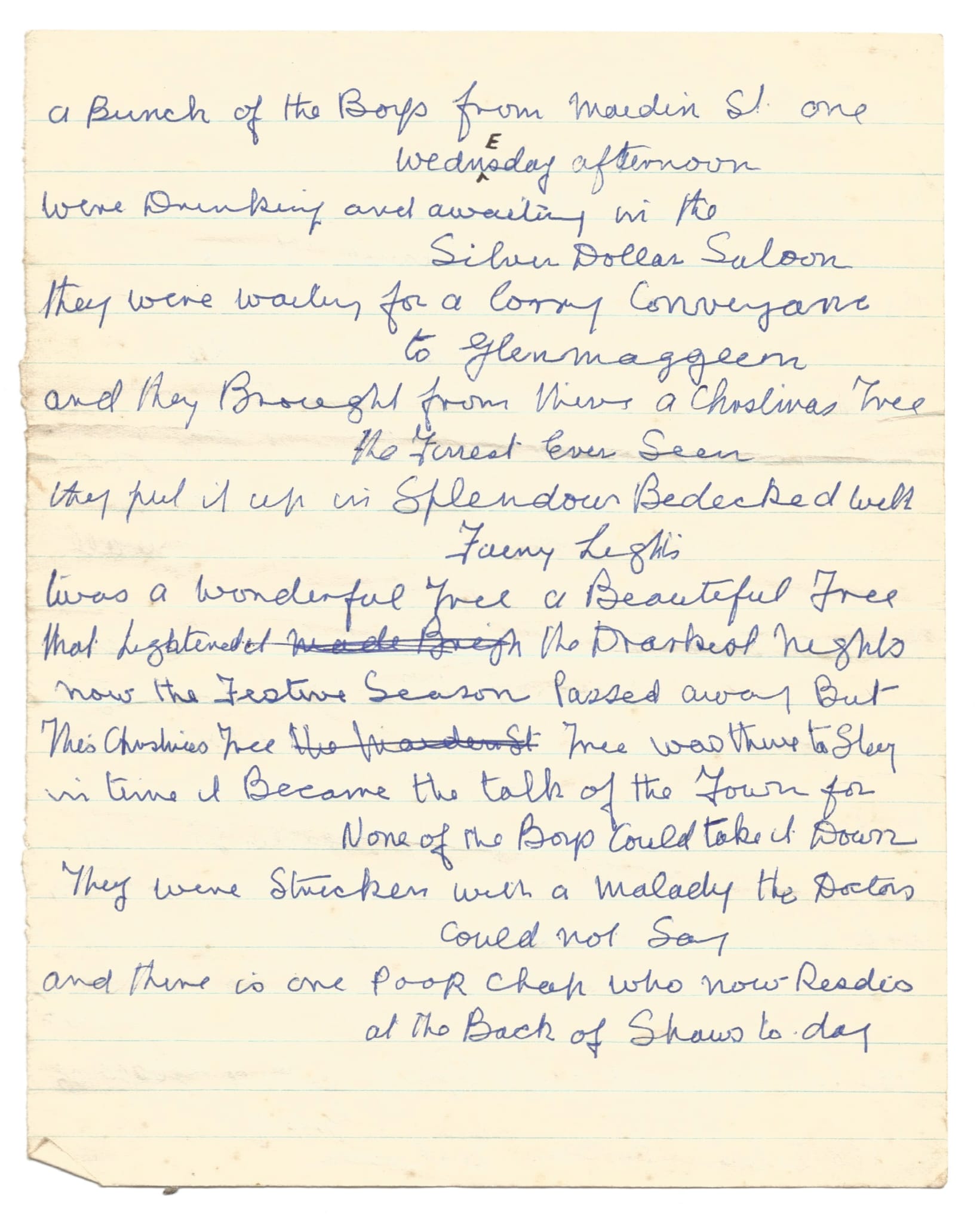
Danny Barry’s poem, ‘The Christmas Tree’, deals with an actual happening. A few men from Maiden Street in Newcastle West decided to erect a Christmas tree in the street. They cut it down in Glenmageen, an area reputed to be haunted by a witch known as Sprid na Barna. Glenmageen is located about four miles south of Newcastle West and people can now visit the townland as they walk or cycle on the new Limerick Greenway. The stories of Sprid na Barna were well known, and the area near the present-day Barna Gardens was greatly feared by the local people. Indeed, it was said that only a few tough men would go home after dark along the road she haunted. Michael Hartnett is fulsome in his praise for the poet:
Danny Barry’s simple evocation of Sprid and her victims is extraordinary. Not because it is great poetry, but because he does not question the truth of the event at all. By the way, the Silver Dollar Saloon, which is a strange Hollywood, Western-type name, is a pub in Newcastle West, which was then run by the Flynn family, and is now run by the Kelly family.
The poem is purely mischievous and no insult should be taken by anyone, dead or alive, concerning the story told by the poet. Danny Barry is ‘ball hopping’ here and there are distinct similarities between this poem and many later written by Michael Hartnett, such as ‘The Balad of Salad Sunday’.
The Christmas Tree
A bunch of the boys from Maiden Street, one Wednesday afternoon,
Were drinking and awaiting in the Silver Dollar Saloon,
Waiting for a lorry to convey them to Glenmageen.
And they brought from there a Christmas tree, the finest ever seen.
They put it up in splendor, bedecked with fairy lights.
It was a wonderful tree, a beautiful tree, that lightened the darkest nights.
Now, the festive season passed away, but this Christmas tree was there to stay.
In time it became the talk of the town, for none of the boys dared take it down.
They were stricken with a malady the doctors could not say,
And there is one poor chap who now resides at the back of Shaw’s today.
Now, you have heard of Sprid na Barna, that very naughty dame,
That evil maid of Glenmageen, of the haunting ghostly fame.
The clergy had to banish her between the tree and the bark.
No more she would haunt and terrify the neighbours after dark.
Now the moral of this ditty I want you all to know
Twas a tree that grew in Glenmageen twenty years ago.
Now what I am trying to tell you will cause you all to frown
That the amadans from Maiden Street have brought auld sprig to town.
Now when the blackthorn blooms again and the sheepdogs howl at the full of moon
You could meet auld sprig with a glass of grog in the Silver Dollar Saloon.
Note: The reference to ‘auld sprig’ in the last line is a local mispronunciation of ‘sprid’
The original manuscript of the poem in Danny Barry’s own handwriting – you can see that it was a work in progress from all the crossing out!




 Reviews Rants and Rambles
You must be logged in to post a comment.