Maiden Street Wake by Michael Hartnett

Maiden Street Wake by Michel Hartnett (1968)

I watched the hand

until a finger moved

and veins above the index knuckle

pulsed.

That was his last movement.

She had a band

of tan tobacco juice

upon her chin.  Her few teeth buckled.

That was all the grief she showed.

In public.

Columned and black with women in shawls,

yellow and pillared with penny candles,

bright-eyed and blue-toed with children

in their summer sandals,

that was the mud house, talkative and lit.

In the bed, the breeding ground and cot,

he wore his best blouse

and would have seen

the finest teacups in his life.

But he was white

as an alabaster Christ

and cold to kiss.

We shuffled round and waited.

Our respects were paid.

And then we ate soft biscuits

and drank lemonade.

Commentary

The Irish are a people well-versed in tragedy, suffering, grief and sorrow.  Beset by famine, poverty and colonization, the history of Ireland is one that is steeped in immense adversity and sadness. Perhaps this is why the Irish are so particularly adept at mourning the loss of a loved one and saying goodbye. This may explain Hartnett’s fascination with the unique customs and traditions surrounding the Irish Wake, a tradition which is one of the most distinctive and renowned funeral traditions worldwide.  Needless to say, alcohol and music, both significant staples of Irish culture, are often heavily featured at a wake. While an Irish Wake is first and foremost a final farewell to the one departed, it can also serve as a potent and bracing reminder to those in attendance that they are still alive and a part of the world. This unique mixture of melancholy and mirth is partly why the Irish Wake is so famous the world over. Such an atmosphere is especially likely if the deceased was elderly or ill for a long period of time.  Often the wake of a younger person or a child is a far more sombre affair.

Hartnett’s, Collected Poems, contain several ‘Wake Poems’, including, of course, a wake that he missed, that of his grandmother Bridget Halpin, whom he immortalised in Death of an Irishwoman.  He was in Morocco at the time of her death in 1965.  There is also his beautiful epitaph for John Kelly; In Memoriam Sheila Hackett, where he laments the passing of an early childhood friend; and reveries on the death of his young infant brother, For Edward Hartnett, ‘All the death room needs …’; and ‘How goes the night boy? …’, in which he plays a ten-year-old Fleance to his father’s Banquo, as they mourn the loss of his sister Patricia in 1951.  Both Edward and Patricia died as very young infants, a not unusual occurrence in the late 40s, and early 50s.

At this time in Newcastle West there were over fifty public houses in the town and Maiden Street had its fair share such as Flanagans, McMahons, Cremins, Ahernes, Houghs, O’Gormans, and Flynns.  However, custom and culture dictated that when there was a death, what was known as ‘The Corpse House’ became, in effect, another public house for the duration of the funeral obsequies.  This explains why the young Hartnett had such ready access to the events surrounding the death of a neighbour in the close-knit community of the Coole and Lower Maiden Street.  The death described here stands out because it seems that the young Hartnett arrives in time to witness the old man draw his last breath,

I watched the hand

until a finger moved

and veins above the index knuckle

pulsed.

That was his last movement.

The dead man’s wife is also described, and she comes across as being stoic and somewhat overwhelmed as she has been thrust into the limelight at this public event.

She had a band

of tan tobacco juice

upon her chin. 

This poem, Maiden Street Wake, was written in 1968 and so, therefore, it is a memory poem, probably from the late 50s.  The young Hartnett was present at this wake, and it may have awakened in him his near obsession with death and wakes and funerals that he revisited many times, especially for his friends in Maiden Street.  This wake is reminiscent of the wake that is described so brilliantly in the first sequence of The Retreat of Ita Cagney.  In the stage directions for an unpublished dramatic version/libretto of the same story, Hartnett describes the scene, obviously harking back to those wakes he had visited in his youth: ‘There is a sudden confused noise of prayer, glasses clinking, sneezes, melodeon music, a puff of smoke, sobs’.  Later, the stage directions relate, ‘The other door opens: smoke, glass-noise, music, sneezes, sobs, rising and falling prayer-sounds’ and again ‘There is the sound of glasses tinkling, praying, sobbing, sneezing.  The melodeon takes up the theme, and a puff of blue smoke comes from the doorway’.

Hartnett places this poem, Maiden Street Wake, alongside his poem Prisoners (both written in 1968) as the only two poems in a limited edition (250 copies) joint venture publication between Deerfield Press and Gallery Press that was published in 1977.  Both poems are illustrated by Timothy Engelland and all copies are individually signed by the author.  It seems that both poems were in his mind as he embarked on writing The Retreat of Ita Cagney / Cúlú Íde, the first major works, along with Farewell to English, undertaken on his return to West Limerick.  Both poems celebrate their 50th Anniversary this year!

Maiden Street Wake may be an account of yet another random wake, one of the many wakes that the very young Hartnett witnessed and attended in Maiden Street during his childhood.  Whatever the case may be, the old traditional Irish wake, with its old women keeners, flickering candles, music and drink, tobacco and snuff, as well as ‘soft biscuits and lemonade’ for the children, is used by Hartnett to set the scene for us in the poetic version of The Retreat of Ita Cagney. It is obvious that these events made a lasting impression on the young teenage Hartnett and those events fuelled his imagination and gave rise to some of his best poetry.

He describes the scene at ‘The Corpse House’, a mud-walled cabin in Lower Maiden Street.  The dead man is laid out in his bedroom, surrounded by ‘women in shawls, and young children from the street in their ‘summer sandals’. His bed, ‘the breeding ground and cot’, is surrounded by ‘penny candles’ and people file by to pay their last respects.  The family have made a great effort to cater for the influx of visitors and the best and ‘finest teacups’ have been brought out for the occasion.  The poet uses a beautiful simile to describe the corpse, he is like ‘an alabaster Christ’ laid out in the tomb.  For the young Hartnett viewing this traditional custom there is a sense of anticlimax at the end: after waiting their turn, they ‘shufffled round’ and were rewarded later in the meagre kitchen with ‘soft biscuits’ and a glass of the famous local soft drink, Nash’s red lemonade.

The Irish wake has long been the subject of poems, songs, films and stage plays.  Hartnett has written several poems in which he explores the old custom in a very sympathetic way.  These ‘Wake Poems’,  his poems such as A Small Farm and the many poems written to honour his grandmother, Bridget Halpin, all attest to a poet exploring the past, its customs and traditions while seeking to enhance their value and importance lest they be lost.

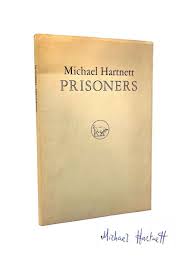
An Analysis of ‘Prisoners’ by Michael Hartnett

‘Prisoners’ was a limited edition (250 signed copies) jointly published by Gallery Press, Oldcastle, County Meath and Deerfield Press, Massachusetts.  Each copy was signed by the author.  The edition consisted of two poems, Prisoners and Maiden Street Wake and was illustrated by Timothy Engelland.  It was Hartnett’s last collection of poems in English, written before his collection ‘A Farewell To English’ (1975) but not printed until 1977.

This poem, Prisoners has largely been overlooked, but is of vital importance in the Hartnett canon.  The poem, written in 1968, dates from his time spent working as a night telephonist in the Posts and Telegraphs Exchange in Exchequer Street, in Dublin.  The poet visits and explores a theme close to his heart, which had bubbled to the surface again and which still sparked his interest on his return to his West Limerick base in 1975.  Though it is other-worldly, reminiscent and redolent of a medieval setting, there is a close connection between Prisoners and the iconic The Retreat of Ita Cagney / Cúlú Íde.  One poem anticipates the other, and both poems are inspired by events that had taken place in his beloved Maiden Street in or around 1958.

Another poem worthy of mention here is Maiden Street Wake. Hartnett’s Collected Poems contains several ‘Wake Poems’, including, of course, a wake that he missed, that of his grandmother Bridget Halpin immortalised in Death of an Irishwoman.  His poem, Maiden Street Wake may be an account of yet another random wake, one of the many wakes that the very young Hartnett witnessed and attended in Maiden Street during his childhood.  Whatever the case may be, the old traditional Irish wake, with its old women keeners, flickering candles, music and drink, tobacco and snuff, as well as ‘soft biscuits and lemonade’ for the children, is used by Hartnett to set the scene for us in the poetic version of The Retreat of Ita Cagney. This old traditional Irish wake is also constantly in the background throughout the dramatic version (in English) of the same story.  It is obvious that these events made a lasting impression on the young teenage Hartnett and those events fuelled his imagination and gave rise to some of the best poetry he has written either in English or in Irish.

Prisoners explores the plight of a young, unnamed woman who is involved in a relationship with a married man, her ‘human Lord’.  This arrangement is a source of local scandal and is frowned upon by society and the townspeople.  In his Collected Poems, the poet places Prisoners immediately before The Retreat of Ita Cagney, where the same theme is revisited again, but where now the woman is given a name.  The poet also published an Irish retelling of the story in the iconic Cúlu Íde.  His papers in the National Library also contain fragments in Irish and English of the poet’s efforts to dramatise the story, efforts that eventually came to nought, but they are testament to his obsession with this story.  It is interesting to note that in both Prisoners and The Retreat of Ita Cagney, the poet is sympathetic to the woman’s dilemma.

Whereas The Retreat of Ita Cagney has a sequence structure, Prisoners is a much shorter lyric. However, like The Retreat of Ita Cagney, it is a dramatic ex­ploration of a woman’s loneliness and isolation in a callous and hostile society. The Retreat of Ita Cagney (in both its iterations in English and Irish), is undoubtedly Hartnett’s finest achievement.  In Prisoners, and especially in The Retreat of Ita Cagney, as fellow Munster poet, Brendan Kennelly pointed out in his review of the latter poem, Hartnett, ‘pays relentless imaginative attention to this woman’s fate, and he presents with admirable dramatic balance her loneliness, independence and state of severed happiness’.  In this condition, he states that ‘Ita Cagney becomes a visionary critic of the society that hounds and isolates her’ (Poetry Ireland Review, Issue 15, p. 26).

The Retreat of Ita Cagney is a pained celebration of an en­forced privacy as experienced by the woman at the centre of the story; the title of this poem, Prisoners, paints her dilemma in an equally disturbing light.  It opens with images of a self-imposed captivity.  The man congratulates himself on being able to keep this ‘wild’ young woman, whom he obviously loves, ‘captive’ from the prying eyes of the town.

There are striking similarities between Sequence 2 in The Retreat of Ita Cagney and the way the poet proceeds to describe the woman who has been isolated and shunned by her neighbours in this poem.  The images used follow the strict requirements of the Dánta Grá, and like Ita Cagney, the young woman here is described stylistically and is given classical features:

So her face was white as almond

pale as wax for lack of sunlight

blue skin by her eyes in etchings

She is described here as waif-like and ghostly because she has not been seen outside – she is literally a prisoner in her own home or castle.  Her classical features reveal the stresses and tensions of being ostracised by society, and her beauty is now of little consequence anymore because of her self-imposed house arrest.

In the later poem (1975), Hartnett also describes Ita Cagney in similar symbolic language.  However, in contrast, Ita comes across as a strong and formidable woman: he describes Ita Cagney’s head from ‘her black hair’ to her throat, which ‘showed no signs of age’. Her hair is black save for a single rib of grey which stands out ‘like a steel filing on a forge floor’. He then describes her brow, her eyebrows, her eyes, ‘her long nose’, ‘her rose-edged nostrils’, her upper lip, her chin and jawline and finally her throat. The reason for this detail is, I think, to give us a sense of the formidable woman at the centre of this poem.

In Prisoners, the female protagonist is obviously loved and revered by her Lord, who arrives home, like a knight errant, a Gearóid Íarla*, on his trusty grey steed.  The reason for the couple’s exclusion is hinted at here: she has abandoned the old gods and the old religion of the townspeople, and she now sings ‘to a new god, to the church of her invention’. It seems that she has abandoned organised religion and its laws, edicts and diktats in favour of a more private and personal one.   However, this behaviour and lifestyle choice have led to strained relationships with friends and neighbours and have also led to her being seen as a ‘scarlet’ woman in the town.  The only comparison between the old religion and the new is her scarlet dress, similar to the bishop’s garb from the old dispensation.

She has made her choice, and she and her partner have brought a son into this ‘secret world’.  The poet then gives her a voice (if not yet a name):

… my Lord God is a human Lord,

not Lord of towns, but Lord of white horses, holy

of the hyacinth, the human Lord of light, of rain.

The word ‘Lord’ is repeated here eight times as in a monastic chant.  She invokes the hyacinth, often associated with the sun god, Apollo, as a symbol of peace, commitment and beauty, but also of power and pride. The hyacinth is often found in Christian churches as a symbol of happiness and love.   She cries out in anguish in the hope that the gods who ‘speak in rain of trees: send your holy fire to heat me’.

The woman and her partner at the centre of the poem have made their choices and are suffering because of the pressure being brought to bear on them.  Their townhouse, towerhouse, keep now resembles a fortress, a prison, and those within, prisoners.  Of necessity, the doors are bound ‘with iron chains’ and the besieged family are ‘locked safe inside an open moat of water’.  The poet is hopeful that their struggle will succeed and, like his later masterpiece, The Retreat of Ita Cagney’, he is quietly proud of the woman’s heroic stand against the threatening and ominous forces that ranged against her.  It is interesting to note that in Celtic mythology, the birch tree is associated with the goddess Brigid and symbolises new beginnings and protection. Their house is protected by birches, and the poet’s hope is emphasised by the beautiful final lyrical line:

The birch-hid dove was silk with peace.

There is one final echo of this poem, Prisoners,  in the Irish version Cúlú Íde.  In the final sequence (Section 9), Ita finds herself besieged in her ‘keep’ as neighbours move around outside ‘as venom breaks in strident fragments / on the slates’.  She ‘hears the infantry of eyes advance’ and so she closely guards her child,

ag cosaint a saighdiúirín

ó uaill leaca an sraide

ó shúile dearga an yeos.

Her child, her ‘saighdiúirín’, her little soldier boy,  must be protected from the dreaded yeomen, the hated symbol of the oppressor from a troubled colonial past.

Author’s Note: 

* Gerald Fitzgerald, the third Earl of Desmond, known as Gearóid Íarla, was famous as a poet and wizard (1339 – 1398).  He inherited his earldom, with its vast estates, in 1359.  His castle in Newcastle West was one of his main strongholds, and he spent much of his time there.  He successfully combined the Norman and the Gaelic Irish cultures, and he wrote his poetry in Irish.  In 1398, it is said he mysteriously disappeared while walking in his Newcastle West demesne and was never seen again.  Myth has it that he still lives under the enchanted waters of Lough Gur, in County Limerick, and that every seven years he and his hosts rise to the surface and ride their horses over the lake, and that, when the horse’s silver shoes wear out, he will be set free!

Works Cited

Hartnett, Michael. Collected Poems, ed. Peter Fallon. Gallery Books, Oldcastle, County Meath, 2001.  Reprinted 2009 and 2012.

Poetry Ireland Review, Issue 15.