Me Blogging down rabbit holes……

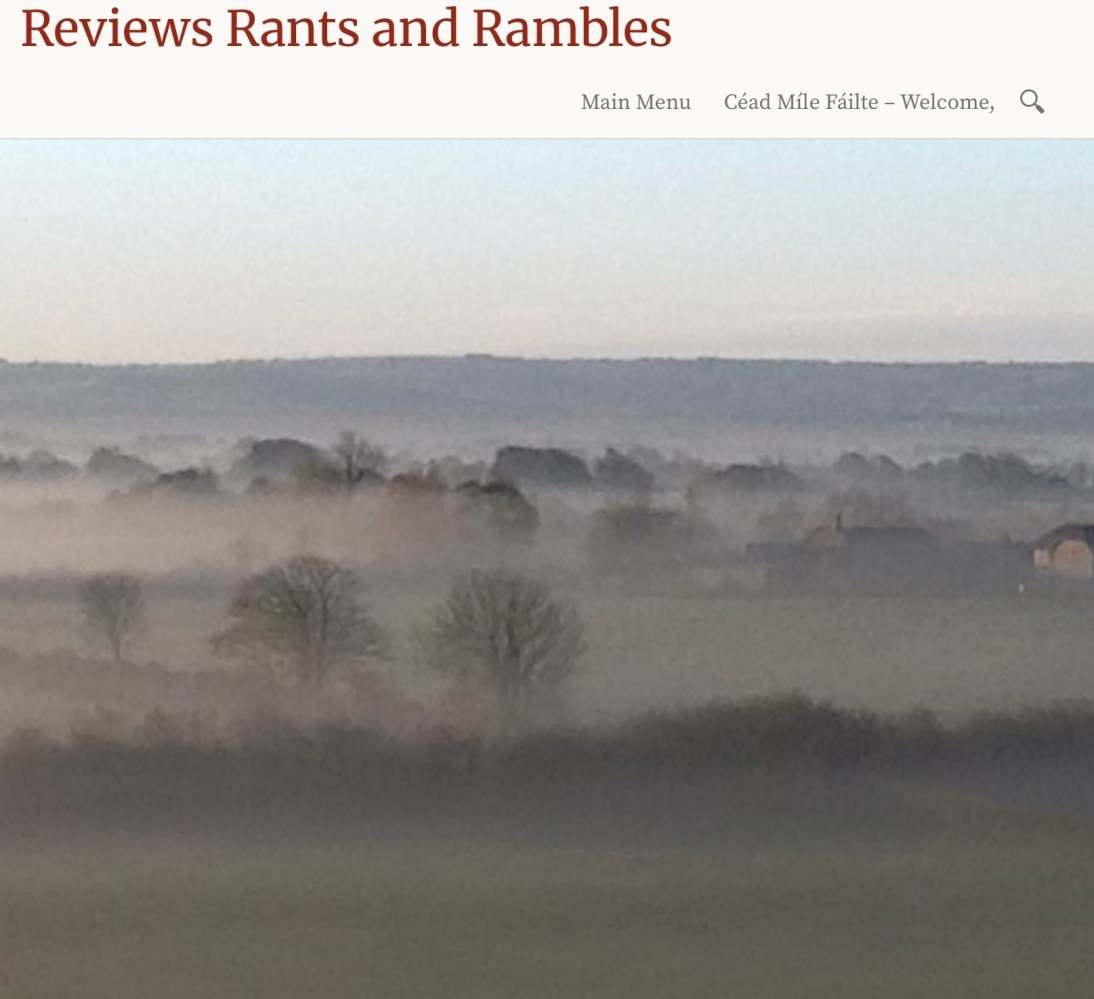
The homepage of my blog. The photo was taken from my front
door, looking down over the valley of Mágh Ghréine on a lovely foggy morning.


When I retired from teaching in 2013, I resolved to take on a new challenge, so I began experimenting with developing my own blog. I eventually settled on WordPress and, slowly but surely, began learning, single-handedly, the intricacies of building my site and editing, adding, importing, and sharing photographs, video clips, and other images and illustrations to embellish my writing. Since those early days, it has brought me great joy and satisfaction. In truth, I get a great sense of achievement when I send a blog post out into the ether and wait for a reaction, hopefully a positive one.

My initial hope was to publish some musings about life in the slow lane following my retirement! The blog was meant to be a repository of my rants, my rambles, and my reviews of poetry, fiction, and film. It was also meant to include some analysis of the political situation that my rants section didn’t already cover!

Over the intervening years, it has become a platform for second-level students and their teachers, guiding them in their Leaving Cert English studies. I have published well over 260 blog posts on poetry, drama, and film. From September to June each year, I have a loyal following of eager students who visit my site and use the free resources. I also have a very loyal following in India!

For years, when I was teaching, I gave grinds to neighbours’ children and children of friends and colleagues and a few others who came – in desperation! – because they had heard things on the grapevine. I have to say I always begrudged the time I lavished on this one-to-one teaching. I would have much preferred to be out in the garden or pucking a sliothar around with Don. My blog fixed all that, I can now work at my own pace; I can come and go, let matters rest, distil, and ferment before I publish at my leisure.

To date, the blog has had over 1.8 million hits, which is astounding. This year alone, I have had visitors from 179 countries!
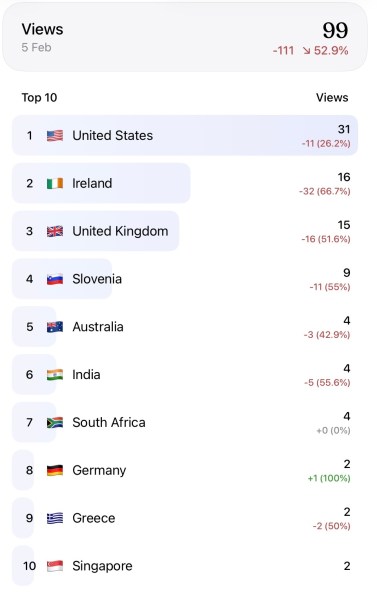
This is what I can see behind the scenes! My Top 10 customers on any one day!  As you can see, I have many loyal followers in India!

In addition to publishing material that students studying for Leaving Cert and A Levels snap up, I also write posts that reflect my own interest in poetry. Chief among these is my near obsession with Michael Hartnett, who was reared in Maiden Street in Newcastle West. I knew him when he returned to live in Glendarragh, near the town, from 1975 to 1985. I also had the pleasure of teaching his son, Niall. I have done some exhaustive research on his background, influences and, of course, his poetry, which I love. I have enough material on one of his iconic poems, The Retreat of Ita Cagney (Cúlú Íde in Irish), to write a PhD thesis! Maybe someone else will take up that baton in time!

I am also very interested in local history, and I have done some research into the etymology of some local places and place names, like Ahalin and Clouncagh in my own parish and Maiden Street in Newcastle West. The harsh reality, however, is that even though I have about 400 active followers, very few read my ‘local’ stuff! Like Goldsmith’s village schoolmaster, I sometimes feel that I am ‘wasting my sweetness on the desert air’!

Now, I mentioned rabbit holes in this rambling essay’s title, so here’s why.  Teachers worry that the era of books is over, and their worst fears may be about to be realised.  Alice, in that wonderful story, disappeared down a rabbit hole, but the power of our internet age gives us all the opportunity to disappear down several rabbit holes each day, to our great advantage and for further education.  I’ll give you an example now, and you’ll quickly see that you couldn’t do this trick with a novel or even a textbook.  All you have to do is click the links below, and down that rabbit hole you will go!

My blog contains several reviews of novels, plays, and films, mainly material that interests me personally. I have reviewed many Irish writers, like James Joyce,  John McGahern, Claire Keegan,  Donal Ryan,  Jennifer Johnston,  John Boyne, Seamus Deane, Brian Friel, and  Kate Cruise O’ Brien. I have reviewed plays from Knockaderry Hall to The Abbey Theatre and have had great fun reviewing films like The Banshees of Inisherin for my own enjoyment.  Each link opens up an opportunity for further, deeper study – if you so wish.  If you’d like to read some of my Hartnett material, then simply click on The Hartnett Files and off you go!

I’ve had the odd post go viral, such as Michael Hartnett’s 26 Pubs at Christmas!, which I posted just before Christmas 2023. By Christmas Day, 12,000 people had read it, which was a great Christmas present indeed. The most views in a day occurred on the 7th of June, 2022, the day before yet another COVID-affected Leaving Cert began: would you believe it, 3,959 chancers visited my blog that day looking for inspiration before the English exam on the following day!  In truth, I am astounded by the stats, and the internet audience is staggering.  Here are just a few of my most read blog posts, the major hitters: Study Notes on ‘Foster’ by Claire Keegan – 131,000 views, An Analysis of Inversnaid by Gerard Manley Hopkins – 14,000 views, A Brief Analysis of Seamus Heaney’s poem ‘Death of a Naturalist‘ – 15,000 views, Analysis of  ‘The Forge’ by Seamus Heaney – 76,000 views, Character Study of Elizabeth Bennet and Mr Darcy in ‘Pride and Prejudice‘ – 108,000 views, An Analysis of the Poetry of Thomas Hardy (1840  – 1928) –  40,000 views, and finally, AN ANALYSIS OF THE POETRY OF ROBERT FROST (1874  – 1963) –  32,000 views, etc., etc.

All my material is freely available to view. Still, unfortunately, I have noticed recently that sites in China and America have been harvesting all my material to enrich their dubious AI project.  I haven’t been approached for permission – or indeed payment.  Such is our crazy world!

Anyway, a quote from Leonard Cohen sums up the overwhelming ethos of my blog. I don’t believe in perfection and have always agreed with him when he says in his iconic song, Anthem:

Ring the bells that still can ring,

Forget your perfect offering,

There is a crack in everything,

That’s how the light gets in.

 

Music to the ears of any blogger! Stats booming!
Music to the ears of every blogger! Stats booming!

Brandon Creek Epiphany – and a Rant!

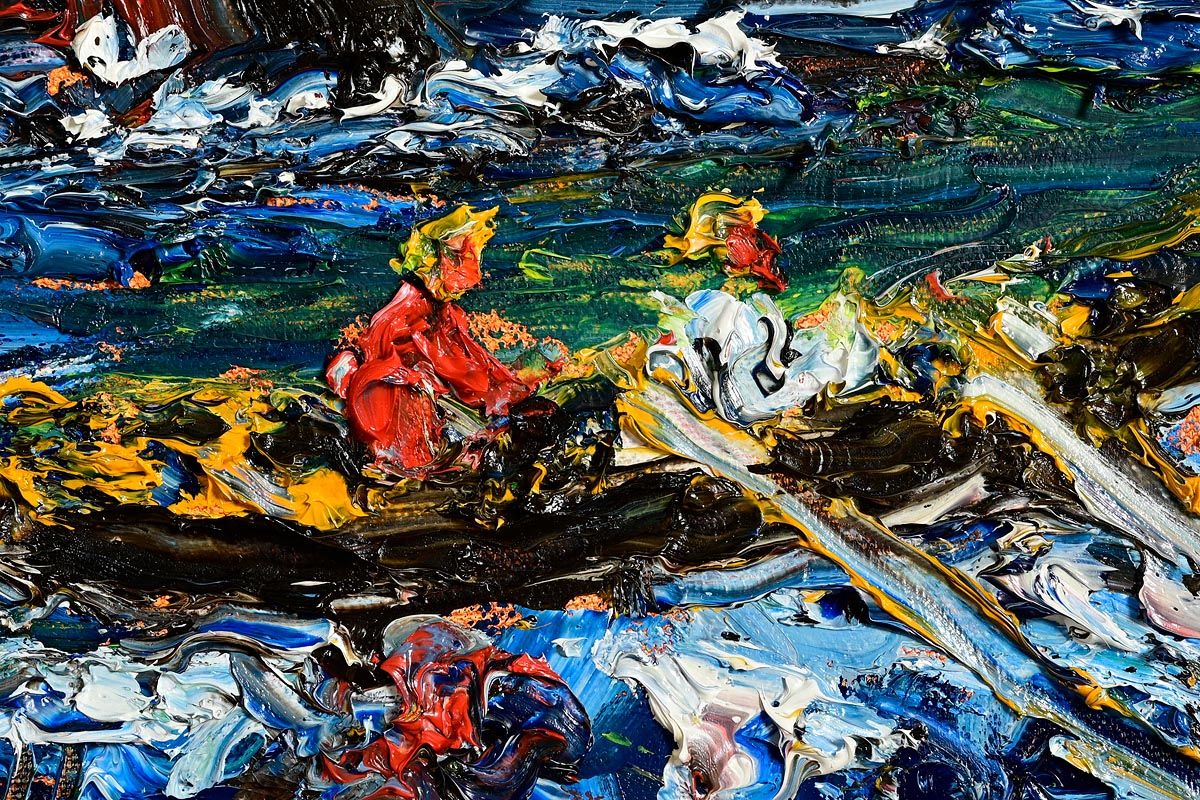
‘Brandon Creek, West of Dingle’ by Liam O’Neill/Morgan O’Driscoll.

The title of this blog is ‘Reviews, Rants and Rambles’ and since 2015, there have been many reviews and rambles but very few rants – so here’s one:  We are living through the craziest of times.  Like Macbeth after his confrontation with the witches, ‘ Nothing is but what is not, ’ and global leaders have taken their chainsaws to the truth.  Irony is everywhere: billionaires and huge multinational corporations try with all their ingenuity to destroy all borders so that their profits are maximised, while at the same time their political buddies stoke nationalistic fervour and division and demonise immigrants and those who cross borders to a better life.  Globalism is the buzzword, but global efforts to combat impending Doomsday scenarios and pandemics have been seen to be pathetic attempts at cooperation. Rant over.

The summer of 2024 was yet another Climate Change paradox in Ireland.   The Jetstream seemed to be stuck in some Groundhog Day cycle during June, July and most of August. There were no two days the same; no long sunny spells, rain was never far away, although rainfall amounts were below normal levels.  Towards the end of August, a temporary high moved in over Ireland and Kate and I decided to take full advantage. On Friday, August 30th, Don’s birthday, we decamped to Dingle.

On Saturday morning, we decided to head out west towards Baile na nGall, and on the way, we stopped off at Brandon Creek to explore this unheralded and largely forgotten gem on the Wild Atlantic Way. On that morning, it was indeed sensational, and a revelation and my words are inadequate to describe the beauty and tranquillity of the place. We parked our car in an unofficial grassy layby near the top of the narrow roadway leading to the Creek and the neglected pier. The narrow single-lane path descended to a very rustic bridge over the creek. The solitude was magical and eerie. I couldn’t help but think that in another era, this narrow roadway would have been used to collect guns and other contraband smuggled into this isolated cove in the dead of night.

Maybe this scenario from bygone days was prompted by the many rebel songs and ballads and stirring sea shanties we had listened to the night before from the marvellous local group, Tintéan, in Murphy’s pub in Dingle. They had entertained a very diverse and varied audience with a two-and-a-half-hour session of rousing rebel songs, some of which even the Wolf Tones wouldn’t include on their concert playlist for fear of offending someone! The Irish diaspora was there in force from Ohio, Connecticut, and Washington; I even had trouble distinguishing between the Canadian and South Florida accents! Then there were couples from Spain, Germany, and Sweden and holidaymakers from Derry, Tipperary, Limerick and Kerry.

As we walked down the steep incline to the pier, there was much evidence of neglect and some evidence that, at one time, the now rusty winch had been used to haul the local currachs with their catches up onto the pier. I walked to the end of the pier and could hear the quiet, rhythmic gurgling of seawater in the hollow caverns at its base. I imagined what it would be like in the throes of an Atlantic storm. It was hard to believe that it was from this very location around 600 AD that Saint Brendan the Navigator was reputed to have set out and discovered America.

There is much talk today, especially across the water, about the problems caused by small boats precariously being used to bring immigrants to Britain’s shores. St. Brendan and his hardy crew of monks not only made it to Iceland and probably Newfoundland and Labrador, but they also made it home again! There is some anecdotal evidence and much more scientific evidence that the people living today in those far-off regions carry West Kerry genes, so the monastic concept of celibacy must have been an optional requirement in those early days!

I also remembered that in the 1970s, the explorer, writer and filmmaker, Tim Severin, tried to recreate St. Brendan’s voyage in an effort to prove that the 6th-century Irish saint could have reached the Americas 900 years before Columbus.

On May 17th, 1976, Severin and his three fellow crewmen rowed out of this same Brandon Creek to begin what would prove to be a 7,200km epic journey. I remember avidly following their progress as Severin and his crew first sailed to the Aran Islands and from there to Iona, the Hebrides, and the Faroe Islands, before sailing on to Iceland and Greenland and from Greenland to Newfoundland.

On June 26th, 1977, some 13 months after leaving Brandon Creek, Severin and his crew sailed into Musgrave Harbour on Peckford Island, Newfoundland and were welcomed as heroes by the locals who fully appreciated the navigational feat.  Amazingly, there is nothing on the pier in Brandon Creek today to remember those heroic feats of yesteryear.

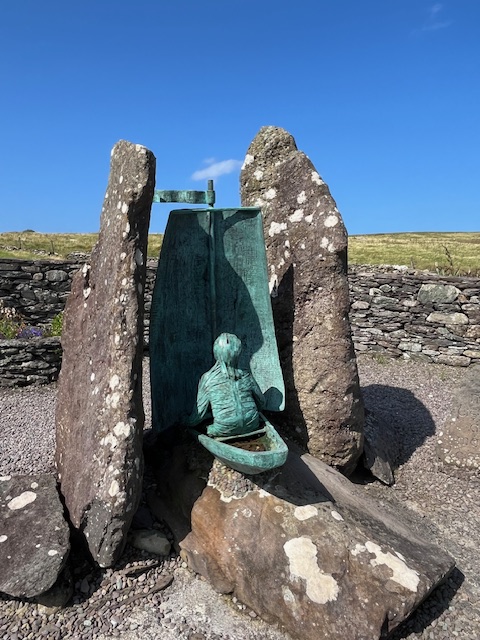
Kate and I made our return journey up the steep, narrow incline with visions of the stormy gunrunning scene from Ryan’s Daughter playing in my head. As we reached our car after the slow climb, I noticed what seemed like a half-hidden art installation surrounded by low walls of local stonework. At first, I took it to be yet another of the numerous shrines and grottos that lie scattered all over this Gaeltacht region, but this was different. While I was exploring this very unobtrusive, unflagged surprise, Kate had struck up a conversation with a woman whose car was also parked nearby. I continued on my way and came upon a copper-green sculpture depicting a lone sailor navigating between two standing stones, which, I presume, were meant to represent the perils encountered on an ocean voyage. The sailor seemed to be sailing blind as his view forward was blocked by the fragile sail on his lowly currach. I presume the sculpture was meant to depict the voyage of St. Brendan in his frail craft all those centuries ago. There was an inscription in Irish on a red sandstone flag nearby, which read ‘Ná ligamís ár maidí le sruth’.  I wanted to remember this, so I took a note of it on my phone.

I returned to the car where Kate was waiting, and she told me of her conversation with the woman she had met. The woman had set out that morning at 6 a.m. on her own and had climbed the nearby Mount Brandon. It had taken her three hours to climb to the summit and three hours to make her descent. Because she was muddy and splattered from the climb, she had decided to go for a swim down in Brandon Creek before heading home.  Needless to say, we were both in awe of this woman’s achievements. This hardy soul epitomised for us the strength and resilience of the locals in this almost-forgotten outpost of our country. I then told Kate what I had got up to and the marvellous discovery I had come across, something not mentioned in any of the Bord Fáilte brochures in nearby cosmopolitan Dingle. I told her about the inscription I had come across and translated the hopeful message as best I could.

Sometimes when we begin to doubt our ability to solve personal or global issues like climate change, the inscription from that beautiful, wild and neglected place has, for me, the feel of a powerful call to arms:

‘Ná ligamís ár maidí le sruth’

‘We must never rest on our oars’