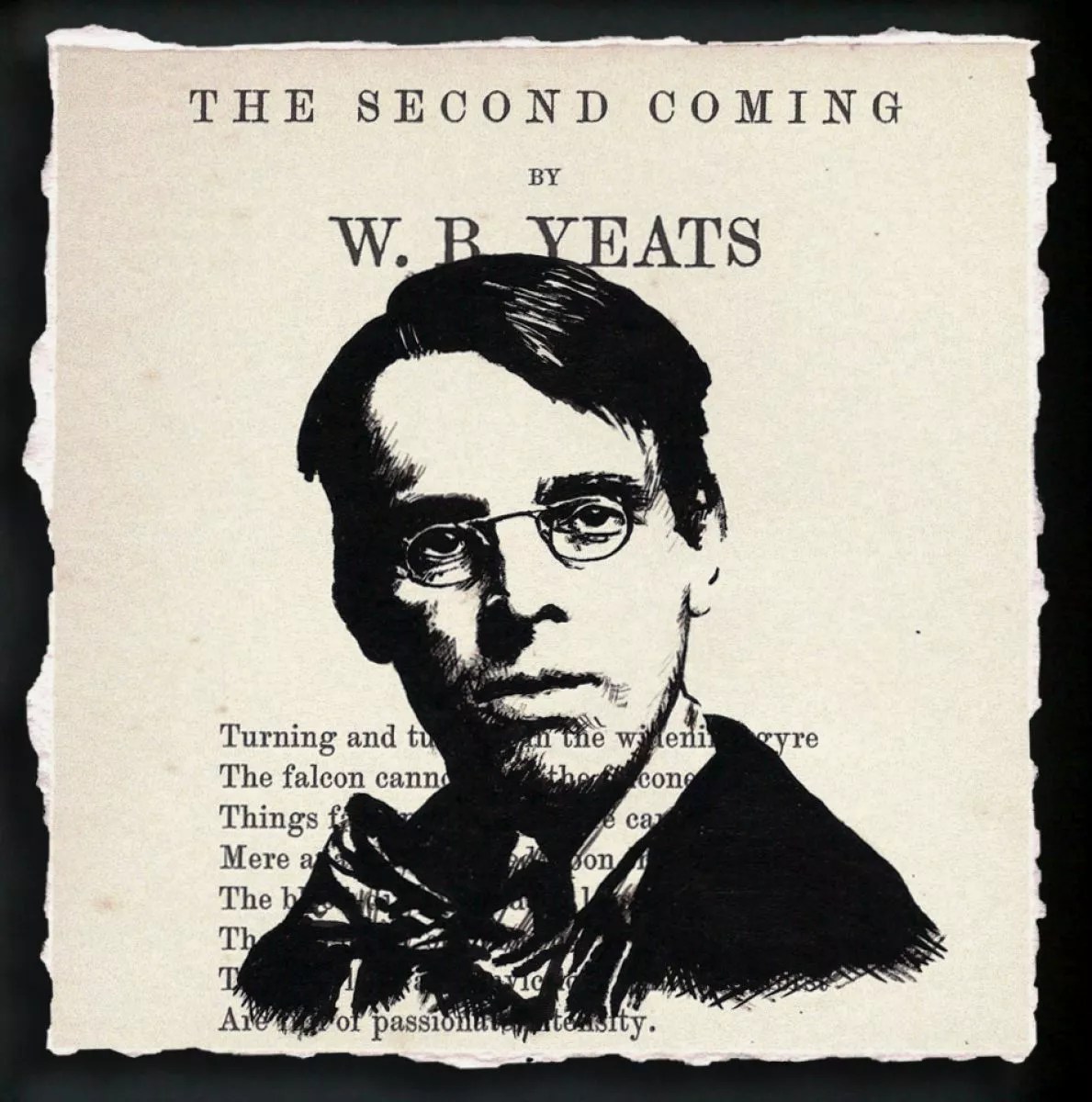
The Second Coming
Turning and turning in the widening gyre

The falcon cannot hear the falconer;

Things fall apart; the centre cannot hold;

Mere anarchy is loosed upon the world,

The blood-dimmed tide is loosed, and everywhere

The ceremony of innocence is drowned;

The best lack all conviction, while the worst

Are full of passionate intensity.
Surely some revelation is at hand;

Surely the Second Coming is at hand.

The Second Coming! Hardly are those words out

When a vast image out of Spiritus Mundi

Troubles my sight: somewhere in sands of the desert

A shape with lion body and the head of a man,

A gaze blank and pitiless as the sun,

Is moving its slow thighs, while all about it

Reel shadows of the indignant desert birds.

The darkness drops again; but now I know

That twenty centuries of stony sleep

Were vexed to nightmare by a rocking cradle,

And what rough beast, its hour come round at last,

Slouches towards Bethlehem to be born?
Source: The Collected Poems of W. B. Yeats (1989)
Commentary
The Second Coming surely holds the distinction of being the most plundered poem in the English language. To fully understand the poem, we are required to have some biblical knowledge as well as a basic understanding of Yeats’s vision of history. The biblical reference is twofold: the poem blends Christ’s prediction of his own second coming with St. John’s vision of the coming of the Antichrist, the beast of the Apocalypse. This is ‘the rough beast’ of the second last line of the poem. Yeats makes the rough beast even more disturbing and sinister by assigning its place of birth to Bethlehem, the place of Christ’s birth, associated over the course of two thousand years – until recent times – with peace, mercy, gentleness and forgiveness.
To understand Yeats’ cosmology it is essential to read his book, A Vision where he explained his views on history and how it informed his poetry. Yeats saw human history as a series of epochs, what he called “gyres.” He saw the age of classical antiquity as beginning with the Trojan War and then that thousand-year cycle was overtaken by the Christian era, which he suggests is now coming to a close. That is the basis for the final line of the poem, “And what rough beast, its hour come round at last/ Slouches towards Bethlehem to be born?” In his mystical book, A Vision, he foretold the birth of a new, violent, bestial anti-civilisation and the simultaneous destruction of the two-thousand-year-old Christian cycle. The second coming of the poem is thus not that of Christ but of his opposite, the slouching, revolting figure of the beast whose birth will herald in a new age of anarchy to be ‘loosed upon the world’ (line 4). Yeats’s thesis in A Vision is that each epoch or period of history is eventually overthrown by some massive upheaval. This may explain why Yeats used the phrase “the second birth” instead of “the Second Coming” in some of his first drafts.
It is in this context that the opening lines of the poem should be read: ‘Turning and turning in the widening gyre / The falcon cannot hear the falconer’. The falcon here is an image of man rapidly losing contact with Christ the falconer as he moves along the widening gyre of history. The next six lines paint a grim picture of the beginning of a new age, marked by worldwide anarchy and violence (‘The blood-dimmed tide is loosed’). As the gyre widens, ‘things fall apart; the centre cannot hold’. The end of the Christian age is granted the revelation of the character of the new age. The tide of violence has already begun to move, and as it does, it begins to drown ‘the ceremony of innocence’ which, in Yeats’s symbolic system, stands for order and harmony as opposed to the personal and social violence of the ‘blood-dimmed tide’.
The ‘vast image out of ‘Spiritus Mundi’ (line 12) is a favourite Yeatsian idea. According to Yeats, Spiritus Mundi is a storehouse of ideas deriving from the great universal memory common to all humankind, and is also the source of prophecy, since, he believed, history repeats the same predestined cycles every two thousand years or so.
The more terrible events associated with the coming of the Antichrist are all in the future, but in lines 3 – 8, Yeats suggests that his world is already experiencing a foretaste of the grim future heralded by the birth of the ‘rough beast’. There was plenty of evidence all around him in 1919, the year he composed the poem. Yeats began The Second Coming during the tense, eventful month of January 1919. The ‘war to end all wars’ was barely over and the Russian Revolution, which dismayed him, was still unfolding, while another war was brewing on his doorstep. On 21 January, the revolutionary Irish parliament met in Dublin to declare independence while, in a quarry in Soloheadbeg in Tipperary, Dan Breen and other members of the IRA killed two officers of the Royal Irish Constabulary ushering in the War of Independence. This war threatened to uproot the Anglo-Irish ascendency and the civilisation it represented, many elements of which appealed to Yeats himself. Empires and dynasties were all in a state of flux as a result of this anarchy and revolution that had been loosed upon the world. The birth of Yeats’s daughter, Anne, in February, was also fraught with danger. During her pregnancy, his young wife Georgie Hyde-Lees had been stricken by the Spanish flu that was burning through Europe at that time in the wake of the war. All these events conspired to put Yeats in an apocalyptic frame of mind.
For Yeats, the Incarnation of Christ was a violent, turbulent event, after which ‘twenty centuries of stony sleep / were vexed to nightmare by a rocking cradle’. This new incarnation, that of the slouching ‘rough beast’ will unleash universal horrors. Its sinister possibilities are hinted at in the suggestion that even the predatory desert birds, for all their savagery, are ‘indignant’ at its coming.
The poem gives us a frightening account of the fate in store for the post-Christian world. Social anarchy and massive destruction are made worse by the collapse of moral values among the leaders of nations: ‘The best lack all conviction, while the worst / Are full of passionate intensity’. He predicts that evil will triumph in the public sphere because those political leaders who might be expected to defend humane values (and basic human rights) lack the determination to resist those who preach violence and intolerance.
As I mentioned earlier, The Second Coming has become perhaps the most plundered poem in the English language – only Heaney’s From ‘The Cure at Troy’ comes a close second, with its ‘let hope and history rhyme’ so beloved of politicians. At 164 words, The Second Coming consists of almost nothing but quotable lines. Someone reading it for the first time in 2024 might resemble the apocryphal theatregoer who complained that Hamlet was nothing but a bunch of quotations strung together. Whether or not it is Yeats’s greatest poem, it is by far his most useful. As Auden wrote in “In Memory of WB Yeats” (1939), “The words of a dead man / Are modified in the guts of the living.” We have to admit, after its first one hundred years, this poem was built to last.
As our world has recently been wrenched out of joint by the Covid-19 pandemic, many people are turning to poetry for wisdom and consolation. However, The Second Coming fulfils a different role, as it has done in crisis after crisis, from the Vietnam War to 9/11, to the genocides in Rwanda or Syria or Gaza, to the election of Donald Trump and to the looming prospect of his imminent re-election: it provides us with an opportunity to confront chaos and dread, rather than to escape it. This is surely why Fintan O’Toole has proposed the “Yeats Test”: “The more quotable Yeats seems to commentators and politicians, the worse things are.”


 Reviews Rants and Rambles
You must be logged in to post a comment.