The Joys of Walking

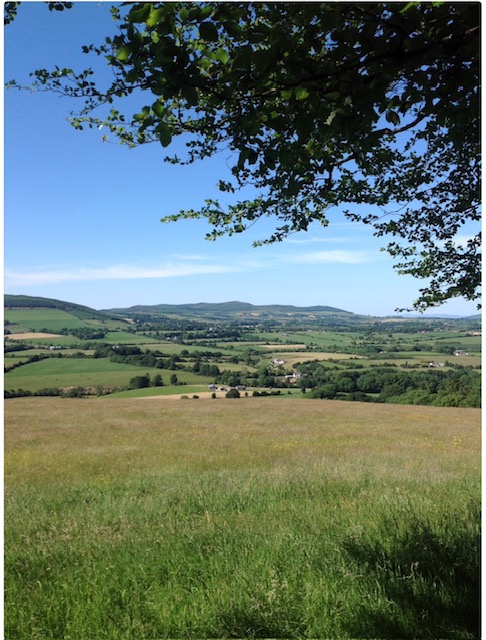
Photo taken looking out from Johnny Hennessy’s memorial on the way up to Castlegale through the old Gabhairín Rua pathway. Beautiful view of Glenroe, Ballintubber and Slievereagh.

I became a serious walker in 2009! For several years before that, I had been severely hampered by arthritis in my left hip. After years of being told that I was too young for a hip replacement, I had the operation in Croom in November 2008. The operation was a complete ‘textbook’ success, according to my very favourite orthopaedic surgeon, Eric Masterson.

The operation gave me a new lease of life and, whereas up to that time walking was a painful chore, now I felt energised and ready to explore. Since then, I have loved to walk – in Summer especially or when the scales tip 215 lbs! I head off, and a trek of twenty kilometres is not unusual. I have visited all my local villages on foot, in their turn, Rathkeale, Ballingarry, Castlemahon, and Kilmeedy. In recent years, since Mary moved to Glenroe, I have gloried in rediscovering the Ballyhouras, and whether it is a trek over Sheehy’s Hill or climbing up to Castlegale or the more arduous Darragh Loop, the trails and loops have brought me great joy. 

Castlegale is a great parish reference point.  Looking south, it dominates the landscape.  I remember my mother telling me that in the landlord days of rents and rackrents, the Gascoignes of Castle Oliver placed a flag on the cairn at the summit of Castlegale to let tenants know their rents were due.  Today, Castlegale is central to some of the many amazing trekking loops which have been developed in recent years by the Ballyhoura Bears and by Ballyhoura Development.  The walk to the summit from Darragh takes you through the beautiful ancient pathway, the Gabhairín Rua.

The Ballyhoura Region itself is a truly mythical landscape – Seefin, Glenosheen, Glenanaar, the Black Dyke, Ardpatrick – these high places carry evidence of cairns or old monastic ruins, a strange mixture of the ancient battles between the old dispensation and the new.  And up in these hills, you come across strange sights as you ramble.  I’ve come across Army Rangers perfecting their orienteering skills, in full combat gear, traversing this God-forsaken wilderness on their way to rendezvous with other members of their regiment. 

The name Seefin (Suí Finn) translates as the ‘Seat of Fionn (Mac Cumhaill)’.  It is so named because, according to tradition, Fionn and his Fianna rested here on their hunting excursions to the other sacred places, like Knockainey (Cnoc Áine), and our other sacred Limerick hill, Knockfierna (Cnoc Fírinne).  Down below Seefin, the highest point in the Ballyhouras, is the quaint Palatine village of Glenosheen, named in honour of Óisin, the son of Fionn.  The village is famous as one of the settlements established by a colony of Irish Palatines, German Protestant refugees, who settled there in the early 18th century.  Some of their historic houses and family names, like Switzer, Teskey, Ruttle, Young, Sparling, Wolf, Baker,  Weekes and the Steepes, are still evident today.  Their main settlement in Limerick was Rathkeale, where they used their expertise to bolster the emerging linen and flax industry in the area. Today, in Rathkeale, there is a fabulous Palatine Museum at the trailhead for the West Limerick Greenway dedicated to their memory.

Glenosheen is also remembered as the birthplace of the famous Joyce Brothers, Patrick Weston Joyce and Robert Weston Joyce.  Patrick Weston Joyce (1827 – 1914) was a distinguished educationalist who, would you believe it, began his teaching career in Glenroe N.S. at the age of eighteen.  He had been educated in numerous well-known and well-endowed Hedge Schools in Kilfinane, Kilmallock and Mitchelstown by the very best travelling scholars.  He taught in a number of schools, including the High School Clonmel, before eventually going on to have a distinguished career at Trinity College, Dublin.  Here, he made a name for himself as a historian, a linguist, and a significant collector of Irish folk music and traditional airs. He held influential positions in the Irish education system and authored numerous works on Irish history, place names, and the Irish language. His efforts helped preserve a vast amount of Irish cultural heritage.  Indeed, the first book I ever read when I was in Fifth Class in Primary School, having recently graduated from comics, was his fabulous collection of old legends, Old Celtic Romances, telling the almost forgotten tales of Fionn and Óisín, Cúchulainn and Diarmuid agus Gráinne.

His brother, Robert Dwyer Joyce (1830 – 1883), was no less famous and distinguished.  He was a medical doctor who achieved renown as a writer, poet, and song lyricist. He was associated with the Fenian movement (1867) and wrote popular ballads, including ‘The Wind that Shakes the Barley’ and ‘The Boys of Wexford’. His literary contributions often centred on Irish themes and history. He also spent time in the United States, where he was well-regarded. 

Further west, and nearer to home, I love trekking on the slopes of Knockfierna, near Ballingarry in County Limerick.  This place is famous for its poignant Famine Village history, where, during Famine times, over a thousand people lived in makeshift homes on the side of the hill.  It is a unique experience to walk among the ruins of the semi-restored cottages, shebeens, and Rambling House.  Today, thanks to the work of Pat O’Donovan and his restoration group, the Knockfierna Famine Trail leads visitors past these preserved cottage ruins, garden plots, and other memorials, offering a moving, reflective experience amidst stunning views of the Golden Vale.  The whole experience showcases both Irish resilience and the devastating impact of the famine. 

Another one of my favourite rambles is in The Castle Demesne in Newcastle West, Co. Limerick, especially when rain threatens.  This beautiful 100+ acre sylvan parkland with walking trails, playgrounds, and picnic spots, surrounding the historic Desmond Castle and its Banqueting Hall in the town square, is heavily wooded, and there is great shade from wind and blustery showers. It is an amazing family-friendly amenity right by the town centre, and it is easily connected to the scenic Limerick Greenway. This historic site, once home to the powerful Earls of Desmond, including the famous third Earl of Desmond, Gearóid Íarla, features centuries of history with stunning parklands for leisurely strolls, rich flora and fauna, and is a central part of Newcastle West’s heritage.  Legend has it that Gearóid disappeared in mysterious circumstances in 1398 while walking in the Demesne grounds, and today he is fabled to live beneath the waters of Lough Gur, near Bruff, over whose waters he is said to appear once every seven years, riding his white steed.

I am also very lucky to have the fabulous Limerick Greenway within striking distance.  I have to say it is becoming more and more dangerous walking on minor country roads; such is the total absence of courtesy, and speed limits are totally ignored.  Thankfully, I now have The Greenway, which was built along the former Limerick to Tralee railway line, and after many years of development, is now a state-of-the-art off-road cycling and walking route that can be accessed through numerous entry points.  The Greenway weaves its way through West Limerick’s traditional agricultural landscape, starting in Rathkeale, on through Ardagh, Newcastle West, Barnagh, Templeglantine and finishing in Abbeyfeale, passing through Tullig Wood, with its mature, serene woodland and native trees, providing a restful calm and balm for all travellers.

Walking by the sea offers therapeutic benefits, combining gentle exercise with stunning views.  There are other benefits, such as stress relief and connecting with nature. Whether one sets out on a relaxing stroll on sandy beaches or undertakes the more vigorous coastal path hikes, one can be enriched by the bracing fresh air, the sound of waves, the prospect of some whale spotting and the occasional sea wreck. It’s a popular way to enjoy leisure time, explore scenic routes, and find peace, like the beautiful hike out past the Diamond Rocks in Kilkee and up Dunlicky or George’s Head. 

One of our favourites is the Ballycotton Cliff Walk, definitely a podcast-free ramble, with majestic sea vistas looking out over the final resting place of the doomed Lusitania.  No trip to Ballycotton is complete without a rewarding visit to nearby Ballymaloe for a coffee and delicacies! Or when in Ardmore, head out past the Cliff House Hotel and the ruins of St. Declan’s Hermitage and Well and enjoy the stunning sea views and ramble back towards the quaint little seaside town via the majestic Round Tower.  It is a stunning looped coastal trail offering beautiful sea views, historical sites, and the chance to spot the Samson crane barge wreck in its lonely final resting place.

Since retirement, we have been making frequent visits to the Canary Islands and especially, Puerto Rico in Gran Canaria. This place, as opposed to Puerto del Carmen, is challenging enough and rambles in the early morning or after four in the evening are recommended. Kate and I have been coming here now for the past twenty years, and each visit uncovers new delights, and improved pathways, steps and roadways. Our favourite walk is the Cliff Walk between Puerto Rico Beach and the man-made Amadores Playa. This is an easy ramble and often a preamble to more strenuous excursions.

We invariably book accommodation on the lower level. Corona Cedral would be our favourite place of all, but we have also stayed in Monte Verde, Letitia del Mar, Maracaibo, and Rio Piedras, with its terracotta terraces overlooking the beach. All these are very central – near the two main Shopping Centres and the beach and its many restaurants.

The only drawback I find with Puerto Rico is its distance from the airport – approximately 40 kilometres. However, Gran Canaria has a first-class public transport system and once free of arrivals and the terminal building, you can go to the bus terminal and get the 91 bus to Puerto Rico for €5.45 – as opposed to €70 for a taxi. Alternatively, Ryanair and others provide reasonably priced shuttle services to and from the airport.

Casting a long shadow before descending those 756 steps!

As one becomes familiar with the area, one becomes more confident in foraging out new trails, loops and challenging treks. The one thing to notice is that there are steps everywhere linking the various levels. The local authority has done fabulous work in the past five years, building a series of steps from the beach to the high point near Puerto Azul apartments. In all, there are 756 steps in this series – individually counted! Depending on your exertions, you can decide to descend the 756 or take on the more daunting challenge and ascend – or even decide to work both into your evening ramble!

Evening walks usually involve thoughts of home and the girls, Maeve, Anna, Muireann and, of course, Mary, Mike and Don. There is a tree on one of the summits which I always associate with them. It grows in the centre of a roundabout down the road from the Europa Centre, and very near the Balcon de Amadores apartment complex, and invariably, when I get this far, I usually give them a ring to check how things are, and to check on Knockaderry’s, Clanna Gael Fontenoy’s, or Limerick’s progress in the Championship.
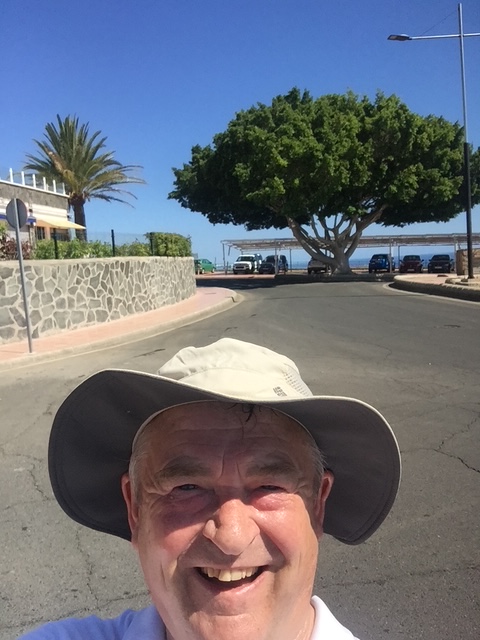
Selfie with a tree!

On Lanzarote, ‘El Varadero de la Tinosa’, is the original village of what is now the thriving Old Town centre of Puerto del Carmen. Today, it is still a centre for fishing, and there is a very strong seafaring tradition in the area.  The beautiful little church sits just feet from the water’s edge, facing the little fishing port.  Today, it is a centre for tourist trips, and there is a regular hourly ferry plying between the port and Puerto Calero – the destination for one of my favourite rambles.  Leaving Casa Roja restaurant, we walk to the end of the boardwalk and to the newly paved area at the top.  There are lovely views out to sea and many viewing areas along this stretch of the walk.

We walk south-east along the coast. The distance is 2.2 kms. approx and the walk, taken at a nice brisk pace, will take you about thirty minutes.  The path now changes to a dirt track, and there is evidence of the remnants of an ancient stone road which runs above a small cliff that permits a glimpse from above of the intertidal area, its coves and small inlets.

We arrive at ‘The Barranco (ravine) del Quiquere’, of interest because its volcanic sides contain engravings from the indigenous world of the island of Lanzarote. We can get a close look at them by taking the track just 50 metres to the north on the right side of the ravine as you walk from Puerto del Carmen. 

The views of the sea and islands of Lobos Island and Fuerteventura to the south enhance the beauty of the landscape in this area, and eventually we arrive at the newly man-made marina of Puerto Calero. This beautiful port and marina are a fitting ending after our cliff walk, and a ramble around the upmarket shops and outlet stores is highly recommended.  There are also numerous high-quality restaurants and at least two hotels nearby.  Puerto Calero is renowned as a headquarters for some round-the-world yacht crews, and after a brief look around, you will see why.

Ralph Waldo Emerson has laid down my walking ground rules: “Few people know how to take a walk. The qualifications are endurance, plain clothes, old shoes, an eye for nature, good humour, vast curiosity, good speech, good silence, and nothing too much.” I am also reminded that numerous other poets, philosophers and novelists have also wandered and wondered. Kierkegaard did so in the countryside near Copenhagen and suggested that it might be good for his niece, Jette, to do likewise. Prompting her in 1847, he came up with a notion I repeat on my own travels: “Above all, do not lose your desire to walk. I walk myself into a state of well-being and walk away from every illness. I have walked myself into my best thoughts, and I know of no thought so burdensome that one cannot walk away from it” (A Letter to Henrietta Lund from Søren Kierkegaard, 1847, trans. Henrik Rosenmeier, 1978).

I haven’t read many of HG Wells’ novels, but there’s another mantra from one of the non-fiction works, Modern Utopia, that I’ll happily take to my grave: “There will be many footpaths in Utopia.” And whether I’m rambling in the Ballyhouras or Ballycotton or above Ashford on the Cob Road or the hills above Bormes les Mimosa, in the Provence-Alpes-Côte d’Azur Region, southeastern France, or in Puerto Rico, my favourite nugget of wisdom is, of course, T.S. Eliot’s evocative words from The Waste Land (1922), surely one of the most beautiful poetic lines ever written, “In the mountains, there you feel free.”

In conclusion, I am often reminded of the lovely Latin phrase, Solvitur ambulando – ‘it is solved by walking’ – sometimes attributed to St. Jerome or Diogenes, or St. Augustine, maybe even Thoreau or Chatwin, inter alios…..

So, put your best foot forward!
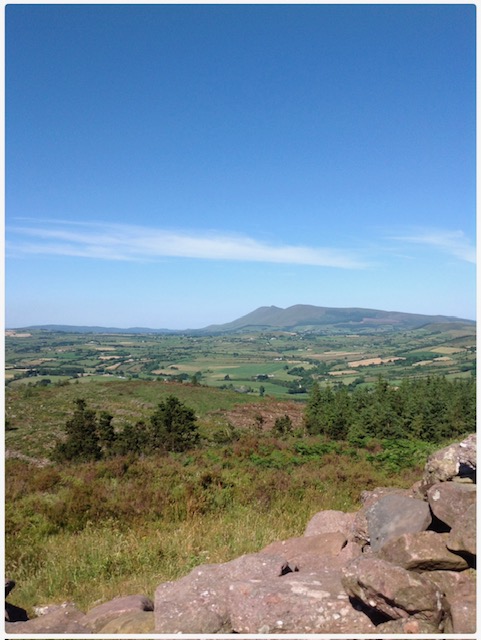
Looking towards the Galtees from the sandstone cairn on the summit of Castlegale.

Some Glendarragh Poems of Michael Hartnett: Poems from the Hearth

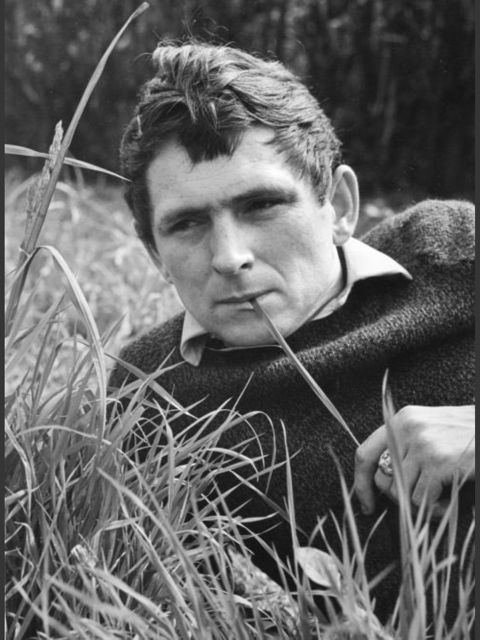
A pensive Hartnett ‘among (his) nameless weeds’. Photographer unknown.

As I have mentioned already in another post here, the decade from 1975 to 1985 in Glendarragh, Templeglantine, was arguably the most productive of Hartnett’s career.  Indeed, the output from that little cottage in the shade of ‘Tom White’s green hill’ in Glendarragh was prodigious.  The first poems to be published were his collection A Farewell to English, which was published in 1975, and thus began his long-lasting association with Peter Fallon and The Gallery Press.  The same year saw the publication of The Retreat of Ita Cagney / Cúlú ÍdeAdharca Broic was published in 1978, followed by An Phurgóid in 1983, Do Nuala: Foighne Crainn in 1984 and his fourth collection in Irish, An Lia Nocht, appeared in 1985.  During this period, he also undertook the translation of Daibhí Ó Brudair’s poems, which were published in 1985.  Many of his better Glendarragh poems are contained in the 1987 collection, A Necklace of Wrens.  This collection, following his return to Dublin, contains all poems in Irish with their English translation that Hartnett wanted preserved for posterity, and it was edited by Peter Fallon.

During this decade, 1975 to 1985, in parallel to this ‘serious’ output, he was writing and entertaining the locals with ballads, some serious or semi-serious like ‘A Ballad on the State of the Nation’, which was distributed as a one-page pamphlet like the ballads of old and even included original linocuttings by local artist Cliodhna Cussen. Other ballads were more contentious and even semi-libellous (or fully slanderous!), such as ‘The Balad (sic) of Salad Sunday’ and ‘The Duck Lovers Dance’.  These latter creations were written under the very appropriate nom de plume, ‘The Wasp’!  His most memorable local work was, of course, ‘Maiden Street Ballad’, a poem he composed for his father as a Christmas present in 1980.

These three intimate family poems were written in Glendarragh, Templeglantine and first appeared in his collection, Adharca Broic, in 1978.  Two of the poems are written for his children: Lara, who was born in 1968 and Niall, who was born in 1971.  These two poems with English translations also appear in his 1987 collection A Necklace of Wrens.   The third poem, Dán do Rosemary, was not included in this collection, and the reason for its exclusion is obvious.  As early as 1978, the tensions and stresses which eventually led to their separation in 1985 were beginning to show.   They were both navigating the inevitable separation, which eventually led to his departure for Dublin and Inchicore that year.  His gift for love poetry is again in evidence, as it had been back in 1968 with the publication of Anatomy of a Cliché.  Unfortunately, the clock had come full circle, and his final poem to Rosemary is one of abject apology and regret and wistful hopes for their post-separation lives.

The poem reads as a sad indictment of the way artists were treated in this country in the 70s and 80s.  They lead a ‘miserable life’, ‘for our lack of money / scrimping and scraping’.    He apologises profusely and admits that their marriage is ‘pitiless, loveless’, which has affected ‘your soft fragile (English) heart’.  Their small rural cottage is ‘run-down’, with ‘walls of clay, tear-stained’, ‘the place is falling apart’.  He takes full responsibility for their sorry plight and admits that he is ‘blundering, tactless, clueless’.  I have said elsewhere that at this time, Newcastle West was booming during the construction phase of the Aughenish Alumina Plant near Askeaton in County Limerick.  Newcastle’s twenty-six pubs were doing a roaring trade, and he apologises to his wife because he is ‘always acting the yob in the pub’. If anything, this poem in the original Irish is far more confessional and personal than most of his poetry up to this time.

The poem concludes on a far more positive and hopeful note.  He tells Rosemary that he has ‘abandoned English, but I never turned my back on you’.  This is a time for reappraisal, and he hopes to ‘relearn my craft from fresh woodland’ – he was living at the time in a townland called Glendarragh – the glen of the oak.  He ends on a hopeful note: he hopes that the future will bring Rosemary happiness and that her ‘worth will be appreciated’.  The final line is so sad and poignant – he hopes that ‘we both reach our America’.  The sadness of this final line arises from the fact that some seven years later, they both parted and went their separate ways.

Cliodhna Cussen, a fellow native of Newcastle West, has an interesting point to make about this poem:

‘Nuair a dhirigh Michéal ar an nGaeilge níor cuireadh aon rófháilte roimhe.  Bhí ceisteanna á n-ardú i dtaobh chaighdeán a chuid Gaeilge, ceisteanna a árdaíodh i dtaobh an Riordánaigh 30 bliain níos túisce. Ach léiríonn Michéal a anam, a chuspóir, agus a ghrá sa tseoid sin de dhán, ‘Dán do Rosemary’, ina bhfuil a chumas agus a chroí nochtaithe aige’.

 When Michael began writing in Irish, he didn’t receive great encouragement from Gaelgóirí.  There were questions about the standard of his Irish, just as there had been about Sean Ó Riordán some thirty years earlier.  But in this gem of a poem, ‘Poem for Rosemary’, Hartnett reveals his soul, his motive, his love – indeed, his supreme craft and heart are laid bare.’ (My own translation).

His poem for his son Niall, Dán do Niall, 7 (‘Poem for Niall, 7’), again shows his honesty and courage, although it does tend to descend into cliché at times.  Like King Canute and his futile attempts to hold back the tide, he wishes that his son wouldn’t have to leave this safe place in ‘Bird Nest country’, their home in Glendarragh.  He tries to warn his son about the many dangers that exist in the outside world and does so by making reference to nature.  This advice is somewhat reminiscent of the advice spoken by Polonius to his son Laertes in Shakespeare’s Hamlet: ‘This above all: to thine own self be true, And it must follow, as the night the day, Thou canst not then be false to any man’.  This suggests that integrity begins with honesty to oneself, and Hartnett gives us a modern take on this when he advises, ‘Be happy but be tough. ’

There is great poignancy in the final stanza when he states that he will be there for his son ‘in spite of death’.  Niall was 28 when his father died in 1999 at the age of 58, and the second line of this stanza adorns the poet’s headstone in Calvary Cemetery in Newcastle West: ‘mar labhraíonn dúch is labhraíonn pár’, ‘for ink speaks and paper speaks’.  The poet is saying that he will be present and live on in his body of work even after his death.  The reality is that he wasn’t there for many of the landmark celebrations in his son’s life, his graduations, his wedding, the birth of his grandchildren and so the promise he makes, ‘and some day I’ll buy you porter!’ sounds very hollow indeed to a young man who must now take on the onerous mantle of preserving and promoting his father’s rich and varied legacy at such a young age.

Hartnett’s grave in Calvary Cemetery, Churchtown, Newcastle West. The inscription reads: ‘Beadsa ann d’anneoin an bháis, mar labhraíonn dúch is labhraíonn pár’, (‘I will be there in spite of death, for ink speaks and paper speaks.’

His Dán do Lara, 10, (‘Poem for Lara, 10’), is a masterpiece.  The sunshine and nature in this poem are at odds with the penury and hardship of the poet’s existence in 1978, nestling below ‘Tom White’s green hill’ in Glendarragh, Templeglantine.  Flame-haired Lara is compared to a rowan tree in autumn, her voice disturbing the larks, ‘in the green grass’.  She is surrounded by nature in all its glory, ‘a crowd of daisies playing with you, a crowd of rabbits dancing with you’.  The blackbird and the goldfinch are there for her amusement and playtime.  Then the master of metaphor compares his daughter: ‘You are perfume, you are honey, a wild strawberry.’    The poem ends with the poet’s wish for his young daughter:

Little queen of the land of books            

may you be always thus                           

may you ever be free                                             

from sorrow-chains.

Interestingly, the poet compares his daughter to a queen in ‘the land of books’; this seems to set the seal on Lara’s perfection. Obviously, a poet would value literature and reading, and his choice of this image is significant as it tells us that Lara has another, deeper side to her – she is not just interested in the outdoors and a lover of nature.

His final wish for Lara is that she will grow up to be as beautiful and graceful as her mother, Rosemary.  He hopes that she will inherit her mother’s beautiful soul as well as ‘the beauty of her face.’

It is fitting that these three poems, written in that little rural cottage in Glendarragh, feature family and the travails of being a husband and a parent.  I have examined many of his papers in the National Library of Ireland on Kildare Street, and it is undeniable that hand-in-hand with arranging his poems and latest projects, there is ample evidence of the presence of young people, Lara and Niall, in the many doodles and scribbles on the margins of those frayed notebooks.

Doodles with Dad – the joys of being a poet with young children!


Dán do Rosemary   le Michéal Ó hAirtnéide

Dán do Rosemary                                               


As an saol lofa seo                                                               

gabhaim leat leithscéal:                                         

as an easpa airgid atá                                             

ár siorsheilg thar pháirc                                                     

ár bpósta mar Fhionn                                             

gan trua gan chion                                                  

ag bagairt ar do shacs-chroí bog ceannúil.          

Gabhaim leat leithscéal                                         

as an teach cloch-chlaonta                                     

as fallaí de chré is de dheora déanta –                 

do dheora boga:                                                       

an chlog leat ag cogarnach                                     

ag insint bréag,                                                        

an teallach ag titim as a chéile.                             

Téim chugat ar mo leithscéal féin:                       

m’anam tuathalach, m’aigne i gcéin,                    

an aois i ngar dom, le dán i ngleic,                       

i mo gheocach sa tabhairne ag ól is ag reic.        

Thréig mé an Béarla                                               

ach leatsa níor thug me cúl:                                   

caithfidh mé mo cheird                                          

a ghearradh as coill úr:                                          

mar tá mo gharrán Béarla                                     

cran-nochta seasc:                                                                                      

ach tá súil agam go bhfuil                                      

lá do shonais ag teacht.                                          

Cuirfidh mé síoda do mhianta ort lá.                   

Aimseoimid beirt ár Meiriceá.                              

Poem for Rosemary

For this miserable life

I apologise:

for our lack of money

scrimping and scraping,

our marriage like Fionn’s

pitiless, loveless,

affecting your soft fragile heart.

I apologise

for our run-down house,

its clay walls, tear stained –

with your soft tears:

the clock is ticking

telling you lies,

the place is falling apart.

I go to you with my apology:

blundering, tactless, clueless,

with a poem in my fist,

and I always acting the yob in the pub.

I abandoned English

but I never turned my back on you:

I now must relearn my craft

from fresh woodland:

because my English copse

is leafless and bare:

but I remain hopeful

that your days of happiness are near.

Your worth will be appreciated yet.

I hope we both reach our America.

Note: This poem is taken from Michael Hartnett’s first collection in Irish, Adharca Broic, which was published in 1978 by Peter Fallon’s Gallery Press. 

My Pipe Smoking Days …..

Hard at work grading Higher Level English papers each July.

I come from a long line of pipe smokers. My Dad smoked the pipe, and from a young age, I wallowed in the wafted aroma of Mick McQuaid, or Condor or Mellow Virginia. My Grandad also smoked the pipe; it was ever-present in his mouth, and I also noticed that he used a cap on his pipe to prolong the smoke. I have to confess, before I go any further, that of all the vices I’ve explored in my lifetime, pipe smoking was my favourite! I began to smoke the pipe at the age of 27 – around the time I got married! In the beginning, before addiction set in, I was an occasional smoker. I smoked a Dutch tobacco called Clan, which was very popular, and it had a beautiful, scented flavour. I was very active at the time, playing football with Newcastle West and hurling with Knockaderry. I continued to rationalise with myself that my pipe smoking had no impact whatsoever on my fitness and, after all, it would have been far worse if I had been smoking cigarettes!

Giving it a try, I entered one of the most compelling, habit-forming subcultures I’d ever found. There are plenty of rabbit holes to go down in life, though few that hold you there so avidly as pipe smoking. Part of it was the tobacco, as different from the cigarette kind as you can imagine. In those early years, I mainly smoked nice light, sometimes aromatic, mellow Virginias. My Aunty Meg spoiled me rotten by bringing me back 16-ounce packets of scented Cherry Brandy flavoured tobacco from her many journeys to New York. I later discovered the time-consuming rituals associated with various plug tobaccos before eventually settling on Yachtsman, my favourite of all. I became an expert mixer of tobaccos and would often add some of my Cherry Brandy mix with my Yachtsman plug to make it go farther. If suppressed memory serves me at all, the mixture was Divine!

Fr. Dan Lane was curate in Newcastle West in the late 80s and early 90s, and we were firm friends. Dan smoked cigarettes mainly, and when he wanted to give them up, which was often, he dabbled with the pipe. Each year, Fr Dan organised a pilgrimage to Lourdes for the Fifth-Year girls in the parishes of NewcastleWest and Abbeyfeale. The pilgrimage set out for Lourdes each year on Easter Sunday and returned a week later. Each year, he would bring copious amounts of tobacco, far exceeding his own Duty Free allowance of cigarettes and pipe tobacco on his return journey.

I remember one evening in 1986, Fr. Dan arrived out to Knockaderry laden down with two Duty-Free bags of pipe tobacco. His doctor had again advised him that he should quit smoking, so he wanted to get rid of the temptation and give his stash a good home. Obviously, I was delighted, and by my estimation, I wouldn’t have to buy tobacco again until Christmas! Later, I went through the treasure trove and found packets of my old favourite Clan, along with pouches of Holland House, Condor, Mellow Virginia, Mick  McQuaid, and some tins of Erinmore and Three Nuns. I’m reminded here of Brendan Behan’s joke about the availability of tobacco while he was in prison. He said that the warden’s favourite brand was Three Nuns – none yesterday, none today and none tomorrow!

Gradually, I became an expert, collecting all the necessary paraphernalia: my beloved Kapp and Peterson Numbers 303, 314 or 317 sandblasted briar pipes, a sleek pipe lighter, pipe cleaners, rustic tampers, a pipe pouch, a small penknife, and a leather airtight tobacco pouch. The pipe was the most essential item, however, and I sourced mine and, in later years, my plug tobaccos from the erudite Eleanor at M. Cahill and Sons Tobacco Shop, 47 Wickham Street in Limerick.

Kapp and Peterson, from their famous shop in Nassau Street in Dublin, were then, and still are, the oldest continuously operating briar pipe factory in the world. They had built up a reputation both here and abroad and they were proud of their tradition and their legacy of craftsmanship dating back over 150 years. A Peterson pipe wasn’t just a utilitarian tool; it was a piece of history you carried with you on your travels, a faithful companion to accompany you through all of life’s travails.

My favourite pipe! Eschewing the robust, muscular aesthetic that defines so much of the Kapp and Peterson style, this classic bent Donegal Rocky 80s briar pipe design is an elegant, timeless shape that haunts my frequent tobacco dreams!!

Pipe smoking is a messy business. Oftentimes, stale dottle became wedged in the pipe bowl from a previous smoke, and this required cleaning with a penknife. Tobacco dust and ash permeate everything and everywhere, and often the smoker doesn’t realise that all those in the vicinity can smell smoke fumes from his clothes, from his breath. Pipe smokers are forever fidgety around their pipe; it requires constant attention and frequent relighting, not to mention the endless ceremonial preparation for yet another smoke.

I have a few very serious confessions to make now that I am a reformed smoker. I cringe when I think that I continually smoked the pipe in the car without a care or any consideration for Kate or my two darlings, Mary and Don, who were in the backseat without gasmasks, seatbelts or any of the modern safety methods that had not yet become legal and essential. I smoked while I was carrying them to music lessons, to matches, to training sessions. I smoked in the house after school; I smoked all day in the study during those long summers correcting Leaving Cert English. I smoked in restaurants, in pubs, and in the street, without a thought for anyone other than my own enjoyment and satisfaction.

Eventually, after many false dawns, I gave up smoking the pipe on the 12th of October 2008. There were several factors which precipitated this major decision. I was due to go to Croom in November that year to have a hip replacement, so I told myself that I needed to be fit and healthy! On March 29, 2004, Tánaiste Michéal Martin, representing the Irish government, introduced the first national comprehensive legislation banning smoking in all workplaces, including bars and restaurants. I was beginning to get the message in 2008! In truth, my momentous decision had been hastened by the repeated price hikes in tobacco in successive Budgets, which were making smoking a very, very expensive hobby. I couldn’t justify it any longer, and so, even though I had just purchased a brand-new Peterson on the 1st of October that year, I went ‘cold turkey’ and never looked back.

On that fateful day, I was aware that I was consciously making a decision to exclude myself from an elite club. Pipe smokers had always traditionally been considered different, and membership of this convivial fraternity was considered to be something special. In our heyday, we were seen as wise, contemplative men who sat and smoked and read serious, leather-bound literature, as well as a world of rugged outdoorsmen, canoeists, fly fishermen and clipper ship captains who puffed their pipes as they pored over nautical charts before sailing ‘round the Horn.  Those halcyon days, unfortunately, are all now, but a hazy pipe dream in the smoky recesses of treasured memories!  I conclude with the immortal words of C.S. Lewis: “A pipe gives a wise man time to think and a fool something to stick in his mouth.”

Michael Hartnett’s Legacy

311030211_471914084962595_2001561487708472105_n
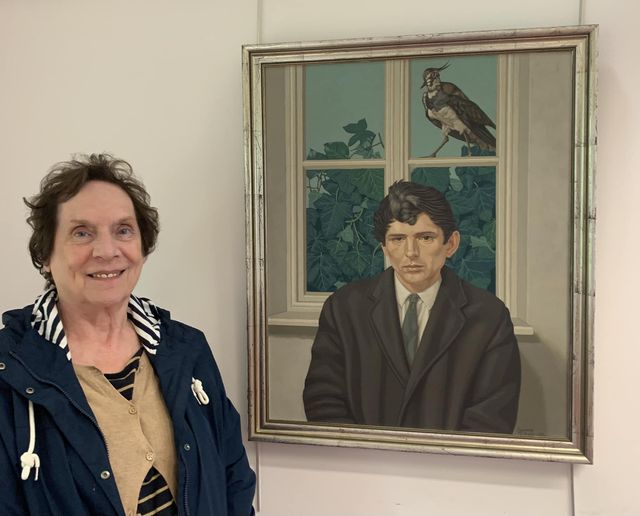
Éigse stalwart, Vicki Nash, pictured next to the 1971 portrait of Michael Hartnett by artist Edward McGuire, which was on display for the opening ceremony of Éigse 2022.

In academic circles, when poetic legacies, such as that of Michael Hartnett, are thrashed out and explored, there is always, of necessity, a legacy BUT.  BUT… he passed away in mid-sentence; his potential was unfulfilled, etc., etc.  We leave such debates to the continuing academic interest in Hartnett, but for those of us who love Michael Hartnett, the debate has already been won.   His core work, what we see in his numerous collections, his brilliant work as a translator, and his lyrical evocation of a Maiden Street upbringing (‘we were such golden children never to be dust’) and his other mischievous local interventions, are timeless and will stand the test of time – no ifs, ands or buts.

For those of us who are true believers, Michael Hartnett’s legacy as one of the central figures in modern Irish poetry is guaranteed. The Éigse Michael Hartnett festival, held annually throughout the town in schools, the library, the Red Door Gallery, the Desmond Complex, St. Ita’s Hospital, the Longcourt House Hotel, and in the ever-dwindling number of local pubs, celebrates that legacy each year. The festival’s wide-ranging and diverse programme creates an atmosphere of warmth and conviviality, perfect for lively gatherings, easy conversation, and spirited debate.

While his memory still lingers among us, however, the pace of change is relentless.  The Newcastle West he wrote so roguishly about has faded into the past, living on only in memory and in his verse.  Many of the central characters in these sagas, such as Tony Sheehan, Peg Devine, Tony Roche, Jimmy Deere, John Bourke, Billy the Barber, Pat Whelan, Ned O’Dwyer or Ned Lynch, are no longer readily remembered by the young people of the town.  Each year, however, they are recalled, remembered and celebrated in Éigse Michael Hartnett.

The Michael Hartnett Poetry Award is now worth a whopping €8,000, and the list of winners over the past twenty-five years is impressive. Many of those poets have gone on to achieve national prominence.  And, in the intervening years since the unveiling of that statue by fellow poet Paul Durcan on April 16th, 2011, Durcan’s hope that the statue would become a meeting place, a rendezvous, for parents and children, for schoolchildren, friends, and lovers has come to be a reality.

Michael Hartnett deserves all these efforts to keep his legacy alive – and, some would argue, the time has come for a more permanent centre to attract tourists and scholars to the town.  The Éigse organisers welcome recent efforts to establish a permanent Arts and Cultural Centre in Newcastle West.  This town needs to be a centre for the continued study of the poet’s work and a recognised repository for his papers and other materials before they are lost forever. It has been done successfully in Bellaghy and Inniskeen, so why not in Newcastle West?

Hartnett’s eclectic legacy is assured: his poetry in Irish and in English; his translations of modern Irish poets and of Ó’Bruadair, Haicéid and Ó Rathaille; his ‘local’ poems in Newcastle West and Inchicore; his engagement with the thorny issue of Irish nationalism and language at a time in the 70s during great political unrest without introducing any of the usual tribal undertones, will always be respected and applauded.

In recent times, we salute those who ensured that Hartnett’s iconic portrait by artist Edward McGuire was purchased by Limerick City and County Council on behalf of Limerick City Gallery of Art.  Like Hartnett himself, the portrait returns after a lengthy exile and will now forever be available to view locally.  However, in our continuing efforts to further Hartnett’s legacy, we can and must do more.

The decade from 1975 to 1985 in Glendarragh, Templeglantine, was arguably the most productive of his career.  Adharca Broic was published in 1978, followed by An Phurgóid in 1983, Do Nuala: Foighne Crainn in 1984 and his fourth collection in Irish, An Lia Nocht, appeared in 1985.  During this period, he also undertook the translation of Daibhi Ó Brudair’s poems, which were published in 1985.    In parallel to this ‘serious’ output, he was writing and entertaining the locals with ballads, some serious or semi-serious like ‘A Ballad on the State of the Nation’, which was distributed as a one-page pamphlet like the ballads of old and even included original linocuttings by local artist Cliodhna Cussen. Other ballads were more contentious and even semi-libellous (or fully slanderous!), such as ‘The Balad (sic) of Salad Sunday’ and ‘The Duck Lovers Dance’.  These latter creations were written under the very appropriate nom de plume, ‘The Wasp’!

It has to be remembered that at this time, Newcastle West and its West Limerick hinterland were booming.  The Alcan plant in Aughinish Island near Askeaton was under construction and every man, woman and child was working there.  Added to this, every spare room was occupied as up to 4,000 workers from all over Ireland were involved in the construction phase of the project.  The idyll of coming back home to a quiet rural backwater conducive to creativity in West Limerick was shattered by this unexpected and localised economic progress.  Ironically, while Michael was enjoying the  Klondike atmosphere in the hostelries of Newcastle West, his wife Rosemary was working as the Personal Assistant to the Managing Director of the newly commissioned Alcan Aluminium site.

This surely goes to the heart of the tragedy of what was Michael Hartnett’s life as a poet.  The literary and academic world tried in vain to accommodate him, although this help and recognition may have come too late to save him from the clutches of alcoholism.  While the annual Éigse sets out to maintain his rich legacy and celebrate his genius, it does tend to sugar-coat his reputation and often the big elephant in the room is ignored.  This must be a continuing source of frustration to his wife, Rosemary, his children and his surviving family members in and around Newcastle West.

The sad reality for Michael and his family was that he did not avail himself fully of the many opportunities that were offered to him in the 1970s and later. Rosemary bemoans the fact that while his contemporaries, such as Montague, Durcan, Kennelly and Heaney all wrote poetry, they also managed to earn a salary, whereas her husband ‘spurned all opportunities to do anything except write poetry and drink!’

He was the first recipient of a bursary from the Irish American Cultural Institute in 1974, which allowed him and his wife, Rosemary, to put a deposit on a cottage in the townland of Glendarragh, Templeglantine.  In that same year, he was awarded both the Irish American Literature Award and the Arts Council Award.  Following his return to West Limerick, he was employed for a brief time as a lecturer in Creative Writing at Thomond College of Physical Education (now the University of Limerick), but his tenure there was patchy and temporary.

Thus, at age 34, one would presume that Michael was free to pursue his calling as a poet and enjoy the countryside ‘out foreign in ‘Glantine’.  A good fairy, his wife Rosemary, paid the mortgage and all the bills and dealt with bureaucratic matters. She did it willingly because she believed in him and loved him and because she did not want her children to starve. 

Sadly, it seems that his obsession with poetry and drink left very little room for any other relationships to thrive and survive, and this included his marriage to Rosemary.  The acclaimed documentary by Pat Collins, A Necklace of Wrens (1999), ends with a very poignant, philosophical reverie as to whether Hartnett saw poetry as a gift or a curse:

It’s very difficult to describe where poetry comes from.  It certainly was given to me, but so were my brown eyes and my big ears.  They are just part of what I am, to coin a phrase.  I believe it’s a gift, certainly, and I’m lucky to have it.  But also it’s a curse, so I’m in two moods about it really.  I could say I did it all myself, which would be a total lie because there’s an entire three or four thousand years of tradition behind me in many languages.  But whether it was given or not, I can’t answer that question.  It just turned up and I turned up to meet it and we met at the crossroads and got married and we’re still married.

Michael Hartnett had a great predilection for romantic yarns. If they weren’t true, he was amused by the way they were taken up, including by the media and even sometimes by academics. Most of these myths, created by Hartnett to suit his own nefarious purposes, are trotted out again and again. One example of what passes for analysis:

At the age of three, Hartnett was sent to live with his grandmother, Bridget Halpin, who lived in Camas, a townland in the parish of Templeglantine, west of Newcastle West.  He was educated in the local primary school, and then in the well-known and enlightened St. Ita’s secondary school in Tarbert, Co. Kerry, run by the redoubtable Jane Agnes McKenna, a school that would later boast both Gabriel Fitzmaurice and Brendan Kennelly as alumni (McDonagh, Newman 15).

Hartnett, himself a master of misinformation and disinformation, would have been very impressed with the inventive mythmaking in this piece.  For the record, Brigid Halpin’s cottage in Camas is situated about a mile from the village of Raheenagh in the parish of Kileedy.  While it is true that he spent some time with his grandmother before beginning school and frequently thereafter for short stays at weekends and during school holidays, he attended Primary School in Newcastle West, first in Scoil Iosef and later in the long-established Courtenay Boys’ School. He then attended the very well-known and enlightened St. Ita’s Secondary School in Newcastle West, which was run by Jim Breen and where his English teacher was Billy O’Donnell.

Many of the myths surrounding Hartnett relate to Brigid Halpin, his grandmother. The reality is that she was not a native Irish speaker; he was not ‘fostered out’ to her for long periods in his childhood, and he did not learn Irish in her lowly cottage in Camas. Neither was she born in 1870, as he suggests in the famous Pat Collins documentary.  We know from Census records that she was a mere 80 years of age when she died alone in St. Ita’s Hospital, Newcastle West, in 1965. These inaccuracies continue to appear in much of what passes for scholarly research and analysis since he passed away in 1999, and, as I pointed out earlier, some of the biggest culprits are local. 

Despite this, Hartnett’s legacy is assured but demands continued and vigorous investigation.  While Declan Kiberd lavishes praise on Hartnett for being ‘the greatest translator of Irish-language poetry in the second half of the twentieth century’, he also bemoans the fact that ‘he is also his country’s most underrated poet (Kiberd, 381).  From the lofty heights where Heaney declares that Hartnett is the ‘authentic heir to the poets of the Maigue’ to those in the many hostelries he visited who dismissed him as an annoyance, there is the growing realisation of the truth in his son Niall’s observation that, ‘My father was many men to many people’ (McDonagh and Newman, 7).  Seamus Heaney remembers the frisson of electric energy which followed a Hartnett book launch – he says it was akin to a ‘power surge’ in the national grid.  He continues:

Yet despite that, his achievement was under-noticed.  Slight of build and disinclined to flaunt himself on the literary scene, he was always more focused on his creative journey than on career moves.  Edward McGuire’s portrait catches this singular intensity, but the response to his writings has been less definitive.’

Hartnett’s son, Niall, in an article in the Sunday Independent, on September 30th, 2024, spells out the current reality:

“His legacy as a poet is hard to gauge. His legacy is still spreading in Ireland, especially through the school system, although slowing in my opinion. But progress internationally is at a snail’s pace, sadly. My hope is that the school-goers of today in Ireland will be the next to carry his torch in the future to a wider audience.” 

And as we celebrate the twenty-fifth anniversary of Hartnett’s passing, we can see that time moves on and new poets emerge and are celebrated each year at Éigse  Michael Hartnett in Newcastle West, and in Listowel and Dromineer and many other far-flung Literary Festivals whose aim is to foster and nurture and give a platform to the young, vibrant successors of Hartnett. 

Twenty-five years on, the judgement of John McDonagh and Stephen Newman made shortly after his passing still holds true:

His body of work is a testament to his lifelong struggle with complacency and a desire to write with honesty and integrity that marks him out as one of the most overlooked yet influential Irish poets of the twentieth century (McDonagh, Newman, 24).

Prophets are never recognised in their own countries.  Until, that is, they make themselves irremovable landmarks on our landscapes and streetscapes.  The once-banished artist returns as a statue in our most cherished Square, an Éigse Literary and Arts Festival to honour him in perpetuity.  Hartnett deserves all these accolades.  He was at times painfully honest, very acerbic at other times, but always truthful until it hurt.  Emerson had him in mind when, in his famous definition of friendship, he states, ‘Better be a nettle in the side of your friend than his echo’, and he concludes with the admonition: ‘Let him be to thee forever a sort of beautiful enemy, untameable and devoutly revered’.

References:

Collins, Pat.  Film documentary A Necklace of Wrens (1999).

Hartnett, Rosemary, in correspondence with the author.

Kiberd, Declan. The Double Vision of Michael Hartnett in After Ireland: Writing the nation from Beckett to the present, Head of Zeus UK, 2017.

McDonagh, J., Newman, S.  (eds). Remembering Michael Hartnett, Four Courts Press Ltd., Dublin, 2006.

Michaelandrosemary
Michael Hartnett, his wife Rosemary and daughter Lara.

Paula Meehan’s ‘Letter to Michael Hartnett’

Paula Meehan in full flow, delivering her eloquent ‘Letter to Michael Hartnett’ on the Opening Night of Éigse Michael Hartnett, 2025. The photograph is by Dermot Lynch

As part of our preparations for Éigse 2025 we decided to ask Paula Meehan to be our special guest on Opening Night, 2nd of October.  Her remit was to ‘speak from the heart about her memories of Michael Hartnett’.  She did so by framing her thoughts in the form of ‘A Letter to Michael Hartnett’ – a wonderful prose poem.  This was written on the 1st of October 2025, the night before the Éigse in his name opened in his native Newcastle West, County Limerick.  The result is truly magnificent and deserves to be shared with Michael’s family, his many friends and ardent followers who didn’t make it to the Library in Newcastle West on that momentous night.


 Dearest Michael,

Tomorrow I will rise with the sun and take to the road, and by eight-ish I will stand to speak of you before a crowd of your devotees in your home town where your name will be on everyone’s lips. Being blessed for the most part — but you have to allow, as you’d say yourself: there’s always the one.

The Éigse, founded in your name, will be opened with ceremonials and celebrations through all the arts, on its twenty-fifth birthday. If fate allows, I’ll be there to sing your praises, to sing them to the high heavens, where I hope you reside with the cherubim and seraphim, your ears ringing with their choral magic. I’ll say you were and are of greatness wrought. I’ll offer gratitude for the poems you carried, for the pure music of your shining spirit. So many of us will be gathered in your name and cherishing all you stand for.

I’ll be aware, too, of your black sardonic eye on proceedings somewhere in the otherwhere of elsewhere; aware especially of how you hated poets going on, and on. And weren’t afraid to let them know. Now as I enter my anecdotage and my crankitude, I can hear your voice in my ear:

‘Just tell them I’m not the worst.’

That’s what you whispered one night as I rose to introduce you to students in a small back room, over fifty years ago. After the reading they would have died for you, each and every one of them, so thoroughly had you enchanted them.  I remember the joke you told them at the end of your reading: ‘What do you get if you cross a donkey with a bag of onions? A ride that would bring tears to your eyes’.

‘Come to the Éigse,’ said Norma Prendiville, ‘and speak from the heart about Michael for twenty minutes.’ Michael, I’ll speak from the heart you broke. You broke the hearts of all of us who loved you.

You were our purest poet. Our own Orpheus.

Even Eavan Boland, who reckoned there was no Orpheus in Ireland, came to understand the Orphic nature of your lyric. I extract from ‘Irish Poetry’, the poem she dedicated to you, where she tells how over a pot of tea one winter’s evening you —

began to speak of our own gods.

Our heartbroken pantheon:

No Attic light for them and no Herodotus.

But thin rain and dogfish and the stopgap

of the sharp cliffs
they spent their winters on.

And the pitch-black Atlantic night.
And how the sound
of a bird’s wing in a lost language sounded.

You made the noise for me.
Made it again.
Until I could see the flight of it: suddenly

the silvery, lithe rivers of your south-west

lay down in silence.
And the savage acres no one could predict

were all at ease, soothed and quiet and

listening to you, as I was.
As if to music, as if to peace.

Eavan, who always referred to you as Mikey, with great fondness.

I first met you, Michael, in Grogan’s Castle Lounge in South William Street in my native city of Dublin. The poet’s horror hole a friend called it, a poet already sober, a rare enough thing in Grogan’s Castle Lounge. In those days fadó, fadó.

It is nineteen eighty-three and I am just back home to Dublin. I have been studying for a Masters of Fine Arts degree, in Washington State in the far Northwest of the United States. I brought two slim volumes with me when I left for the States – poets I had never met in person, but I considered them poetical mother and father to my craft or sullen art.

The books were Eavan Boland’s 1980 volume In Her Own Image and your 1975 volume A Farewell to English. When I met you that first time in Grogans, introduced by Tommy Smith, I told you I had the whole of the title poem, dedicated to Brendan Kennelly, by heart. Go on so, said you, prove it. I did. By heart. With only a few wobbles.

I think you were gobsmacked. You asked to see poems for, you said, I must be a poet. I showed you one I had in my pocket — do young poets still carry new poems on their person? Maybe on their mobile phones …..   I showed you one and you said it wasn’t very good. I showed you another and you said that was much better. The real thing. Of course, I paid no heed to your critique. Isn’t arrogance a protective force when you’re a baby poet?

If I had the whole poem by heart then, I have only fragments now, but it comes back to me when I need it. It gets me through as much as it gets through to me, the beautiful, sustained meditation on our politics. our culture, our colonised minds. Your masterpiece of scorn and hurt and resistance.

In the choppy waves of loneliness in an American university the poems kept me on some kind of even keel. They were part of the reason I came back to Ireland despite the terrible prospects.

‘What are you going home for? Sure all the kids are going the other way?’ ’What are you coming home for. There’s no work here.’

The era of last one to leave the country turn out the lights. The era of redundancies, butter vouchers, dole queues, heroin hitting the poor communities of the inner city like a juggernaut, moving statues, The Kerry Babies, Anne Lovett, The Heavy Gang. The Troubles live on TV every night.

You understood I came home to get the poems I needed to get.

What did we talk of on those walks by the Camac River, that palindromic waterway? Oh, you could fascinate from Akhmatova to Zozimus. You were dazzling in your erudition. You had the names, and the naming and so took possession of every blooming thing, of every wingèd thing and creature of the riparian zone. In two tongues.

I found blessing and curse in every poem. You were countryman. You were cosmopolite. You were ancient. You were avant garde. You were honey. You were vitriol.

Kind. Ferocious. Wicked. Lonely. So lonely, Michael, for your boy and your girl, for Niall and Lara, your beautiful children.

I carried your poem ‘Death of an Irishwoman’ like a holy fire. You understood that the most important culture bearers come in humble guise, like the Zen master scrubbing the kitchen floor of the monastery. Your ‘ignorant’ grandmother Bridget Halpin, who gave you Irish, who handed you the tool you would use to decolonise your mind. Decolonise our minds.

You were the wounded healer.

Death of an Irishwoman

Ignorant, in the sense
she ate monotonous food
and thought the world was flat,
and pagan, in the sense
she knew the things that moved
at night were neither dogs nor cats
but púcas and darkfaced men,
she nevertheless had fierce pride.
But sentenced in the end
to eat thin diminishing porridge
in a stone-cold kitchen
she clenched her brittle hands
around a world
she could not understand.
I loved her from the day she died.
She was a summer dance at the crossroads.
She was a card game where a nose was broken.
She was a song that nobody sings.
She was a house ransacked by soldiers.
She was a language seldom spoken.
She was a child’s purse, full of useless things.

I carried that poem into workshops, workshops in universities, in prisons (sometimes on the same day).  I read it with women prisoners, with the political prisoners in Portlaoise, with the men in Arbour Hill High Security Prison, in recovery programmes. I brought it into art colleges, into classrooms all over the country, into other countries.

Everyone has loved someone from the day they died. Some creature. Some thing.

Only last week at a workshop in Kilmore Quay, I read that poem and there was a gasp, an audible intake of breath on the line, ‘I loved her from the day she died.’ She will never die, your grandmother, bearer of Irish, cultural heroine, your grandmother Bridget Halpin.

Those last few years of your life, your ever faithful friend Tony Curtis would drive myself and Theo (Dorgan) out to Dundrum, where you lived close by what you called The Sentimental Hospital, known to the rest of us as The Central Mental Hospital. You were dying in the loving care of Angela Liston.

The October of your going was radiant and glorious. But the day of your funeral it lashed. Early to the town for the burial, we took shelter in a pub. A man came in and said there’s a fierce crowd in for a funeral. Dinny Hartnett, the postman, his brother the poet is after dying. You would have liked that, Michael. You would like that the woman in the Pound Shop gave us armfuls of umbrellas, all the umbrellas in the shop, and wouldn’t take any money. Sure bring them back when the funeral’s over.

I did a poetry reading in Limerick a while back, in the City Gallery under Eddie Maguire’s magnificent portrait of you, the one on the front of your Collected Poems. Una McCarthy, who has recently retired as Director of the Gallery, had fought a long, hard battle to wrest the funding for it and get it back to Limerick from a private collection in the United States. You hung there, your black eyes boring into me, as intensely as they had in life. You could read minds, an uncanny gift. You were drawn to the wounded in bar or street. I saw people open to you like flowers – they felt your nobility of spirit, your deeply empathetic heart.

Michael, I hope wherever you are that this Éigse energy in the streets of the town of your birth will touch you. Your name is on every tongue. You are cast in bronze in the marketplace. The rain flows down your beautiful face, mingles with the tears you shed for your mother, for your father in his blanket of snow.

I send this letter into the void, dear Michael, in gratitude, devotion and fond memory.

 Sincerely,

P. Meehan

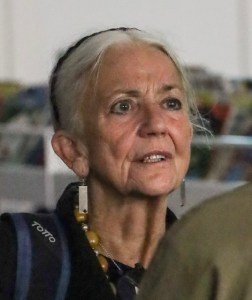
Paula Meehan. Photograph by Dermot Lynch

About the Author

Paula Meehan was born in Dublin in 1955, the eldest of six children. She attended a number of primary schools, finishing her primary education at the Central Model Girls’ School off Gardiner Street. She began her secondary education at St. Michael’s Holy Faith Convent in Finglas but was expelled for organising a protest march against the regime of the school. She studied for her Intermediate Certificate on her own and then went to Whitehall House Senior College, to study for her Leaving Certificate.

Outside school, she was a member of a dance drama group, became involved in band culture and, around 1970, began to write lyrics. Gradually composing song lyrics would give way to writing poetry.

At Trinity College, Dublin, (1972–1977) she studied English, History and Classical Civilization, taking five years to complete her Bachelor of Arts degree. This included one year off, spent travelling through Europe. While a student she was involved in street theatre and various kinds of performance.

After college she travelled again, spending long stretches in Greece, Germany, Scotland and England. She was offered a teaching fellowship at Eastern Washington University where she studied (1981–1983) in a two-year programme which led to a Master of Fine Arts degree in Poetry.  She returned to Dublin in 1983.

Meehan has also written poetry for film, for contemporary dance companies and for collaborations with visual artists; her poems have been put to music by songwriters (including Christy Moore). Her poetry has been extensively published in translation, including substantial collections in French and German.

The 2015 Poetry Competition ‘A Poem for Ireland’ shortlisted her 1991 poem ‘The Statue of the Virgin at Granard Speaks’ in the final ten poems. She selected poems for and introduced the Candlestick Press anthology Ten Poems from Ireland in 2017. Meehan was a judge for the 2020 Griffin Poetry Prize.

In September 2013, Meehan was installed as the Ireland Professor of Poetry by President Michael D. Higgins.

In 2023, she was elected an honorary fellow of Trinity College Dublin.

  • information sourced from Wikipedia

The Camas Poems of Michael Hartnett

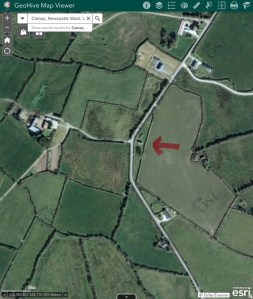
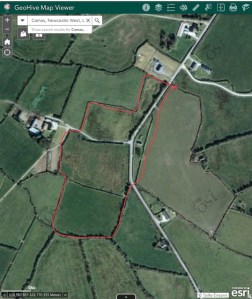
A Geohive Hub aerial view of Bridget Halpin’s cottage in Camas taken in 2006.

Camas is a small nondescript townland nestling in the shadow of the nearby village of Ratheenagh in rural West Limerick.  In the Author’s Notes to his Collected Poems (2001), Michael Hartnett tells us that, ‘Camas is a townland five miles south of Newcastle West in County Limerick where I spent most of my childhood’.   This local townland proved to be a central element in his early development.  There, the young impressionable Hartnett was influenced by his people, particularly his grandmother, Bridget Halpin, and their customs and way of life.  Indeed, in the mid-70s, when he tired of the Dublin literary milieu, it was to this same rural West Limerick bastion, nearby Glendarragh in Templeglantine, still steeped in Irish music and culture, to which he returned.  It was to this place he came to escape Dublin’s incestuous stranglehold and perhaps to write a new chapter “out foreign in ‘Glantine”.

There are up to fifteen poems by Hartnett which could be considered ‘Camas Poems’. These memory poems are all based on his childhood recollections of those happy times in his grandmother’s kitchen.   Students of Hartnett’s poetry should consider studying  ‘A Small Farm’  (Collected Poems 15) as one of a series of memory poems that he wrote celebrating his grandmother, Bridget Halpin and the townland of Camas where she lived.  The most obvious of these Camas Poems is ‘Death of an Irishwoman’ (Collected Poems 139), which he wrote on the passing of his grandmother in 1965.  Others include ‘For My Grandmother Bridget Halpin’ (Collected Poems 52), and ‘Mrs Halpin and the Lightning’ Collected Poems 138) and of course ‘An Múince Dreoilíní ‘/ ‘A Necklace of Wrens’ (A Necklace of Wrens 18), a quintessential memory poem from childhood.

Hartnett’s early poetry creates a delicate balance between description and abstraction, the actual and the figurative. The poem ‘A Small Farm’, the first poem of the Collected Poems (2001), a memory poem dating from Hartnett’s teenage years, establishes this. Abstractions, clichés, their representation through language, and the moment where these are drawn into focus, made specific and immediate, are central. The setting of the ‘small farm’ is described en abstracto: ‘All the perversions of the soul / I learnt on a small farm’ (15). In contrast to other contemporary representations of Irish farm homesteads, most obviously Kavanagh’s ‘Inniskeen’, and Heaney’s ‘Anahorish’, there is no naming of place here. The picture of the farm is rather etched out in generalisation and aphorism, and through the accordant clichés of petty hatred and ignorance, ‘how to do the neighbours harm / by magic, how to hate’ (15), before Hartnett brings the glass into focus, employing idiosyncratic detail which establishes the world of the poem itself. In this way, Hartnett’s particular subjectivity, his way of seeing, is established. It would become his poetic currency:

 Here were rosary beads,

a bleeding face,

the glinting doors that did encase their cutler needs,

their plates, their knives, the cracked calendars of their lives. (15)

In the final stanza, Hartnett makes an explicit link between his awakening as a perceiver of social interactions and moments of poetic beauty, with a growing knowledge and identification with the natural world:

I was abandoned to their tragedies and began to count the birds,

to deduce secrets in the kitchen cold,

and to avoid among my nameless weeds

the civil war of that household. (15)

The attentive intellect which ‘counts the birds’ has as yet no language to describe or express his experience of the natural world, his ‘nameless weeds’. Still, he is possessive of it, seeing it as distinct from the human society which he can describe, yet does not identify with.

The ‘small farm’ referred to here belonged to his grandmother, Bridget Halpin, and like many other small holdings in Camas, it consisted of a meagre ten acres, three roods and thirteen perches. This woman, Bridget Halpin, would later wield great influence over her young grandson, Michael Hartnett.  Indeed, if we are to believe the poet, she was the one who first affirmed his poetic gift when one day he ran into her kitchen in Camas and told her that a nest of young wrens had alighted on his head.   Her reply to him was, ‘Aha, you’re going to be a poet!’.  (A more detailed genealogy of the Halpin family and the early formative influences on Michael Hartnett can be read here).

Bridget        Halpin’s small farm of ten acres, three roods and thirteen perches, which was so vital in the early development of one of our greatest poets. This view is taken from a Geohive Hub aerial view taken in 2006.

Hartnett claimed that he spent much of his early childhood in Bridget Halpin’s cottage in the rural townland of Camas, five miles from his home in nearby Newcastle West.   He went on to immortalise this woman in many of his poems, but especially in his beautiful poem, ‘Death of an Irishwoman’.  This quiet townland of Camas must therefore be seen as central to his development as a poet, and maybe in time, this early association with Camas will be given its rightful importance, and the little rural townland will vie with Maiden Street or Inchicore as one of Hartnett’s important formative places.

‘Camas Road’, Michael Hartnett’s first ever published work, appeared in the Limerick Weekly Echo on the 18th of June 1955. He was thirteen. The poem describes the rural vista of the West Limerick townland of Camas at evening: ‘A bridge, a stream, a long low hedge, / A cottage thatched with golden straw’ (A Book of Strays 67). Its two eight-line stanzas of alternating rhyme and regular metre contain a litany of natural images, at times idiosyncratically rendered; the ‘timid hare sits in the ditch’, ‘the soft lush hay that grows in fields’. It is a peculiar mix of a poem, apparent images from both the poet’s lived and literary experience, placed side by side. It is contentedly denotative, creating a sense of ease and oneness with the natural world. The movement of sunrise to sunset is perpetually peaceful, its colours oils for the young poet’s palette. The ruminative introspection which elevates Kavanagh’s ‘Inniskeen Road: July Evening’, a poem which can be read in useful parallel to ‘Camas Road’, is not present. At the poem’s turn, as ‘Dark shadows fall o’er land so still’, Hartnett’s only thought and action are of flattened description, the creation of ‘this ode’.

‘Camas Road’ then, though essentially a curiosity which stands outside of Hartnett’s body of work, can be read as a seldom afforded snapshot of Michael Hartnett the poet before he became one.  In contrast, his poem ‘A Small Farm’ shows a marked development in his poetic craft.  Bridget Halpin, his grandmother, lived there with her son, Denis (Dinny Halpin), in what Hartnett describes as a prolonged state of ‘civil war’,

I was abandoned to their tragedies,

Minor but unhealing.

The word ‘abandoned’ here has many undertones and is important for the poet because he repeats the line twice in the poem.  He has told us elsewhere that he was, in effect, ‘fostered out’ by his parents in Maiden Street, Newcastle West, to his grandmother, Bridget Halpin, from a young age and spent much of his childhood in her cottage in Camas.  However, there is also the suggestion that while there he was ‘abandoned’ and somewhat neglected as he became an outsider, an unwilling observer of the ‘civil war’ of the household, as Bridget and her son Dinny constantly argued and fought over the minutiae of running a small farm in difficult times in the Ireland of the late 40s and early 50s.

Hartnett saw in his grandmother a remnant of a generation in crisis, still struggling with the precepts of Christianity and still familiar with the ancient beliefs and piseógs of the countryside.  For Hartnett, there is also the added heartache that sees his grandmother struggling to come to terms with a lost language that has been cruelly taken from her. This, therefore, is a totally different place when compared to, for example, Kavanagh’s Inniskeen or Heaney’s Mossbawn or Montague’s Garvahey.  However, there is an underlying paganism here that is absent from their work, although Montague comes close in his great poem, ‘Like Dolmens Round my Childhood, the Old People’.

For Hartnett, his grandmother represents a generation that lived a life dominated by myth, half-truth, some learning, and limited knowledge of the laws of physics, and therefore, as he points out in ‘Mrs Halpin and the Lightning’,

Her fear was not the simple fear of one

who does not know the source of thunder:

these were the ancient Irish gods

she had deserted for the sake of Christ.

However, Hartnett’s powers of observation and intuition were honed in Camas on Bridget Halpin’s small farm during his frequent visits.    He tells us that he learnt much on that small farm during those lean years in the forties and early fifties,

All the perversions of the soul

I learnt on a small farm,

how to do the neighbours harm

by magic, how to hate.

The struggle to make a success and eke out a living was a constant struggle and burden.  The begrudgery of neighbours, the ‘bitterness over boggy land’, and the ‘casual stealing of crops’ went side by side with ‘venomous card games’, ‘a little music’ and ‘a little peace in decrepit stables’.  The similarities with Kavanagh’s ‘The Great Hunger’ are everywhere, but Hartnett does not name this place; it is an Everyplace.  The poem is simply titled, ‘A Small Farm’, so there is no Inniskeen, Drummeril, or Black Shanco here. Still, the harshness and brutality of existence, ‘the cracked calendars / of their lives’  in the 50s in Ireland, is given a universality even more disturbing than the picture we receive from Kavanagh.  Yet, it is here in Camas that he first becomes aware of his calling as a poet and, like Kavanagh, it was here that ‘The first gay flight of my lyric / Got caught in a peasant’s prayer’. And so, to avoid the normal household squabbles of his grandmother and her son, he ‘abandons’ them, turns his back on them, and begins to notice the birds and the weeds and the grasses.

The depiction of another agricultural custom is shown in ‘Pigkilling’.  The joyful detailing of the killing of a pig at his grandmother’s farm in Camas eschews any characterisation of Hartnett as a simplistically environmental poet, denouncing all human domination over nature.  Rather, it depicts the killing as a vital part of the rural community’s relationship with animal-kind, comparable to ritual.

Like a knife cutting a knife

his last plea for life

echoes joyfully in Camas.

This is one of the few Camas Poems that names the place and the central figure of the poem himself uses the pig’s bladder as a plaything: ‘I kicked his golden bladder / in the air’ (Collected Poems 125).  Agriculture here is not mechanised but depicted as an ongoing, sustainable facet of rural life: the poem echoes the loss of many of these old rituals and crafts of the past, as Heaney does in his collection, Death of a Naturalist.

The townland of Camas is also central to an episode that the poet recounts for us in his seminal poem, ‘A Farewell to English’ (Collected Poems 141).  This encounter hovers somewhere between reality and dream, aisling (the Irish word for a vision) or epiphany.  The incident takes place at Doody’s Cross as the poet walks out on a summer Sunday evening from Newcastle West to the cottage in Camas.  He is on his way to meet up with his uncle, Dinny Halpin.  He sits down ‘on a gentle bench of grass’ to rest his weary feet after his exertions, when he sees approaching him three spectral figures from the Bardic Gaelic past – Andrias Mac Craith, Aodhagán Ó Rathaille, and Daíbhí Ó Bruadair.  These ‘old men’ walked on ‘the summer road’ with

sugán belts and long black coats

with big ashplants and half-sacks

of rags and bacon on their backs.

They pose as a rather pathetic group, ‘hungry, snot-nosed, half-drunk’ and they give him a withering glance before they take their separate ways to Croom, Meentogues and Cahirmoyle, the locations of their patronage, ‘a thousand years of history / in their pockets’.  Here, Hartnett is situating himself as their direct descendant and the inheritor of their craft, and the enormity of this epiphany occurs at Doody’s Cross in Camas: the enormity of the task that lies ahead also terrifies and haunts him.

Earlier in ‘For My Grandmother, Bridget Halpin’ (Collected Poems 52), he again alludes to the wildness, the paganism, the piseógs that surrounded him during his childhood in Camas.  His grandmother’s worldview is almost feral.  She looks to the landscape and the birds for information about the weather or impending events,

A bird’s hover,

seabird, blackbird, or bird of prey,

was rain, or death, or lost cattle.

This poorly educated woman reads the landscape and the skies as one would read a book,

The day’s warning, like red plovers

so etched and small the clouded sky,

was book to you, and true bible.

And yet, in his beautiful poem, ‘Bread’ (Collected Poems 53), he evokes and echoes the warmth and nurture of Mary Heaney’s kitchen in Mossbawn.  His grandmother’s kitchen in Camas was a comforting place for him, and his early childhood memories are ones of coming home to roost,

and I come here

on tiring wings.

Odours of bread….

The picture we get of the small farm in Camas is rather etched out in generalisation and aphorism, and through the accordant clichés of petty hatred and ignorance, ‘how to do the neighbours harm / by magic, how to hate’, before Hartnett brings the glass into focus, employing idiosyncratic detail which establishes the world of the poem itself. As already mentioned, the cottage on this small farm was a Rambling House, a house where neighbours gathered to tell stories, play music and card games,

 venomous card games

across swearing tables

His early poetry, then, creates a delicate balance between description and abstraction, the actual and the figurative. In this way, Hartnett’s particular subjectivity, his way of seeing, is established. In time, it would become his poetic currency. We are invited into the quintessentially old traditional Irish kitchen with its pictures of the Pope, the Sacred Heart, the statue of Our Lady, the Crucifix,

Here were rosary beads,  

a bleeding face,

the glinting doors that did encase their cutler needs,

their plates, their knives, the cracked calendars of their lives

 In this poem, therefore, Hartnett is following on from Kavanagh in shining a light into the domestic and interior life of rural dwellers not previously considered worthy of attention.

I have to mention one other poem, a quintessential Camas poem, which appears in the collection A Necklace of Wrens, published in 1987 after his return to Dublin.  This is a collection of selected poems in Irish with English translations by Hartnett.  The poem in question is titled ‘The Country Chapel’, with its Irish translation ‘An Séipéal faoin Tuath’.  This memory poem describes the scene outside the country church on any given Sunday.  The young, observant Hartnett describes the various characters who have come from the ‘fat meadows’ as ‘sly and happy’.  They resemble ‘a set-dance team / by the wall of the old chapel’.  They are all strategically placed depending on the various local rows and even their differing sporting and political allegiances, ‘foe avoiding enemy’.  This eclectic group of neighbours are beautifully portrayed in the lovely Hartnett metaphor: ‘The congregation is a lonely horse’ who appear to be ‘as awkward as a man /dancing with a nun / on a wedding day’.  This may well be a long-lost poetic portrait of the people of Killeedy, Ratheenagh, Ballagh and Kantoher in the mid-40s and 50s.

Bridget Halpin’s ‘small farm’ in Camas may have been small and full of rushes and wild iris, but it helped produce one of Ireland’s leading poets of any century.  The influences absorbed in this rural setting, his powers of observation, his knowledge of wildlife and flowers, and his ecocentric bias, are impressive and are all-pervasive in these Camas Poems and, indeed, his poetry in general.  Hartnett, the quintessential nature poet, would be delighted and impressed to see the magnificent new Killeedy  Eco Park, which has been set up less than a mile from his ‘foster’ home in Camas by the combined efforts of that same local community in Killeedy. It is also significant that the visionary developers of this project have included a Poet’s Corner where Hartnett is remembered, just a stone’s throw from the small farm of his formative years. Here today’s generation in Camas and beyond can now come to ‘count the birds’ and the ‘nameless weeds’.

References

Hartnett, M. Collected Poems, edited by Peter Fallon, Gallery Press, 2001 (Reprinted 2012)

Hartnett, M. A Necklace of Wrens: Poems in Irish and English, The Gallery Press, 1987 (Reprinted 2015).

HARTNETT, M. A Book of Strays, edited by Peter Fallon, The Gallery Press, 2002, (Reprinted 2015).

Statue of a pensive Michael Hartnett in The Square, Newcastle West.


Free Resources for Leaving Cert Poetry 2025

image (1)
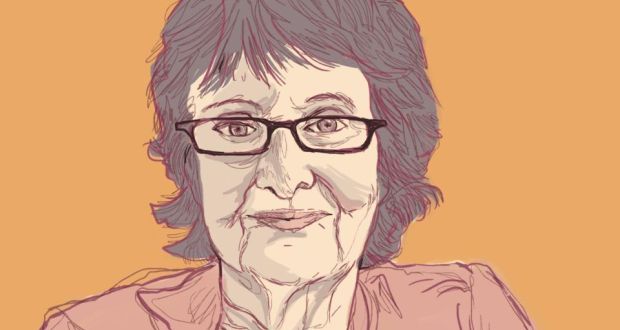
  Portrait of Eavan Boland http://www.irishtimes.com. Illustration: Dearbhla Kelly

I have been posting English notes on my blog, Reviews Rants and Rambles, since I retired as an English teacher and an Advising Examiner for English Higher Level.  I have brought all those links together here in one post or blog  – an Index of all the posts I’ve written that are relevant to Leaving Cert English Poetry 2025.  Bookmark this to save you the trouble of constantly searching the internet each time you want to do some background work on a particular poet or author. It’s imperfect and won’t suit every student, class, or teacher but it’s my version of a ‘Pop-Up-One-Stop Shop’ and you know the drill: just click on the link if it’s relevant to your studies!  My choice of poets is personal and you will easily see where my own preferences lie by simply viewing the number of links provided for each text or poet!

However, Caveat Emptor!  Leaving Cert Student Beware !!  These are resources that you should use wisely.  They are my personal responses to the various texts and you should read and consider them and decide to study them if you find them useful.
IN OTHER WORDS, MAKE YOUR OWN OF THEM, ADD TO THEM, OR DELETE FROM THEM AS YOU SEE FIT.
Eavan Boland

Major Themes in Eavan Boland’s Poetry

The Beauty of Ordinary Things  In the Poetry of Eavan Boland

Child of Our Time by Eavan Boland

Emily Dickinson

An Overview of the Poetry of Emily Dickinson

T. S. Eliot

Observations on ‘The Love Song of J. Alfred Prufrock’ by T. S. Eliot

The Religious Poetry of T. S. Eliot (with a particular focus on ‘Journey of the Magi’ and

‘A Song for Simeon‘)

Gerard Manley Hopkins

The Poetry of Gerard Manley Hopkins

An Analysis of Inversnaid by Gerard Manley Hopkins

An Analysis of Spring by Gerard Manley Hopkins

Analysis of ‘The Windhover’ by Gerard Manley Hopkins

The Terrible Sonnets,  not so terrible after all!

Commentary on ‘Pied Beauty’ by Hopkins

Patrick Kavanagh

The Poetry of Patrick Kavanagh

Some Recurring Themes in the Poetry of Patrick Kavanagh

Analysis of Patrick Kavanagh’s Use of the Sonnet

An Overview of Patrick Kavanagh’s Poetry

A Christmas Childhood by Patrick Kavanagh

Advent by Patrick Kavanagh

Canal Bank Walk by Patrick Kavanagh

Patrick Kavanagh is a very Religious Poet’  Discuss

A sense of loss pervades much of Patrick Kavanagh’s poetry’  Discuss

Patrick Kavanagh’s Poetry is full of Honesty, Integrity and Simplicity’   Discuss

Patrick Kavanagh is a poet of the Ordinary’   Discuss

Bonus Kavanagh Stuff – Have a read!  Enjoy!

Luke Kelly : Raglan Road (A Parade of Posts for St Patrick 1)

An Introduction to ‘Tarry Flynn’ by Patrick Kavanagh

Stony Grey Soil by Patrick Kavanagh

Derek Mahon

Derek Mahon:  An Overview

Sylvia Plath

The Poetry of Sylvia Plath

fullsizerender

The Second Coming by W.B. Yeats – A Poem for Our Time

2354f8aaf8f740849907452ec6867daf
W.B. Yeats – The Second Coming (2014). Acrylic painting by Peter Walters.

The Second Coming


Turning and turning in the widening gyre

The falcon cannot hear the falconer;

Things fall apart; the centre cannot hold;

Mere anarchy is loosed upon the world,

The blood-dimmed tide is loosed, and everywhere

The ceremony of innocence is drowned;

The best lack all conviction, while the worst

Are full of passionate intensity.

Surely some revelation is at hand;

Surely the Second Coming is at hand.

The Second Coming! Hardly are those words out

When a vast image out of Spiritus Mundi

Troubles my sight: somewhere in sands of the desert

A shape with lion body and the head of a man,

A gaze blank and pitiless as the sun,

Is moving its slow thighs, while all about it

Reel shadows of the indignant desert birds.

The darkness drops again; but now I know

That twenty centuries of stony sleep

Were vexed to nightmare by a rocking cradle,

And what rough beast, its hour come round at last,

Slouches towards Bethlehem to be born?

Source: The Collected Poems of W. B. Yeats (1989)

 Commentary

The Second Coming surely holds the distinction of being the most plundered poem in the English language. To fully understand the poem, we are required to have some biblical knowledge as well as a basic understanding of Yeats’s vision of history.  The biblical reference is twofold: the poem blends Christ’s prediction of his own second coming with St. John’s vision of the coming of the Antichrist, the beast of the Apocalypse.  This is ‘the rough beast’ of the second last line of the poem.  Yeats makes the rough beast even more disturbing and sinister by assigning its place of birth to Bethlehem, the place of Christ’s birth, associated over the course of two thousand years – until recent times – with peace, mercy, gentleness and forgiveness.

To understand Yeats’ cosmology it is essential to read his book, A Vision where he explained his views on history and how it informed his poetry. Yeats saw human history as a series of epochs, what he called “gyres.” He saw the age of classical antiquity as beginning with the Trojan War and then that thousand-year cycle was overtaken by the Christian era, which he suggests is now coming to a close. That is the basis for the final line of the poem, “And what rough beast, its hour come round at last/ Slouches towards Bethlehem to be born?”  In his mystical book, A Vision, he foretold the birth of a new, violent, bestial anti-civilisation and the simultaneous destruction of the two-thousand-year-old Christian cycle.  The second coming of the poem is thus not that of Christ but of his opposite, the slouching, revolting figure of the beast whose birth will herald in a new age of anarchy to be ‘loosed upon the world’ (line 4).  Yeats’s thesis in A Vision is that each epoch or period of history is eventually overthrown by some massive upheaval.  This may explain why Yeats used the phrase “the second birth” instead of “the Second Coming” in some of his first drafts.

It is in this context that the opening lines of the poem should be read: ‘Turning and turning in the widening gyre / The falcon cannot hear the falconer’.  The falcon here is an image of man rapidly losing contact with Christ the falconer as he moves along the widening gyre of history.  The next six lines paint a grim picture of the beginning of a new age, marked by worldwide anarchy and violence (‘The blood-dimmed tide is loosed’).  As the gyre widens, ‘things fall apart; the centre cannot hold’.  The end of the Christian age is granted the revelation of the character of the new age. The tide of violence has already begun to move, and as it does, it begins to drown ‘the ceremony of innocence’ which, in Yeats’s symbolic system, stands for order and harmony as opposed to the personal and social violence of the ‘blood-dimmed tide’.

The ‘vast image out of ‘Spiritus Mundi’ (line 12) is a favourite Yeatsian idea.  According to Yeats, Spiritus Mundi is a storehouse of ideas deriving from the great universal memory common to all humankind, and is also the source of prophecy, since, he believed, history repeats the same predestined cycles every two thousand years or so.

The more terrible events associated with the coming of the Antichrist are all in the future, but in lines 3 – 8, Yeats suggests that his world is already experiencing a foretaste of the grim future heralded by the birth of the ‘rough beast’.  There was plenty of evidence all around him in 1919, the year he composed the poem.  Yeats began The Second Coming during the tense, eventful month of January 1919. The ‘war to end all wars’ was barely over and the Russian Revolution, which dismayed him, was still unfolding, while another war was brewing on his doorstep. On 21 January, the revolutionary Irish parliament met in Dublin to declare independence while, in a quarry in Soloheadbeg in Tipperary, Dan Breen and other members of the IRA killed two officers of the Royal Irish Constabulary ushering in the War of Independence. This war threatened to uproot the Anglo-Irish ascendency and the civilisation it represented, many elements of which appealed to Yeats himself.  Empires and dynasties were all in a state of flux as a result of this anarchy and revolution that had been loosed upon the world. The birth of Yeats’s daughter, Anne, in February, was also fraught with danger. During her pregnancy, his young wife Georgie Hyde-Lees had been stricken by the Spanish flu that was burning through Europe at that time in the wake of the war.  All these events conspired to put Yeats in an apocalyptic frame of mind.

For Yeats, the Incarnation of Christ was a violent, turbulent event, after which ‘twenty centuries of stony sleep / were vexed to nightmare by a rocking cradle’.  This new incarnation, that of the slouching ‘rough beast’ will unleash universal horrors.  Its sinister possibilities are hinted at in the suggestion that even the predatory desert birds, for all their savagery, are ‘indignant’ at its coming.

The poem gives us a frightening account of the fate in store for the post-Christian world.  Social anarchy and massive destruction are made worse by the collapse of moral values among the leaders of nations: ‘The best lack all conviction, while the worst / Are full of passionate intensity’.  He predicts that evil will triumph in the public sphere because those political leaders who might be expected to defend humane values (and basic human rights) lack the determination to resist those who preach violence and intolerance.

As I mentioned earlier, The Second Coming has become perhaps the most plundered poem in the English language – only Heaney’s From ‘The Cure at Troy’  comes a close second, with its ‘let hope and history rhyme’ so beloved of politicians.  At 164 words, The Second Coming consists of almost nothing but quotable lines. Someone reading it for the first time in 2024 might resemble the apocryphal theatregoer who complained that Hamlet was nothing but a bunch of quotations strung together. Whether or not it is Yeats’s greatest poem, it is by far his most useful.  As Auden wrote in “In Memory of WB Yeats” (1939), “The words of a dead man / Are modified in the guts of the living.”  We have to admit, after its first one hundred years, this poem was built to last.

As our world has recently been wrenched out of joint by the Covid-19 pandemic, many people are turning to poetry for wisdom and consolation. However, The Second Coming fulfils a different role, as it has done in crisis after crisis, from the Vietnam War to 9/11, to the genocides in Rwanda or Syria or Gaza,  to the election of Donald Trump and to the looming prospect of his imminent re-election: it provides us with an opportunity to confront chaos and dread, rather than to escape it. This is surely why Fintan O’Toole has proposed the “Yeats Test”: “The more quotable Yeats seems to commentators and politicians, the worse things are.”

bwgqngybqe-1577215055