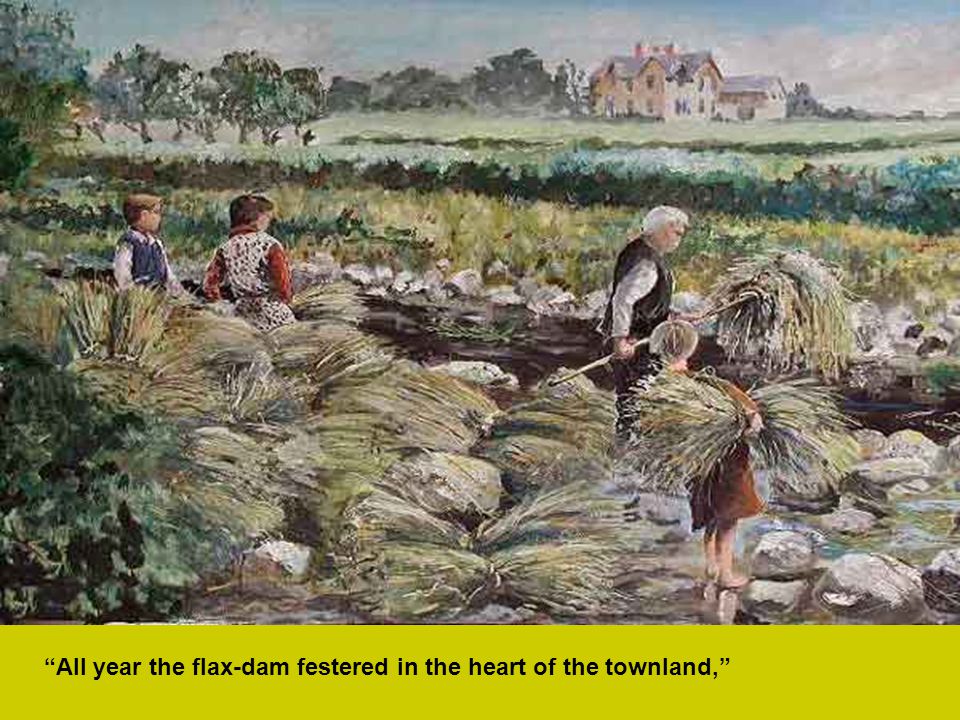
‘Lint Water’ by Seamus Heaney

slide_4

Lint Water

       
by Seamus Heaney


The flax was pulled by hand once it ripened,

Bound into tall green pillars with rush bands

And buried underwater, roots upwards.

When the dam was full they loaded stones and sods

On top, then left the whole thing for three weeks

To rot, to stink: a pit of rotten eggs

Could not have generated such a fug

As flax decaying, steaming like a bog,

Wafting its heavy, nauseating fall-out.

As soon as stems had turned to slime and smut

The dam was emptied: men stood waist deep

In the fouled water, with fork and four-pronged grape

Pitching out sheaves like half-gone carcasses.

They spread it dripping, then, flat on the grass

To crisp and dry hard in the summer sun

Until it could be stooked up, stiff as broom

And whistling in the wind.  Toughened to sticks,

The stems were milled, spun, woven into fabrics.

The dam was cleared, poured down into the river

Its poisonous bellyful. “Lint water”

It was called.  Across the stream it swirled brown froth

That scummed clean stone and sickened fish to death;

And if the drains were blocked, it still seeped down,

Filtering unseen contamination.

Putrid currents floated trout to the loch,

Their bellies white as linen tablecloths.

This poem was first published in The Times Literary Supplement on August 5th, 1965.  Despite being a strong contender for inclusion in his first collection, Heaney seems to have opted instead for a very similar poem, ‘Death of a Naturalist’ after which his first collection is named.  The language of the poem, while on the surface appearing to be very matter-of-fact and factual, is loaded with allegorical undertones.  Words used to describe the flax dam, ‘rotten eggs’, ‘stink’, ‘decaying’, ‘poisonous’, ‘unseen contamination’, and ‘putrid currents’, are really intended to describe the dysfunctional nature of politics in the North of Ireland.  Heaney goes into much more detail here in this poem and the rotting flax is weighed down with ‘stones and sods’ which stands for the violence and coercion he has experienced as a young boy and man.

This poem, therefore, is not as innocent as it seems at first reading.  However, it does show early signs of an author who has found a way to illustrate the myriad tensions of his native province before the inevitable meltdown in the late 60s occurred. Unlike other ‘innocent’ poems from his early collections, there is a harsher more jarring approach here in this poem and yet, like much of his earlier poetry, the poem truly reflects his upbringing in Mossbawn and Annahorish. His use of allusion and his reference to the dying rural crafts such as that of the flax farmer, the farrier, the diviner, the ploughman, and his respect for those who worked in the bog is to the fore here also. So, we can see here the germ of an approach that would allow Heaney, in collections such as North and Wintering Out, to explain his unique predicament to an often oblivious and naive world audience.
6.Seamus-Heaney-34-e1561471357986 (1)
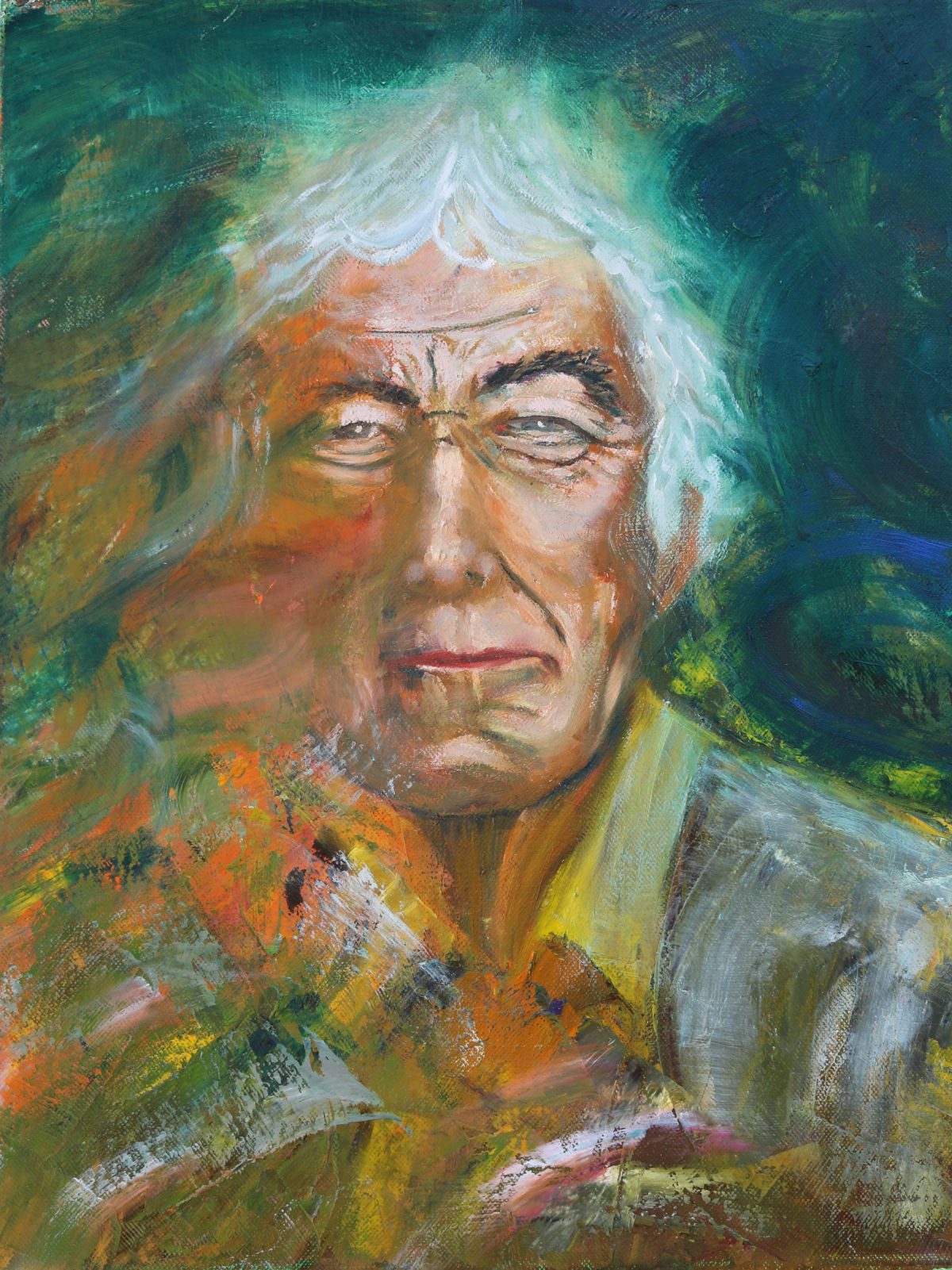
                                      The Hands of History by artist Raymie Watson

Free Resources for Leaving Cert English (Higher) 2023

river

I have been posting notes here for some years now since I retired as a teacher of English and as an Advising Examiner for English Higher Level for many years.  What I have done here is bring all those links together in one post or blog to save you the trouble of constantly searching the internet each time you want to do some background work on a text or a poet or author. It’s my version of a ‘One-Stop Shop’ and you know the drill: just click on the link!  My choice of texts is personal and obviously will not suit every teacher, every student, or every class.  You can easily see where my own preferences lie by simply viewing the number of links provided for each text or poet!

YEATS SAID OF  HIS OWN POETRY THAT IT WAS ‘BUT THE CONSTANT STITCHING AND RESTITCHING OF OLD THEMES’.  CHECK THIS OUT FOR YOURSELF!  

 YOUR AIM SHOULD BE TO PICK YOUR OWN FAVOURITES FROM THIS SELECTION AND GET TO KNOW THEM VERY WELL. 

However, Caveat Emptor!  Leaving Cert Student Beware !!  These are resources that you should use wisely.  They are personal responses to the various texts and you should read and consider them if you find them useful.   IN OTHER WORDS, MAKE YOUR OWN OF THEM, ADD TO THEM OR DELETE FROM THEM AS YOU SEE FIT.  ALSO, YOU MIGHT SPREAD THE WORD, DON’T KEEP THEM ALL TO YOURSELF!

Single Text

Study Notes on A Doll’s House by Henrik Ibsen

Macbeth

Shakespearean Tragedy Defined

Macbeth: A Tragedy

Macbeth: Order violated, order restored.

Macbeth: From Centrality to Isolation

Macbeth: A Truly Aware Tragic Hero?

Macbeth is a villain, but…

Some Grace Notes on Macbeth

Macduff’s Character Explored

Comparative Section 

Philadelphia,  Here I Come!

Characters and Relationships in Philadelphia Here I Come!

The Theme of Communication in Philadelphia Here I Come!

The Theme of Escape in Philadelphia Here I Come!

Wuthering Heights

Major Themes in Wuthering Heights

The Depiction of Childhood in Wuthering Heights: Some Observations on Characterisation in the Novel

Imagery and Symbolism in Wuthering Heights

Grace Notes on Wuthering Heights

Silas Marner

Silas Marner: The Characters

Themes in Silas Marner

Imagery in Silas Marner

Fairy-Tale Elements in Silas Marner

Silas Marner by George Eliot is a radically disturbing social document

Poetry

Elizabeth Bishop

Themes and Issues in the Poetry of Elizabeth Bishop

Elizabeth Bishop: The Poet’s Poet

These two at the end are not on your course but what the heck enjoy them anyway!

Roosters’ by Elizabeth Bishop: A poem whose time has come again?

Commentary on ‘Sandpiper’ by Elizabeth Bishop

Emily Dickinson

An Overview of the Poetry of Emily Dickinson

John Donne

An Introduction to Metaphysical Poetry

John Donne and Metaphysical Poetry

An Analysis of Some of my Favourite Poems by John Donne

Patrick Kavanagh

The Poetry of Patrick Kavanagh

Some Recurring Themes in the Poetry of Patrick Kavanagh

Analysis of Patrick Kavanagh’s Use of the Sonnet

An Overview of Patrick Kavanagh’s Poetry

Patrick Kavanagh is a very Religious Poet: Discuss

Patrick Kavanagh is a poet of the Ordinary: Discuss

Patrick Kavanagh’s Poetry is full of Honesty, Integrity, and Simplicity: Discuss

A sense of loss pervades much of Patrick Kavanagh’s poetry: Discuss

Stony Grey Soil by Patrick Kavanagh

Canal Bank Walk by Patrick Kavanagh

Advent by Patrick Kavanagh

Derek Mahon

Derek Mahon: An Overview

Adrienne Rich

Exploring the Poetry of Adrienne Rich (1929 – 2012)

Hidden Riches in The Poetry of Adrienne Rich

William Butler Yeats

Study Notes on the Poetry of W.B. Yeats

An Overview of Yeats’s Poetry

YEATS: A POET OF OPPOSING TENSIONS.

21036