The Camas Poems of Michael Hartnett

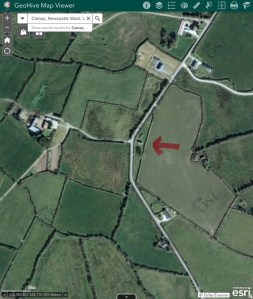
A Geohive Hub aerial view of Bridget Halpin’s cottage in Camas taken in 2006.

Camas is a small nondescript townland nestling in the shadow of the nearby village of Ratheenagh in rural West Limerick.  In the Author’s Notes to his Collected Poems (2001), Michael Hartnett tells us that, ‘Camas is a townland five miles south of Newcastle West in County Limerick where I spent most of my childhood’.   This local townland proved to be a central element in his early development.  There, the young impressionable Hartnett was influenced by his people, particularly his grandmother, Bridget Halpin, and their customs and way of life.  Indeed, in the mid-70s, when he tired of the Dublin literary milieu, it was to this same rural West Limerick bastion, nearby Glendarragh in Templeglantine, still steeped in Irish music and culture, to which he returned.  It was to this place he came to escape Dublin’s incestuous stranglehold and perhaps to write a new chapter “out foreign in ‘Glantine”.

There are up to fifteen poems by Hartnett which could be considered ‘Camas Poems’. These memory poems are all based on his childhood recollections of those happy times in his grandmother’s kitchen.   Students of Hartnett’s poetry should consider studying  ‘A Small Farm’  (Collected Poems 15) as one of a series of memory poems that he wrote celebrating his grandmother, Bridget Halpin and the townland of Camas where she lived.  The most obvious of these Camas Poems is ‘Death of an Irishwoman’ (Collected Poems 139), which he wrote on the passing of his grandmother in 1965.  Others include ‘For My Grandmother Bridget Halpin’ (Collected Poems 52), and ‘Mrs Halpin and the Lightning’ Collected Poems 138) and of course ‘An Múince Dreoilíní ‘/ ‘A Necklace of Wrens’ (A Necklace of Wrens 18), a quintessential memory poem from childhood.

Hartnett’s early poetry creates a delicate balance between description and abstraction, the actual and the figurative. The poem ‘A Small Farm’, the first poem of the Collected Poems (2001), a memory poem dating from Hartnett’s teenage years, establishes this. Abstractions, clichés, their representation through language, and the moment where these are drawn into focus, made specific and immediate, are central. The setting of the ‘small farm’ is described en abstracto: ‘All the perversions of the soul / I learnt on a small farm’ (15). In contrast to other contemporary representations of Irish farm homesteads, most obviously Kavanagh’s ‘Inniskeen’, and Heaney’s ‘Anahorish’, there is no naming of place here. The picture of the farm is rather etched out in generalisation and aphorism, and through the accordant clichés of petty hatred and ignorance, ‘how to do the neighbours harm / by magic, how to hate’ (15), before Hartnett brings the glass into focus, employing idiosyncratic detail which establishes the world of the poem itself. In this way, Hartnett’s particular subjectivity, his way of seeing, is established. It would become his poetic currency:

 Here were rosary beads,

a bleeding face,

the glinting doors that did encase their cutler needs,

their plates, their knives, the cracked calendars of their lives. (15)

In the final stanza, Hartnett makes an explicit link between his awakening as a perceiver of social interactions and moments of poetic beauty, with a growing knowledge and identification with the natural world:

I was abandoned to their tragedies and began to count the birds,

to deduce secrets in the kitchen cold,

and to avoid among my nameless weeds

the civil war of that household. (15)

The attentive intellect which ‘counts the birds’ has as yet no language to describe or express his experience of the natural world, his ‘nameless weeds’. Still, he is possessive of it, seeing it as distinct from the human society which he can describe, yet does not identify with.

The ‘small farm’ referred to here belonged to his grandmother, Bridget Halpin, and like many other small holdings in Camas, it consisted of a meagre ten acres, three roods and thirteen perches. This woman, Bridget Halpin, would later wield great influence over her young grandson, Michael Hartnett.  Indeed, if we are to believe the poet, she was the one who first affirmed his poetic gift when one day he ran into her kitchen in Camas and told her that a nest of young wrens had alighted on his head.   Her reply to him was, ‘Aha, you’re going to be a poet!’.  (A more detailed genealogy of the Halpin family and the early formative influences on Michael Hartnett can be read here).
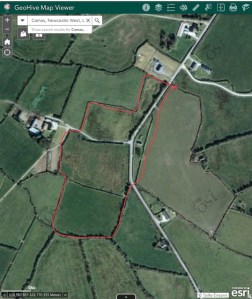
Bridget        Halpin’s small farm of ten acres, three roods and thirteen perches, which was so vital in the early development of one of our greatest poets. This view is taken from a Geohive Hub aerial view taken in 2006.

Hartnett claimed that he spent much of his early childhood in Bridget Halpin’s cottage in the rural townland of Camas, five miles from his home in nearby Newcastle West.   He went on to immortalise this woman in many of his poems, but especially in his beautiful poem, ‘Death of an Irishwoman’.  This quiet townland of Camas must therefore be seen as central to his development as a poet, and maybe in time, this early association with Camas will be given its rightful importance, and the little rural townland will vie with Maiden Street or Inchicore as one of Hartnett’s important formative places.

‘Camas Road’, Michael Hartnett’s first ever published work, appeared in the Limerick Weekly Echo on the 18th of June 1955. He was thirteen. The poem describes the rural vista of the West Limerick townland of Camas at evening: ‘A bridge, a stream, a long low hedge, / A cottage thatched with golden straw’ (A Book of Strays 67). Its two eight-line stanzas of alternating rhyme and regular metre contain a litany of natural images, at times idiosyncratically rendered; the ‘timid hare sits in the ditch’, ‘the soft lush hay that grows in fields’. It is a peculiar mix of a poem, apparent images from both the poet’s lived and literary experience, placed side by side. It is contentedly denotative, creating a sense of ease and oneness with the natural world. The movement of sunrise to sunset is perpetually peaceful, its colours oils for the young poet’s palette. The ruminative introspection which elevates Kavanagh’s ‘Inniskeen Road: July Evening’, a poem which can be read in useful parallel to ‘Camas Road’, is not present. At the poem’s turn, as ‘Dark shadows fall o’er land so still’, Hartnett’s only thought and action are of flattened description, the creation of ‘this ode’.

‘Camas Road’ then, though essentially a curiosity which stands outside of Hartnett’s body of work, can be read as a seldom afforded snapshot of Michael Hartnett the poet before he became one.  In contrast, his poem ‘A Small Farm’ shows a marked development in his poetic craft.  Bridget Halpin, his grandmother, lived there with her son, Denis (Dinny Halpin), in what Hartnett describes as a prolonged state of ‘civil war’,

I was abandoned to their tragedies,

Minor but unhealing.

The word ‘abandoned’ here has many undertones and is important for the poet because he repeats the line twice in the poem.  He has told us elsewhere that he was, in effect, ‘fostered out’ by his parents in Maiden Street, Newcastle West, to his grandmother, Bridget Halpin, from a young age and spent much of his childhood in her cottage in Camas.  However, there is also the suggestion that while there he was ‘abandoned’ and somewhat neglected as he became an outsider, an unwilling observer of the ‘civil war’ of the household, as Bridget and her son Dinny constantly argued and fought over the minutiae of running a small farm in difficult times in the Ireland of the late 40s and early 50s.

Hartnett saw in his grandmother a remnant of a generation in crisis, still struggling with the precepts of Christianity and still familiar with the ancient beliefs and piseógs of the countryside.  For Hartnett, there is also the added heartache that sees his grandmother struggling to come to terms with a lost language that has been cruelly taken from her. This, therefore, is a totally different place when compared to, for example, Kavanagh’s Inniskeen or Heaney’s Mossbawn or Montague’s Garvahey.  However, there is an underlying paganism here that is absent from their work, although Montague comes close in his great poem, ‘Like Dolmens Round my Childhood, the Old People’.

For Hartnett, his grandmother represents a generation that lived a life dominated by myth, half-truth, some learning, and limited knowledge of the laws of physics, and therefore, as he points out in ‘Mrs Halpin and the Lightning’,

Her fear was not the simple fear of one

who does not know the source of thunder:

these were the ancient Irish gods

she had deserted for the sake of Christ.

However, Hartnett’s powers of observation and intuition were honed in Camas on Bridget Halpin’s small farm during his frequent visits.    He tells us that he learnt much on that small farm during those lean years in the forties and early fifties,

All the perversions of the soul

I learnt on a small farm,

how to do the neighbours harm

by magic, how to hate.

The struggle to make a success and eke out a living was a constant struggle and burden.  The begrudgery of neighbours, the ‘bitterness over boggy land’, and the ‘casual stealing of crops’ went side by side with ‘venomous card games’, ‘a little music’ and ‘a little peace in decrepit stables’.  The similarities with Kavanagh’s ‘The Great Hunger’ are everywhere, but Hartnett does not name this place; it is an Everyplace.  The poem is simply titled, ‘A Small Farm’, so there is no Inniskeen, Drummeril, or Black Shanco here. Still, the harshness and brutality of existence, ‘the cracked calendars / of their lives’  in the 50s in Ireland, is given a universality even more disturbing than the picture we receive from Kavanagh.  Yet, it is here in Camas that he first becomes aware of his calling as a poet and, like Kavanagh, it was here that ‘The first gay flight of my lyric / Got caught in a peasant’s prayer’. And so, to avoid the normal household squabbles of his grandmother and her son, he ‘abandons’ them, turns his back on them, and begins to notice the birds and the weeds and the grasses.

The depiction of another agricultural custom is shown in ‘Pigkilling’.  The joyful detailing of the killing of a pig at his grandmother’s farm in Camas eschews any characterisation of Hartnett as a simplistically environmental poet, denouncing all human domination over nature.  Rather, it depicts the killing as a vital part of the rural community’s relationship with animal-kind, comparable to ritual.

Like a knife cutting a knife

his last plea for life

echoes joyfully in Camas.

This is one of the few Camas Poems that names the place and the central figure of the poem himself uses the pig’s bladder as a plaything: ‘I kicked his golden bladder / in the air’ (Collected Poems 125).  Agriculture here is not mechanised but depicted as an ongoing, sustainable facet of rural life: the poem echoes the loss of many of these old rituals and crafts of the past, as Heaney does in his collection, Death of a Naturalist.

The townland of Camas is also central to an episode that the poet recounts for us in his seminal poem, ‘A Farewell to English’ (Collected Poems 141).  This encounter hovers somewhere between reality and dream, aisling (the Irish word for a vision) or epiphany.  The incident takes place at Doody’s Cross as the poet walks out on a summer Sunday evening from Newcastle West to the cottage in Camas.  He is on his way to meet up with his uncle, Dinny Halpin.  He sits down ‘on a gentle bench of grass’ to rest his weary feet after his exertions, when he sees approaching him three spectral figures from the Bardic Gaelic past – Andrias Mac Craith, Aodhagán Ó Rathaille, and Daíbhí Ó Bruadair.  These ‘old men’ walked on ‘the summer road’ with

sugán belts and long black coats

with big ashplants and half-sacks

of rags and bacon on their backs.

They pose as a rather pathetic group, ‘hungry, snot-nosed, half-drunk’ and they give him a withering glance before they take their separate ways to Croom, Meentogues and Cahirmoyle, the locations of their patronage, ‘a thousand years of history / in their pockets’.  Here, Hartnett is situating himself as their direct descendant and the inheritor of their craft, and the enormity of this epiphany occurs at Doody’s Cross in Camas: the enormity of the task that lies ahead also terrifies and haunts him.

Earlier in ‘For My Grandmother, Bridget Halpin’ (Collected Poems 52), he again alludes to the wildness, the paganism, the piseógs that surrounded him during his childhood in Camas.  His grandmother’s worldview is almost feral.  She looks to the landscape and the birds for information about the weather or impending events,

A bird’s hover,

seabird, blackbird, or bird of prey,

was rain, or death, or lost cattle.

This poorly educated woman reads the landscape and the skies as one would read a book,

The day’s warning, like red plovers

so etched and small the clouded sky,

was book to you, and true bible.

And yet, in his beautiful poem, ‘Bread’ (Collected Poems 53), he evokes and echoes the warmth and nurture of Mary Heaney’s kitchen in Mossbawn.  His grandmother’s kitchen in Camas was a comforting place for him, and his early childhood memories are ones of coming home to roost,

and I come here

on tiring wings.

Odours of bread….

The picture we get of the small farm in Camas is rather etched out in generalisation and aphorism, and through the accordant clichés of petty hatred and ignorance, ‘how to do the neighbours harm / by magic, how to hate’, before Hartnett brings the glass into focus, employing idiosyncratic detail which establishes the world of the poem itself. As already mentioned, the cottage on this small farm was a Rambling House, a house where neighbours gathered to tell stories, play music and card games,

 venomous card games

across swearing tables

His early poetry, then, creates a delicate balance between description and abstraction, the actual and the figurative. In this way, Hartnett’s particular subjectivity, his way of seeing, is established. In time, it would become his poetic currency. We are invited into the quintessentially old traditional Irish kitchen with its pictures of the Pope, the Sacred Heart, the statue of Our Lady, the Crucifix,

Here were rosary beads,  

a bleeding face,

the glinting doors that did encase their cutler needs,

their plates, their knives, the cracked calendars of their lives

 In this poem, therefore, Hartnett is following on from Kavanagh in shining a light into the domestic and interior life of rural dwellers not previously considered worthy of attention.

I have to mention one other poem, a quintessential Camas poem, which appears in the collection A Necklace of Wrens, published in 1987 after his return to Dublin.  This is a collection of selected poems in Irish with English translations by Hartnett.  The poem in question is titled ‘The Country Chapel’, with its Irish translation ‘An Séipéal faoin Tuath’.  This memory poem describes the scene outside the country church on any given Sunday.  The young, observant Hartnett describes the various characters who have come from the ‘fat meadows’ as ‘sly and happy’.  They resemble ‘a set-dance team / by the wall of the old chapel’.  They are all strategically placed depending on the various local rows and even their differing sporting and political allegiances, ‘foe avoiding enemy’.  This eclectic group of neighbours are beautifully portrayed in the lovely Hartnett metaphor: ‘The congregation is a lonely horse’ who appear to be ‘as awkward as a man /dancing with a nun / on a wedding day’.  This may well be a long-lost poetic portrait of the people of Killeedy, Ratheenagh, Ballagh and Kantoher in the mid-40s and 50s.

Bridget Halpin’s ‘small farm’ in Camas may have been small and full of rushes and wild iris, but it helped produce one of Ireland’s leading poets of any century.  The influences absorbed in this rural setting, his powers of observation, his knowledge of wildlife and flowers, and his ecocentric bias, are impressive and are all-pervasive in these Camas Poems and, indeed, his poetry in general.  Hartnett, the quintessential nature poet, would be delighted and impressed to see the magnificent new Killeedy  Eco Park, which has been set up less than a mile from his ‘foster’ home in Camas by the combined efforts of that same local community in Killeedy. It is also significant that the visionary developers of this project have included a Poet’s Corner where Hartnett is remembered, just a stone’s throw from the small farm of his formative years. Here today’s generation in Camas and beyond can now come to ‘count the birds’ and the ‘nameless weeds’.

References

Hartnett, M. Collected Poems, edited by Peter Fallon, Gallery Press, 2001 (Reprinted 2012)

Hartnett, M. A Necklace of Wrens: Poems in Irish and English, The Gallery Press, 1987 (Reprinted 2015).

HARTNETT, M. A Book of Strays, edited by Peter Fallon, The Gallery Press, 2002, (Reprinted 2015).

Statue of a pensive Michael Hartnett in The Square, Newcastle West.


Maiden Street Wake by Michael Hartnett

Maiden Street Wake by Michel Hartnett (1968)

I watched the hand

until a finger moved

and veins above the index knuckle

pulsed.

That was his last movement.

She had a band

of tan tobacco juice

upon her chin.  Her few teeth buckled.

That was all the grief she showed.

In public.

Columned and black with women in shawls,

yellow and pillared with penny candles,

bright-eyed and blue-toed with children

in their summer sandals,

that was the mud house, talkative and lit.

In the bed, the breeding ground and cot,

he wore his best blouse

and would have seen

the finest teacups in his life.

But he was white

as an alabaster Christ

and cold to kiss.

We shuffled round and waited.

Our respects were paid.

And then we ate soft biscuits

and drank lemonade.

Commentary

The Irish are a people well-versed in tragedy, suffering, grief and sorrow.  Beset by famine, poverty and colonization, the history of Ireland is one that is steeped in immense adversity and sadness. Perhaps this is why the Irish are so particularly adept at mourning the loss of a loved one and saying goodbye. This may explain Hartnett’s fascination with the unique customs and traditions surrounding the Irish Wake, a tradition which is one of the most distinctive and renowned funeral traditions worldwide.  Needless to say, alcohol and music, both significant staples of Irish culture, are often heavily featured at a wake. While an Irish Wake is first and foremost a final farewell to the one departed, it can also serve as a potent and bracing reminder to those in attendance that they are still alive and a part of the world. This unique mixture of melancholy and mirth is partly why the Irish Wake is so famous the world over. Such an atmosphere is especially likely if the deceased was elderly or ill for a long period of time.  Often the wake of a younger person or a child is a far more sombre affair.

Hartnett’s, Collected Poems, contain several ‘Wake Poems’, including, of course, a wake that he missed, that of his grandmother Bridget Halpin, whom he immortalised in Death of an Irishwoman.  He was in Morocco at the time of her death in 1965.  There is also his beautiful epitaph for John Kelly; In Memoriam Sheila Hackett, where he laments the passing of an early childhood friend; and reveries on the death of his young infant brother, For Edward Hartnett, ‘All the death room needs …’; and ‘How goes the night boy? …’, in which he plays a ten-year-old Fleance to his father’s Banquo, as they mourn the loss of his sister Patricia in 1951.  Both Edward and Patricia died as very young infants, a not unusual occurrence in the late 40s, and early 50s.

At this time in Newcastle West there were over fifty public houses in the town and Maiden Street had its fair share such as Flanagans, McMahons, Cremins, Ahernes, Houghs, O’Gormans, and Flynns.  However, custom and culture dictated that when there was a death, what was known as ‘The Corpse House’ became, in effect, another public house for the duration of the funeral obsequies.  This explains why the young Hartnett had such ready access to the events surrounding the death of a neighbour in the close-knit community of the Coole and Lower Maiden Street.  The death described here stands out because it seems that the young Hartnett arrives in time to witness the old man draw his last breath,

I watched the hand

until a finger moved

and veins above the index knuckle

pulsed.

That was his last movement.

The dead man’s wife is also described, and she comes across as being stoic and somewhat overwhelmed as she has been thrust into the limelight at this public event.

She had a band

of tan tobacco juice

upon her chin. 

This poem, Maiden Street Wake, was written in 1968 and so, therefore, it is a memory poem, probably from the late 50s.  The young Hartnett was present at this wake, and it may have awakened in him his near obsession with death and wakes and funerals that he revisited many times, especially for his friends in Maiden Street.  This wake is reminiscent of the wake that is described so brilliantly in the first sequence of The Retreat of Ita Cagney.  In the stage directions for an unpublished dramatic version/libretto of the same story, Hartnett describes the scene, obviously harking back to those wakes he had visited in his youth: ‘There is a sudden confused noise of prayer, glasses clinking, sneezes, melodeon music, a puff of smoke, sobs’.  Later, the stage directions relate, ‘The other door opens: smoke, glass-noise, music, sneezes, sobs, rising and falling prayer-sounds’ and again ‘There is the sound of glasses tinkling, praying, sobbing, sneezing.  The melodeon takes up the theme, and a puff of blue smoke comes from the doorway’.

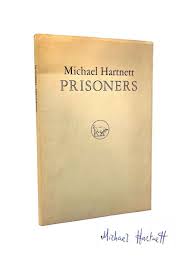
Hartnett places this poem, Maiden Street Wake, alongside his poem Prisoners (both written in 1968) as the only two poems in a limited edition (250 copies) joint venture publication between Deerfield Press and Gallery Press that was published in 1977.  Both poems are illustrated by Timothy Engelland and all copies are individually signed by the author.  It seems that both poems were in his mind as he embarked on writing The Retreat of Ita Cagney / Cúlú Íde, the first major works, along with Farewell to English, undertaken on his return to West Limerick.  Both poems celebrate their 50th Anniversary this year!

Maiden Street Wake may be an account of yet another random wake, one of the many wakes that the very young Hartnett witnessed and attended in Maiden Street during his childhood.  Whatever the case may be, the old traditional Irish wake, with its old women keeners, flickering candles, music and drink, tobacco and snuff, as well as ‘soft biscuits and lemonade’ for the children, is used by Hartnett to set the scene for us in the poetic version of The Retreat of Ita Cagney. It is obvious that these events made a lasting impression on the young teenage Hartnett and those events fuelled his imagination and gave rise to some of his best poetry.

He describes the scene at ‘The Corpse House’, a mud-walled cabin in Lower Maiden Street.  The dead man is laid out in his bedroom, surrounded by ‘women in shawls, and young children from the street in their ‘summer sandals’. His bed, ‘the breeding ground and cot’, is surrounded by ‘penny candles’ and people file by to pay their last respects.  The family have made a great effort to cater for the influx of visitors and the best and ‘finest teacups’ have been brought out for the occasion.  The poet uses a beautiful simile to describe the corpse, he is like ‘an alabaster Christ’ laid out in the tomb.  For the young Hartnett viewing this traditional custom there is a sense of anticlimax at the end: after waiting their turn, they ‘shufffled round’ and were rewarded later in the meagre kitchen with ‘soft biscuits’ and a glass of the famous local soft drink, Nash’s red lemonade.

The Irish wake has long been the subject of poems, songs, films and stage plays.  Hartnett has written several poems in which he explores the old custom in a very sympathetic way.  These ‘Wake Poems’,  his poems such as A Small Farm and the many poems written to honour his grandmother, Bridget Halpin, all attest to a poet exploring the past, its customs and traditions while seeking to enhance their value and importance lest they be lost.

An Analysis of ‘Prisoners’ by Michael Hartnett

‘Prisoners’ was a limited edition (250 signed copies) jointly published by Gallery Press, Oldcastle, County Meath and Deerfield Press, Massachusetts.  Each copy was signed by the author.  The edition consisted of two poems, Prisoners and Maiden Street Wake and was illustrated by Timothy Engelland.  It was Hartnett’s last collection of poems in English, written before his collection ‘A Farewell To English’ (1975) but not printed until 1977.

This poem, Prisoners has largely been overlooked, but is of vital importance in the Hartnett canon.  The poem, written in 1968, dates from his time spent working as a night telephonist in the Posts and Telegraphs Exchange in Exchequer Street, in Dublin.  The poet visits and explores a theme close to his heart, which had bubbled to the surface again and which still sparked his interest on his return to his West Limerick base in 1975.  Though it is other-worldly, reminiscent and redolent of a medieval setting, there is a close connection between Prisoners and the iconic The Retreat of Ita Cagney / Cúlú Íde.  One poem anticipates the other, and both poems are inspired by events that had taken place in his beloved Maiden Street in or around 1958.

Another poem worthy of mention here is Maiden Street Wake. Hartnett’s Collected Poems contains several ‘Wake Poems’, including, of course, a wake that he missed, that of his grandmother Bridget Halpin immortalised in Death of an Irishwoman.  His poem, Maiden Street Wake may be an account of yet another random wake, one of the many wakes that the very young Hartnett witnessed and attended in Maiden Street during his childhood.  Whatever the case may be, the old traditional Irish wake, with its old women keeners, flickering candles, music and drink, tobacco and snuff, as well as ‘soft biscuits and lemonade’ for the children, is used by Hartnett to set the scene for us in the poetic version of The Retreat of Ita Cagney. This old traditional Irish wake is also constantly in the background throughout the dramatic version (in English) of the same story.  It is obvious that these events made a lasting impression on the young teenage Hartnett and those events fuelled his imagination and gave rise to some of the best poetry he has written either in English or in Irish.

Prisoners explores the plight of a young, unnamed woman who is involved in a relationship with a married man, her ‘human Lord’.  This arrangement is a source of local scandal and is frowned upon by society and the townspeople.  In his Collected Poems, the poet places Prisoners immediately before The Retreat of Ita Cagney, where the same theme is revisited again, but where now the woman is given a name.  The poet also published an Irish retelling of the story in the iconic Cúlu Íde.  His papers in the National Library also contain fragments in Irish and English of the poet’s efforts to dramatise the story, efforts that eventually came to nought, but they are testament to his obsession with this story.  It is interesting to note that in both Prisoners and The Retreat of Ita Cagney, the poet is sympathetic to the woman’s dilemma.

Whereas The Retreat of Ita Cagney has a sequence structure, Prisoners is a much shorter lyric. However, like The Retreat of Ita Cagney, it is a dramatic ex­ploration of a woman’s loneliness and isolation in a callous and hostile society. The Retreat of Ita Cagney (in both its iterations in English and Irish), is undoubtedly Hartnett’s finest achievement.  In Prisoners, and especially in The Retreat of Ita Cagney, as fellow Munster poet, Brendan Kennelly pointed out in his review of the latter poem, Hartnett, ‘pays relentless imaginative attention to this woman’s fate, and he presents with admirable dramatic balance her loneliness, independence and state of severed happiness’.  In this condition, he states that ‘Ita Cagney becomes a visionary critic of the society that hounds and isolates her’ (Poetry Ireland Review, Issue 15, p. 26).

The Retreat of Ita Cagney is a pained celebration of an en­forced privacy as experienced by the woman at the centre of the story; the title of this poem, Prisoners, paints her dilemma in an equally disturbing light.  It opens with images of a self-imposed captivity.  The man congratulates himself on being able to keep this ‘wild’ young woman, whom he obviously loves, ‘captive’ from the prying eyes of the town.

There are striking similarities between Sequence 2 in The Retreat of Ita Cagney and the way the poet proceeds to describe the woman who has been isolated and shunned by her neighbours in this poem.  The images used follow the strict requirements of the Dánta Grá, and like Ita Cagney, the young woman here is described stylistically and is given classical features:

So her face was white as almond

pale as wax for lack of sunlight

blue skin by her eyes in etchings

She is described here as waif-like and ghostly because she has not been seen outside – she is literally a prisoner in her own home or castle.  Her classical features reveal the stresses and tensions of being ostracised by society, and her beauty is now of little consequence anymore because of her self-imposed house arrest.

In the later poem (1975), Hartnett also describes Ita Cagney in similar symbolic language.  However, in contrast, Ita comes across as a strong and formidable woman: he describes Ita Cagney’s head from ‘her black hair’ to her throat, which ‘showed no signs of age’. Her hair is black save for a single rib of grey which stands out ‘like a steel filing on a forge floor’. He then describes her brow, her eyebrows, her eyes, ‘her long nose’, ‘her rose-edged nostrils’, her upper lip, her chin and jawline and finally her throat. The reason for this detail is, I think, to give us a sense of the formidable woman at the centre of this poem.

In Prisoners, the female protagonist is obviously loved and revered by her Lord, who arrives home, like a knight errant, a Gearóid Íarla*, on his trusty grey steed.  The reason for the couple’s exclusion is hinted at here: she has abandoned the old gods and the old religion of the townspeople, and she now sings ‘to a new god, to the church of her invention’. It seems that she has abandoned organised religion and its laws, edicts and diktats in favour of a more private and personal one.   However, this behaviour and lifestyle choice have led to strained relationships with friends and neighbours and have also led to her being seen as a ‘scarlet’ woman in the town.  The only comparison between the old religion and the new is her scarlet dress, similar to the bishop’s garb from the old dispensation.

She has made her choice, and she and her partner have brought a son into this ‘secret world’.  The poet then gives her a voice (if not yet a name):

… my Lord God is a human Lord,

not Lord of towns, but Lord of white horses, holy

of the hyacinth, the human Lord of light, of rain.

The word ‘Lord’ is repeated here eight times as in a monastic chant.  She invokes the hyacinth, often associated with the sun god, Apollo, as a symbol of peace, commitment and beauty, but also of power and pride. The hyacinth is often found in Christian churches as a symbol of happiness and love.   She cries out in anguish in the hope that the gods who ‘speak in rain of trees: send your holy fire to heat me’.

The woman and her partner at the centre of the poem have made their choices and are suffering because of the pressure being brought to bear on them.  Their townhouse, towerhouse, keep now resembles a fortress, a prison, and those within, prisoners.  Of necessity, the doors are bound ‘with iron chains’ and the besieged family are ‘locked safe inside an open moat of water’.  The poet is hopeful that their struggle will succeed and, like his later masterpiece, The Retreat of Ita Cagney’, he is quietly proud of the woman’s heroic stand against the threatening and ominous forces that ranged against her.  It is interesting to note that in Celtic mythology, the birch tree is associated with the goddess Brigid and symbolises new beginnings and protection. Their house is protected by birches, and the poet’s hope is emphasised by the beautiful final lyrical line:

The birch-hid dove was silk with peace.

There is one final echo of this poem, Prisoners,  in the Irish version Cúlú Íde.  In the final sequence (Section 9), Ita finds herself besieged in her ‘keep’ as neighbours move around outside ‘as venom breaks in strident fragments / on the slates’.  She ‘hears the infantry of eyes advance’ and so she closely guards her child,

ag cosaint a saighdiúirín

ó uaill leaca an sraide

ó shúile dearga an yeos.

Her child, her ‘saighdiúirín’, her little soldier boy,  must be protected from the dreaded yeomen, the hated symbol of the oppressor from a troubled colonial past.

Author’s Note: 

* Gerald Fitzgerald, the third Earl of Desmond, known as Gearóid Íarla, was famous as a poet and wizard (1339 – 1398).  He inherited his earldom, with its vast estates, in 1359.  His castle in Newcastle West was one of his main strongholds, and he spent much of his time there.  He successfully combined the Norman and the Gaelic Irish cultures, and he wrote his poetry in Irish.  In 1398, it is said he mysteriously disappeared while walking in his Newcastle West demesne and was never seen again.  Myth has it that he still lives under the enchanted waters of Lough Gur, in County Limerick, and that every seven years he and his hosts rise to the surface and ride their horses over the lake, and that, when the horse’s silver shoes wear out, he will be set free!

Works Cited

Hartnett, Michael. Collected Poems, ed. Peter Fallon. Gallery Books, Oldcastle, County Meath, 2001.  Reprinted 2009 and 2012.

Poetry Ireland Review, Issue 15.

Prisoners by Michael Hartnett

‘Prisoners’ by Michael Hartnett

Brave

To keep as captive

one he loved, this wild woman

not so old, so many years

in quiet place,

unknown to all the town.

So her face was white as almond

pale as wax for lack of sunlight

blue skin by her eyes in etchings,

all her beauty now attainted,

all her loveliness unwanted.

Not to say his love was lessened,

no.  He came home to her same altar

at night, grey horse bore him to the threshold,

quiet rooms, where the woman sang her service,

sang to new gods, to the church of her invention

her own cloistered psalms, in her bishoped dress of scarlet.

For she built walls to keep God in,

and waiting there from eyes ahide

at night before her tearful face

at calm crossroads her child did raise,

her child into the secret world.

And she involved a secret Lord,

prayed the holy prayers she made herself,

and sang so: my Lord God is a human Lord,

not Lord of towns, but Lord of white horses, holy

of the hyacinth, the human Lord of light, of rain.

Yes, Lord of sacred anguish, hear

me, and speak in rain of trees: send

your holy fire to heat me. I

cry: my Lord of holy pain, hear.

House of slated roof was their house,

daylight knew no way to hound them out of peace:

the door was closed with iron chains

locked safe inside an open moat of water;

secret in their love they lived there:

the birch-hid dove was silk with peace.

– Michael Hartnett

This poem is vital in the Hartnett canon.  The poem, which he wrote in 1968, visits and explores a theme close to Hartnett’s heart.   It is later included as the title poem in his last collection in English before his now famous Farewell to English.  This was a limited-edition (250 copies) joint venture publication between Deerfield Press and Gallery Press that was published in 1977.  The publication includes two poems (Prisoners and Maiden Street Wake), and both poems are illustrated by Timothy Engelland.

The Second Coming by W.B. Yeats – A Poem for Our Time

2354f8aaf8f740849907452ec6867daf
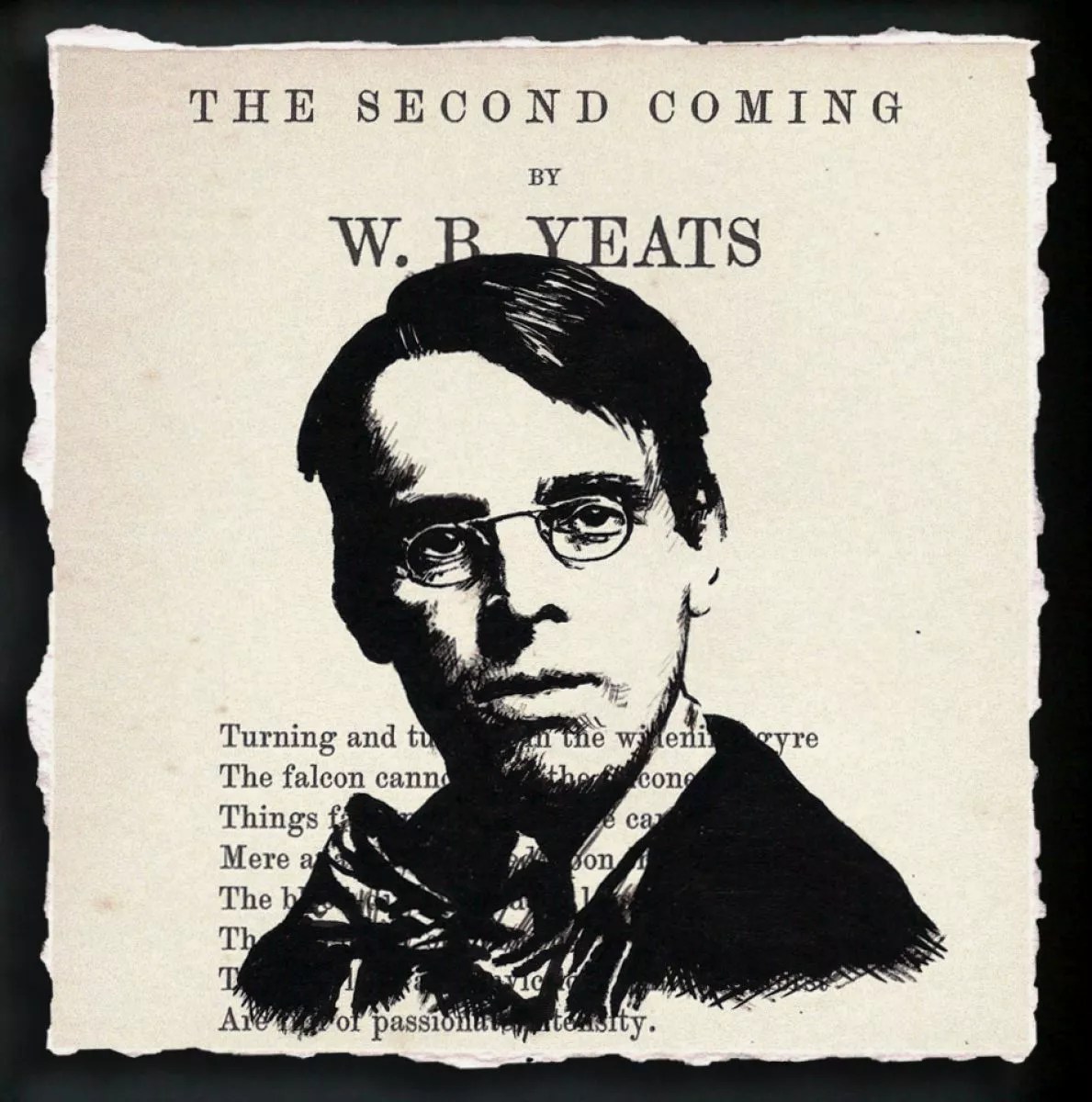
W.B. Yeats – The Second Coming (2014). Acrylic painting by Peter Walters.

The Second Coming


Turning and turning in the widening gyre

The falcon cannot hear the falconer;

Things fall apart; the centre cannot hold;

Mere anarchy is loosed upon the world,

The blood-dimmed tide is loosed, and everywhere

The ceremony of innocence is drowned;

The best lack all conviction, while the worst

Are full of passionate intensity.

Surely some revelation is at hand;

Surely the Second Coming is at hand.

The Second Coming! Hardly are those words out

When a vast image out of Spiritus Mundi

Troubles my sight: somewhere in sands of the desert

A shape with lion body and the head of a man,

A gaze blank and pitiless as the sun,

Is moving its slow thighs, while all about it

Reel shadows of the indignant desert birds.

The darkness drops again; but now I know

That twenty centuries of stony sleep

Were vexed to nightmare by a rocking cradle,

And what rough beast, its hour come round at last,

Slouches towards Bethlehem to be born?

Source: The Collected Poems of W. B. Yeats (1989)

 Commentary

The Second Coming surely holds the distinction of being the most plundered poem in the English language. To fully understand the poem, we are required to have some biblical knowledge as well as a basic understanding of Yeats’s vision of history.  The biblical reference is twofold: the poem blends Christ’s prediction of his own second coming with St. John’s vision of the coming of the Antichrist, the beast of the Apocalypse.  This is ‘the rough beast’ of the second last line of the poem.  Yeats makes the rough beast even more disturbing and sinister by assigning its place of birth to Bethlehem, the place of Christ’s birth, associated over the course of two thousand years – until recent times – with peace, mercy, gentleness and forgiveness.

To understand Yeats’ cosmology it is essential to read his book, A Vision where he explained his views on history and how it informed his poetry. Yeats saw human history as a series of epochs, what he called “gyres.” He saw the age of classical antiquity as beginning with the Trojan War and then that thousand-year cycle was overtaken by the Christian era, which he suggests is now coming to a close. That is the basis for the final line of the poem, “And what rough beast, its hour come round at last/ Slouches towards Bethlehem to be born?”  In his mystical book, A Vision, he foretold the birth of a new, violent, bestial anti-civilisation and the simultaneous destruction of the two-thousand-year-old Christian cycle.  The second coming of the poem is thus not that of Christ but of his opposite, the slouching, revolting figure of the beast whose birth will herald in a new age of anarchy to be ‘loosed upon the world’ (line 4).  Yeats’s thesis in A Vision is that each epoch or period of history is eventually overthrown by some massive upheaval.  This may explain why Yeats used the phrase “the second birth” instead of “the Second Coming” in some of his first drafts.

It is in this context that the opening lines of the poem should be read: ‘Turning and turning in the widening gyre / The falcon cannot hear the falconer’.  The falcon here is an image of man rapidly losing contact with Christ the falconer as he moves along the widening gyre of history.  The next six lines paint a grim picture of the beginning of a new age, marked by worldwide anarchy and violence (‘The blood-dimmed tide is loosed’).  As the gyre widens, ‘things fall apart; the centre cannot hold’.  The end of the Christian age is granted the revelation of the character of the new age. The tide of violence has already begun to move, and as it does, it begins to drown ‘the ceremony of innocence’ which, in Yeats’s symbolic system, stands for order and harmony as opposed to the personal and social violence of the ‘blood-dimmed tide’.

The ‘vast image out of ‘Spiritus Mundi’ (line 12) is a favourite Yeatsian idea.  According to Yeats, Spiritus Mundi is a storehouse of ideas deriving from the great universal memory common to all humankind, and is also the source of prophecy, since, he believed, history repeats the same predestined cycles every two thousand years or so.

The more terrible events associated with the coming of the Antichrist are all in the future, but in lines 3 – 8, Yeats suggests that his world is already experiencing a foretaste of the grim future heralded by the birth of the ‘rough beast’.  There was plenty of evidence all around him in 1919, the year he composed the poem.  Yeats began The Second Coming during the tense, eventful month of January 1919. The ‘war to end all wars’ was barely over and the Russian Revolution, which dismayed him, was still unfolding, while another war was brewing on his doorstep. On 21 January, the revolutionary Irish parliament met in Dublin to declare independence while, in a quarry in Soloheadbeg in Tipperary, Dan Breen and other members of the IRA killed two officers of the Royal Irish Constabulary ushering in the War of Independence. This war threatened to uproot the Anglo-Irish ascendency and the civilisation it represented, many elements of which appealed to Yeats himself.  Empires and dynasties were all in a state of flux as a result of this anarchy and revolution that had been loosed upon the world. The birth of Yeats’s daughter, Anne, in February, was also fraught with danger. During her pregnancy, his young wife Georgie Hyde-Lees had been stricken by the Spanish flu that was burning through Europe at that time in the wake of the war.  All these events conspired to put Yeats in an apocalyptic frame of mind.

For Yeats, the Incarnation of Christ was a violent, turbulent event, after which ‘twenty centuries of stony sleep / were vexed to nightmare by a rocking cradle’.  This new incarnation, that of the slouching ‘rough beast’ will unleash universal horrors.  Its sinister possibilities are hinted at in the suggestion that even the predatory desert birds, for all their savagery, are ‘indignant’ at its coming.

The poem gives us a frightening account of the fate in store for the post-Christian world.  Social anarchy and massive destruction are made worse by the collapse of moral values among the leaders of nations: ‘The best lack all conviction, while the worst / Are full of passionate intensity’.  He predicts that evil will triumph in the public sphere because those political leaders who might be expected to defend humane values (and basic human rights) lack the determination to resist those who preach violence and intolerance.

As I mentioned earlier, The Second Coming has become perhaps the most plundered poem in the English language – only Heaney’s From ‘The Cure at Troy’  comes a close second, with its ‘let hope and history rhyme’ so beloved of politicians.  At 164 words, The Second Coming consists of almost nothing but quotable lines. Someone reading it for the first time in 2024 might resemble the apocryphal theatregoer who complained that Hamlet was nothing but a bunch of quotations strung together. Whether or not it is Yeats’s greatest poem, it is by far his most useful.  As Auden wrote in “In Memory of WB Yeats” (1939), “The words of a dead man / Are modified in the guts of the living.”  We have to admit, after its first one hundred years, this poem was built to last.

As our world has recently been wrenched out of joint by the Covid-19 pandemic, many people are turning to poetry for wisdom and consolation. However, The Second Coming fulfils a different role, as it has done in crisis after crisis, from the Vietnam War to 9/11, to the genocides in Rwanda or Syria or Gaza,  to the election of Donald Trump and to the looming prospect of his imminent re-election: it provides us with an opportunity to confront chaos and dread, rather than to escape it. This is surely why Fintan O’Toole has proposed the “Yeats Test”: “The more quotable Yeats seems to commentators and politicians, the worse things are.”

bwgqngybqe-1577215055

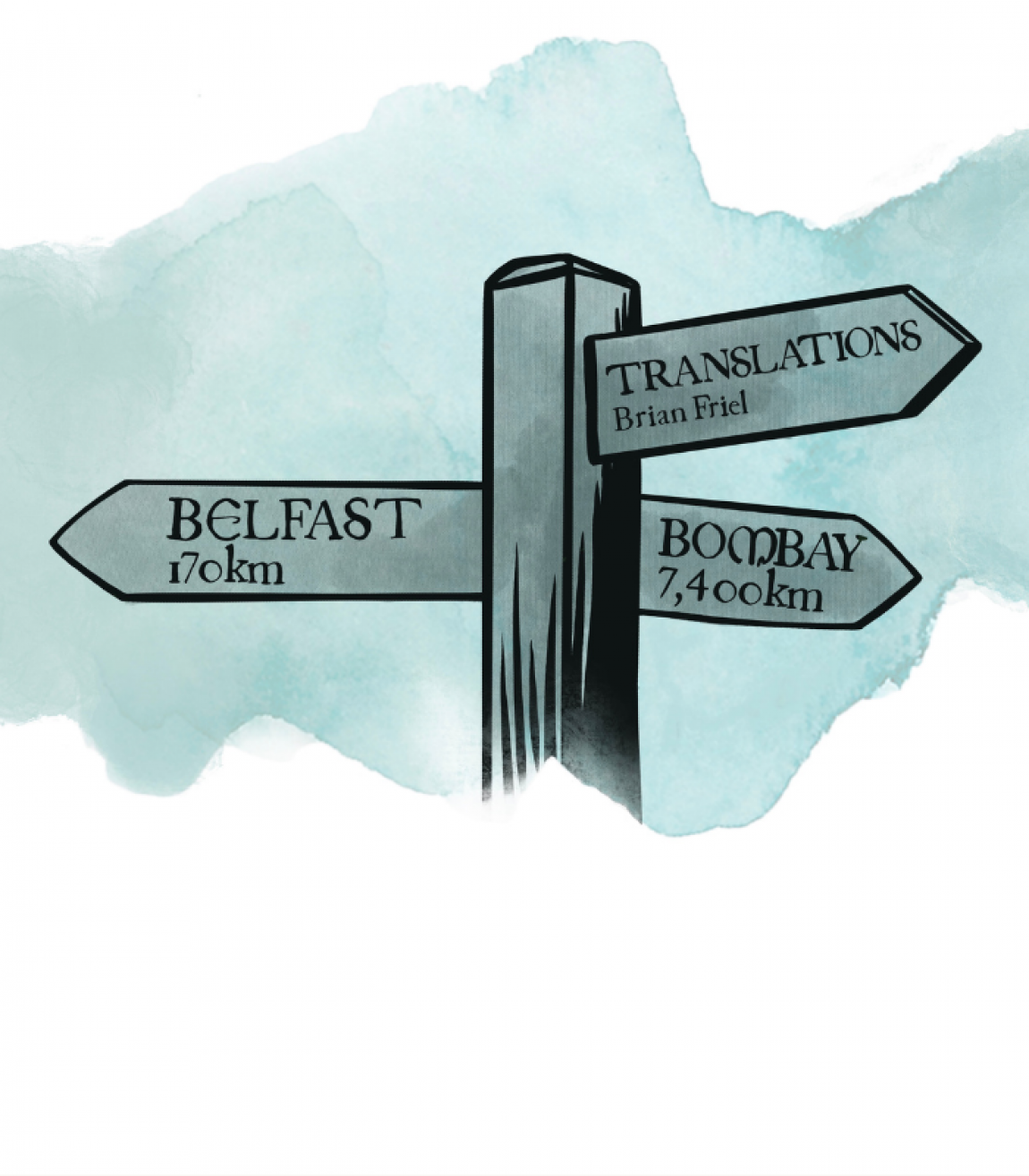
Translations by Brian Friel

translations-featuredTranslations is a three-act play by Irish playwright Brian Friel, written in 1980. It is set in Baile Beag (Ballybeg), in County Donegal which is probably loosely based on his beloved village of Glenties in West Donegal where Friel was a frequent visitor and where he is buried. It is the fictional village, created by Friel as a setting for several of his plays, including Dancing at Lughnasa, although there are many real places called Ballybeg throughout Ireland. Towns like Stradbally and Littleton were other variations and ‘translations’ of the very common original ‘Baile Beag’. In effect, in Friel’s plays, Ballybeg is Everytown.
The original staging of the play, in Derry in 1980, was the inaugural production by the newly formed Field Day Theatre Company, which Brian Friel had founded with the actor Stephen Rea. “It was a poignant play for us because the Troubles in the north of Ireland were still raging,” Rea says. “All the issues were local, but Friel was writing about the bigger picture.”

That inaugural production was at the Guildhall, often seen as a symbol of British authority in the city. “It was pretty different for us to do a play there,” Rea says. “It had a huge impact. That was radical because we didn’t premiere it in Dublin, we didn’t premiere it in Belfast. We did it in Derry, which was very severely affected by the Troubles… When we first did the play, many anti-nationalist people said it was whingeing and moaning about the same old problems. However, because of the continuing war in Ukraine, people can see that the play has a considerable influence and relevance to colonialism worldwide”.

Translations is one of the greatest plays about identity, language, landscape, history – about how we communicate across those divides or fail to – and how a community or nation can navigate times of profound change and dislocation,” said Tánaiste and Minister for Foreign Affairs Micheál Martin when speaking at the grand opening of the Lesya Ukrainka National Academic Drama Theatre production at The Abbey Theatre in July 2023. “Friel wrote it for the Field Day company during one of the darkest periods of the conflict in Northern Ireland – it’s very significant that the national theatre ensemble in Kyiv, and their audiences, have felt that this Irish text resonates with their personal and collective experience as they live through this appalling, illegal war”.

Friel has said that Translations is ‘a play about language and only about language’, but it deals with a wide range of issues, stretching from language and communication to Irish history and cultural imperialism and the effects of colonialism. Friel said that his play ‘should have been written in Irish’ but, despite this fact, he carefully crafted the verbal action in English, which help bring the political questions of the play into focus.

The play traces the impact of an actual historical event, the 1824 – 1846 project to produce a British government-sanctioned ordnance survey map of Ireland. The English Parliament ordered Major Thomas Colby to Ireland in 1824 to undertake a comprehensive survey of the country. His teams of surveyors would produce detailed maps on a six-inch = one-mile scale that would be used to determine land valuations for tax purposes. The maps were finally published in 1846. They cover almost the entire country and include details of even the smallest civil division of the time: the townland.

Translations shows the effect this operation has upon a typical Irish village (Baile Beag), an impact which causes unemployment, theft, flight, threatened evictions, and violence. Here in Ballybeg, Captain Lancey has been tasked with creating an accurate map of Ireland, with English placenames, so that Ireland can be more easily navigated by the British Army, and that land taxes can be more easily charged. These objectives are connected to the British agenda to colonise and modernise the comparatively ancient civilisation of Ireland. Lancey, who has been sent by commanders in London to carry out this project, is described by Yolland in Act Two, Scene One as ‘the perfect colonial Servant’.  Yolland marvels at this hard-working, industrious attitude: ‘Not only must the job be done — it must be done with excellence’.

At face value, this development seemed to be progressive yet in reality it is being used as a weapon of subjugation by a colonial invader. I am reminded of those Pathè News clips from the 40s seen in cinemas at the time and often lampooned by many commentators since of local Home Guard volunteers taking down all road signs in the English countryside so that any of Hitler’s spies who might happen to parachute in would be totally lost. Tragically the huge and ambitious translating project being carried out by the British army sappers which replace all the Irish placenames with new, standardised English ones has the effect of surgically cutting off the natives from their culture – their living geography, history, mythology, and literature – and leaves them stranded and apprehensive in a strange, new world with unfamiliar language labels. This is all the more relevant today because this very tactic is being re-enacted and repeated by Russia in trying to illegally invade and reclaim territory belonging to one of its neighbours.

Translations is set at the time in the nineteenth century when English was becoming the dominant language of Ireland. Using historical metaphor, Friel at once writes an elegant epitaph for Irish as a cultural medium and reflects on the emerging new reality; what it means to be Irish while speaking English. This context is appropriate because it marks the beginning of a more active intervention in Ireland by Britain. The early decades of the 19th century saw the tide turn against the Irish language in Ireland. Already English was spoken in major cities such as Dublin, and the potato blight and mass emigration would combine to reduce the proportion of Irish speakers to about a quarter of Ireland’s population by the end of the century. The decline of Irish was further spurred on by the introduction of the National Schools system in the 1830s, whose origins are hinted at in the play. Maire expresses succinctly the reasons for learning English in Act One: “I don’t want Greek. I don’t want Latin. I want English… I want to be able to speak English because I’m going to America as soon as the harvest’s all saved”. It is hard to argue with the desire of the 19th-century Irish peasant to learn English, as it was the only way for basic economic advancement, and in many cases, survival. The tension between the need to learn the language of the coloniser and the desire to preserve one’s heritage is the central dilemma of Translations.

The play is, appropriately enough, set in a school. While some historians have accused Friel of mythologizing and lionising the Irish Hedge School, his use of it in the play allows him to embrace the full range of Irish education of the early 19th century, giving the audience a limited idea of what it meant to be Irish then. The Hedge School is the place where all education is conducted, from the simplest things, such as Manus teaching the dumb Sarah Johnny Sally to say her name, to Jimmy Jack’s constant poring over Homer in the original Greek. In the town of Baile Beag, students learn in Irish, and they learn the languages and cultures of classical antiquity. Those who do know English only use it, to quote Hugh, the master of the school, “outside the parish… and then usually for the purposes of commerce, a use to which [English] is particularly suited”. We are reminded here of Michael Hartnett’s cutting riposte in his Farewell to English when he too notes the advantages of having English:

… finding English a necessary sin

the perfect language to sell pigs in.

Hugh explains the significance of the Irish language and literature to the inhabitants of Baile Beag to the British surveyor, Lieutenant Yolland, in this half-joking way:

A rich language. A rich literature… full of the mythologies of fantasy and hope and self-deception – a syntax opulent with tomorrows. It is our response to mud cabins and a diet of potatoes; our only method of replying to… inevitabilities.

A major theme of Translations is the replacement of the Ancient with the Modern. This can be seen in the Royal Engineers project to replace the Irish place names with standard English ones. While Irish is the traditional language of the country, it is being replaced by English: a language spoken internationally, one of commerce and progress.

The Irish language represents Ireland’s ancient past, while English represents the replacement of this in favour of something more modern and pragmatic. Maire speaks to this in Act One, when arguing they should all learn English. She quotes Daniel O’Connell, The Liberator, who had only recently (1829) achieved a huge victory for Ireland in Westminster with the passing of the Catholic Emancipation Act which finally gave Catholics freedom to practice their religion in public. In his view, Maire tells us, ‘The old language is a barrier to modern progress’. However, not all the residents of Baile Beag, are as keen to adapt to these modern ways.

Thus, the colonial encounter between the English and Irish is illustrated for us in the play within the cultural realm. From the point of view of the English surveyors, the cultural space of the Irish seems to be inaccessible. Yolland tells his Irish assistant, Owen, for instance, “Even if I did speak Irish, I’d always be an outsider here… I may learn the password but the language of the tribe will always elude me”. Similarly, to the inhabitants of Baile Beag, the English seem strange and distant. Hugh reflects that English succeeds in making Latin verse sound “plebian,” and remarks that the Irish are not familiar with English literature, feeling “closer to the warm Mediterranean”. Maire, for all her love of things English, also reflects that even the English placenames Yolland tells her about “don’t make no sense to me at all”.

The drama revolves around contact between the people of Baile Beag and colonising soldiers, who enter the town to conduct a survey that will “standardise” the place names, meaning, to Anglicize them, either by changing the sounds to approximate those of English – for example, Cnoc Ban to “Knockban,” or by translating them directly – in this case, Cnoc Ban would become “Fair Hill”. Although the villagers welcome the soldiers at first, most of the characters soon become aware of the sinister aspects of this task. As Manus, the son of Hugh and his assistant at the Hedge School, tells his brother Owen, “It’s a bloody military operation”. The task of giving new names to the places of Baile Beag stands in for the full colonisation of Irish life, covering over the previously existing Irish cultural map in order to make “a new England called Ireland,” to use Declan Kiberd’s phrase. Owen, who has been assisting in the colonisation of his own country, draws out the implications:

Lis na Muc, the Fort of the Pigs, has now become Swinefort… And to get to Swinefort you pass through Greencastle and Fair Head and Strandhill and Gort and Whiteplains. And the new school isn’t at Poll na gCaorach – it’s at Sheepsrock. Will you be able to find your way?

It seems that much has been ‘lost in translation’ and the loss of the Irish language reflected in this play is a huge loss for civilisation, none more so than for the Irish themselves. However, Friel’s play also carries an implicit critique of the modern-day use of Irish. If today the vast majority of Irish do not speak Irish, what significance does the quest to preserve or restore the language really have? In Translations, different characters engage in this discussion, with many points made on both sides. The most obvious is Jimmy Jack, who while marginal to the action for the most part is important, especially in this respect. Called “the infant prodigy” by the Hedge School students, Jimmy is anything but – he is in his sixties, does not wash himself, and spends most of his time reading the Greek and Latin classics. His fellow students regard his devotion to the literature of antiquity with bemusement, and he is treated as a buffoon. His infatuation with antiquity, which ends in a literal desire to marry Pallas Athene, serves in the play as a metaphor for a certain kind of cultural nationalist (or Gaelgóir) who continues to use Irish long after it has ceased to be relevant to the Irish themselves. By speaking Irish, and revelling in the glories of Ireland that was, they make themselves as irrelevant to modern Irish life as Jimmy Jack with his Greek, whose only response to the English army’s incursion into Baile Beag is to shout “Thermopylae! Thermopylae!”. The idea seems to be that trying to preserve Irish as a way to evoke the past before colonisation is a futile endeavour and is inadequate for the need of the Irish seeking a new cultural identity. Besides, one suspects that in any case, the glories of Celtic civilisation might never have existed quite in the form one reads about in books, much like life in ancient Greece and Rome could not be judged by reading the Odyssey or the Aeneid.

Close readers of Friel will know that there is this double dimension in all of his work. He purposely sets out to illustrate the same theme from different points of view.  In his play ‘Philadelphia Here I Come!’, for example, we see immigration and ‘escape from the land’ from Gar’s viewpoint and from Lizzie’s point of view. Even here in Translations, Yolland wishes to be part of the more ancient Irish civilisation, and so tries to learn Irish; Maire, on the other hand, wants to become part of modern society, and so feels she must learn English.

The final question that the play poses is a simple one: can Irish civilisation and culture survive after colonisation, after the loss of Irish as a medium and the enforcement of English norms? Friel seems to believe that it does, and his answer is implied in a remark of Hugh from Act Two:

Remember that words are signals, counters. They are not immortal. And it can happen – to use an image you’ll understand – it can happen that a civilisation can be imprisoned in a linguistic contour that no longer matches the landscape of… fact.

One of the many tragedies perpetrated by the English colonisation of Ireland is that the words of Irish no longer match “the landscape of fact,” an act that the play shows us happening very literally. However, to use the words of Hugh once again, Friel is arguing precisely against allowing Irish civilisation to be imprisoned in the linguistic contour it once had. Hugh, drunk and distraught at the end of the play, sees the necessary step one must take to prevent this:

“We must learn these new names… We must learn where we live. We must learn to make them our own. We must make them our new home”.

For the Irish, to accept the new place names as their home and to “learn to make them their own” is to ask them to carry on their civilisation, in a language that was imposed on them by force, it is true – but Friel suggests it is either this, or nothing remains to be called Irish culture. The great irony of course is that modern Irish writers now writing in English have taken a stranglehold on most of the prestigious English literary awards including the Booker Prize in recent years!

In conclusion, the contexts and drama of Translations combine in a remarkable, sophisticated discussion of cultural decline and renewal. Brian Friel uses many characters and events that combine into a central argument: the loss of Irish as a cultural medium was a tragedy, enforced both by literal violence and the “soft power” of English cultural hegemony. However, it is equally a mistake to try and recreate the Irish past, as this would be to condemn Irish civilisation to death and complete the task the coloniser started. His play ends with the proposition that not only can English be used to express a uniquely Irish cultural identity, but that it must be used in this manner if it is to happen at all. That Friel wrote his play in English rather than Irish is more than for the sake of convenience or comprehensibility – it is his way of participating in the task he sets out for the Irish in the very same work.

brian-friel

***********

My own fascination with Translations stems from some research I did back in 2019 on the contentious etymology of the townland of Ahalin (Aughalin) in my own home place of Knockaderry (Cnoc an Doire, the hill of the oak). Dr John O’Donovan, noted historian and the translator of the Annals of the Four Masters, an Irish-speaking scholar and scribe, was the Ordnance Survey’s overall Names Expert used by the Ordnance Survey during their survey conducted between 1824 and 1846.  Like Owen in the play, it was O’Donovan’s responsibility to enter all the Irish versions of names into the Names Books, in addition to the English spelling recommended for the published maps.  For this reason, the Ordnance Survey of Ireland Names Books are sometimes referred to as O’Donovan’s Name Books.

O’Donovan spent July and August 1840 in Limerick and he signed off on his work on the parish of Clonelty and Clouncagh on 25 July 1840.  He was assisted in his work in Limerick by Padraig Ó Caoimh and Antaine Ó Comhraí.

Evidence suggests that in the year 1824, there were three pay Hedge Schools recorded in Knockaderry by official report – two in the village of Knockaderry run by John Mulcahy and John O’Callaghan, and one in Clouncagh run by Edward Conway which was located in the corner of ‘Hartnett’s Field’ on the Begley farm. This was at a time when every field had a name not to mind every townland!  John Croke, a relative of Archbishop Thomas Croke, first patron of the GAA and after whom Croke Park is named, set up a Hedge School in Clouncagh in 1850 in a building set aside for him by William McCann and his family.

The first official National School in the parish assisted by the Board of Commissioners of National Education was established in 1832. The school was located in the village of Knockaderry and John O’Callaghan was appointed headmaster of the Boys’ School and his daughter, Amelia O’Callaghan, was appointed as mistress of the Girls’ School. The first purpose-built National School in the parish opened its doors in 1867 in Ahalin (Áth na Linne, The Ford of the Pool).

You can read further about my own local investigations here:

Ahalin (Achadh Lín)  The Field of the Flax

An Attempt at a Conclusive Etymology of the Placename Ahalin in Knockaderry, County Limerick

The Etymology of the Placename Clouncagh in County Limerick

The Christmas Tree by Danny Barry

This beautiful video has been produced by Danny Barry’s grandson, Dan Barry. The poem is narrated by the poet Michael Hartnett and it is taken from a radio documentary that he did in 1979 for RTE Radio entitled Poems Plain.  The programme was produced by Donal Flanagan. The video contains copyrighted material that is being used for educational purposes under the doctrine of ‘fair use’. The use of this material is not intended to infringe upon the copyright owner’s rights. The material is used here solely for educational and non-commercial purposes.  Dan Barry has suggested a small but necessary edit to verse four and the printed poem below reflects those changes.

Danny Barry’s poem, ‘The Christmas Tree’, deals with an actual happening. A few men from Maiden Street in Newcastle West decided to erect a Christmas tree in the street. They cut it down in Glenmageen, an area reputed to be haunted by a witch known as Sprid na Barna.  Glenmageen is located about four miles south of Newcastle West and people can now visit the townland as they walk or cycle on the new Limerick Greenway. The stories of Sprid na Barna were well known, and the area near the present-day Barna Gardens was greatly feared by the local people. Indeed, it was said that only a few tough men would go home after dark along the road she haunted.  Michael Hartnett is fulsome in his praise for the poet:

Danny Barry’s simple evocation of Sprid and her victims is extraordinary.  Not because it is great poetry, but because he does not question the truth of the event at all. By the way, the Silver Dollar Saloon, which is a strange Hollywood, Western-type name, is a pub in Newcastle West, which was then run by the Flynn family, and is now run by the Kelly family.

The poem is purely mischievous and no insult should be taken by anyone, dead or alive, concerning the story told by the poet.  Danny Barry is ‘ball hopping’ here and there are distinct similarities between this poem and many later written by Michael Hartnett, such as ‘The Balad of Salad Sunday’.

The Christmas Tree

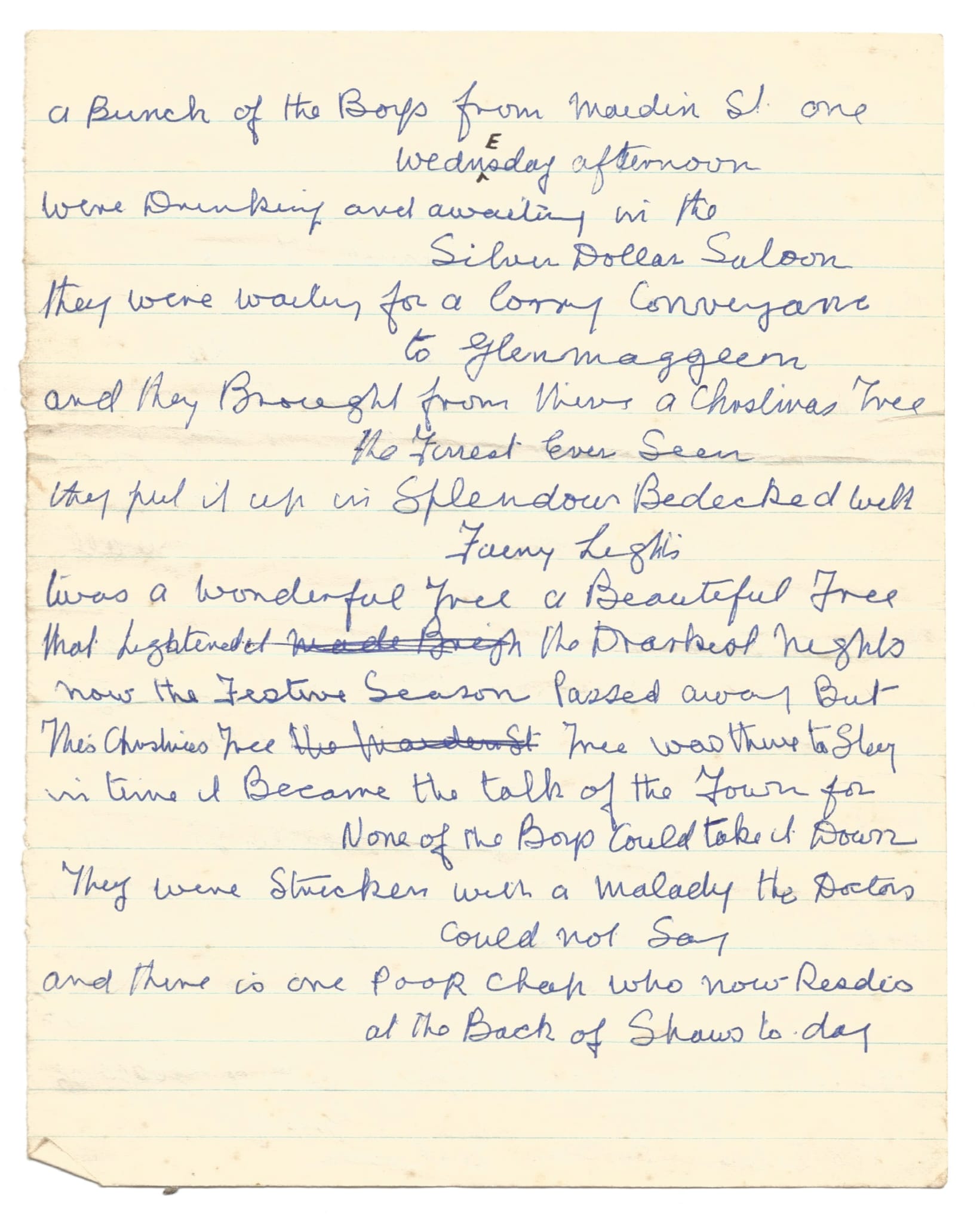
A bunch of the boys from Maiden Street, one Wednesday afternoon,

Were drinking and awaiting in the Silver Dollar Saloon,

Waiting for a lorry to convey them to Glenmageen.

And they brought from there a Christmas tree, the finest ever seen.


They put it up in splendor, bedecked with fairy lights.

It was a wonderful tree, a beautiful tree, that lightened the darkest nights.

Now, the festive season passed away, but this Christmas tree was there to stay.

In time it became the talk of the town, for none of the boys dared take it down.


They were stricken with a malady the doctors could not say,

And there is one poor chap who now resides at the back of Shaw’s today.

Now, you have heard of Sprid na Barna, that very naughty dame,

That evil maid of Glenmageen, of the haunting ghostly fame.


The clergy had to banish her between the tree and the bark.

No more she would haunt and terrify the neighbours after dark.

Now the moral of this ditty I want you all to know

Twas a tree that grew in Glenmageen twenty years ago.


Now what I am trying to tell you will cause you all to frown

That the amadans from Maiden Street have brought auld sprig to town.

Now when the blackthorn blooms again and the sheepdogs howl at the full of moon

You could meet auld sprig with a glass of grog in the Silver Dollar Saloon.

Note: The reference to ‘auld sprig’ in the last line is a local mispronunciation of ‘sprid’

4DE7AD7D-9765-4545-AC1F-8B8BF89BA495

791999D0-BB90-426F-B052-5DFF9973A6B2

 The original manuscript of the poem in Danny Barry’s own handwriting – you can see that it was a work in progress from all the crossing out!

The Hartnett Files

Hartnett by the Bridge in Newcastle West
Michael Hartnett in pensive mood by the River Arra in Newcastle West in the 1970s. Photo credit to Limerick Leader Photo Archives

I have been posting essays and commentary here over the years on the life and poetry of Michael Hartnett.  The nature of my blog is a bit disjointed and doesn’t have a ready index, so I  have decided to pull together all the Hartnett stuff in this one blog post.  It’s a One-Stop-Shop for Hartnett fans.  All you need to do – I think! – is Bookmark the post, and you can then browse at your leisure.  You know the drill – just click on the link!

General Essays

Michael Hartnett’s Legacy

Exploring Michael Hartnett’s early development as a poet.

Michael Hartnetts 26 Pubs at Christmas!

Michael Hartnett’s ‘Move to The Park

Michael Hartnett’s Travails in St. Itas Secondary School

The Etymology of Maiden Street in Newcastle West

Michael Hartnett’s ‘Christmas in Maiden Street’

Remembering Michael Hartnett

An Enthralling Companion

THE TOWN THE YOUNG LEAVE

Ageless Hartnett!

A Singular Life: The Poet Michael Hartnett

Where did Michael Hartnett get the idea for the title of A Farewell to English?

Poetry Analysis

‘A Small Farm’ by Michael Hartnett

The Retreat of Ita Cagney / Cúlú Íde

‘Death of an Irishwoman’ by Michael Hartnett

Maiden Street

‘Hands’ by Michael Hartnett

‘Crossing the Iron’ Bridge by Michael Hartnett

Analysis of ‘Water Baby’ by Michael Hartnett

In Memoriam Sheila Hackett

Epitaph for John Kelly, Blacksmith

Aere Perrenius – more lasting than bronze 

The Mystery of Michael Hartnett’s Entry for the Eurovision Song Contest

Prisoners by Michael Hartnett

An Analysis of  ‘Prisoners‘ by Michael Hartnett

Maiden Street Wake by Michael Hartnett

The Camas Poems of Michael Hartnett

Reconstructionists by Michael Hartnett

The Last Vision of Eoghan Rua Ó Súilleabháin by Michael Hartnett

Dán do Rosemary   le Michéal Ó hAirtnéide

Dán do Niall, 7, le Michéal Ó hAirtnéide

Dán do Lara, 10, le Michéal Ó hAirtnéide

Some Glendarragh Poems of Michael Hartnett: Poems from the Hearth

 Eigse Michael hartnett

Michael Hartnett Memorial Lecture 2021

Words of Encouragement to Those who Work Alone on Ledges

Pulled Pork and Poetry at Éigse Michael Hartnett 2018

The Michael Hartnett Poetry Prize 2018 – The Citations

Treasured Father-Son Memories Recounted at Opening of Éigse Michael Hartnett 2018

Éigse Michael Hartnett 2022

Paula Meehan’s ‘Letter to Michael Hartnett‘ 2025

Hartnett bronze by Rory Breslin
Hartnett bronze by artist Rory Breslin in The Square, Newcastle West.

In Memory of Danny Barry – Newcastle West’s Other Poet

Danny Barry 'The Bard of Bothar Buí'
Danny Barry ‘The Bard of Bothar Buí’

Believe it or not, Michael Hartnett is not the only poet to hail from Newcastle West!  There have always been local balladeers and poets who have pandered to their local audience in the town and in the surrounding parishes.  In Hartnett’s brilliant poem Maiden Street Ballad, he mentions two of these troubadours and he takes pride in saying that he intends to hold people to account ‘like Aherne and Barry before me’.  He will, therefore, follow in the illustrious footsteps of Jack Aherne from Lower Maiden Street and Danny Barry who was born in Bothar Buí.  He will be true to them and speak out like they had done in the generation before him.  In the introductory verses of that famous ballad, Hartnett sets out his stall and warns us in advance of what we are to expect from him:

8

Now before you get settled, take a warning from me

for I’ll tell you some things that you won’t like to hear –

we were hungry and poor down in Lower Maiden Street,

a fact I will swear on the Bible.

There were shopkeepers then, quite safe and secure –

seven Masses a week and then shit on the poor;

ye know who I mean, of that I am sure,

and if they like they can sue me for libel.


9

They say you should never speak ill of the dead

but a poet must say what is inside his head;

let drapers and bottlers now tremble in dread:

they no longer can pay men slave wages.

Let hucksters and grocers and traders join in

for they all bear the guilt of a terrible sin:

they thought themselves better than their fellow men –

now the nettles grow thick on their gravestones.

10

So come all you employers, beware how you act

for a poet is never afraid of a fact:

your grasping and greed I will always attack

like Aherne and Barry before me.

My targets are only the mean and the proud

and the vandals who try to make dirt of this town,

if their fathers were policemen they’d still feel the clout

of a public exposure in poetry.

Danny Barry was born in Bothar Buí in 1911 and lived his whole life in Newcastle West. He married Margaret (Peig) Sayers from Ferriter’s Quarter, Dunquin, and together, they had four children: Breda, Mary, Kevin and Dennis. Danny worked as a summons server and pound keeper in Newcastle West. He was known to many as the “Sheriff” and to others as the “Bard of Bothar Buí”.

Danny Barry Warrant (1)
Danny Barry’s Warrant of Appointment as Summons Server issued by the Circuit Court Office on 15th August 1955

Michael Hartnett believed that Danny Barry of Newcastle West was an example of the local poet at his best. He lived most of his married life at 46 Assumpta Park, just round the corner from Hartnett’s childhood home. He died in 1973 while still in his early 60s. He is still remembered with a shudder by many of the people targeted by his verse.  In praise of Danny’s poetry, Hartnett has said ‘he mocked the foolish, the vain, the craw thumper, the jack-in-office, and the bogus patriot’.

Danny’s son Kevin and Kevin’s sons, Dan and Graham Barry have done sterling work collecting the remnants of their grandfather’s poems in recent years.  Remember these local poets did not publish their work or expect to have it dissected and analysed in academic circles.  They never considered themselves as professional poets in the first place.  Their songs and ballads were written for local consumption, to be recited in their homes, in local bars, in local ‘rambling houses’, or occasionally given a public performance in The Square.  In a recently unearthed radio documentary entitled ‘Poems Plain’, broadcast by Radio Eireann in 1979 and produced at the time by Donal Flanagan, Michael Hartnett praises the work of these local balladeers and especially the work of Danny Barry:

They seldom publish their work. They write about local events. They’re firmly rooted in 19th-century verse forms. They don’t worry about identity, life, love, or any of the big themes that begin with capital letters. As a result, they’re not accepted by the arbiters of literary taste.

So, if these poets don’t write about the big mainstream issues, ‘life or love’, what do they write about?  In the documentary, Hartnett tells his audience that they concentrate on local issues:

They commemorate hurling matches, football matches, disasters and they usually write badly when dealing with these themes. The ballads they produce are virtually interchangeable. Just a few names need to be changed here and there. But when they deal with humorous themes, or when they satirize, they can be brilliant.

In this, Hartnett suggests they form an unbroken line that stretches back into the Gaelic past, especially into the 18th century. The professional poets even then, such as Dáibhí Ó Bruadair, who was lucky and privileged enough to enjoy the patronage of the Fitzgerald family of Springfield Castle in Broadford, County Limerick, despised these local poets, ‘the sráid éigse, he called them, the street poets’.

Thankfully, due mainly to the intervention of Kevin Barry and his sons Dan and Graham and other members of the family much of his best work has been saved for posterity. Along with his other contemporary, the often notorious, Jack Aherne, only the more salubrious of their sound bites are still retained in people’s memories. Some of their surviving verses are still libelous, but as Hartnett says in the documentary, ‘the trouble with poetry is, no matter how vicious, how scandalous, how libelous, it becomes public property once distributed, whether by word of mouth or slipped under people’s doors early in the morning’.  Hartnett, like Barry and Aherne before him, was wont to deliver verses to his neighbours in this manner on his return to Newcastle West in 1975, especially for those who had recently passed away.  His Epitaph for John Kelly, Blacksmith, and In Memoriam Sheila Hackett are but two such examples of poems written following the death of a friend or neighbour.

Hartnett, who took no prisoners in his role as critic, dismisses some of Danny Barry’s work as weak and overly sentimental:

Like all Irish poets, he was in love with places, and his verses are full of place names. But these poems happen also to be his weakest poems. He fell heavily into an almost cloying sentimentality, made more syrupy by echoes from Robert Service and Thomas Moore.

Barry wrote about local places, Newcastle West, Glenastar, Glenmageen, Rooska Hill, the river Arra but Hartnett tells us that ‘his real strength lay in his satires, or in those poems in which he dealt with people’.

One such poem is The Old School in which he mentions two of the teachers, J.D. Musgrave and George Ambrose, who taught in the old Courtenay School.  Master Musgrave was the principal of the school until his retirement in 1915.  The poem was probably written around 1955 at the time when the old school was demolished to be replaced by the present building in Gortboy.  There are slight echoes of Goldsmith’s The Village Schoolmaster here, but the poem is firmly rooted in the 18th century Anglo Irish ballad tradition, as in such songs as The Limerick Rake.

The Old School

Gone are the days when hearts were young and gay

Gone are the boys from the old school away

Gone are the monks the bright boys and the fool

Gone are the days of the old Courtenay School

If you wander back in memory to the days of long ago

When you were young and happy and worry you did not know

Ducking out to the back alley to play a game of ball

Or trying to jump the highest point of Boody Fitz’s wall

Or mooching in the Majors where the breeze was fresh and cool

And these are the happy memories of the old Courtenay School


Gone is J.D. Musgrave a gentleman was he

A student of prognosis he could tell what was to be

‘Twas often said he was severe he made them face the wall

But he was a man of progress he made scholars of them all

And there was Master Ambrose as George he was better known

For nicknames and for wisdom of superiors he had none

There was no one could afford to miss for he had an awful saying

You had better brush it up me boys cause you have sawdust for a brain

He christened many a pupil from his lofty rostrum stool

And no one knew his own name at the old Courtenay school.


So goodbye old school  memories no more your rooms will ring

Of children’s happy voices and the happy songs they sing

My dear old school you are silent now ’cause they took your heart away

No more the tramp of children’s feet soon you will crumble and decay

But I will not forget you and the happy days of yore

Nor will the boys across the seas in far and foreign shore

Our boyhood terms our boyhood joys a lingering memory

That no time or age can yet blot out in our hearts you will always be

For there are many words when spoken cause a tear to dim their eye

But the saddest little word of all is the simple word Goodbye.

Here Danny Barry uses words and misuses words which only a master of verse in the 18th century could have done.  He uses the lovely expression, “a student of prognosis” to describe Master Musgrave. Interestingly, his son, Maurice Musgrave later married Dolly McMahon who ran a public house where Gearoid Whelan now has his establishment.  She is the Dolly Musgrave that Hartnett immortalises in Maiden Street Ballad:

‘twas in Dolly Musgrave’s I drank my first glass

As is obvious from the poem nicknames have always been synonymous with Newcastle West.  Hartnett, himself, in Maiden Street Ballad, describes the many from the town who had to take the emigrant boat to England and elsewhere:

Off went Smuggy and Eye-Tie and Goose-Eye and Dol,

off went Ratty and Muddy and Squealer and Gull;

then the Bullock and Dando and Gallon were gone,

all looking for work among strangers.

The old men who stayed, time soon thinned their ranks –

like Gogga and Ganzie and Dildo and Sank,

and the Major and Bowler felt death’s icy hand;

old Maiden Street went to the graveyard.

Hartnett himself admitted that the list given in the verse above is only a small sample of the nicknames given to the natives of the town.  The nickname ‘Smuggy’ is interesting – it’s from the Irish smugach, meaning ‘snotty’!

In his notes for that great ballad, Hartnett tells us that, ‘it used to be said that if a stranger walked from Forde’s Corner (now Bourke’s Corner at the top of Maiden Street) he’d have a nickname before he got to Leslie’s Ating House’ (where Richard (Dickie) Liston had his sweet shop).  Also in an article written for The Irish Times on 11th November 1968 entitled ‘Poet’s Progress’, he declared that ‘in small towns in Ireland, unless a man has a nickname (a reputation, good or bad), he hardly exists at all’.

Hartnett himself was simply referred to as ‘The Poet’ and he gave his younger brother John the nickname ‘Wraneen’.  In the Maiden Street Ballad, he refers to his brother Denis as ‘Dinny the Postman’.   Dinny, who has sadly only recently passed away, was also often referred to as ‘Halpin’.  In Danny Barry’s poem The Old School, George Ambrose is credited with giving each student a nickname and, Barry uses the poignant and telling phrase, ‘and no one knew his own name at the old Courtenay school’.  I’m sure that this also applied to the teachers!

Hartnett informs us that Barry’s poem, The Christmas Tree, deals with an actual happening. A few men from Maiden Street in Newcastle West decided to erect a Christmas tree in the street. They cut it down in Glenmageen, an area reputed to be haunted by a witch known as Sprid na Barna.  Glenmageen is located about four miles south of Newcastle West and people can now visit the townland as they walk or cycle on the new Limerick Greenway. The stories of Sprid na Barna were well known, and the area near the present-day Barna Gardens was greatly feared by the local people. Indeed, it was said that only a few tough men would go home after dark along the road she haunted. Again Hartnett is fulsome in his praise for the poet:

Danny Barry’s simple evocation of Sprid and her victims is extraordinary.  Not because it is great poetry, but because he does not question the truth of the event at all. By the way, the Silver Dollar Saloon, which is a strange Hollywood, Western-type name, is a pub in Newcastle West, which was then run by the Flynn family, and is now run by the Kelly family.

The poem is called The Christmas Tree. Again I mention Robert Service, and it’s evident in the meter, even the introduction is pure Service.

 The Christmas Tree

A bunch of the boys from Maiden Street, one Wednesday afternoon,

Were drinking and awaiting in the Silver Dollar Saloon,

Waiting for a lorry to convey them to Glenmageen.

And they brought from there a Christmas tree, the finest ever seen.


They put it up in splendour, bedecked with fairy lights.

It was a wonderful tree, a beautiful tree, that lightened the darkest night.

Now, the festive season passed away, but this Christmas tree was there to stay.

In time it became the talk of the town, for none of the boys dared take it down.


They were stricken with a malady the doctors could not say,

And there is one poor chap who now resides at the back of Shaw’s today.

Now, you have heard of Sprid na Barna, that very naughty dame,

That evil maid of Glenmageen, of the haunting ghostly fame.


The clergy had to banish her between the tree and the bark.

No more she would haunt and terrify the neighbours after dark.

Now the moral of this ditty I want you all to know

‘Twas a tree that grew in Glenmageen twenty years ago.


Now what I am trying to tell you will cause you all to frown

That the amadáns from Maiden Street have brought auld sprig* to town.

Now when the blackthorn blooms again and the sheepdogs howl at the full of moon

You could meet auld sprig with a glass of gin in the Silver Dollar Saloon.

*Sprid na Barna was sometimes mispronounced locally as Sprig na Barna

This beautiful video has been produced by Danny Barry’s grandson, Dan Barry. The poem is narrated by the poet Michael Hartnett and it is taken from a radio documentary that he did in 1979 for RTE Radio entitled Poems Plain.  The programme was produced by Donal Flanagan. The video contains copyrighted material that is being used for educational purposes under the doctrine of ‘fair use’. The use of this material is not intended to infringe upon the copyright owner’s rights. The material is used here solely for educational and non-commercial purposes.

Danny Barry perhaps wrote a couple of hundred poems, many of them now lost or mouldering in the cupboards of his victims. A handful, between twenty and twenty-five, have been recovered due to the perseverance of Danny’s family, especially his daughter Mary Flanagan, and in recent times by his grandchildren Dan and Graham Barry.

Michael Hartnett believed that the best poem Danny Barry wrote, is a piece called The Eviction. Again, it is based on a natural happening.  It is full of irony and humour, and of course, the elemental Irish hate for landlords, sheriffs, and bailiffs is very evident.

 The Eviction

My name is Peter Shea, my age is fifty-seven.

The old Dock Road was my abode, a station next to heaven.

I was happy as an angel, with my lot I was content,

But I took the drinking porter, and I could not pay the rent.

So now to all good neighbours, a sad tale I must state.

I was forced to go from my bungalow, beside the Sandpit Gate.


Tom Hartnett was my landlord, and a damn bad one was he.

I only owed him six years’ rent when he kindly summoned me.

I tried to calm his temper, but I could not calm old Tom,

So to ease the situation, I took in sweet Maggie Nom.

Poor Maggie was so gentle and mild in her debate

That she won my heart and I lost my house beside the Sandpit Gate.


It was on a fine September morn, the year was thirty-one,

The sheriff came and flung me out, myself and Maggie Nom.

As he called to his head bailiff, ‘Is there any more to go?’

I said, wait a while your honour, sir, you forgot poor Maggie’s po.

And when he raised the lid off in candour I must state,

I smothered all the neighbours that live around the Sandpit Gate.


So now to finish up my rhyme, there’s one thing I must say

About the smiling face and the charming grace of my darling Gurky Shea.

For when the world frowned at me, she did not hesitate

With me to stay, and perhaps to lay, down by the Sandpit Gate.

Hartnett is effusive in his praise for this poem and as already stated he was by nature a very severe critic.  His verdict here is glowing!

If you compare this poem, with the hundreds similar to it, which were written in Munster in the Irish language 200 years ago, it is easy to see the link between, say, Seán Ó Tuama and Danny Barry. The same love of place, of the cherished phrase, of galloping meters and tumbling rhyme, the same disregard for the very thin skins of the fool and of the oppressor, and amazingly enough, they had the same effect.

Danny Barry could frighten his enemies with a threat of public laughter,  and yet he achieved what all poets try to achieve. Because of the earlier efforts of Danny Barry and Jack Aherne, Michael Hartnett was very conscious of his local audience, and when he returned to Newcastle West in the mid-70s he wrote many ribald verses for that audience culminating in the publication of Maiden Street Ballad in 1980.  Like Hartnett, Danny Barry managed to ‘write a few songs for his people’, he was recognized by them as a poet, he could make his people laugh or sing or tremble, and he was well aware of the fragility of his own meagre attempts in verse. He says in one of his little poems, called Remembrance,

And so it will be when he is gone.

Someone will sing of him in song.

Someone will read what he held dear.

But too late for praise he will not hear.


References and Links:

“Poems Plain – Danny Barry” was a short radio documentary presented by Michael Hartnett on RTE radio in 1979 and produced by Donal Flanagan.  All quotations in this article come from a transcript of the documentary.  Listen to the full radio documentary by clicking on the link below

https://youtu.be/BcckbNKdYn4?si=9IeX-nx_zwYSCG3I

Listen to Hartnett recite ‘The Eviction’ by Danny Barry with photos added by Dan Barry from Sean Kelly’s collection

https://youtu.be/keIVQW6W9qQ?si=ysm79q64-UXq8LF3

Attached are a few more of Sean Kelly’s photos of Maiden Street taken from here https://ncwoldentimes.com/maiden-street-2/.

You might also like to browse through Michael’s own publication of Maden Street Ballad which you can see here: https://ncwoldentimes.com/maiden-street-ballad-2/

The author is indebted in particular to Dan Barry, grandson of Danny Barry, for invaluable background information in the preparation of this blog post.  The Barry family has done amazing work in collecting the scattered remnants of their grandfather’s life’s work.  They have done us all a great service.

undefined

Jack Aherne’s Supermarket in Lower Maiden Street. Jack was also a coal merchant and he also sold sand and gravel from the sandpit behind the store in what was known as Aherne’s Field – now the location for the Lidl Supermarket and the Scanglo factory. When Jack Aherne closed his supermarket the premises were bought by Tom Moran who carried on an electrical business on the site. Jack’s father, also Jack Aherne is the other noted bard and rhymer whom Hartnett refers to in Maiden Street Ballad – ‘like Aherne and Barry before me’. Photograph by Sean Kelly.

The Banshees of Inisherin – A Review

the_banshees_of_inisherin_quad_uki

Five years after his brilliant dark comedy “Three Billboards Outside Ebbing, Missouri”, Martin McDonagh has written and directed another brilliant tale about friendship, ambition, and loneliness. “The Banshees of Inisherin” is the best a McDonagh movie has ever looked, every scene has a visual landscape setting and the colour tone has a uniquely pleasing filter throughout.  It pays homage to other ‘Irish’ classics such as “Ryan’s Daughter” and “The Quiet Man” and in its costumes and setting there are very obvious echoes of J. M. Synge’s “The Playboy of the Western World”.

The movie is set on an island off the coast of Ireland about 100 years ago. On the mainland a Civil War is raging, where after long years of colonisation, brother is fighting brother; friends and families are being ruptured and irreparably damaged.  However, the island, the last bastion of innocence, has its own demons and banshees to contend with. Inisherin is an enclosed place, a microcosm, where everything is concentrated and the surrounding sea keeps everything compressed and isolated.  This island has deeply affected its inhabitants and they have each been moulded by it and damaged by its limited horizons.

McDonagh was born in London in 1970 the son of Irish parents from the West of Ireland.  The backdrop to his childhood and early adulthood was dominated by ‘The Troubles’ in Northern Ireland and Britain’s most recent involvement in that sad and tragic episode in Irish history.  The setting for this film, Inisherin, has only recently freed itself from the grip of British colonial domination, and the gossipy postmistress is seen painting the red postbox in the village a garish green, the colour of the new ‘Free State’.  There is evidence of other colonial powers at play also: the island is home to a prominently located Catholic church and the mysterious and magical Latin Mass reminds us of the power of Rome. There is also a grotto to the Virgin Mary which stands where the road diverges.

So, this is Ireland: there’s a pub, a church, a Post Office, a thatched cottage where  Pádraic Ó Súilleabháin (Colin Farrell) lives with his unmarried sister Siobhán; and another hovel where Colm Doherty (Brendan Gleeson) lives alone. Colm, who plays the violin and composes (mediocre) music, has recently become obsessed with the passing of time, with the pressing need to indulge his art in order not to be forgotten. His art now demands total exclusive focus from him, leaving no room for the banality of feelings and former friendships.  Pádraic Ó Súilleabháin (Colin Farrell) can’t figure out why his friend Colm Doherty (Brendan Gleeson) has become hostile and refuses to speak to him.  Colm’s behaviour turns darkly troubled and before long even Pádraic is acting a bit unhinged himself, especially after the departure of his sister, Siobhán, (played superbly by Kerry Condon), to the mainland.   Pádraic’s repeated efforts at reconciliation only strengthen his former friend’s resolve and when Colm delivers a desperate ultimatum, events swiftly escalate, with shocking consequences.

It becomes clear there’s something beneath the surface of their friendship that is struggling to break through to see the light of day. Colm no doubt knows what it is, but Pádraic may not have quite figured it out yet.   Only a few fleeting moments hint at their deep feelings for each other, but it is a subject neither of them can even articulate – much less try to fulfil.

The movie is a study of friendship on the edge of becoming something deeper, but instead, it works its way out in violent, destructive deeds.  The shockingly needless maiming is a metaphor for the Civil War atrocities taking place within earshot of the islanders.  What we have here is what Patrick Kavanagh would call ‘a local row’ and there is another bigger ‘local row’ in progress on the nearby mainland, again as Kavanagh would say, ‘God’s make their own importance’.

The movie tries to resolve its three main subplots and in the end, all three have their perfect conclusions and intersect cleverly. The writing is impeccable and as in “Three Billboards Outside Epping, Missouri” and the earlier “In Bruges”, there is a perfect blend of humour and tragedy. The three stories revolve around Pádraic trying to come to terms with the fact that his best friend Colm has rejected him; his sister Siobhán trying to find a meaningful purpose in her life and Dominic (played by Barry Keoghan), who is fighting his own demons and seeking friendship and intimacy.  Indeed, Barry Keoghan’s performance as the haunted abused, and fragile Dominic is a masterclass and equals John Mill’s performance in the classic “Ryan’s Daughter”.

The wild beauty and desolate qualities of the island are captured in the cinematography and the music is perfectly sewn into the fabric of the film without drowning it. What’s so satisfying about the story, is that you’re left to interpret it for yourself.  This, of course, has caused consternation on Twitter and Live Line and on other platforms because McDonagh leaves people to make up their own minds.

It is a well-told dark (even black) comedy that keeps you wanting more.  McDonagh explores a myriad of largely unexplored themes at a time when Ireland was full of despair, not long after the War of Independence and a long-suffering period that brought about a post-colonial inferiority complex (which still hasn’t been fully addressed to this day). Other motifs touched on include: the struggle to achieve an Irish identity, a repressive church, superstitions, isolation, mass emigration, poverty and to top it all off a brutal civil war. This film does a great job to capture the zeitgeist of the time and to top that off the cinematography, costumes, music, and atmosphere are wonderful.

Both leads, Colin Farrell and Brendan Gleeson, as they did in “In Bruges”, knock it out of the park, and they are ably supported by the two new shining stars of Irish cinema in Barry Keoghan and the beautiful Kerry Condon.  Pat Shortt who plays Jonjo Devine the publican and Jon Kenny who plays his sidekick Gerry add to the ensemble cast and they make valuable contributions to the banter and gossip in the pub scenes.  (And there are also goats, a dog and a donkey, a horse, and some nondescript cattle).

And then there is the war, distant but present, with ominous explosions heard in the distance. And finally, there is the old banshee (a fairy woman), a legendary harbinger of Death in Irish folklore and legend.  At times it’s hard to tell if this is a wonderful dark comedy or a Shakespearean tragedy. Served by a magisterial group of actors and actresses, this film takes you to stunning Irish landscapes and gives you a false sense of security with its comfortable scenery, cute farm animals, and lovely violin tunes in the old local shebeen … until men resort to a classic story of pride and stubbornness, mirroring the sad, pathetic and damaging Civil War being played out on the mainland.

Like a dark children’s tale, the movie seems to be a metaphor for the stupidity of war and humanity’s many contradictions. Colin Farrell, Brendan Gleeson, and a scene-stealing Barry Keoghan as Dominic are just wonderful at creating those flawed and unique men spiralling toward their destiny.

Martin McDonagh has created a fantastic piece of filmmaking here with a very timely message.  The ending, like all black comedies, is pessimistic – Pádraic suggests that scores have not been settled fully – like the war of brothers on the mainland this local skirmish will be played out until the banshee’s prophecy is finally fulfilled.  Dare I say it but Colm’s dog may well be Pádraic’s next target!

“The Banshees of Inisherin” is not perfect and no modern director has the ability to satisfy every critic – and there are many.  Maybe I ascribe far too much credit to McDonagh in this review but I have to say I really enjoyed exploring the intricate layers of meaning suggested in the dialogue and the cinematography.  For me, it is the best movie of the year so far, better even, dare I say it than “An Cailín Ciúin”. It has left me brooding long after the final credits and that’s no bad thing!

banshees-1600x1066-1