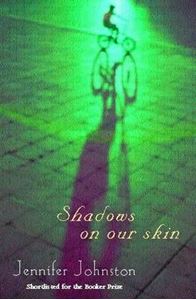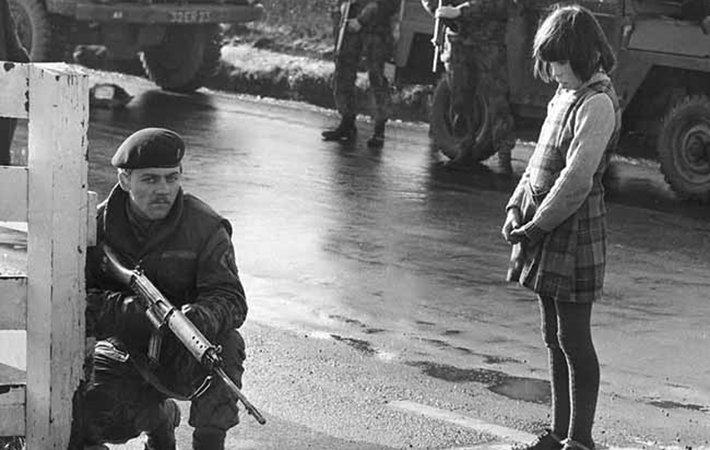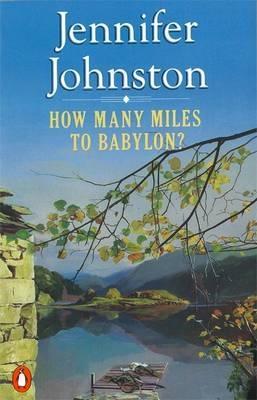
‘How Many Miles to Babylon?’ by Jennifer Johnston

819524

THE HISTORICAL AND LITERARY BACKGROUND

This novella was published in 1974 and is set at the time of the First World War. It depicts the culture of the Big House before its collapse as a result of the war and the 1916 Rising. The occupants of the Big House are sheltered from the reality of the world outside. They continue to live an ordered and leisurely life, which is only occasionally interrupted by distasteful reports of war injuries. As more and more local men enlist in the forces and many are killed or maimed, the war slowly becomes a reality for the family. When Alec enlists, this brings the war right into their home, and they are forced to acknowledge its existence.

Before he joined the British forces, Jerry had been involved in Republican activities in the local area, and this was his main reason for joining. He planned to bring back knowledge of fighting methods to use to good effect in fighting for a free Ireland. The location of the novel changes. It is now set in France in the heat of battle. Even though the hail of gunfire and the agonised screams of the wounded are always present, the novel focuses primarily on human emotions and man’s capacity to endure war.

10269133-700x390

THE STORY

This is a novel about friendship based on a young man’s experience in the First World War. Alec Moore is an only child from an Anglo-Irish family in Wicklow. There is a tense atmosphere in the home because Alec’s parents are estranged from each other. The boy from the Big House befriends Jerry Crowe, a local boy from a working-class background, and a close friendship develops between them.

As they grow older and the war intensifies, both men enlist in the British Forces for very different reasons and are sent to fight in France. Their friendship continues under the disapproving eye of Major Glendinning who forbids his officers to associate with junior soldiers.

Jerry deserts the army temporarily to search for his father who had gone missing on the battlefield. On his return, he is sentenced to death as an example to other soldiers who may be considering desertion. Alec, as an officer, is ordered to instruct the firing squad or face the same fate himself for refusing to obey orders.

The men exchange farewells and to avoid prolonging the agony, Alec kills Jerry in his room. He is sentenced to death for defying authority and the novel ends with Alec writing while calmly awaiting death.

Ollie-Cuthbertson-Post

THEMES AND ISSUES

1. Love versus Hatred
2. Friendship (Relationships)
3. War

Love versus Hatred  In the novel How Many Miles to Babylon? Jennifer Johnston explores the theme of love versus hatred in an interesting way. Alec Moore must experience a horrific test of love in the course of the novel.  He narrates his tragic tale of a loveless childhood, which left him emotionally scarred. His mother is cruel, manipulative and full of hatred for her husband whom she regards as weak.

From childhood, Alec was goaded by his beautiful mother, who is portrayed as being without nurturing or loving instincts. Mrs Moore’s physical beauty is contrasted with her vindictive personality. Her actions, which are swift and dismissive, suggest her passionless nature. Despite keeping a beautiful house hers is not a home where real love and affection are displayed: ‘The dining-room in the daytime was unwelcoming. It faced north and that cold light lay on the walls and furniture without kindness’.

Alec’s closest experience of love for his mother is related very early in the novel when he describes her daily ritual of strolling down the gravelled path towards the lake to feed the swans: ‘I heard her call once to them in a voice so unlike her own recognisable voice that for a moment I felt a glow of love for her’. This rather ironic revelation indicates her unloving attitude towards her son. It appears as though she loves the perfection of the swans, their separateness from her and their uncomplicated, instinctive existence.

For her, human relationships are meaningless unless she can gain some kind of power or victory from such intimacy. She uses her allure, the pretence of love, to secure what she desires while underneath she seethes with rage. He concludes that he ‘thinks’ his mother loved him but not in a way that he could understand.

Alicia Moore also disregards her husband’s feelings by constantly insulting him even in front of Alec; ‘I have no intention of remaining alone in this house with you. I have already said that. Made myself quite clear, I thought’. When she discovers the friendship between Alec and Jerry Crowe she moves swiftly to destroy it. Not only is she averse to the mixing of the classes but she is also suspicious and aggrieved at the bond which exists between the boys. Her refusal to allow Alec to go away to school is not the result of her grief at their separation but because she would be left alone with a husband she detests. She uses her son in a most despicable way, as a buffer between herself and her husband. She brings her son to Europe not for the love of learning but as a means of dealing with his unsuitable friendship with Jerry.

Friendship  Alec feels real affection for his father. He realises that his mother abuses his father but he is helpless to prevent it. It has to be acknowledged that Alec’s father is partly responsible for the maltreatment he receives. He misjudges Alicia, only realising his mistake when it is too late to rectify it. It is interesting to note that Mr Moore deteriorates in the absence of his son. When Alec returns after four months in Europe, he notices a change in his father, ‘My father had failed a little during our absence … but he seemed a smaller man than I had remembered’. It is also interesting to note the way that Frederick’s defective eyesight is highlighted in the novel – we deduce from this that he lacks the insight necessary to recognise true love and he suffers grievously for this defect.

The friendship which develops between Alec and Jerry is the only real love and affection which Alec experiences. Jerry makes Alec’s dreary life more bearable with his sense of fun, adventure and good humour. He mimics and makes fun of Alec’s education and he ‘sends up’ the Anglo-Irish ‘set’. However, he shares the same sad home life as Alec. His father is distant and his mother is unloving and apparently greedy for money: ‘She wants me to join the army … follow me, dad. Then she’d have two envelopes arriving. On the pig’s bloody back.’.

The boys’ friendship is firmly fixed not only because of their sad home lives but also because of their passion for horses and nature. Both Alec and Jerry are capable horsemen. They plan to somehow overcome their class barriers to breed and train horses together.

War  The images of hatred in the novel revolve around references to the First World War and the Irish Nationalist cause. From the earliest moments in the novel, the impending war in Europe forms the backdrop to the feuding husband and wife. It is possible to argue that the hatred between Alicia and Frederick Moore is used as a compressed image of the hatred between the allied and enemy forces in the war.

The inferences to madness in the novel serve the same moral function as the images of war. They make the reader understand that love is the essential element to the survival of the world because without it there is only chaos, cruelty and hatred. Alec’s decision to go to war is partly a consequence of his mother’s hateful behaviour, but the insanity of the war, the death and maiming, proves that it too is a destructive human force.

Alec’s relationship with his father is affected by the war. Alec’s decision to become a soldier leaves his father bereft of his only source of love. Their parting scene in the novel, though it seems superficial, is actually heart-rending. Given the period in which the novel is set and the class to which they belong, Alec and his father do not show the intensity of their feelings for each other but it is evident in Frederick’s actions and his son’s private reflections. Alec accepts the money which his father gives him, understanding it as a gesture of love: ‘Don’t let yourself go short. Anything you want’. Similarly, the gold watch which the father gives the son is used metaphorically, as though it represents his beating heart, that somehow if Alec kept his watch close to him it would protect him from danger, give him comfort by reminding him of his father: ‘It was warm in my hand with the warmth of his body. I put it into my pocket with the money’.

Alec’s mother sees his decision to become a soldier as a personal triumph. Having goaded him earlier about his cowardice, she can now ‘enjoy’ and ‘suffer’ the sympathy of her peers about giving a son to the war effort. Both Jerry and Alec ridicule their mothers for their hypocritical show of grief as they go to war. Jerry’s reference to ‘candles and novenas’ and ‘bending the ear of God with decades of the rosary’, illustrate his sense of alienation from his mother. Alec satirises Alicia for her insensitivity towards him: ‘Mine played Chopin triumphantly on the piano the moment I left the room’.

The description of the war in the novel evokes a sense of horror in the reader. The trenches which Alec describes are a physical representation for the reader of humankind without the redemptive power of love. It is like descending into the hell which he describes so well in the course of the novel.

We can plot the gradual degeneration of Alec’s physical condition over the course of the war. However, Alec’s love for his friend remains intact despite the class barriers between ranks in the army. Alec embraces the friendship of Jerry, caring for his welfare and trying to buffer some of the abuse hurled at him by the officers.

When Major Glendinning reprimands Alec for his friendship with Jerry, arguing that ‘strict impersonal discipline’ must be maintained between the men, he is actually arguing that there is no place for sentiment (or love) in the army. It seems that Alec and Jerry should become insensitive to feeling and the little kindnesses which make life bearable. Yet despite this ultimatum, Alec continues to befriend Jerry and their smallest gestures of help to each other indicate the pointlessness of the war which rages around them.

The murder of the ‘Gloucester’s regiment’ soldier by Glendinning is carried out with precision and dispassion. This murder illustrates the breakdown of the inherent moral code in humanity. After the murder, Glendinning never once shows remorse or disgust for his act. His dispassionate nature is illustrated again when Alec requests leave for Jerry to find his father, who was reported missing in action: ‘The answer is no. Crowe goes to the front again tomorrow with the rest of his squalid friends.’

Jerry also abides by his sense of filial duty and wants to find his father, ‘if he’s wounded maybe there’d be something I could do for him’. Jerry’s compassion for his father is contrasted with a very good description of the barbarity at the front.

Friendship  The reunion between Jerry and Alec near the end of the novel is very moving. This poignancy is more effective because the reader of the novel suspects that the reunion will be short-lived:

He threw an arm across my shoulders and we lay in silence. My warmth was spreading through him, but the hand that clasped the back of my neck was still cold as a stone fresh from the sea.

When Jerry is found he is put into the detention camp where Alec visits him to carry out the greatest test to their friendship and love. They reminisce about their youthful dreams and ambitions. Jerry confesses for the last time that he loves his country above his king. It seems an odd thing to say before death but it is important to remember its symbolic significance. For Jerry, his country encompasses more than the nationalist cause, more than the land itself; it reflects his belief about the brutality of war, the uselessness of it. When Alec pulls the trigger he has committed no gross act of murder but has saved his friend from a shameful death by firing squad: ‘They will never understand. So I say nothing’.

Without Jerry, there is no love in Alec’s life and he becomes indifferent to everything and everyone and he effectively withdraws from life after Jerry’s death.
images (3)

LITERARY GENRE

This novel fits into the category of social realism. It is a story which is extremely true to life. Johnston does not over-exaggerate her plot or stretch it beyond the bounds of credibility. It is a novel based firmly in an actual time and place in history. Her main characters belong to clearly defined social backgrounds, the Anglo Irish gentry and the Catholic underclass of Ireland in the early 1900s. Both men are accurately drawn as they each possess certain qualities of their respective backgrounds. The bigotries which attempt to divide them both at home and on the battlefield are all too real in the novel.

All of the events are quite plausible, such as when the men escape briefly on horseback to have a good time and avoid the reality of the trenches, or when the Major ends a man’s suffering because it may have a negative effect on his men. Also, Jerry’s escape to search for his father is believable and his death sentence fits in all too well with the personality of Major Glendinning. It is, therefore, a book rooted in reality.

THE STRUCTURE OF THE NOVEL
This novel is written in the form of a first-person narrative. At all times the reader shares Alec’s view on life and his interpretation of the things which occur to him or around him. In many respects, the novel takes on the form of an autobiography. It could also be said to be a confessional work. It begins with an officer alone in his room, about to face death by firing squad and he is writing his last thoughts. Therefore, the novel is told in flashback.

He begins by reflecting on his life, ‘As a child I was alone’, and the story develops as the officer goes back over his past as a child, his life as a man in the trenches and the events which led up to his imminent death. The novel is presented strictly in chronological order with only a few slight references to the past, as Jerry and Alec at times of depression or crisis look back longingly to the good times they spent together in the Irish countryside. It is divided into two distinct settings: Ireland and France. It ends with Alec in captivity beginning to write his last words, so that the novel has come full circle and ends as it began, ‘So I sit and wait and write’. It is a simply structured but completely effective novel with a plot that is uncomplicated and direct.

THE STYLE OF THE NOVEL
Jennifer Johnston’s use of language is striking. She does not waste words on rambling descriptions nor does she overuse images for exaggerated effect. This makes her images all the more memorable when she does use them. Clarity is her main strength. She describes her characters and the action in the plot in a concise condensed manner.

Many of her descriptions are based in nature:

‘Memories slide up to the surface of the mud, like weeds to the surface of the sea, once you begin to stir the depths where every word, every gesture, every sigh, lies hidden.’

‘Rain was in the air. The rushes bowed to her as a little rippling wind stirred through them. A thousand green pikemen bowing.’

‘The swans would allow themselves to drift on the wind like huge crumpled pieces of paper hurled up into the sky.’

She also conveys the desolation of the Irish landscape very well:

‘The lake was in one of its black moods. It heaved uncomfortably and its blackness was broken from time to time by tiny figures of white, mistakes.’

The loneliness of the characters who inhabited that desolate landscape and the emptiness of the family atmosphere is also beautifully expressed:

‘Their words rolled past me up and down the polished length of the table. Their conversations were always the same, like some terrible game, except that unlike normal games, the winner was always the same. They never raised their voices, the words dropped malevolent and cool from their well-bred mouths.’

The emptiness of the Irish landscape and the emptiness of the inhabitants of the Big House are matched by the desolation of the war fields. The desolate landscape of Flanders is reflected in the ‘leaden rain which fell continuously’ or ‘The wind was blowing straight in our faces and the drops were like a million needles puncturing our skin.’

Johnston introduces a vivid comparison when she introduces war for the first time. As the men trained on the shores of Belfast Lough, ‘It was like some mad children’s game, except that the rules had to be taken seriously.’ The mental torture which the men were subjected to was brought out in the description of the man screaming:

‘Out beyond the wire, a man was screaming. Not a prolonged scream, it rose and fell, faded, deteriorated into a babbling from time to time and then occasionally there was silence. During the silence you could never forget the scream, only wait for it to start again. The men hated the sound as much as I. You could see the hate on their faces.’

Johnston also uses symbols to good effect in the novel. At intervals in the book, the swan is used as a symbol of loyalty and eternal friendship. Alec and Jerry share a common love and respect for swans as they begin to know each other. Swans reappear in Flanders, both literally and metaphorically. At times of crisis as the men struggle to endure the hardship of the war, they remember the swans in the few rare glimpses the reader gets of the past. At the end of the novel, as Alec leads his men to a new location, two swans fly overhead and a man kills one for fun, to Alec’s horror. This symbolises the imminent death of Jerry as the bond of friendship between him and Alec is about to be severed.

Another literary device favoured by Johnston is the use of rhyme and poetry at crucial moments. The title of the novel is taken from a well-known children’s rhyme:

How many miles to Babylon?
Four score and ten, sir
Will I get there by candlelight?
Yes and back again sir.

This was a rhyme that Alec learned innocently as a child and it comes back to haunt him as an adult. It is referred to three times in the early part of the book and again just as Alec leaves for the war: ‘Will I get there by candlelight?’ This reflects Alec’s uncertainty as he heads off into the unknown, to some ‘Babylonic’ place, unsure if he will ever return again.

Lines of poetry are sprinkled through the novel when Alec is at his most philosophical: ‘I was being troubled by the poetry of Mr Yeats’. As children, Alec introduces Jerry to Yeats on the shore of the lake:

Rose of all roses, Rose of all the world
And heard ring
The bell that calls us on; the sweet far thing.

In contrast to this, Yeats reappears in a very different situation. A line of Yeats’ slips out involuntarily as Alec sees a man writhing in agony on the battlefield:

Far off and secret and inviolate Rose

Here he is experiencing his strongest emotional test and it is significant that he turns to Yeats for help. There are echoes of Yeats’ work in many places in the novel, for example, Alec’s statement at the very beginning of the novel: ‘I am committed to no cause. I love no living person.’ This reminiscent of Yeats’ poem ‘An Irish Airman Foresees his Death’. Jerry also compares Alec’s mother to Helen of Troy, a striking beauty often admired and featured by Yeats in his work.

While Alec quotes the poetry of Yeats, Jerry uses a different kind of rhyme to show his dedication to the Republican cause:

Now father bless me and let me go
To die if God has ordered so.

This emphasises some of the differences between the two men.

Humour is sparse in the novel and when used it is often grim. It is evident on the morning when Alec leaves for the war and it is used by the soldiers at moments of stress to lighten their moods.

Dialogue is used sparingly and it is often loaded with inferences particularly in the relationship between Alec and his parents. The absence of words only illustrates the lack of communication within the family. Dialogue is not favoured by Major Glendinning who uses short, sharp sentences. These have the primary function of giving orders and he forbids discussion as much as possible.

Johnston’s style of writing is compact yet lucid. It is extremely effective as it invites the reader to fill in the gaps and particularly to infer meaning from the electric silences which permeate the story.
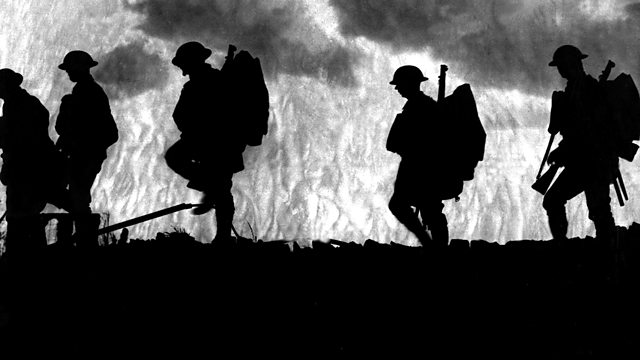
p01l9f1h

CULTURAL CONTEXT

While Alec and Jerry have lived in close proximity to each other in Ireland there is a strong contrast between their backgrounds. Alec is the only child of an aristocratic couple whose values and beliefs differ significantly from those of the Catholic people of the time. The socials division between both groups was strong yet Alec and Jerry chose to ignore it. Alec’s mother forbade him to see Jerry and his father, for once, agreed with her that it was an unsatisfactory relationship:

‘It is a sad fact, boy, that one has to accept young. Yes, young. The responsibilities and limitations of the class into which you are born. They have to be accepted. But then look at all the advantages. Once you accept the advantages, then the rest follows. Chaos can set in so easily.’

Both boys were also educated differently. Alec had the doubtful pleasure of his own tutor, Mr Bingham, and a piano teacher. This meant that Alec never mixed with other boys of his own age as a child and therefore his friendship with Jerry was particularly important for him. Jerry, on the other hand, went to an ordinary school but had to leave early to find work. Alec naively suggested that Jerry could work in his father’s stables, but Jerry knew that this would end their friendship. Their respective cultural backgrounds would raise innumerable barriers between them: ‘Why is neither here not there. Your lot would care. My lot too if it came to it. One’s as bad as the other.’ Alec realises the truth of Jerry’s statement:

Yes, I knew they would care. He was right. My mother would purse up with disapproval, her voice rise alarmingly as it sometimes did when she spoke to my father.

Both men enlisted in the army for different reasons. Alec did so to escape from a disintegrating family structure, driven by the knowledge that he was not his father’s son. This was a damaging experience for him and now that the blood ties had been broken and he was dispossessed both emotionally and financially, he saw little hope for a positive future. He felt a strong desire to get away from his parents and war offered him an opportunity. Alec cut himself off and drifted into war in the hope of blocking out thoughts of reality.

Jerry had been involved in Republican activities and this was his main reason for joining. He planned to use his knowledge of fighting to fight for a free Ireland on his return. He tells Alec on the night before they leave that he also needs the money: ‘Or maybe the thought of all those shiny buttons appeals to me’. Whatever his reasons, Jerry cares little for the cause he will be fighting for, as his own personal needs are a priority.

On the battlefield itself, the cultural background of the soldiers is unimportant when men are facing a life and death crisis, yet ironically the distinction between gentry and peasantry is maintained by the emphasis on army rank. It is a strange paradox: background is irrelevant yet is of ultimate importance. Men cling to the importance of rank as it gives them a feeling of stability when everything else is crumbling around them. Alec and Jerry disregard this as the war intensifies.

Culturally, while there are many differences between them, Alec and Jerry are alike in that neither of them is attempting to be a hero who will come back decked with glory, as Alec’s mother would certainly like him to be. Neither of them is driven by a strong desire to win the war for the people. Both of them are using the war as an opportunity to resolve or escape painful issues in their own lives.

Another cultural contrast made by Johnston is to highlight the differences between the Irish and English soldiers. There was a certain amount of lighthearted banter between Alec, Jerry and Bennet when they were out on horses:

‘Don’t be such a damned English snob’ or ‘Irish sentiment creeping in. Perspective is needed. You damned Celts have none. It’s no wonder we don’t think you’re fit to rule yourselves.’

Major Glendinning also had difficulty with the fact that he had Irish soldiers to deal with and in a moment of anger declared to Alec: ‘I never asked for a bunch of damn bog Irish’.
trenches-007

Concluding Comments

How Many Miles to Babylon? is not a novel solely about war.  Although World War I is in the background, Johnston also touches upon Irish history, in particular the tensions between the Irish and the British. Through Jerry’s revolutionary leanings and the harsh comments about the Irish made by Major Glendinning, Johnston hints at the coming battle for Irish independence.

Alec, the narrator, is a very passive character for most of the book. Just like his father, he submits to his mother’s every demand. When she told him that he has to go to war, he protests that he has no desire to fight or be killed, but he ends up doing what she expects of him anyway.    In many ways the novel is a tragedy of obedience: Alec, the isolated only-child in an Anglo-Irish big house, is a pawn in his parent’s pathological relationship. “Oh, you’ll go, my boy,” his fatalist father tells him. “You’re a coward, so you’ll go.”   In contrast, Jerry is more of a free spirit, making his own decision to go to war and speaking out when he should keep his mouth shut. With Alec as narrator, the book moves a bit slowly, possibly because I didn’t have any strong feelings for him until the very end. Still, there’s a beauty to Johnston’s prose that kept me glued to the page.

How Many Miles to Babylon? is one of those novels that hit you hard at the end.  The ending says so much about the characters, and it was both a satisfying end to the journey and one that left me wanting to know what happened next. Johnston surprised me and I’ll certainly be thinking about this book for a while. Amazingly, there are only two deaths described in the novella, yet, for me, it remains a stark depiction of devastation.
20161025_173023

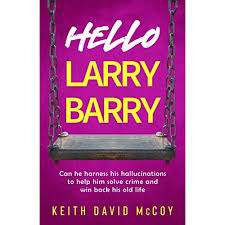
Hello Larry Barry by Keith McCoy

Hello Larry Barry

I have just finished my advance copy of Hello Larry Barry by my former past pupil Keith McCoy. Because of my very close and dear connection to Keith I have to confess that this will not be an objective review. I am biased from the start! However, I was very impressed and you will be too with Keith’s storytelling ability on this his first venture into the murky waters of fiction writing. This is a cracking first novel by this dark horse and true to his personality it is full of his uniquely quirky dark sense of humour.

Larry’s long stay in a mental health unit is at an end, but on discharge, he learns that he has been demoted from his very senior role with the Garda Special Branch in Dublin. Instead, he finds that he has been transferred to a relatively new detective unit in Limerick that appears to house a number of failed, odd and dysfunctional detectives. He wants his old job back and needs to save his marriage, all of which he believes rests on him being a success with this new team. Still very unwell and constantly hallucinating, he is having a go.

Set against a backdrop of police, political and business corruption, can Larry achieve this ultimate challenge. This is a funny, warm and serious story that explores mental health stigma, hope and the drive required to overcome the obstacles thrown at this likeable man. If you enjoyed TV shows such as The Office, Monty Python and Father Ted or any films by the Coen brothers, you will love this.

Keith McCoy was born and raised in Newcastle West, in County Limerick.   After finishing secondary school in St Ita’s Secondary School in 1992 he moved to London to attend university where he trained as a mental health nurse.  In St Ita’s he excelled as the school’s rugby captain and superb Number Eight.  Since then he has achieved even greater accolades, completing his master’s degree in mental health and an MBA. He is hugely interested in film, sport and acting.  He continues to work in mental health, in recent years as a health care director. Today he lives with his wife and young family in Manchester.

IMG_4053
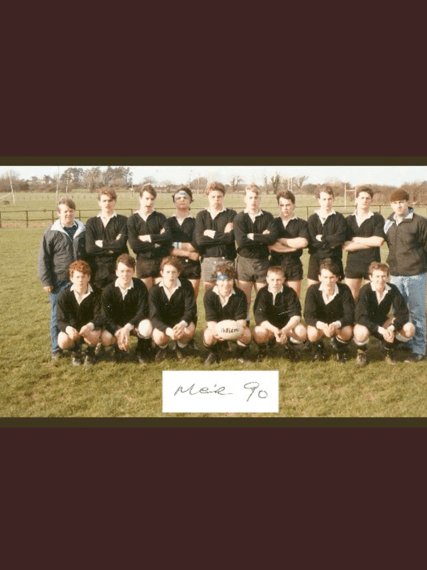
West Munster Junior Cup Winners 1990. Back Row (Left to Right): Ger Normoyle (coach), Rob Moone, Kevin O’Brien, Tom Dooley, Barry Madden, Keith McCoy, Dylan O’Doherty, John Ahern, Eoin Cahill, Micky Lane (coach). Front Row: Seamus Harrold, Maurice Magner, Paul Murphy, Dave Dooley (Capt.), John Flavin, Noel Murphy, Noel Hennessy. (Photo jdtvideo, NCW).


The novel draws on Keith’s extensive experience in the mental health area and fittingly the locations in Newcastle West, Monegea and Limerick are obviously close to his heart.  Keith himself explains: “I was never interested in books, (despite the best efforts of my teachers!), I was very active, and just couldn’t sit still, I found the idea of reading very boring. Then one summer in the late 90s I was working nights as a nurse and was doing suicide watch on one particular male patient, and ended up doing so with him for the whole summer. He was very depressed, would just lie there, and was totally uncommunicative. After about three nights, I was finding the task difficult and decided to buy a book to keep myself stimulated.  I bought a biography of Frank Sinatra, and once I had settled down with this male patient for the night, I opened the book and he spoke to me for the first time, saying,  “You can read that aloud if you want”. That summer I must have read at least a dozen books to him. Over time he recovered from his depressive episode, and by that time I had developed a new and huge interest in books.

“I deliberately used humour in this book. When you are writing about a subject that for many is uncomfortable, writing it in dramatic reality makes it too heavy for most, so what I aimed to do and I hope I have achieved it, was use humour to engage the reader, get them enjoying the read, the fun, and then let everything sink in slowly, and gently provoke them to think about and understand the subject matter differently. I truly hope I have done justice to those who have mental health challenges, and that it is recognised that I am not making light of their journey, just using the comedy to get the audience to think more deeply about mental health.

“When I got the idea for Hello Larry Barry, I was halfway through an MBA and busy, so I promised myself that I would have a bash at writing it when the degree was finished. Then after I had finished it, one day my son was telling me about how he was going to write a book too etc., and he explained some of his characters to me, so I thought to myself, how can I help him? I concluded that the best way would be by being an excellent role model, and therefore I should crack on with trying to write Hello Larry Barry. The following day, I sat down and took on the challenge.

“I got huge enjoyment from writing Hello Larry Barry, the words just flowed. It was hugely exciting and the positivity that came each day from achieving a new part or direction to the story was immense. At the outset, I wasn’t sure if I could write this and just went for it, and then it was done. Since completing it, the personal impact has been interesting, from feelings of incredulity to just being calm and much more content with myself. It’s hard to explain, maybe something to do with a renewed self-acceptance or something in relation to Identity.”

The novel was due its local launch in the Ballintemple Inn in Newcastle West tonight, 21st of March but events elsewhere intervened and the event had to be postponed. However, rest assured there will be and there deserves to be a local launch of this cracking read. It’s not every day that Newcastle West and Monegea form the backdrop to a modern novel. I loved the story and there’s a lovely twist at the end.  It’s also for sale on all Ebook platforms including Kindle, with print versions available from Amazon. Hopefully, ‘hard’ copies will be available locally in Tony Hayes’ and elsewhere in the near future.

In the meantime, from my enforced isolation in Knockaderry, I tell all my callers that I taught Keith McCoy everything he knows and even though he was somewhat slow in developing into the novelist that he has become there always seemed to be other challenges that took precedence over his academic studies and called for his attention first. He was one of the best natural leaders on the rugby field (and unfortunately, also in the classroom) that I have ever seen and even though he has travelled far and wide and now resides in Manchester his heart has never left his native place.

I hope you enjoy the read – spread the word!

GN4_DAT_15852947.jpg--first_time_novelist_keith_to_launch_in_limerick_s_county_town
The author of Hello Larry Barry, Keith McCoy

Michael Hartnett’s 26 Pubs at Christmas!

Hartnett by the Bridge in Newcastle West
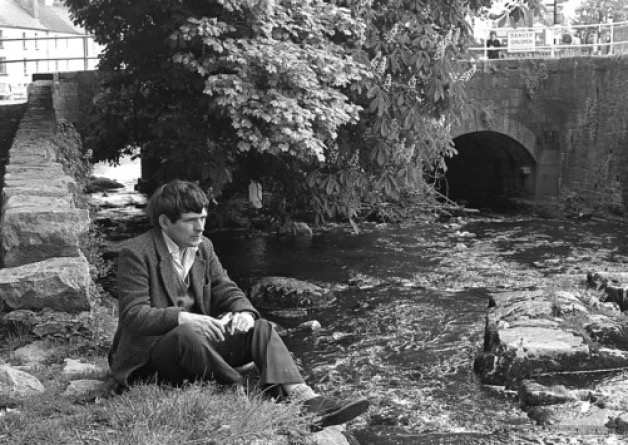
Michael Hartnett in pensive mood by the River Arra in Newcastle West in the 1970s. Photo credit to Limerick Leader Photo Archives

Michael Hartnett arrived back in Newcastle West after nearly fifteen years of ‘exile’, around 1975.  He then imposed a further exile on himself by deciding to settle with his wife Rosemary and his two young children, Niall and Lara, ‘out foreign in Glantine’.  Thus began one of his most productive periods as a poet – a fact which has been largely overlooked by critics and academics to this very day.

The decade from 1975 to 1985 in Glendarragh, Templeglantine was arguably the most productive of his career.  Adharca Broic was published in 1978, followed by An Phurgóid in 1983, Do Nuala: Foighne Crainn in 1984 and his fourth collection in Irish, An Lia Nocht, appeared in 1985.  During this period, he also undertook the translation of Daibhi Ó Brudair’s poems which were published in 1985.    In parallel to this ‘serious’ output, he was writing and entertaining the locals with ballads, some serious or semi-serious like ‘A Ballad on the State of the Nation’, which was distributed as a one-page pamphlet like the ballads of old and even included original lino cuttings by local artist Cliodhna Cussen. Other ballads were more contentious and even semi-libellous (or fully slanderous!) such as ‘The Balad (sic) of Salad Sunday’ and ‘The Duck Lovers Dance’.  These latter creations were written under the very appropriate nom de plume, ‘The Wasp’!

It has to be remembered that at this time Newcastle West and its West Limerick hinterland was booming.  The Alcan plant in Aughinish Island near Askeaton was under construction and every man, woman and child were working there.  Added to this, every spare room was occupied as up to 4,000 workers from all over Ireland were involved in the construction phase of the project.

In late 1980 Hartnett began work on his best ballad and the one which is most loved and recited to this day, the ‘Maiden Street Ballad’.  The ballad stretches out for 47 verses and is a compendium of much of what he had written in prose about Newcastle West in articles for The Irish Times, for Magill magazine and for the local Annual Observer, the annual publication of the Newcastle West Historical Society during the 60s and early 70s.  There are also echoes of other local poems such as ‘Maiden Street’ and ‘Epitaph for John Kelly, Blacksmith’ included among the verses of the ballad.

In his own mind, Hartnett had lofty ambitions for the project – the ballad was to be Newcastle West’s own Cannery Row.  Indeed, in the Preface to the ballad Hartnett wrote of his affection for his home place:

Everyone has a Maiden Street.  It is the street of strange characters, wits, odd old women and eccentrics; also a street of hot summers, of hop-scotch and marbles: in short the street of youth.  But Maiden Street was no Tir na nÓg … Human warmth and poverty often go hand in hand … The object of this ballad is to invoke and preserve ‘times past’ and to do so without being too sentimental … But this ballad is not all grimness.  I hope it is humorous in spots.  It was not written in mockery but with affection – part funny song, part social history.

‘Maiden Street Ballad’ was published by local entrepreneur Davy Cahill and his The Observer Press ‘with the help of members of Newcastle West Historical Society’.  Copies of the original are much sought after on eBay and elsewhere to this day.  It carried a very eloquent dedication, ‘This ballad was composed by Michael Hartnett in Glendarragh, Templeglantine, County Limerick in the month of December 1980 as a Christmas present for his father Denis Harnett (sic)’.  His long-time friend and fellow poet, Gabriel Fitzmaurice is fulsome in his praise for the ‘Maiden Street Ballad’:

… it is unquestionably the best ballad he wrote during this period.  It is a celebration of his native place in which he describes mainly the period 1948 – 51, the time of his childhood; it also describes the Newcastle West of the late 1970s during which time he lived in Templeglantine (McDonagh/Newman, p.107).

‘Maiden Street Ballad’ was set to the air of ‘The Limerick Rake’ which Hartnett himself described as ‘the best Hiberno-English ballad ever written in this country’.  Hartnett was drawing on a rich tradition of local balladeers ‘like Aherne and Barry before me’, but there are also echoes here of Patrick Kavanagh and such ballads as ‘If Ever You Go to Dublin Town’.  It is a matter of record that after early skirmishes in various hostelries in Dublin in the early 60s both Hartnett and Kavanagh came to an understanding and Hartnett tells us, ‘I used to drink with him and indeed back horses for him (he owes me £3-10s for the record)’ (O’Driscoll interview, p.144).

Writing in The Irish Times, June 10, 1969, Hartnett relates a story about his father which may have sown the seeds for the famous virtual pub-crawl which is such a central feature of ‘Maiden Street Ballad’ and which is the focus of this essay.  Speaking about his relationship with his father he recalls:

I sat there in the small kitchen-cum-living room, innocently working out the problems my father set me: ‘If it took a beetle a week to walk a fortnight, how long would it take two drunken soldiers to swim out of a barrel of treacle?’  I never worked it out. Or, “How would you get from the top of Church Street to the end of Bridge Street without passing a pub”?  He did supply the answer to that, which indeed is the logical answer for any Irishman: “You don’t pass any – you go into them all.”

‘Maiden Street Ballad’ contains a number of autobiographical segments; from his early days in Lower Maiden Street where they rented from Legsa Murphy; then later he eloquently documents the move to the new housing scheme in Assumpta Park.  However, the most notorious segment is the ten ribald verses from 27 to 37 which describe a virtual pub crawl of all of Newcastle West’s 26 public houses which were doing business in 1980.  These verses portray Hartnett at his best, they are witty, they are caustic, they are slanderous; they poke fun at his friends, and especially at his brothers and cousins.  BUT there is also great sadness.

The ‘pub crawl’ begins in Stanza 27 and the poet bemoans the fact that he visits too many pubs.  The first pub mentioned is Dinny Pa’s, owned and run by Dinny Pa Aherne.  The pub was situated where The Weekly Observer now has its offices.  Local lore has it that the pub broke all records in Munster for whiskey sales because Dinny Pa couldn’t pull a pint!  In more recent times this pub was owned by another doggie man, Ted Danaher from Knockaderry.  By the way, the present pub known as The Forge next door to Dinny Pa’s is not mentioned in the Ballad because it was closed then and has only reopened in recent years.  This pub was originally the property of J.J. Hough and his wife Mary (nee Dore).  The pub was subsequently bought by John Sullivan from Killarney and he eventually sold it on and it has had a number of incarnations in recent years.  Next, he mentions The Silver Dollar in Lower Maiden Street, which was originally owned by Bill Flynn.  By the 1970s The Silver Dollar had been passed down to his daughter Margaret and her husband John Kelly who was originally from Broadford and who was at that time a Fine Gael County Councillor. He then takes a big jump to the other side of town and mentions Mike Flynn’s in Churchtown, now The Ballintemple.

In Stanza 28 he mentions four more pubs beginning with McCarthy’s in Maiden Street which was owned by John McCarthy and his wife, Clare Finucane, and was known then as The Tall Ships (today trading as Ned Kelly’s).  He then mentions a cluster of three pubs just off The Square, heading up Churchtown.   Pat Whelan was by 1980 probably one of the most successful publicans in the town and he ran a very successful pub next door to what was then Crowley’s Drapery.  Directly across the road was The Greyhound, owned and run by Lena Barrett.  Finally, by all accounts, the poet nearly landed himself in choppy legal waters with the line, ‘and I have been known to peep into Peep Outs’.  Seemingly the owner was known to occasionally peep out to see if there were any prospective customers on their way and, like many other unfortunates in the town quickly gained a none-too-complimentary nickname for his troubles.  To give his ballad added gravitas Hartnett added some ‘scholarly’ footnotes (to the first 20 verses only) and in one he tells us that, ‘It used to be said that if a stranger walked from Forde’s Corner (now Burke’s Corner at the junction of The Square and Upper Maiden Street) he’d have a nickname before he got to Leslie’s Ating House (where, in recent years, Dickie Liston had his shop in ‘Middle’ Maiden Street)’.

In Stanza 29 he mentions two other pubs who were making waves in the town in the late 70s.  Tom Meaney was doing a roaring trade in The Turnpike – also the venue for Zanadu’s Nite Club – and to encourage punters he held quizzes on Sundays in which Des Healy and Joe White excelled.  He also mentions Mike Kelly who at that time was running the Ten Knights of Desmond pub in the Square.  He was leasing the pub from Jimmy and Mary Lee and the pub is now being run by their son, Joe.  Mike Kelly was endeavouring to raise standards and expectations and so had peanuts and cheese available for his ‘better-class clients’ who ‘dine free there on Sundays, the chancers’.

Stanza 30 mentions The Tally-Ho and this was situated across the road from the Carnegie Library which at that time housed St. Ita’s Secondary School, owned and managed by Jim Breen and which, of course, had been Hartnett’s alma mater.  Some ruffians in the town claimed that The Tally-Ho was the unofficial staff room for St. Ita’s – but that’s for another day!  He tells us he’d ‘go there more often but Mike Cremin sings’.  Nearby on the corner was John Whelan’s pub.  John was Pat Whelan’s father and was a legend in GAA circles having given a lifetime to Newcastle West, West Board and County Board administration.  This was the same John Whelan who had joined the railway service in Newcastle West in 1945 and had worked there until its eventual closure on Friday, October 31st, 1975.  Later as Chairperson of The Limerick and Kerry Railway Society in the 80s John and others were instrumental in preserving the railways ‘Permanent Way’ which was initially developed by the visionary Great Southern Trail group and today forms the route for the amazing local amenity, The Limerick Greenway.  Having retired from CIE John had moved into the pub business and had purchased the Corner House which was the local of Hartnett’s ‘cousin’ Billy O’Connor, or Billy the Barber as he was better known and who was, in fact, married to Hartnett’s aunt, Kit Harnett.

In Stanza 31 he doesn’t name a pub but I presume he is still in The Corner House with his relations and various ‘cousins’!  Hartnett’s brother, Dinny was a postman in town at this time and Michael makes sure to mention Dinny a number of times, and not always in glowing terms.  Here he joins his brother, and some of Dinny’s colleagues, Tony Roche and Davy Horan for a session.   The Christmas flavour of the ballad is maintained when he says, ‘You can hear Dinny laugh miles up the Cork Road / as he adds up his Christmas donations!’.

Stanza 32 is dedicated to Barry’s Pub in Bridge Street.  He describes the pub as being a little above the ordinary.  Of course, we must remember, many of these recommendations were given with a view to future free pints, post-publication! However, the opposite could also be the case and after the publication of the infamous, ‘The Balad of Salad Sunday’, Hartnett rather ruefully declared that as a result ‘I was barred from thirteen pubs’.[1]   According to the poet, John and Peg Barry ran a classy establishment and ‘if you want to read papers you don’t buy at home’ or if ‘you want a hot whiskey with more than one clove’ then you should give them a call!

Stanza 33 is dedicated to another favourite of Hartnett’s, The Shamrock Bar in South Quay.  In the late 70’s Damien Patterson and Tony McCarthy undertook an extensive renovation of Fuller’s Folly, part of the Desmond Castle complex and fronting on to the Arra River near the bridge at the bottom of Bridge Street.  Indeed, to add to their conservation work Tony McCarthy and others decided that they would introduce different species of duck to the river to enhance its attractiveness.  This project, years ahead of its time, entailed setting up a breeding programme and sourcing young ducklings and, as a consequence, this gave rise to numerous fundraising ventures.  The Duck Lovers Committee set up their headquarters in The Shamrock Bar, managed at the time by Tony Sheehan and his wife, Peg (nee Devine), who were both immortalised by Hartnett in his ballad, ‘The Duck Lovers Dance’.   The Shamrock was later acquired by George Daly and his wife Breda and Hartnett was a regular there and benefitted from their generosity and patronage. In return, he penned a beautiful song in their honour, ‘Daly’s Shamrock Bar’.

Hartnett had come back home to find and nurture his Gaelic roots and to immerse himself in the language and traditions of the past.  Here at home, he was universally known as ‘The Poet’ and this title was bestowed on him as a nickname of honour.  However, like the old Gaelic poets such as Ó Brudair, Ó Rathaille, Sean Ó Tuama and Aindreas MacCraith before him, being mentioned by the poet could make you famous for all the wrong reasons.  Suffice it to say that sometimes it was an honour to have a poet in your midst during a drinking session but you needed to be on your best behaviour or you could be shamed for life.  For example, Hartnett tells us that in The Shamrock, ‘You’ll see Jimmy Deere and he making soft farts, / you’ll see Terry Hunt, he’s a martyr for darts – / he spends every weeknight nearly bursting his arse / to bring home a ham or a turkey.’!

Stanza 34 mentions seven iconic public houses.  Many of these were very small premises and they also sold groceries and other items to their loyal patrons.  For example, the poet says he usually, but not exclusively, visits Donal Scanlon’s in Upper Maiden Street ‘when the new spuds come in’.  It is interesting that in South Quay you had four pubs probably within a hundred metres of each other – Seamus Connolly’s, The Shamrock, Gerry Flynn’s and The Crock of Gold, owned by Moss Dooley.  All but one remains today – Gerry Flynn’s is now Clery’s having been owned by Paddy Sammon for a while and then being won in a raffle sometime before the Celtic Tiger began to roar in earnest!   He also mentions Walsh’s which was situated on the corner of Lower Bridge Street and North Quay.  This imposing pub has recently undergone major renovations but regrettably is not open for business at present.  Cremin’s was in Upper Maiden Street where The Dresser now carries on business.  This pub had somewhat of a coloured reputation and was run by the Cremin sisters, Nora, Mary, Gretta and their mother.  Gretta Cremin was also for many years the church organist in the nearby parish church     He also mentions The Heather in Bridge Street which was owned and run by the Duggan family.  However, today Hartnett’s statue in The Square points longingly across to Ned Lynch’s, still run by the man himself, the last survivor of the old stagers.

FullSizeRender (14)
Ned Lynch giving his traditional rendering of  ‘The Balad of Salad Sunday’ during Éigse 2018

Stanza 35 mentions two other very well-known pubs – Dan Cronin’s pub in the Square and Cullen’s in Upper Maiden Street.  Cullen’s was formerly known as Dolly Musgraves (Gearoid Whelan, son of Pat and grandson of John, carries on the tradition today on this site in a newly refurbished Sports Pub).  Dolly Musgraves pub had a special place in Hartnett’s affections because he tells us that it was here (in the company of his great friend and partner in crime, Des Healy) that he had his first pint – no names, no pack drill, but suffice it to say they were barely out of short pants!  He also fondly remembers The Sunset Lounge in The Square (later to become the TSB Bank premises and now Ladbrokes Betting Office) which was owned by Bill Hinchy and his wife Kit.  Hartnett tells us that he had many fond memories of playing chess there with Bill Buckley.  Finally, as if by way of a postscript he mentions the bar in The Motel which was a bit out of the way being situated on the main Limerick – Killarney Road.  He tells us that he didn’t frequent this bar too often because of its political links to Fianna Fáil – Mike himself being a tried and trusted paid-up member of The Labour Party!

Stanza 36 mentions the final two bars close to his heart – The Central Hotel which at that time was owned and run by Arthur and Vera Ward.  It had been known as Egan’s Hotel at one time and even though the title Hotel still remained it was really only a bar – today it trades simply as The Central Bar. Last but not least he mentions Seamus Connolly’s little pub in South Quay.  Hartnett’s fondness for Seamus Ó Conghaile was obvious because he could speak Irish and after his proclamation on the stage of the Peacock Theatre in 1974, Hartnett had returned home with the express intention of henceforth writing only in Irish. He was, therefore, doubly glad of every opportunity to frequent Seamus Connolly’s to imbibe at ease in convivial company and also improve on his Irish language skills.

Stanza 37 ends this section of the Ballad and Hartnett hopes that we won’t consider that he is ‘mad for the drink’!  During the virtual tour of all the 26 pubs in town, he has been wistful and rueful, and only his true friends and relations have felt the full brunt of his devilment and ball-hopping.  Others elsewhere in the ballad, such as employers and charitable institutions do not escape the cold breeze of his displeasure but here he is among friends and in his element.  However, it also has to be said that these verses also tend to paper over the cracks that were beginning to appear in Hartnett’s serious project – to return to his roots in West Limerick and to write only in Irish.  He was drinking heavily by this time and his marriage to Rosemary was beginning to show signs of strain.  The Ballad is dedicated to his father, Denis Harnett, with love and gratitude.  It has to be seen as a poet’s gift, a poet who was penniless with little else to give except his considerable talent as a poet and who was now finally writing ‘a few songs for his people’.  His father Denis passed away in 1984 and shortly afterwards his marriage came to its inevitable conclusion and Hartnett left his hometown for good to return to Dublin.  So, for me, reading the Ballad today, and despite the jokes and the jibes and the critical social commentary, the overriding emotion is one of sadness.

Anecdotal evidence suggests that there were 56 pubs in Newcastle West in the 40s and 50s.  However, the years have passed, the Celtic Tiger has come and gone in Newcastle West and today, instead of the 26 pubs that were doing business in 1980 there are only 11 open for business – and as I mentioned earlier this figure includes The Forge which didn’t feature in Hartnett’s original 26 because it was not trading in 1980! If you wanted to do the ‘Twelve Pubs at Christmas’ in Newcastle West today you’d have to end up in Hanley’s in Knockaderry for your twelfth!  Or maybe the Golf Club in Ardagh?  

I mentioned earlier his father setting the young Hartnett a riddle: “How would you get from the top of Church Street to the end of Bridge Street without passing a pub”?   In 1975 if you were to visit all the pubs from the top of Churchtown to the end of Bridge Street you would have had to visit nine pubs in all, today in 2019 the number has been reduced to three (if you pass by both banks on your way through The Square) – The Ballintemple, recently under new management, The Central in Bridge Street, and last but not least, Ned Lynch’s in The Square!  If you take the long way round The Square you can add in Dan Cronin’s and Lee’s!

Alas, Shane Ross, our Minister for Transport, Tourism and Sport, has been instrumental in ensuring that the pub trade in rural Ireland has seen better days and the old dispensation is no more.  In a radio interview on WLR 102 on 26th September 2019 to promote the upcoming Éigse, Gabriel Fitzmaurice recalled a journey home to Glendarragh with Michael Hartnett in the late 70s after having visited a number of the hostelries mentioned earlier in this article.  Gabriel was acting as a willing chauffeur on this occasion and on their way up Old Bearna, Michael turned to him and said: ‘Gabriel, for God’s sake, take it easy – the future of Irish poetry is in this car’.

‘Maiden Street Ballad’ today stands as a unique piece of social history as well as being a very beautiful, and funny poem, which I would strongly urge you to read or re-read. (The full Ballad, including ‘scholarly’ footnotes, is included in The Book of Strays, published by Gallery Books in 2002 and reprinted in 2015). Many of Hartnett’s prose pieces for The Irish Times and elsewhere in the 70s show him to be an astute and acerbic social commentator and we can also see clear evidence of this in the 47 verses of ‘Maiden Street Ballad’:

And in times to come if you want to dip

back into the past, through these pages flip

and, if you enjoy it, raise a glass to your lips

and drink to the soul of Mike Hartnett!


I would like to acknowledge the encyclopaedic help received from Sean Kelly and his wife Mary in compiling this piece of nostalgia!

Author’s Note:  Sadly, since this post was published in December 2019 three of the eleven pubs still surviving have ceased trading – The Forge fell foul of the taxman, The Ballintemple Inn was badly damaged in a fire and Ned Lynch’s didn’t reopen following the first Covid -19 Lockdown of 2020.  So, for Christmas 2023 there are only eight of the 26 pubs much beloved of Hartnett in 1980 still trading.


 Footnotes

[1] In an interview with James Stack in 1987 as part of James’s thesis for his degree in English from UCG.   Audio available in Memories from the Past: Episode 305

Works Cited

McDonagh, J. and Newman, S., Remembering Michael Hartnett.  Dublin, Four Courts Press, 2006.

O’Driscoll, Dennis., Interview with Michael Hartnett, in Metre, Issue 11, Winter 2001-2002

FullSizeRender (9)

Exposure by Seamus Heaney – An Analysis

FullSizeRender (13)
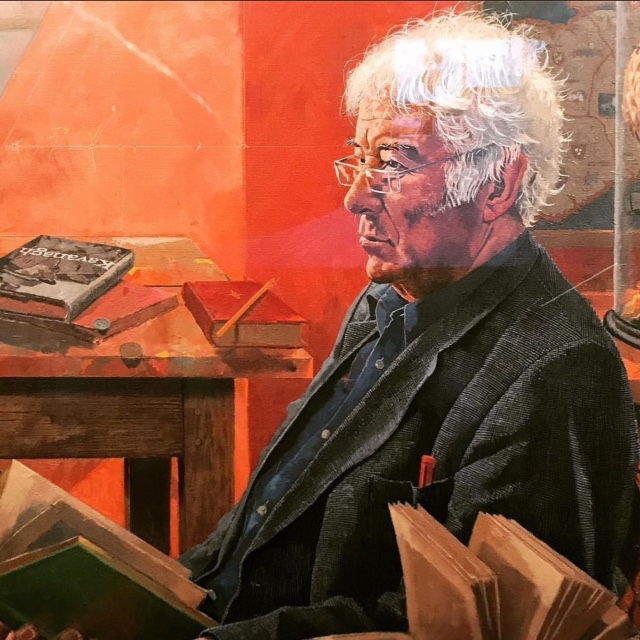
“In the Attic”, a portrait of Seamus Heaney by the artist Jeffrey Morgan now hanging in the HomePlace Centre in Bellaghy, Co. Derry.

Exposure


It is December in Wicklow:
Alders dripping, birches
Inheriting the last light,
The ash tree cold to look at.

A comet that was lost
Should be visible at sunset,
Those million tons of light
Like a glimmer of haws and rose-hips,

And I sometimes see a falling star.
If I could come on meteorite!
Instead I walk through damp leaves,
Husks, the spent flukes of autumn,

Imagining a hero
On some muddy compound,
His gift like a slingstone
Whirled for the desperate.

How did I end up like this?
I often think of my friends’
Beautiful prismatic counselling
And the anvil brains of some who hate me

As I sit weighing and weighing
My responsible tristia.
For what? For the ear? For the people?
For what is said behind-backs?

Rain comes down through the alders,
Its low conductive voices
Mutter about let-downs and erosions
And yet each drop recalls

The diamond absolutes.
I am neither internee nor informer;
An inner emigre, grown long-haired
And thoughtful; a wood-kerne

Escaped from the massacre,
Taking protective colouring
From bole and bark, feeling
Every wind that blows;

Who, blowing up these sparks
For their meagre heat, have missed
The once-in-a-lifetime portent,
The comet’s pulsing rose.

– Seamus Heaney


Commentary
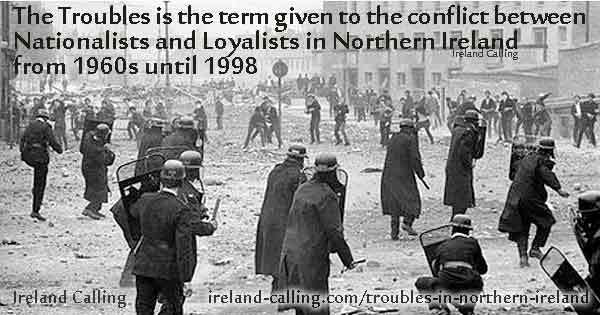
‘Exposure’ was written in 1975 and significantly is the last poem in the poet’s volume, North. Not only that, but ‘Exposure’ is the final poem in a six poem sequence grouped under the title The Singing School, a phrase borrowed from W. B. Yeats’ famous poem ‘Sailing to Byzantium’, which concludes that great collection. The poem itself is, to an extent, a reflective self-analysis, as Heaney takes stock of his life and poses a series of questions about his role and function as a poet. The poem depicts Heaney’s anxiety and discomfort with his position in society and with his role as a poet. The poem explores Heaney’s dilemma as ‘The Troubles’ detonate and resonate and invade his artistic space. He has removed himself from the North and like his friend Michael Longley, who had already moved to Carrigskeewaun in Mayo, he has thus acquired a new perspective from his cottage in Glanmore in County Wicklow. He is, however, troubled by self-doubt and uncertainty and hurt by the whispers, the innuendo, the charge that he hasn’t taken sides, that he has abandoned his people and taken the English ‘shilling’.

It is a ten stanza poem that is separated into quatrains. The lines do not follow a specific rhyme scheme. They are composed in free verse, meaning there is no pattern of rhyme or rhythm. The poem opens, ‘It is December in Wicklow.’ December is deep winter in Ireland, characterised by its cold bracing wet weather, it is also the end of a year. This sets up a peaceful and tranquil scene providing time for self-reflection and a chance to reappraise his situation. This time affords him an opportunity to analyse his obvious anxiety and discomfort and the horrible tension that has arisen between his private persona and his very public career as a poet. It is a rainy, wintry month, the ‘alders [are] dripping,’ the ‘birches’ are fighting for the ‘last light,’ and ‘the ash tree’ is bare, too cold ‘to look at.’

It is obvious that his main source of frustration is that he feels that he is being dragged unwillingly into the current fraught political situation in his own native place. His former neighbours in Bellaghy have all been forced by circumstances to take sides and here, Bellaghy’s most famous son is seen to be ambivalent and non-committal. Earlier on in North, in the poem ‘Whatever You Say, Say Nothing’, he has made the famous statement:

The famous

Northern reticence, the tight gag of place
And times: yes, yes. Of the ‘wee six’ I sing
Where to be saved you only must save face
And whatever you say, say nothing.

In ‘Exposure’, then, we see the poet is under pressure from all sides to say something and he feels that he is being used by all sides for their own political ends. How then can he solve this dilemma? He tries to wrestle with this dilemma in his solitary walk in the Wicklow hills. He considers the inherent differences between a comet and a meteorite. A comet is predictable and appears after sunset on a set date once every four years or four hundred years. A ‘falling star’ or meteorite is totally unpredictable and appears randomly in the evening sky. The comet ‘visible at sunset’ is expected, it ‘should’ appear. Yet, the ‘falling star’ only ‘sometimes’ appears. Heaney himself admires the meteorite, the ‘falling star’. This is shown through the use of the exclamation mark. Unlike the comet which typically follows a cycle, a meteorite is free, it does not need to keep to a designated orbit. Rather, it is able to float and fall whenever and wherever it wishes. Here, Heaney is making the metaphorical comparison between the comet and the meteorite and his own role as a poet. He wishes to be able to express himself freely yet the political circumstances in Northern Ireland do not allow for such, it forces him to choose sides, and tries to drag him into the conflict. Here, Heaney poses an important question – is he to be simply another insignificant individual pushed around by politics or is he to be an independent figure able to freely voice his own thoughts?

In the next two stanzas, Heaney further ponders his role as a poet. He plaintively asks ‘How did I end up like this?’ There is a certain degree of torment shown through this as he sits, ‘weighing and weighing’ his worth. This repetition places emphasis on his vulnerable psychological state. He identifies two opposing groups: the rational ones with their ‘beautiful prismatic counselling’ and his enemies with their impenetrable ‘anvil brains’. He feels isolated from all groups and becomes an ‘inner émigré’ as he is unable to satisfy the demands of one, without conflicting with the others. Heaney is frustrated that he is unable to change the perceptions of those people, close-minded and devoted to their own beliefs. Once again, he questions his role as a poet; he questions himself as to who he is to please, who should he be serving – the minority, the various political groups or society as a whole?

This poem helps him resolve his dilemma and therefore it is a seminal poem in which he takes his lonely stand as an artist and refuses to be drawn in and forced to take sides – he will be his own man – the epiphany comes like Austin Clarke’s ‘The Lost Heifer’ appearing out of the mist. He clarifies the reference to ‘the alders’ in stanza one and this time the image is clearer and more definite:

Rain comes down through the alders,
Its low conductive voices
Mutter about let-downs and erosions
And yet each drop recalls

The diamond absolutes.

This is more hopeful as Heaney gradually comes to terms with himself. He realises, despite the rain causing ‘let-downs and erosions,’ it is able to ‘(recall) the diamond absolutes.’ Through his self-imposed ‘exile’ in Wicklow, he has ‘grown long-haired and thoughtful.’ He repudiates both extremes – the fanaticism of ‘the internee’ languishing ‘on some muddy compound’ in Long Kesk and the despicable betrayal of ‘the informer’. He emphatically states that ‘I am neither’. Instead, he has gained wisdom and realised that like the ‘wood-kerne,’ the Irish soldiers of old who having lost the battle retreat to the woods to regroup, he is able to use his writing as a way of controlling and fighting for his voice in society. His solitary trek through the winter woods has given him a deeper insight into his role as a poet in a society devastated by violence and divisions.

In ‘Exposure’, Heaney reflects on his changed circumstances and on his present situation living and writing in the quiet backwater of Glanmore in County Wicklow. He reflects on the great expectations being placed on him as a poet of standing. This marks a drastically different approach to that seen in earlier collections such as Death of a Naturalist. In this final poem of The Singing School sequence and the final poem in the collection, North, Heaney wonders whether his move South will have any effect. Will it give him the perspective he craves or will he be exposed to ridicule like the emperor without clothes in the children’s fable. He knows he is taking a risk and giving his critics and the ‘anvil brains’ ammunition to mortally wound him. What if after all the brouhaha he only produces the odd spark to illuminate the daily atrocities taking place further North when what the situation really needs is the arrival of a ‘comet’s pulsing rose’?

seamus-heaney-quote-lby9c9v

‘Dances With Wolves’ by Michael Durack

Kevin Costner in Dancing With Wolves

Dances With Wolves


By Michael Durack

Watching ‘Dances With Wolves’ in Pass English,

the buffalo hunt has our undivided attention

until Teacher (aka Knows It All) pauses the video

to draw attention to a clever camera angle and to share

a priceless nugget about Native American tribal customs.

Cue outburst from Darren (aka Talks through His Hole).

The tape rolls again while Dunbar courts Stands With A Fist

and logs his emotions in that classy leather-bound journal

beloved of lieutenants and stocked in Waterstone’s.

Then Eddie (aka Breaking Wind) uncorks a silent rasper;

the braves groan and swear, and fan themselves

with A4 copy books of the type beloved of fifth-years

and purchased in Tesco’s.  But peace comes dropping slow

before the bell rings, when all of us, including me

(aka Keeps A Low Profile) and Barry (aka Sleeps Through English)

Spring from our desks, and the entire Sioux nation sets off

On its Trail of Tears to French and German or Ag. Science.

Comment

This is an extremely funny poem by Michael Durack (aka Poet Who Keeps A Low Profile).  Michael quietly taught English for many years in Nenagh CBS in County Tipperary. His work has appeared in journals such as Boyne Berries, Skylight 47, The Stony Thursday Book and Poetry Ireland Review. His publications include a memoir in prose and poems, Saved to Memory: Lost to View (2016) and a poetry collection, Where It Began, published by Revival Press in 2017.

Little did the unsuspecting ‘braves’ who sat before him every day in his English class realise that they were in the presence of a very keen observer of the human condition, and someone with a very wry sense of poetic humour to boot.  In this poem he captures beautifully the mood in a (double) Pass English class on a Friday evening with the young male ‘braves’ of Nenagh and its hinterland!

One of the great emancipations in the Noughties for all English teachers was the rejuvenation and re-imagining of the Leaving Cert English Syllabus brought about by such luminaries as Hal O’Neill and others in the NCCA. One such early new arrival on the English Syllabus was the epic Western, Dances with Wolves, which starred, Kevin Costner  as Lieutenant Dunbar.  Indeed, the film was also produced and directed by Costner.  In the film, Dunbar is depicted as a Civil War soldier who develops a relationship with a band of Lakota Indians. Attracted by the simplicity of their lifestyle, he chooses to leave his former life behind to be with them. Having observed him, they give the name Dances With Wolves. Soon he is a welcomed member of the tribe and falls in love with a white woman, Stands With A Fist, who has been raised in the tribe. However, tragedy soon ensues when Union soldiers arrive with designs on the land.

Looking back now from 2019, those halcyon days seem Dickensian!  The changes in mass media and communications that have taken place since 2000 are simply mind-boggling!  In those days the efforts harried teachers made to ensure that their students could avail of these new developments was often Herculean.  Firstly, you had to come by a VHS copy of the film and then you had to search the school to find a television and a tape machine and wheel it in to your designated classroom.  This was not an easy task as these trolleys containing big, bulky 28” TV’s and a VCR player were like gold dust, in high demand.

TV and Tape Deck on Trolley
The eponymous TV and Video Cassette Recorder (VCR) – the staple piece of equipment long before the arrival of the laptop in every classroom and long before the arrival of the interactive whiteboard, or Netflix or …..

And for those nostalgic for that great, epic Western – sit back and enjoy the trailer to Dances with Wolves (1990).

https://youtu.be/lTO-aVv5LWI

Bogland by Seamus Heaney


Commentary:

 ‘Bogland’ is the final poem in Seamus Heaney’s second collection Door into the Dark (1969).  The poem fittingly brings to a head his emerging, extended exploration of his rural upbringing and all the dying rural crafts associated with it.  It also signals to us that his interest in the Irish landscape is being brought into sharper focus.  The placing of the poem as his final offering in this, his second collection, is no coincidence and we must always be aware that the placing of poems by Heaney in his collections is never accidental.  The poem is a deepening and focusing of his early poetic efforts and it is seen as one of his most important early poems.  In it, the poet finally plucks up the courage to speak for Ireland and in its nine sentences the poem sets out new possibilities and directions for his future writing.

‘Bogland’ turns on a comparison between the American prairies and Irish bogs.  In America, the eye has an unlimited vista, its history immortalises those young men who went West to conquer the wild frontiers and in recent history, those intrepid explorers have continued to explore space as The Final Frontier!   However, in Ireland, the eye is drawn to features of the landscape which continually encroach on our view – here we live in a saucer island with mountains on the rim and ‘bottomless’ bog in the centre!  In America, as the poet sees it, the early pioneers (many of them Irish) moved West across vast empty spaces – save for the occasional presence of Native Americans, Sioux, Apache, Commanche, Arapaho and members of the Cherokee nation who were then being given salutary lessons in oppression and dispossession.  In Ireland, however, Heaney suggests that our pioneers (poets) explore downwards, cutting through the layers of bog, ‘going down and down for the good turf’ (‘Digging’).  Therefore, from early on in his career (1969) he clearly identifies with the bog and by implication, he identifies himself as a Bogman and in this poem he finds his voice to speak on behalf of all Bogmen.

The word ‘pioneer’ has many connotations but here it suggests adventure and discovery – he seems to be suggesting that our pioneers are poets and that poetry is an adventure.  He also seems to be suggesting that the complex work of exploring our past and our complicated national identity is yet another such hazardous adventure.

The issue of Irishness or of not being ‘Irish’ enough has long bedevilled Heaney’s legacy – without great justification, in my opinion.  Heaney deals with the issue in these early collections and in Door into the Dark there are two outstanding examples: ‘Requiem for the Croppies’ and ‘Bogland’.   In reality, of course, he cannot win this argument and his position has been misunderstood by many.  It is the equivalent of our answer to the question, ‘When did you stop beating your wife?’  In my reading, his poetry constantly explores the divisions tearing the Ulster of his youth apart.  His position has often met with criticism from all sides regarding his treatment of contemporary Ulster history.  Some critics say he has too much politics in his poetry, while others say he should stand up for his people and take sides.  He has been accused of obscuring the horrors of sectarian killings; of endorsing a ‘tribal’ position, or of not endorsing it enough; he has also been accused of evading the issues and being non-committal in his writing.  For many critics, like Elmer Andrews[1], Heaney doesn’t go far enough: ‘Heaney’s art is fundamentally an art of consciously and carefully cultivated non-engagement’.  However, surely in ‘Requiem for the Croppies’ (1966) and ‘Bogland’ (1969), he clearly steps up to the plate and is unashamedly ‘tribal’.

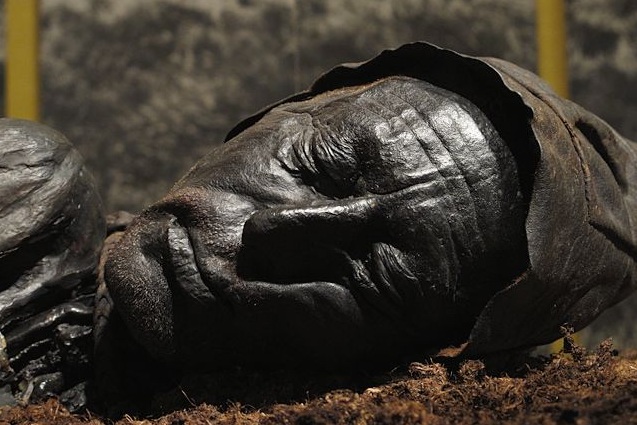
In these poems, Heaney steps off the fence and he takes sides.  For him, Bogland is synonymous with Ireland – just as many of the surrounding countries are also named, such as Iceland, England, Greenland, etc.  Indeed, other countries can have their uplands, and Lowlands and Highlands so why can’t we have our Boglands?  Because of his upbringing in rural Ulster, he is only too aware of the pejorative terms used to describe Irishmen such as ‘bogger’ or ‘bogman’.  That is why in this poem he embraces the bog and all its cultural nuances and he is proud to be associated with the bog and all that it represents for him.   He is aware that in Ireland’s recent colonial past the Irish were for centuries oppressed and confined to the bogs and uplands.  These boglands and uplands were also, therefore, the centres of resistance and traditionally the bogs were used as hiding places for weapons and bodies and where the Irish rebels, the Croppies, the pikemen of ’98, looked out like the snipe, the grouse and the pheasant, all the hunted, the marginalised, and all were fair game.

So here in Door into the Dark, Heaney is going deeper than he has already; in hurling parlance, he is ‘lowering the blade’.  He uses the first line from the poem ‘The Forge’ as the title for the overall collection of poems.  This sonnet celebrates the simple, everyday hard work of the local blacksmith, Barney Devlin, who daily undertakes the strenuous task of turning the rough metals into fine works of art and everyday utensils for the local farming community.    Barney’s ‘anvil’ is turned into an ‘altar’ which is set ‘somewhere in the centre’, ‘horned as a unicorn’.  Here Heaney touches upon God’s work, the artist’s work and a blacksmith’s work and weaves them together as in a garland. The sonnet is an analogy for the creative, poetic impulses which are gestating beneath the surface in Heaney’s subconscious.

One of Heaney’s famous poems in this second anthology is ‘Requiem for the Croppies’ which deals directly with an historical event of war and violence.  The terrible battle of ‘Vinegar Hill’ (1798), fought between Irish rebels and the English colonial rulers is the subject of the poem.   One major achievement of the poem is that it craftily conjoins the centuries of Irish violence and political struggle and achieves an organic, indeed germinal resolution: And in August the barley grew up out of the grave’.  Heaney himself gives an elaborate account of the composition of the poem, its historical and political relevance:

“[It] was written in 1966 when most poets in Ireland were straining to celebrate the anniversary of the 1916 Rising  ……   The poem was born of and ended with an image of resurrection based on the fact that sometime after the rebels were buried in common graves, these graves began to sprout with young barley, growing up with the barleycorn that the ‘ croppies’ had carried in their pockets to eat while on the march. The oblique implication was that the seeds of violent resistance sowed in the year of Liberty had flowered in what Yeats called ‘the right rose tree’ of 1916. I did not realize at the time that the original heraldic murderous encounter between protestant yeomen and Catholic rebel was to be initiated again in the summer of 1969, in Belfast, two months after the book was published” (Preoccupations, 56).

The poem’s patriotic fervour and humanitarian zeal are noticeable. The first person narrator is a rebel who has been killed and who hails their uprising as resurrection. The rebels may be killed, but the struggle for justice and liberty would continue.  Although on many occasions he is accused of remaining passive and detached from the cause of Irish independence, this poem is a fitting reply to this unjust criticism of Heaney.

In ‘Bogland’ Heaney reverses his approach and method of presentation. He gives up monologue and refuses to refer to any particular historical-political event.  Instead, he takes recourse to symbol, metaphor, allegory and myth. ‘Bogland’ stands as a metaphor for Ireland.  The poet speaks of a voyage ‘inwards’, and ‘downwards’.  This journey throws up many possibilities. The foremost, of course, is the journey back to the primordial Irish past, its folk history and myth.  The psychic residue or the racial memory of a great people is excavated through the inward journey of the poet. This inward journey may also suggest a spiritual exploration of a plundered nation. It is noteworthy that the poet uses the plural term for the great journey ‘inwards’ and ‘downwards’.   Through the extended allegory of ‘bogland’, the poet simultaneously lays bare the greatness and beauty as well as the suffering and agony of his motherland.

It is obvious that the poet has reflected deeply on the notion of bogs and he uses memorable images such as the Great Elk and bog’s ‘black butter’ to capture (or recapture) his own childish sense of wonder.  This is akin to the elation the poet feels when he excavates a poem from the bog of memory.  The bog is generous in that it preserves and returns the past to us, in the form of ordinary, domestic gifts:

Butter sunk under

More than a hundred years

Was recovered salty and white.

The bog with its watery element is soft and accommodating:

The ground itself is kind, black butter

Melting and opening underfoot.

‘Bogland’ is, therefore, a seminal poem in which Heaney opens himself up to new possibilities, and he delves deeper into the bog of autobiography and history.  The bog contains the history of the island:

Every layer they strip

Seems camped on before.

Therefore, in this way, the bog acts as the memory of the Irish race.  To dig the bog, by ‘striking inwards and downwards’, is to search into the bottomless centre of Irish history.  Although not stated explicitly here (as he does in ‘Digging’, for example), it is clear that the action of digging the bog is seized on by the poet as a symbol of his work as a poet.  The landscape of the poem, therefore, is both the natural landscape of Ireland but also a cultural/visionary landscape.  ‘Bogland’ is a poem that is poised between the literal and the symbolic and the reader must constantly shift between the literal and metaphorical reading of the text.

The bog, as a symbol of Irish history, allows Heaney, in future poems, to speak about the Troubles in Northern Ireland (1969 – 1998).  One of the insights gained in this poem, and developed in his third collection, Wintering Out (1972) in the poem ‘Tollund Man’, is that the soil of Ireland contains its past, including all the spilt blood and the broken bones and bodies of ‘The Disappeared’ and all the other remnants of its violent history.  In both ‘Bogland’ and ‘The Tollund Man’ Heaney, like the ‘pioneers’ who keep ‘striking / Inwards and downwards’, prompts us to think across thousands of years.  ‘Bogland’ speaks of how our ancestors’ lives are recorded and contained within the bog.  ‘The Tollund Man’, though it also speaks of a bog find, is a more complex poem in that it compares and contrasts a violent death that took place two thousand years ago in Jutland to the violent deaths which occurred almost daily in Northern Ireland from 1969 until the signing of the Belfast Agreement on Good Friday in 1998.  The Danes weren’t the only ones to bury their dead in the bog – there were numerous victims of violence ‘disappeared’ during ‘The Troubles’ and buried in remote, windswept locations on this island also.   Heaney himself has said that he has searched for ‘images and symbols adequate to our predicament’.  And despite what some of his critics say, he never shirks or avoids the savage reality of violence: in ‘The Tollund Man’ he writes with stark realism of how the mutilated bodies of four young brothers were dragged along the train tracks, their skin and teeth flecking the railway sleepers.

I suppose it is fitting for a poem written in the late ’60s in Ireland that there is no sense of closure in ‘Bogland’.  In describing the ground of the bog as bottomless, the poem is also describing itself and the endless possibilities of the bog as a symbol.  ‘Bogland’ seems to suggest that poems are found having lain hidden in the subconscious of the poet, awaiting discovery.  In his own words, Heaney states:

‘I have listened for poems, they come sometimes like bodies out of the bog, almost complete, seeming to have been laid down a long time ago, surfacing with a touch of mystery’ (Preoccupations, 34).

‘Bogland’ sees a more confident and spare style emerge and the nine phrases in the poem open and meld into one another, in imitation of the yielding ground of the bog.  The epiphany to be taken from the poem is that there is no bottom to the well of imagination; there is no end to the exploration of the past.  The poem is delivered with a new air of assurance and confidence.  Heaney, like James Joyce in Portrait of the Artist as a Young Man,  is now finally ready and prepared to speak, with no hint of self-consciousness, on behalf of his race – ‘We have no prairies’, ‘Our unfenced country’, ‘Our pioneers keep striking’…..

Therefore, this is a groundbreaking poem which lays down deeper nuances to the original ideas first expressed in ‘Digging’ and other poems.  Heaney identifies with the bog – he takes on board the implied insult that he is ‘a bogman’ and he owns it! The bog, with all its implications, becomes a kind of subconscious racial memory for him, providing him with inspiration for his poetry.


[1] Andrews, Elmer (ed). The Poetry of Seamus Heaney: Essays, Articles, Reviews. Columbia University Press (Icon Books Limited), 1998.

Seamus Heaney talks about why he wrote the ‘bog’ poems.


DAN_tollundmanden_1_face_c (1)
https://youtu.be/ZDT2ZdNL9CM


Works Cited

Andrews, Elmer (ed). The Poetry of Seamus Heaney: Essays, Articles, Reviews. Columbia University Press (Icon Books Limited), 1998.

Heaney, Seamus. Preoccupations: Selected Prose, 1968 – ’78. London: Faber and Faber, 1980.


The Mystery of Michael Hartnett’s Entry for the Eurovision Song Contest

There was a time in the ’80s and ’90s when Ireland dominated the Eurovision Song Contest.   We have participated in the Eurovision Song Contest 55 times, missing only two contests (1983 and 2002). Believe it or not, Ireland has a record total of seven wins and is the only country to have won the Eurovision three times consecutively.

Ireland’s seven wins were achieved by Dana with “All Kinds of Everything” (1970), Johnny Logan with “What’s Another Year” (1980) and “Hold Me Now” (1987), Linda Martin with “Why Me” (1992), Niamh Kavanagh with “In Your Eyes” (1993), Paul Harrington and Charlie McGettigan with “Rock ‘n’ Roll Kids” (1994) and Eimear Quinn with “The Voice” (1996). Johnny Logan is the only performer to have won twice and also wrote the 1992 winning entry.

Indeed, RTE was forced to host the competition so often that the station was in danger of going bankrupt.  They eventually began to share their largesse with the great unwashed outside the Pale and on one famous occasion in 1993 the event was staged in the Green Glens Arena in Millstreet, County Cork.  The Green Glens was more commonly associated with show jumping and other equestrian events at the time but RTE was known to make the occasional foray into the wilderness and so Noel C. Duggan’s state-of-the-art equestrian centre was chosen to stage the event on this occasion.  This was the 38th Eurovision Song Contest and, low and behold, yet again, Ireland, represented by Niamh Kavanagh, was the winner with the song, “In Your Eyes”.

Long before this famous victory, however, a young impecunious poet called Michael Hartnett, formerly from Newcastle West but now living ‘out foreign in Glantine’ had decided that it was about time that he tried his hand at songwriting.  He had been looking closely at the lyrics and he felt that surely a wordsmith of his quality could match the quality of Johnny Logan’s ‘What’s Another Year’!  He gathered a small, intrepid band of musicians and wordwrights about him, and in the Winter Poet’s Corner[1] in The Shamrock Bar in South Quay he produced the following entry for the Eurovision Song Contest of 1981.  Fittingly, for a poet that is, the song was entitled ‘I Can Read You Like a Book’.  Peter Fallon includes this version in the 2015 reprint of The Book of Strays. He tells us in a postscript to that edition that he received it from Seán Tyrrell the great traditional singer and musician who sadly passed away in October 2021. Unfortunately, Hartnett’s foray into songwriting did not find favour with the judges, and his ‘song’ with its quite intriguing Chorus disappeared forever, or so we thought …….

FullSizeRender (20)

……… and then, would you believe it, another version of the ‘song’ turned up on 8th October 2022 during a concert given by that great Limerick troubadour, Mick Hanly.  He told the  Éigse audience in The Longcourt Hotel in Newcastle West that one evening in the 80s he was in the snug of Doheny and Nesbit’s Pub in Dublin having a quiet pint with his brother David when Michael Hartnett arrived and took some papers from his inside pocket and said, ‘I have a Country and Western song for you, Mick’.  Miraculously all those years later Mick produced the original sheets of paper on which Hartnet had written out the song in his own distinctive handwriting.  In the recording below Mick didn’t use Hartnett’s chorus and substituted it with his own as, I think, he felt it was too bizarre and maybe a little too risque especially for his Country and Western devotees! Instead, he uses his own chorus:

Sometimes when you smile

Unless you rub my brow

I don’t know if you’re sad, happy, or mad

It’s the cheek (?) I’ve never found.

He readily agreed to give me a copy and I quickly photocopied them at the hotel reception.  The interesting thing about this version is that, as you can see, the chorus differs slightly from the Eurovision entry and there is the added bonus of an extra verse!  No doubt there are numerous other copies and variations out there in the poet’s own handwriting.  Maybe in time, we will come across extra verses to this unique undertaking – a song that doubles as a Eurovision entry and as a Country and Western classic!!

IMG_4605
IMG_4604

Click on the link below to see Mick Hanly sing the World Premiere of Michael Hartnett’s song, ‘I Can Read You Like A Book’:

https://drive.google.com/file/d/1Yu0tlPZ81YkrOnRJKkxvQrFXTRt6b5wC/view?usp=sharing

Author’s Note: Thanks to Dermot Lynch for the video.

Footnotes

[1] Tony Sheehan and Peg Devine, and later George Daly and his wife Breda, were the owners of The Shamrock Bar in South Quay and both owners were great friends and patrons of the poet.  In fact, there were two Poet’s Corners in the pub – a Winter one and a Summer one!

Commentary on the poem ‘The Diviner’ by Seamus Heaney

liamoneill01
“Seamus Heaney in Toner’s Bog” by Liam O’Neill

THE DIVINER


By Seamus Heaney

Cut from the green hedge a forked hazel stick

That he held tight by the arms of the V:

Circling the terrain, hunting the pluck

Of water, nervous, but professionally


Unfussed.  The pluck came sharp as a sting.

The rod jerked down with precise convulsions,

Spring water suddenly broadcasting

Through a green aerial its secret stations.


The bystanders would ask to have a try.

He handed them the rod without a word.

It lay dead in their grasp till, nonchalantly,

He gripped expectant wrists.  The hazel stirred.


Commentary: Dr Andrew Barker called ‘Digging’ – the first poem in Heaney’s first collection – his Mission Statement Poem.  If that is so, ‘The Diviner’ is an early codicil to that Mission Statement!  It is yet another of Heaney’s poems about rural crafts and craftsmen.  These earlier poems focussed on his rural roots and the local crafts which were synonymous with his local place.  Similar to ‘Digging’ and ‘The Forge’, and ‘Follower’, this poem also explores the poet’s early search for poetic inspiration.  Heaney discovered his own gift by seeing the connection between the local craftsmen and his own burgeoning desire to be different yet the same.

The first thing to notice here is that Heaney doesn’t name the poem ‘The Water Diviner’ – instead, he uses the more generic title ‘The Diviner’.  This allows him to make ancient connections with the meaning of the word.  In the ancient world of Greece and Rome, a diviner was a wise man, a seer, a prophet, a mystic, an oracle.  Even in ancient Ireland in the Bardic tradition, the diviner was a saoi, literally a ‘wise one’, a poet at the pinnacle of his powers.  So, it is evident that Heaney here is making a clear analogy between the work of the local diviner in Bellaghy and the work of a poet.  Heaney is making this connection very early on in his career and so he has already accepted the onerous responsibility of following in the ancient footsteps of the Filí and Bards who had gone before him.

Water is, of course, a vital element and it has to be understood by the modern reader that in Ireland even in the 1950’s, houses, especially in rural areas, did not have water on tap as they do today.  Instead, water for daily household use was still being drawn by bucket from communal wells in each locality.  Therefore, it is no surprise that the person who could locate the presence of water in such springs and wells would be given great recognition and elevated status in the community.

Heaney speaks of this in some of his early poetry in such poems as ‘Personal Helicon’ and ‘Sunlight’.  In ‘Sunlight’, one of two poems dedicated to his Aunt Mary’s home place in Mossbawn, he speaks of the ‘helmeted pump in the yard’; this pump which was the centre of his boyhood universe, where ‘water honeyed in the slung bucket’.  In ‘Personal Helicon’ he tells us that he is inspired by and attracted to the water in wells and springs.  He tells us that as a child ‘they could not keep me from wells’.  However, as an adult, it seems that this activity is frowned upon, so instead, he became a poet!  In a beautiful concluding sentence, he says, ‘I rhyme / To see myself, to set the darkness echoing.’  There is a clear connection suggested here between the young Heaney’s activities and the older Heaney’s poetry.

The diviner in this poem is seen in the same light as his father and grandfather are in ‘Digging’.  The diviner is exploring the hidden depths, the unexplored layers of landscape, seeking out water-bearing aquifers.   This is similar to his father or grandfather toiling in the bog, ‘going down and down for the good turf’.

The jury is still out on whether it is even possible to divine the presence of water by holding a forked hazel stick in one’s hands!  Scientists still seem to frown on the idea yet in Heaney’s home place of South Derry there would have been one or two men with this innate power, just as there would have been a person who had a cure for burns or had the ability to fix a bad back or rid a person of warts.  These cures or remedies had been handed down through the generations from father to son, from mother to daughter.  Heaney has realised that he too has a rare gift and he normalises his own talent as a poet by comparing it to those with rare gifts in his own rural community.

The diviner described here was a real expert and he put on a performance for the onlookers present.  His actions were ceremonial, just like a priest at the altar on Sunday – he refers to the diviner ‘Circling the terrain’. The poet creates a mood of tension as the ritual performance commences; words like ‘tight’, ‘hunting’, ‘pluck’, ‘nervous’, sharp’, ‘sting’, ‘jerked’, ‘convulsions’, convey tension, urgency, doubt, and expectation in the reader.  The tone of the final stanza is far more relaxed and of course, this is because the diviner has been successful in his quest for water and so he ‘nonchalantly’ grips the ‘expectant’ wrists of those who have asked to have a turn and see if the hazel stick will work for them.

Notice the poet’s clever use of the word ‘nervous’ here in stanza one.  He is referring to the fact that our nervous system carries messages to the brain – but here it is the diviner who is the path along which the message from the underground water will be carried.

The poet tries to demystify the work of the diviner by using the analogy of a radio signal picking up foreign radio stations as one turned the dial on the old cumbersome radios that were a feature in many rural homes in the Fifties.  The hazel stick is likened to ‘a green aerial’, which picks up the unseen signals the water gives off from underground caverns.  We know the diviner has picked up the signal when Heaney says in the second stanza, ‘The rod jerked with precise convulsions’.  This image of the water broadcasting its position presents us with the notion that the diviner is the receiver and interpreter of messages that ordinary mortals cannot experience or understand.  In Heaney’s view, this is also an exact analogy with his work as a poet.

The word ‘convulsions’ suggests to me that the diviner is not in control of his movements and of course the fact that these ‘convulsions’, these involuntary movements, are visible to the bystanders adds to their sense of wonder and awe.

The style of the poem is very matter-of-fact – as if the poet is reporting for his local newspaper!  There is also the subtle innuendo that it’s all some kind of hoax that is being perpetrated here by the diviner – that he is some kind of charlatan, pulling the wool over the eyes of his unsuspecting, gullible audience.  These notions are finally dispelled and underlined by the final short sentence: ‘The hazel stirred’.

Another interesting feature of the poem that we need to explore is that we are not told what the diviner looks like.  This helps the poet to create the feeling of awe and wonder.  This is in marked contrast to other poems such as ‘The Forge’ and ‘Digging’, for example, where we are given little pen pictures, sometimes uncomplimentary, of his father and the blacksmith.  In ‘Digging’ he looks down from his upstairs study window and sees his father digging in the flower garden: ‘I look down / Till his straining rump among the flowerbeds / Bends low’.  In ‘The Forge’ he describes the blacksmith, Barney Devlin, in a very Chaucerian manner: ‘Sometimes, leather-aproned, hairs in his nose,  / He leans out on the jamb, …’.  However, in ‘The Diviner’ he refrains from making any of these derogatory comments and therefore the mystique of the diviner is maintained right to the end.

The reason Heaney is drawn to these rural craftsmen and their various trades is that he is in awe of the power of the diviner, the turf-cutter, the ploughman, talents that he doesn’t possess but ones that he admires.  In ‘Digging’ he tells us, ‘But I’ve no spade to follow men like them’.  He is drawn to these people who divine for water, dig in gardens and plough the land and shoe horses because he wants to follow in their footsteps but in his own unique way.

In many ways, these poems, particularly the ones from the collection Death of a Naturalist, are efforts to pacify and appease worried parents who have suspicions that their young son is different.  In this, his first collection, he is reassuring them that he’s not that different but that they will have to accept his choice of career: he will be a poet to be reckoned with, he will dig and plough and divine – but with his pen.  Fittingly then, thirty or so years later, The Nobel Prize in Literature was awarded to Seamus Heaney in 1995, “for works of lyrical beauty and ethical depth, which exalt everyday miracles and the living past’.

Works Cited

Seamus Heaney.  100 Poems, Faber and Faber, 2018

The Nobel Prize in Literature citation 1995:

<https://www.nobelprize.org/prizes/literature/1995/summary/&gt;

Further Reading by the same author:

A more comprehensive analysis of ‘The Forge’ is available here

A more comprehensive analysis of recurring themes in the poetry of Seamus Heaney (with particular benefit to Leaving Cert Students) is available here

Study Notes on ‘Shadows on Our Skin’ by Jennifer Johnston

0097652_9780747267911_300

It is encouraging to see Shadows on Our Skin back on bookstore shelves again, thanks mainly to its inclusion on the new Junior Cycle Text List for Second and Third Years.  The novel tells the story of a young dreamer called Joe Logan who lives with his ailing, cranky, sick father and harsh, resentful mother in a Northern Ireland beset by ‘The Troubles’. He has a gentle soul, the environment does him no favours, he escapes through thinking up and writing poetry but each day he faces the reality of the world he lives in.   It was first published in 1977, eight years after British troops were deployed onto the streets of Derry and Belfast.  The purpose of this move by the British Government in Westminster was to prevent further civil strife between the increasingly polarised Protestant and Catholic communities.  While the initial reaction of the beleaguered Catholic community was a guarded welcome for the British soldiers, this over time turned to suspicion and hostility and finally hatred, especially in such ghettoised areas as The Bogside in Derry and The Falls Road and Ardoyne areas in Belfast.  Many Catholics came to regard the British as an army of occupation, much as Joe Logan’s father does in Shadows on Our Skin. For example, on Bloody Sunday, 30 January 1972, in the Bogside area of Derry, British soldiers shot 28 unarmed civilians during a peaceful protest march against internment. Fourteen people died: thirteen were killed outright, while the death of another man four months later was attributed to his injuries.  Many of the victims were shot while fleeing from the soldiers and some were shot while trying to help the wounded.  Other protesters were injured by rubber bullets or batons, and two were run down by army vehicles.   The march had been organised by the Northern Ireland Civil Rights Association (NICRA).  The soldiers involved in this infamous incident were members of the  Parachute Regiment.  The inevitable result of incidents such as this was that increasing numbers of young men joined the newly formed Provisional IRA.

Battle-of-the-Bogside-overview_photo-BBC
Battle of the Bogside

‘Over and over again, the same stories’

The background to Shadows on Our Skin, therefore, is the plight of these poor Catholics living in deprivation in mean streets, their lives constantly disrupted by street fighting, ambushes and British army raids on their homes, leading to the destruction of their property and the arrest and internment of many fathers and sons.  This struggle between the authorities and a large section of the Catholic population is mirrored in the tensions within the Logan home.  Two distinct points of view on the IRA campaign are represented by Joe’s father and mother.  The father’s background, reflected in his political outlook, helps to explain why the struggle against the British occupation of part of Ireland persists from generation to generation.  He has, for years, filled his son Brendan’s head with tales of his own achievements as an Irish freedom-fighter during the War of Independence in the early 1920’s.  We are never quite sure whether these heroic stories are to be believed; his wife, for one, has her doubts.  Whatever the truth about the days in which, as Mrs. Logan sarcastically remarks, he ‘ran the Movement’, he creates a persona for himself by means of which he impresses and indoctrinates Brendan.  Since childhood, Brendan has been close to his father, feeding off his romanticised accounts of the part he has played in the downfall of the British power in Ireland, ‘listening to the stories, over and over again the same stories, of the glamorous days, the fairy tales’.

What matters is not whether these stories are true, but the effect they have on Brendan’s imagination, outlook and actions.  He can repeat the names of the heroes of the War of Independence, the Civil War and the new IRA as one might repeat a litany of saints: Liam Lynch, Ernie O’Malley, Liam Mellows, Sean Russell.  He has been taught that these men were uniquely men of principle as well as heroic men of action.  Even Joe, young as he is, has been affected by the mythology of republican nationalism.  The world his father imaginatively inhabits is peopled with heroes, ‘with patrols and flying columns and sad songs that used to drift down to Joe below, songs about death and traitors and freedom and more heroes’.  Much of his father’s patriotism is a matter of bar-room rhetoric, of purely negative emotions such as hatred for the British and contempt for ‘the Free state’ authorities for shirking their ‘legitimate responsibilities’.  He is in total sympathy with the military campaign of the new IRA.  He believes that the organisation could do with the expertise of people like himself.  He longs for a part in the guerrilla campaign as an armchair general (‘If they’d ask me … I have it all at my fingertips … Not only have I the experience but I’ve read the books … They need the old fellows so they do’).

A selfish father

The value of these ideas and of Mr. Logan’s present career as ‘a retired hero’ is consistently challenged in the novel by his wife.  From her point of view, he has been living far too long on the legacy of a wound acquired in the Civil War.  For her, this has meant living with his self-pity and sentimental reminiscences.  It has also meant that she must support the family while he wallows in the misery of his decaying health, tears trembling in his voice as he remembers the days when he was in his prime.  Now his life is divided between his sick-bed, the dinner-table and the pub, and dominated by wasteful, futile regrets (‘I should have died then, instead of being mutilated, body and soul.  Aye, soul too.  I have wasted away my life since’).  Apart from having to endure this ever-present sickness of body and soul, the yearlong tears which have left their grey tracks on his cheeks, Mrs. Logan must live with a man whose outlook on issues of life and death differs fundamentally from hers.  He is the great life-denying force in the novel, not only in regard to himself but in regard to others as well.  He is sustained by memories, drink, and hatred of Britain, none of which find a sympathetic echo in his wife’s heart.

Mr. Logan’s visual appearance suggests a sinister significance: ‘He was like some evil old demon propped up there in his grey pyjamas with an old jersey pulled over the top of them.  His eyes were a dirty grey like his pyjamas.’  His response to the killing of two British soldiers provokes a bitter argument with his wife, in which the play of contrasting ideas on violence which dominates the novel is given free rein.  When Joe tells him that the two soldiers are dead he smiles happily (‘That’s as good as a tonic … Cause for celebration … A nation once again … Two of the enemy are dead’).

NYC36085_640px

A worn out mother

Mrs. Logan finds this gloating over the deaths of two young soldiers offensive and absurd.  What she has to say exposes the poverty of her husband’s outlook on the political situation.  Their arguments show how defiantly he lives in a world of abstractions, most of them quite meaningless and alien to her practical mind.  His hackneyed celebration of freedom gives her an opening to express the point of view of all those, particularly women and children, who suffer on behalf of political causes.  She turns his own terminology of freedom back on him.  She wonders, for example, if ‘liberated’ southern Ireland enjoys any more freedom than the occupied North.  To her practical mind, freedom has no real purpose unless it results in a better way of life for people.  Her comments on the Southern Republic bring some of the major issues raised in the novel into sharp focus:

Is there a job for every man?  And a home for everyone?  Have all the children got shoes on their feet?  Are there women down there scrubbing floors to keep the home together because stupid, useless olds men are sitting round gassing about freedom?  Singing their songs about heroes?

A dominated brother

This suggests that Mr. Logan’s notions about Irish freedom reflect an absolute lack of concern for practical urgent realities.  There is, of course, more to them than this, because of their profound influence on Brendan.  The son precisely echoes and mirrors his father’s reactions to the deaths of the British soldiers. ‘Not too bad … a couple of soldiers killed’ is how Brendan responds when Kathleen Doherty asks him if anybody has been hurt.  The depth of his father’s influence is further suggested in conversation with his mother.  She believes that the young men of the area who have been arrested for IRA involvement deserve their fate.  He sees them as leaders in the struggle for a better life for people like his mother, and argues, as his father does, that nobody will have a decent life until after the British have been dislodged.  He regards those who oppose the aims and methods of the IRA as traitors to their class and to their religion, and therefore finds the killing of British soldiers can be easily justified.  Her condemnation of this idea and of her husband’s patriotic outbursts is absolute. ‘Does it not enter your head,’ she asks Brendan, ‘that there’s a rare difference between sitting around and listening to a bunch of old men telling their hero stories and what is happening now?’  Words, she knows, can be as deadly in their effect as bullets.  She can even defend the actions of the British soldiers in pillaging the Logan home by fixing the blame on her husband and son: ‘They’re no worse than the next man.  They only do what they do because of people like you and your father.’

Joe, a victim of his environment

Shadows on Our Skin is a novel of blighted childhood.  The adult world casts an ugly shadow on Joe’s youth.  He is the innocent victim of a hopelessly inept, irresponsible father and a selfish brother.  His school life is as unhappy as his home life.  His one pleasant human relationship is ruined by his brother’s interference.  The most remarkable thing about Joe is his ability to endure all the cruelties that life can heap on his head and still remain buoyant for so much of the time.  Jennifer Johnston renders the sordid atmosphere of the Logan home and its effect on Joe with disturbing realism.  Images of decay, filth, and tedium pervade the novel.  Down-to-earth details of the domestic scene can suggest the silent, frightening desperation of so many lives like Joe Logan’s: ‘they were eating their Sunday dinner, Mass behind them, an endless Sunday afternoon in front of them …’  the atmosphere of sickness is also ever-present in the Logan household.  His father’s sick spells are liable to last for weeks: ‘Ill, shaking all the time and giving off a terrifying smell of illness that made Joe want to keep away from him.’  The father’s predicament has made him so repulsive that Joe is afraid to touch him: ‘He was always afraid that his fingers would sink through the soft, mouldering skin.’

All of this leaves Joe with a diminished capacity for optimism.  Everywhere around him there is evidence of human despair and unhappiness.  Apart from his father, who has been bemoaning his own fate for years, those closest to him often seem close to tears, particularly his mother.  ‘He was’, we are told, ‘frightened by tears, not by children’s tears of rage or pain, nor his father’s blubberings of self-pity, but adult tears like hers and Kathleen’s which made him feel that the world might crack open suddenly.’  Towards the end of the novel, we are given a pitiful glimpse of the effect of his morbid experience on his vision of the world.  In his natural resentment of his brother’s interference in his personal life, Joe instinctively destroys Brendan’s relationship with Kathleen by revealing the identity and occupation of her fiancé Fred Burgess.  Having performed his act of what he calls ‘deliberate destruction’, Joe runs away for a while, speculating on the kind of world that might lie beyond the sea.  The real world beyond the confines of Derry may not, he decides, be any different from the world he knows.  His account of the world of his own experience shows that nothing he has so far learned about human relationships gives him cause for hope.  As far as he can judge, people are helpless victims of their mutual cruelties, doomed to have their hopes dashed:

Perhaps everywhere you went people were lost, searching with desperation for something they would never find, mutilating themselves and each other in their desperation.  There was no safety.

Joe is puzzled by some of the unhappiness he finds in the lives of others, such as Kathleen Doherty, for example.  She is telling him about Fred Burgess, the British soldier she intends to marry when he notices how unhappy she is.  She eventually confesses that her life is without purpose and she is extremely unhappy with her lot.  Even the prospect of marriage to Fred fails to give purpose or meaning to her daily activities.  She is unable to find happiness in what she calls ‘the birth, marriage, death routine’.  Joe can understand why he himself might have cause for unhappiness but what he finds hard to understand is that ‘safe’ people like Kathleen could or should be unhappy with their life.  This he finds unfair.  He thinks it unacceptable that life should ‘gnaw at her in this way’.  Kathleen’s unhappiness induces a ‘clotted sadness’ in his head.

MI-northern-ireland-troubles-soldier-girl

A world of grief

Joe views the world as a place where people mutilate themselves and each other and where nobody is really secure from grief.  The endless domestic conflicts between his parents have helped to condition his responses to the unhappiness of most human relationships.  His mother’s predicament is a further lesson in the horrors of home life for so many people of her social class.  The burdens of family life have almost crushed her spirit.  We learn that her voice is ‘tired to death’, and that she cries quietly.  Her face is ‘full of pain at having to move into yet another week’.  She is not, however, the burnt-out wreck of humanity that her husband is.  She responds with animation to every domestic challenge, repairs the ruins of the house after the British soldiers have wrecked it, devotes herself untiringly to the basic needs of her family, does all she can to further Joe’s moral education, and keeps a home going heroically against the odds.  Her husband does little to deserve it, but her love for him shines through in subtle ways.  After they have quarrelled bitterly over politics, he leaves her in tears with Joe for company:

‘There’s no sign of your Daddy.’

‘No.’

‘He must have someone to have a drink with.’

‘Yes.’

‘He’d have been home otherwise.’

‘Yes’

Despite his total inadequacy as a husband, she can still look forward to his return and worry about his late homecoming.

Three themes in the novel

Three interwoven themes in Shadows on Our Skin are the past, the family and betrayal.  (These same themes are also dealt with powerfully in Seamus Deane’s brilliant novel Reading in the Dark also about a young boy’s experience of ‘The Troubles’ in Northern Ireland).  The legacy of the past haunts the Logan family and has a profound effect on the present outlook and activity of its members.  Betrayal by family members and close friends of each other’s interests is a disturbing feature of the novel. Indeed, Jennifer Johnston herself has written:

The way I see the world, we are constantly at risk from the people we love most.  They are, after all, the only people who can do us serious damage, a damage that lasts forever.  I’m a very optimistic person, but I can see this happening.

Mr. Logan is the vehicle through which the past constantly intrudes into the lives of his wife and two sons.  He himself lives much more in the past than in the present and keeps an idealised version of his own past before the minds of all who will listen to him.   The continuity between past and present which he enforces is based on an ongoing hatred of the ancient crimes of the British enemy against the long-suffering Irish people.  He sees to it that his eldest son remains conscious of the grievances of the past and all its bitter memories.  His emphasis on past wrongs means that his eldest son sometimes approaches the British-dominated world around him in a spirit of revolt.  Love or forgiveness of enemies can have no place in this scheme of things: ‘Look around.  Hate is a better word.  I can understand that.’  Mr. Logan’s insistence on living in a mythical past in which he was a wounded hero disables him from living in the present in any useful sense and from making any positive contribution to the welfare of his family.  Indeed, he invokes the past to poison the atmosphere of the present, to hand on his peculiar version of old events to the next generation.

The novel offers some small (prophetic?)  glimmer of hope that the terrible dominance of the past may eventually be broken.  Brendan has been indoctrinated by his father’s view of the past, but his commitment to its influence is far from absolute.  Kathleen Doherty recognises this.  Far from being totally committed to the legacy his father seeks to pass on to him, Brendan is, as Kathleen observes, ‘in a state of great confusion’, with ‘a lot of wrong ideas pushing the right ideas rather hard’.  Towards the end, the ‘right’ ideas, the rejection of the violent heritage represented by Mr. Logan, achieve the upper hand, at least temporarily.  Brendan tells Joe that he always sees himself carrying on the struggle against the British where his father left off.  When the IRA people gave him a gun, this ended his dream of violent activity: ‘It was the gun finished me off.  I wouldn’t be any use to them.’

A sense of betrayal haunts the novel.  Mr. Logan betrays the interests of his wife and children by refusing to take a constructive interest in anything relating to their welfare.  His life is a betrayal of decent standards, an outpouring of totally negative and destructive emotions.  Joe practises his own understandable but very deadly form of betrayal.  When Brendan infringes on his pleasant relationship with Kathleen, Joe’s jealousy and hatred begin to dominate his life.  Kathleen has indicated to Joe her intention of marrying a British soldier, Fred Burgess, but he has kept the identity of this man a secret from Brendan.  Joe has promised Kathleen that he will tell his brother nothing about Fred.  When Brendan confides in him that he may marry Kathleen, he betrays Kathleen’s secret, taunts Brendan to fury with revelations which shock him, telling him that his rival is ‘a British soldier.  She wears his ring, you know.  And she tells him everything.’  It is this final betrayal which leads to frightening consequences for Kathleen and darkens the close of the novel.

This series of events split Joe’s world apart, and he is left to process the consequences of the things he has done and the choices he has made.  Shadows on Our Skin is a book that is quick and enjoyable to read, but also evokes sadness and seriousness as you absorb the life of the characters within it.  It’s a fairly low-key story, and not much seems to happen plot-wise, but there is something about Shadows on our Skin which is strangely compelling and incredibly moving. There’s an aching quality to the story, the type of pain which feels like a knot in the throat which cannot be swallowed away.

And of course, there’s also a bigger picture at work here, which is the political and sectarian war being waged on the streets of Derry.  Jennifer Johnson ensures that this is the ever-present backdrop to the novel but it is never the main focus for the reader.  However, its presence is felt on almost every page, whether it is reports of bombs going off, soldiers raiding Catholic homes in search of IRA weapons or boys having their sports bags searched en-route to school.

In essence, this is a coming of age story as Joe deals with some very serious situations that he faces, choices he makes and who he is becoming.  It’s a poignant and powerful book that really does reflect the awful times that children had to live in during the 1970’s in Northern Ireland.  Joe is depicted as an innocent victim of the ‘troubles’ and strife that is going on all around him.

This novel was shortlisted for the Man Booker Prize in 1977 and I am not surprised. It is very well written and has stood the test of time with many readers.  I think the author did a marvellous job of portraying the characters of Joe’s father and mother.   We really are transported right to their tiny little kitchen as his mother pours the tea and his father complains about how he was once a hero but no more.

Jennifer_Johnston_Author
The author, Jennifer Johnston in a garden in Goatstown, Dublin. Photographer: Dara MacDónaill

The full list of Junior Cycle English Texts for Second and Third Year can be viewed here

The Poetry of Seamus Heaney: Some Recurring Themes


poetrycornerseamus

The main purpose of these notes is to assist you in forming an overview of Heaney’s work.  For this reason, the material is structured as a series of ‘thinking points’, grouped under general headings.  These cover the poet’s main preoccupations and methods, but they are not exhaustive.  Neither are they ‘carved in stone’, to be memorised: ideally, they should be altered, added to or deleted as you develop your own set of notes.  This priceless pearl of wisdom is relevant for Heaney BUT it equally applies to all the other poets on your course as well!

The following ‘grace notes’ presuppose a basic knowledge of the following poems by Heaney on your Leaving Cert Poetry Syllabus:

  • Sunlight
  • The Forge
  • Bogland
  • The Tollund Man
  • A Constable Calls
  • The Harvest Bow
  • Lightenings VIII
  • Postscript

IRISHNESS – HISTORY, MYTHS, POLITICS

  • In his early poems, Heaney was preoccupied with local history, with communicating the experience of his own place with its numerous customs, rituals and ancient rural crafts (See ‘Sunlight’ and ‘The Forge’).
  • Then he began to think of history as landscape, exploring downwards, finding evidence of history in the bogs and the very contours of the land, exploring what myth and prehistoric evidence revealed about Irishness (See ‘Bogland’)
  • Exploring back in time, he makes historical connections between the Iron Age and the present. He draws parallels between ancient human sacrifices and the contemporary violence which was engulfing his native Ulster at the time.  He seems to be saying that violence is indeed endemic in all societies throughout history, that human sacrifice is necessary for the integrity of territory, that myths, however savage, are an integral part of the creation of the identity of a people (See ‘The Tollund Man’).
  • Overall, Heaney’s position has been seen as ambivalent and has been misunderstood by many. His poetry constantly explores the divisions tearing present-day Ulster apart.  His position has often met with criticism from all sides regarding his treatment of recent Ulster history.  Some critics say he has too much politics in his poetry, while others say he should stand up for his people and take sides.  He has been accused of obscuring the horrors of sectarian killings; of endorsing a ‘tribal’ position, or of not endorsing it enough; he has also been accused of evading the issues and being non-committal in his writing.

For many critics, like Elmer Andrews, Heaney doesn’t go far enough: ‘Heaney’s art is fundamentally an art of consciously and carefully cultivated non-engagement’.  Do you agree?  Is Heaney completely uncritical of his own side? (See ‘Bogland’, ‘The Tollund Man’, ‘A Constable Calls’).

OLYMPUS DIGITAL CAMARA
A traditionally crafted Harvest Bow

PLACE AND LANDSCAPE

  • Like Patrick Kavanagh, who is synonymous with his native Inniskeen, Heaney too has immortalised his native place and Mossbawn and Anahorish are mentioned often, especially in those poems which deal with childhood. ‘Sunlight’ presents us with a picture of an idealised childhood, his aunt Mary Heaney’s kitchen is depicted as enveloping him in a womb-like security.  His earlier poems, especially those from his collections Death of a Naturalist (1966), Door into the Dark (1969), North (1975), and Field Work (1979), focus very much on home and family, his relationship with his father and mother and the need for continuity between the generations (See ‘Sunlight’, ‘The Harvest Bow’)
  • Anybody who has read ‘Blackberry Picking’ or ‘Death of a Naturalist’ and other such poems by Heaney will need no convincing that he is a fine descriptive nature poet. Terence Brown says that he has an ‘extraordinary gift in realising the physical world freshly and with vigorous exact economy.  Heaney can bring everyday natural events before the readers’ eyes with such telling precision that his images are both recognition and revelation’ (See any of his poems!).
  • Landscape for Heaney is more than just a subject to be painted: it is a living presence, an ever-present force, a sort of third party to human activity in the poems. This is the same immediate personal presence that we also find in Kavanagh and Wordsworth (See ‘Postscript’, ‘Bogland’, ‘The Tollund Man’).
  • He shows us differing aspects, different faces, of the landscape: from the life force (‘spirit of the corn’) to the threatening, menacing aspect (‘the bottomless bog’). When writing about the farming traditions of his community he also presents us with the juxtaposing ideas of growth and decay.
  • Heaney believes that people have a human and a religious relationship with the landscape (See ‘Bogland’, ‘The Tollund Man’, ‘The Harvest Bow’).
  • The landscape is seen as essentially female, often with erotic associations in its relationship with man (Examine ‘The Tollund Man’ closely).
  • Heaney’s landscape is dominated by the earth rather than the sky, with the bog providing a metaphor for Irish consciousness (See ‘Bogland’, ‘The Tollund Man’).
  • ‘The landscape for me is an image and it’s almost an element to work with as much as it is an object of admiration or description’. Heaney often uses nature metaphors to express his feelings of frustration and loneliness.  For example, in ‘The Harvest Bow’ he describes his frustrating attempts at communicating with his father like this: ‘your stick / Whacking the tops off weeds and bushes / Beats out of time, and beats, but flushes / Nothing’ (See also ‘Postscript’).
  • Driving out west along the now famous Wild Atlantic Way, along by Flaggy Shore near Ballyvaughan on the West Coast of Clare, the poet explores the beauty of the Irish landscape as a tourist would.  Heaney describes the beauty of the landscape and the changing light and the feelings it will inspire.  It is a journey poem where the poet finds himself caught between wild things and settled things, between things earthed and things in flight.  The sonnet-like structure of the poem gives it a postcard quality  ending with simple and powerful words: ‘And catch the heart off guard and blow it open’ (‘Postscript’)
  • Above all, the landscape for Heaney is a source of creativity and insight: ‘poems … come up … like bodies out of the bog of my own imagination’ (See ‘Bogland’, ‘The Tollund Man’).

DAN_tollundmanden_1_face_c (1)
Listen to Heaney read ‘The Tollund Man’ below:

https://youtu.be/ZDT2ZdNL9CM

TRADITION AND IDENTITY

  • For Heaney, an awareness of one’s tradition is fundamental to a sense of identity. He explains and explores his own roots, celebrating the ancient skills and crafts that sustained the farming community that nurtured him and his family for generations: the digging, the ploughing, the water-divining, the bread-making, the skills of the farmer, the blacksmith, etc.  These skills are described in a reverential way as if they were sacred rituals. (See ‘Sunlight’, ‘The Forge’).
  • Sometimes he still hankers back to the womb-like security of that life of early childhood. Some interpret these poems describing his Aunt Mary’s kitchen in Mossbawn as a form of regression or escapism from the daily horrors of life in Northern Ireland in the Seventies and Eighties (See ‘Sunlight’).  Sometimes he needs to re-forge, reinterpret and understand his links with family in order to rediscover his identity (See ‘The Harvest Bow’ where he says, ‘I tell and finger it like braille’).
  • ‘Our sense of the past, our sense of the land and perhaps even our sense of identity are inextricably interwoven,’ according to Heaney (The Irish Press, June 1st 1974). Therefore, finding and maintaining a sense of continuity is vital to Heaney: family, traditions, customs and values come to him as memories in his poetry and reassure and comfort him amidst the mayhem and uncertainty of daily atrocities in his home place (See ‘Sunlight’, ‘The Harvest Bow’).
  • He explores his Catholic roots too, as set against the other traditions. According to Robert Welch: ‘Heaney is engaged upon a cultural and tribal exploration; he is testing out his cultural inheritance to see where the significant deposits are located; but he is not engaged upon a mindless submission to the old tradition of the goddess or whatever.’ (See ‘Sunlight’, ‘The Harvest Bow’, ‘Bogland’, ‘The Tollund Man’).
  • There are times in his writing when his personal identity has overtones of victimhood about it. He certainly seems to identify with victims: ‘something of this sad freedom … should come to me.’  (See ‘The Tollund Man’, ‘A Constable Calls’).

images (5)
The Forge, situated on the Hillhead Road, near Castledawson and dates from the 19th Century. (www.georgemcintyre.tripod.com)

IDENTITY AND POETRY

  • Heaney’s identity as a poet is inextricably linked in with his historical and cultural identity. The autographical voice we encounter in his first collection, Death of a Naturalist, becomes the spokesperson of his people in the later collection, Door into the Dark  (See ‘Bogland’).
  • He identifies with the bog – he takes on board the implied insult that he is ‘a bogman’ and he owns it! The bog, with all its implications, becomes a kind of subconscious racial memory for him, providing him with inspiration for his poetry.  The Danes weren’t the only ones to bury their dead in the bog – there were numerous victims of violence ‘disappeared’ during ‘The Troubles’ and buried in remote, windswept locations on this island too (See ‘The Tollund Man’, ‘Bogland’).
  • Elmer Andrews describes Heaney’s method in this way: ‘He is proposing an idea of poetry which combines psychic investigation with historical enquiry’. In an essay  entitled ‘Feeling into Words’, Heaney himself spoke of ‘poetry as divination, poetry as revelation of the self to the self, as restoration of the culture to itself; poems as elements of continuity, with the aura of authenticity of archaeological finds, where the buried shard has an importance that is not diminished by the importance of the buried city; poetry as a dig, a dig for finds that end up being plants’ (Preoccupations, 1980) (See also ‘The Tollund Man’, ‘Bogland’).
  • Heaney sees the craft of poetry not just as something mechanical but rather a ‘combination of imagination and skill. He uses a brilliant analogy to describe a poem as ‘a completely successful love act between the craft and the gift’ (See ‘The Forge’).
  • Heaney’s voice in his poems is often indecisive, timid and ambiguous, his position is that of a hesitant observer on the fringes of the scene. For example, in The Forge he is outside looking in, afraid of the darkness within.
  • Heaney and other Northern poets such as Montague, Mahon, and Longley have come to prominence because of their efforts to make poetry relevant in a difficult political backdrop. He feels at times that poetry may be powerless to influence politics but nevertheless, it is vital to a sense of identity.

FullSizeRender (13)
“In the Attic”, a portrait of Seamus Heaney by the artist Jeffrey Morgan now hanging in the HomePlace Centre in Bellaghy, Co. Derry.

SAMPLE ANSWER: What are the recurring themes in the poetry of Seamus Heaney?

Heaney’s poetry brings us to our senses!  There is a tactile, sensuous quality to his poetry and his poetry is often multi-layered.  When he says that he will ‘dig’ with his pen he is referring to how layer after layer of meaning can be revealed in the act of writing.  In ‘The Forge’ he records a changing way of life as the horse and car make way for the motorcar, but the poem also reveals a growing awareness of the mystery of the creative process.  It becomes, therefore, a poem about poetry.

His poetry often draws on childhood memories of growing up on a farm in Co. Derry.  In ‘Sunlight’ and ‘A Constable Calls’ he presents us with two contrasting memories, one beautifully tranquil, the other troubled and uneasy.  Place is of vital importance, as in Kavanagh’s poetry, but so too are the people associated with that place: the exhumed Tollund man, his Aunt Mary in the family kitchen, his father ‘making tillage returns /In acres, roods and perches’, and his father making the harvest bow.

There is, therefore, a preoccupation with the past and a fascination with it.  In both ‘Bogland’ and ‘The Tollund Man’ Heaney, like the ‘pioneers’ who keep ‘striking / Inwards and downwards’, prompts us to think across thousands of years.  ‘Bogland’ speaks of how our ancestors’ lives are recorded and contained within the bog.  ‘The Tollund Man’, though it also speaks of a bog find, is a more complex poem in that it relates a violent death that took place two thousand years ago in Jutland to the violent deaths which occurred almost daily in Northern Ireland from 1969 until the signing of the Belfast Agreement on Good Friday in 1998.  Though Heaney writes about contemporary events, he does so sometimes at a tangent.  Heaney himself has said that he has searched for ‘images and symbols adequate to our predicament’.  And despite what some of his critics say, he never shirks or avoids the savage reality of violence: in ‘The Tollund Man’ he writes with stark realism of how the mutilated bodies of four young brothers were dragged along the train tracks, their skin and teeth flecking the railway sleepers.

Heaney’s lyric voice is often straightforward.  Lines can be plain, unadorned, and deceptively simple: ‘His bicycle stood at the windowsill’, but these opening lines open up and at the same time deepen our understanding of a particular experience.  In Heaney’s own words a poem preserves an experience, but ‘it should also open experience up and move it along … so that, first of all, the poet and then the reader, hopefully, gets carried away a little.’

‘So’ is a key word in Heaney’s poetry.  It signals a clear-sighted focus on the scene before.  For example, in ‘Sunlight’ he says, ‘So her hands scuffled / over the bakeboard’.  By his use of this simple word, he achieves an immediate, direct, warm tone in his poetry.  Also in ‘Sunlight’, we can see how his use of a shift in tense from past to present indicates how memory or a remembered event can be given a living quality within the poem.  The poem begins in the past – ‘There was a sunlit absence’ – but ends in the present – ‘Now she dusts the board … now sits broad-lapped …

And here is love

like a tinsmith’s scoop

sunk past its gleam

in the meal-bin.

Throughout his career, Heaney was very interested in poetic form and structure.  ‘The Forge’ is a sonnet and other poems on our course reveal a mastery of many forms – a variety of line lengths and differently shaped stanzas.  In ‘The Harvest Bow’ the intricacies of the making of the bow is mirrored in the intricacies of the poem itself: in a line such as ‘brightens and tightens twist by twist’, with its perfect example of internal rhyme and repetition.

Heaney’s poetry is both sensitive and sympathetic.  He identifies and understands others.  Relationships are at the heart of his poetry, his relationships with loved ones, family, and also his relationship with significant places such as Mossbawn and later Glanmore.  He recognises what is good and he cherishes and celebrates it.  In his poems he is capable of delight and astonishment; the ordinary becomes marvellous, and such moments are conveyed with wonder, humility and gratitude.

Further Reading

You might also like to read some of the following:

  • a comprehensive analysis of ‘The Forge’ here
  • an analysis of ‘The Harvest Bow’ here
  • an analysis of ‘The Blackbird of Glanmore’ here
  • an analysis of ‘Follower’ here
  • a brief analysis of ‘Death of a Naturalist’ here
  • a discussion on the treatment of women in Heaney’s poetry here
  • another sample essay on Heaney’s poetry here

 Digging

 Works Cited

Andrews, Elmer (ed). The Poetry of Seamus Heaney: Essays, Articles, Reviews. Columbia University Press (Icon Books Limited), 1998.

Brown, Terence. The Literature of Ireland: Culture and Criticism. Cambridge University Press, 2010.

Heaney, Seamus. The Government of the Tongue, Faber and Faber, 1989.

Heaney here scrutinizes the work of several poets, British and Irish, American and European, whose work he considers might call into question the rights of poetic utterance. The author asks whether the voice of the poet should be governed, or whether it should be the governor.

Heaney, Seamus. Preoccupation: Selected Prose 1968 – 1978,  Faber and Faber 1980.

Nobel laureate Seamus Heaney’s first collection of prose, Preoccupations, begins with a vivid account of his early years on his father’s farm in Northern Ireland and his coming of age as a student and teacher in Belfast. Subsequent essays include critical work on Gerard Manley Hopkins, William Wordsworth, John Keats, Robert Lowell, William Butler Yeats, John Montague, Patrick Kavanagh, Ted Hughes, Geoffrey Hill, and Philip Larkin.

Welch, Robert (ed).  Irish Writers and Religion, Rowman and Littlefield, 1992